A hex bolt is a six-sided headed fastener used to join metal, wood, machinery parts, structures, and equipment assemblies with strong mechanical clamping force. It is available in different types, sizes, materials, thread standards, and strength grades, making it suitable for construction, automotive, industrial, and general fastening applications.
1. Hex Bolt Overview
1.1 Hex Bolt Meaning
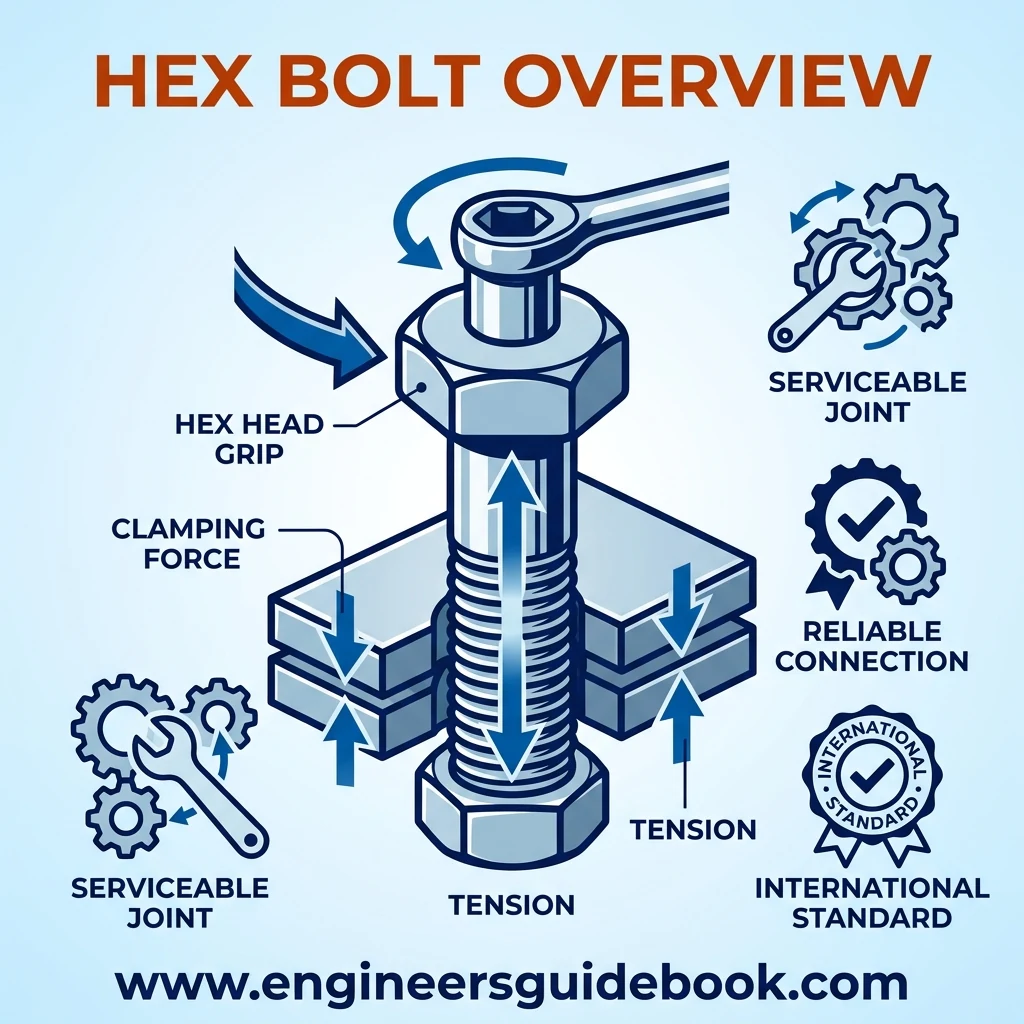
A hex bolt is a threaded mechanical fastener with a six-sided head designed for tightening with a wrench, socket, or spanner. The term “hex” comes from the hexagonal shape of the bolt head. This shape gives the tool six contact faces, allowing firm torque application during installation or removal.
Hex bolts are commonly used with nuts, washers, or tapped holes. Their main purpose is to create a secure joint between two or more components. In engineering, construction, and maintenance work, they are valued because they are strong, simple, replaceable, and widely standardized.
1.2 Hex Bolt Shape
The most recognizable feature of a hex bolt is its hexagonal head. This head provides excellent tool grip and allows the bolt to be tightened from different angles, even in restricted spaces. Below the head, the bolt has a cylindrical shank that may be fully or partially threaded.
The body shape is not random. Each part supports load transfer, alignment, and clamping. The flat top, six external sides, bearing face, and threaded section all contribute to reliable fastening. A properly formed hex bolt looks simple, but its geometry is the result of deliberate mechanical design.
1.3 Hex Bolt Function
The primary function of a hex bolt is to clamp components together. When the bolt is tightened, it stretches slightly and creates tension. This tension produces compressive force between the joined parts. That force is what keeps the assembly stable under vibration, load, pressure, or movement.
Hex bolts are also used where future disassembly is required. Unlike welding or riveting, a bolted joint can be opened, inspected, repaired, and reassembled. This makes hex bolts highly practical in machinery maintenance, structural erection, piping supports, vehicle assemblies, and equipment foundations.
1.4 Hex Bolt Importance
Hex bolts are important because they offer a dependable balance of strength, availability, and ease of installation. They are used in small household repairs and large industrial structures alike. Their standardized dimensions help engineers, buyers, and technicians select compatible nuts, washers, and tools without guesswork.
In critical applications, the right hex bolt prevents joint failure, equipment misalignment, leakage, fatigue cracking, and unsafe movement. A low-quality or incorrect bolt may appear minor, but it can compromise the entire assembly. This is why bolt selection should never be treated as an afterthought.
1.5 Hex Bolt Versus Regular Bolt
A hex bolt is one type of bolt, while “regular bolt” is a general term that may refer to many fastener styles. Carriage bolts, eye bolts, U-bolts, anchor bolts, and flange bolts all serve different purposes. The hex bolt is defined mainly by its six-sided external head and threaded shank.
Compared with many other bolts, hex bolts are easier to grip with standard tools. They also provide strong torque control and are suitable for heavy-duty fastening. In most industrial and construction applications, hex bolts are preferred when strength, serviceability, and simple installation matter.
2. Hex Bolt Anatomy
2.1 Hex Head
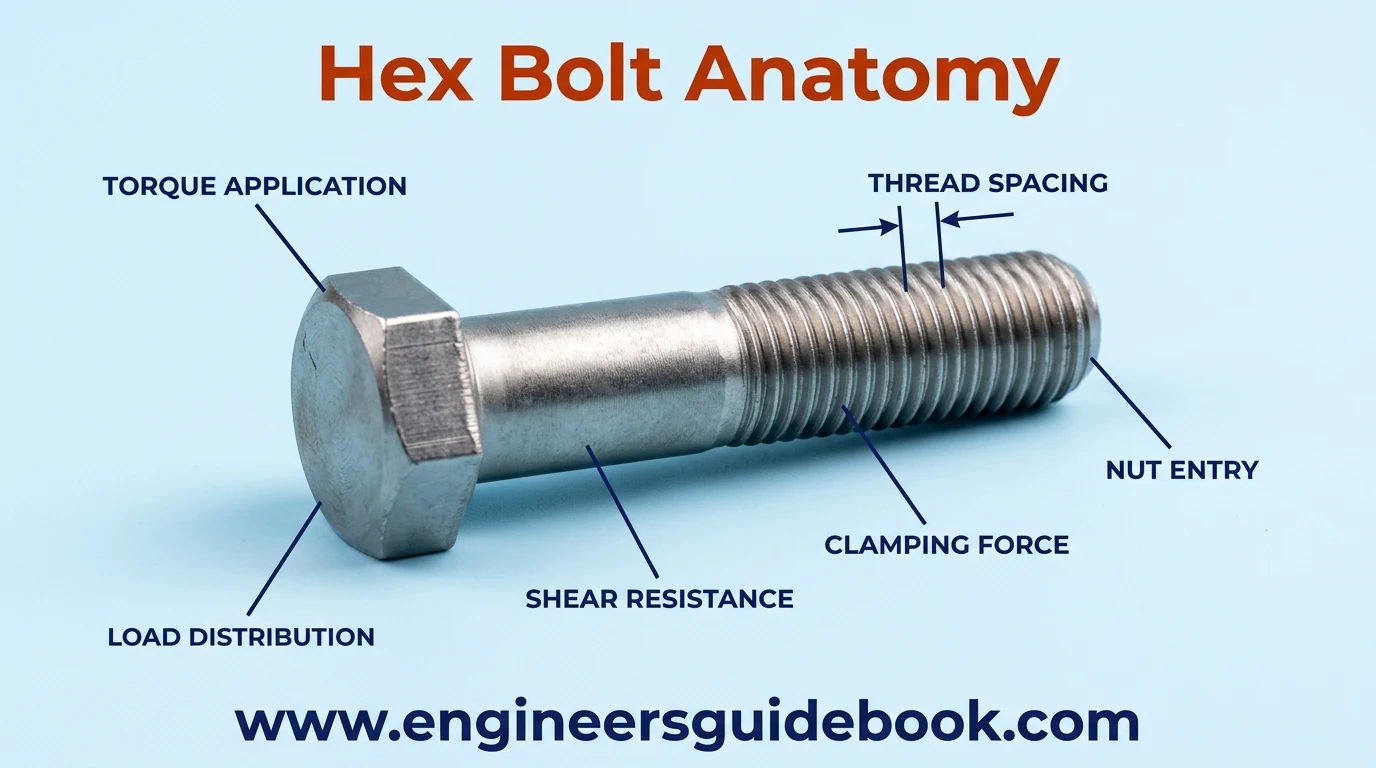
The hex head is the driving feature of the bolt. Its six flat sides allow torque to be applied using a wrench or socket. The head must be accurately shaped because poor head geometry can cause tool slippage, rounded corners, or uneven tightening.
A larger head offers more bearing area and better load distribution. Heavy hex bolts, for example, have a larger head than standard hex bolts. This makes them useful in structural and high-load applications where joint integrity is critical.
2.2 Threaded Shank
The threaded shank is the spiral-grooved portion of the bolt that engages with a nut or internal thread. Threads convert rotational tightening into axial clamping force. They also resist pull-out when the joint is loaded.
Thread quality affects the entire fastening performance. Damaged, undersized, or poorly rolled threads can reduce strength and make installation difficult. In precision work, clean and correctly matched threads are essential for achieving the desired torque and preload.
2.3 Unthreaded Grip Length
The unthreaded grip length is the smooth portion of the bolt between the head and the threaded section. It is commonly found on partially threaded hex bolts. This smooth shank helps carry shear loads better than threads because it has a continuous cross-section.
In structural and machinery joints, the grip length should match the thickness of the clamped materials as closely as possible. If threads sit inside the shear plane, the joint may become weaker. Proper grip length improves alignment, stability, and fatigue resistance.
2.4 Bolt Point
The bolt point is the end of the threaded section. It may be flat, chamfered, or slightly rounded depending on the manufacturing standard. A chamfered point helps the bolt enter the nut or tapped hole smoothly.
A well-formed point prevents cross-threading during assembly. This is especially important in repetitive maintenance work, where bolts are removed and installed many times. A damaged point can ruin internal threads and increase repair cost.
2.5 Bearing Surface
The bearing surface is the underside of the bolt head that contacts the fastened part or washer. This area transfers compressive force into the joint. A smooth and flat bearing surface helps create even pressure during tightening.
If the bearing surface is rough, distorted, or too small for the application, it may embed into the material. This can reduce preload over time. Washers are often used to improve load distribution and protect the connected surface.
2.6 Thread Pitch
Thread pitch is the distance between adjacent thread peaks. In metric bolts, pitch is measured in millimeters. In inch-based bolts, threads are usually described by the number of threads per inch.
Pitch affects tightening behavior, resistance to loosening, and load distribution. Coarse threads are easier to install and better for general use, while fine threads provide greater adjustment control and stronger holding in certain applications. Choosing the right pitch improves both assembly quality and joint reliability.
3. Hex Bolt Types
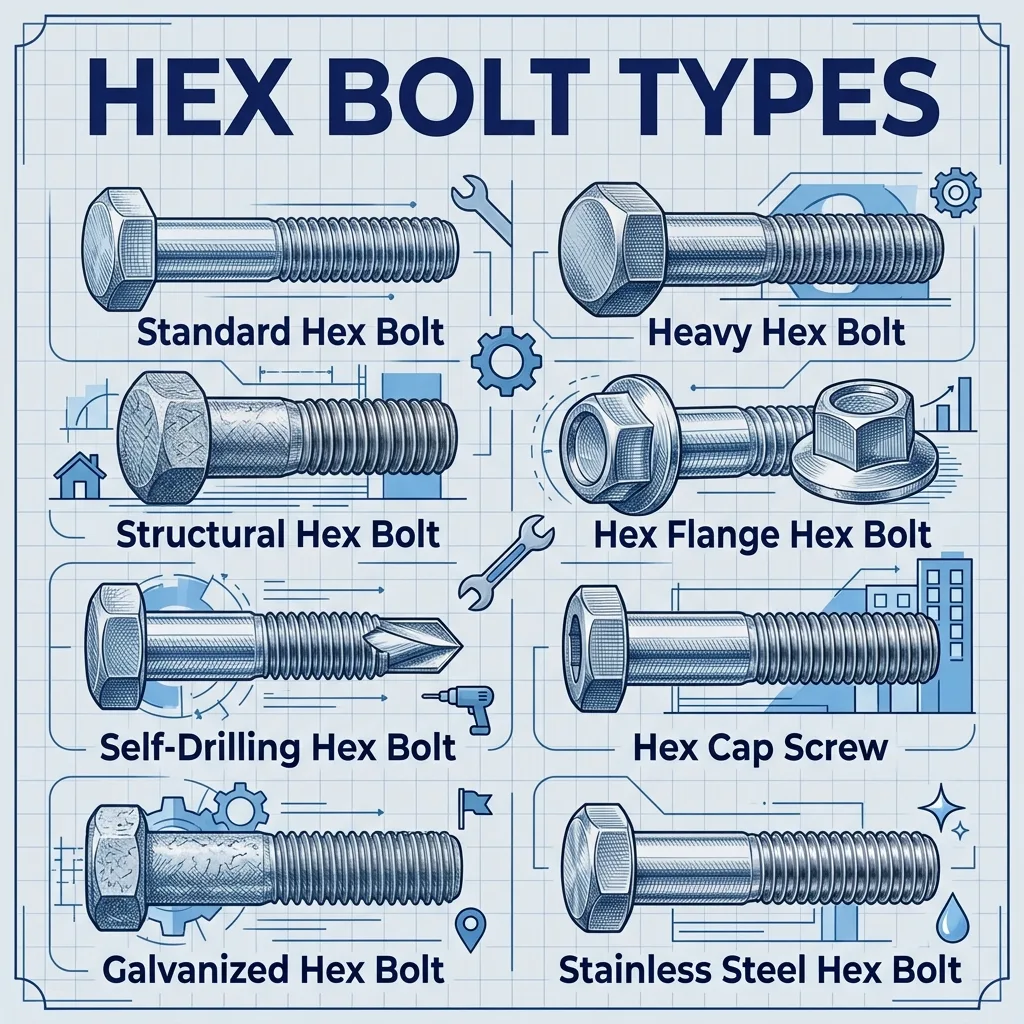
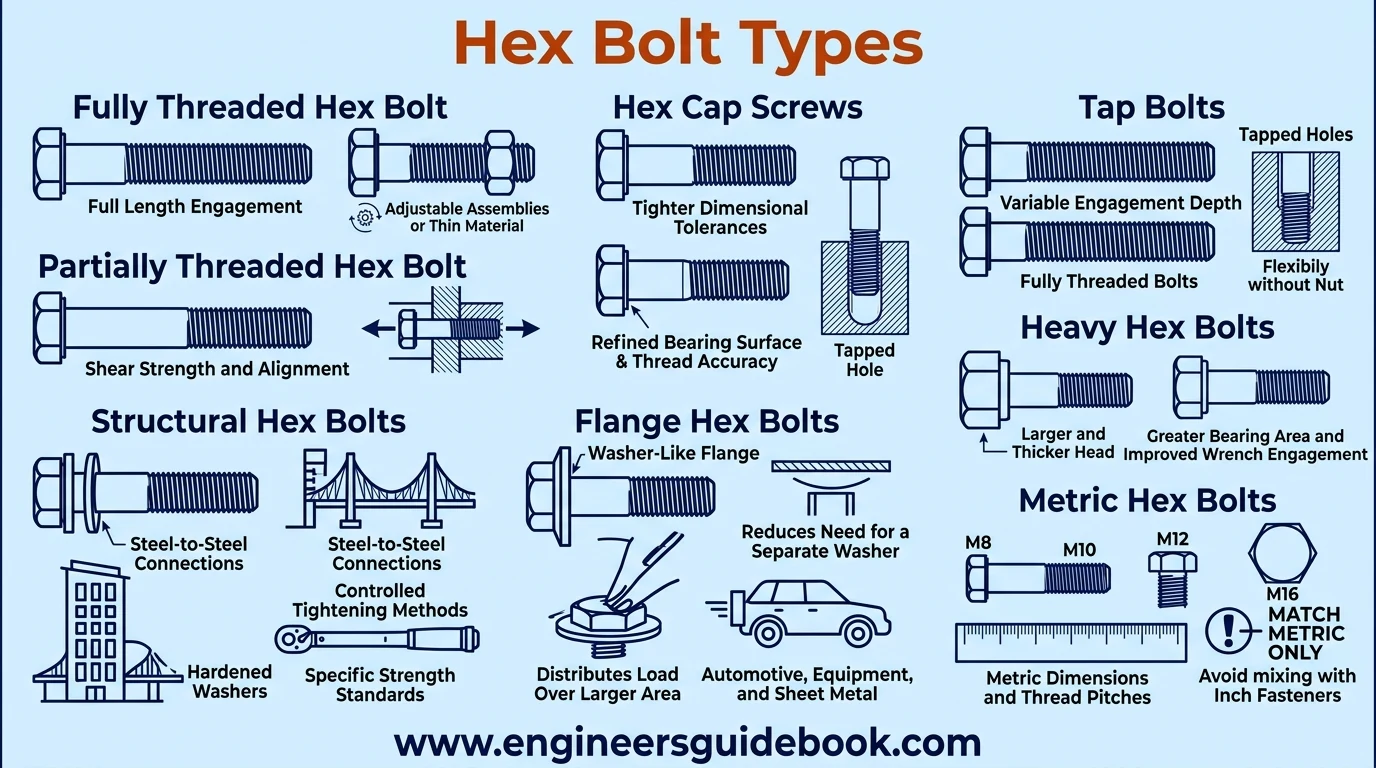
3.1 Fully Threaded Hex Bolts
Fully threaded hex bolts have threads running from near the head to the end of the bolt. They are useful when the full length of the bolt must engage with a nut or tapped hole. They are end often selected for adjustable assemblies or thin material fastening.
Because the threads extend along most of the body, these bolts offer versatile installation depth. However, they are not always ideal for high shear applications because threads may sit in the shear plane.
3.2 Partially Threaded Hex Bolts
Partially threaded hex bolts have a smooth shank under the head and threads near the end. This design is preferred when alignment and shear strength are important. The unthreaded portion helps position parts accurately and provides better resistance against lateral forces.
These bolts are common in machinery, frames, brackets, and structural connections. When selected correctly, the smooth shank passes through the joined parts while the threaded section engages only with the nut.
3.3 Hex Cap Screws
Hex cap screws look similar to hex bolts but are generally manufactured with tighter dimensional tolerances. They are often used in tapped holes rather than with a nut. Their bearing surface and thread accuracy are typically more refined.
These fasteners are common in machinery, engines, pumps, and equipment assemblies. Where a cleaner fit, controlled finish, and precise fastening are required, hex cap screws are often chosen over ordinary hex bolts.
3.4 Tap Bolts
Tap bolts are fully threaded bolts designed for use in tapped holes. Since the thread extends along the complete shank, they can be installed where variable engagement depth is needed. They are often used in maintenance, repair, and equipment mounting work.
Tap bolts are practical when parts must be fastened directly into a threaded component without using a nut. Their full-thread design provides flexibility, but proper thread engagement is necessary to avoid stripping.
3.5 Structural Hex Bolts
Structural hex bolts are designed for steel-to-steel connections in buildings, bridges, towers, and heavy frameworks. They are made to meet specific strength and dimensional standards. These bolts are not ordinary general-purpose fasteners.
Their use often involves hardened washers and controlled tightening methods. In structural joints, bolt grade, tension, hole size, and installation procedure all matter. A structural bolt must provide dependable performance under static, dynamic, and environmental loads.
3.6 Flange Hex Bolts
Flange hex bolts have an integrated washer-like flange under the head. This flange distributes load over a larger area and may reduce the need for a separate washer. Some flange bolts also have serrations to resist loosening.
They are widely used in automotive, equipment, and sheet metal applications. Their built-in bearing surface speeds up assembly and improves joint consistency.
3.7 Heavy Hex Bolts
Heavy hex bolts have a larger and thicker head than standard hex bolts. This increased head size provides greater bearing area and improved wrench engagement. They are commonly used in high-strength and structural applications.
The heavy head design supports better load distribution, especially when used with large nuts and washers. These bolts are suitable for demanding joints where ordinary head dimensions may not provide enough contact area.
3.8 Metric Hex Bolts
Metric hex bolts are manufactured according to metric dimensions and thread pitches. Their diameter is usually identified with an “M” followed by the nominal size, such as M8, M10, M12, or M16. The pitch is measured in millimeters.
They are used worldwide in automotive, machinery, construction, and industrial equipment. Metric bolts must be matched with metric nuts and washers. Mixing metric and inch fasteners can damage threads and cause unsafe joints.
4. Hex Bolt Sizes
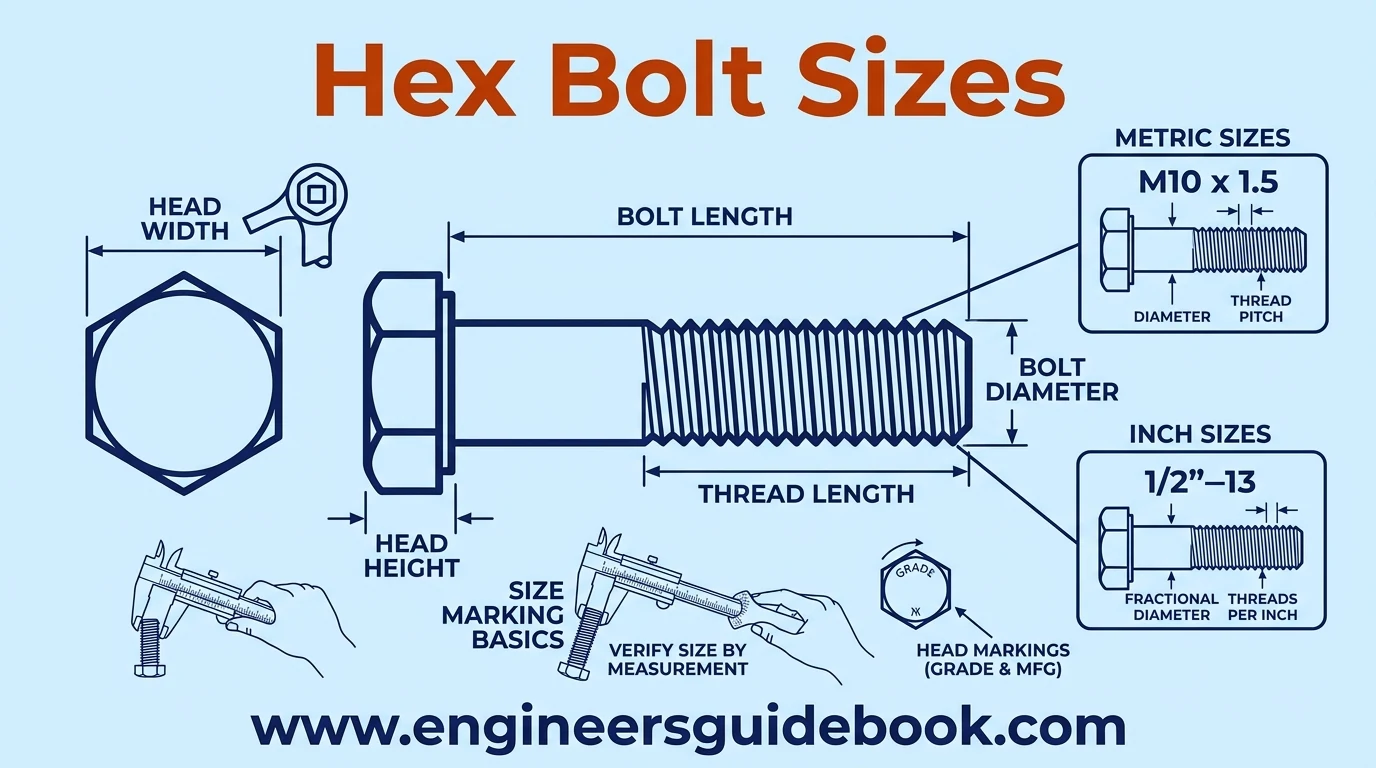
4.1 Bolt Diameter
Bolt diameter refers to the nominal outside diameter of the threaded portion. It is one of the most important size parameters. A larger diameter generally provides higher tensile and shear capacity, provided the material and grade are suitable.
Selecting diameter depends on load, hole size, material thickness, and design requirement. Oversized bolts may be costly or difficult to install, while undersized bolts may fail under service load.
4.2 Bolt Length
Bolt length is usually measured from under the head to the end of the bolt. The head itself is not included in most standard hex bolt length measurements. Correct length ensures proper clamping and thread engagement.
A bolt that is too short may not fully engage the nut. A bolt that is too long may interfere with nearby parts or waste material. The ideal length allows a small amount of thread to extend beyond the nut after tightening.
4.3 Thread Length
Thread length is the portion of the bolt covered with threads. Fully threaded bolts have thread along almost the entire shank, while partially threaded bolts have a defined thread section near the end.
Thread length affects grip, shear location, and nut engagement. In load-bearing assemblies, enough thread must be available for tightening, but unnecessary thread in the joint grip area should be avoided when shear strength is important.
4.4 Head Width
Head width is the distance across the flats of the hex head. This dimension determines the wrench or socket size needed for installation. Accurate head width ensures proper tool fit and prevents rounding.
Different standards may define different across-flat dimensions for similar nominal bolt sizes. For this reason, tool selection should match the bolt standard, not just the bolt diameter.
4.5 Head Height
Head height is the vertical thickness of the hex head. It affects strength, tool grip, and clearance. A taller head can provide better wrench engagement, while a shorter head may be useful in compact spaces.
Heavy hex bolts usually have greater head height than standard hex bolts. This makes them better suited for high-load applications where more robust head geometry is required.
4.6 Metric Sizes
Metric hex bolt sizes are identified by nominal diameter and pitch. For example, M10 × 1.5 means the bolt has a 10 mm nominal diameter and a 1.5 mm thread pitch. Length is added separately, such as M10 × 1.5 × 50.
Common metric sizes include M6, M8, M10, M12, M16, M20, and larger. The selected size should match the design load, hole clearance, and mating components.
4.7 Inch Sizes
Inch hex bolts are identified by fractional diameter, thread count, and length. A common example is 1/2”-13 × 2”, where 1/2” is the diameter, 13 is the number of threads per inch, and 2” is the length.
Inch sizes are common in many American standards and older industrial equipment. Correct identification is essential because similar-looking metric and inch bolts are not interchangeable.
4.8 Size Marking Basics
Size markings are not always printed on the bolt, but head markings may indicate grade or manufacturer. Diameter, length, and thread pitch are usually confirmed by measurement or specification.
A thread gauge, caliper, and bolt chart are useful for accurate identification. Guessing bolt size by appearance can lead to mismatched threads, poor tightening, and damaged components.
5. Hex Bolt Thread Standards
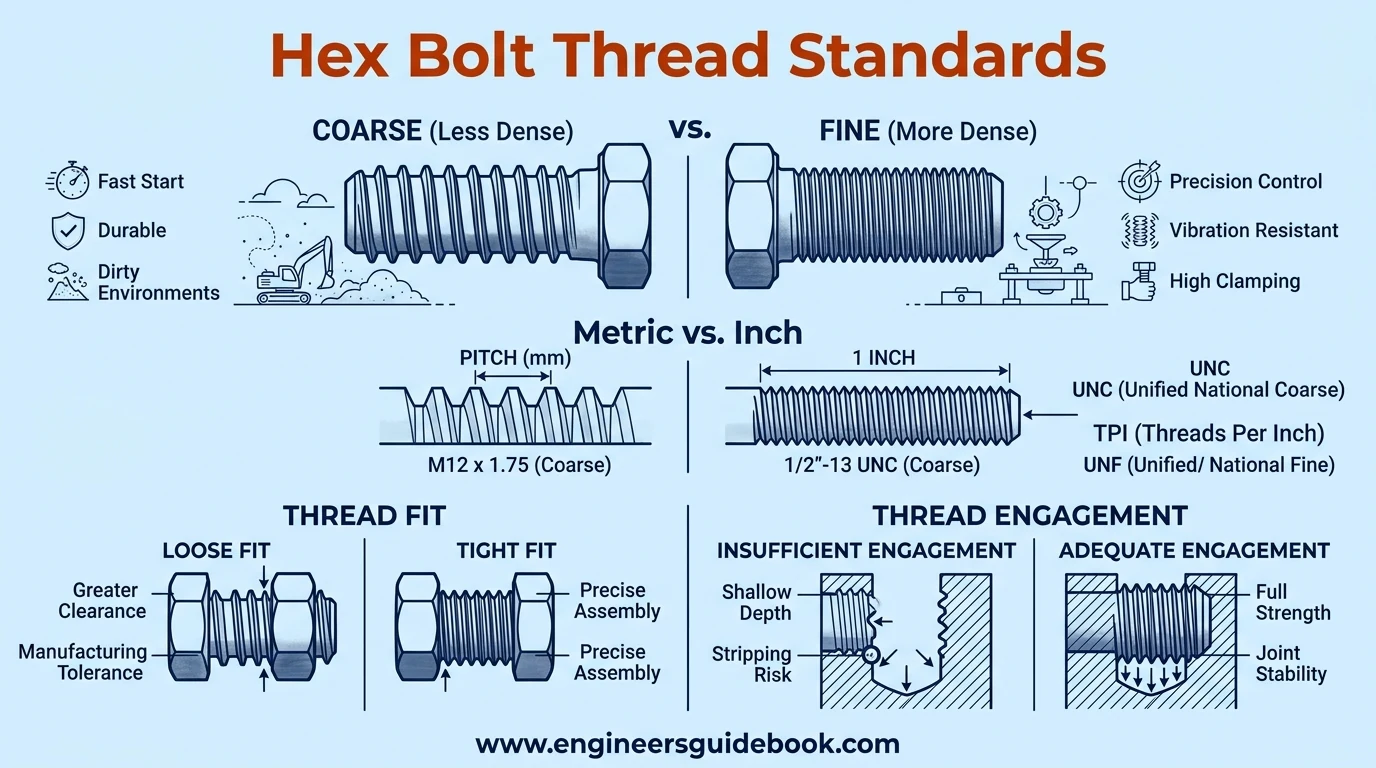
5.1 Coarse Threads
Coarse threads have larger spacing between thread peaks. They are easier to start, faster to install, and more resistant to damage in dirty or rough environments. They are commonly used in general construction and maintenance.
Coarse threads also perform well in softer materials because the deeper thread form provides better grip. For many standard applications, coarse thread is the default choice.
5.2 Fine Threads
Fine threads have smaller spacing between thread peaks. They offer better adjustment control and can provide higher clamping force in certain applications. They are often used where vibration resistance and precision are important.
However, fine threads are more vulnerable to dirt, galling, and cross-threading. They require cleaner installation conditions and more careful handling.
5.3 Metric Thread Pitch
Metric thread pitch is measured as the distance from one thread crest to the next. A smaller pitch means finer threads. Metric bolts may come in standard coarse pitch or fine pitch versions.
For example, M12 coarse thread is commonly 1.75 mm pitch, while fine thread options may be 1.5 mm or 1.25 mm. The nut or tapped hole must match the exact pitch.
5.4 UNC Threads
UNC stands for Unified National Coarse. It is a common inch-based coarse thread standard. UNC bolts are widely used in general-purpose fastening because they are durable and easy to assemble.
They are suitable for construction, equipment repair, and many non-precision applications. Their thread form tolerates minor contamination better than fine threads.
5.5 UNF Threads
UNF stands for Unified National Fine. These threads have more threads per inch than UNC threads of the same diameter. UNF bolts are often used where higher tension control and finer adjustment are needed.
They are common in automotive, aerospace, and machinery applications. Proper lubrication and clean threads help prevent galling and thread damage.
5.6 Thread Fit
Thread fit describes the tightness or looseness between external and internal threads. A proper fit allows smooth assembly while maintaining adequate strength. If the fit is too loose, the joint may lack stability. If it is too tight, installation becomes difficult.
Thread fit is controlled by manufacturing tolerances. In precision assemblies, the correct fit class must be specified to avoid performance issues.
5.7 Thread Engagement
Thread engagement is the length of thread contact between the bolt and nut or tapped hole. Adequate engagement is essential for strength. Insufficient engagement can strip the internal thread before the bolt reaches full clamping force.
As a general principle, stronger joints require enough engaged threads to transfer the load safely. Material strength, thread pitch, and bolt diameter all influence the required engagement length.
6. Hex Bolt Grades
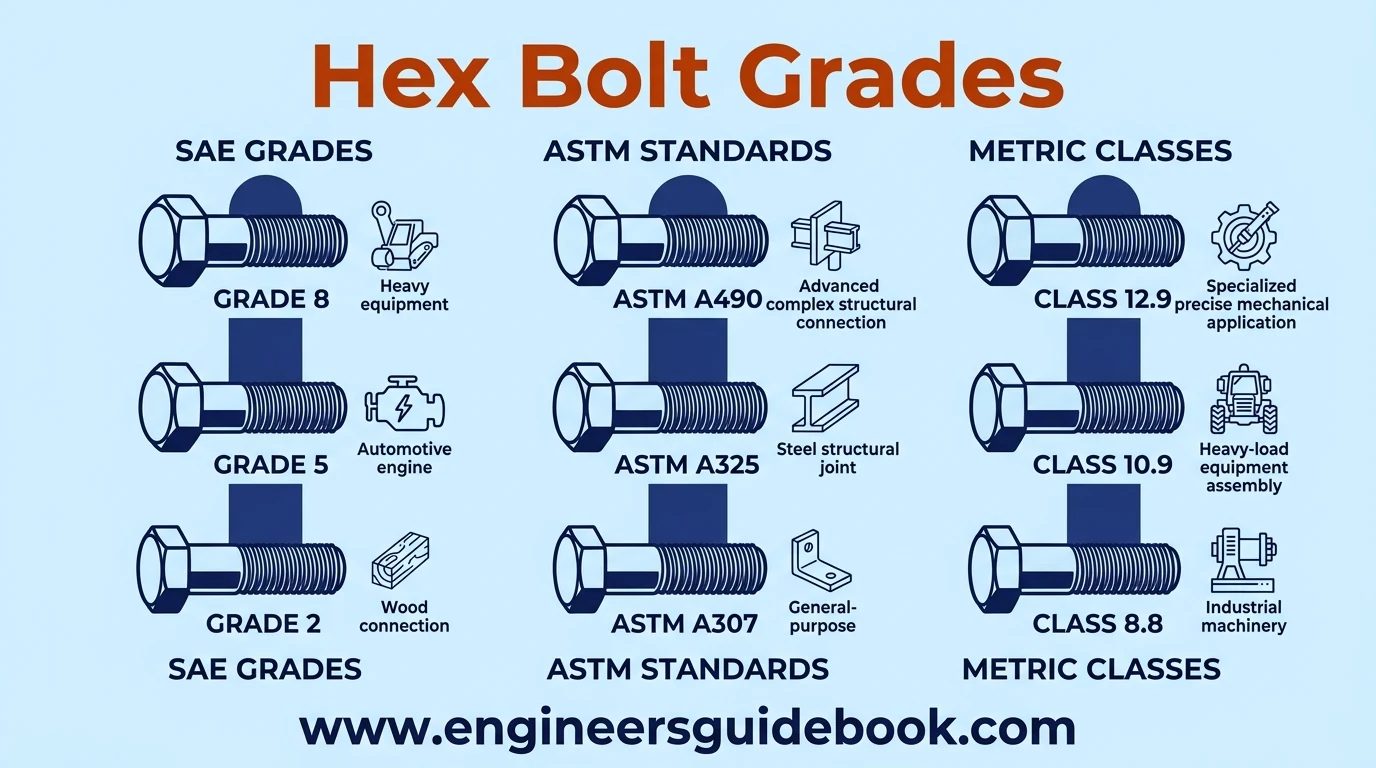
6.1 Grade 2 Hex Bolts
Grade 2 hex bolts are low to medium strength fasteners commonly made from low carbon steel. They are suitable for light-duty applications where high tensile strength is not required.
They are often used in wood connections, light brackets, non-critical fixtures, and general repairs. They should not be used in structural or high-stress assemblies unless specifically approved.
6.2 Grade 5 Hex Bolts
Grade 5 hex bolts are medium-strength fasteners typically made from quenched and tempered medium carbon steel. They are stronger than Grade 2 bolts and are widely used in automotive, machinery, and equipment applications.
They offer a good balance between strength and cost. For many mechanical assemblies, Grade 5 bolts are a practical and reliable choice.
6.3 Grade 8 Hex Bolts
Grade 8 hex bolts are high-strength fasteners made from alloy steel and heat treated for superior tensile capacity. They are used in demanding applications where high clamping force and mechanical strength are needed.
These bolts are common in heavy equipment, automotive suspension parts, and industrial machinery. However, higher strength does not always mean better suitability. The joint design must also consider brittleness, fatigue, and compatibility.
6.4 ASTM A307 Hex Bolts
ASTM A307 hex bolts are carbon steel bolts used for general-purpose applications. They are common in construction, piping supports, flanges, and low-pressure assemblies.
They are not intended for high-strength structural joints. Their main advantage is economical fastening for moderate-load service.
6.5 ASTM A325 Hex Bolts
ASTM A325 bolts are high-strength structural bolts used in steel construction. They are designed for heavy structural connections and are commonly used with matching nuts and hardened washers.
These bolts require proper installation practices. In many structural applications, tension control and inspection are essential.
6.6 ASTM A490 Hex Bolts
ASTM A490 bolts are higher-strength structural bolts compared with A325 bolts. They are made from alloy steel and used in demanding steel connections.
Because of their higher strength, they require careful handling and correct coating selection. Improper use may lead to hydrogen embrittlement or premature failure.
6.7 Metric Class 8.8 Hex Bolts
Metric Class 8.8 hex bolts are medium to high-strength fasteners widely used in machinery, automotive, and structural applications. The first number relates to tensile strength, while the second relates to yield strength ratio.
Class 8.8 bolts are a common engineering choice because they provide reliable strength without being excessively hard or brittle.
6.8 Metric Class 10.9 Hex Bolts
Metric Class 10.9 hex bolts offer higher strength than Class 8.8 bolts. They are often used in heavy machinery, automotive assemblies, and high-load equipment.
They require proper torque control and compatible nuts. Using a lower-grade nut with a high-grade bolt can weaken the joint.
6.9 Metric Class 12.9 Hex Bolts
Metric Class 12.9 hex bolts are very high-strength fasteners used in specialized mechanical applications. They provide exceptional tensile capacity but must be used with caution.
They are not always suitable for every environment, especially where corrosion, impact, or fatigue is severe. Correct design approval is important before using Class 12.9 bolts.
7. Hex Bolt Materials
7.1 Carbon Steel
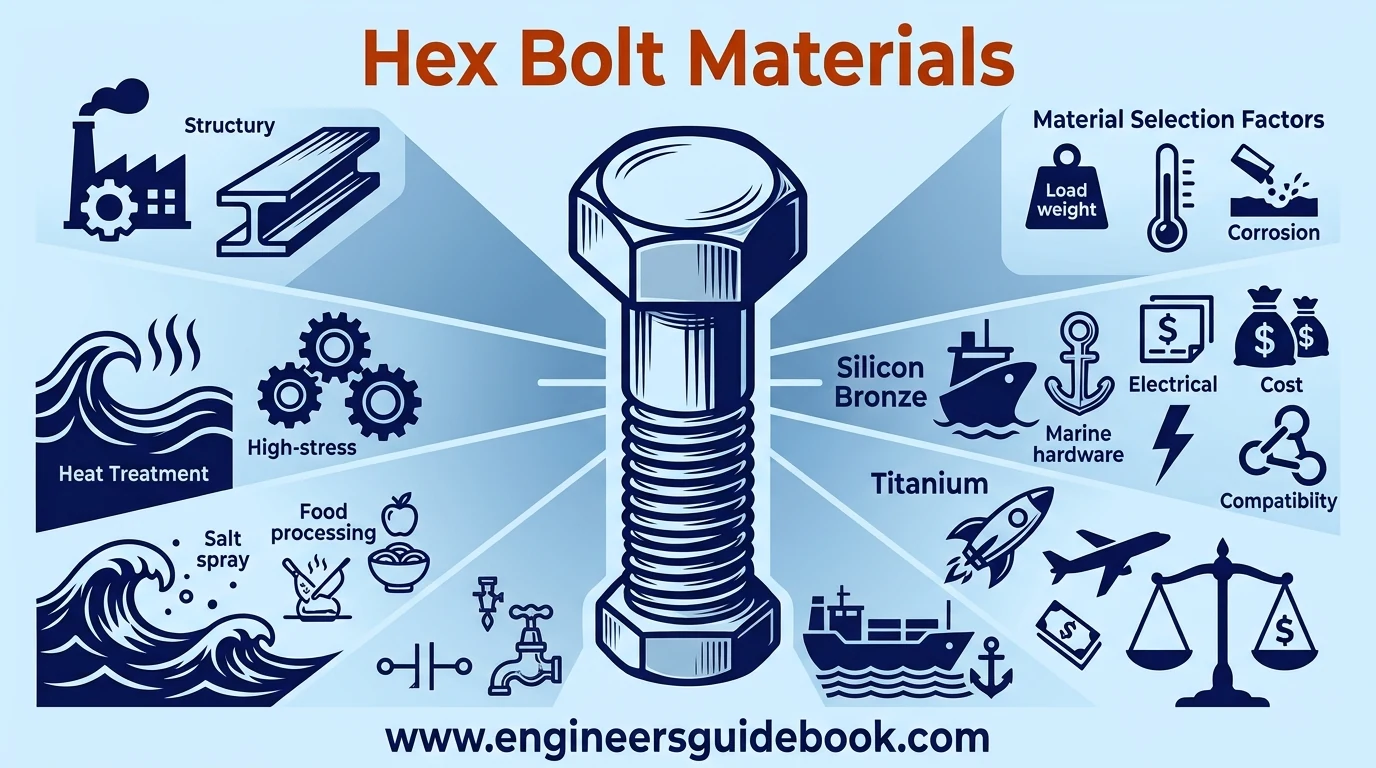
Carbon steel is the most common material for hex bolts. It is economical, strong enough for many uses, and easy to manufacture. With suitable coating, it can perform well in general indoor and outdoor applications.
7.2 Alloy Steel
Alloy steel contains additional elements that improve strength, hardness, and wear resistance. It is often used for high-grade bolts such as Grade 8 and metric Class 10.9 or 12.9.
7.3 Stainless Steel
Stainless steel hex bolts provide excellent corrosion resistance. They are used in food processing, marine environments, chemical plants, and outdoor installations. Austenitic stainless grades are especially popular where rust resistance is more important than maximum strength.
7.4 Brass
Brass hex bolts offer good corrosion resistance and a decorative appearance. They are also non-sparking and electrically conductive. They are commonly used in electrical, plumbing, and light-duty decorative applications.
7.5 Silicon Bronze
Silicon bronze bolts are highly resistant to corrosion, especially in marine and coastal environments. They are stronger than many brass fasteners and offer long service life in harsh atmospheric conditions.
7.6 Titanium
Titanium hex bolts are lightweight, strong, and exceptionally corrosion-resistant. They are used in aerospace, marine, chemical, and high-performance applications. Their main limitation is cost.
7.7 Material Selection Factors
Material selection depends on load, temperature, corrosion exposure, cost, electrical behavior, and compatibility with joined materials. A bolt should not be chosen by strength alone.
The right material improves safety, service life, and maintenance reliability. In aggressive environments, corrosion resistance may be more important than tensile strength. In heavy machinery, grade and fatigue performance may matter more than appearance.
8. Hex Bolt Coatings
8.1 Zinc Plating
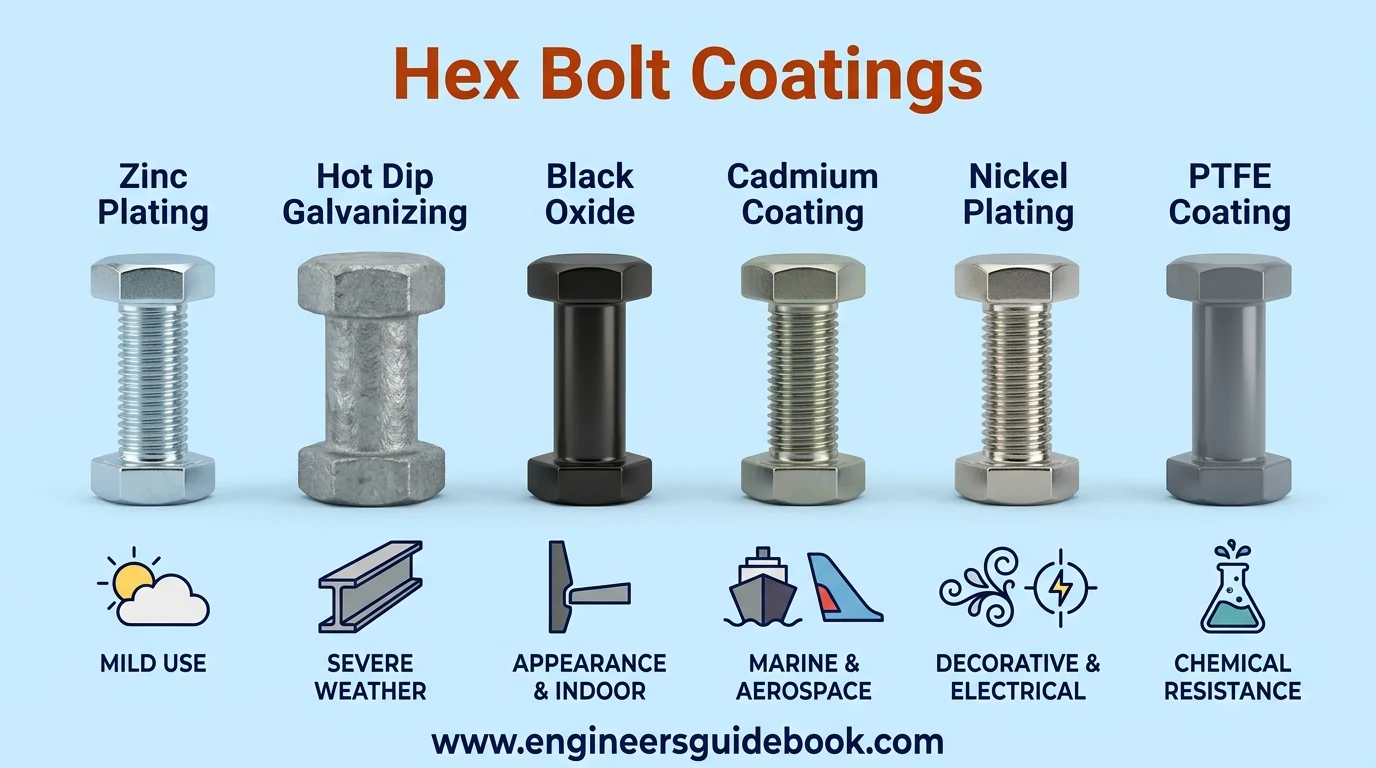
Zinc plating is one of the most common coatings for hex bolts. It gives the fastener a thin protective layer that helps slow down rust formation in mild indoor and outdoor conditions. The finish is economical, clean, and suitable for general machinery, furniture, brackets, guards, and light structural work.
8.2 Hot Dip Galvanizing
Hot dip galvanizing provides a much thicker zinc layer than ordinary electroplating. The bolt is dipped into molten zinc, creating a rugged coating that resists weather, moisture, and atmospheric corrosion. It is widely used for outdoor steel structures, poles, platforms, bridges, fencing, and exposed construction hardware.
8.3 Black Oxide
Black oxide gives hex bolts a dark, smooth finish with limited corrosion resistance. It is mainly used where appearance, reduced light reflection, and slight surface protection are required. Because the coating is thin, black oxide bolts are usually used indoors or with additional oil treatment.
8.4 Cadmium Coating
Cadmium coating offers excellent corrosion resistance, especially in marine and aerospace environments. It also provides good lubricity, which helps with consistent tightening. However, cadmium is toxic and environmentally restricted in many industries, so its use is now limited to specialized applications where approved alternatives cannot perform adequately.
8.5 Nickel Plating
Nickel plating improves both corrosion resistance and surface appearance. It gives hex bolts a bright, hard, and wear-resistant finish. Nickel-coated bolts are commonly used in decorative assemblies, electrical components, instruments, and light industrial equipment where clean appearance and moderate protection are both important.
8.6 PTFE Coating
PTFE coating provides low friction, chemical resistance, and anti-galling performance. It is useful in corrosive plants, chemical processing areas, and assemblies exposed to aggressive media. The slick surface helps reduce seizure during tightening and removal, especially where stainless steel fasteners are used.
8.7 Corrosion Protection
Corrosion protection depends on coating thickness, environment, base material, and maintenance conditions. A zinc-plated bolt may work indoors but fail quickly near saltwater or chemicals. For severe exposure, stainless steel, hot dip galvanized, PTFE-coated, or silicon bronze fasteners may be more reliable.
9. Hex Bolt Applications
9.1 Construction Structures
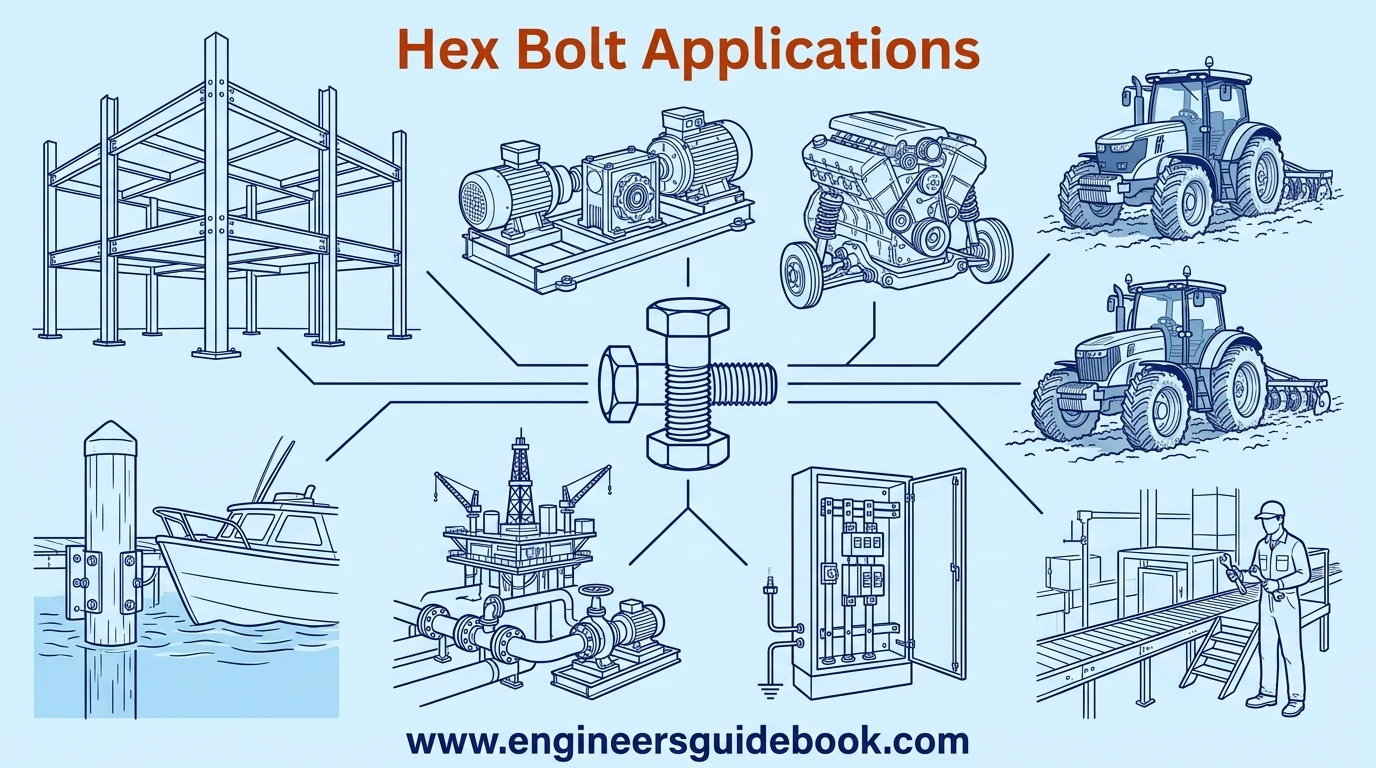
Hex bolts are heavily used in construction for beams, columns, plates, supports, frames, and anchor assemblies. They provide strong mechanical joints that can be inspected, tightened, and replaced when required. Structural connections often demand specific bolt grades, washers, nuts, and tightening procedures.
9.2 Machinery Assembly
Machinery relies on hex bolts for mounting motors, gearboxes, guards, bases, housings, and moving assemblies. Their wrench-friendly head makes maintenance easier. In rotating equipment, correct bolt strength and preload are vital because vibration can loosen weak or poorly tightened joints.
9.3 Automotive Fastening
Automotive applications use hex bolts in engines, chassis, suspension systems, brackets, exhaust supports, and body assemblies. These bolts must handle vibration, heat, shock load, and repeated service cycles. Grade selection is important because automotive joints often require controlled strength and fatigue resistance.
9.4 Agricultural Equipment
Agricultural machines work in dust, mud, moisture, impact, and vibration. Hex bolts are used in tractors, harvesters, tillage tools, trailers, and implements. Coated or high-strength bolts are often preferred because farm equipment faces abrasive environments and frequent mechanical stress.
9.5 Marine Hardware
Marine hardware requires fasteners that resist saltwater corrosion. Stainless steel, silicon bronze, and hot dip galvanized hex bolts are common choices. In boats, docks, coastal structures, and offshore equipment, poor bolt selection can lead to rapid rusting and unsafe loosening.
9.6 Oil and Gas Equipment
Oil and gas facilities use hex bolts on pipe supports, skids, platforms, pumps, valves, compressors, and structural steel. These applications may involve pressure, vibration, chemicals, and harsh weather. Material traceability, coating compatibility, and grade compliance are especially important in this sector.
9.7 Electrical Installations
Hex bolts are used in electrical panels, cable trays, grounding systems, busbar supports, brackets, and equipment frames. Material choice matters because conductivity, corrosion resistance, and magnetic behavior may affect performance. Brass and stainless steel fasteners are often selected for specific electrical environments.
9.8 Industrial Maintenance
In industrial maintenance, hex bolts are valued because they are accessible, standardized, and easy to replace. Maintenance teams use them for conveyors, pumps, blowers, platforms, guards, ducts, flanges, and machine bases. Stocking common sizes reduces downtime during emergency repairs.
10. Hex Bolt Selection Guide
10.1 Load Requirement
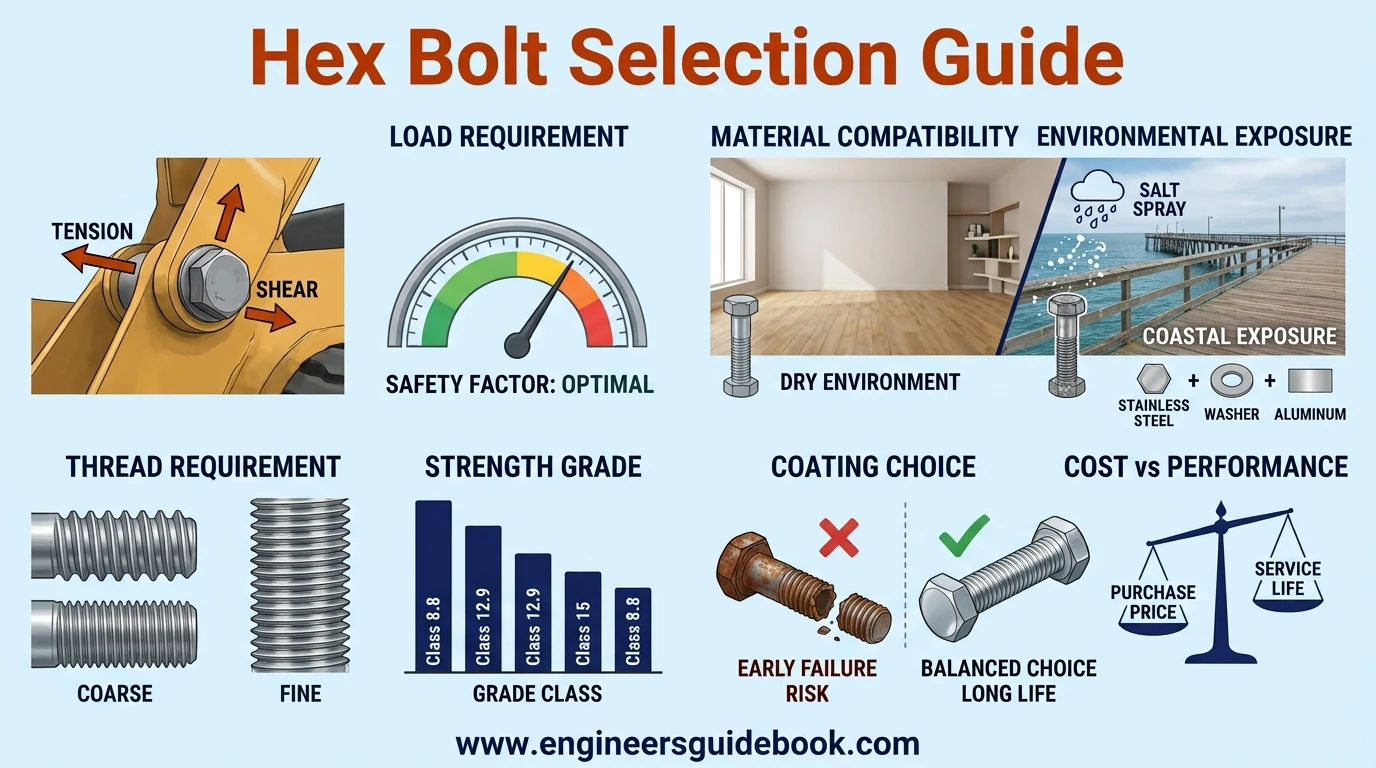
The first selection factor is load. A bolt must withstand tensile load, shear load, vibration, and service stress without yielding or failing. Light brackets may need basic bolts, while lifting points, structures, and machinery foundations require higher-strength fasteners.
10.2 Material Compatibility
Bolt material should be compatible with the joined parts and operating environment. Dissimilar metals can cause galvanic corrosion when moisture is present. For example, stainless steel fasteners in contact with aluminum may require isolation washers or protective compounds.
10.3 Environmental Exposure
Temperature, humidity, chemicals, salt, dust, and outdoor exposure affect bolt life. Indoor dry areas may only need zinc plating, while coastal or chemical environments demand stronger corrosion resistance. Environmental conditions should be evaluated before choosing coating or material.
10.4 Thread Requirement
Thread type must match the nut or tapped hole exactly. Metric and inch threads are not interchangeable. Coarse threads are better for general use, while fine threads provide better adjustment and tension control in precision applications.
10.5 Strength Grade
Strength grade determines how much load the bolt can safely carry. Grade 2, Grade 5, Grade 8, Class 8.8, Class 10.9, and Class 12.9 all serve different requirements. Higher grade is not always better if the joint needs ductility or corrosion resistance.
10.6 Coating Choice
Coating should be selected according to exposure and assembly needs. Zinc plating is economical, hot dip galvanizing suits outdoor structures, and PTFE is useful for chemical resistance. Coating thickness must also be considered because it may affect thread fit.
10.7 Safety Factor
A safety factor allows the bolt to handle unexpected loads, vibration, wear, corrosion, or installation variation. Critical applications should never be designed at the exact failure limit. Proper engineering margin improves reliability and reduces the risk of sudden joint failure.
10.8 Cost Versus Performance
The cheapest bolt is not always economical. A low-cost fastener may fail early, damage equipment, or increase maintenance work. Good selection balances purchase price, service life, downtime risk, safety, and replacement cost.
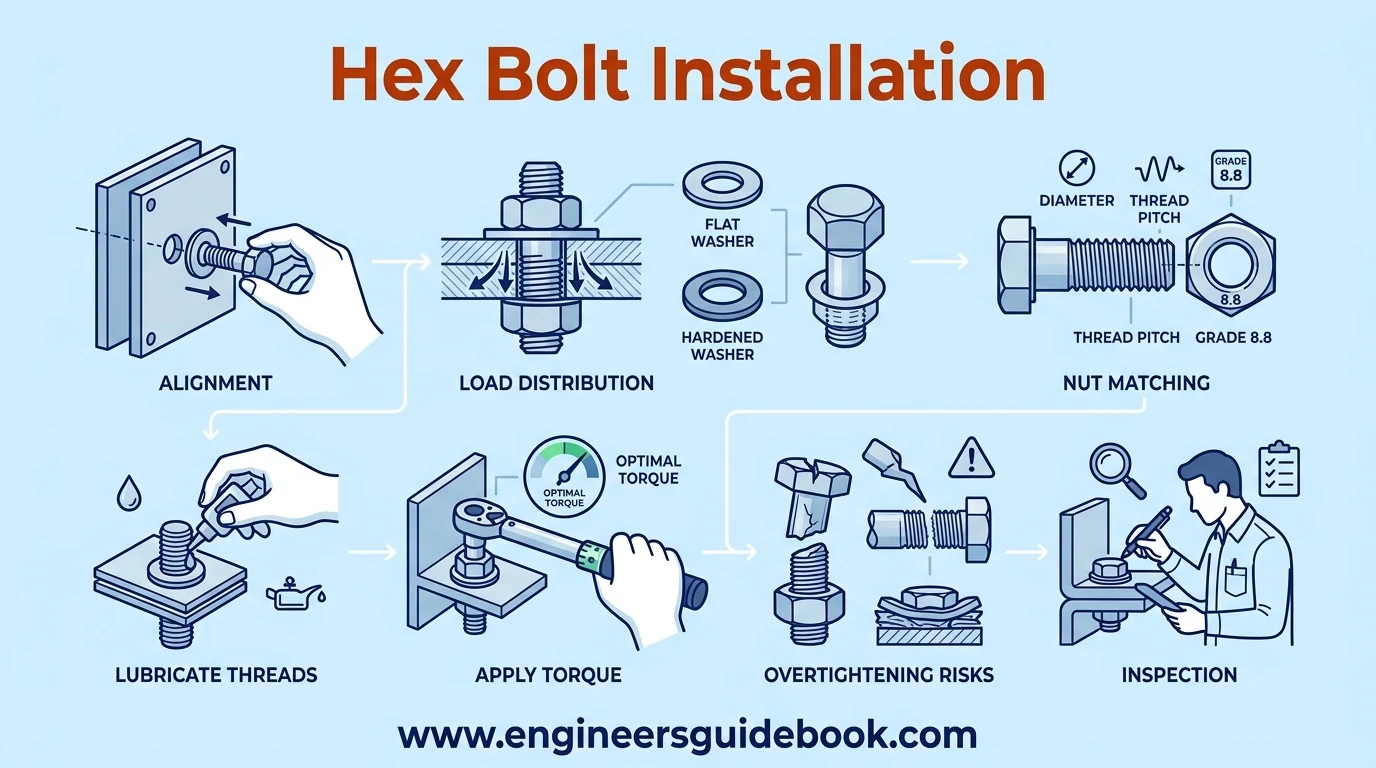
11. Hex Bolt Installation
11.1 Correct Washer Use
Washers help distribute load, protect surfaces, and reduce embedding under the bolt head or nut. Flat washers are used for general bearing support, while hardened washers are used in high-strength joints. The washer must match the bolt size and application.
11.2 Nut Matching
The nut must match the bolt diameter, thread pitch, and strength grade. A high-strength bolt with a weak nut can strip under load. For safe fastening, both parts should be compatible in standard, material, coating, and mechanical capacity.
11.3 Proper Torque
Torque controls the clamping force in a bolted joint. Too little torque can allow loosening, while too much torque can stretch or break the bolt. Reliable installation requires a calibrated torque wrench and the correct torque value for the bolt condition.
11.4 Bolt Alignment
Bolts should pass through aligned holes without forcing. Misalignment creates bending stress and poor seating under the head. If a bolt must be hammered into place, the joint geometry should be checked before tightening.
11.5 Thread Lubrication
Lubrication reduces friction and helps achieve more consistent preload. It is useful for stainless steel, high-strength bolts, and high-temperature service. However, lubricated threads require adjusted torque values because the same torque can create higher bolt tension.
11.6 Over Tightening Risks
Over tightening can strip threads, crush joined materials, distort washers, or permanently stretch the bolt. In severe cases, the bolt may crack or fail during service. More torque does not always mean a stronger joint.
11.7 Inspection After Installation
After installation, bolts should be checked for correct seating, thread engagement, washer placement, and visible damage. Critical joints may require torque verification, marking, or scheduled reinspection. Regular inspection is essential where vibration, corrosion, or thermal cycling is present.
12. Hex Bolt FAQ
12.1 What is a hex bolt used for?
A hex bolt is used to fasten two or more parts together with strong clamping force. It is commonly used in construction, machinery, automotive work, industrial maintenance, and equipment assembly.
12.2 What is the difference between a hex bolt and a hex cap screw?
A hex bolt is often used with a nut, while a hex cap screw is commonly used in a tapped hole. Hex cap screws usually have tighter tolerances and a more finished bearing surface.
12.3 How do you measure a hex bolt?
A hex bolt is measured by diameter, thread pitch or thread count, and length. Length is usually measured from under the head to the end of the bolt.
12.4 What are the common sizes of hex bolts?
Common metric sizes include M6, M8, M10, M12, M16, and M20. Common inch sizes include 1/4 inch, 5/16 inch, 3/8 inch, 1/2 inch, and 5/8 inch.
12.5 What grade of hex bolt is the strongest?
Among common inch fasteners, Grade 8 is stronger than Grade 5 and Grade 2. In metric fasteners, Class 12.9 is stronger than Class 10.9 and Class 8.8.
12.6 What does Grade 8 mean on a hex bolt?
Grade 8 means the bolt is a high-strength fastener made from heat-treated alloy steel. It is designed for demanding mechanical applications where high tensile strength is required.
12.7 Are stainless steel hex bolts stronger than steel hex bolts?
Stainless steel hex bolts are usually chosen for corrosion resistance, not maximum strength. Many alloy steel bolts, such as Grade 8 or Class 10.9, are stronger than common stainless steel bolts.
12.8 Can hex bolts be used outdoors?
Yes, hex bolts can be used outdoors when the material or coating is suitable. Hot dip galvanized, stainless steel, and weather-resistant coated bolts are better choices for outdoor exposure.
12.9 What is the difference between full thread and partial thread hex bolts?
A fully threaded hex bolt has threads along most of its length. A partially threaded hex bolt has a smooth shank under the head, which improves alignment and shear strength.
12.10 How do you choose the right hex bolt?
Choose a hex bolt by checking load, size, thread type, material, grade, coating, and environment. The best bolt is the one that safely matches the joint’s mechanical and service conditions.
13. Conclusion
Hex bolts are essential fasteners used across construction, machinery, automotive, marine, electrical, and industrial applications. Their performance depends on correct size, thread, grade, material, coating, and installation practice.
The best selection starts with the working load and environment. After that, thread compatibility, corrosion resistance, strength grade, washer use, and torque control should be reviewed carefully. A well-selected bolt improves safety and service life.
When buying hex bolts, avoid choosing by price or appearance alone. Confirm the standard, size, grade, coating, and material before purchase. For critical joints, use certified fasteners from reliable suppliers and follow proper installation procedures.