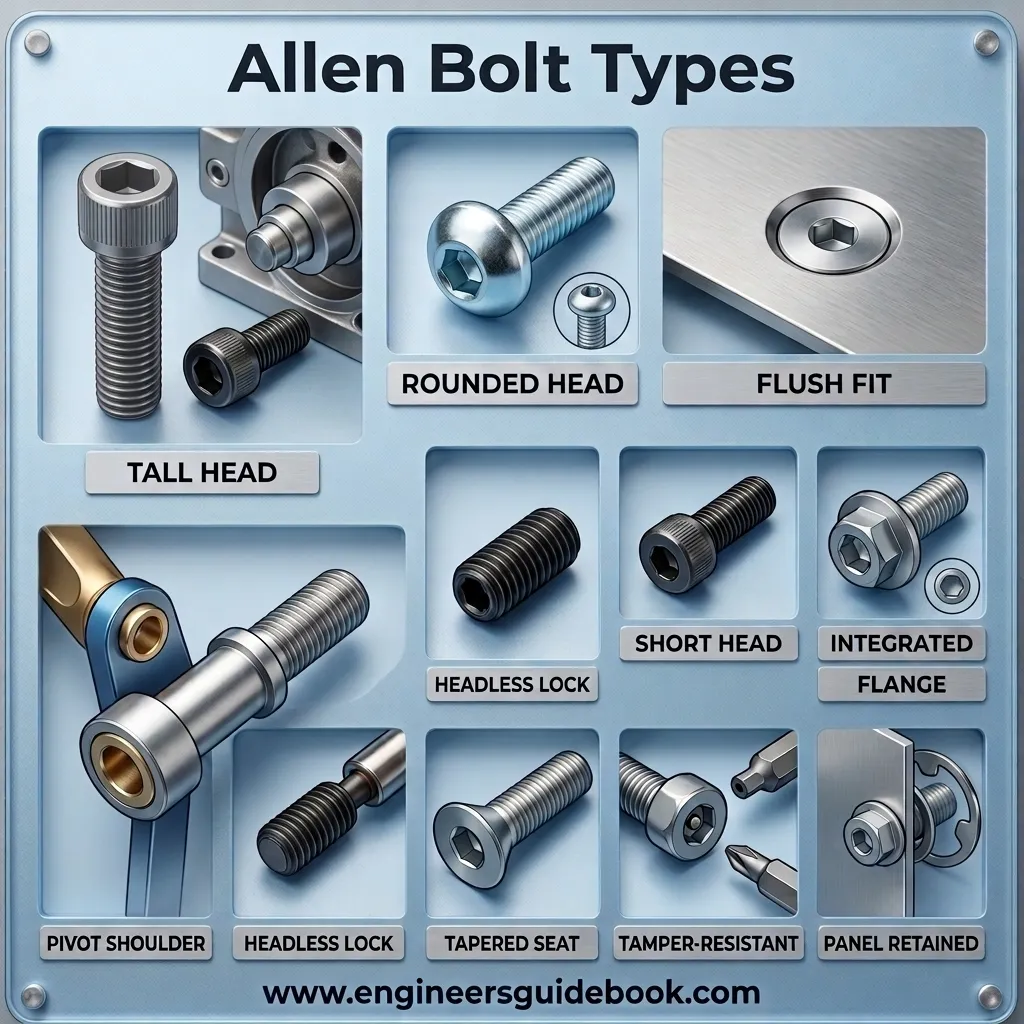
An Allen bolt is a threaded fastener driven by a hexagonal recess using an Allen key or hex bit. Available in multiple head styles, materials, finishes, sizes, and strength grades, Allen bolts provide high clamping force within compact assemblies. They are commonly used in machinery, vehicles, furniture, electronics, tooling, and precision engineering applications.
1. Allen Bolt Overview
1.1 Allen Bolt Definition
An Allen bolt is a threaded fastener distinguished by an internal hexagonal drive formed in its head. Instead of using an external wrench, it is tightened or loosened with an Allen key, hex key, or compatible driver bit.
Its recessed drive permits installation in confined spaces where conventional spanners cannot operate efficiently. The design also creates a neat, unobtrusive appearance while allowing substantial tightening torque.
1.2 Allen Bolt History
The internal hexagonal drive emerged during the early twentieth century as manufacturers sought safer and more efficient fastening methods. Externally protruding bolt heads frequently caught clothing, obstructed machinery, and complicated compact equipment design.
The Allen Manufacturing Company helped popularize the recessed hex-drive system. Over time, the term “Allen bolt” became a familiar generic expression, although socket screw is often the more technically precise designation.
2. Allen Bolt Anatomy
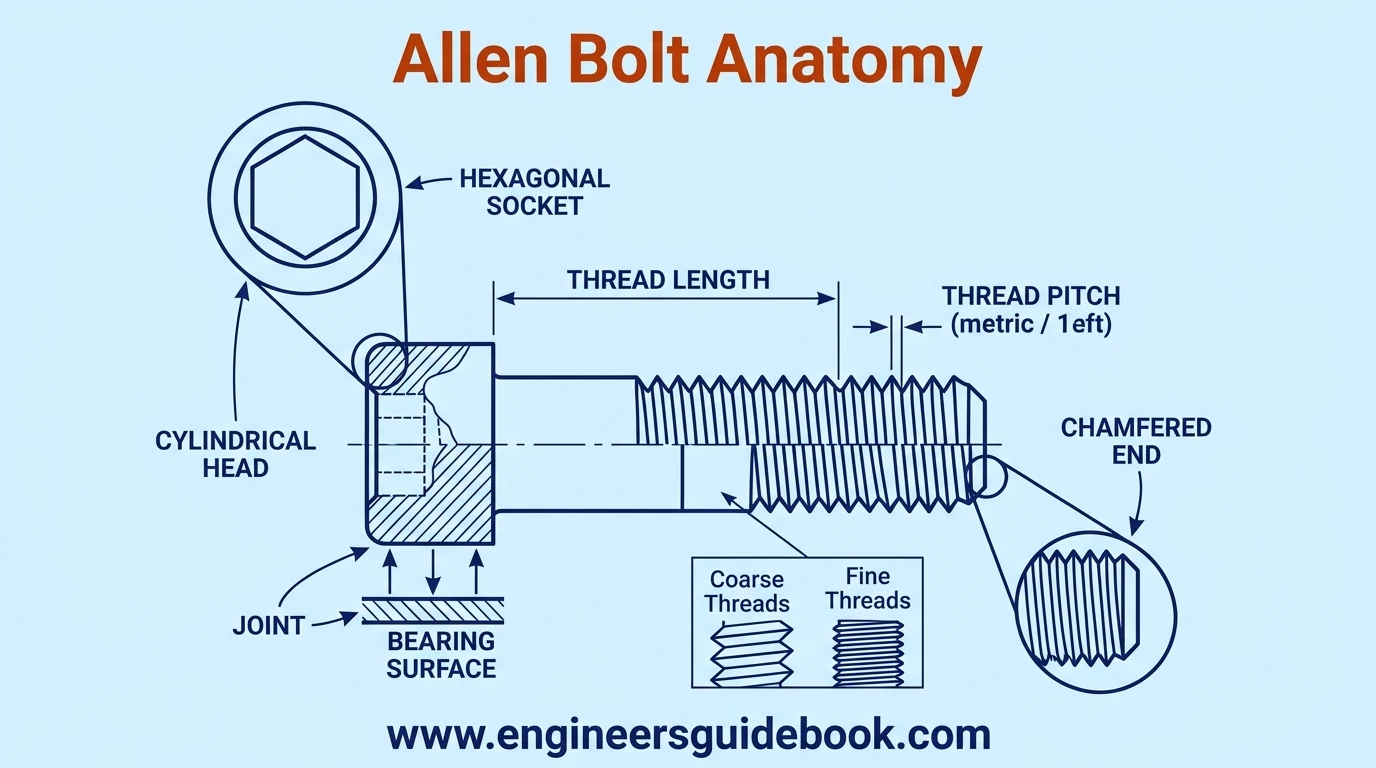
2.1 Cylindrical Head
The cylindrical head is characteristic of the traditional socket head cap screw. Its comparatively small diameter allows the bolt to fit within counterbores and tightly packed mechanical assemblies.
Despite its compact footprint, the head contains enough material to withstand elevated tightening forces. Its vertical sides also simplify accurate seating inside machined recesses.
2.2 Hexagonal Socket
The hexagonal socket is the internal recess that receives the Allen key. Its six-sided geometry provides multiple contact faces for transmitting rotational force.
A correctly matched tool sits deeply inside the socket and reduces slippage. However, undersized, worn, or incorrectly angled keys can deform the internal corners and cause socket rounding.
2.3 Threaded Shank
The threaded shank converts rotational movement into axial clamping force. As the bolt turns, its helical threads engage with a nut or internally threaded hole.
Some Allen bolts are fully threaded, while others contain a smooth, unthreaded portion beneath the head. The smooth section can improve shear performance when positioned across a joint interface.
2.4 Thread Pitch
Thread pitch describes the distance between adjacent thread crests. Metric Allen bolts express pitch in millimetres, while imperial fasteners are usually identified by threads per inch.
Coarse threads resist damage and assemble quickly. Fine threads provide more precise adjustment, greater tensile stress area, and improved resistance to loosening under certain operating conditions.
2.5 Thread Length
Thread length is the axial portion of the shank covered by threads. It determines how deeply the bolt can engage with a nut or tapped component.
Insufficient thread length prevents proper tightening, while excessive threaded exposure may place weaker thread roots across a shear plane. Correct selection supports dependable load transfer.
2.6 Bearing Surface
The bearing surface is the underside of the bolt head that presses against the assembled component. It transfers clamping force from the bolt into the joint.
A clean and level bearing surface promotes uniform pressure. Burrs, paint accumulation, misalignment, or surface irregularities can cause uneven seating and unpredictable preload.
2.7 Chamfered End
The threaded end is commonly chamfered to remove sharp edges and facilitate initial engagement. This small bevel helps the bolt enter a nut or tapped hole without cross-threading.
A damaged or poorly formed chamfer can obstruct assembly. In precision work, even minor end deformation may compromise thread alignment.
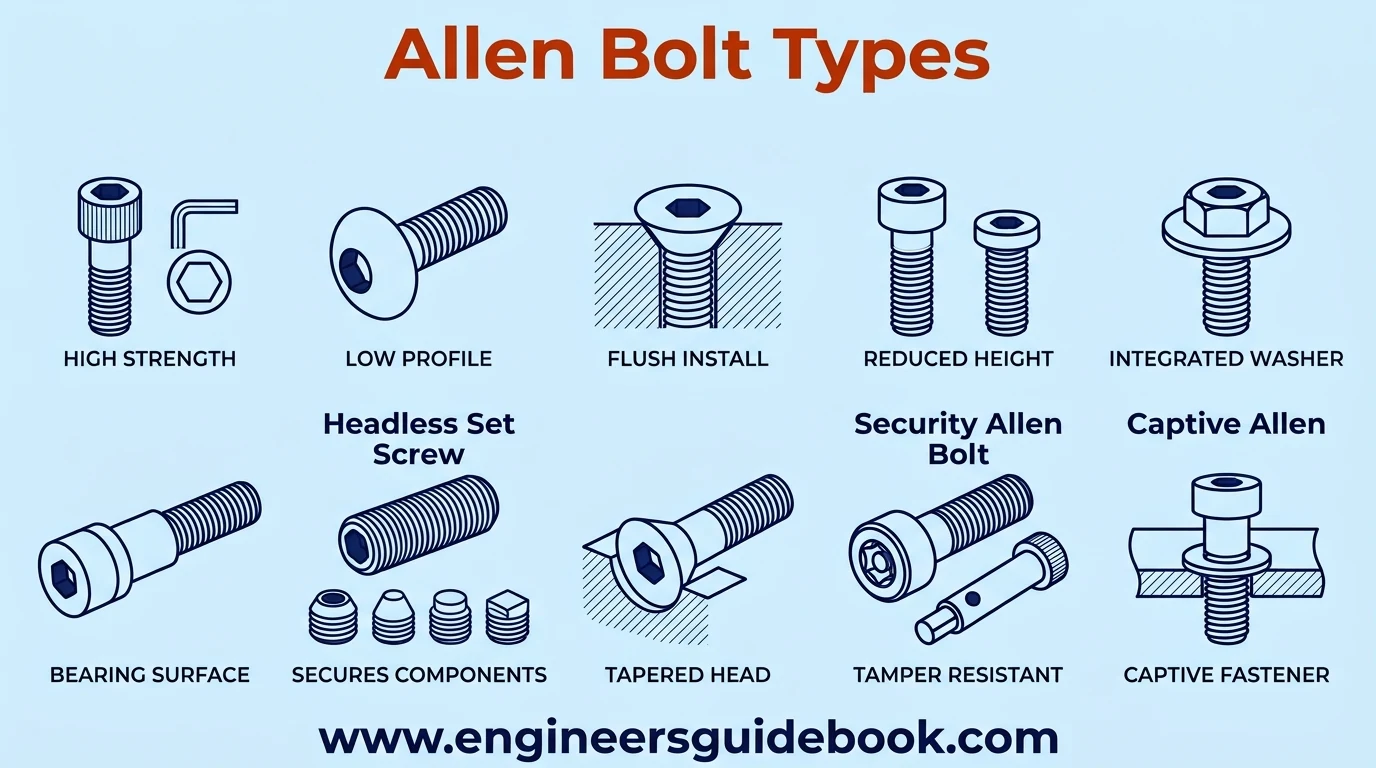
3. Allen Bolt Types
3.1 Socket Head Cap Screws
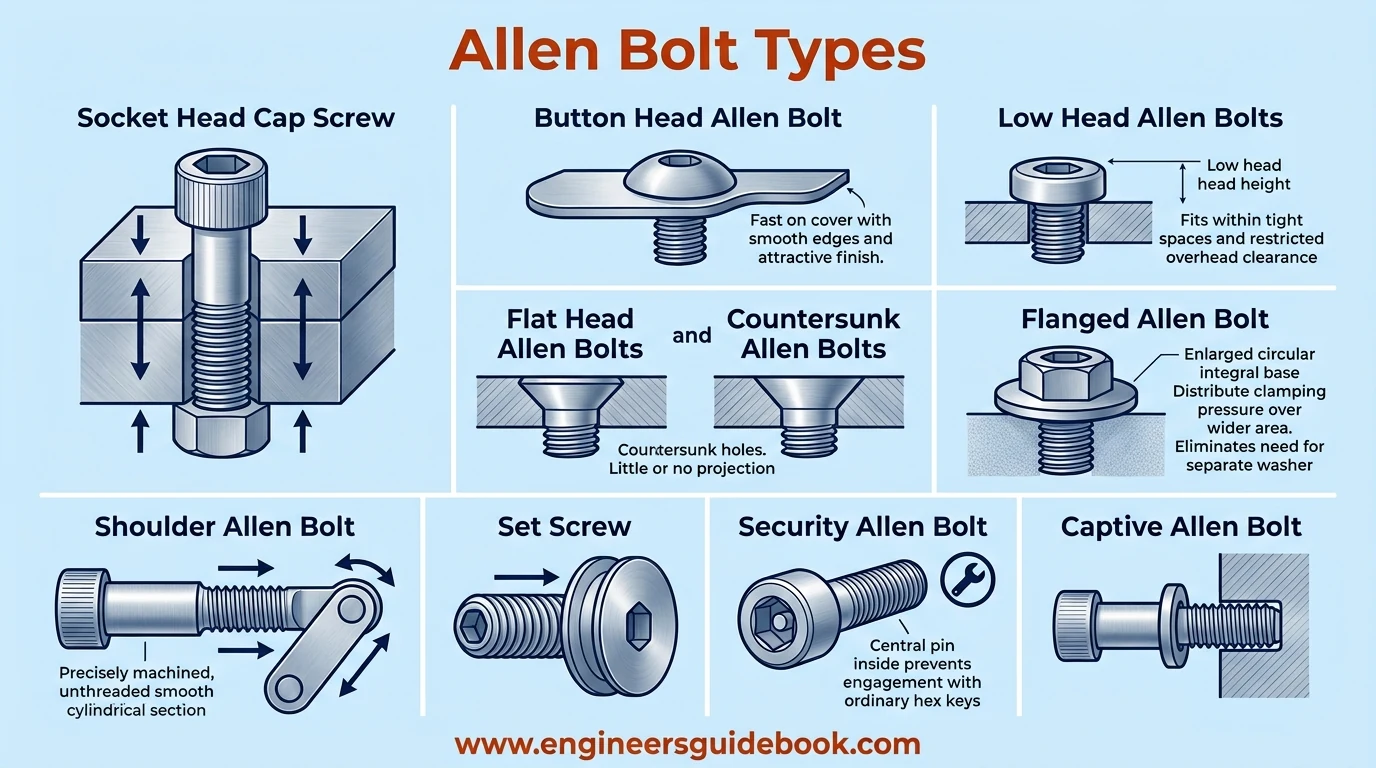
Socket head cap screws have tall cylindrical heads and deep hexagonal sockets. They offer excellent tool engagement and are commonly manufactured in high-strength alloy steel.
Their compact head diameter makes them suitable for machinery, fixtures, moulds, engines, and industrial equipment requiring substantial clamping force.
3.2 Button Head Allen Bolts
Button head Allen bolts feature broad, rounded heads with a low profile. Their smooth contour creates an attractive appearance and minimizes protruding edges.
Because the socket is shallower and the head is thinner, they usually tolerate less tightening torque than standard socket head cap screws.
3.3 Flat Head Allen Bolts
Flat head Allen bolts are designed to sit flush inside countersunk holes. Their conical underside nests within the matching recess, leaving little or no projection above the surface.
They are widely used in panels, machine guards, furniture, and assemblies requiring a streamlined exterior.
3.4 Low Head Allen Bolts
Low head Allen bolts provide a reduced head height for applications with restricted overhead clearance. They are useful where a standard cylindrical head would interfere with nearby parts.
Their thinner geometry generally lowers allowable tightening torque, so they should not automatically replace full-height socket head screws.
3.5 Flanged Allen Bolts
Flanged Allen bolts incorporate an enlarged circular base beneath the head. The flange distributes clamping pressure over a wider area and may eliminate the need for a separate washer.
These fasteners are useful on softer materials, slotted holes, automotive assemblies, and components vulnerable to localized indentation.
3.6 Shoulder Allen Bolts
Shoulder Allen bolts contain a precisely machined, unthreaded cylindrical section between the head and threads. This shoulder can function as a bearing surface, pivot, guide, axle, or locating element.
Accurate shoulder diameter and length are critical because these bolts often perform both fastening and motion-control duties.
3.7 Set Screws
Set screws are headless fasteners with an internal hexagonal socket. They secure one component relative to another, such as a pulley, collar, gear, or knob mounted on a shaft.
Different point styles include cup, cone, flat, dog, and oval ends. Each produces a distinct holding action and degree of surface penetration.
3.8 Countersunk Allen Bolts
Countersunk Allen bolts have tapered heads intended for matching countersunk cavities. Once tightened, the head becomes flush with or slightly below the surrounding surface.
Although similar to flat head bolts, the term emphasizes the installation geometry. Correct countersink angle is essential for complete seating and balanced load distribution.
3.9 Security Allen Bolts
Security Allen bolts include a central pin or modified socket that prevents engagement with ordinary hex keys. Removal requires a corresponding tamper-resistant tool.
They are used in public furniture, access panels, transportation systems, electronics, and equipment vulnerable to unauthorized dismantling.
3.10 Captive Allen Bolts
Captive Allen bolts are retained within a panel or component even after being loosened. Washers, reduced shanks, retaining rings, or specially formed threads prevent complete separation.
This design reduces dropped fasteners, simplifies maintenance, and protects sensitive machinery from loose-component contamination.
4. Allen Bolt Materials
4.1 Carbon Steel
Carbon steel provides economical strength for general fastening applications. Its mechanical properties depend on carbon content, heat treatment, and manufacturing quality.
Because untreated carbon steel corrodes readily, it is frequently zinc plated, phosphated, blackened, or otherwise protected.
4.2 Alloy Steel
Alloy steel is widely used for high-strength socket head cap screws. Elements such as chromium, molybdenum, and nickel improve hardenability, toughness, and load-carrying capability.
Heat-treated alloy steel bolts are common in machinery, tooling, presses, engines, and structural mechanical assemblies.
4.3 Stainless Steel
Stainless steel Allen bolts offer improved corrosion resistance and a clean appearance. Austenitic grades such as A2 and A4 are common, with A4 providing better performance in chloride-rich environments.
Stainless fasteners may experience galling, particularly when assembled dry at high speed. Suitable lubrication can reduce this risk.
4.4 Brass
Brass Allen bolts provide moderate corrosion resistance, electrical conductivity, and decorative appeal. They are suitable for instruments, electrical fittings, furniture, and light-duty marine environments.
Their strength is considerably lower than hardened alloy steel, making them inappropriate for heavily loaded joints.
4.5 Titanium
Titanium Allen bolts combine low density, high specific strength, and exceptional corrosion resistance. They are used in aerospace, motorsport, chemical processing, medical devices, and premium bicycles.
Their high price and specialized installation requirements generally limit them to applications where weight or environmental durability is critical.
4.6 Aluminum
Aluminum Allen bolts are lightweight, nonmagnetic, and naturally resistant to atmospheric corrosion. They are often selected for electronics, lightweight enclosures, decorative assemblies, and low-load equipment.
Their limited thread strength demands careful torque control. Excessive tightening can stretch the bolt or strip the engaged threads.
5. Allen Bolt Finishes
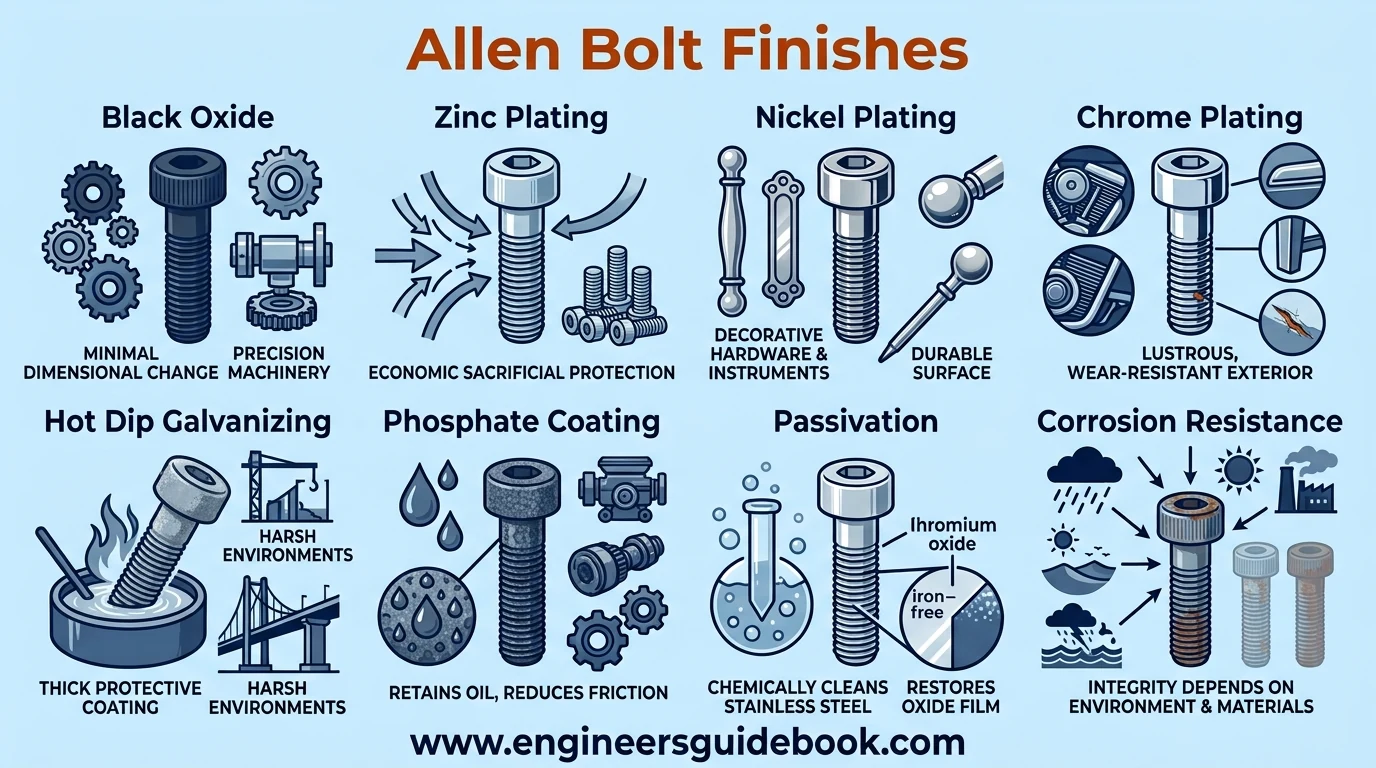
5.1 Black Oxide
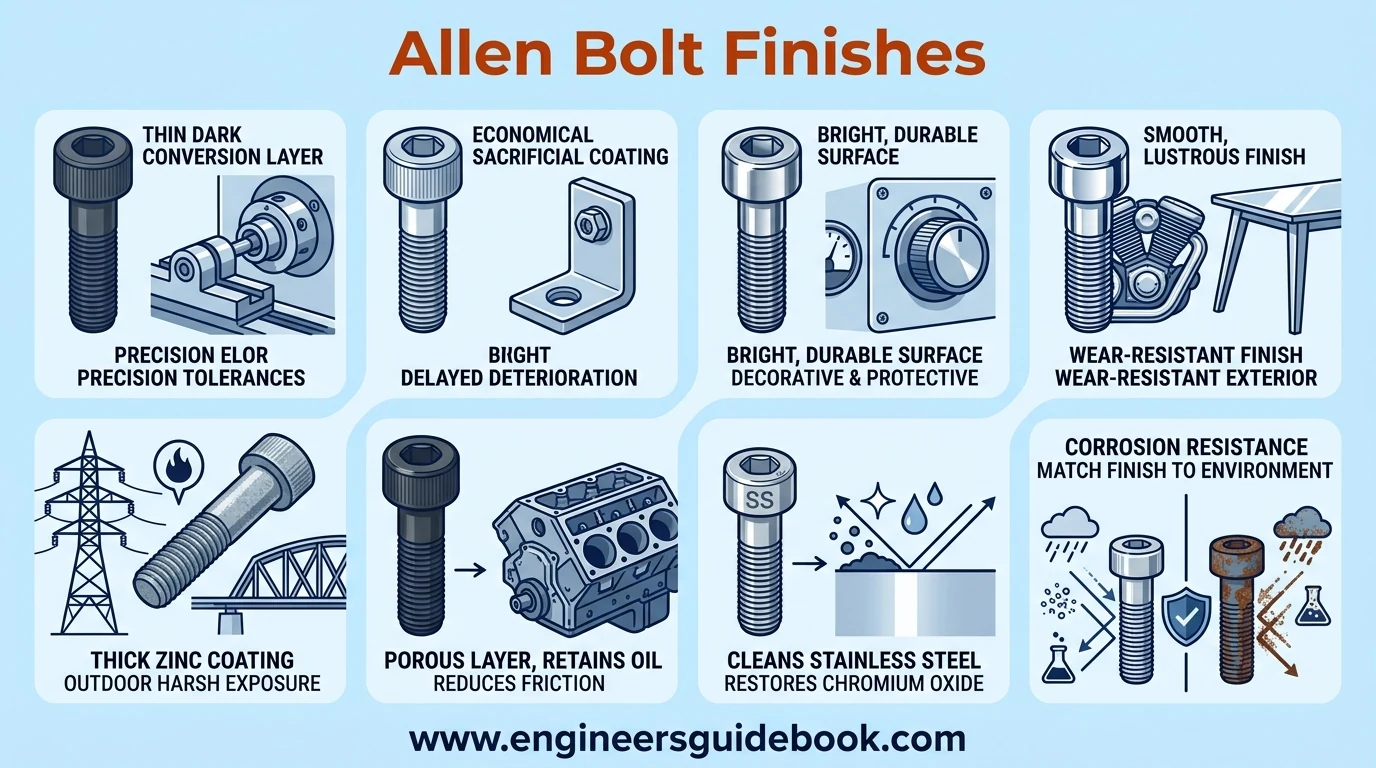
Black oxide creates a thin, dark conversion layer on ferrous Allen bolts. It improves appearance and provides limited corrosion resistance when supplemented with oil or wax.
It causes minimal dimensional change, making it useful for close-tolerance fasteners and precision machinery.
5.2 Zinc Plating
Zinc plating provides economical sacrificial protection for carbon and alloy steel bolts. The zinc corrodes preferentially, delaying deterioration of the underlying steel.
Different chromate treatments can alter appearance and protection. However, plating specifications must account for hydrogen embrittlement in high-strength fasteners.
5.3 Nickel Plating
Nickel plating produces a bright, durable surface with improved wear and corrosion resistance. It is used for decorative hardware, instruments, equipment controls, and moderately aggressive environments.
The finish is harder and often more visually refined than basic zinc plating.
5.4 Chrome Plating
Chrome plating creates a smooth, lustrous, and wear-resistant exterior. Decorative chrome is common on furniture, motorcycles, automotive accessories, and consumer equipment.
Its performance depends heavily on substrate preparation and underlying plating layers. Damaged chrome may allow corrosion to propagate beneath the coating.
5.5 Hot Dip Galvanizing
Hot dip galvanizing immerses steel fasteners in molten zinc, producing a thick protective coating. It is suitable for outdoor structures and harsh atmospheric exposure.
The coating thickness can alter thread fit, so galvanized bolts and nuts must be manufactured with appropriate allowances.
6. Allen Bolt Sizes
6.1 Metric Sizes
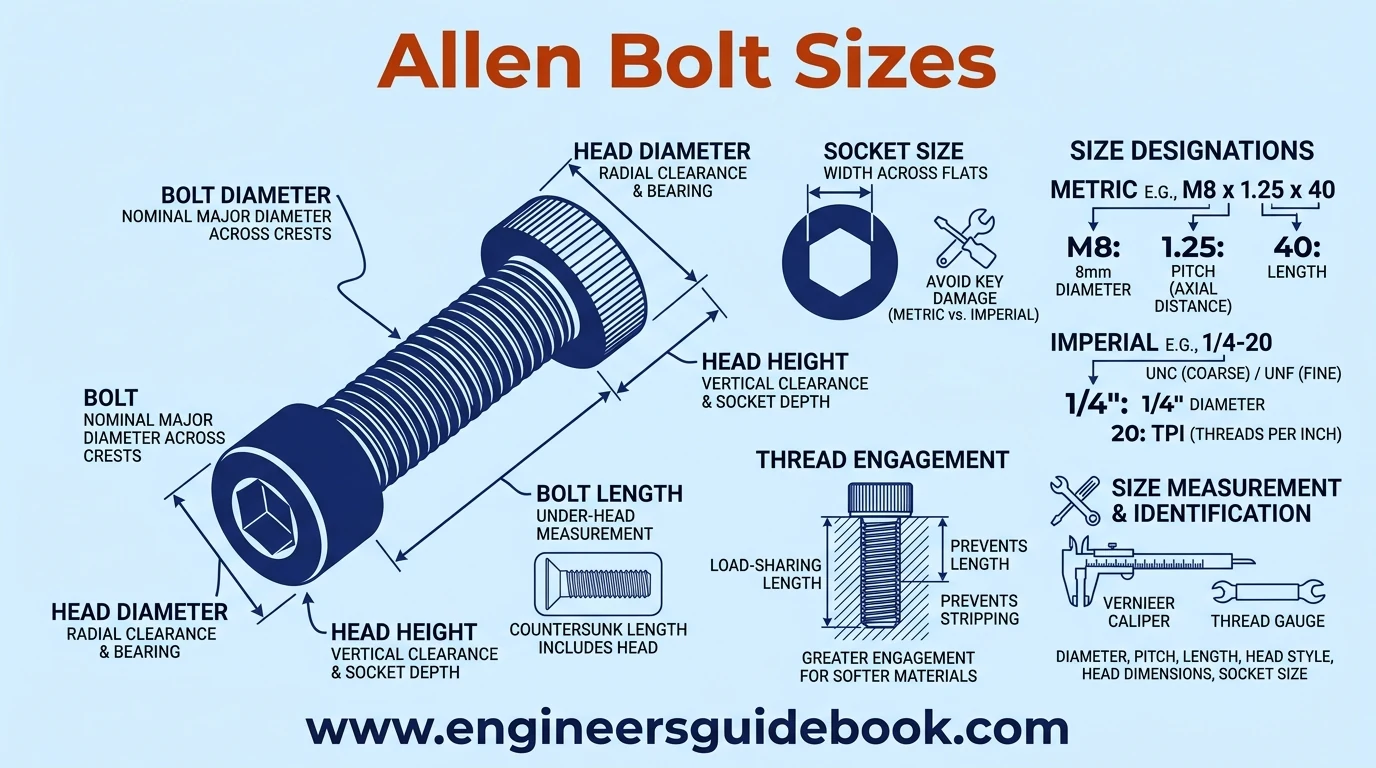
Metric Allen bolts are identified by the letter M followed by nominal thread diameter, such as M6 or M10. Thread pitch and length may also appear in the designation.
An M8 × 1.25 × 40 bolt has an 8-millimetre nominal diameter, 1.25-millimetre pitch, and 40-millimetre length.
6.2 Imperial Sizes
Imperial Allen bolts use fractional or numbered diameters, threads per inch, and inch-based lengths. A designation such as 1/4-20 indicates a quarter-inch diameter with twenty threads per inch.
UNC and UNF identify coarse and fine thread series respectively.
6.3 Bolt Diameter
Bolt diameter refers to the nominal major diameter measured across the external thread crests. It is one of the primary parameters governing tensile area and overall load capacity.
Accurate identification requires distinguishing between similar metric and imperial dimensions.
6.4 Bolt Length
Bolt length is generally measured from beneath the head to the threaded end. Countersunk bolts are an exception because their overall length includes the head.
Selecting the wrong reference point can produce an unsuitable fastener even when the nominal length appears correct.
6.5 Head Diameter
Head diameter determines the radial clearance required around the fastener. It also influences bearing area and compatibility with counterbored holes.
Standard dimensional tables should be consulted whenever head clearance is restricted.
6.6 Head Height
Head height affects vertical clearance and socket depth. Standard socket head cap screws offer greater head height than button, low-profile, or countersunk variants.
Reduced head height improves packaging but usually lowers maximum drive torque.
6.7 Socket Size
Socket size identifies the width across the flats of the internal hexagon. Each bolt size normally corresponds to a standardized key dimension.
Using a near-fitting imperial key in a metric socket, or vice versa, can permanently damage the recess.
6.8 Thread Pitch
Metric pitch is measured as the axial distance between threads. Imperial pitch is expressed as the number of threads within one inch.
Pitch must match the mating thread exactly. Even similar-looking threads can bind, cross-thread, or fail if their pitch differs.
6.9 Thread Engagement
Thread engagement is the length over which male and female threads share load. Adequate engagement prevents stripping and supports proper preload development.
Required engagement varies with bolt strength and the material of the tapped component. Softer materials generally require greater engagement length.
6.10 Size Measurement
Allen bolt measurement should include diameter, pitch, length, head style, head dimensions, and socket size. A thread gauge and vernier caliper provide more reliable identification than visual estimation.
The fastener standard may also be necessary when sourcing an exact replacement.
7. Allen Bolt Grades
7.1 Metric Property Classes
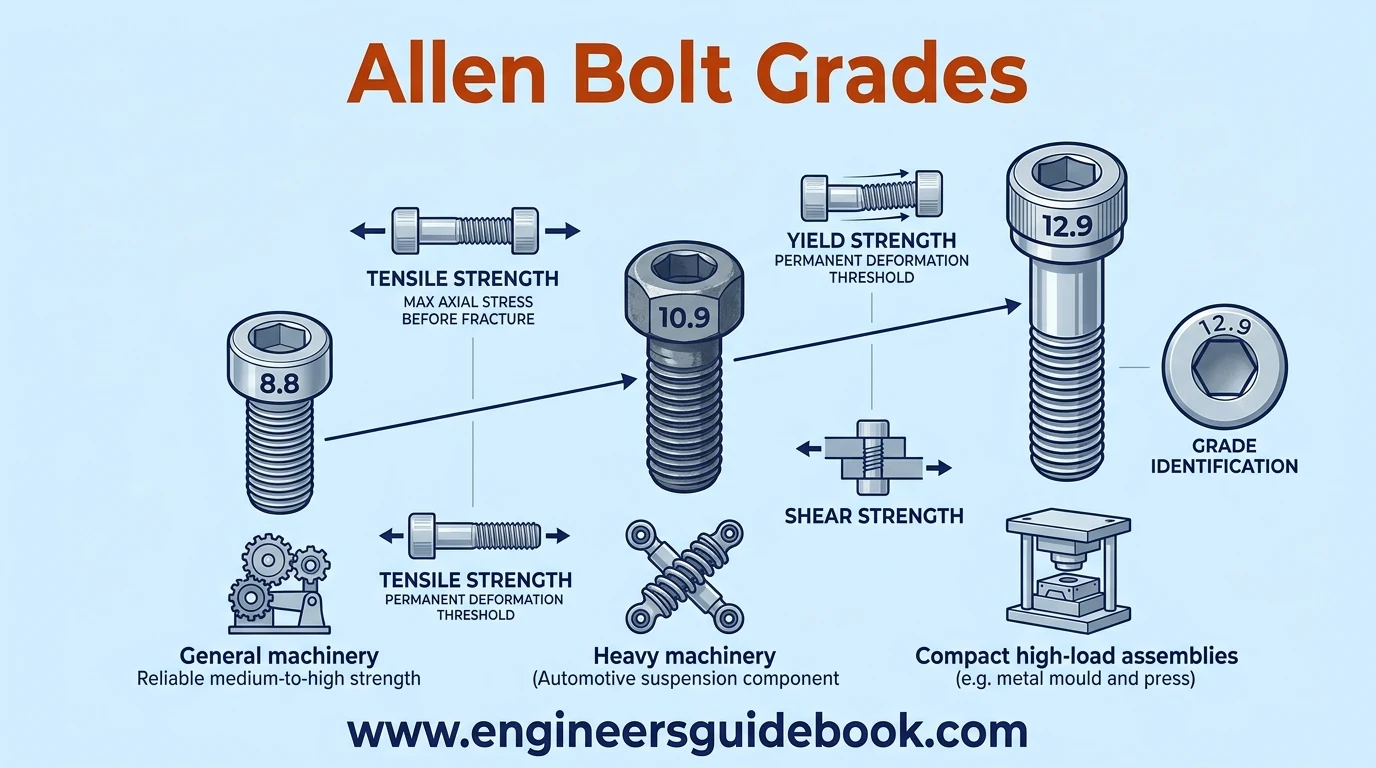
Metric property classes indicate mechanical strength using paired numbers such as 8.8, 10.9, and 12.9. The first number relates to nominal tensile strength, while the second represents the yield-to-tensile ratio.
Higher numbers generally indicate stronger, more highly heat-treated fasteners.
7.2 Imperial Strength Grades
Imperial socket screws may follow SAE, ASTM, or industry-specific strength classifications. Head markings, material specifications, and certification documents help identify their mechanical properties.
Grade terminology should not be interchanged casually between metric and imperial systems.
7.3 Grade 8.8
Property class 8.8 provides reliable medium-to-high strength for machinery, automotive components, frames, and general industrial assemblies. It offers a practical balance of strength, ductility, availability, and cost.
It is stronger than ordinary low-carbon commercial fasteners.
7.4 Grade 10.9
Property class 10.9 is used where elevated preload and higher load capacity are required. Applications include automotive suspension, heavy machinery, structural mechanical joints, and equipment mounting.
Correct torque control is important because the fastener operates at higher stress levels.
7.5 Grade 12.9
Property class 12.9 represents a very high-strength category commonly associated with alloy steel socket head cap screws. It is used in dies, moulds, machine tools, presses, and compact high-load assemblies.
Its high hardness can reduce tolerance for misuse, impact damage, and unsuitable environmental exposure.
7.6 Stainless Steel Grades
Stainless bolts commonly use designations such as A2-70, A4-70, or A4-80. The first portion identifies the stainless family, while the number indicates tensile strength classification.
Stainless grades should be selected for both corrosion resistance and mechanical performance.
7.7 Tensile Strength
Tensile strength is the maximum axial stress a bolt can withstand before fracture. It is influenced by material, heat treatment, thread geometry, and manufacturing quality.
A higher tensile rating does not compensate for poor installation or inadequate thread engagement.
7.8 Yield Strength
Yield strength indicates the stress at which permanent deformation begins. Bolts are normally tightened below this threshold unless a specialized tightening procedure specifies otherwise.
Exceeding yield can permanently elongate the fastener and reduce its future clamping reliability.
7.9 Shear Strength
Shear strength describes resistance to forces acting transversely across the bolt. Joints should ideally transfer shear through friction created by preload rather than relying solely on the bolt body.
Where direct shear is unavoidable, the smooth shank should preferably cross the joint plane.
7.10 Grade Identification
Allen bolt grades may be identified through head markings, packaging labels, certificates, dimensional standards, or manufacturer documentation. Absence of markings can make reliable classification difficult.
Critical applications should use traceable fasteners with verified material and mechanical test records.
8. Allen Bolt Standards
8.1 ISO Standards
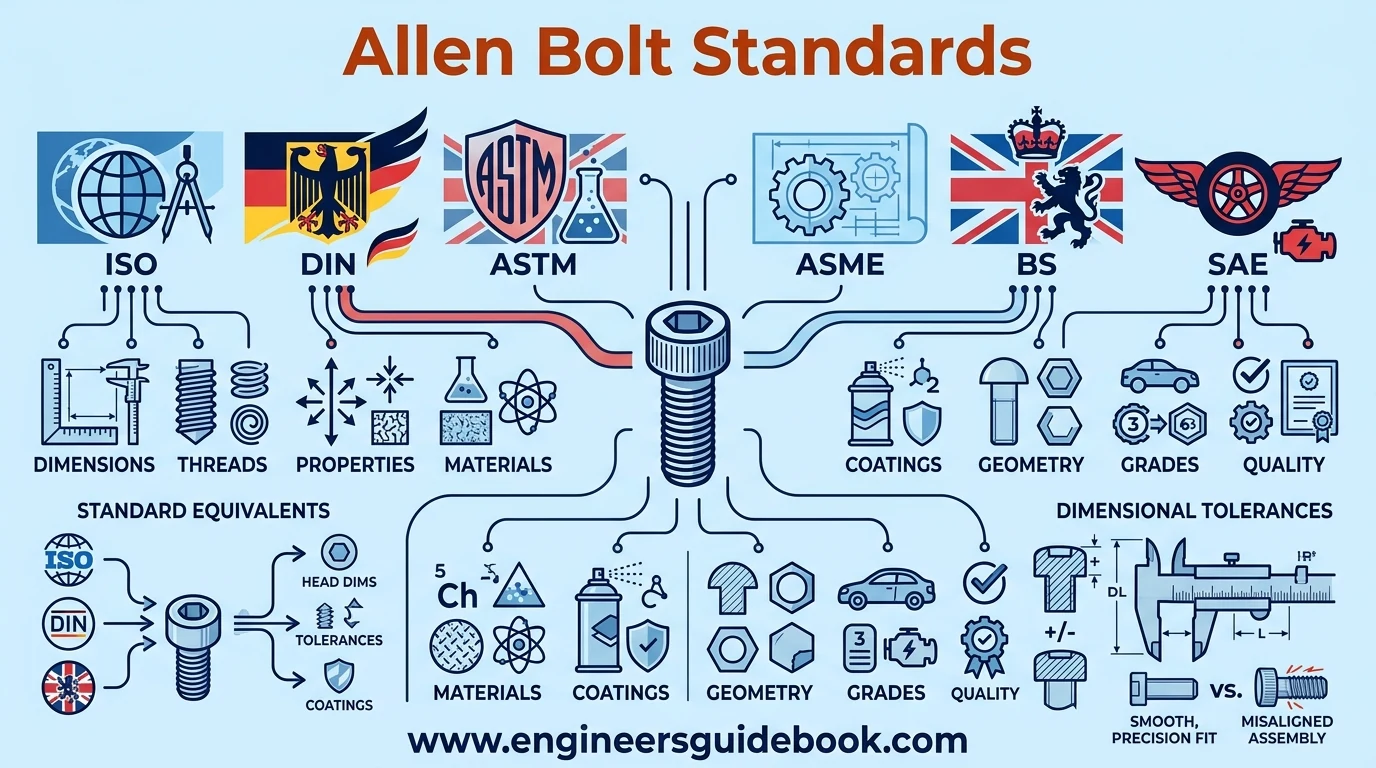
ISO standards define standard dimensions, threads, properties, and testing requirements, supporting fastener interchangeability.
8.2 DIN Standards
DIN standards originated in Germany and remain in engineering drawings. DIN 912 traditionally covers cylindrical socket head cap screws.
8.3 ASTM Standards
ASTM specifications emphasize materials, coatings, mechanical properties, and testing for applications requiring documented strength or resistance.
8.4 ASME Standards
ASME standards address thread geometry, dimensional conventions, and fastening practices used in North American engineering.
8.5 BS Standards
British Standards define fastener dimensions, threads, and quality requirements. Older BS references still appear on legacy equipment drawings.
8.6 SAE Standards
SAE standards are used for inch-series automotive fasteners, covering grades, materials, dimensions, and performance.
8.7 Standard Equivalents
Equivalent ISO, DIN, and BS fasteners may serve similar functions, but head dimensions, tolerances, coatings, or properties can differ.
8.8 Dimensional Tolerances
Tolerances control head diameter, socket depth, thread fit, shank size, and length. Precision assemblies require close limits to prevent misalignment and wear.
9. Allen Bolt Tools
9.1 Allen Keys
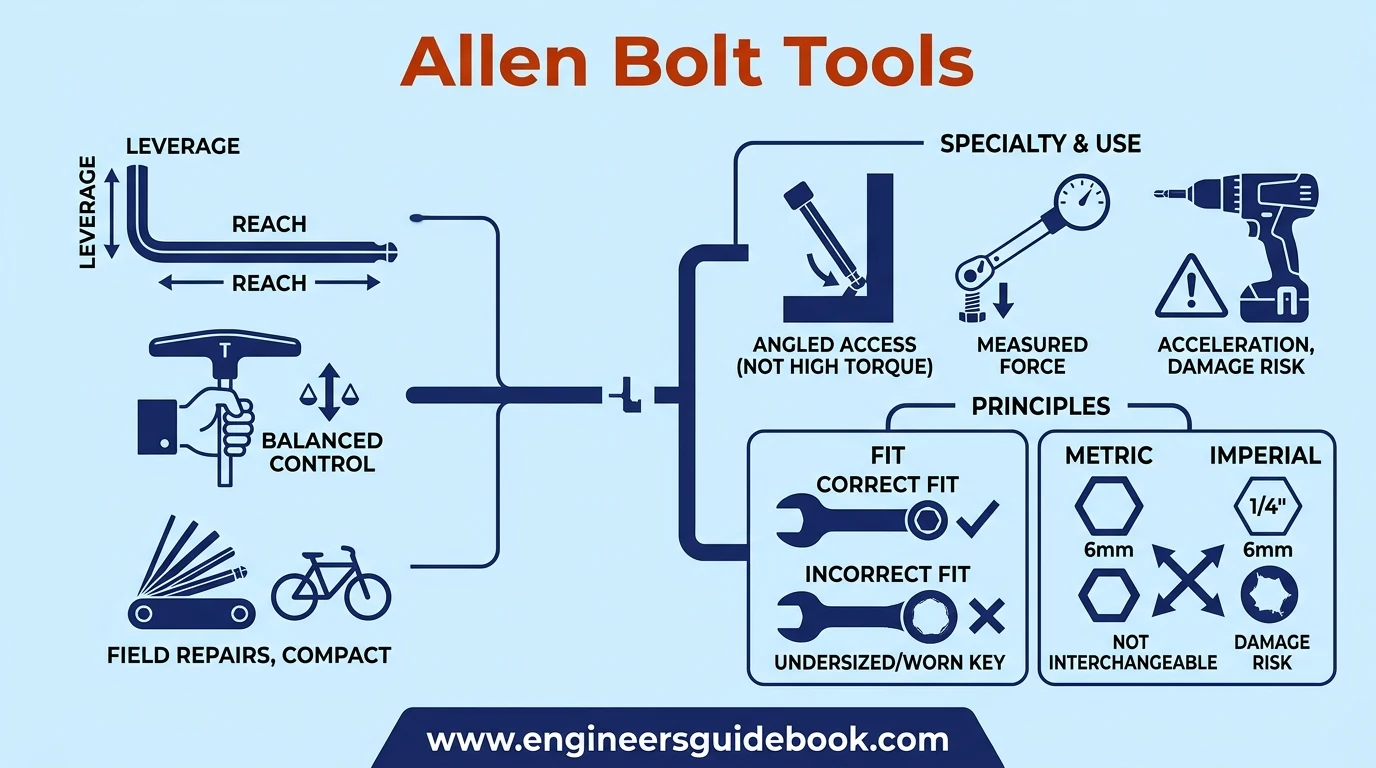
Allen keys are L-shaped tools for internal hex sockets. The short arm provides leverage; the long arm improves reach.
9.2 Hex Bit Sockets
Hex bit sockets connect to ratchets, extensions, or torque wrenches for controlled tightening and repetitive maintenance.
9.3 T Handle Keys
T-handle keys provide a comfortable grip and balanced control during bench assembly, adjustment, and machine setup.
9.4 Folding Hex Keys
Folding sets place several sizes in one compact handle for field repairs, bicycles, and furniture.
9.5 Torque Wrenches
Torque wrenches apply measured force, reducing inconsistent preload, thread stripping, bolt yielding, and under-tightened joints.
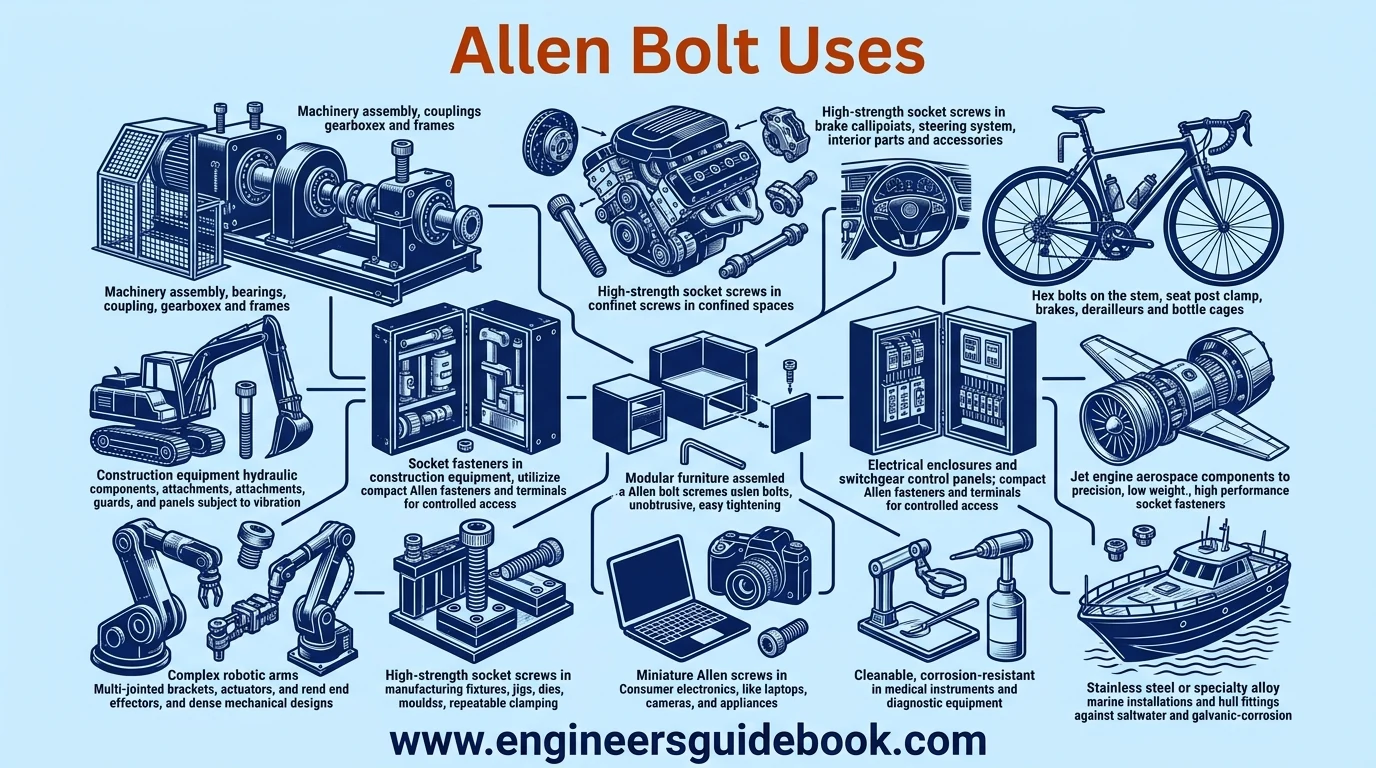
10. Allen Bolt Uses
10.1 Machinery Assembly
Allen bolts secure guards, bearings, couplings, gearboxes, housings, and frames where compact heads are advantageous.
10.2 Automotive Components
Automotive applications include engines, brakes, steering systems, interiors, and accessories, often using high-strength grades in confined assemblies.
10.3 Bicycle Components
Bicycles use Allen bolts on stems, seat clamps, brakes, derailleurs, and bottle cages because one tool services multiple components.
10.4 Furniture Assembly
Modular furniture uses Allen bolts because they are inexpensive, unobtrusive, and easily tightened with a supplied key.
10.5 Construction Equipment
Construction machinery uses robust socket fasteners in hydraulic components, attachments, guards, and panels exposed to vibration.
10.6 Electrical Equipment
Electrical enclosures, switchgear, terminals, and control panels use Allen fasteners where compact installation and controlled access are needed.
10.7 Aerospace Components
Aerospace assemblies require traceable socket fasteners offering low weight, accurate preload, fatigue resistance, and corrosion performance.
11. Allen Bolt Selection
11.1 Load Requirements
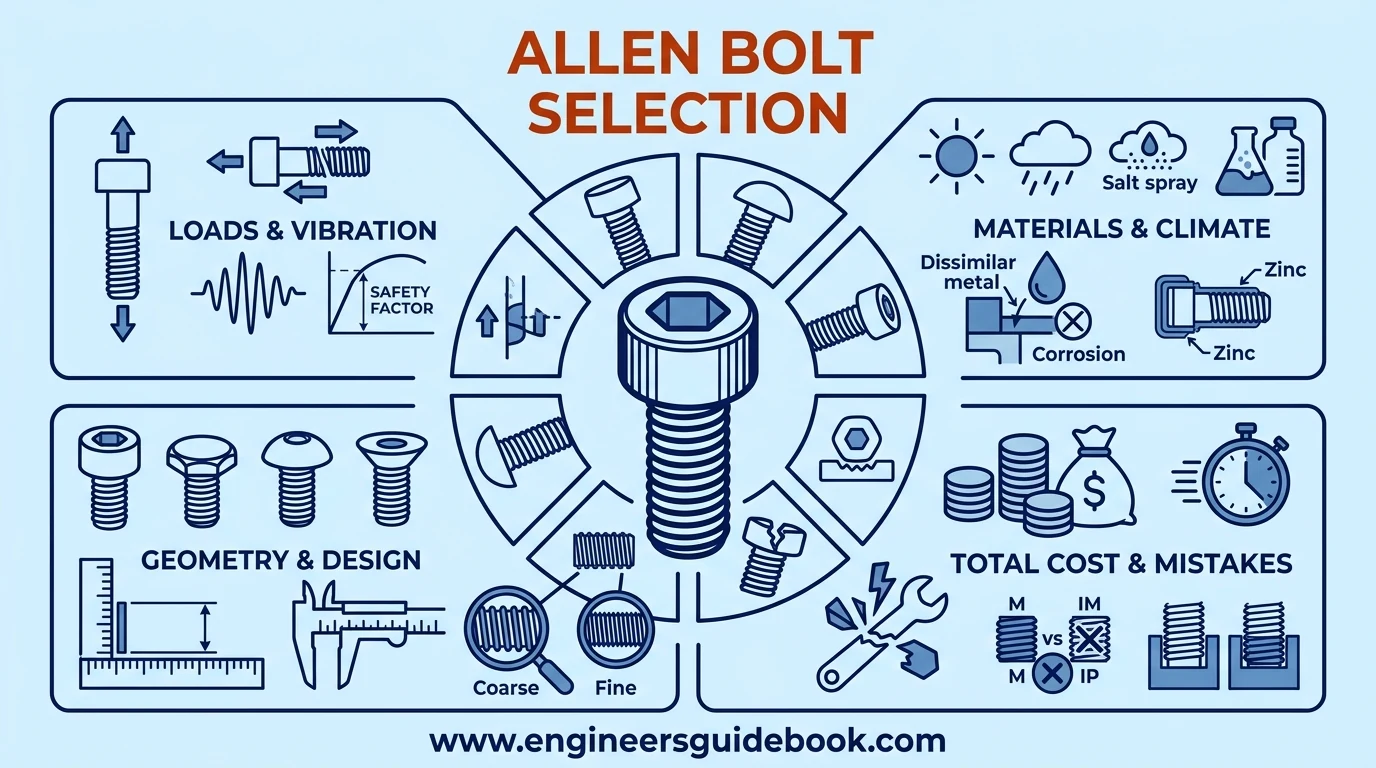
Evaluate tensile, shear, fatigue, and vibration loads before selecting diameter, grade, thread engagement, and preload.
11.2 Material Compatibility
Fastener and component materials must be mechanically and electrochemically compatible where moisture could initiate galvanic corrosion.
11.3 Environmental Conditions
Humidity, salt, chemicals, dust, and temperature determine whether coatings, stainless steel, or specialized alloys are required.
11.4 Space Limitations
Available radial and vertical clearance influences the choice between socket head, low head, button head, and countersunk designs.
11.5 Head Style Selection
Head style affects torque capacity, bearing area, appearance, and accessibility. Low-profile designs usually tolerate less tightening force.
12. Allen Bolt Installation
12.1 Surface Preparation
Clean mating surfaces and remove burrs, scale, paint, or debris that could cause joint settlement and preload loss.
12.2 Hole Alignment
Align components before insertion because forced assembly can bend bolts or damage threads.
12.3 Thread Cleaning
Remove corrosion, chips, dirt, and damaged fragments to promote accurate engagement and predictable tightening friction.
12.4 Lubrication
Lubrication reduces friction and galling but increases preload at a given torque, so tightening values must reflect it.
12.5 Correct Tightening
Insert the tool fully, keep it aligned with the bolt axis, and apply smooth force without abrupt impact.
12.6 Torque Requirements
Torque depends on size, pitch, grade, coating, lubrication, and joint design. Approved specifications should govern critical assemblies.
13. Frequently Asked Questions
13.1 What Is an Allen Bolt?
An Allen bolt is a threaded fastener with an internal hexagonal socket operated by an Allen key or hex bit.
13.2 Why Are Allen Bolts Used?
They provide compact installation, strong engagement, high clamping capability, and convenient access in recessed locations.
13.3 What Is the Difference Between an Allen Bolt and a Hex Bolt?
An Allen bolt has an internal hex drive, whereas a conventional hex bolt has an external six-sided head.
13.4 How Are Allen Bolt Sizes Measured?
Measure thread diameter, pitch, length, head dimensions, and socket size. Countersunk bolt length includes the head.
13.5 What Size Allen Key Do I Need?
Use the exact metric or imperial key specified for the socket; it should fit deeply without looseness.
13.6 Are Allen Bolts Metric or Imperial?
They are available in both systems, but their threads, dimensions, and tools must not be mixed.
13.7 What Is the Strongest Allen Bolt Grade?
Property class 12.9 is among the strongest widely available metric grades, although specialized fasteners may exceed it.
13.8 Can Allen Bolts Be Used Outdoors?
Yes, when their material and finish suit moisture, salt, chemicals, and temperature.
13.9 Why Do Allen Bolt Heads Strip?
Common causes include incorrect tools, worn keys, shallow engagement, corrosion, misalignment, and excessive torque.
13.10 How Do You Remove a Stripped Allen Bolt?
Use penetrating oil, an oversized bit, extractor, locking pliers, heat, or careful drilling as appropriate.
13.11 Should Allen Bolts Be Lubricated?
Lubrication can prevent galling, but torque must be adjusted because reduced friction creates greater preload.
13.12 Can Allen Bolts Be Reused?
Undamaged bolts may be reusable, but stretched, corroded, torque-to-yield, or safety-critical fasteners should be replaced.
13.13 What Torque Should Be Used for Allen Bolts?
Use manufacturer or engineering data based on size, grade, coating, lubrication, and joint requirements.
13.14 Where Are Allen Bolts Commonly Used?
They are common in machinery, vehicles, furniture, bicycles, electronics, robotics, aerospace equipment, tooling, and marine assemblies.
14. Conclusion
14.1 Key Takeaways
Allen bolts combine compact geometry, dependable drive engagement, and broad material availability. Performance depends on correct type, size, grade, finish, tooling, and installation.
Select each fastener through load assessment, environmental review, dimensional verification, and controlled tightening to protect joint safety, durability, and maintainability.