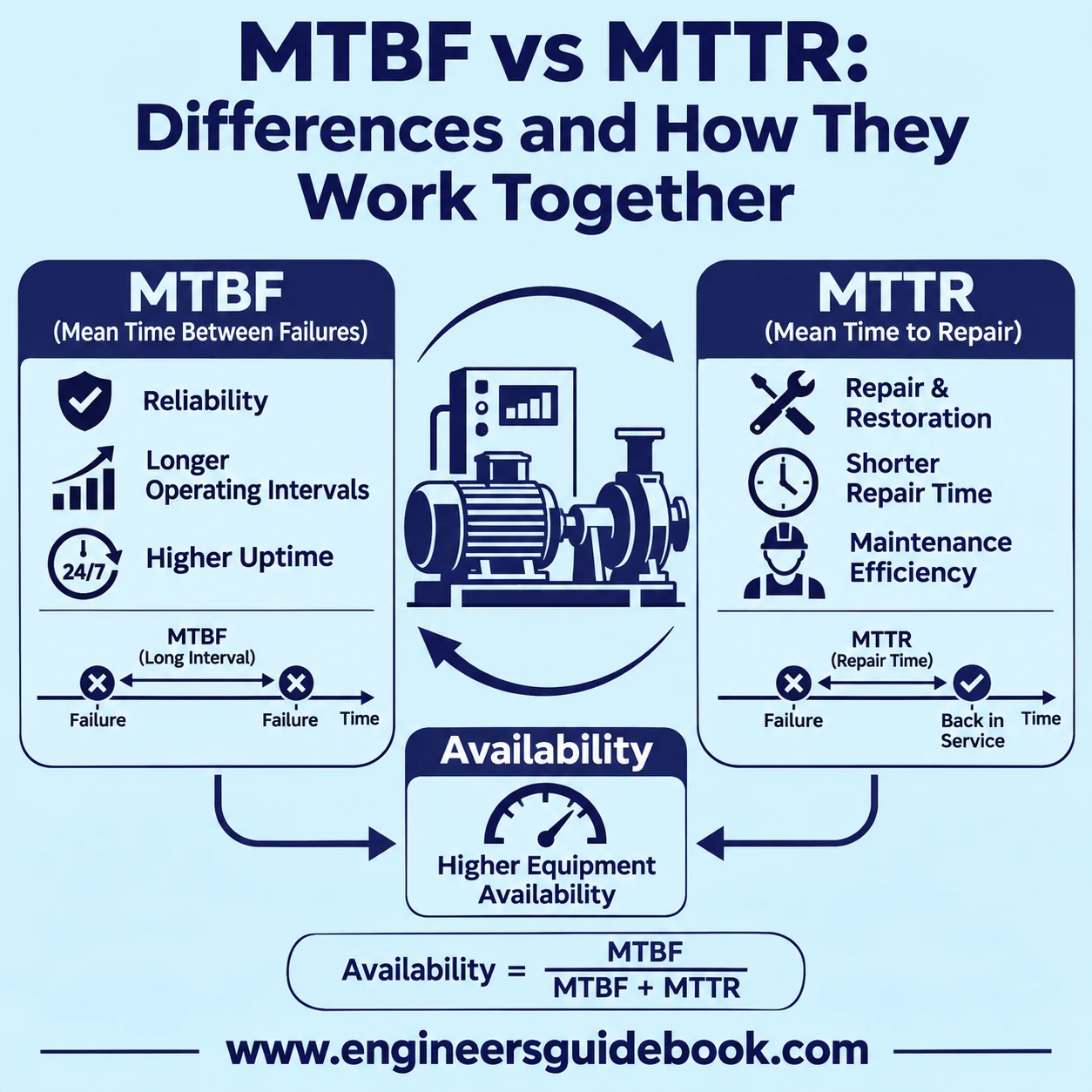
MTBF vs MTTR. MTBF (Mean Time Between Failures) measures equipment reliability, while MTTR (Mean Time to Repair) measures the average time required to repair failed equipment. A higher MTBF indicates fewer failures, whereas a lower MTTR indicates faster repairs. Together, these maintenance metrics help calculate equipment availability, minimize operational downtime, improve productivity, and optimize industrial maintenance strategies.
1. Introduction to MTBF and MTTR
1.1 What Are MTBF and MTTR?
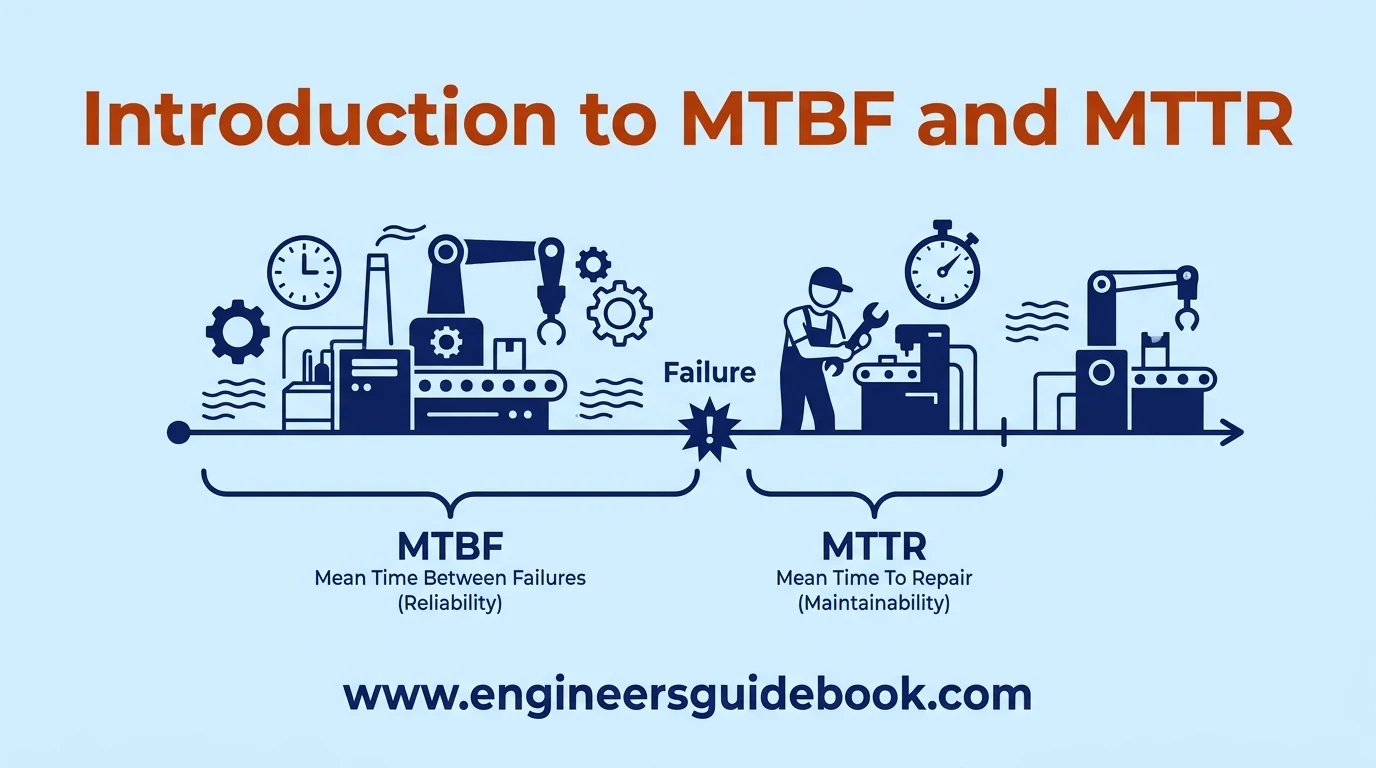
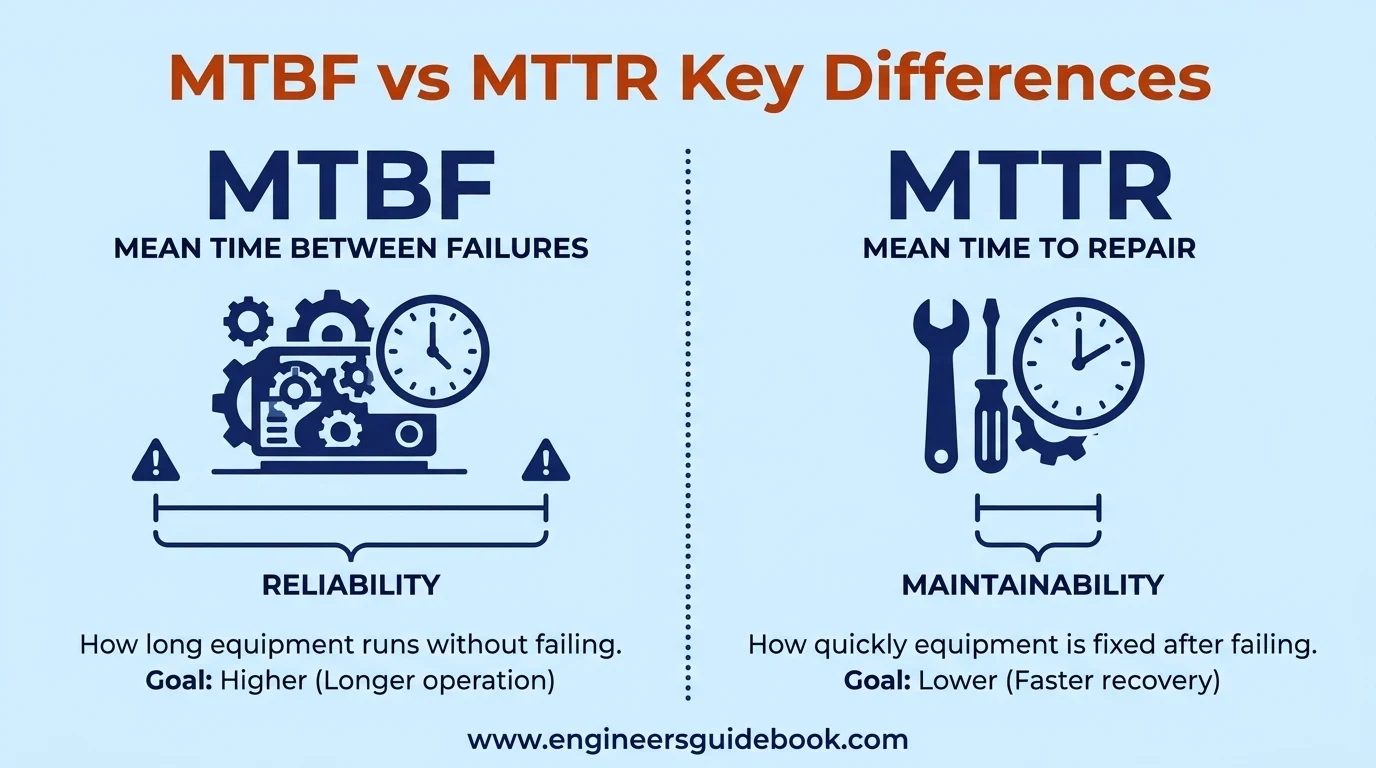
MTBF and MTTR are fundamental maintenance key performance indicators (KPIs) used to evaluate the operational effectiveness of repairable equipment. MTBF measures the average operating duration between failures, whereas MTTR determines the average time required to repair equipment following a failure.
Together, they provide a quantitative assessment of equipment reliability and maintenance effectiveness.
1.2 Importance of Maintenance Performance Metrics
Maintenance performance metrics enable organizations to identify equipment deficiencies, evaluate maintenance practices, and allocate resources effectively. Without measurable indicators, maintenance decisions frequently depend on subjective observations rather than empirical evidence.
MTBF and MTTR help organizations reduce maintenance expenditure, improve asset utilization, and minimize unexpected production interruptions.
1.3 Role of MTBF and MTTR in Industrial Maintenance
Industrial facilities use these metrics to evaluate machinery performance, establish maintenance priorities, and develop reliability improvement programs.
A declining MTBF may indicate progressive equipment deterioration, while an increasing MTTR could reveal inadequate troubleshooting capabilities, spare parts shortages, or inefficient repair procedures.
1.4 Understanding Equipment Reliability and Maintainability
Reliability describes the ability of equipment to perform its intended function without failure under specified operating conditions for a defined period.
Maintainability describes how readily equipment can be restored to its functional condition following a failure. MTBF primarily reflects reliability, while MTTR reflects maintainability.
2. Understanding Mean Time Between Failures (MTBF)
2.1 Definition of MTBF
Mean Time Between Failures (MTBF) represents the average operating time between failures of a repairable asset.
It is commonly used to assess industrial machinery, electrical systems, manufacturing equipment, and mechanical assemblies. A higher MTBF generally indicates greater equipment reliability under comparable operating conditions.
2.2 MTBF Formula
The standard MTBF formula is:
MTBF = Total Operating Time / Total Number of Failures
Where:
Total Operating Time = Actual equipment operating hours.
Total Number of Failures = Recorded failures during the observation period.
MTBF = Average operating time between failures.
Equipment downtime should not be included in the total operating time.
2.3 Step-by-Step MTBF Calculation
Calculating MTBF involves the following steps:
1. Establish the equipment observation period.
2. Determine the total actual operating hours.
3. Identify the number of recorded equipment failures.
4. Divide the operating hours by the number of failures.
5. Evaluate the result against historical performance.
Consistent failure classification is essential for meaningful calculations.
2.4 Practical MTBF Calculation Example
Consider an industrial packaging machine with the following operational data:
Parameter Value Total operating time 2,400 hours Number of failures 8 MTBF 300 hours
MTBF = 2,400 / 8 = 300 hours
The machine experiences a failure approximately every 300 operating hours on average. This does not guarantee that individual failures will occur at fixed intervals.
2.5 Factors Affecting MTBF
Several operational and mechanical factors influence MTBF, including equipment design, lubrication quality, operating temperature, mechanical loading, contamination, component quality, installation accuracy, and preventive maintenance effectiveness.
Addressing these factors can reduce failure frequency and improve asset reliability.

3. Understanding Mean Time to Repair (MTTR)
3.1 Definition of MTTR
Mean Time to Repair (MTTR) measures the average time required to repair failed equipment and restore its operational functionality.
It evaluates maintenance responsiveness, diagnostic efficiency, and equipment maintainability. Lower MTTR values generally indicate more efficient repair operations.
3.2 MTTR Formula
The standard MTTR formula is:
MTTR = Total Repair Time / Total Number of Repairs
Where:
Total Repair Time = Combined duration of recorded repair activities
Total Number of Repairs = Number of completed repairs.
MTTR = Average repair duration
Organizations should clearly define whether diagnostic, testing, and waiting times are included.
3.3 Step-by-Step MTTR Calculation
The MTTR calculation procedure includes:
1. Identify completed equipment repair activities.
2. Record the duration of each repair.
3. Calculate the cumulative repair time.
4. Divide the total repair time by the number of repairs.
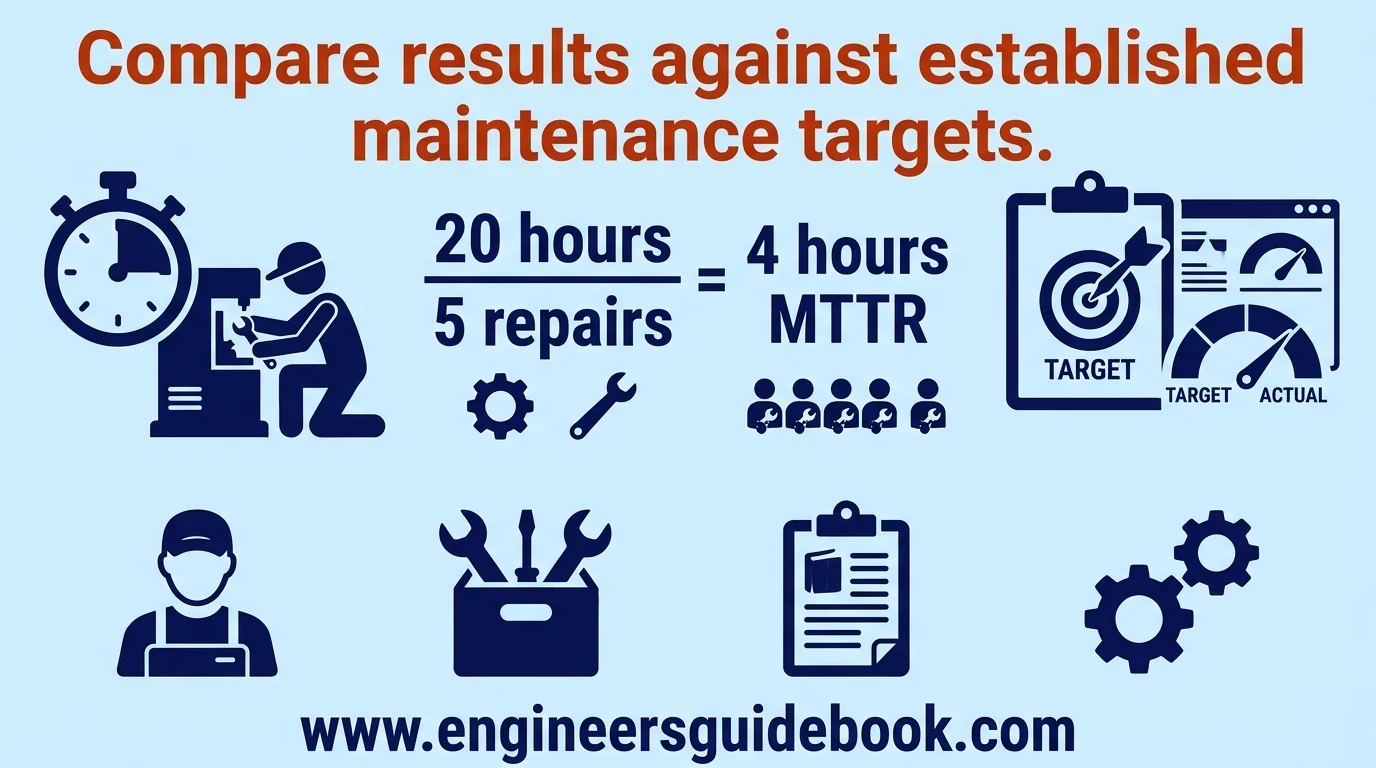
5. Compare results against established maintenance targets.
3.4 Practical MTTR Calculation Example
Consider an industrial machine that underwent five repairs during a specific observation period.
Parameter Value Total repair time 20 hours Number of repairs 5 MTTR 4 hours
MTTR = 20 / 5 = 4 hours
The maintenance team requires an average of four hours to repair the equipment.
3.5 Factors Affecting MTTR
MTTR depends on technician competency, equipment accessibility, troubleshooting procedures, diagnostic instruments, technical documentation, spare parts availability, and repair complexity.
Modular equipment designs and standardized repair procedures can substantially improve maintainability.
4. MTBF vs MTTR Key Differences
4.1 Differences in Definition and Purpose
MTBF evaluates how frequently equipment fails during operation. MTTR evaluates how efficiently maintenance personnel restore failed equipment.
The former focuses on failure prevention, while the latter concentrates on failure recovery.
4.2 Differences in Calculation Methods
MTBF is calculated using total equipment operating time and failure frequency. MTTR uses cumulative repair duration and the number of completed repairs.
Although both metrics are expressed in time units, they represent fundamentally different aspects of maintenance performance.
4.3 Reliability vs Maintainability
Reliability improvement involves reducing equipment failure frequency through improved design, maintenance, and operating practices.
Maintainability improvement focuses on reducing repair complexity and restoration duration. Both characteristics are indispensable for sustainable asset performance.
4.4 High MTBF vs Low MTTR
A high MTBF indicates that equipment operates for longer periods without failure. A low MTTR indicates that failures can be rectified quickly.
Industrial organizations should pursue both objectives rather than optimizing one metric independently.
4.5 MTBF vs MTTR Comparison Table
Comparison Parameter MTBF MTTR Full form Mean Time Between Failures Mean Time to Repair Primary objective Equipment reliability Equipment maintainability Measurement Average operating time Average repair time Desired value Higher Lower Calculation basis Operating hours and failures Repair hours and repairs Improvement focus Failure prevention Faster repairs Maintenance application Reliability assessment Repair performance assessment Availability impact Reduces failure frequency Reduces repair-related downtime
5. How MTBF and MTTR Work Together
5.1 Relationship Between MTBF and MTTR
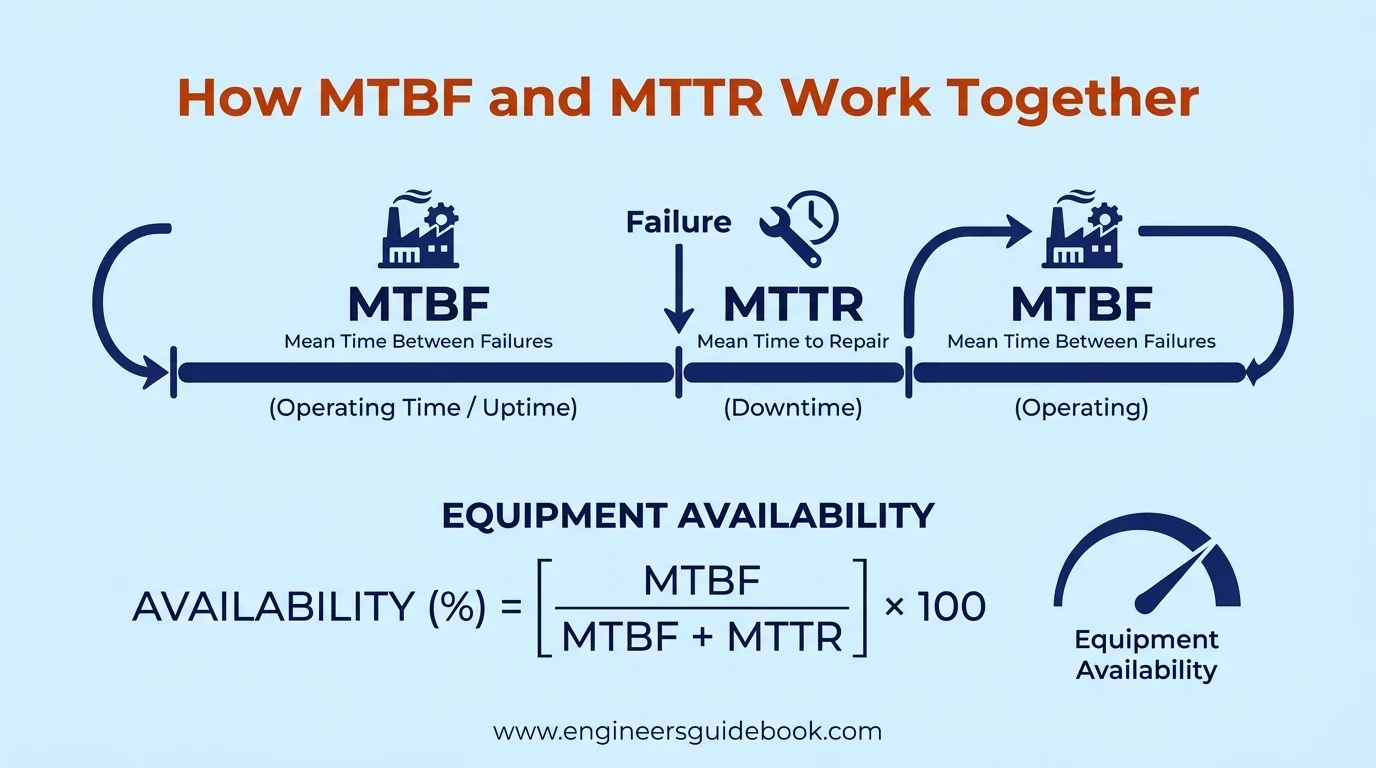
MTBF and MTTR are complementary maintenance indicators. MTBF determines the average operational interval between failures, while MTTR determines the average repair duration.
Their combined evaluation provides a more comprehensive understanding of equipment performance than either metric alone.
5.2 Understanding Equipment Availability
Equipment availability represents the proportion of time an asset is capable of performing its intended function.
Frequent failures and prolonged repairs reduce availability, potentially creating production bottlenecks, financial losses, and operational inefficiencies.
5.3 Equipment Availability Formula Using MTBF and MTTR
Inherent equipment availability can be calculated using the following formula:
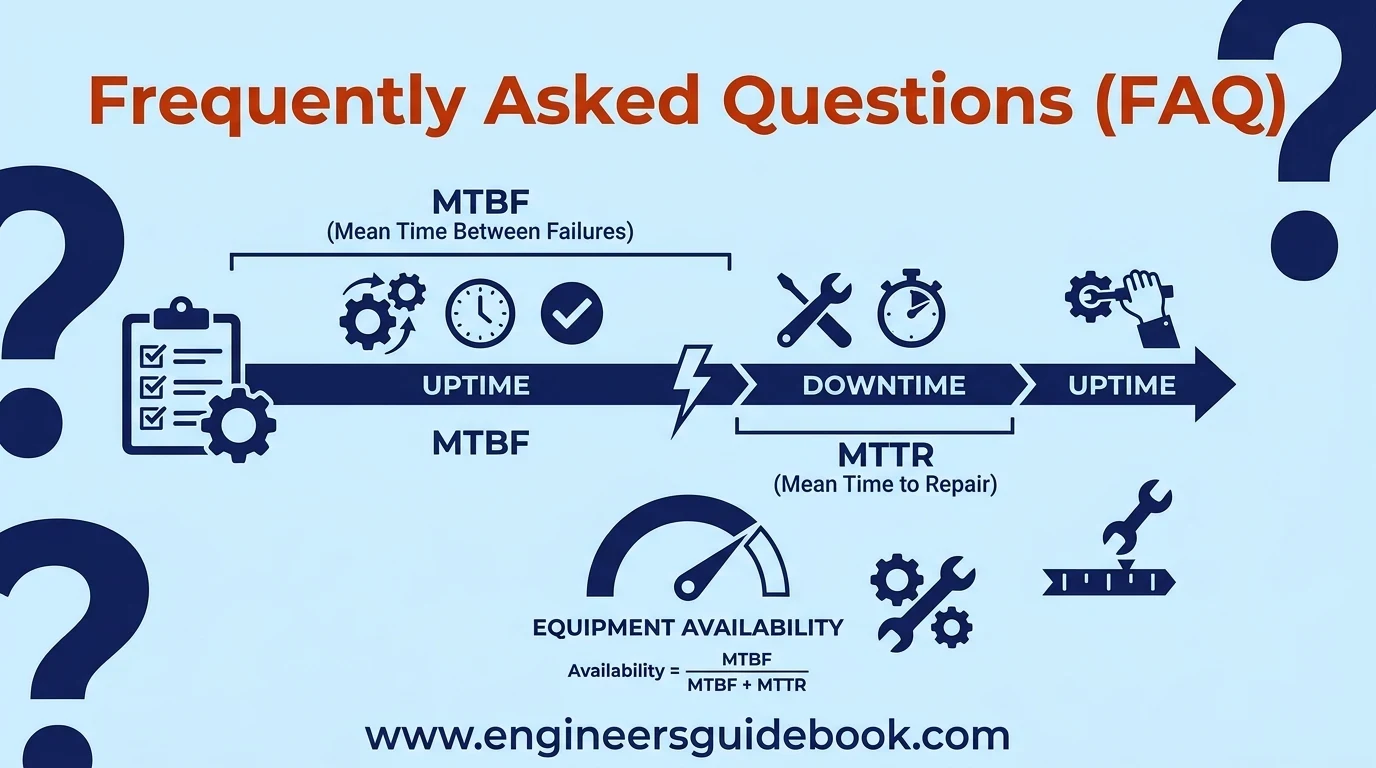
Availability (%) = [MTBF / (MTBF + MTTR)] × 100
This formula estimates steady-state availability based on operating and corrective repair durations. It does not necessarily account for preventive maintenance, administrative delays, or logistical downtime.
5.4 Combined MTBF and MTTR Calculation Example
Consider a manufacturing machine with an MTBF of 500 hours and an MTTR of 5 hours.
Availability = [500 / (500 + 5)] × 100
Availability = 99.01%
The equipment achieves an estimated inherent availability of 99.01%.
Reducing MTTR or increasing MTBF would further improve this availability figure.
5.5 Impact on Equipment Downtime
Higher MTBF reduces the frequency of equipment failures, while lower MTTR reduces the duration of individual repair events.
Combining both improvements minimizes cumulative downtime, strengthens production continuity, and enhances manufacturing efficiency.
6. Understanding Different MTBF and MTTR Scenarios
6.1 High MTBF and Low MTTR
This scenario represents highly reliable and readily maintainable equipment. Failures occur infrequently, and maintenance personnel restore functionality rapidly.
It is generally the most desirable maintenance performance condition.
6.2 High MTBF and High MTTR
Equipment operates reliably for extended periods, but individual failures require prolonged repairs.
Maintenance teams should investigate repair complexity, component accessibility, specialist availability, and spare parts procurement delays.
6.3 Low MTBF and Low MTTR
Equipment fails frequently but can be repaired quickly. Although individual interruptions are short, repeated failures may create considerable cumulative production losses.
Root cause analysis should receive priority over repetitive corrective repairs.
6.4 Low MTBF and High MTTR
This scenario indicates poor reliability and inefficient repair performance.
Frequent breakdowns combined with prolonged restoration periods create substantial operational disruptions. Comprehensive reliability improvement, maintenance process optimization, or equipment replacement may be necessary.
6.5 Identifying the Ideal Maintenance Performance Scenario
Scenario MTBF MTTR Performance Scenario 1 High Low Excellent Scenario 2 High High Repair improvement needed Scenario 3 Low Low Reliability improvement needed Scenario 4 Low High Critical improvement needed
Performance targets should reflect equipment criticality, operating conditions, maintenance economics, and production requirements.

7. Industrial Applications and Practical Examples
7.1 Electric Motor Reliability and Repair Analysis
Electric motors frequently experience bearing degradation, insulation deterioration, overheating, and shaft misalignment.
Monitoring MTBF helps identify recurring motor failures, while MTTR highlights opportunities to improve bearing replacement, electrical troubleshooting, and motor installation procedures.
7.2 Centrifugal Pump Maintenance Performance
Centrifugal pump reliability can deteriorate due to cavitation, mechanical seal leakage, bearing wear, and inadequate lubrication.
Increasing MTBF requires addressing underlying failure mechanisms. Reducing MTTR involves maintaining critical spare parts and standardizing dismantling, assembly, and alignment procedures.
7.3 Manufacturing Production Line Availability
Production lines contain interconnected mechanical, electrical, and automation systems. Failure of a critical component can interrupt the entire manufacturing process.
Monitoring individual equipment MTBF and MTTR helps maintenance teams identify bottlenecks, prioritize critical assets, and improve overall production line availability.
7.4 Industrial Compressor Reliability Assessment
Industrial compressors require effective lubrication, cooling, filtration, and vibration monitoring to maintain reliable operation.
MTBF helps assess compressor failure frequency, whereas MTTR evaluates maintenance effectiveness during component replacement, troubleshooting, and mechanical overhauls.
7.5 Real-World Maintenance Performance Comparison
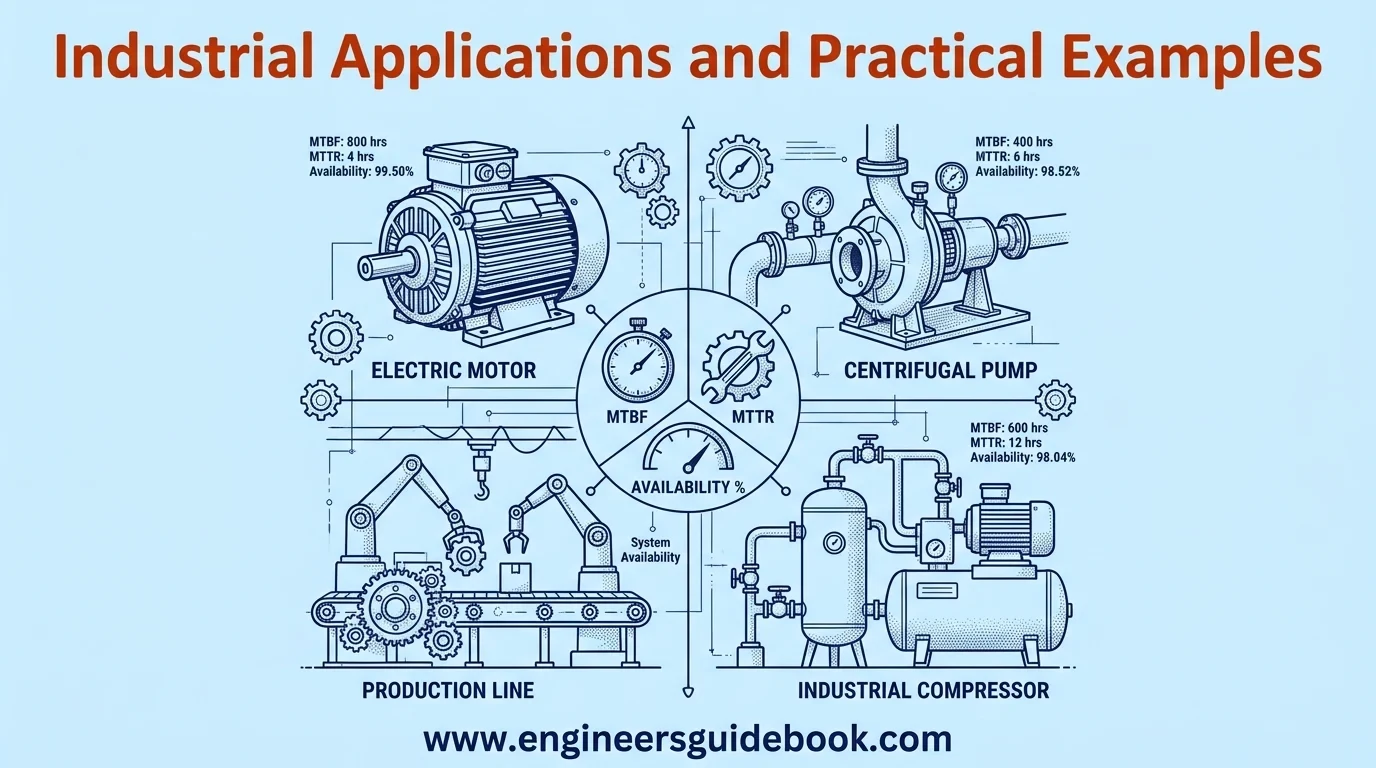
Consider three illustrative industrial assets operating under different maintenance conditions.
Equipment MTBF MTTR Inherent Availability Electric motor 800 hours 4 hours 99.50% Centrifugal pump 400 hours 6 hours 98.52% Industrial compressor 600 hours 12 hours 98.04%
The electric motor demonstrates the highest availability due to its comparatively high MTBF and low MTTR.
Although the compressor has a higher MTBF than the centrifugal pump, its prolonged repair duration results in lower availability. This comparison demonstrates why maintenance teams must evaluate both reliability and maintainability when developing asset performance improvement strategies.
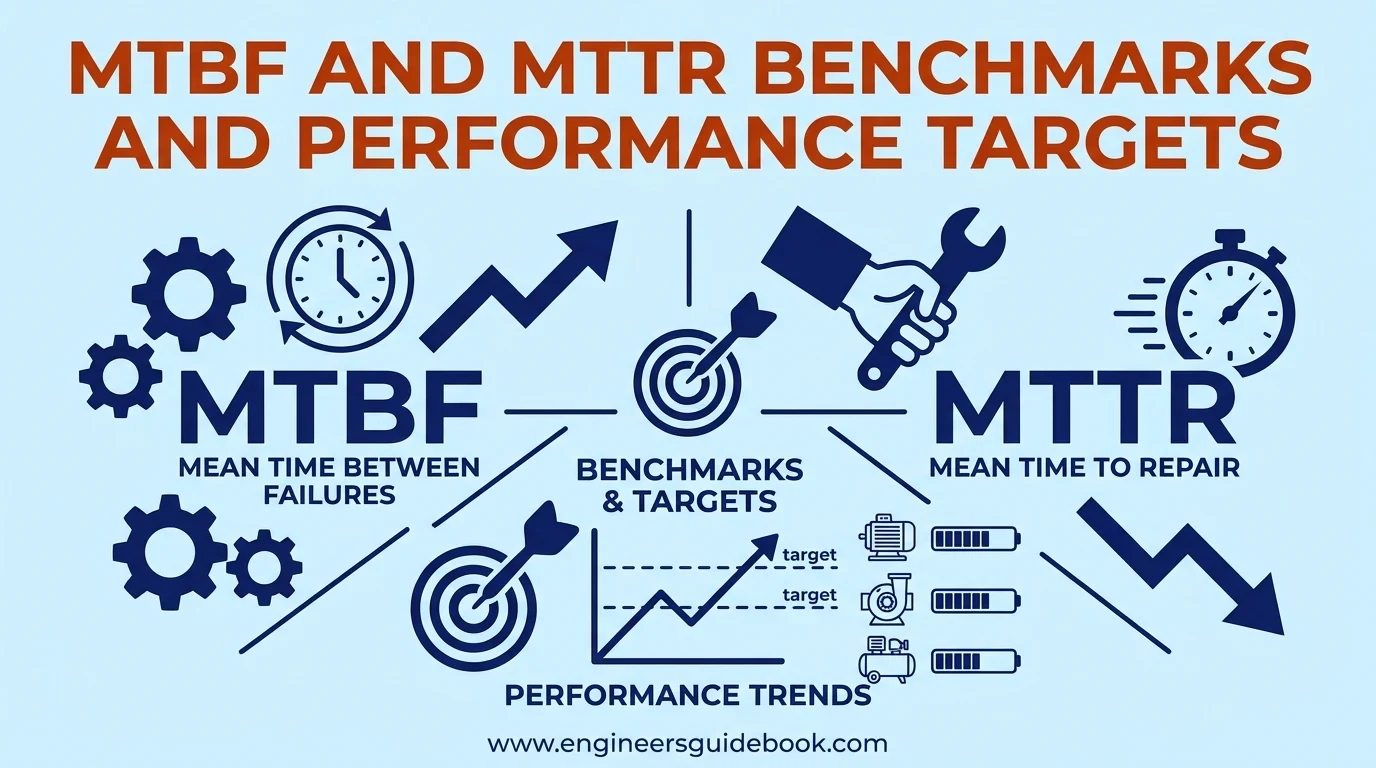
8. MTBF and MTTR Benchmarks and Performance Targets
8.1 What Is a Good MTBF Value?
A good MTBF value depends on equipment classification, operational requirements, environmental conditions, and asset criticality. There is no universally acceptable MTBF benchmark for every industrial machine.
Maintenance teams should compare current MTBF values against historical performance, manufacturer specifications, and comparable equipment operating under similar conditions.
8.2 What Is a Good MTTR Value?
A good MTTR value represents the shortest achievable repair duration without compromising equipment functionality, workmanship, or operational safety.
While minor mechanical repairs may require less than an hour, complex compressor overhauls can take several days. Performance targets should therefore reflect repair complexity and available maintenance resources.
8.3 Equipment-Specific Performance Benchmarks
The following illustrative targets demonstrate how maintenance benchmarks may vary across industrial assets.
Equipment MTBF Target MTTR Target Electric motor 2,000 hours 4 hours Centrifugal pump 1,500 hours 6 hours Industrial compressor 3,000 hours 12 hours Conveyor system 800 hours 2 hours Packaging machine 500 hours 3 hours
These figures are hypothetical planning targets rather than established industry standards.
8.4 Setting Realistic Maintenance Targets
Maintenance targets should follow the SMART framework, meaning specific, measurable, achievable, relevant, and time-bound.
For example, increasing packaging machine MTBF from 300 to 450 hours within six months provides a quantifiable objective for evaluating reliability improvement initiatives.
8.5 Tracking Maintenance Performance Trends
Periodic monitoring reveals whether maintenance interventions produce sustainable improvements. Monthly, quarterly, and annual performance comparisons help identify equipment deterioration, recurrent failures, and repair inefficiencies.
Rolling averages can reduce statistical fluctuations caused by isolated breakdown events.
9. Effective Strategies to Increase MTBF and Reduce MTTR
9.1 Implementing Preventive Maintenance
Preventive maintenance reduces failure probability through scheduled inspections, lubrication, adjustments, cleaning, and component replacement.
Properly established maintenance intervals help mitigate progressive deterioration and premature equipment failure. However, excessive maintenance should be avoided because unnecessary interventions can introduce additional defects.
9.2 Utilizing Predictive and Condition-Based Maintenance
Predictive and condition-based maintenance techniques identify developing equipment abnormalities before functional failure occurs.
Vibration analysis, infrared thermography, ultrasonic testing, and lubricant analysis provide actionable information about equipment health. Early detection allows maintenance teams to schedule interventions before catastrophic breakdowns occur.
9.3 Conducting Root Cause Analysis
Root cause analysis (RCA) identifies the underlying mechanisms responsible for recurrent equipment failures.
Techniques such as the 5 Whys, Fishbone Diagram, Fault Tree Analysis, and Failure Mode and Effects Analysis help identify or investigate failure causes. Eliminating these causes improves MTBF more effectively than repeatedly addressing symptoms.
9.4 Optimizing Spare Parts Management
Spare parts unavailability frequently prolongs equipment restoration time.
Effective inventory management involves identifying critical components, establishing minimum stock levels, monitoring procurement lead times, and maintaining accurate material specifications. These measures reduce logistical downtime and accelerate equipment restoration.
9.5 Improving Maintenance Team Skills
Technician competency directly influences diagnostic accuracy and repair effectiveness.
Regular technical training, practical troubleshooting exercises, equipment-specific instruction, and knowledge-sharing programs improve maintenance capabilities. Skilled technicians can identify complex faults efficiently while minimizing unnecessary component replacement.
9.6 Standardizing Troubleshooting and Repair Procedures
Standard operating procedures (SOPs) establish consistent methods for fault diagnosis, dismantling, component replacement, reassembly, and functional verification.
Documented procedures minimize procedural discrepancies, reduce repair variability, and improve workmanship. Equipment-specific troubleshooting checklists also help technicians avoid repetitive diagnostic activities.

10. Measuring and Monitoring MTBF and MTTR
10.1 Collecting Equipment Failure and Repair Data
Accurate maintenance performance measurement begins with reliable operational data.
Essential information includes equipment identification, actual operating hours, failure timestamps, failure descriptions, repair durations, replaced components, and equipment restoration timestamps. Incomplete records can produce misleading reliability and maintainability assessments.
10.2 Using CMMS for Maintenance Tracking
A Computerized Maintenance Management System (CMMS) facilitates centralized maintenance documentation, work order management, failure tracking, and asset history analysis.
Automated KPI calculations reduce administrative workload and improve data traceability. Maintenance managers can also identify recurring failures across individual assets and equipment categories.
10.3 Developing Maintenance KPI Dashboards
Maintenance dashboards consolidate performance indicators into accessible visual formats.
A comprehensive dashboard should include:
Mean Time Between Failures (MTBF)
Mean Time to Repair (MTTR)
Equipment availability
Breakdown frequency
Total equipment downtime
Preventive maintenance compliance
Maintenance expenditure
These indicators provide a multidimensional assessment of maintenance effectiveness.
10.4 Analyzing Historical Maintenance Data
Historical maintenance records reveal recurring failure mechanisms, seasonal performance variations, and deteriorating equipment conditions.
Pareto analysis can identify assets responsible for disproportionate downtime, while trend analysis helps determine whether corrective actions have generated measurable reliability improvements.
10.5 Integrating MTBF and MTTR With OEE
Overall Equipment Effectiveness (OEE) evaluates manufacturing performance through availability, performance, and quality.
OEE = Availability × Performance × Quality
MTBF and MTTR primarily influence the availability component by affecting breakdown frequency and duration. However, inherent equipment availability should not automatically be treated as OEE availability because their calculation boundaries differ.
10.6 Data-Driven Maintenance Decision-Making
Maintenance decisions should be supported by empirical evidence rather than assumptions.
Equipment exhibiting declining MTBF requires reliability investigation, whereas increasing MTTR may indicate maintainability deficiencies. Combining both metrics with maintenance costs and asset criticality enables more judicious resource allocation.

11. Common Mistakes and Limitations of MTBF and MTTR
11.1 Incorrect Operating Time and Downtime Calculations
Including non-operating hours in MTBF calculations can artificially inflate reliability figures. Similarly, inconsistent inclusion of waiting periods in MTTR calculations can distort repair performance assessments.
Standardized calculation boundaries are essential for accurate comparisons.
11.2 Inconsistent Failure and Repair Definitions
Different departments may classify minor stoppages, component defects, and complete breakdowns differently.
Organizations should establish uniform definitions for functional failure, corrective repair, operating time, and equipment restoration. Consistency improves the statistical integrity of maintenance records.
11.3 Confusing MTBF With Equipment Lifespan
MTBF does not represent the total expected service life of equipment.
A machine with an MTBF of 1,000 hours does not necessarily become unusable after 1,000 hours. The metric represents an estimated average operating duration between failures of repairable equipment.
11.4 Ignoring Equipment Operating Conditions
Temperature, humidity, contamination, mechanical loading, operating speed, and duty cycles influence equipment reliability.
Comparing identical machines operating under substantially different conditions without appropriate normalization may produce erroneous conclusions about maintenance effectiveness.
11.5 Overreliance on Average Performance Values
MTBF and MTTR are statistical averages that can conceal significant performance variability.
Maintenance teams should supplement these metrics with failure distributions, median repair times, standard deviations, and individual breakdown histories to obtain a more comprehensive understanding of asset behavior.
11.6 Neglecting Equipment Criticality and Maintenance Costs
Not every equipment failure has equivalent operational consequences.
A relatively infrequent failure of a critical production asset may generate greater financial losses than frequent failures of auxiliary equipment. Maintenance priorities must therefore incorporate production consequences, safety implications, and lifecycle costs.

12. Frequently Asked Questions (FAQ)
12.1 What Is the Main Difference Between MTBF and MTTR?
MTBF measures the average operating time between equipment failures, while MTTR measures the average time required to repair failed equipment. MTBF evaluates reliability, whereas MTTR evaluates maintainability.
12.2 How Do MTBF and MTTR Affect Equipment Availability?
Higher MTBF reduces failure frequency, while lower MTTR minimizes repair duration. Together, these improvements increase equipment availability and reduce corrective maintenance downtime.
12.3 Is a Higher MTBF Always Better?
Generally, a higher MTBF indicates improved equipment reliability. However, excessively expensive maintenance interventions may make further reliability improvements economically unjustifiable. Data accuracy and comparable operating conditions must also be considered.
12.4 Is a Lower MTTR Always Better?
A lower MTTR is desirable when repairs are completed safely and effectively. Rushed repairs that compromise workmanship or equipment integrity can cause recurrent failures and reduce long-term reliability.
12.5 Can MTTR Be Greater Than MTBF?
Yes. MTTR can exceed MTBF when equipment fails frequently and requires prolonged repairs. Under the inherent availability formula, this condition results in equipment availability below 50%.
12.6 How Do You Calculate Availability Using MTBF and MTTR?
Inherent equipment availability is calculated using the following formula:
Availability (%) = [MTBF / (MTBF + MTTR)] × 100
Both metrics must use identical time units and consistent measurement boundaries.
12.7 What Is the Difference Between MTBF, MTTR, and MTTF?
MTBF measures average operating time between failures of repairable equipment. MTTR measures average repair duration, while MTTF (Mean Time to Failure) measures the expected operating time until failure, commonly for non-repairable components.
12.8 How Can MTBF Be Increased and MTTR Reduced?
MTBF can be increased through preventive maintenance, condition monitoring, improved equipment design, and root cause elimination. MTTR can be reduced through technician training, standardized repair procedures, improved accessibility, and efficient spare parts management.
12.9 What Is the Relationship Between MTBF, MTTR, and OEE?
MTBF and MTTR influence the availability component of OEE by determining failure frequency and repair duration. Improvements in both metrics can increase OEE when other production factors remain unchanged.
12.10 Which Is More Important, MTBF or MTTR?
Neither metric is universally more important. MTBF deserves greater attention when failures occur frequently, whereas MTTR becomes particularly important when prolonged repairs dominate equipment downtime.
13. Conclusion
13.1 Key Takeaways From MTBF vs MTTR
MTBF and MTTR are complementary maintenance KPIs that measure equipment reliability and maintainability. Their combined evaluation provides valuable insights into equipment availability and maintenance performance.
13.2 Balancing Equipment Reliability and Maintainability
Effective maintenance management requires simultaneous attention to failure prevention and repair efficiency. Optimizing either metric independently may overlook significant opportunities for operational improvement.
13.3 Maximizing Equipment Availability and Operational Efficiency
Increasing MTBF and reducing MTTR helps minimize downtime, strengthen production continuity, and improve asset utilization. These improvements contribute to lower maintenance costs and enhanced manufacturing productivity.
13.4 Achieving Long-Term Maintenance Performance Improvement
Sustainable maintenance excellence requires accurate data collection, continuous performance monitoring, systematic root cause analysis, and proactive maintenance strategies. Integrating MTBF and MTTR into an organization’s reliability management framework enables measurable improvements in equipment performance, operational resilience, and long-term asset management effectiveness.