1. Introduction to Bearing Numbers
1.1 What Is a Bearing Number?
A bearing number is a structured alphanumeric code assigned to a bearing to define its essential characteristics. It acts as a compact technical language, conveying critical information such as type, size, load capacity, internal design, and special features.
Rather than relying on lengthy descriptions, engineers and technicians use these codes to quickly identify and specify bearings. Each digit and letter is deliberate. Nothing is arbitrary. And we will learn in this guide step by step how to Read Bearing number.
1.2 Overview of Standard Bearing Identification Systems
Bearing numbering systems are largely standardized, primarily governed by ISO conventions. However, manufacturers may introduce slight variations through prefixes and suffixes.
Despite these differences, the core structure remains consistent across major brands. This universality enables interchangeability and simplifies global procurement. Engineers can decode a bearing from one manufacturer and find its equivalent elsewhere with confidence.
2. Basic Structure of a Bearing Number
2.1 General Format of Bearing Codes
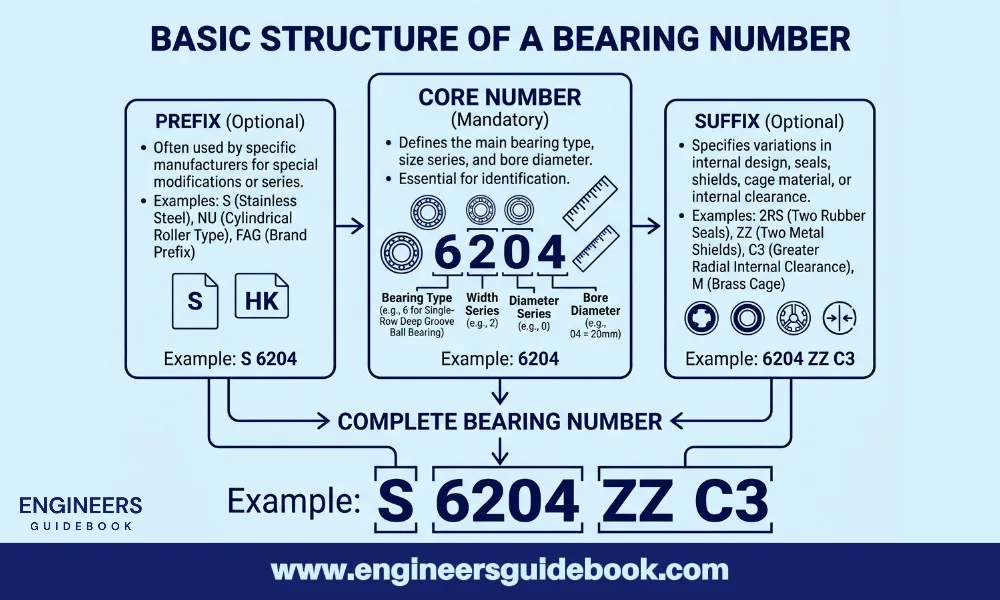
A typical bearing number consists of three main components:
- Prefix (optional)
- Core number (mandatory)
- Suffix (optional)
The core number itself is the backbone of the code. It usually contains a series designation, a type identifier, and a bore size indicator. Each segment carries precise technical meaning.
2.2 Prefixes, Core Numbers, and Suffixes Explained
Prefixes often indicate special design features or modifications applied before the standard configuration. These may include non-standard materials or unique construction styles.
The core number defines the fundamental attributes—bearing type, dimensional series, and bore diameter. This is the most critical portion of the code.
Suffixes, on the other hand, provide additional information about internal clearance, sealing arrangements, lubrication, or accuracy class. They refine the specification further, ensuring the bearing matches the exact application requirements.
2.3 Example Breakdown of a Typical Bearing Number
Consider a bearing labeled 6205-2RS-C3.
- 6 → Deep groove ball bearing type
- 2 → Light series
- 05 → Bore size (25 mm)
- 2RS → Rubber seals on both sides
- C3 → Increased internal clearance
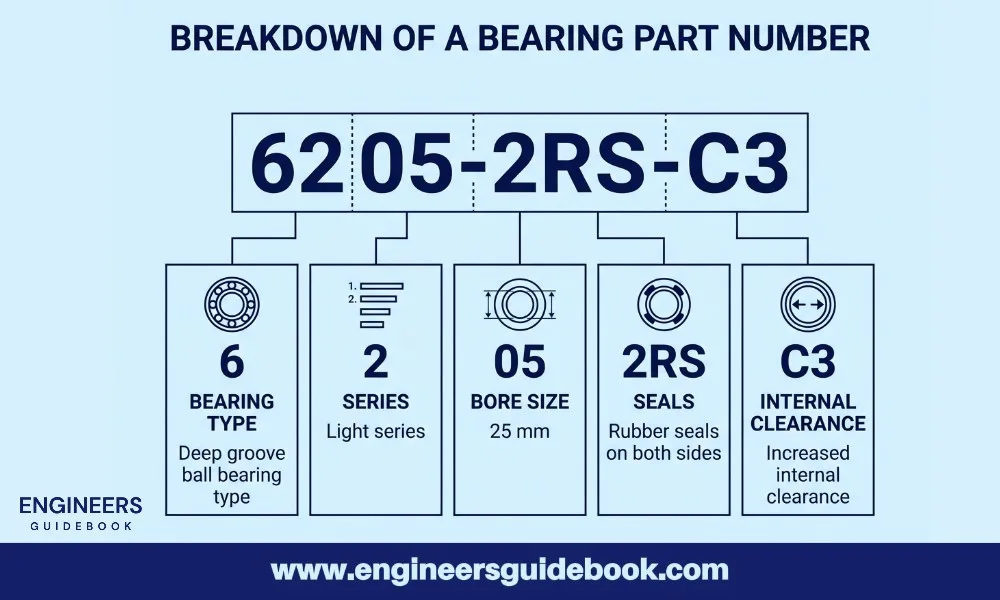
This concise string encapsulates multiple engineering parameters. Once understood, it becomes an efficient diagnostic and selection tool.
3. How to Read Bearing Number
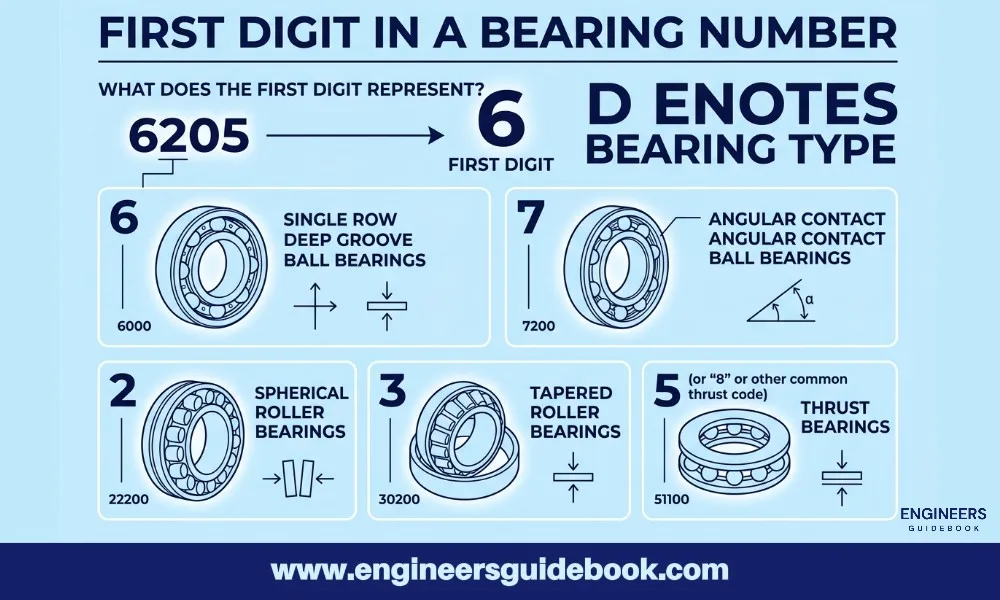
3.1 What Does the First Digit Represent?
The first digit in a bearing number typically denotes the bearing type. It distinguishes between categories such as ball bearings, roller bearings, and thrust bearings.
This initial identifier is crucial. It immediately narrows down the functional behavior of the bearing, including load direction and speed capability.
3.2 Light, Medium, and Heavy Bearing Series
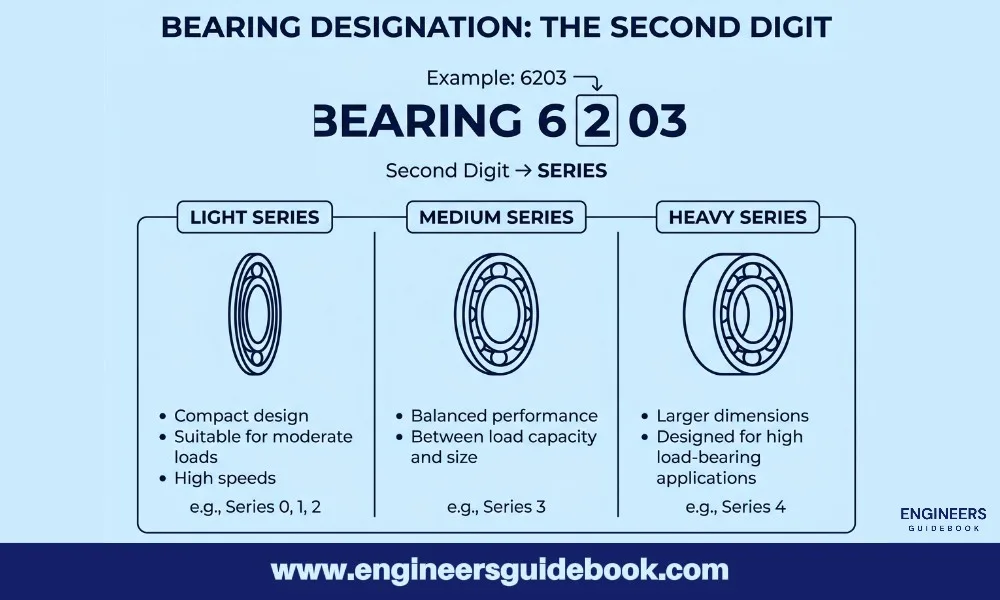
The second digit generally represents the bearing series, which relates to its robustness and cross-sectional dimensions.
- Light series: Compact design, suitable for moderate loads and high speeds
- Medium series: Balanced performance between load capacity and size
- Heavy series: Larger dimensions, designed for high load-bearing applications
This classification ensures that the bearing aligns with the mechanical stresses it will encounter.
3.3 How Series Affects Load Capacity and Application
Bearing series directly influence load capacity, stiffness, and durability. A heavier series bearing can higher radial and axial loads but occupies more space and may operate at lower speeds.
Conversely, lighter series bearings are ideal for applications where space constraints and rotational speed are critical. Selecting the correct series is a trade-off. Performance must align with design constraints.
Also Read Similar Articles:
Ball Bearings: Fundamental Concepts and Applications
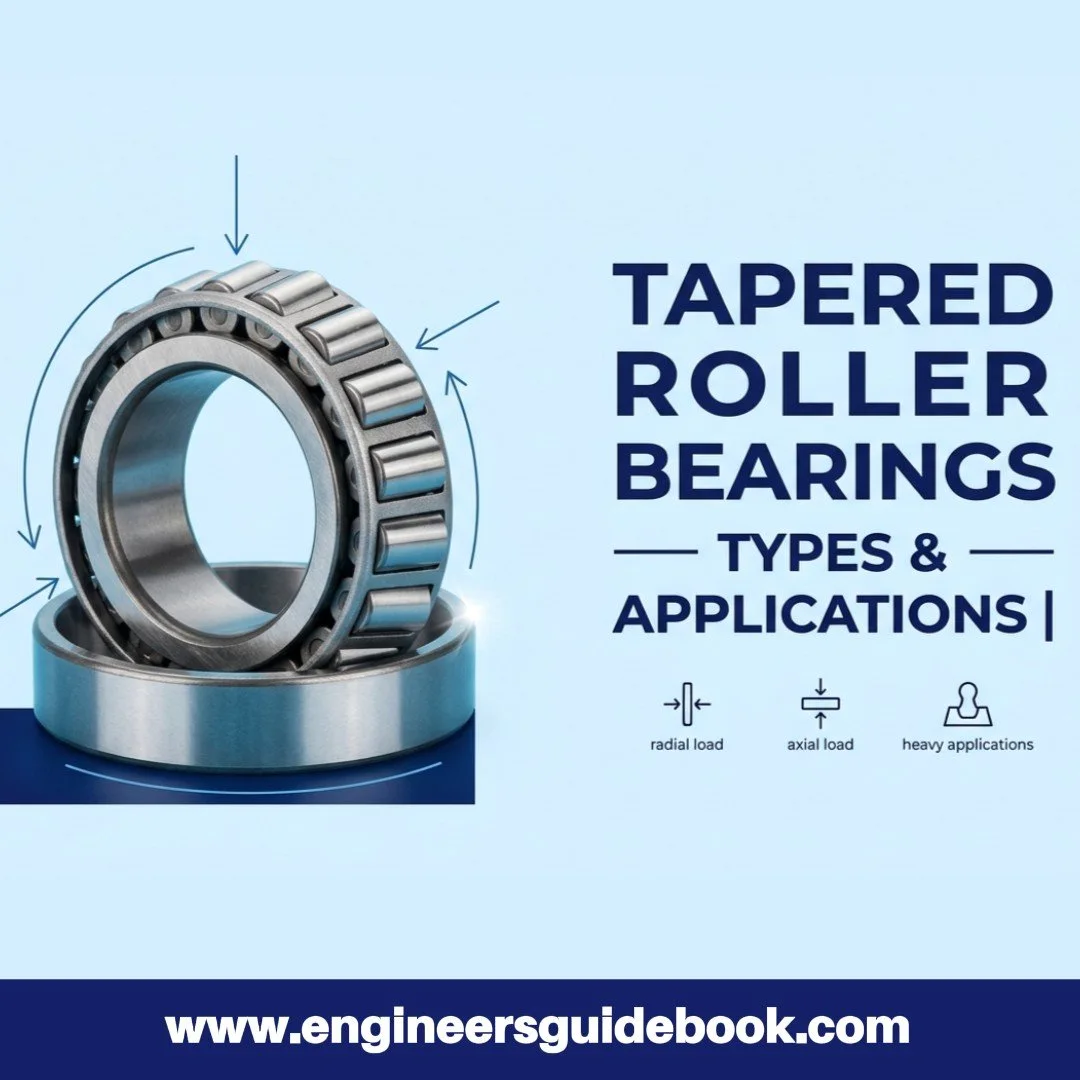
Tapered Roller Bearings | Types and Applications |
How to Choose the Right Bearing |Step-by-Step Selection Guide|
Thrust Bearing Types, Features, Applications
4. Decoding the Bearing Type Code
4.1 Identifying Bearing Types from Codes
Each bearing type is assigned a specific numerical identifier. For instance:
- 6 → Deep groove ball bearing
- 7 → Angular contact bearing
- 2 → Spherical roller bearing
Recognizing these codes enables immediate identification of the bearing’s operational characteristics.
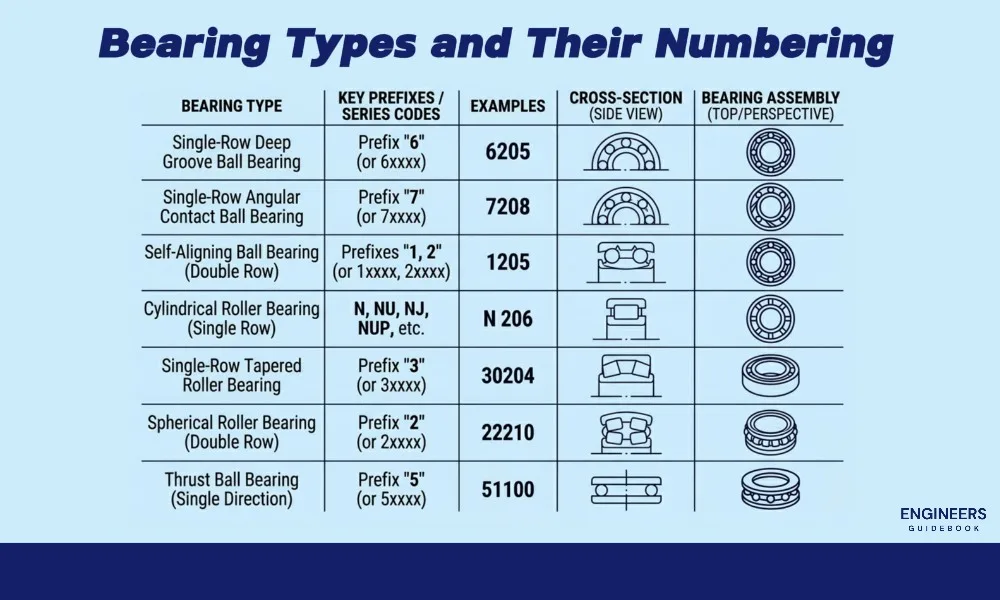
4.2 Common Bearing Types and Their Numbering (Ball, Roller, Needle)
Different bearing types serve distinct purposes:
- Ball Bearings (6xxx): High-speed applications with moderate loads
- Cylindrical Roller Bearings (NU, NJ series): High radial load capacity
- Needle Bearings: Compact design with high load capacity in limited space
- Tapered Roller Bearings: Suitable for combined radial and axial loads
4.3 Application-Based Selection Using Type Codes
Selecting a bearing type depends on operational demands. High-speed electric motors favor deep groove ball bearings. Heavy industrial equipment often relies on roller bearings for their superior load-handling capabilities.
The type code simplifies this selection process. It acts as a shortcut to understanding the bearing’s functional domain.
5. Bore Size Identification in Bearing Numbers
5.1 How Bore Diameter Is Represented
The last two digits of the core bearing number typically indicate the bore size. This dimension corresponds to the inner diameter of the bearing, which fits onto the shaft.
For most bearings, these digits follow a standardized scaling rule.
5.2 Standard Bore Size Calculation Method
For bore codes 04 and above, the bore diameter is calculated by multiplying the code by 5.
Examples:
- 04 → 20 mm
- 05 → 25 mm
- 06 → 30 mm
This simple multiplication rule allows quick determination of shaft compatibility.
5.3 Special Cases (Bore Sizes Below 20 mm)
Bore codes below 04 do not follow the standard multiplication rule. Instead, they are predefined:
- 00 → 10 mm
- 01 → 12 mm
- 02 → 15 mm
- 03 → 17 mm
These exceptions must be memorized or referenced, as they deviate from the general pattern. Overlooking them can lead to incorrect bearing selection.
6. Prefixes in Bearing Numbers
6.1 What Are Prefixes and Why They Matter
Prefixes are alphanumeric characters placed before the core bearing number to denote specialized design attributes or non-standard configurations. They function as pre-identifiers, signaling that the bearing deviates in some way from conventional specifications.
In engineering practice, these seemingly minor additions carry substantial weight. A prefix may indicate a modified internal geometry, a unique cage design, or even a bearing tailored for a specific industrial application. Ignoring prefixes can lead to misinterpretation. And in high-stakes environments, such oversight is costly.
6.2 Common Prefixes and Their Meanings
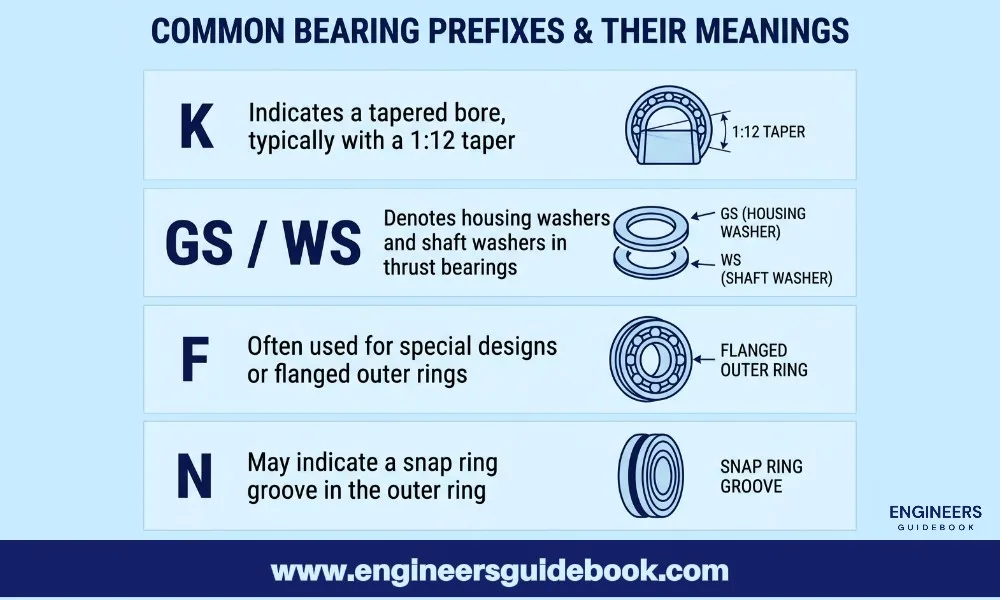
Several widely recognized prefixes are used across bearing catalogs:
- K: Indicates a tapered bore, typically with a 1:12 taper
- GS / WS: Denotes housing washers and shaft washers in thrust bearings
- F: Often used for special designs or flanged outer rings
- N: May indicate a snap ring groove in the outer ring
6.3 Manufacturer-Specific Prefix Variations
While international standards exist, manufacturers frequently introduce proprietary prefixes to differentiate their products. These variations may reflect unique engineering enhancements, material upgrades, or application-specific optimizations.
For instance, one manufacturer may use a prefix to denote reinforced cages, while another may use a different symbol for the same feature. Therefore, consulting manufacturer catalogs becomes indispensable. Uniformity exists—but only to a point.
7. Suffixes in Bearing Numbers
7.1 Role of Suffixes in Bearing Identification
Suffixes appear after the core bearing number and provide granular detail about the bearing’s internal configuration and operational features. They refine the identity of the bearing, transforming a generic component into a highly specialized mechanical element.
These codes often define lubrication provisions, sealing arrangements, internal clearance, and precision class. In essence, suffixes complete the narrative initiated by the core number.
7.2 Common Suffix Codes (Seals, Shields, Clearance)
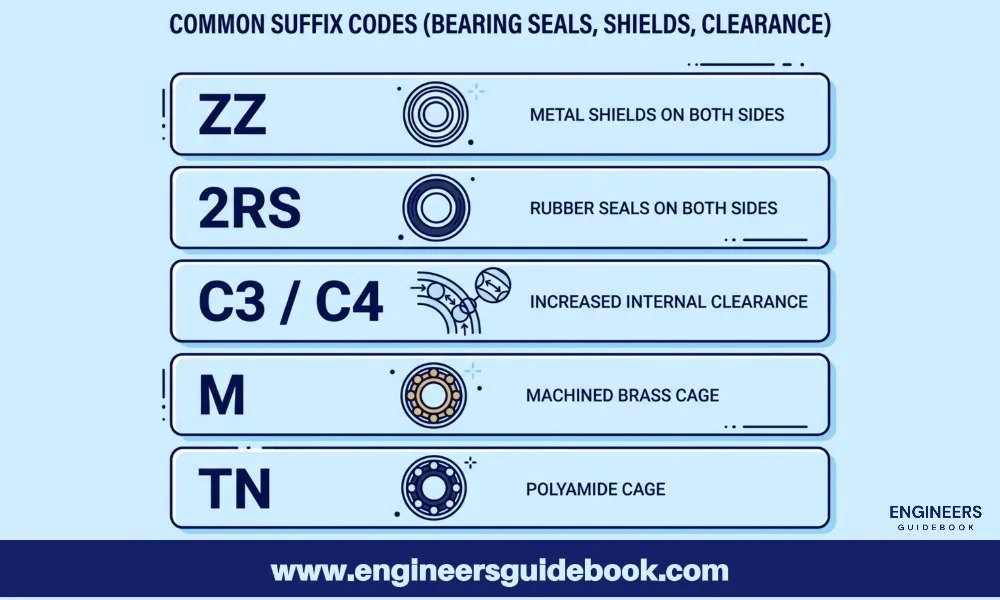
Some frequently encountered suffixes include:
- ZZ: Metal shields on both sides
- 2RS: Rubber seals on both sides
- C3 / C4: Increased internal clearance
- M: Machined brass cage
- TN: Polyamide cage
Each suffix is a technical annotation. It ensures that the bearing performs optimally under specified operating conditions, whether high-speed rotation or contamination-prone environments.
7.3 How Suffixes Impact Performance and Maintenance
Suffixes are not merely descriptive—they are prescriptive. A bearing with a 2RS seal, for instance, offers superior protection against dust and moisture but may exhibit slightly higher friction. Conversely, shielded bearings (ZZ) allow higher speeds but provide less sealing integrity.
Maintenance strategies are also influenced. Sealed bearings often require minimal lubrication intervention, whereas open variants demand periodic servicing. Thus, suffix selection directly affects lifecycle cost and reliability.
8. Internal Clearance and Tolerance Codes
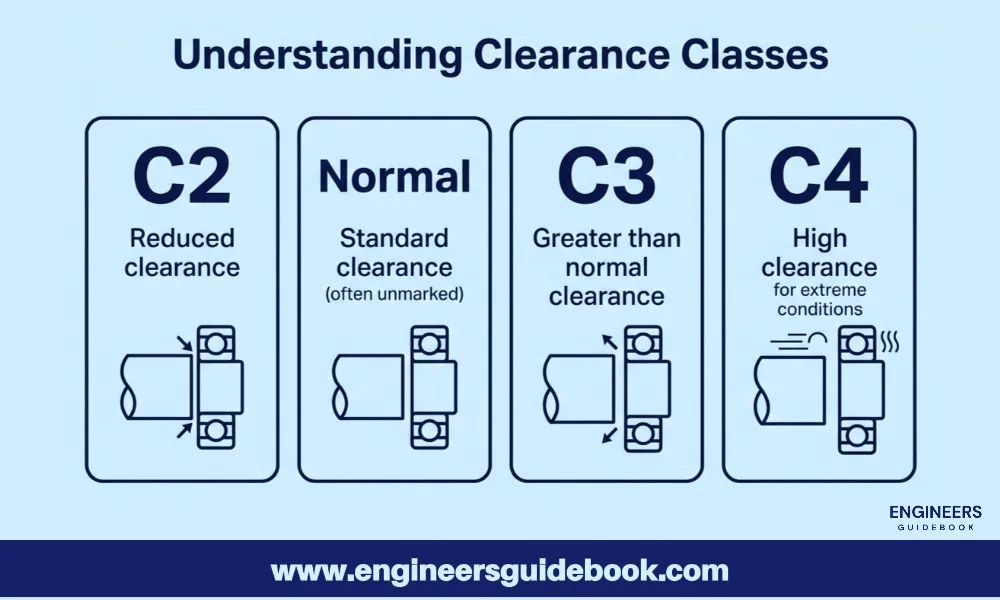
8.1 Understanding Clearance Classes (C2, C3, C4)
Internal clearance refers to the slight gap between rolling elements and raceways. This microscopic space accommodates thermal expansion and operational deformation.
- C2: Reduced clearance
- Normal: Standard clearance (often unmarked)
- C3: Greater than normal clearance
- C4: High clearance for extreme conditions
Choosing the correct clearance is critical. Too tight, and friction escalates. Too loose, and vibration becomes problematic.
8.2 Tolerance Classes and Precision Levels
Tolerance classes define the permissible deviation in bearing dimensions and rotational accuracy. These are often expressed using standards such as P0 (normal), P6, P5, and P4, with increasing precision.
High-precision bearings are indispensable in applications like machine tools and turbines, where even micron-level inaccuracies can compromise performance. Precision is not optional in such contexts—it is foundational.
8.3 When to Choose Higher Clearance Bearings
Higher clearance bearings, such as C3 or C4, are typically selected for high-speed or high-temperature environments. As components heat up, they expand. Without adequate internal clearance, this expansion can induce excessive preload and eventual failure.
Electric motors, for example, frequently utilize C3 clearance bearings. It is a deliberate choice. Thermal dynamics demand it.
9. Sealing and Shielding Codes
9.1 Types of Bearing Seals (Open, ZZ, 2RS)
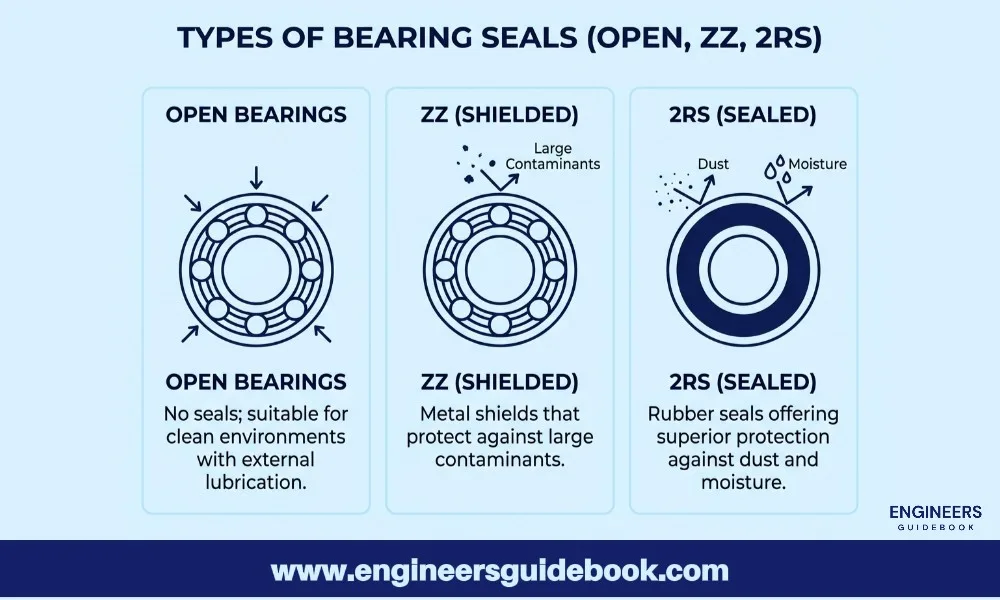
Bearings are available in various sealing configurations, each suited to specific environmental conditions:
- Open Bearings: No seals; suitable for clean environments with external lubrication
- ZZ (Shielded): Metal shields that protect against large contaminants
- 2RS (Sealed): Rubber seals offering superior protection against dust and moisture
The choice is situational. There is no universal solution.
9.2 How to Identify Sealing from the Bearing Number
Sealing arrangements are typically indicated by suffixes appended to the bearing number. For instance, 6205-ZZ clearly denotes a shielded bearing, while 6205-2RS indicates a sealed variant.
These suffixes provide immediate clarity. No additional documentation is required if the coding system is understood.
9.3 Choosing the Right Seal for Industrial Applications
Selecting the appropriate sealing mechanism depends on environmental exposure, speed, and maintenance constraints.
Dust-laden environments necessitate sealed bearings. High-speed applications may favor shielded or open designs to minimize frictional losses. In corrosive settings, advanced sealing materials become essential.
The decision is rarely trivial. It requires a balanced evaluation of performance and durability.
10. Material and Special Design Codes
10.1 Codes Indicating Special Materials (Stainless Steel, Ceramic)
Material composition significantly influences bearing performance. Certain codes indicate specialized materials:
- SS: Stainless steel bearings for corrosion resistance
- Hybrid Bearings: Ceramic rolling elements combined with steel races
- Full Ceramic Bearings: Designed for extreme environments
These materials extend operational boundaries, enabling bearings to function under atypical conditions.
10.2 High-Temperature and Corrosion-Resistant Bearings
Bearings operating in elevated temperatures or chemically aggressive environments require bespoke design considerations. Special suffixes may indicate heat stabilization or corrosion-resistant coatings.
Such bearings often feature advanced lubricants or dry-running capabilities. They are engineered for resilience. Conventional bearings would fail prematurely under similar conditions.
10.3 Custom Design Indicators in Bearing Numbers
Custom or application-specific bearings often include unique identifiers within their numbering system. These may denote non-standard dimensions, specialized cages, or enhanced load capacities.
In many cases, these codes are proprietary. Interpretation requires direct reference to manufacturer documentation. Precision demands specificity.
11. Practical Examples of Bearing Number Interpretation
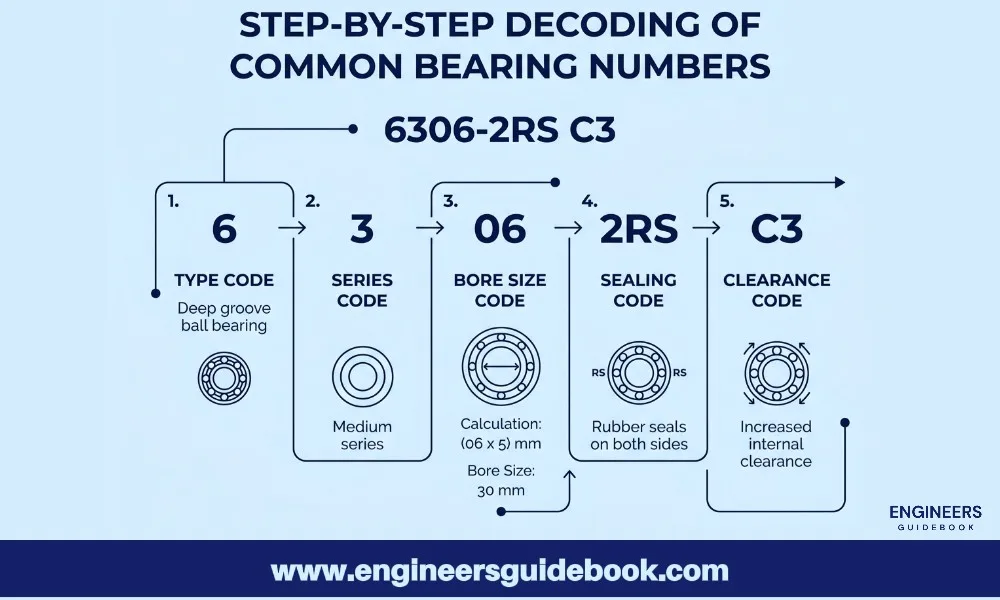
11.1 Step-by-Step Decoding of Common Bearing Numbers
Consider the bearing 6306-2RS-C3:
- 6 → Deep groove ball bearing
- 3 → Medium series
- 06 → Bore size (30 mm)
- 2RS → Rubber seals on both sides
- C3 → Increased internal clearance
Each segment contributes a distinct piece of information. Together, they form a complete technical profile.
11.2 Real-World Industrial Examples
In industrial motors, bearings like 6204-ZZ-C3 are commonly used. The shielding protects against dust ingress, while the increased clearance accommodates thermal expansion.
In heavy machinery, a bearing such as 22210 K C3 may be selected. Here, the spherical roller design handles misalignment, while the tapered bore facilitates secure mounting.
These examples illustrate how bearing numbers translate directly into functional decisions.
11.3 Common Mistakes While Reading Bearing Numbers
Misinterpretation often stems from overlooking suffixes or miscalculating bore size. Assuming all bearings follow identical coding conventions is another frequent error.
Neglecting manufacturer-specific variations can also lead to incorrect substitutions. Precision in reading is essential. Even a single misplaced assumption can compromise the entire system.
12. Common FAQs About Bearing Numbers
1. What do the numbers on a bearing mean?
This is the most frequently searched question. Users want to understand what each digit represents—typically bearing type, series (load capacity), and bore size.
2. How do you read a bearing number step by step?
A very common query focused on the decoding process. It involves breaking the number into parts: prefix, basic designation (type + series + bore), and suffix.
3. What does the last two digits in a bearing number indicate?
Many users specifically ask about bore size calculation. The last two digits usually represent the inner diameter (often multiplied by 5 for standard bearings).
4. What do bearing suffixes like ZZ, 2RS, or C3 mean?
This question targets the additional codes after the main number, which indicate sealing type, internal clearance, and special features.
5. Are bearing numbers the same across all brands?
A widely asked question related to interchangeability. Most users want to know if a bearing number (e.g., 6205) is universal or varies between manufacturers.
13. Conclusion
Bearing numbers are not arbitrary sequences; they are structured technical descriptors. Each digit and letter conveys a specific parameter—type, size, series, clearance, or special feature
Understanding this coding system transforms a complex identification process into a streamlined exercise. It empowers engineers to interpret specifications rapidly and accurately. Clarity replaces ambiguity.
Accurate bearing identification is foundational to mechanical reliability. An incorrect selection can precipitate excessive wear, thermal instability, or even catastrophic failure.
Conversely, precise identification ensures optimal load distribution, efficient operation, and extended service life. It also reduces maintenance frequency and operational downtime. In industrial environments, this translates directly into cost savings and productivity gains.