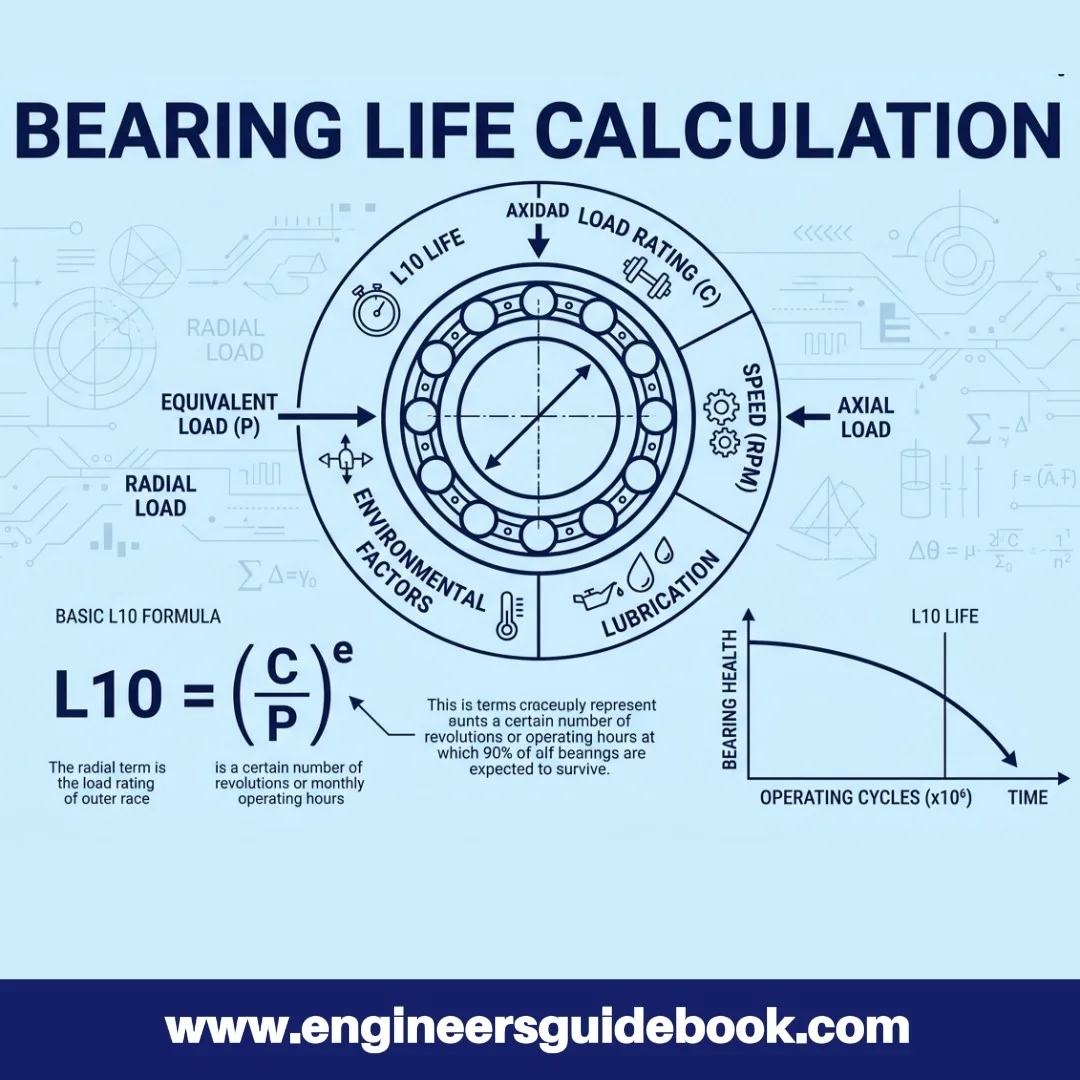
1. What is Bearing Life?
Bearing Life Calculation is a fundamental engineering process used to estimate how long a bearing will operate before failure under specific conditions. In industrial environments, bearings are critical components that support rotating shafts and reduce friction between moving parts.
The life of a bearing is not simply measured in time but in the number of revolutions or operating hours it can sustain before fatigue occurs. This makes Bearing Life Calculation an essential part of machine design, maintenance planning, and reliability engineering.
1.1 Why Bearing Life Calculation is Important
Accurate Bearing Life Calculation helps engineers:
- Predict maintenance intervals
- Reduce unexpected downtime
- Improve machine reliability
- Optimize bearing selection
- Lower operational costs
Without proper Bearing Life Calculation, equipment may fail prematurely, leading to costly repairs and production losses.
2. Bearing Life Calculation Formula
2.1 Standard Bearing Life Equation
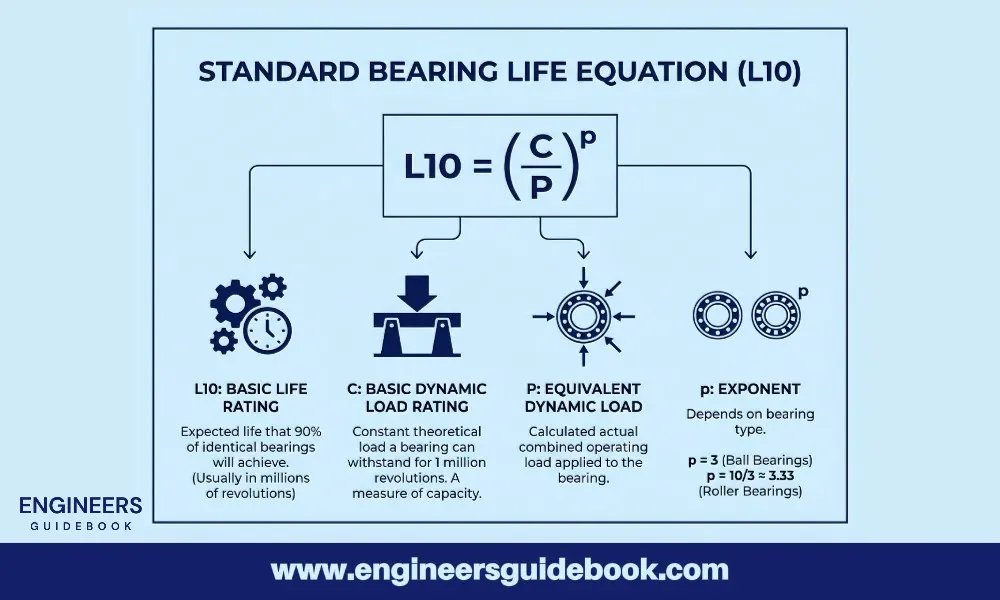
Bearing Life Calculation is typically performed using the basic life equation:
L10 = (C / P)^p
Where:
- L10 = Basic rating life (in million revolutions)
- C = Dynamic load rating (N)
- P = Equivalent dynamic load (N)
- p = Life exponent
Values of p:
- For ball bearings: p = 3
- For roller bearings: p = 10/3
This formula is the industry standard for Bearing Life Calculation and is widely used in engineering design and maintenance planning.
Also Read These:
Thrust Bearing Types, Features, Applications
Types of Roller Bearings |Classification and Applications|
Ball Bearings: Fundamental Concepts and Applications
How to Read Bearing Number | Step By Step Guide |
3. Types of Bearing Life
3.1 L10 Life (Basic Rating Life)
The L10 life represents the number of revolutions at which 90% of a group of identical bearings will still be operational. It is the most commonly used metric in Bearing Life Calculation.
3.2 L50 Life (Median Life)
The L50 life indicates the life at which 50% of bearings are expected to fail. It is often used for statistical analysis but less common in practical Bearing Life Calculation.

3.3 Service Life vs Rating Life
- Rating Life: Theoretical life based on ideal conditions
- Service Life: Actual life considering lubrication, contamination, and misalignment
Understanding this difference is crucial for realistic Bearing Life Calculation.
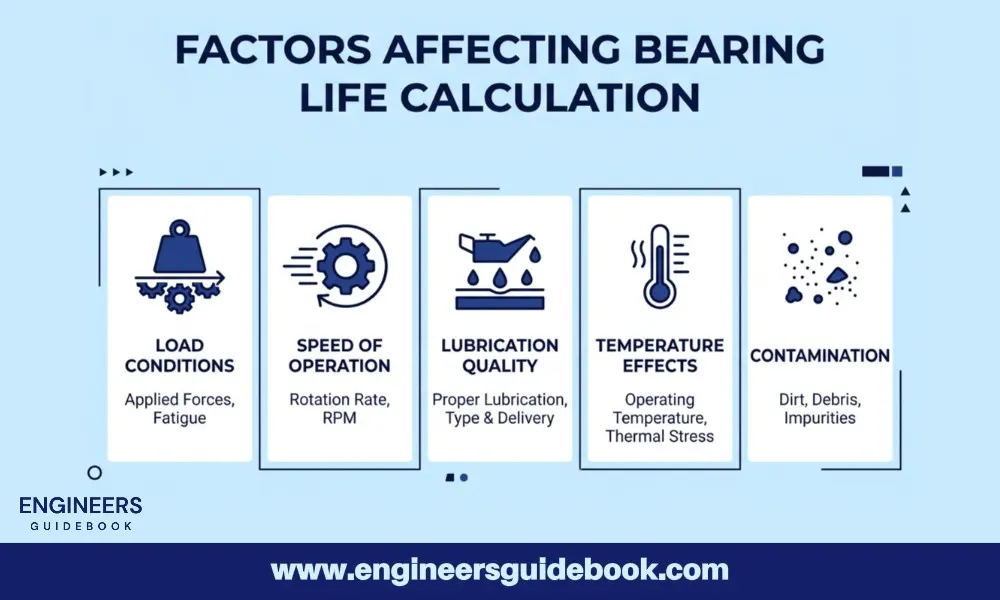
4. Factors Affecting Bearing Life Calculation
4.1 Load Conditions
Load is the most critical factor in Bearing Life Calculation. Higher loads significantly reduce bearing life. Both radial and axial loads must be considered.
4.2 Speed of Operation
Higher speeds increase heat generation and wear, affecting Bearing Life Calculation results.
4.3 Lubrication Quality
Proper lubrication reduces friction and prevents metal-to-metal contact. Poor lubrication drastically reduces the accuracy of Bearing Life Calculation predictions.
4.4 Temperature Effects
Extreme temperatures can degrade lubricant and material properties, impacting Bearing Life Calculation.
4.5 Contamination
Dust, dirt, and moisture can shorten bearing life. Clean environments improve Bearing Life Calculation outcomes.
5. Equivalent Dynamic Load Calculation
5.1 Formula for Equivalent Load
In Bearing Life Calculation, the equivalent dynamic load is calculated as:
P = X * Fr + Y * Fa
Where:
- P = Equivalent dynamic load (N)
- Fr = Radial load (N)
- Fa = Axial load (N)
- X, Y = Load factors (from manufacturer tables)
5.2 Importance in Bearing Life Calculation
Accurate load calculation ensures reliable Bearing Life Calculation results. Incorrect values can lead to overdesign or premature failure.
6. Bearing Life in Hours
6.1 Conversion Formula
To convert life into operating hours:
L10h = (L10 * 10^6) / (60 * N)
Where:
- L10h = Bearing life in hours
- N = Speed in RPM
6.2 Practical Use
This conversion makes Bearing Life Calculation more practical for maintenance scheduling and operational planning.
7. Reliability Adjustment in Bearing Life Calculation
7.1 Modified Life Equation
For higher reliability, the equation becomes:
Lna = a1 * (C / P)^p
Where:
- Lna = Adjusted bearing life
- a1 = Reliability factor
Typical values:
- 90% reliability → a1 = 1
- 95% reliability → a1 ≈ 0.62
- 99% reliability → a1 ≈ 0.21
7.2 Why Reliability Matters
Modern applications require higher reliability, making this adjustment essential in advanced Bearing Life Calculation.
8. Bearing Life Calculation Example
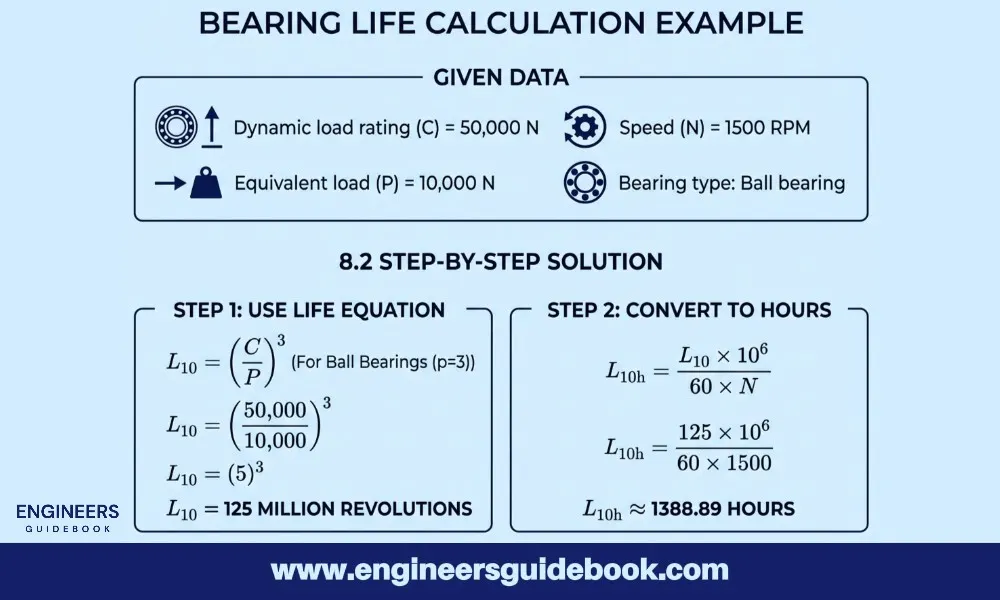
8.1 Given Data
- Dynamic load rating (C) = 50,000 N
- Equivalent load (P) = 10,000 N
- Speed (N) = 1500 RPM
- Bearing type: Ball bearing
8.2 Step-by-Step Solution
Step 1: Use life equation
L10 = (50000 / 10000)^3
L10 = (5)^3 = 125 million revolutions
Step 2: Convert to hours
L10h = (125 * 10^6) / (60 * 1500)
L10h ≈ 1388.89 hours
8.3 Interpretation
This Bearing Life Calculation shows that the bearing will operate for approximately 1389 hours under given conditions.
9. Advanced Bearing Life Models
9.1 ISO 281 Standard
The ISO 281 standard improves Bearing Life Calculation by including factors like lubrication and contamination.
9.2 Adjusted Life Equation
Lnm = aISO * (C / P)^p
Where aISO accounts for real-world conditions.
9.3 Importance in Industry
Advanced models provide more realistic Bearing Life Calculation results, especially in harsh environments.
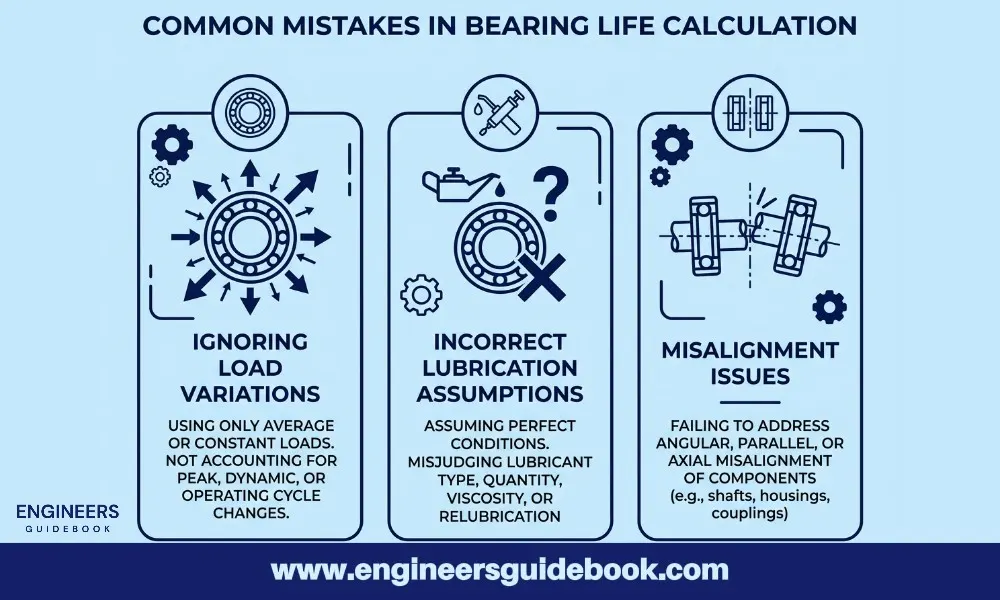
10. Common Mistakes in Bearing Life Calculation
10.1 Ignoring Load Variations
In practical applications, loads are rarely constant. Machines often experience fluctuating, shock, or cyclic loads during operation. Neglecting these variations can significantly distort Bearing Life Calculation, resulting in overly optimistic life estimates. For accurate analysis, engineers should consider equivalent load calculations or duty cycle-based load averaging.
10.2 Incorrect Lubrication Assumptions
One of the most common errors in Bearing Life Calculation is assuming ideal lubrication conditions. In reality, lubrication quality may degrade due to contamination, temperature changes, or improper selection. This leads to increased friction and wear, ultimately reducing actual bearing life compared to calculated values.
10.3 Misalignment Issues
Misalignment between shaft and housing introduces uneven load distribution across the bearing elements. This creates localized stress concentrations, accelerating fatigue failure. Ignoring alignment factors in Bearing Life Calculation can therefore result in significant discrepancies between predicted and actual service life.
11. Tips to Improve Bearing Life
11.1 Proper Installation
Accurate installation is critical to achieving expected performance. Using correct mounting techniques, proper tools, and recommended fits minimizes internal stresses and prevents premature damage. Proper installation directly enhances the reliability of Bearing Life Calculation outcomes.
11.2 Regular Maintenance
A well-structured maintenance program—including periodic lubrication, condition monitoring, and inspection—ensures optimal operating conditions. Consistent maintenance practices help align real-world performance with Bearing Life Calculation predictions.
11.3 Use of High-Quality Bearings
Selecting bearings manufactured with superior materials and precision processes improves fatigue resistance and load-carrying capacity. High-quality bearings provide more predictable and reliable results in Bearing Life Calculation, especially in demanding industrial environments.
12. Applications of Bearing Life Calculation
12.1 Industrial Machinery
Bearing Life Calculation is extensively used in industrial equipment such as pumps, compressors, gearboxes, and conveyors. It enables engineers to design systems with higher reliability and optimized maintenance intervals.
12.2 Automotive Industry
In automotive engineering, Bearing Life Calculation plays a key role in designing components like wheel hubs, transmissions, and differential systems, ensuring durability under varying load and speed conditions.
12.3 Power Plants
In power generation systems, bearings are critical components in turbines, generators, and auxiliary equipment. Accurate Bearing Life Calculation is essential to prevent unexpected failures, as downtime in such systems can lead to substantial financial and operational losses.
13. FAQ Section
13.1 What is Bearing Life Calculation?
Bearing Life Calculation is a method used to estimate the operational lifespan of a bearing based on load, speed, and operating conditions.
13.2 What does L10 mean in Bearing Life Calculation?
L10 represents the life at which 90% of bearings are expected to survive under given conditions.
13.3 How can I increase bearing life?
You can improve Bearing Life Calculation results by reducing load, improving lubrication, and maintaining proper alignment.
13.4 What is the difference between static and dynamic load?
Dynamic load relates to rotating conditions, while static load applies when the bearing is stationary.
13.5 Why is Bearing Life Calculation important?
It helps prevent unexpected failures, reduces downtime, and improves machine efficiency.
14. Conclusion
Bearing Life Calculation is an indispensable tool in mechanical engineering that ensures reliability, efficiency, and cost-effectiveness in machine operations. By understanding the fundamental equations, influencing factors, and real-world considerations, engineers can make informed decisions about bearing selection and maintenance.
Whether you are designing new equipment or maintaining existing machinery, mastering Bearing Life Calculation will significantly enhance performance and reduce operational risks.