A T bolt is a specialized fastener with a broad, T-shaped head designed to fit securely inside T-slots, channels, machine tables, and structural profiles. Available in multiple types, materials, grades, threads, and sizes, T bolts provide strong, adjustable fastening for machinery, fixtures, automation systems, fabrication equipment, and other industrial assemblies where reliable clamping and repositioning are required.
1. T Bolt Overview
1.1 What Is a T Bolt
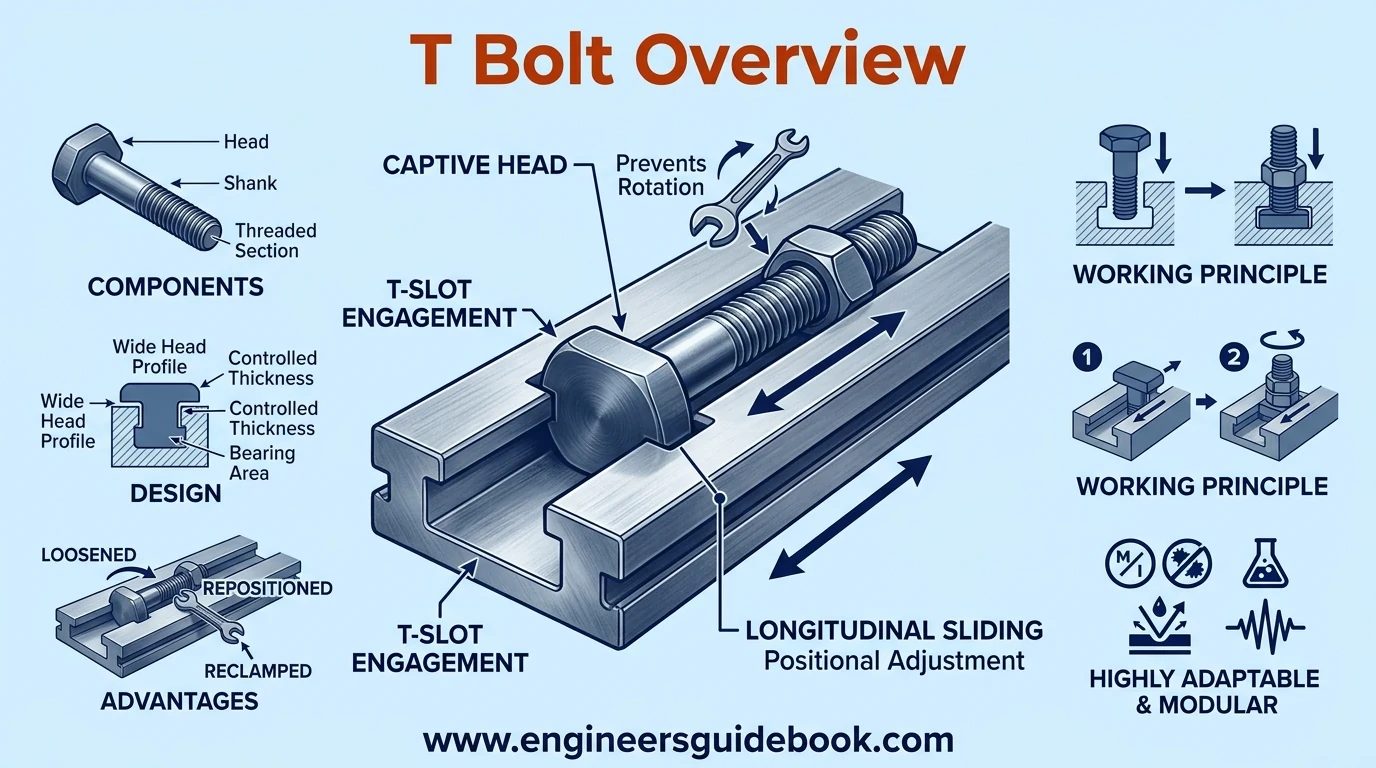
A T bolt is a mechanical fastener distinguished by its characteristically wide, flattened head and threaded shank. The head is designed to engage with a matching T-shaped slot or channel, preventing the bolt from rotating while a nut is tightened on the exposed threaded end.
Unlike conventional hex bolts, which generally require access to both the bolt head and nut, T bolts can often be retained inside a slot without a wrench on the head. This makes them particularly useful for machine tables, industrial framing, jigs, fixtures, conveyors, and modular structures.
Their principal advantage is adjustability. The bolt can slide longitudinally within a compatible slot before tightening, allowing components to be positioned, aligned, and subsequently secured.
1.2 T Bolt Design
The design of a T bolt combines rotational restraint with longitudinal mobility. Its head is wider than the shank and typically has a rectangular, square, or slightly contoured profile that matches the geometry of the intended slot.
Head thickness is carefully controlled so the bolt can travel within the channel without excessive clearance. At the same time, sufficient bearing area must remain beneath the head to distribute clamping forces against the internal shoulders of the slot.
The shank may be fully or partially threaded depending on the application. High-load variants can incorporate forged heads, enhanced radii at critical transitions, and high-strength materials to improve fatigue resistance.
1.3 T Bolt Working Principle
A T bolt operates through mechanical interlocking. The head is inserted into a T-slot or channel where its geometry prevents it from passing through the narrower slot opening.
Once positioned, the threaded portion projects outward through the slot. A component, washer, and nut can then be installed over the shank. Tightening the nut generates bolt preload, drawing the head against the internal bearing surfaces of the slot and clamping the attached component securely.
Because the head cannot freely rotate inside the channel, torque applied to the nut creates tightening rather than simply spinning the entire fastener. Before final tightening, the bolt can usually slide along the slot for positional adjustment.
2. T Bolt Types
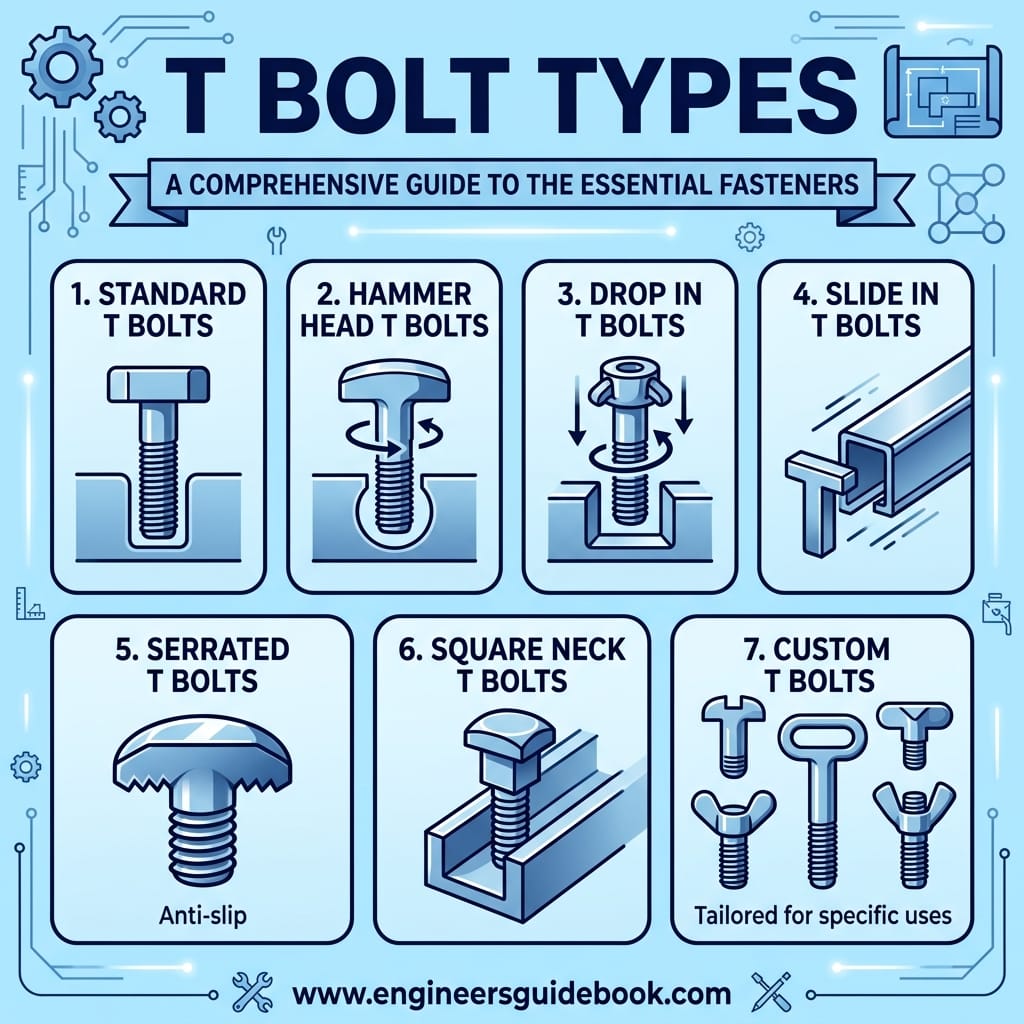
2.1 Standard T Bolts
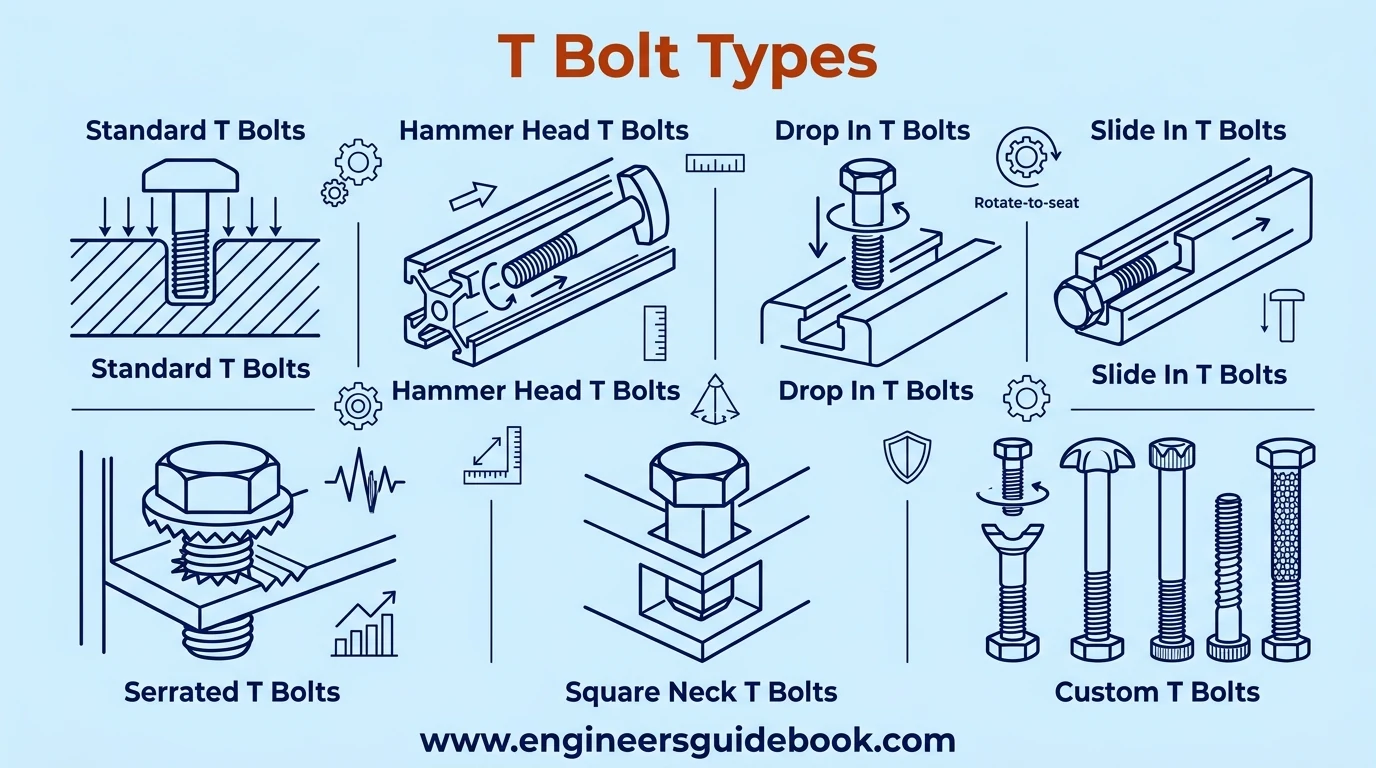
Standard T bolts feature a conventional broad head designed for established T-slot dimensions. They are extensively used with machine tables, fixtures, tooling plates, and industrial equipment.
These bolts are commonly manufactured from carbon or alloy steel and are available in numerous thread sizes and lengths. Their straightforward geometry provides reliable anti-rotation performance and high clamping capability.
2.2 Hammer Head T Bolts
Hammer head T bolts have elongated heads resembling the profile of a hammer. Their geometry allows them to enter certain channels through the slot opening and then rotate into the locking position.
This installation method is useful when access to the end of an extrusion or channel is restricted. Hammer head bolts are particularly common in modular aluminum framing and equipment construction.
2.3 Drop In T Bolts
Drop in T bolts are designed to enter a compatible slot directly from an accessible opening rather than being inserted from the end of the profile.
After insertion, the bolt is rotated or seated so its head engages beneath the slot shoulders. This capability makes retrofitting easier because existing assemblies may not need to be dismantled.
They are frequently employed when accessories must be added to completed machine frames or structural profiles.
2.4 Slide In T Bolts
Slide in T bolts are introduced through the open end of a T-slot and moved longitudinally to the required mounting position. Once located correctly, the component is installed and the nut tightened.
Their design normally provides excellent engagement with the channel because the head can closely match the internal slot profile. They are widely used where secure mounting is more important than rapid mid-slot insertion.
2.5 Serrated T Bolts
Serrated T bolts incorporate teeth, ribs, or serrations on selected contact surfaces. These features increase mechanical grip and help inhibit unwanted movement under vibration or dynamic loading.
Serrations may bite into the mating material as the fastener is tightened, increasing resistance to sliding or rotation. Consequently, these bolts can be valuable in automotive assemblies, machinery, brackets, and vibration-prone structures.
2.6 Square Neck T Bolts
Square neck T bolts feature a square section immediately beneath the head. This geometry provides additional rotational restraint when the neck engages with a compatible opening or slot.
The square neck can improve torque transfer during installation and reduce the possibility of bolt spinning. Such configurations are selected where a more positive anti-rotation mechanism is desirable.
2.7 Custom T Bolts
Custom T bolts are manufactured for applications where standard dimensions, materials, or geometries cannot satisfy operational requirements.
Customization may involve unusual head widths, special shank lengths, nonstandard thread pitches, corrosion-resistant alloys, heat-resistant materials, or specialized surface treatments.
Heavy machinery, proprietary production equipment, transportation systems, and specialized fixtures frequently use custom T bolts where slot geometry or loading conditions are unique.
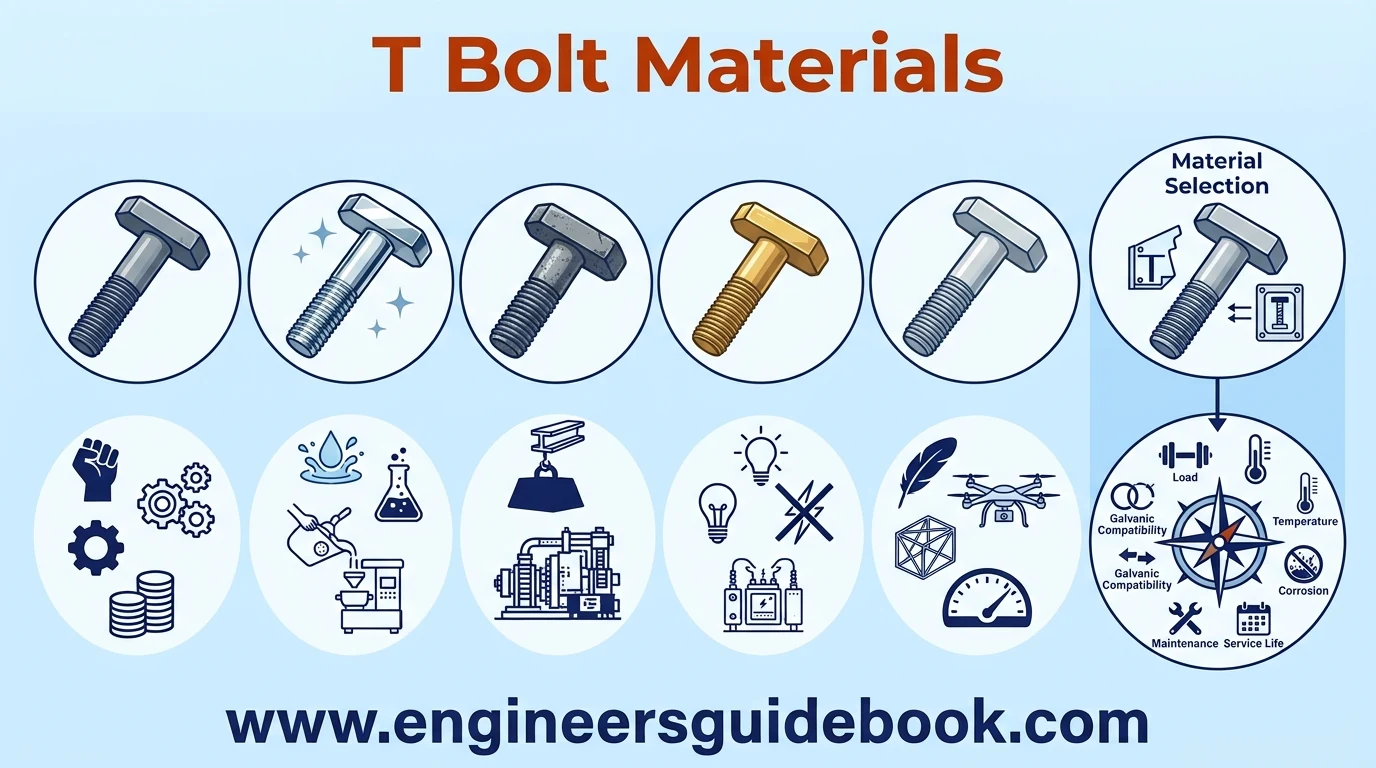
3. T Bolt Materials
3.1 Carbon Steel T Bolts
Carbon steel is one of the most widely used materials for T bolts because it offers favorable strength, machinability, availability, and cost.
Carbon steel bolts can be heat treated to achieve specified mechanical properties and may receive zinc plating, galvanizing, or other finishes for corrosion protection. They are suitable for numerous indoor and general industrial applications.
3.2 Stainless Steel T Bolts
Stainless steel T bolts are preferred where corrosion resistance is a major design consideration. Grades such as 304 and 316 are frequently selected for wet environments, chemical facilities, food-processing equipment, and outdoor installations.
Grade 316 provides enhanced resistance to many corrosive environments because of its molybdenum content. Stainless steel also provides a clean appearance and generally requires less protective coating than carbon steel.
3.3 Alloy Steel T Bolts
Alloy steel T bolts are selected for demanding applications involving elevated tensile loads, impact, cyclic stress, or severe service conditions.
Elements such as chromium, molybdenum, and nickel may be incorporated into the steel to enhance strength, toughness, and hardenability. Heat treatment can further increase mechanical performance.
These bolts are commonly encountered in heavy machinery, tooling, structural clamping, and high-load manufacturing systems.
3.4 Brass T Bolts
Brass T bolts provide corrosion resistance, electrical characteristics, and an attractive surface finish. They are also non-sparking under many practical conditions, although suitability for hazardous environments must always be evaluated against applicable engineering requirements.
Brass fasteners are generally used for moderate loads rather than extreme structural duty. Typical applications include electrical equipment, decorative assemblies, instruments, and specialized machinery.
3.5 Aluminum T Bolts
Aluminum T bolts offer low weight and good resistance to atmospheric corrosion. They are particularly beneficial where reducing assembly mass is more important than achieving extremely high tensile strength.
They can complement aluminum extrusion systems and lightweight structures, but load capacity must be assessed carefully because aluminum fasteners generally provide lower strength than many steel alternatives.
3.6 Material Selection
T bolt material should be selected according to load, temperature, corrosion exposure, mating materials, service life, and maintenance conditions.
Carbon steel provides economical strength, stainless steel enhances corrosion resistance, and alloy steel supports more demanding mechanical loads. Brass and aluminum serve specialized requirements.
Galvanic compatibility must also be considered when dissimilar metals are assembled, particularly in humid or chemically aggressive environments.
4. T Bolt Sizes
4.1 Metric T Bolt Sizes
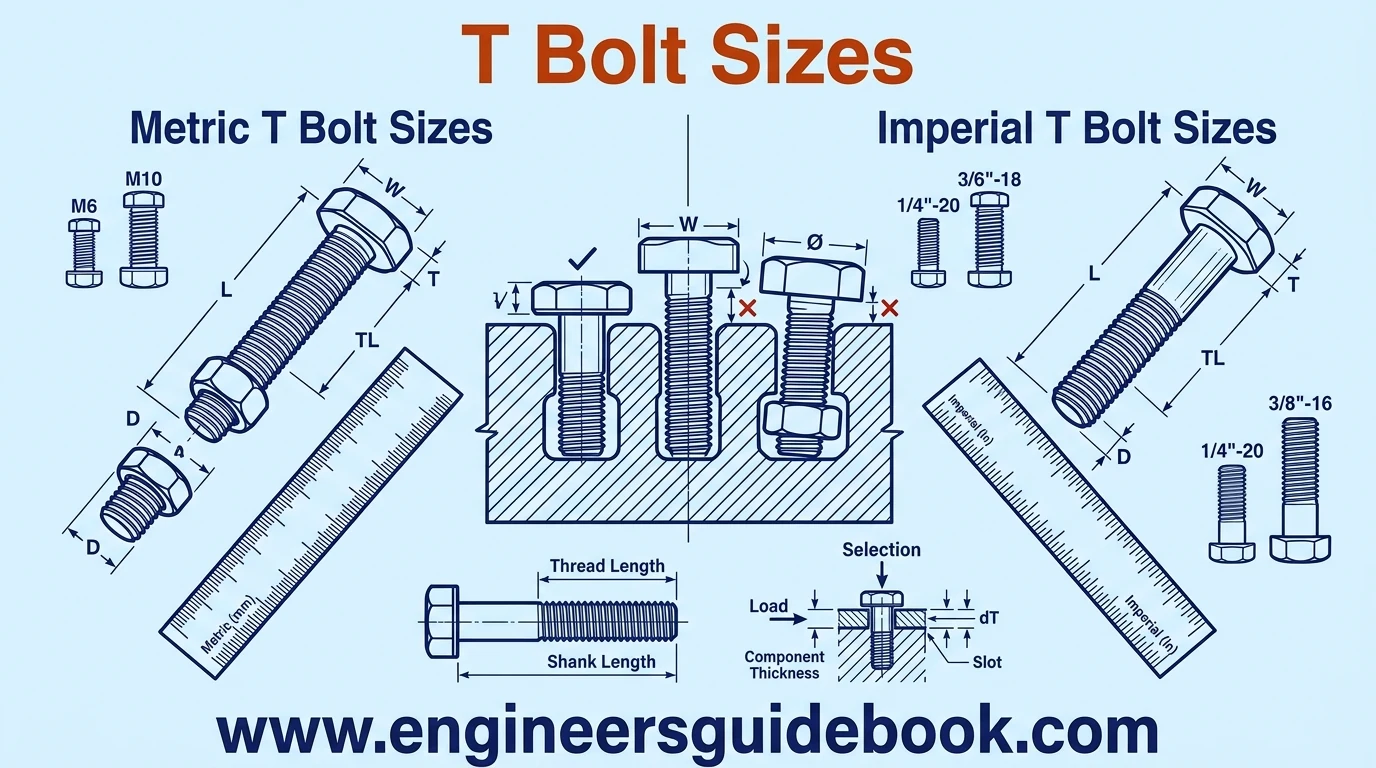
Metric T bolts are identified primarily by nominal thread diameter, thread pitch, length, and head dimensions. Typical designations may include sizes such as M6, M8, M10, M12, M16, and larger.
The correct size depends not only on the threaded diameter but also on the geometry of the T-slot. A bolt may have the correct thread yet remain unsuitable if its head cannot properly engage the channel.
4.2 Imperial T Bolt Sizes
Imperial T bolts use inch-based dimensional systems. Common specifications identify nominal diameter, threads per inch, bolt length, and head dimensions.
UNC and UNF thread forms may be encountered depending on the required strength, adjustment, and service conditions. Compatibility with the nut and mating slot remains essential.
4.3 Bolt Diameter
Bolt diameter strongly influences tensile capacity, clamping capability, and thread engagement. Increasing diameter generally permits greater load capacity, provided the associated slot and connected materials can safely support the resulting forces.
Selection should therefore be based on engineering loads rather than simply choosing the largest bolt that fits.
4.4 Bolt Length
T bolt length determines whether sufficient thread remains available after passing through the mounted component, washer, and nut.
An excessively short bolt can provide inadequate thread engagement. An unnecessarily long bolt may create clearance problems, interfere with equipment, or complicate installation.
4.5 Head Dimensions
Head width, length, and thickness are critical because the T-shaped head must interact correctly with the slot.
A head that is too narrow can provide insufficient bearing engagement, while an oversized head may not enter or move within the slot. Proper dimensions allow smooth adjustment while retaining adequate contact area.
4.6 Thread Length
Thread length determines the available adjustment range and influences compatibility with different component thicknesses.
Fully threaded T bolts offer extensive adjustment, whereas partially threaded designs may provide a smooth shank in sections where threads are unnecessary. The required configuration depends on the intended clamping arrangement.
4.7 Size Selection
Selecting a T bolt requires evaluation of thread diameter, bolt length, head dimensions, slot dimensions, component thickness, load, and available installation clearance.
The complete fastening system should be considered rather than selecting the bolt independently. A properly matched bolt, nut, slot, and washer arrangement provides reliable preload and minimizes localized deformation.
5. T Bolt Threads
5.1 Metric Threads
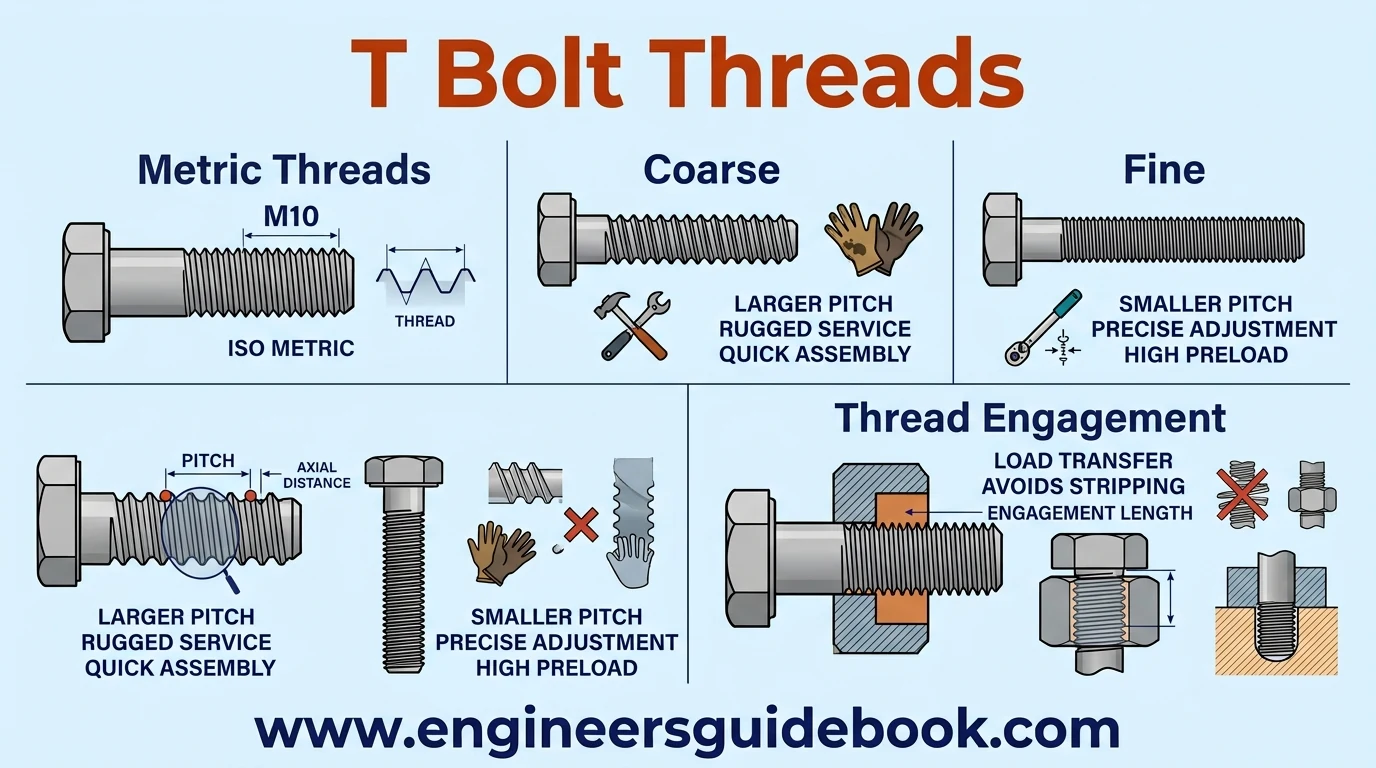
Metric T bolts commonly use ISO metric thread forms identified by nominal diameter and pitch. An M10 thread, for example, has a nominal diameter of approximately 10 mm, with pitch specified separately when necessary.
Metric threads are widely used in international machinery and industrial framing systems.
5.2 UNC Threads
Unified National Coarse threads provide relatively large thread pitches and fewer threads per inch. Their robust geometry makes them suitable for general industrial service and environments where contamination may be present.
UNC threads are also comparatively resistant to accidental cross-threading during installation.
5.3 UNF Threads
Unified National Fine threads have a smaller pitch and more threads per inch than UNC threads of equivalent nominal diameter.
They can provide finer adjustment and a larger tensile stress area in certain sizes. However, fine threads are generally more sensitive to contamination and handling damage.
5.4 Coarse Threads
Coarse threads are frequently chosen for quick assembly and rugged service. Their deeper thread profile can perform effectively in relatively soft mating materials and dirty industrial environments.
They also require fewer rotations to advance the nut over a given distance, accelerating repetitive assembly operations.
5.5 Fine Threads
Fine threads provide more precise axial adjustment and can support high preload when correctly designed and tightened.
Because their pitch is smaller, they offer increased resistance to certain loosening mechanisms, although joint design and preload remain much more important than thread pitch alone in controlling vibration-related loosening.
5.6 Thread Pitch
Thread pitch is the axial distance between corresponding points on adjacent threads. It directly affects nut advancement, thread geometry, and engagement characteristics.
Selecting the correct pitch is mandatory because bolts and nuts with incompatible pitches cannot form a reliable threaded connection even when their nominal diameters appear identical.
5.7 Thread Engagement
Adequate thread engagement is necessary to transfer load between the bolt and nut without stripping either component.
Required engagement depends on fastener strength, nut material, thread geometry, and applied load. Softer materials often require greater engagement length than high-strength steel components.
6. T Bolt Grades
6.1 Property Classes
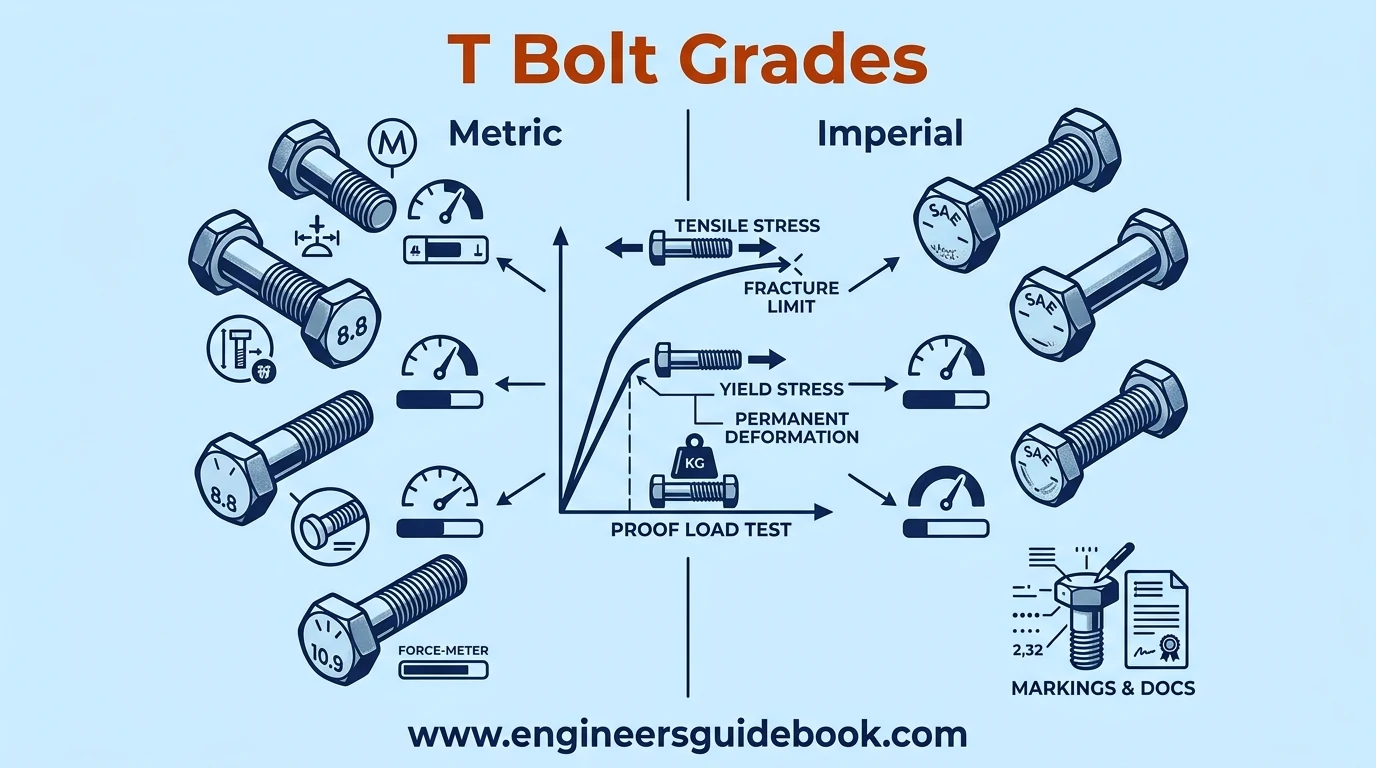
Metric steel T bolts may be specified by property classes such as 8.8, 10.9, or other classes appropriate to the governing standard and application.
These classifications communicate defined mechanical properties, allowing engineers to select fasteners according to required strength and service conditions.
6.2 SAE Grades
Imperial fasteners may use SAE grade classifications where applicable. Different grades represent different strength levels and material or heat-treatment requirements.
The appropriate grade should be matched to the joint design rather than substituted solely on dimensional similarity.
6.3 Tensile Strength
Tensile strength represents the maximum tensile stress the fastener material can sustain before fracture under standardized testing conditions.
T bolts carrying substantial clamping forces require sufficient tensile capacity to withstand preload together with external service loads.
6.4 Yield Strength
Yield strength indicates the stress at which permanent deformation begins. Maintaining operational stresses within the intended elastic range helps the fastener preserve preload and dimensional integrity.
Yield behavior is therefore a fundamental consideration in highly loaded bolted joints.
6.5 Proof Load
Proof load represents a specified test load that a fastener must withstand without unacceptable permanent deformation.
It provides an important reference for assessing fastener performance and establishing appropriate tightening procedures. Proof-load requirements vary with fastener class, size, material, and applicable standard.
6.6 Grade Identification
Fastener grades may be indicated through head markings, manufacturer markings, documentation, packaging, or material certification.
Identification should never be assumed from appearance alone. For safety-critical equipment, traceability and conformity documentation provide greater assurance that installed bolts possess the specified mechanical properties.
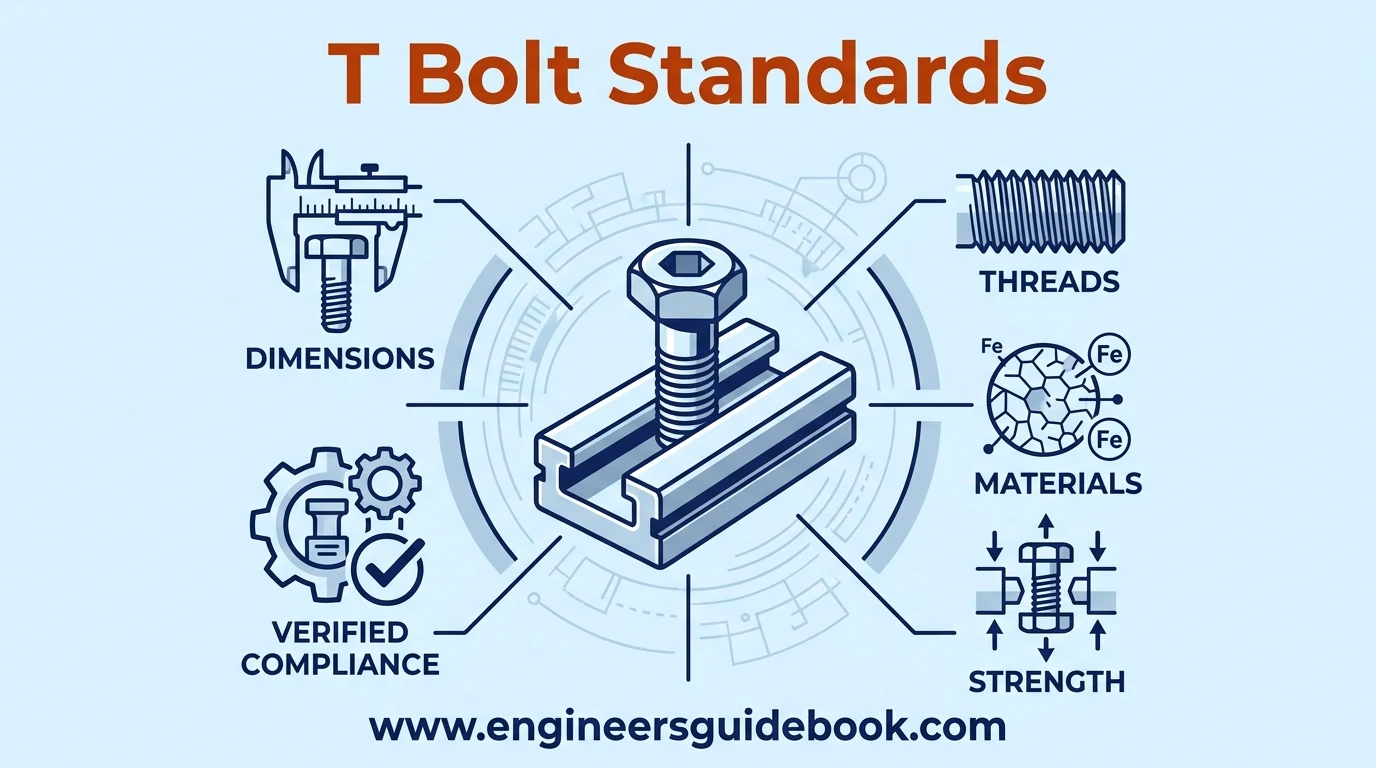
7. T Bolt Standards
7.1 DIN Standards
DIN specifications have historically defined dimensions, materials, tolerances, and mechanical requirements for numerous fasteners, including T-slot-related fastening products.
DIN 787 is particularly associated with T-slot bolts used in machine-tool applications. Confirming the applicable edition and dimensional requirements is important before procurement or replacement.
7.2 ISO Standards
ISO standards provide internationally recognized requirements for fastener threads, dimensional practices, mechanical properties, testing, and related specifications.
A T bolt assembly may therefore rely on several ISO standards rather than a single document covering every aspect of its construction.
7.3 ASTM Standards
ASTM standards are frequently used to specify fastener materials, chemical composition, heat treatment, mechanical properties, coatings, and testing requirements.
Their relevance depends on the industry and particular fastener specification. Designers should verify that the selected ASTM material requirement is appropriate for the intended T bolt configuration.
7.4 ASME Standards
ASME standards are widely applied throughout mechanical, piping, pressure equipment, and dimensional engineering practice.
While a particular T bolt may not necessarily be governed by a dedicated ASME dimensional standard, associated threads, bolted-joint requirements, equipment design provisions, or project specifications may reference ASME requirements.
7.5 ANSI Standards
ANSI coordinates and accredits standards used throughout American industry. References to ANSI fastener standards frequently relate to standards developed by recognized organizations and adopted within the broader U.S. standardization framework.
When a specification states ANSI compliance, the exact referenced standard and revision should be identified rather than relying on the ANSI designation alone.
7.6 Standard Compliance
Standard compliance confirms that a T bolt satisfies defined requirements concerning dimensions, thread geometry, material properties, strength, tolerances, coatings, or testing.
Industrial buyers should verify the applicable standard, grade, material certificate, dimensional compatibility, and required inspection documentation before installation. In critical machinery, using a bolt that merely resembles the original component can introduce substantial risk. Verified conformity improves interchangeability, reliability, traceability, and long-term fastening performance.
8. T Bolt Finishes
8.1 Zinc Plating
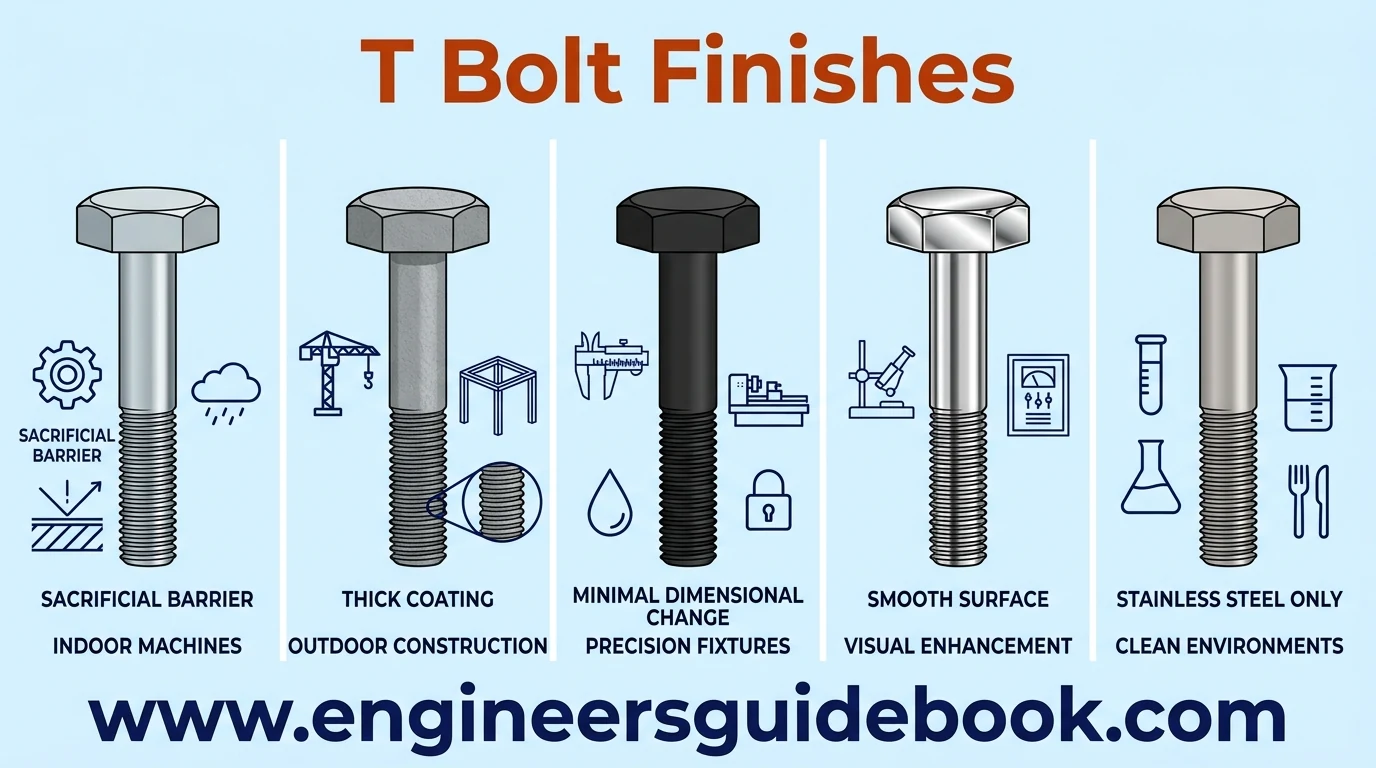
Zinc plating is one of the most common surface treatments for carbon steel T bolts. A thin zinc layer is deposited over the fastener, creating a sacrificial barrier that protects the underlying steel from oxidation.
This finish is economical, visually clean, and suitable for indoor machinery, fixtures, production equipment, and moderately humid environments. Zinc-plated T bolts are often selected where corrosion protection is required without substantially altering head dimensions or thread geometry.
8.2 Hot Dip Galvanizing
Hot dip galvanizing provides a substantially thicker zinc coating than conventional electroplating. The T bolt is immersed in molten zinc, producing a metallurgically bonded protective layer that performs well in outdoor and aggressive atmospheric conditions.
Galvanized T bolts are suitable for construction equipment, outdoor frames, structural assemblies, and exposed machinery. However, the thicker coating can influence thread fit and dimensional tolerances, so compatible galvanized nuts and appropriate thread allowances should be considered.
8.3 Black Oxide
Black oxide creates a dark conversion coating on ferrous T bolts. Unlike thick metallic coatings, it produces minimal dimensional change, making it useful for precision fixtures and machine-tool applications where close tolerances are important.
Its corrosion protection is comparatively modest and is commonly enhanced with oil, wax, or another protective treatment. Black oxide is frequently chosen for indoor machinery because it provides an unobtrusive appearance while preserving accurate fastener dimensions.
8.4 Nickel Plating
Nickel plating provides a durable, smooth surface with improved resistance to corrosion and wear. It can also enhance the visual appearance of T bolts used in exposed equipment or precision assemblies.
Nickel-plated fasteners may be found in machinery, instruments, electrical systems, and specialty fabrication. The coating can offer better environmental protection than some basic finishes, although its suitability depends on coating thickness, substrate preparation, and actual service exposure.
8.5 Passivation
Passivation is primarily associated with stainless steel T bolts. The treatment removes free iron and surface contaminants while promoting the formation of a stable chromium-rich passive layer.
This passive film improves the stainless steel surface’s natural resistance to corrosion. Passivated T bolts are therefore valuable in food-processing equipment, pharmaceutical machinery, chemical facilities, and other applications where cleanliness and corrosion resistance are important.
8.6 Corrosion Resistance
Corrosion resistance depends on much more than surface appearance. Base material, coating type, exposure conditions, temperature, moisture, chemical contact, and galvanic interaction all influence service life.
Indoor equipment may require only zinc plating or black oxide, whereas outdoor or chemically exposed assemblies may justify galvanizing or stainless steel. Selecting an appropriate finish protects both mechanical integrity and long-term reliability.
9. T Bolt Industrial Applications
9.1 Machine Tool Fixtures
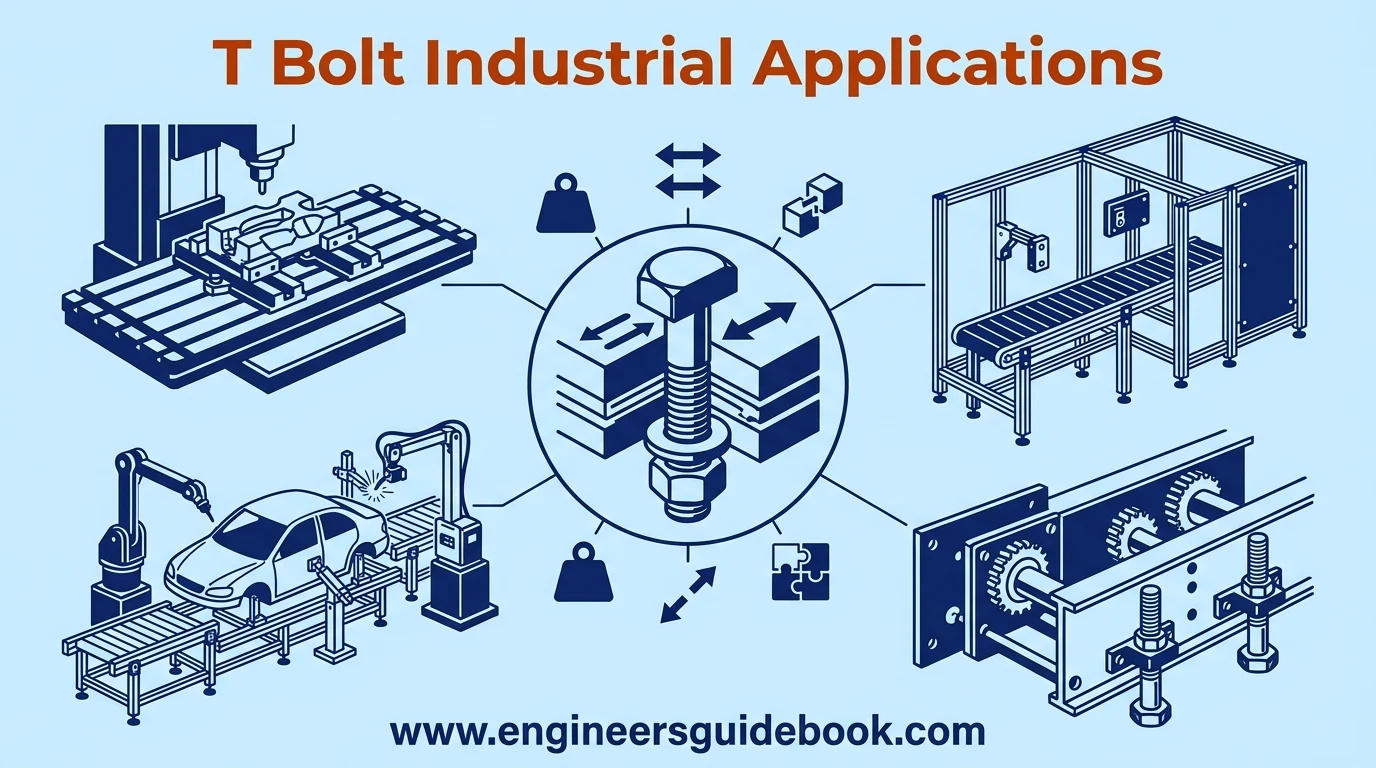
Machine-tool fixtures are among the classic applications for T bolts. Milling machines, drilling machines, and other equipment often feature T-slotted tables where workpieces, clamps, vises, and fixtures must be positioned securely.
T bolts slide within these slots and provide strong clamping without permanent alterations to the machine table. This arrangement enables quick fixture changes and accurate repositioning.
9.2 CNC Machines
CNC machines frequently use T bolts for securing fixtures, vises, workholding systems, and modular tooling. Their adjustability is particularly valuable when machining different workpiece geometries.
Reliable clamping is essential because unwanted fixture movement can reduce machining accuracy or damage tools. Properly selected T bolts therefore contribute directly to positional stability and repeatability.
9.3 T Slot Tables
T-slot tables are specifically designed to accommodate T bolts and associated clamping hardware. The bolt head remains captive beneath the narrow slot opening while the threaded shank projects upward.
Operators can position bolts wherever required along the slot, providing exceptional flexibility. This makes T-slot tables indispensable in machining, welding, inspection, prototyping, and assembly operations.
9.4 Aluminum Profiles
Modular aluminum extrusion systems commonly rely on specialized T bolts for connecting brackets, panels, machine guards, frames, sensors, and accessories.
The bolts engage within channels formed in the extrusion profile. Because components can be loosened and relocated, the resulting structure remains highly configurable. This modularity is valuable in automation cells and rapidly changing production environments.
9.5 Conveyor Systems
Conveyor systems contain numerous adjustable components, including guides, sensors, brackets, guards, supports, and side rails. T bolts simplify their mounting and repositioning.
During product changeovers, these components may require frequent adjustment. A slotted T-bolt system allows technicians to make modifications without drilling new holes or extensively dismantling the conveyor structure.
9.6 Automotive Assembly
Automotive manufacturing uses T bolts in production fixtures, assembly stations, modular frames, testing rigs, conveyors, and tooling systems.
Their combination of adjustability and strong clamping supports production lines that must accommodate different components or vehicle models. Certain specialized T bolts are also used within vehicle assemblies where their anti-rotation geometry offers installation advantages.
9.7 Construction Equipment
Construction and heavy equipment may use T bolts in adjustable supports, guides, frames, attachments, and specialized machinery.
These environments can impose vibration, contamination, impact, moisture, and substantial mechanical loads. Consequently, suitable material strength, protective finish, and thread design become especially important for maintaining joint integrity.
9.8 Industrial Automation
Industrial automation systems extensively use T bolts in machine frames, robotic cells, guarding, sensor mounts, control enclosures, and aluminum extrusion structures.
Their greatest advantage is configurability. Equipment can be expanded or rearranged without rebuilding the complete frame, making T bolts well suited to evolving manufacturing systems and modular automation.
10. T Bolt Selection
10.1 Load Requirements
Selection should begin with an evaluation of the forces acting on the joint. Tensile load, shear load, vibration, impact, and preload requirements can influence the necessary bolt diameter and grade.
A fastener should not be selected merely because it physically fits the slot. Adequate mechanical capacity is equally important.
10.2 Slot Dimensions
Head dimensions must correspond closely with the T-slot geometry. Slot width, throat width, internal width, and depth determine whether the head will enter correctly and remain securely retained.
An undersized head can reduce bearing contact, while an oversized head may jam inside the channel. Dimensional compatibility is therefore fundamental.
10.3 Material Compatibility
T bolt material should be compatible with the surrounding assembly. High-strength steel works well for heavily loaded fixtures, while stainless steel may be preferable in corrosive environments.
When aluminum profiles are involved, excessive tightening or inappropriate material combinations can damage the softer extrusion. Galvanic interaction between dissimilar metals should also be assessed.
10.4 Strength Requirements
Fastener grade establishes important mechanical characteristics such as tensile strength, yield strength, and proof load.
Higher strength is not automatically better for every application. The surrounding slot, nut, washer, and mounted component must also withstand the developed clamping force without yielding or deformation.
10.5 Environmental Conditions
Temperature, humidity, chemicals, salt exposure, dust, and washdown practices can determine the appropriate material and finish.
An indoor machine shop may require relatively modest corrosion protection. Outdoor, marine, chemical, or hygienic environments demand considerably more robust material selection.
10.6 Thread Compatibility
Bolt and nut threads must match in nominal diameter, thread form, and pitch. Mixing similar-looking thread systems can damage both components and produce unreliable engagement.
Metric, UNC, and UNF systems should be positively identified before assembly, particularly when maintaining imported or mixed-standard equipment.
10.7 Safety Factors
A safety factor accounts for uncertainties such as variable loading, manufacturing tolerances, installation deviations, and unexpected service conditions.
The appropriate value depends on the application and applicable engineering requirements. Safety-critical assemblies should be designed through formal load analysis rather than intuition or dimensional resemblance.

11. T Bolt Installation
11.1 Installation Preparation
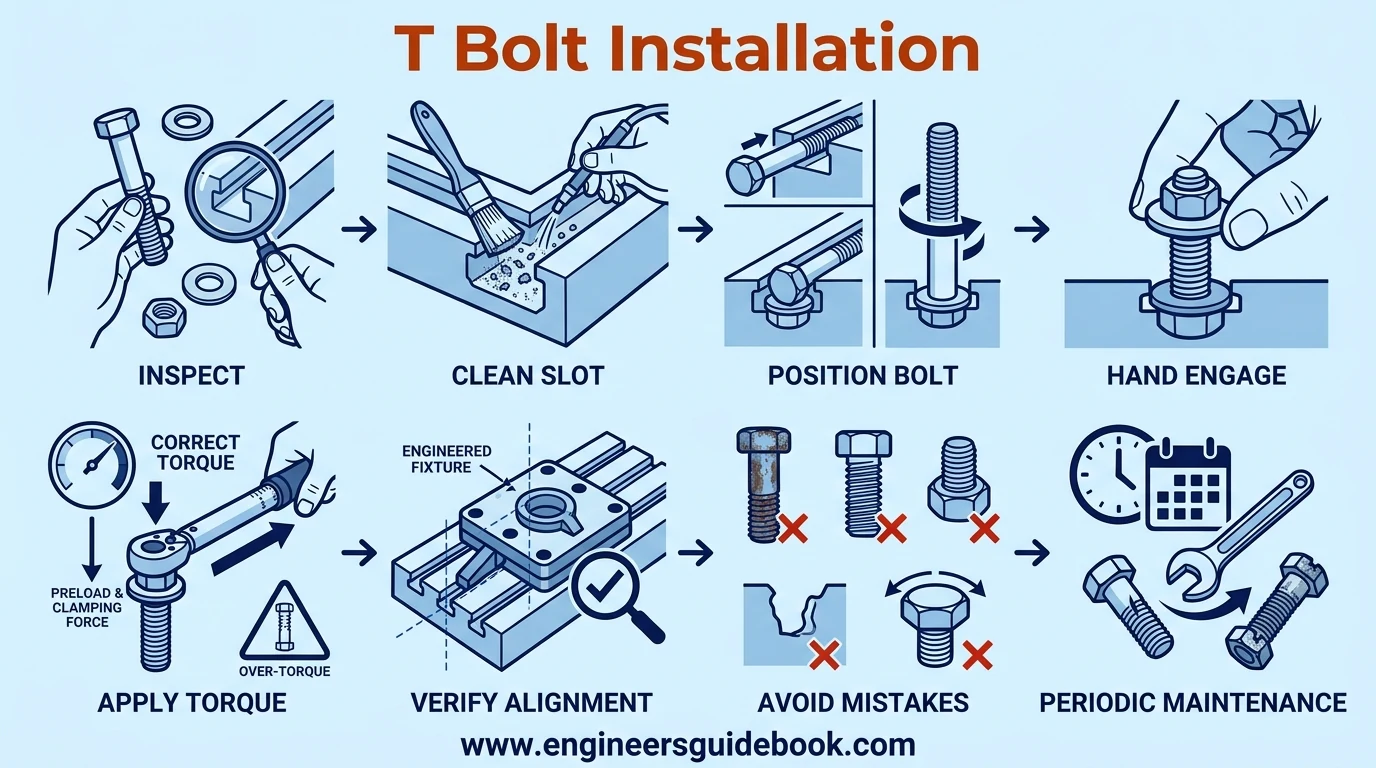
Before installation, inspect the T bolt, nut, washer, slot, and mating components. Threads should be undamaged and free from burrs, while the bolt head should fit the slot correctly.
Confirm that the selected grade, dimensions, and finish correspond to the intended application.
11.2 Slot Cleaning
Debris inside a T-slot can prevent proper seating. Chips, dirt, corrosion products, dried lubricant, and process residue should therefore be removed before assembly.
A clean slot allows the bolt head to sit evenly against the internal bearing surfaces and move smoothly during positioning.
11.3 Bolt Positioning
Insert the bolt according to its design. Slide-in bolts normally enter through the end of the slot, while drop-in or hammer-head designs may be inserted directly and rotated into engagement.
Ensure the head is fully seated beneath the slot shoulders before tightening.
11.4 Nut Installation
Install the specified washer and nut without forcing the threads. Hand engagement should occur smoothly before tools are used.
Adequate thread engagement must remain after the final assembly. Damaged or mismatched nuts should not be used to overcome resistance during installation.
11.5 Torque Tightening
Tightening creates preload that clamps the joint together. The required torque depends on bolt size, material grade, thread pitch, lubrication, coating, and joint configuration.
Published or engineered torque requirements should be followed where available. Excessive torque can stretch the bolt, damage threads, or deform the T-slot.
11.6 Alignment Inspection
After preliminary tightening, verify that the mounted component remains correctly aligned. Fixture position can shift slightly as clamping force develops.
Final tightening should occur only after confirming bolt-head engagement, component orientation, and the absence of unintended interference.
12. T Bolt FAQs
12.1 What Is a T Bolt Used For
A T bolt is used to secure components to T-slots, channels, machine tables, aluminum profiles, fixtures, conveyors, and modular structures. It provides adjustable positioning combined with strong mechanical clamping.
12.2 How Does a T Bolt Work
The broad head sits beneath the shoulders of a T-slot and prevents the bolt from rotating or pulling through the narrow opening. Tightening a nut generates preload that clamps the attached component against the supporting structure.
12.3 What Are the Different Types of T Bolts
Common types include standard, hammer head, drop-in, slide-in, serrated, square neck, and custom T bolts. Each design differs in insertion method, anti-rotation behavior, and intended slot geometry.
12.4 How Do I Choose the Right T Bolt Size
Match the bolt head to the slot dimensions, then select thread diameter and length according to load, component thickness, nut engagement, and installation clearance.
12.5 What Is the Difference Between a T Bolt and a Hex Bolt
A T bolt uses a broad head designed to engage a slot and resist rotation. A hex bolt uses an external hexagonal head that is normally held or turned with a wrench.
12.6 What Is the Difference Between a T Bolt and a T Nut
A T bolt has a threaded shank with a captive head, whereas a T nut contains an internally threaded hole and sits within the slot. Both provide attachment points for slotted systems but employ opposite thread configurations.
12.7 Can T Bolts Be Used in Aluminum Profiles
Yes. Specialized T bolts are widely used with aluminum extrusion profiles for brackets, guards, panels, sensors, and machine frames. The bolt must match the specific extrusion slot geometry.
12.8 Are Stainless Steel T Bolts Corrosion Resistant
Yes, stainless steel T bolts generally provide strong corrosion resistance, particularly when the appropriate stainless grade and surface treatment are selected. However, resistance depends on the specific environment and chemical exposure.
12.9 How Tight Should a T Bolt Be
The correct tightening torque depends on fastener diameter, grade, lubrication condition, coating, thread type, and the strength of the mating components. Manufacturer or engineered torque specifications should be used whenever available.
12.10 Can T Bolts Be Reused
T bolts may be reused when permitted by the application and when inspection confirms that the threads, head, shank, and coating remain serviceable. Fasteners that are stretched, corroded, cracked, heavily worn, or otherwise damaged should be replaced
13. Conclusion
T bolts provide secure, adjustable fastening for machine tools, T-slot tables, aluminum profiles, conveyors, automotive systems, construction equipment, and automation structures. Their distinctive head geometry combines positional flexibility with effective resistance to rotation.
Reliable performance depends on correctly matching type, material, grade, size, finish, thread, and slot geometry to the application.
A T bolt should be treated as an engineered component rather than a generic piece of hardware. Load conditions, slot dimensions, material compatibility, corrosion exposure, thread engagement, installation torque, and safety requirements should all influence selection.