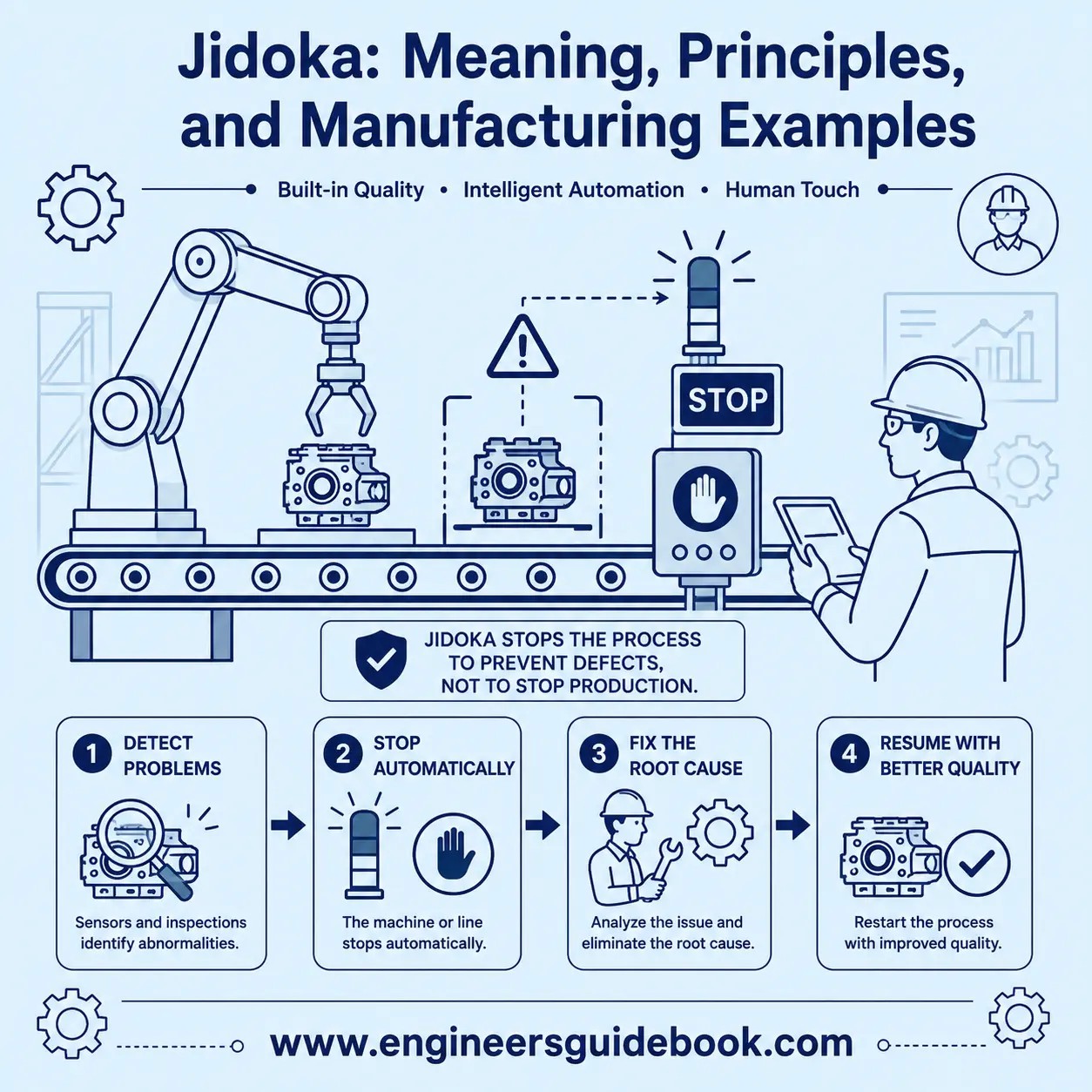
Jidoka is a core lean manufacturing principle that builds quality directly into production by detecting abnormalities, stopping the process, correcting problems, and preventing recurrence. Often described as automation with a human touch, Jidoka enables machines and operators to identify defects immediately rather than allowing faulty products to continue downstream, improving quality, productivity, safety, and process reliability.
1. Jidoka Fundamentals
1.1 Jidoka Meaning
Jidoka is a Japanese manufacturing concept centered on recognizing abnormalities and stopping production before defects proliferate. The term is commonly associated with autonomation , meaning automation equipped with human intelligence or judgment.
Instead of allowing machinery to continue producing defective components, Jidoka creates an immediate response to abnormal conditions. A machine, sensor, or operator can interrupt production, making the problem visible and preventing defective output from moving to the next process.
1.2 Jidoka Definition
Jidoka can be defined as a production philosophy in which equipment and employees possess the capability to detect abnormal conditions, stop the process, correct the immediate issue, and eliminate its underlying cause.
This distinguishes Jidoka from conventional automation. Ordinary automation performs predefined actions repeatedly. Jidoka adds discernment. The system is expected not merely to operate, but also to recognize when operation has deviated from acceptable conditions.
1.3 Japanese Origins
The roots of Jidoka emerged in Japan’s textile industry before becoming synonymous with automotive manufacturing. Its conceptual foundation developed around the idea that machines should not require constant human surveillance.
This approach transformed the relationship between workers and equipment. Instead of assigning one person to continuously watch one machine, intelligent stopping mechanisms allowed workers to supervise several machines while responding only when an abnormality occurred.
1.4 Automation With Intelligence
Jidoka is frequently described as automation with intelligence because it combines mechanization with the capacity to identify unacceptable conditions.
For example, a conventional filling machine may continue operating even when containers are incorrectly positioned. A Jidoka-oriented system can detect the misalignment through sensors, stop the filling cycle, and alert the operator.
The objective is not automation for its own sake. It is dependable automation capable of protecting process quality.
1.5 Built In Quality
Built-in quality means defects are controlled at the point where they originate rather than being discovered during final inspection.
Jidoka therefore shifts quality assurance upstream. If a machining operation produces an out-of-tolerance component, the ideal response is to identify that deviation immediately. Continuing production would multiply defects, consume material, occupy equipment capacity, and create additional inspection work.
Quality becomes part of the process rather than a separate downstream activity.
1.6 Human Machine Interaction
Jidoka does not attempt to eliminate people from manufacturing. It reallocates human attention toward judgment, troubleshooting, improvement, and decision-making.
Machines perform repetitive functions and monitor defined conditions. Humans investigate anomalies that require contextual understanding.
This division of responsibility creates a more sophisticated production environment. Employees are no longer passive machine attendants. They become problem solvers who improve the systems surrounding them.
1.7 Jidoka Objectives
The principal objectives of Jidoka are to prevent defects, expose abnormalities, reduce unnecessary supervision, accelerate problem resolution, and strengthen process capability.
Another important objective is preventing recurrence. Simply restarting equipment after removing a jam does not represent complete Jidoka practice. The underlying reason for the jam should be investigated so that technical or procedural countermeasures can be implemented.
1.8 Manufacturing Importance
Modern production lines operate at speeds where even a small abnormality can generate hundreds of defective units within minutes. Jidoka limits that exposure by interrupting the defect-generating mechanism early.
Its importance extends beyond product quality. Proper abnormality detection can also protect machinery, improve workplace safety, minimize raw-material losses, and create more predictable production performance.

2. Jidoka History
2.1 Sakichi Toyoda
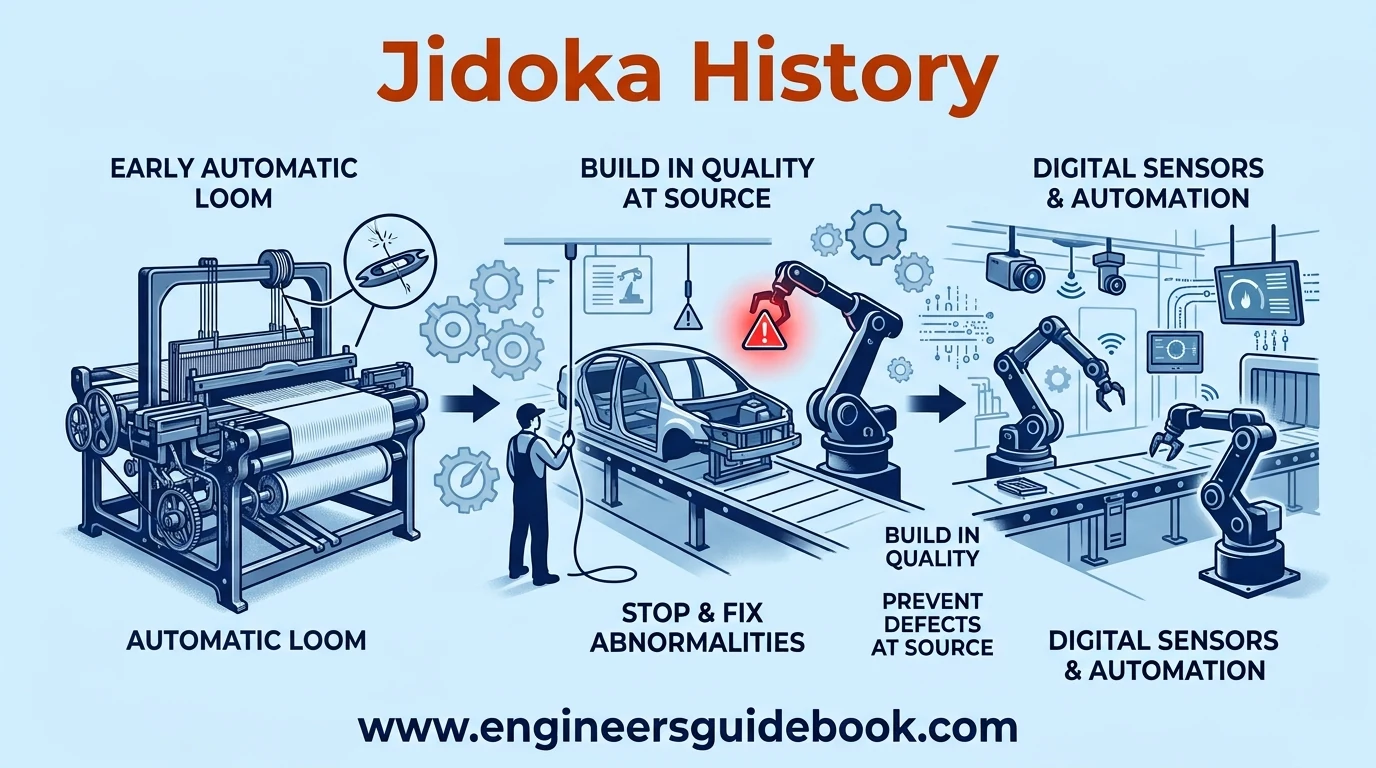
Sakichi Toyoda played a formative role in the development of Jidoka. His work focused on improving textile looms and eliminating the need for operators to continuously monitor machines.
He pursued mechanisms that could recognize thread breakage and automatically interrupt operation. This apparently simple idea introduced a powerful manufacturing principle: equipment should stop when continuing would create defective output.
2.2 Automatic Loom Innovation
The automatic loom represented a major advance because it could detect specific abnormalities without relying exclusively on human observation.
When a thread broke, the loom stopped instead of continuing to weave defective fabric. Operators could consequently supervise several looms simultaneously.
This innovation delivered two benefits at once. It improved quality while also increasing labor productivity, demonstrating how intelligent stopping could outperform uninterrupted production.
2.3 Toyota Evolution
As Toyota moved into automobile production, the underlying philosophy of intelligent automation evolved beyond textile machinery.
The concept was applied to manufacturing processes where operators needed the authority and mechanisms to expose problems immediately. Defects, equipment abnormalities, missing components, and process deviations were treated as signals requiring attention rather than inconveniences to be concealed.
2.4 Production System Integration
Jidoka eventually became one of the foundational concepts of the Toyota Production System. Its function was complementary to flow-oriented practices.
Efficient flow is valuable only when the products moving through that flow meet requirements. Jidoka protects that integrity by preventing abnormal production from continuing unnoticed.
The resulting system combines speed with control rather than pursuing output volume indiscriminately.
2.5 Quality Philosophy
The quality philosophy behind Jidoka rejects the assumption that inspection alone can guarantee excellence.
Inspection identifies defects after they have already been produced. Jidoka seeks to prevent their continuation at the source.
This changes quality from a sorting activity into a production responsibility. Operators, engineers, maintenance personnel, supervisors, and equipment designers all contribute to maintaining process conformity.
2.6 Lean Manufacturing Influence
Jidoka became an important influence on lean manufacturing because it supports several lean objectives simultaneously.
It reduces overproduction of defective goods, limits rework, exposes instability, accelerates learning, and promotes standardized problem-solving. It also reinforces the lean principle that abnormalities should be visible rather than hidden behind inventory, buffers, or excessive inspection.
2.7 Modern Industrial Adoption
Today, Jidoka concepts appear across automotive, electronics, food processing, pharmaceuticals, packaging, machining, chemical manufacturing, and automated assembly.
Modern implementations may use programmable logic controllers, machine vision, digital Andon systems, condition monitoring, torque verification, barcode validation, and sophisticated sensor networks.
The technology has changed considerably. The underlying logic remains remarkably consistent.
Also Read This:
Toyota Production System| A Complete Guide |
Toyota Production System House Explained
14 Principles of the Toyota Way Explained
Muda, Mura, and Muri: The 3M Model of Lean Manufacturing
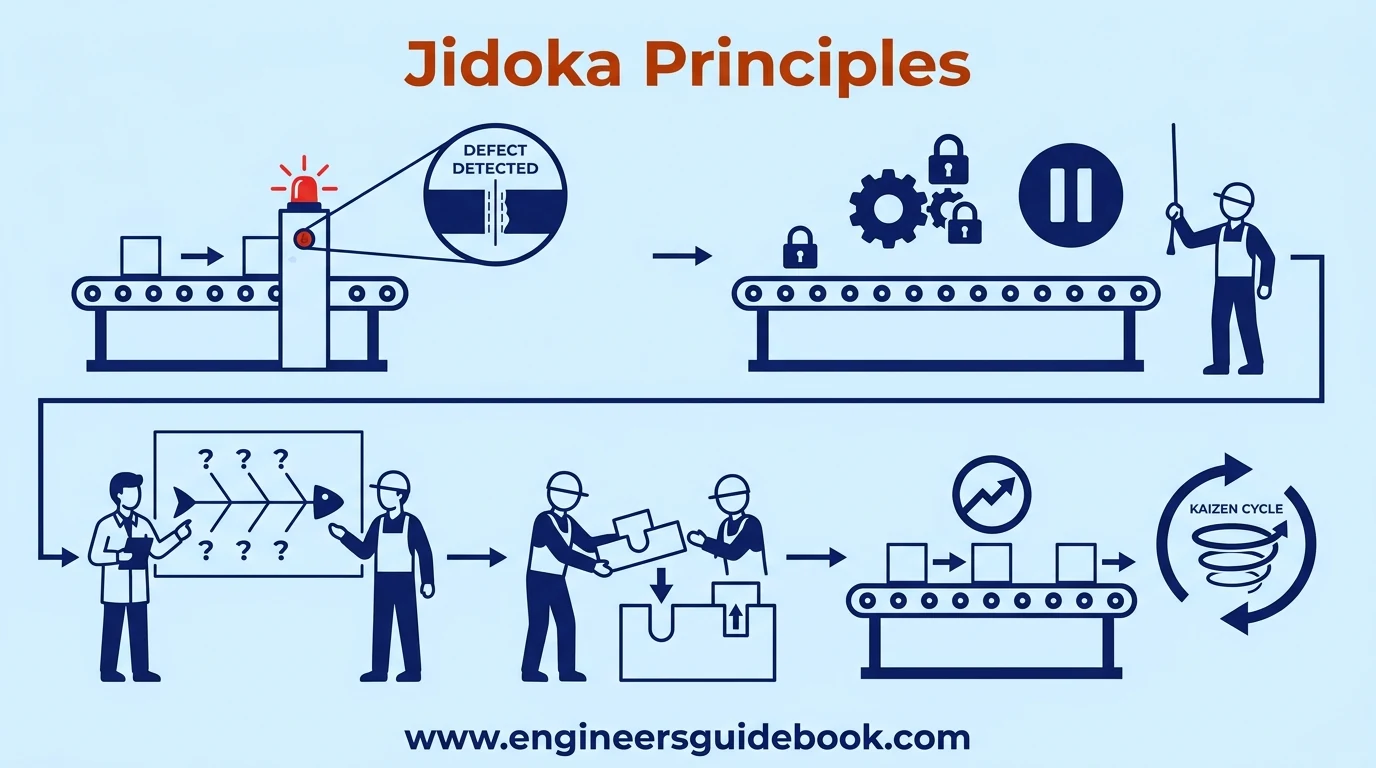
3. Jidoka Principles
3.1 Abnormality Detection
Every Jidoka system begins by defining what constitutes an abnormal condition.
Examples include excessive temperature, incorrect torque, missing components, dimensional deviation, low pressure, material blockage, contamination, equipment vibration, or an unsafe operating condition.
Detection must be dependable because a problem cannot be controlled if the production system cannot recognize it.
3.2 Automatic Stopping
Once a significant abnormality is detected, the affected process should stop automatically or provide an immediate means for an operator to stop it.
Stopping prevents additional defective products from being produced. Although stoppage may appear detrimental to productivity, allowing defective production to continue usually creates far greater losses through scrap, rework, sorting, complaints, and disruption.
3.3 Immediate Response
A production stop should trigger a rapid response from the appropriate personnel.
Operators may perform initial checks, while technicians, supervisors, quality personnel, or engineers become involved depending on the problem’s severity.
Fast response reduces downtime, but speed should not encourage superficial correction. The objective is controlled restoration rather than hurried restarting.
3.4 Root Cause Elimination
Jidoka places substantial emphasis on understanding why an abnormality occurred.
Tools such as the Five Whys, fishbone analysis, fault-tree thinking, and direct observation can help identify underlying causes.
If a conveyor repeatedly trips because of excessive loading, merely resetting the overload relay treats the symptom. Eliminating the cause might require correcting material flow, mechanical alignment, equipment capacity, or operating practice.
3.5 Defect Prevention
The strongest Jidoka systems prevent defects rather than merely detecting them.
Fixtures may be designed so components cannot be installed incorrectly. Sensors may verify presence before assembly proceeds. Control logic may reject an incorrect recipe before production begins.
This preventive orientation converts recurring quality problems into engineered impossibilities wherever practical.
3.6 Operator Empowerment
Operators must have the authority to expose and stop abnormal production without fearing inappropriate criticism.
This requirement is cultural as much as technical. If employees are pressured to maintain output regardless of quality, they may conceal minor problems until those problems become serious.
Jidoka instead treats stopping for a legitimate abnormality as responsible process control.
3.7 Quality At Source
Quality at source means every process assumes responsibility for the work it produces.
A defective component should not deliberately move downstream with the expectation that inspection will catch it later. The originating process should detect the problem, contain affected material, and initiate corrective action.
This reduces hidden factory costs and strengthens accountability throughout the value stream.
3.8 Continuous Improvement
Every abnormality represents information about weakness in the production system.
When recurring problems are documented and analyzed, they generate opportunities for Kaizen. Equipment can be modified, standards improved, detection systems refined, and error-proofing introduced.
Over time, Jidoka therefore becomes more than a stopping mechanism. It becomes a structured engine for organizational learning.
4. Jidoka Process
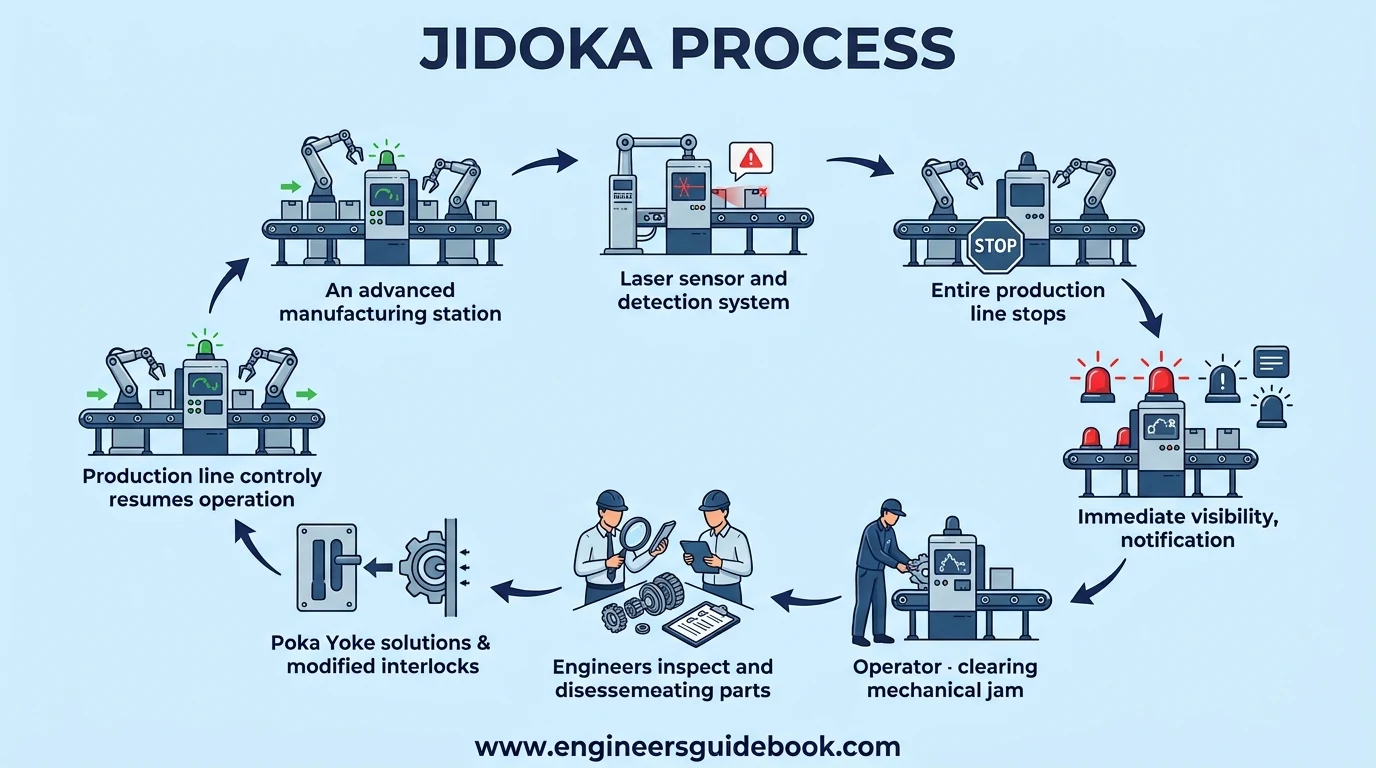
4.1 Normal Operation
The Jidoka process begins with stable operation under clearly defined standards. Equipment parameters, quality requirements, cycle conditions, and operator procedures must establish what normal production looks like.
Without a defined standard, abnormalities become subjective and difficult to detect consistently.
4.2 Problem Detection
The second stage occurs when equipment or personnel recognize a deviation from normal conditions.
Detection may come from sensors, measurement devices, inspection systems, machine logic, or direct operator observation. Effective detection should occur as close as possible to the point where the abnormality originates.
4.3 Process Stoppage
When the deviation threatens quality, safety, or equipment integrity, production is stopped.
The stoppage may affect one machine, one station, or the entire production line depending on process architecture. The goal is controlled containment rather than unnecessary interruption.
4.4 Problem Notification
Once the process stops, the issue must become visible.
Andon lights, audible alarms, digital notifications, HMI messages, dashboard alerts, or escalation systems can identify the affected workstation and communicate the nature of the problem.
Visibility reduces response time and prevents abnormalities from disappearing into routine operations.
4.5 Immediate Correction
The immediate problem is then corrected so the process can be stabilized.
A misplaced component might be repositioned, a blockage removed, or an incorrect setting corrected. However, immediate correction should not be confused with permanent corrective action.
One restores operation. The other prevents recurrence.
4.6 Root Cause Analysis
Repeated or significant abnormalities require systematic investigation.
Personnel examine the actual process, collect evidence, review operating conditions, and determine why the deviation occurred. Effective analysis avoids assumptions and focuses on causal mechanisms rather than blaming individuals.
4.7 Corrective Action
Corrective actions should directly address the verified cause.
Solutions may include equipment modification, revised operating parameters, new interlocks, improved preventive maintenance, Poka Yoke devices, stronger standards, or additional training.
The action should subsequently be verified to confirm that the abnormality has genuinely been eliminated.
4.8 Process Restart
Production resumes only when acceptable operating conditions have been restored.
The restart should confirm machine readiness, product conformity, safety conditions, and corrective measures where required. Controlled restarting prevents unresolved problems from being reintroduced into the production stream.
5. Jidoka Tools
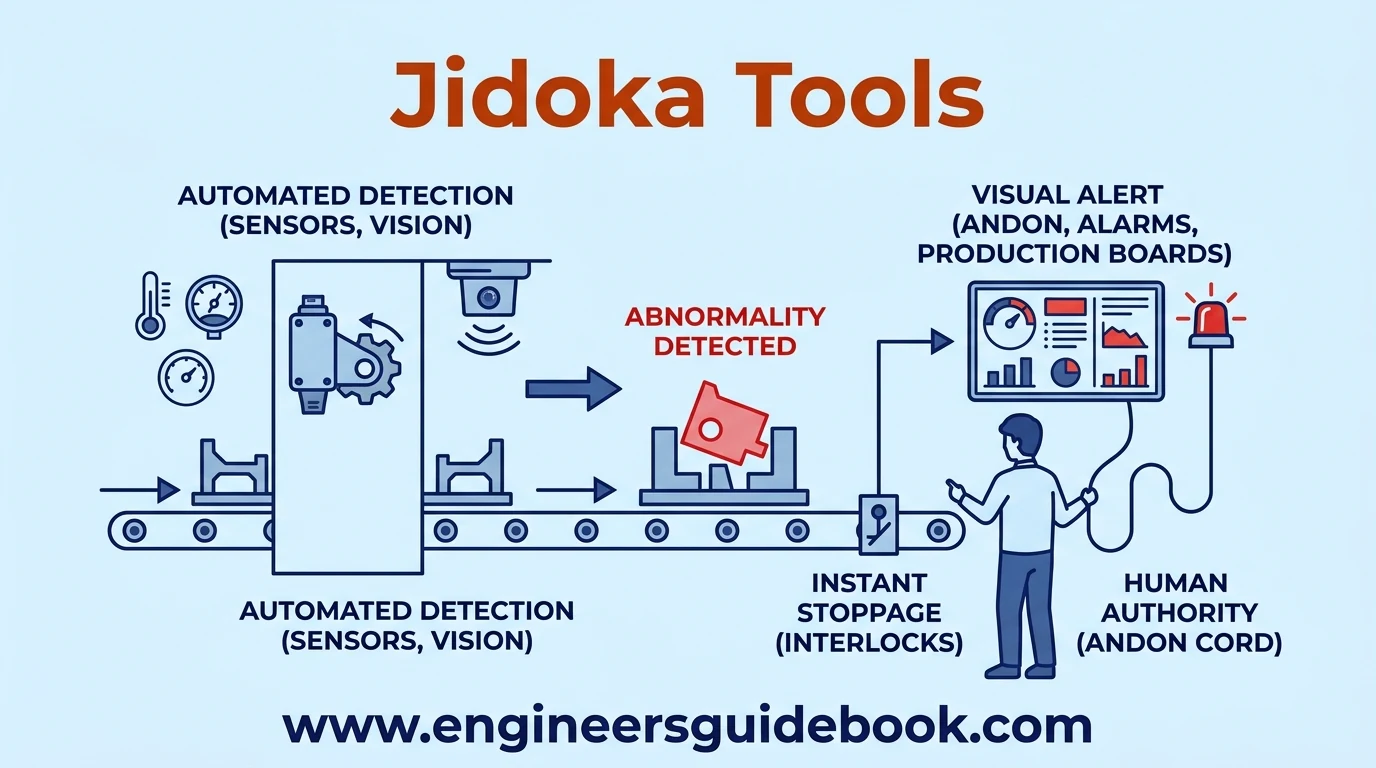
5.1 Andon
Andon is a visual communication system used to display production status and abnormalities.
Traditional Andon systems use colored lights, while modern systems may include electronic boards and digital dashboards. Their essential purpose is instantaneous visibility.
5.2 Andon Cord
An Andon cord allows an operator to request assistance or stop a production process when an abnormality is discovered.
Its significance extends beyond the physical cord. It symbolizes the authority to prioritize quality over uninterrupted production.
5.3 Poka Yoke
Poka Yoke is mistake-proofing designed to prevent human or process errors from becoming defects.
Examples include keyed connectors, asymmetric fixtures, component-presence sensors, and software validations. Poka Yoke complements Jidoka by removing opportunities for predictable errors.
5.4 Sensors
Sensors provide automated detection for temperature, pressure, position, flow, proximity, vibration, level, and numerous other variables.
They give machines the ability to recognize deviations without continuous human observation.
5.5 Limit Switches
Limit switches verify mechanical position and movement.
They can confirm whether guards are closed, actuators have completed their stroke, fixtures are positioned correctly, or moving components remain within permitted travel.
5.6 Vision Systems
Machine vision expands Jidoka into complex visual inspection.
Cameras and image-processing systems can identify missing parts, incorrect labels, dimensional anomalies, surface defects, orientation errors, and packaging inconsistencies at production speed.
5.7 Alarm Systems
Alarm systems communicate conditions requiring attention.
Effective alarms should be prioritized and meaningful. Excessive nuisance alarms create desensitization, weakening the very abnormality response that Jidoka is intended to strengthen.
5.8 Automatic Interlocks
Interlocks prevent equipment from proceeding unless prerequisite conditions are satisfied.
A machine may refuse to start if a guard is open, pressure is inadequate, a component is absent, or a preceding operation remains incomplete.
5.9 Production Boards
Production boards display status, targets, abnormalities, downtime, and performance indicators.
They make deviations visible to operators and management while supporting accountability and structured problem-solving.
6. Jidoka And Toyota Production System
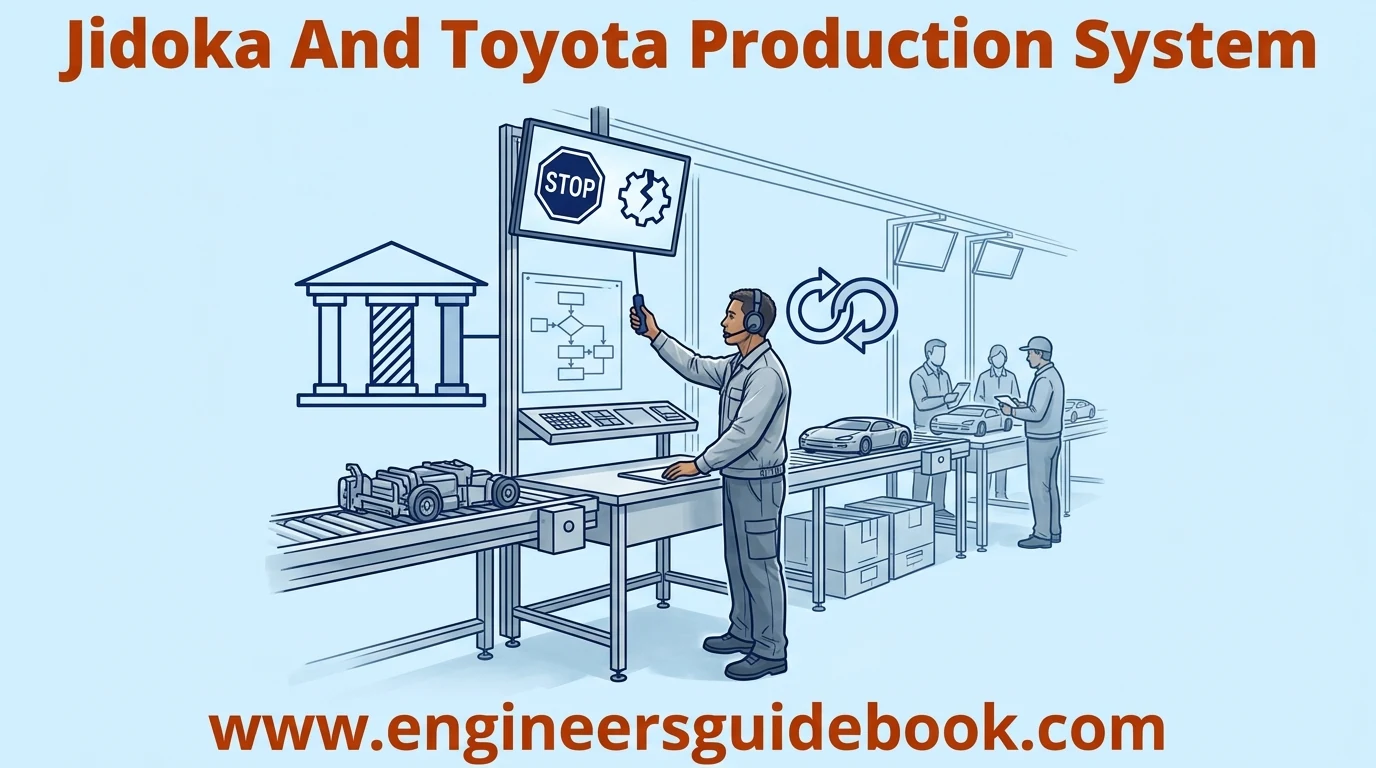
6.1 TPS Pillars
Jidoka is traditionally recognized as one of the principal pillars of the Toyota Production System alongside Just In Time.
Jidoka protects quality, while Just In Time governs efficient material flow. Together they support a production system designed around stability, responsiveness, and waste elimination.
6.2 Just In Time Relationship
Just In Time reduces inventory and produces according to actual demand. However, lower inventory also means there is less buffer available to conceal defects.
Jidoka therefore becomes essential. Problems must be identified and corrected rapidly because defective production can destabilize downstream flow immediately.
6.3 Toyota House
Within the Toyota Production System house, Jidoka supports the pursuit of high quality, low cost, short lead time, safety, and dependable delivery.
Its placement as a structural pillar illustrates that quality cannot be treated as an ancillary inspection function.
6.4 Standardized Work
Standardized work establishes the expected method, sequence, timing, and operating conditions for a process.
Jidoka relies on these standards because abnormality can be recognized only when normality is clearly defined.
6.5 Kaizen Connection
Jidoka and Kaizen reinforce each other continuously.
Jidoka exposes problems. Kaizen transforms those problems into improvement opportunities. The resulting corrective measures create a stronger process standard, after which new abnormalities become easier to detect.
6.6 Heijunka Support
Heijunka seeks to level production volume and product mix.
Stable, leveled production becomes more difficult when defects and equipment problems generate erratic interruptions. Jidoka supports Heijunka by addressing instability at its source.
6.7 Respect For People
Respect for people is embedded in Jidoka because human capability is directed toward judgment and improvement rather than monotonous observation.
Operators are trusted to identify abnormalities and participate in solving them. Their practical knowledge becomes an integral component of process development.
6.8 Operational Stability
Operational stability does not mean avoiding production stops at all costs.
True stability emerges when problems are exposed, understood, and systematically removed. Jidoka may initially increase visible stoppages, but disciplined corrective action progressively produces a more reliable and predictable production environment.
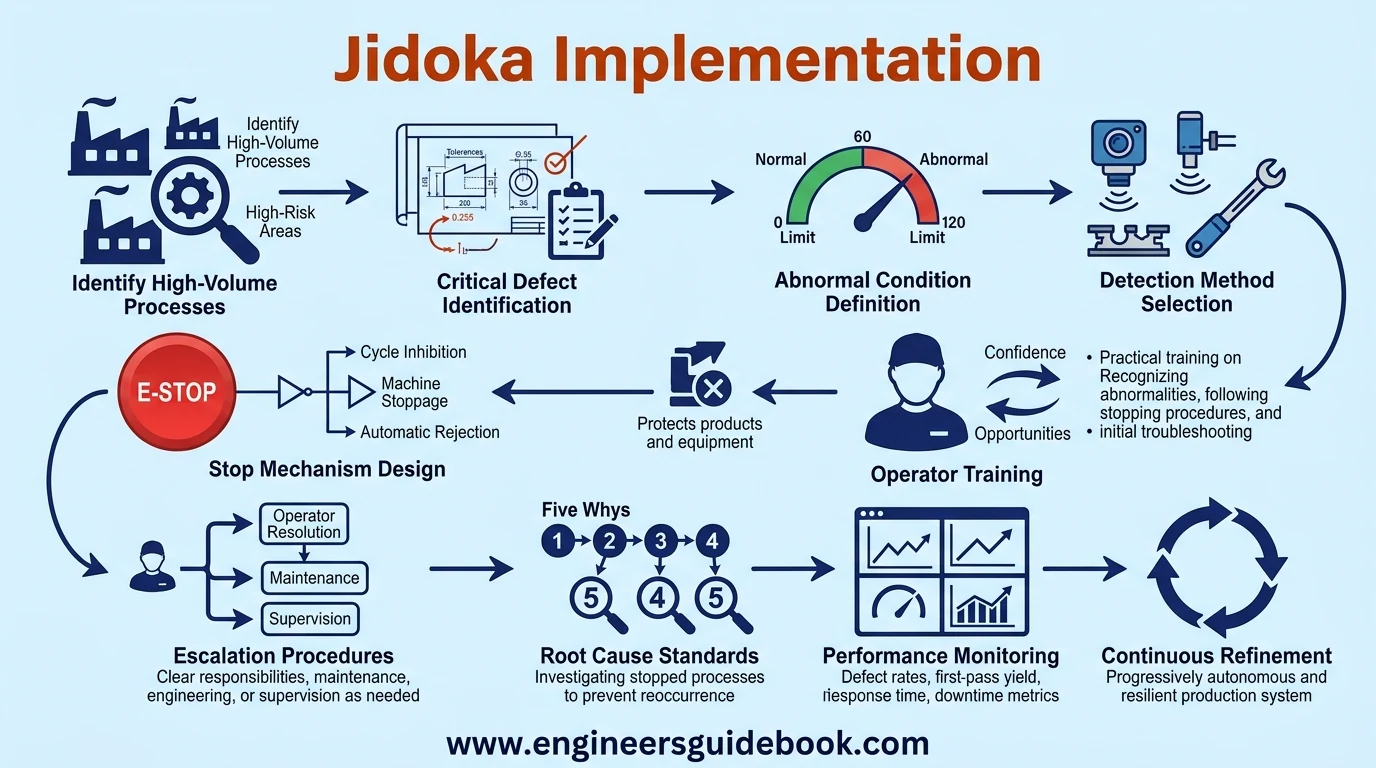
7. Jidoka Implementation
7.1 Process Selection
Implementation should begin with processes where defects, safety risks, equipment failures, or repetitive abnormalities create substantial operational consequences.
High-volume and quality-critical processes often provide strong opportunities for early Jidoka applications.
7.2 Critical Defect Identification
Organizations should determine which defects require immediate containment.
Customer-critical characteristics, safety requirements, regulatory parameters, dimensional tolerances, and recurring internal failures can help establish priorities.
7.3 Abnormal Condition Definition
Each targeted process requires explicit criteria separating normal operation from abnormal operation.
These limits should be measurable wherever possible. Ambiguous standards produce inconsistent responses and unnecessary stoppages.
7.4 Detection Method Selection
The detection mechanism should match the abnormality.
Proximity sensors may verify component presence, vision systems can examine appearance, pressure transmitters can detect process deviations, and torque monitoring can confirm fastening quality.
7.5 Stop Mechanism Design
Stopping logic should protect the product and equipment without creating secondary hazards.
Engineers must determine whether the abnormality requires cycle inhibition, machine stoppage, line stoppage, automatic rejection, or controlled shutdown.
7.6 Operator Training
Operators need practical training on abnormality recognition, stopping procedures, escalation protocols, containment, and basic troubleshooting.
Training should reinforce that legitimate production stops are opportunities to protect the process rather than failures of individual performance.
7.7 Escalation Procedures
Escalation responsibilities must be unambiguous.
Teams should know when operators can resolve problems independently and when maintenance, quality, engineering, supervision, or management involvement becomes necessary.
7.8 Root Cause Standards
Standardized root cause methods prevent organizations from repeatedly applying superficial fixes.
Evidence-based investigation, direct process observation, Five Whys analysis, and corrective-action verification should become routine practices for significant recurring abnormalities.
7.9 Performance Monitoring
Jidoka effectiveness can be monitored through defect rates, first-pass yield, repeat abnormalities, response time, downtime, scrap, rework, and corrective-action recurrence.
Metrics should reveal whether the process is becoming more capable rather than merely counting how frequently production stops.
7.10 Continuous Refinement
Jidoka implementation is never completely finished.
Detection thresholds can be optimized, false alarms eliminated, interlocks strengthened, recurring failures mistake-proofed, and operator feedback incorporated into standards. Through continuous refinement, the production system progressively becomes more autonomous, more transparent, and substantially more resilient.
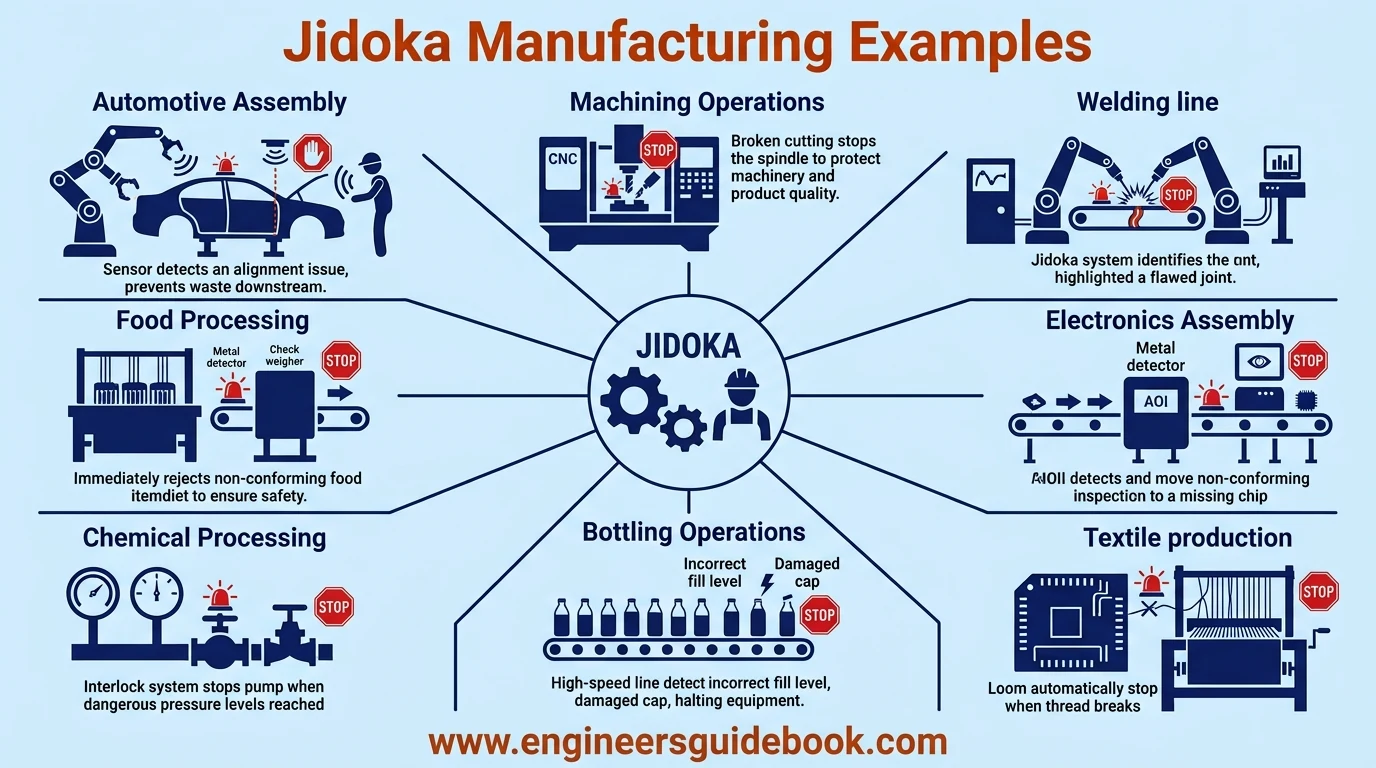
8. Jidoka Manufacturing Examples
8.1 Automotive Assembly
Automotive assembly provides one of the clearest applications of Jidoka. If an operator discovers a missing fastener, incorrect component, abnormal torque value, or alignment problem, the workstation can signal the abnormality or stop the line.
Modern assembly systems also use torque sensors, presence detection, barcode verification, and error-proof fixtures. Defects are therefore contained at the station where they originate instead of being discovered after the vehicle reaches final inspection.
8.2 Machining Operations
Machining processes can apply Jidoka through tool-breakage detection, dimensional monitoring, vibration sensing, spindle-load analysis, and automatic gauging.
If a cutting tool becomes damaged, continuing production could generate dozens of out-of-tolerance components. A Jidoka-enabled machine recognizes the deviation, stops the cycle, and requests intervention. This protects both product quality and expensive machinery.
8.3 Welding Lines
Automated welding lines depend on precise current, voltage, wire feed, positioning, and cycle timing.
Jidoka mechanisms can identify incomplete welds, electrode deterioration, positioning errors, or abnormal welding parameters. The process can then stop or quarantine the affected component.
This is particularly valuable because many weld defects are difficult or costly to correct after downstream assembly has progressed.
8.4 Packaging Lines
Packaging operations often use sensors and vision systems to verify labels, seals, caps, barcodes, weights, and package orientation.
If a carton lacks a label or a package is improperly sealed, the system can reject the item or halt the machine. Such intervention prevents recurring defects from entering warehousing and distribution.
8.5 Bottling Operations
Bottling lines can integrate Jidoka into filling, capping, coding, labeling, and inspection stages.
Sensors may detect missing bottles, incorrect fill levels, damaged caps, misaligned labels, or unreadable date codes. When deviations exceed permissible limits, equipment can stop automatically.
This approach is especially useful on high-speed lines where a minor malfunction can generate large quantities of nonconforming product within minutes.
8.6 Food Processing
Food manufacturers use Jidoka to control temperature, weight, contamination risks, cooking parameters, ingredient addition, and package integrity.
Metal detectors, checkweighers, temperature sensors, and vision systems can trigger automatic rejection or stoppage. Because food quality and safety are tightly interconnected, rapid abnormality detection can prevent both waste and serious compliance problems.
8.7 Electronics Assembly
Electronics manufacturing requires exceptional precision. Jidoka can detect missing components, incorrect polarity, solder defects, faulty connections, or assembly sequence errors.
Automated optical inspection and electrical testing provide immediate feedback before defective circuit boards proceed further. This is important because downstream repair becomes increasingly expensive as additional components and labor are added.
8.8 Pharmaceutical Manufacturing
Pharmaceutical production demands rigorous process control and traceability.
Jidoka principles can be applied through automatic verification of batch parameters, tablet weights, fill volumes, labeling accuracy, environmental conditions, and packaging integrity. When specifications are violated, systems can stop production or isolate affected material.
The result is stronger quality assurance and more reliable regulatory compliance.
8.9 Textile Production
Textile manufacturing has historical significance in Jidoka because automatic loom technology helped establish the principle itself.
Modern textile machinery can detect broken threads, fabric defects, tension irregularities, color variation, and machine abnormalities. Automatic stopping prevents defective fabric from accumulating while allowing operators to oversee multiple machines efficiently.
8.10 Chemical Processing
Chemical processing applies Jidoka through automated monitoring of temperature, pressure, flow, level, composition, and equipment condition.
Interlocks can stop pumps, isolate valves, or shut down processing equipment when dangerous or unacceptable conditions occur. In this environment, Jidoka protects not only quality but also personnel, equipment, and environmental integrity.
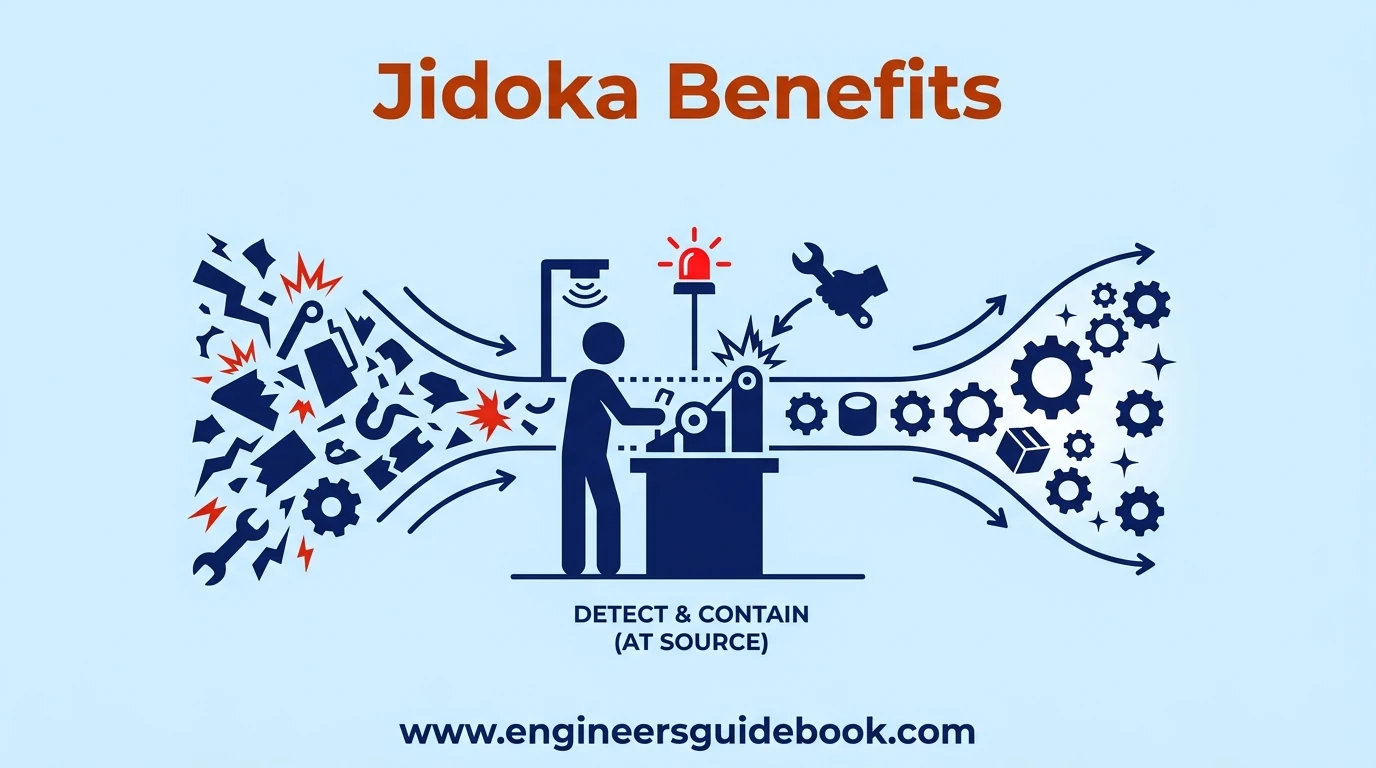
9. Jidoka Benefits
9.1 Defect Reduction
Jidoka reduces defects by stopping production at the moment an abnormality is detected. Instead of allowing defective output to accumulate, the process contains the problem immediately.
9.2 Quality Improvement
Quality improves because responsibility moves closer to the source of production. Problems are corrected where they occur, strengthening first-pass yield and reducing dependence on final inspection.
9.3 Waste Reduction
Defective products consume material, labor, machine time, energy, and storage space. Jidoka curtails these losses by preventing continuous production under abnormal conditions.
9.4 Downtime Control
Although Jidoka can create intentional stoppages, it can reduce chronic downtime over time. Repeated abnormalities become visible and are systematically eliminated instead of being tolerated indefinitely.
9.5 Faster Problem Solving
Immediate notification accelerates response. Maintenance, production, and quality personnel receive earlier information, making investigation easier because the problem remains fresh and observable.
9.6 Operator Ownership
Jidoka gives operators greater responsibility for process quality. They become active guardians of production rather than passive observers of equipment.
9.7 Process Visibility
Andon systems, alarms, dashboards, and stop signals make abnormalities visible. Greater transparency allows management to understand where instability actually exists.
9.8 Customer Satisfaction
Fewer defects reaching customers result in fewer complaints, returns, warranty claims, and reputation problems. Consistent quality strengthens customer confidence.
9.9 Cost Reduction
Lower scrap, reduced rework, fewer claims, and less sorting contribute directly to cost reduction. Jidoka also improves utilization of labor and equipment by preventing wasteful production.
9.10 Production Reliability
As recurring causes are eliminated, production becomes more predictable. Reliable processes support better planning, delivery performance, and overall equipment effectiveness.
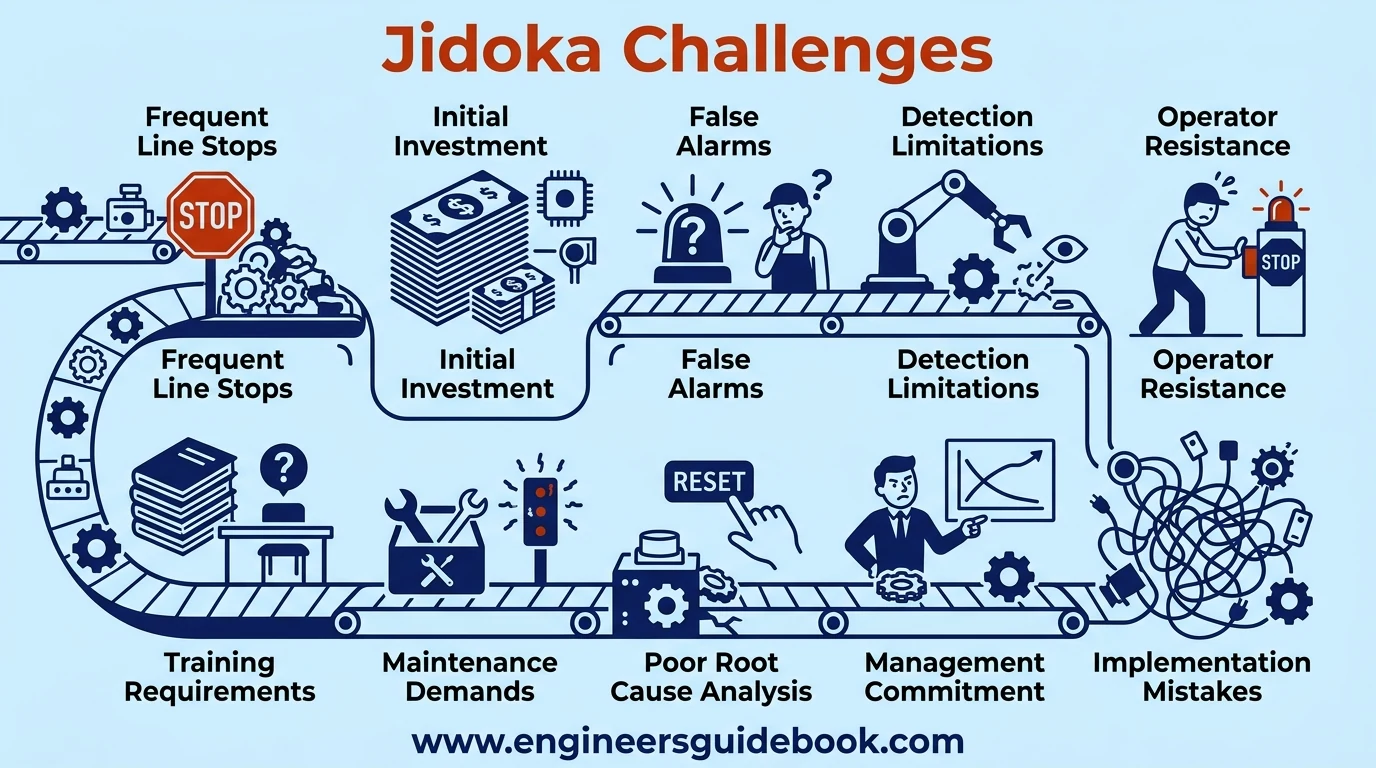
10. Jidoka Challenges
10.1 Frequent Line Stops
Poorly designed Jidoka systems may stop production too frequently. Early implementation can also reveal numerous hidden problems that were previously ignored.
The solution is not to disable stopping mechanisms, but to eliminate the causes generating repeated abnormalities.
10.2 Initial Investment
Sensors, vision systems, controls, interlocks, automation hardware, and training can require substantial investment. Companies must prioritize applications where quality or operational risk justifies the expenditure.
10.3 False Alarms
Incorrect thresholds or unreliable sensors can generate nuisance alarms. Frequent false signals reduce operator confidence and may eventually cause legitimate warnings to be ignored.
10.4 Detection Limitations
Not every abnormality is easy to detect automatically. Some defects require human judgment, complex inspection, or specialized testing.
Effective Jidoka therefore combines technology with skilled observation.
10.5 Operator Resistance
Employees may resist stopping equipment if workplace culture emphasizes production quantity above all else.
Management must reinforce that stopping for a genuine quality or safety concern is responsible behavior.
10.6 Training Requirements
Operators need more than instructions on pressing stop buttons. They must understand abnormality criteria, escalation procedures, containment, troubleshooting, and restart requirements.
10.7 Maintenance Demands
Sensors, switches, cameras, interlocks, and control devices require maintenance and calibration. Neglected detection systems can create both false alarms and dangerous undetected failures.
10.8 Poor Root Cause Analysis
Jidoka loses much of its value when organizations repeatedly reset equipment without investigating why the problem occurred.
Superficial fixes convert intelligent stopping into repetitive downtime.
10.9 Management Commitment
Leadership must support problem exposure even when stoppages temporarily reduce output. Without this commitment, employees quickly learn that production targets matter more than quality.
10.10 Implementation Mistakes
Common mistakes include monitoring too many trivial conditions, setting unrealistic thresholds, lacking escalation standards, and failing to verify corrective actions.
Successful implementation requires disciplined design rather than indiscriminate automation.
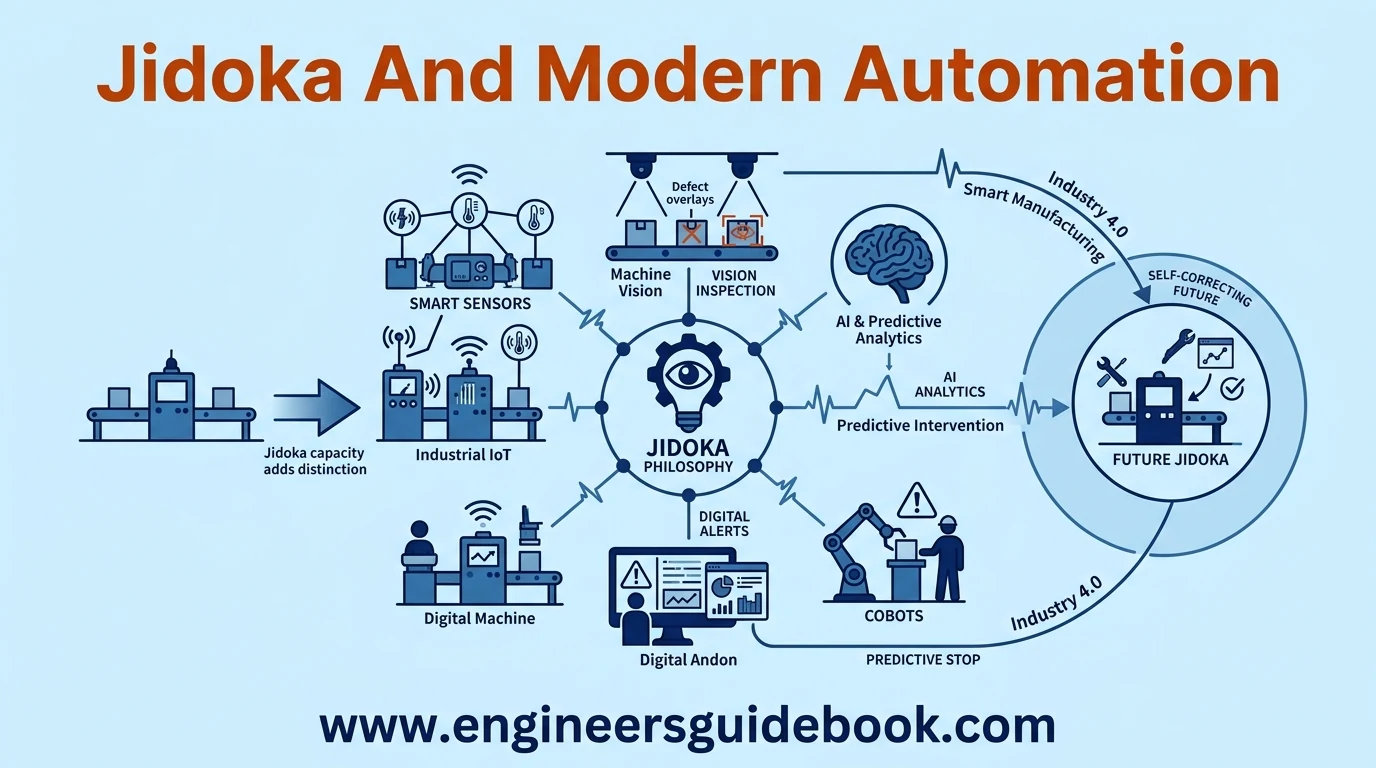
11. Jidoka And Modern Automation
11.1 Traditional Automation
Traditional automation executes repetitive tasks efficiently but may continue operating despite defects unless specific detection logic has been included.
Jidoka adds the capacity to distinguish acceptable operation from abnormal operation.
11.2 Smart Manufacturing
Smart manufacturing expands Jidoka through connected equipment, digital controls, and real-time information.
Production systems can increasingly detect, communicate, and contextualize abnormalities without waiting for manual inspection.
11.3 Industrial IoT
Industrial IoT devices collect continuous data from machines and processes. Temperature, vibration, current, pressure, and cycle information can reveal subtle deviations before visible defects emerge.
11.4 Machine Vision
Machine vision allows automated inspection of shape, color, orientation, dimensions, labeling, and surface condition.
It extends Jidoka into applications where conventional sensors cannot adequately evaluate product appearance.
11.5 Artificial Intelligence
Artificial intelligence can recognize complex patterns that fixed thresholds may overlook.
AI-based inspection can classify defects, detect anomalous behavior, and support more adaptive decision-making in advanced production environments.
11.6 Predictive Analytics
Predictive analytics shifts Jidoka from reactive detection toward anticipatory intervention.
Machine data can indicate degrading bearings, tools, motors, or process conditions before failure produces defective output.
11.7 Collaborative Robots
Collaborative robots can integrate sensors and force monitoring to recognize abnormal contact, positioning errors, or missing components.
When unusual conditions arise, they can stop safely and request human intervention.
11.8 Digital Andon
Digital Andon systems communicate abnormalities through monitors, mobile devices, dashboards, and centralized control rooms.
They can also record response times, causes, corrective actions, and recurring trends automatically.
11.9 Industry 4.0
Industry 4.0 strengthens Jidoka through interconnected machines, real-time analytics, cloud platforms, edge computing, and intelligent control.
The fundamental philosophy remains unchanged: abnormalities must become visible and actionable.
11.10 Future Jidoka
Future Jidoka systems are likely to become increasingly predictive, autonomous, and self-correcting.
Advanced equipment may not merely stop after detecting abnormality. It may identify probable causes, recommend countermeasures, adjust parameters, and verify recovery automatically.
12. Frequently Asked Questions
12.1 What Does Jidoka Mean In Lean Manufacturing
Jidoka means building quality into the production process by detecting abnormalities, stopping when necessary, correcting problems, and preventing recurrence. It is often described as automation with a human touch.
12.2 What Are The Four Steps Of Jidoka
The four basic steps are detecting an abnormality, stopping the process, correcting the immediate condition, and investigating the root cause to prevent recurrence.
12.3 What Is An Example Of Jidoka
A machining center that automatically stops when it detects a broken cutting tool is a practical example of Jidoka.
12.4 Why Is Jidoka Important In Manufacturing
Jidoka prevents defective production from continuing, improves process visibility, reduces waste, and encourages faster problem-solving.
12.5 What Is The Difference Between Jidoka And Automation
Automation performs work automatically. Jidoka adds abnormality recognition and the ability to stop or respond intelligently when conditions become unacceptable.
12.6 What Is The Difference Between Jidoka And Poka Yoke
Jidoka detects and responds to abnormalities, while Poka Yoke is designed specifically to prevent mistakes or make them immediately obvious.
12.7 How Does Jidoka Improve Quality
Jidoka improves quality by controlling problems at their source instead of relying primarily on downstream inspection.
12.8 How Does Jidoka Reduce Waste
It reduces scrap, rework, unnecessary processing, inspection effort, material consumption, and production of defective goods.
12.9 What Is The Role Of Andon In Jidoka
Andon makes abnormalities visible and communicates where assistance is required, helping teams respond rapidly.
12.10 How Is Jidoka Used In Toyota
Toyota uses Jidoka to empower workers and equipment to identify abnormalities, stop production when needed, and resolve causes before defects propagate.
12.11 Can Jidoka Be Used Outside Automotive Manufacturing
Yes. Jidoka is applicable to food, pharmaceuticals, electronics, packaging, textiles, chemical processing, logistics, and many other operational environments.
12.12 How Can A Company Implement Jidoka
A company can begin by identifying critical abnormalities, defining detection methods, establishing stop mechanisms, training operators, creating escalation procedures, and conducting disciplined root cause analysis.
13. Conclusion
Jidoka combines abnormality detection, controlled stopping, rapid correction, and root cause elimination to build quality directly into manufacturing.
Its value lies in preventing defects from multiplying while improving visibility, responsiveness, safety, and operational discipline.
Jidoka also strengthens organizational culture by making quality everyone’s responsibility. Employees are encouraged to expose problems rather than conceal them.