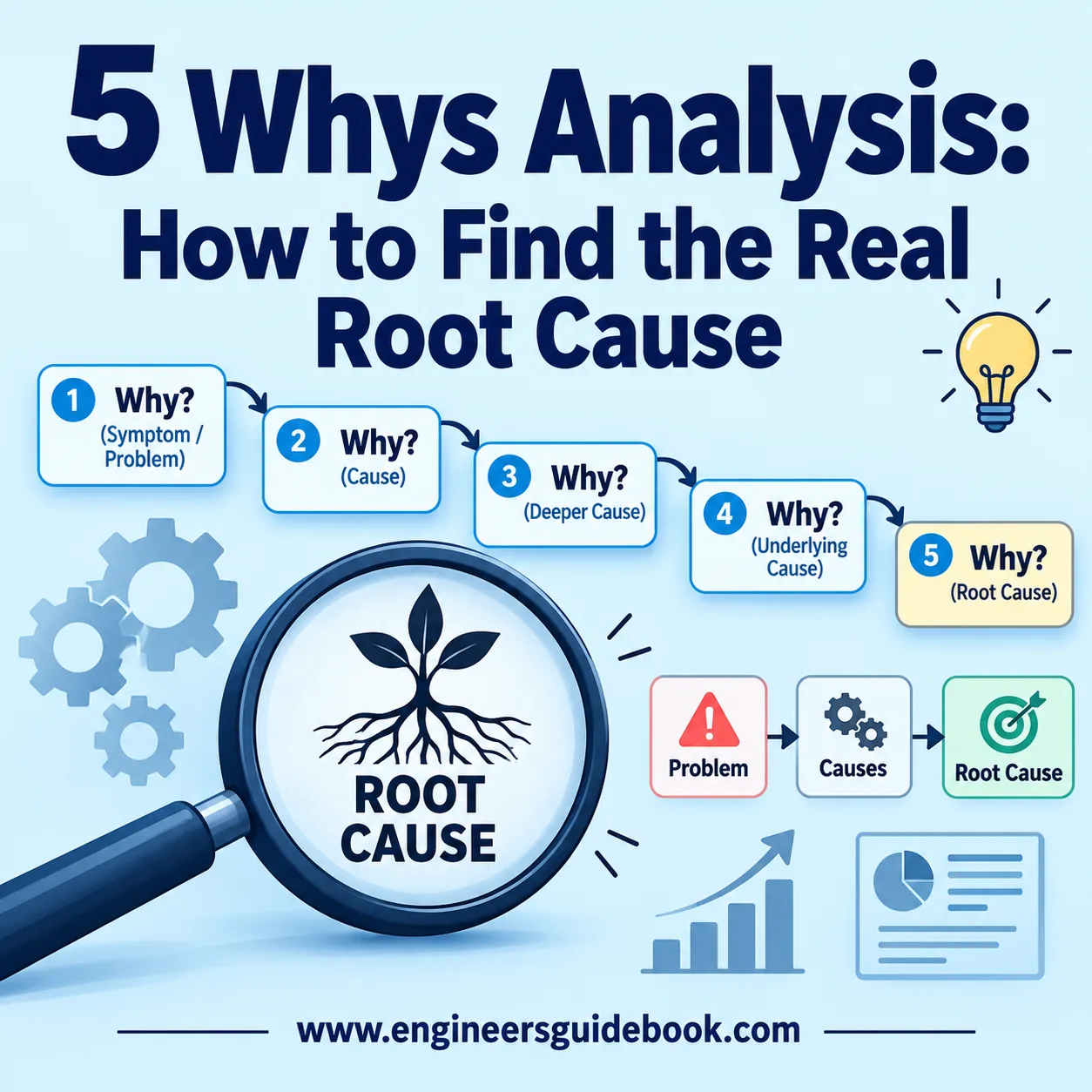
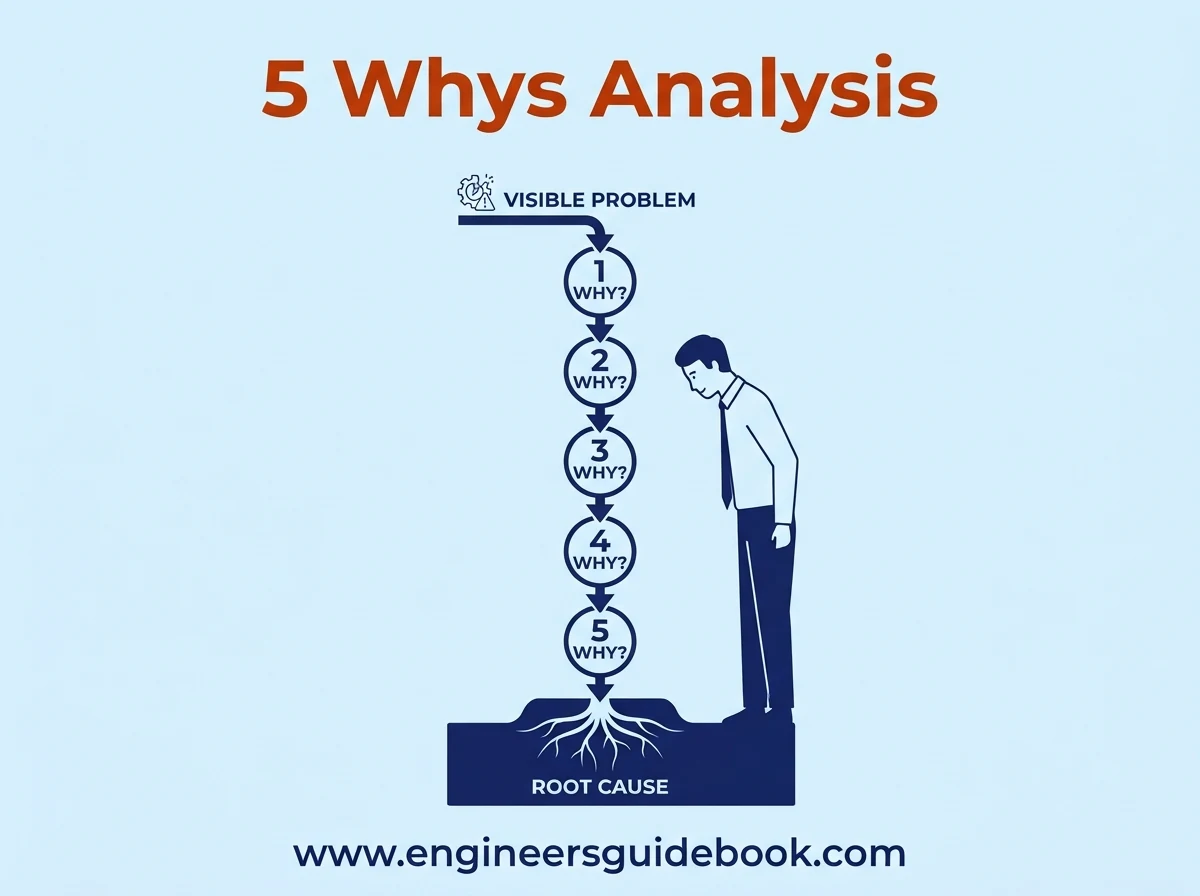
The 5 Whys Analysis is a root cause analysis technique used to uncover the underlying reason behind a problem by repeatedly asking why it occurred. Instead of correcting only visible symptoms, the method traces a logical chain of causes until the controllable process, system, or management deficiency responsible for the failure becomes identifiable and actionable.
1. 5 Whys Analysis
1.1 Definition of 5 Whys Analysis
The 5 Whys Analysis is a structured problem-solving technique in which a team repeatedly asks “Why did this happen?” to move from an observable problem toward its underlying cause. Each answer becomes the basis for the next question, creating a causal chain.
Despite its name, the method does not rigidly require exactly five questions. Some problems may reveal their root cause after three iterations, while more intricate failures may require six or seven. The objective is depth, not numerical conformity.
1.2 Purpose of the 5 Whys Method
The primary purpose of the 5 Whys method is to prevent organizations from repeatedly treating symptoms while leaving the actual failure mechanism untouched.
For example, restarting a stopped machine may restore production, but it does not explain why the machine stopped. Replacing a failed bearing may solve the immediate breakdown, yet the bearing could fail again if poor lubrication, shaft misalignment, contamination, or an inadequate preventive maintenance system remains unresolved.
The technique therefore shifts problem solving from temporary correction toward systematic prevention .
1.3 Origins of the 5 Whys Technique
The 5 Whys technique is strongly associated with the Toyota Production System and the development of lean manufacturing practices. It became an important mechanism for investigating production abnormalities and exposing deficiencies hidden beneath obvious technical symptoms.
Its practical value came from simplicity. Engineers, supervisors, operators, and managers could investigate a problem without requiring elaborate statistical software or specialized analytical equipment.
Over time, the approach expanded beyond manufacturing into maintenance, quality management, logistics, healthcare, information technology, construction, and business process improvement.
1.4 Role in Root Cause Analysis
Within root cause analysis, the 5 Whys serves as a rapid investigative tool for establishing a logical sequence between an undesirable event and its deeper causal factors.
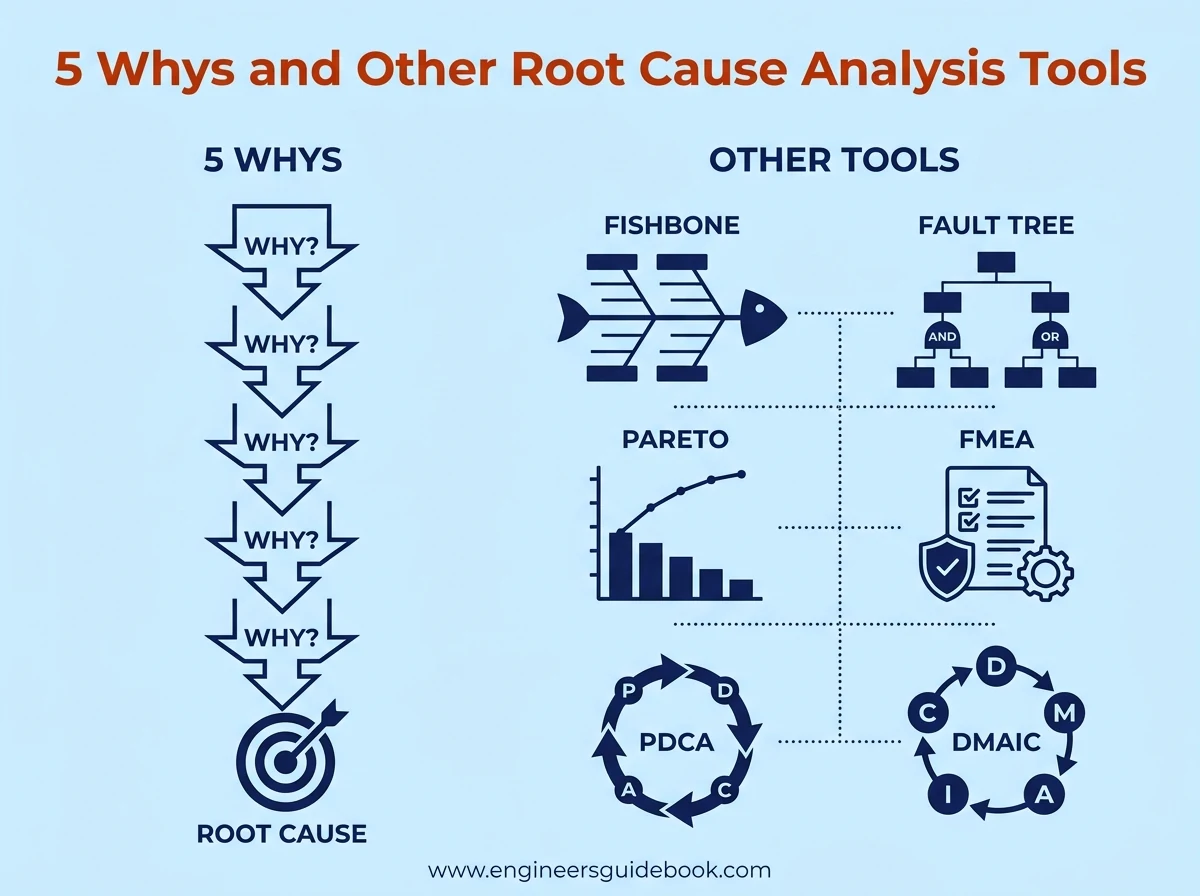
It is particularly effective for problems with relatively clear cause-and-effect relationships. However, complex incidents may contain several parallel causal pathways. In those situations, the 5 Whys can be combined with tools such as fishbone diagrams, fault tree analysis, Pareto analysis, or failure mode investigations.
The essential principle remains unchanged: identify why the failure became possible, not merely what failed.
2. How the 5 Whys Method Works
2.1 Problem Identification
Every effective investigation begins with an accurate problem statement. The team must establish exactly what occurred, where it happened, when it occurred, and what consequence followed.
A vague statement such as “the machine is unreliable” provides little investigative value. A stronger statement would be “Packaging Line 2 stopped for 45 minutes because the main conveyor drive tripped during production.”
Specificity creates analytical discipline.
2.2 Sequential Questioning
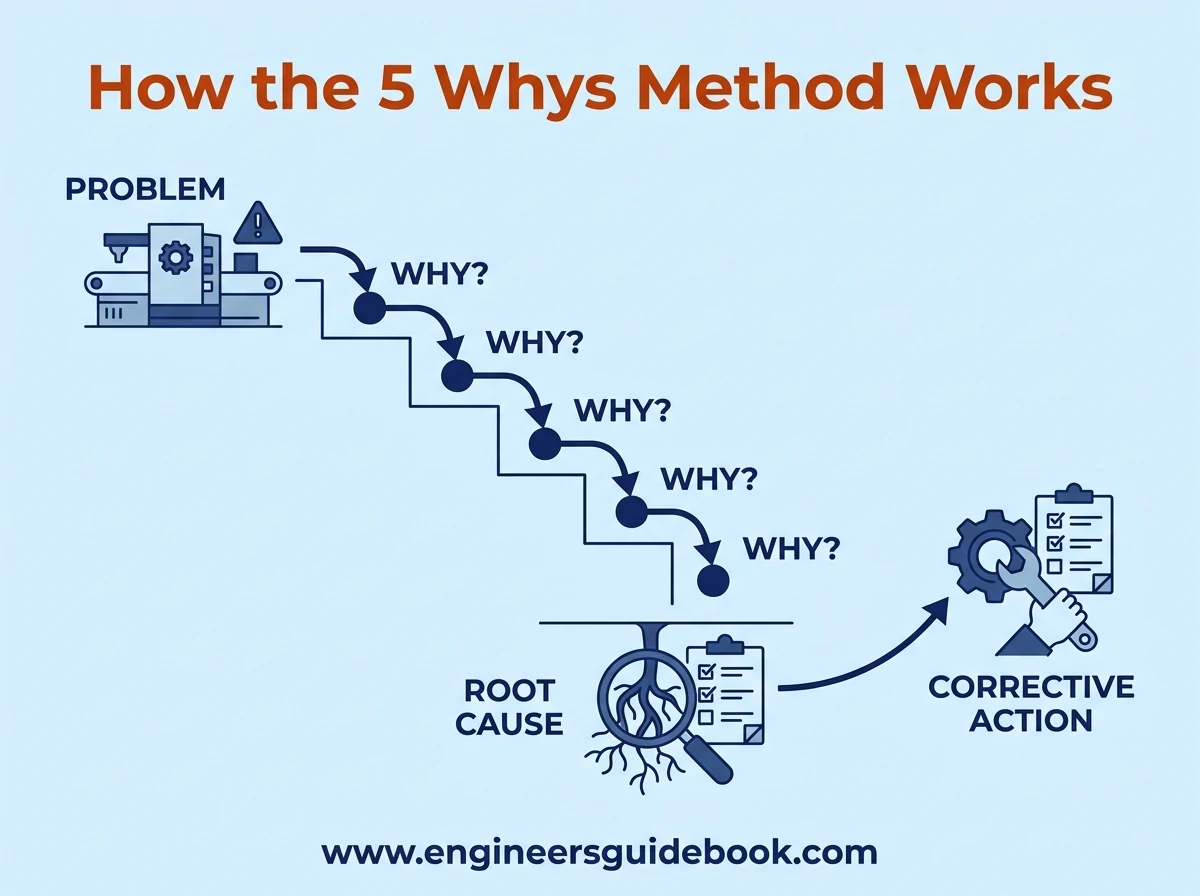
After defining the problem, the investigator asks why the event occurred. The answer should describe a plausible and preferably verifiable cause.
That answer then becomes the subject of the next why.
This sequence continues progressively. Instead of jumping directly toward assumptions, the team follows the causal pathway one link at a time. The technique is therefore deceptively simple but intellectually demanding when applied correctly.
2.3 Cause and Effect Logic
Each answer in a 5 Whys investigation must maintain a credible cause-and-effect connection with the previous statement.
Suppose a pump stopped because its motor protection relay tripped. Asking why the relay tripped may reveal excessive motor current. Asking why current increased may reveal mechanical resistance in the pump. Further investigation might identify damaged bearings caused by inadequate lubrication.
Every step must be logically connected.
Unsupported conjecture weakens the entire analysis.
2.4 Root Cause Recognition
A root cause is normally reached when the investigation identifies a factor that can be controlled or corrected and whose elimination would significantly reduce the probability of recurrence.
A damaged component is often not the true root cause. The deeper question is why the component became damaged.
Perhaps inspections were never scheduled. Perhaps the lubrication specification was incorrect. Perhaps an operating procedure did not exist. These systemic deficiencies frequently represent more meaningful root causes than the physical failure itself.
2.5 Corrective Action Selection
Once the root cause has been identified, corrective action should directly address that cause.
If poor lubrication resulted from the absence of a maintenance schedule, simply replacing the bearing is insufficient. A stronger corrective action would establish lubrication intervals, assign responsibility, define lubricant specifications, and include verification within the preventive maintenance program.
Effective corrective actions alter the conditions that allowed the failure to develop.
3. The 5 Whys Process
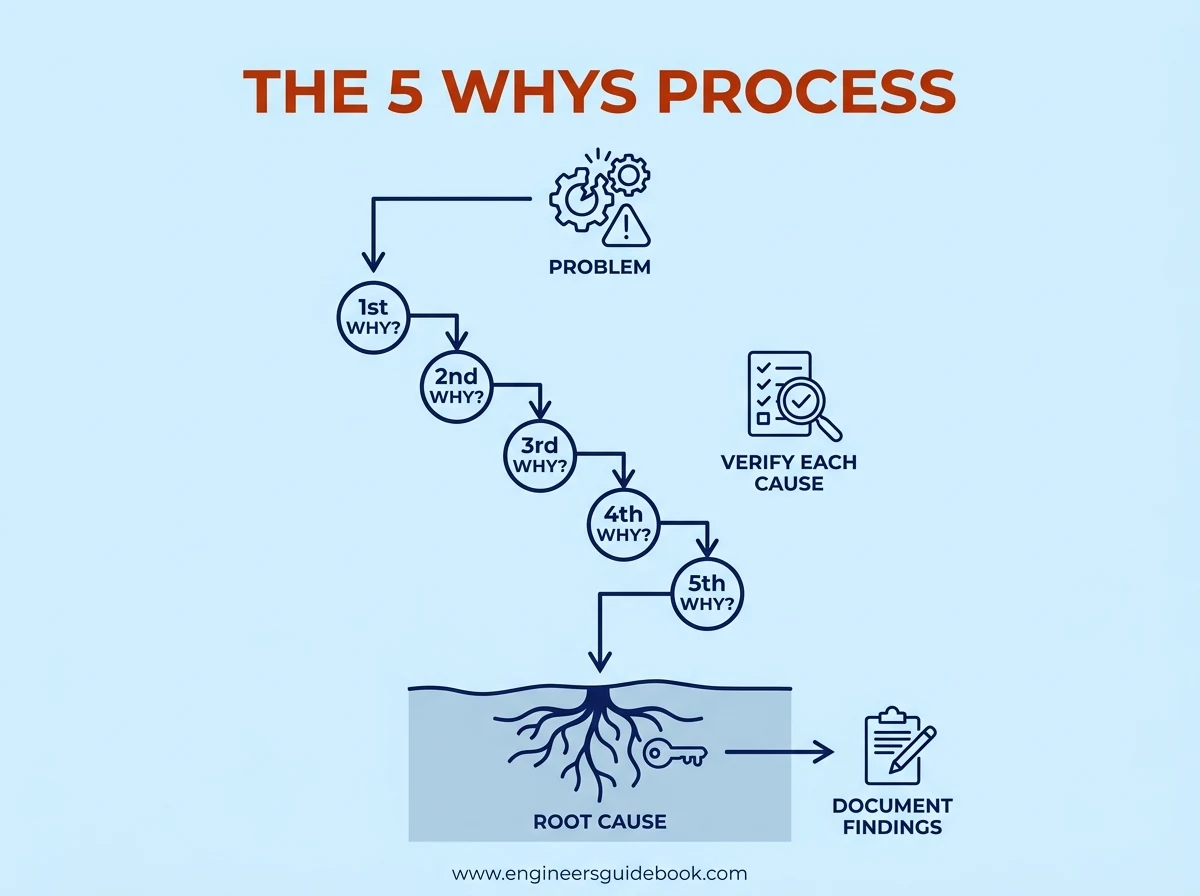
3.1 Define the Problem Clearly
Begin with a factual statement rather than an interpretation. Include measurable information whenever available.
Describe the equipment, process, defect, downtime, deviation, location, and timing. A well-framed problem narrows the investigative field and reduces speculative discussion.
3.2 Ask the First Why
The first why normally identifies the immediate cause.
For example:
“Why did the production line stop?”
Because the conveyor motor overloaded and tripped.
This answer explains the immediate mechanism but rarely represents the final root cause.
3.3 Follow Each Answer With Another Why
Continue questioning the previous answer.
Why did the motor overload? Why was the conveyor mechanically overloaded? Why had material accumulated? Why did the sensor fail to detect the accumulation?
The investigation gradually moves from the visible event toward deeper procedural, technical, or organizational conditions.
3.4 Verify Each Cause
Every important cause should be verified with available evidence.
Maintenance records, alarm history, photographs, operator statements, inspection findings, process trends, damaged components, and control system data can substantiate the causal chain.
Without verification, the 5 Whys can deteriorate into an exercise based on opinions rather than evidence.
3.5 Stop at the Root Cause
Stop when the team reaches a cause that is sufficiently fundamental, controllable, and relevant to recurrence prevention.
Continuing indefinitely can produce abstract answers such as organizational culture or human nature that offer little practical corrective value.
The appropriate stopping point is generally where meaningful action can permanently strengthen the system.
3.6 Document the Findings
Document the original problem, each why, supporting evidence, identified root cause, corrective actions, responsible personnel, deadlines, and verification method.
Proper documentation transforms an informal conversation into a traceable improvement record.
It also enables future teams to determine whether similar failures have occurred previously.
4. 5 Whys Analysis Example
5 Whys Examples for Manufacturing and Equipment Failure
4.1 Equipment Breakdown Example
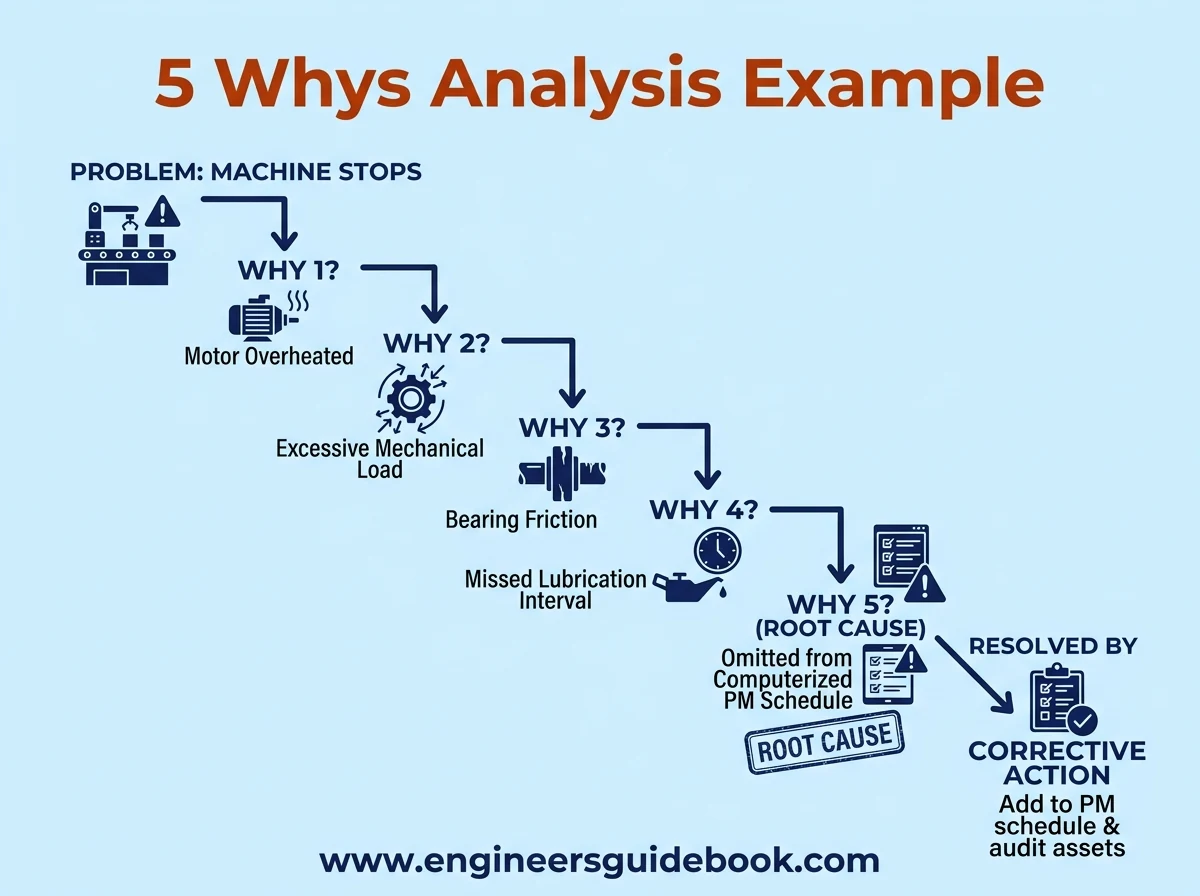
Consider a production machine that unexpectedly stops because its drive motor overheats. Maintenance restores operation, but management wants to prevent the incident from recurring.
A 5 Whys investigation can reveal the deeper reason.
4.2 First Why
Why did the machine stop?
The drive motor overheated and triggered the thermal protection system.
This establishes the immediate failure event.
4.3 Second Why
Why did the motor overheat?
The motor was operating under excessive mechanical load.
The analysis now moves from the electrical symptom toward the mechanical condition.
4.4 Third Why
Why was the mechanical load excessive?
The driven shaft bearings had developed excessive friction.
Inspection confirms elevated bearing temperature and deteriorated lubrication.
4.5 Fourth Why
Why did the bearings develop excessive friction?
The bearings had not received the required lubrication at the specified interval.
This reveals a maintenance-related deficiency rather than an isolated component failure.
4.6 Fifth Why
Why was lubrication not performed at the required interval?
The equipment had not been included in the computerized preventive maintenance schedule after a recent line modification.
Now the causal chain has reached a systemic weakness.
4.7 Root Cause Identification
The root cause is not simply the overheated motor or damaged bearing. The deeper cause is the omission of the modified equipment from the preventive maintenance system.
Because lubrication activities were never automatically generated, the bearings operated beyond their intended maintenance interval.
4.8 Corrective Action Development
Corrective actions could include adding the equipment to the preventive maintenance schedule, defining lubrication frequency, assigning maintenance responsibility, verifying lubricant specifications, and auditing recently modified assets for similar omissions.
These measures address recurrence instead of merely restoring equipment.
5. How to Ask Effective Why Questions
5.1 Evidence Based Questions
Why questions should be grounded in observable evidence.
Instead of asking, “Why did the operator make a mistake?” ask, “What condition allowed the incorrect setting to be entered?”
The latter question encourages investigation rather than accusation.
5.2 Specific Questions
Specific questions produce useful answers.
“Why did the pump fail?” may be too broad. “Why did the pump’s mechanical seal begin leaking during operation?” directs attention toward an identifiable failure mode.
Precision improves causal clarity.
5.3 Neutral Questions
Questions should avoid implying a predetermined conclusion.
Leading questions such as “Why did poor maintenance cause this failure?” contaminate the investigation because they assume the answer before evidence is examined.
Neutral questioning preserves analytical objectivity.
5.4 Process Focused Questions
Focus on processes and systems rather than individual blame.
Human error may explain an immediate action, but deeper investigation should examine training, procedures, workload, supervision, equipment design, labeling, and mistake-proofing measures.
Robust systems anticipate foreseeable human variability.
5.5 Follow Up Questions
Each answer should naturally generate the next investigative question.
If a technician says that a valve was installed incorrectly, the next question should explore why incorrect installation was possible. Perhaps installation instructions were ambiguous, components lacked identification, or inspection requirements were absent.
5.6 Verification Questions
Ask whether evidence supports each proposed cause.
Useful verification questions include whether the condition was physically observed, whether historical records confirm it, and whether correcting the suspected cause would plausibly prevent the original problem.
This protects the analysis from convenient but erroneous conclusions.

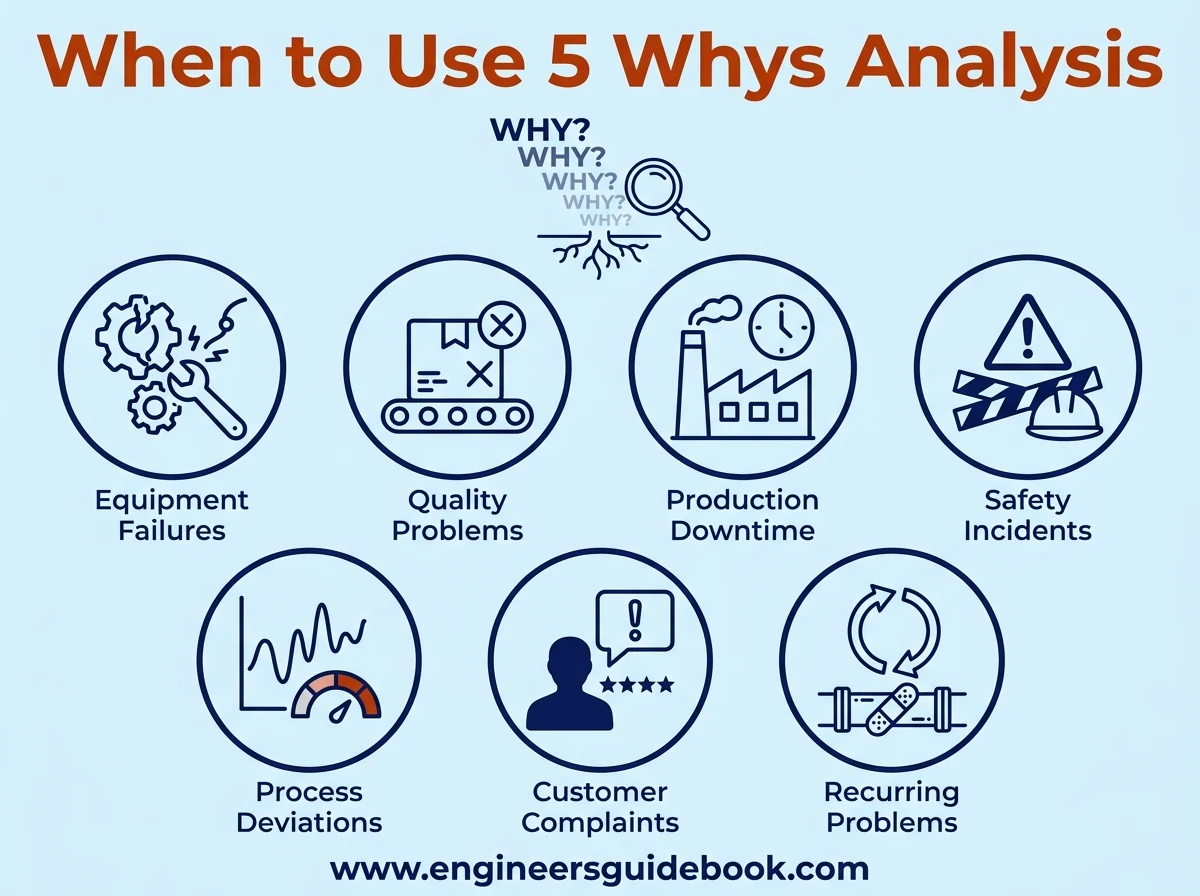
6. When to Use 5 Whys Analysis
6.1 Equipment Failures
The technique is highly useful for mechanical and electrical breakdowns where failures can be traced through maintenance, operating, design, or inspection deficiencies.
6.2 Quality Problems
Manufacturing defects, dimensional variation, contamination, incorrect assembly, and packaging errors can frequently be investigated using sequential why questions.
6.3 Production Downtime
Unplanned stops often involve interconnected technical and operational causes. The 5 Whys helps distinguish the immediate trip condition from the management-system weakness that permitted it.
6.4 Safety Incidents
For relatively straightforward safety incidents, the method can identify deficiencies involving procedures, safeguards, training, inspections, or hazard controls.
Serious incidents, however, normally require more comprehensive investigation methodologies.
6.5 Process Deviations
Unexpected temperature, pressure, flow, speed, concentration, or cycle-time deviations can be traced through instrumentation, operating conditions, maintenance, and procedural causes.
6.6 Customer Complaints
Repeated complaints about product defects or service failures may reveal upstream weaknesses in inspection, production controls, communication, packaging, or order processing.
6.7 Recurring Problems
The 5 Whys is especially valuable when a problem repeatedly returns after temporary repairs.
Recurrence often indicates that previous actions treated the symptom rather than the underlying cause.
7. Benefits of 5 Whys Analysis
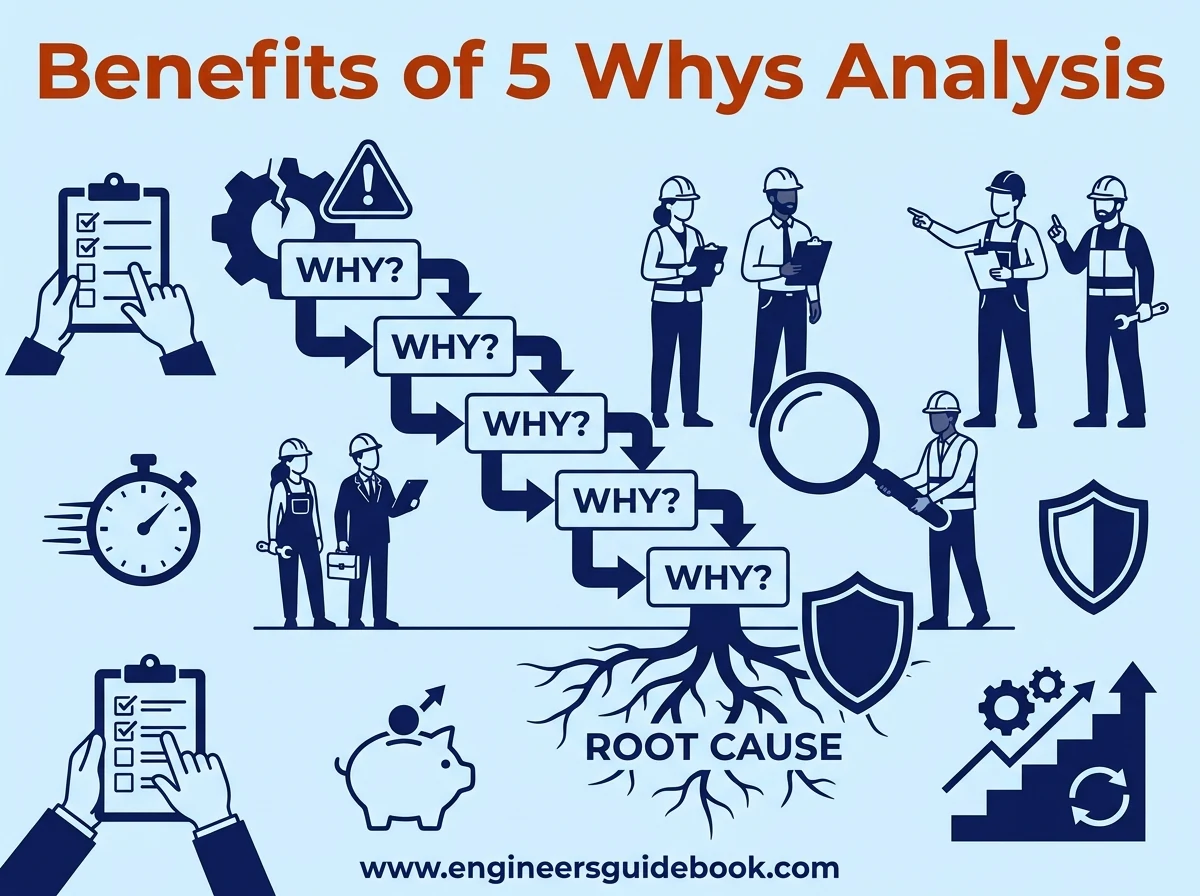
7.1 Simplicity
The method requires no sophisticated software or elaborate mathematical models. Teams can apply it using a worksheet, whiteboard, maintenance report, or digital RCA system.
7.2 Speed
Straightforward problems can often be investigated rapidly, allowing corrective actions to begin without prolonged analytical delays.
7.3 Low Cost
Because the method primarily depends on disciplined questioning and evidence collection, implementation costs are minimal compared with more resource-intensive investigative techniques.
7.4 Team Collaboration
Operators, technicians, engineers, supervisors, and quality personnel can contribute different perspectives to the causal chain.
Cross-functional participation frequently exposes information that one department alone might overlook.
7.5 Root Cause Visibility
The technique visually demonstrates how an apparently minor event can originate from deeper procedural or systemic deficiencies.
This visibility helps decision-makers understand why replacing failed components alone may not prevent recurrence.
7.6 Continuous Improvement
Repeated application of the 5 Whys encourages organizations to improve maintenance systems, standard operating procedures, training programs, inspection regimes, and process controls.
Individual failures consequently become opportunities for organizational learning.
7.7 Problem Prevention
The greatest benefit of the method is prevention.
When the true causal mechanism is identified and eliminated, corrective action extends beyond restoring normal operation. It strengthens the process so that the same failure becomes less likely to occur again.
8. Common Mistakes in 5 Whys Analysis
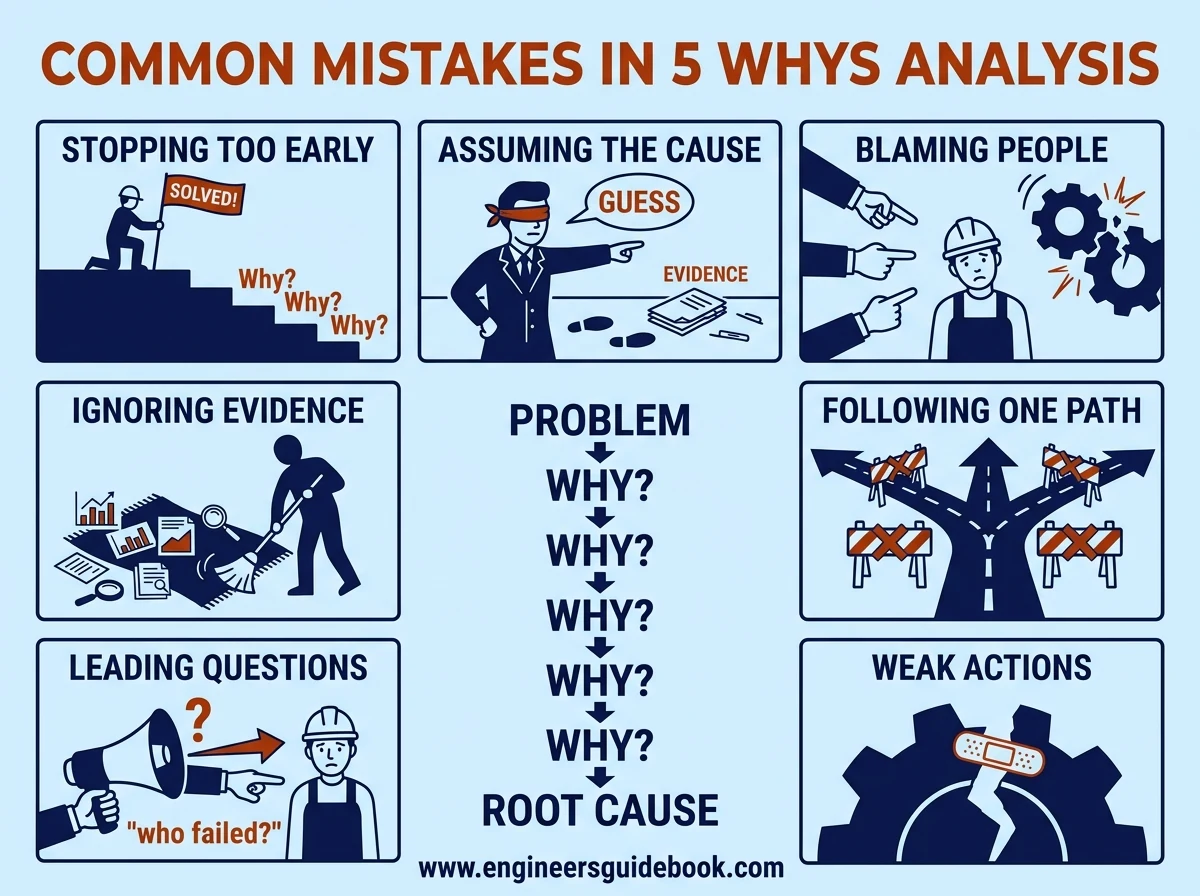
8.1 Stopping Too Early
One of the most frequent errors in 5 Whys Analysis is ending the investigation at the first plausible explanation. A failed bearing, tripped breaker, blocked filter, or operator mistake may describe what happened, but it often does not explain why the condition was allowed to develop.
Stopping prematurely produces superficial corrective action. The team may replace the damaged component, restart production, and consider the matter closed. Weeks later, the same fault reappears.
A stronger investigation continues until the cause becomes sufficiently systemic, controllable, and relevant to recurrence prevention.
8.2 Assuming the Cause
Assumptions can rapidly distort a root cause investigation. Experienced personnel may believe they already know the answer because they have seen similar failures before.
That familiarity can create confirmation bias.
Every proposed cause should be treated as a hypothesis until supporting evidence is found. Maintenance history, alarms, inspection records, process trends, photographs, failed components, and operator observations should substantiate the conclusion.
Experience is valuable, but evidence must arbitrate the final judgment.
8.3 Blaming People
Statements such as “the operator was careless” or “maintenance forgot the task” rarely represent robust root causes.
Human actions usually occur within a surrounding system. The deeper questions are why the action was possible, why it was not detected, and why existing controls failed to prevent it.
Training deficiencies, confusing procedures, inadequate supervision, poor labeling, excessive workload, weak interlocks, or ambiguous responsibilities may all contribute.
Effective 5 Whys Analysis investigates the system around the person rather than terminating at blame.
8.4 Ignoring Evidence
A causal chain without evidence is merely a narrative.
Teams sometimes create a neat sequence of why statements that sounds logical but is not empirically verified. This can lead to corrective actions aimed at the wrong problem.
Evidence should accompany critical links in the chain whenever possible. If lubrication deficiency is suspected, inspect grease condition and maintenance records. If overheating is proposed, review temperature trends or thermal protection history.
The more consequential the failure, the more rigorous the verification should be.
8.5 Following a Single Cause
Real-world failures are not always linear. A breakdown may arise from several interacting conditions rather than one uninterrupted chain.
For example, a seal failure might involve incorrect installation, excessive pressure, unsuitable material, shaft misalignment, and inadequate inspection simultaneously.
In such cases, insisting on one single branch can conceal important contributory factors.
The 5 Whys method should therefore be allowed to branch when evidence indicates multiple causal pathways.
8.6 Asking Leading Questions
Leading questions contaminate analytical neutrality.
Asking “Why did poor maintenance cause the failure?” already presupposes that maintenance is responsible. A more objective question would be “What caused the component to deteriorate?”
Neutral wording encourages participants to explore competing explanations rather than defend or confirm an implied conclusion.
This is particularly important in multidisciplinary investigations where departmental interests may influence interpretation.
8.7 Choosing Weak Corrective Actions
Even an excellent root cause analysis becomes ineffective if the resulting action is weak.
Instructions such as “be more careful,” “monitor closely,” or “remind operators” depend heavily on memory and behavior. They seldom create resilient control.
Stronger actions may include engineering modifications, interlocks, automated alarms, revised preventive maintenance schedules, standardized procedures, poka-yoke devices, competency verification, or redesigned inspection systems.
Corrective action should modify the conditions that enabled the failure.
9. How to Improve 5 Whys Analysis
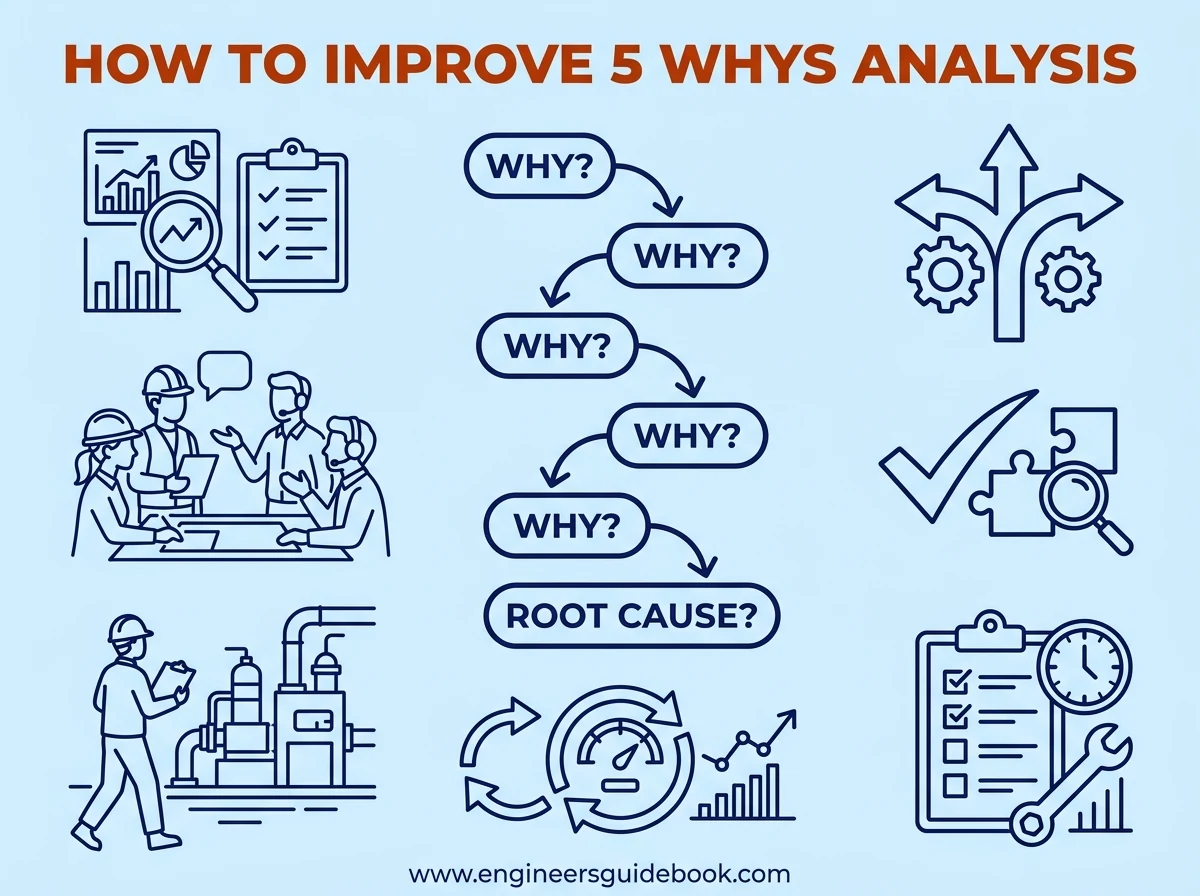
9.1 Use Supporting Data
Data elevates the 5 Whys from an informal discussion into a disciplined investigation.
Trend charts, maintenance logs, downtime records, process parameters, alarm histories, quality data, inspection results, and component life records can confirm or disprove suspected causes.
Quantitative evidence is especially useful when several explanations appear plausible.
The objective is not to make the method unnecessarily complex, but to anchor each important conclusion in verifiable information.
9.2 Involve the Right Team
Root cause investigations benefit from cross-functional participation.
Operators understand how the equipment behaves during normal production. Maintenance personnel understand failure modes. Engineers understand design intent. Quality personnel recognize specification deviations. Supervisors understand scheduling and procedural constraints.
Bringing these perspectives together reduces blind spots.
The team should be large enough to provide relevant expertise but small enough to preserve focused discussion.
9.3 Visit the Problem Location
Investigations conducted entirely in meeting rooms can miss crucial physical evidence.
Visiting the actual location allows the team to inspect layout, accessibility, component condition, housekeeping, operator interaction, environmental conditions, instrumentation, and process flow.
This principle is closely aligned with the practical concept of observing the real place, real equipment, and real condition.
Direct observation frequently exposes discrepancies that documentation alone cannot reveal.
9.4 Explore Multiple Cause Paths
When a problem has several plausible causes, create separate why chains.
One branch might investigate equipment design, another maintenance practices, another operating conditions, and another management controls.
This approach prevents premature convergence on a single explanation.
Branching is particularly valuable for safety incidents, recurring defects, chronic downtime, and process failures where technical and organizational factors coexist.
9.5 Validate the Root Cause
A proposed root cause should explain the original event convincingly.
One useful validation question is: if this cause were eliminated, would the probability of recurrence materially decrease?
Another is whether the evidence demonstrates a coherent connection between the root cause and each preceding event.
Where feasible, corrective trials, inspections, controlled tests, or historical comparisons can strengthen validation.
A root cause should survive scrutiny rather than merely sound reasonable.
9.6 Define Measurable Actions
Corrective actions should be specific, assigned, time-bound, and measurable.
Instead of writing “improve lubrication,” define the lubricant grade, application interval, responsible role, inspection method, and completion deadline.
Specificity makes implementation auditable.
It also prevents corrective actions from disappearing into vague intentions after the investigation meeting concludes.
9.7 Review Effectiveness
Closing an action is not the same as proving effectiveness.
After implementation, the organization should verify whether the problem has actually stopped recurring. This may involve reviewing downtime, failure frequency, quality rejects, inspection findings, alarms, or process stability over an appropriate period.
If recurrence continues, the root cause analysis should be reopened.
A completed form is not evidence of a solved problem.
10. 5 Whys and Other Root Cause Analysis Tools
10.1 5 Whys vs Fishbone Diagram
The 5 Whys follows causes progressively downward through repeated questioning. A fishbone diagram, by contrast, organizes possible causes into broad categories such as people, machines, methods, materials, measurement, and environment.
Fishbone analysis is often better for brainstorming a wide range of possibilities, while 5 Whys is useful for drilling deeper into selected causes.
The two methods are frequently complementary.
10.2 5 Whys vs Fault Tree Analysis
Fault Tree Analysis uses a structured deductive model to examine how combinations of failures can produce a top event.
It is more formal than the 5 Whys and can represent AND and OR relationships between causes.
For complex safety-critical or engineering systems, fault trees provide greater analytical rigor. The 5 Whys remains more suitable for relatively straightforward operational problems requiring rapid investigation.
10.3 5 Whys vs Pareto Analysis
Pareto analysis identifies which problem categories contribute most heavily to an overall issue.
It answers questions such as which defects, downtime causes, or failure modes deserve priority.
The 5 Whys then investigates why a selected high-priority problem occurs.
Pareto analysis therefore helps decide where to focus, while the 5 Whys helps investigate the selected problem.
10.4 5 Whys vs FMEA
Failure Mode and Effects Analysis is predominantly preventive. It evaluates potential failure modes before or during process design and assesses their consequences and controls.
The 5 Whys is typically reactive, beginning after a problem has already occurred.
FMEA asks what could fail and how risk can be reduced. The 5 Whys asks why an observed failure happened.
10.5 5 Whys and PDCA
The Plan-Do-Check-Act cycle provides a broader framework for continuous improvement.
The 5 Whys can be applied during the Plan stage to understand the underlying cause of a problem. Corrective actions are then implemented during Do, evaluated during Check, and standardized or revised during Act.
Together, the methods connect diagnosis with sustained improvement.
10.6 5 Whys and DMAIC
Within Six Sigma, the 5 Whys can support the Analyze phase of DMAIC.
After defining the problem and measuring performance, teams can use the method to investigate suspected causes. More advanced statistical tools may then validate relationships where necessary.
The technique works best as one component of a larger analytical framework rather than as a universal substitute for every RCA method.
11. 5 Whys Analysis Template
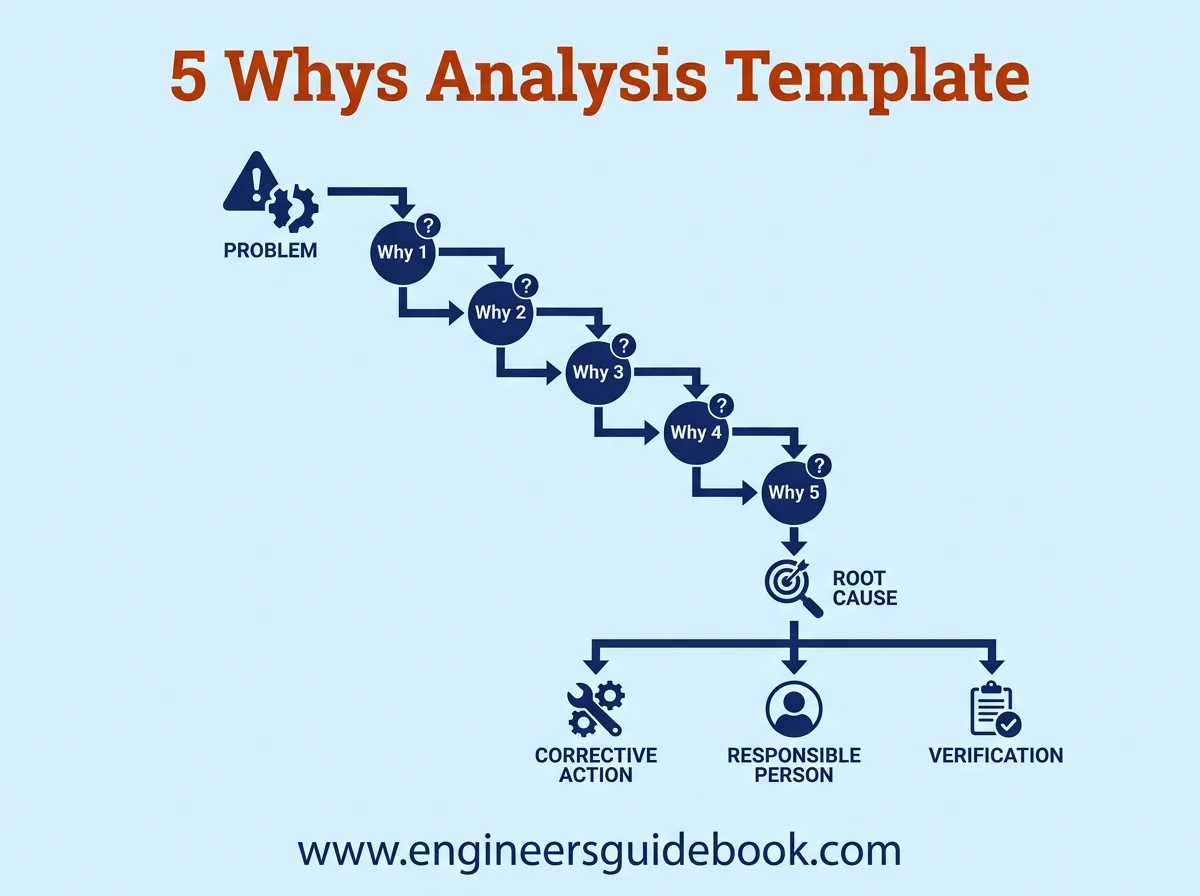
11.1 Problem Statement
Begin with a concise description of the undesirable event. Include measurable details such as location, equipment, timing, frequency, defect type, or downtime where relevant.
11.2 Why One
Record the immediate reason the problem occurred. This normally describes the first observable failure mechanism.
11.3 Why Two
Ask why the first cause existed and document the next causal factor.
11.4 Why Three
Continue deeper into the process, equipment condition, procedure, or control system.
11.5 Why Four
Investigate why the preceding condition was not prevented or detected.
11.6 Why Five
Identify the deeper systemic or controllable deficiency responsible for allowing the causal chain to persist.
11.7 Root Cause
State the validated root cause clearly and avoid simply repeating a symptom or failed component.
11.8 Corrective Action
Define actions that directly address the root cause and reduce the likelihood of recurrence.
11.9 Responsible Person
Assign ownership to a named role or individual so accountability is unambiguous.
11.10 Verification
Specify how effectiveness will be confirmed, including measurable criteria and a review period where appropriate.
12. Frequently Asked Questions
12.1 What Is the 5 Whys Analysis Method
The 5 Whys Analysis is a root cause analysis technique that repeatedly asks why a problem occurred until the investigation reaches an underlying, actionable cause rather than stopping at the visible symptom.
12.2 How Do You Perform a 5 Whys Analysis
Start by defining the problem precisely. Ask why it happened, record the answer, and then ask why that answer occurred. Continue until a verified root cause is reached, then develop corrective actions and confirm their effectiveness.
12.3 Why Are There Five Whys
Five is a practical guideline rather than a mandatory number. It is often sufficient to move from a surface-level symptom to a deeper systemic cause, but some investigations require fewer or more questions.
12.4 What Is an Example of the 5 Whys
If a machine stops because a motor overheats, further questioning may reveal excessive bearing friction, inadequate lubrication, missed maintenance, and ultimately omission of the equipment from the preventive maintenance schedule.
12.5 When Should You Use the 5 Whys Method
The method is suitable for recurring operational problems, equipment failures, quality defects, process deviations, customer complaints, and relatively straightforward incidents with traceable cause-and-effect relationships.
12.6 What Are the Limitations of 5 Whys Analysis
The technique can oversimplify complex failures, depend heavily on investigator knowledge, encourage linear thinking, and produce weak conclusions when evidence is insufficient. Complex incidents may require additional RCA tools.
12.7 Can 5 Whys Have More Than Five Questions
Yes. The investigation should continue until a meaningful root cause is identified. The number five is not a rigid stopping rule.
12.8 What Is the Difference Between 5 Whys and Root Cause Analysis
Root cause analysis is the broader discipline of identifying fundamental causes of problems. The 5 Whys is one specific technique that can be used within an RCA investigation.
12.9 How Do You Know When You Have Found the Root Cause
A credible root cause is supported by evidence, logically explains the causal chain, can be influenced or controlled, and leads to corrective action that materially reduces the chance of recurrence.
13. Conclusion
The 5 Whys Analysis is powerful because it converts a simple question into a structured investigative pathway. Its effectiveness depends on precise problem definition, neutral questioning, supporting evidence, cross-functional participation, and disciplined corrective action.
Used carelessly, it can produce superficial explanations. Used rigorously, it exposes deficiencies that routine troubleshooting may overlook.
The real root cause is rarely the first failure that becomes visible.
A broken component, missed task, alarm, or human error is often only an intermediate event within a larger causal system. Effective investigation continues until the team identifies the condition that made the failure possible and allowed it to remain uncontrolled.