
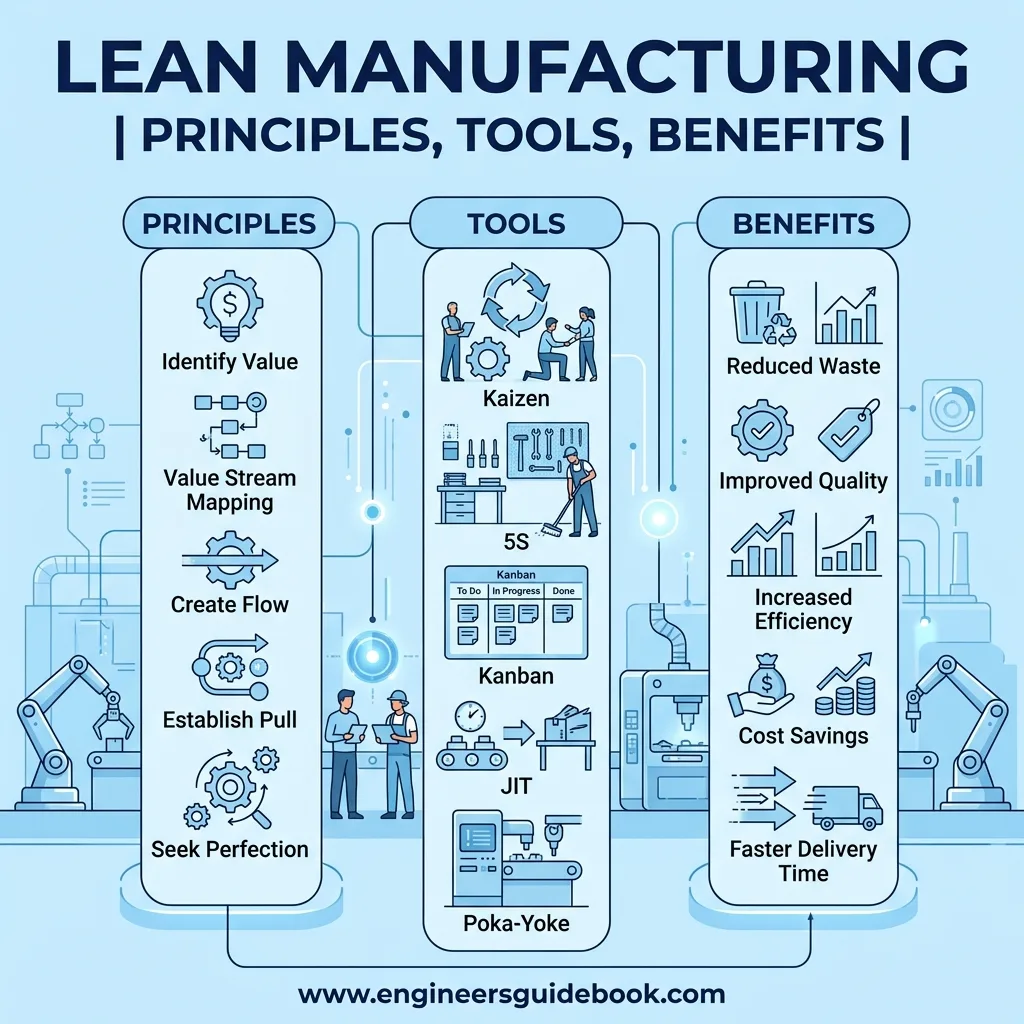
Lean manufacturing is a production philosophy focused on maximizing customer value while minimizing waste, delays, defects, excess inventory, and unnecessary activity. It combines principles such as continuous flow, pull production, standardized work, and continuous improvement with practical tools including 5S, Kanban, Kaizen, value stream mapping, and Poka Yoke to improve quality, productivity, cost, and operational efficiency.
1. Lean Manufacturing Overview
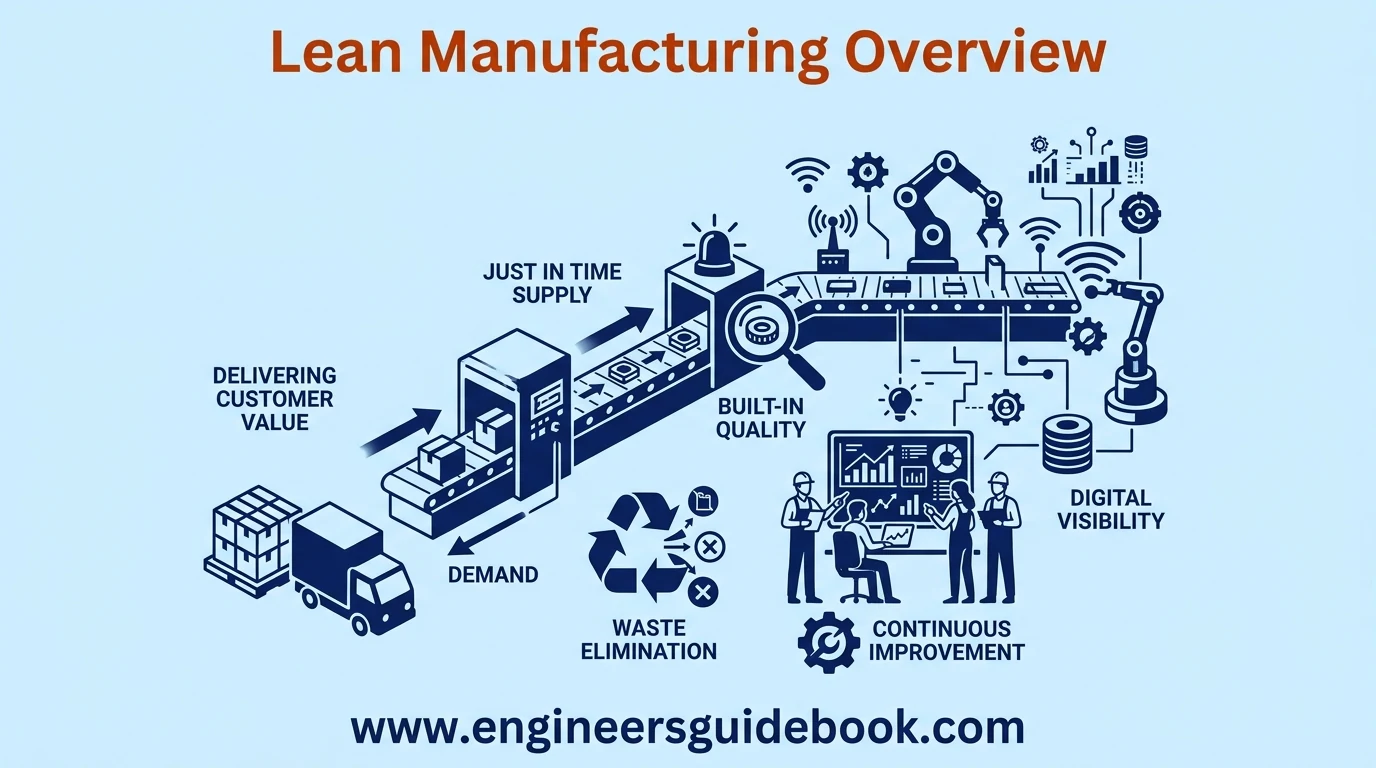
Lean manufacturing is a systematic approach to designing and managing production so that resources are concentrated on activities that create genuine customer value. Instead of merely increasing output, lean organizations scrutinize processes, eliminate inefficiencies, stabilize operations, and continuously improve the way work moves through the enterprise.
1.1 What Is Lean Manufacturing
Lean manufacturing is a management and production methodology that seeks to deliver maximum value with the minimum necessary resources. It identifies non-value-added activities and removes or reduces them while improving workflow, quality, responsiveness, and reliability.
A lean factory therefore focuses on producing the right product, in the right quantity, at the right time. Materials, labor, equipment, information, and production capacity are coordinated around actual demand rather than accumulated unnecessarily.
1.2 Lean Manufacturing Origins
Modern lean manufacturing evolved largely from Japanese industrial practices developed after the Second World War. Manufacturers faced constrained capital, limited resources, and markets that demanded greater product variety than traditional mass-production systems could efficiently provide.
These conditions encouraged highly economical production methods built around waste elimination, flexible workflows, quality at the source, and continuous improvement. The term lean later became widely used to describe these interconnected practices.
1.3 Toyota Production System
The Toyota Production System is one of the principal foundations of modern lean manufacturing. It developed around two central concepts: Just in Time and Jidoka.
Just in Time aims to produce only what is needed, when it is needed, and in the quantity required. Jidoka introduces quality into the production process by allowing abnormalities to be detected and addressed immediately. Together, these concepts help create stable, efficient, and responsive manufacturing systems.
1.4 Lean Manufacturing Objectives
The primary objective of lean manufacturing is to increase customer value while reducing operational waste. This broad objective encompasses shorter lead times, lower inventory, fewer defects, improved productivity, better equipment utilization, reduced production costs, and more consistent delivery performance.
Lean also seeks process stability. A production system that repeatedly meets expected quality, quantity, cost, and delivery requirements is easier to control and improve.
1.5 Lean Manufacturing Philosophy
Lean is more than a collection of isolated improvement techniques. It is a managerial philosophy in which problems are treated as opportunities to improve the system.
Processes are observed carefully, standards are established, abnormalities become visible, and employees participate in solving problems. Improvement becomes habitual rather than an occasional response to declining performance.
1.6 Lean Manufacturing and Operational Excellence
Lean manufacturing supports operational excellence by connecting daily process improvement with broader organizational performance. Productivity, quality, reliability, safety, delivery, and cost are improved together rather than treated as unrelated objectives.
When lean principles are applied consistently, maintenance, production, quality, logistics, engineering, and supply-chain activities become more synchronized. This reduces departmental silos and encourages end-to-end process optimization.
1.7 Lean Manufacturing in Modern Industry
Lean manufacturing is now applied far beyond automotive production. Food processing, pharmaceuticals, electronics, metal fabrication, packaging, aerospace, logistics, healthcare, and many other sectors use lean principles.
Modern factories increasingly combine lean methods with automation, industrial data systems, sensors, analytics, and digital performance dashboards. Technology strengthens lean when it helps reveal abnormalities, reduce variation, and simplify decision-making rather than merely automating inefficient processes.
2. Lean Manufacturing Principles
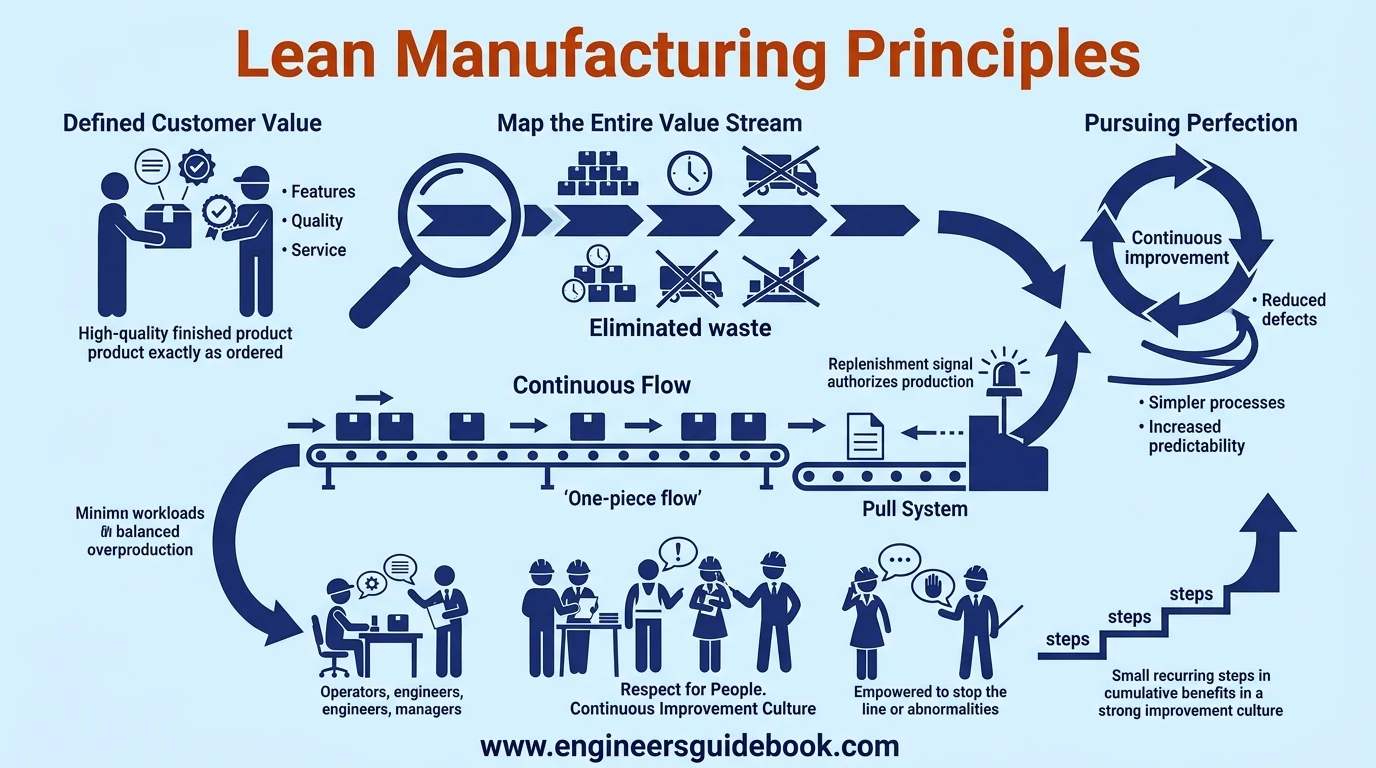
Lean manufacturing is commonly organized around five fundamental principles that guide organizations from identifying value to continuously improving the entire value stream.
2.1 Define Customer Value
Customer value represents the features, functions, quality, delivery, and service for which the customer is genuinely willing to pay. Lean organizations begin by understanding these expectations before changing production processes.
Activities that consume resources without contributing meaningful value should be questioned, simplified, reduced, or eliminated whenever technically and commercially feasible.
2.2 Map the Value Stream
The value stream includes all major activities required to transform materials, information, and resources into a finished product or service. Mapping this sequence makes delays, excessive inventory, redundant processing, and poor information flow visible.
Value stream mapping therefore helps distinguish value-added work from non-value-added activity and provides a structured basis for process improvement.
2.3 Create Continuous Flow
Continuous flow aims to move products smoothly from one operation to another with minimal waiting, interruption, accumulation, or unnecessary transportation.
Achieving flow may require improved equipment reliability, balanced workloads, optimized layouts, standardized work, smaller batches, and better coordination between processes.
2.4 Establish Pull Systems
A pull system authorizes production according to actual downstream demand rather than forecast-driven overproduction. Work begins because the next process requires material, not simply because upstream equipment is available.
Kanban systems are frequently used to regulate this replenishment mechanism. Pull production can reduce work-in-process inventory, congestion, storage requirements, and the risk of producing unnecessary items.
2.5 Pursue Perfection
Lean improvement has no definitive finishing point. Once one inefficiency is removed, another opportunity often becomes visible.
Pursuing perfection means continuously reducing defects, delays, instability, unnecessary movement, excessive inventory, and other performance losses. Organizations progressively move toward processes that are simpler, faster, safer, and more predictable.
2.6 Respect for People
Sustainable lean systems depend heavily on employee knowledge and participation. Operators, technicians, supervisors, engineers, and managers often possess different perspectives on the same process.
Respect for people means encouraging participation, developing competencies, listening to operational concerns, and empowering employees to identify abnormalities and suggest practical improvements.
2.7 Continuous Improvement Culture
Continuous improvement turns lean from a temporary initiative into an organizational habit. Small, recurring improvements can produce substantial cumulative benefits.
A strong improvement culture promotes problem visibility instead of concealment. Teams examine causes, test countermeasures, standardize successful changes, and continue searching for better methods.
3. Lean Manufacturing Waste
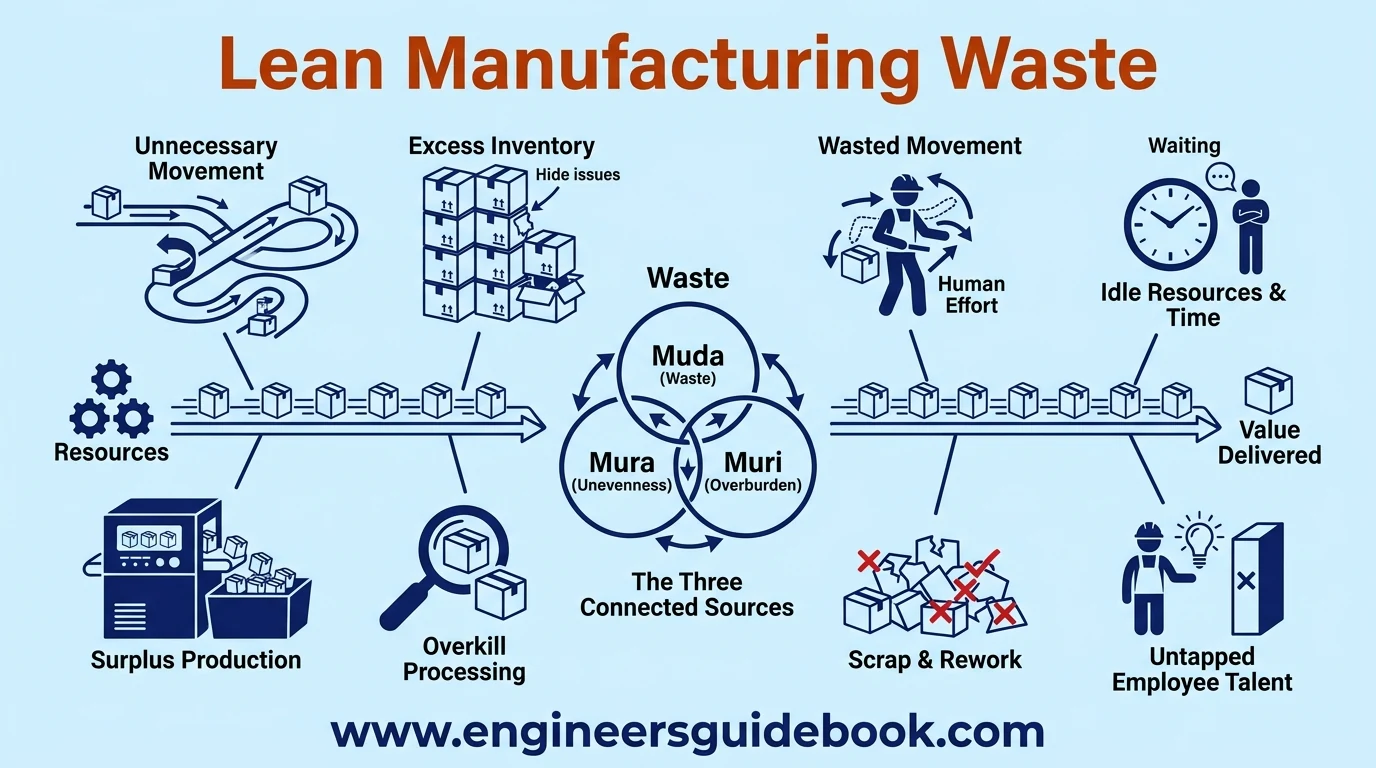
Lean manufacturing classifies activities that consume resources without creating sufficient customer value as waste. Recognizing these losses is essential because inefficiency often becomes normalized within established production routines.
3.1 Transportation Waste
Transportation waste occurs when materials, components, tools, or products are moved more than necessary. Excessive movement increases handling time, labor requirements, congestion, and the probability of damage.
Improved plant layouts and point-of-use storage can substantially reduce transportation losses.
3.2 Inventory Waste
Excess raw material, work in process, and finished goods consume storage space and working capital. Inventory can also conceal deeper problems such as unreliable equipment, unstable scheduling, quality defects, and poor supplier performance.
Lean systems aim for controlled inventory levels aligned with actual demand and operational risk.
3.3 Motion Waste
Motion waste refers to unnecessary human movement such as excessive walking, reaching, bending, searching, or repeated repositioning.
Ergonomic workstation design, logical tool placement, standardized layouts, and 5S practices can reduce motion while improving productivity and safety.
3.4 Waiting Waste
Waiting occurs whenever people, machines, materials, or information remain idle because the next required activity cannot proceed.
Common causes include machine breakdowns, missing materials, approval delays, imbalanced production lines, extended changeovers, and slow quality decisions.
3.5 Overproduction Waste
Overproduction means producing earlier, faster, or in greater quantities than required. It is particularly damaging because it frequently generates additional inventory, transportation, storage, handling, and obsolescence.
Pull systems and demand-based scheduling are important controls against overproduction.
3.6 Overprocessing Waste
Overprocessing occurs when more work is performed than the customer or technical requirement actually demands. Examples include redundant inspections, unnecessary machining, excessive documentation, duplicate data entry, or unnecessarily tight tolerances.
Process simplification can remove these hidden costs without compromising functionality.
3.7 Defects Waste
Defects create scrap, rework, inspection, delays, warranty costs, and customer dissatisfaction. A recurring defect also indicates that the production process is not sufficiently controlled.
Lean emphasizes preventing defects at their source rather than relying exclusively on final inspection.
3.8 Skills Waste
Skills waste occurs when employee knowledge, experience, creativity, or capability is underutilized. Organizations lose valuable improvement opportunities when frontline employees are excluded from problem-solving.
Training, cross-functional collaboration, suggestion systems, and Kaizen activities help capture this frequently overlooked resource.
3.9 Muda Mura Muri
Lean analysis often considers three interconnected sources of inefficiency. Muda refers to waste, Mura to unevenness, and Muri to overburden.
Eliminating visible waste without addressing production variability or excessive workloads may create only temporary improvement. Sustainable lean systems therefore seek balanced workloads, stable processes, and reasonable utilization.
4. Lean Manufacturing Tools
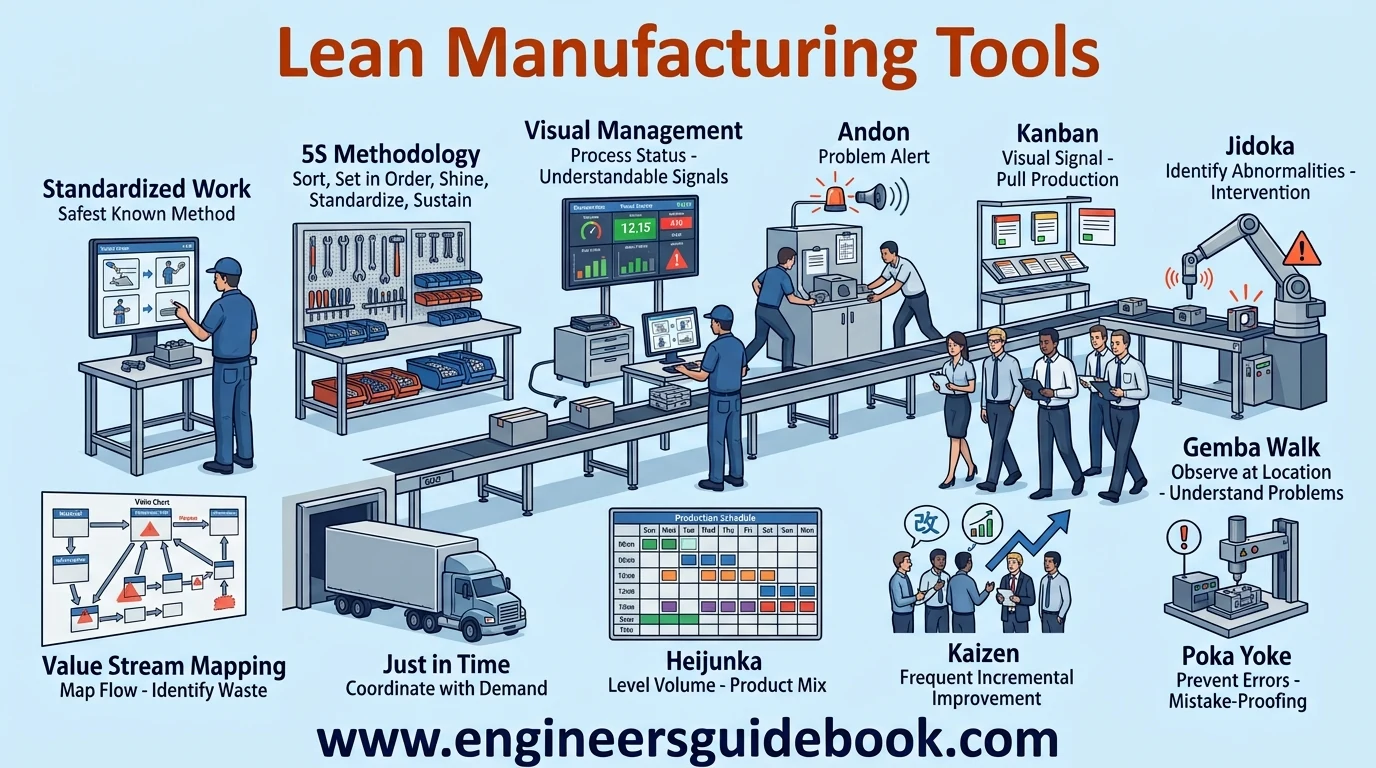
Lean tools translate improvement principles into practical actions that can be applied on the production floor.
4.1 5S Methodology
5S organizes workplaces through Sort, Set in Order, Shine, Standardize, and Sustain. The method improves visibility, housekeeping, accessibility, and workplace discipline.
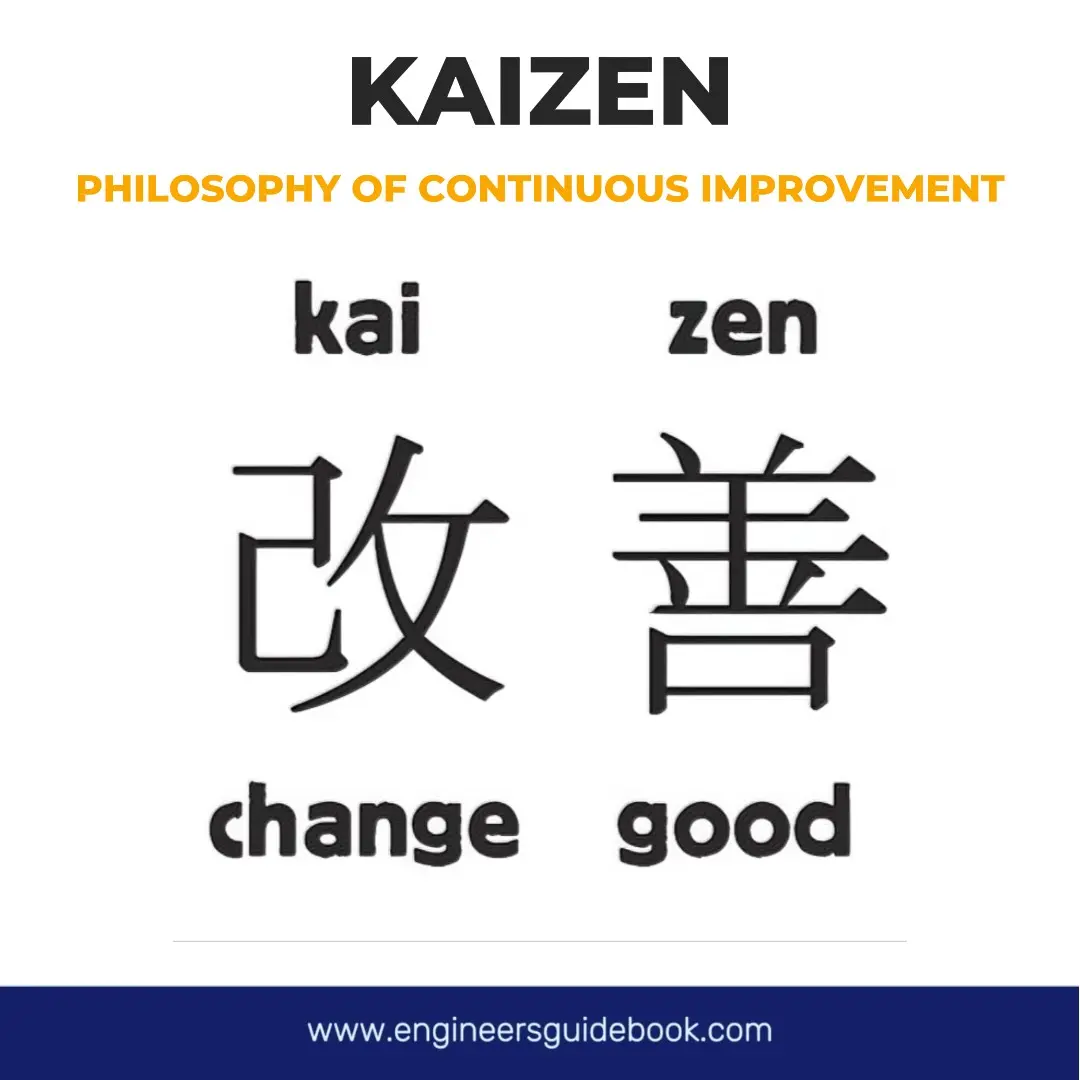
4.2 Kaizen
Kaizen promotes frequent incremental improvement. Employees identify problems, investigate root causes, implement changes, and standardize effective solutions.
4.3 Kanban
Kanban is a visual signaling method used to control material replenishment and production authorization. It helps regulate work in process and supports pull production.
4.4 Value Stream Mapping
Value stream mapping visually represents material and information flow. It highlights waiting, inventory, processing steps, and improvement opportunities across the complete value stream.
4.5 Just in Time
Just in Time coordinates production with demand so that materials and products arrive or are produced close to the moment they are required.
4.6 Poka Yoke
Poka Yoke means mistake-proofing. Devices, fixtures, sensors, or process controls are designed to prevent errors or detect them before defects progress further.
4.7 Standardized Work
Standardized work defines the safest and most effective known method for completing a task. It establishes a baseline against which future improvements can be evaluated.
4.8 Visual Management
Visual management communicates process status through boards, markings, indicators, charts, labels, and other immediately understandable signals.
4.9 Heijunka
Heijunka levels production volume and product mix to reduce fluctuations, workload imbalance, and instability throughout the production system.
4.10 Jidoka
Jidoka enables processes to identify abnormalities and stop or trigger intervention before defective output continues downstream.
4.11 Andon
Andon systems provide visible or audible alerts when a production problem occurs, helping teams respond quickly to abnormalities.
4.12 Gemba Walk
A Gemba walk involves observing work at the actual location where value is created. Managers examine processes directly, ask questions, and understand problems from operational evidence.
5. Lean Manufacturing Techniques
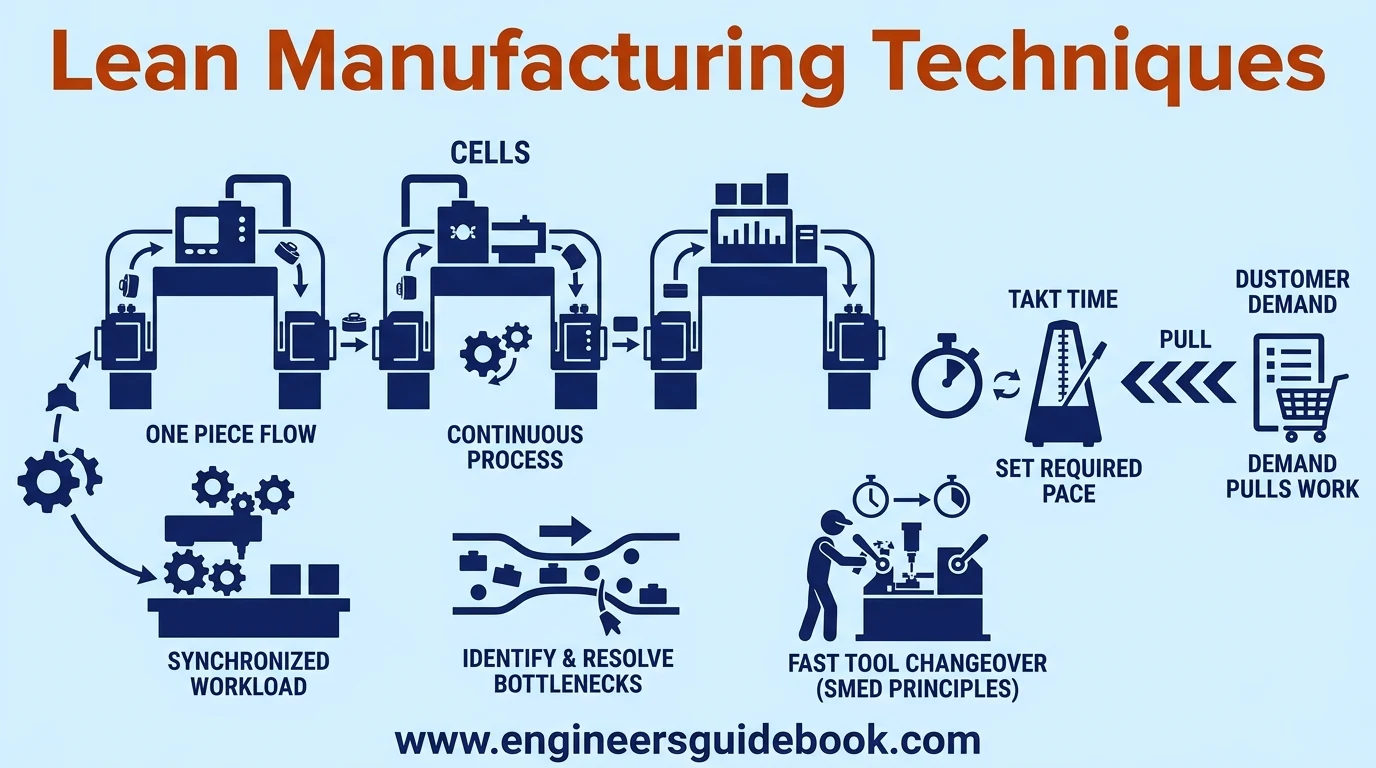
Lean techniques modify production behavior to create faster, more predictable, and demand-responsive workflows.
5.1 Continuous Flow
Continuous flow minimizes interruptions between sequential production activities, reducing queues and work-in-process inventory.
5.2 One Piece Flow
One piece flow processes individual units through successive operations instead of accumulating large batches between stages.
5.3 Pull Production
Pull production initiates work according to actual downstream requirements, limiting unnecessary production and inventory.
5.4 Takt Time
Takt time represents the production pace required to satisfy customer demand and helps determine whether available capacity is appropriately aligned.
5.5 Cycle Time
Cycle time measures how long a process requires to complete one production cycle. Comparing cycle time with takt time helps identify capacity constraints.
5.6 Cellular Manufacturing
Cellular manufacturing arranges equipment according to product families or processing sequences, reducing travel distance, handling, and waiting.
5.7 Line Balancing
Line balancing distributes work among stations so that workloads are reasonably synchronized with production requirements.
5.8 Bottleneck Reduction
Bottleneck reduction focuses improvement on the process constraining overall throughput. Increasing capacity elsewhere provides limited benefit while the constraint remains unresolved.
5.9 Setup Time Reduction
Reducing setup and changeover time increases flexibility, decreases downtime, and makes smaller production batches economically practical.
5.10 SMED
Single Minute Exchange of Die is a structured methodology for reducing changeover duration by separating internal and external activities and simplifying necessary setup work.
6. Lean Manufacturing Implementation
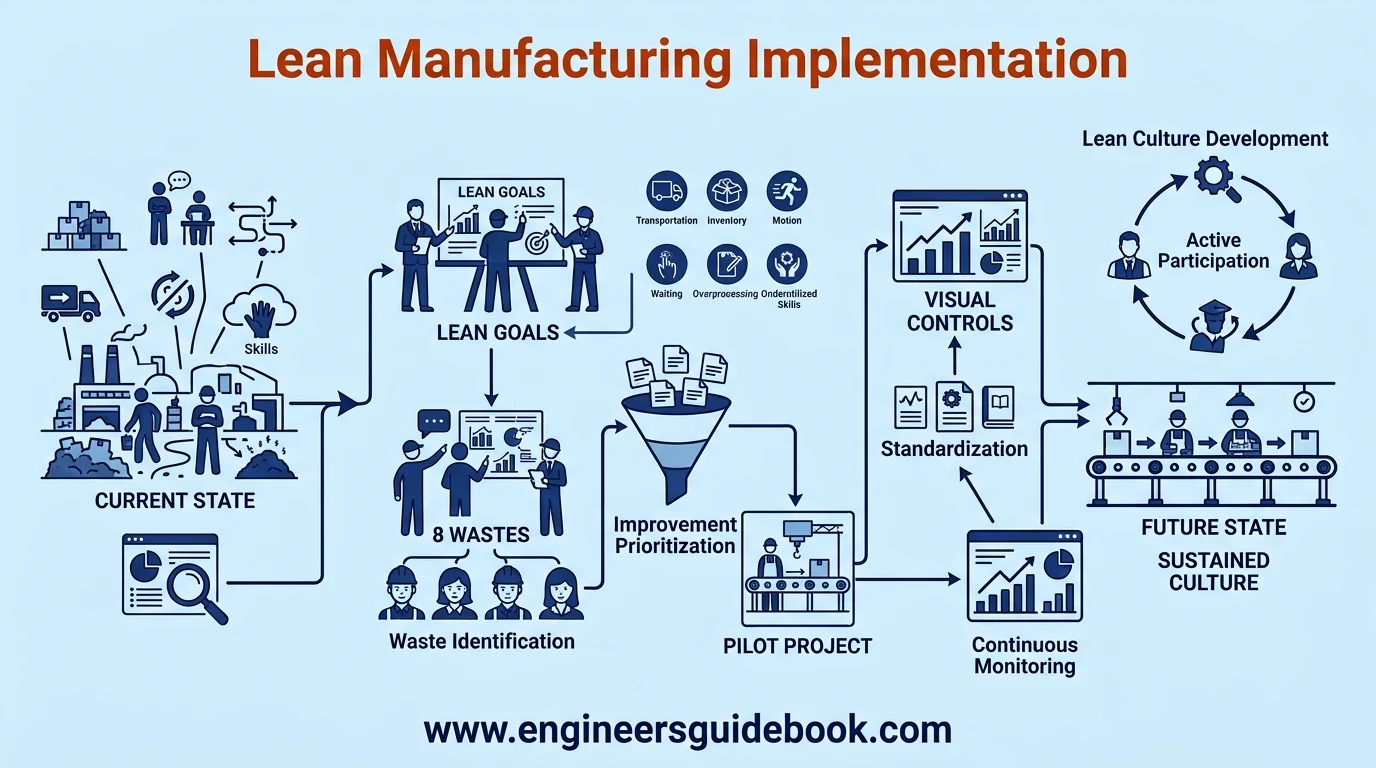
Successful lean implementation requires structured organizational change rather than isolated deployment of individual tools.
6.1 Current State Assessment
The existing process should first be evaluated for flow, quality, downtime, inventory, lead time, productivity, and recurring constraints.
6.2 Lean Goals
Lean goals should translate business priorities into measurable targets such as reduced lead time, lower defects, shorter changeovers, or improved delivery performance.
6.3 Leadership Commitment
Leaders must provide direction, resources, accountability, and visible participation. Without sustained leadership involvement, lean initiatives often deteriorate into temporary campaigns.
6.4 Employee Engagement
Employees should participate directly in identifying waste and developing improvements because they interact with production processes every day.
6.5 Value Stream Selection
Organizations should prioritize value streams where improvement offers meaningful operational or customer impact.
6.6 Waste Identification
Teams observe processes and identify transportation, inventory, motion, waiting, overproduction, overprocessing, defects, and underutilized skills.
6.7 Improvement Prioritization
Improvement opportunities should be ranked according to impact, urgency, feasibility, risk, and resource requirements.
6.8 Pilot Projects
Pilot projects allow organizations to test lean methods on a manageable scale before broader deployment.
6.9 Standardization
Successful improvements must be converted into standardized procedures, visual controls, training requirements, and operating expectations.
6.10 Continuous Monitoring
Performance should be monitored against established metrics so that deterioration, abnormalities, and new improvement opportunities become visible.
6.11 Lean Culture Development
Long-term lean success requires disciplined problem-solving, employee participation, leadership consistency, and continuous learning across the organization.
7. Lean Manufacturing Metrics
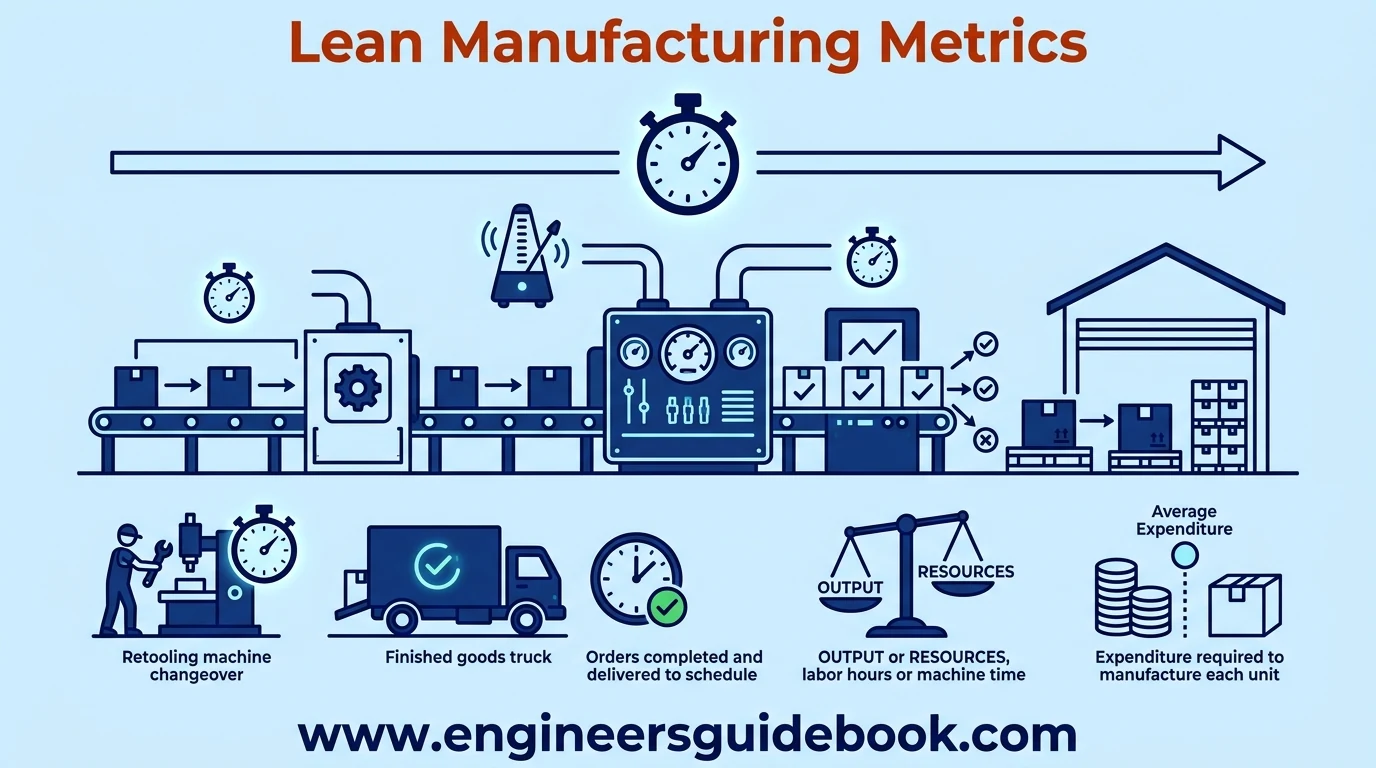
Metrics provide objective evidence of whether lean initiatives are producing measurable operational improvement.
7.1 Overall Equipment Effectiveness
Overall Equipment Effectiveness evaluates equipment performance through availability, performance rate, and quality output.
7.2 Lead Time
Lead time measures the total elapsed time required for a product or order to move through the complete process.
7.3 Cycle Time
Cycle time indicates the time required to complete an individual operation or production cycle.
7.4 Takt Time
Takt time defines the pace at which products must be completed to match customer demand.
7.5 First Pass Yield
First Pass Yield measures the percentage of units completed correctly without requiring rework, repair, or additional processing.
7.6 Inventory Turnover
Inventory turnover indicates how frequently inventory is consumed and replenished during a defined period.
7.7 Defect Rate
Defect rate measures the proportion of output that fails to meet established quality requirements.
7.8 Changeover Time
Changeover time measures the duration required to switch equipment or processes from one product configuration to another.
7.9 On Time Delivery
On Time Delivery measures how consistently customer orders are completed and delivered according to committed schedules.
7.10 Productivity
Productivity compares useful production output with resources such as labor hours, machine time, or other production inputs.
7.11 Cost per Unit
Cost per unit indicates the average expenditure required to manufacture each unit. Tracking it helps reveal whether improvements in waste, productivity, quality, and utilization are producing genuine economic gains.
8. Lean Manufacturing Benefits
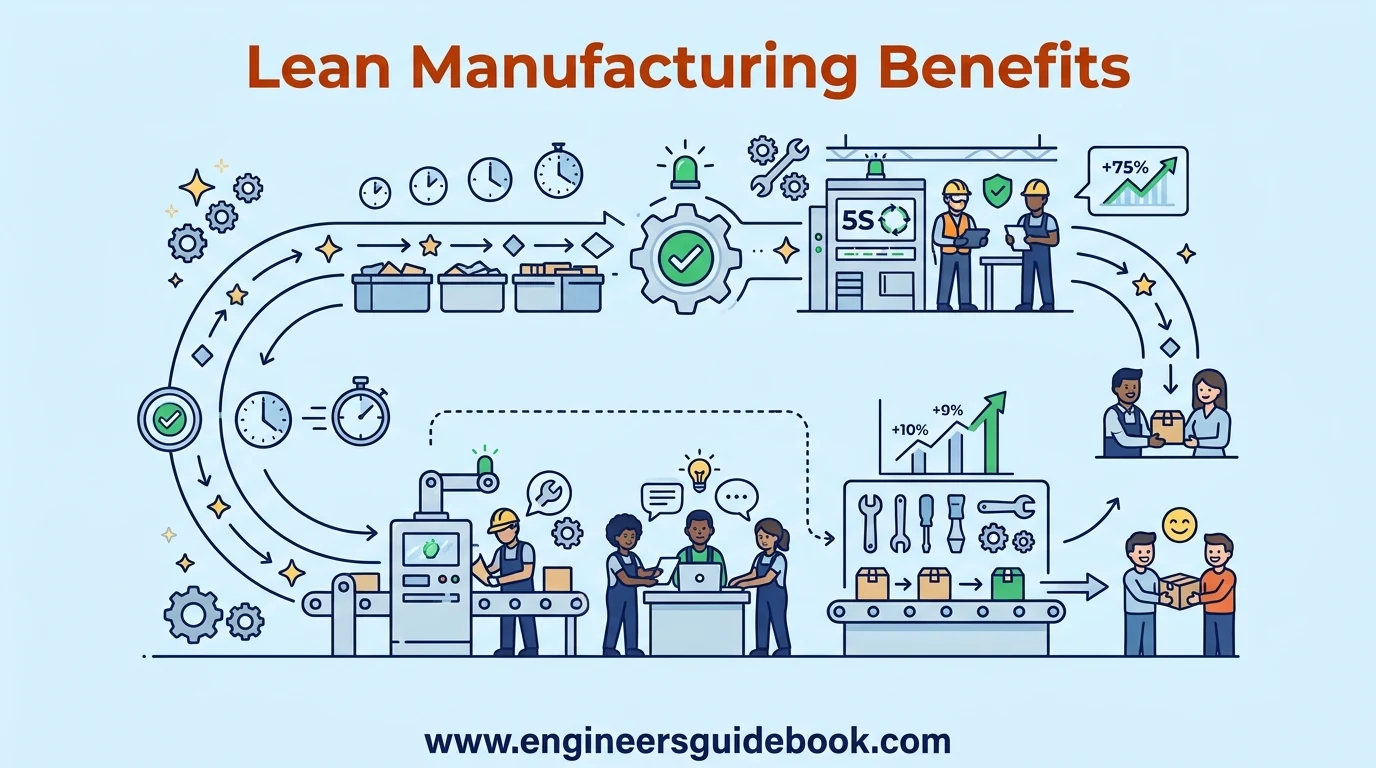
Lean manufacturing creates measurable gains by eliminating activities that consume resources without contributing customer value. Its benefits extend beyond production speed because lean influences cost, quality, equipment reliability, workforce participation, inventory, and responsiveness.
8.1 Waste Reduction
Waste reduction is the central benefit of lean manufacturing. By identifying transportation, inventory, motion, waiting, overproduction, overprocessing, defects, and unused employee capabilities, manufacturers can streamline operations and direct resources toward value-producing activities.
Reducing waste also exposes underlying inefficiencies that may have remained hidden behind excessive inventory, labor, or production capacity.
8.2 Cost Reduction
Lower waste generally produces lower manufacturing costs. Reduced scrap, fewer defects, smaller inventories, shorter production times, improved equipment availability, and better labor utilization collectively decrease operating expenses.
Lean cost reduction is particularly sustainable because it focuses on removing unnecessary activity rather than simply reducing budgets or workforce numbers.
8.3 Productivity Improvement
Lean improves productivity by enabling employees and machines to spend more time performing productive work. Better layouts, standardized procedures, balanced workloads, and fewer interruptions increase useful output without necessarily increasing resources.
Productivity gains become especially powerful when multiple small improvements accumulate across an entire value stream.
8.4 Quality Improvement
Lean manufacturing emphasizes preventing defects rather than discovering them after production. Poka Yoke, standardized work, Jidoka, root cause analysis, and visual controls help abnormalities become visible quickly.
When errors are addressed at their source, manufacturers reduce scrap, rework, customer complaints, and inspection requirements while improving process consistency.
8.5 Lead Time Reduction
Removing unnecessary waiting, transportation, batching, and inventory shortens the time required to transform an order into a finished product.
Shorter lead times enable faster customer response and reduce uncertainty within production planning. Problems also become easier to detect because products no longer remain concealed inside large queues of work in process.
8.6 Inventory Reduction
Pull systems, smaller production batches, improved process stability, and Just in Time practices reduce excessive raw material, work-in-process, and finished-goods inventory.
Lower inventory releases working capital and storage space. It can also expose production problems because organizations can no longer rely on large buffers to conceal downtime, quality defects, or scheduling instability.
8.7 Equipment Efficiency
Lean manufacturing supports better equipment utilization by addressing breakdowns, minor stops, slow operating speeds, setup losses, and other causes of reduced effectiveness.
Practices such as standardized maintenance, SMED, visual inspection, and performance monitoring can improve availability and reduce unnecessary equipment-related losses.
8.8 Workplace Safety
Lean workplaces are often safer because unnecessary materials, clutter, excessive movement, and poorly organized work areas are systematically addressed.
5S, visual management, standardized work, and ergonomic improvements can reduce tripping hazards, manual handling risks, confusion, and unsafe improvisation. Safety should remain an intrinsic requirement rather than an incidental consequence of productivity improvement.
8.9 Employee Engagement
Lean encourages employees to participate in problem-solving instead of merely following instructions. Operators often understand practical process abnormalities more intimately than distant decision-makers.
Kaizen meetings, improvement teams, Gemba observations, and suggestion systems create opportunities for employees to contribute ideas and develop broader operational competence.
8.10 Customer Satisfaction
Improved quality, shorter lead times, reliable delivery, and consistent products directly strengthen customer satisfaction.
Lean manufacturing places customer value at the beginning of improvement efforts, helping organizations avoid spending resources on activities or product characteristics that customers do not need.
8.11 Business Flexibility
Lean systems can respond more effectively to changing demand because smaller batches, faster changeovers, lower inventory, and standardized processes increase operational agility.
Manufacturers can adjust product mix and production volumes with less disruption than inflexible systems dependent on large batches and excessive buffers.
9. Lean Manufacturing Challenges
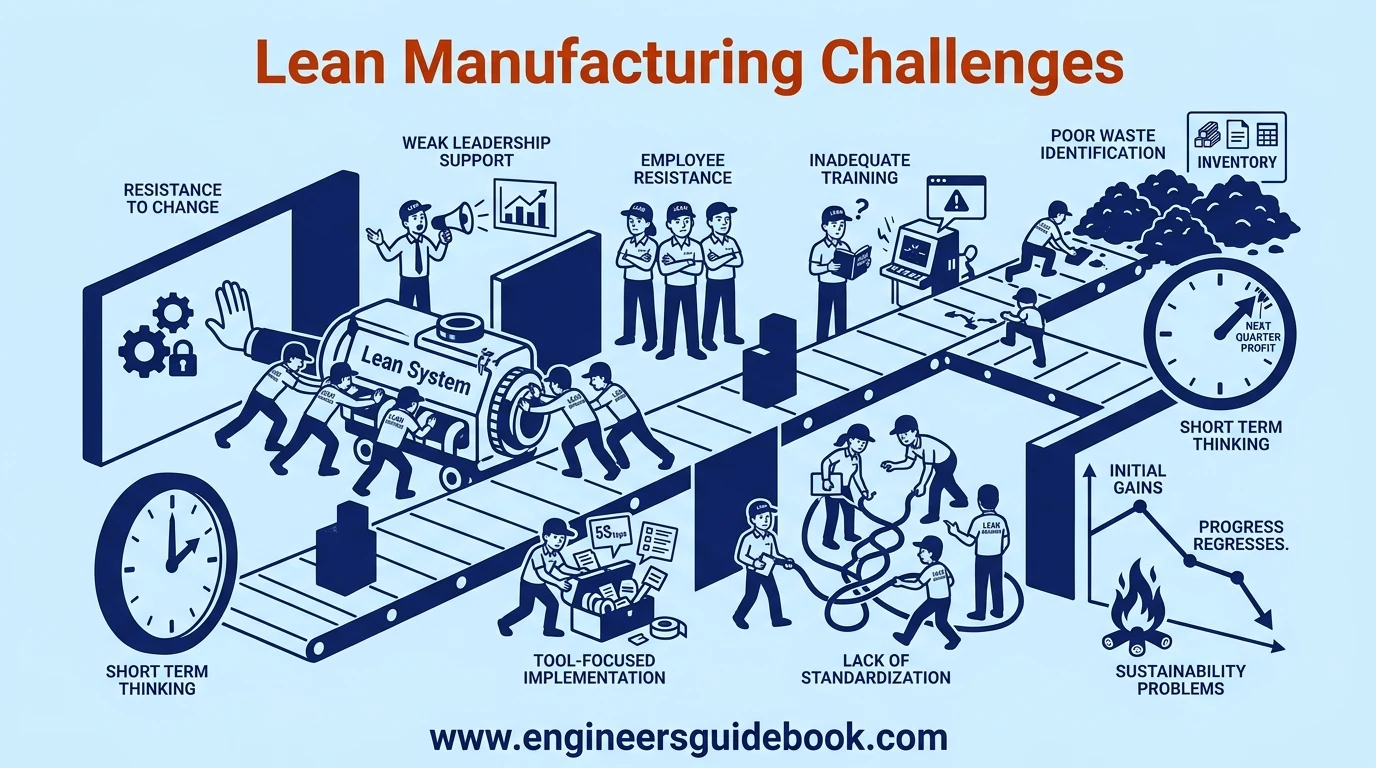
Lean implementation can produce substantial improvement, but adopting the philosophy requires organizational discipline. Many failures occur because lean is treated as a temporary efficiency project rather than a long-term management system.
9.1 Resistance to Change
Employees and managers may resist lean because established routines feel familiar and predictable. Process changes can also create concerns about workload, job security, or authority.
Effective implementation requires communication, participation, and evidence that lean improvement benefits both operations and employees.
9.2 Weak Leadership Support
Lean initiatives frequently lose momentum when leaders delegate improvement entirely to operational teams while continuing to reward traditional behaviors.
Leadership must provide resources, remove barriers, review performance, visit the workplace, and demonstrate that continuous improvement is an organizational priority.
9.3 Employee Resistance
Employees may perceive lean methods as additional work or a covert cost-cutting exercise. Resistance becomes stronger when improvement programs are imposed without consultation.
Involving frontline personnel in diagnosis and solution development can build ownership and increase practical acceptance.
9.4 Inadequate Training
Lean terminology alone does not produce competence. Employees need practical understanding of tools, problem-solving methods, waste identification, standardization, and performance measurement.
Training should connect lean concepts with actual workplace problems rather than relying solely on theoretical classroom instruction.
9.5 Poor Waste Identification
Organizations sometimes target obvious waste while overlooking systemic causes. Removing inventory, for example, without improving equipment reliability may create shortages rather than efficiency.
Waste identification should therefore examine relationships among flow, quality, capacity, maintenance, scheduling, and customer demand.
9.6 Short Term Thinking
Lean rarely reaches its full potential through short campaigns. Organizations focused exclusively on immediate financial savings may abandon improvements before cultural and operational benefits mature.
Sustainable lean programs combine near-term improvements with long-term capability development.
9.7 Tool Focused Implementation
Using 5S, Kanban, or Kaizen without understanding lean principles can produce superficial results.
Tools should solve clearly defined process problems. Installing visual boards or painting floor markings does not create lean manufacturing unless these actions improve flow, quality, visibility, or decision-making.
9.8 Lack of Standardization
Without standardized work, improvements gradually disappear as employees return to previous methods.
Standards preserve successful practices and create a stable baseline from which further improvements can be developed.
9.9 Sustainability Problems
Early enthusiasm can decline once initial projects are completed. Poor follow-up, changing priorities, and weak accountability often cause lean systems to regress.
Regular audits, performance reviews, employee involvement, and leadership attention are essential for sustaining gains.
9.10 Lean Implementation Mistakes
Common mistakes include copying another company’s system, reducing inventory too aggressively, ignoring employee knowledge, focusing only on cost, introducing too many tools simultaneously, and failing to measure results.
Effective lean implementation should be contextual, evidence-based, and progressively scaled.
10. Lean Manufacturing Examples
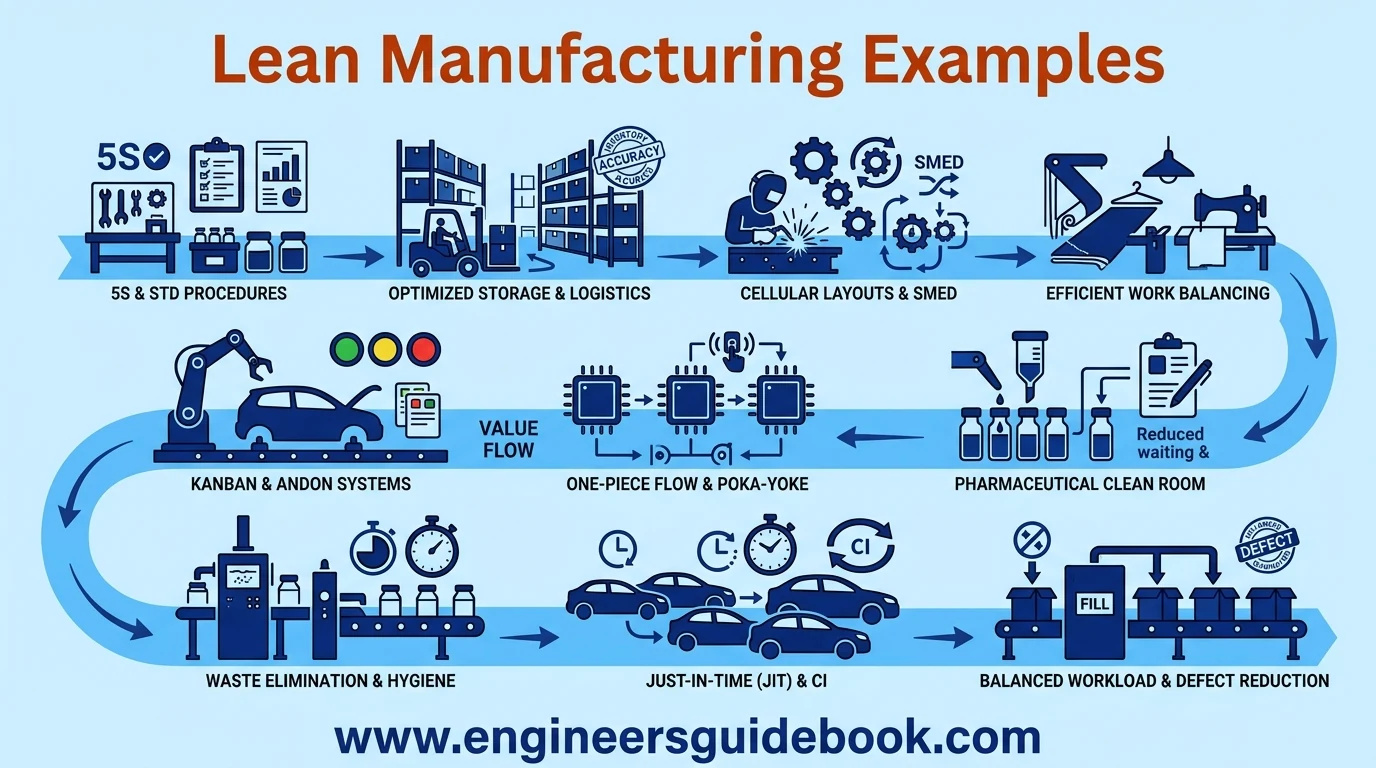
Lean manufacturing can be adapted across industries because its fundamental purpose is improving value flow rather than prescribing a single production configuration.
10.1 Toyota Production System
Toyota remains the most recognized example of lean production. Its system integrates Just in Time, Jidoka, standardized work, continuous improvement, and respect for people to create controlled production flow with minimal unnecessary inventory.
10.2 Automotive Manufacturing
Automotive plants use Kanban replenishment, cellular layouts, standardized work, Andon systems, line balancing, and rapid changeovers to coordinate complex assembly operations.
10.3 Food Manufacturing
Food manufacturers apply lean to reduce changeover time, product loss, excessive handling, sanitation delays, packaging waste, and unnecessary inventory while maintaining hygiene and traceability requirements.
10.4 Pharmaceutical Manufacturing
Pharmaceutical operations use lean techniques to improve material flow, reduce waiting, simplify documentation processes, enhance changeovers, and eliminate non-value-added activities while maintaining rigorous quality requirements.
10.5 Electronics Manufacturing
Electronics manufacturers can use one-piece flow, visual management, mistake-proofing, and cellular production to manage short product cycles and high component complexity.
10.6 Textile Manufacturing
Lean textile operations may improve cutting, sewing, inspection, material movement, changeovers, and work balancing to reduce queues and production delays.
10.7 Metal Fabrication
Metal fabrication businesses use SMED, 5S, standardized work, cellular layouts, and bottleneck analysis to improve machining, welding, forming, and assembly processes.
10.8 Packaging Operations
Packaging lines can apply lean principles to reduce machine stoppages, changeover losses, packaging defects, excessive materials, and unbalanced workstation workloads.
10.9 Warehouse Operations
Warehouses use lean methods to optimize storage locations, picking routes, replenishment, inventory accuracy, material handling, and visual control.
10.10 Small Manufacturing Businesses
Small manufacturers can implement lean without expensive technology. Simple improvements such as workplace organization, standardized procedures, reduced batch sizes, visual scheduling, and employee problem-solving can generate substantial gains.
11. Lean Manufacturing Comparisons
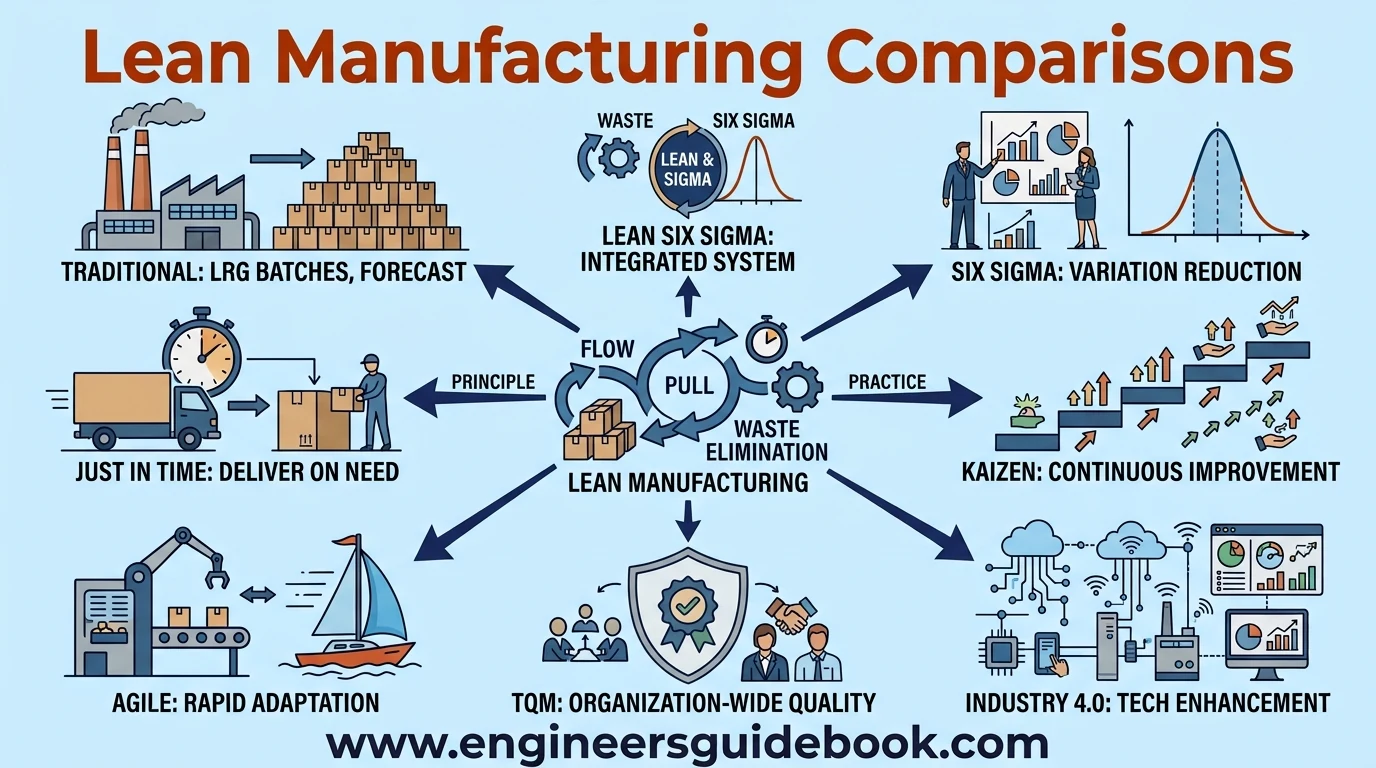
Understanding related improvement methodologies helps clarify what lean manufacturing does and how it can complement other management systems.
11.1 Lean Manufacturing vs Traditional Manufacturing
Traditional manufacturing often relies on large batches, forecast-driven production, functional departments, and inventory buffers. Lean manufacturing prioritizes flow, pull production, small batches, waste reduction, and rapid problem visibility.
11.2 Lean Manufacturing vs Six Sigma
Lean primarily focuses on improving flow and eliminating waste, whereas Six Sigma emphasizes reducing variation and defects through structured statistical problem-solving.
11.3 Lean Manufacturing vs Lean Six Sigma
Lean Six Sigma combines lean waste reduction with Six Sigma variation reduction. The integrated approach targets both process efficiency and process capability.
11.4 Lean Manufacturing vs Kaizen
Lean is a broad operating philosophy, while Kaizen is the practice of continuous incremental improvement. Kaizen functions as one important component of a lean system.
11.5 Lean Manufacturing vs Just in Time
Just in Time is a production principle within lean manufacturing rather than a complete alternative system. It concentrates on producing and delivering items according to actual need.
11.6 Lean Manufacturing vs Agile Manufacturing
Lean seeks efficiency and waste elimination, while agile manufacturing emphasizes rapid adaptation to volatile demand and product variety. Modern operations may combine both approaches.
11.7 Lean Manufacturing and Total Quality Management
Total Quality Management emphasizes organization-wide quality and customer satisfaction. Lean complements it by addressing process flow, waste, standardization, and operational responsiveness.
11.8 Lean Manufacturing and Industry 4.0
Industry 4.0 technologies such as sensors, automation, analytics, connected equipment, and digital dashboards can enhance lean by providing faster visibility into abnormalities and performance.
Technology should support lean processes rather than digitizing unnecessary complexity.
12. Lean Manufacturing FAQ
12.1 What Are the Five Principles of Lean Manufacturing
The five principles are defining customer value, mapping the value stream, creating flow, establishing pull, and pursuing perfection through continuous improvement.
12.2 What Are the Eight Wastes of Lean Manufacturing
The eight wastes are transportation, inventory, motion, waiting, overproduction, overprocessing, defects, and unused skills or talent.
12.3 What Are the Most Common Lean Manufacturing Tools
Common tools include 5S, Kaizen, Kanban, value stream mapping, Poka Yoke, standardized work, SMED, visual management, Heijunka, Jidoka, and Gemba walks.
12.4 How Does Lean Manufacturing Reduce Waste
Lean reduces waste by examining value streams, identifying non-value-added work, determining root causes, implementing countermeasures, and standardizing improved processes.
12.5 What Is an Example of Lean Manufacturing
A manufacturer using Kanban to replenish components only when downstream operations consume them is a practical lean example because it reduces unnecessary inventory and overproduction.
12.6 What Is 5S in Lean Manufacturing
5S is a workplace organization methodology consisting of Sort, Set in Order, Shine, Standardize, and Sustain.
12.7 What Is Kaizen in Lean Manufacturing
Kaizen is continuous improvement through frequent, practical changes involving employees at multiple organizational levels.
12.8 What Is Kanban in Lean Manufacturing
Kanban is a visual signaling system that controls production or material replenishment according to downstream demand.
12.9 What Is the Difference Between Lean and Six Sigma
Lean focuses primarily on waste and flow, while Six Sigma focuses primarily on defects, variation, and process capability.
12.10 How Do You Implement Lean Manufacturing
Implementation typically begins with assessing current processes, defining goals, mapping value streams, identifying waste, introducing targeted improvements, standardizing results, measuring performance, and developing continuous improvement habits.
12.11 What Industries Use Lean Manufacturing
Lean is used in automotive, aerospace, food, pharmaceuticals, electronics, textiles, metal fabrication, packaging, logistics, healthcare, and numerous service industries.
12.12 What Are the Main Benefits of Lean Manufacturing
Major benefits include lower waste, reduced costs, improved productivity, better quality, shorter lead times, lower inventory, stronger employee involvement, and greater operational flexibility.
13. Conclusion
Lean manufacturing provides a structured way to maximize customer value while systematically reducing waste and instability throughout production processes.
Value, value streams, flow, pull, and perfection provide the foundation, while tools such as 5S, Kanban, Kaizen, Poka Yoke, SMED, and standardized work translate those principles into operational practice.
Long-term success depends on leadership commitment, employee participation, disciplined measurement, process standardization, and persistent attention to root causes rather than temporary symptoms.
The strongest lean organizations treat improvement as an enduring operating philosophy. Each solved problem creates a more stable baseline, revealing the next opportunity to make production safer, faster, simpler, and more valuable.

One Response
I like what you guys tend to be up to. This kind of clever
work and coverage! Keep up the good work, guys. I’ve incorporated you guys to blogroll.