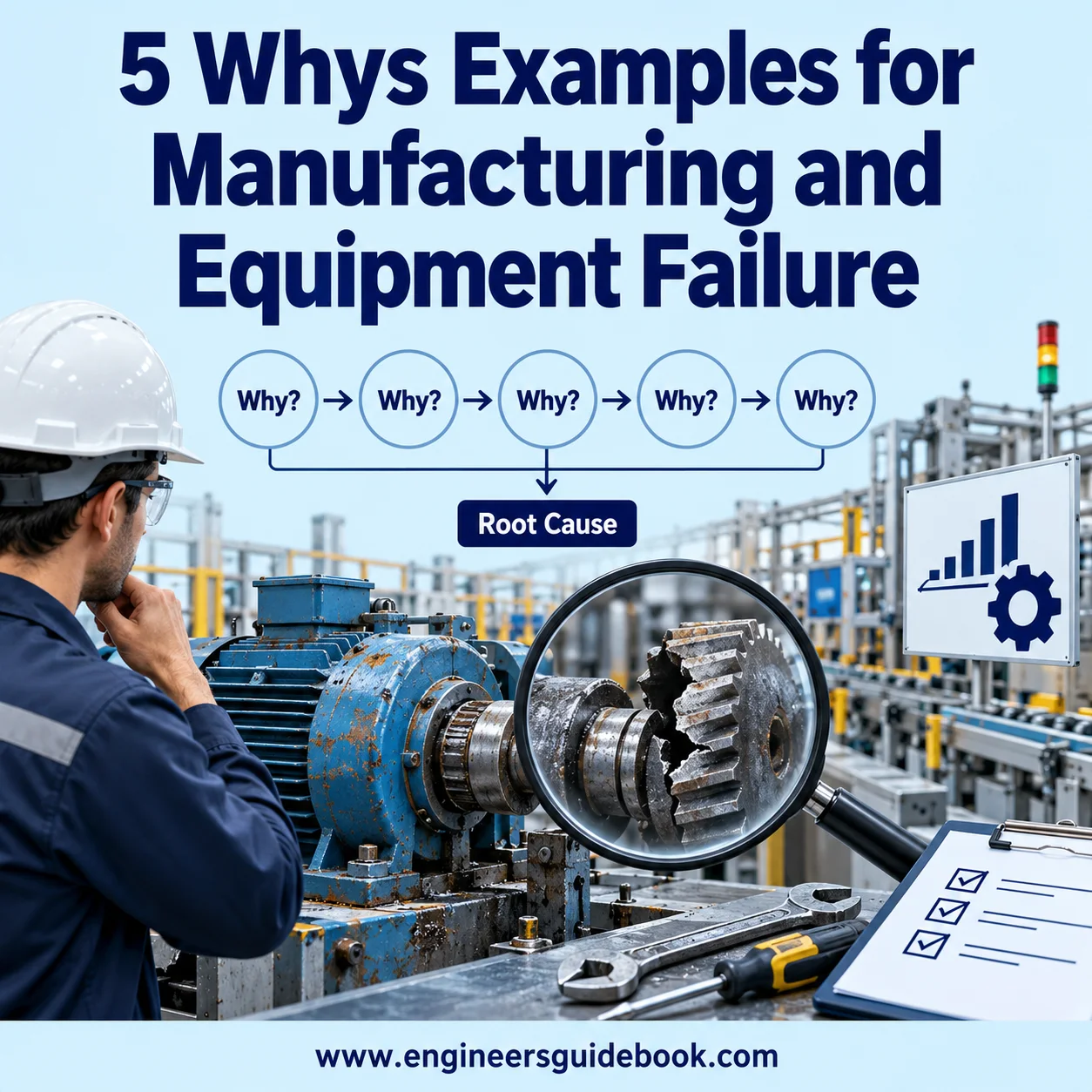
The 5 Whys method helps manufacturing teams trace equipment failures and production problems beyond visible symptoms to their underlying causes. By repeatedly asking why a failure occurred, maintenance and operations personnel can uncover weaknesses in lubrication, inspection, operating practices, maintenance planning, component selection, or management systems, then implement corrective actions that reduce recurrence and improve equipment reliability. In this article, we see some different 5 Whys Examples form Manufacturing point of view.
1. 5 Whys Analysis in Manufacturing
1.1 Purpose of the 5 Whys
The primary purpose of the 5 Whys is to move an investigation away from superficial observations and toward the mechanism that actually created the failure. In manufacturing, simply replacing a damaged component may restore production, but it does not necessarily prevent the same event from happening again.
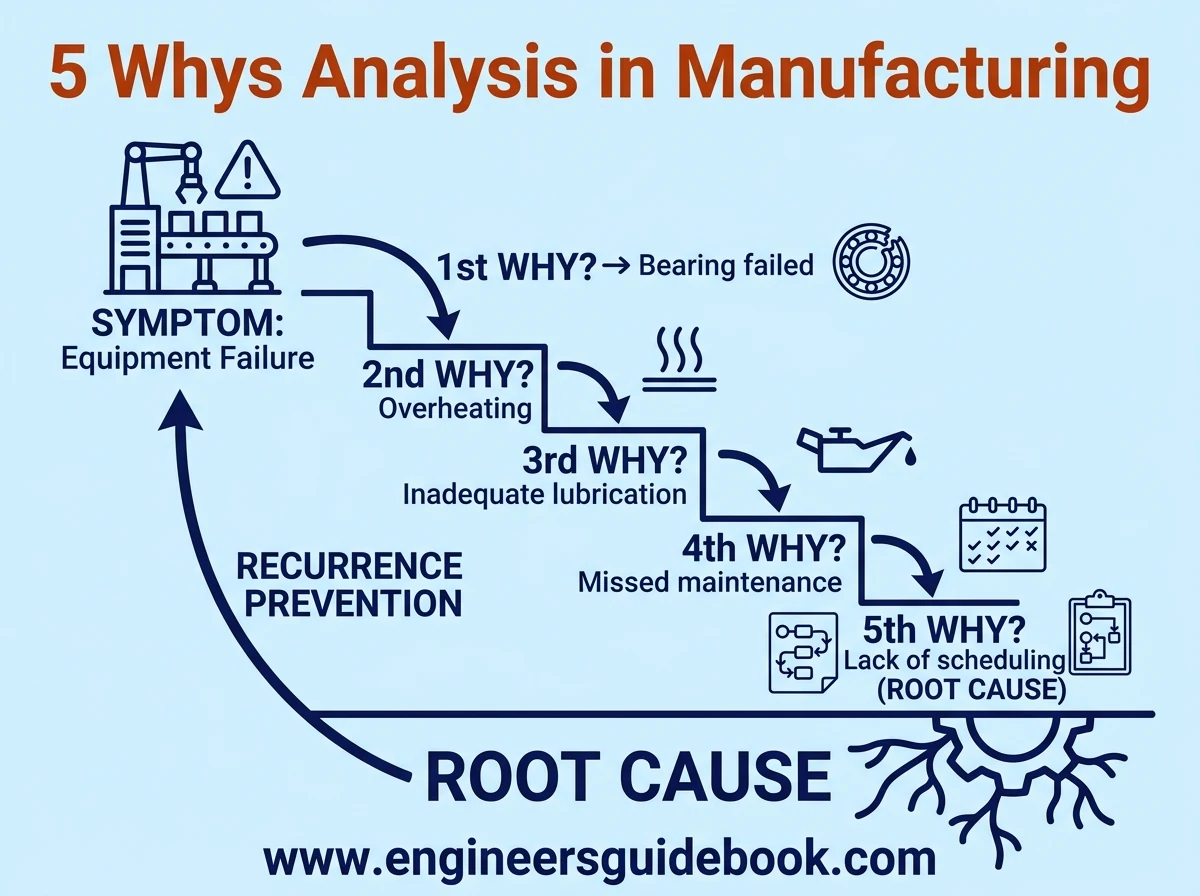
The technique encourages investigators to ask why each preceding condition existed. A failed bearing, for example, may be linked to inadequate lubrication, which may itself originate from an incomplete preventive maintenance schedule. The ultimate objective is therefore not merely repair, but recurrence prevention.
1.2 Manufacturing Problem Solving
Manufacturing environments contain interconnected mechanical, electrical, operational, and human systems. A production interruption rarely exists in isolation.
The 5 Whys provides a simple framework for examining those interactions. It can be applied to machine breakdowns, quality defects, excessive scrap, reduced production speed, repeated alarms, maintenance delays, and process instability.
Its simplicity is valuable because operators, technicians, engineers, supervisors, and managers can participate without specialized statistical software. Nevertheless, conclusions should still be supported by maintenance records, inspection findings, process data, and physical evidence.
1.3 Equipment Failure Investigation
Equipment failure investigation begins with understanding what physically happened. Investigators should examine the failed component, operating conditions, maintenance history, alarms, lubrication records, process parameters, and recent interventions.
Suppose a centrifugal pump unexpectedly stops. Declaring that the bearing failed is merely identifying the failed part. Asking why the bearing failed may reveal overheating. Asking why overheating occurred may expose lubrication degradation, misalignment, contamination, or excessive loading.
This progressive inquiry transforms component replacement into genuine failure analysis.
1.4 Root Cause Versus Symptoms
A symptom is an observable manifestation of a problem, whereas a root cause is an underlying condition that allowed the problem to develop.
High vibration is a symptom. A damaged coupling may be an intermediate cause. Improper shaft alignment caused by an inadequate installation procedure may be closer to the root cause.
Confusing symptoms with root causes is one of the most common weaknesses in maintenance investigations. Replacing the coupling may eliminate vibration temporarily, but unless alignment practices are corrected, deterioration can reappear.
1.5 When to Use the 5 Whys
The 5 Whys works particularly well for relatively straightforward problems where a logical cause-and-effect sequence can be established.
Typical applications include recurring bearing failures, conveyor stoppages, pump cavitation, motor overheating, gearbox damage, leaking seals, missed preventive maintenance activities, and repeated quality defects.
For highly complex failures involving multiple simultaneous mechanisms, the method may need to be combined with tools such as fault tree analysis, fishbone diagrams, FMEA, vibration analysis, or detailed root cause analysis.
2. How the 5 Whys Process Works
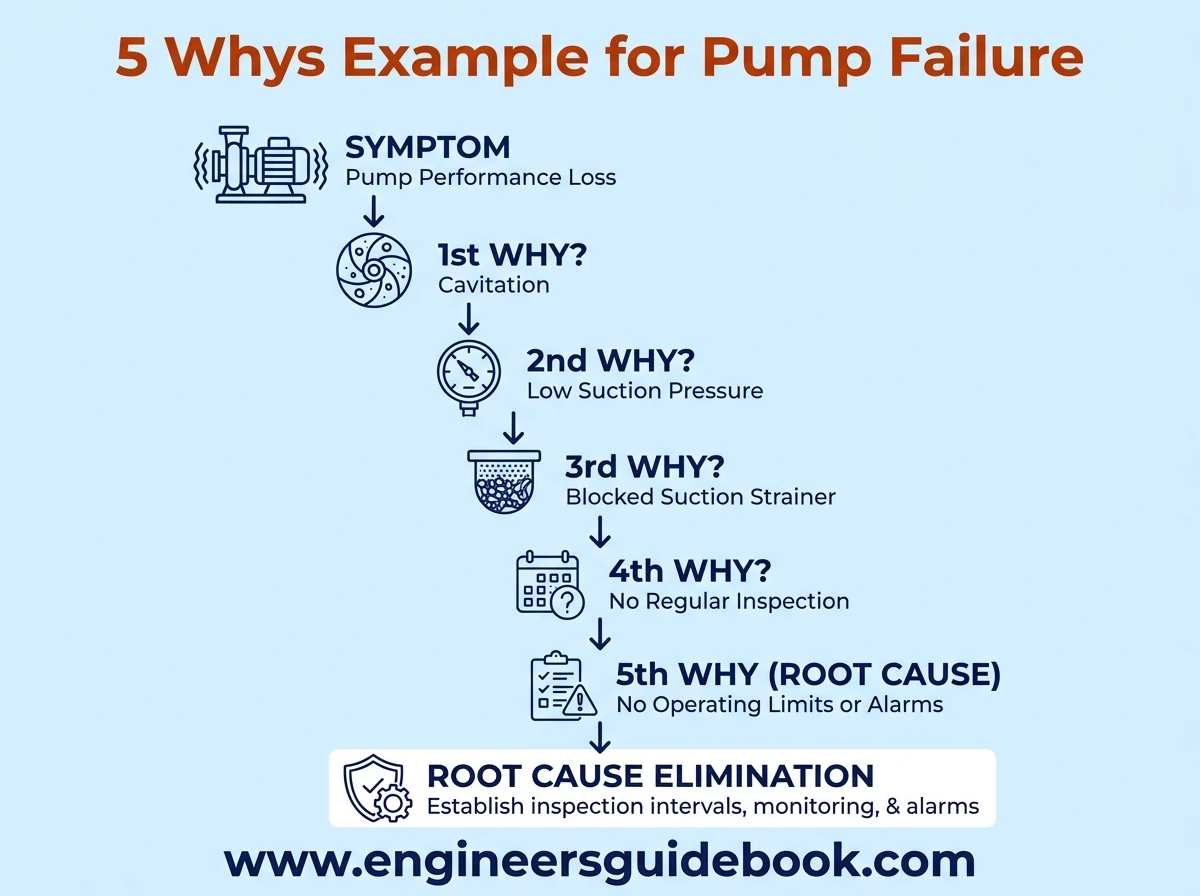
2.1 Problem Definition
An effective investigation starts with a precise problem statement. Vague descriptions such as “the machine failed” provide little analytical value.
A stronger statement might be: “The conveyor drive stopped at 14:20 after the motor overload relay tripped during normal production.”
A good problem definition specifies what happened, where it occurred, when it occurred, and what operational consequence followed. Accurate scoping prevents the analysis from drifting toward unrelated issues.
2.2 First Why
The first why should address the immediate physical or operational reason for the event.
If a motor stopped, the first question might be, “Why did the motor stop?” The answer could be that the overload protection tripped.
This first answer should be based on evidence rather than assumption. Alarm history, current readings, inspection results, photographs, operator observations, or component condition can help validate the response.
2.3 Cause and Effect Chain
Each subsequent why should logically follow from the previous answer. This creates a causal chain.
For example:
Motor stopped → overload relay tripped → current increased → mechanical load increased → bearing seized → lubrication was not replenished.
The sequence exposes progressively deeper conditions. However, the number five should not be treated as an immutable rule. Some investigations reach a defensible root cause after three questions, while others require six or seven.
2.4 Root Cause Identification
A credible root cause should explain why the failure occurred and identify something that the organization can reasonably control.
Statements such as “operator error” or “bearing failure” are often inadequate because they stop too early. Investigators should determine why the operator made the error or why the bearing deteriorated.
Potential systemic causes include missing procedures, incorrect maintenance frequencies, deficient training, unsuitable component specifications, poor spare-part quality, absent inspection criteria, or inadequate engineering controls.
2.5 Corrective Action Selection
Corrective actions should address the identified cause rather than merely repair the damage.
If contamination caused bearing failure, simply installing a new bearing is corrective maintenance, not necessarily root-cause correction. Additional measures may include replacing damaged seals, improving storage practices, specifying filtration requirements, revising lubrication procedures, or introducing contamination inspections.
The strongest actions remove or control the failure mechanism directly.
2.6 Verification and Follow Up
A 5 Whys investigation is incomplete until the corrective action is verified.
Maintenance teams should monitor relevant indicators after implementation. These may include vibration, temperature, downtime frequency, lubricant condition, motor current, failure rate, or mean time between failures.
If the same problem returns, the analysis should be reopened. Verification converts a theoretical corrective action into demonstrated reliability improvement.
3. 5 Whys Example for Bearing Failure
3.1 Bearing Overheating
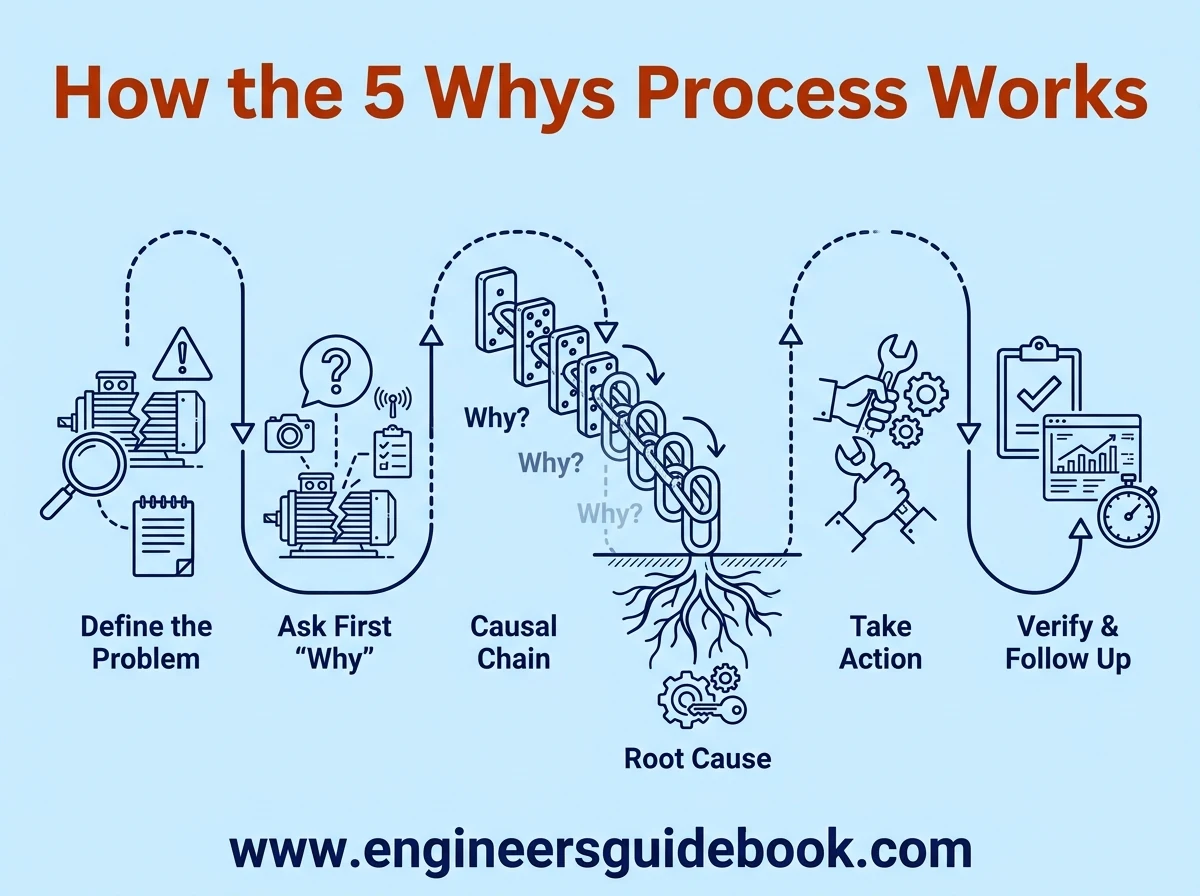
Consider a production machine that repeatedly develops high bearing temperatures. The first question is why the bearing overheated.
Inspection may reveal excessive friction caused by inadequate lubrication. This establishes the beginning of the causal sequence rather than prematurely attributing the event to a defective bearing.
3.2 Lubrication Failure
The next question asks why lubrication was inadequate.
Maintenance records may show that the bearing had not received the required quantity of grease within the specified interval. Alternatively, the wrong lubricant could have been used or grease passages may have been obstructed.
Physical evidence should determine which explanation is valid.
3.3 Lubrication Schedule Gap
If lubrication was missed, the investigation continues by asking why the scheduled task was not performed.
Perhaps the bearing was absent from the computerized maintenance system, or its lubrication frequency had never been formally defined. Such findings reveal a maintenance-system weakness rather than an isolated technician mistake.
3.4 Maintenance Planning Weakness
The next why may establish that equipment lubrication points were never systematically mapped during commissioning.
Consequently, certain bearings were omitted from routine lubrication routes. This is substantially more actionable than stating that the bearing failed because it was dry.
The investigation has now progressed from component damage to an underlying maintenance planning deficiency.
3.5 Root Cause and Corrective Action
Corrective actions could include creating a complete lubrication register, defining lubricant type and quantity, incorporating tasks into the CMMS, labeling lubrication points, and auditing schedule compliance.
The failed bearing should still be replaced, but the enduring improvement comes from eliminating the planning gap responsible for repeated under-lubrication.
4. 5 Whys Example for Conveyor Breakdown
4.1 Conveyor Stoppage
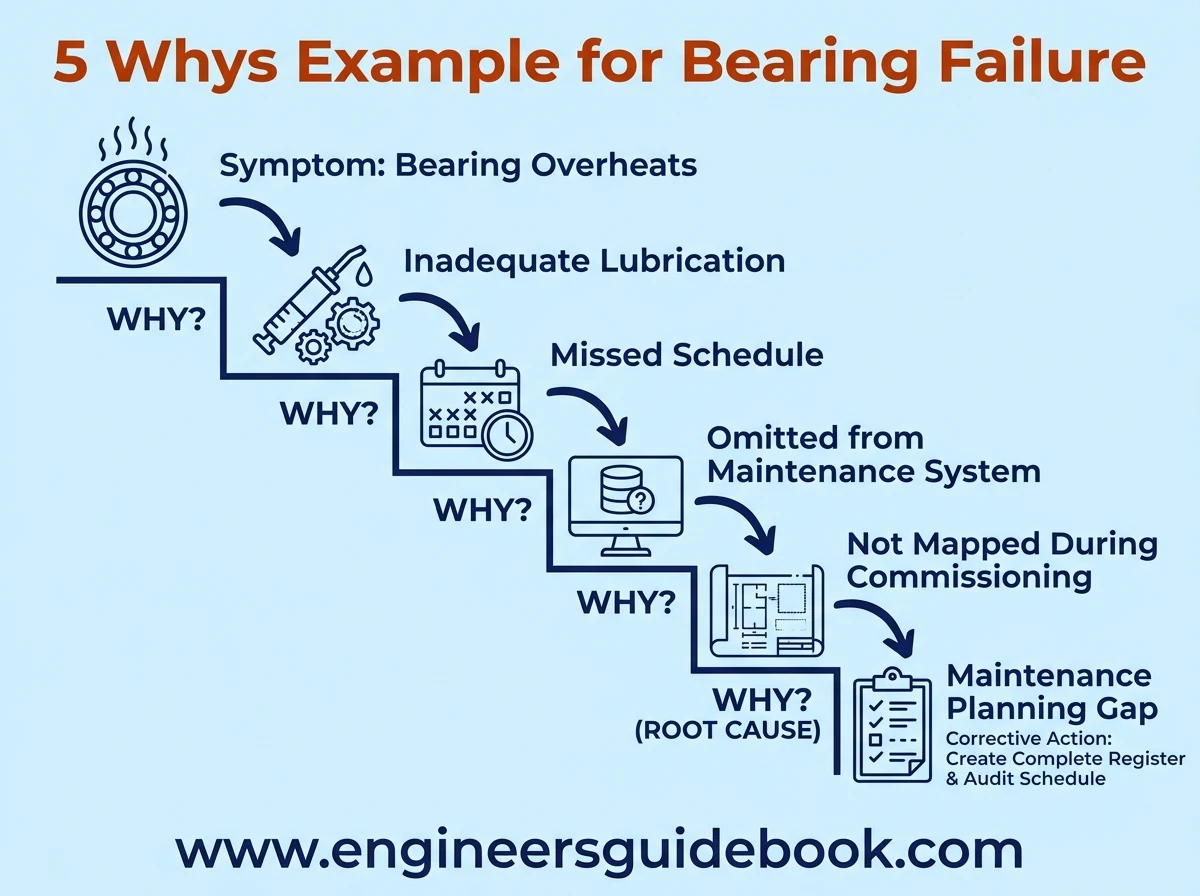
Suppose a conveyor stops during production because the belt moves off-center and activates a safety switch.
The first why identifies belt misalignment as the immediate reason for the stoppage. The investigation should then determine why tracking deteriorated.
4.2 Belt Misalignment
Inspection may reveal that one section of the belt continually drifts toward one side.
Possible causes include unequal tension, material buildup, displaced rollers, pulley misalignment, structural distortion, or damaged idlers. Measurements and physical examination are necessary before continuing the analysis.
4.3 Roller and Pulley Issues
Assume the investigation discovers a seized return roller that forces the belt away from its normal path.
The next question becomes why the roller seized. Examination may reveal bearing contamination and excessive wear that had developed gradually over several weeks.
4.4 Inspection Deficiency
Why was the deteriorating roller not identified earlier?
The conveyor inspection checklist may focus on belt condition and motor operation while failing to require individual roller checks. The defect therefore remained undetected until functional failure occurred.
4.5 Preventive Maintenance Failure
The deeper issue is not simply the seized roller but the absence of a sufficiently detailed preventive inspection regime.
Where inspection standards lack measurable criteria for noise, free rotation, temperature, or bearing condition, deteriorating rollers can remain in service unnoticed.
4.6 Permanent Corrective Actions
Permanent actions may include revising conveyor inspection routes, establishing roller condition criteria, using infrared temperature checks, monitoring abnormal noise, maintaining critical spare rollers, and defining replacement thresholds.
These measures address the mechanism that permitted degradation to progress unchecked.
5. 5 Whys Example for Pump Failure
5.1 Pump Performance Loss
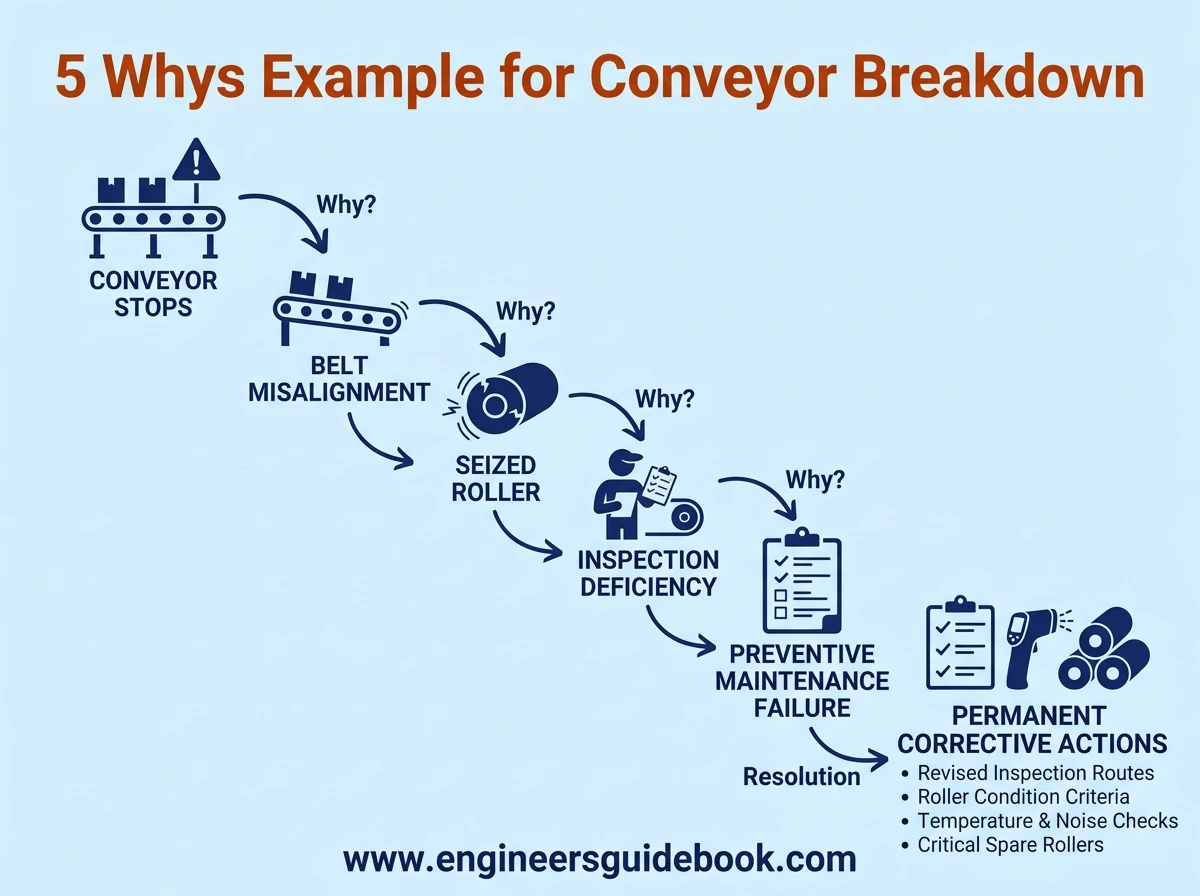
A process pump may show reduced discharge pressure, excessive vibration, and abnormal noise.
Rather than immediately replacing the pump, the first why should investigate the direct reason for lost hydraulic performance.
5.2 Cavitation
Inspection may indicate cavitation, characterized by fluctuating pressure, vibration, and pitting on the impeller.
The next question asks why adequate suction conditions were not maintained.
5.3 Low Suction Pressure
Low suction pressure can result from insufficient liquid level, excessive suction lift, high fluid temperature, blocked strainers, partially closed valves, or undersized suction piping.
Operating data should be compared with the pump’s required net positive suction head.
5.4 Suction System Restrictions
Suppose the suction strainer is found heavily obstructed.
The next why investigates why contamination accumulated until flow became restricted. Perhaps cleaning frequency was undefined or differential pressure was not monitored.
5.5 Operating Condition Failure
The investigation may ultimately reveal that no operational limit existed for suction pressure or strainer differential pressure.
Operators therefore had no early-warning criterion indicating deteriorating suction conditions.
5.6 Root Cause Elimination
Corrective actions could include introducing strainer inspection intervals, differential-pressure monitoring, minimum suction-pressure alarms, operating limits, and periodic pump performance reviews.
The objective is to prevent recurrence of cavitation rather than repeatedly repairing damaged impellers.
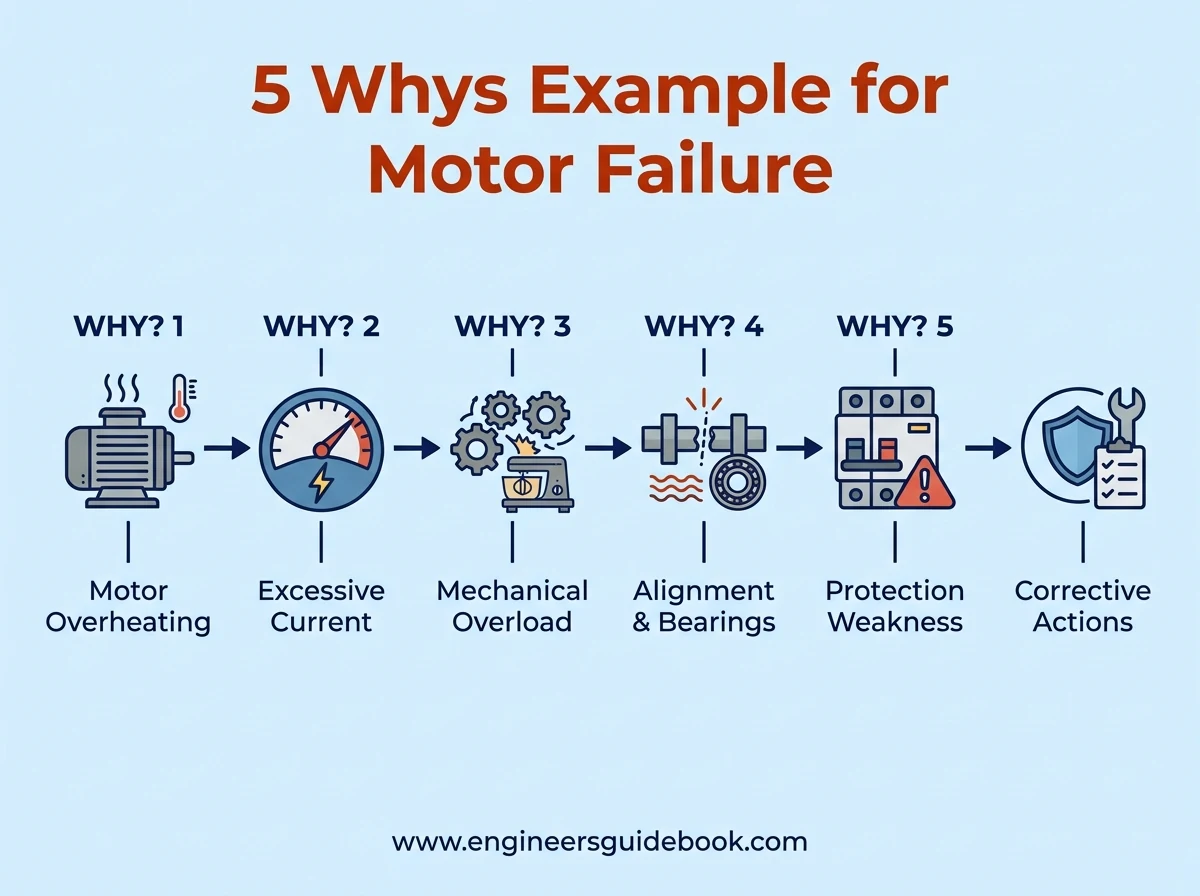
6. 5 Whys Example for Motor Failure
6.1 Motor Overheating
Motor overheating frequently signals excessive electrical or mechanical stress.
The initial investigation should compare winding temperature, current, voltage balance, ventilation condition, mechanical loading, and ambient temperature against acceptable limits.
6.2 Excessive Current
If current exceeds the rated value, investigators should determine why the motor is drawing excessive amperage.
Potential causes include overload, phase imbalance, low voltage, bearing friction, driven-equipment problems, or inappropriate motor sizing.
6.3 Mechanical Overload
Suppose the driven mixer requires abnormally high torque because material accumulation has increased mechanical resistance.
The overload is therefore a consequence of process or mechanical conditions rather than an intrinsic motor defect.
6.4 Alignment and Bearing Problems
Misalignment, deteriorated bearings, or excessive belt tension can similarly increase motor load.
Routine vibration measurements, current trending, and alignment verification can reveal these conditions before overheating becomes destructive.
6.5 Protection System Weakness
A further why may reveal that overload settings were incorrect or thermal protection was inadequate.
Protection devices should be configured to safeguard the motor without causing unnecessary trips under normal operating conditions.
6.6 Corrective and Preventive Actions
Actions may include correcting mechanical load, performing precision alignment, replacing damaged bearings, verifying overload settings, improving ventilation, and trending motor current.
These measures tackle both the immediate problem and conditions that could recreate it.
7. 5 Whys Example for Gearbox Failure
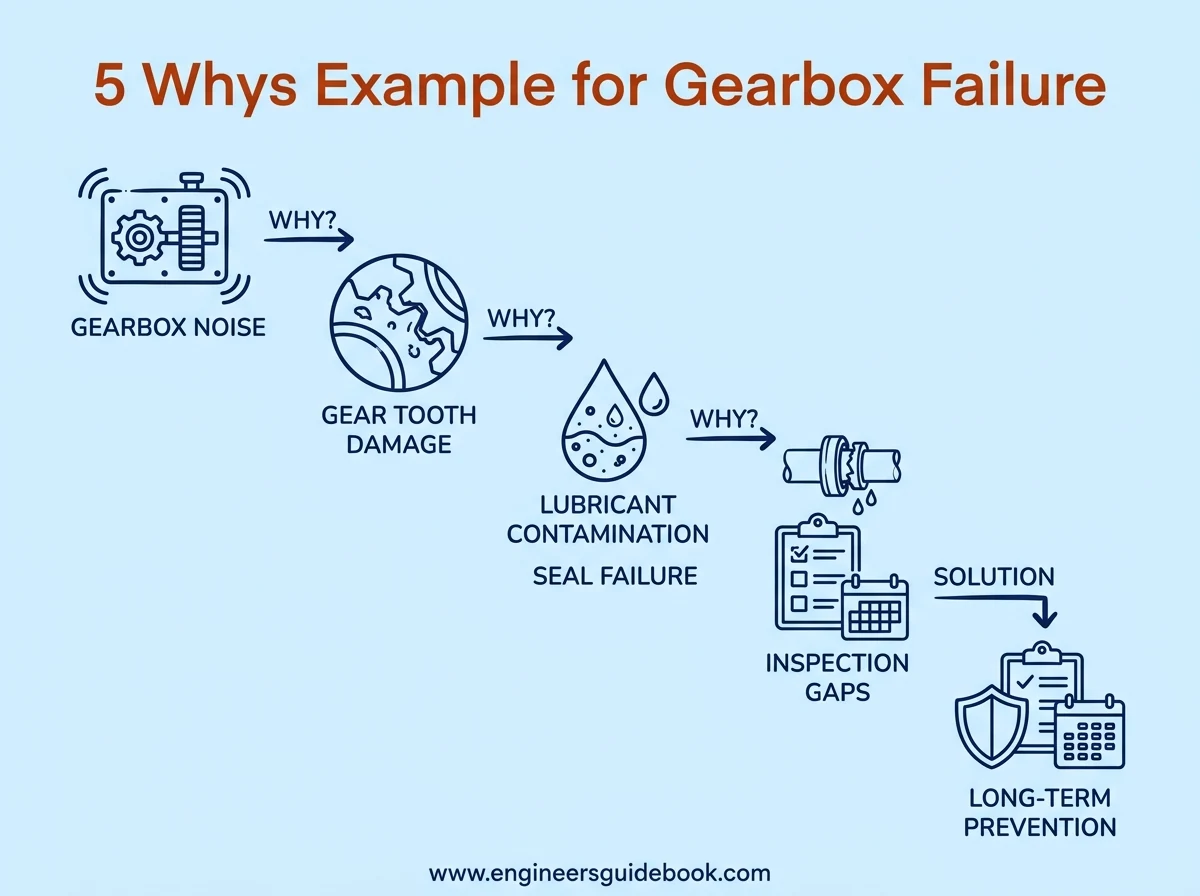
7.1 Gearbox Noise
Abnormal gearbox noise is often an early warning of internal deterioration.
The first investigation should examine vibration, lubricant condition, temperature, backlash, shaft alignment, and load behavior.
7.2 Gear Tooth Damage
Inspection may reveal pitting or spalling on gear teeth.
The next why considers why the tooth surfaces deteriorated, including lubrication deficiency, contamination, overload, misalignment, or incorrect gear contact.
7.3 Lubricant Contamination
Suppose oil analysis identifies elevated water and particulate contamination.
Contaminated lubricant can disrupt the protective oil film, accelerate abrasive wear, and damage bearings and gear surfaces.
7.4 Seal Failure
Further investigation may show that damaged shaft seals allowed moisture and contaminants into the gearbox.
The analysis should then determine why seal deterioration was not detected or corrected earlier.
7.5 Inspection and Replacement Gaps
A missing seal inspection standard or undefined replacement criterion may be the systemic cause.
Without routine condition checks, seals may remain installed until leakage or contamination becomes severe.
7.6 Long Term Prevention
Long-term measures may include lubricant analysis, contamination control, breather upgrades, seal inspections, vibration monitoring, oil-level checks, and defined replacement criteria.
The 5 Whys therefore transforms a noisy gearbox from a reactive repair event into an opportunity for systematic reliability improvement.
8. 5 Whys Examples for Production Problems
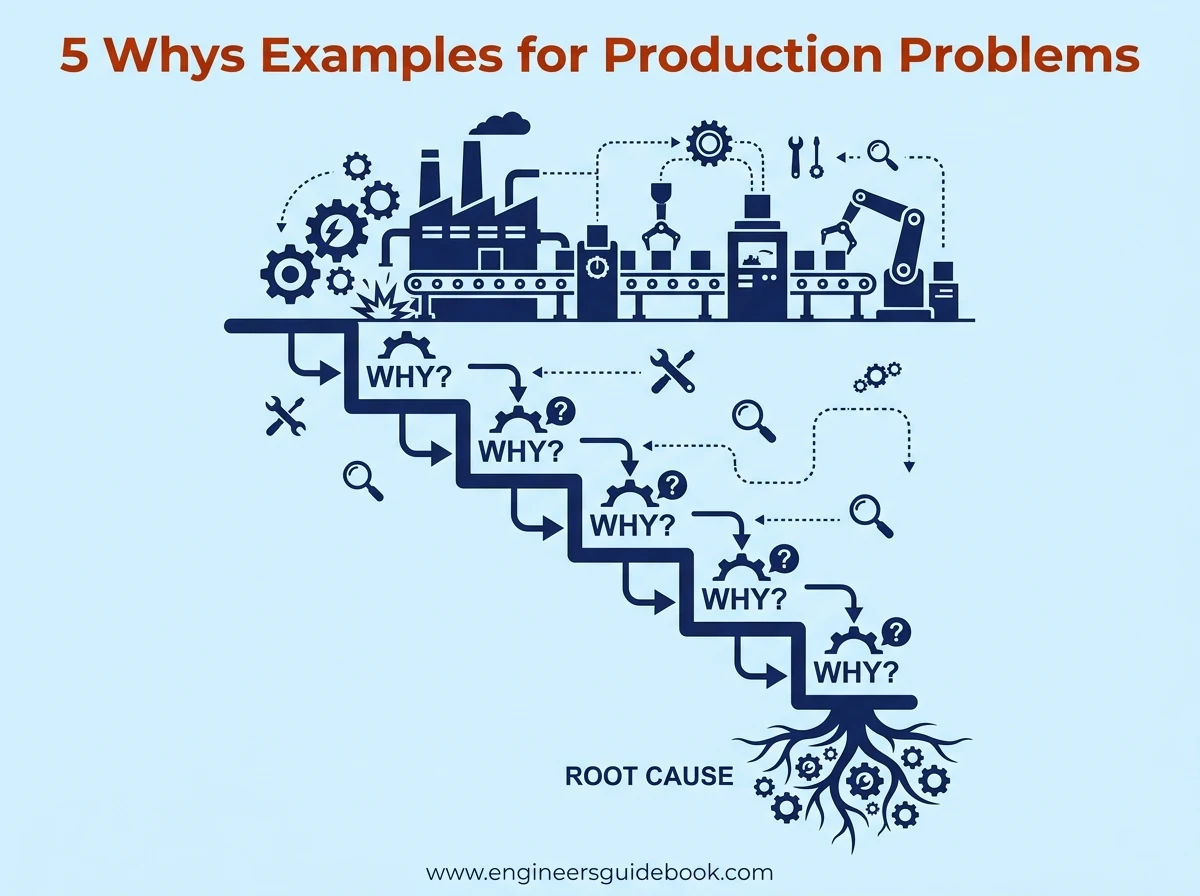
8.1 Repeated Machine Downtime
Repeated machine downtime is often treated as a maintenance issue, but the actual cause may be far deeper. Consider a packaging machine that stops several times per shift. The first why may reveal frequent sensor faults. The second may show contamination on the sensor lens. Further questioning may expose inadequate guarding, poor cleaning standards, or an unsuitable sensor location.
The strongest 5 Whys analysis does not stop at replacing the sensor. It determines why the condition keeps returning and eliminates the recurring mechanism.
8.2 Product Quality Defects
Suppose finished products repeatedly fail dimensional inspection. The first why may identify variation in machine settings. The next may show that operators manually adjust parameters because no standardized setup sheet exists.
Further analysis could reveal outdated process specifications or poor engineering change control. In this case, the defect is not fundamentally an operator problem. It originates from deficient process standardization.
Corrective measures may include validated setup parameters, controlled work instructions, first-piece approval, and automated parameter locking.
8.3 Low Production Output
Low production output can result from micro-stoppages, reduced operating speed, material shortages, poor scheduling, or inefficient changeovers.
For example, if a line produces 20 percent below target, the first why might reveal frequent minor stops. The next may indicate product jams at a transfer point. Further questions could expose worn guides, inadequate inspection criteria, and missing replacement standards.
The 5 Whys helps convert a general productivity complaint into a specific, controllable cause.
8.4 Excessive Scrap
Excessive scrap is rarely solved by simply asking operators to work more carefully.
Suppose a forming process generates excessive rejected parts because dimensions drift during production. The first why may reveal fluctuating tool position. The second may identify fixture wear. The next may establish that no wear limit exists for the fixture.
The root cause therefore lies in missing inspection and replacement criteria. Establishing dimensional checks and defined wear limits can reduce recurring scrap far more effectively than repeated sorting.
8.5 Frequent Changeover Delays
Long changeovers can significantly reduce equipment availability and overall equipment effectiveness.
A 5 Whys analysis may reveal that changeovers take too long because tooling cannot be found immediately. Why? Tools are stored in multiple locations. Why? No dedicated changeover kit exists. Why? Changeover requirements were never standardized.
Corrective actions might include shadow boards, preassembled kits, standardized work sequences, external preparation, and SMED principles. Small organizational weaknesses can create substantial cumulative production loss.
8.6 Operator Errors
Operator error should rarely be accepted as the final root cause.
If an operator selects an incorrect machine recipe, investigators should ask why that selection was possible. Perhaps recipe names are ambiguous, access controls are absent, or the interface presents similar options without confirmation.
Corrective actions may include interface improvements, barcode selection, interlocks, clearer instructions, or authorization controls. Good root cause analysis redesigns the process so the same mistake becomes difficult to repeat.
9. 5 Whys Examples for Maintenance Failures
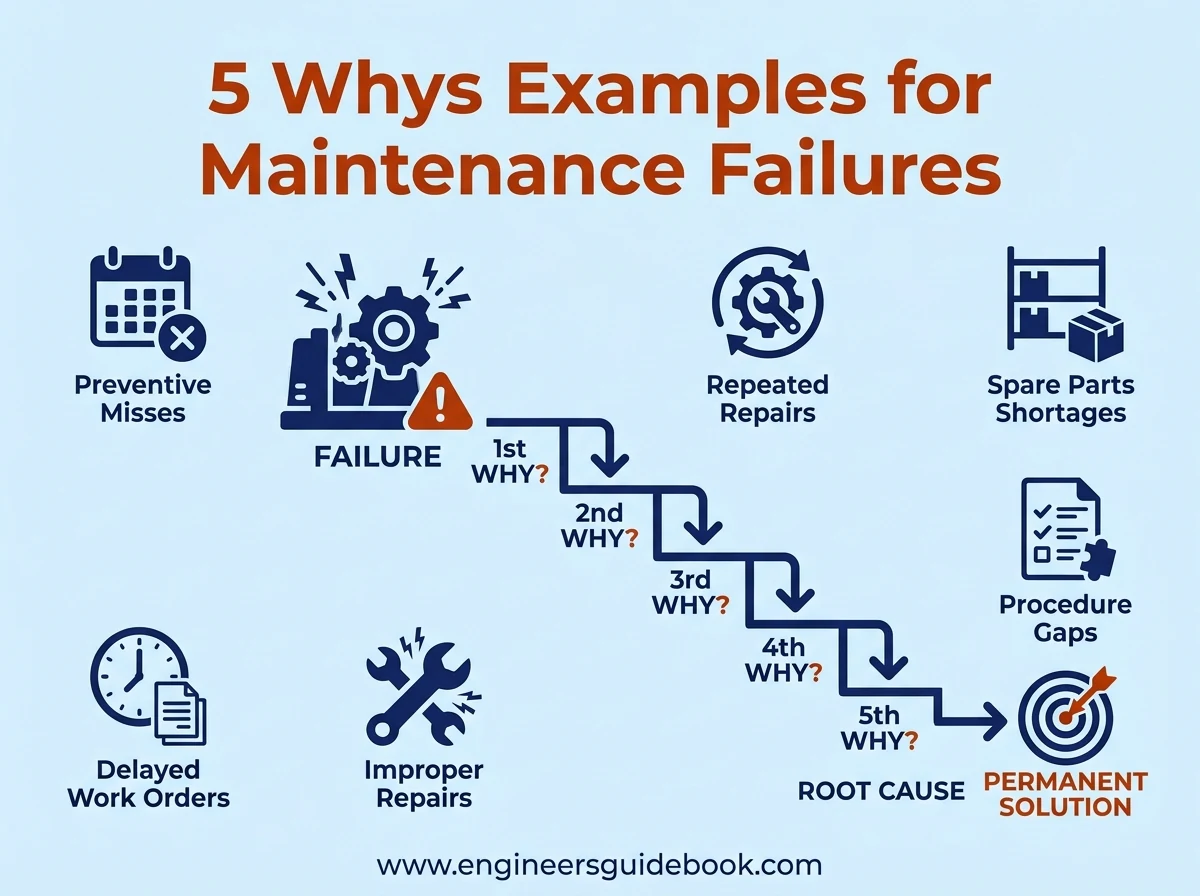
9.1 Preventive Maintenance Misses
A missed preventive maintenance task may appear to be a technician oversight, but deeper analysis often exposes planning or scheduling deficiencies.
Why was lubrication missed? Because the task did not appear on the weekly schedule. Why? The equipment was not linked to the correct maintenance plan. Why? Asset master data was incomplete during commissioning.
The permanent solution is therefore better asset data governance, not merely reminding technicians to be more attentive.
9.2 Repeated Corrective Maintenance
Repeated corrective work is a strong indication that the underlying failure mechanism remains unresolved.
If a mechanical seal is replaced every two months, asking why it fails may reveal shaft vibration. Further questioning may expose misalignment, soft foot, piping strain, or incorrect installation practices.
Replacing the same component repeatedly is expensive and misleading. The 5 Whys helps maintenance teams move from repetitive repair toward defect elimination.
9.3 Spare Parts Shortages
Suppose production remains stopped because a critical gearbox bearing is unavailable.
The first why identifies the missing spare. The second may reveal that no minimum stock level existed. Further investigation may show that criticality analysis had never been completed.
The root cause is therefore not simply procurement delay. It may be the absence of a structured critical-spares strategy.
Corrective action can include equipment criticality ranking, reorder points, lead-time review, and standardized spare-parts lists.
9.4 Delayed Work Orders
Maintenance work orders can remain open because of unclear priorities, missing materials, poor coordination, or insufficient labor.
A 5 Whys analysis should trace the exact delay. If a work order waits ten days for execution, the investigation may reveal repeated rescheduling because operations cannot release the machine.
The deeper cause could be weak shutdown coordination. Joint planning between maintenance and production may therefore be more effective than increasing maintenance manpower.
9.5 Improper Repairs
An improper repair can restore equipment temporarily while creating a future failure.
Suppose a coupling fails shortly after replacement. Investigation may reveal incorrect alignment. Why was alignment incorrect? Precision tools were unavailable. Why? The workshop had no defined alignment standard or equipment requirement.
Corrective action might include laser alignment tools, technician competency standards, repair checklists, and post-maintenance verification.
9.6 Maintenance Procedure Gaps
Maintenance procedures should describe critical tolerances, tools, safety requirements, inspection points, and acceptance criteria.
If these details are absent, different technicians may perform the same task differently. Such variability creates latent defects.
The 5 Whys can expose these procedural weaknesses and support development of standardized maintenance instructions that improve repeatability and reliability.
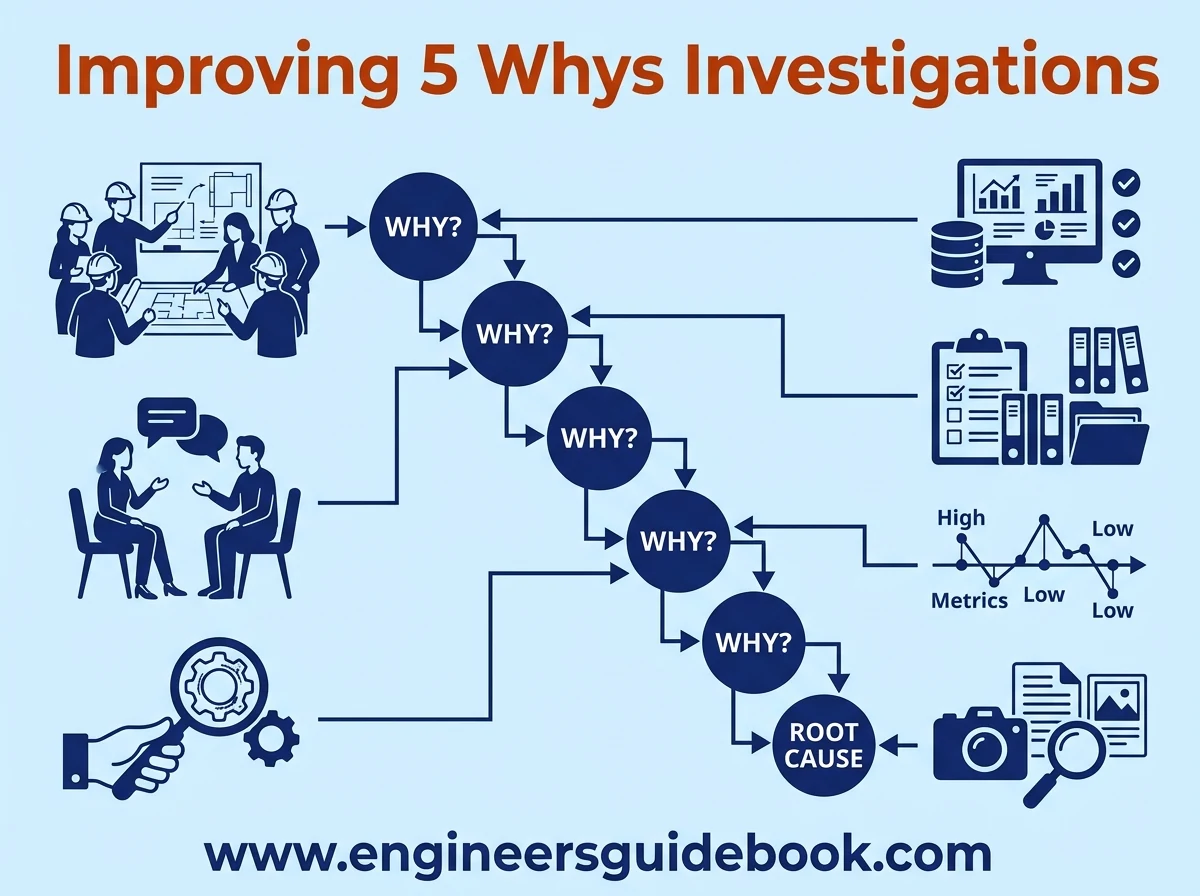
10. Improving 5 Whys Investigations
10.1 Evidence Based Questions
Every why should be supported by observable evidence whenever possible.
Measurements, photographs, alarms, laboratory analysis, process trends, maintenance history, and component condition are more reliable than recollection alone. Evidence prevents the investigation from becoming an exercise in speculation.
10.2 Maintenance Records
Work orders, preventive maintenance reports, breakdown history, lubrication records, and inspection sheets can reveal patterns that are invisible during a single failure event.
Repeated component replacement, recurring alarms, or similar defects across multiple machines may indicate a systemic weakness.
10.3 Operator Interviews
Operators often notice subtle changes before equipment fails.
Questions should focus on observations such as abnormal noise, changing cycle time, vibration, temperature, product behavior, or recent adjustments. Interviews should seek facts rather than assign blame.
10.4 Failure History
Historical data helps determine whether a failure is isolated or recurrent.
If the same bearing, sensor, seal, or gearbox has failed several times, investigators should compare previous causes and corrective actions. Recurrence may indicate that earlier analyses stopped too early.
10.5 Physical Inspection
Failed components should be preserved and inspected whenever practical.
Wear patterns, discoloration, scoring, corrosion, fracture surfaces, contamination, and deformation can provide valuable evidence regarding the failure mechanism.
10.6 Data Validation
Investigation conclusions should be cross-checked against operating data.
If overload is identified as the cause, current readings should support it. If overheating is suspected, temperature trends should be reviewed. Validation strengthens confidence in the final conclusion.
10.7 Cross Functional Teams
Complex failures often require participation from maintenance, production, engineering, quality, and safety personnel.
Different disciplines observe different parts of the process. Cross-functional involvement reduces tunnel vision and improves the probability of identifying systemic causes.
11. Common 5 Whys Mistakes
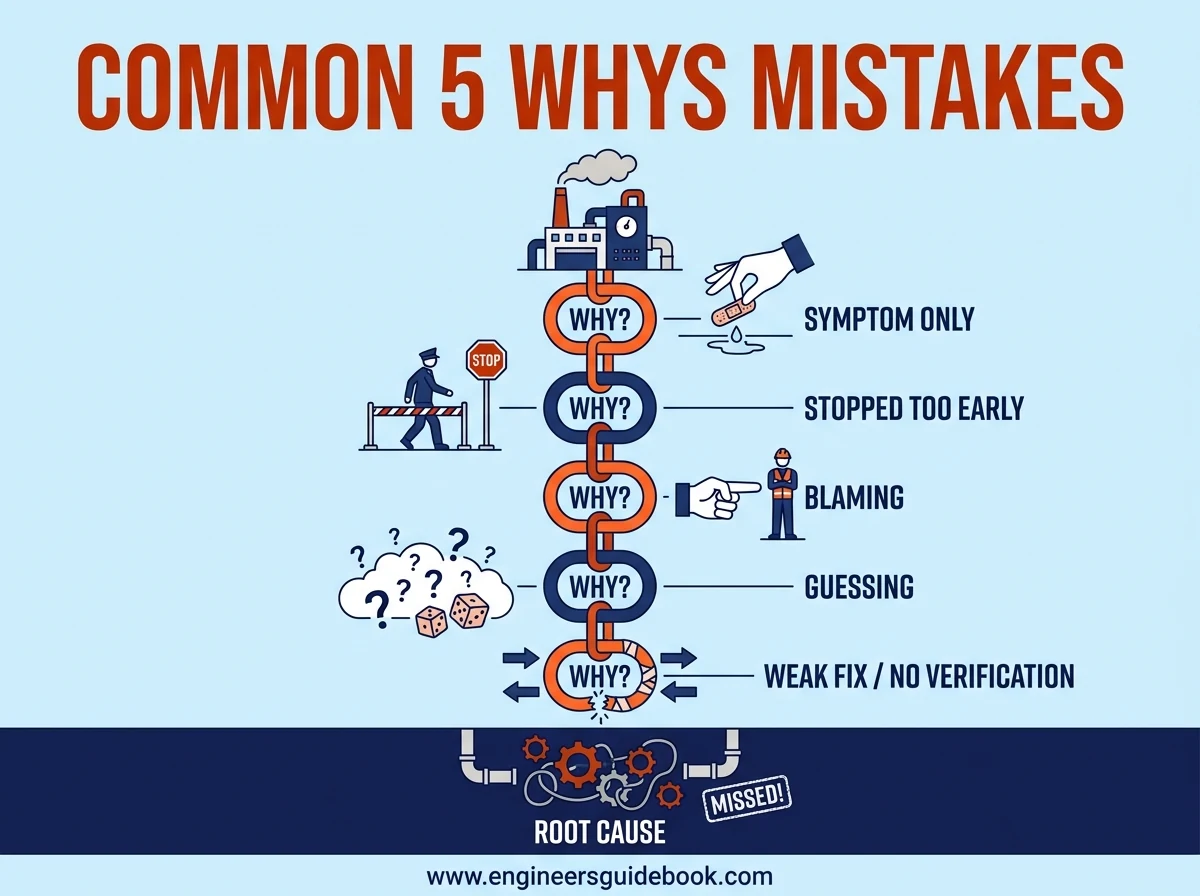
11.1 Stopping Too Early
Stopping after identifying the failed component usually produces weak corrective action. The investigation should continue until a controllable underlying cause is reached.
11.2 Blaming Operators
Statements such as “operator negligence” often conceal poor procedures, inadequate training, confusing interfaces, or missing controls. Human error should be investigated, not merely recorded.
11.3 Assuming the Cause
A plausible explanation is not necessarily the correct explanation. Conclusions should be verified using evidence.
11.4 Ignoring Multiple Causes
Some failures have several causal branches. A motor may overheat because of overload, poor ventilation, and voltage imbalance simultaneously. The analysis should not force a single cause where multiple contributing factors exist.
11.5 Weak Corrective Actions
Instructions such as “be careful” or “monitor closely” are rarely robust corrective actions. Strong actions modify equipment, processes, standards, or controls.
11.6 Missing Verification
Corrective actions must be followed by monitoring. Without verification, the organization cannot determine whether recurrence risk has actually decreased.
11.7 Confusing Symptoms With Root Causes
Noise, vibration, leakage, overheating, and tripping are generally symptoms. Investigators must continue asking why these conditions developed.
12. Frequently Asked Questions
12.1 What Is a 5 Whys Example in Manufacturing
A common example is a conveyor stopping because a bearing seized. Asking successive whys may trace the failure from bearing seizure to lubrication deficiency, a missed maintenance task, an incomplete lubrication schedule, and ultimately inadequate maintenance planning.
12.2 How Do You Use the 5 Whys for Equipment Failure
Start with a precise failure statement and repeatedly ask why each condition occurred. Validate every answer with available evidence and continue until a controllable root cause is identified.
12.3 What Are the Five Steps of the 5 Whys
The typical steps are defining the problem, asking why the event occurred, continuing the causal questioning, identifying the root cause, and implementing corrective actions followed by verification.
12.4 Does the 5 Whys Method Always Require Five Questions
No. Five is a guideline rather than a rigid requirement. Some problems require fewer questions, while complex failures may require more.
12.5 What Is a Good 5 Whys Example for Machine Breakdown
A motor trip caused by excessive current can be traced to mechanical overload, a seized bearing, inadequate lubrication, a missed PM task, and an incomplete maintenance schedule.
12.6 How Do You Identify the Root Cause of Equipment Failure
Combine structured questioning with physical evidence, operating data, maintenance history, inspection results, and technical analysis. The root cause should explain the failure and support a practical corrective action.
12.7 What Is the Difference Between 5 Whys and Root Cause Analysis
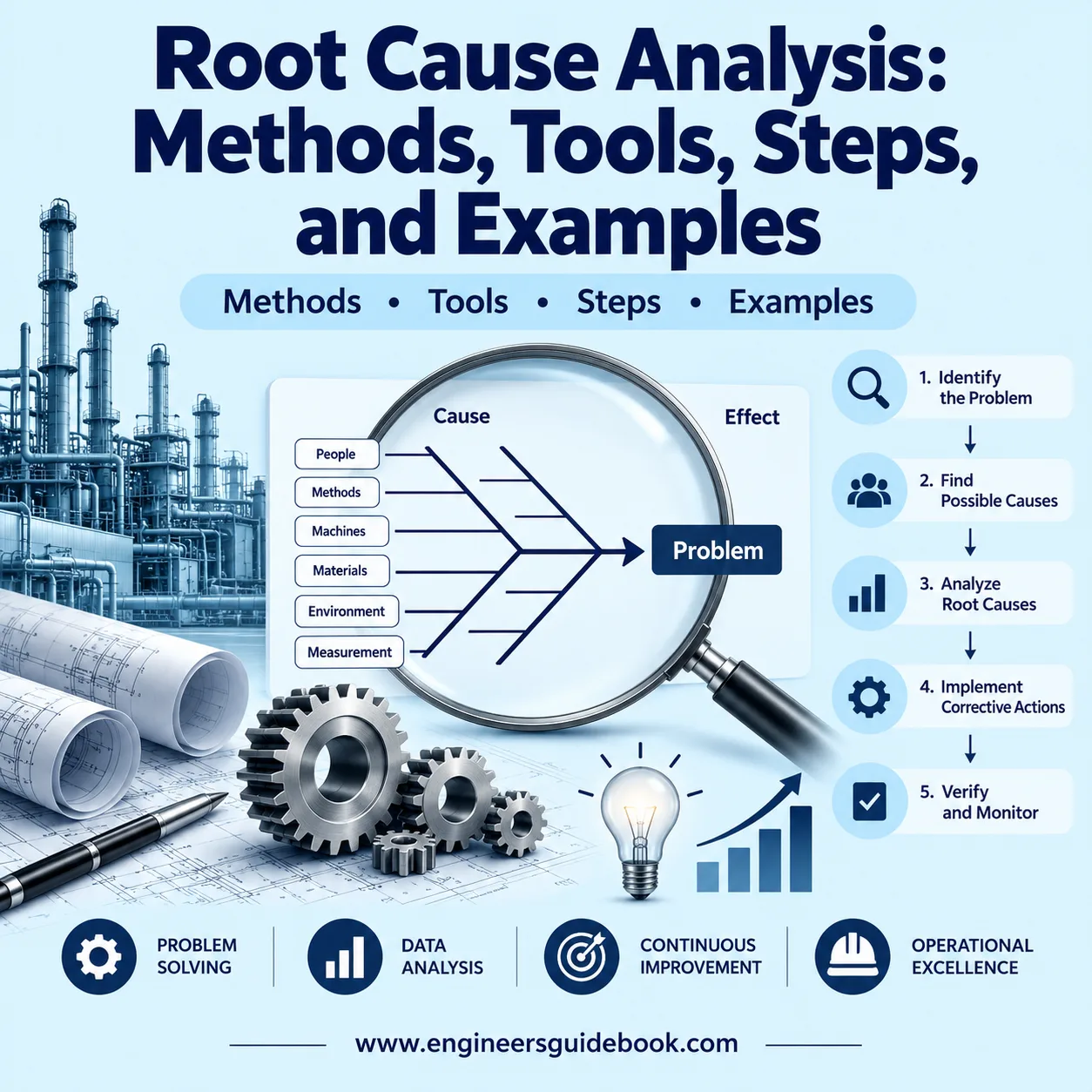
The 5 Whys is one root cause analysis technique. Broader RCA may also use fault trees, fishbone diagrams, FMEA, laboratory examination, vibration analysis, and statistical tools.
12.8 Can the 5 Whys Have More Than One Root Cause
Yes. Complex failures frequently involve several contributing causes. Separate causal branches can be investigated where evidence supports them.
12.9 When Should the 5 Whys Not Be Used
The method should not be used alone for highly complex, safety-critical, or multi-factor failures that require more rigorous analytical techniques.
12.10 How Do You Document a 5 Whys Analysis
Documentation should include the problem statement, each why and answer, supporting evidence, identified root cause, corrective actions, responsible persons, deadlines, and verification results.
13. Conclusion
The 5 Whys is most effective when investigators resist superficial answers and follow evidence through the complete causal chain. Its value lies in recurrence prevention, not merely fault description.
Applied correctly, the method can improve equipment availability, reduce repetitive breakdowns, lower maintenance expenditure, and strengthen operational reliability. It also encourages teams to treat failures as learning opportunities rather than isolated incidents.
Every well-conducted 5 Whys investigation should improve the system that allowed the failure to occur. When findings are converted into stronger maintenance plans, engineering controls, procedures, training, and verification practices, individual failures become catalysts for continuous improvement across the manufacturing operation.