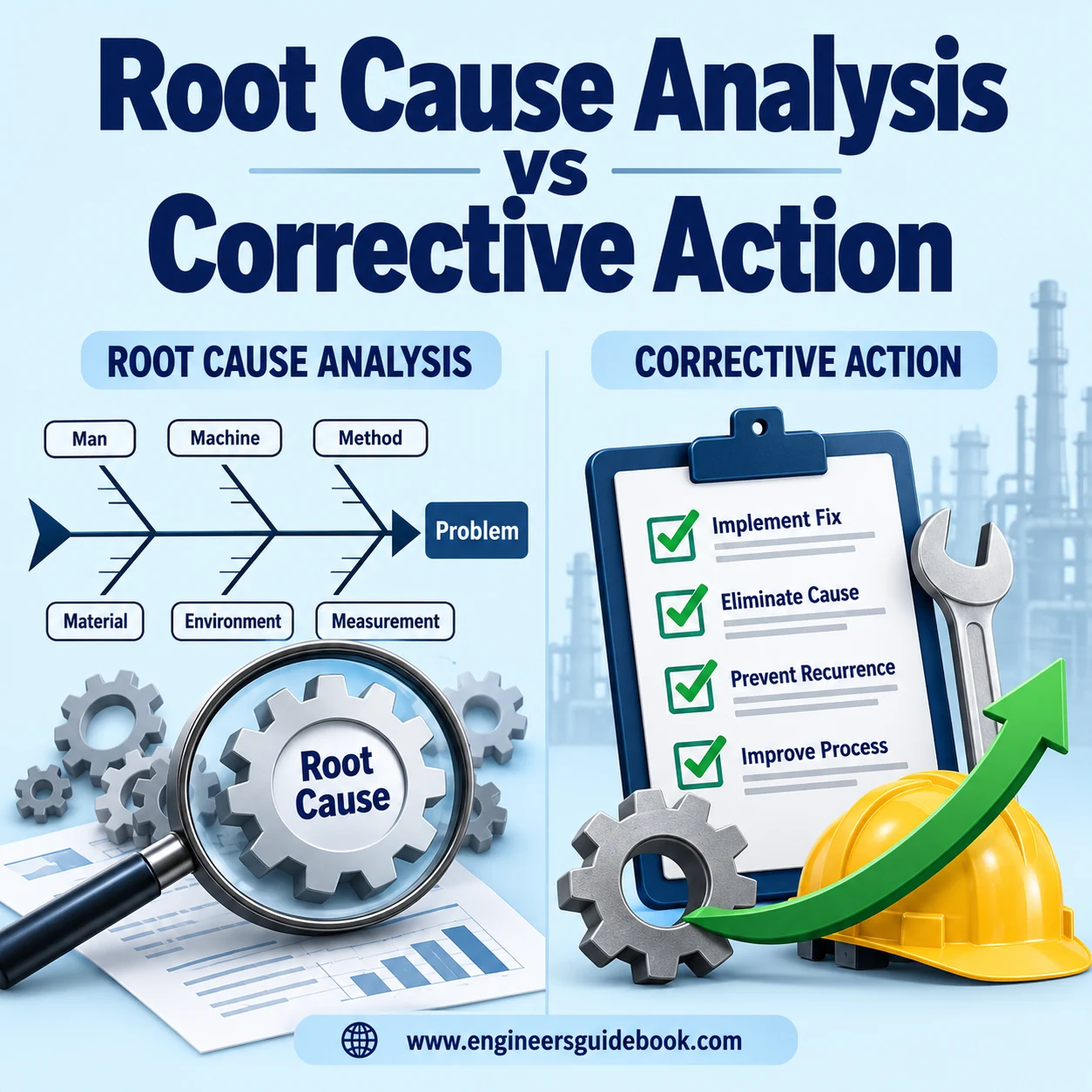
Root cause analysis vs corrective action refers to two interconnected approaches to problem-solving. Root cause analysis (RCA) identifies the underlying reasons a problem occurs, while corrective action eliminates those causes to prevent recurrence. In manufacturing, maintenance, and quality management, both processes work together to reduce equipment failures, eliminate defects, improve reliability, and achieve sustainable operational improvements.
1. Introduction to Root Cause Analysis and Corrective Action
1.1. Understanding Root Cause Analysis and Corrective Action
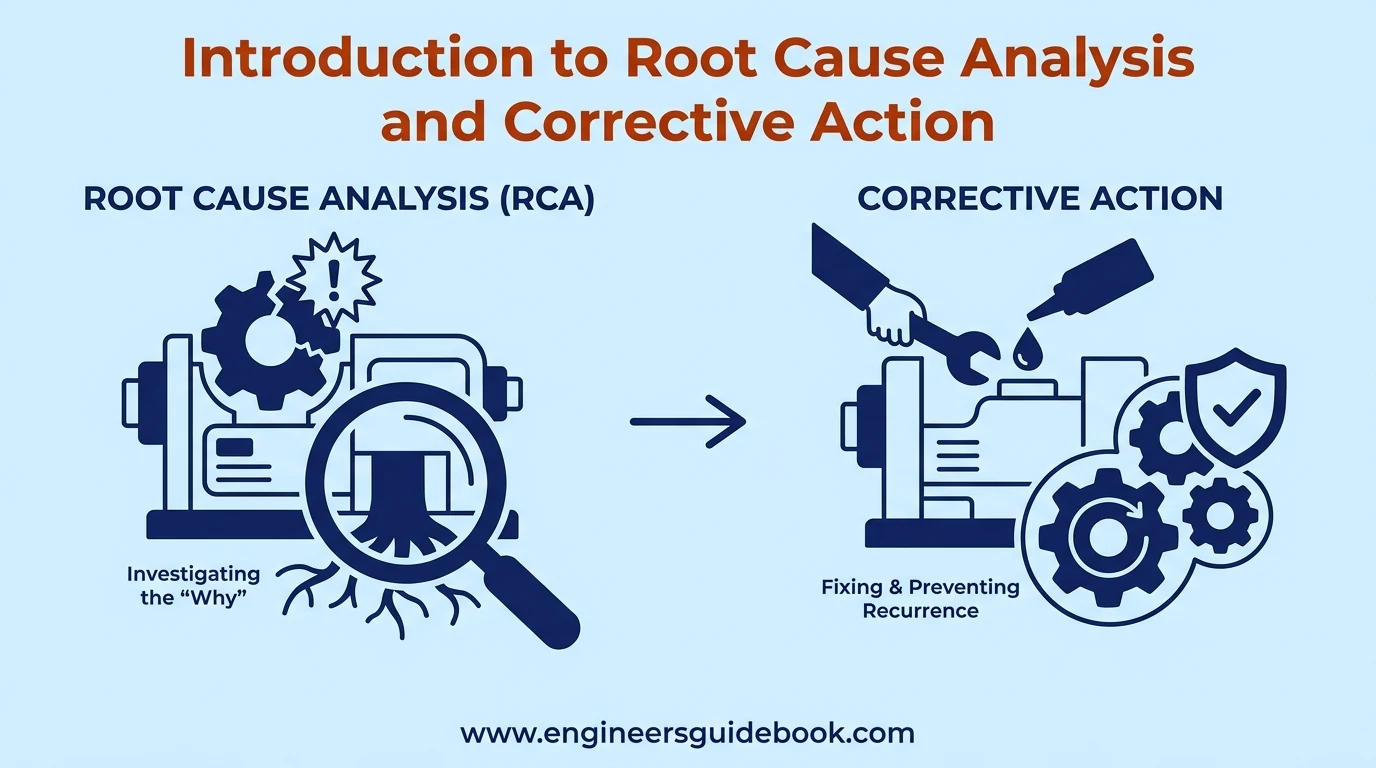
Root cause analysis (RCA) and corrective action are fundamental components of systematic problem-solving. RCA investigates why an undesirable event occurred, whereas corrective action implements measures to eliminate its verified causes.
Together, they establish a structured approach to resolving operational failures, improving processes, and preventing recurring nonconformities.
1.2. Why Identifying Problems Is Different From Solving Them
Identifying a problem reveals what went wrong. Solving it requires understanding its underlying causes and implementing sustainable improvements.
For example, replacing a damaged bearing restores equipment operation, but investigating lubrication deficiencies, misalignment, or excessive loading explains why the bearing failed. Without addressing these conditions, failure may recur.
1.3. The Importance of RCA and Corrective Action in Manufacturing
Manufacturing facilities encounter equipment breakdowns, quality deviations, production interruptions, and safety incidents.
Effective RCA and corrective action help organizations minimize unplanned downtime, reduce maintenance expenditure, improve product consistency, and maintain regulatory compliance. They also strengthen operational discipline and accountability across departments.
1.4. How RCA and Corrective Action Improve Quality and Reliability
RCA identifies the mechanisms responsible for failures, while corrective action removes or controls those mechanisms.
This complementary relationship improves equipment availability, process stability, and product quality. Over time, fewer recurring failures contribute to improved mean time between failures (MTBF), reduced maintenance costs, and greater operational reliability.
2. What Is Root Cause Analysis
2.1. Root Cause Analysis Definition and Core Objectives
Root cause analysis is a systematic investigative methodology used to identify the fundamental causes of equipment failures, process deviations, accidents, and quality defects.
Its primary objective is to establish evidence-supported causal relationships rather than simply treating visible symptoms.
Effective RCA identifies controllable conditions whose elimination or modification can prevent similar incidents.
2.2. How Root Cause Analysis Works
RCA begins with a clearly defined problem, followed by evidence collection, causal investigation, and hypothesis verification.
Investigators examine operating records, maintenance histories, equipment conditions, and process parameters to reconstruct failure mechanisms.
For instance, repeated motor overheating may result from excessive mechanical loading rather than an electrical malfunction. Verification ensures that conclusions reflect actual operating conditions.
2.3. Understanding Symptoms, Contributing Factors, and Root Causes
Distinguishing these elements is essential for accurate investigations.
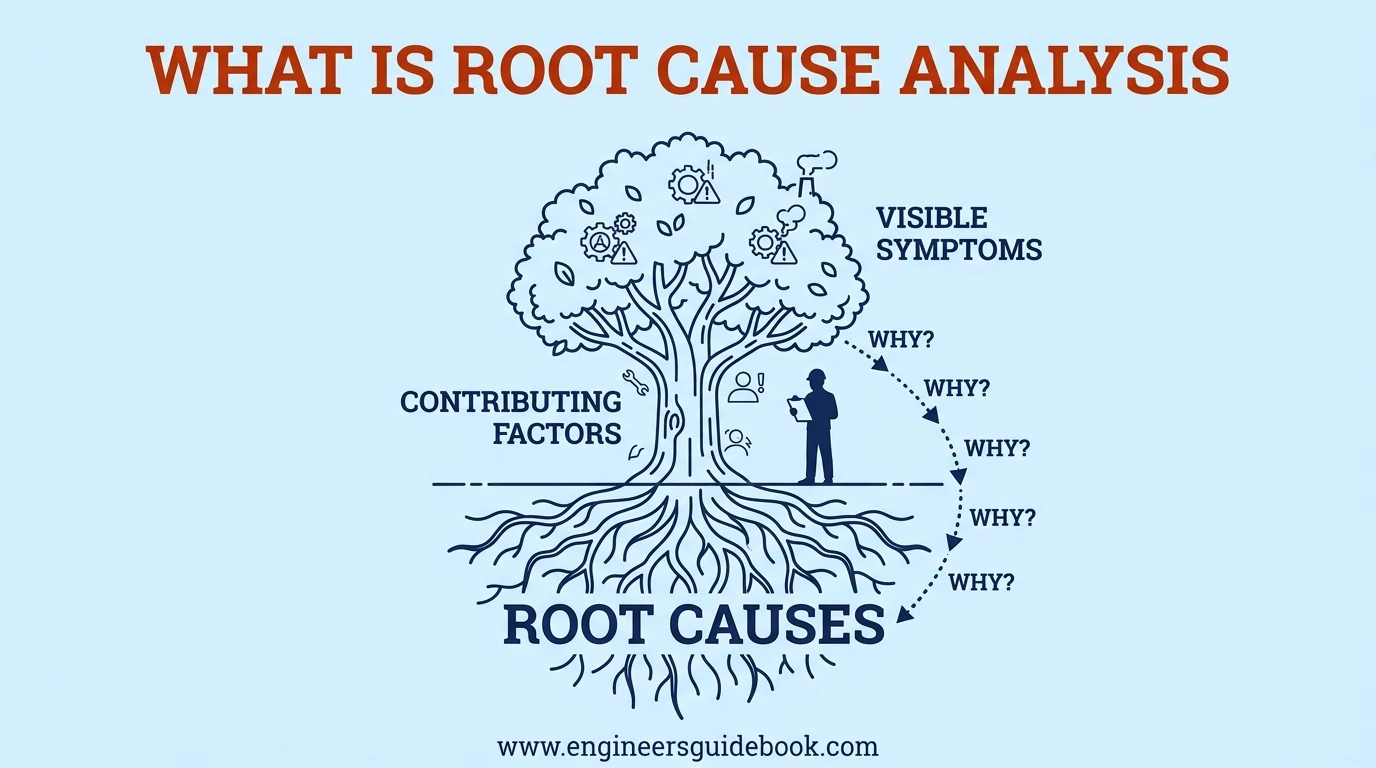
Symptoms represent observable consequences, such as vibration, leakage, or overheating.
Contributing factors increase failure probability or severity.
Root causes are underlying controllable conditions responsible for the problem.
A leaking mechanical seal might be a symptom, while shaft misalignment and inadequate alignment procedures represent progressively deeper causal factors.
2.4. Different Types of Root Causes
Industrial root causes generally fall into several categories.
Physical causes include component wear, fatigue, corrosion, and structural defects.
Human factors involve errors influenced by training, workload, or working conditions.
Systemic causes include inadequate procedures, poor maintenance planning, and deficient management controls.
Complex failures frequently involve interacting causes rather than one isolated deficiency.
2.5. Common Root Cause Analysis Methods
Several methodologies support systematic failure investigation.
The 5 Whys technique uses successive questioning to examine causal relationships. Fishbone diagrams organize potential causes into categories, while fault tree analysis evaluates combinations of events leading to failure.
Pareto analysis identifies dominant problem categories, whereas failure mode and effects analysis (FMEA) assesses potential failure risks.
Method selection depends on problem complexity and available evidence.
2.6. When to Perform Root Cause Analysis
RCA is particularly valuable when incidents involve recurring failures, significant downtime, safety consequences, customer complaints, or substantial financial losses.
Organizations should prioritize investigations according to severity, recurrence, and operational risk.
Minor isolated deviations may require simpler investigations, while catastrophic equipment failures demand comprehensive, multidisciplinary analysis.
2.7. Benefits and Limitations of Root Cause Analysis
RCA improves troubleshooting accuracy, reveals systemic weaknesses, and supports evidence-based decision-making.
However, investigations can become resource-intensive when operating data is incomplete or failure mechanisms are complex.
Furthermore, RCA alone cannot eliminate problems. Its findings must translate into effective corrective actions before sustainable improvements can occur.
3. What Is Corrective Action
3.1. Corrective Action Definition and Purpose
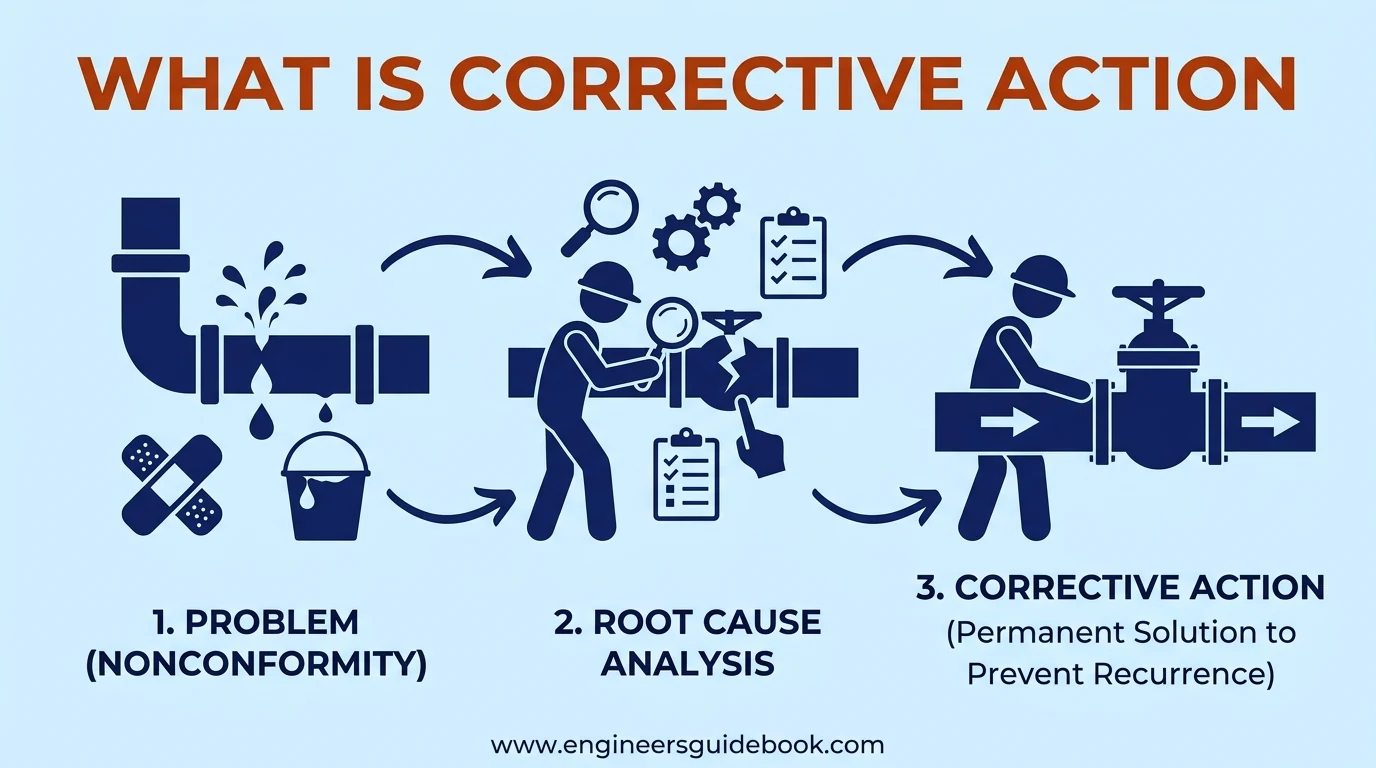
Corrective action is an intervention undertaken to eliminate the cause of a detected nonconformity or undesirable situation and prevent its recurrence.
Unlike temporary repairs, effective corrective action addresses underlying deficiencies in equipment, procedures, processes, or organizational controls.
Its principal purpose is to establish lasting operational stability.
3.2. How Corrective Action Works
The corrective action process converts verified investigation findings into practical improvement measures.
It typically involves solution development, feasibility assessment, responsibility assignment, implementation, and effectiveness verification.
For example, if repeated gearbox failure results from inadequate lubrication controls, corrective action may involve redesigning lubrication procedures and introducing monitored lubrication intervals.
3.3. Correction vs Corrective Action vs Preventive Action
Although related, these terms describe distinct activities.
Correction eliminates an existing nonconformity, such as replacing a defective component.
Corrective action eliminates the cause of an existing nonconformity to prevent recurrence.
Preventive action addresses potential nonconformities before they occur.
Modern ISO 9001 quality management also incorporates preventive thinking through risk-based planning.
3.4. Immediate Containment vs Permanent Corrective Action
Containment measures temporarily control consequences while investigations continue.
For instance, isolating a defective production batch prevents further distribution, but it does not eliminate the manufacturing defect.
Permanent corrective action addresses the verified cause through process modifications, equipment improvements, or revised operational controls.
3.5. Types of Corrective Actions in Industrial Operations
Corrective actions may involve engineering modifications, component redesign, maintenance optimization, employee training, procedure revisions, or enhanced inspection systems.
Engineering controls are often preferable when they eliminate hazards or failure mechanisms directly.
Administrative measures remain useful but may require continuous supervision to maintain effectiveness.
3.6. When Corrective Action Is Necessary
Corrective action becomes necessary when investigation findings demonstrate a recurrence risk requiring intervention.
Typical triggers include repeated equipment breakdowns, audit nonconformities, customer complaints, safety incidents, and persistent quality deviations.
The scale of intervention should remain proportional to the associated operational risk.
3.7. Benefits and Limitations of Corrective Action
Successful corrective action reduces recurring defects, improves reliability, strengthens compliance, and supports operational efficiency.
However, poorly designed actions may introduce additional risks, increase costs, or fail to prevent recurrence.
Therefore, effectiveness verification is indispensable before formally closing corrective action records.
4. Root Cause Analysis vs Corrective Action
4.1. Key Differences Between RCA and Corrective Action
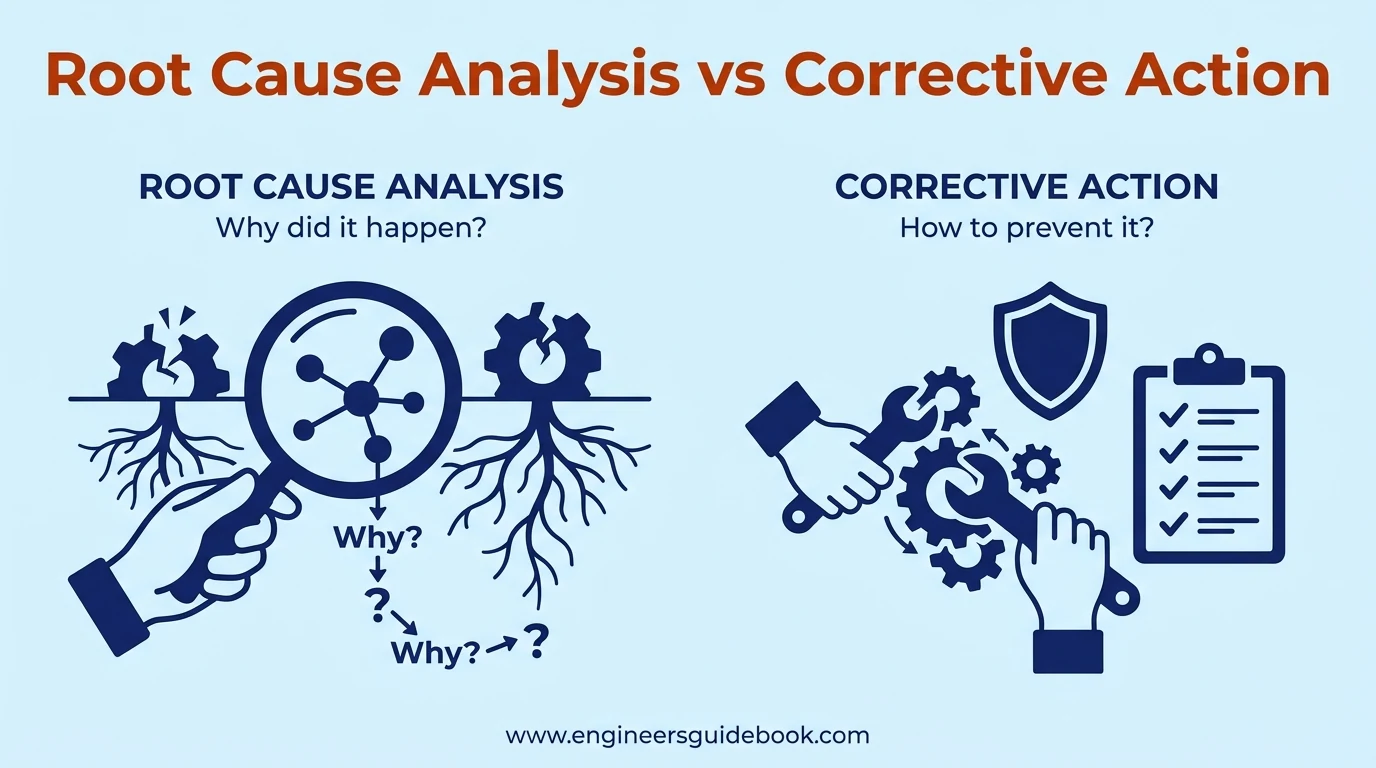
The fundamental distinction lies in purpose.
RCA determines why a problem occurred , while corrective action establishes what must change to prevent recurrence .
One emphasizes causal investigation; the other emphasizes implementing and validating solutions.
4.2. Differences in Objectives and Scope
RCA focuses on understanding failure mechanisms, causal dependencies, and systemic deficiencies.
Corrective action focuses on eliminating those deficiencies through controlled modifications.
Consequently, RCA produces investigative conclusions, whereas corrective action produces implemented improvements and measurable outcomes.
4.3. Differences in Methodology and Execution
RCA employs evidence collection, causal mapping, hypothesis testing, and technical verification.
Corrective action uses implementation planning, engineering evaluation, responsibility allocation, change control, and effectiveness monitoring.
Both require systematic documentation, but their execution activities differ substantially.
4.4. Differences in Tools and Techniques
RCA commonly utilizes 5 Whys, fishbone diagrams, fault trees, and statistical investigations.
Corrective action employs action registers, project implementation plans, risk assessments, standard operating procedures, and effectiveness verification checklists.
Combined application creates a comprehensive problem-resolution framework.
4.5. Differences in Responsibilities and Ownership
RCA investigations are commonly conducted by maintenance engineers, quality specialists, production personnel, and technical experts.
Corrective action implementation may involve engineering managers, department heads, procurement teams, and process owners.
Clear accountability prevents approved solutions from remaining unimplemented.
4.6. Differences in Documentation and Deliverables
RCA documentation includes problem statements, collected evidence, causal diagrams, verified findings, and investigation conclusions.
Corrective action records include approved solutions, assigned owners, completion deadlines, implementation evidence, and effectiveness assessments.
These records establish traceability and support internal or external audits.
4.7. Differences in Time, Cost, and Resources
RCA duration depends on investigation complexity, equipment accessibility, and available technical evidence.
Corrective action may require additional investment, equipment modifications, procurement, or scheduled shutdowns.
Long-term savings generally depend on whether corrective interventions successfully reduce recurring losses.
4.8. Root Cause Analysis vs Corrective Action Comparison Table
Comparison Factor Root Cause Analysis Corrective Action Primary purpose Identify underlying causes Eliminate verified causes Main question Why did it happen? How can recurrence be prevented? Approach Investigative Implementation-focused Common tools 5 Whys, Fishbone, FTA Action plans, CAPA tracking Primary output Verified causal findings Implemented improvements Success criterion Evidence-supported causes Demonstrated effectiveness Typical ownership Investigation team Responsible process owner
5. How Root Cause Analysis and Corrective Action Work Together
5.1. The Relationship Between RCA and Corrective Action
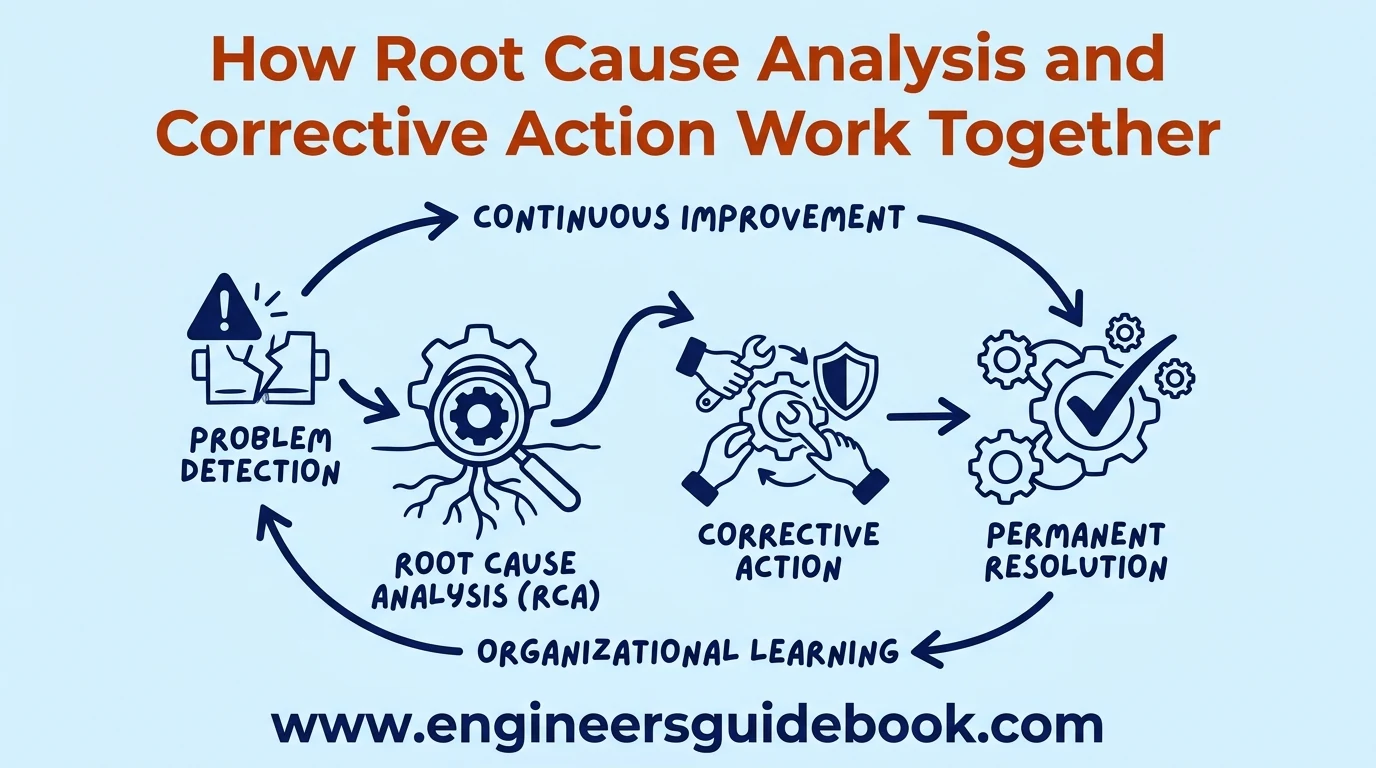
RCA and corrective action function as complementary stages of continuous improvement.
RCA provides the diagnostic foundation, while corrective action translates findings into operational changes.
Their integration reduces the likelihood of ineffective repairs and repeated investigations.
5.2. From Problem Detection to Permanent Resolution
Effective problem resolution progresses through detection, containment, investigation, corrective action implementation, and effectiveness verification.
Each stage supports the next.
Skipping causal verification increases the likelihood of unsuitable solutions, while inadequate implementation undermines otherwise accurate investigations.
5.3. Why Corrective Actions Should Address Verified Root Causes
Corrective actions based on assumptions may temporarily suppress symptoms without eliminating failure mechanisms.
For example, repeatedly replacing conveyor bearings will not resolve failures caused by persistent shaft misalignment.
Verified root causes enable targeted interventions with greater prospects of sustained effectiveness.
5.4. Connecting Root Causes With Effective Solutions
Every significant verified cause should be linked to an appropriate corrective measure.
A cause-and-action matrix helps establish traceability between investigation findings, proposed interventions, responsible personnel, and verification requirements.
This structured linkage improves accountability and prevents unresolved causal factors.
5.5. Integrating RCA Into the Corrective Action Process
Organizations can integrate RCA into corrective action request systems, computerized maintenance management systems, and quality management workflows.
Standardized investigation templates, approval requirements, and evidence-based closure criteria improve consistency.
Digital tracking additionally strengthens visibility over overdue actions and recurring deficiencies.
5.6. The Role of Continuous Improvement and Organizational Learning
Completed investigations generate valuable institutional knowledge.
Documenting failure mechanisms, successful interventions, and lessons learned enables organizations to improve maintenance strategies and operational standards.
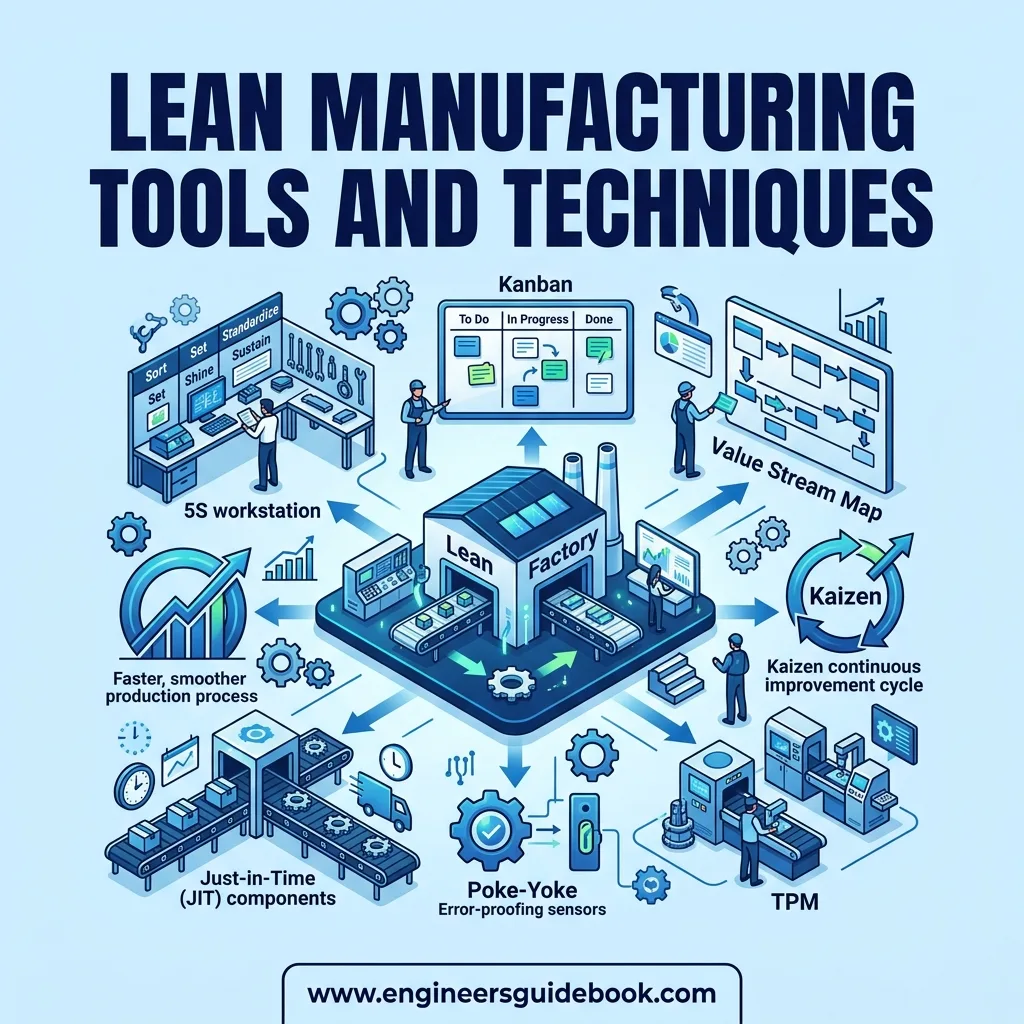
This knowledge supports continuous improvement methodologies such as PDCA, Lean Manufacturing, and Total Productive Maintenance.
6. Step-by-Step Root Cause Analysis Process
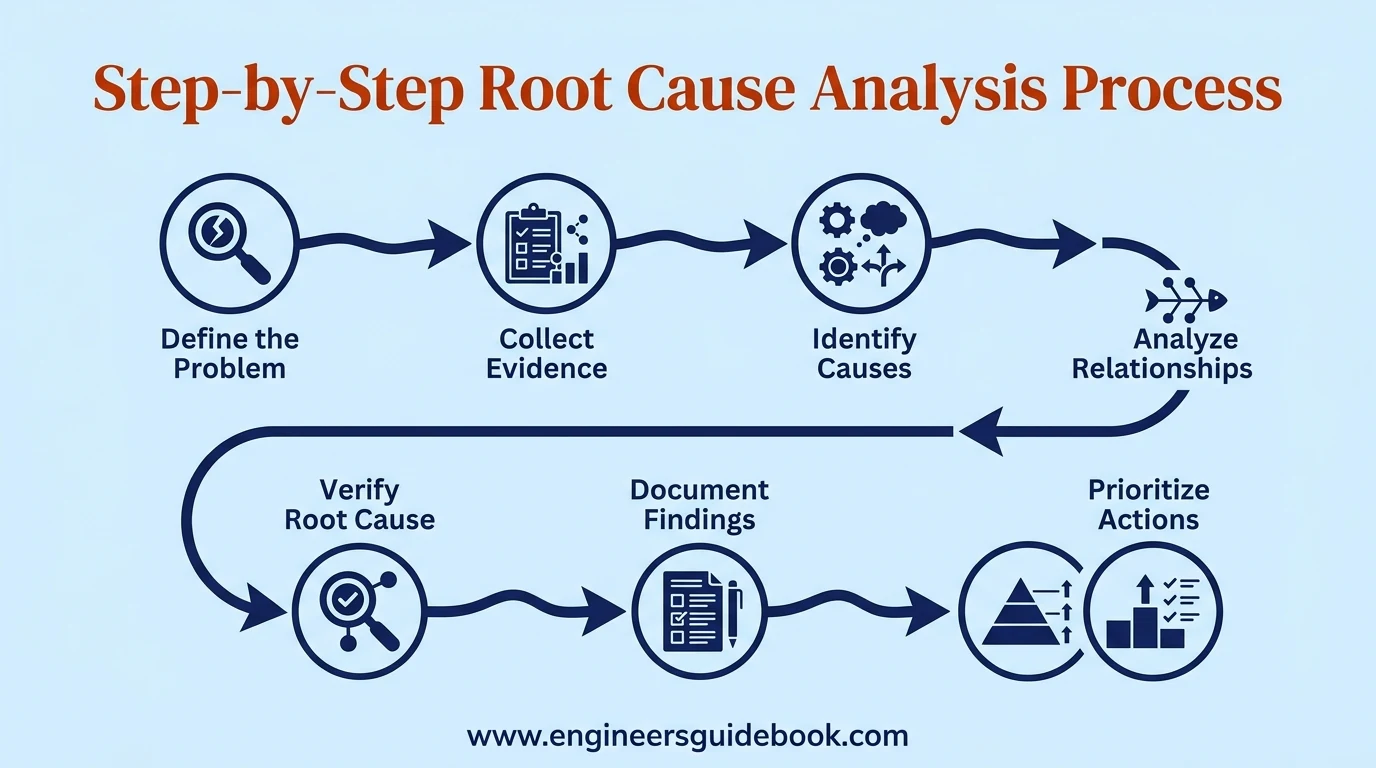
6.1. Step 1 – Define the Problem Clearly
Develop a precise problem statement identifying affected equipment, observed symptoms, occurrence frequency, and operational consequences.
Avoid embedding unverified explanations within the statement.
A measurable definition establishes the foundation for objective investigation.
6.2. Step 2 – Collect Evidence and Relevant Data
Gather maintenance records, equipment operating parameters, inspection reports, failure photographs, and operator observations.
Historical trends can reveal recurring anomalies.
Preserve evidence integrity and distinguish verified observations from assumptions or interpretations.
6.3. Step 3 – Identify Possible Causes and Contributing Factors
Generate potential causal explanations using technical expertise, brainstorming, and structured analysis tools.
Consider mechanical, electrical, operational, environmental, and organizational influences.
Avoid prematurely excluding plausible causes before supporting evidence becomes available.
6.4. Step 4 – Analyze Cause-and-Effect Relationships
Evaluate how identified conditions interact to produce the observed failure.
Fishbone diagrams, causal trees, and chronological event mapping can clarify dependencies.
The objective is to distinguish genuine causal mechanisms from coincidental observations.
6.5. Step 5 – Verify the Actual Root Cause
Validate suspected causes through inspections, measurements, technical calculations, or controlled testing.
Where practical, demonstrate that the proposed mechanism explains the available evidence.
Unverified hypotheses should not be presented as established root causes.
6.6. Step 6 – Document Findings and Supporting Evidence
Prepare a structured investigation report describing the incident, methodology, evidence, causal analysis, and conclusions.
Include supporting measurements and relevant technical records.
Comprehensive documentation facilitates audits, future investigations, and knowledge transfer.
6.7. Step 7 – Prioritize Root Causes for Corrective Action
Rank verified causes according to severity, recurrence probability, safety implications, and operational consequences.
Address high-risk deficiencies first.
Prioritization ensures that available resources target interventions with the greatest expected operational benefit.
7. Step-by-Step Corrective Action Process
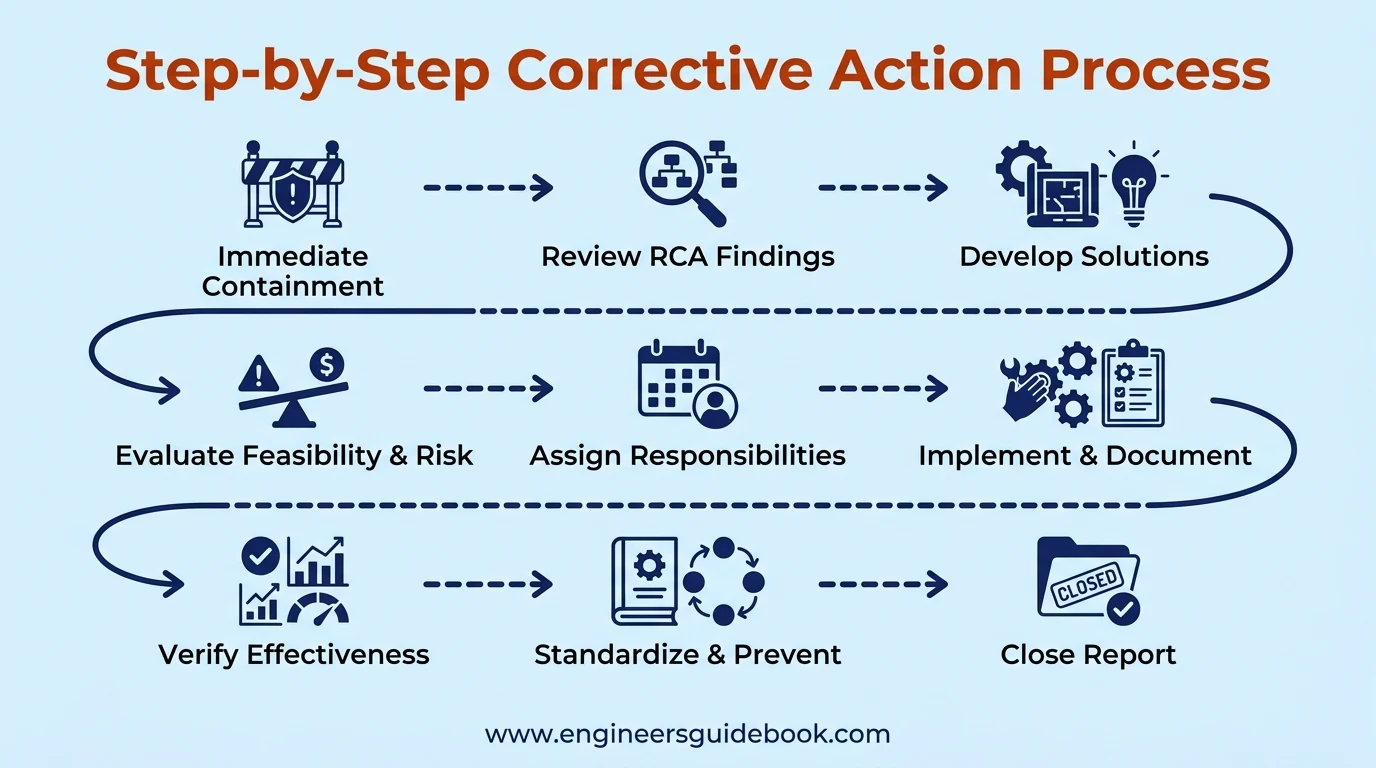
7.1. Step 1 – Establish Immediate Containment Measures
Implement temporary controls to limit further damage, production losses, or safety exposure.
Containment may involve equipment isolation, additional inspections, or segregation of defective products.
Document these controls until permanent solutions become effective.
7.2. Step 2 – Review and Validate RCA Findings
Confirm that proposed corrective measures address evidence-supported causes.
Review investigation findings with relevant technical and operational stakeholders.
Resolve significant uncertainties before approving permanent modifications.
7.3. Step 3 – Develop Permanent Corrective Action Solutions
Identify solutions capable of eliminating or controlling verified causal mechanisms.
Consider design improvements, preventive maintenance revisions, process automation, and procedural changes.
Prefer sustainable engineering solutions over repetitive temporary interventions.
7.4. Step 4 – Evaluate Feasibility, Risk, and Cost
Assess proposed interventions against technical feasibility, operational disruption, implementation expenditure, and residual risk.
Consider whether modifications introduce additional hazards or reliability concerns.
Select solutions that balance effectiveness, safety, and lifecycle cost.
7.5. Step 5 – Assign Responsibilities and Implementation Deadlines
Designate accountable action owners and establish realistic completion dates.
Clearly define required resources, approval authorities, and measurable deliverables.
Ownership clarity reduces execution delays and strengthens organizational accountability.
7.6. Step 6 – Implement and Document Corrective Actions
Execute approved modifications through controlled procedures and applicable change-management requirements.
Record installation details, revised documents, training completion, and commissioning results.
Maintain evidence demonstrating that each authorized action was completed.
7.7. Step 7 – Verify Corrective Action Effectiveness
Monitor relevant performance indicators after implementation.
Evaluate recurrence frequency, defect rates, equipment availability, or other measurable outcomes.
Where sufficient operating history is unavailable, keep effectiveness verification open until meaningful evidence can be collected.
7.8. Step 8 – Standardize Improvements and Prevent Recurrence
Incorporate successful interventions into maintenance plans, operating procedures, training materials, and inspection standards.
Evaluate whether comparable equipment or processes face similar vulnerabilities.
Standardization transforms isolated corrective measures into broader organizational improvements.
7.9. Step 9 – Close the Corrective Action Report
Close the report only after implementation evidence and effectiveness verification satisfy established acceptance criteria.
Document final approvals, residual risks, and relevant lessons learned.
Formal closure confirms that corrective actions have been implemented and their effectiveness adequately demonstrated.
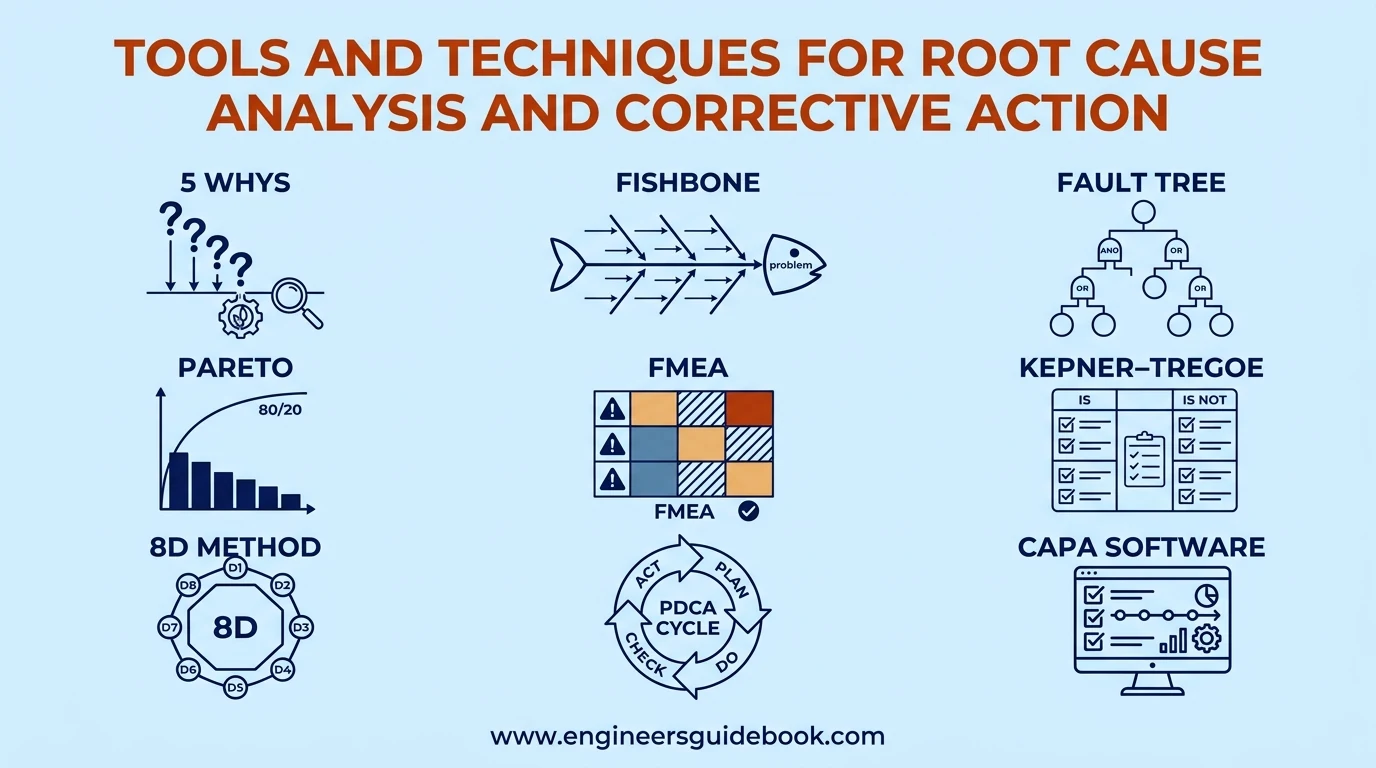
8. Tools and Techniques for Root Cause Analysis and Corrective Action
8.1. 5 Whys Analysis for Identifying Root Causes
The 5 Whys technique identifies underlying problems through successive questioning. Investigators repeatedly ask why an event occurred until they uncover a defensible causal explanation.
For example, a motor failure may originate from overheating, excessive loading, inadequate lubrication, or deficient maintenance procedures. Each answer must be supported by evidence rather than speculation.
8.2. Fishbone Diagram for Cause-and-Effect Analysis
The Fishbone Diagram, also called the Ishikawa Diagram, organizes potential causes into structured categories.
Manufacturing investigations frequently use the 6M framework covering Man, Machine, Method, Material, Measurement, and Mother Nature or Environment.
This visual approach promotes cross-functional brainstorming and helps investigators recognize interacting causes that conventional troubleshooting might overlook.
8.3. Fault Tree Analysis for Complex Failures
Fault Tree Analysis (FTA) examines how combinations of component failures, human errors, and operational conditions contribute to an undesirable event.
Using logical AND and OR gates, investigators develop graphical representations of failure pathways.
FTA is particularly useful for complex machinery, industrial safety systems, and reliability-critical equipment requiring systematic risk evaluation.
8.4. Pareto Analysis for Prioritizing Problems
Pareto Analysis identifies dominant contributors to operational problems using frequency, cost, or severity data.
The commonly referenced 80/20 principle suggests that a relatively small number of causes may account for a substantial proportion of undesirable outcomes.
Pareto charts help maintenance and quality teams prioritize investigations where improvement efforts offer maximum operational benefit.
8.5. Failure Mode and Effects Analysis for Risk Reduction
Failure Mode and Effects Analysis (FMEA) systematically evaluates potential failure modes, their consequences, and existing controls.
Teams assess severity, occurrence likelihood, and detection capability to prioritize preventive improvements.
Unlike conventional RCA, which generally investigates existing failures, FMEA primarily anticipates potential failures before they occur.
8.6. Kepner-Tregoe Analysis for Structured Troubleshooting
Kepner-Tregoe Analysis applies disciplined problem definition, distinction analysis, and hypothesis testing to complex operational abnormalities.
Investigators examine what the problem is, what it is not, where it occurs, and when it appears.
This structured reasoning helps separate competing explanations and reduces confirmation bias during technical investigations.
8.7. 8D Problem-Solving Methodology for Corrective Action
The Eight Disciplines methodology integrates team formation, problem definition, containment, root cause verification, corrective action, and recurrence prevention.
Widely applied in automotive manufacturing and quality management, 8D problem-solving provides a documented framework for resolving persistent nonconformities.
Its emphasis on effectiveness verification makes it especially suitable for customer complaints and recurring defects.
8.8. PDCA Cycle for Continuous Improvement
The Plan-Do-Check-Act cycle supports iterative problem-solving and process improvement.
Organizations plan improvements, implement controlled changes, evaluate results, and standardize successful interventions.
Integrating RCA within the planning stage strengthens corrective action decisions and supports sustainable operational improvements.
8.9. CAPA Software and Digital Tracking Systems
Corrective and Preventive Action (CAPA) software centralizes investigation reports, action assignments, deadlines, supporting evidence, and approval workflows.
Digital systems improve traceability and facilitate overdue-action monitoring.
Integration with computerized maintenance management systems or enterprise resource planning platforms further connects corrective actions with equipment histories.
8.10. Choosing the Right RCA and Corrective Action Tools
Tool selection depends on failure complexity, available evidence, recurrence frequency, and operational consequences.
Simple problems may require 5 Whys, whereas complicated failures benefit from fishbone diagrams, FTA, or structured statistical investigation.
The most effective methodology balances analytical rigor with practical implementation requirements.
9. Root Cause Analysis vs Corrective Action Examples
9.1. Repeated Bearing Failure in Industrial Equipment
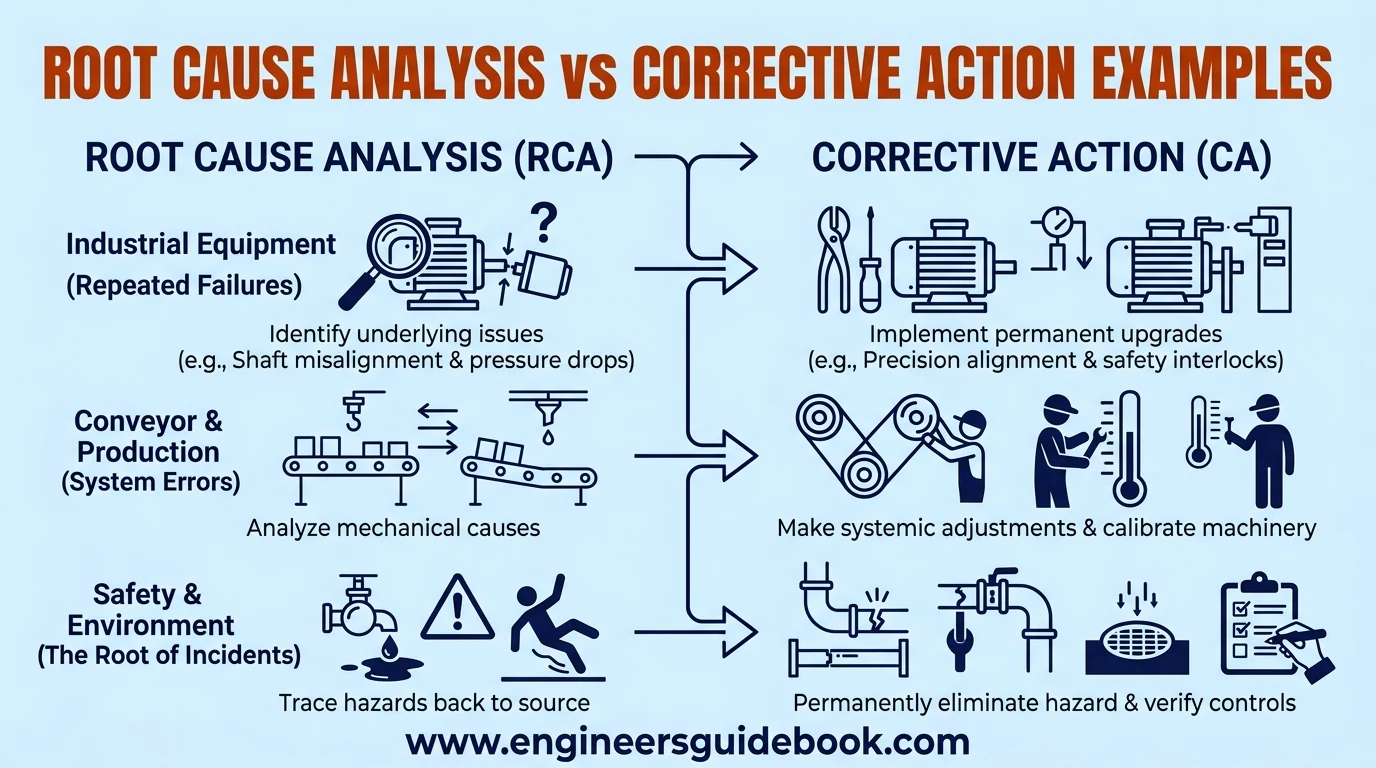
Consider a conveyor motor experiencing repeated bearing failures.
RCA identifies excessive shaft misalignment and inadequate alignment verification during maintenance.
Corrective action introduces precision alignment procedures, calibrated measuring instruments, and mandatory post-maintenance inspections.
Performance monitoring subsequently verifies whether bearing reliability improves.
9.2. Centrifugal Pump Seal Leakage and Premature Failure
A centrifugal pump repeatedly develops mechanical seal leakage.
Investigation reveals intermittent dry running caused by insufficient suction pressure and inadequate low-level protection.
Corrective action involves improving suction conditions and installing appropriate protective interlocks.
Seal replacement alone would constitute correction rather than permanent corrective action.
9.3. Conveyor Belt Misalignment and Unplanned Downtime
Frequent conveyor belt tracking problems interrupt production.
RCA identifies improperly aligned pulleys and uneven material loading.
Corrective measures include pulley realignment, improved loading arrangements, and standardized inspection procedures.
These interventions address mechanical causes instead of repeatedly adjusting the belt temporarily.
9.4. Manufacturing Product Defects and Quality Rejections
A packaging line produces containers with inconsistent sealing quality.
Investigation identifies fluctuating sealing temperatures and an improperly calibrated temperature sensor.
Corrective action includes sensor calibration, process validation, and revised inspection frequencies.
The objective is consistent product quality rather than simply rejecting defective units.
9.5. Recurring Filling Machine Nozzle Dripping
A liquid filling machine experiences persistent nozzle dripping, contaminating bottles and labels.
RCA examines valve closure timing, sealing surfaces, product viscosity, and nozzle construction.
Once the failure mechanism is verified, corrective action may include improved shutoff components, actuator adjustments, or nozzle redesign.
Subsequent production trials establish effectiveness.
9.6. Workplace Safety Incident and Hazard Elimination
An operator slips near frequently leaking process equipment.
RCA identifies recurring leakage, insufficient containment, and ineffective inspection arrangements.
Corrective action involves repairing the leakage source, improving drainage, and strengthening inspection controls.
Immediate cleaning provides containment but does not independently eliminate recurrence.
9.7. Customer Complaints and Product Nonconformities
Recurring customer complaints indicate inconsistent product dimensions.
Investigation identifies worn tooling and an inadequate tool replacement schedule.
Corrective action establishes wear limits, inspection intervals, and controlled tooling replacement.
Verification uses dimensional inspection results and subsequent complaint trends.
9.8. Comparing RCA Findings With Implemented Corrective Actions
Operational Problem RCA Finding Corrective Action Bearing failure Shaft misalignment Precision alignment controls Pump seal leakage Insufficient suction protection Protective interlock Conveyor mistracking Pulley misalignment Pulley realignment Sealing defects Temperature measurement error Sensor calibration Nozzle dripping Defective shutoff mechanism Verified nozzle modification
9.9. Lessons Learned From Real-World Problem-Solving Scenarios
These illustrative scenarios demonstrate that successful problem-solving requires both accurate diagnosis and effective implementation.
Replacing failed components restores functionality, but eliminating verified failure mechanisms provides lasting improvement.
Organizations should evaluate subsequent performance before declaring corrective actions successful.
10. Best Practices and Common Mistakes
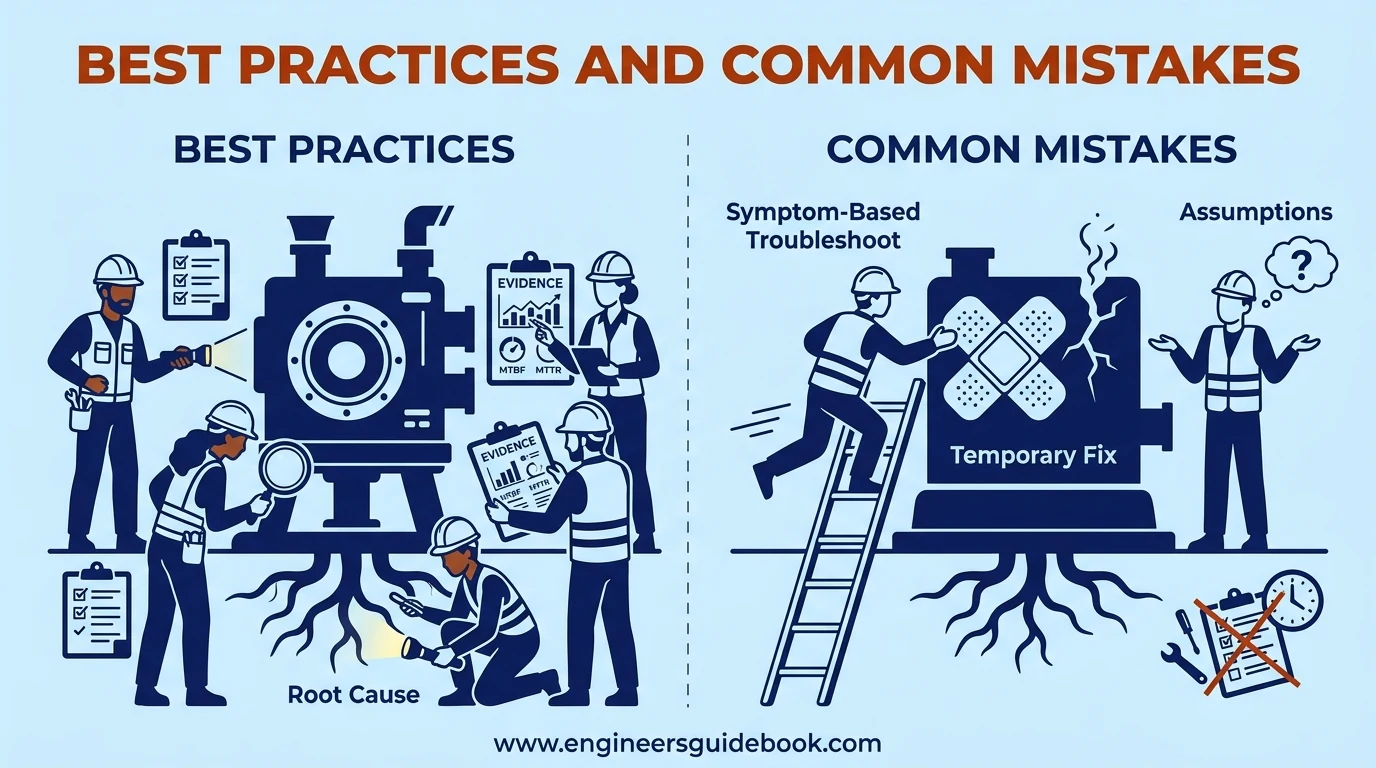
10.1. Avoiding Symptom-Based Troubleshooting
Replacing damaged components without investigating failure mechanisms encourages repetitive maintenance.
Effective troubleshooting distinguishes observable symptoms from underlying causal conditions.
10.2. Preventing Premature Conclusions During RCA
Investigators should avoid assigning causes before collecting adequate evidence.
Premature conclusions can misdirect corrective actions and leave significant failure mechanisms unresolved.
10.3. Using Evidence Instead of Assumptions
Maintenance histories, process measurements, photographs, and inspection findings strengthen causal verification.
Evidence-based investigations produce more defensible conclusions than undocumented assumptions.
10.4. Avoiding Temporary Fixes Disguised as Corrective Actions
Temporary repairs may restore production but rarely establish recurrence prevention independently.
Organizations must distinguish containment, correction, and permanent corrective action within investigation records.
10.5. Ensuring Corrective Actions Address the Actual Root Cause
Every corrective measure should correspond to a verified causal mechanism.
A cause-and-action matrix helps establish traceability and identify unresolved deficiencies.
10.6. Building Effective Cross-Functional Investigation Teams
Complex industrial failures require contributions from maintenance, production, engineering, quality, and safety personnel.
Multidisciplinary collaboration improves technical understanding and reduces investigative blind spots.
10.7. Measuring Corrective Action Effectiveness With KPIs
Relevant key performance indicators include failure recurrence, defect frequency, maintenance expenditure, and equipment availability.
Measurements should reflect the original problem and provide meaningful evidence of improvement.
10.8. Tracking Repeat Failures, MTBF, MTTR, and Downtime
Mean time between failures (MTBF) evaluates repairable equipment reliability, while mean time to repair (MTTR) measures restoration efficiency.
Combined with downtime trends, these indicators support corrective action evaluation.
10.9. Integrating RCA and Corrective Action With ISO 9001 and CAPA
ISO 9001 emphasizes evaluating nonconformities, determining their causes when necessary, implementing appropriate actions, and reviewing effectiveness.
CAPA systems provide structured documentation and accountability for these activities.
10.10. Improving RCA and Corrective Action Through Audits and Follow-Up
Periodic audits verify whether implemented changes remain effective.
Follow-up investigations identify recurring deficiencies, incomplete actions, and opportunities for further operational improvement.
11. Root Cause Analysis and Corrective Action Templates and Documentation
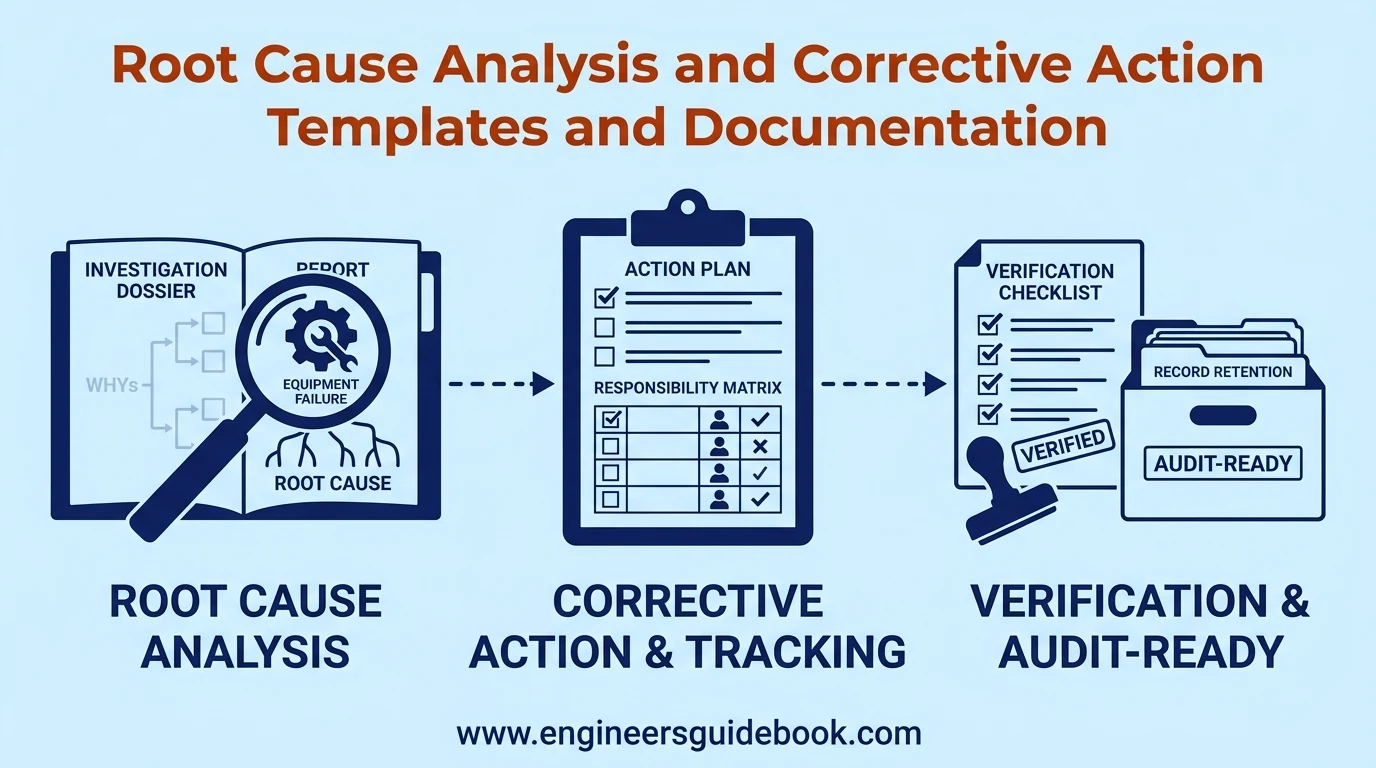
11.1. Essential Elements of an RCA Report
An effective RCA report includes incident identification, problem description, investigation evidence, causal analysis, verified findings, and recommendations.
Supporting records should establish clear investigative traceability.
11.2. Corrective Action Request and Action Plan Templates
Corrective action templates identify required improvements, responsible personnel, deadlines, and approval requirements.
Standardized documentation facilitates implementation monitoring and accountability.
11.3. Root Cause Verification and Evidence Checklists
Verification checklists confirm whether identified causes are supported by observations, measurements, or technical testing.
They help prevent unsubstantiated conclusions from progressing into implementation.
11.4. Corrective Action Tracking and Responsibility Matrix
A responsibility matrix connects each action with an accountable owner, implementation date, and completion status.
Tracking systems improve coordination and highlight overdue corrective measures.
11.5. Effectiveness Verification and Closure Criteria
Closure criteria should specify measurable outcomes, acceptable performance limits, and appropriate monitoring periods.
Actions remain open when available evidence cannot demonstrate effectiveness.
11.6. Audit-Ready Documentation and Record Retention
Organizations should retain investigation evidence, approvals, implementation records, and effectiveness assessments according to applicable requirements.
Document control improves retrieval, traceability, and audit readiness.
11.7. Sample RCA and Corrective Action Report for Equipment Failure
A simplified equipment failure report might document:
Problem: Repeated conveyor bearing failure.
Verified cause: Persistent shaft misalignment.
Corrective action: Precision alignment and revised maintenance procedures.
Responsible department: Mechanical Maintenance.
Effectiveness verification: Alignment measurements and subsequent failure monitoring.
12. Frequently Asked Questions About Root Cause Analysis vs Corrective Action
12.1. What Is the Main Difference Between Root Cause Analysis and Corrective Action?
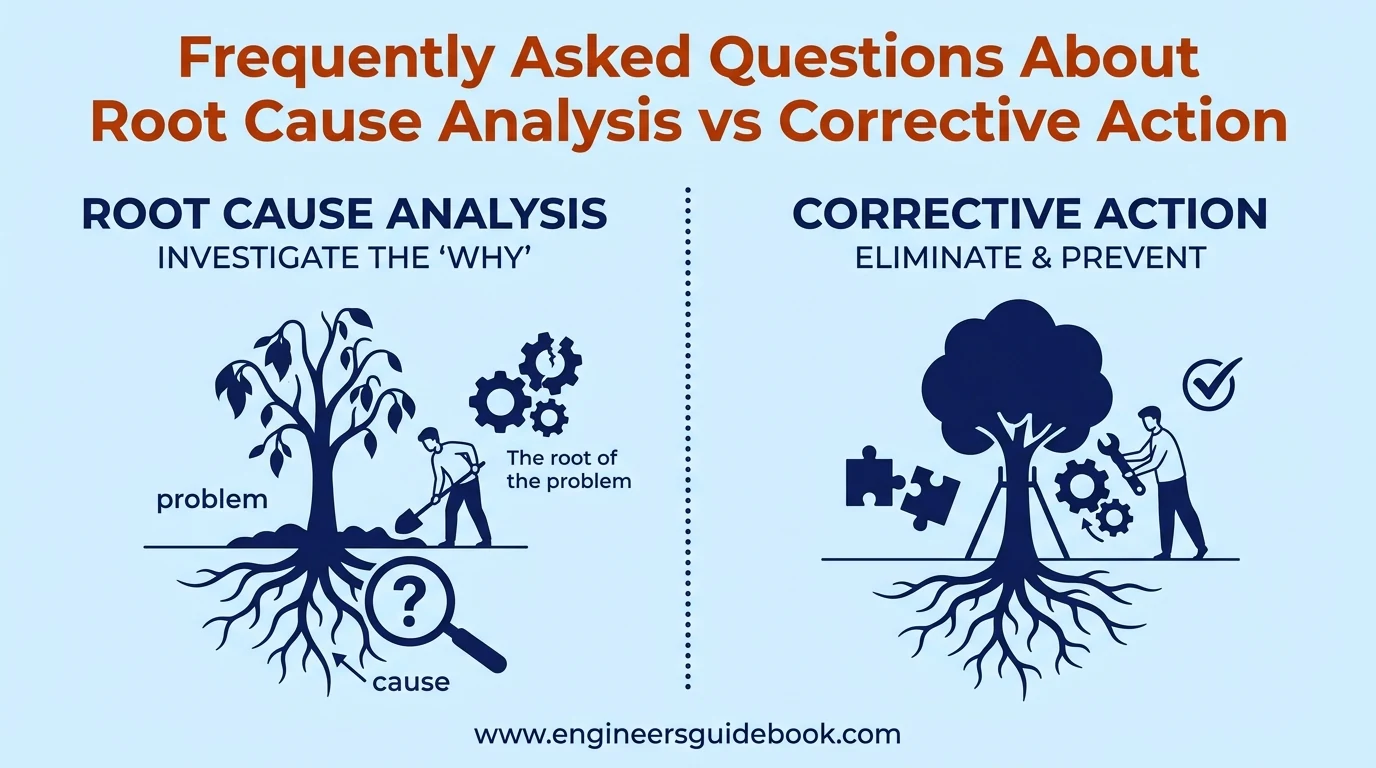
Root cause analysis identifies why a problem occurred, while corrective action eliminates verified causes to prevent recurrence.
12.2. Is Root Cause Analysis a Corrective Action?
No. RCA is an investigative process that supports corrective action selection. Investigation findings alone do not eliminate existing failure mechanisms.
12.3. What Comes First in Problem-Solving?
Immediate containment may occur first to control risk. RCA normally follows before permanent corrective actions are selected and implemented.
12.4. Can Corrective Action Be Taken Without Root Cause Analysis?
A formal, extensive RCA is not always necessary. However, effective corrective action requires sufficient understanding of the actual cause.
12.5. What Is the Difference Between Root Cause Analysis and CAPA?
RCA identifies underlying causes. CAPA is a broader management process covering corrective and preventive activities, implementation tracking, and effectiveness verification.
12.6. What Is the Difference Between Correction and Corrective Action?
Correction addresses an existing nonconformity. Corrective action eliminates its cause to prevent the same problem from recurring.
12.7. What Are the Five Steps of Root Cause Analysis?
A simplified five-step RCA process involves defining the problem, collecting evidence, identifying potential causes, verifying root causes, and documenting findings.
12.8. What Is an Example of Root Cause Analysis and Corrective Action?
For recurring bearing failures, RCA may identify shaft misalignment. Corrective action introduces precision alignment standards and verification procedures.
12.9. How Do You Determine Whether a Corrective Action Is Effective?
Compare relevant performance indicators before and after implementation. Verify improvement over a suitable operating period and check for recurrence.
12.10. Who Is Responsible for Root Cause Analysis and Corrective Action?
Investigation teams typically perform RCA, while designated process owners implement corrective actions. Management ensures adequate resources and accountability.
12.11. What Tools Are Used for RCA and Corrective Action?
Common tools include 5 Whys, Fishbone Diagrams, Fault Tree Analysis, Pareto Analysis, FMEA, 8D methodology, and CAPA tracking systems.
12.12. How Does ISO 9001 Address Root Cause Analysis and Corrective Action?
ISO 9001 requires organizations to respond appropriately to nonconformities, evaluate causes and recurrence risks, implement necessary actions, and review their effectiveness.
13. Conclusion
13.1. Key Takeaways From Root Cause Analysis vs Corrective Action
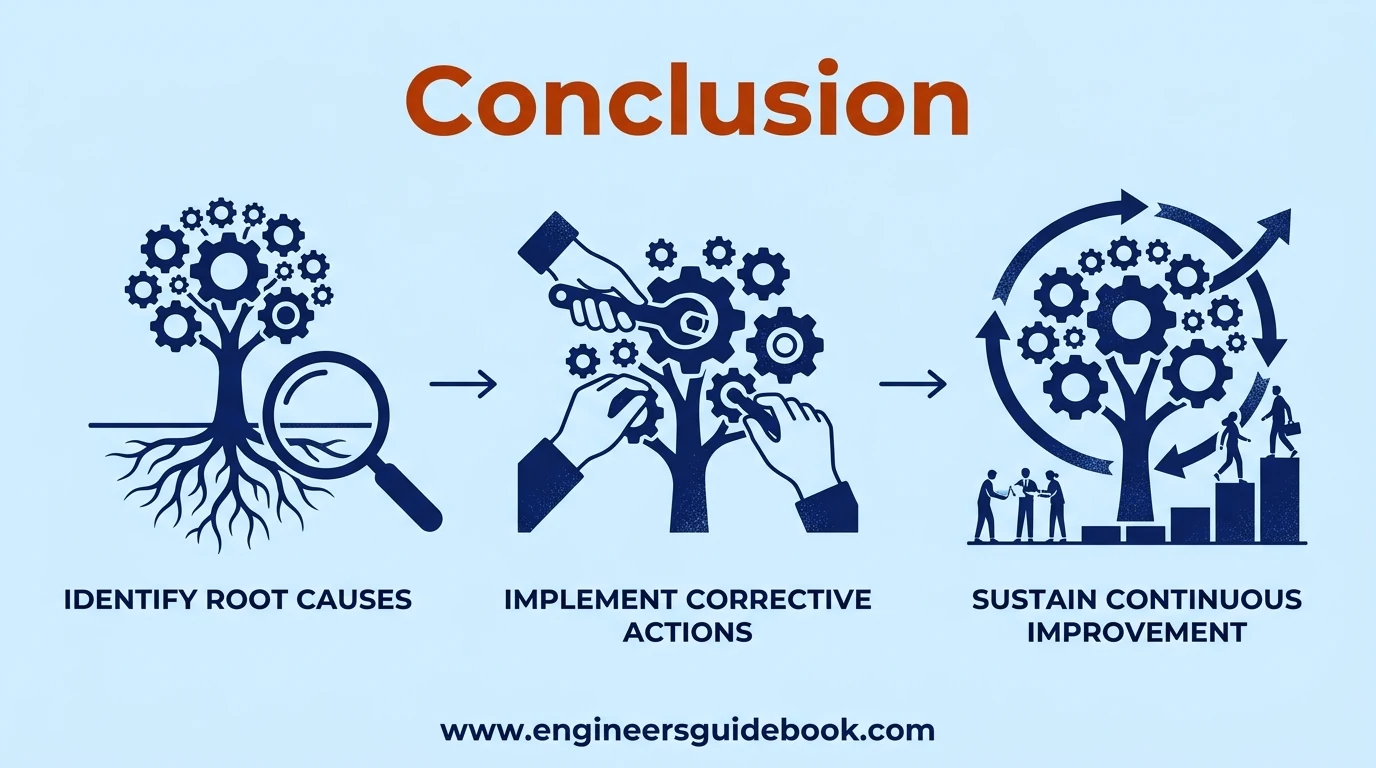
Understanding root cause analysis vs corrective action is essential for effective industrial problem-solving.
RCA establishes why failures occur, while corrective action eliminates verified causes and supports sustained operational improvement.
13.2. Why Identifying the Root Cause Is Only Half the Solution
An accurate investigation has limited value unless its findings result in effective interventions.
Implementation, documentation, and performance verification transform technical knowledge into measurable operational benefits.
13.3. Building a Sustainable Problem-Solving and Continuous Improvement Culture
Organizations achieve stronger reliability and quality performance when systematic investigations become routine management practices.
Combining evidence-based RCA, accountable corrective action, and continuous effectiveness monitoring establishes a disciplined foundation for sustainable manufacturing excellence.