Mean Time Between Failures (MTBF) is a maintenance and reliability metric that measures the average operating time between failures of repairable equipment. MTBF is calculated by dividing total equipment operating time by the number of failures. A higher MTBF generally indicates better equipment reliability, fewer breakdowns, and improved operational continuity under comparable operating conditions.
1. Introduction to MTBF
1.1 What Is Mean Time Between Failures?
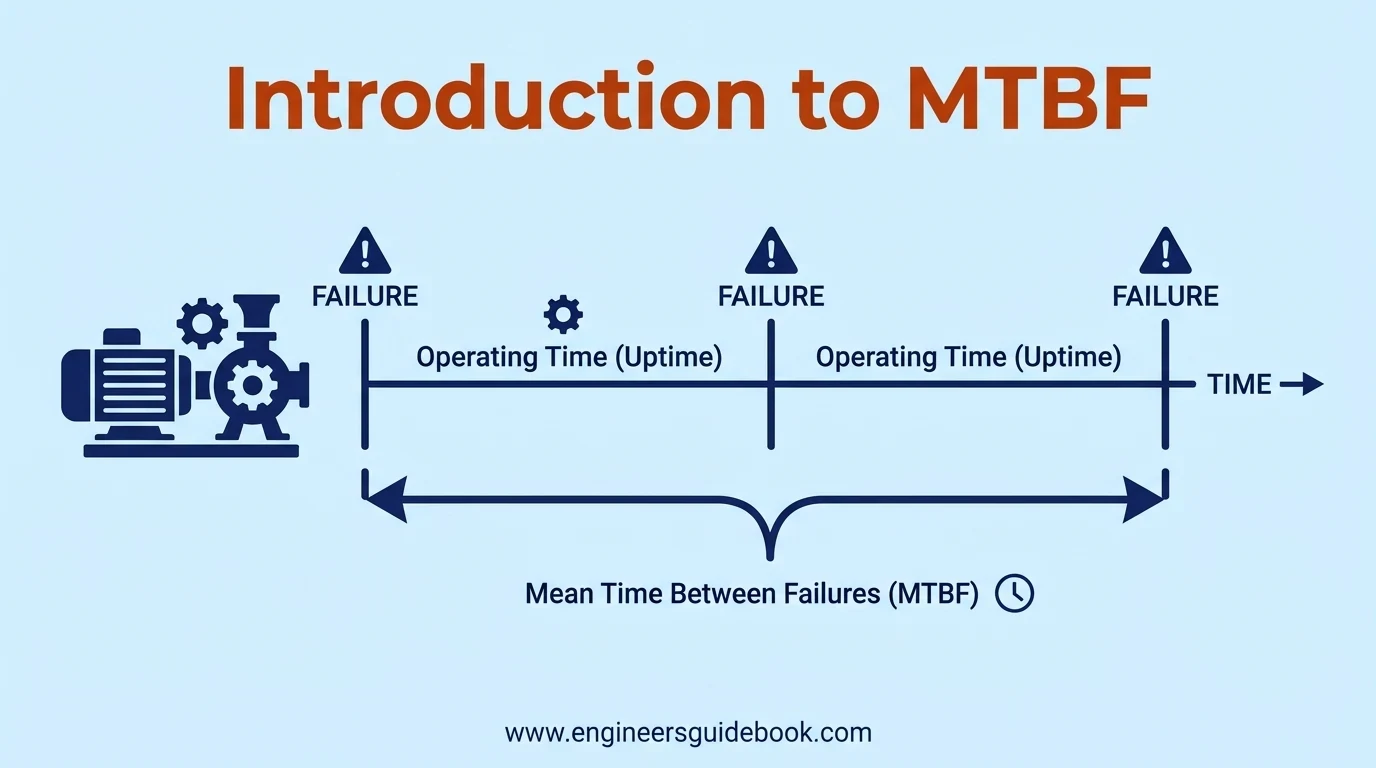
Mean Time Between Failures (MTBF) represents the average operating duration of repairable equipment between successive failures. It is typically expressed in hours and provides a quantitative indication of equipment reliability.
For example, an industrial machine with an MTBF of 500 hours experiences approximately one failure per 500 operating hours on average.
1.2 Purpose of MTBF in Maintenance Management
MTBF helps maintenance professionals evaluate equipment performance, identify unreliable assets, and establish maintenance priorities. It transforms historical breakdown records into actionable reliability information.
Maintenance departments can use MTBF to assess the effectiveness of maintenance interventions and allocate technical resources more efficiently.
1.3 Importance of MTBF in Industrial Reliability
Frequent equipment failures disrupt production schedules, increase maintenance expenditure, and undermine operational efficiency. MTBF provides a measurable indicator for identifying these reliability deficiencies.
Improving MTBF can reduce unplanned downtime, improve asset availability, and enhance production stability.
1.4 Applications of MTBF Across Industries
MTBF is widely used across manufacturing, power generation, telecommunications, automotive engineering, oil and gas, and chemical processing industries.
Typical applications include evaluating the reliability of centrifugal pumps, electric motors, compressors, gearboxes, electronic assemblies, and automated production machinery.
2. Understanding the Fundamentals of MTBF
2.1 Operating Time and Equipment Failures
Operating time refers to the accumulated duration during which equipment performs its intended function. A failure occurs when equipment loses its ability to meet specified functional requirements.
Accurate differentiation between operating time, standby time, planned downtime, and breakdown downtime is essential for meaningful MTBF calculations.
2.2 Repairable and Non-Repairable Equipment
MTBF primarily applies to repairable equipment that can return to service following maintenance intervention.
Non-repairable components, such as disposable fuses, are generally evaluated using Mean Time to Failure (MTTF). Understanding this distinction prevents the inappropriate application of reliability metrics.
2.3 Relationship Between MTBF and Failure Rate
MTBF and failure rate have an inverse relationship under a constant failure rate model.
Equipment with a higher MTBF generally exhibits a lower failure rate. Conversely, declining MTBF indicates that failures are occurring more frequently relative to accumulated operating time.
2.4 MTBF and Equipment Reliability
Reliability describes the probability that equipment performs its required function without failure over a specified period under defined operating conditions.
MTBF characterizes average failure intervals, whereas reliability expresses failure-free operating probability. Although interconnected, these measurements are not interchangeable.
2.5 Key Assumptions Behind MTBF
Meaningful MTBF analysis requires consistent failure definitions, accurate operating records, and comparable operating conditions.
A constant failure rate is not required to calculate historical MTBF, but it is necessary for certain reliability predictions based on the exponential distribution.

3. MTBF Formula and Its Components
3.1 Standard MTBF Formula
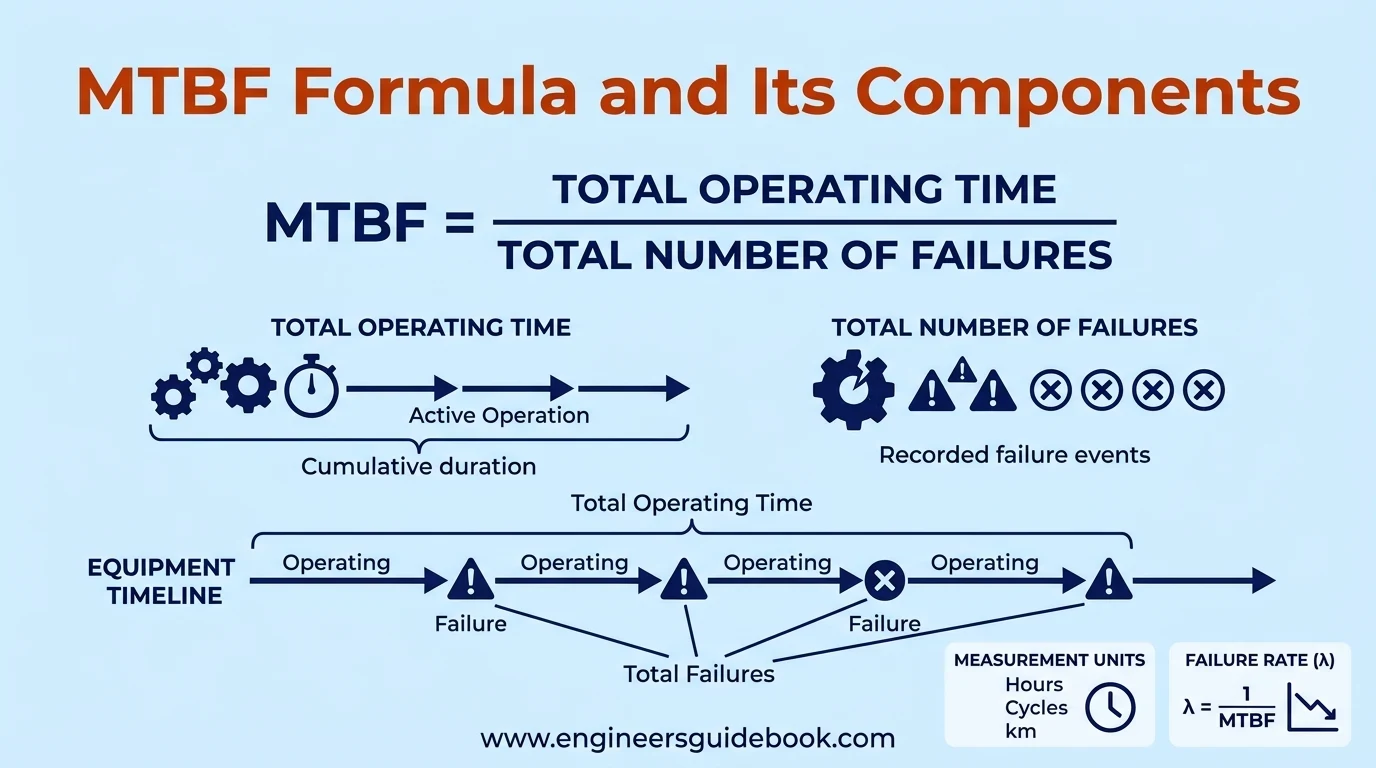
The standard MTBF formula is:
M T B F = Total Operating Time Total Number of Failures MTBF=\frac{\text{Total Operating Time}}{\text{Total Number of Failures}} M T B F = Total Number of Failures Total Operating Time
This equation determines the average accumulated operating time associated with each recorded failure during the measurement period.
3.2 Total Equipment Operating Time
Total operating time represents the actual cumulative duration during which equipment operates.
For example, if a machine is scheduled for 1,000 hours but remains unavailable for 100 hours, its operating time is 900 hours, assuming no other non-operating periods.
3.3 Total Number of Failures
The total number of failures includes all qualifying functional failure events recorded during the measurement period.
Scheduled maintenance, routine inspections, and normal production stoppages should not automatically be classified as equipment failures.
3.4 MTBF Measurement Units
MTBF is commonly expressed in operating hours. However, alternative exposure measurements may include operating cycles, kilometres, or machine strokes.
The selected measurement basis should reflect equipment utilization characteristics and remain consistent throughout reliability comparisons.
3.5 Failure Rate Formula Using MTBF
Under a constant failure rate model, failure rate is calculated using:
λ = 1 ÷ MTBF
Where:
λ = Failure rate
MTBF = Mean Time Between Failures
For an MTBF of 500 hours, the estimated failure rate is 0.002 failures per operating hour.
4. How to Calculate MTBF Step by Step
4.1 Defining the Measurement Period
Establish a consistent observation period, such as one month, one quarter, or one year. The selected duration should provide sufficient operating exposure and failure data to support meaningful reliability assessment.
4.2 Collecting Equipment Operating Data
Gather actual equipment running hours from operating logs, hour meters, PLC records, production reports, or computerized maintenance management systems.
Reliable data acquisition minimizes discrepancies and improves calculation accuracy.
4.3 Identifying and Recording Failures
Document every qualifying functional failure within the observation period. Failure records should include equipment identification, failure date, failure mode, and restoration details.
Avoid counting multiple repair activities associated with a single failure as separate failure events.
4.4 Excluding Equipment Downtime
Subtract breakdown downtime, planned maintenance periods, and other non-operating intervals from scheduled time where applicable.
Including downtime in operating exposure can artificially inflate MTBF and misrepresent actual equipment reliability.
4.5 Applying the MTBF Formula
Consider equipment operating for 1,800 hours and experiencing six failures.
MTBF = 1800 ÷ 6 = 300 hours
The calculated MTBF is 300 operating hours.
4.6 Interpreting the Calculation Results
An MTBF of 300 hours indicates an average failure interval of 300 operating hours.
It does not guarantee that the equipment will operate continuously for exactly 300 hours before its next failure.

5. MTBF Calculation Examples
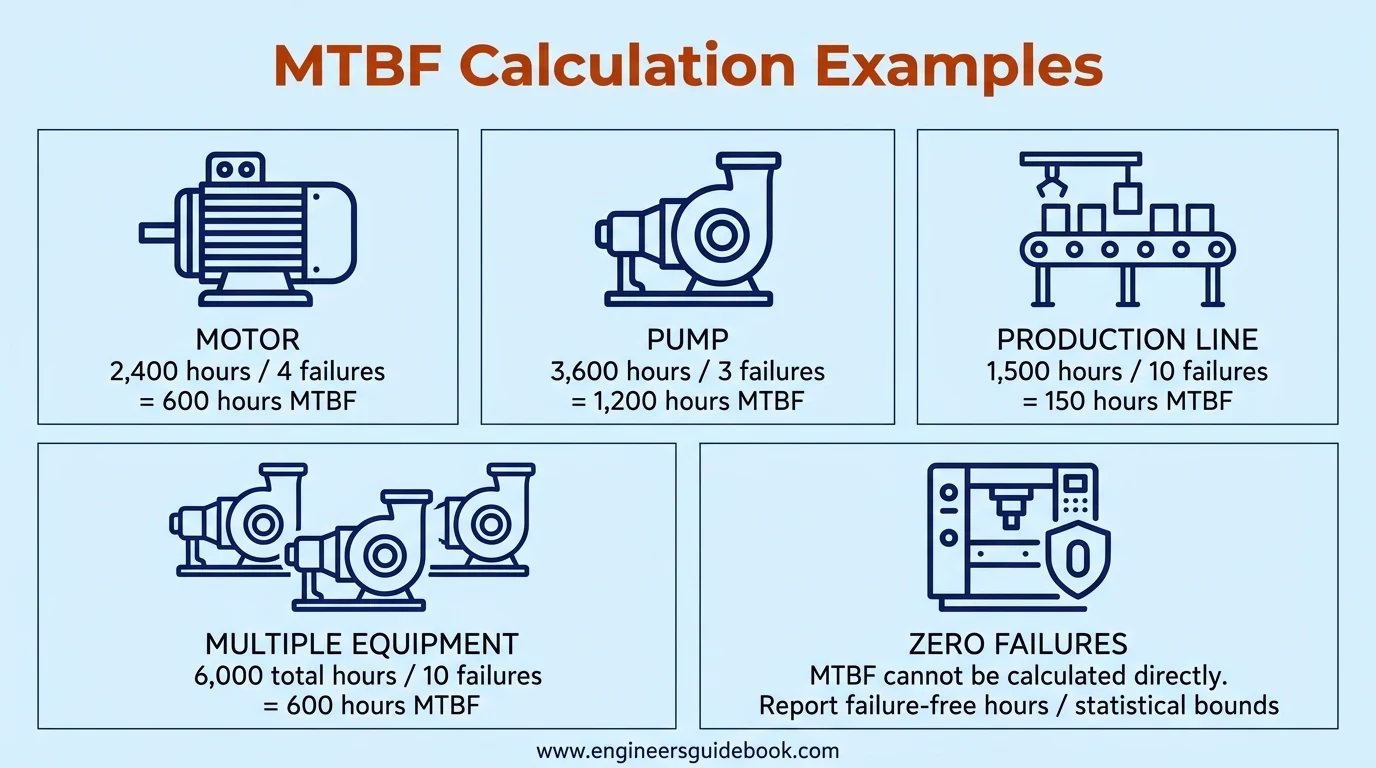
5.1 Electric Motor MTBF Calculation
An industrial electric motor operates for 2,400 hours and experiences four failures.
MTBF = 2400 ÷ 4 = 600 hours
The motor experiences one failure per 600 operating hours on average.
5.2 Centrifugal Pump MTBF Calculation
A centrifugal pump accumulates 3,600 operating hours with three recorded failures.
MTBF = 3600 ÷ 3 = 1200 hours
The pump achieves an MTBF of 1,200 hours.
5.3 Production Line MTBF Calculation
An automated production line operates for 1,500 hours and experiences ten functional failures.
MTBF = 1500 ÷ 10 = 150 hours
This result provides a baseline for evaluating subsequent reliability improvements.
5.4 Multiple Equipment MTBF Calculation
Consider three comparable pumps operating under similar conditions.
Equipment Operating Hours Failures Pump A 2,000 4 Pump B 1,800 3 Pump C 2,200 3 Total 6,000 10
MTBF = 6000 ÷ 10 = 600 hours
The pooled equipment MTBF is 600 hours. This represents fleet-level reliability rather than the MTBF of an interconnected system.
5.5 MTBF Calculation With Zero Failures
When equipment experiences zero failures, the standard MTBF formula involves division by zero.
A finite observed MTBF cannot be calculated directly. Instead, report the accumulated failure-free operating hours and, where appropriate, estimate a statistical lower confidence bound for MTBF.
6. MTBF and Other Maintenance KPIs
6.1 MTBF vs MTTR
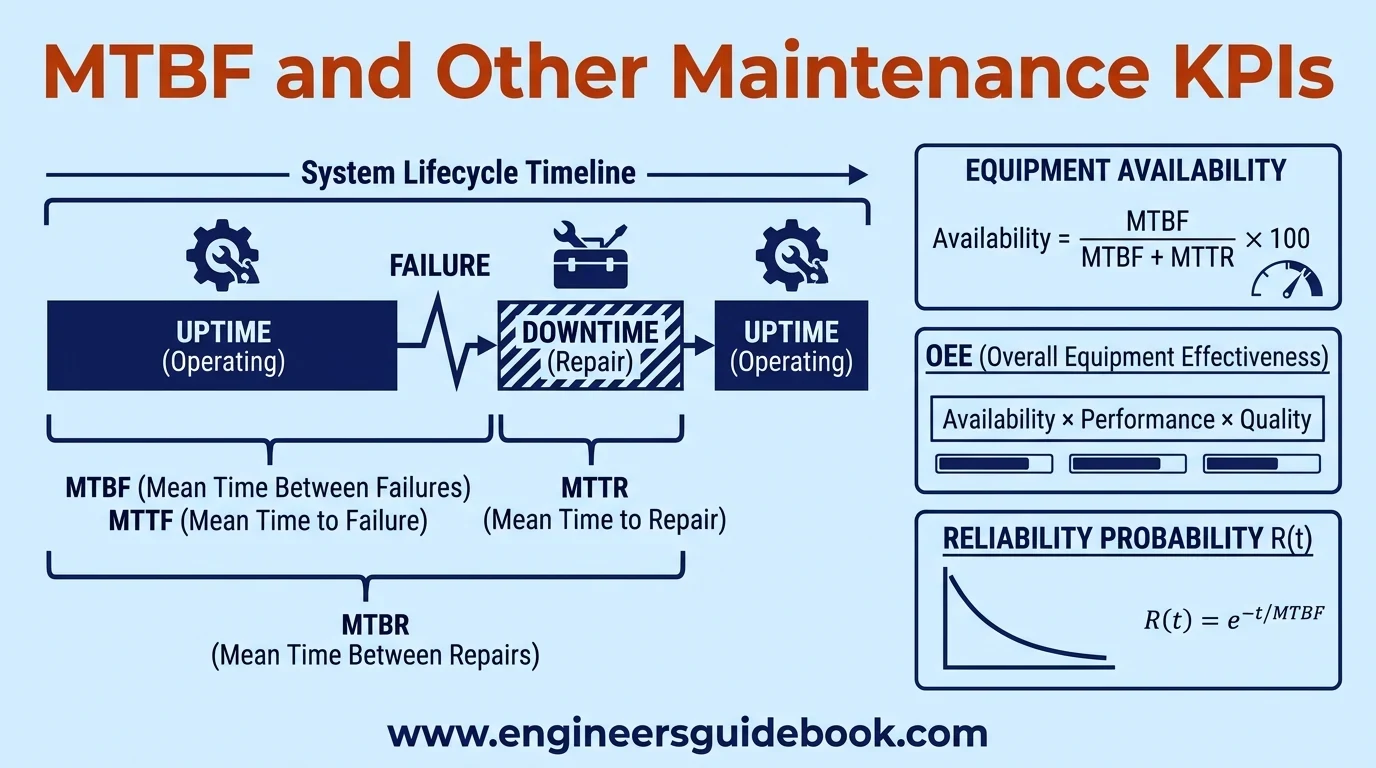
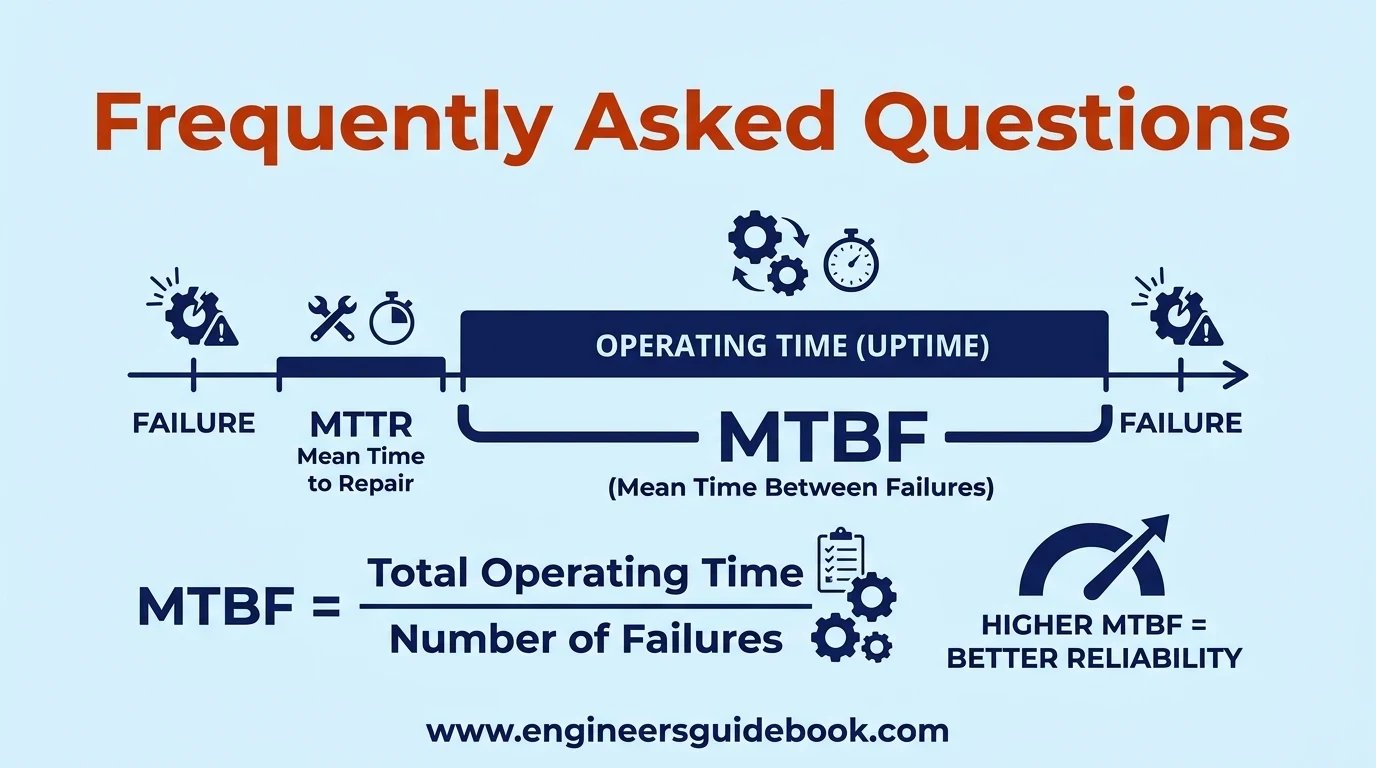
MTBF measures average operating time between failures, while Mean Time to Repair (MTTR) measures average repair duration.
Higher MTBF and lower MTTR are generally desirable because they indicate fewer failures and faster equipment restoration.
6.2 MTBF vs MTTF
MTBF evaluates repairable equipment experiencing recurring failures. Mean Time to Failure evaluates the expected operating duration until failure, particularly for non-repairable components.
Both metrics support reliability engineering but serve different analytical purposes.
6.3 MTBF vs Mean Time Between Repairs
Mean Time Between Repairs measures the average interval between repair interventions according to the organization’s measurement definition.
Unlike MTBF, this metric may include repairs performed before complete functional failure, depending on established reporting criteria.
6.4 MTBF and Equipment Availability
MTBF and MTTR can estimate inherent equipment availability using:
Availability (%) = [MTBF ÷ (MTBF + MTTR)] × 100
For an MTBF of 500 hours and MTTR of five hours:
Availability = 99.01%
This simplified calculation excludes additional logistical and administrative delays.
6.5 MTBF and Overall Equipment Effectiveness
Overall Equipment Effectiveness (OEE) evaluates manufacturing productivity using availability, performance, and quality.
Improving MTBF can reduce breakdown-related availability losses and consequently improve OEE. However, production speed losses and quality defects must also be addressed.
6.6 MTBF and Reliability Probability
Under a constant failure rate assumption, reliability probability is expressed as:
R(t) = e^(−t/MTBF)
Where R(t) represents the probability of failure-free operation over a specified time period t.
For equipment with an MTBF of 1,000 hours, the probability of operating without failure for 100 hours is approximately 90.48%.
7. Understanding MTBF Results
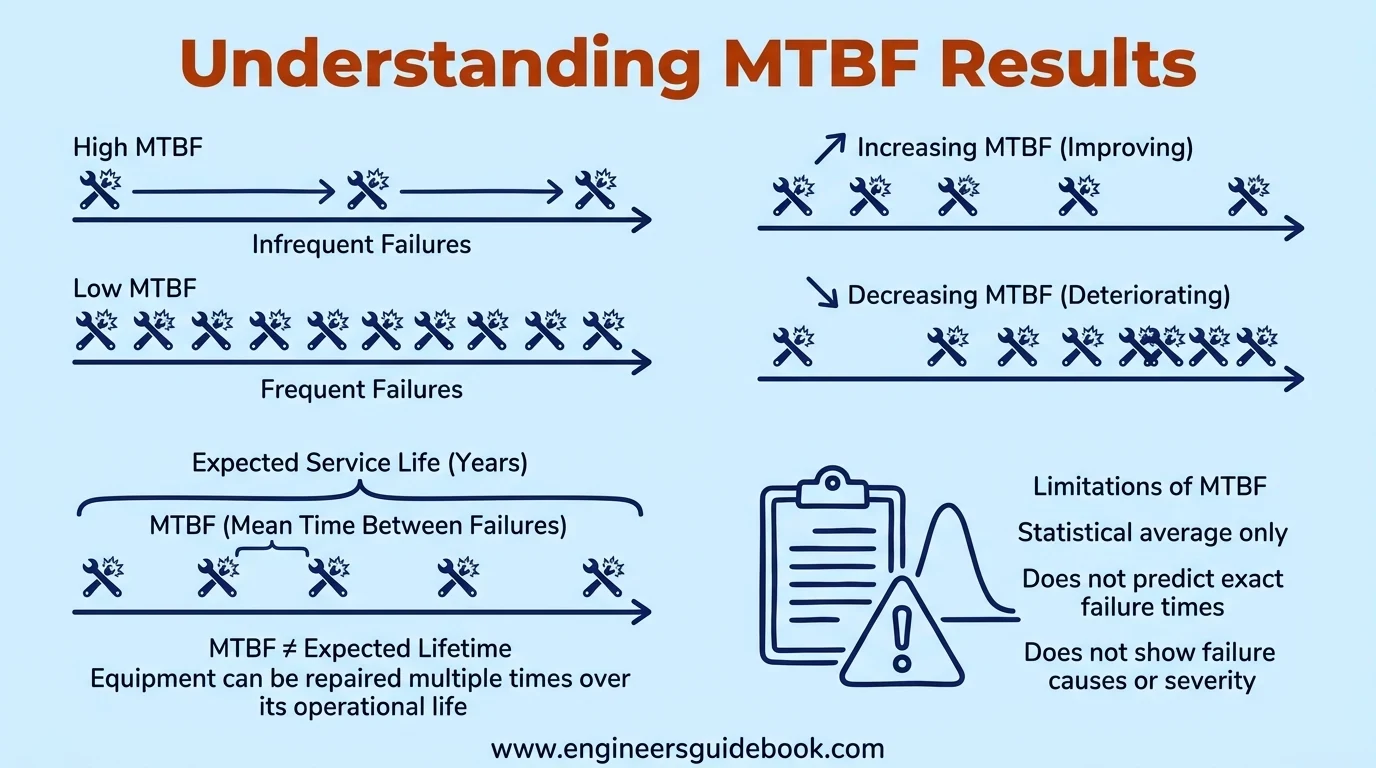
7.1 What a High MTBF Indicates
A high MTBF generally indicates infrequent equipment failures relative to operating exposure. It may reflect effective maintenance practices, robust equipment design, and favorable operating conditions.
Nevertheless, comparisons require equivalent failure definitions and operating environments.
7.2 What a Low MTBF Indicates
A low MTBF suggests frequent equipment failures and potential reliability deficiencies.
Common contributing factors include component degradation, inadequate lubrication, improper installation, excessive loading, contamination, and ineffective maintenance strategies.
7.3 Increasing and Decreasing MTBF Trends
An increasing MTBF trend generally suggests improving reliability, while a decreasing trend may indicate progressive deterioration or recurring technical deficiencies.
Monitoring MTBF over successive periods helps maintenance teams evaluate corrective interventions and detect emerging reliability problems.
7.4 MTBF and Expected Equipment Lifetime
MTBF should not be confused with equipment service life. A repairable machine can experience numerous failures throughout its useful operational lifespan.
For instance, equipment with an MTBF of 1,000 hours may remain operational for several years through appropriate repairs and component replacements.
7.5 Limitations of MTBF Interpretation
MTBF is an aggregate statistical measurement that does not identify specific failure mechanisms, failure severity, or exact future failure times. It can also obscure differences between individual assets and become statistically unreliable when based on insufficient failure data.
Combining MTBF with condition monitoring, failure mode analysis, MTTR, equipment availability, and root cause analysis provides a more comprehensive foundation for industrial reliability management.
8. MTBF Benchmarks and Industry Standards
8.1 What Is a Good MTBF Value?
A good MTBF value depends on equipment type, operational criticality, design specifications, and working conditions. No universal MTBF benchmark applies to every industrial asset. Equipment performance should be evaluated against manufacturer specifications, historical reliability records, and organizational targets.
8.2 Manufacturing Industry MTBF Benchmarks
Manufacturing facilities establish MTBF benchmarks for individual machines, production lines, and auxiliary equipment. Continuous manufacturing processes generally require higher reliability than intermittent production operations. Benchmarking helps identify bottleneck equipment responsible for disproportionate production losses.
8.3 Electrical Equipment MTBF Benchmarks
Electrical equipment MTBF varies considerably depending on component quality, electrical loading, insulation integrity, and thermal management. Electric motors, transformers, variable frequency drives, and switchgear should be evaluated against comparable equipment operating under similar conditions.
8.4 Mechanical Equipment MTBF Benchmarks
Mechanical equipment benchmarks depend on operating speed, mechanical loading, lubrication effectiveness, and environmental conditions. Centrifugal pumps, compressors, bearings, and gearboxes require equipment-specific reliability targets because their failure mechanisms differ substantially.
8.5 Electronics and Telecommunications MTBF Benchmarks
Electronic components and telecommunications equipment frequently have predicted MTBF ratings reaching tens or hundreds of thousands of hours. However, predicted reliability figures are not guaranteed service lifetimes. Actual field reliability depends on operating conditions and component degradation.
8.6 Establishing Equipment-Specific MTBF Targets
Equipment-specific targets should consider historical breakdown frequency, asset criticality, production requirements, maintenance expenditure, and manufacturer recommendations. Establishing achievable incremental improvements creates a practical framework for continuous reliability enhancement.
8.7 Internal vs External Benchmarking
Internal benchmarking compares similar equipment within an organization, whereas external benchmarking evaluates performance against comparable industrial facilities. Both approaches help identify reliability deficiencies, although differences in measurement methodology must be considered.

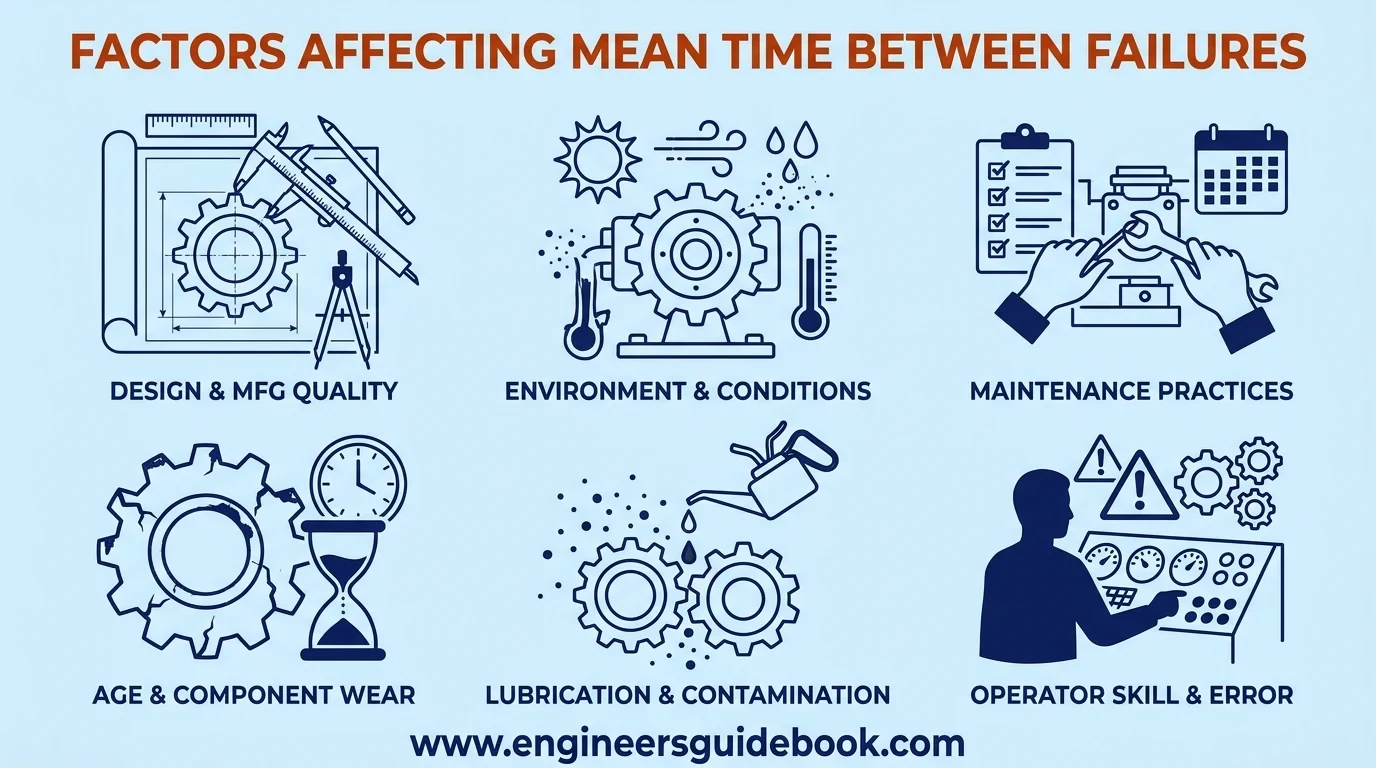
9. Factors Affecting Mean Time Between Failures
9.1 Equipment Design and Manufacturing Quality
Robust engineering design, appropriate material selection, manufacturing tolerances, and component quality significantly influence equipment reliability. Inherent design deficiencies can produce recurring failures despite comprehensive maintenance interventions.
9.2 Operating Conditions and Environmental Factors
Excessive temperatures, humidity, vibration, chemical exposure, dust accumulation, and fluctuating loads accelerate equipment deterioration. Maintaining equipment within specified operational parameters reduces premature component degradation and extends average failure intervals.
9.3 Maintenance Practices and Frequency
Inadequate maintenance allows deterioration to progress undetected. Conversely, excessive intrusive maintenance can introduce assembly errors and unnecessary disturbances. Optimized maintenance intervals balance equipment reliability, intervention frequency, and maintenance expenditure.
9.4 Equipment Age and Component Wear
Progressive material fatigue, corrosion, abrasion, and insulation degradation can increase failure frequency as equipment ages. During the wear-out phase of the bathtub curve, declining reliability may necessitate refurbishment or replacement.
9.5 Lubrication and Contamination
Incorrect lubricant viscosity, insufficient lubrication, and particulate contamination accelerate frictional deterioration. Effective lubrication management, filtration, and contamination control are particularly important for improving the MTBF of rotating machinery.
9.6 Operator Skills and Human Error
Improper equipment operation, incorrect adjustments, overloading, and failure to recognize abnormal conditions contribute to premature breakdowns. Structured operator training and standardized operating procedures minimize human-induced reliability losses.
10. How to Improve MTBF
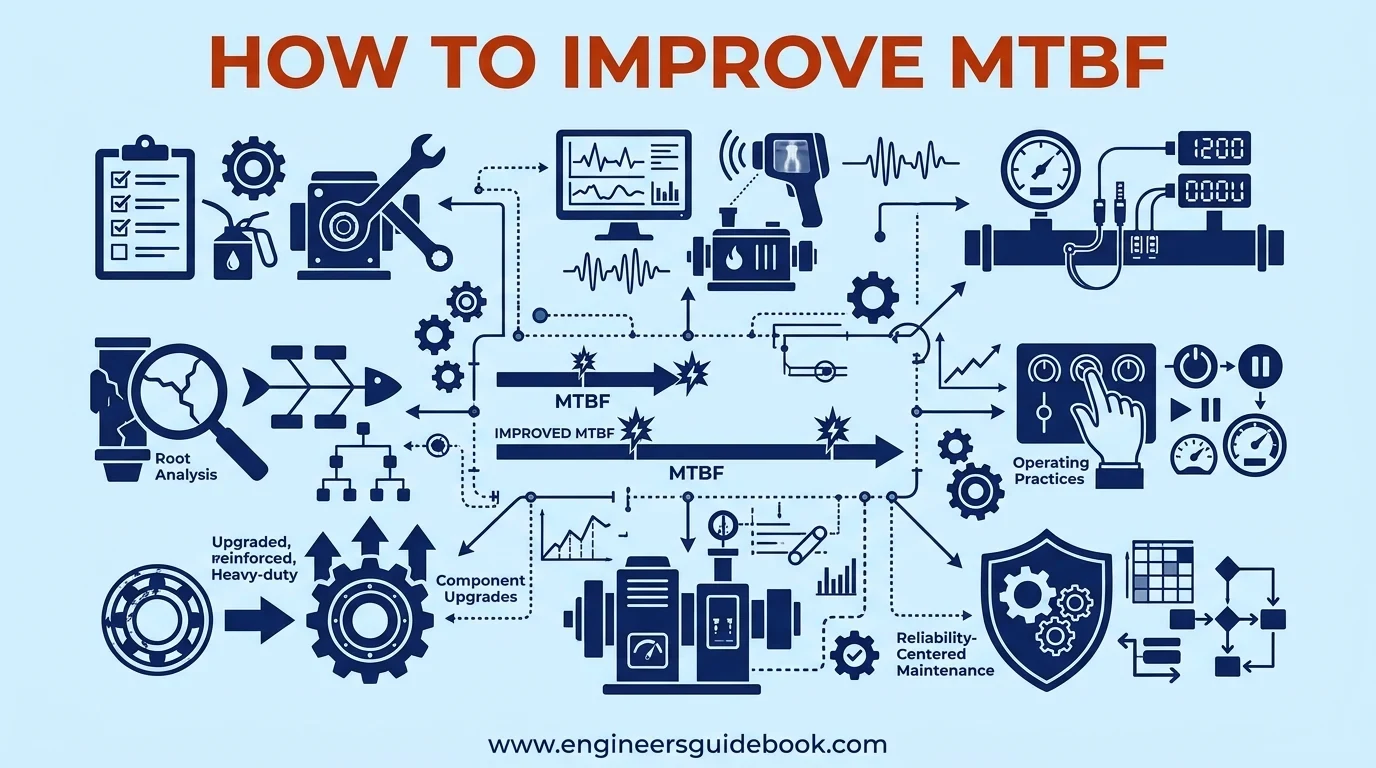
10.1 Implementing Preventive Maintenance
Preventive maintenance involves scheduled inspections, lubrication, adjustments, cleaning, and component replacement. Appropriately planned interventions reduce age-related failures and prevent manageable deterioration from developing into significant equipment breakdowns.
10.2 Adopting Predictive Maintenance
Predictive maintenance utilizes condition monitoring data and analytical techniques to anticipate equipment deterioration. Vibration analysis, infrared thermography, oil analysis, and motor current signature analysis help identify developing failure mechanisms before functional failure occurs.
10.3 Implementing Condition-Based Maintenance
Condition-based maintenance initiates interventions according to measured equipment health rather than predetermined schedules. Monitoring temperature, vibration, pressure, and other operational parameters enables targeted maintenance while avoiding unnecessary component replacement.
10.4 Performing Root Cause Analysis
Root cause analysis identifies the underlying mechanisms responsible for recurring equipment failures. Techniques such as the 5 Whys, Fishbone Diagram, and Fault Tree Analysis facilitate permanent corrective actions rather than repetitive symptomatic repairs.
10.5 Improving Equipment Operating Practices
Maintaining appropriate operating speeds, pressures, temperatures, and loading conditions minimizes unnecessary mechanical and electrical stresses. Standardized startup and shutdown procedures also reduce transient loading and premature equipment degradation.
10.6 Upgrading Unreliable Components
Repeated component failures may justify engineering modifications or material upgrades. Improved bearing arrangements, sealing systems, lubrication mechanisms, and appropriately rated electrical components can eliminate chronic reliability deficiencies.
10.7 Implementing Reliability-Centered Maintenance
Reliability-centered maintenance evaluates equipment functions, failure modes, failure consequences, and suitable maintenance strategies. This systematic approach prioritizes technically appropriate interventions that preserve equipment functionality and optimize lifecycle reliability.
11. MTBF Tracking and Common Calculation Mistakes
11.1 Tracking MTBF Using Excel
Microsoft Excel provides a straightforward platform for recording operating hours, failure occurrences, and monthly reliability performance. The following formula calculates MTBF when cell B2 contains operating hours and C2 contains failure occurrences:
=IF(C2>0,B2/C2,”No Failures”)
11.2 Monitoring MTBF Through CMMS
A Computerized Maintenance Management System (CMMS) centralizes equipment histories, breakdown records, operating data, and maintenance work orders. Automated MTBF reporting improves data accessibility, traceability, and reliability performance monitoring.
11.3 Creating MTBF Performance Dashboards
Reliability dashboards visualize historical MTBF trends, equipment rankings, failure frequencies, and performance against established targets. Graphical representation facilitates rapid identification of deteriorating assets and emerging maintenance priorities.
11.4 Using MTBF for Maintenance Planning
MTBF supports asset prioritization, spare parts planning, maintenance resource allocation, and reliability improvement initiatives. However, maintenance intervals should also consider failure mechanisms, equipment condition, and operational consequences.
11.5 Incorrect Failure Classification
Classifying routine inspections, scheduled maintenance, or unrelated production interruptions as equipment failures artificially reduces calculated MTBF. Consistent functional failure definitions are essential for dependable reliability assessment.
11.6 Inaccurate Operating Time Records
Using calendar hours instead of actual operating hours can inflate MTBF values. Accurate hour meters, production records, and automated equipment monitoring systems improve the integrity of operating exposure data.
11.7 Comparing Incompatible Equipment
Comparing equipment with different designs, operating environments, duty cycles, and failure definitions can produce misleading conclusions. Meaningful benchmarking requires comparable assets and standardized measurement criteria.
11.8 Overreliance on MTBF as a Reliability Indicator
MTBF does not independently measure failure severity, repair duration, maintenance expenditure, or operational risk. Combining it with MTTR, availability, maintenance costs, and equipment condition indicators provides a more comprehensive performance assessment.

12. Frequently Asked Questions
12.1 What Does MTBF Stand for in Maintenance?
MTBF stands for Mean Time Between Failures. It measures the average operating time between failures of repairable equipment and is commonly used to assess industrial asset reliability.
12.2 What Is the Formula for MTBF?
The MTBF formula is:
M T B F = Total Operating Time Number of Failures MTBF=\frac{\text{Total Operating Time}}{\text{Number of Failures}} M T B F = Number of Failures Total Operating Time
The result is typically expressed in operating hours.
12.3 How Do You Calculate MTBF in Hours?
Divide total equipment operating hours by the number of recorded functional failures. For example, equipment operating for 4,000 hours with eight failures has an MTBF of 500 hours.
12.4 What Is Considered a Good MTBF?
A good MTBF meets or exceeds equipment-specific reliability requirements. Acceptable values depend on equipment design, operating conditions, historical performance, and the consequences of equipment failure.
12.5 Is a Higher or Lower MTBF Better?
A higher MTBF is generally better because it indicates fewer failures relative to equipment operating time. Higher MTBF can improve production continuity and reduce breakdown-related maintenance requirements.
12.6 What Is the Difference Between MTBF and MTTR?
MTBF measures average operating time between failures, whereas MTTR measures average repair duration. MTBF reflects failure frequency, while MTTR reflects repair efficiency and equipment maintainability.
12.7 How Do You Calculate MTBF When There Are No Failures?
A finite MTBF cannot be calculated directly when the number of failures is zero. Report accumulated failure-free operating hours or calculate a statistical lower confidence bound using an appropriate reliability model.
12.8 Is MTBF the Same as Equipment Life Expectancy?
No. MTBF represents the average operating interval between failures, whereas equipment life expectancy describes the anticipated service lifespan before permanent retirement or replacement.
12.9 How Do You Calculate Availability Using MTBF and MTTR?
Inherent equipment availability can be estimated using:
Availability (%) = [MTBF ÷ (MTBF + MTTR)] × 100
Higher MTBF and lower MTTR generally result in improved inherent equipment availability.
12.10 Can MTBF Predict the Next Equipment Failure?
No. MTBF provides a statistical average rather than an exact failure prediction. Predictive maintenance and condition monitoring techniques are more suitable for identifying developing equipment defects.
12.11 How Can MTBF Be Improved?
MTBF can be improved through preventive maintenance, predictive maintenance, root cause analysis, effective lubrication, equipment modifications, operator training, and optimized operating conditions.
12.12 What Are the Limitations of MTBF?
MTBF does not reveal specific failure mechanisms, predict exact failure times, or account for failure severity. Its accuracy also depends heavily on reliable operating records and sufficient failure data.
13. Conclusion
13.1 Key Takeaways From MTBF
Mean Time Between Failures is a fundamental reliability engineering metric that quantifies average operating exposure between equipment failures. Its straightforward calculation supports maintenance performance evaluation, equipment benchmarking, and industrial reliability analysis.
13.2 Importance of Accurate MTBF Monitoring
Accurate MTBF monitoring requires standardized failure definitions, dependable operating records, and consistent measurement periods. Reliable data prevents erroneous interpretations and strengthens maintenance decision-making.
13.3 Using MTBF for Continuous Reliability Improvement
Organizations should integrate MTBF monitoring with root cause analysis, condition monitoring, maintenance optimization, and complementary performance indicators. Systematically addressing recurring failures can increase equipment reliability, minimize unplanned downtime, reduce maintenance expenditure, and strengthen long-term operational excellence.