1. Hydraulic Seals Fundamentals
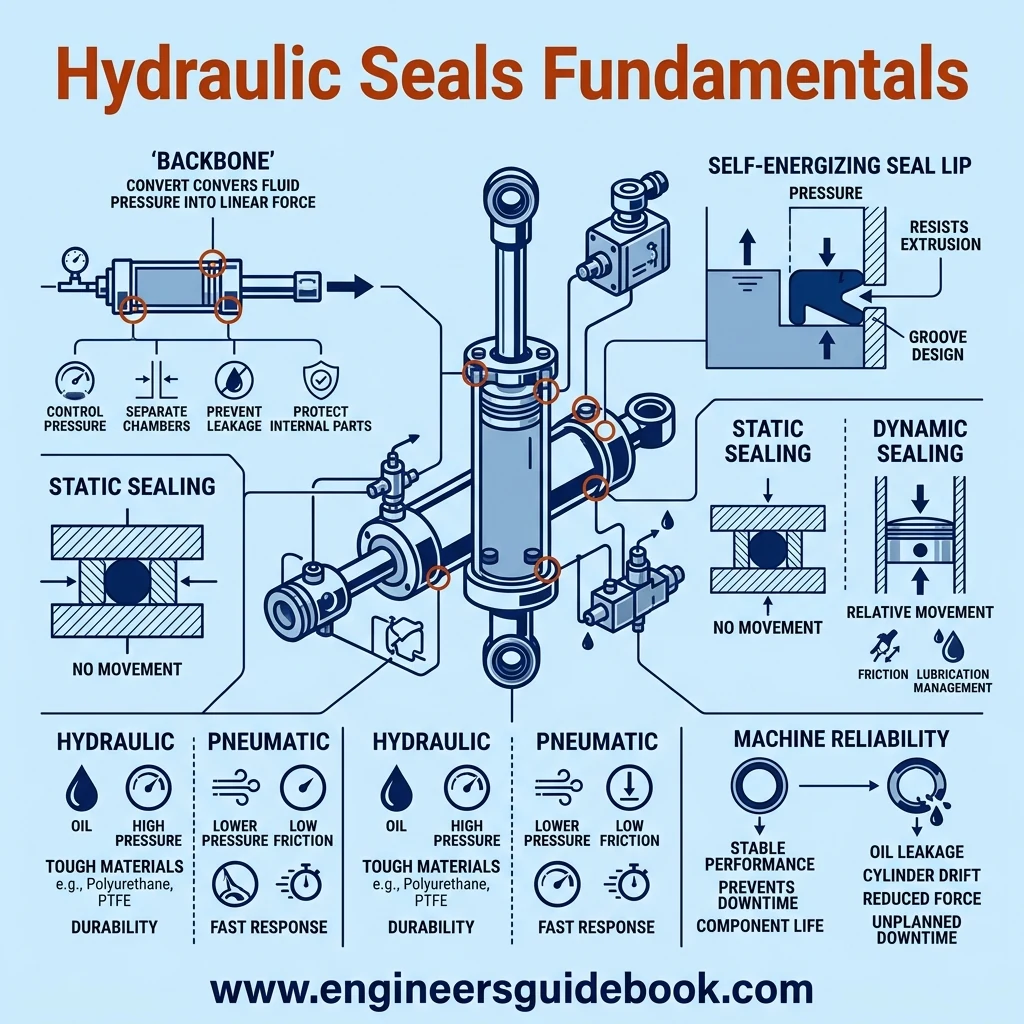
Hydraulic seals are essential components in fluid power systems. They control pressurized oil, separate working chambers, prevent leakage, and protect internal parts from contamination. Although they are usually small compared with cylinders, pumps, valves, and actuators, their influence on system performance is enormous.
A hydraulic seal must work in a difficult environment. It faces pressure, friction, temperature variation, surface movement, fluid chemistry, and sometimes abrasive dust or moisture. A weak seal can turn a powerful hydraulic machine into an unreliable, oil-leaking liability.
1.1 The Backbone of Fluid Power
Hydraulic seals form the quiet backbone of fluid power machinery. They allow hydraulic energy to be converted into controlled mechanical force by keeping oil exactly where it must remain.
In a hydraulic cylinder, fluid pressure acts on the piston surface to create linear movement. The seals maintain this pressure difference between chambers. Without them, oil would bypass the piston or escape through the rod side, causing force loss, slow movement, and erratic operation.
They also support operational cleanliness. A good sealing arrangement keeps the hydraulic system closed, stable, and predictable. This makes seals indispensable in construction equipment, manufacturing machinery, agricultural systems, marine hydraulics, and industrial presses.
1.2 How Hydraulic Seals Control Pressure
Hydraulic seals control pressure by creating a barrier between high-pressure and low-pressure areas. This barrier may be formed by an elastomeric lip, a compressed O-ring, a polyurethane profile, or a PTFE sealing ring energized by pressure.
When pressure rises, many hydraulic seals become more effective. The fluid pushes the seal lip against the rod, piston, bore, or gland surface. This self-energizing action increases contact force and reduces leakage paths.
However, pressure control is not only about tightness. The seal must resist extrusion, deformation, and thermal stress. If pressure forces the seal material into the clearance gap, the seal may tear or nibble. This is why groove design, backup rings, and material hardness are so important.
1.3 Static Sealing Versus Dynamic Sealing
Static sealing occurs between parts that do not move relative to each other. Examples include flange joints, threaded plugs, end caps, valve bodies, and cylinder gland interfaces. Static seals rely on compression and material resilience to block leakage.
Dynamic sealing is more demanding. It occurs where one surface moves against another, such as a piston sliding inside a cylinder bore or a rod moving through the gland. The seal must prevent leakage while allowing movement.
Dynamic seals must manage tribological behavior. That means friction, lubrication, wear, heat generation, and surface texture all matter. A dynamic seal that is too tight may overheat. One that is too loose may leak. The design window is narrow.
1.4 Hydraulic Seals Versus Pneumatic Seals
Hydraulic seals and pneumatic seals may look similar, but their working conditions are different. Hydraulic seals operate with liquid under high pressure, while pneumatic seals usually work with compressed air at lower pressure.
Hydraulic systems demand stronger leakage control because oil leakage causes efficiency loss, contamination, safety hazards, and environmental concerns. Pneumatic systems can often tolerate minor air leakage, but hydraulic systems cannot tolerate uncontrolled oil escape.
Hydraulic seals are commonly made from tougher materials such as polyurethane, nitrile rubber, PTFE, FKM, and reinforced compounds. Pneumatic seals often prioritize low friction and fast response. Hydraulic seals must prioritize pressure retention, extrusion resistance, and durability.
2. Core Design Principles
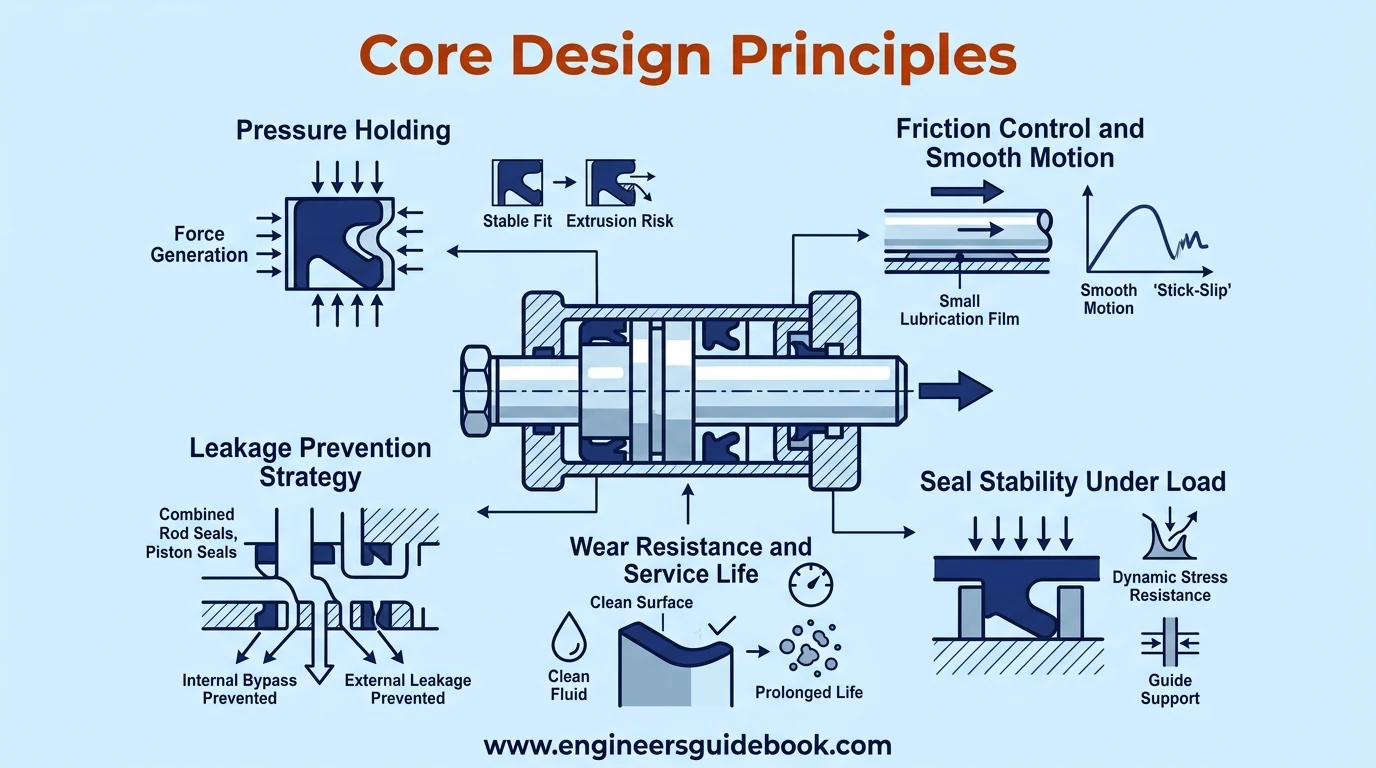
Hydraulic seal design requires balance. A seal must be tight but not excessively restrictive. It must be flexible but not weak. It must reduce leakage while still allowing a lubricating film to protect the sliding surfaces.
Good design considers pressure, speed, fluid, temperature, housing geometry, surface finish, contamination level, and expected service life. Ignoring any one of these factors can compromise the whole sealing system.
2.1 Pressure Holding Performance
Pressure holding performance is the primary function of most hydraulic seals. The seal must maintain separation between pressurized zones so that the system can produce useful force.
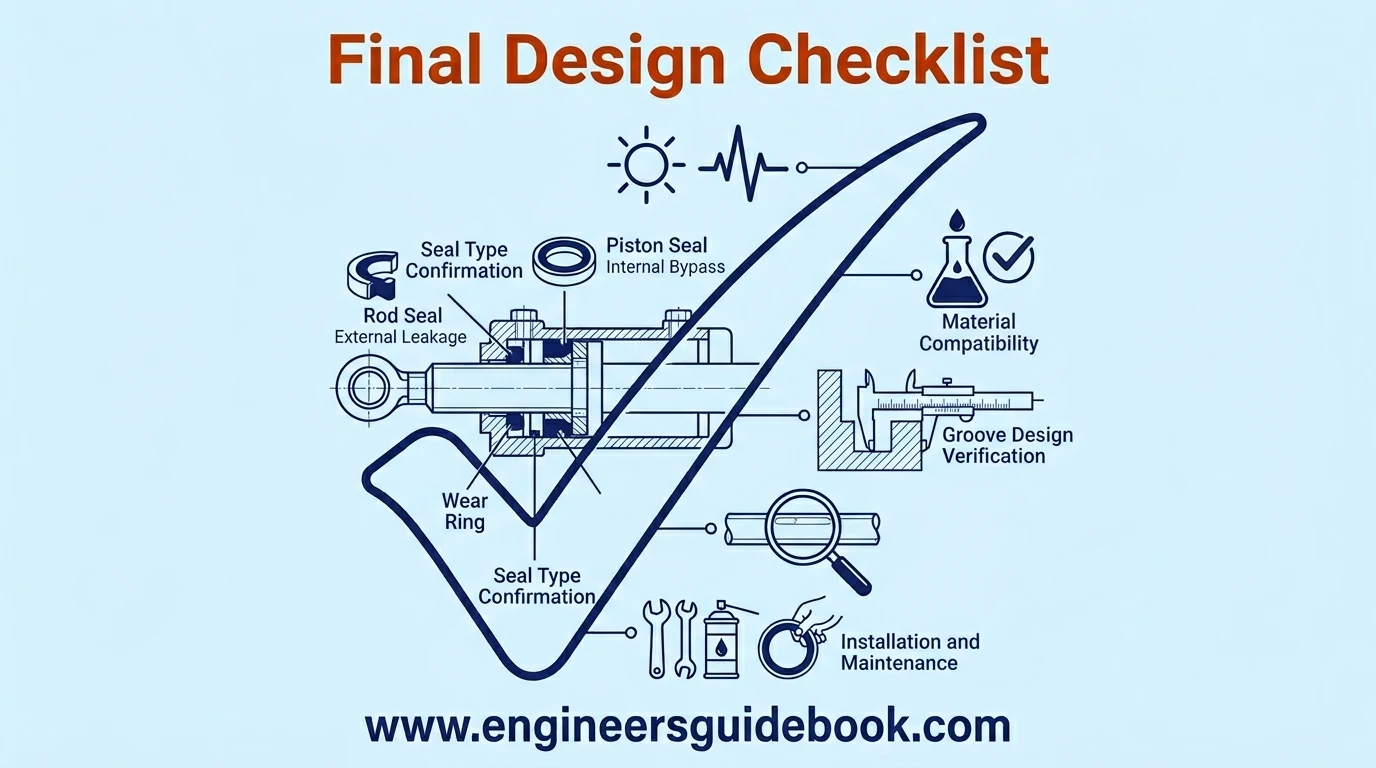
In cylinders, pressure holding affects lifting capacity, clamping force, pressing force, and positional stability. If the piston seal allows internal bypass, the cylinder may lose force or drift under load. If the rod seal fails, oil escapes externally.
High pressure also creates extrusion risk. The seal material may be pushed into the hardware clearance gap and damaged. For this reason, high-pressure systems often require backup rings, harder compounds, or specially engineered seal profiles.
2.2 Friction Control and Smooth Motion
Friction control is essential for smooth hydraulic movement. Every dynamic seal generates some resistance, but excessive friction causes heat, energy loss, stick-slip, and accelerated wear.
Stick-slip is especially problematic in precision equipment. It creates jerky movement instead of controlled motion. This can affect presses, positioning cylinders, automation systems, and machine tools.
Seal geometry, material choice, lubrication film, and surface finish all influence friction. PTFE seals, optimized polyurethane profiles, and carefully finished rods can reduce friction while maintaining reliable sealing action.
2.3 Leakage Prevention Strategy
Leakage prevention is not limited to stopping visible oil. It includes preventing external leakage, internal bypass, pressure decay, and contamination entry.
External leakage usually appears around the rod, gland, fittings, or static joints. It creates housekeeping issues, safety hazards, and oil consumption. Internal leakage is less visible but equally damaging. It reduces efficiency and causes drifting or weak cylinder movement.
An effective leakage prevention strategy uses the correct combination of rod seals, piston seals, wipers, backup rings, static seals, and wear rings. The sealing system must be treated as an integrated assembly, not a collection of isolated parts.
2.4 Wear Resistance and Service Life
Wear resistance determines how long a seal can function before its sealing edge deteriorates. In hydraulic systems, wear may be caused by friction, contaminated oil, poor surface finish, misalignment, or insufficient lubrication.
Polyurethane is widely used where wear resistance is critical. PTFE is preferred where low friction and chemical resistance are needed. Reinforced materials are selected for heavy-duty pressure and shock loading.
Service life also depends on maintenance discipline. Clean oil, effective filtration, good wipers, and proper installation can significantly extend seal performance. A premium seal installed in dirty hardware may still fail early.
2.5 Seal Stability Under Load
Seal stability under load means the seal maintains its shape, position, and function during pressure, movement, and mechanical stress. An unstable seal may twist, roll, extrude, or lose contact with the sealing surface.
Stability is influenced by groove design, seal profile, material hardness, clearance gap, and pressure direction. Compact seals and pressure-energized designs are often used to improve stability in demanding applications.
Side loads can also affect seal stability. If the rod or piston is not properly guided, the seal may experience uneven loading. This leads to localized wear and leakage. Wear rings and guide elements are therefore essential companions to hydraulic seals.
3. Main Types of Hydraulic Seals
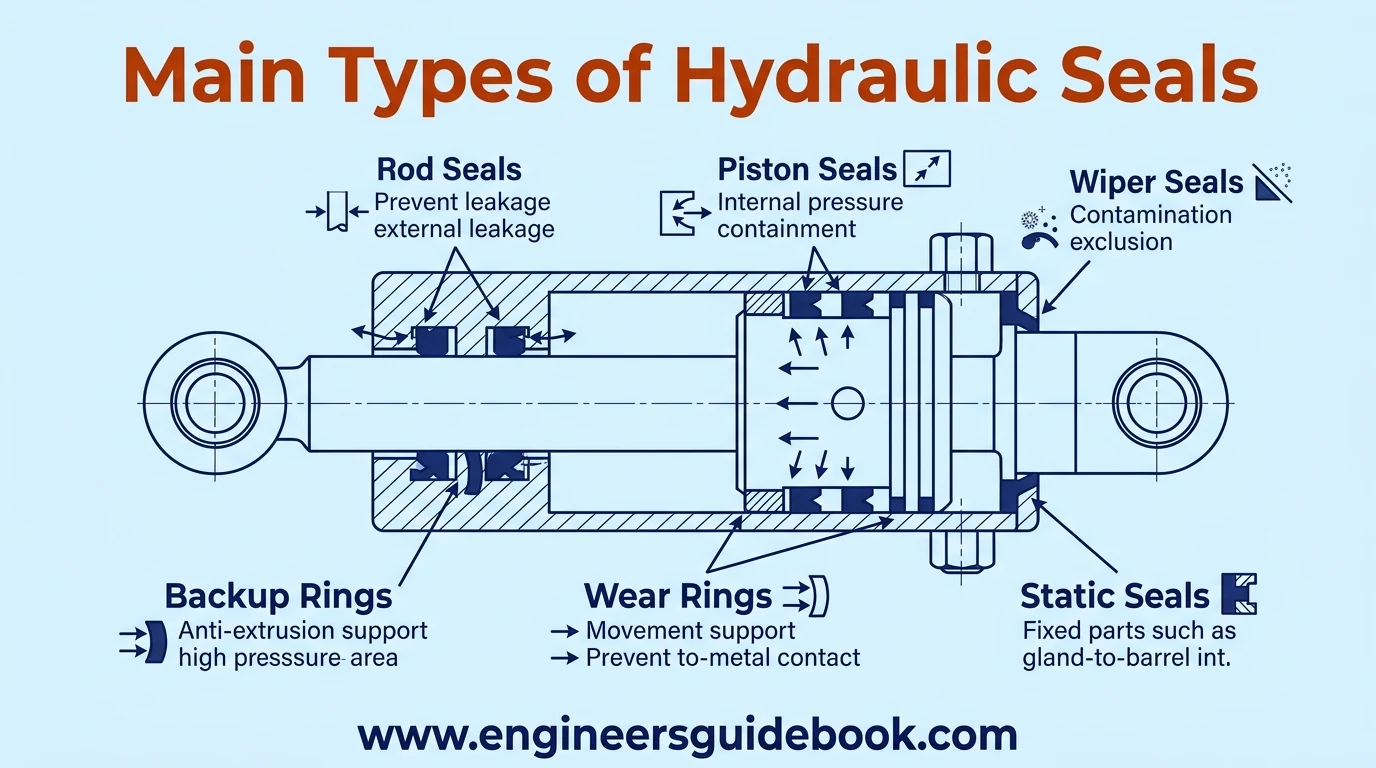
Hydraulic systems use different seals for different functions. Each seal type has a specific role in pressure control, leakage prevention, contamination exclusion, or mechanical support.
A complete cylinder sealing arrangement usually includes rod seals, piston seals, wipers, wear rings, backup rings, and static seals. Selecting the correct type is the first step toward reliable hydraulic performance.
3.1 Rod Seals
Rod seals are installed in the cylinder head or gland. They seal against the moving piston rod and prevent hydraulic oil from leaking outside the cylinder.
These seals are critical because external leakage is immediately visible and often unacceptable. A failed rod seal can cause oil loss, contamination of nearby equipment, safety hazards, and reduced hydraulic efficiency.
Rod seals must handle reciprocating motion, pressure variation, surface lubrication, and possible rod deflection. Their design must balance tight sealing with acceptable friction.
3.2 Piston Seals
Piston seals are fitted around the piston and seal against the cylinder bore. Their main function is to prevent oil from bypassing from one side of the piston to the other.
When piston seals fail, the cylinder may not hold position under load. It may drift, lose force, or move slowly despite adequate pump pressure.
Piston seals are available in single acting and double acting designs. Their selection depends on pressure direction, cylinder function, speed, and leakage tolerance.
3.3 Wiper Seals
Wiper seals, also called scraper seals, are installed at the outer side of the cylinder gland. They clean the rod surface as it retracts into the cylinder.
Their job is contamination defense. Dust, mud, moisture, metal particles, and chemical residue can damage rod seals and internal components if allowed to enter the cylinder.
A damaged or poorly selected wiper can shorten the life of the entire sealing system. In dirty environments, the wiper is one of the most important seals in the cylinder.
3.4 Wear Rings
Wear rings are guide elements that prevent metal-to-metal contact between moving and stationary parts. They support the piston or rod and absorb side loads.
Although wear rings do not seal fluid directly, they protect the seals by maintaining alignment. Without proper guidance, seals may be unevenly compressed and rapidly worn.
Wear rings are commonly made from engineered plastics, composite materials, or fabric-reinforced resins. Their load capacity and friction behavior must match the application.
3.5 Backup Rings
Backup rings support seals against extrusion. They are installed on the low-pressure side of a seal where the clearance gap creates a risk of material deformation.
Under high pressure, softer seal materials can be forced into small gaps between metal components. This causes nibbling, tearing, and premature failure. Backup rings block this movement.
They are commonly used with O-rings, U-cups, and other elastomeric seals in high-pressure systems. PTFE, nylon, and other thermoplastic materials are frequently used for backup rings.
3.6 Static Seals
Static seals are used between fixed parts. They are found in flanges, end covers, gland housings, valve blocks, ports, and threaded connections.
Static seals do not face sliding motion, but they must resist compression set, pressure, fluid attack, and temperature changes. O-rings, gaskets, bonded seals, and molded seals are common examples.
Their reliability depends on proper squeeze, groove design, material compatibility, and surface quality. A static seal may be simple, but it still demands precision.
4. Rod Seal Design
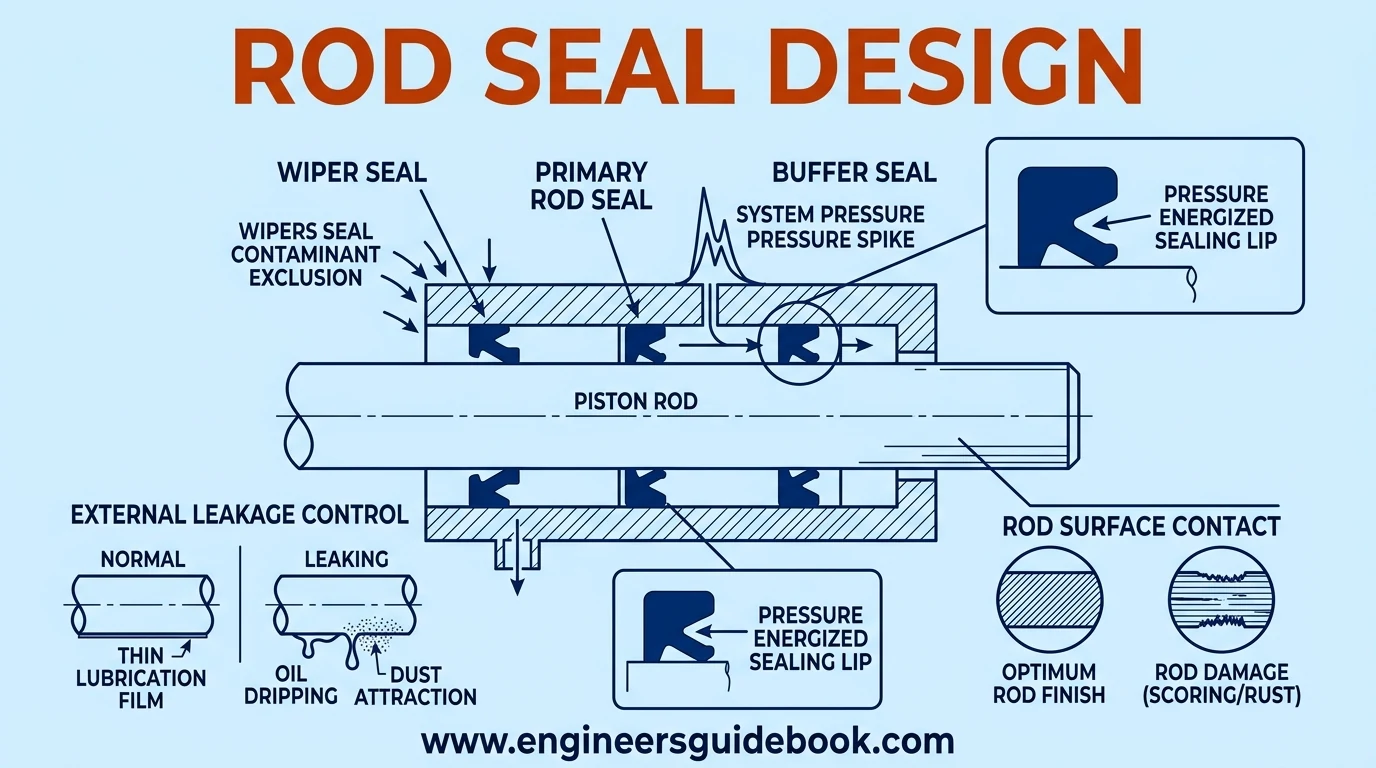
Rod seal design is one of the most important aspects of hydraulic cylinder engineering. The rod seal must control leakage at the point where the rod exits the cylinder and enters the external environment.
This location is mechanically sensitive. It experiences pressure, movement, contamination, surface exposure, and possible misalignment. A strong rod sealing system protects both machine performance and workplace safety.
4.1 External Leakage Control
The rod seal is the main defense against external hydraulic oil leakage. It wipes and seals the rod surface as the cylinder extends and retracts.
External leakage can create slippery surfaces, attract dust, damage nearby components, and increase oil consumption. In regulated environments, leakage may also create environmental compliance issues.
Effective leakage control depends on seal lip design, rod finish, fluid viscosity, pressure, and installation accuracy. A thin lubrication film is acceptable, but oil dripping is not.
4.2 Primary Rod Seal Function
The primary rod seal carries the main sealing responsibility. It is positioned inside the gland and designed to withstand system pressure.
As pressure acts on the seal, the sealing lip is energized against the rod. This improves contact and reduces leakage. The profile must be strong enough to resist deformation while remaining flexible enough for smooth movement.
Primary rod seals are often made from polyurethane, nitrile rubber, PTFE, or composite materials. The selected material depends on pressure, speed, temperature, fluid, and service conditions.
4.3 Buffer Seal Protection
A buffer seal is installed ahead of the primary rod seal in high-pressure cylinders. Its job is to absorb pressure spikes and reduce the load on the main rod seal.
Hydraulic systems often experience sudden pressure peaks due to shock loading, rapid valve shifts, or load impact. These spikes can damage the primary seal. A buffer seal acts like a sacrificial pressure moderator.
Buffer seals also help stabilize the oil film on the rod surface. In heavy-duty applications, they improve rod seal life and reduce leakage risk.
4.4 Rod Surface Contact
Rod surface contact is critical because the seal lip slides directly against the rod. The surface must be smooth, hard, corrosion-resistant, and properly finished.
If the rod is too rough, it abrades the seal. If it is too smooth, it may not hold enough lubrication. A controlled microtexture is required for optimum sealing.
Chrome plating, induction hardening, and specialized coatings improve rod durability. However, scratches, rust pits, dents, and coating flaking can destroy seals rapidly. Hardware condition must always be checked before seal replacement.
4.5 Rod Seal Failure Risks
Rod seal failure may result from extrusion, abrasion, heat, contamination, chemical incompatibility, incorrect installation, or rod damage.
A common mistake is replacing the leaking seal without identifying the root cause. If the rod is scored or the wiper is damaged, the new seal may fail quickly.
Symptoms of rod seal failure include oil wetness around the gland, dripping during cylinder movement, dust sticking to oil film, and reduced hydraulic oil level. Early detection prevents larger failures.
5. Piston Seal Design
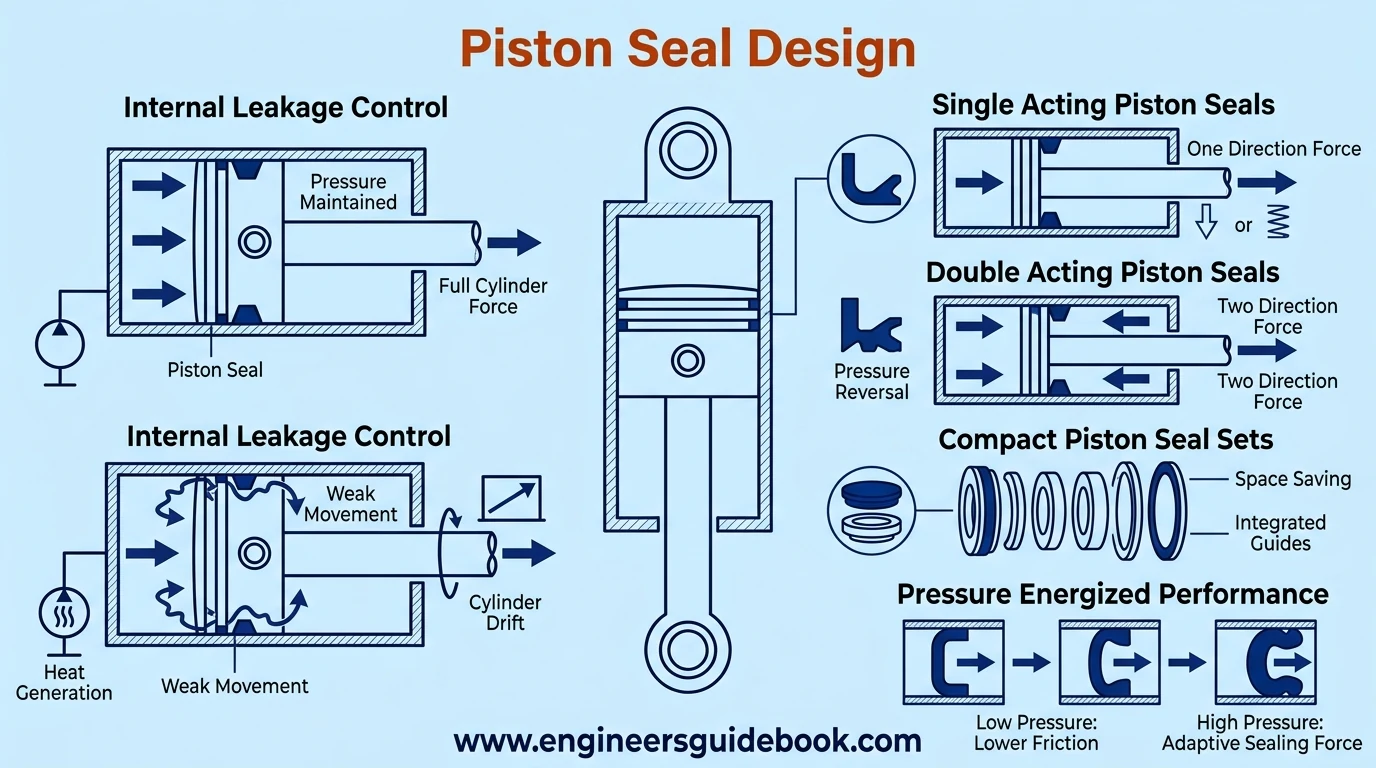
Piston seals control internal leakage inside hydraulic cylinders. They separate pressure chambers and allow hydraulic force to act effectively on the piston.
A good piston seal maintains pressure, prevents bypass, supports smooth motion, and helps the cylinder hold position. Poor piston sealing can reduce force even when no external leakage is visible.
5.1 Internal Leakage Control
Internal leakage occurs when pressurized fluid bypasses the piston seal and moves to the opposite chamber. This reduces the pressure difference required for cylinder force.
The result may be cylinder drift, weak movement, reduced speed, or inability to hold load. In some cases, the pump continues working harder to compensate, generating heat and wasting energy.
Internal leakage control depends on seal design, bore finish, piston alignment, pressure, and fluid viscosity. It is invisible from outside, so performance testing is often needed for diagnosis.
5.2 Single Acting Piston Seals
Single acting piston seals hold pressure from one direction only. They are used in cylinders where hydraulic force is applied in one direction and return movement occurs by spring, gravity, or external load.
These seals usually have a directional profile. The sealing lip must face the pressure side. Incorrect orientation can cause immediate bypass leakage.
Single acting designs are common in jacks, lift cylinders, presses, and simple hydraulic actuators. They are efficient when the pressure direction is predictable and consistent.
5.3 Double Acting Piston Seals
Double acting piston seals hold pressure from both directions. They are used in cylinders that extend and retract under hydraulic power.
These seals must perform during pressure reversal. When the control valve changes direction, the seal must respond quickly and maintain sealing force on either side.
Double acting piston seals may use symmetrical profiles, energized rings, or multi-component assemblies. They are common in construction equipment, industrial machinery, steering systems, and automation cylinders.
5.4 Compact Piston Seal Sets
Compact piston seal sets combine multiple sealing functions in a smaller installation space. They may include a sealing element, energizer, and guide features in one assembly.
These designs are useful where piston length is limited. They simplify installation and reduce component count.
Compact seal sets often provide good extrusion resistance and stable performance under pressure. They are widely used in mobile hydraulics and modern cylinder designs where power density is important.
5.5 Pressure Energized Performance
Pressure energized piston seals use hydraulic pressure to increase sealing force. As pressure rises, the seal expands or presses more firmly against the bore.
This creates adaptive performance. At low pressure, friction remains controlled. At high pressure, sealing force increases. The result is efficient movement with reliable leakage control.
Pressure energized designs are common in U-cups, lip seals, and energized PTFE seals. Their success depends on correct orientation, groove support, and material selection.
6. Wiper Seal Design
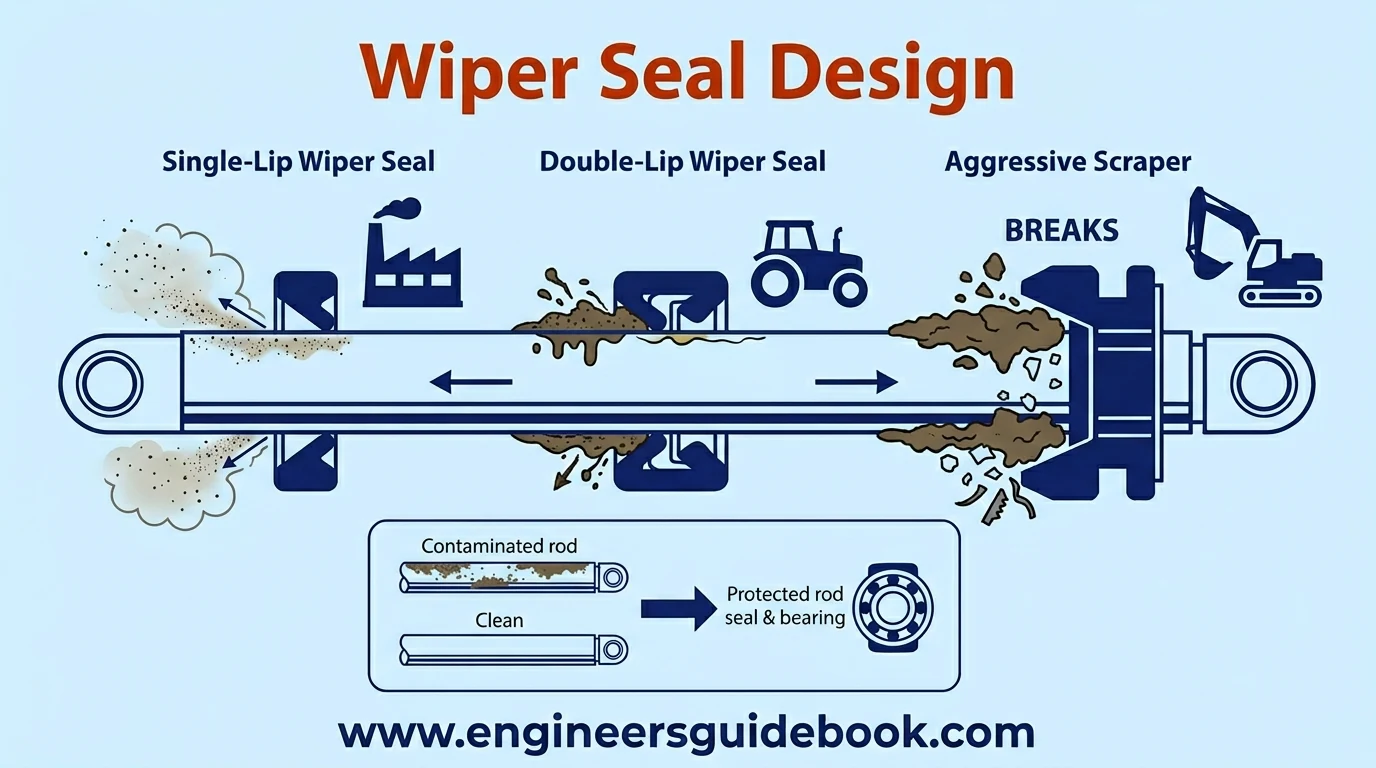
Wiper seals protect hydraulic cylinders from the outside world. They prevent dirt, dust, water, and abrasive particles from entering the sealing chamber.
This function is often underestimated. A strong rod seal cannot survive for long if contamination passes through the gland area. The wiper is the first defensive barrier.
6.1 Contamination Defense
Contamination defense begins at the rod surface. When the rod extends, it becomes exposed to the working environment. As it retracts, anything stuck to the rod can be pulled into the cylinder.
The wiper removes these contaminants before they reach the rod seal and bearing area. This reduces abrasion, corrosion, and oil contamination.
In dusty or muddy applications, wiper performance can determine total cylinder life. A poor wiper allows damage to start silently and spread internally.
6.2 Single Lip Wipers
Single lip wipers use one scraping edge to remove contaminants from the rod. They are suitable for relatively clean or moderately dirty environments.
They are simple, compact, and cost-effective. In general industrial applications, a single lip wiper may provide adequate protection when contamination levels are controlled.
However, they may be insufficient for outdoor machinery, construction equipment, mining systems, or agricultural machines. Selection must reflect the actual working environment.
6.3 Double Lip Wipers
Double lip wipers offer improved protection. One lip scrapes external dirt from the rod, while the second lip helps retain lubrication or provides additional sealing support.
This design is useful in environments where moisture and fine particles are present. It helps reduce the chance of contamination reaching the primary rod seal.
Double lip wipers can also improve oil film management. They offer a more robust barrier without excessively complicating the sealing arrangement.
6.4 Aggressive Scraper Profiles
Aggressive scraper profiles are designed for severe contamination. They have stronger wiping edges and may be made from durable polyurethane or reinforced materials.
These profiles remove mud, ice, cement dust, metal scale, and other stubborn contaminants. They are used where standard wipers would wear quickly or allow ingress.
The design must still avoid damaging the rod surface. A scraper should remove contamination, not cut through the rod coating or create excessive friction.
6.5 Outdoor Equipment Protection
Outdoor equipment faces rain, dust, sunlight, temperature variation, mud, and mechanical impact. Hydraulic cylinders on excavators, loaders, tractors, cranes, and dumpers need strong wiper protection.
Moisture is especially harmful because it can cause rod corrosion. Once the rod surface becomes pitted, the rod seal lip loses uniform contact and leakage begins.
For outdoor equipment, wipers should be selected with the same seriousness as rod seals and piston seals. They are essential for long-term reliability.
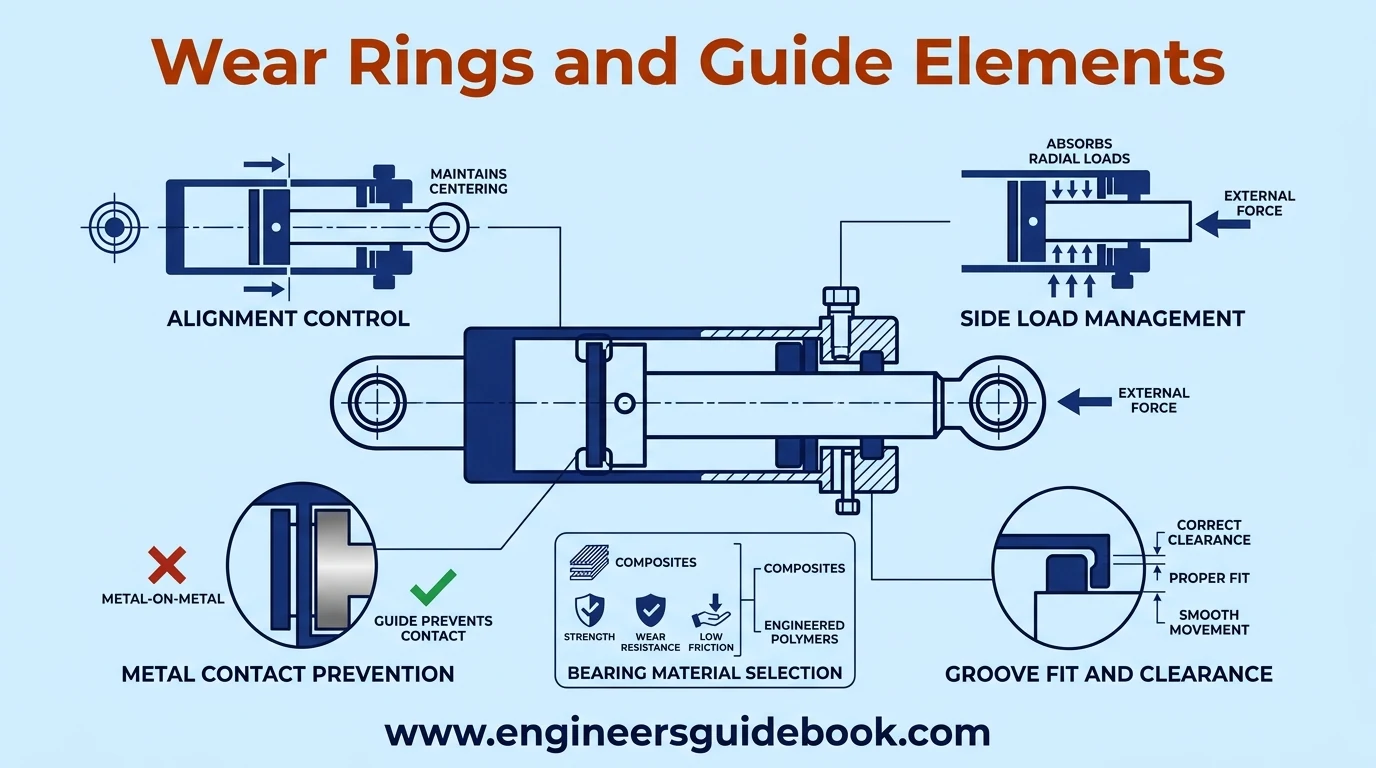
7. Wear Rings and Guide Elements
Wear rings and guide elements provide mechanical support inside hydraulic cylinders. They guide the piston and rod while preventing direct metal contact.
They do not usually seal fluid, but they protect the sealing system. Without proper guidance, seals become overloaded, distorted, and prematurely worn.
7.1 Cylinder Alignment Control
Cylinder alignment control keeps moving components centered during operation. The piston should move smoothly through the bore, and the rod should pass through the gland without excessive side pressure.
Wear rings maintain this alignment. They create a controlled bearing surface between components.
Good alignment reduces uneven seal loading. It also protects the bore, rod, gland, and piston from scoring or galling.
7.2 Side Load Management
Side loads occur when external forces act at an angle to the cylinder axis. These forces may come from misaligned mounting, uneven loading, machine movement, or heavy attachments.
If side loads are not controlled, the piston or rod presses against one side of the cylinder. This can deform seals and damage hardware.
Wear rings absorb radial loads and distribute them over a larger surface area. They are especially important in mobile machinery, lifting equipment, presses, and heavy-duty cylinders.
7.3 Metal Contact Prevention
Metal-to-metal contact creates friction, heat, scoring, and metallic debris. Once metal particles enter the hydraulic oil, they can damage pumps, valves, seals, and bearings.
Wear rings prevent this direct contact by acting as sacrificial guide elements. They are easier and cheaper to replace than rods, pistons, or cylinder barrels.
This protective function is crucial in high-load applications. A properly designed wear ring system preserves cylinder geometry and extends seal life.
7.4 Bearing Material Selection
Bearing material selection depends on load, speed, temperature, fluid compatibility, and operating environment. Common materials include filled PTFE, phenolic resin, polyester fabric composites, nylon, and other engineered polymers.
The material must have sufficient compressive strength. It must also resist wear, swelling, and thermal degradation.
Low friction is useful, but load-bearing capacity is often more important. In heavy cylinders, a weak guide material can collapse or deform, leading to seal failure.
7.5 Groove Fit and Running Clearance
Wear rings must fit correctly in their grooves. If the fit is too loose, guidance becomes ineffective. If it is too tight, friction and binding may occur.
Running clearance must allow smooth movement while limiting lateral displacement. The clearance also affects extrusion risk for nearby seals.
Proper groove design includes correct width, depth, side clearance, and material expansion allowance. Small dimensional inaccuracies can create large mechanical problems.
8. Backup Rings and Extrusion Control
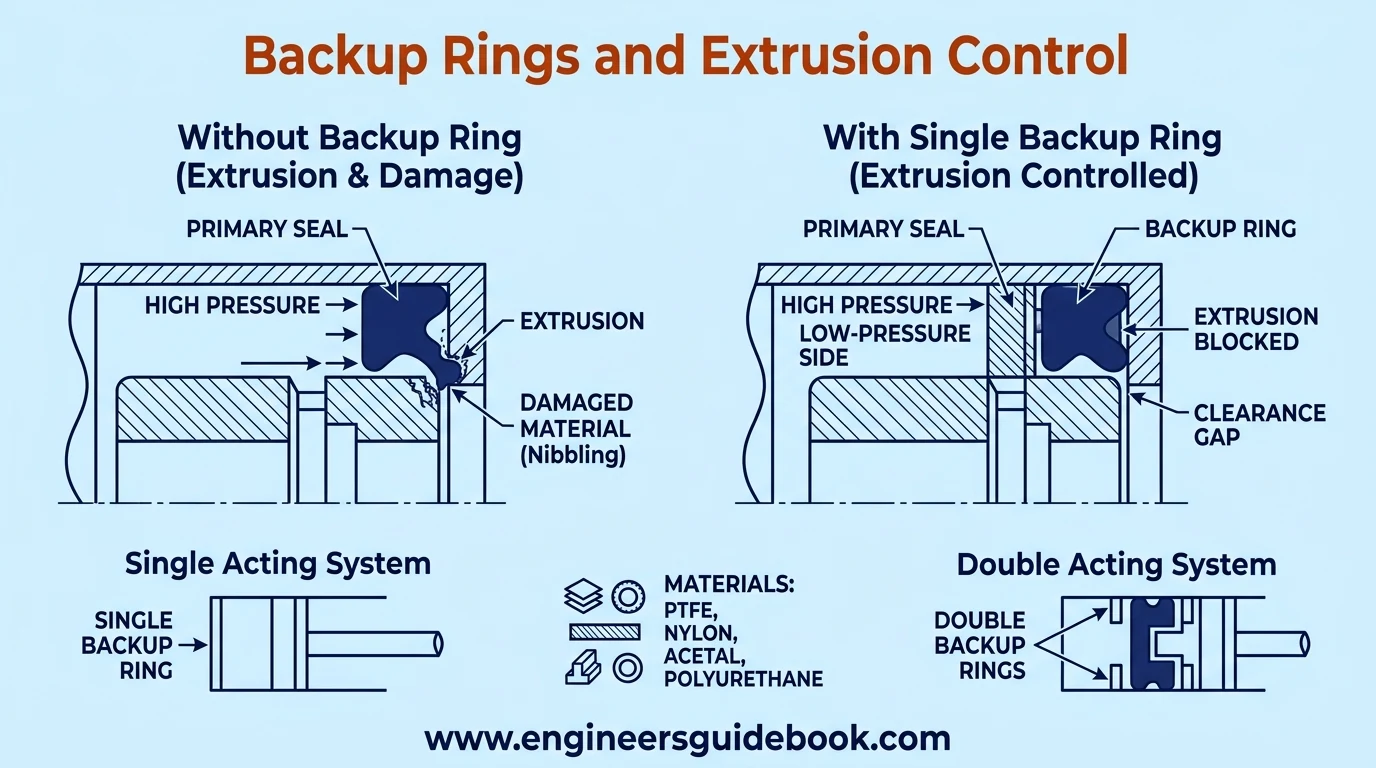
Backup rings are used to protect seals from extrusion under pressure. They are especially important where high pressure, high temperature, or large clearance gaps are present.
Extrusion control is a fundamental design concern in hydraulic systems. Once seal material is forced into a clearance gap, damage can progress rapidly.
8.1 High Pressure Seal Support
High-pressure hydraulic systems place intense force on sealing elements. Soft materials may deform under this load, especially near clearance gaps.
Backup rings support the primary seal by blocking the extrusion path. They do not usually create the main sealing action, but they preserve the seal’s shape and integrity.
In severe applications, backup rings can significantly increase seal life. They are often used with O-rings, U-cups, and other elastomeric seals.
8.2 Clearance Gap Protection
The clearance gap is the small space between moving and stationary hardware. Under pressure, seal material can be pushed into this space.
This creates nibbling, tearing, or shearing of the seal edge. The damage may appear as small missing pieces or ragged material at the seal perimeter.
Backup rings reduce this risk by filling or shielding the clearance area. They are a practical solution when hardware clearance cannot be reduced enough.
8.3 Single Backup Ring Design
A single backup ring is installed on the low-pressure side of a seal when pressure acts from one direction. It supports the seal against extrusion in that direction.
This design is common in single acting systems or static sealing arrangements with predictable pressure direction.
Correct placement is essential. If installed on the wrong side, the backup ring will not protect the seal when pressure rises.
8.4 Double Backup Ring Design
Double backup rings are used when pressure can act from both directions. They are placed on both sides of the primary seal.
This arrangement is common in double acting cylinders, reversing pressure systems, and applications with uncertain pressure direction.
Double backup rings improve seal security but require enough groove space. Their dimensions must be compatible with the seal and housing design.
8.5 Material Options for Backup Rings
Backup rings are commonly made from PTFE, nylon, acetal, polyurethane, or other thermoplastic materials. The selected material must resist pressure, temperature, wear, and fluid exposure.
PTFE backup rings offer low friction and good chemical resistance. Nylon and acetal provide strength and dimensional stability. Material choice depends on application severity.
A backup ring should be firm enough to prevent extrusion but compatible enough to work with the main seal. It is a support component with a highly strategic role.
9. Hydraulic Seal Materials
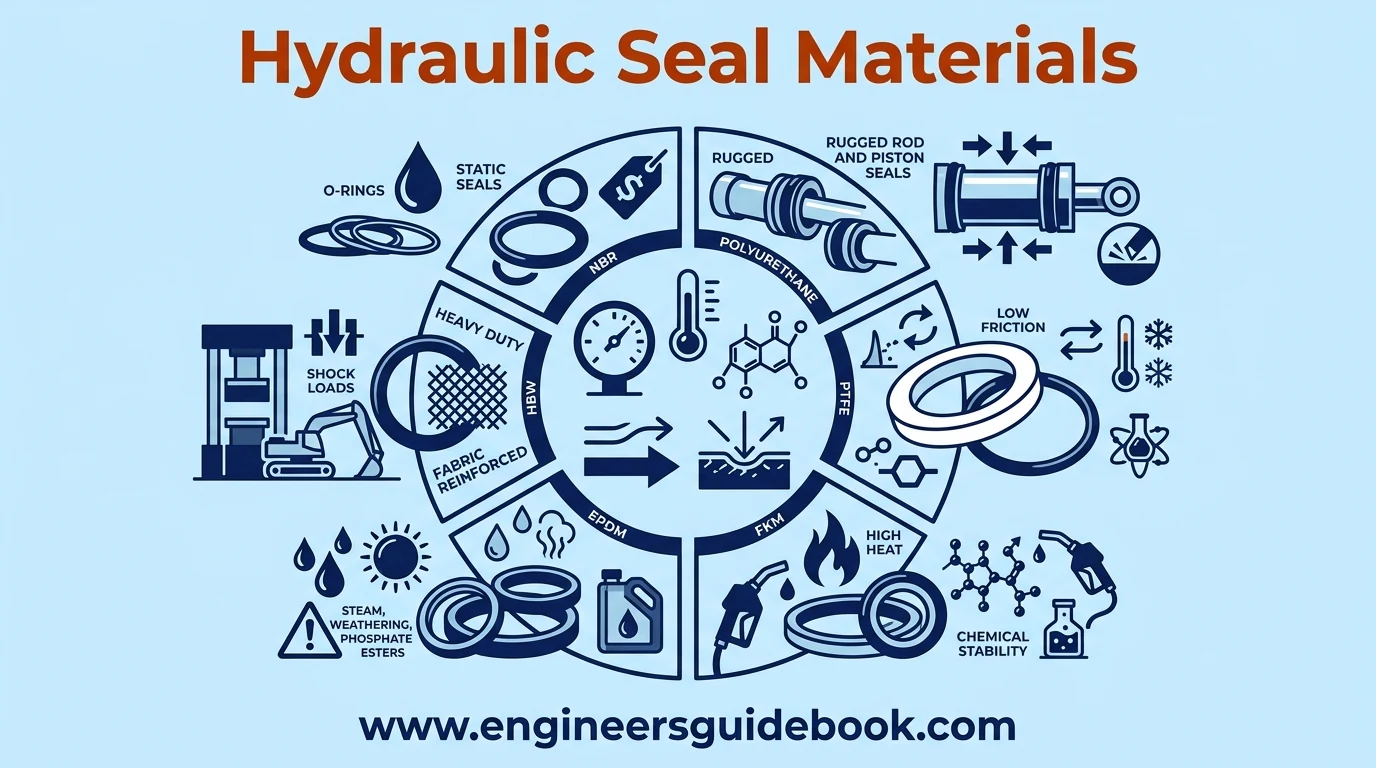
Hydraulic seal materials determine how a seal responds to pressure, temperature, movement, fluid chemistry, and wear. Material selection is one of the most important decisions in sealing design.
No single material is best for every application. Each has strengths, limitations, and ideal operating conditions.
9.1 Nitrile Rubber
Nitrile rubber, often called NBR, is one of the most common materials for hydraulic seals. It offers good compatibility with mineral oil-based hydraulic fluids and provides reliable elasticity.
It is cost-effective and suitable for many general-purpose hydraulic systems. O-rings, static seals, and some dynamic seals are frequently made from nitrile.
Its limitations include reduced resistance to high temperature, ozone, weathering, and certain synthetic fluids. For standard industrial service, however, it remains a practical and widely used option.
9.2 Polyurethane
Polyurethane is known for high abrasion resistance, tear strength, and extrusion resistance. It is widely used in rod seals, piston seals, and wiper seals.
This material performs well in mobile equipment and high-pressure applications. It can tolerate harsh mechanical conditions better than many rubber compounds.
However, not all polyurethane grades are the same. Some may be sensitive to hydrolysis, high temperature, or specific hydraulic fluids. Correct grade selection is essential.
9.3 PTFE
PTFE is valued for extremely low friction, excellent chemical resistance, and wide temperature capability. It is often used where smooth motion and low stick-slip are required.
Because PTFE has limited elasticity, it is commonly used with an energizer such as an O-ring. The energizer applies initial force, while the PTFE sealing element provides low-friction contact.
Filled PTFE compounds can improve wear resistance and load capacity. Bronze, carbon, glass, and other fillers are used to modify performance.
9.4 FKM
FKM is a fluorocarbon elastomer selected for heat resistance and chemical stability. It performs better than nitrile in high-temperature or aggressive-fluid environments.
It is commonly used in specialized hydraulic systems, fuel-contact applications, and process equipment where standard elastomers degrade too quickly.
FKM is more expensive than many general-purpose materials, but its durability can justify the cost in severe service. It is chosen when chemical and thermal resilience are priorities.
9.5 EPDM
EPDM is used where resistance to water, steam, weathering, and certain phosphate ester fluids is required. It is not generally suitable for mineral oil-based hydraulic fluids.
This material has good ozone and aging resistance. It can perform well in selected fluid systems where nitrile or polyurethane may not be compatible.
Material compatibility must be verified carefully before using EPDM in hydraulic applications. Using it with the wrong fluid can cause rapid swelling or degradation.
9.6 Fabric Reinforced Compounds
Fabric reinforced compounds combine elastomeric sealing properties with textile reinforcement. This gives the seal improved strength, dimensional stability, and extrusion resistance.
These materials are often used in heavy-duty hydraulic cylinders, presses, and large industrial equipment. They tolerate shock loads and high pressure better than many unreinforced elastomers.
Their structure helps prevent deformation under load. In rugged applications, fabric reinforcement provides a strong defense against mechanical fatigue.
10. Material Selection Factors
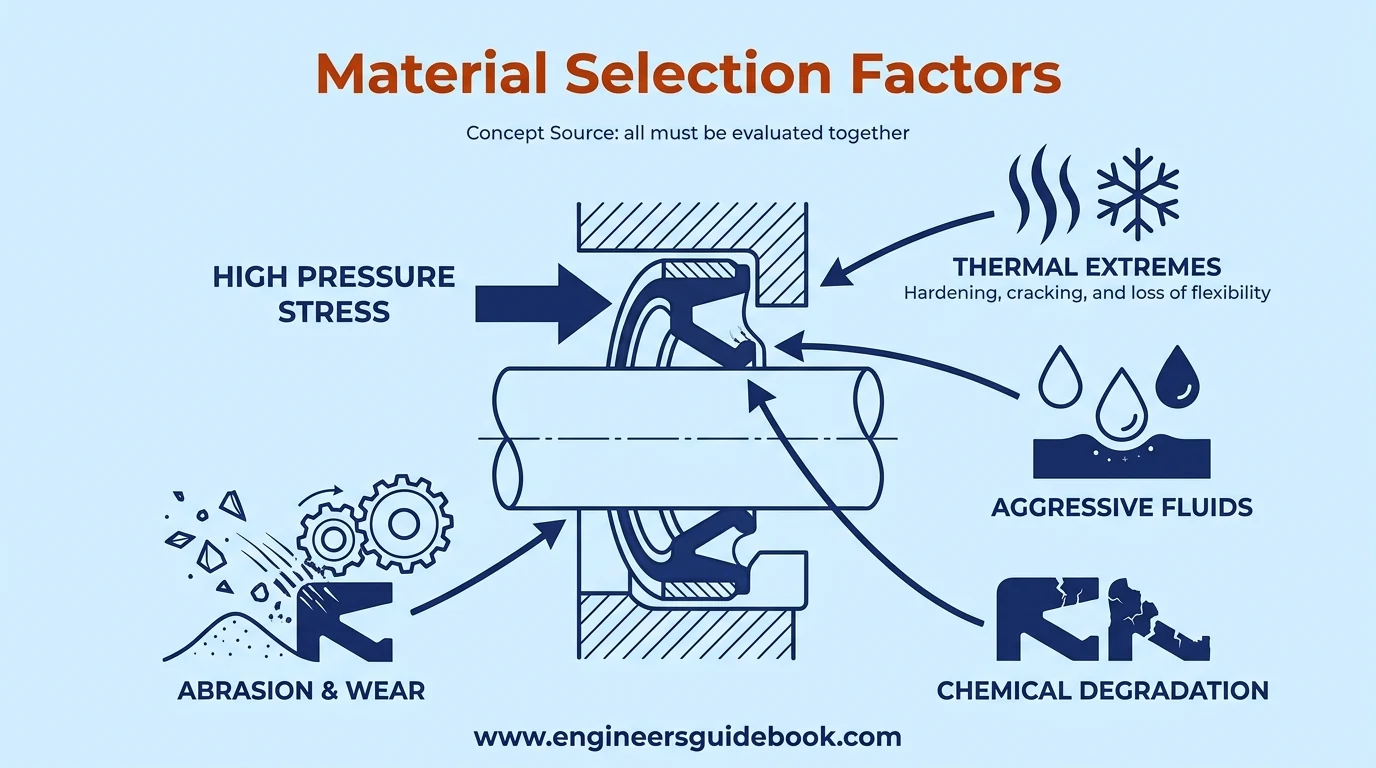
Material selection should be based on the complete operating environment. Pressure, temperature, fluid, speed, contamination, and mechanical load must all be evaluated together.
A seal material that works well in one machine may fail quickly in another. Selection must be application-specific.
10.1 Pressure Compatibility
Pressure compatibility determines whether the material can resist deformation, extrusion, and mechanical damage under hydraulic load.
Soft elastomers may seal well at low pressure but fail in high-pressure systems without backup support. Harder materials may resist extrusion but generate more friction.
The correct material must match maximum pressure, pressure spikes, and clearance gap conditions. Normal operating pressure alone is not enough for selection.
10.2 Temperature Resistance
Temperature affects hardness, elasticity, friction, and chemical stability. High temperature can cause hardening, cracking, shrinkage, and loss of sealing force.
Low temperature can make seals stiff and less responsive. A rigid seal lip may fail to follow surface movement, creating leakage.
Temperature resistance must include both fluid temperature and ambient conditions. Local heat generated by friction should also be considered.
10.3 Fluid Compatibility
Fluid compatibility is critical. Hydraulic fluids contain base oils and additives that can interact with seal materials.
Incompatible fluids may cause swelling, softening, hardening, blistering, or chemical decomposition. These changes distort the seal and reduce performance.
Compatibility should be checked against mineral oils, synthetic fluids, water-glycol fluids, phosphate esters, biodegradable fluids, and cleaning chemicals where applicable.
10.4 Abrasion Resistance
Abrasion resistance is necessary where seals face contamination, rough surfaces, high cycle rates, or dirty operating environments.
Abrasive particles can cut and polish seal lips until sealing force is lost. This is common in construction, agriculture, mining, cement, and steel applications.
Polyurethane and reinforced compounds are often selected for abrasion resistance. However, contamination control and surface finish remain equally important.
10.5 Chemical Stability
Chemical stability refers to the material’s ability to resist degradation from fluids, additives, cleaning agents, gases, and environmental exposure.
A chemically unstable seal may crack, swell, soften, or lose elasticity. The damage may occur gradually, making diagnosis difficult.
Strong chemical stability is important in process plants, marine systems, fire-resistant hydraulic systems, and equipment exposed to aggressive media. Material data sheets and supplier guidance should be reviewed carefully.
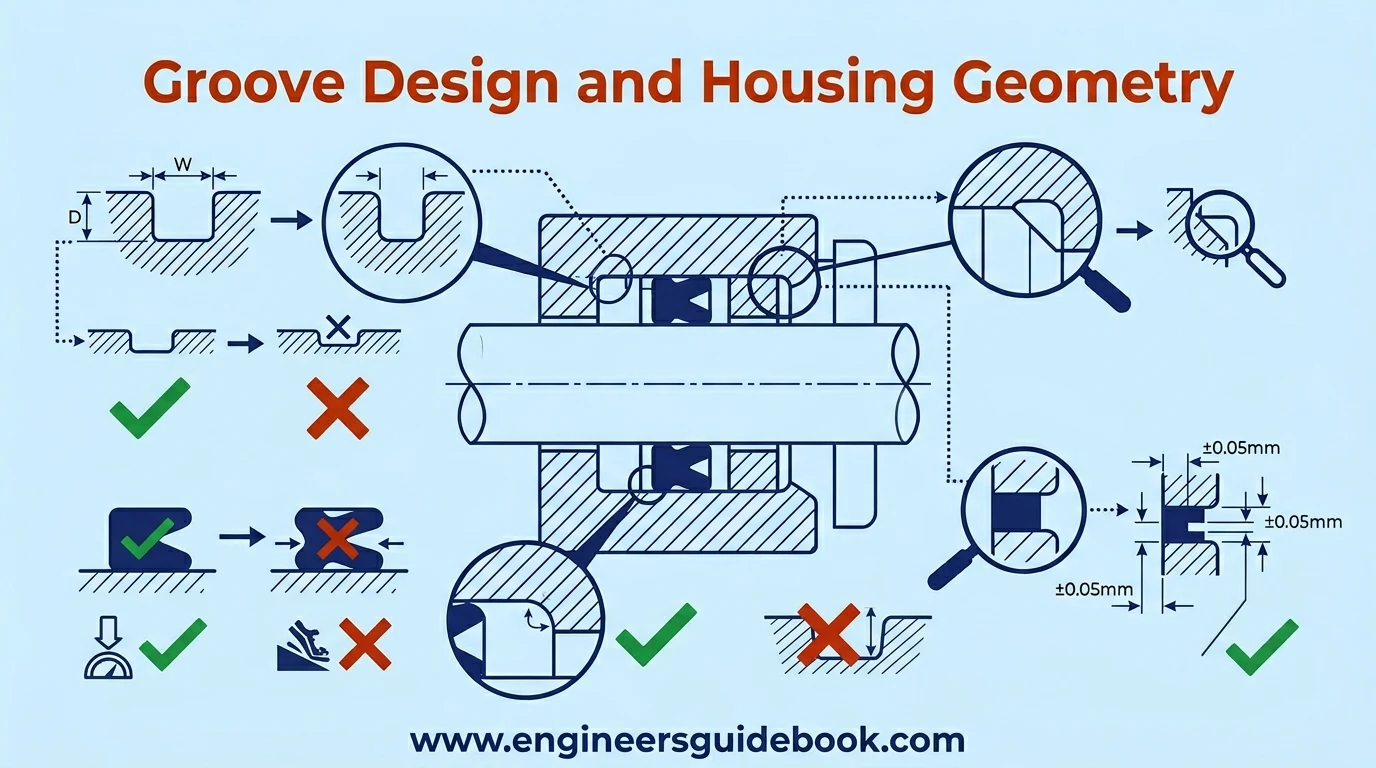
11. Groove Design and Housing Geometry
Groove design and housing geometry determine how the seal sits, compresses, moves, and reacts to pressure. Even a premium seal can fail if the groove is incorrect.
The seal and housing must function as one engineered system. Dimensions, tolerances, chamfers, radii, and clearances all influence sealing behavior.
11.1 Groove Width and Depth
Groove width and depth control seal compression and movement. If the groove is too shallow, the seal may be over-compressed. If it is too deep, the seal may not generate enough sealing force.
Incorrect groove width can cause twisting, instability, or insufficient space for thermal expansion. Dynamic seals need enough room to move slightly without losing support.
Manufacturer groove recommendations should be followed closely. Improvised dimensions often lead to leakage or early wear.
11.2 Seal Squeeze and Compression
Seal squeeze is the intentional deformation applied during installation. It creates initial contact between the seal and mating surface.
Proper squeeze helps the seal work at low pressure before hydraulic pressure energizes it. Too little squeeze causes leakage. Too much squeeze increases friction, heat, and wear.
Compression must be controlled according to seal type and material. Elastomers, PTFE rings, and compact seals all require different design considerations.
11.3 Chamfer and Radius Design
Chamfers and radii help protect seals during installation and operation. Sharp edges can cut, shave, or tear sealing lips.
A proper lead-in chamfer allows the seal to slide into position without damage. Rounded groove edges reduce stress concentration and help prevent cutting.
This detail may appear minor, but it has major practical value. Many seals are damaged during assembly because hardware edges were not properly prepared.
11.4 Tolerance Control
Tolerance control ensures that groove dimensions, clearances, and mating surfaces remain within acceptable limits. Hydraulic seals are sensitive to small dimensional variations.
If tolerances are too loose, extrusion and leakage may occur. If they are too tight, the seal may bind or overheat.
Precision machining is especially important in high-pressure and high-speed applications. Reliable sealing begins with accurate hardware.
11.5 Installation Space Optimization
Hydraulic cylinders often have limited space for sealing components. Designers must fit rod seals, buffer seals, wipers, wear rings, and backup rings into compact areas.
Installation space optimization requires careful profile selection. A compact seal may save space, but it still needs proper support and clearance.
The goal is not simply to reduce size. The goal is to achieve reliable sealing within available geometry while maintaining assembly practicality.
12. Surface Finish Requirements
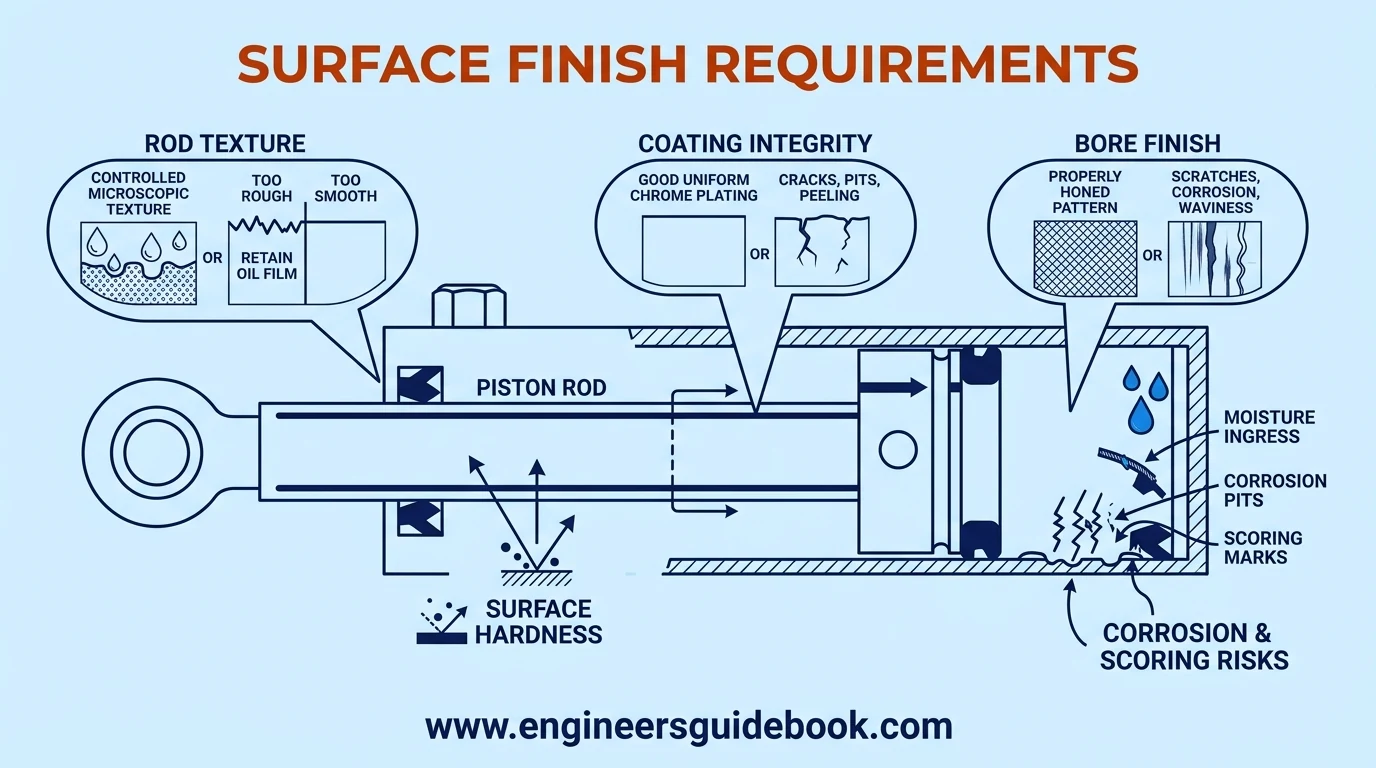
Surface finish has a direct effect on seal life. The sealing surface must support lubrication, reduce wear, and maintain uniform contact with the seal lip.
Poor surface finish can destroy seals quickly. It can also cause leakage even when seal material and groove design are correct.
12.1 Rod Roughness
Rod roughness must be controlled within an appropriate range. A rough rod acts like abrasive paper against the seal lip.
A surface that is too smooth can also create problems because it may not retain enough oil film for lubrication. The ideal surface has a controlled microscopic texture.
Rod roughness should be evaluated along with hardness, straightness, roundness, and coating condition. A seal performs only as well as the surface it runs on.
12.2 Cylinder Bore Finish
Cylinder bore finish affects piston seal wear, internal leakage, and motion smoothness. A properly honed bore provides a suitable surface for sealing and lubrication.
Deep scratches, corrosion, waviness, or poor honing patterns can damage piston seals. They can also create bypass paths for oil.
Bore finish quality is especially important in long-stroke cylinders and high-cycle systems. Consistent surface texture supports consistent performance.
12.3 Surface Hardness
Surface hardness protects rods and bores from scoring, indentation, and abrasive wear. A soft surface can be damaged by particles, side loading, or seal contact.
Hard surfaces maintain geometry for longer periods. This helps seals maintain uniform contact pressure and stable leakage control.
However, hardness alone is not enough. The surface must also be smooth, corrosion-resistant, and free from defects.
12.4 Chrome Plating Quality
Chrome plating is commonly used on hydraulic rods because it provides hardness, corrosion resistance, and wear protection.
Good chrome plating must be uniform, adherent, and free from cracks, pits, and peeling. Poor plating can damage seals and allow corrosion to begin beneath the surface.
If chrome flakes or becomes rough, the rod seal will deteriorate quickly. Rod coating quality should always be inspected during cylinder maintenance.
12.5 Corrosion and Scoring Risks
Corrosion and scoring create direct leakage paths. A seal lip cannot maintain full contact over pits, grooves, or scratches.
Corrosion often begins when rods are exposed to moisture, chemicals, or damaged wipers. Scoring may result from contamination, side loading, poor alignment, or metal particles in the oil.
Once the rod or bore is damaged, replacing only the seal is rarely enough. The surface must be repaired, polished, rechromed, or replaced to restore sealing reliability.
13. Operating Conditions
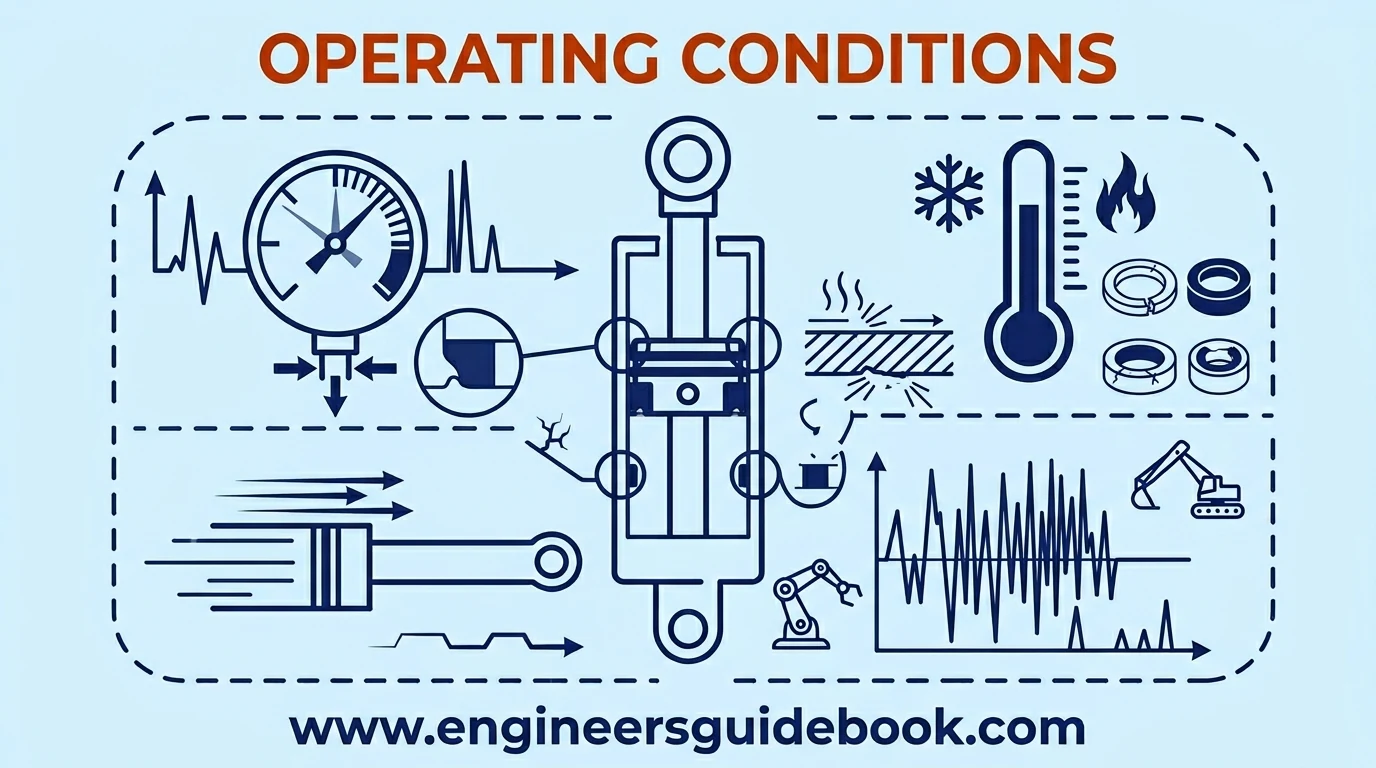
Operating conditions define the real environment in which hydraulic seals must survive. Pressure, temperature, speed, and duty cycle all influence seal performance.
A seal should never be selected by size alone. It must be selected according to the full operating envelope.
13.1 System Pressure
System pressure determines the force acting on seals. Higher pressure improves sealing force in some designs but also increases extrusion risk and mechanical stress.
The selected seal must withstand normal working pressure and maximum system pressure. Safety margins should be considered, especially in heavy-duty systems.
Pressure also affects friction. As sealing force increases, contact stress may rise, generating more heat and wear. This balance must be managed carefully.
13.2 Pressure Spikes
Pressure spikes are sudden increases in hydraulic pressure. They may occur due to shock loading, rapid valve closure, load impact, or sudden direction changes.
These spikes can exceed the normal pressure rating of the system for short periods. Even brief spikes can damage seals through extrusion, cracking, or lip deformation.
Buffer seals, backup rings, accumulators, pressure relief valves, and improved circuit design can help manage pressure spikes. Seal selection should always account for transient loads.
13.3 Operating Temperature
Operating temperature influences seal elasticity, hardness, friction, and chemical resistance. Excessive heat accelerates aging and can cause hardening or cracking.
Low temperature can make seals brittle or slow to respond. This may lead to leakage during startup or cold operation.
Temperature evaluation should include fluid temperature, ambient temperature, frictional heat, and nearby heat sources. Thermal stability is vital for long service life.
13.4 Rod Speed
Rod speed affects lubrication, friction, heat generation, and wear. High-speed movement can increase temperature at the sealing interface.
Very slow movement can cause stick-slip, especially when friction is high or lubrication is poor. This creates jerky motion and poor control.
Seal material and profile must match the actual speed range. Low-friction designs may be required for fast or precision movement.
13.5 Duty Cycle Severity
Duty cycle severity refers to how often and how intensely the hydraulic system operates. A cylinder used occasionally has different sealing demands than one running continuously in a production line.
High-cycle systems generate more frictional heat and wear. Heavy-duty cycles with shock loads create additional mechanical stress.
Seal selection should reflect operating hours, stroke frequency, load variation, temperature buildup, and maintenance access. Severe duty requires stronger materials, better guidance, and more disciplined contamination control.
14. Hydraulic Fluid Compatibility
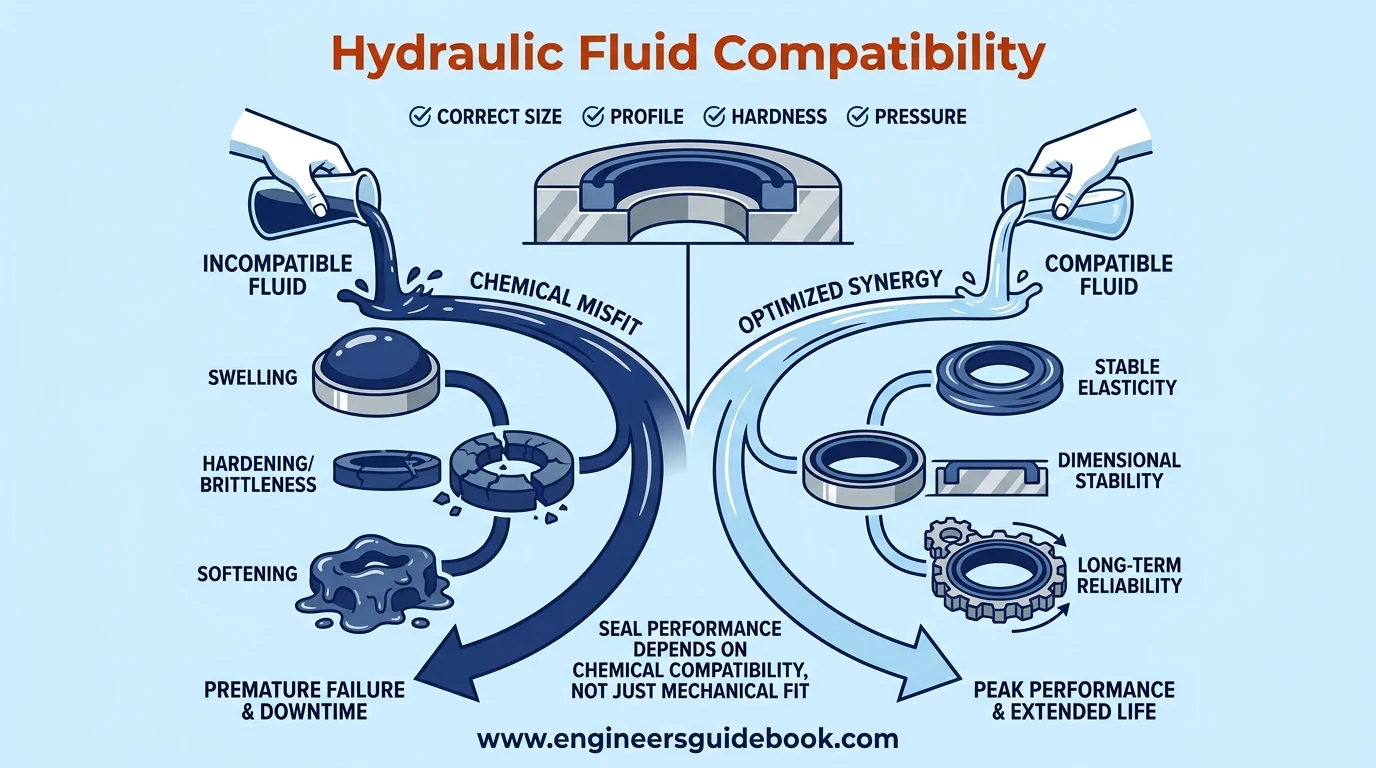
Hydraulic fluid compatibility is one of the most decisive factors in seal performance. A seal may have the correct size, profile, hardness, and pressure rating, yet still fail prematurely if the fluid attacks the material.
The relationship between seal and fluid is chemical as much as mechanical. Hydraulic oils contain base fluids, viscosity modifiers, anti-wear additives, oxidation inhibitors, detergents, and sometimes water or synthetic esters. Each ingredient can influence swelling, hardening, softening, elasticity, and long-term dimensional stability.
14.1 Mineral Oil Fluids
Mineral oil fluids are the most common hydraulic fluids used in industrial and mobile equipment. They are generally compatible with nitrile rubber, polyurethane, PTFE, and many standard hydraulic seal materials.
Their popularity comes from good lubrication properties, reasonable cost, and wide availability. In conventional hydraulic cylinders, mineral oil fluids provide a stable operating medium for rod seals, piston seals, wipers, and static seals.
However, compatibility should not be assumed blindly. Additive packages can alter seal behavior, especially at elevated temperatures. Anti-wear additives, oxidation inhibitors, and viscosity improvers may interact differently with specific elastomers. A mineral oil that performs well in one system may not behave identically in another.
14.2 Synthetic Hydraulic Fluids
Synthetic hydraulic fluids are used where improved temperature stability, oxidation resistance, or specialized performance is required. These fluids may include synthetic hydrocarbons, polyalphaolefins, phosphate esters, or other engineered formulations.
Seal compatibility with synthetic fluids requires careful verification. Some synthetic fluids can cause swelling or shrinkage in materials that perform well with mineral oil. Others may extract plasticizers from elastomers, leaving the seal brittle and vulnerable.
PTFE and FKM are often selected for synthetic fluid applications because of their strong chemical resistance. Still, the final selection should be based on actual fluid chemistry, operating temperature, pressure, and supplier recommendations.
14.3 Fire Resistant Fluids
Fire resistant hydraulic fluids are used in environments where leaked oil could ignite near hot surfaces, flames, molten metal, or electrical hazards. Steel mills, foundries, die-casting machines, mining systems, and offshore equipment often use these fluids.
These fluids may be water-glycol based, phosphate ester based, or synthetic fire resistant formulations. Their chemistry can be aggressive toward standard seal materials. A seal designed for mineral oil service may fail rapidly in fire resistant fluid.
Material selection is critical. EPDM may work with some phosphate ester fluids, while nitrile and polyurethane may not be suitable in certain formulations. The seal supplier should confirm compatibility before installation because trial-and-error selection can create expensive and dangerous failures.
14.4 Water Glycol Fluids
Water glycol fluids provide fire resistance by combining water content with glycol-based chemistry. They are useful in high-fire-risk applications, but they create specific sealing challenges.
The water content can affect some polyurethane grades through hydrolysis, especially at elevated temperatures. Certain elastomers may swell, soften, or lose mechanical strength. Corrosion protection and microbial control also become important in the overall hydraulic system.
Seals used with water glycol fluids must resist water absorption, chemical degradation, and changes in hardness. EPDM, selected nitrile grades, and specialized compounds may be suitable depending on the formulation. Compatibility testing is strongly recommended for severe-duty equipment.
14.5 Biodegradable Fluids
Biodegradable hydraulic fluids are used where environmental protection is important. Forestry machinery, agricultural equipment, marine systems, waterway equipment, and outdoor construction machines often use biodegradable fluids to reduce ecological damage from leakage.
These fluids may be vegetable-oil based, synthetic ester based, or other environmentally acceptable formulations. Their interaction with seals can differ significantly from mineral oil. Some biodegradable fluids may cause swelling, softening, or accelerated aging in standard materials.
Temperature control is also important. Certain biodegradable fluids oxidize or degrade faster under heat, creating acidic byproducts that can attack seals. For dependable service, seal material, fluid type, operating temperature, and maintenance interval must be evaluated together.
15. Hydraulic Seal Applications
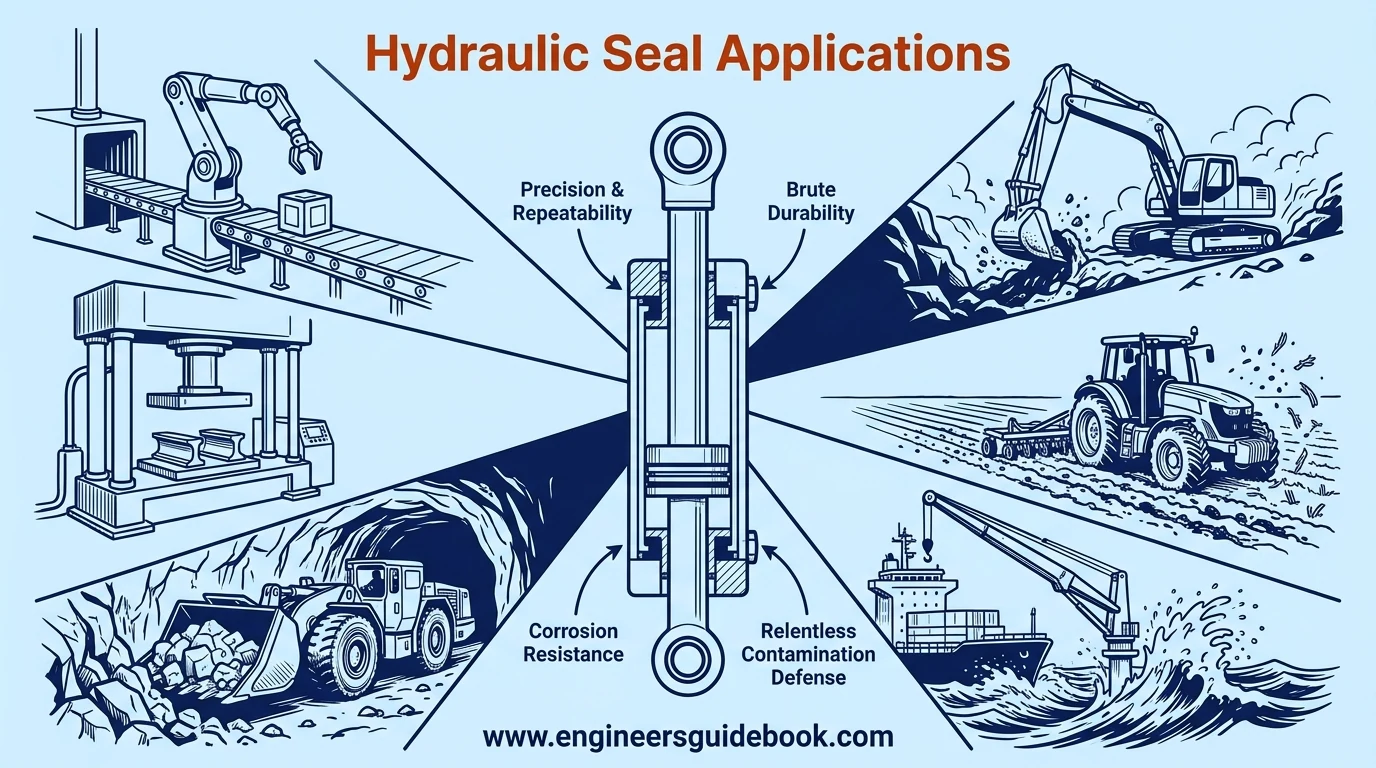
Hydraulic seals are used wherever pressurized fluid creates controlled movement or force. Their applications range from compact industrial actuators to massive heavy-duty cylinders operating in destructive environments.
The same basic sealing principles apply across industries, but each application has different priorities. Some require precision. Some require brute durability. Others require cleanliness, corrosion resistance, or extreme contamination defense.
15.1 Industrial Hydraulic Cylinders
Industrial hydraulic cylinders are used in presses, lifting tables, clamping systems, machine tools, conveyors, automation lines, and material handling equipment. These cylinders usually operate in controlled environments, but reliability requirements are high.
In industrial systems, seal failure can interrupt production, damage products, or create safety risks. Rod seals must prevent external leakage, while piston seals must maintain force and positioning accuracy. Static seals protect gland and port connections.
Smooth motion is often important. Stick-slip, internal bypass, or leakage can reduce machine accuracy. Proper seal selection helps maintain repeatable movement and stable hydraulic performance.
15.2 Mobile Construction Equipment
Mobile construction equipment uses hydraulic cylinders in excavators, loaders, bulldozers, graders, cranes, telehandlers, and dump trucks. These machines operate in dust, mud, rain, impact, vibration, and irregular loading.
Seals in construction equipment must be tough. Rod seals must resist high pressure and shock loads. Wiper seals must scrape dirt and moisture from exposed rods. Wear rings must handle side loading caused by uneven forces and harsh movement.
Polyurethane seals, aggressive wipers, and strong guide elements are commonly used in these applications. The sealing system must be designed for punishment, not laboratory cleanliness.
15.3 Agricultural Machinery
Agricultural machinery operates in soil, moisture, fertilizer residue, crop debris, and outdoor weather. Tractors, harvesters, sprayers, seeders, balers, and loaders all depend on hydraulic sealing systems.
The environment is abrasive and often chemically active. Dust and fine soil particles can damage rod seals if wipers are weak or worn. Fertilizers and moisture can contribute to corrosion on rod surfaces.
Agricultural equipment may also sit idle for long periods between seasons. Seals must resist aging, compression set, and environmental degradation during storage, then return to reliable service under heavy operating loads.
15.4 Marine Hydraulic Systems
Marine hydraulic systems face saltwater, humidity, corrosion, and limited maintenance access. Ship steering systems, deck machinery, cranes, hatch covers, winches, stabilizers, and offshore equipment all use hydraulic seals.
The marine environment is especially severe for exposed cylinder rods. Saltwater can attack damaged chrome plating and create corrosion pits. Once pitting starts, rod seals lose their contact integrity and leakage becomes difficult to control.
Marine seal systems often require corrosion-resistant rod coatings, durable wipers, compatible fluids, and materials with strong chemical resistance. Reliability is essential because repairs at sea or offshore are costly and logistically difficult.
15.5 Mining Equipment
Mining equipment operates in abrasive dust, moisture, shock loading, heavy vibration, and continuous duty cycles. Hydraulic seals are used in loaders, drilling rigs, roof supports, haul trucks, crushers, and material handling equipment.
In mining, contamination is relentless. Fine abrasive particles can destroy seal lips, score rods, and contaminate hydraulic oil. Wiper design and filtration discipline are therefore critical.
Seals for mining equipment must offer high abrasion resistance, extrusion resistance, and mechanical toughness. Fabric reinforced materials, advanced polyurethane, heavy-duty wipers, and strong wear rings are commonly used to survive this punishing environment.
15.6 Manufacturing Machinery
Manufacturing machinery uses hydraulic seals in presses, injection molding machines, forming equipment, packaging systems, assembly lines, and automation devices. These applications often demand consistent motion, repeatable force, and minimal downtime.
Cleanliness may be more controlled than in outdoor equipment, but accuracy matters more. Internal leakage can affect pressure holding. Friction can disturb smooth movement. External leakage can contaminate products, floors, or production cells.
Seal selection in manufacturing should consider pressure, cycle frequency, oil cleanliness, maintenance access, and machine criticality. A small seal failure can stop an entire production line.
16. Heavy Duty Equipment Applications
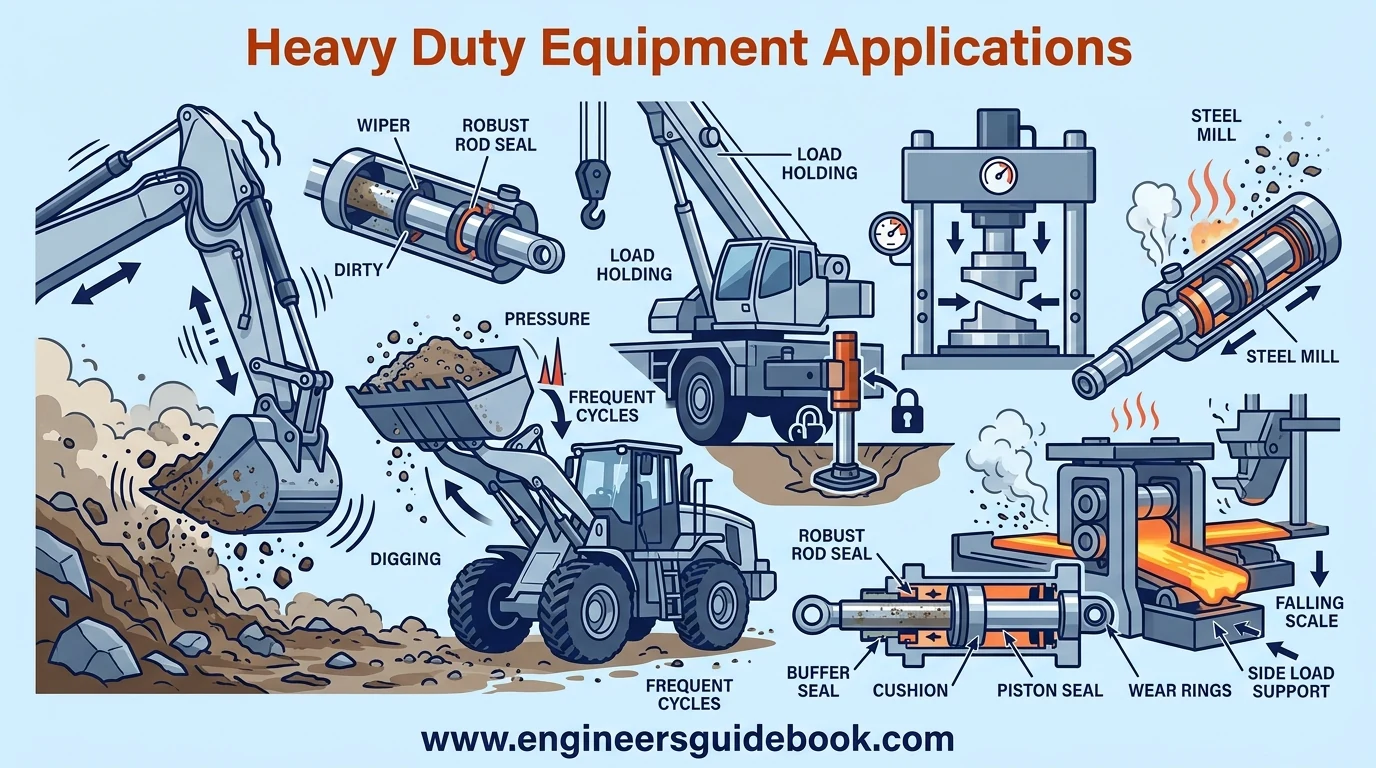
Heavy-duty equipment places extreme demands on hydraulic seals. Loads are high, movement is often aggressive, and environmental conditions are rarely forgiving.
In these applications, seals do not merely prevent leakage. They protect machine availability, operator safety, and component life. Strong sealing systems are part of the machine’s structural dependability.
16.1 Excavator Boom Cylinders
Excavator boom cylinders handle heavy lifting, digging forces, vibration, and exposure to soil, mud, and impact. The cylinder rods extend into harsh surroundings during operation, then retract through the sealing system.
Rod seals must resist pressure and movement under changing load. Wipers must remove abrasive contamination before it enters the gland area. Wear rings must support the rod and piston against side loading caused by digging forces.
Failure in a boom cylinder can reduce lifting power, create visible oil leakage, and compromise productivity. For this reason, robust polyurethane seals, buffer seals, and heavy-duty wiper profiles are commonly preferred.
16.2 Loader Lift Cylinders
Loader lift cylinders experience frequent cycles, rapid movement, and uneven loading. They lift buckets filled with gravel, soil, debris, or bulk material, often under shock conditions.
The sealing system must tolerate pressure spikes and contamination. Rod seals control external leakage, piston seals maintain lifting force, and wear rings manage radial loads during bucket movement.
Because loaders work close to dust and abrasive particles, wiper performance is essential. A weak wiper allows contamination to enter the gland, where it damages the rod seal and bearing surface.
16.3 Crane Stabilizer Cylinders
Crane stabilizer cylinders must hold loads safely. Their function is not only movement but also secure support. Leakage, drift, or internal bypass can affect machine stability.
Piston seals must provide strong pressure holding capability. Static seals must prevent leakage at fixed joints. Rod seals must resist external leakage during extension, retraction, and load holding.
The safety implications are serious. Stabilizer cylinder sealing systems should be selected with conservative margins, proper material verification, and disciplined inspection intervals.
16.4 Hydraulic Press Cylinders
Hydraulic press cylinders operate under high force and often high pressure. They are used in forming, stamping, molding, compacting, straightening, and assembly operations.
Seal performance affects force generation, pressure holding, and operational consistency. Piston seals prevent internal bypass, while rod seals prevent external oil loss. Backup rings may be needed to resist extrusion under high pressure.
Press cylinders may hold pressure for extended periods. Compression set, fluid compatibility, and thermal stability become important. A leaking press cylinder can reduce product quality and create unsafe working conditions.
16.5 Steel Mill Cylinders
Steel mill cylinders operate near heat, scale, water, vibration, and heavy mechanical shock. They are used in rolling mills, furnace equipment, slab handling, coil processing, and auxiliary hydraulic systems.
The environment is highly aggressive. Hot scale and abrasive particles can damage rods and wipers. Elevated temperatures can harden seals. Water and chemicals can accelerate corrosion.
Sealing systems for steel mills often require heat-resistant compounds, strong wipers, reinforced materials, and robust contamination control. Ordinary seals may not survive long in these applications.
17. Seal Failure Modes
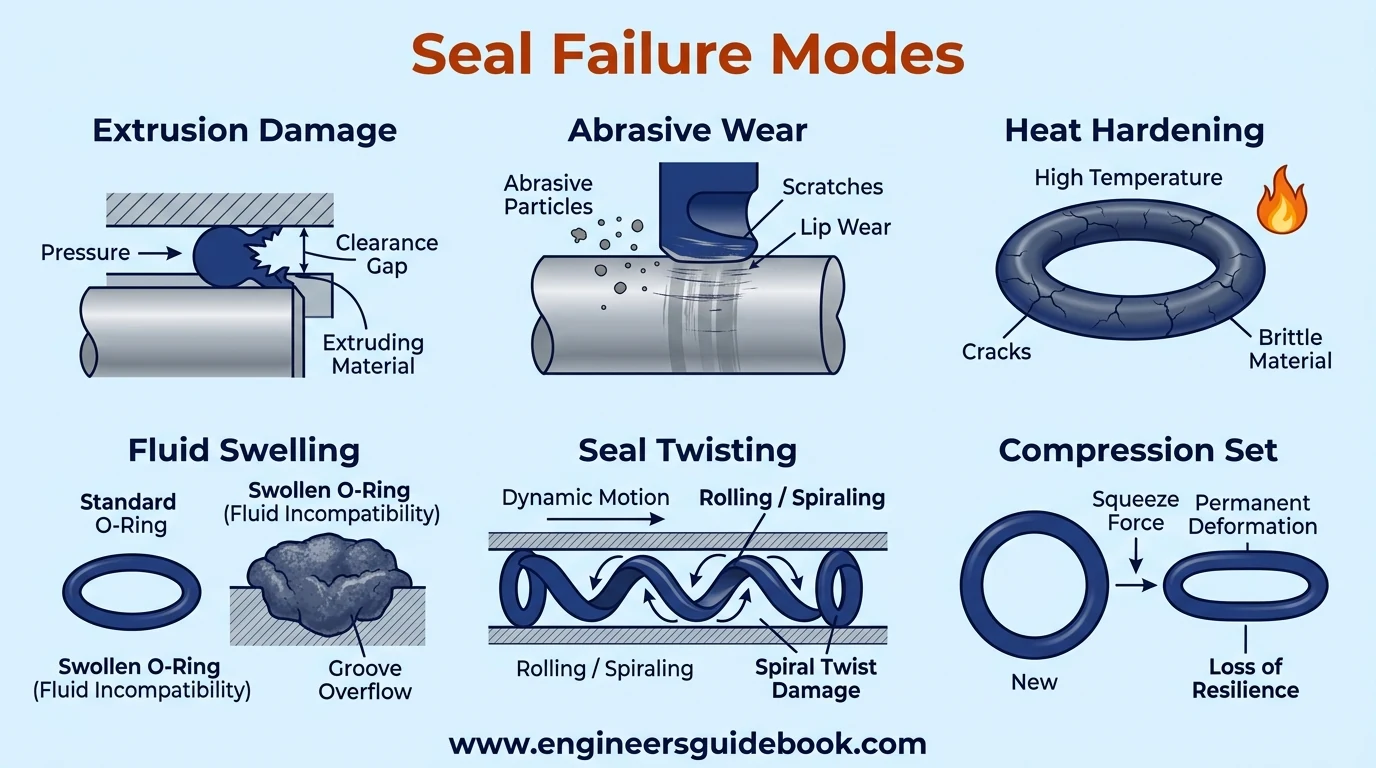
Hydraulic seal failure usually leaves evidence. The damage pattern can reveal whether the root cause is pressure, heat, contamination, chemical attack, installation damage, or hardware defects.
Understanding failure modes helps prevent repetition. Replacing a seal without studying why it failed often leads to the same failure again.
17.1 Extrusion Damage
Extrusion damage occurs when seal material is forced into the clearance gap between moving and stationary components. High pressure, excessive clearance, soft material, and elevated temperature increase this risk.
The damaged seal may show nibbling, ragged edges, torn lips, or missing material. In severe cases, the seal is cut away in fragments.
Backup rings, tighter clearances, harder materials, and improved groove design can reduce extrusion. High-pressure applications should always be reviewed for extrusion risk before seal selection.
17.2 Abrasive Wear
Abrasive wear occurs when hard particles scrape the sealing surface. Contaminated oil, dirty rods, damaged wipers, and poor maintenance practices are common causes.
The seal lip may appear polished, flattened, scratched, or unevenly worn. Rods and bores may also show scoring or dull wear bands.
Abrasive wear is often a system problem, not just a seal problem. Better filtration, improved wipers, cleaner assembly methods, and surface repair may be required to prevent recurrence.
17.3 Heat Hardening
Heat hardening occurs when elastomeric seals lose flexibility due to excessive temperature. The seal becomes rigid, cracked, glazed, or brittle.
High fluid temperature, frictional heat, poor lubrication, excessive compression, or nearby heat sources can trigger this failure. Once hardened, the seal can no longer maintain proper contact pressure.
Heat-related failure may develop gradually. Early symptoms include increased leakage, darkened material, reduced elasticity, and surface cracking. Temperature control and proper material selection are essential.
17.4 Fluid Swelling
Fluid swelling happens when the seal absorbs an incompatible hydraulic fluid or chemical. The material expands, softens, and loses dimensional stability.
A swollen seal may become difficult to remove from its groove. It may also create excessive friction, stick-slip, or jamming. In some cases, the seal material becomes gummy or friable.
Fluid swelling is a compatibility failure. The solution is not simply installing another identical seal. The fluid chemistry and seal material must be matched correctly.
17.5 Seal Twisting
Seal twisting occurs when a seal rolls, spirals, or rotates inside its groove during dynamic movement. O-rings in reciprocating service are especially vulnerable if groove design or lubrication is poor.
Twisting creates uneven stress and can cause spiral cuts or corkscrew-like damage. The seal may leak intermittently before failing completely.
Proper groove dimensions, adequate lubrication, anti-spiral profiles, and suitable dynamic seal designs help prevent this issue. A seal must remain seated and stable during motion.
17.6 Compression Set
Compression set occurs when a seal loses its ability to return to its original shape after being compressed. The material remains flattened and no longer produces enough sealing force.
This failure is common in static seals exposed to heat, long-term compression, or incompatible fluids. It can also affect dynamic seals in poorly designed grooves.
Compression set leads to leakage at low pressure and during startup. Materials with good resilience, correct squeeze, and suitable temperature resistance reduce the risk.
18. Common Causes of Seal Failure
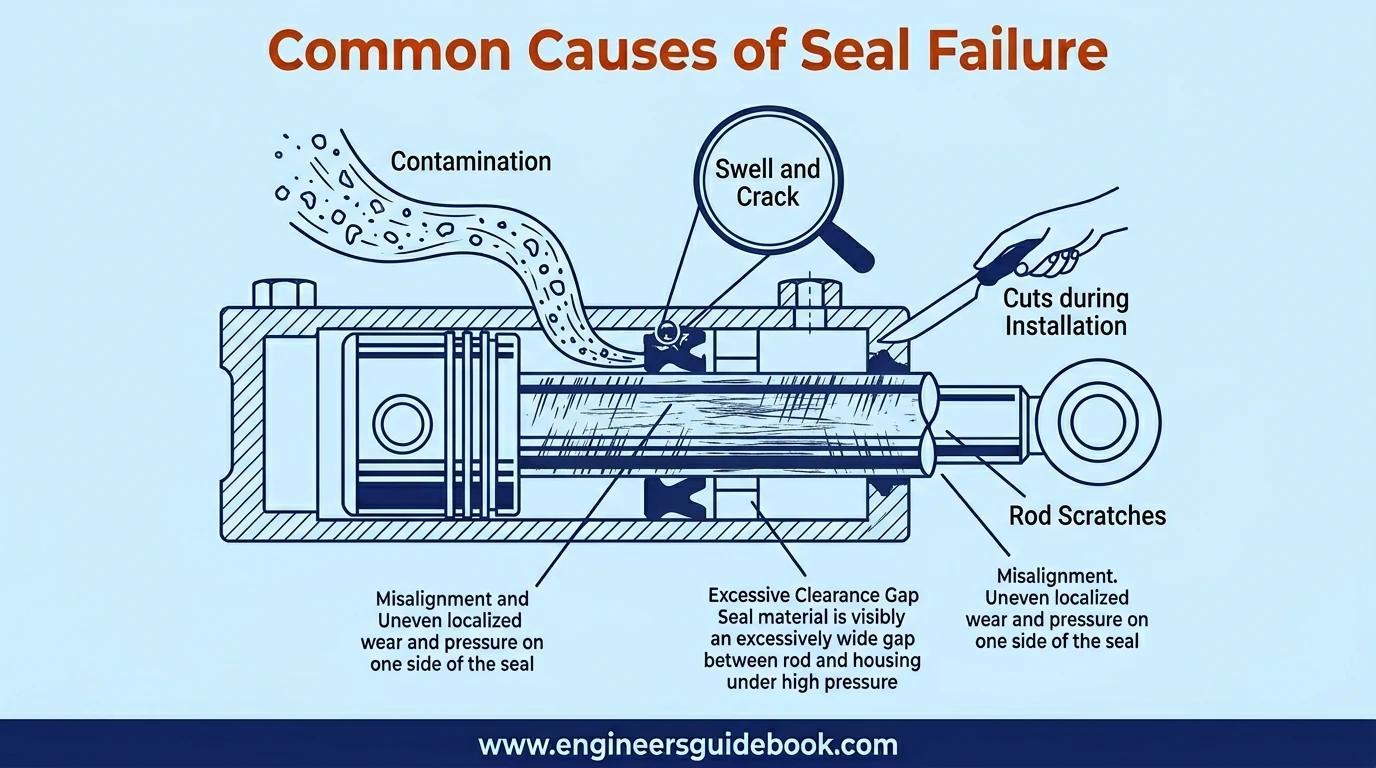
Seal failure is usually caused by a combination of factors. Incorrect material, poor installation, contamination, surface damage, clearance issues, and misalignment can interact and accelerate deterioration.
A disciplined failure investigation identifies the initiating cause rather than only the visible symptom. This is the difference between repair and true correction.
18.1 Incorrect Material Selection
Incorrect material selection is one of the most common causes of premature seal failure. A material may be too soft, too hard, chemically incompatible, or thermally unsuitable.
For example, a standard nitrile seal may perform well in mineral oil but fail in certain synthetic or fire resistant fluids. A polyurethane seal may resist abrasion but degrade in incompatible water-based fluids.
Material selection must consider pressure, temperature, fluid, speed, contamination, and environment. Choosing by price or availability alone can create recurring maintenance problems.
18.2 Poor Installation Practice
Poor installation can damage a seal before the hydraulic system starts. Sharp edges, dry assembly, twisting, excessive stretching, dirty hands, and improper tools can all create hidden defects.
A small cut on a sealing lip may become a major leakage path under pressure. A twisted seal may fail quickly during movement. An incorrectly oriented seal may never work properly.
Installation should be controlled, clean, and methodical. Correct tools and trained technicians are as important as correct seal selection.
18.3 Contaminated Hydraulic Oil
Contaminated hydraulic oil carries abrasive particles through the system. These particles damage seals, rods, bores, pumps, valves, and bearings.
Contamination may come from poor filtration, dirty reservoirs, worn components, external ingress, or careless maintenance. Once particles enter the system, they circulate and cause progressive damage.
Oil cleanliness should be managed through proper filtration, breather protection, clean oil transfer, and regular monitoring. A seal cannot survive indefinitely in dirty oil.
18.4 Damaged Rod Surface
A damaged rod surface is a direct enemy of rod seal life. Scratches, dents, rust pits, chrome flaking, and scoring cut or abrade the seal lip during every stroke.
Even a new seal will leak if the rod surface has a continuous defect. Oil can pass through grooves, while sharp edges damage the lip.
Rod inspection is essential during seal replacement. Depending on severity, the rod may require polishing, rechroming, resurfacing, or replacement.
18.5 Excessive Clearance Gap
Excessive clearance gap allows seal material to extrude under pressure. This is especially dangerous in high-pressure cylinders or systems with pressure spikes.
The clearance gap may become excessive because of poor design, wear ring failure, machining error, or component wear. Once the gap becomes too large, the seal loses support.
Backup rings can help, but they cannot always compensate for severely worn hardware. Clearance must be measured and corrected where necessary.
18.6 Misalignment and Side Loading
Misalignment and side loading create uneven pressure on seals and guide elements. The rod or piston may press harder on one side, causing localized wear.
This condition is common in poorly mounted cylinders, heavy lifting equipment, and applications where external loads are not aligned with the cylinder axis.
Wear rings can manage some side load, but they have limits. Proper cylinder mounting, alignment checks, and sufficient bearing length are required to protect the sealing system.
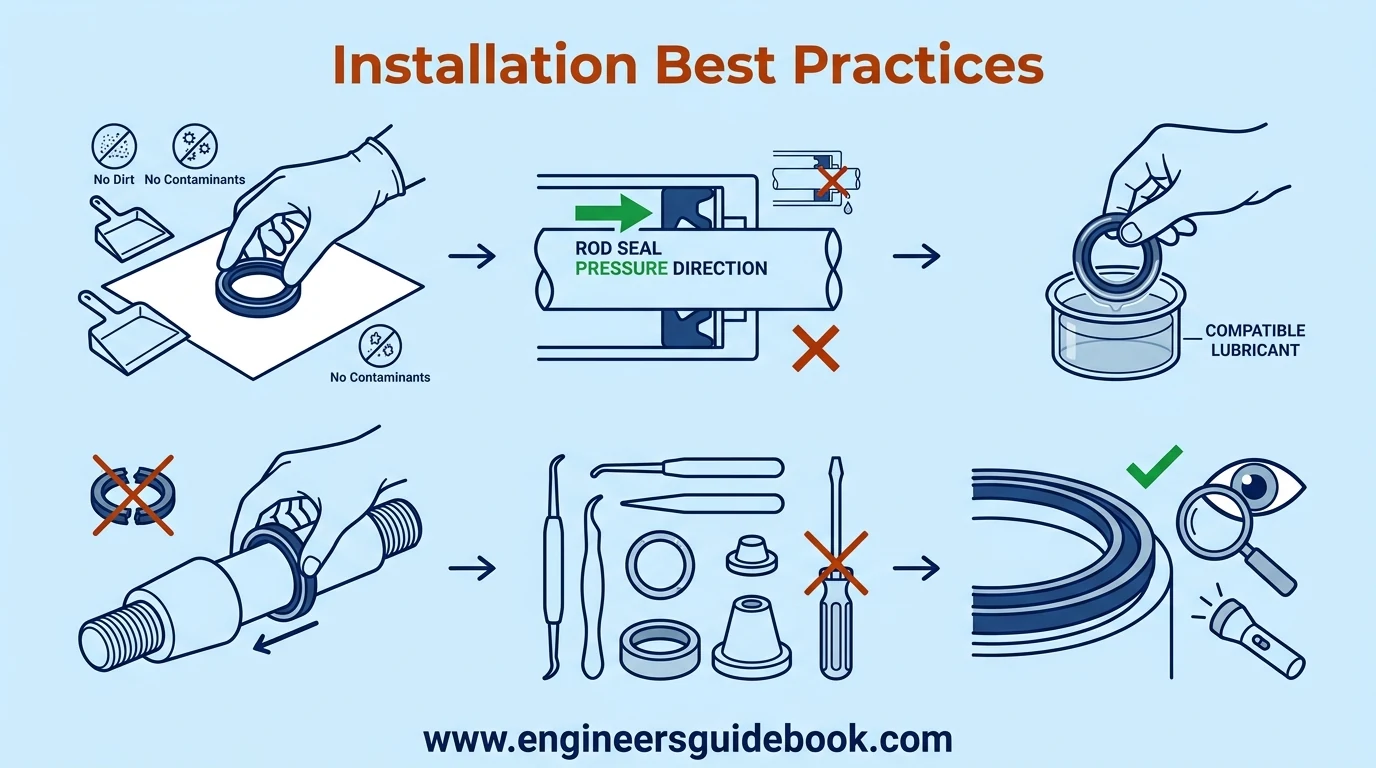
19. Installation Best Practices
Correct installation is essential for hydraulic seal reliability. Many seals fail early not because they were poorly designed, but because they were damaged during assembly.
A careful installation process protects the seal profile, preserves material integrity, and ensures the seal begins operation under proper conditions.
19.1 Clean Assembly Area
A clean assembly area prevents dirt, metal chips, fibers, and abrasive particles from entering the seal groove or hydraulic system.
Seals should be handled on clean surfaces only. Components should be washed, dried, and inspected before assembly. Cylinder ports should be protected from dust during maintenance.
Cleanliness is not a cosmetic requirement. It directly affects hydraulic life. A few particles trapped under a seal lip can start wear immediately.
19.2 Correct Seal Orientation
Many hydraulic seals are directional. Their lips, energizers, or pressure-facing profiles must be installed in the correct direction.
A rod seal installed backward may leak externally. A piston seal facing the wrong pressure side may allow internal bypass. A backup ring placed on the wrong side may provide no extrusion protection.
Orientation should be verified against drawings, manufacturer instructions, and the pressure direction of the application. Guesswork is unacceptable during seal assembly.
19.3 Pre Lubrication
Pre lubrication reduces friction during installation and startup. Seals should be lubricated with compatible hydraulic fluid or approved assembly lubricant.
Dry seals may tear, twist, or generate excessive heat during initial movement. Lubrication helps the seal slide into position and prevents lip damage.
The lubricant must be compatible with both the seal material and hydraulic fluid. Incompatible greases or oils can cause chemical problems later.
19.4 Sharp Edge Protection
Sharp edges can cut seals during installation. Threads, ports, retaining grooves, keyways, and unfinished chamfers are common hazards.
Protective sleeves, installation cones, rounded tools, and proper chamfers should be used to prevent damage. Seals should never be dragged across burrs or sharp transitions.
A cut that is barely visible during installation can become a serious leakage path under pressure. Edge protection is a small precaution with large reliability value.
19.5 Proper Installation Tools
Proper installation tools prevent stretching, twisting, and cutting. Plastic or soft-edged tools are preferred because they reduce the risk of damaging sealing surfaces.
Screwdrivers, sharp hooks, and improvised metal tools can easily gouge seals or scratch grooves. They may also damage rods, bores, or gland surfaces.
For complex seals, especially PTFE rings or compact piston seals, special sizing tools and assembly cones may be required. Correct tooling preserves the designed geometry of the seal.
19.6 Post Assembly Inspection
Post assembly inspection confirms that seals are seated correctly, oriented properly, and free from visible damage. The rod, bore, groove, and gland should also be checked before startup.
After assembly, the cylinder should be moved slowly at low pressure where possible. This allows seals to settle and helps detect immediate leakage or abnormal friction.
Inspection should not be rushed. A few minutes of verification can prevent hours of rework and unplanned downtime.
20. Contamination Control
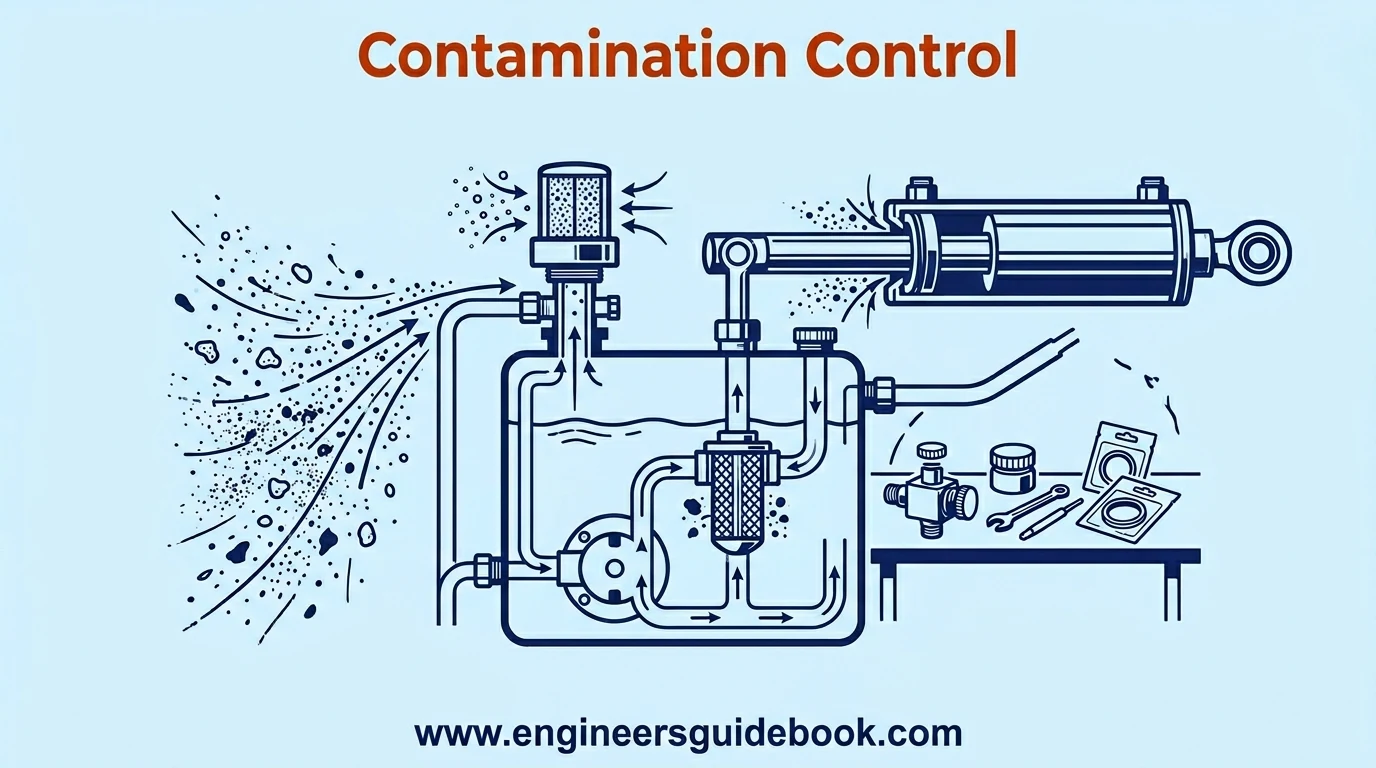
Contamination control is one of the strongest contributors to hydraulic seal life. Dirt, water, metal particles, and degraded oil can destroy seals even when design and installation are correct.
A hydraulic system is only as clean as its weakest maintenance practice. Effective contamination control combines filtration, wiper performance, reservoir protection, and disciplined handling.
20.1 Dirt Ingress Prevention
Dirt ingress prevention starts at exposed points. Cylinder rods, breathers, filler caps, hose connections, and maintenance openings are common contamination pathways.
When dirt enters the system, it can damage seals and circulate through valves, pumps, and actuators. Fine particles are especially harmful because they can pass through small clearances and create abrasive wear.
Good prevention includes effective wipers, clean oil transfer, sealed reservoirs, protected fittings, and careful maintenance procedures. Stopping dirt before it enters is easier than removing it later.
20.2 Wiper Seal Importance
Wiper seals are crucial for contamination control. They remove external debris from the rod before it retracts into the cylinder.
In harsh environments, the wiper may determine whether the rod seal lasts months or fails within days. A damaged wiper allows abrasive particles to reach the gland and rod seal.
Wipers should be inspected regularly. Cracked, hardened, loose, or worn wipers should be replaced before contamination damages internal components.
20.3 Hydraulic Oil Filtration
Hydraulic oil filtration removes particles from the fluid. Filters protect seals, pumps, valves, and precision components from abrasive damage.
Filter rating, placement, flow capacity, and maintenance interval all matter. Return-line filters, pressure filters, suction strainers, and offline filtration systems may be used depending on system requirements.
A clogged filter can bypass contaminants or restrict flow. Regular filter replacement and oil cleanliness monitoring are essential for seal reliability.
20.4 Breather Protection
Breathers allow air exchange in hydraulic reservoirs as fluid level changes. If the breather is poor quality or damaged, airborne dust and moisture can enter the tank.
Desiccant breathers and high-efficiency breathers improve reservoir cleanliness. They are especially useful in humid, dusty, or outdoor environments.
A good breather protects the entire hydraulic system. It reduces water ingress, oxidation, corrosion, and particle contamination.
20.5 Clean Maintenance Procedures
Clean maintenance procedures prevent contamination during repair work. Cylinders, hoses, fittings, and reservoirs should be opened only under controlled conditions.
Ports should be capped. Tools should be clean. Replacement seals should remain packaged until use. New oil should be filtered before filling if necessary.
Maintenance discipline is often the difference between long seal life and repeated failure. Clean work produces clean hydraulics.
21. Leakage Control and Troubleshooting
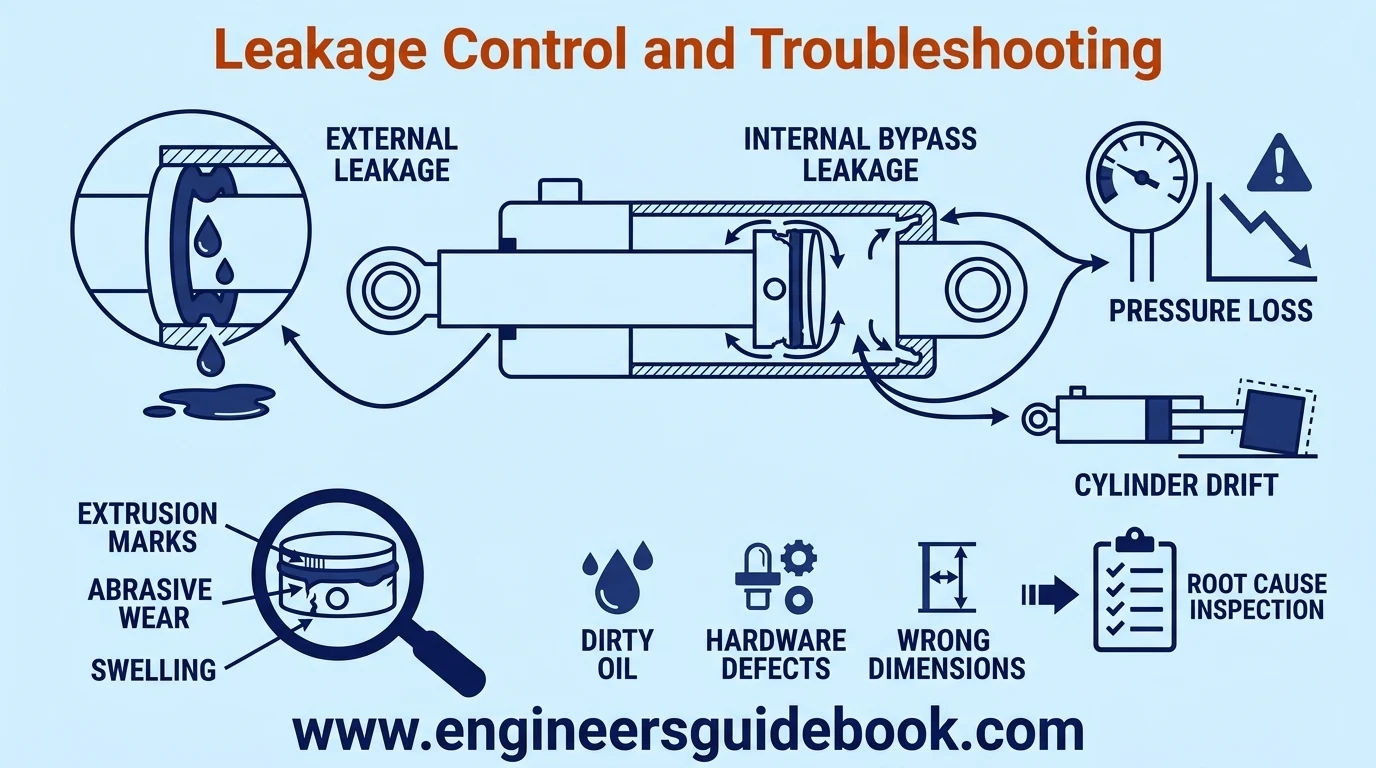
Leakage control requires understanding where the leakage occurs and why it started. Hydraulic leakage may be external, internal, intermittent, pressure-dependent, or temperature-related.
Troubleshooting should focus on root cause, not only visible symptoms. Effective diagnosis saves time, seals, oil, and labor.
21.1 External Leakage
External leakage is visible oil escaping from the hydraulic system. It commonly appears around rod seals, static joints, fittings, hoses, ports, and valve blocks.
Rod seal leakage may show as oil film, dripping, wet dust, or oil accumulation around the gland. Static seal leakage may appear at flanges or covers.
External leakage creates safety and environmental concerns. It should be investigated promptly because small leaks often become larger under pressure cycling.
21.2 Internal Bypass Leakage
Internal bypass leakage occurs when fluid passes from one pressure chamber to another inside the cylinder. It is commonly caused by worn piston seals or damaged bore surfaces.
This leakage may not be visible from outside. Symptoms include cylinder drift, weak force, slow movement, or inability to hold pressure.
Testing may be required to confirm internal bypass. A cylinder can look dry externally and still lose performance internally.
21.3 Cylinder Drift
Cylinder drift occurs when a cylinder moves slowly without command or cannot hold its position under load. Piston seal leakage is a common cause, but valves and circuit components may also be responsible.
Drift is serious in lifting, clamping, pressing, and stabilizing applications. It can affect product quality, machine safety, and operator confidence.
Troubleshooting should isolate whether the problem is inside the cylinder or in the hydraulic circuit. Replacing seals without testing may not solve the issue.
21.4 Pressure Loss
Pressure loss may result from internal leakage, external leakage, pump wear, valve leakage, relief valve malfunction, or excessive clearances.
When seals are responsible, the pressure loss often occurs because oil bypasses a piston seal or escapes through a rod or static seal. Heat generation may also increase as the system works harder.
A systematic approach is required. Pressure readings, flow testing, temperature checks, and visual inspection help identify the real fault.
21.5 Root Cause Inspection
Root cause inspection examines the failed seal, hardware, fluid, and operating conditions. The failed seal should be studied before disposal.
Extrusion marks, abrasive wear, swelling, hardening, twisting, and cuts all point toward different causes. Rod scratches, bore defects, dirty oil, and wrong groove dimensions must also be checked.
True troubleshooting connects evidence to corrective action. This prevents repeated failures and improves long-term reliability.
22. Maintenance and Inspection
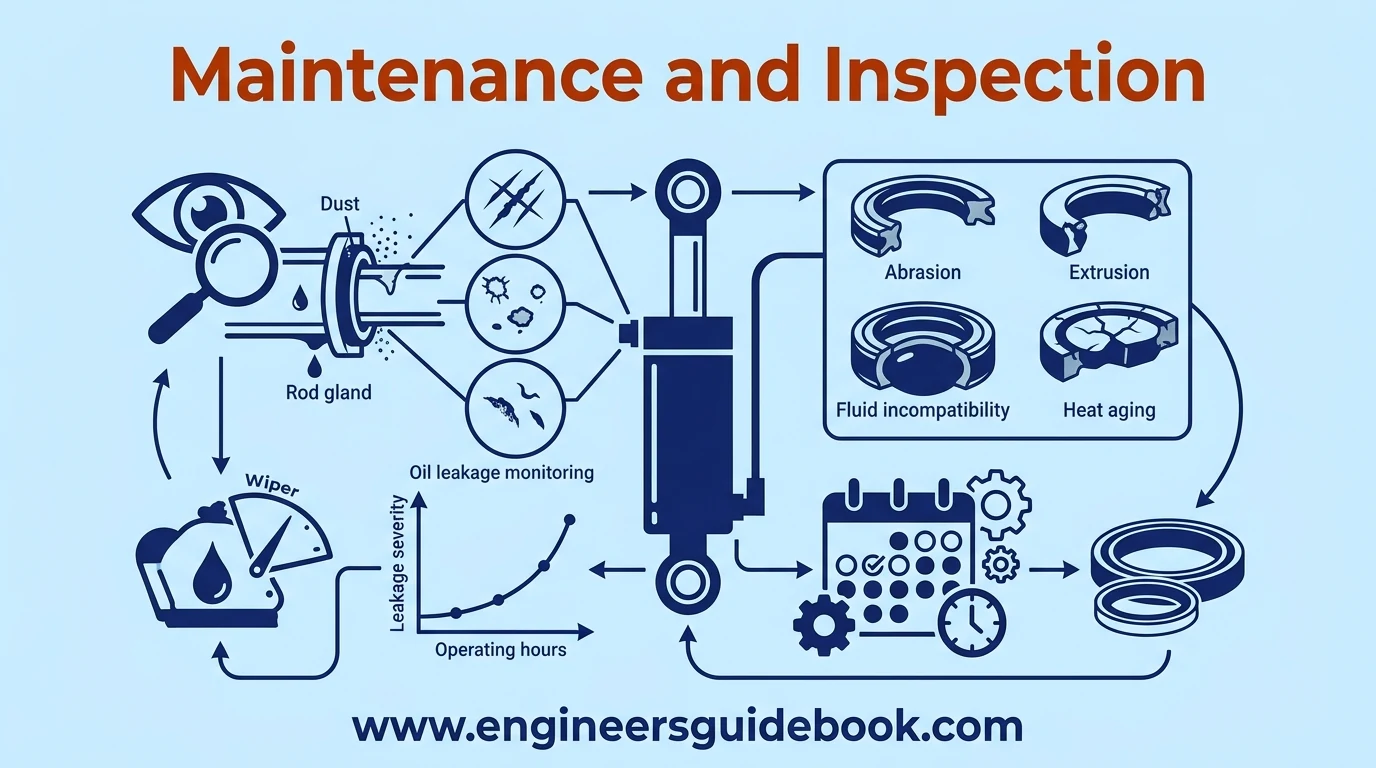
Maintenance and inspection keep hydraulic seals working before failure becomes severe. A structured inspection program reduces downtime and improves equipment safety.
Seal maintenance is not limited to replacement. It includes monitoring leakage, checking surfaces, controlling contamination, and recording failure patterns.
22.1 Visual Seal Checks
Visual seal checks should focus on oil leakage, dust accumulation, wiper condition, rod cleanliness, gland wetness, and unusual movement.
A light oil film may be normal in some dynamic applications, but dripping or wet buildup is a warning sign. Dust sticking to oil around the rod often indicates early leakage.
Regular visual checks help detect problems before they become shutdown events. Operators and maintenance teams should know what abnormal seal behavior looks like.
22.2 Rod Damage Inspection
Rod damage inspection is essential because the rod surface directly contacts the rod seal and wiper. Scratches, corrosion, dents, and chrome damage can destroy new seals quickly.
Inspection should be done across the full stroke length. Damage may exist only in the exposed section or near the working zone.
If rod damage is found, the corrective action may include polishing, resurfacing, rechroming, or replacement. Installing new seals on a damaged rod is usually a temporary fix.
22.3 Oil Leakage Monitoring
Oil leakage monitoring tracks leakage frequency, location, severity, and operating conditions. This helps identify recurring problems and weak points in the hydraulic system.
Leak records should include the machine number, cylinder location, seal type, operating hours, fluid type, and suspected cause. This information supports better future seal selection.
Monitoring also helps distinguish isolated failures from systematic issues. Repeated leakage from the same cylinder often indicates a deeper design, alignment, or surface problem.
22.4 Seal Wear Pattern Review
Seal wear pattern review reveals how the seal failed. A worn seal is diagnostic evidence.
Flattened lips may indicate abrasion or long service life. Torn edges suggest extrusion or installation damage. Swelling suggests fluid incompatibility. Hard and cracked material suggests heat aging.
Reviewing wear patterns allows maintenance teams to correct the real cause. It turns failure into useful engineering feedback.
22.5 Planned Replacement Intervals
Planned replacement intervals reduce unexpected downtime. Critical cylinders should not always be operated until failure.
Replacement planning should consider operating hours, cycle frequency, machine criticality, safety risk, and historical failure data. Severe-duty equipment may require shorter intervals.
Planned replacement also allows better spare parts preparation. The right seals, tools, and technicians can be ready before maintenance begins.
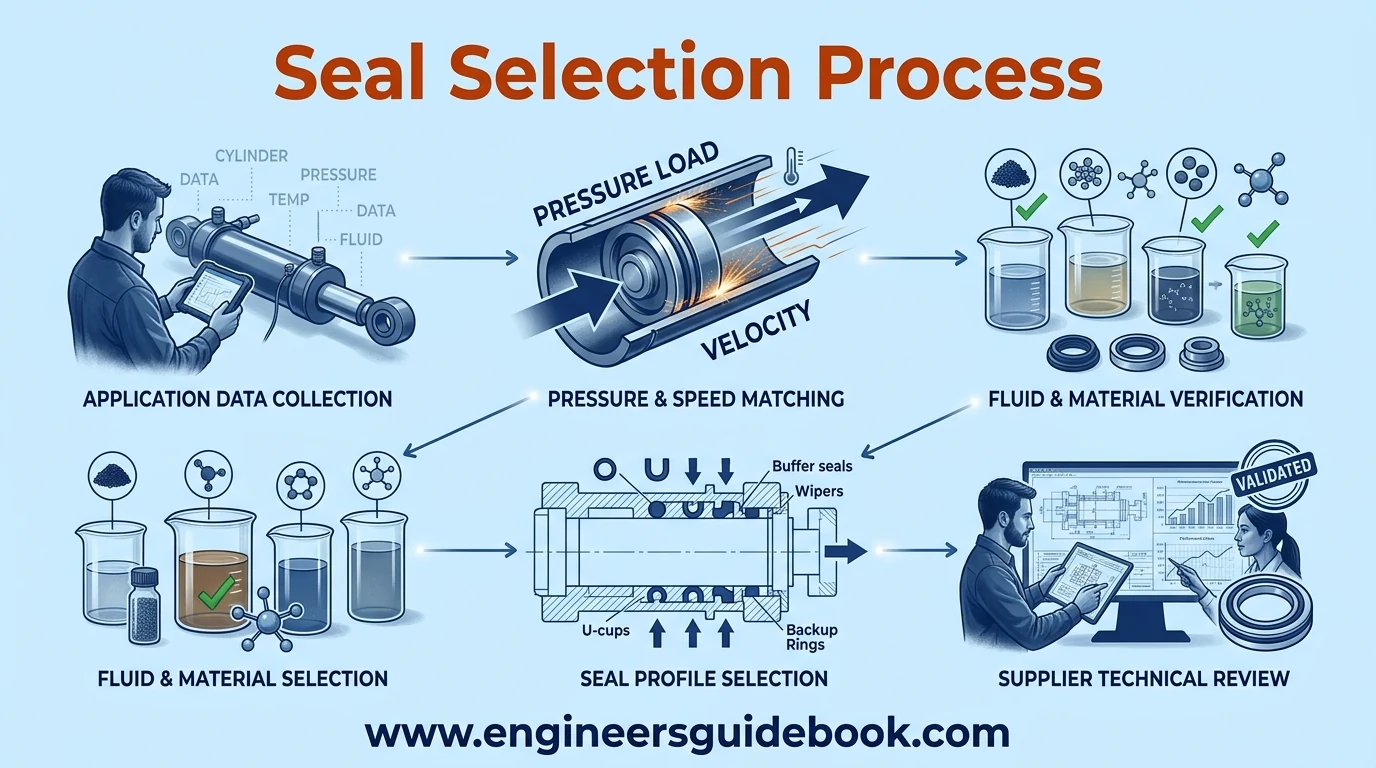
23. Seal Selection Process
Seal selection should follow a structured process. Choosing a seal by size alone is inadequate because hydraulic applications differ widely in pressure, speed, fluid, temperature, and contamination exposure.
The best seal is the one that matches the complete operating envelope. Technical validation is more valuable than guesswork.
23.1 Application Data Collection
Application data collection is the first and most important step. Required information includes cylinder dimensions, pressure range, maximum pressure spikes, temperature, speed, stroke length, fluid type, duty cycle, and environmental conditions.
The condition of the rod, bore, groove, and guide elements should also be reviewed. Hardware defects can influence seal choice and expected life.
Incomplete data often leads to poor recommendations. A clear application profile allows accurate seal selection and better reliability planning.
23.2 Pressure and Speed Matching
Pressure and speed matching ensures that the selected seal can handle mechanical load and movement conditions. High pressure requires extrusion resistance, while high speed requires friction and heat control.
A seal designed for slow high-pressure service may not perform well in fast reciprocating motion. Similarly, a low-friction seal may need additional support in high-pressure applications.
Pressure spikes and acceleration should also be considered. Real operating behavior is often more severe than catalog conditions.
23.3 Fluid and Material Verification
Fluid and material verification confirms that the seal compound is compatible with the hydraulic fluid and external environment.
The review should include base fluid, additives, cleaning chemicals, water exposure, temperature, and possible contamination. Compatibility should be confirmed through technical data or supplier guidance.
This step prevents swelling, shrinkage, hardening, and chemical degradation. It is a small check that protects the entire sealing system.
23.4 Seal Profile Selection
Seal profile selection depends on the sealing function. Rod seals, piston seals, wipers, static seals, and backup rings all have different geometries and performance characteristics.
The profile must match pressure direction, groove space, movement type, leakage tolerance, and installation method. Directional seals must be oriented correctly.
Advanced profiles may offer low friction, high extrusion resistance, or improved contamination protection. The profile should solve the application problem, not merely fit the groove.
23.5 Supplier Technical Review
Supplier technical review helps validate the final selection. Reliable suppliers can provide material data, pressure ratings, groove recommendations, installation guidance, and compatibility information.
This review is especially important for critical equipment, unusual fluids, high-pressure systems, or repeated failures. Supplier experience can prevent costly mistakes.
Technical review should include drawings, operating conditions, and failure history where available. Better information produces better recommendations.
24. Modern Hydraulic Seal Technology
Modern hydraulic seal technology focuses on longer life, lower friction, higher pressure capability, and improved reliability. Seal design has moved beyond simple rubber shapes into engineered sealing systems.
Advanced materials, computer-aided profiles, improved manufacturing control, and maintenance data now influence seal performance. The result is better productivity and reduced lifecycle cost.
24.1 Low Friction Seal Profiles
Low friction seal profiles reduce energy loss, heat generation, and stick-slip movement. They are useful in precision cylinders, high-speed systems, and automation equipment.
These seals often use optimized lip geometry, PTFE elements, or specially formulated polyurethane. The goal is to maintain sealing force while reducing unnecessary drag.
Lower friction improves motion quality and reduces wear. It also helps protect rods, bores, and hydraulic fluid from excessive heat.
24.2 High Pressure Compact Seals
High pressure compact seals are designed to provide strong sealing in limited space. They are common in modern cylinders where compact size and high power density are required.
These seals may combine an elastomer energizer, thermoplastic sealing ring, and support elements. The assembly resists extrusion while maintaining sealing efficiency.
Compact seals simplify piston design and reduce component count. They are especially useful in mobile equipment and industrial cylinders with restricted installation space.
24.3 Advanced Polyurethane Materials
Advanced polyurethane materials offer improved abrasion resistance, extrusion strength, hydrolysis resistance, and temperature capability compared with older grades.
These materials are widely used in rod seals, piston seals, and wipers for demanding applications. They perform well under high pressure, dirty environments, and frequent cycling.
The correct polyurethane grade must still match the fluid and temperature range. Modern compounds are powerful, but they are not universal.
24.4 PTFE Energized Seals
PTFE energized seals use a PTFE sealing element combined with an energizer such as an O-ring or spring. The energizer provides initial contact force, while PTFE provides low friction and chemical resistance.
These seals are valuable in applications requiring smooth movement, low breakaway force, high chemical resistance, or wide temperature capability.
Filled PTFE options improve wear and load performance. Common fillers include bronze, carbon, glass, and other engineered additives. The selected filler changes friction, wear, and compatibility characteristics.
24.5 Data Driven Maintenance
Data driven maintenance uses operating history and failure records to improve seal reliability. Instead of replacing seals only after failure, maintenance teams analyze trends.
Useful data includes leakage frequency, operating hours, temperature, contamination level, seal material, cylinder location, and failure mode. Over time, patterns become visible.
This approach supports better seal selection, spare parts planning, and preventive maintenance intervals. It converts field experience into practical reliability intelligence.
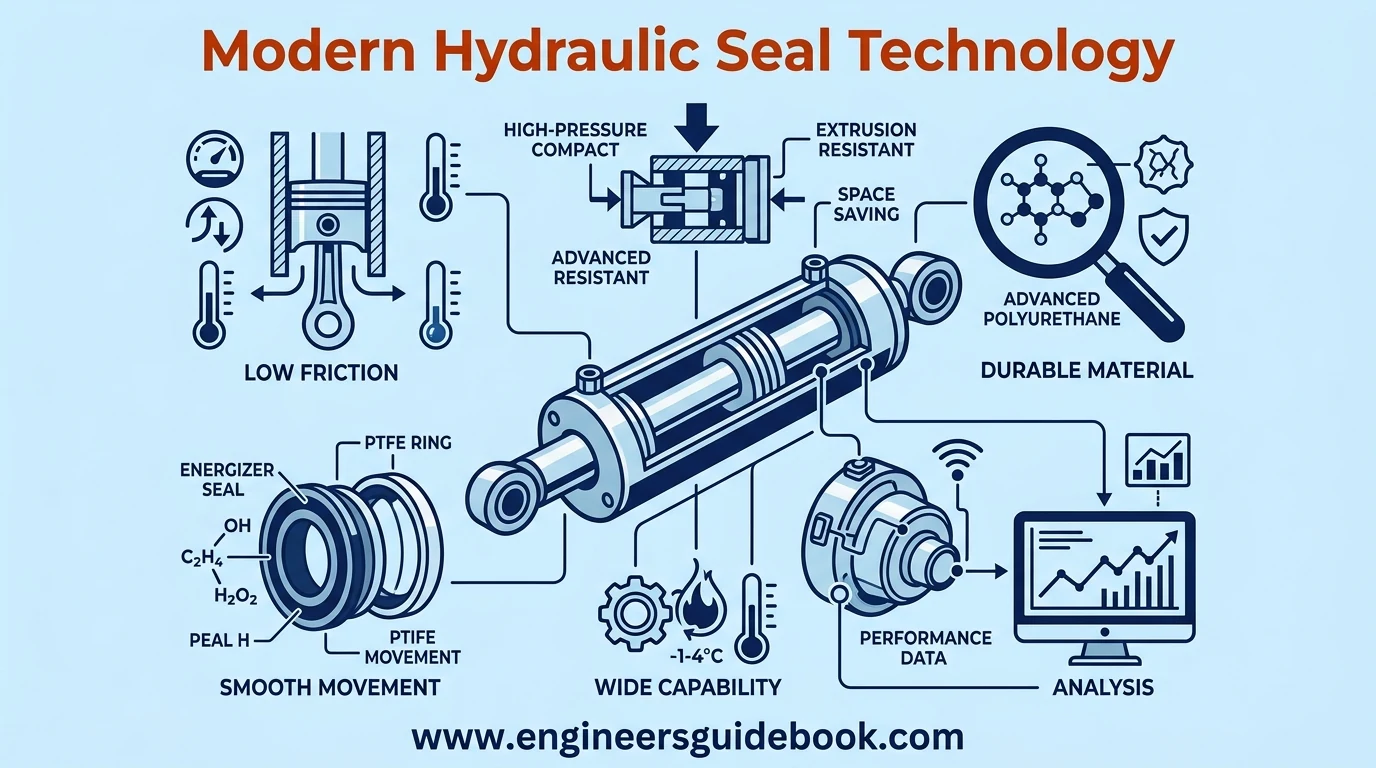
25. Cost and Performance Balance
Seal cost should be evaluated through lifecycle performance, not purchase price alone. A cheap seal that fails early can become far more expensive than a premium seal that lasts longer.
The true cost includes downtime, labor, oil loss, cleaning, lost production, component damage, safety risk, and emergency procurement. In critical equipment, reliability has monetary value.
25.1 Seal Price Versus Downtime Cost
Seal price is usually small compared with downtime cost. A single failed seal can stop a press, excavator, production line, or crane operation.
The direct cost of the seal may be minor, but the indirect cost can be substantial. Labor, machine stoppage, oil cleanup, production loss, and delayed schedules add up quickly.
Selection should therefore consider equipment criticality. For important machines, the lowest-cost seal is rarely the best economic choice.
25.2 Premium Materials and Longer Life
Premium materials can provide longer service life in severe applications. Advanced polyurethane, FKM, PTFE, and reinforced compounds may resist wear, heat, chemicals, or pressure better than standard materials.
Longer life reduces replacement frequency and maintenance interruptions. It also improves equipment availability.
However, premium materials should be selected for a clear technical reason. The best material is not always the most expensive one. It is the one that fits the application.
25.3 Spare Parts Inventory Planning
Spare parts inventory planning ensures that critical seals are available when needed. Long lead times can extend downtime, especially for imported or non-standard seals.
Plants should identify critical cylinders, frequent failure points, and unique seal sizes. Essential seals should be stored under proper conditions away from heat, sunlight, ozone, moisture, and chemicals.
Good inventory planning reduces emergency purchases and maintenance delays. It also allows planned shutdown work to proceed efficiently.
25.4 Lifecycle Cost Evaluation
Lifecycle cost evaluation considers the total cost of seal ownership. This includes purchase price, installation labor, expected life, downtime risk, oil loss, and failure consequences.
A seal with higher initial cost may offer lower lifecycle cost if it lasts longer and reduces downtime. Conversely, an expensive seal may be wasteful in a low-duty, non-critical application.
The evaluation should match seal quality to operational importance. Cost control and reliability must be balanced intelligently.
25.5 Reliability Based Seal Selection
Reliability based seal selection prioritizes predictable performance over short-term savings. It uses operating data, failure history, application severity, and technical requirements to guide decisions.
Critical machines require conservative seal choices, validated materials, and reliable suppliers. Non-critical applications may allow more economical options.
This approach improves maintenance planning and reduces repeated failures. It treats seals as reliability components, not disposable commodities.
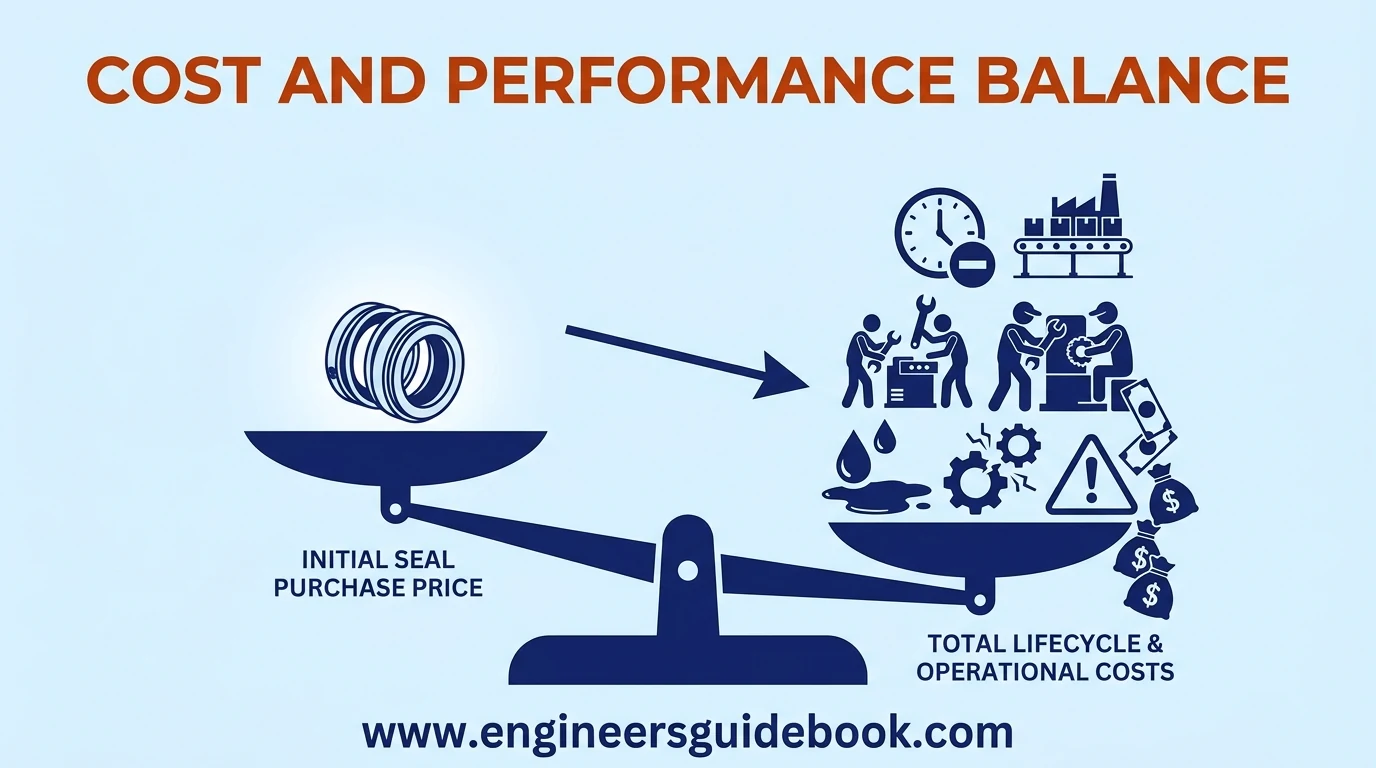
26. Final Design Checklist
A final design checklist helps ensure that important sealing factors are not missed. Hydraulic seal performance depends on the interaction of material, profile, groove, surface, fluid, and installation.
A structured review reduces uncertainty. It also improves communication between engineering, procurement, maintenance, and suppliers.
26.1 Operating Conditions Review
Operating conditions review should include pressure, pressure spikes, temperature, speed, stroke, fluid, contamination, duty cycle, and environmental exposure.
The review must consider maximum and abnormal conditions, not only normal operation. Many seal failures occur during pressure spikes, heat buildup, contamination events, or overloads.
A complete operating profile creates the foundation for correct seal selection. Without it, selection becomes guesswork.
26.2 Seal Type Confirmation
Seal type confirmation verifies that the correct sealing element is being used for the function. Rod seals, piston seals, wipers, static seals, backup rings, and wear rings are not interchangeable.
Each component performs a specific duty. The rod seal controls external leakage. The piston seal controls internal bypass. The wiper excludes contamination. The wear ring guides movement. The backup ring controls extrusion.
Confirming seal type prevents fundamental design mistakes. It also improves assembly accuracy and spare parts management.
26.3 Material Compatibility Check
Material compatibility check confirms that the seal material can tolerate the hydraulic fluid, additives, temperature, pressure, and environment.
This step should include mineral oil, synthetic fluids, fire resistant fluids, water glycol fluids, biodegradable fluids, cleaning agents, and external chemicals where relevant.
Compatibility failure can cause swelling, hardening, softening, cracking, or shrinkage. Verification before installation prevents avoidable failure after startup.
26.4 Groove Design Verification
Groove design verification checks width, depth, squeeze, clearance gap, chamfers, radii, and tolerances. The seal must sit correctly and have enough support under pressure.
Incorrect groove design can cause leakage, extrusion, twisting, over-compression, or installation damage. Even a high-quality seal cannot overcome poor housing geometry.
Manufacturer recommendations should be followed closely. Deviations should be reviewed technically before approval.
26.5 Surface Finish Inspection
Surface finish inspection confirms that rods, bores, glands, and sealing faces are suitable for operation. Roughness, hardness, corrosion, scoring, coating quality, and roundness should be checked.
A damaged surface can destroy new seals rapidly. Scratches and pits create leakage paths, while rough surfaces accelerate abrasion.
Surface inspection is especially important during repair. Seal replacement without surface correction often leads to repeat failure.
26.6 Installation and Maintenance Planning
Installation and maintenance planning ensures that seals are assembled correctly and monitored throughout service life. The plan should include clean handling, correct tools, lubrication, orientation checks, and post-assembly inspection.
Maintenance planning should include leakage monitoring, rod inspection, oil cleanliness control, wiper checks, and planned replacement intervals for critical equipment.
Hydraulic seal reliability is created through design, protected during installation, and preserved through maintenance. When all three stages are controlled, the sealing system delivers longer life, cleaner operation, and stronger machine performance.