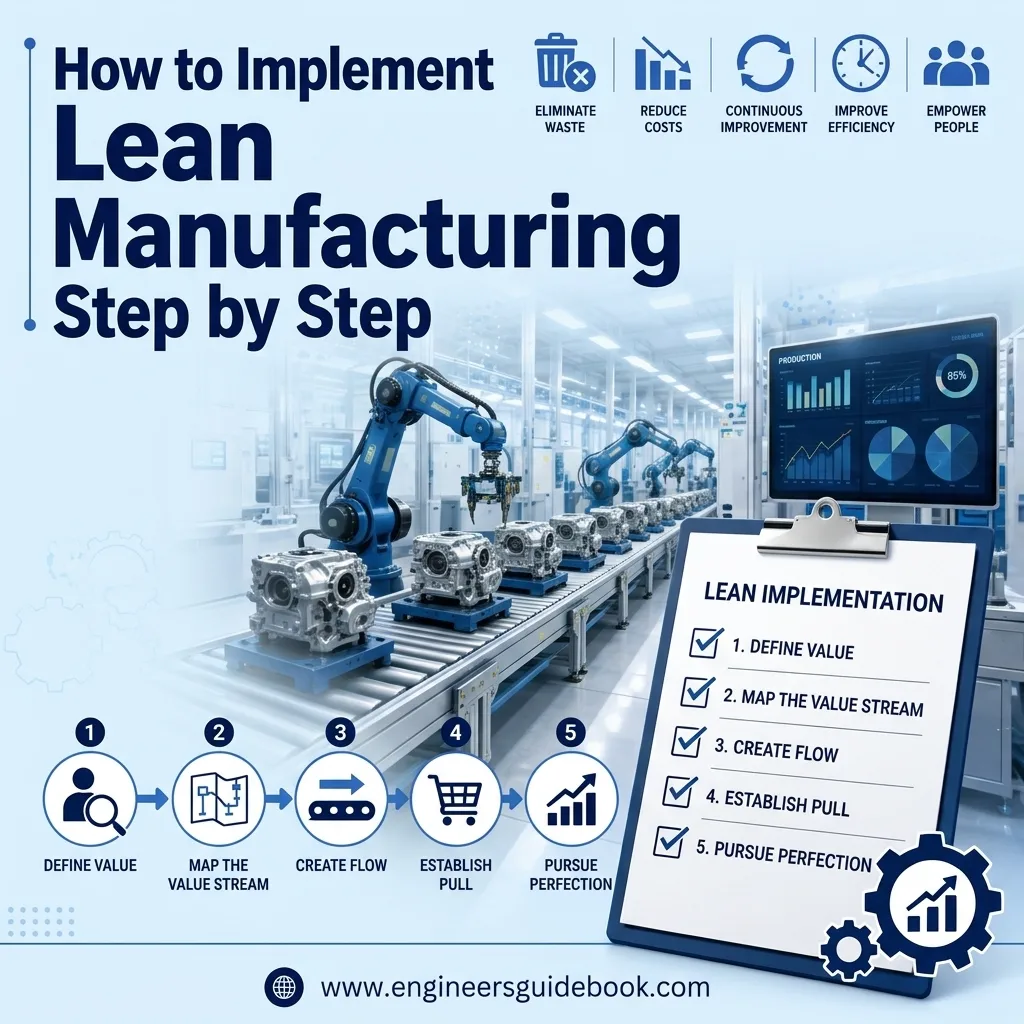
Lean manufacturing implementation is defined by customer value, assessing organizational readiness, setting measurable objectives, establishing accountable leadership, analyzing current workflows, eliminating waste, and organizing the workplace through 5S. A successful transformation begins with a focused pilot area, reliable baseline data, employee participation, and disciplined improvement routines before lean practices are expanded across the organization. In this article, we will learn how to implement lean manufacturing step by step.
1. How to implement lean manufacturing
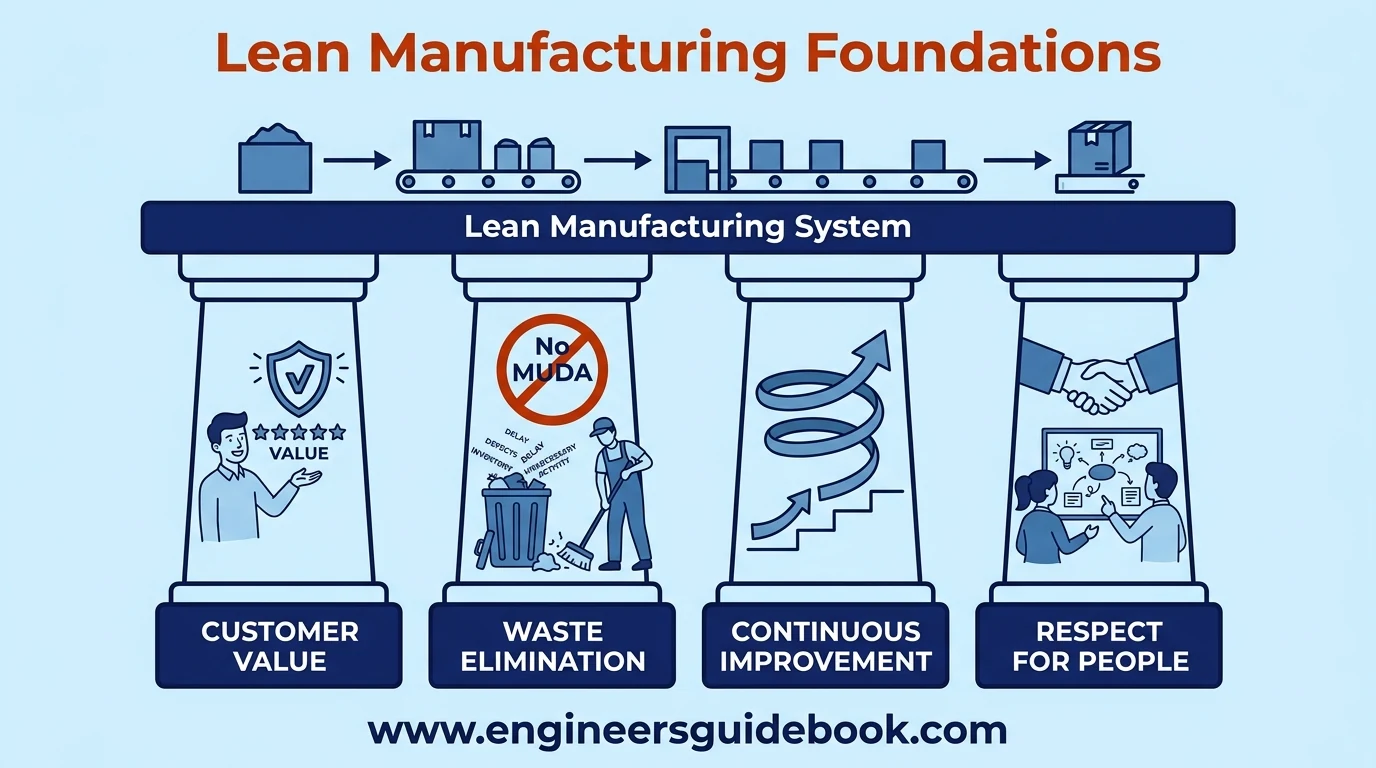
Lean implementation begins with a shared understanding of its philosophy. Tools alone cannot yield sustainable results unless the organization adopts a value-driven approach, fosters disciplined learning, and implements systematic waste reduction.
1.1 Lean Manufacturing Definition
Lean manufacturing is a management system that maximizes customer value while minimizing resources, delays, defects, inventory, and unnecessary activity. It develops smoother processes through continuous observation and improvement.
1.2 Core Lean Principles
The core principles involve defining value, mapping the value stream, creating uninterrupted flow, establishing pull, and pursuing perfection. Together, they convert fragmented production into a responsive operating system.
1.3 Customer Value
Customer value represents the features, quality, delivery, and service for which buyers are willing to pay. Every activity should therefore be examined from the customer’s perspective, rather than from the internal convenience.
1.4 Waste Elimination
Waste elimination requires identifying work that consumes time or resources without improving the product. Removing such activity releases capacity, lowers cost, and simplifies operational control.
1.5 Continuous Improvement
Continuous improvement encourages frequent, incremental refinements instead of relying exclusively on large projects. Small changes accumulate, producing substantial gains in safety, quality, productivity, and reliability.
2. Lean Readiness Assessment
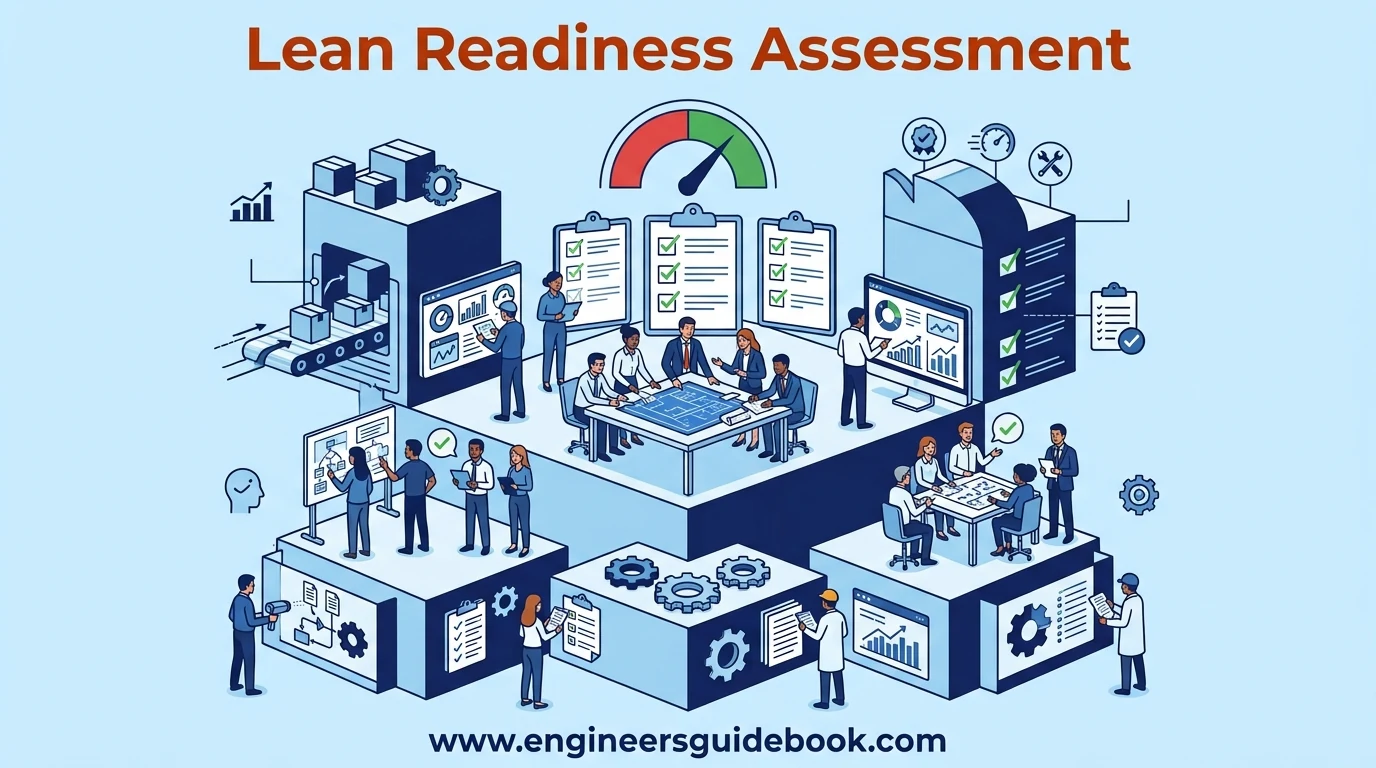
Before launching improvement activities, the organization should determine whether its culture, systems, leadership, and processes can support transformation. Readiness assessment prevents premature implementation of lean manufacturing and unrealistic expectations.
2.1 Organizational Readiness
Organizational readiness reflects the company’s capacity to absorb change. Stable operations, cooperative departments, reliable data, and openness to experimentation create favorable conditions for lean deployment.
2.2 Leadership Commitment
Senior leaders must provide resources, remove barriers, and participate visibly. Employees quickly recognize ceremonial support, so leadership behavior must consistently reinforce the declared improvement priorities.
2.3 Workforce Awareness
Employees should understand why lean is being introduced and how it affects their roles. Early awareness reduces suspicion and prevents lean from being misinterpreted as workforce reduction.
2.4 Process Maturity
Processes should be sufficiently understood before optimization begins. Highly erratic operations may first require basic controls, documented methods, maintenance discipline, and quality stabilization.
2.5 Technology Capability
Technology should support operational visibility rather than complicate it. Data collection systems, sensors, ERP platforms, and dashboards must provide accurate information at a usable level of detail.
2.6 Supplier Readiness
Suppliers influence material availability, quality, lot size, and replenishment frequency. Their reliability must be evaluated before introducing pull systems or sharply reducing safety stock.
2.7 Customer Expectations
Customer demand patterns, quality requirements, delivery windows, and customization needs should be clarified. Lean processes must respond to actual market expectations rather than internally fabricated assumptions.
2.8 Readiness Assessment Checklist
A readiness checklist should review leadership sponsorship, workforce capability, data accuracy, process stability, supplier performance, improvement experience, communication quality, and available implement lean manufacturing resources.
3. Lean Vision and Objectives
A lean transformation needs a coherent destination. Without a defined vision and quantified objectives, improvement teams may complete isolated projects that produce little strategic value.
3.1 Lean Transformation Vision
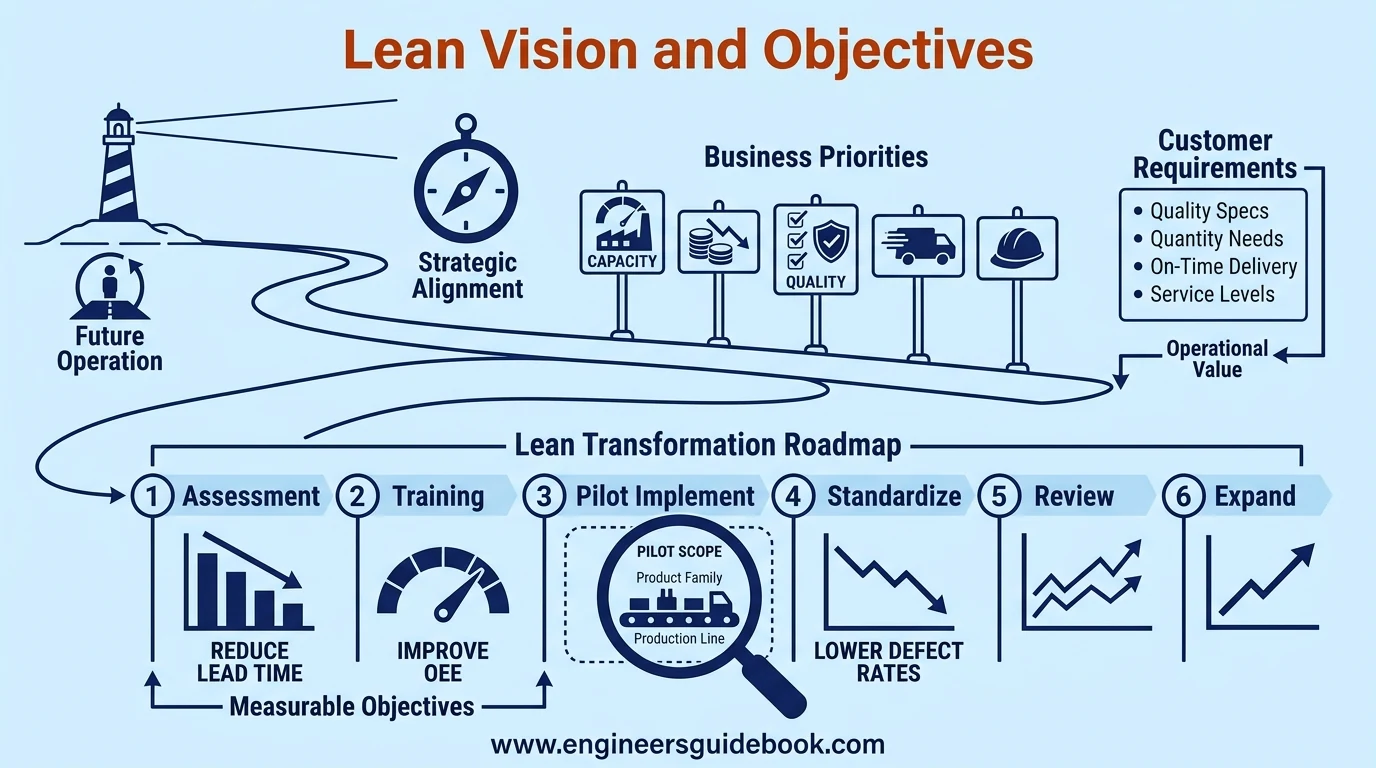
The transformation vision should describe how the future operation will serve customers, engage employees, and control processes. It must be ambitious yet intelligible enough to guide daily decisions.
3.2 Business Priorities
Lean initiatives should address pressing business priorities such as capacity constraints, excessive cost, quality losses, delivery failures, or safety exposure. Strategic relevance sustains executive attention.
3.3 Customer Requirements
Customer requirements should be translated into measurable specifications covering quality, quantity, delivery, responsiveness, and service. These requirements establish the practical definition of operational value.
3.4 Strategic Alignment
Lean objectives must align with the organization’s broader strategy. A company competing on rapid delivery requires different priorities from one competing through customization or cost leadership.
3.5 Measurable Objectives
Objectives should be specific, time-bound, and supported by credible baseline data. Examples include reducing lead time, improving overall equipment effectiveness, or lowering defect rates.
3.6 Performance Targets
Performance targets should be demanding but attainable. Arbitrary targets can provoke data manipulation, while carefully derived targets encourage structured problem-solving and responsible experimentation.
3.7 Implementation Scope
The initial scope should be narrow enough to manage but meaningful enough to demonstrate value. A product family, production line, or recurring process usually provides an effective starting boundary.
3.8 Lean Transformation Roadmap
The roadmap should sequence assessment, training, pilot implementation, standardization, review, and expansion. It should also define major milestones, resource requirements, dependencies, and governance arrangements.
Also Read More:
Lean Manufacturing: Principles, Tools, Benefits, and Examples
5 Principles of Lean Manufacturing Explained With Examples
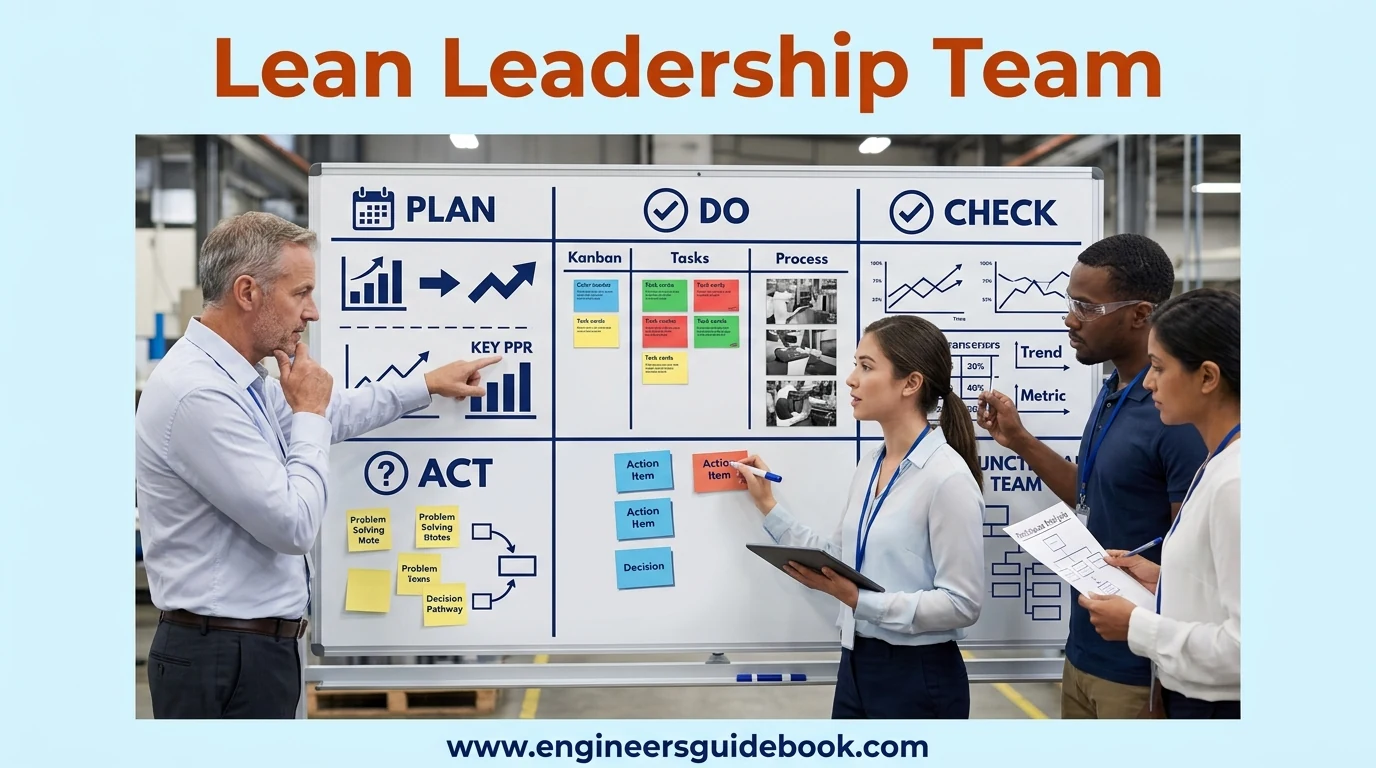
4. Lean Leadership Team
Lean implementation requires a leadership structure with clear ownership. Transformation becomes vulnerable when authority, responsibilities, and escalation pathways remain ambiguous.
4.1 Executive Sponsor
The executive sponsor legitimizes the program, secures resources, and resolves cross-departmental obstacles. This role should remain actively involved throughout implementation rather than appearing only at launch events.
4.2 Lean Champion
The lean champion coordinates implementation, coaches teams, tracks progress, and protects methodological integrity. Strong facilitation skills are as important as technical knowledge.
4.3 Cross Functional Team
A cross-functional team should include production, maintenance, quality, supply chain, engineering, safety, and finance. Diverse participation reveals interdependencies hidden within departmental boundaries.
4.4 Department Representatives
Department representatives communicate local constraints and support implementation within their functions. They also help prevent improvement decisions from creating unintended problems elsewhere.
4.5 Team Responsibilities
Responsibilities should cover data collection, process observation, root-cause analysis, countermeasure development, training, documentation, and performance review. Explicit ownership minimizes duplication and neglect.
4.6 Decision Authority
Teams need defined authority for operational changes, expenditures, trials, and escalation. Improvement slows when every minor decision requires multiple layers of approval.
4.7 Communication Structure
Communication should include regular meetings, visual boards, progress reports, and escalation routines. Information must travel vertically and horizontally without distortion or unnecessary delay.
4.8 Accountability Framework
An accountability framework links objectives to named owners, deadlines, evidence, and review intervals. It turns improvement commitments into verifiable responsibilities rather than aspirational statements.
5. Current State Analysis
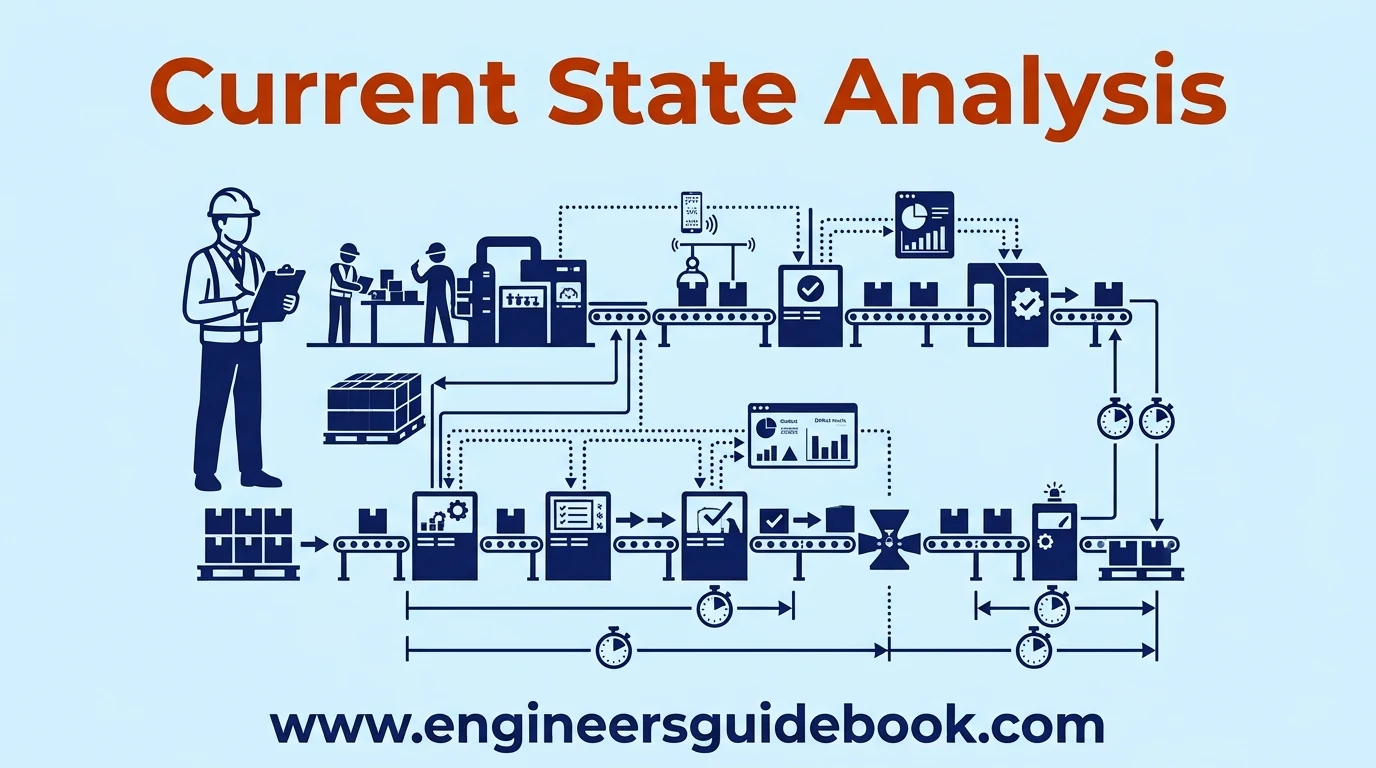
Current state analysis establishes how work actually occurs. Decisions based on procedures alone are unreliable because documented processes frequently differ from shop-floor reality.
5.1 Process Selection
Select a process with clear customer impact, measurable losses, and manageable complexity. Early success is more likely when the pilot area has supportive supervision and accessible data.
5.2 Gemba Walk
A gemba walk involves observing work where value is created. Leaders should ask respectful questions, examine abnormalities, and avoid drawing conclusions before understanding operational conditions.
5.3 Process Mapping
Process mapping documents activities, decisions, delays, handoffs, and rework loops. It reveals procedural convolution that may remain invisible within departmental reports.
5.4 Value Stream Mapping
Value stream mapping visualizes material and information flow from demand to delivery. It distinguishes value-adding work from queues, interruptions, inventory, and administrative latency.
5.5 Material Flow
Material flow analysis examines travel distance, storage points, handling frequency, batch size, and congestion. Poor layouts often create substantial hidden transportation and waiting costs.
5.6 Information Flow
Information flow determines how production instructions, forecasts, approvals, and quality decisions move through the system. Delayed or contradictory information frequently destabilizes otherwise capable processes.
5.7 Cycle Time Analysis
Cycle time measures how long a task or process requires to complete. Comparing cycle time with takt time exposes capacity imbalances and potential constraints.
5.8 Lead Time Analysis
Lead time includes processing, waiting, transportation, inspection, and queue time. In many factories, actual processing represents only a small fraction of total elapsed time.
5.9 Bottleneck Identification
A bottleneck is the resource that restricts overall throughput. It may involve equipment, labor, approvals, tooling, testing capacity, or unreliable material supply.
5.10 Baseline Performance
Baseline performance should document output, defects, downtime, inventory, lead time, changeover duration, and delivery reliability. Future improvements must be compared against this validated starting point.
6. Waste Identification
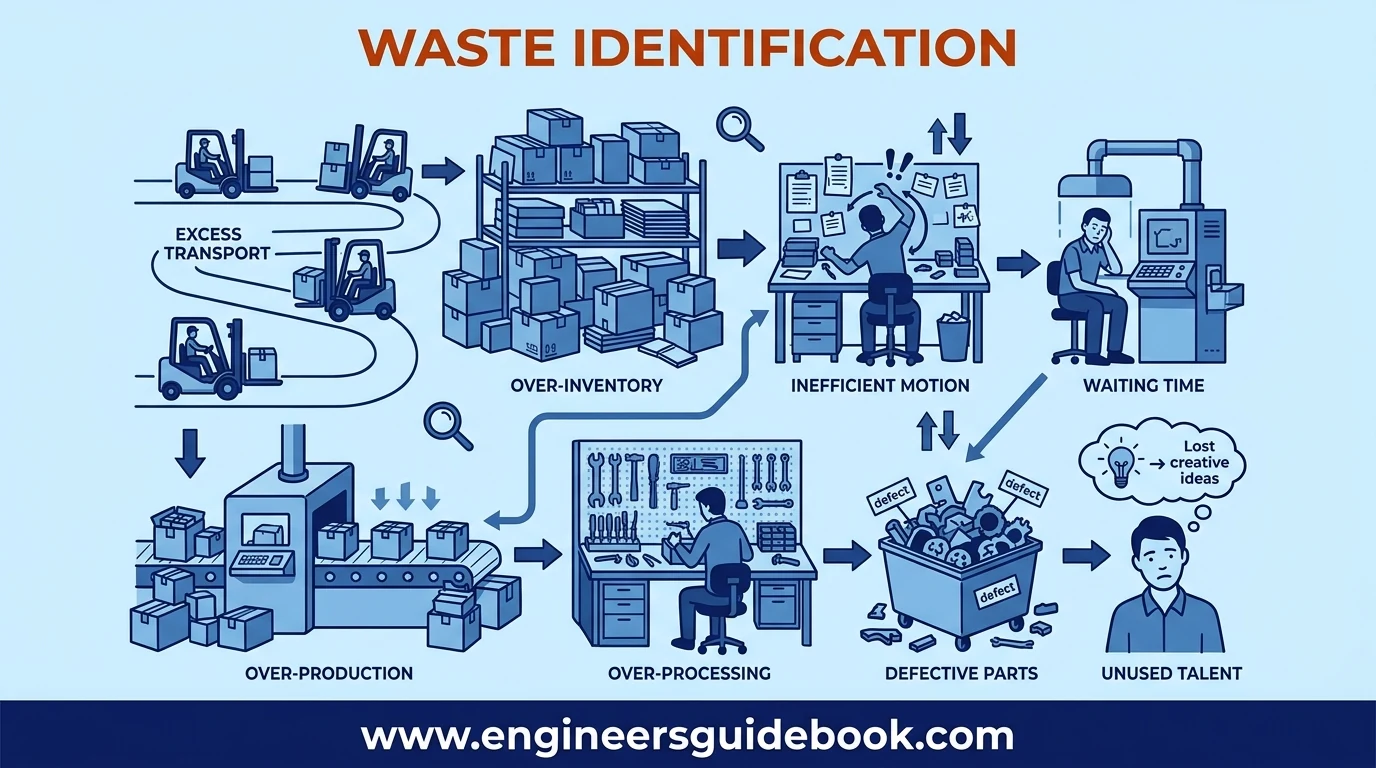
Waste identification translates lean philosophy into observable operational problems. Teams should examine the complete system because waste often migrates between departments rather than disappearing.
6.1 Transportation Waste
Transportation waste occurs when materials or products move without gaining value. Excessive movement increases handling cost, damage risk, congestion, and production lead time.
6.2 Inventory Waste
Excess inventory conceals quality problems, unreliable equipment, inaccurate planning, and supplier instability. It also consumes cash, space, labor, and administrative attention.
6.3 Motion Waste
Motion waste includes unnecessary walking, reaching, bending, searching, and repositioning. Poor workstation ergonomics can simultaneously reduce productivity and increase musculoskeletal risk.
6.4 Waiting Waste
Waiting arises when employees, equipment, or materials remain idle because of imbalance, breakdowns, shortages, approvals, inspections, or incomplete information.
6.5 Overproduction Waste
Overproduction means producing earlier or in greater quantity than required. It generates inventory, masks demand signals, and magnifies downstream defects.
6.6 Overprocessing Waste
Overprocessing includes redundant inspections, excessive finishing, repeated data entry, and unnecessarily complex procedures. Such activities consume resources without increasing customer-perceived value.
6.7 Defect Waste
Defects create scrap, rework, complaints, delays, and warranty costs. Effective lean systems detect abnormalities close to their source and prevent recurrence.
6.8 Talent Waste
Talent waste occurs when employee knowledge, creativity, and problem-solving ability remain underused. Organizations lose improvement opportunities when operators are expected only to follow instructions.
6.9 Waste Observation Checklist
A waste checklist guides structured observation across people, machines, materials, methods, information, and layout. It should prompt investigation without replacing analytical judgment.
6.10 Waste Prioritization
Waste should be prioritized according to safety, customer impact, financial loss, frequency, and feasibility. Addressing high-impact causes prevents teams from pursuing merely cosmetic improvements.
7. Workplace Organization
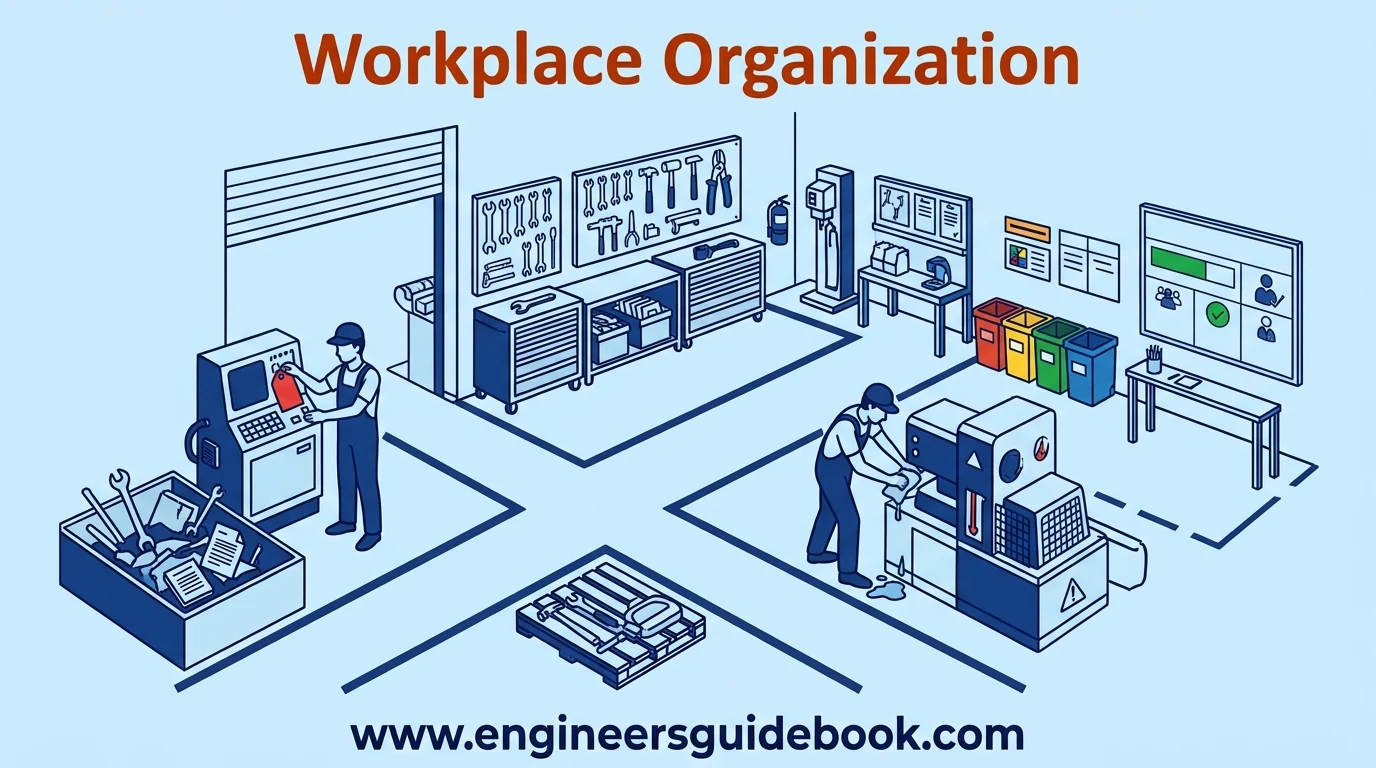
Workplace organization creates the visual and physical stability required for lean operations. The 5S methodology makes abnormalities visible and establishes disciplined control of tools, materials, and work areas.
7.1 Sort
Sorting removes unnecessary tools, materials, documents, and equipment from the workplace. Only items required for current operations should remain readily accessible.
7.2 Set in Order
Setting in order assigns a defined location to every necessary item. Storage decisions should reflect usage frequency, ergonomics, safety, and retrieval speed.
7.3 Shine
Shine involves cleaning while inspecting equipment and work areas. Leaks, looseness, wear, contamination, and damage become easier to detect in orderly environments.
7.4 Standardize
Standardization establishes common arrangements, labels, cleaning methods, inspection routines, and visual controls. It preserves improvements across shifts, teams, and changing personnel.
7.5 Sustain
Sustain converts temporary cleanup into routine discipline. Leadership follow-up, employee ownership, training, audits, and corrective actions are necessary to prevent regression.
7.6 Visual Management
Visual management communicates conditions through labels, markings, indicators, boards, and status signals. A well-designed workplace reveals normal and abnormal conditions immediately.
7.7 Workplace Safety
Safety must be integrated into every 5S decision. Clear access routes, secure storage, ergonomic placement, guarding, and hazard identification strengthen both productivity and employee protection.
7.8 Red Tagging
Red tagging identifies items whose necessity or location is uncertain. Tagged objects are reviewed, relocated, disposed of, repaired, or retained through a documented decision.
7.9 Shadow Boards
Shadow boards provide outlined storage positions for tools and accessories. Missing items become visible at a glance, reducing search time and improving accountability.
7.10 5S Audit System
A 5S audit system measures compliance, identifies deterioration, and assigns corrective actions. Audits should encourage learning and ownership rather than becoming perfunctory scoring exercises.
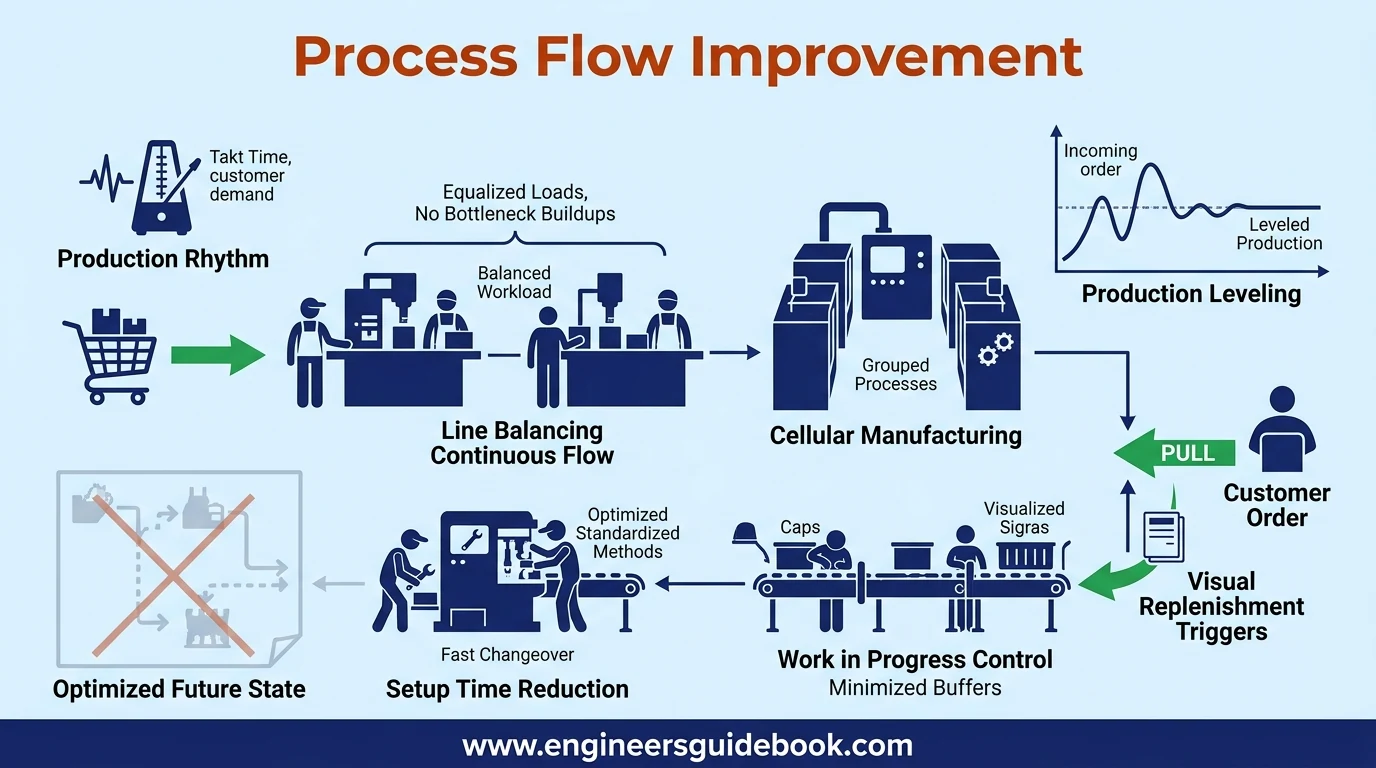
8. Process Flow Improvement
8.1 Future State Mapping
Future state mapping depicts the desired value stream after waste removal. It assigns priorities, owners, and implementation deadlines.
8.2 Continuous Flow
Continuous flow moves units directly between operations. Reliable equipment, balanced work, small batches, and standardized methods support it.
8.3 Cellular Manufacturing
Cellular manufacturing groups related machines by product family, reducing transportation and simplifying communication across connected production steps.
8.4 Takt Time
Takt time is available production time divided by customer demand. It establishes production rhythm and reveals stations above or below demand.
8.5 Line Balancing
Line balancing distributes tasks evenly among workstations. Activities may be divided, combined, or resequenced to prevent bottlenecks without compromising safety or quality.
8.6 Pull Production
Pull production authorizes output only after downstream consumption. It restrains overproduction, lowers inventory, and helps processes respond more accurately to changing customer requirements.
8.7 Kanban System
Kanban uses cards, containers, spaces, or electronic signals to trigger replenishment and specify item, quantity, source, and destination.
8.8 Work in Progress Control
Work in progress limits cap material between operations, exposes congestion, accelerates feedback, and prevents inventory from concealing instability.
8.9 Setup Time Reduction
Setup reduction externalizes preparation, standardizes tools, and removes unnecessary adjustments, making smaller batches economical.
8.10 Production Leveling
Production leveling smooths volume and product-mix fluctuations, reducing overtime, supplier disruption, erratic workloads, and finished-goods accumulation.
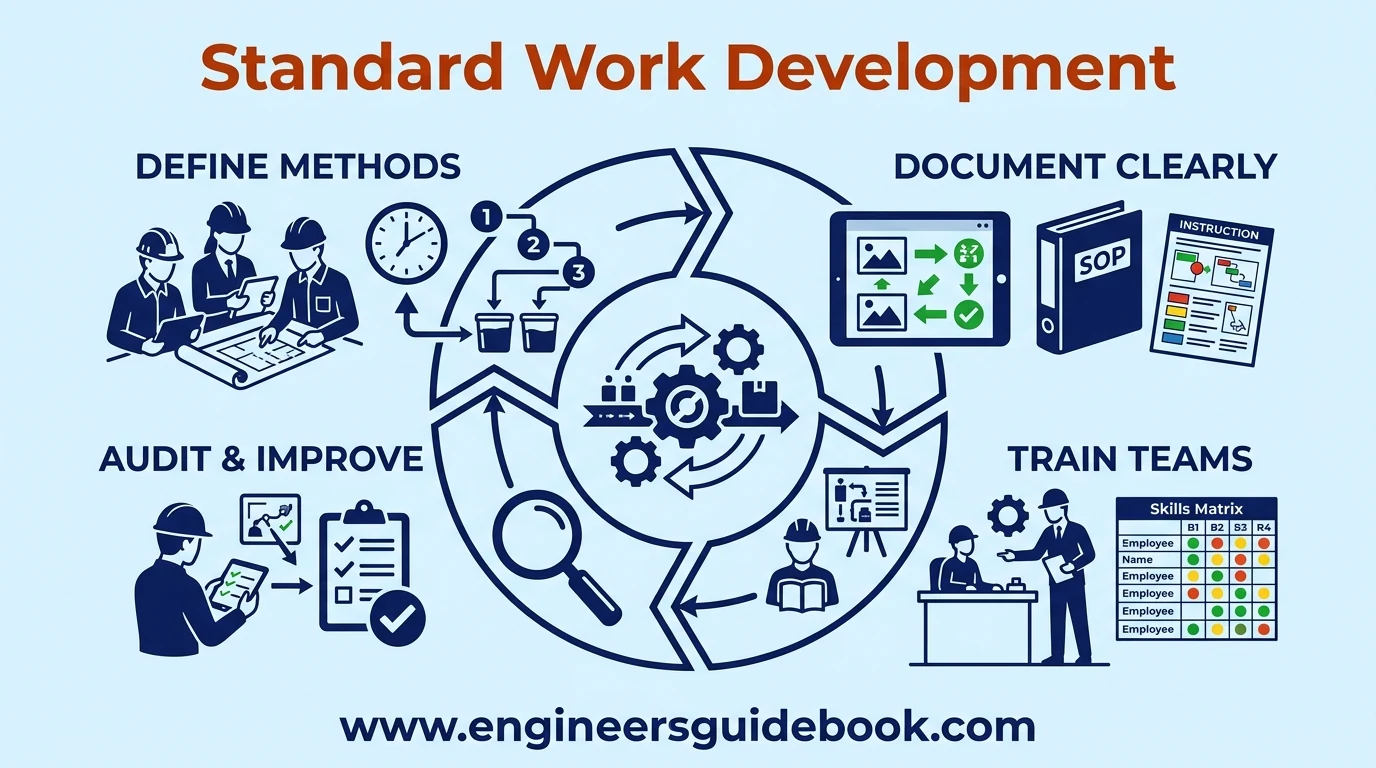
9. Standard Work Development
9.1 Standard Work Sequence
The standard work sequence defines the correct order of tasks. Consistent sequencing reduces variation and makes procedural deviations readily observable.
9.2 Standard Cycle Time
Standard cycle time establishes the expected duration of each task under normal conditions. It supports staffing, capacity analysis, and line balancing.
9.3 Standard Inventory
Standard inventory is the minimum material needed to sustain flow. It includes units in processing and carefully calculated buffers between connected operations.
9.4 Work Instructions
Work instructions provide concise steps, specifications, precautions, and acceptance criteria. They should remain accessible, visual, and current.
9.5 Standard Operating Procedures
Standard operating procedures define responsibilities, controls, approvals, and interfaces while integrating production with safety, quality, and regulatory obligations.
9.6 Visual Work Standards
Photographs, diagrams, samples, labels, and color coding make correct methods easier to understand. Visual comparison also exposes abnormalities immediately.
9.7 Operator Involvement
Operators should help design standard work because their practical knowledge improves accuracy, acceptance, ownership, and feasibility.
9.8 Training Within Industry
Training Within Industry develops supervisors through structured job instruction, work improvement, and employee-relations methods.
9.9 Skills Matrix
A skills matrix displays competence across processes and machines, revealing training gaps, staffing vulnerabilities, and cross-training needs.
9.10 Standard Work Audits
Standard work audits compare practice with approved methods and trigger coaching, correction, or justified revision.
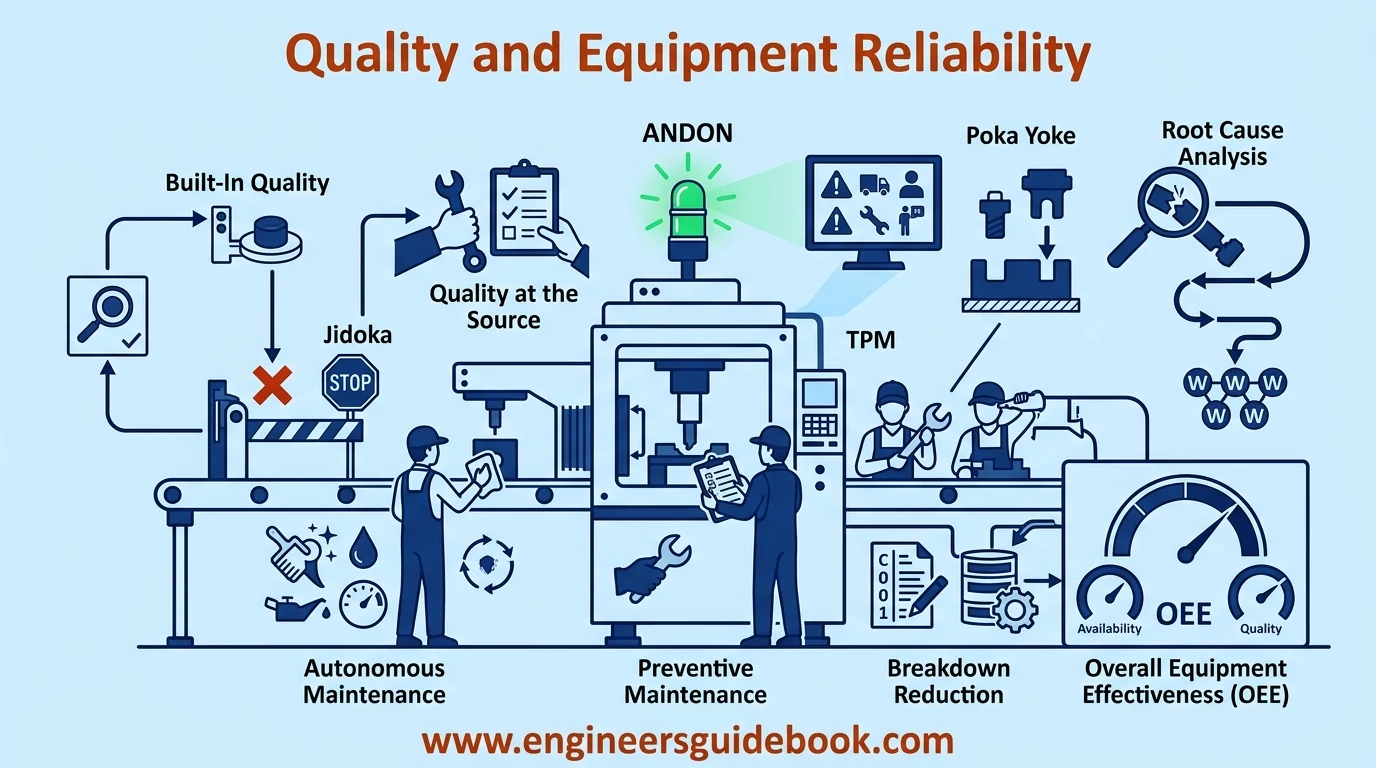
10. Quality and Equipment Reliability
10.1 Built In Quality
Built-in quality detects, contains, and corrects abnormalities during production. It prevents defective work from traveling downstream and multiplying losses.
10.2 Quality at the Source
Quality at the source makes employees responsible for verifying their work. Problems are stopped and corrected where they originate.
10.3 Poka Yoke
Poka yoke prevents mistakes or makes them instantly visible. Fixtures, sensors, interlocks, counters, and shaped components are common examples.
10.4 Jidoka
Jidoka enables machines or operators to stop production when abnormalities occur, preventing defects from continuing downstream.
10.5 Andon System
An andon system communicates faults, shortages, stoppages, or assistance requests through visual or audible signals linked to a defined response.
10.6 Root Cause Analysis
Root cause analysis investigates systemic conditions behind recurring failures, replacing assumptions and blame with evidence.
10.7 Five Whys
The Five Whys method repeatedly questions causation until the underlying process weakness becomes visible. Complex failures may require additional analytical tools.
10.8 Total Productive Maintenance
Total productive maintenance unites production and maintenance employees around preventive care, operator ownership, and focused loss elimination.
10.9 Preventive Maintenance
Preventive maintenance schedules inspection, lubrication, adjustment, and replacement before failure, using criticality and history to determine frequency.
10.10 Autonomous Maintenance
Autonomous maintenance trains operators to clean, inspect, lubricate, and detect deterioration. Technicians can then concentrate on specialized reliability work.
10.11 Overall Equipment Effectiveness
Overall equipment effectiveness combines availability, performance, and quality. It exposes losses from downtime, slow running, minor stops, and defective output.
10.12 Breakdown Reduction
Breakdown reduction requires failure coding, root-cause elimination, maintenance planning, and spare-parts control. Repeated repair without causal correction preserves instability.
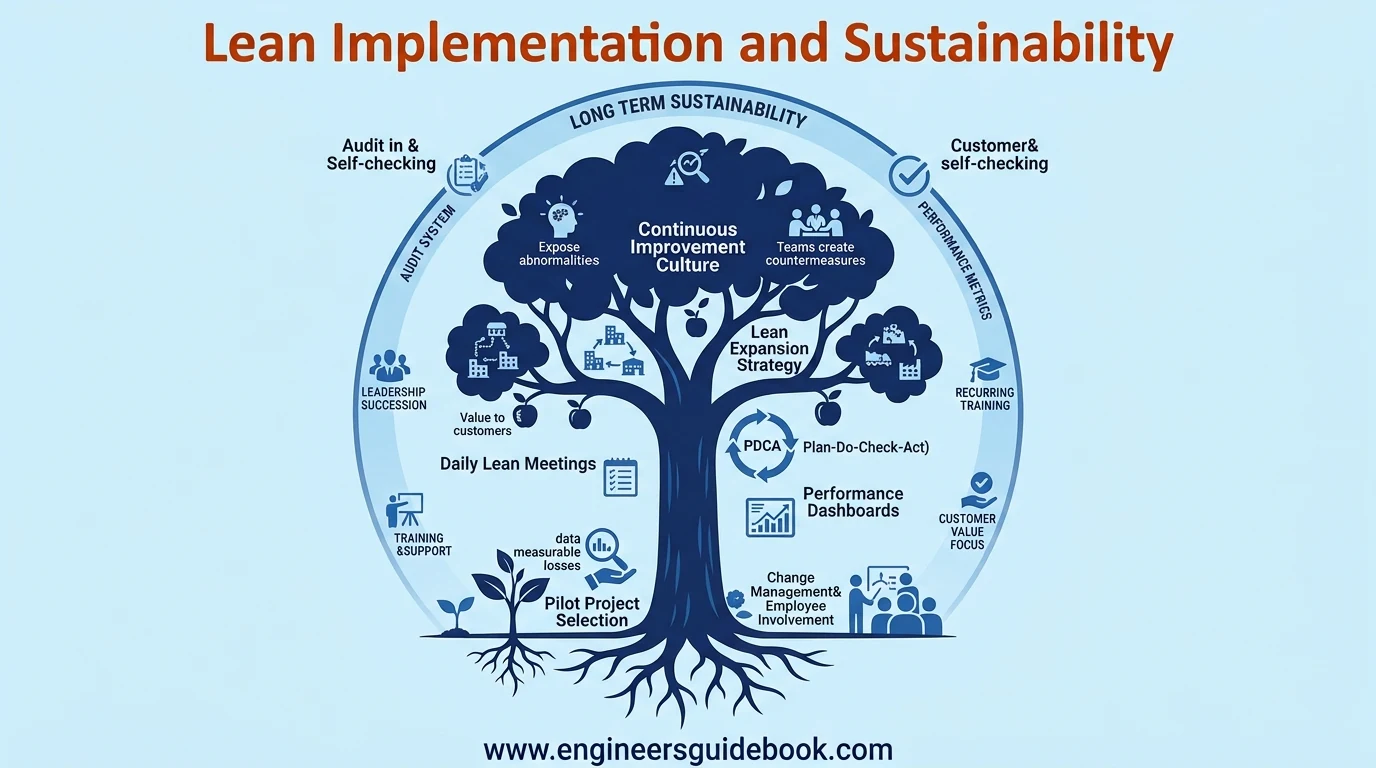
11. Lean Implementation and Sustainability
11.1 Pilot Project Selection
Select a pilot with measurable losses, manageable complexity, reliable data, and supportive leadership. Results should demonstrate value and transferable lessons.
11.2 Rapid Improvement Events
Rapid improvement events focus a cross-functional team on one problem. Preparation and follow-up prevent ephemeral gains.
11.3 Kaizen Implementation
Kaizen encourages frequent, incremental improvements near the workplace. Successful ideas should be tested safely, documented, standardized, and recognized promptly.
11.4 Employee Training
Training should combine lean concepts with practice in observing waste, interpreting metrics, solving problems, and applying standards.
11.5 Change Management
Change management explains why lean is needed, what will change, and how employees will be affected. Transparent communication reduces uncertainty.
11.6 Resistance Management
Resistance may reflect fear, fatigue, or failed initiatives. Leaders should listen, address concerns, involve skeptics, and demonstrate evidence.
11.7 Daily Lean Meetings
Daily meetings review safety, quality, delivery, cost, staffing, and abnormalities. They should remain brief, visual, and focused on ownership.
11.8 Performance Dashboards
Dashboards display trends, targets, gaps, actions, and owners without inundating teams with decorative metrics.
11.9 Lean Key Performance Indicators
Useful indicators include lead time, first-pass yield, inventory turns, schedule attainment, changeover time, equipment effectiveness, safety, and improvement closure.
11.10 Plan Do Check Act
Plan Do Check Act structures experimentation. Teams define a problem, test a countermeasure, evaluate results, and standardize or revise the solution.
11.11 Lean Audit System
Lean audits evaluate standards, controls, routines, problem-solving, and cultural adoption. Scores matter only when deficiencies receive action.
11.12 Continuous Improvement Culture
A continuous improvement culture treats problems as learning opportunities. Employees should expose abnormalities without fear and participate in developing countermeasures.
11.13 Lean Expansion Strategy
Expansion should follow proven capability rather than arbitrary deadlines. Validated practices can gradually extend across lines, departments, suppliers, and offices.
11.14 Long Term Sustainability
Long-term sustainability requires leadership succession, recurring training, updated standards, routine audits, and persistent attention to customer value.
12. Frequently Asked Questions
12.1 What Are the First Steps in Implementing Lean Manufacturing
Define customer value, assess readiness, choose a pilot, map the current process, collect baseline data, and train the implementation team.
12.2 How Long Does Lean Manufacturing Implementation Take
Visible improvements may appear within weeks, but enterprise-wide transformation usually requires years of consistent leadership.
12.3 How Much Does Lean Manufacturing Implementation Cost
Costs depend on training, equipment, software, consulting, and employee time. Many early improvements need minimal capital.
12.4 Which Lean Tool Should Be Implemented First
Choose the tool that addresses the priority problem. Process mapping, 5S, visual management, and standard work are common starting points.
12.5 Can Lean Manufacturing Work in Small Companies
Yes. Small companies often implement lean quickly because communication is direct, decisions are faster, and methods scale economically.
12.6 What Are the Biggest Barriers to Lean Implementation
Common barriers include inconsistent leadership, weak employee participation, unstable processes, poor data, inadequate training, departmental silos, and short-term thinking.
12.7 How Can Employees Be Involved in Lean Manufacturing
Employees can map processes, identify waste, create standards, conduct trials, perform autonomous maintenance, and review daily performance.
12.8 How Is Lean Manufacturing Success Measured
Success is measured through lead time, quality, delivery, productivity, inventory, safety, customer satisfaction, and employee participation.
12.9 What Is the Role of Leadership in Lean Manufacturing
Leaders set direction, provide resources, remove barriers, coach problem-solving, review progress, and model expected behaviors.
12.10 How Can Lean Manufacturing Be Sustained
Sustain lean through standard work, daily management, audits, continuous training, employee ownership, and consistent leadership attention.
12.11 What Is the Difference Between Lean and Six Sigma
Lean emphasizes flow and waste elimination, whereas Six Sigma emphasizes variation reduction and statistical control. Both approaches can complement each other.
12.12 Can Lean Manufacturing Be Implemented Without Consultants
Yes. Consultants may accelerate learning, but trained internal leaders can succeed through disciplined experimentation, benchmarking, and sustained management support.
13. Conclusion
Lean implementation progresses from assessment and analysis to flow improvement, standardization, quality control, equipment reliability, and cultural reinforcement.
Success requires committed leadership, employee participation, reliable data, stable processes, clear accountability, and persistent follow-up.
Select one value stream, appoint leaders, establish baseline metrics, observe the workplace, identify priority waste, and launch a controlled pilot.