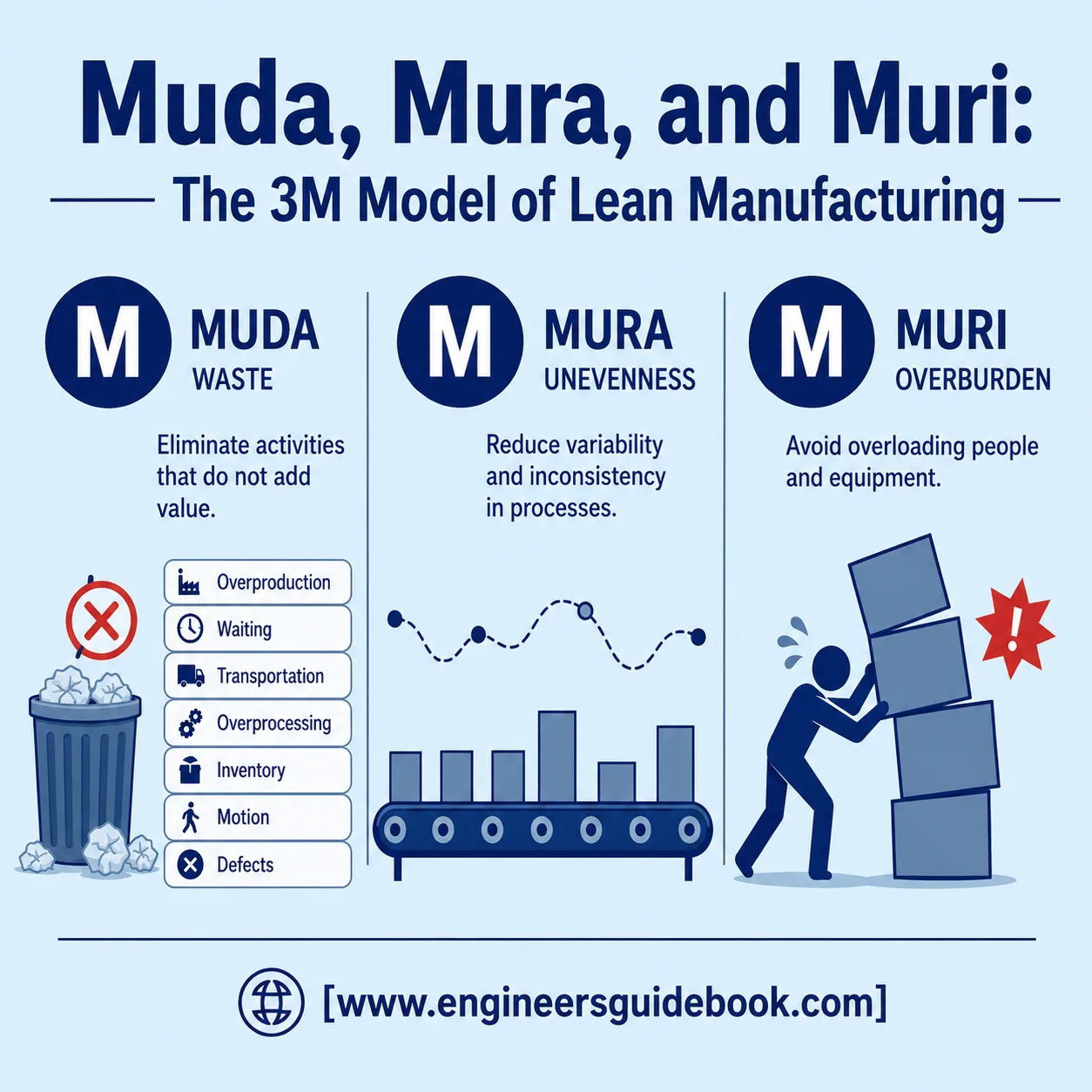
Muda, Mura, and Muri form the 3M model of lean manufacturing, a framework used to eliminate waste, reduce unevenness, and prevent overburden. Muda targets activities that consume resources without creating customer value, Mura addresses inconsistency in workload and production flow, while Muri prevents excessive strain on people and equipment. Together, they create stable, efficient, and sustainable operations.
1. Lean 3M Model
1.1 3M Model Definition
The 3M model is a lean manufacturing concept built around three Japanese terms: Muda, Mura, and Muri . Each represents a different form of operational inefficiency. Muda means waste, Mura refers to unevenness or inconsistency, and Muri represents overburden.
Rather than treating inefficiency as a single problem, the 3M model examines the production system from multiple perspectives. It helps organizations understand not only where waste appears, but also why that waste develops.
1.2 Lean Manufacturing Connection
Lean manufacturing seeks to maximize customer value while minimizing unnecessary consumption of labor, materials, equipment, time, and capital. The 3M model supports this objective by revealing systemic inefficiencies that conventional cost-cutting initiatives may overlook.
Eliminating visible waste alone is insufficient. If production remains erratic or employees remain overloaded, waste will eventually reappear. Lean therefore requires coordinated control of all three Ms.
1.3 Muda Mura Muri Relationship
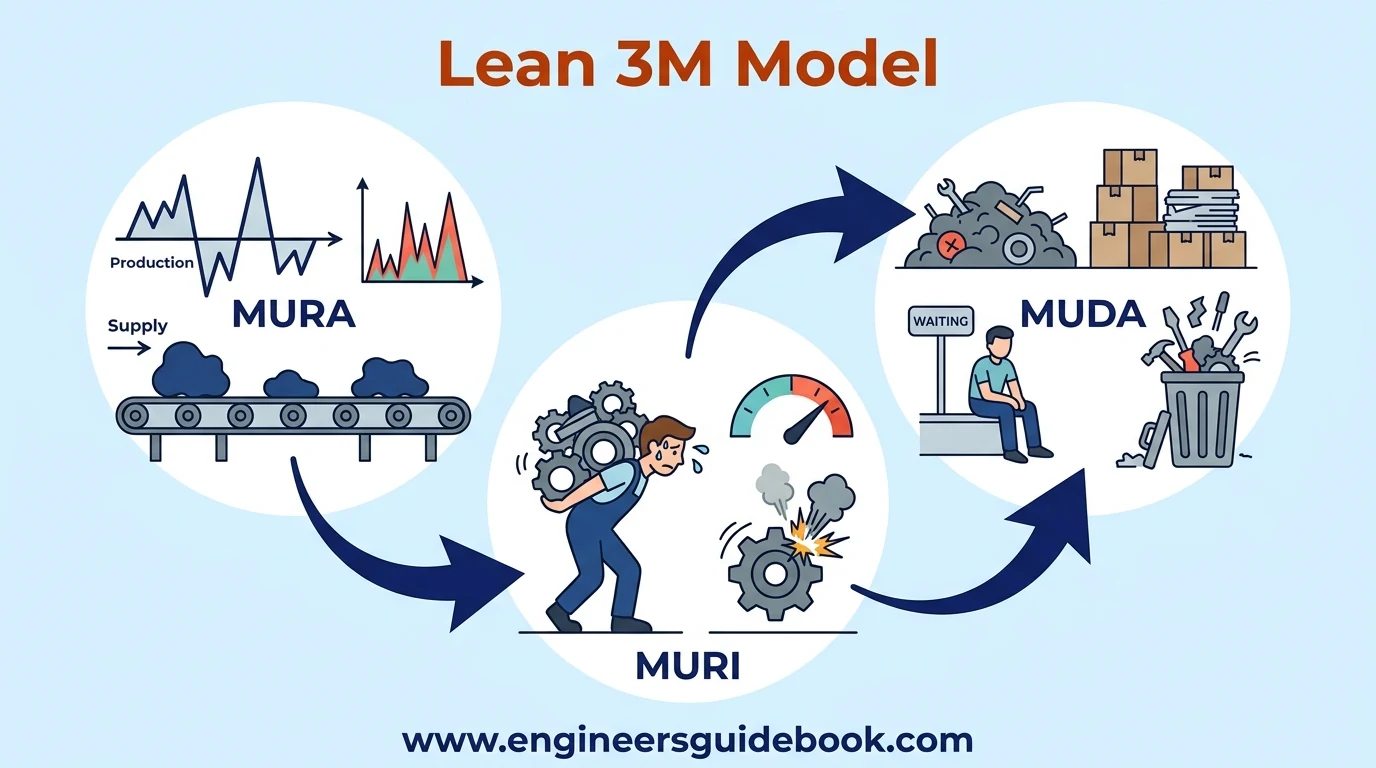
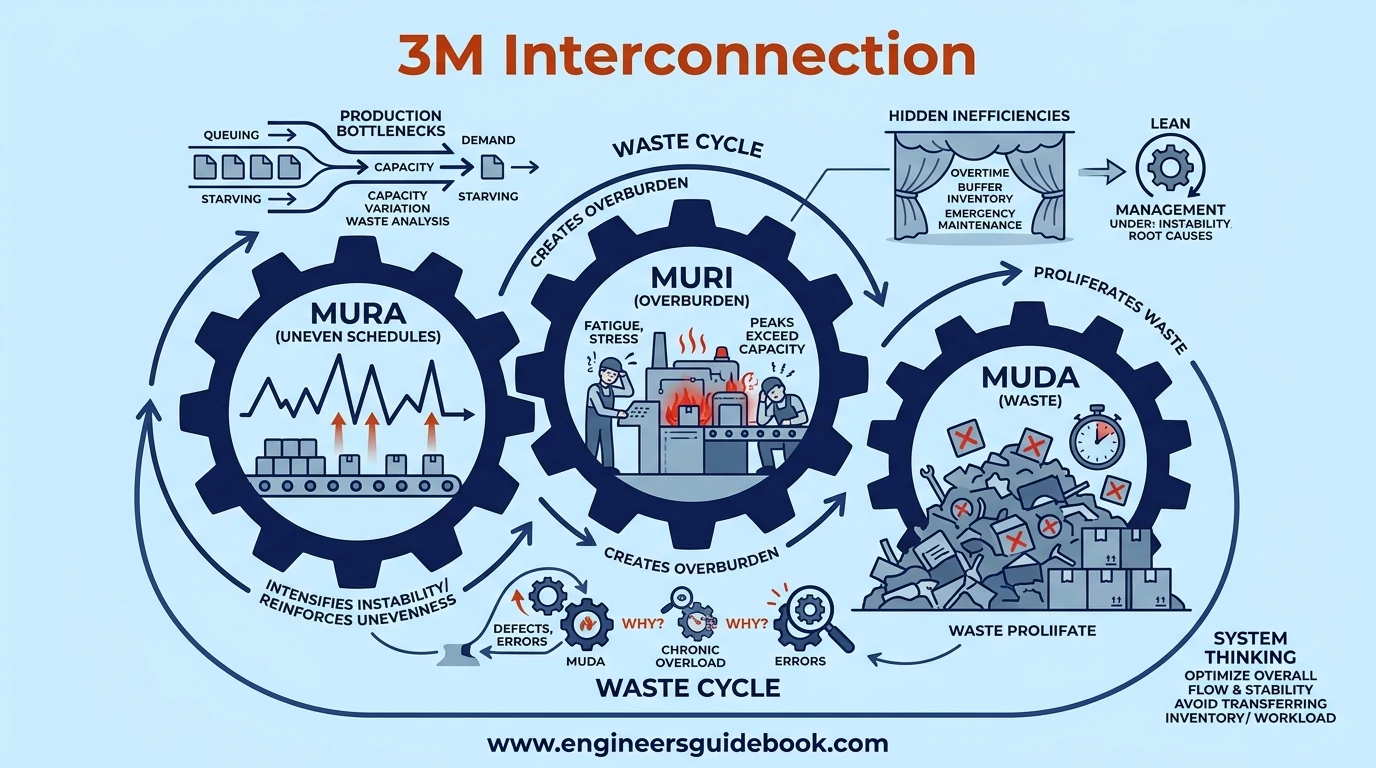
Muda, Mura, and Muri are strongly interconnected. Uneven production schedules create periods of excessive workload. Excessive workload, in turn, causes errors, breakdowns, waiting, rework, and other forms of waste.
For example, a sudden production surge may overload operators and machinery. Quality deteriorates, maintenance requirements increase, and unfinished inventory accumulates. What initially appears to be Muda may actually originate from Mura and Muri.
1.4 Operational Efficiency
Operational efficiency improves when work proceeds at a predictable pace using appropriate resources. The 3M model enables organizations to identify interruptions, capacity mismatches, redundant activities, and workload abnormalities.
Efficient operations are not necessarily those running at maximum speed. A machine operating continuously above its sustainable capacity may temporarily increase output while simultaneously accelerating deterioration. True efficiency balances productivity, reliability, quality, safety, and cost.
1.5 Toyota Production System
The concepts of Muda, Mura, and Muri are closely associated with the Toyota Production System . Toyota developed production practices that emphasized continuous flow, standardized work, Just-in-Time production, built-in quality, and systematic problem solving.
Within this philosophy, waste elimination extends beyond visible inefficiency. Production must also be leveled and manageable. This broader interpretation distinguishes sustainable lean systems from isolated productivity campaigns.
1.6 Waste Reduction Philosophy
Lean waste reduction begins by questioning whether each activity contributes meaningful value. Processes are scrutinized for redundant transportation, unnecessary movement, waiting, defects, excessive stock, and similar losses.
However, the objective is not indiscriminate elimination. Some non-value-adding activities remain necessary because of safety, legal, technical, or quality requirements. Lean thinking focuses on removing avoidable waste while simplifying unavoidable tasks.
1.7 Process Stability
Stable processes produce consistent results within predictable operating conditions. They depend on standardized procedures, reliable equipment, controlled material flow, balanced workloads, and competent operators.
Mura and Muri frequently undermine this stability. Erratic schedules generate workload peaks, while persistent overburden increases the probability of human error and mechanical failure. Consequently, stability becomes a prerequisite for sustained waste elimination.
1.8 Continuous Improvement
Continuous improvement, commonly associated with Kaizen , ensures that the 3M model remains an ongoing management discipline rather than a temporary initiative.
Employees routinely examine work methods, identify abnormalities, test countermeasures, and standardize successful improvements. Small improvements accumulate over time, gradually creating processes that are simpler, safer, more predictable, and increasingly resistant to waste.
2. Muda
2.1 Muda Definition
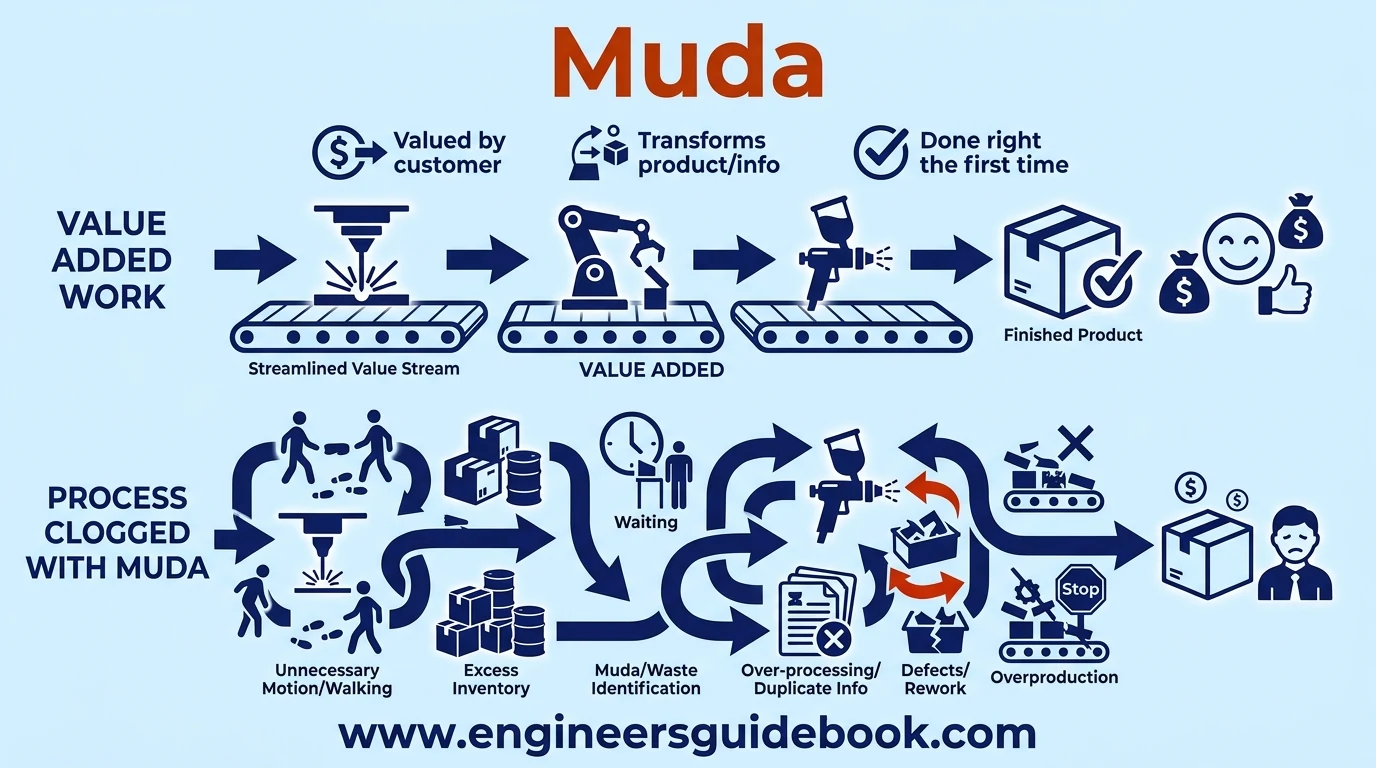
Muda means waste or uselessness. In lean manufacturing, it describes activities that consume resources without producing value that the customer is willing to pay for.
Muda can involve labor hours, material, floor space, energy, equipment utilization, inventory, or administrative effort. Detecting it requires analyzing how work actually flows rather than relying solely on documented procedures.
2.2 Value Added Work
Value-added work changes a product or service in a manner that satisfies customer requirements. Typically, three conditions apply: the customer values the activity, the activity transforms the product or information, and it is performed correctly the first time.
Machining a component to its required dimension, assembling functional parts, or applying a specified coating may therefore constitute value-added work.
2.3 Non Value Added Work
Non-value-added work consumes resources without increasing customer value. Examples include moving material unnecessarily, searching for tools, waiting for approvals, correcting defective work, and entering duplicate information.
These activities often become normalized because employees encounter them every day. Lean analysis challenges such habituation by asking why the activity exists and whether its underlying cause can be eliminated.
2.4 Necessary Waste
Some activities do not directly create customer value but remain necessary under present operating conditions. These may include regulatory inspections, safety checks, equipment setup, documentation, or mandatory testing.
Lean organizations distinguish necessary waste from pure waste. The aim is to simplify, automate, combine, or shorten necessary activities rather than removing controls that protect safety, legality, or product integrity.
2.5 Pure Waste
Pure waste contributes no meaningful value and can often be eliminated without impairing the product or process. Examples include repeated handling, unnecessary approvals, excessive walking, avoidable waiting, and rework caused by preventable defects.
Pure waste represents an immediate improvement opportunity because removing it usually decreases lead time and operating cost without compromising customer requirements.
2.6 Customer Value
Customer value provides the reference point for distinguishing productive activity from waste. An activity may appear important internally while offering little or no benefit to the customer.
Organizations must therefore understand required functionality, quality, delivery, reliability, and price. Lean improvement becomes more precise when decisions are based on what customers genuinely require rather than entrenched organizational habits.
2.7 Process Waste
Process waste frequently develops through poor layout, cumbersome procedures, obsolete equipment, excessive batch sizes, unclear responsibilities, or inadequate standardization.
These inefficiencies may remain concealed because individual departments optimize their own tasks. Value stream analysis exposes waste across the complete process, revealing delays and handoffs that local performance metrics often fail to capture.
2.8 Muda Identification
Muda can be identified through Gemba walks, process observation, time studies, value stream mapping, employee feedback, and operational data.
The strongest approach combines quantitative evidence with direct observation. Reports may indicate excessive lead time, but observing the workplace reveals whether the cause is waiting, motion, transport, rework, or another form of waste.
Also Read More:
Lean Manufacturing: Principles, Tools, Benefits, and Examples
How to Implement Lean Manufacturing Step by Step
5 Principles of Lean Manufacturing Explained With Examples
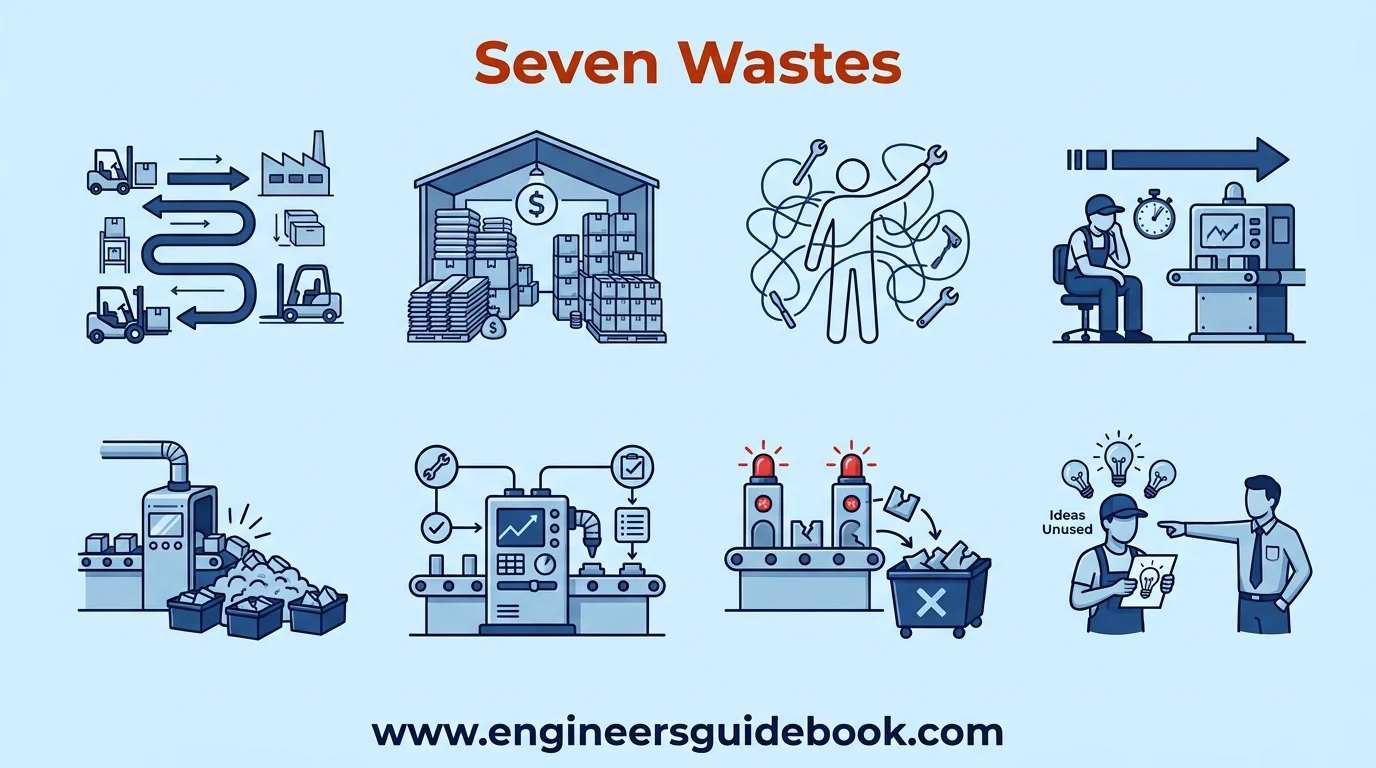
3. Seven Wastes
3.1 Transportation
Transportation waste occurs when materials, components, tools, or information are moved more than necessary. Excessive transportation consumes time and handling resources while increasing the possibility of damage or loss.
Poor plant layout is a common culprit. Locating sequential operations closer together can substantially reduce unnecessary movement.
3.2 Inventory
Excess inventory includes unnecessary raw materials, work-in-process, finished goods, and spare parts. Although inventory may provide temporary protection against uncertainty, excessive stock ties up capital and occupies valuable space.
It can also obscure deeper problems such as unreliable equipment, unstable suppliers, poor scheduling, and lengthy changeovers.
3.3 Motion
Motion waste concerns unnecessary movement by people or equipment. Walking long distances, repeatedly reaching for tools, bending excessively, or searching for materials all consume effort without transforming the product.
Improved workplace organization and ergonomic design can eliminate substantial amounts of motion while simultaneously enhancing safety.
3.4 Waiting
Waiting occurs whenever people, equipment, or materials remain idle because the next required activity cannot begin. Causes include machine breakdowns, delayed approvals, missing materials, long setups, and unbalanced production.
Waiting increases lead time without generating customer value, making it one of the most conspicuous manifestations of Muda.
3.5 Overproduction
Overproduction means producing earlier, faster, or in greater quantity than required. Lean practitioners often regard it as particularly damaging because it generates additional inventory, storage, handling, and scheduling complexity.
Large batches can conceal defects for longer periods and make production less responsive to changing customer demand.
3.6 Overprocessing
Overprocessing occurs when more work is performed than necessary to satisfy requirements. Excessive inspections, unnecessarily tight tolerances, duplicate documentation, redundant approvals, or sophisticated processing where simpler methods suffice are common examples.
The remedy begins by clarifying actual customer and technical requirements.
3.7 Defects
Defects create waste through scrap, rework, inspection, replacement, delayed delivery, and customer dissatisfaction. They also consume capacity that could otherwise produce saleable output.
Lean systems emphasize defect prevention rather than relying primarily on downstream inspection. Standardized work, Poka Yoke, root cause analysis, and Jidoka contribute to this objective.
3.8 Skills Waste
Skills waste occurs when employee knowledge, creativity, and experience are underutilized. Operators often understand recurring production problems intimately, yet organizations may exclude them from improvement activities.
Encouraging employee participation transforms practical experience into process improvement while strengthening engagement and problem-solving capability.
4. Mura
4.1 Mura Definition
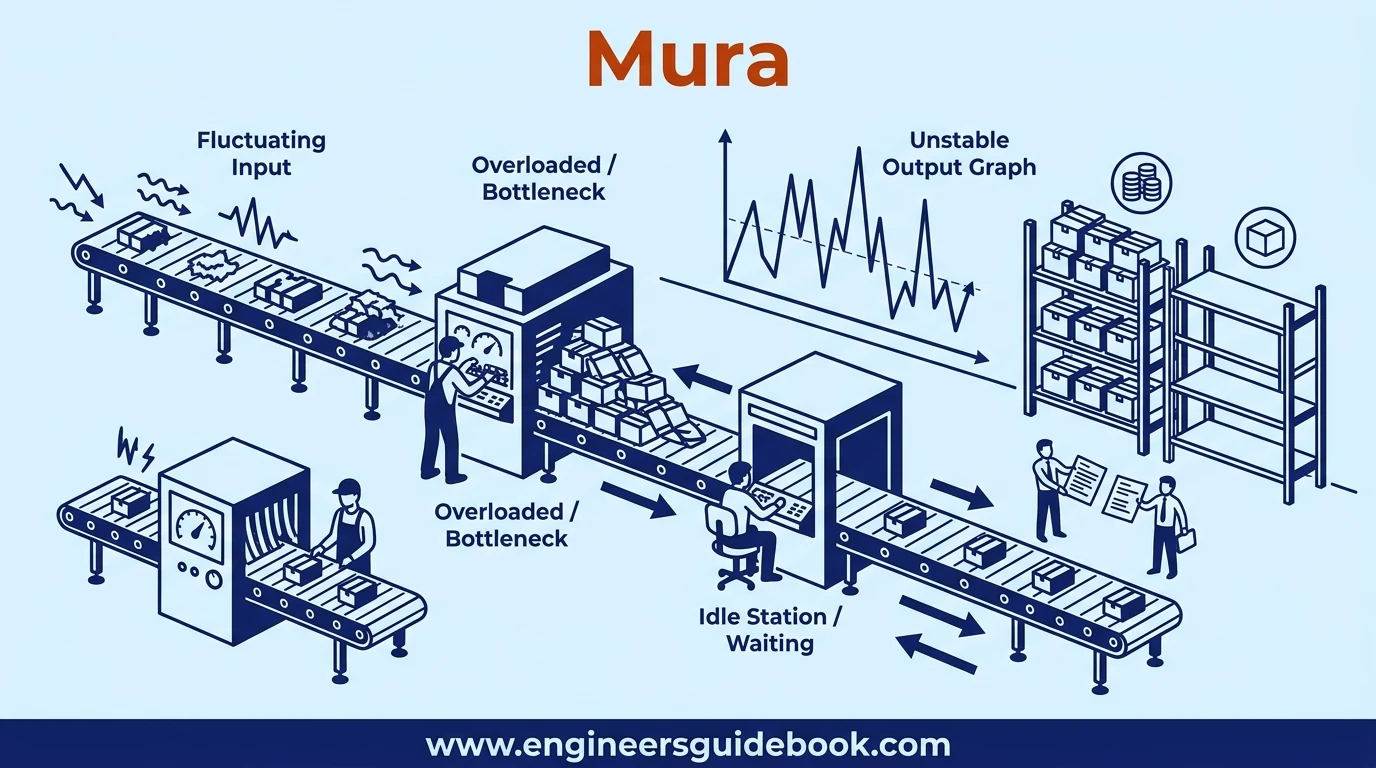
Mura means unevenness, irregularity, or inconsistency. It occurs when workload, demand, production rate, staffing, or material flow fluctuates unnecessarily.
Mura destabilizes operations because resources must repeatedly adjust between low and high activity. This oscillation often creates both Muri and Muda.
4.2 Uneven Workload
Uneven workloads occur when some operators or machines are overloaded while others remain underutilized. Bottlenecks form at heavily loaded stations, while downstream processes wait for material.
Work balancing helps distribute tasks more evenly and creates smoother production flow.
4.3 Demand Fluctuation
Customer demand naturally varies, but poor planning can amplify that variation within the factory. Large batch releases, monthly production pushes, and abrupt schedule changes create artificial peaks and troughs.
Production leveling helps absorb such variability without continually destabilizing resources.
4.4 Production Variation
Variation in cycle times, output rates, quality, and material availability disrupts synchronization between processes. When one operation performs inconsistently, adjacent operations compensate through waiting, buffering, overtime, or excess inventory.
Reducing variation improves predictability and enables leaner production systems.
4.5 Capacity Imbalance
Capacity imbalance exists when connected processes cannot sustain compatible output rates. One machine may produce 100 units per hour while the next can process only 70.
The resulting mismatch generates queues and work-in-process inventory. Capacity planning, line balancing, and constraint management help correct these disparities.
4.6 Scheduling Instability
Frequent changes to production schedules create confusion, expedited work, excess setups, and material shortages. Operators struggle to maintain standard work when priorities constantly change.
Stable scheduling establishes a more dependable production rhythm and allows labor, machinery, and materials to be coordinated effectively.
4.7 Inventory Variation
Uncontrolled inventory fluctuations are often symptoms of irregular production and inconsistent replenishment. One period may experience shortages while another accumulates excess stock.
Pull systems, Kanban, replenishment standards, and leveled production can moderate these oscillations.
4.8 Process Variability
Process variability includes fluctuations in machine performance, operator methods, material quality, cycle times, and environmental conditions.
Standardized work and statistical process control help reduce unnecessary variation. Predictable processes make abnormalities easier to detect because deviations become conspicuous rather than being obscured by routine inconsistency.
5. Muri
5.1 Muri Definition
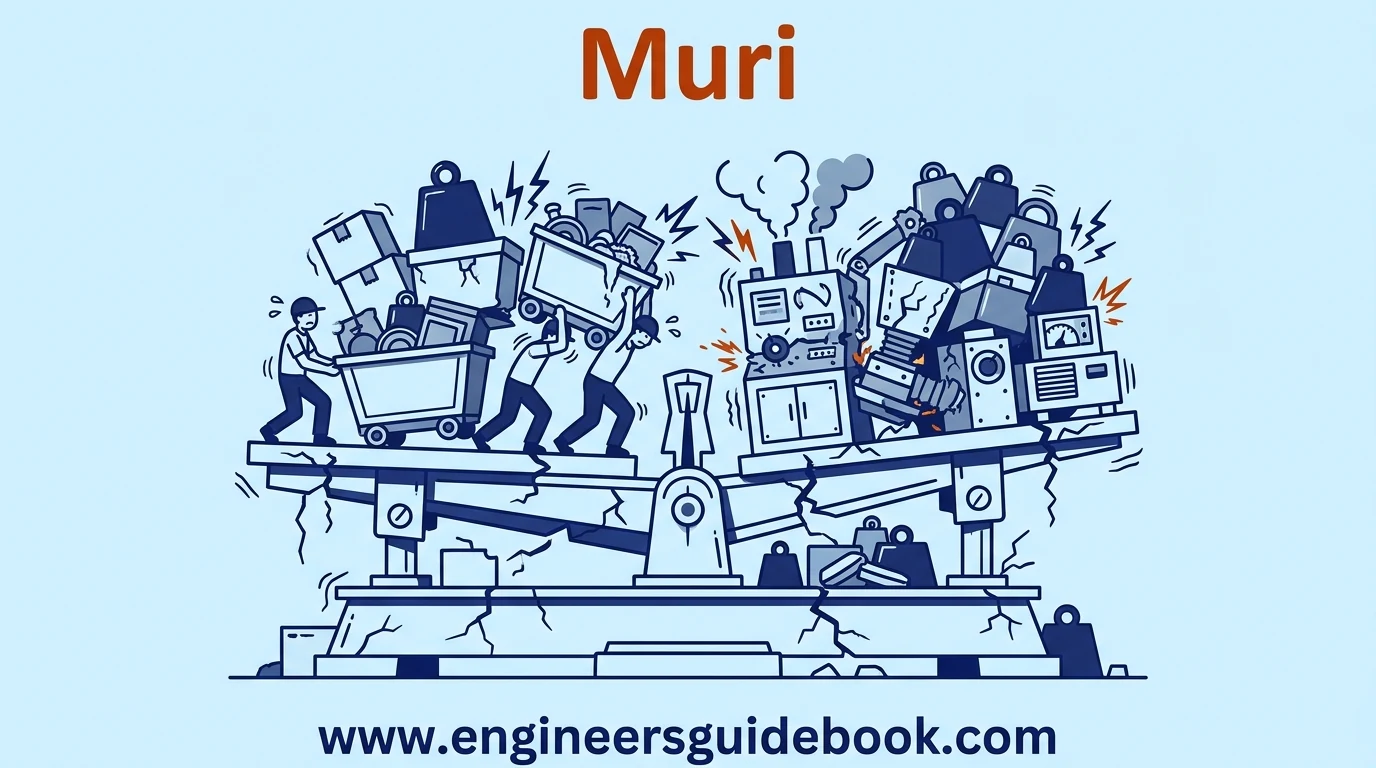
Muri means overburden or unreasonable strain. It occurs when people, equipment, or systems are required to operate beyond sustainable limits.
Muri is especially pernicious because short-term productivity gains can conceal long-term deterioration. Excessive workload eventually manifests as fatigue, errors, failures, injuries, or declining quality.
5.2 Worker Overburden
Worker overburden can result from unrealistic production targets, inadequate staffing, poor ergonomics, repetitive tasks, excessive overtime, or insufficient training.
Sustainable lean systems respect human limitations. Work should be designed so employees can consistently achieve expected performance without compromising safety or quality.
5.3 Equipment Overload
Machines experience Muri when operated beyond their rated capacity, speed, pressure, temperature, or duty cycle. Continuous overload accelerates wear and increases failure probability.
Operating within engineered limits, combined with appropriate preventive and condition-based maintenance, protects equipment reliability.
5.4 Excessive Workload
Excessive workloads frequently originate from inadequate capacity planning or unstable scheduling. Temporary peaks may be manageable, but sustained overload creates chronic operational fragility.
Balancing demand with available capacity prevents heroic recovery efforts from becoming the normal method of production.
5.5 Unsafe Conditions
Overburden can encourage unsafe shortcuts. Employees under extreme time pressure may bypass procedures, adopt awkward working postures, or continue using malfunctioning equipment.
Lean manufacturing therefore treats safety as integral to operational excellence rather than as an impediment to productivity.
5.6 Unrealistic Targets
Targets disconnected from actual process capability create systemic Muri. Employees may respond by rushing work, postponing maintenance, building hidden inventory, or circumventing quality controls.
Effective performance targets should challenge improvement while remaining grounded in demonstrated process capability and available resources.
5.7 Maintenance Stress
Maintenance departments experience Muri when reactive breakdown work dominates planned maintenance. Emergency repairs, deferred preventive tasks, inadequate spare parts, and chronic understaffing create recurring technical instability.
A mature maintenance strategy reduces this burden through planned interventions, reliability engineering, and root cause elimination.
5.8 Resource Constraints
Insufficient labor, tooling, equipment, materials, utilities, or technical expertise can overload existing resources. Lean does not mean operating permanently with the fewest possible resources.
Instead, resources should be proportionate to customer demand and process capability. Removing genuine waste is fundamentally different from stripping away essential capacity.
6. 3M Interconnection
6.1 Mura Creates Muri
Mura often initiates the 3M chain. An uneven production schedule produces workload peaks that exceed normal capacity, forcing employees and equipment into overburden.
Thus, reducing unevenness can prevent many forms of Muri before they emerge.
6.2 Muri Creates Muda
Once resources are overloaded, waste tends to proliferate. Fatigued operators make more errors, overloaded machinery breaks down, and rushed production produces defects.
Consequently, attempts to eliminate Muda without addressing Muri frequently deliver transient improvements.
6.3 Muda Creates Instability
Waste itself can also intensify instability. Excessive inventory obscures bottlenecks, rework disrupts schedules, and long transportation routes increase lead-time variation.
The relationship between the three Ms is therefore cyclical rather than linear.
6.4 Waste Cycle
A typical waste cycle begins with uneven demand, which creates overburden, followed by defects, delays, overtime, inventory accumulation, and emergency intervention.
Unless the original source is removed, organizations repeatedly spend resources treating symptoms rather than eliminating causes.
6.5 Production Bottlenecks
Bottlenecks concentrate workload at specific resources. Upstream processes create queues while downstream operations experience starvation.
Analyzing bottlenecks through the 3M framework helps determine whether the constraint results from excessive demand, inadequate capacity, process variation, or wasteful practices.
6.6 Hidden Inefficiencies
Some inefficiencies remain concealed behind overtime, buffer inventory, experienced operators, and emergency maintenance. These countermeasures allow production to continue but disguise underlying instability.
Lean management intentionally exposes such abnormalities so their root causes can be addressed.
6.7 Root Cause Relationships
Effective lean problem solving asks why waste exists rather than merely removing its visible manifestation. A waiting problem may originate from equipment unreliability, while repeated equipment failure may result from chronic overload.
Understanding these causal relationships prevents superficial improvements.
6.8 System Thinking
System thinking evaluates the complete value stream rather than optimizing isolated departments. Improving one workstation is counterproductive if it simply transfers inventory, delays, or workload elsewhere.
The 3M model therefore encourages managers to optimize overall flow, stability, and customer value.
7. Manufacturing Examples
7.1 Automotive Assembly
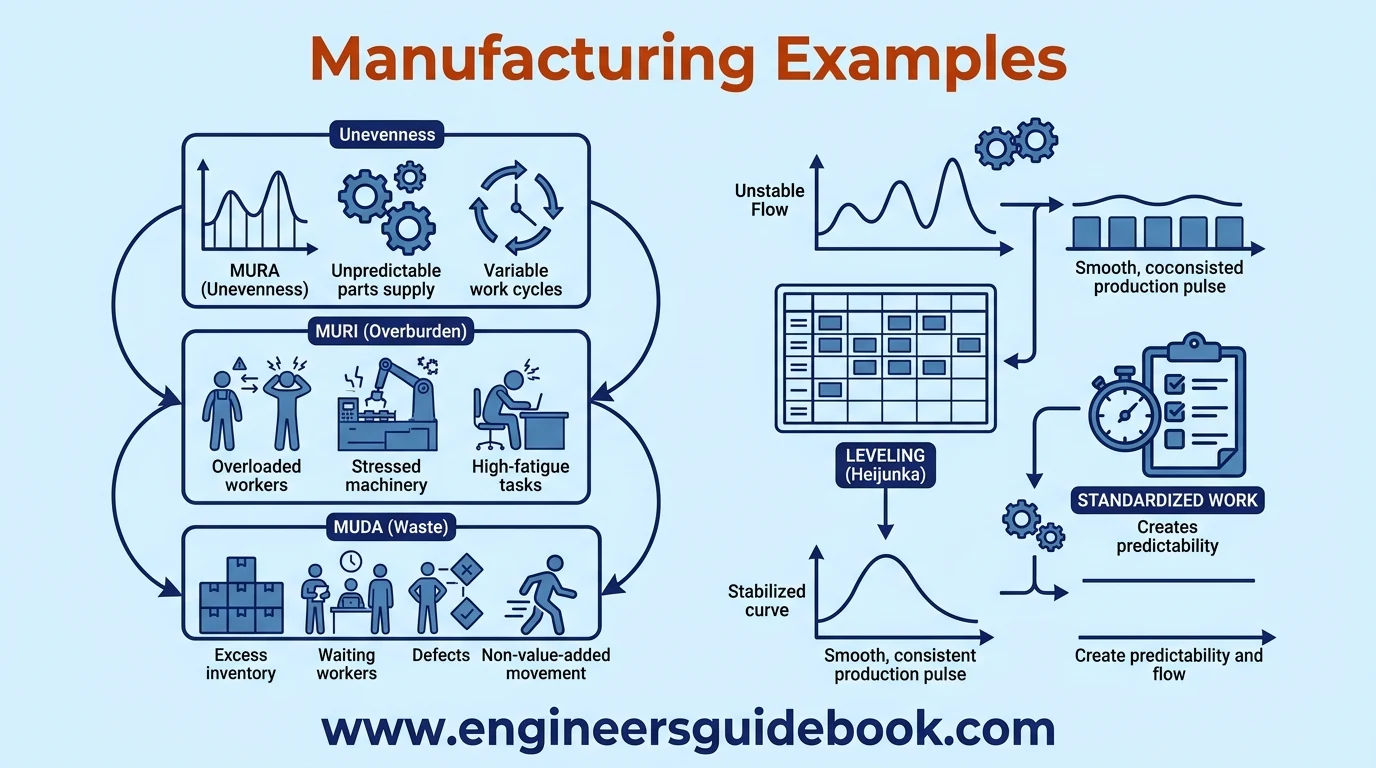
In automotive assembly, overproduction represents Muda, fluctuating model schedules create Mura, and demanding excessive output from operators produces Muri.
Production leveling and standardized work help synchronize the line while protecting quality and workforce sustainability.
7.2 Machining Operations
A machining department may accumulate excessive work-in-process between CNC machines. That inventory is Muda. Irregular job releases create Mura, while continuously running a critical machine beyond recommended duty conditions creates Muri.
Balancing workloads and improving scheduling addresses all three simultaneously.
7.3 Packaging Lines
Packaging lines often expose 3M problems clearly. Waiting for cartons creates Muda, inconsistent product supply causes Mura, and forcing operators to manually compensate for recurring machine faults creates Muri.
Reliable equipment and balanced line speeds restore smoother flow.
7.4 Warehouse Operations
Unnecessary forklift travel represents Muda, irregular dispatch volumes create Mura, and repeatedly assigning excessive lifting or picking workloads produces Muri.
Improved slotting, replenishment planning, ergonomics, and workload distribution can substantially reduce these losses.
7.5 Maintenance Activities
Repeated emergency repair is a form of waste because it consumes resources without permanently eliminating failure. Highly irregular breakdown demand creates Mura, while technicians working prolonged emergency shifts experience Muri.
Preventive maintenance and root cause analysis convert maintenance from reactive firefighting into controlled reliability management.
7.6 Material Handling
Excessive material movement, double handling, and unnecessary storage are classic examples of Muda. Irregular material deliveries introduce Mura, while overloaded forklifts or manual handling beyond ergonomic limits represent Muri.
Facility layout and standardized material routes can alleviate all three conditions.
7.7 Quality Inspection
Repeated inspection may become waste when defects could be prevented at their source. Sudden surges in inspection workload create Mura, while forcing inspectors to process unrealistic quantities creates Muri.
Built-in quality and process capability improvement shift emphasis from defect detection toward defect prevention.
7.8 Production Scheduling
Production scheduling provides one of the clearest demonstrations of the 3M relationship. Large batches and frequent priority changes generate excess inventory and waiting, creating Muda. Irregular schedules generate Mura. The resulting production peaks overload employees and equipment, producing Muri.
A stable, leveled schedule establishes the foundation for smoother flow and sustainable lean performance.
8. Muda Reduction
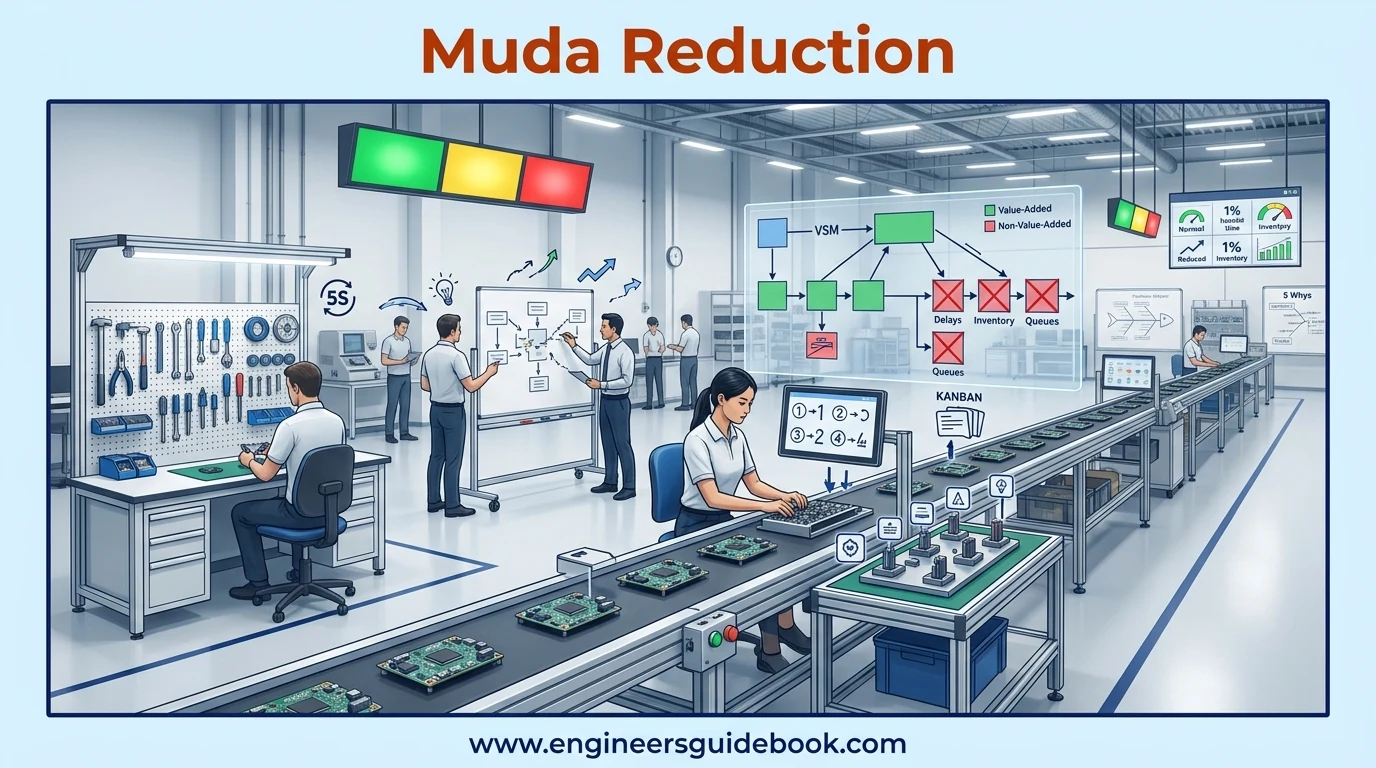
Reducing Muda requires more than removing obvious inefficiencies. Sustainable waste reduction depends on understanding process flow, customer value, workplace organization, quality controls, and the causes that allow waste to recur.
8.1 Value Stream Mapping
Value Stream Mapping provides a visual representation of material and information flow from supplier to customer. It distinguishes value-added activities from delays, queues, inventories, handoffs, and redundant processing.
By examining the entire value stream rather than isolated operations, organizations can locate systemic Muda. Future-state mapping then establishes a more efficient sequence with shorter lead times, reduced inventory, and improved flow.
8.2 Five S
5S organizes the workplace through Sort, Set in Order, Shine, Standardize, and Sustain. Its purpose extends beyond cleanliness.
A well-structured workplace reduces searching, unnecessary motion, misplaced tools, abnormal conditions, and avoidable delays. Visual order also makes deviations conspicuous, allowing employees to identify problems before they develop into larger operational losses.
8.3 Kaizen
Kaizen means continuous improvement through frequent, incremental changes. Employees closest to a process are encouraged to identify waste and propose practical countermeasures.
Small improvements in layouts, work sequences, setup methods, or material presentation can accumulate into substantial gains. Kaizen also prevents lean transformation from becoming dependent exclusively on expensive technology or large capital projects.
8.4 Standardized Work
Standardized work establishes the safest and most efficient known method for completing an activity. It typically defines work sequence, cycle time, quality requirements, and standard work-in-process.
Without standardization, operators may perform identical tasks differently, generating inconsistency and waste. A stable standard creates a baseline from which future improvements can be measured and institutionalized.
8.5 Kanban
Kanban is a visual signaling system that supports pull-based production. Instead of producing according to assumptions or large forecasts, upstream processes replenish material when downstream processes actually consume it.
This approach limits work-in-process, reduces overproduction, and improves inventory visibility. Properly designed Kanban systems also expose shortages and process instability that excessive stock would otherwise conceal.
8.6 Poka Yoke
Poka Yoke refers to mistake-proofing methods that prevent errors or make them immediately detectable. Examples include fixtures that allow only correct assembly, sensors that verify component presence, or connectors designed to prevent incorrect orientation.
Preventing defects at source eliminates rework, inspection burden, scrap, and customer complaints. It therefore attacks several forms of Muda simultaneously.
8.7 Root Cause Analysis
Root Cause Analysis seeks the underlying reason a problem exists rather than treating its symptoms. Techniques such as the Five Whys , fishbone diagrams, and fault analysis help trace recurring waste back to its origin.
A machine stoppage, for example, may initially appear to be a maintenance issue but ultimately result from lubrication standards, operator practices, or improper loading.
8.8 Visual Management
Visual management communicates operating conditions through signs, boards, markings, indicators, Andon lights, performance displays, and standardized labels.
The objective is immediate comprehension. Employees should be able to recognize normal and abnormal conditions quickly. Effective visual systems reduce ambiguity, accelerate decision-making, and prevent waste caused by communication failures.
9. Mura Reduction
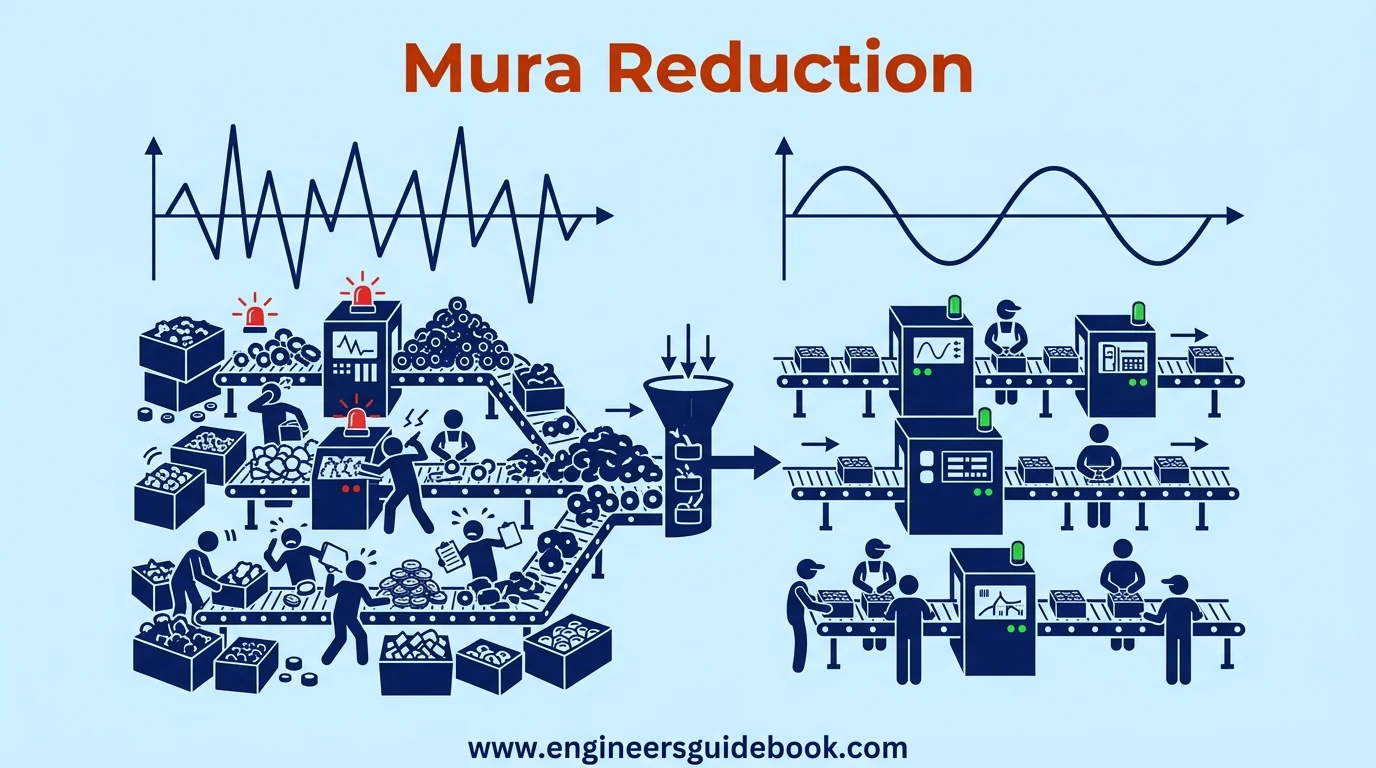
Mura reduction focuses on creating consistency. Unevenness in workload, production volume, staffing, inventory, or scheduling destabilizes processes and frequently creates both waste and overburden.
9.1 Heijunka
Heijunka is the lean practice of production leveling. It distributes production volume and product mix more evenly over time instead of allowing large peaks and troughs.
By leveling demand placed on processes, organizations can reduce overtime, excess inventory, capacity shocks, and abrupt changes in resource requirements.
9.2 Production Leveling
Production leveling transforms fluctuating demand into a manageable operating rhythm. Rather than producing one product in enormous batches, output can be divided into smaller, recurring quantities.
This approach improves responsiveness and reduces the operational turbulence associated with batch-and-queue manufacturing. It also helps supporting processes maintain more consistent workloads.
9.3 Takt Time
Takt time defines the rate at which production must operate to satisfy customer demand. It is calculated by dividing available production time by required customer quantity.
Takt time provides a cadence for balancing processes. When workstations consistently operate much faster or slower than takt, queues, waiting, or overburden are likely to emerge.
9.4 Demand Smoothing
Demand smoothing reduces artificial volatility created by promotions, ordering practices, batch releases, or internal planning routines.
Although customer demand cannot always be controlled, organizations can prevent internal processes from magnifying its variability. More predictable order release patterns improve procurement, staffing, production planning, and equipment utilization.
9.5 Workload Balancing
Workload balancing distributes tasks so that no workstation or employee becomes chronically overloaded while others remain idle.
Time studies, work combination charts, cross-training, and line balancing can reveal inequitable task distribution. Balanced workloads improve throughput while reducing fatigue, waiting, and bottleneck formation.
9.6 Standard Scheduling
Standard scheduling establishes predictable rules for production sequencing, order release, changeovers, and replenishment.
Constantly changing priorities create Mura because resources must repeatedly adapt. Stable schedules reduce expediting and enable maintenance, logistics, labor, and material supply to synchronize with production requirements.
9.7 Capacity Planning
Capacity planning ensures that available labor, machinery, utilities, tooling, and infrastructure can support expected demand.
Operating permanently at or above theoretical maximum capacity leaves little resilience for breakdowns, changeovers, variation, or quality problems. Effective capacity planning therefore includes realistic allowances rather than optimistic assumptions.
9.8 Flow Improvement
Flow improvement seeks uninterrupted movement of material and information through the value stream.
Smaller batches, cellular layouts, synchronized operations, balanced cycle times, and reduced setup duration all contribute to smoother flow. As interruptions decline, Mura becomes easier to detect and control.
10. Muri Reduction
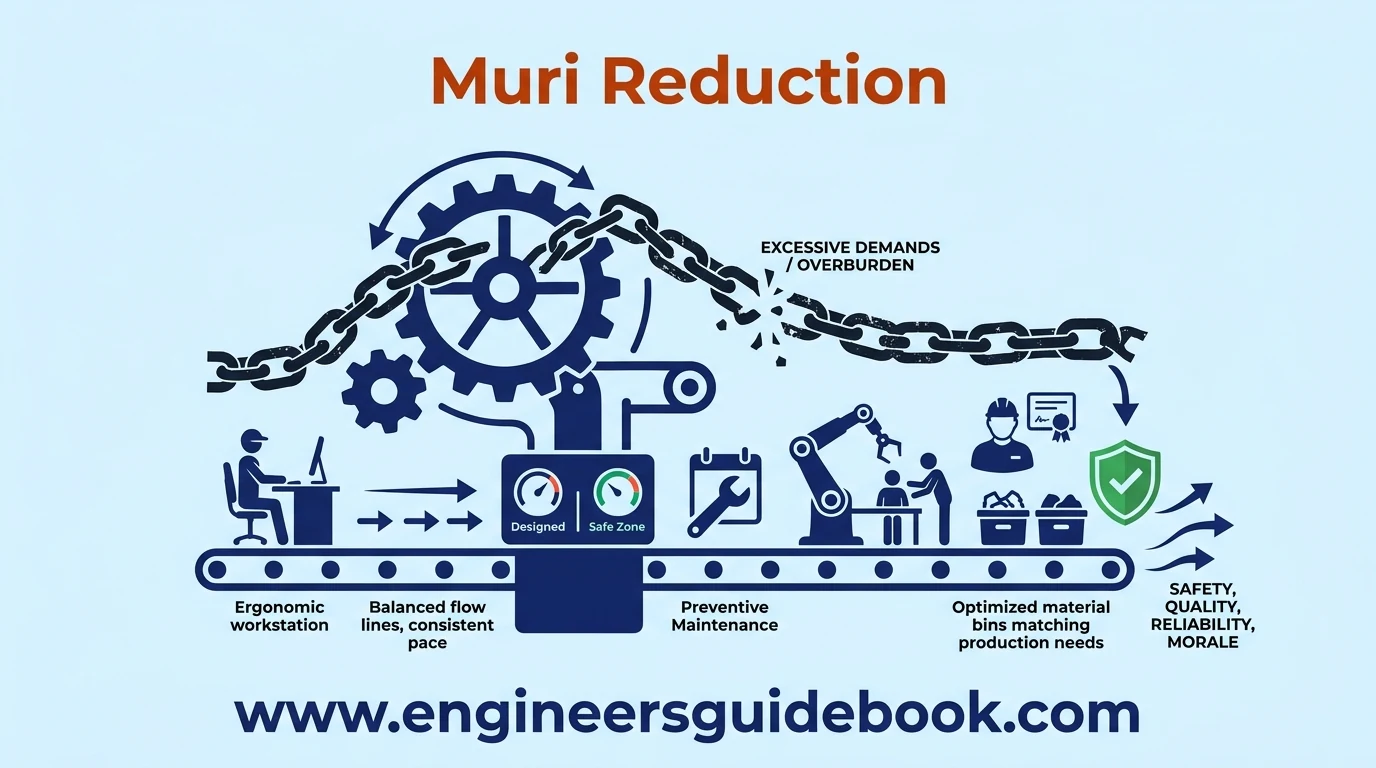
Muri reduction protects people and equipment from excessive demands. Lean organizations recognize that chronic overburden may create impressive short-term output while simultaneously degrading safety, quality, reliability, and morale.
10.1 Ergonomic Design
Ergonomic design adapts work to human capabilities. Appropriate working heights, lifting aids, tool positioning, reach distances, lighting, and task rotation reduce physical strain.
Good ergonomics is not merely a safety intervention. It also improves consistency, accuracy, and productivity by eliminating unnecessary exertion.
10.2 Work Standardization
Work standardization prevents employees from compensating for poorly designed processes through excessive effort.
Clear methods, balanced task content, and defined cycle times reduce ambiguity and discourage unsafe shortcuts. Standards must remain practical, however. Unrealistic standards simply institutionalize Muri.
10.3 Equipment Capacity
Machines should operate within their engineered design envelope. Excessive speed, load, temperature, pressure, or duty cycles accelerate deterioration.
Capacity limits must therefore be incorporated into production planning. Increasing output by repeatedly exceeding equipment capability merely converts current demand into future downtime.
10.4 Preventive Maintenance
Preventive maintenance reduces equipment overburden by preserving correct operating conditions.
Inspection, lubrication, alignment, cleaning, replacement intervals, and condition monitoring help detect deterioration before failure. Reliable equipment also reduces secondary Muri on maintenance personnel who would otherwise face frequent emergency repairs.
10.5 Automation Support
Automation can reduce Muri when applied to repetitive, hazardous, physically demanding, or highly precise work.
Robotic handling, sensors, automatic inspection, lifting devices, and process controls can remove unnecessary strain. Automation should support process design rather than conceal inefficient methods behind expensive machinery.
10.6 Skill Development
Properly trained employees perform work with greater confidence, consistency, and safety.
Cross-training also provides operational flexibility by allowing labor to shift when workloads change. Without adequate competency, employees may compensate for uncertainty through excessive effort, improvisation, or repeated corrections.
10.7 Resource Allocation
Resource allocation ensures that people, tools, materials, and equipment are available in proportion to workload.
Lean operations do not pursue minimal resources indiscriminately. Insufficient staffing or equipment can create chronic overload. Resources should instead match takt, process capability, and expected variability.
10.8 Safety Improvement
Safety improvement is inseparable from Muri reduction. Excessive force, fatigue, awkward posture, time pressure, and overloaded equipment frequently precede accidents.
Removing these conditions protects employees while simultaneously improving process reliability. A genuinely lean system should become safer as efficiency improves.
11. 3M Implementation
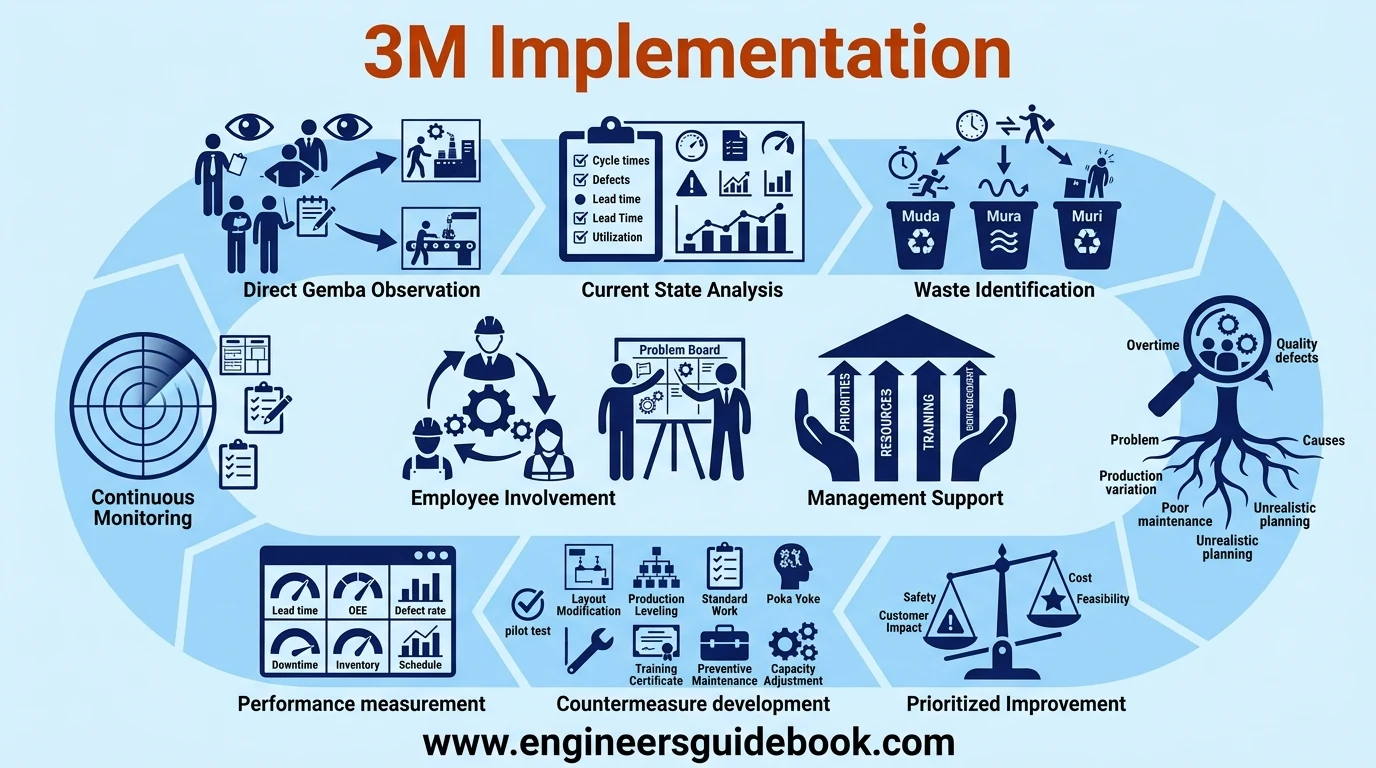
Implementing the 3M model requires a structured methodology that connects observation, diagnosis, corrective action, and performance control.
11.1 Gemba Observation
Gemba means the actual place where work occurs. Managers and improvement teams must observe processes directly rather than relying solely on spreadsheets or reports.
Watching the work exposes waiting, workarounds, excessive motion, queues, overload, and abnormal conditions that aggregated data may conceal.
11.2 Current State Analysis
Current state analysis establishes how the process actually performs before changes are introduced.
Cycle times, downtime, inventory, staffing, defects, workload, lead time, and equipment utilization should be documented. This baseline enables improvement teams to distinguish genuine gains from subjective impressions.
11.3 Waste Identification
Waste identification classifies observed problems according to Muda, Mura, and Muri.
This classification prevents teams from treating every inefficiency as simple waste. An excessive inventory problem, for example, may actually be a consequence of unreliable production schedules or uneven process capability.
11.4 Root Cause Analysis
Once abnormalities are identified, root cause analysis determines why they occur.
The investigation should continue beyond immediate symptoms. Recurring overtime may originate from production variation, capacity constraints, poor maintenance, or unrealistic planning assumptions rather than employee performance.
11.5 Improvement Priorities
Not every problem should be addressed simultaneously. Priorities should consider safety, customer impact, quality, cost, frequency, risk, and implementation feasibility.
High-impact constraints and recurring sources of instability typically deserve precedence because eliminating them can release improvements across multiple downstream processes.
11.6 Countermeasure Development
Countermeasures should directly address verified causes. Solutions may include layout modification, production leveling, standard work, Poka Yoke, training, preventive maintenance, or capacity adjustment.
Pilot testing is often prudent before wider implementation.
11.7 Performance Measurement
Improvement must be evaluated objectively. Relevant indicators can include lead time, OEE, defect rate, downtime, inventory turnover, cycle time, overtime, safety incidents, and schedule adherence.
Metrics should demonstrate whether Muda, Mura, and Muri are genuinely decreasing.
11.8 Continuous Monitoring
Processes naturally drift over time. Continuous monitoring ensures that improvements remain effective and new abnormalities are detected quickly.
Visual boards, audits, daily management routines, and trend analysis help sustain process discipline.
11.9 Employee Involvement
Employees provide indispensable insight because they interact with processes continuously.
Including operators, technicians, supervisors, and support functions in problem solving improves solution quality and increases ownership. Lean transformation becomes more durable when improvement is participatory rather than imposed.
11.10 Management Support
Management must provide clear priorities, time, resources, training, and reinforcement.
Leaders should avoid demanding lean improvements while simultaneously rewarding behaviors that create overproduction, unstable scheduling, or chronic overtime. Organizational systems must support the same principles expected on the shop floor.
12. Frequently Asked Questions
12.1 What Is Muda Mura and Muri
Muda means waste, Mura means unevenness, and Muri means overburden. Together, they form the 3M framework used in lean manufacturing to improve flow, stability, resource utilization, quality, and operational sustainability.
12.2 What Is the Difference Between Muda Mura and Muri
Muda concerns activities that do not create customer value. Mura concerns irregularity in demand or workload. Muri concerns excessive strain placed on people or equipment.
12.3 What Are Examples of Muda Mura and Muri
Excess inventory is Muda, an erratic production schedule is Mura, and requiring operators or machines to work beyond sustainable capacity is Muri.
12.4 Why Are Muda Mura and Muri Important
They help organizations examine inefficiency as a system. Eliminating visible waste alone is inadequate when uneven production and overburden continue generating new losses.
12.5 How Does Mura Lead to Muri
Mura produces peaks and troughs in workload. During peaks, people and machines may be required to exceed normal capacity, resulting in Muri.
12.6 How Does Muri Create Muda
Overburden increases fatigue, breakdowns, defects, rework, waiting, and accidents. These consequences create additional forms of Muda.
12.7 What Are the Seven Types of Muda
The traditional seven wastes are transportation, inventory, motion, waiting, overproduction, overprocessing, and defects. Underutilized employee talent is commonly recognized as an eighth waste.
12.8 How Can Muda Be Eliminated
Muda can be reduced using value stream mapping, 5S, Kaizen, Kanban, standardized work, Poka Yoke, root cause analysis, and better process design.
12.9 How Can Mura Be Reduced
Mura can be reduced through Heijunka, production leveling, workload balancing, takt-time alignment, stable scheduling, and improved capacity planning.
12.10 How Can Muri Be Prevented
Muri can be prevented through ergonomic work design, realistic workloads, adequate staffing, equipment capacity control, preventive maintenance, training, automation, and strong safety practices.
12.11 What Lean Tools Reduce the 3Ms
Useful tools include 5S, Kanban, Kaizen, Heijunka, standardized work, Poka Yoke, value stream mapping, TPM, visual management, and the Five Whys.
12.12 How Is the 3M Model Used in Manufacturing
Manufacturers use the 3M model to examine production processes, identify waste and instability, diagnose overburden, implement countermeasures, and establish smoother, safer, and more predictable operations
13. Conclusion
The 3M model provides a comprehensive framework for understanding operational inefficiency. Muda eliminates waste, Mura reduces unevenness, and Muri prevents overburden.
Treating these elements collectively produces more durable improvements than focusing on waste alone.
Sustainable lean operations balance productivity with quality, safety, reliability, and human capability.
Efficiency achieved through chronic overtime, excessive machine loading, or unstable schedules is inherently fragile. Sustainable performance requires eliminating the conditions that continuously regenerate waste.