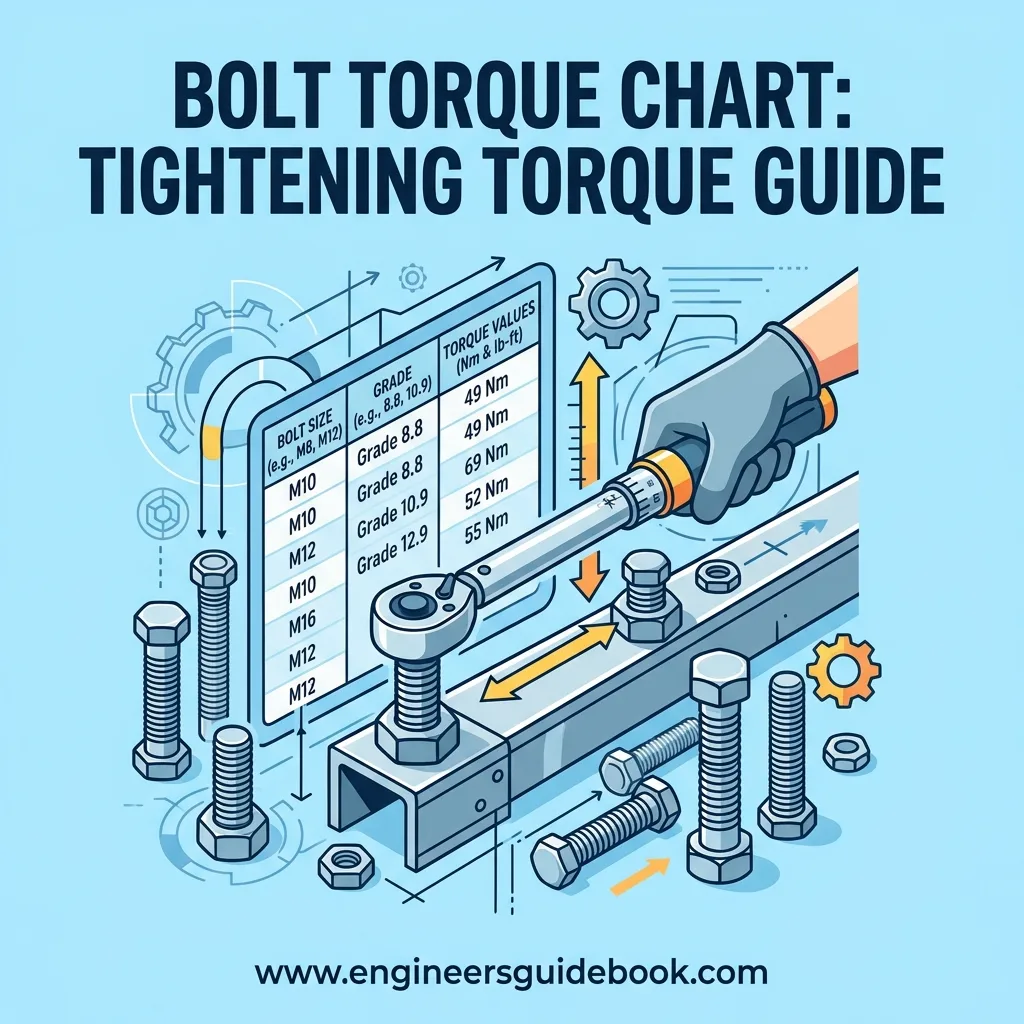
A bolt torque chart lists recommended tightening values by fastener diameter, thread pitch, grade, material, and lubrication. Correct torque stretches the bolt within its elastic range, producing preload that clamps the joint securely. Because friction strongly affects the resulting tension, dry and lubricated torque values must never be used interchangeably.
1. Bolt Torque Fundamentals
1.1 Bolt Torque Definition
Bolt torque is the rotational force applied while tightening a threaded fastener. Measured in newton metres, pound-feet, or pound-inches, it elongates the bolt and creates clamping force.
1.2 Torque and Clamping Force
Applied torque does not convert directly into clamp load. Most energy is consumed by friction beneath the head or nut and within the threads, leaving little to create useful tension.
Preload is the tensile force created in a bolt before operating loads occur. Proper preload keeps joint members compressed, reduces cyclic stress, improves fatigue resistance, and stabilizes the connection under vibration.
2. Bolt Torque Calculation
2.1 Basic Torque Formula
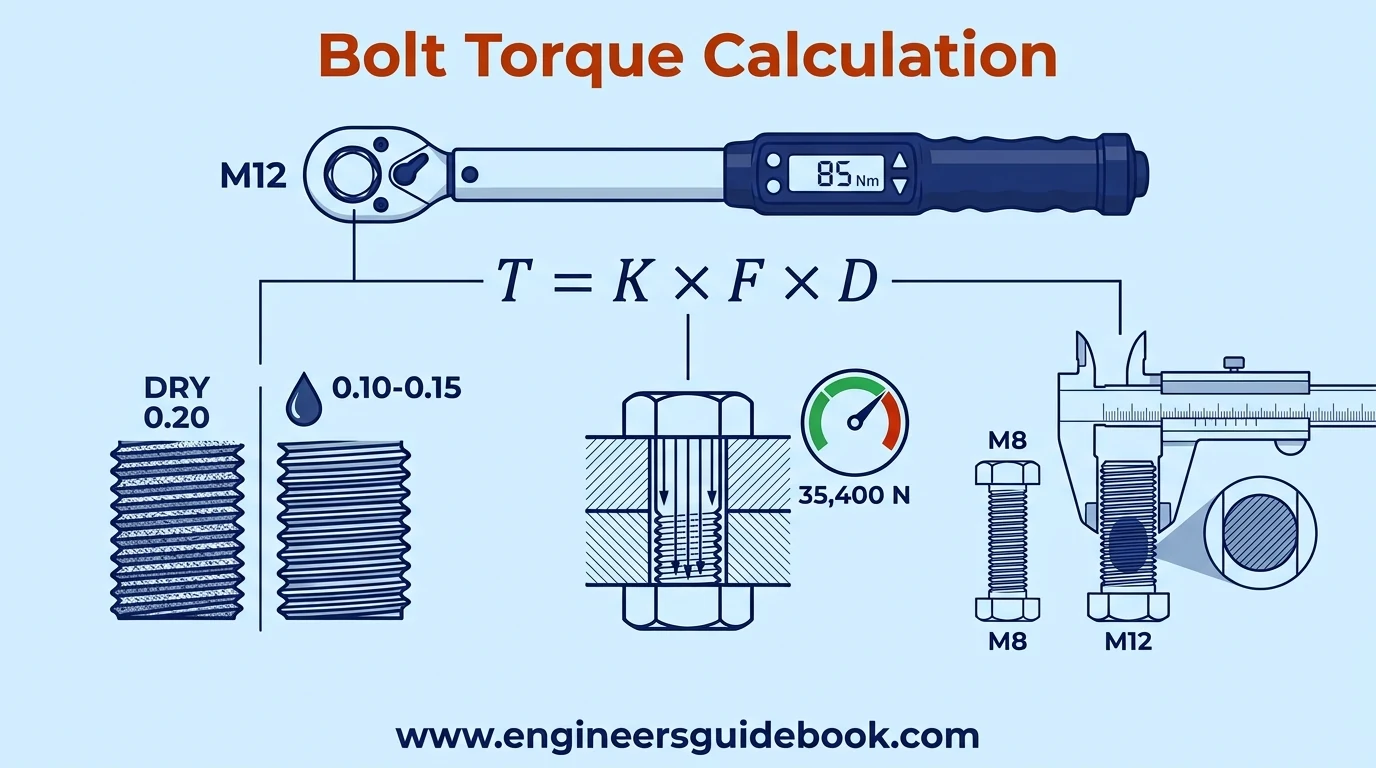
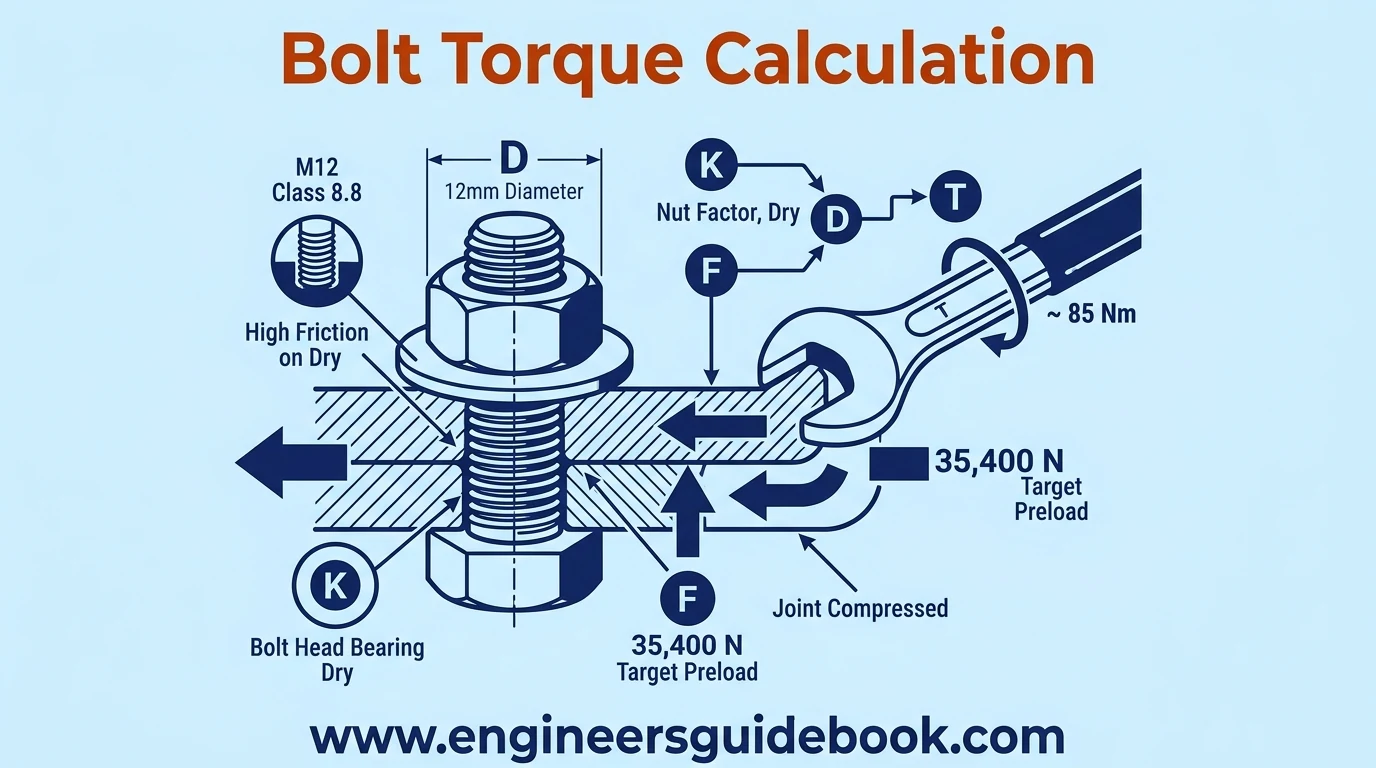
A common estimating formula is T = K × F × D , where T is torque, K is the nut factor, F is target preload, and D is nominal bolt diameter.
2.2 Basic Torque Formula
A common estimating formula for bolt tightening torque is:
T = K × F × D
Where:
- T = required tightening torque in newton-metres
- K = nut factor or torque coefficient
- F = required bolt preload in newtons
- D = nominal bolt diameter in metres
The formula provides an approximate tightening torque based on the desired preload and the frictional condition of the fastener. Because the nut factor represents friction in the threads and beneath the bolt head or nut, it must correspond to the actual lubrication, coating, and surface condition.
Consider an M12 bolt with the following values:
- Nominal bolt diameter = 12 mm
- Target preload = 30,000 N
- Nut factor = 0.20
- Required torque = T
The calculation can be completed through the following procedure.
Step 1: Identify the bolt diameter
The bolt is an M12 fastener, so its nominal diameter is:
D = 12 mm
The formula requires the diameter in metres. Convert millimetres to metres by dividing by 1,000:
D = 12 ÷ 1,000
D = 0.012 m
Step 2: Determine the required preload
Assume the joint design requires a bolt preload of:
F = 30,000 N
The target preload should normally be selected according to the bolt grade, tensile-stress area, proof load, joint material, gasket requirements, and applicable engineering specification.
Step 3: Select the nut factor
Assume a nut factor of:
K = 0.20
A value near 0.20 is commonly used for estimating purposes for dry or lightly oiled steel fasteners. However, the actual value can vary considerably depending on lubrication, plating, thread finish, washer condition, and material combination.
Step 4: Insert the values into the formula
Use the basic torque equation:
T = K × F × D
Substitute the selected values:
T = 0.20 × 30,000 × 0.012
Step 5: Multiply the preload by the diameter
30,000 × 0.012 = 360
Therefore:
T = 0.20 × 360
Step 6: Calculate the required torque
T = 72 N·m
The estimated tightening torque for the M12 bolt is therefore:
Required Torque = 72 N·m
Step 7: Set and apply the torque
Set a calibrated torque wrench to approximately 72 N·m. Tighten the bolt gradually and follow the specified tightening sequence, particularly when several bolts secure the same flange, cover, or structural connection.
3. Bolt Torque Chart
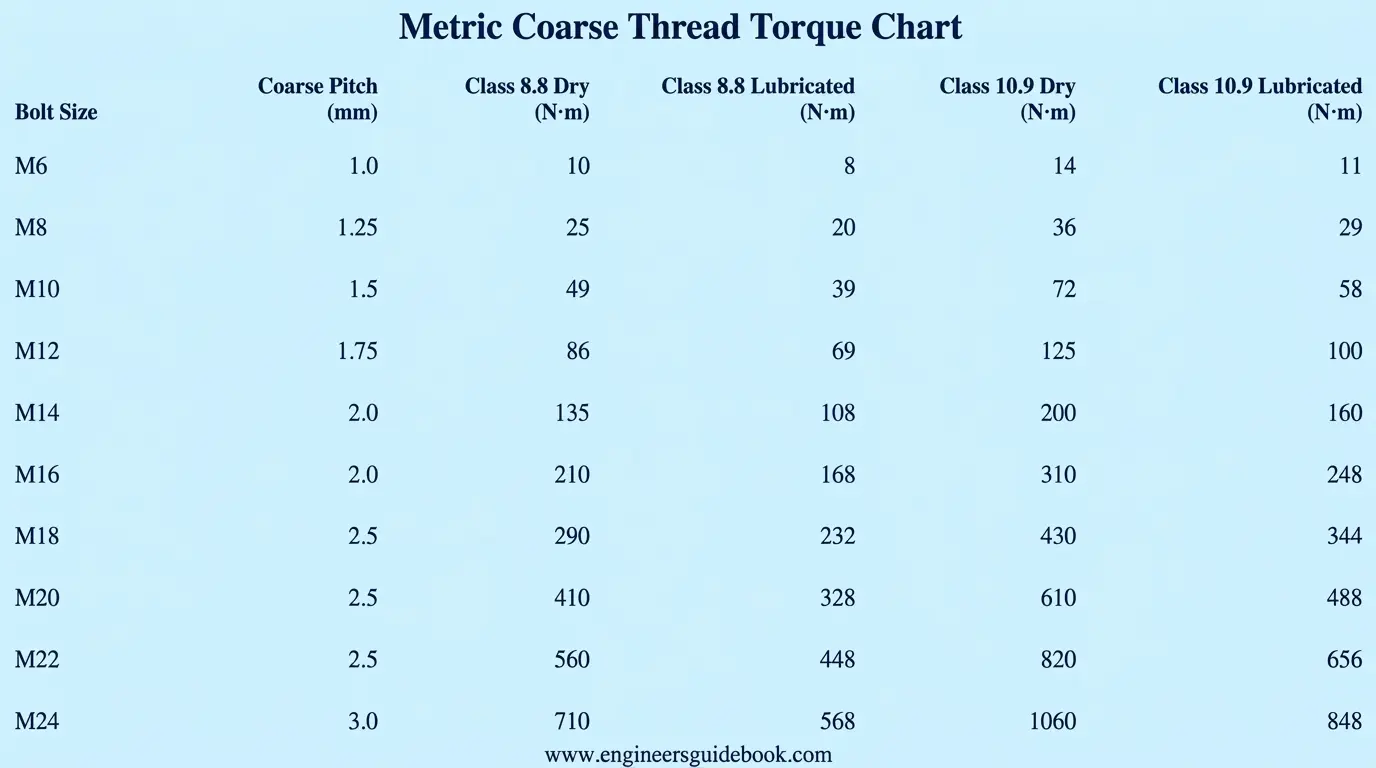
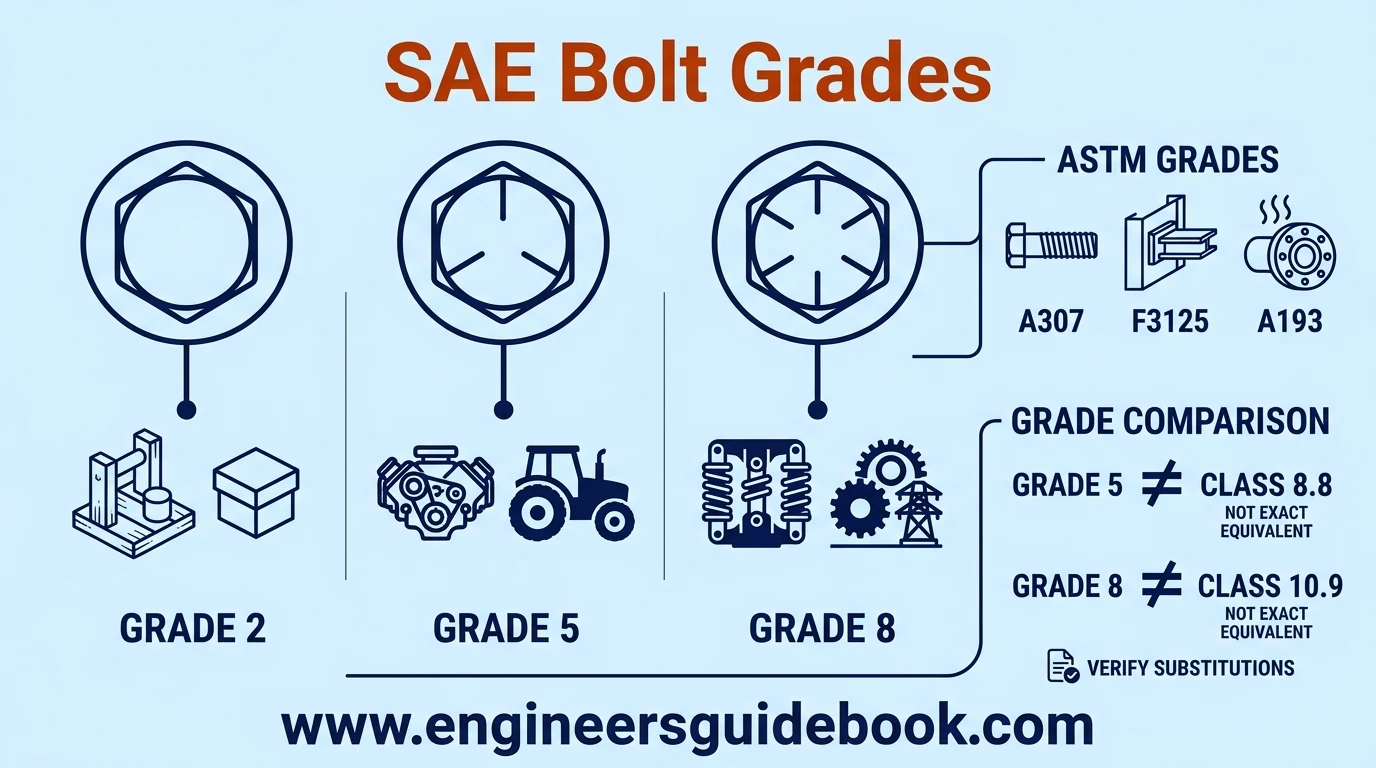
3.1 Metric Bolt Torque Chart
Metric torque charts organize values by sizes such as M6, M8, M10, and M12, then separate them by property class, thread pitch, and lubrication condition. Units are normally shown in newton metres.
3.2 Imperial Bolt Torque Chart
Imperial charts classify fasteners by nominal inch diameter, threads per inch, and SAE grade. Torque is stated in pound-inches for small bolts and pound-feet for larger ones.
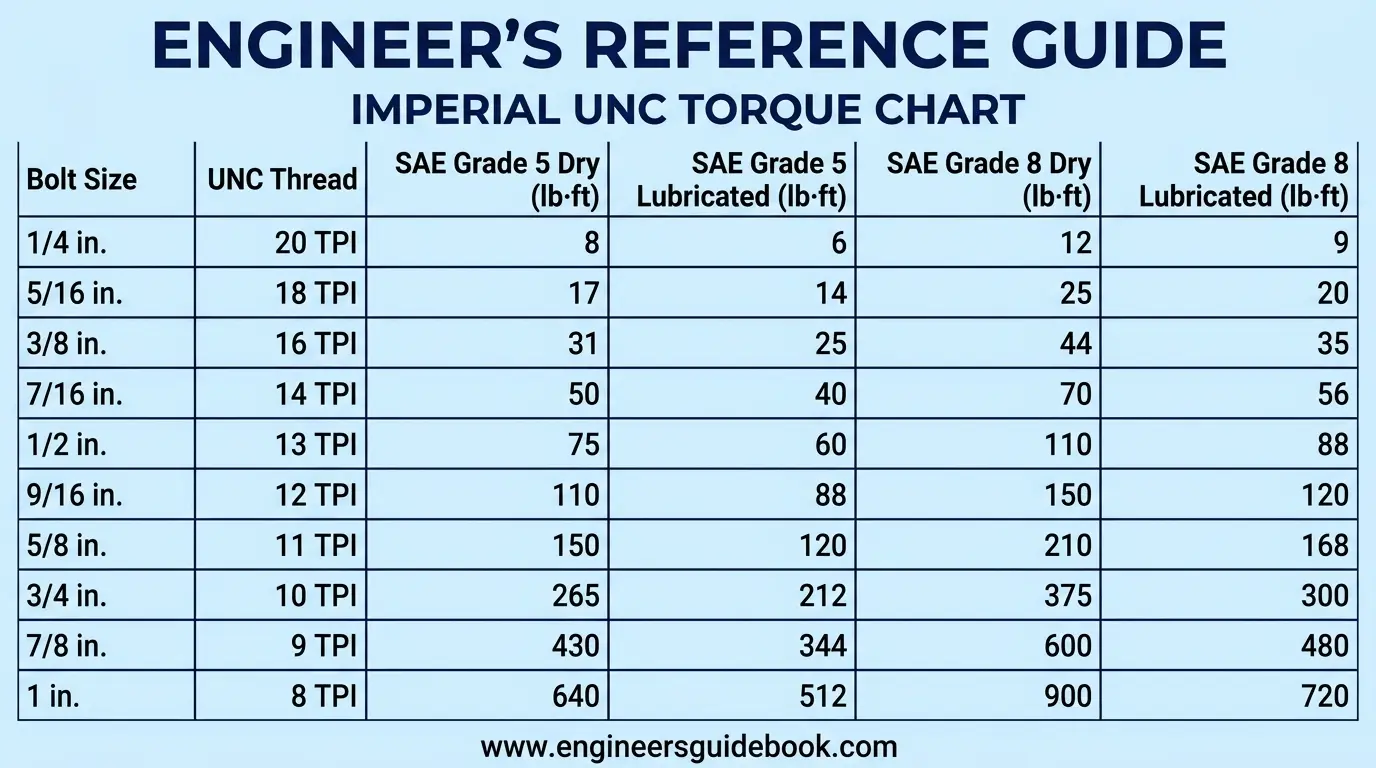
3.3 Coarse Thread Torque Values
Coarse threads have a larger pitch and fewer threads per unit length. They tolerate contamination, assemble quickly, and resist stripping in softer materials, but require geometry-specific torque values.
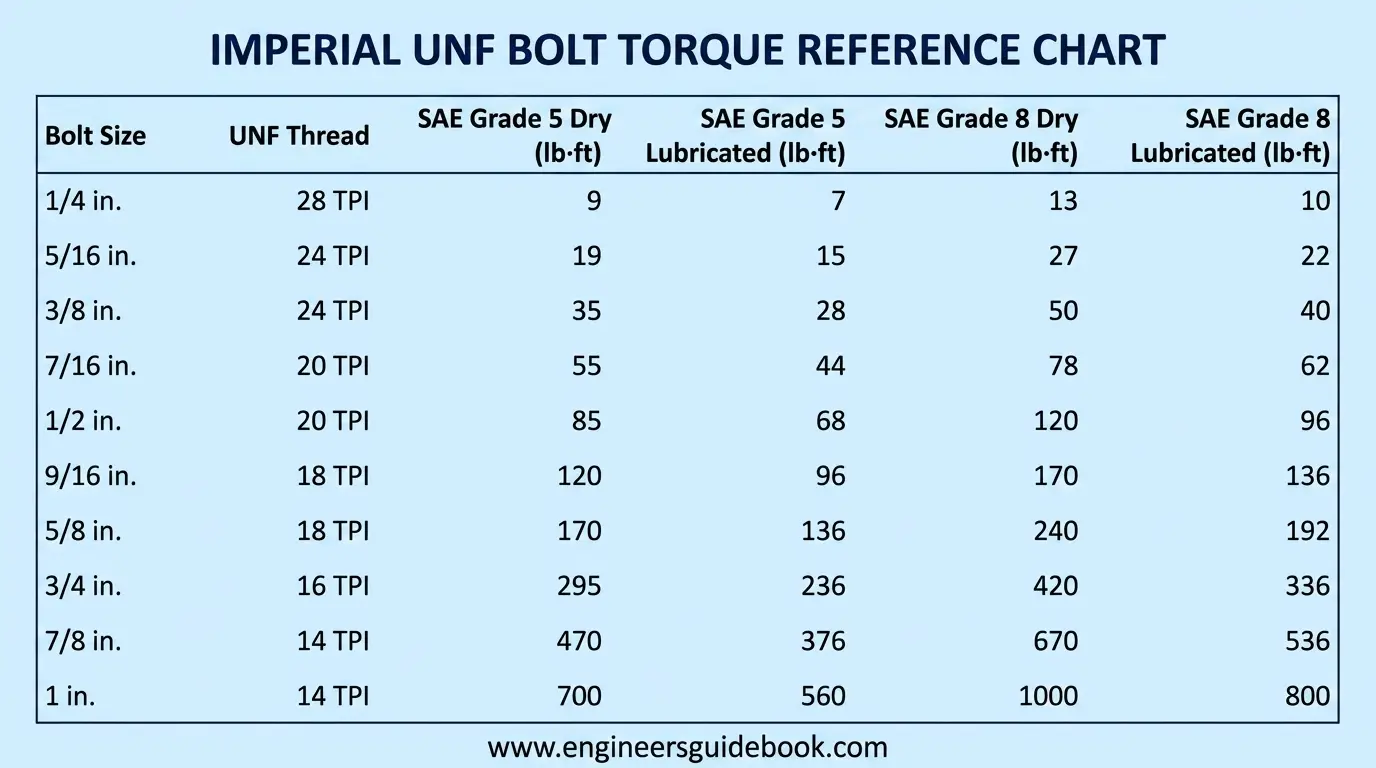
3.4 Fine Thread Torque Values
Fine threads provide a larger tensile stress area and more precise adjustment. They may support greater preload than equal-diameter coarse threads, although they are more vulnerable to cross-threading and contamination.
3.5 Dry Bolt Torque Values
Dry values apply only to fasteners assembled without added lubricant and with the specified surface finish. Hidden oil, wax, inhibitor, or plating lubricant can reduce friction and cause over-tensioning.
3.6 Lubricated Bolt Torque Values
Lubricated torque values are lower because reduced friction converts more wrench effort into preload. Applying a dry specification to an oiled fastener may stretch it beyond its elastic limit.
4. Metric Bolt Grades
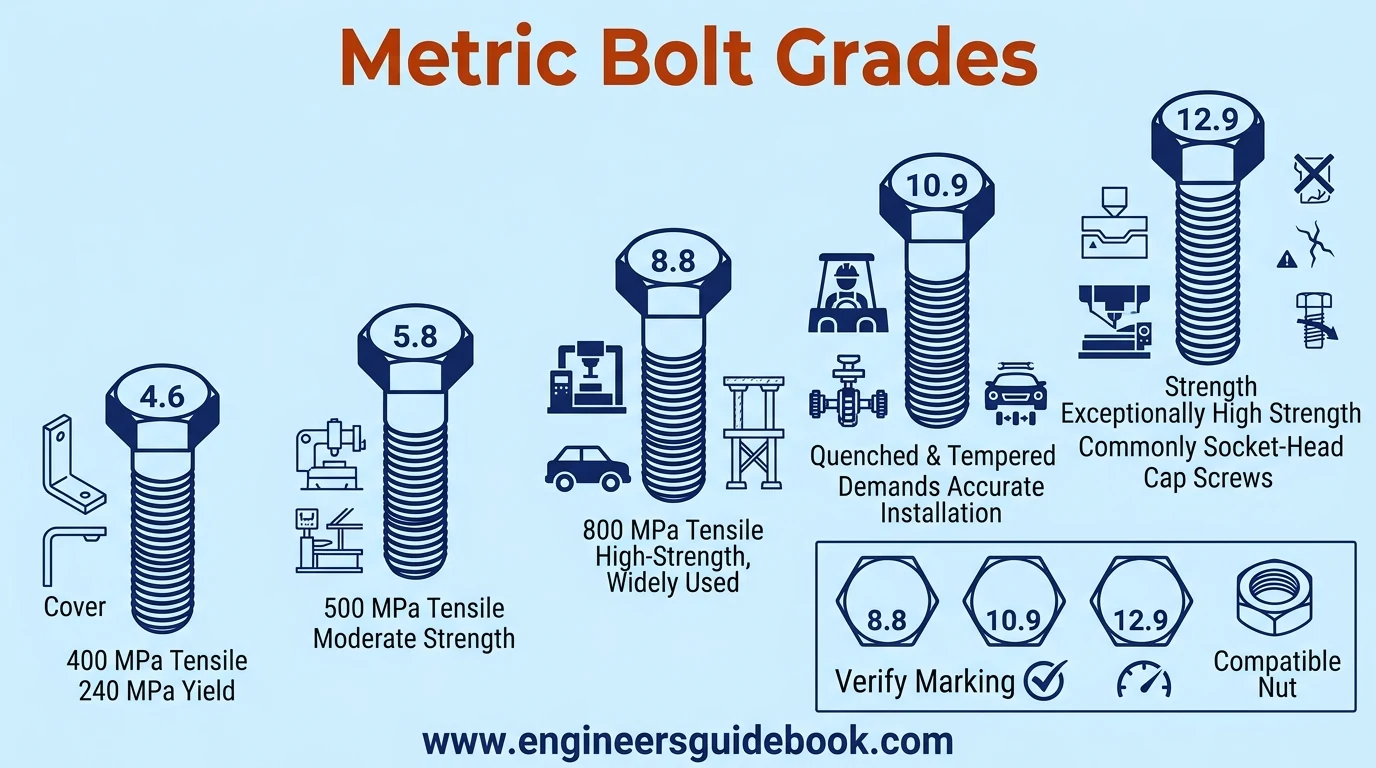
4.1 Grade 4.6 Bolts
Class 4.6 bolts are low-strength carbon steel fasteners with approximately 400 megapascals tensile strength and 240 megapascals yield strength. They suit light-duty brackets, covers, and noncritical work.
4.2 Grade 5.8 Bolts
Class 5.8 bolts provide moderate strength, with approximately 500 megapascals tensile strength and a relatively high yield ratio. They serve general fabrication, guards, supports, and lightly loaded machinery.
4.3 Grade 8.8 Bolts
Class 8.8 bolts are widely used high-strength fasteners with about 800 megapascals tensile strength. Applications include industrial machinery, vehicles, structural supports, and equipment frames.
4.4 Grade 10.9 Bolts
Class 10.9 bolts are quenched and tempered alloy-steel fasteners used in heavy equipment, drivetrains, automotive systems, and demanding machinery. Their higher proof load permits greater torque but demands accurate installation.
4.5 Grade 12.9 Bolts
Class 12.9 bolts offer exceptionally high strength and commonly appear as socket-head cap screws in dies, presses, and machine tools. Improper plating, embrittlement, or over-tightening can cause failure.
4.6 Metric Grade Markings
Metric property classes are stamped on bolt heads as numbers such as 8.8, 10.9, or 12.9. Verify the marking before selecting torque, and use a compatible nut.
5. SAE Bolt Grades
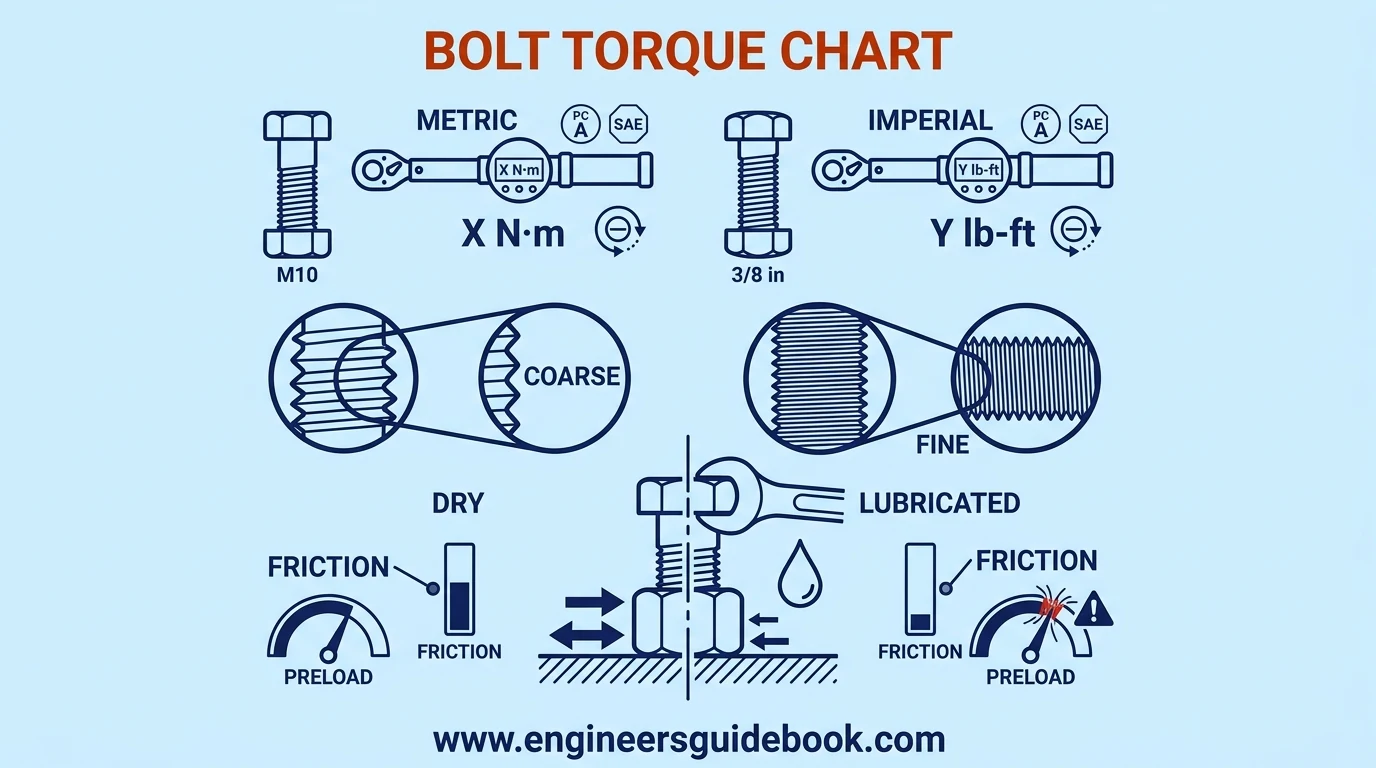
5.1 Grade 2 Bolts
SAE Grade 2 bolts are low-carbon steel fasteners intended for light loads. They commonly have no radial lines and require lower torque than Grades 5 or 8.
5.2 Grade 5 Bolts
SAE Grade 5 bolts are medium-strength, heat-treated fasteners identified by three radial head lines. They are common in vehicles, agricultural machinery, fabricated equipment, and mechanical assemblies.
5.3 Grade 8 Bolts
SAE Grade 8 bolts are high-strength alloy-steel fasteners identified by six radial lines. They support greater preload and serve suspensions, heavy machinery, and power-transmission equipment.
5.4 ASTM Bolt Grades
ASTM specifications classify bolts by material, mechanical properties, heat treatment, and intended service. Examples include A307 general-purpose bolts, F3125 structural bolts, and A193 high-temperature bolting.
5.5 SAE Grade Markings
SAE grades are recognized by radial marks on the head. Grade 2 usually has none, Grade 5 has three, and Grade 8 has six. The line count does not equal the grade number.
5.6 Grade Comparison
Metric and SAE grades are not exact equivalents. Class 8.8 is broadly compared with SAE Grade 5, while class 10.9 resembles Grade 8, but substitutions require formal verification.
6. Bolt Material Torque
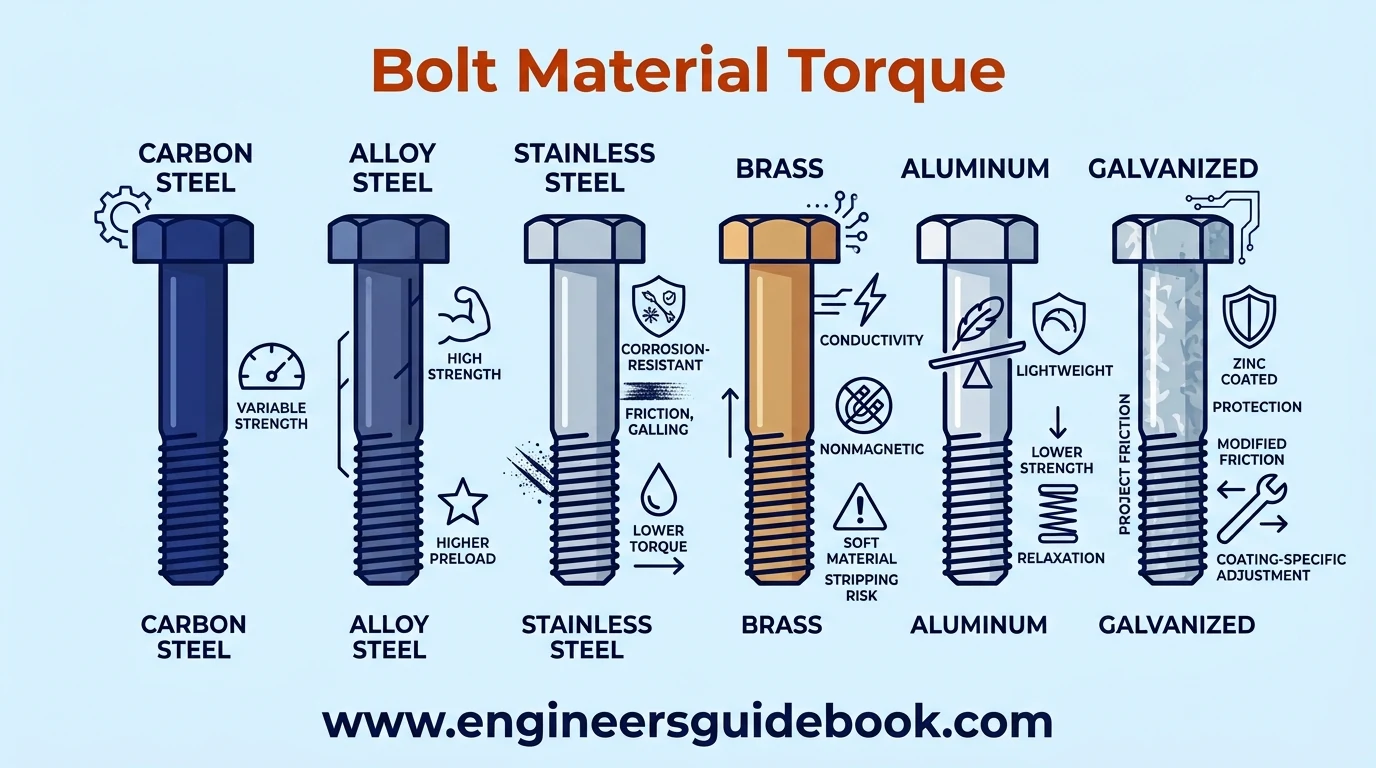
6.1 Carbon Steel Bolts
Carbon steel fasteners span low-strength commercial bolts through heat-treated grades. Torque capacity depends on carbon content, proof strength, heat treatment, thread condition, and coating.
6.2 Alloy Steel Bolts
Alloy steel contains elements such as chromium, molybdenum, nickel, or boron to improve strength and toughness. They accept higher preload, but weak nuts or tapped holes may fail first.
6.3 Stainless Steel Bolts
Stainless steel bolts resist corrosion but often exhibit high friction and galling, particularly in austenitic grades. Lubricants reduce seizure risk but require lower, stainless-specific torque values.
6.4 Brass Bolts
Brass fasteners provide conductivity, corrosion resistance, and nonmagnetic performance. Because brass is soft, excessive tightening can deform heads, strip threads, or fracture the bolt.
6.5 Aluminum Bolts
Aluminium bolts reduce weight and resist atmospheric corrosion but possess lower strength and stiffness than steel. Conservative torque, generous engagement, and control of creep and relaxation are essential.
6.6 Galvanized Bolts
Galvanized bolts use a zinc coating for corrosion protection. Hot-dip galvanizing changes fit and friction, so plain-steel values require coating-specific correction.
7. Thread and Surface Conditions
7.1 Coarse Threads
Coarse threads resist handling damage, tolerate contamination, and perform well in softer materials. Their deeper profile resists stripping, although tensile stress area is usually smaller than with fine threads.
7.2 Fine Threads
Fine threads offer more threads per unit length, a larger tensile stress area, and precise adjustment. Start them by hand because dirt or misalignment can quickly cause cross-threading.
7.3 Clean Threads
Clean threads produce more consistent friction and preload. Rust, chips, sealant, or debris can create false readings before adequate tension develops.
7.4 Damaged Threads
Flattened crests, torn flanks, corrosion pits, and crossed threads reduce load capacity while increasing friction. Replace damaged bolts and repair defective tapped holes by an approved method.
7.5 Plated Threads
Zinc, phosphate, cadmium, nickel, and other finishes alter friction. Some include wax or sealer, effectively lubricating the fastener. Torque must correspond to the exact coating system.
7.6 Thread Engagement
Adequate engagement prevents internal or external thread stripping before preload is achieved. Steel may need less depth than aluminium, cast iron, or plastic, which require longer engagement.
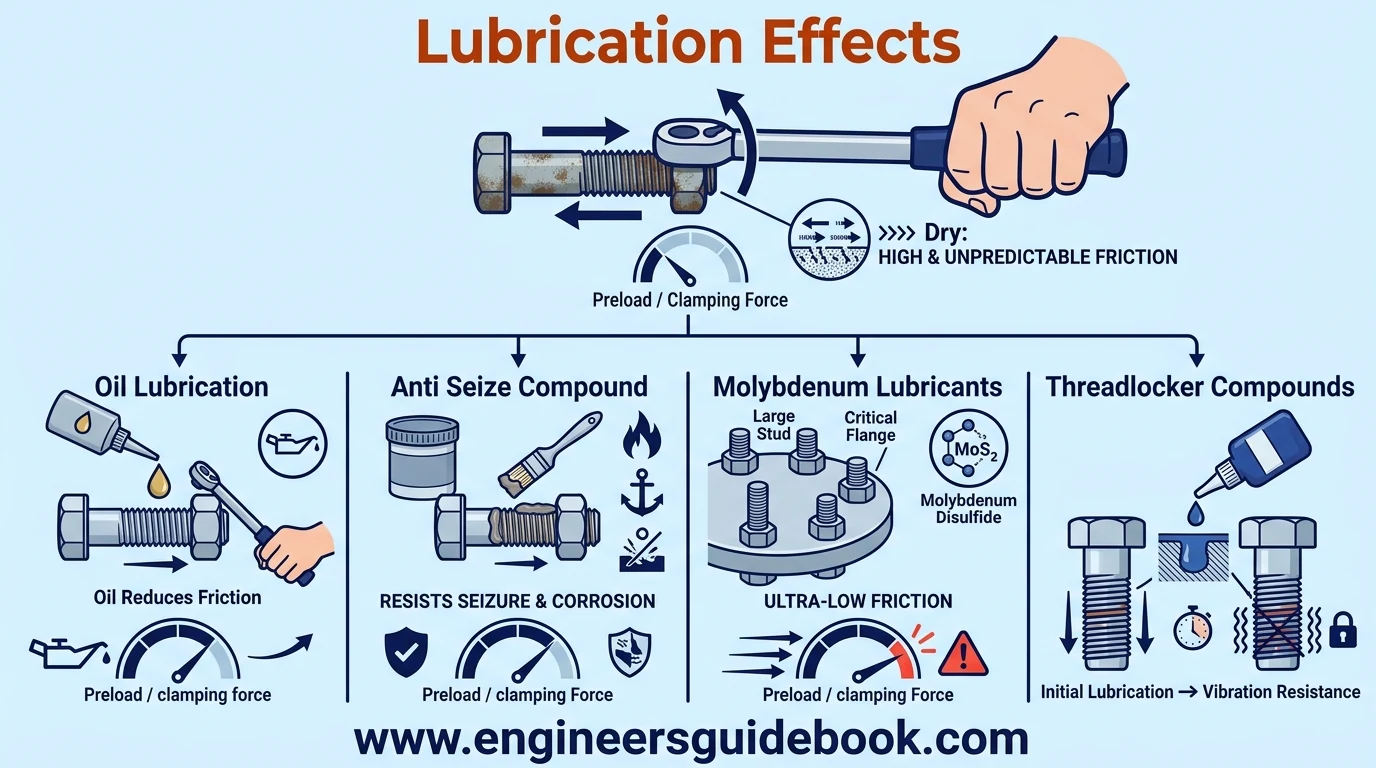
8. Lubrication Effects
Lubrication strongly affects the relationship between applied torque and bolt preload. Because friction consumes much of the input torque, a small surface-condition change can alter clamping force.
8.1 Dry Fasteners
Dry fasteners usually create higher, less predictable friction. Rust, plating texture, dirt, and microscopic asperities absorb torque, so similar bolts may develop different preload. Use dry torque specifications only when the joint design, finish, and chart assume an unlubricated condition.
8.2 Oil Lubrication
Light oil reduces thread and bearing friction, allowing more torque to generate tension. This improves consistency but may create excessive preload when dry torque values are used without correction. Oil type, viscosity, quantity, and coating influence friction.
8.3 Anti Seize Compound
Anti-seize compounds contain metallic or ceramic solids that resist seizure and corrosion. They suit high-temperature, stainless steel, marine, and chemically aggressive applications. Their strong lubricating action can increase preload considerably, so manufacturer torque guidance must be followed.
8.4 Molybdenum Lubricants
Molybdenum disulfide lubricants provide very low friction. They are often used on large studs, pressure equipment, and critical flange joints. Their low friction can produce high bolt tension from modest torque, making accurate calculation and controlled application essential.
8.5 Threadlocker Compounds
Liquid threadlockers fill microscopic clearances and cure to resist vibration-induced loosening. Before curing, many formulations also act as lubricants and alter the torque-preload relationship. Torque values should therefore reflect the specific product’s technical data and intended strength grade.
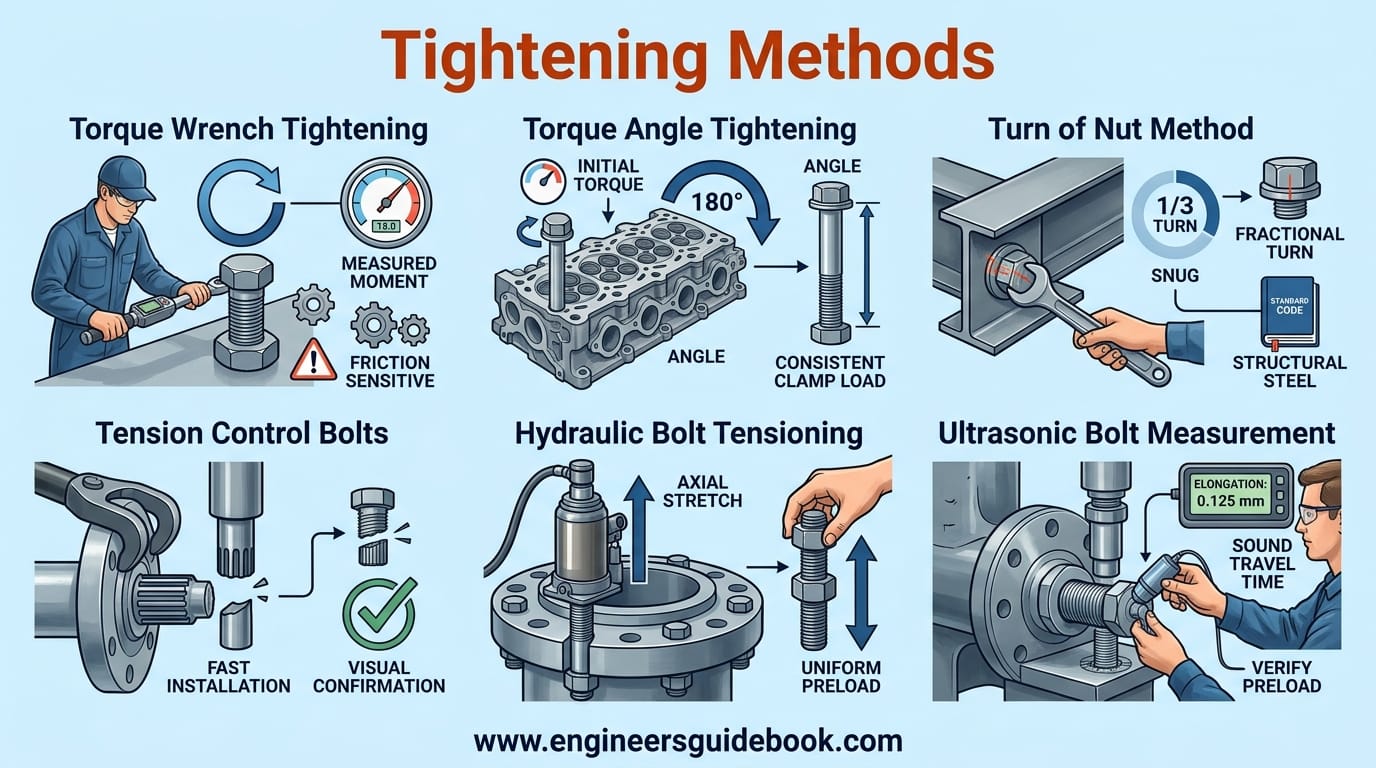
9. Tightening Methods
Tightening methods control bolt load with different levels of precision. Selection depends on joint criticality, bolt size, accessibility, production volume, and inspection requirements.
9.1 Torque Wrench Tightening
Torque wrench tightening is common, portable, and economical. It applies a measured rotational moment, although preload remains friction-sensitive. Click, dial, beam, and electronic tools offer different control levels.
9.2 Torque Angle Tightening
Torque-angle tightening begins with snug torque, followed by a measured rotation. After seating, angular movement correlates more closely with bolt elongation. The method suits engines and other assemblies requiring consistent clamp load.
9.3 Turn of Nut Method
The turn-of-nut method brings the joint to a snug condition before rotating the nut by a prescribed fraction of a turn. It is common in structural steelwork, where bolt length, grip thickness, and required rotation are defined by the applicable standard.
9.4 Tension Control Bolts
Tension control bolts use a splined end that shears off when the installation tool reaches a predetermined condition. They provide fast installation and visual confirmation, although storage, lubrication, and tool condition remain necessary.
9.5 Hydraulic Bolt Tensioning
Hydraulic tensioners stretch the bolt axially before seating the nut. Releasing pressure transfers load into the joint. The method minimizes torsional stress and frictional uncertainty, suiting turbines, pressure vessels, large flanges, and offshore equipment.
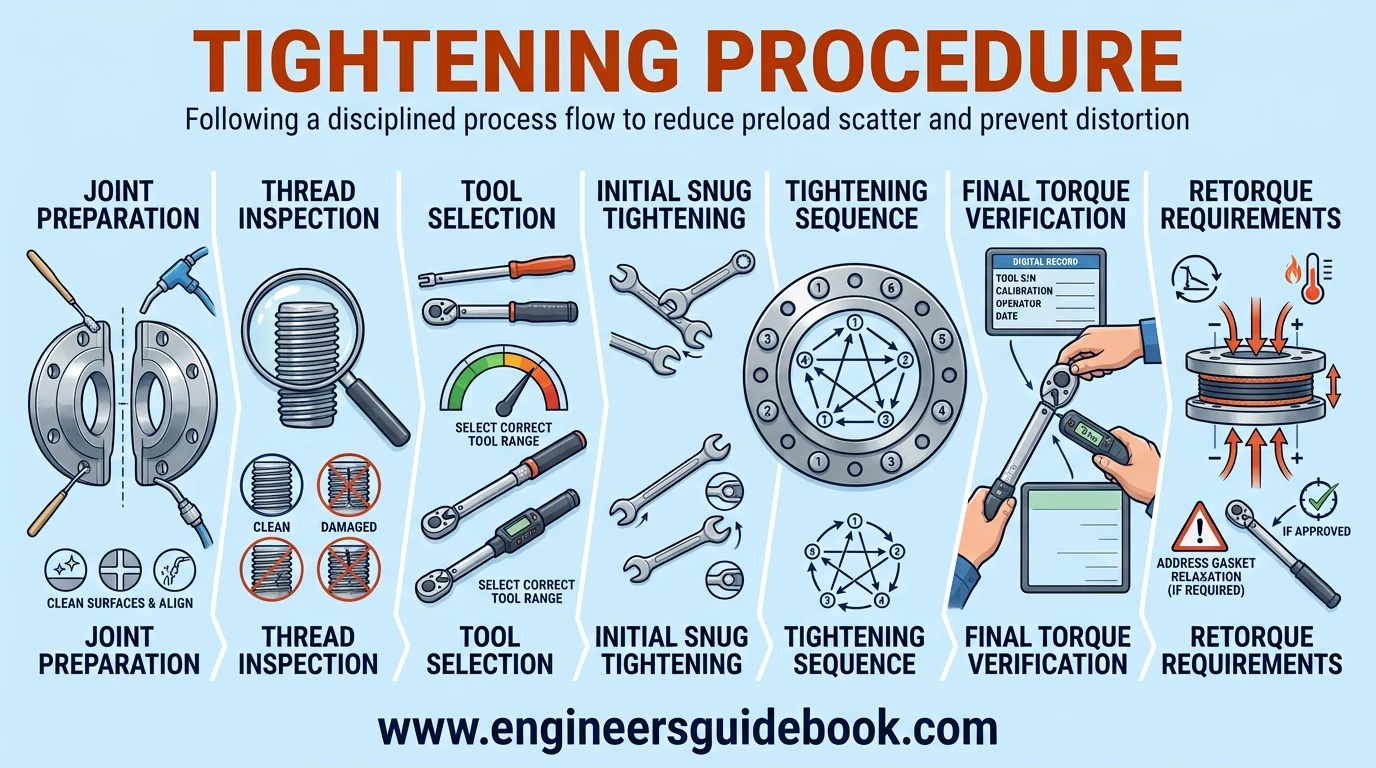
10. Tightening Procedure
A disciplined procedure reduces preload scatter, prevents distortion, and supports traceability.
10.1 Joint Preparation
Mating surfaces should be clean, aligned, and free from burrs, paint buildup, scale, and foreign material. Gaskets must be correctly positioned, and contact surfaces should seat without forced alignment.
10.2 Thread Inspection
Inspect threads for corrosion, flattening, contamination, cross-threading, and dimensional damage. Nuts should run freely by hand unless an intentional prevailing-torque feature is present.
10.3 Tool Selection
Choose a tool with the correct range, drive size, accuracy, and access capability. Target torque should fall within the effective working range rather than near the tool’s extreme limit.
10.4 Initial Snug Tightening
Snug tightening seats components and removes obvious gaps before final loading. All fasteners should reach a uniform preliminary condition so later tightening does not distort the joint.
10.5 Tightening Sequence
Circular flanges usually require a star or cross pattern, while rectangular covers often use a crisscross sequence from the center outward. Multiple incremental passes distribute gasket compression and clamp load more evenly.
10.6 Final Torque Verification
Final verification should confirm tool setting, sequence completion, and specified torque. Critical joints may require records of fastener identity, tool serial number, calibration status, operator, lubricant, and date.
10.7 Retorque Requirements
Retorque may be required when gaskets relax, coatings compress, or thermal cycles reduce preload. It should only be performed when permitted by the equipment manufacturer or approved procedure, because unnecessary retightening can overload bolts or damage gaskets.
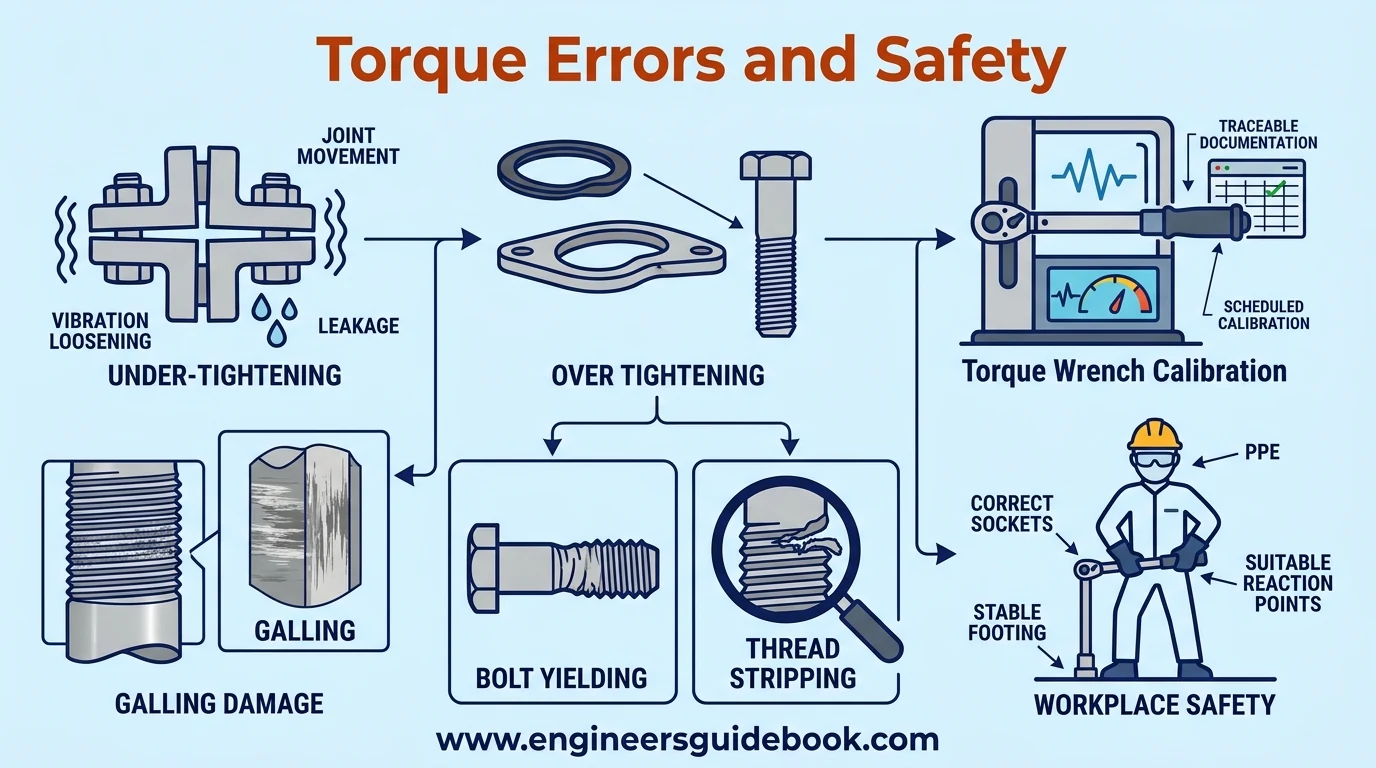
11. Torque Errors and Safety
Incorrect tightening can cause leakage, fatigue, distortion, separation, and injury. Torque control is therefore an engineering and safety function.
11.1 Under Tightening
Under-tightened bolts may permit joint movement, fretting, vibration loosening, leakage, and fluctuating fatigue stress. A fastener that feels secure may still provide inadequate clamp load.
11.2 Over Tightening
Excessive torque can crush gaskets, distort flanges, damage threads, and stretch bolts beyond their elastic range. The joint may fail immediately or deteriorate after repeated service cycles.
11.3 Bolt Yielding
Yielding occurs when tensile stress exceeds the material’s elastic limit. The bolt then acquires permanent elongation and may no longer maintain reliable preload. Suspected yielded bolts should normally be replaced.
11.4 Thread Stripping
Thread stripping occurs when engaged threads shear under excessive load. It depends on material strength, engagement length, nut thickness, and thread quality. Soft materials may require longer engagement or inserts.
11.5 Galling Damage
Galling is adhesive wear caused by severe friction between sliding metal surfaces, particularly stainless steel threads. Clean components, slower tightening speed, compatible lubricants, and suitable material combinations reduce the risk.
12. Frequently Asked Questions
12.1 How Much Torque Should Be Applied to a Bolt
The correct torque depends on bolt diameter, thread pitch, grade, lubrication, coating, joint material, and desired preload. Use an approved engineering specification rather than choosing a value by appearance.
12.2 How Is Bolt Tightening Torque Calculated
A common simplified relationship is torque equals nut factor multiplied by bolt diameter and target preload. The nut factor represents friction and must match the actual thread and lubrication condition.
12.3 Does Bolt Grade Affect Torque
Yes. Higher-grade bolts generally tolerate greater preload, but the nut, washer, tapped material, and joint design must possess compatible strength.
12.4 Should Lubricated Bolts Use Less Torque
Usually, yes. Lubrication reduces friction, so less torque is needed to obtain the same preload. The exact reduction should come from verified lubricant data.
12.5 What Is the Difference Between Torque and Preload
Torque is the rotational input applied to the fastener. Preload is the tensile force created in the bolt and the corresponding clamping force developed in the joint.
12.6 Can the Same Torque Chart Be Used for All Materials
No. Different materials, coatings, temperatures, lubricants, and thread systems create different strength and friction conditions. Charts are valid only for their stated assumptions.
12.7 How Accurate Is a Torque Wrench
Accuracy depends on wrench type, calibration, condition, operator technique, and working range. Even a precise wrench cannot eliminate preload variation caused by friction.
12.8 Should Bolts Be Retightened After Installation
Only when the approved procedure requires it. Some gasketed or thermally cycled joints need retorque, while other assemblies can be damaged by additional tightening.
12.9 What Happens When a Bolt Is Over Torqued
The bolt may yield, threads may strip, the joint may distort, or the gasket may be crushed. Hidden damage can also reduce fatigue life and future reliability.
12.10 How Often Should Torque Tools Be Calibrated
Calibration frequency should follow the manufacturer, quality system, usage level, and work criticality. High-use tools may require more frequent verification.
13. Conclusion
Correct torque application requires more than reading a chart. It depends on friction, preload, strength, joint behavior, tooling, and discipline.
A torque chart is useful when bolt grade, diameter, thread condition, coating, and lubrication match its assumptions. Deviations require engineering review or an approved correction factor.
Reliable tightening begins with clean components, verified specifications, calibrated tools, controlled lubrication, progressive passes, and the correct sequence. Documentation improves repeatability and accountability.
A dependable bolted joint maintains adequate clamp load through vibration, pressure, temperature change, and service aging. Controlled tightening reduces leakage risk, improves fatigue resistance, and supports predictable equipment availability.