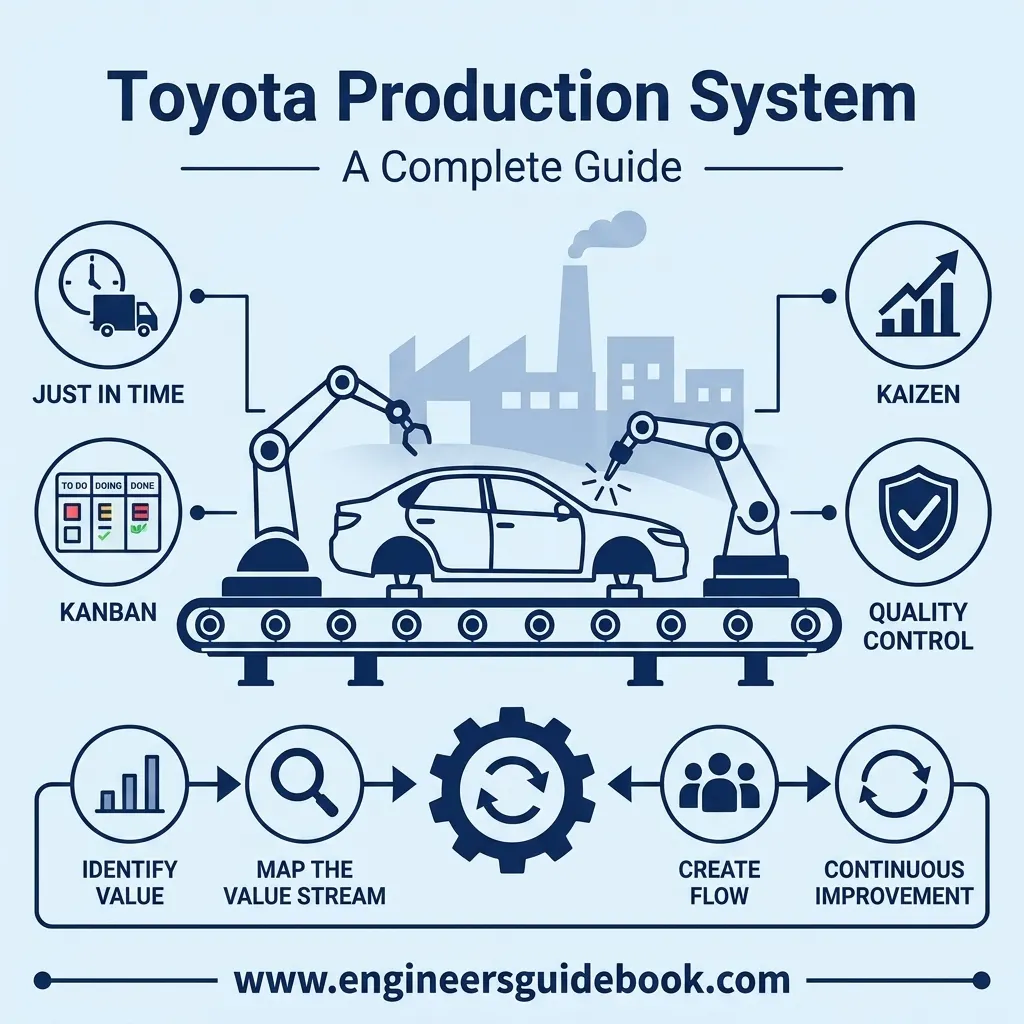
The Toyota Production System is an integrated management philosophy that improves quality, productivity, cost, and delivery by eliminating waste, developing people, and creating stable process flow. Built around Just in Time and Jidoka, TPS aligns customer demand with disciplined operations, standardized work, rapid problem-solving, and continuous improvement throughout the organization.
1. Toyota Production System Overview
The Toyota Production System provides a cohesive framework for producing greater customer value with fewer resources, fewer defects, and shorter lead times.
1.1 TPS Definition
TPS is a socio-technical production system that combines operational discipline, human ingenuity, process stability, and relentless waste elimination.
1.2 TPS Purpose
Its central purpose is to deliver the required product, at the required quality, precisely when the customer needs it.
1.3 TPS Philosophy
The philosophy rests on long-term thinking, respect for people, scientific problem-solving, and incremental improvement rather than transient cost-cutting.
1.4 TPS Objectives
TPS seeks superior quality, minimal waste, dependable delivery, lower inventory, safer work, flexible production, and sustainable organizational learning.
1.5 TPS Scope
Its scope extends beyond assembly lines to engineering, maintenance, logistics, procurement, administration, healthcare, construction, and service operations.
2. History and Evolution
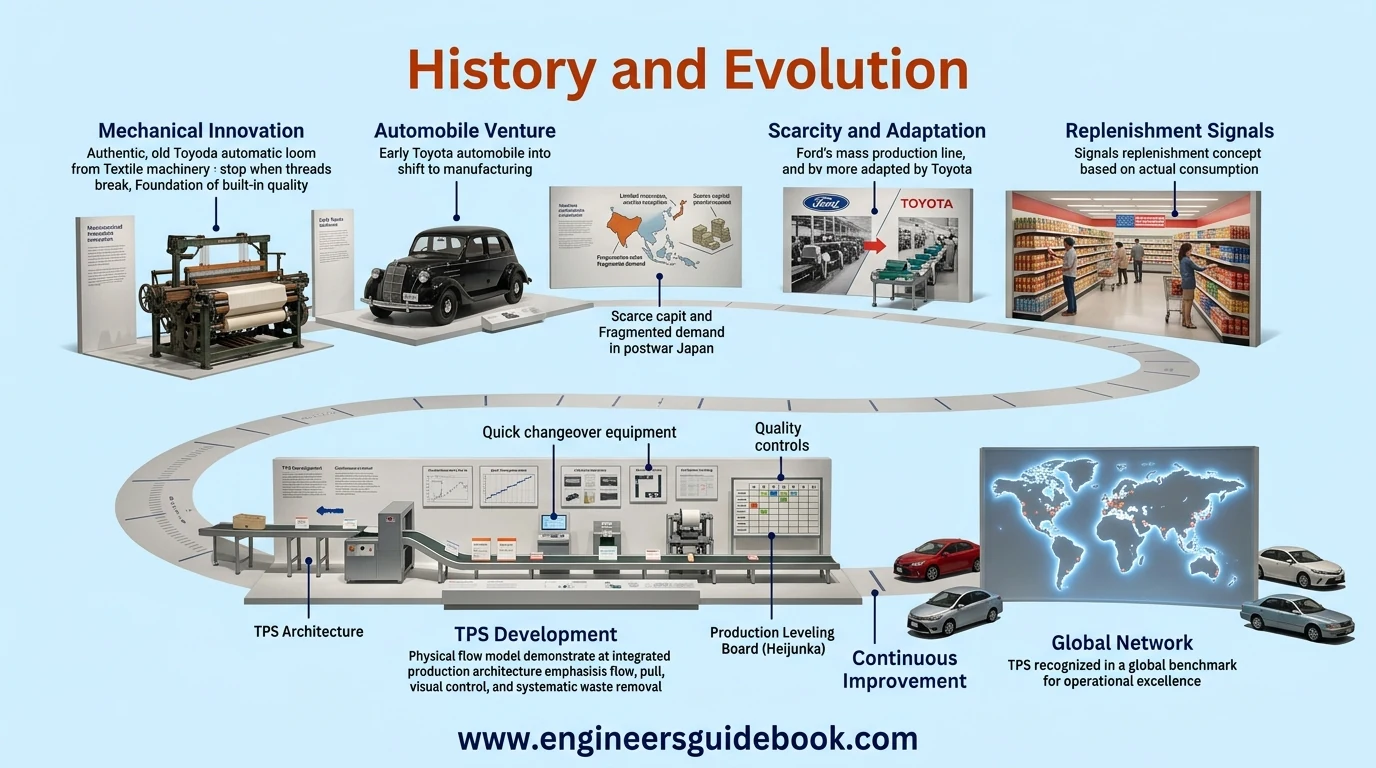
TPS emerged gradually through decades of experimentation, industrial adversity, technological adaptation, and persistent inquiry into how work could be improved.
2.1 Toyota Origins
Toyota evolved from the Toyoda family’s textile machinery enterprise, where mechanical innovation and practical problem-solving became enduring organizational habits.
2.2 Sakichi Toyoda
Sakichi Toyoda developed automatic loom mechanisms that stopped when threads broke, establishing the conceptual foundation for built-in quality.
2.3 Kiichiro Toyoda
Kiichiro Toyoda advanced automobile manufacturing and promoted producing only what was needed, when needed, in the required quantity.
2.4 Taiichi Ohno
Taiichi Ohno transformed these ideas into an integrated production architecture emphasizing flow, pull, visual control, and systematic waste removal.
2.5 Eiji Toyoda
Eiji Toyoda supported long-term industrial development, managerial experimentation, and the institutionalization of Toyota’s distinctive production philosophy.
2.6 Postwar Challenges
Postwar Japan faced scarce capital, limited materials, fragmented demand, and intense competition, making high-inventory mass production economically untenable.
2.7 Ford Production Influence
Toyota studied Ford’s manufacturing achievements but adapted mass-production concepts to accommodate smaller volumes, broader variety, and constrained resources.
2.8 Supermarket Concept
American supermarkets inspired replenishment based on actual consumption, where downstream withdrawal signaled upstream production requirements.
2.9 TPS Development
TPS matured through iterative shop-floor experiments involving Kanban, standardized work, quick changeovers, quality controls, and production leveling.
2.10 Global Expansion
As Toyota expanded internationally, TPS became a global benchmark for operational excellence, although replication often proved culturally demanding.
3. TPS House
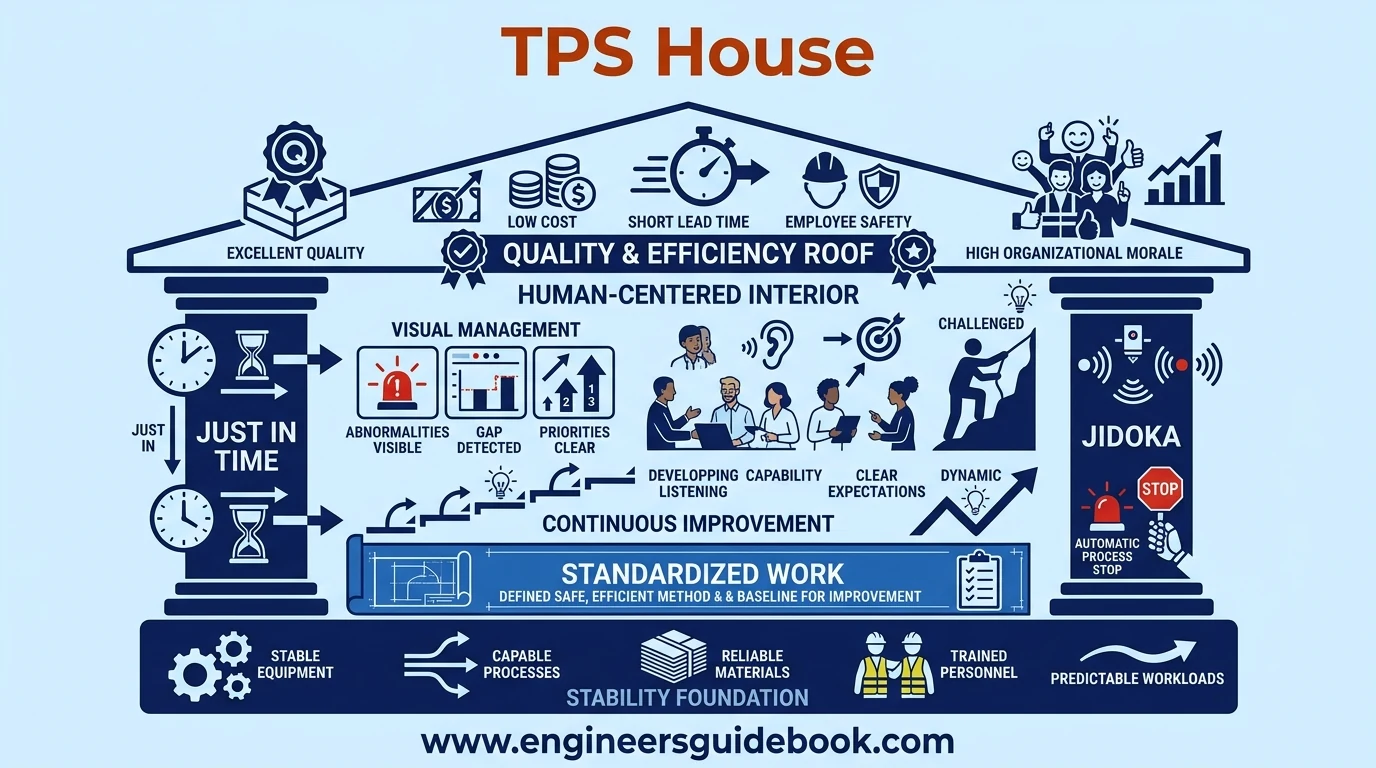
The TPS House illustrates how organizational outcomes depend on mutually reinforcing principles rather than isolated improvement techniques.
3.1 TPS House Structure
The model includes a stable foundation, two structural pillars, a human-centered interior, and a roof representing desired performance outcomes.
3.2 Customer Value
Every activity is judged according to whether it transforms a product or service in a way the customer genuinely values.
3.3 Stability Foundation
Stable equipment, capable processes, reliable materials, trained personnel, and predictable workloads provide the groundwork for continuous flow.
3.4 Standardized Work
Standardized work defines the safest and most efficient current method while creating a baseline for measurement and improvement.
3.5 Visual Management
Visual controls reveal abnormalities, priorities, performance gaps, and process conditions without requiring lengthy reports or abstruse interpretation.
3.6 Continuous Improvement
Kaizen encourages employees to improve everyday work through frequent, evidence-based changes instead of occasional large-scale initiatives.
3.7 Respect for People
Respect means developing capability, listening to employees, setting clear expectations, and challenging individuals without compromising dignity.
3.8 Just in Time Pillar
Just in Time regulates production so each process receives exactly what it needs at the appropriate moment.
3.9 Jidoka Pillar
Jidoka prevents defects from progressing by detecting abnormalities, stopping processes, and enabling immediate corrective action.
3.10 Quality and Efficiency Roof
The roof represents excellent quality, low cost, short lead time, employee safety, and high organizational morale.
4. Core Principles
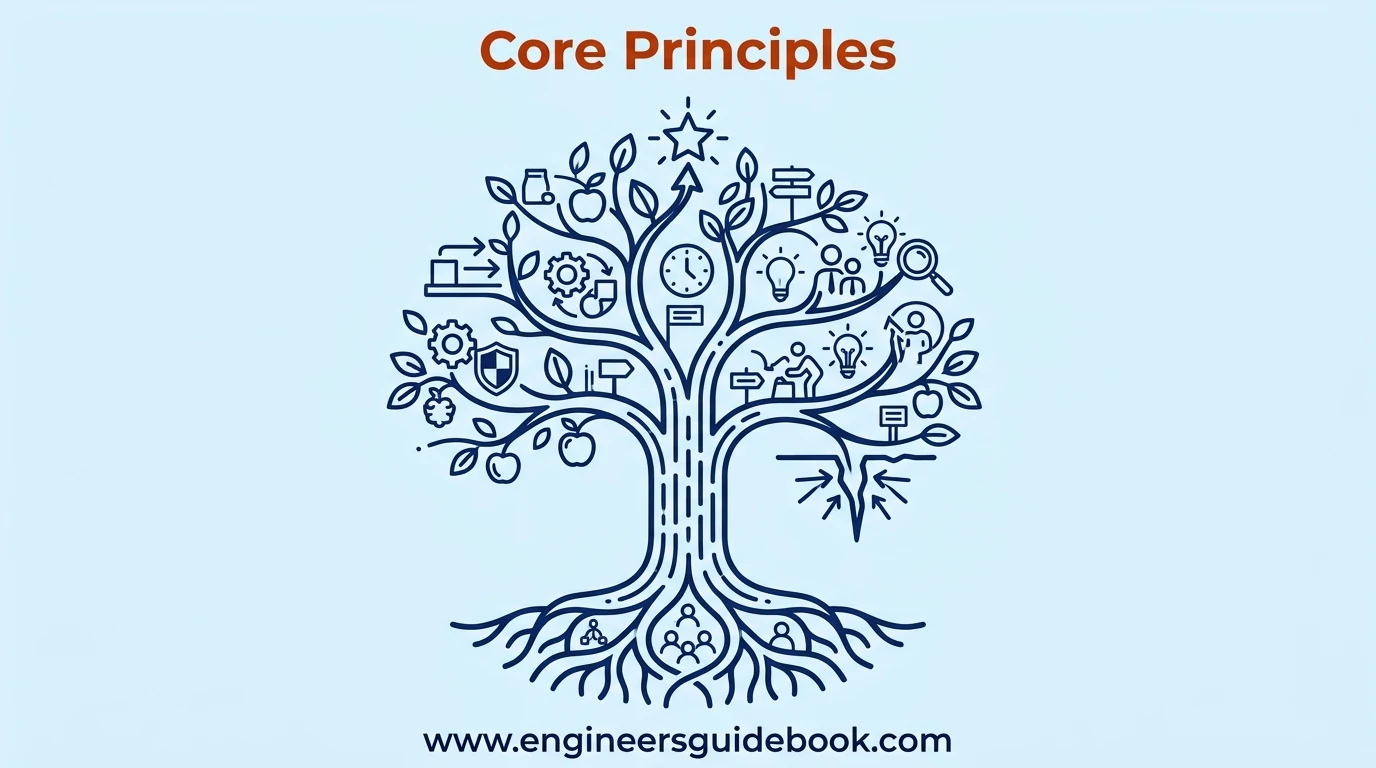
TPS principles govern decisions, behaviors, and improvement priorities across managerial and operational levels.
4.1 Long Term Philosophy
Toyota favors decisions that strengthen enduring capability, even when short-term financial results appear less attractive.
4.2 Customer First Thinking
Customer requirements determine quality standards, production timing, product features, and the sequence of value-creating activities.
4.3 Waste Elimination
Every unnecessary movement, delay, defect, inventory buffer, and redundant transaction consumes resources without improving customer value.
4.4 Continuous Flow
Continuous flow moves work smoothly between processes, reducing queues, delays, handling, hidden defects, and scheduling complexity.
4.5 Pull Production
Pull systems authorize production through actual downstream consumption rather than speculative forecasts or arbitrary utilization targets.
4.6 Built In Quality
Quality is secured during production by preventing, identifying, and correcting abnormalities before defective output advances.
4.7 Standardized Processes
Clear standards reduce variability, preserve operational knowledge, support training, and expose deviations requiring investigation.
4.8 Visual Control
Boards, signals, markings, labels, and indicators make process status discernible at a glance.
4.9 Employee Development
TPS cultivates employees as problem-solvers capable of observing processes, testing hypotheses, and implementing durable countermeasures.
4.10 Supplier Partnership
Suppliers are treated as long-term collaborators and are expected to improve quality, delivery, capability, and cost systematically.
4.11 Root Cause Thinking
Problems are traced beyond superficial symptoms to the process conditions, decisions, and systemic weaknesses that created them.
4.12 Continuous Learning
Experiments, reflections, audits, and standardized lessons allow the organization to convert experience into reusable knowledge.
5. Just in Time
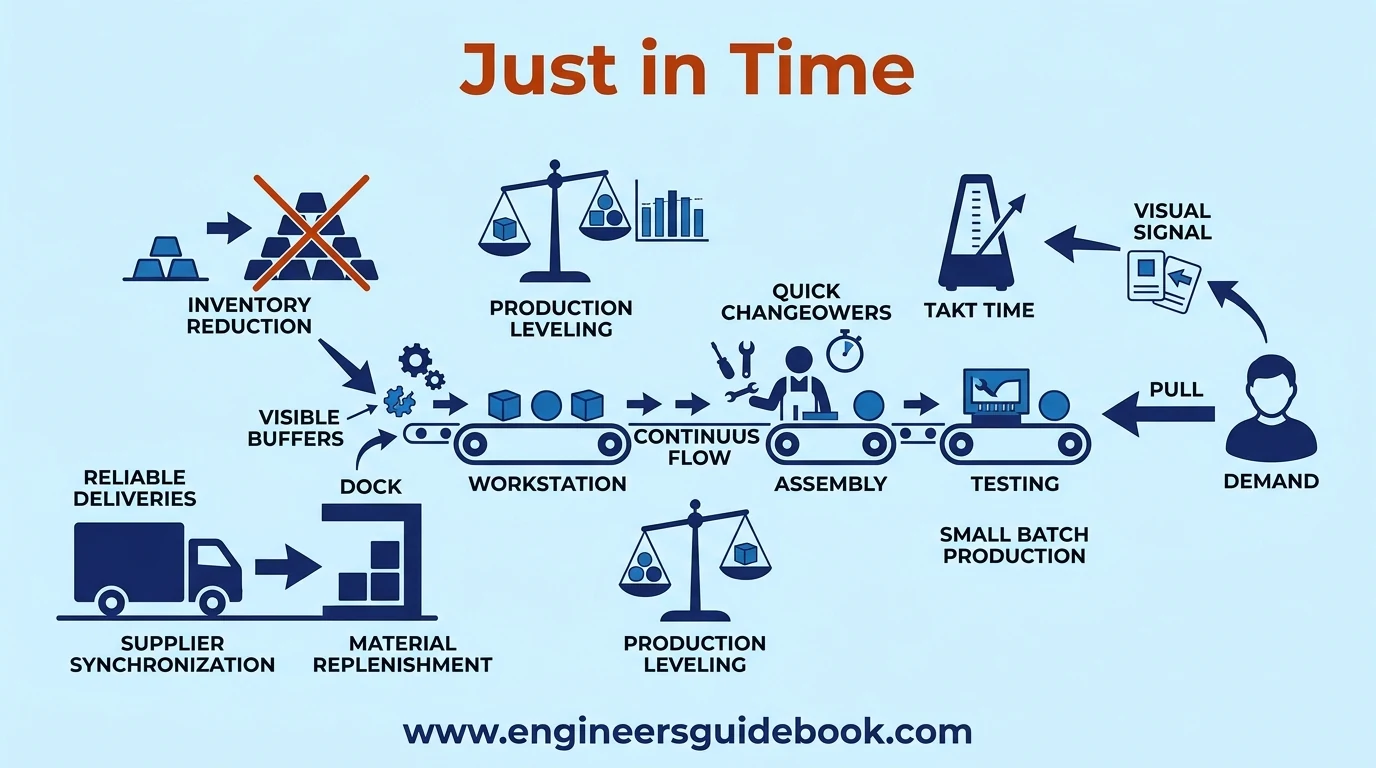
Just in Time synchronizes production with demand while reducing inventory, delay, and overproduction.
5.1 Just in Time Definition
Just in Time means producing the correct item, in the correct quantity, at the exact time required.
5.2 Takt Time
Takt time expresses the production rhythm needed to match available working time with customer demand.
5.3 Continuous Flow
Products move through sequential operations with minimal interruption, batching, storage, or unnecessary transfer.
5.4 Pull System
Downstream demand triggers upstream replenishment, preventing production from exceeding actual consumption.
5.5 Kanban
Kanban provides a visual authorization for producing or moving a specified quantity of material.
5.6 Production Leveling
Heijunka distributes product volume and variety evenly to reduce workload fluctuation and operational turbulence.
5.7 Small Batch Production
Smaller batches shorten feedback cycles, reduce inventory exposure, reveal defects earlier, and improve scheduling flexibility.
5.8 Inventory Reduction
Lower inventory exposes process instability, equipment failures, quality problems, and unreliable supplier performance previously concealed by buffers.
5.9 Quick Changeovers
Rapid setup methods reduce downtime between products and make economical small-batch production feasible.
5.10 Supplier Synchronization
Frequent, reliable deliveries align external material flow with production requirements while minimizing excess stock.
5.11 Material Replenishment
Materials are replenished according to defined consumption signals, quantities, routes, containers, and delivery intervals.
5.12 Just in Time Benefits
Benefits include reduced lead time, lower inventory, improved cash flow, faster defect discovery, and greater operational responsiveness.
5.13 Just in Time Risks
Without stable processes and dependable suppliers, reduced buffers can amplify disruptions, shortages, and production stoppages.
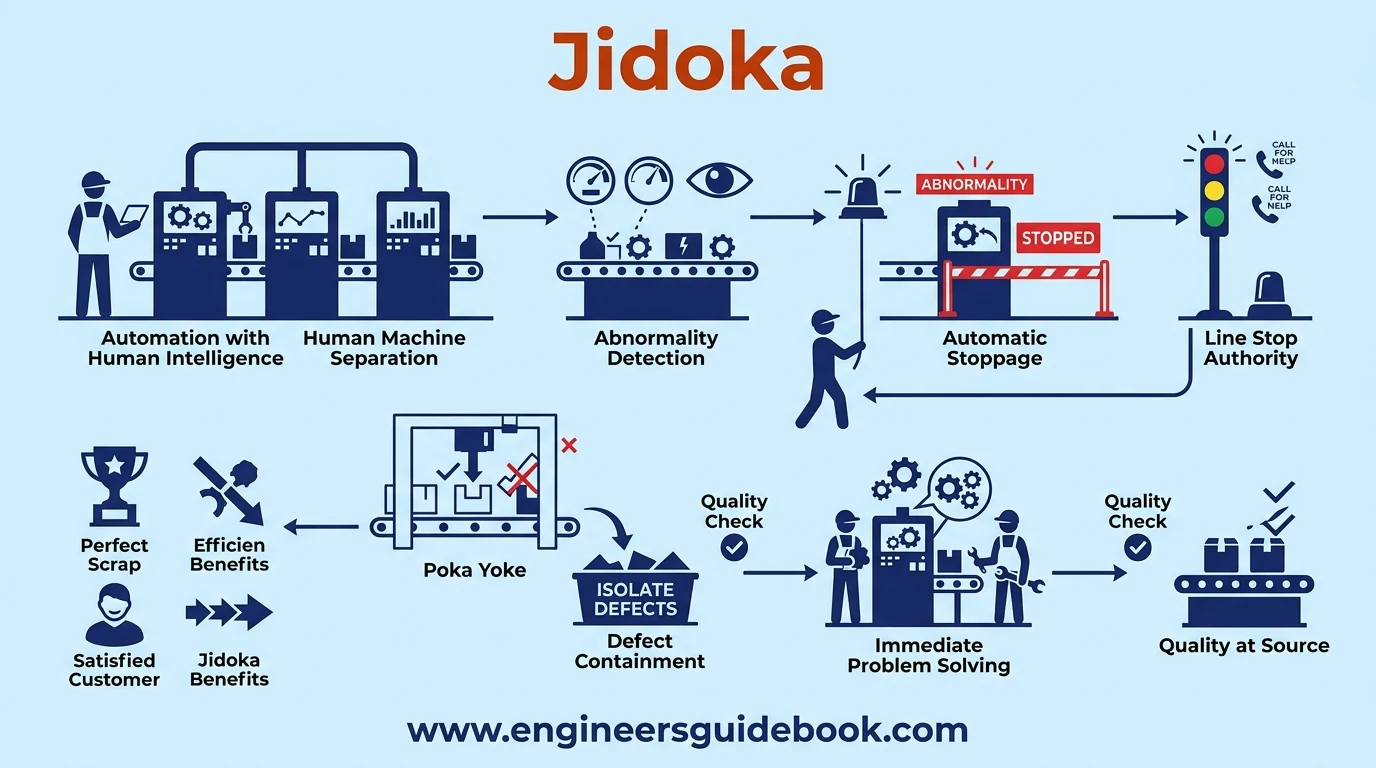
6. Jidoka
Jidoka creates processes that recognize abnormal conditions and prevent defects from moving forward unnoticed.
6.1 Jidoka Definition
Jidoka means building intelligent safeguards into work so abnormalities trigger immediate attention or automatic stoppage.
6.2 Automation with Human Intelligence
Machines perform repetitive functions while human judgment addresses irregularities, causation, and improvement opportunities.
6.3 Abnormality Detection
Sensors, limits, inspections, and operator observations identify departures from expected process conditions.
6.4 Automatic Stoppage
Stopping automatically prevents continued production of defective material and protects downstream operations.
6.5 Andon
Andon systems display process status and summon support when operators encounter abnormalities they cannot resolve immediately.
6.6 Line Stop Authority
Employees may stop production when quality or safety is threatened, reinforcing accountability at the source.
6.7 Poka Yoke
Poka Yoke devices prevent errors or make them immediately conspicuous before defects occur.
6.8 Quality at Source
Each process owns the quality of its output rather than transferring responsibility to final inspection.
6.9 Defect Containment
Suspect material is isolated quickly to prevent contamination of subsequent operations, shipments, or customer use.
6.10 Immediate Problem Solving
Teams respond while evidence remains visible, enabling more accurate diagnosis and faster containment.
6.11 Human Machine Separation
Operators are freed from continuously watching machines and can supervise multiple processes or perform higher-value work.
6.12 Jidoka Benefits
Jidoka improves quality, reduces rework, strengthens accountability, increases visibility, and enables efficient use of labor.
7. Waste Reduction
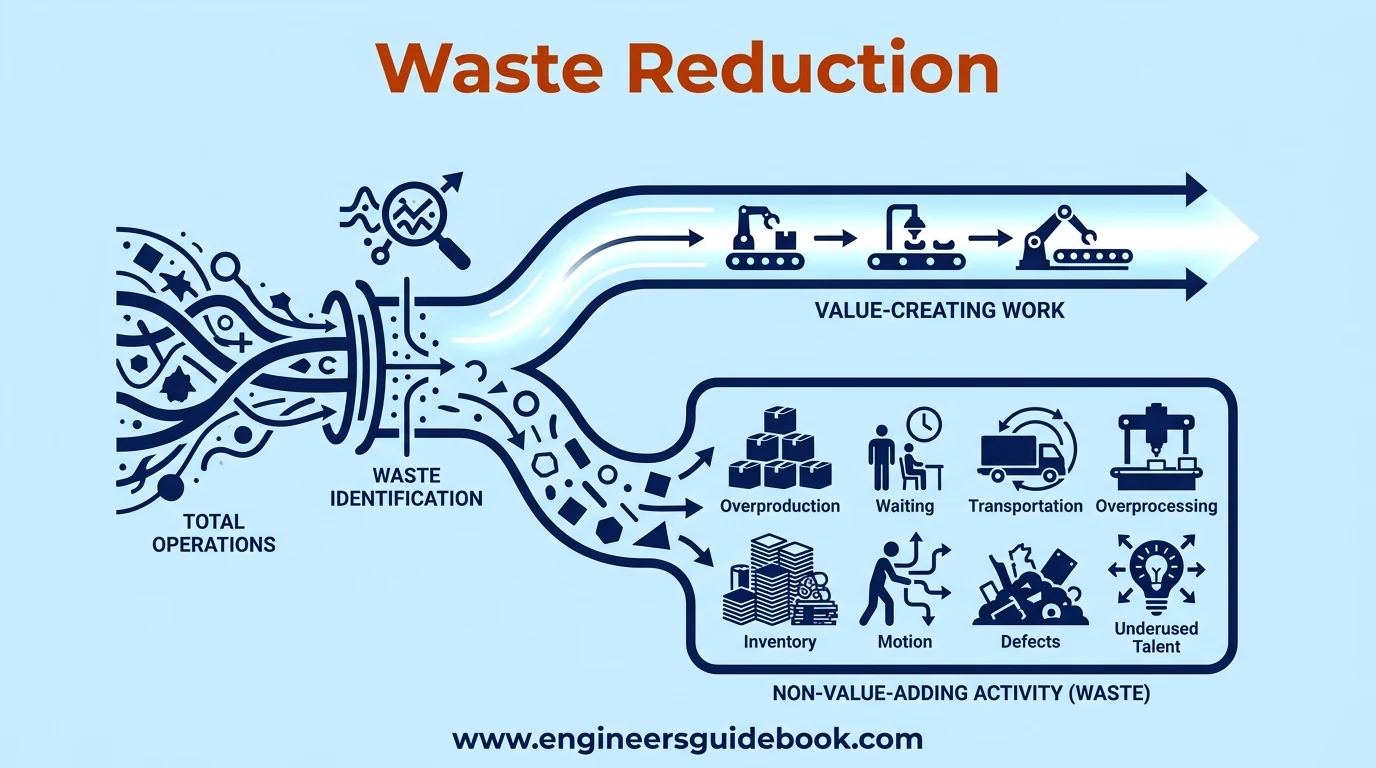
Waste reduction improves performance by separating necessary work from activity that consumes resources without creating value.
7.1 Muda
Muda refers to non-value-adding activity that should be eliminated, reduced, combined, simplified, or redesigned.
7.2 Mura
Mura describes unevenness in demand, workload, timing, or process output that destabilizes operations.
7.3 Muri
Muri means overburdening people or equipment beyond reasonable capability, increasing fatigue, breakdowns, errors, and safety risks.
7.4 Overproduction
Producing earlier or in greater quantities than required creates inventory and conceals operational deficiencies.
7.5 Waiting
Waiting occurs when employees, machines, information, or materials remain idle because preceding work is unavailable.
7.6 Transportation
Unnecessary transportation increases handling cost, damage risk, travel distance, and production lead time.
7.7 Overprocessing
Overprocessing includes redundant approvals, excessive precision, duplicate inspections, and features customers do not value.
7.8 Inventory
Excess inventory occupies space, immobilizes capital, deteriorates, becomes obsolete, and masks process instability.
7.9 Motion
Unnecessary reaching, walking, searching, bending, and repositioning consume time while increasing ergonomic strain.
7.10 Defects
Defects generate scrap, rework, delays, additional inspection, customer dissatisfaction, and reputational damage.
7.11 Underused Talent
Organizations waste talent when employee knowledge, creativity, experience, and improvement ideas remain ignored.
7.12 Waste Identification
Gemba observation, process mapping, performance data, and employee dialogue help reveal waste within daily operations.
7.13 Waste Prioritization
Waste should be prioritized according to customer impact, safety, quality, recurrence, cost, and implementation feasibility.
7.14 Waste Prevention
Sustainable prevention requires standardized countermeasures, employee training, process redesign, visual controls, and regular verification.
8. Essential TPS Tools
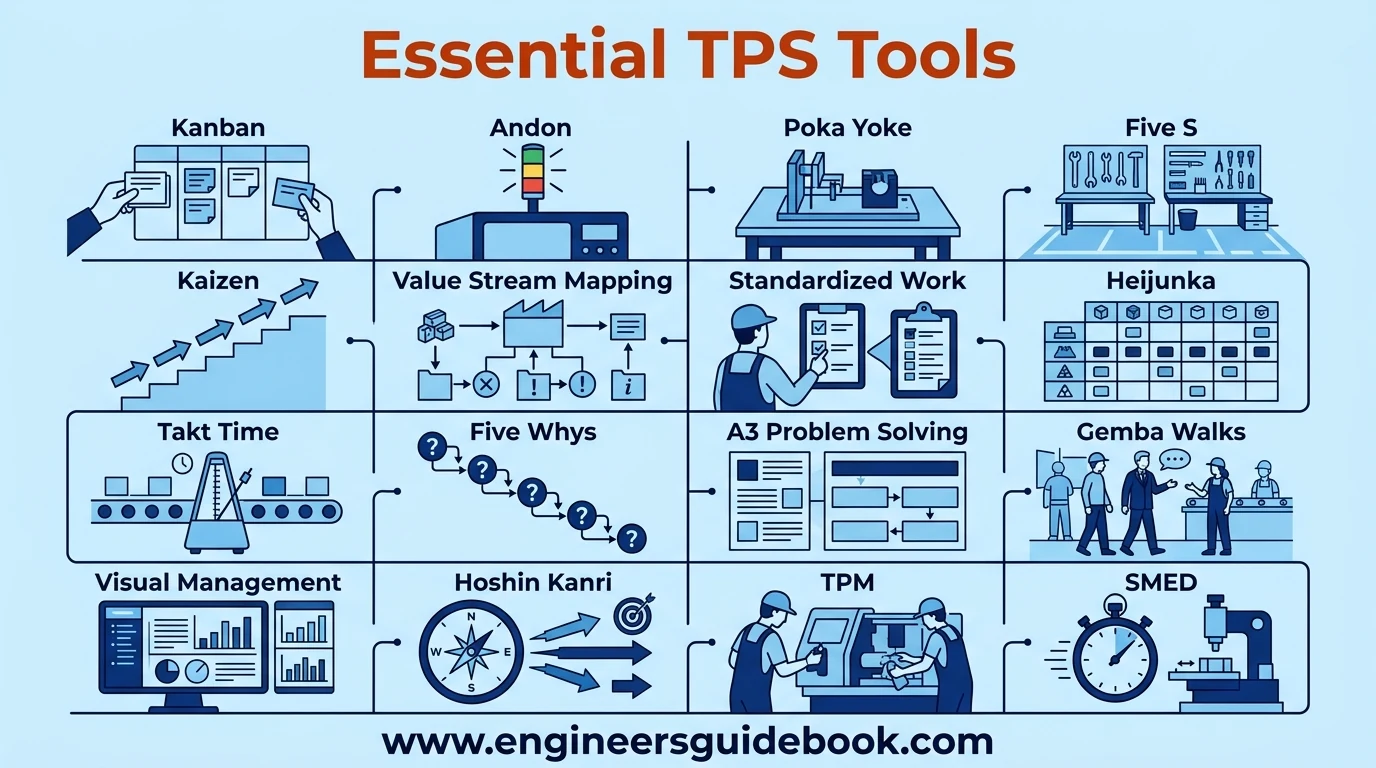
8.1 Kanban
Kanban uses visual signals to authorize production and replenishment according to actual downstream consumption rather than speculative forecasts.
8.2 Andon
Andon displays process conditions instantly and alerts supervisors when operators encounter quality, equipment, material, or safety abnormalities.
8.3 Poka Yoke
Poka Yoke prevents mistakes through simple mechanisms that block incorrect assembly, detect omissions, or expose deviations immediately.
8.4 Five S
Five S organizes workplaces through sorting, systematic arrangement, cleaning, standardization, and disciplined maintenance of established conditions.
8.5 Kaizen
Kaizen promotes frequent, incremental improvements generated by employees who understand the practical intricacies of everyday work.
8.6 Value Stream Mapping
Value Stream Mapping visualizes material and information flows, revealing delays, bottlenecks, excessive inventory, and non-value-adding activities.
8.7 Standardized Work
Standardized work documents the safest, most efficient current method, including work sequence, takt time, and standard inventory.
8.8 Heijunka
Heijunka levels production volume and product variety, reducing workload volatility while creating a more predictable operating cadence.
8.9 Takt Time
Takt time establishes the production pace required to satisfy customer demand within the available working period.
8.10 Five Whys
The Five Whys method repeatedly questions causation until the investigation moves beyond symptoms and identifies a controllable root cause.
8.11 A3 Problem Solving
A3 problem-solving condenses background, analysis, countermeasures, responsibilities, and follow-up actions into one coherent visual document.
8.12 Gemba Walks
Gemba walks take leaders to the actual workplace to observe processes, question assumptions, and understand problems directly.
8.13 Visual Management
Visual management makes standards, abnormalities, priorities, and performance discernible without complicated reports or prolonged interpretation.
8.14 Hoshin Kanri
Hoshin Kanri translates strategic objectives into coordinated departmental priorities, measurable targets, and structured implementation activities.
8.15 Total Productive Maintenance
Total Productive Maintenance improves equipment reliability through preventive care, operator involvement, defect elimination, and focused maintenance improvement.
8.16 Single Minute Exchange of Die
Single Minute Exchange of Die reduces setup duration by separating internal tasks, externalizing preparation, and simplifying adjustments.
9. People and Culture
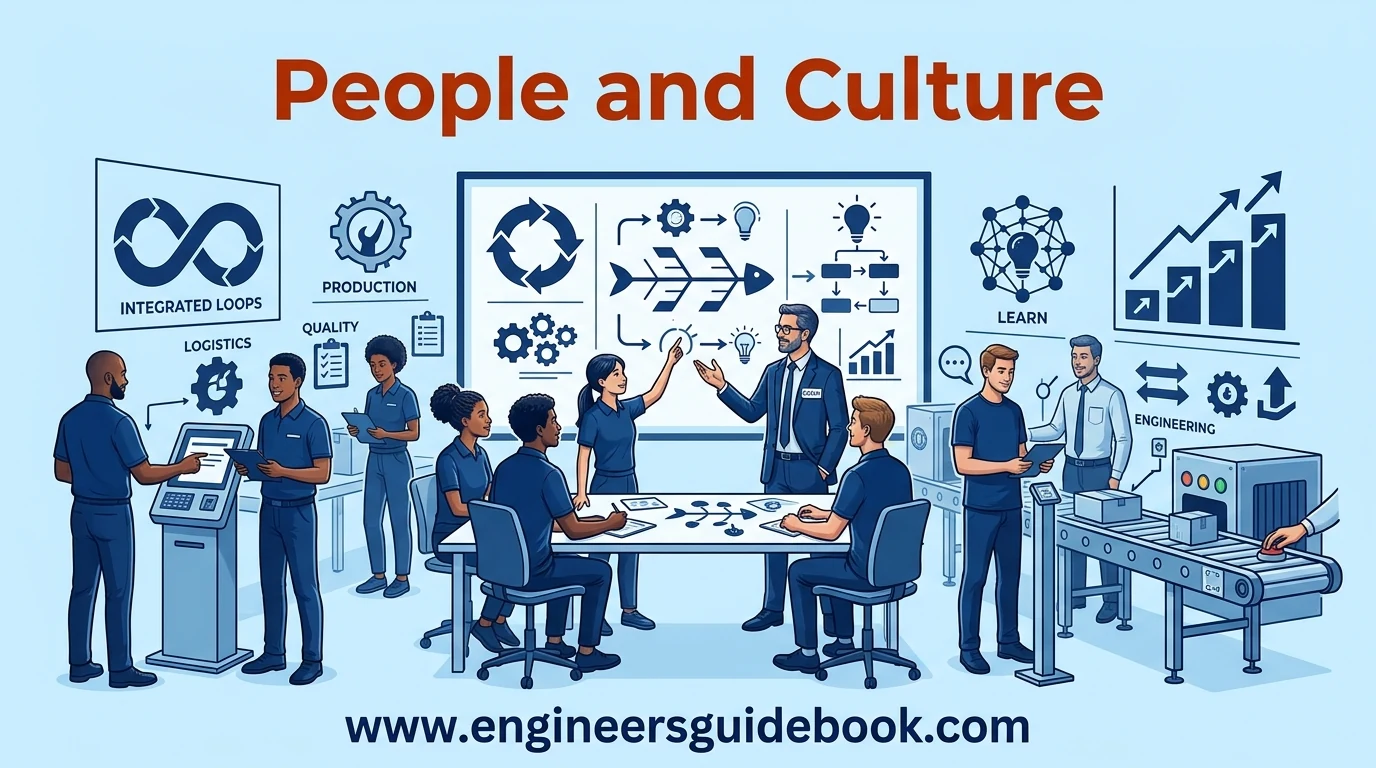
9.1 Respect for People
Respect involves listening, developing competence, providing safe conditions, and challenging employees without undermining their dignity.
9.2 Employee Empowerment
Empowered employees can stop processes, report abnormalities, recommend improvements, and participate meaningfully in operational decisions.
9.3 Teamwork
Cross-skilled teams combine practical knowledge, technical expertise, and shared accountability to solve problems more comprehensively.
9.4 Leadership Standards
TPS leaders demonstrate humility, process discipline, factual decision-making, coaching capability, and consistent adherence to organizational principles.
9.5 Coaching Culture
Managers develop employees by asking incisive questions, encouraging experimentation, and guiding reflection rather than prescribing every solution.
9.6 Problem Solving Skills
Employees learn to define gaps, collect evidence, identify causes, test countermeasures, and verify sustainable results.
9.7 Employee Suggestions
Structured suggestion systems transform frontline observations into practical improvements while recognizing the intellectual contribution of employees.
9.8 Cross Functional Collaboration
Production, maintenance, quality, logistics, engineering, and procurement cooperate to resolve systemic issues crossing departmental boundaries.
9.9 Supplier Respect
Suppliers receive clear expectations, developmental support, honest communication, and opportunities to participate in long-term improvement.
9.10 Learning Organization
A learning organization captures lessons, shares successful practices, studies failures, and converts experience into institutional knowledge.
9.11 Continuous Improvement Mindset
This mindset treats every standard as temporary and every recurring inconvenience as a potential improvement opportunity.
9.12 Management Commitment
Management must provide time, resources, stability, and visible participation rather than delegating TPS entirely to improvement specialists.
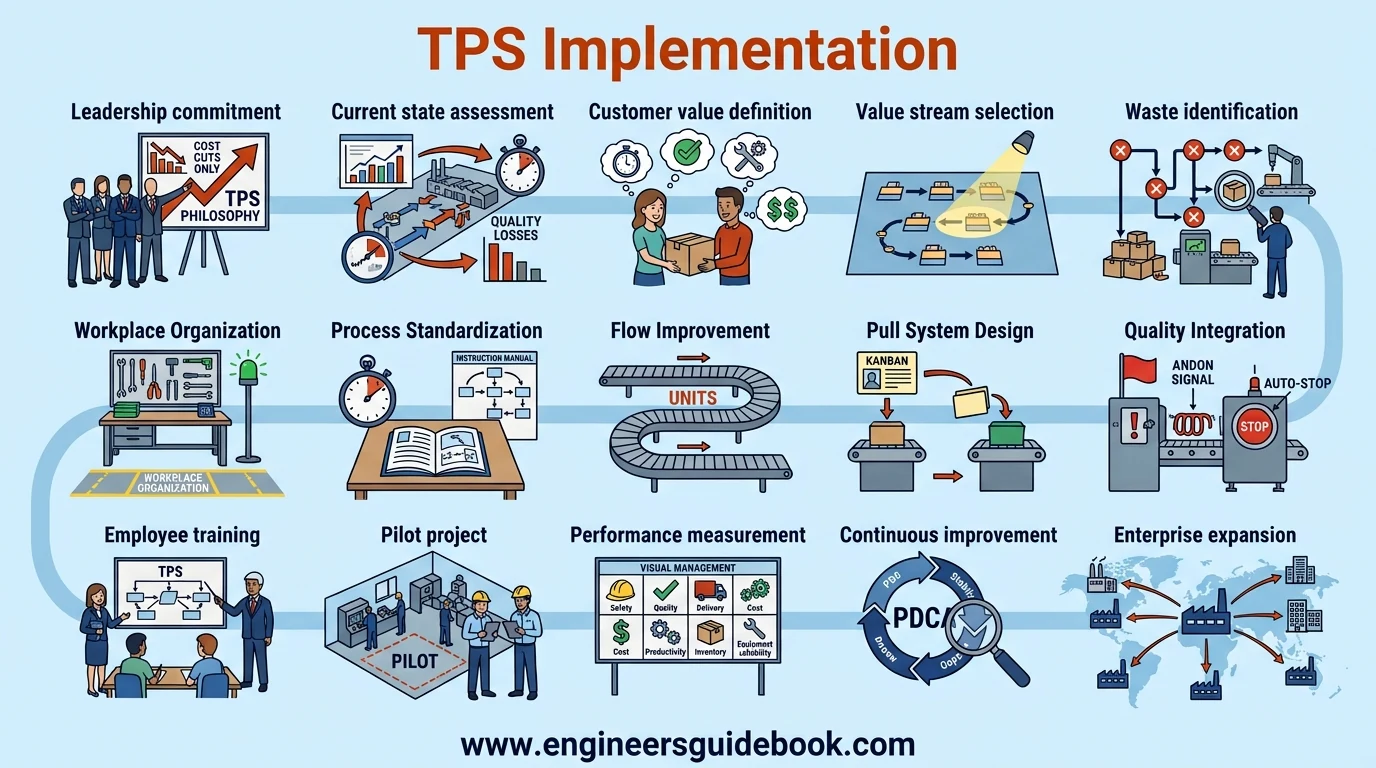
10. TPS Implementation
10.1 Leadership Commitment
Implementation begins when leaders accept TPS as a management philosophy rather than a temporary cost-reduction program.
10.2 Current State Assessment
Organizations should examine process capability, workflow, equipment reliability, quality losses, inventory, skills, and prevailing leadership behaviors.
10.3 Customer Value Definition
Teams must determine what customers genuinely require regarding quality, delivery, functionality, service, and acceptable cost.
10.4 Value Stream Selection
A manageable product family or service pathway should be selected to create focus and demonstrate measurable progress.
10.5 Waste Identification
Direct observation, process mapping, employee interviews, and operational data expose activities that consume resources without creating value.
10.6 Workplace Organization
Five S and visual controls establish orderly, transparent conditions where abnormalities become easier to recognize.
10.7 Process Standardization
Critical tasks require documented sequences, clear parameters, defined responsibilities, and consistent methods before further optimization.
10.8 Flow Improvement
Layouts, batch sizes, handoffs, and work sequences should be redesigned to reduce interruption and waiting.
10.9 Pull System Design
Replenishment signals, inventory limits, container quantities, and withdrawal rules must reflect genuine downstream consumption.
10.10 Quality Integration
Error-proofing, automatic detection, first-piece verification, and stop-response procedures embed quality within each process.
10.11 Employee Training
Training should combine conceptual instruction, supervised practice, standardized methods, and structured problem-solving experience.
10.12 Pilot Project
A pilot allows organizations to test principles, develop internal capability, and refine methods before broader deployment.
10.13 Performance Measurement
Metrics should cover safety, quality, delivery, cost, productivity, inventory, equipment reliability, and employee participation.
10.14 Continuous Improvement
After stabilization, teams should revisit standards, investigate new gaps, and conduct disciplined improvement cycles.
10.15 Enterprise Expansion
Successful practices can gradually extend across departments, facilities, suppliers, and administrative processes without mechanical imitation.
11. Benefits and Challenges
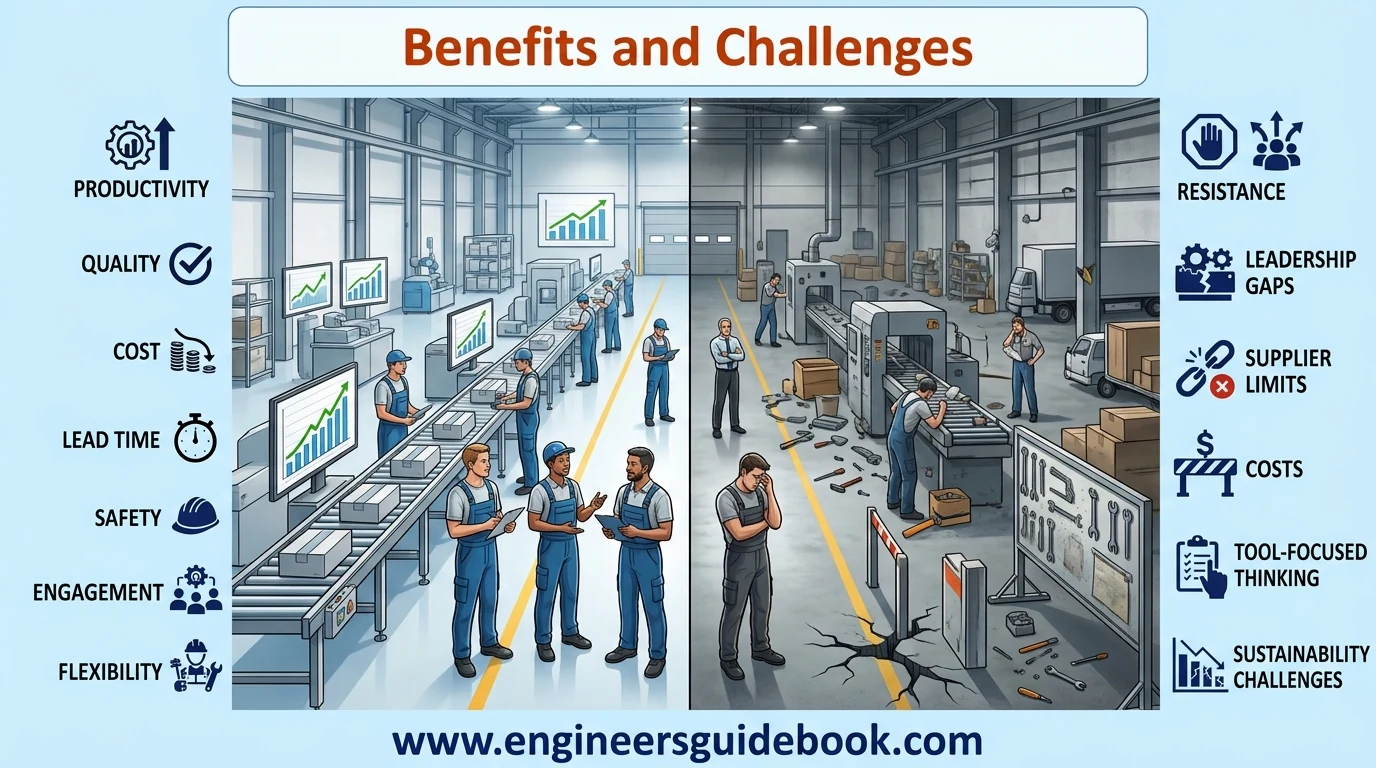
11.1 Productivity Improvement
Balanced workloads, reduced waiting, reliable equipment, and standardized methods enable greater output from existing resources.
11.2 Quality Improvement
Built-in quality prevents defect propagation, shortens feedback loops, and strengthens accountability at the originating process.
11.3 Cost Reduction
TPS lowers costs by removing waste, reducing rework, optimizing labor utilization, and controlling unnecessary inventory.
11.4 Lead Time Reduction
Continuous flow and smaller batches compress the elapsed time between customer demand and completed delivery.
11.5 Inventory Reduction
Pull production reduces raw material, work-in-process, and finished-goods stock while exposing hidden instability.
11.6 Workplace Safety
Organized workplaces, standardized activities, ergonomic improvements, and early abnormality detection reduce occupational risk.
11.7 Employee Engagement
Meaningful participation in problem-solving increases ownership, competence, confidence, and connection with organizational objectives.
11.8 Customer Satisfaction
Consistent quality, dependable delivery, responsive service, and competitive cost create stronger customer confidence.
11.9 Operational Flexibility
Quick changeovers, multiskilled employees, and leveled production help operations respond to changing demand.
11.10 Cultural Resistance
Employees may resist new standards when TPS is associated with surveillance, redundancies, blame, or intensified workloads.
11.11 Leadership Gaps
Implementation deteriorates when managers demand results without practicing Gemba observation, coaching, and long-term problem-solving.
11.12 Training Requirements
TPS requires sustained education because tools alone cannot replace analytical ability, technical competence, and behavioral discipline.
11.13 Supplier Limitations
Unreliable quality, long transportation distances, and inflexible delivery schedules can obstruct synchronized material flow.
11.14 Implementation Costs
Training, layout changes, equipment modifications, digital systems, and temporary productivity losses may require considerable investment.
11.15 Tool Focused Thinking
Organizations often imitate Kanban boards or Five S activities while neglecting philosophy, leadership, and workforce development.
11.16 Sustainability Challenges
Improvements fade when audits replace ownership, standards become obsolete, or leadership attention shifts toward another initiative.
12. Frequently Asked Questions
12.1 What is the Toyota Production System?
The Toyota Production System is an operational philosophy that improves value through waste elimination, process stability, built-in quality, and employee development.
12.2 Who developed the Toyota Production System?
TPS evolved through contributions from Sakichi Toyoda, Kiichiro Toyoda, Eiji Toyoda, Taiichi Ohno, Shigeo Shingo, and numerous Toyota employees.
12.3 What are the two main pillars of TPS?
The two pillars are Just in Time, which synchronizes production with demand, and Jidoka, which builds quality into processes.
12.4 What is the main goal of TPS?
Its main goal is to deliver maximum customer value with excellent quality, minimal waste, dependable delivery, and responsible resource use.
12.5 How does TPS reduce waste?
TPS exposes and removes overproduction, waiting, transportation, overprocessing, inventory, motion, defects, and underused human talent.
12.6 What is Just in Time in TPS?
Just in Time produces and delivers only the required item, quantity, and timing based on actual demand.
12.7 What is Jidoka in TPS?
Jidoka enables machines and employees to detect abnormalities, stop production, contain defects, and initiate immediate corrective action.
12.8 What are the eight wastes in TPS?
They are overproduction, waiting, transportation, overprocessing, inventory, motion, defects, and underutilized employee knowledge or creativity.
12.9 What is Kaizen in the Toyota Production System?
Kaizen is the disciplined practice of making small, continuous improvements through employee participation and factual problem-solving.
12.10 How does Kanban work in TPS?
Kanban authorizes material movement or production when downstream consumption creates a replenishment signal.
12.11 What is the difference between TPS and lean manufacturing?
TPS is Toyota’s integrated management system, while lean manufacturing is the broader adaptation of its principles across organizations.
12.12 Can TPS be used outside manufacturing?
Yes. TPS principles are applied in healthcare, construction, logistics, software, banking, hospitality, and public administration.
12.13 What are the main benefits of TPS?
Principal benefits include improved quality, lower cost, shorter lead time, reduced inventory, safer work, and stronger employee capability.
12.14 What are the challenges of implementing TPS?
Common challenges include cultural resistance, weak leadership, inadequate training, unstable processes, supplier constraints, and superficial tool adoption.
12.15 How long does TPS implementation take?
Initial improvements may appear within months, but developing a mature TPS culture generally requires several years of consistent leadership.
13. Conclusion
TPS integrates Just in Time, Jidoka, standardized work, waste elimination, and respect for people into one coherent system.
When sustained, TPS strengthens operational resilience, customer value, workforce capability, and long-term competitiveness.
Organizations should first establish leadership commitment, process stability, workplace standards, employee competence, and transparent performance measures.
TPS has no definitive endpoint because changing customer needs and operational conditions continually create new improvement possibilities.