An anchor bolt is a fastening component used to secure structural members, machinery, frames, columns, and equipment to concrete or masonry. It transfers tensile, shear, and overturning loads from the attached element into the base material. Anchor bolts are available in multiple types, sizes, materials, and coatings for construction, industrial, and infrastructure applications.
1. Anchor Bolt Basics
1.1 Definition
An anchor bolt is a mechanical fastening device designed to connect an object to concrete, masonry, or another solid base material. Unlike ordinary bolts that join two loose components together, an anchor bolt gains its strength from embedment, expansion, bonding, or mechanical interlock inside the foundation.
In simple terms, it is the hidden grip beneath a structure. It may hold a steel column, a machine base, a railing post, a pressure vessel skid, or a heavy-duty support frame. The visible part is usually the threaded portion above the surface, but the true holding power comes from the section fixed inside the concrete.
Anchor bolts are widely used because concrete is strong in compression but weak in direct tension. The bolt acts as a load-transferring bridge between the mounted component and the foundation mass.
2. Importance in Structural Engineering
2.1 Structural Stability
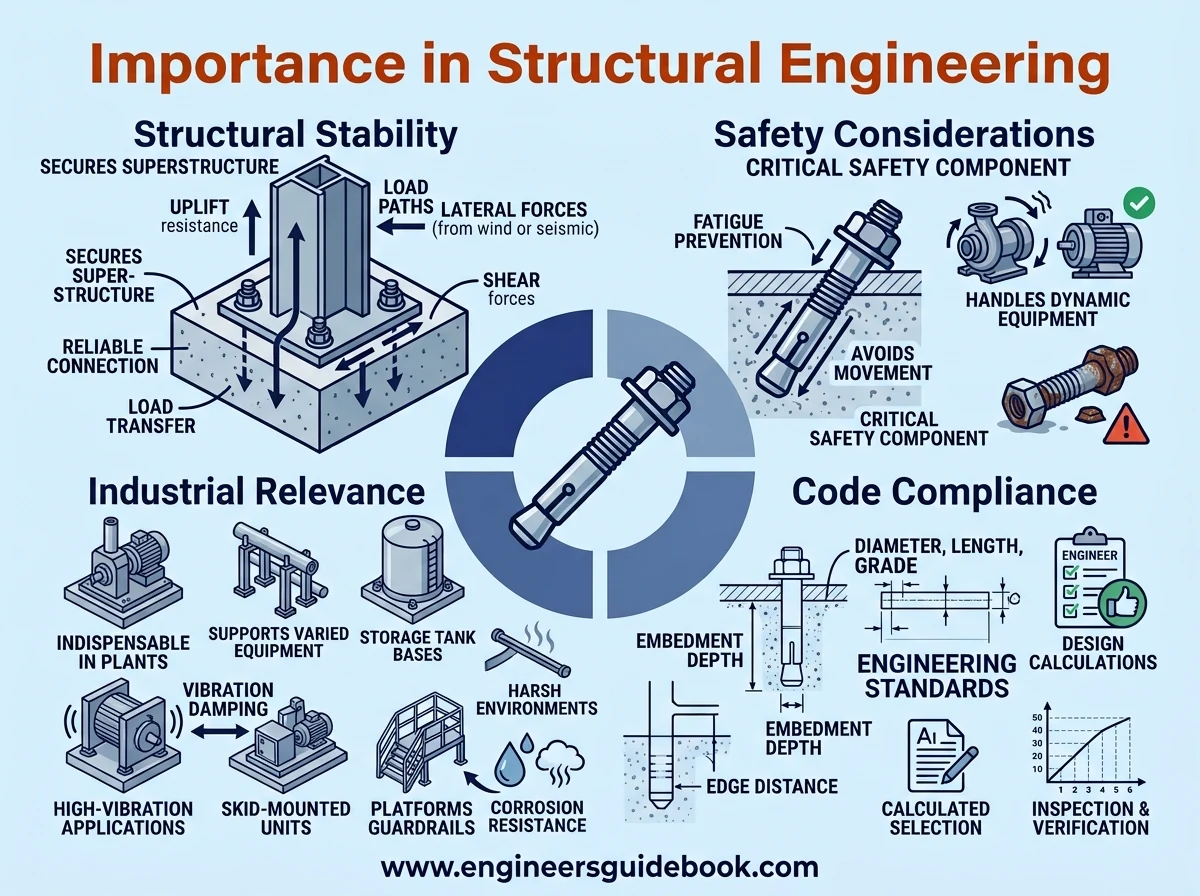
Anchor bolts play a decisive role in structural stability. They connect the superstructure to the foundation and make sure that loads move safely from columns, frames, and supports into the concrete base. Without dependable anchorage, even a well-designed steel member can become unstable.
In steel buildings, anchor bolts hold column base plates in exact position. They resist uplift from wind, lateral forces from seismic movement, and shear forces from operational loads. In smaller structures, they may appear simple. In larger structures, they become critical load-path components.
A structure is only as reliable as its connections. Anchor bolts are among those connections that remain mostly unseen after installation, yet they control the safety and rigidity of the entire assembly.
2.2 Safety Considerations
Anchor bolt safety depends on correct selection, installation, torque application, spacing, and inspection. A bolt that is undersized, poorly embedded, corroded, or misaligned can become a latent hazard. It may not fail immediately, but it can gradually loosen under repeated loading.
Safety is especially important where anchor bolts hold dynamic equipment. Pumps, compressors, blowers, crushers, generators, and rotating machinery create cyclic forces. These forces can fatigue the bolt, enlarge the grout gap, or loosen nuts if the installation is weak.
In structural applications, anchor bolt failure can lead to column base movement, frame instability, falling equipment, or collapse of attached components. For this reason, anchor bolt design should never be treated as an afterthought.
2.3 Industrial Relevance
Anchor bolts are indispensable in industrial plants. They are used for machinery foundations, pipe rack supports, storage tank bases, conveyor frames, skid-mounted units, platforms, ladders, guardrails, and structural steel columns. Every industrial facility depends on them in some form.
Their importance increases in high-vibration and high-load areas. A machine running at high speed requires firm anchorage to maintain alignment. If the anchor bolts loosen, vibration increases. That vibration then accelerates wear in bearings, seals, shafts, couplings, and foundation grout.
Industrial anchor bolts must also survive harsh operating conditions. Chemical fumes, washdown water, oil contamination, thermal cycling, and outdoor exposure can attack the bolt surface. Therefore, material and coating selection are just as important as diameter and length.
2.4 Code Compliance
Anchor bolts must comply with applicable construction codes, engineering standards, and project specifications. Code compliance ensures that anchor design considers load capacity, concrete strength, embedment depth, edge distance, spacing, seismic forces, and material grade.
In engineered projects, anchor bolts are selected through calculations rather than guesswork. Drawings usually specify bolt diameter, length, grade, projection, thread length, hole pattern, washer type, and tightening requirement. These details protect the installation from ambiguity.
Compliance also assists inspection and quality control. When bolts follow recognized standards, engineers and inspectors can verify whether the installation meets the intended design. This reduces the risk of nonconformance, rework, and premature failure.
3. Anchor Bolt Components
3.1 Bolt Body
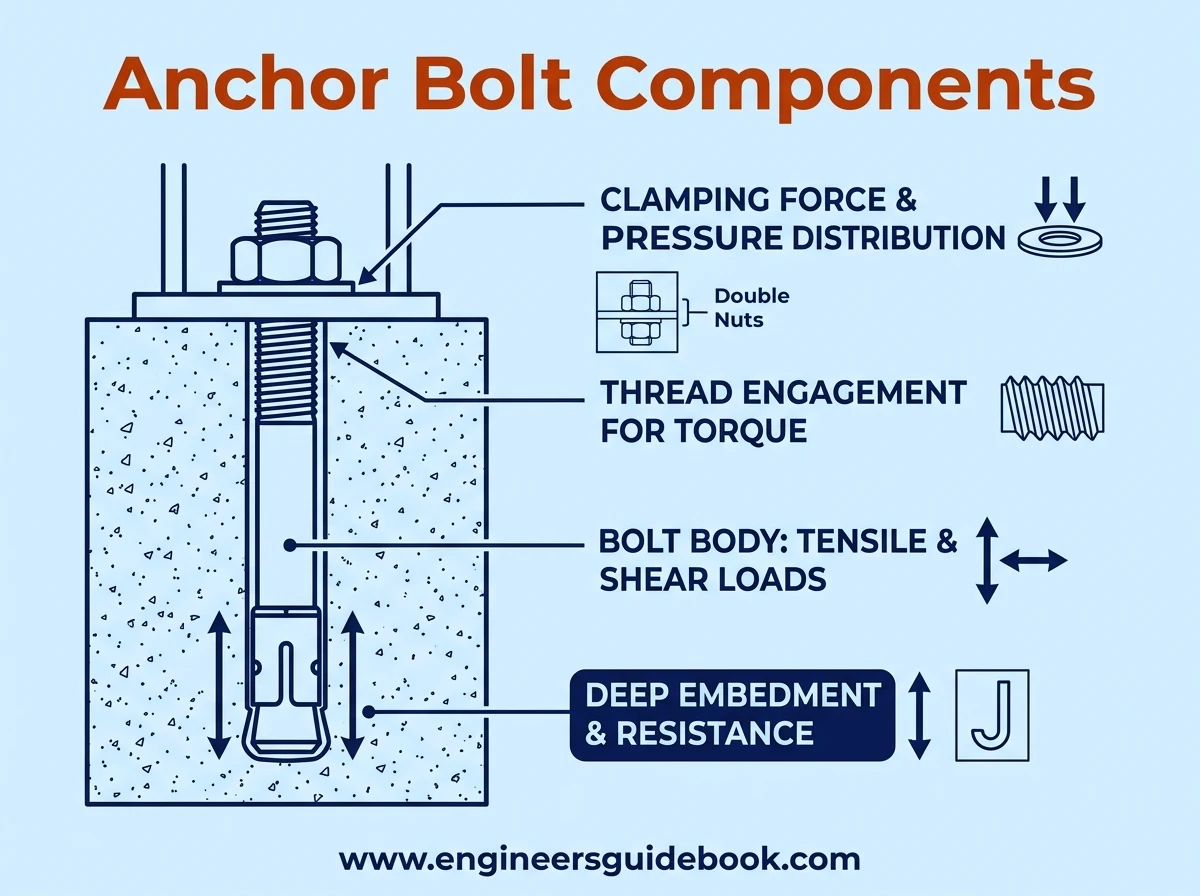
The bolt body is the main shank of the anchor bolt. It carries tensile and shear loads and provides the physical length required for embedment or fastening. The body may be straight, bent, headed, threaded, or partially threaded depending on the anchor type.
In cast-in-place anchors, the body is positioned before concrete pouring. Once the concrete cures, the bolt becomes part of the foundation system. In post-installed anchors, the body is inserted into a drilled hole and secured through expansion, adhesive bonding, or mechanical locking.
3.2 Threads
Threads allow the nut to engage with the anchor bolt and clamp the mounted component in place. The threaded portion is usually located above the concrete surface, although some anchors may have threads along a larger section of the body.
Thread quality is essential. Damaged, rusted, or poorly formed threads can prevent proper nut tightening. This may reduce clamping force and compromise the connection. Clean threads allow accurate torque application and easy installation.
3.3 Nut and Washer
The nut and washer complete the fastening assembly. The nut applies clamping force when tightened, while the washer distributes pressure over the base plate or attached component. This reduces local indentation and improves load distribution.
Washers are particularly important when holes are slightly oversized. They help bridge the gap and provide a firm bearing surface. Heavy-duty applications may require hardened washers or plate washers to prevent deformation under high load.
3.4 Embedded Section
The embedded section is the part of the anchor bolt fixed inside the concrete. It may be straight, hooked, bent, headed, or bonded with adhesive. This section determines how effectively the bolt develops resistance against pullout and breakout.
A deeper embedded section generally provides better holding capacity, but only when edge distance and concrete strength are adequate. Shallow embedment can lead to sudden pullout, especially under tensile loading. Too close to an edge, the concrete may split or break away.
4. Types of Anchor Bolts
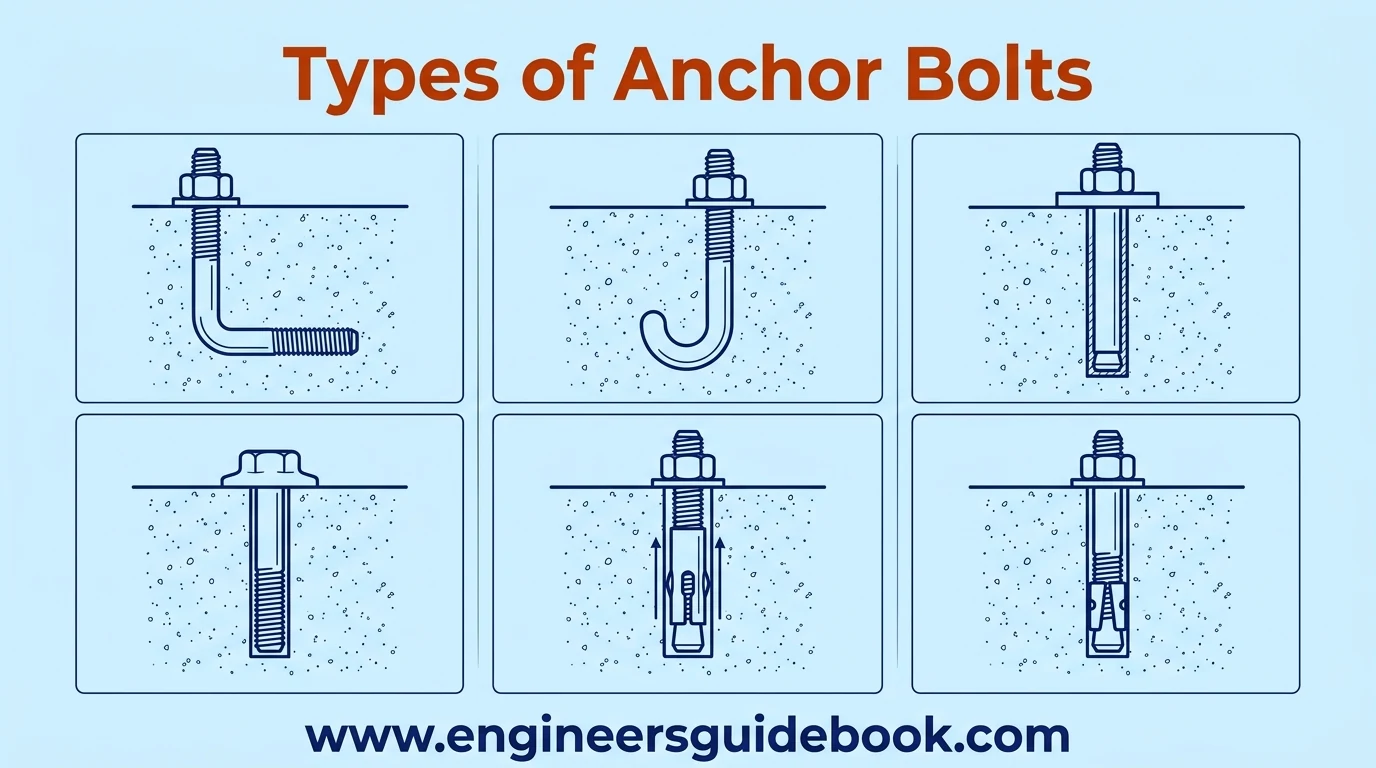
4.1 L Shaped Anchor Bolt
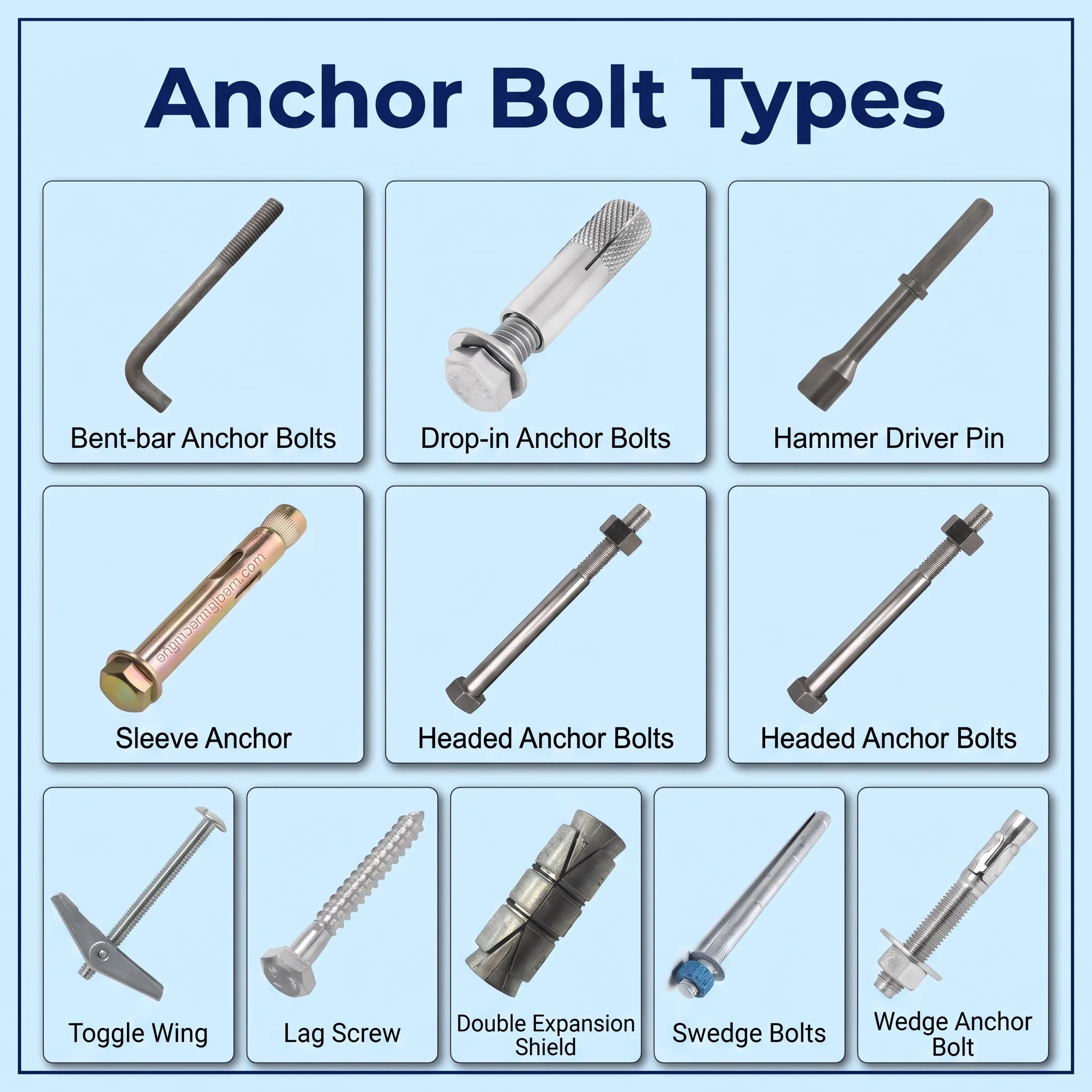
An L shaped anchor bolt has a bent leg at the embedded end. This bend provides mechanical resistance inside the concrete and helps prevent pullout. It is commonly used in light to medium structural applications, foundations, and base plate connections.
The L shape is simple, economical, and easy to fabricate. It works best when installed before concrete pouring. Once embedded, the bent leg acts like a hook that locks the bolt into the concrete mass.
4.2 J Shaped Anchor Bolt
A J shaped anchor bolt has a curved hook at the embedded end. Its function is similar to the L shaped bolt, but the rounded profile provides a different anchoring geometry. These bolts are often used in concrete foundations and structural supports.
J bolts are traditional and reliable for many general-purpose applications. However, modern design practices may prefer headed or straight anchors in certain engineered connections because their behavior can be more predictable.
4.3 Straight Anchor Bolt
A straight anchor bolt has a uniform shank without a bent end. It may be fully threaded, partially threaded, or used with a plate, nut, or adhesive system at the embedded end. Straight bolts are common in both cast-in-place and post-installed applications.
Their clean geometry makes them suitable for precise installation. In adhesive anchoring, straight threaded rods are frequently used because the bonding material grips the threaded surface inside the drilled hole.
4.4 Headed Anchor Bolt
A headed anchor bolt has a forged or welded head at the embedded end. The head provides bearing resistance against the concrete and improves pullout performance. This type is widely used in structural steel base plates and engineered foundations.
Headed anchor bolts offer predictable load transfer. The head acts as a mechanical stop, allowing the bolt to develop strength through concrete bearing and embedment depth. They are often preferred in critical construction.
4.5 Sleeve Anchor Bolt
A sleeve anchor bolt is a post-installed expansion anchor. It consists of a threaded bolt, expansion sleeve, nut, and washer. When the nut is tightened, the sleeve expands against the wall of the drilled hole.
Sleeve anchors are versatile and can be used in concrete, brick, and masonry. They are commonly selected for fixtures, brackets, handrails, and medium-duty fastening. Proper hole diameter and depth are essential for reliable performance.
4.6 Wedge Anchor Bolt
A wedge anchor bolt is a heavy-duty post-installed anchor used mainly in solid concrete. It has an expansion clip near the embedded end. When tightened, the clip wedges firmly against the concrete hole wall.
Wedge anchors provide high holding strength and are commonly used for structural supports, machinery bases, and heavy fixtures. They require accurate drilling and correct embedment. Once installed, they are difficult to remove without damaging the base material.
5. Anchor Bolt Materials and Coatings
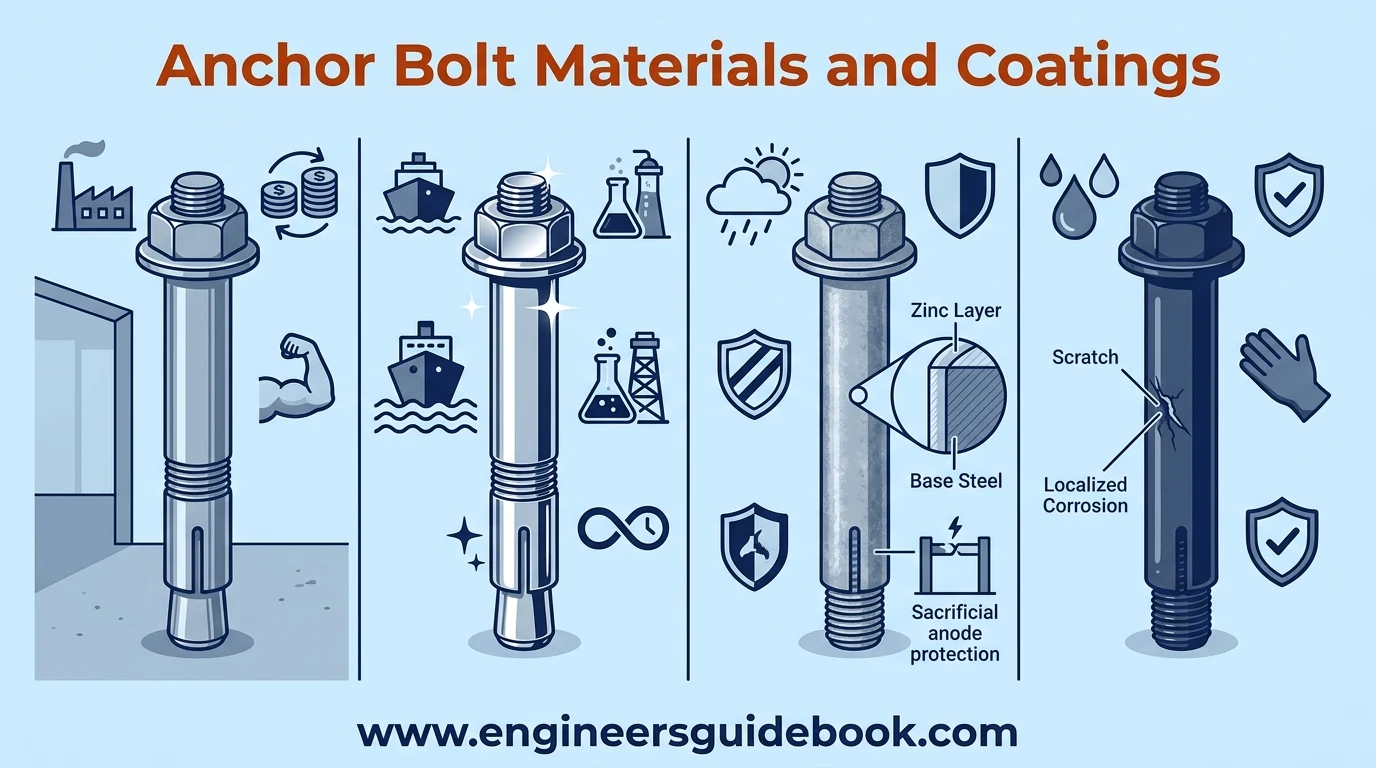
5.1 Carbon Steel
Carbon steel anchor bolts are widely used because they combine strength, availability, and cost efficiency. They are suitable for indoor applications, normal foundations, structural supports, and machinery bases where corrosion exposure is limited.
The main limitation of carbon steel is rust. In damp, chemical, or outdoor environments, unprotected carbon steel can corrode and lose section thickness over time.
5.2 Stainless Steel
Stainless steel anchor bolts provide superior corrosion resistance. They are used in marine areas, wastewater plants, food-grade facilities, chemical plants, and exposed architectural structures.
Although stainless steel costs more, it reduces long-term maintenance. It is especially valuable where replacement is difficult after installation.
5.3 Galvanized Finish
Galvanized anchor bolts are coated with zinc to protect the steel from corrosion. Hot dip galvanizing provides a thicker protective layer than light zinc plating and is better suited for outdoor exposure.
The zinc layer acts as a sacrificial barrier. It corrodes before the base steel, extending bolt life in many environments.
5.4 Epoxy Coating
Epoxy-coated anchor bolts are used where chemical resistance or added corrosion protection is required. The coating forms a protective film over the steel surface and reduces direct contact with aggressive media.
Care is required during handling. Scratched or damaged epoxy coating can expose the steel and create localized corrosion points.
5.5 Corrosion Resistance
Corrosion resistance depends on material, coating, exposure, temperature, and maintenance. Outdoor structures, coastal areas, chemical plants, and wet foundations require special attention.
Choosing the right protection system prevents premature weakening. A strong bolt with poor corrosion resistance can become unsafe long before its expected service life.
6. Anchor Bolt Sizes and Dimensions
6.1 Diameter Range
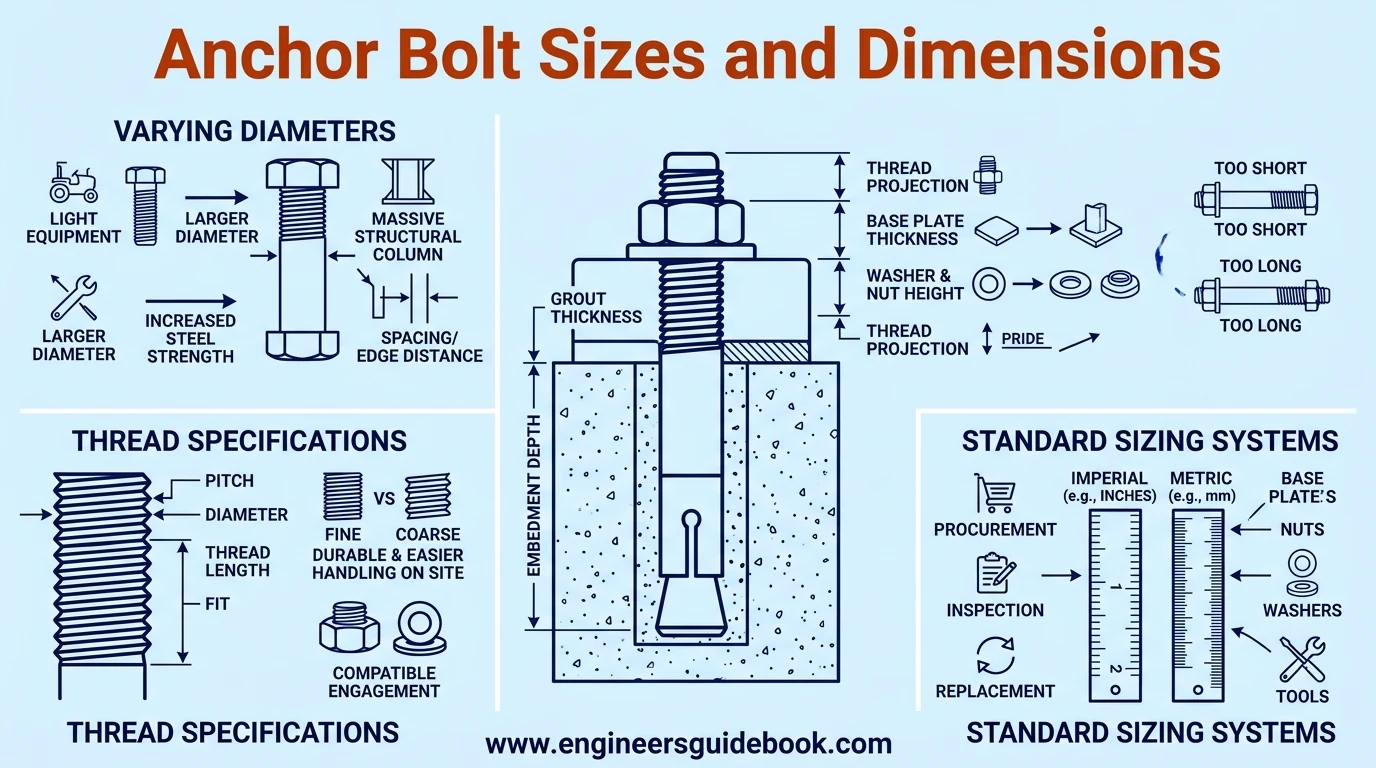
Anchor bolt diameter varies from small light-duty sizes to large heavy-duty sizes used in industrial and structural work. Common diameters depend on load requirement, base plate hole size, equipment weight, and design standard.
A larger diameter increases steel strength and stiffness, but it also requires proper spacing and edge distance. Oversizing without calculation can create installation problems.
6.2 Length Selection
Anchor bolt length includes embedment depth, grout thickness, base plate thickness, washer thickness, nut height, and thread projection. Correct length ensures both holding capacity and proper nut engagement.
Too short is dangerous. Too long can interfere with installation or create unnecessary exposed threads.
6.3 Thread Specifications
Thread specifications define pitch, diameter, thread length, and fit. Coarse threads are common in construction because they are durable and easier to handle on site.
Threads must be compatible with nuts and washers. Mixing standards or grades can create poor engagement and unreliable tightening.
6.4 Standard Sizing Systems
Anchor bolts may follow imperial or metric sizing systems depending on project location and specification. Imperial sizes are often expressed in inches, while metric sizes use millimeters.
Standard sizing improves procurement, inspection, and replacement. It also ensures compatibility with base plates, nuts, washers, and installation tools.
7. Load Capacity and Strength
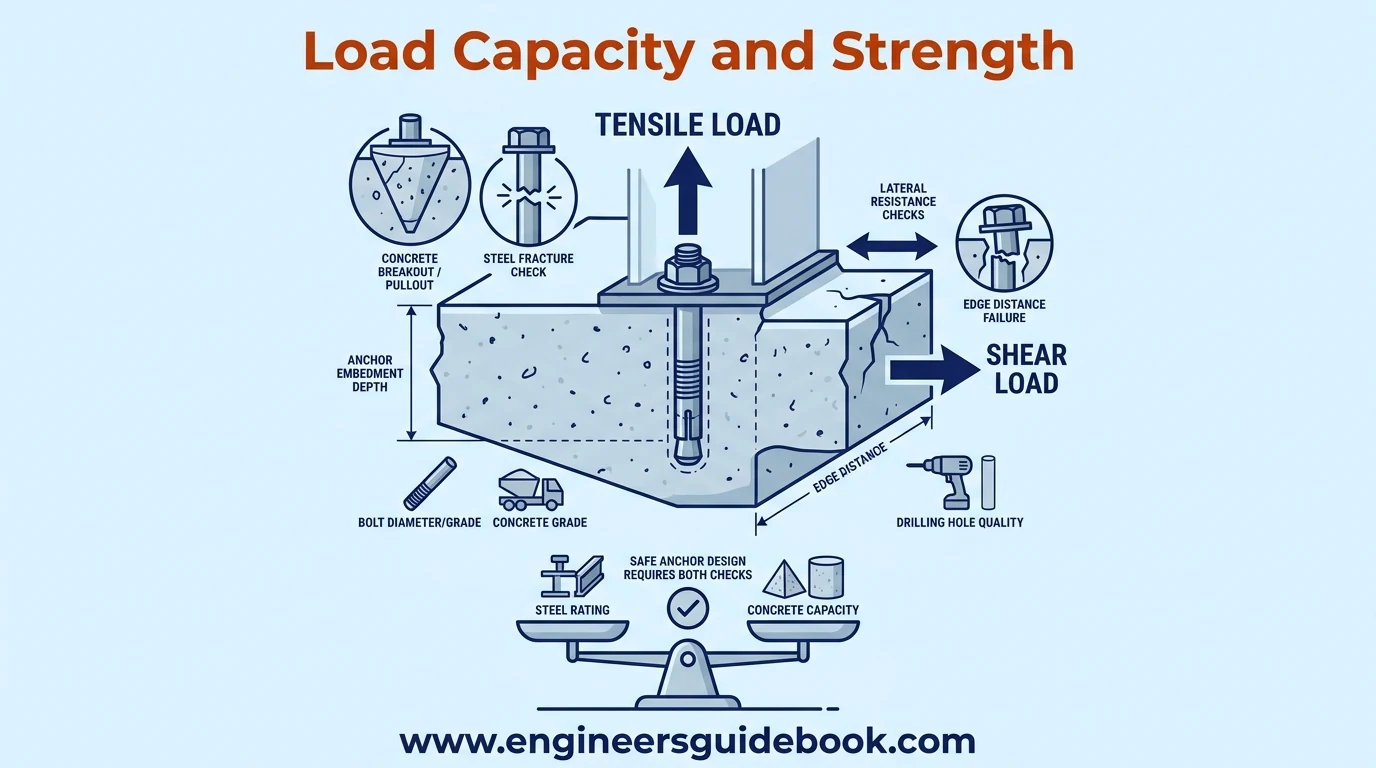
7.1 Tensile Strength
Tensile strength is the resistance of the anchor bolt against pulling force. It depends on steel grade, bolt diameter, thread area, embedment depth, and concrete strength.
In real installations, the bolt may not always fail in steel tension. Concrete breakout, pullout, or bond failure may occur first.
7.2 Shear Strength
Shear strength is the resistance against sideways force. It is important for column bases, brackets, frames, and equipment exposed to lateral loads.
Shear capacity depends on bolt area, material grade, base plate contact, edge distance, and concrete condition.
7.3 Pull Out Resistance
Pull out resistance describes the ability of the anchor to remain fixed inside the concrete under uplift load. It is controlled by embedment, anchor shape, bonding, expansion pressure, and concrete integrity.
Poor drilling, dust contamination, shallow embedment, or weak concrete can reduce pull out resistance significantly.
7.4 Load Calculation Basics
Anchor bolt load calculation begins by identifying tensile load, shear load, moment, vibration, spacing, edge distance, concrete strength, and safety factor. The selected bolt must satisfy both steel strength and concrete failure checks.
A safe anchor bolt design balances all these factors. The strongest bolt is not always the safest choice unless the surrounding concrete can support the load.
8. Installation Methods
8.1 Cast In Place Installation
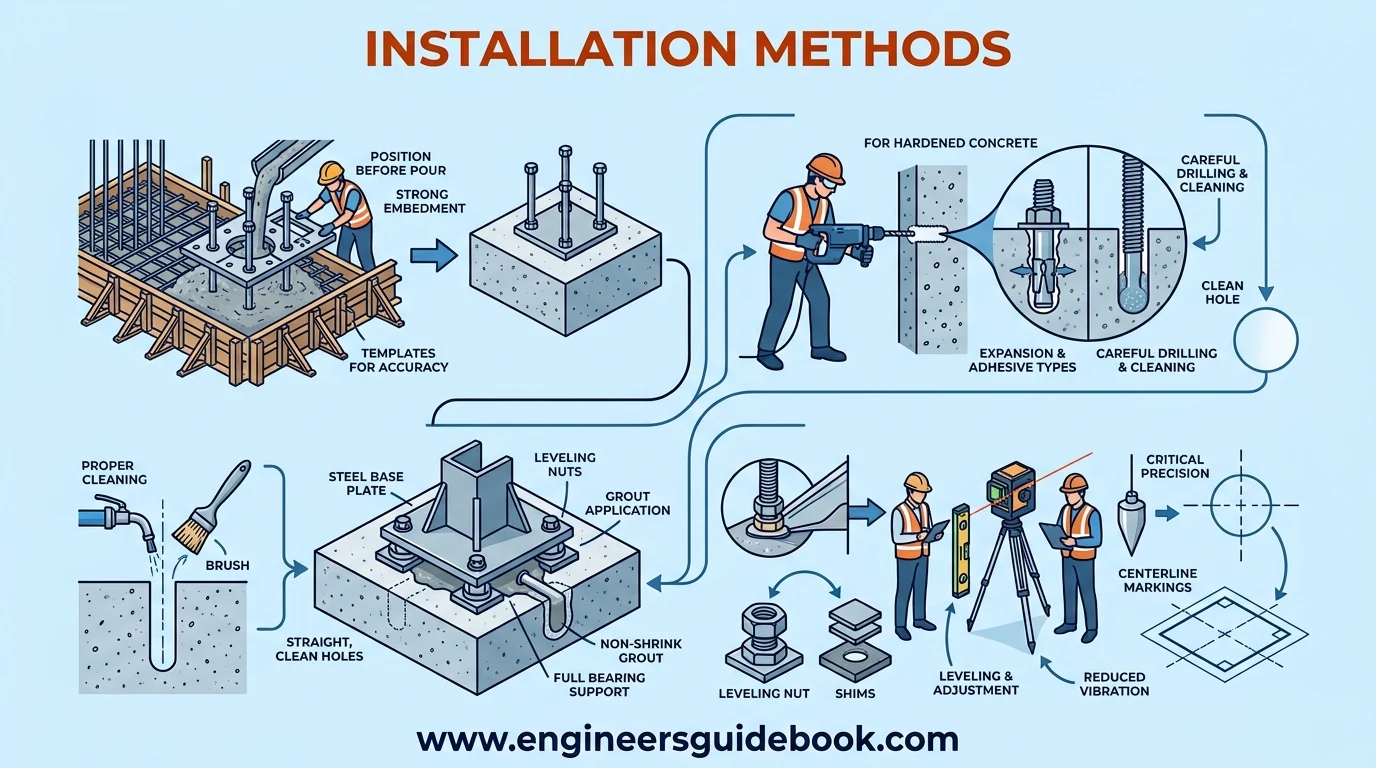
Cast in place installation is one of the most dependable methods for anchoring structural and mechanical components. In this method, anchor bolts are positioned inside the formwork before concrete is poured. Once the concrete cures, the embedded section becomes locked inside the hardened mass, creating a strong and durable connection.
Accuracy is essential. The bolt location, projection height, spacing, and verticality must match the base plate or equipment drawing. Templates are commonly used to keep bolts in their correct position during concrete placement. Even a small deviation can create difficulty during erection, especially when heavy steel columns or machine base frames are involved.
8.2 Post Installed Anchors
Post installed anchors are installed after the concrete has already hardened. They are commonly used for modifications, retrofitting, repair work, and installation of new fixtures on existing concrete surfaces. These anchors may work through expansion, undercutting, adhesive bonding, or mechanical interlock.
Expansion anchors, such as wedge anchors and sleeve anchors, grip the concrete by expanding inside the drilled hole. Adhesive anchors use chemical resin to bond the threaded rod or reinforcing bar to the concrete. Both systems can perform well when installed correctly.
8.3 Drilling and Grouting
Drilling and grouting are important steps in many post installed anchor systems. The drilled hole must be straight, clean, and sized according to the anchor manufacturer’s recommendation. A hole that is too shallow will reduce embedment. A hole that is too wide may weaken the holding capacity.
After drilling, the hole should be cleaned with compressed air, brushes, or vacuum equipment. This step is often underestimated, but it is vital. Concrete dust acts like a separating film between the anchor and the bonding material. In adhesive anchoring, poor cleaning can cause premature pullout.
8.4 Alignment Techniques
Alignment is a critical part of anchor bolt installation. Anchor bolts must match the base plate holes, equipment foundation plan, and erection tolerances. If bolts are misplaced, the installation can become slow, unsafe, and costly.
For cast in place bolts, steel templates, wooden templates, or fabricated jigs are used before concrete pouring. These templates maintain bolt spacing and prevent movement during vibration of concrete. For machinery foundations, centerline marking and elevation checks are equally important.
9. Applications of Anchor Bolts
9.1 Structural Steel Connections
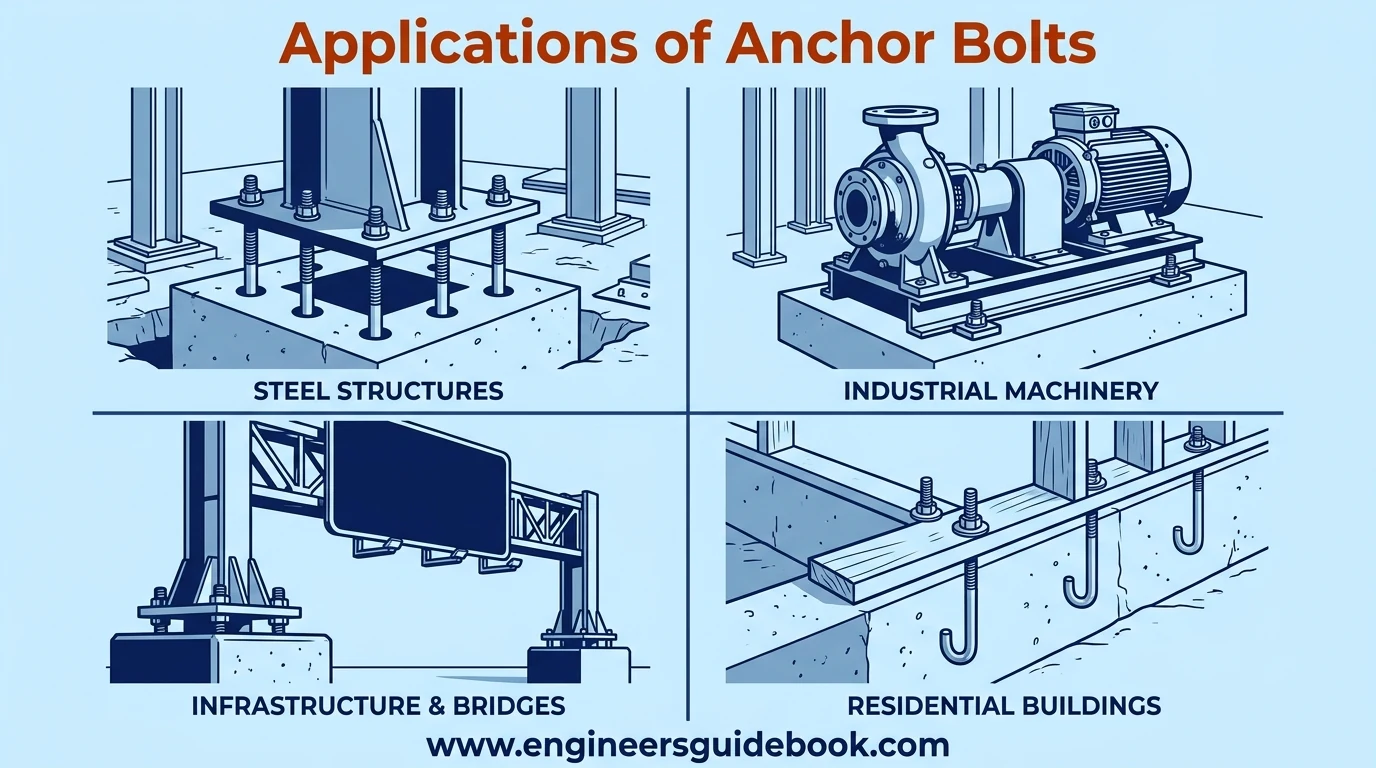
Anchor bolts are extensively used in structural steel connections. They secure steel columns, base plates, bracing frames, and support structures to concrete foundations. In a steel building, these bolts form the connection between the foundation and the superstructure.
Their role is not limited to holding steel in place. They resist uplift, shear, overturning moment, and lateral movement caused by wind, seismic forces, equipment loads, or thermal expansion. A properly designed anchor bolt group ensures that these forces transfer safely into the foundation.
9.2 Machinery Installation
Machinery installation is one of the most common industrial uses of anchor bolts. Pumps, compressors, fans, generators, gearboxes, conveyors, presses, and other equipment require firm anchorage to maintain stability during operation.
Rotating machinery creates dynamic forces. These forces may be small at first, but repeated vibration can loosen weak fasteners, crack grout, damage bearings, and disturb shaft alignment. Anchor bolts help control this movement by securing the machine base to the foundation.
For heavy machines, anchor bolts are often used with sole plates, base frames, leveling nuts, and non-shrink grout. This creates a rigid foundation system. The result is better alignment, lower vibration, and reduced maintenance.
9.3 Industrial Equipment Mounting
Industrial equipment mounting requires anchor bolts that can tolerate load, vibration, temperature variation, moisture, and chemical exposure. Equipment such as storage tanks, pressure vessel skids, pipe supports, platforms, ladders, and structural frames all rely on proper anchoring.
In process plants, anchor bolts may be exposed to oil, water, acidic vapors, alkaline chemicals, and outdoor weather. Material and coating selection become important in these environments. Galvanized, stainless steel, or epoxy-coated anchors may be used depending on site conditions.
9.4 Bridge and Infrastructure Use
Anchor bolts are used in bridges, highways, rail systems, tunnels, sign structures, guardrails, lighting poles, and utility supports. Infrastructure applications often face severe service conditions, including traffic vibration, weather exposure, freeze-thaw cycles, and cyclic loading.
In bridges, anchor bolts may secure bearing plates, expansion joint assemblies, railings, and support frames. In highway work, they hold light poles, sign gantries, and safety barriers. These installations must resist both static and dynamic forces.
9.5 Residential Construction
Anchor bolts are also used in residential construction. They connect wall plates, wooden frames, steel posts, railings, balconies, stairs, and light structural members to concrete foundations or masonry surfaces.
In many homes, anchor bolts secure the sill plate to the concrete foundation. This connection helps resist wind uplift and lateral movement. In earthquake-prone regions, proper anchorage improves the building’s resistance to seismic forces.
10. Design Standards and Codes
10.1 ASTM Standards
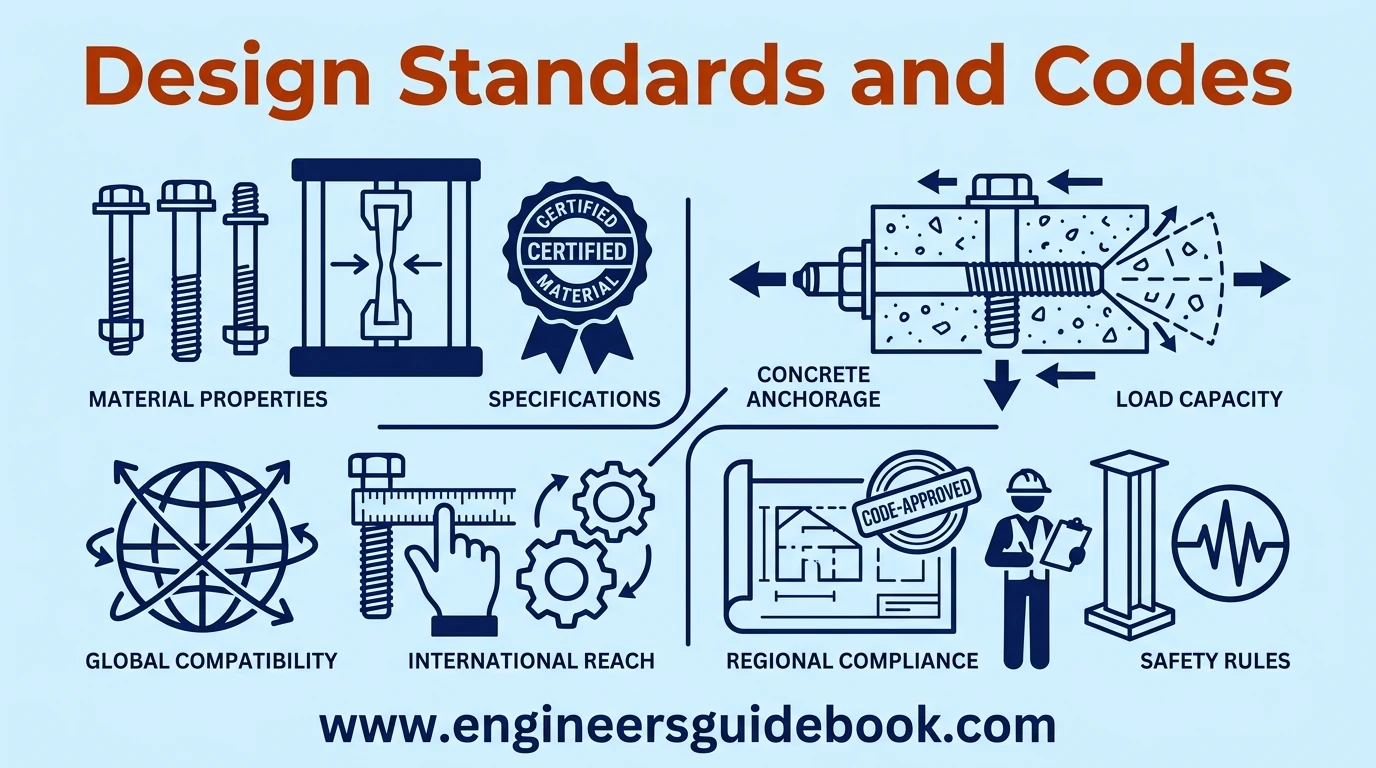
ASTM standards define material properties, grades, dimensions, testing methods, and manufacturing requirements for many anchor bolt products. Commonly specified anchor bolt materials include carbon steel, alloy steel, and stainless steel grades.
ASTM standards help ensure consistency. When an anchor bolt is ordered according to a recognized ASTM specification, engineers can verify its tensile strength, yield strength, chemical composition, and mechanical performance.
This is especially important in structural and industrial projects. Unverified bolts may look acceptable visually but fail to meet strength requirements. Certified material reduces uncertainty and supports quality assurance.
10.2 ACI Guidelines
ACI guidelines are widely used for concrete anchorage design. They address anchor behavior in concrete, including tension, shear, concrete breakout, pullout, pryout, edge distance, spacing, cracked concrete, and seismic conditions.
These guidelines are important because anchor bolt strength is not determined by steel alone. Concrete failure can occur before the bolt reaches its full tensile capacity. ACI-based design helps engineers check both steel strength and concrete capacity.
For critical structures, anchor design should include load combinations, safety factors, installation method, and concrete condition. This produces a safer and more predictable anchorage system.
10.3 ISO Standards
ISO standards provide international guidance for fastener dimensions, mechanical properties, thread forms, coatings, and testing practices. They are commonly used in projects where metric sizing and international procurement are involved.
ISO standards help maintain compatibility between bolts, nuts, washers, and tools. They also support global supply chains by creating uniform technical expectations.
For multinational projects, ISO standards reduce confusion between suppliers, contractors, and engineering teams. Clear specifications prevent mismatched threads, unsuitable materials, and installation delays.
10.4 Local Building Codes
Local building codes define the minimum legal and safety requirements for construction in a specific region. These codes may refer to international standards, national standards, seismic provisions, wind load rules, and inspection requirements.
Anchor bolts used in buildings must satisfy the applicable local code. This is especially important for structural columns, wall anchorage, equipment supports, and safety-critical installations.
11. Common Problems and Solutions
11.1 Misalignment Issues
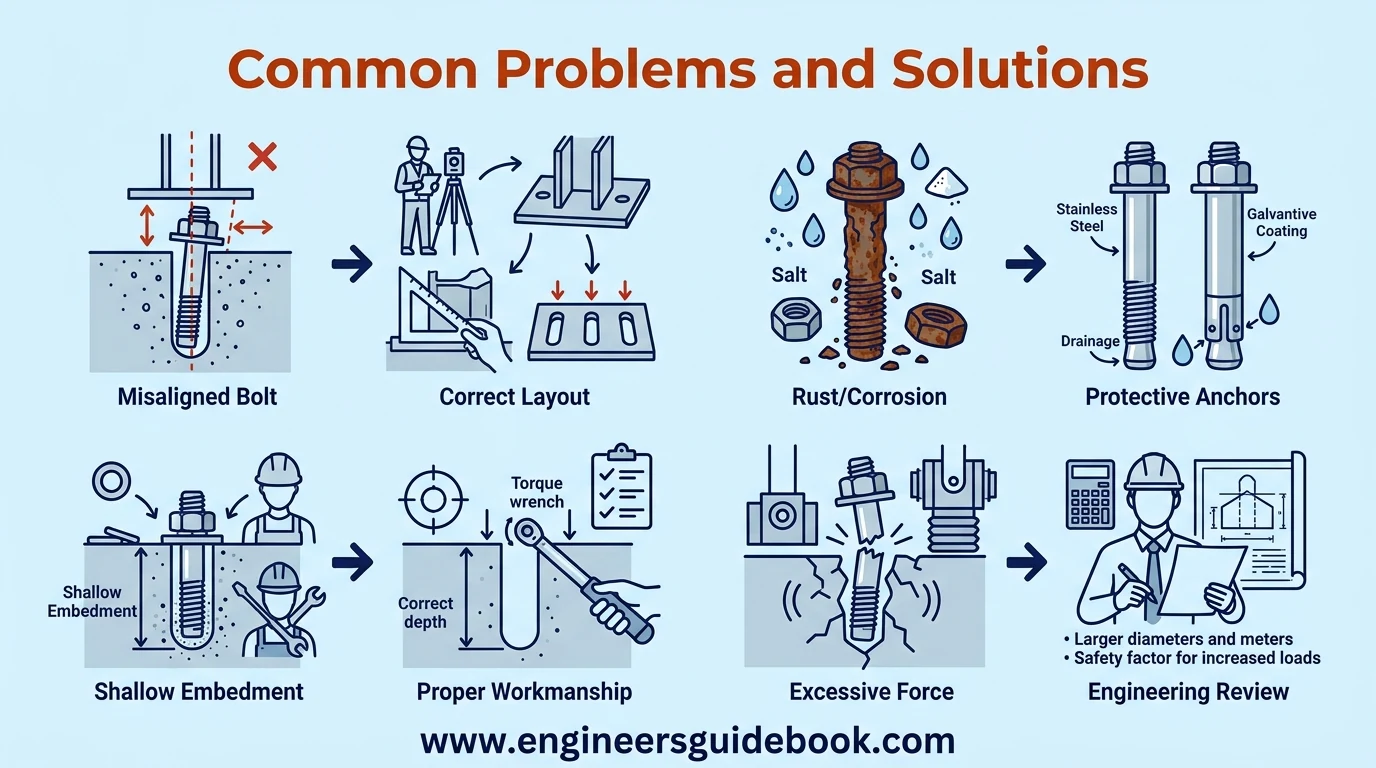
Misalignment is one of the most common anchor bolt problems. It occurs when bolts do not match the base plate hole pattern, centerline, elevation, or vertical position. This can delay installation and create unsafe field modifications.
The best solution is prevention. Templates, layout checks, survey verification, and pre-pour inspection should be used before concrete placement. For post installed anchors, accurate marking and drilling guides help reduce errors.
Minor misalignment may be corrected using slotted holes or approved plate modifications. Severe misalignment should be reviewed by an engineer. Cutting, bending, or forcing anchor bolts without approval can weaken the connection.
11.2 Corrosion Failures
Corrosion failures occur when anchor bolts are exposed to moisture, chemicals, salt, or aggressive atmospheres without proper protection. Rust reduces the bolt cross-section and damages threads, making tightening and inspection difficult.
The solution begins with correct material selection. Stainless steel, galvanized steel, epoxy-coated anchors, or other protective systems should be used in corrosive environments. Drainage and sealing details also help reduce exposure.
Regular inspection is necessary. Early signs such as rust staining, thread pitting, loose nuts, or cracked grout should be addressed before the anchor loses significant strength.
11.3 Improper Installation
Improper installation includes shallow embedment, poor hole cleaning, incorrect torque, wrong hole diameter, damaged threads, missing washers, and inadequate grout. These mistakes can reduce anchor capacity even when the bolt itself is strong.
The solution is controlled workmanship. Installers should follow manufacturer instructions, project specifications, and inspection checklists. For adhesive anchors, curing time and hole cleaning are particularly important.
Torque should be applied with suitable tools. Over-tightening can damage threads or concrete. Under-tightening can allow movement. Both conditions are problematic.
11.4 Overloading Risks
Overloading occurs when the applied force exceeds the anchor bolt’s design capacity. This may happen due to wrong sizing, unexpected vibration, increased equipment load, impact forces, or structural changes.
The solution is proper engineering review. Anchor bolts should be checked for tensile load, shear load, combined loading, edge distance, spacing, concrete strength, and safety factor.
12. FAQs
12.1 What is an anchor bolt used for?
An anchor bolt is used to fasten structures, machines, frames, columns, supports, and fixtures to concrete or masonry. It provides resistance against uplift, shear, vibration, and movement. Common uses include steel column bases, machinery foundations, railings, sign posts, platforms, and residential wall plates.
12.2 How do you choose the right anchor bolt size?
The right anchor bolt size is selected by considering load, bolt diameter, embedment depth, concrete strength, edge distance, spacing, base plate thickness, and environmental exposure. Heavy loads usually require larger diameters and deeper embedment. Final selection should follow engineering calculations and applicable standards.
12.3 What is the difference between wedge anchor and sleeve anchor?
A wedge anchor is mainly used in solid concrete and provides high holding strength through an expansion clip. A sleeve anchor has an expanding sleeve and can be used in concrete, brick, and masonry. Wedge anchors are generally stronger for heavy-duty concrete applications, while sleeve anchors are more versatile for medium-duty fastening.
12.4 How deep should anchor bolts be embedded?
Anchor bolt embedment depth depends on bolt size, load requirement, concrete strength, anchor type, and design standard. Deeper embedment generally improves holding capacity, but it must be combined with proper spacing and edge distance. Manufacturer data or engineering calculations should always be followed for critical installations.
12.5 Can anchor bolts be reused?
Cast in place anchor bolts are usually not reusable because they are permanently embedded in concrete. Some removable mechanical anchors may be reused only if the manufacturer permits it and the bolt is undamaged. In safety-critical applications, reusing anchor bolts is generally avoided unless inspected and approved.
12.6 What causes anchor bolt failure?
Anchor bolt failure can be caused by overload, corrosion, poor installation, shallow embedment, weak concrete, wrong bolt grade, insufficient edge distance, vibration, fatigue, or damaged threads. Many failures are preventable through correct design, proper installation, suitable coating, and routine inspection.
13. Conclusion
Anchor bolts are essential fastening components used to secure structures, equipment, and fixtures to concrete or masonry. Their performance depends on type, size, material, coating, embedment, installation quality, and load condition.
They may appear simple, but their engineering role is substantial. A small anchor bolt can carry critical tensile, shear, and vibration loads in a structure or machine foundation.