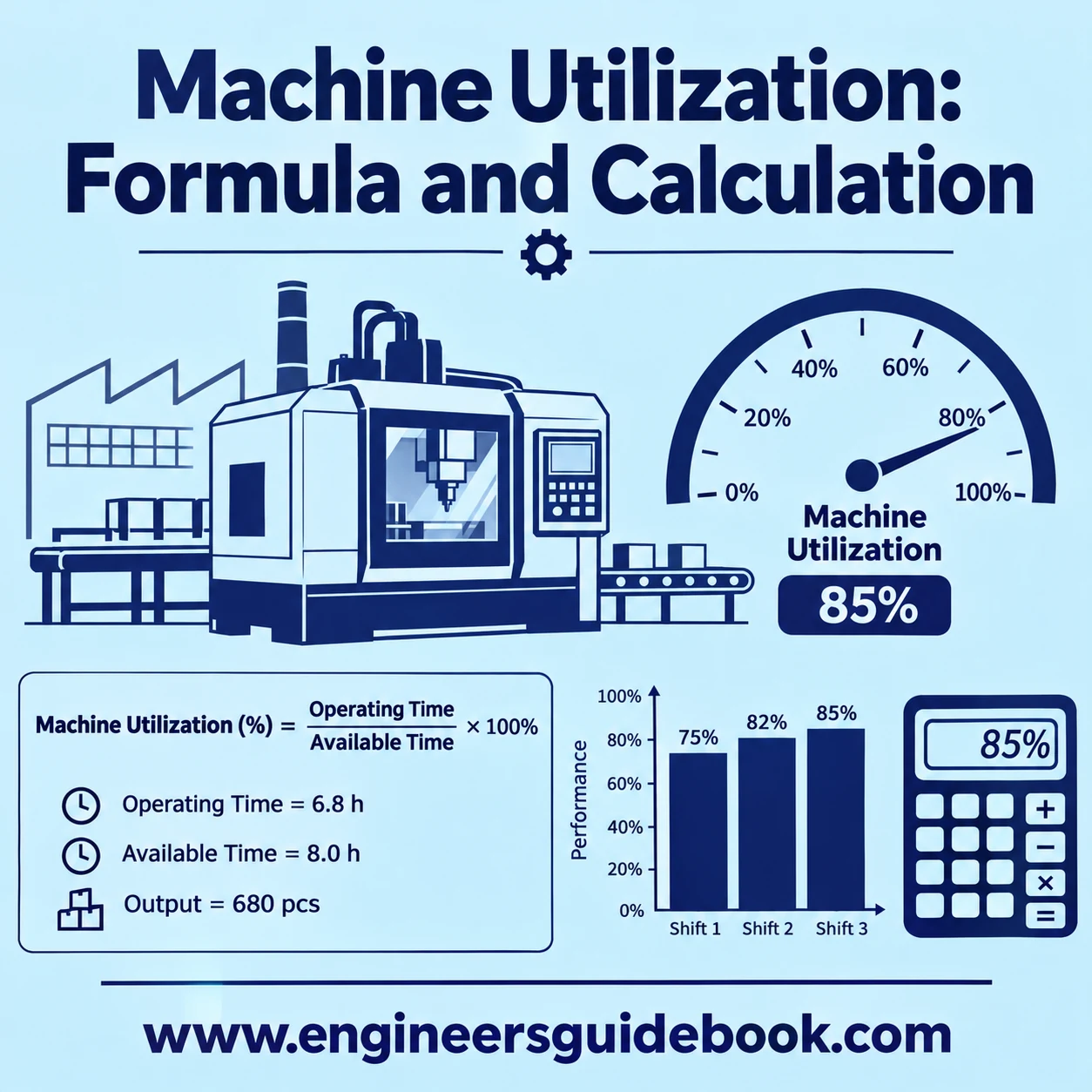
Machine utilization measures the percentage of available time that equipment spends operating. The machine utilization formula is (Actual Machine Operating Time ÷ Total Available Machine Time) × 100. For example, if a machine operates for 6 hours during an 8-hour shift, its utilization is 75%. This metric helps manufacturers identify idle capacity and improve equipment usage.
1. Introduction to Machine Utilization
1.1 What Is Machine Utilization?
Machine utilization is a manufacturing performance metric that measures how effectively equipment operating time is used within a defined period. Expressed as a percentage, it indicates the proportion of available time during which a machine remains operational.
1.2 Importance of Machine Utilization in Manufacturing
Manufacturing organizations invest substantial capital in machinery, infrastructure, and supporting utilities. Poor machine utilization can increase production costs per unit and reduce the return on capital investment. Monitoring utilization helps manufacturers extract greater value from existing assets.
1.3 Objectives of Measuring Machine Utilization
The primary objectives include identifying equipment idle time, improving production scheduling, maximizing asset usage, and discovering underutilized manufacturing resources. Utilization data also supports equipment procurement and capacity expansion decisions.
1.4 Role of Machine Utilization in Operational Excellence
Machine utilization provides visibility into operational inefficiencies. When combined with lean manufacturing, maintenance optimization, and continuous improvement methodologies, it helps organizations establish more reliable and economically sustainable production systems.

2. Understanding Machine Utilization
2.1 Basic Principles of Machine Utilization
Machine utilization compares actual operating time against a predefined time allowance. Accurate measurement requires consistent operating-time definitions, reliable production records, and clearly established reporting periods.
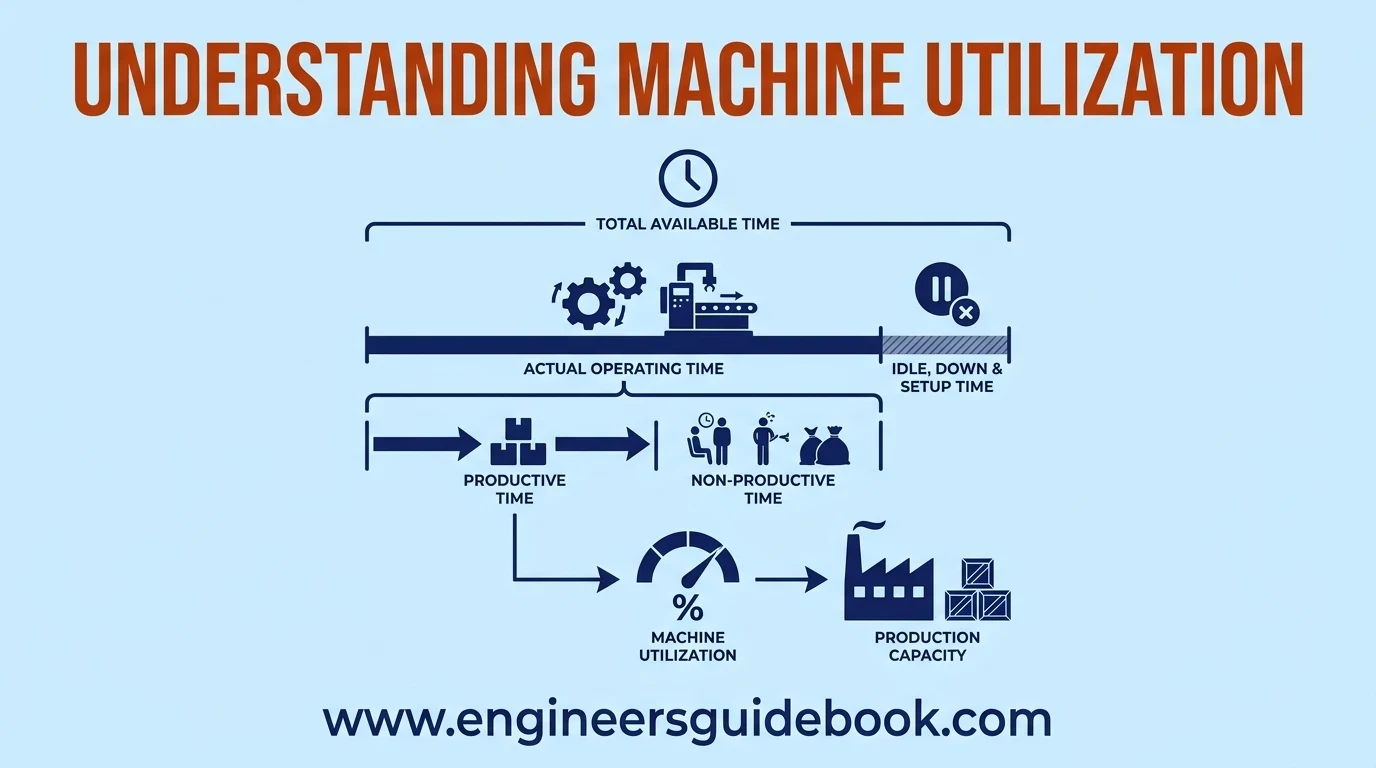
2.2 Actual Machine Operating Time
Actual machine operating time represents the duration during which equipment actively performs its intended manufacturing function. It generally excludes breakdowns, idle periods, and stopped-machine activities according to the established measurement methodology.
2.3 Total Available Machine Time
Total available machine time refers to the reference period during which equipment could potentially operate under the selected scheduling basis. This period may represent scheduled shifts, daily operating windows, or total calendar hours.
2.4 Productive and Nonproductive Machine Time
Productive machine time involves activities that contribute directly to manufacturing output. Nonproductive time includes equipment stoppages, material shortages, unnecessary waiting, and certain setup activities. Some operating time may also produce defective products, making utilization distinct from quality performance.
2.5 Relationship Between Machine Utilization and Production Capacity
Higher machine utilization generally increases the opportunity to produce additional units. However, actual production capacity also depends on operating speed, product quality, equipment reliability, and downstream process limitations.
3. Machine Utilization Formula
3.1 Standard Machine Utilization Formula
The standard time-based machine utilization formula is:
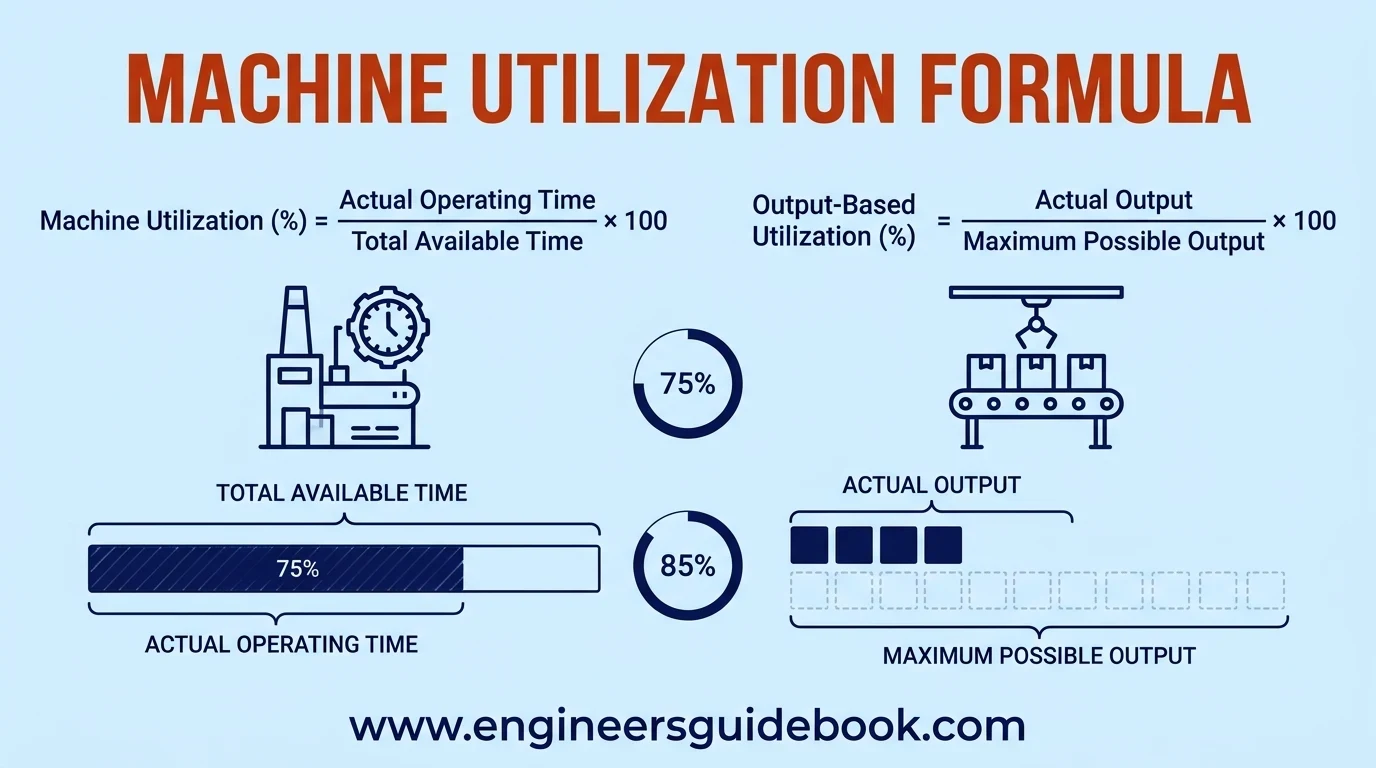
Machine Utilization (%) = (Actual Operating Time / Total Available Time) × 100
This equation provides a straightforward method for evaluating equipment usage across different reporting periods.
3.2 Understanding the Formula Components
The machine utilization equation contains three essential components:
Actual operating time: Total duration of machine operation.
Total available time: Reference time available for equipment usage.
100: Conversion factor that expresses the result as a percentage.
Both time values must use identical measurement units.
3.3 Scheduled Time and Calendar Time
Scheduled time represents designated production hours, whereas calendar time includes all hours within a reporting period. A machine operating six hours during an eight-hour shift achieves 75% scheduled-time utilization but only 25% daily calendar-time utilization.
3.4 Machine Utilization Based on Operating Hours
Operating-hour utilization uses recorded machine running hours to evaluate equipment usage.
For a machine operating 120 hours out of 160 scheduled hours:
Machine Utilization = (120 / 160) × 100 = 75%
3.5 Machine Utilization Based on Production Output
An alternative output-based utilization measure compares actual production with maximum production capacity.
Output-Based Utilization (%) = (Actual Output / Maximum Possible Output) × 100
This approach incorporates output-related limitations and should not be confused with time-based machine utilization.
3.6 Machine Utilization Percentage Calculation
A utilization percentage represents the proportion of the reference period consumed by machine operation. For example, 85% utilization indicates that equipment operated during 85% of its defined available time.
4. How to Calculate Machine Utilization
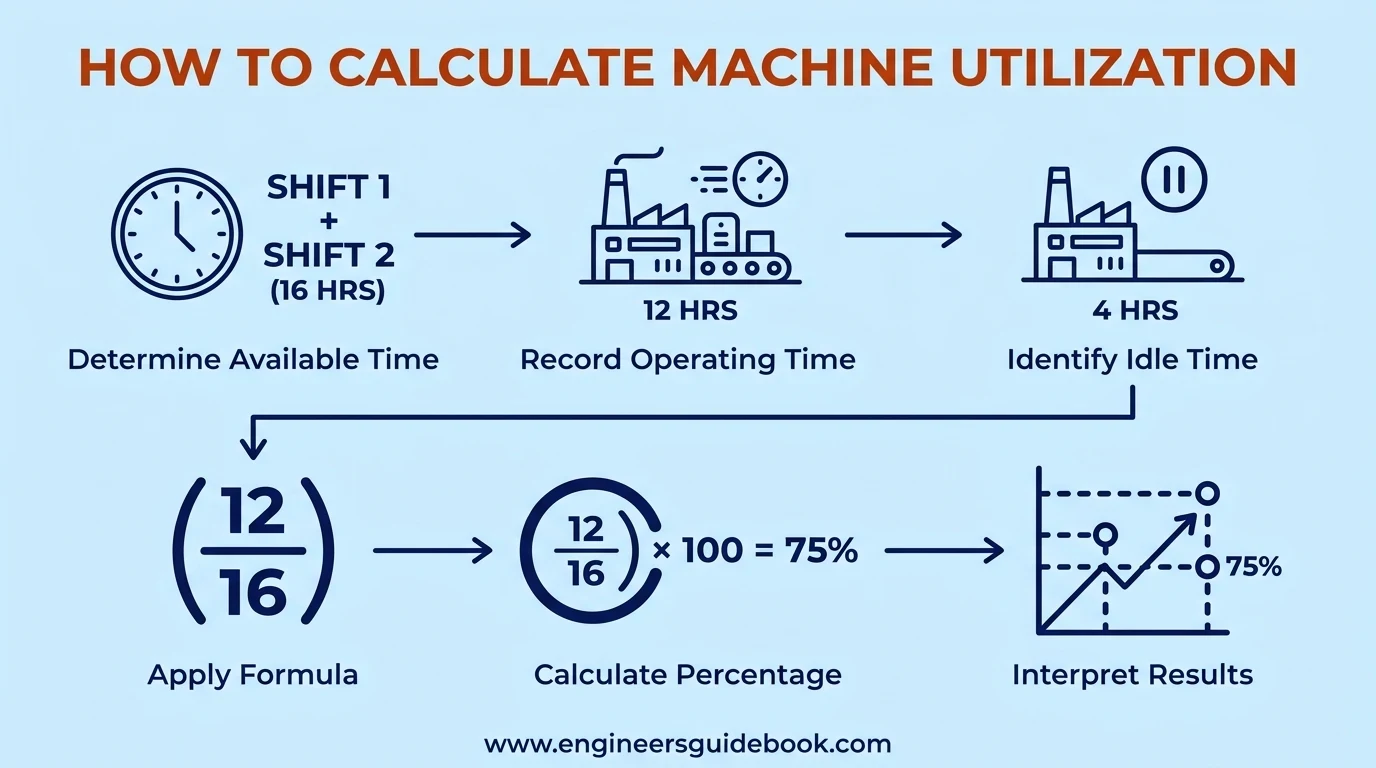
4.1 Step 1 – Determine Total Available Machine Time
Establish the reporting period and its corresponding time allowance. For example, equipment scheduled for two eight-hour shifts has 16 hours of scheduled machine time per day.
4.2 Step 2 – Record Actual Machine Operating Time
Collect equipment running hours using machine counters, programmable logic controllers, operator logbooks, or automated monitoring systems. Exclude stopped-machine periods according to the established measurement criteria.
4.3 Step 3 – Identify Machine Idle Time
Identify periods during which equipment remains inactive. Categorizing stoppages by their underlying causes helps distinguish maintenance-related losses from scheduling, material supply, and operational problems.
4.4 Step 4 – Apply the Machine Utilization Formula
Insert the recorded operating time and available time into the utilization equation. If equipment operates for 12 hours during a 16-hour schedule, divide 12 by 16.
4.5 Step 5 – Calculate the Utilization Percentage
Multiply the resulting decimal value by 100.
Machine Utilization = (12 / 16) × 100 = 75%
The machine utilized three-quarters of its scheduled time.
4.6 Step 6 – Interpret the Calculation Results
Compare the calculated percentage against historical performance, production requirements, and established targets. Investigate significant deviations to identify operational constraints rather than assuming every idle period represents avoidable waste.
5. Machine Utilization Calculation Examples
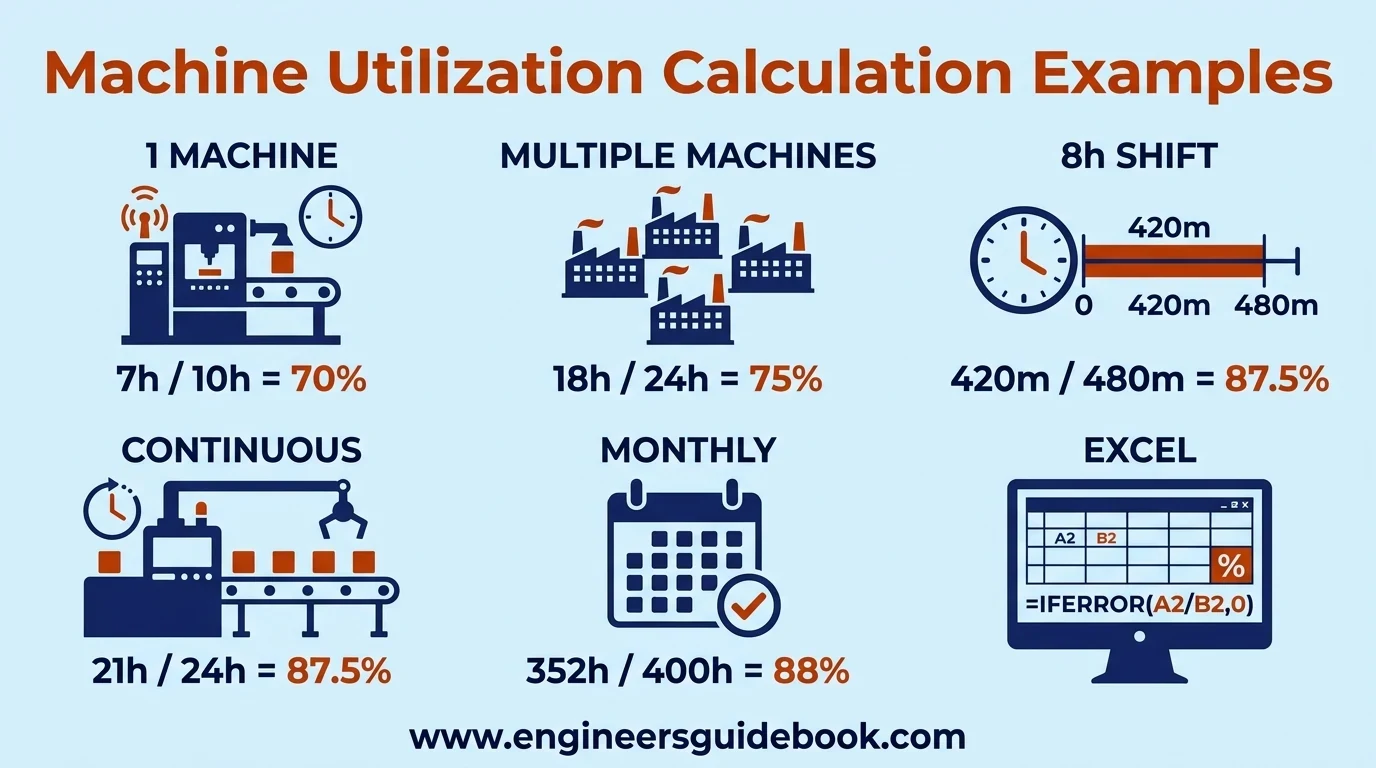
5.1 Machine Utilization Calculation for a Single Machine
A CNC machine operates for seven hours during a ten-hour production schedule.
Machine Utilization = (7 / 10) × 100 = 70%
The remaining three hours represent nonoperating time within the selected schedule.
5.2 Machine Utilization Calculation for Multiple Machines
Consider three machines operating for six, seven, and five hours, respectively, during individual eight-hour shifts.
Total operating time = 18 hours.
Total available time = 24 hours.
Combined Machine Utilization = (18 / 24) × 100 = 75%
5.3 Machine Utilization Calculation for an Eight-Hour Shift
A packaging machine operates for 420 minutes during a 480-minute shift.
Machine Utilization = (420 / 480) × 100 = 87.5%
The equipment remains nonoperational for 60 minutes.
5.4 Machine Utilization Calculation for a Continuous Production Line
A continuous production line operates for 21 hours during a 24-hour reporting period.
Machine Utilization = (21 / 24) × 100 = 87.5%
Analyzing individual machines can reveal additional equipment-specific constraints.
5.5 Monthly Machine Utilization Calculation
A manufacturing machine records 352 operating hours against 400 scheduled hours during a month.
Monthly Machine Utilization = (352 / 400) × 100 = 88%
Monthly measurements facilitate long-term performance evaluation.
5.6 Machine Utilization Calculation Using Excel
Enter actual operating hours in cell A2 and available hours in cell B2. Use the following Excel formula:
=IFERROR(A2/B2,0)
Format the result as a percentage. This method simplifies daily, weekly, and monthly utilization reporting.
6. Machine Utilization vs Other Manufacturing KPIs
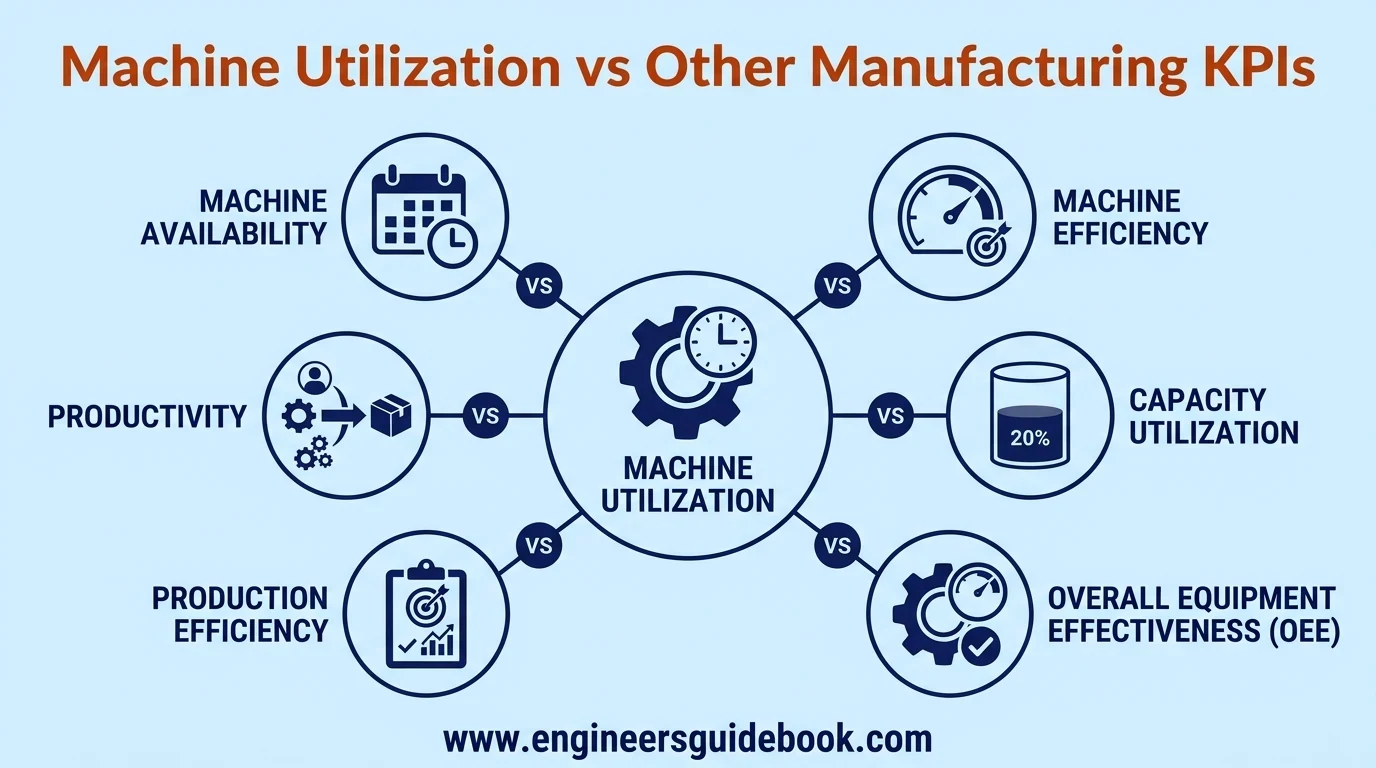
6.1 Machine Utilization vs Machine Availability
Machine availability measures equipment readiness or running time relative to a defined planned operating period. Utilization measures actual usage relative to a selected time allowance. These metrics can produce identical results when their measurement boundaries are identical.
6.2 Machine Utilization vs Machine Efficiency
Utilization indicates how frequently equipment operates. Machine efficiency evaluates how effectively equipment performs against an established operating standard. A highly utilized machine can still operate inefficiently.
6.3 Machine Utilization vs Capacity Utilization
Machine utilization primarily evaluates equipment operating time. Capacity utilization measures actual production output against potential production capacity, typically at machine, department, or facility level.
6.4 Machine Utilization vs Overall Equipment Effectiveness
Overall Equipment Effectiveness (OEE) evaluates availability, performance, and quality.
OEE = Availability × Performance × Quality
Unlike time-based machine utilization, OEE accounts for reduced operating speed and defective production.
6.5 Machine Utilization vs Production Efficiency
Production efficiency evaluates manufacturing output against expected or standard output under defined conditions. Machine utilization focuses primarily on equipment operating duration, irrespective of whether production meets its output targets.
6.6 Machine Utilization vs Productivity
Productivity measures the relationship between output and consumed resources, including labor, materials, energy, and time. Machine utilization evaluates equipment usage without necessarily measuring resource conversion effectiveness.
7. Machine Utilization Benchmarks and Performance Levels
7.1 What Is a Good Machine Utilization Rate?
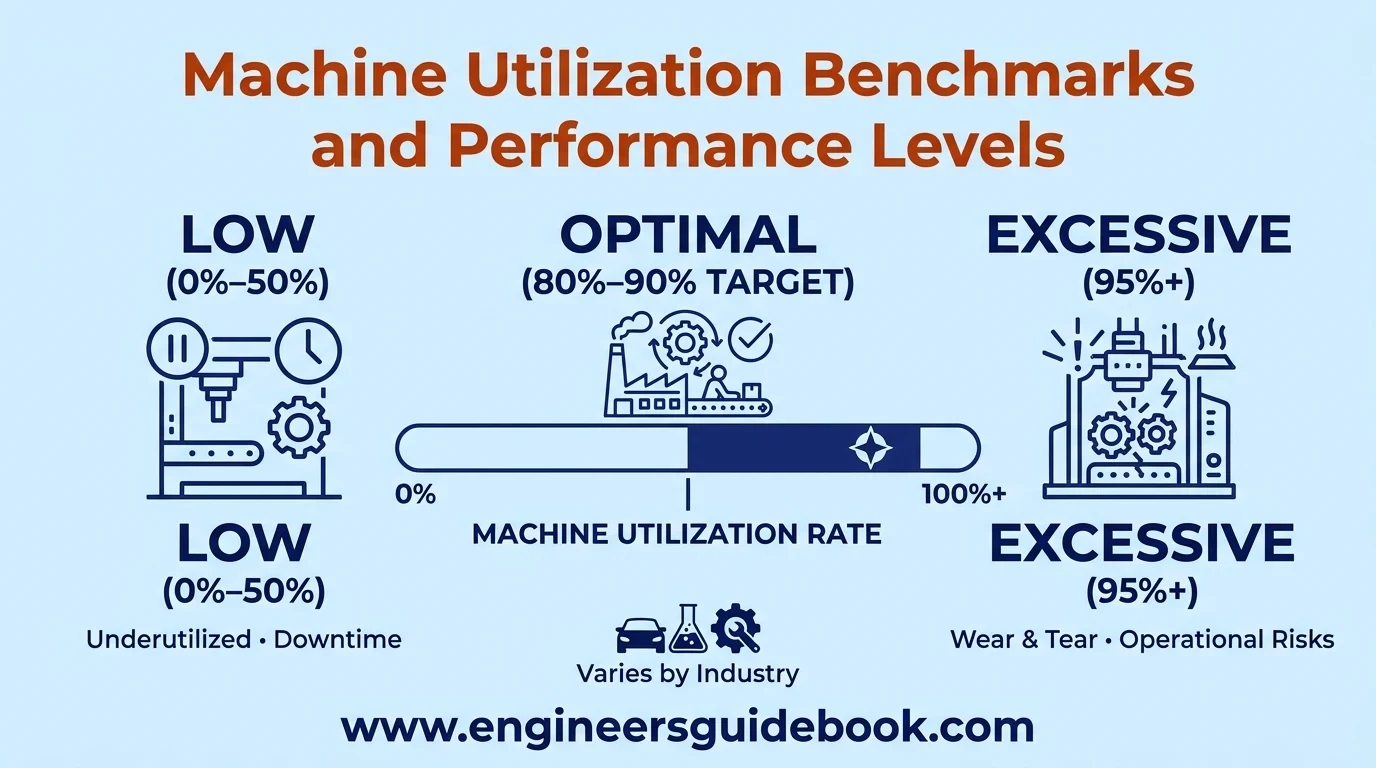
A good machine utilization rate depends on manufacturing processes, demand variability, equipment characteristics, and maintenance requirements. A scheduled-time utilization target of 80% to 90% may be appropriate for certain operations, but no universal benchmark exists.
7.2 Understanding Low Machine Utilization
Low utilization may indicate excessive downtime, inadequate production demand, inefficient scheduling, or surplus manufacturing capacity. Root cause analysis helps determine whether corrective action is economically justified.
7.3 Understanding High Machine Utilization
High utilization indicates frequent equipment operation relative to available time. Nevertheless, it does not guarantee profitable production, satisfactory product quality, or optimal equipment performance.
7.4 Machine Utilization Benchmarks Across Industries
Continuous chemical processing, automotive manufacturing, packaging, and intermittent fabrication operations have different utilization requirements. Comparisons should account for production models, demand patterns, equipment constraints, and consistent measurement methodologies.
7.5 Setting Realistic Machine Utilization Targets
Establish utilization targets using historical operating data, customer demand, maintenance schedules, and process capability. Periodically reassess these targets to accommodate changing manufacturing conditions without compromising equipment reliability.
7.6 Risks of Excessive Machine Utilization
Operating equipment near maximum utilization can accelerate component deterioration, restrict maintenance opportunities, increase production queues, and reduce operational flexibility. Sustainable utilization balances manufacturing throughput with asset integrity, customer requirements, and long-term operational resilience.
8. Factors Affecting Machine Utilization
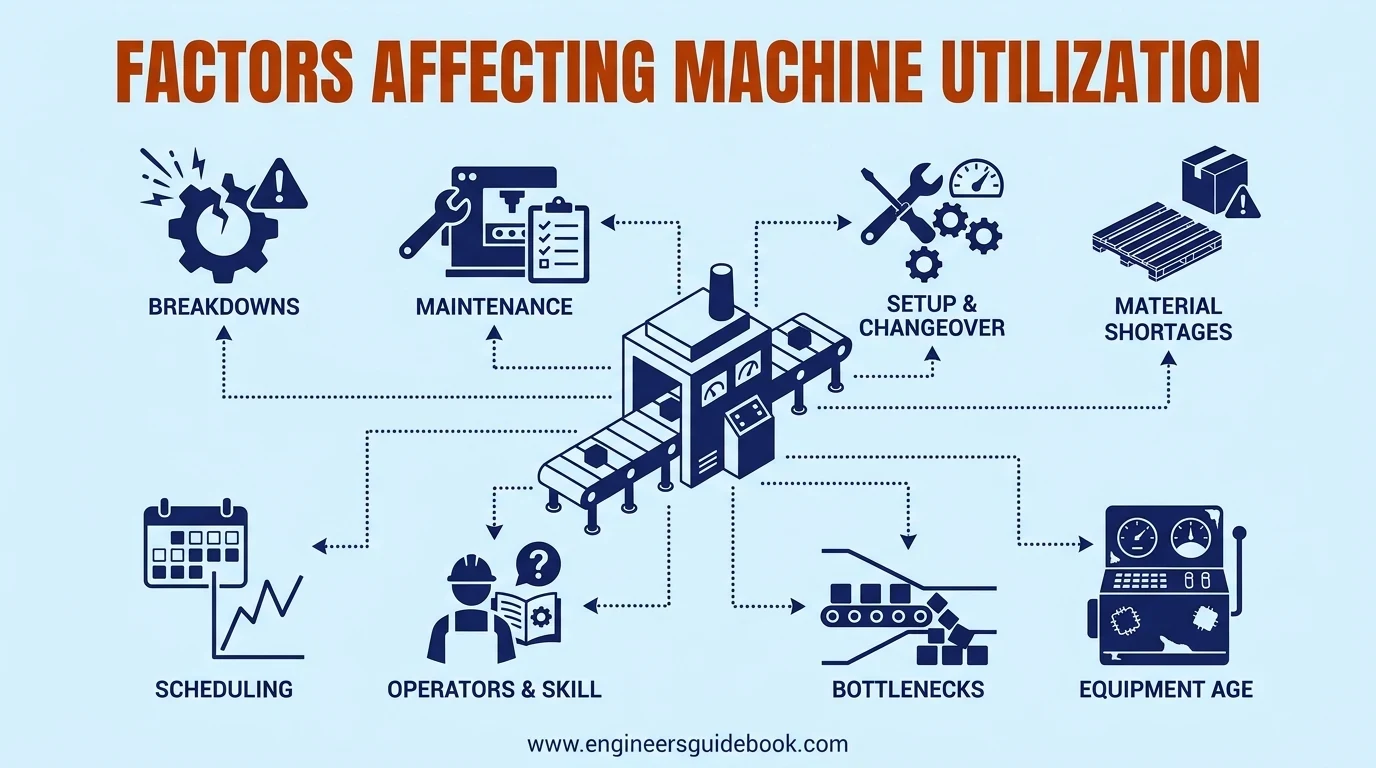
8.1 Equipment Breakdowns and Unplanned Downtime
Unexpected mechanical failures, electrical faults, and instrumentation malfunctions interrupt manufacturing operations. Frequent breakdowns reduce actual operating hours and undermine production schedules. Effective maintenance management and systematic failure analysis help mitigate these utilization losses.
8.2 Preventive Maintenance and Scheduled Shutdowns
Preventive maintenance requires periodic equipment stoppages for inspection, lubrication, servicing, and component replacement. Although these activities temporarily restrict machine operation, they improve long-term reliability and minimize the likelihood of prolonged corrective maintenance.
8.3 Machine Setup and Changeover Time
Product changeovers, tooling adjustments, equipment cleaning, and parameter configuration consume valuable manufacturing time. Excessive changeover duration reduces operating opportunities, particularly in manufacturing environments characterized by frequent product variations and small production batches.
8.4 Raw Material Shortages
Insufficient raw material availability can leave fully functional machinery idle. Inefficient procurement, inventory discrepancies, and supplier disruptions contribute to these stoppages. Effective inventory management and material requirements planning help maintain uninterrupted production.
8.5 Production Scheduling and Demand Fluctuations
Poor production scheduling creates unnecessary operational gaps. Similarly, fluctuating customer demand can result in equipment underutilization during slower periods. Demand forecasting and adaptable production schedules improve the synchronization of manufacturing activities.
8.6 Operator Availability and Skill Levels
Equipment utilization depends partly on the availability of competent personnel. Inadequate staffing, insufficient technical knowledge, and operational mistakes can prolong machine stoppages. Cross-training helps organizations maintain production continuity during personnel shortages.
8.7 Production Bottlenecks and Process Inefficiencies
Manufacturing bottlenecks restrict material movement between interconnected processes. Upstream equipment may remain idle when downstream machinery cannot accommodate additional output. Identifying process constraints is essential for improving overall manufacturing throughput.
8.8 Equipment Age and Technological Limitations
Aging machinery often experiences increased component deterioration, maintenance requirements, and operational inconsistencies. Obsolete control systems and limited automation capabilities can further restrict utilization. Strategic refurbishment or equipment replacement may become economically advantageous.
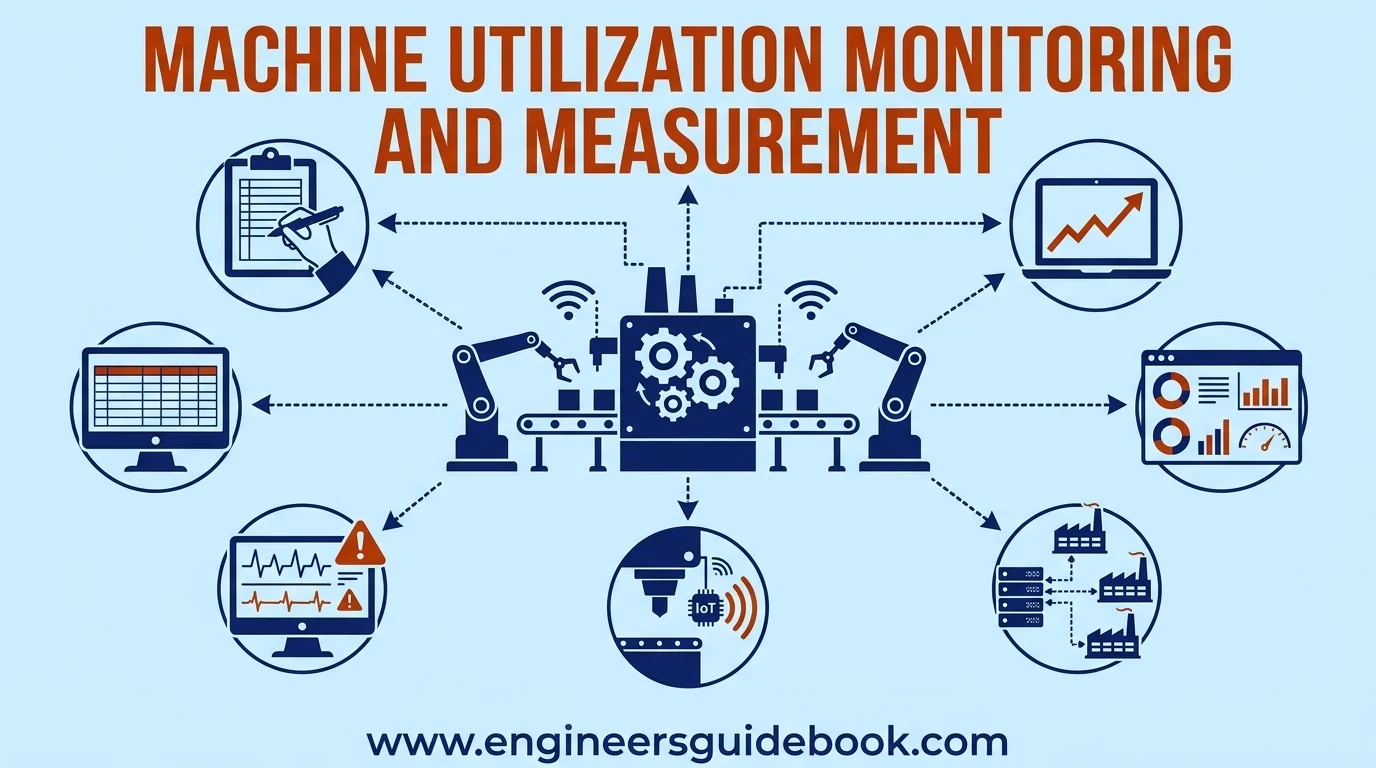
9. Machine Utilization Monitoring and Measurement
9.1 Manual Machine Operating Time Records
Manual monitoring involves documenting machine start times, stop times, breakdowns, and operating hours in production logbooks. Although inexpensive, this approach requires disciplined recordkeeping and remains susceptible to human error.
9.2 Machine Utilization Tracking Sheets
Spreadsheet-based tracking sheets consolidate scheduled hours, operating hours, downtime categories, and utilization percentages. These documents facilitate periodic performance comparisons and provide an accessible monitoring solution for smaller manufacturing facilities.
9.3 Real-Time Machine Monitoring Systems
Real-time monitoring systems automatically identify equipment operating conditions and stoppages. Immediate visibility enables production supervisors to investigate abnormal machine inactivity, coordinate maintenance interventions, and reduce unnecessary response delays.
9.4 Machine Utilization Through IoT Sensors
Industrial Internet of Things sensors collect information such as electrical current, vibration, rotational speed, and equipment operating status. These measurements can support automated utilization calculations and provide additional insights into machinery behavior.
9.5 Manufacturing Execution Systems
Manufacturing Execution Systems integrate production orders, equipment status, material movement, and operational performance data. Their centralized architecture improves production traceability and enables more consistent utilization measurement across manufacturing departments.
9.6 Machine Utilization Dashboards and Reporting
Interactive dashboards present utilization percentages, downtime classifications, equipment comparisons, and historical trends. Visual representations simplify performance evaluation and help management prioritize corrective actions based on measurable operational losses.
9.7 Machine Utilization Trend Analysis
Trend analysis identifies recurring utilization patterns over extended reporting periods. Comparing daily, weekly, and monthly results helps distinguish isolated equipment incidents from persistent operational deficiencies requiring systematic intervention.
10. How to Improve Machine Utilization
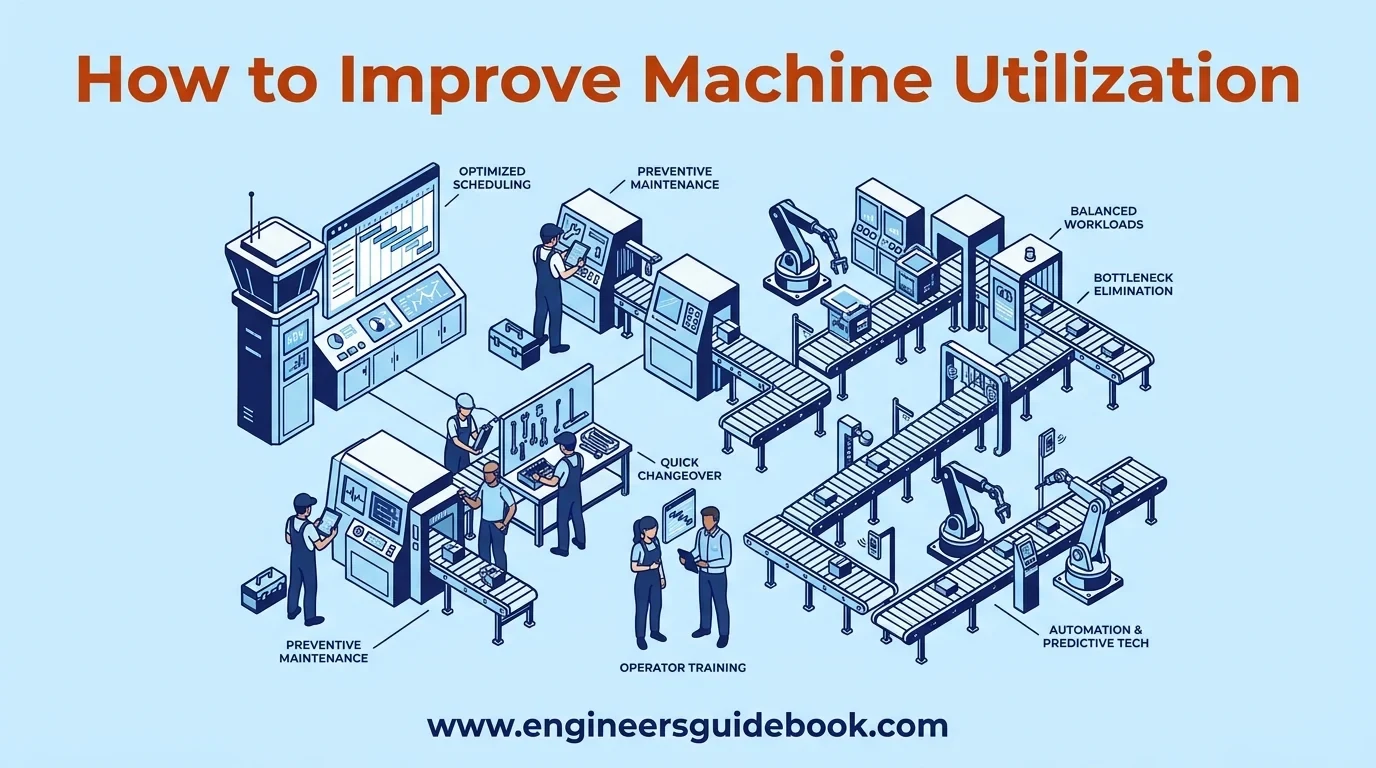
10.1 Implementing Effective Preventive Maintenance
Develop preventive maintenance schedules based on equipment criticality, manufacturer recommendations, and operating conditions. Regular inspections and timely component replacement reduce unexpected failures while preserving equipment integrity.
10.2 Reducing Equipment Breakdown Time
Root cause analysis, spare parts availability, and standardized troubleshooting procedures help shorten equipment breakdown duration. Monitoring Mean Time to Repair (MTTR) also helps evaluate maintenance responsiveness.
10.3 Optimizing Production Scheduling
Align production schedules with customer demand, material availability, equipment capacity, and workforce requirements. Effective sequencing minimizes unnecessary waiting periods and improves coordination between interconnected manufacturing operations.
10.4 Minimizing Setup and Changeover Time
Single-Minute Exchange of Die (SMED) principles help reduce changeover duration by separating internal and external setup activities. Standardized tooling arrangements and advance preparation further minimize machine inactivity.
10.5 Eliminating Production Bottlenecks
Identify manufacturing constraints through cycle time measurements, production flow analysis, and work-in-progress observations. Improving bottleneck capacity can reduce upstream congestion and downstream material starvation.
10.6 Improving Operator Training and Performance
Provide operators with comprehensive training in machine operation, troubleshooting, equipment inspection, and standardized procedures. Competent personnel recognize abnormal operating conditions earlier and minimize avoidable production interruptions.
10.7 Implementing Lean Manufacturing Practices
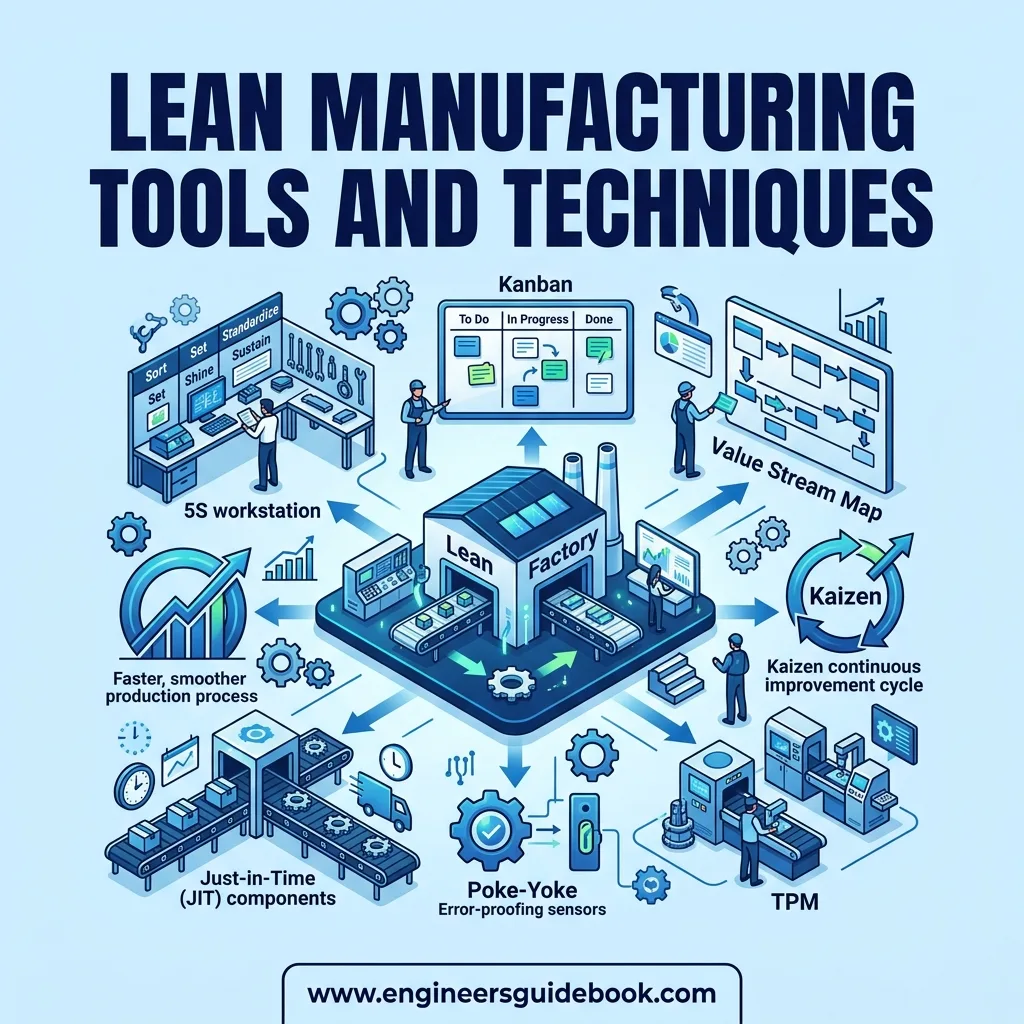
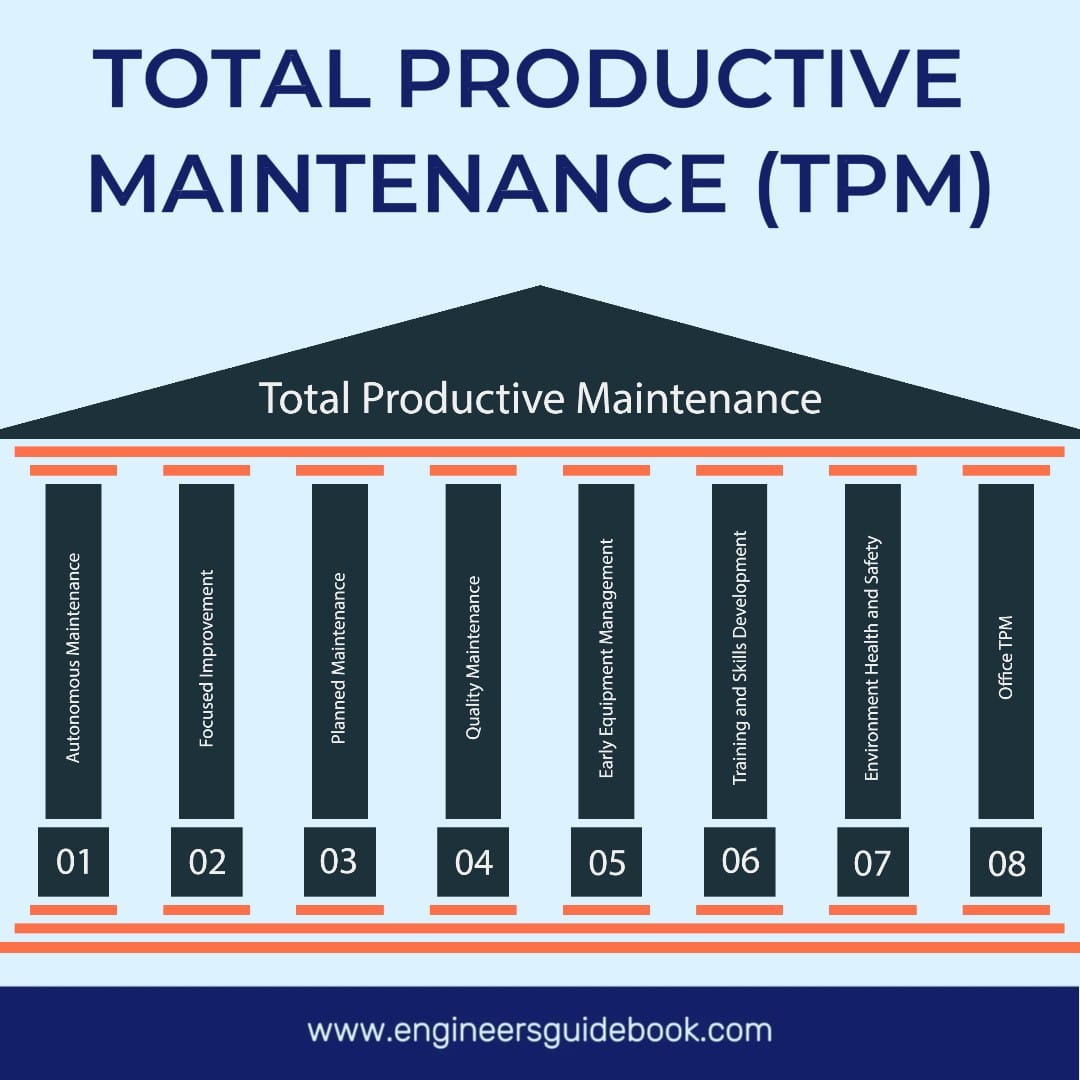
Lean manufacturing methodologies eliminate non-value-adding activities and streamline production workflows. Techniques such as 5S, Kaizen, Total Productive Maintenance, and value stream mapping support sustainable utilization improvements.
10.8 Using Automation and Predictive Maintenance
Automation reduces repetitive manual interventions, while predictive maintenance detects developing equipment abnormalities. Condition monitoring technologies allow maintenance teams to schedule interventions before equipment deterioration causes unexpected operational interruptions.
10.9 Balancing Machine Workloads
Distribute manufacturing activities according to equipment capability, process requirements, and production priorities. Balanced workloads help prevent individual machine overloading while reducing unnecessary inactivity across parallel manufacturing resources.
11. Benefits and Limitations of Machine Utilization
11.1 Improved Production Capacity
Increasing productive equipment operating time allows manufacturers to generate additional output from existing machinery, provided sufficient demand and supporting process capacity exist.
11.2 Reduced Manufacturing Costs
Higher productive utilization can distribute fixed manufacturing expenses across more finished products. Consequently, depreciation, infrastructure, and certain overhead costs per unit may decrease.
11.3 Better Equipment and Resource Allocation
Utilization measurements reveal underused machinery and imbalances in manufacturing workloads. Management can use this information to redistribute production activities, optimize staffing, and evaluate capital expenditure requirements.
11.4 Improved Production Planning and Decision-Making
Reliable utilization records support capacity forecasting, maintenance scheduling, production commitments, and equipment procurement decisions. Historical data reduces dependence on speculative planning assumptions.
11.5 Limitations of Machine Utilization as a Standalone KPI
Machine utilization does not independently measure production quality, operating speed, energy efficiency, or profitability. Complementary indicators such as OEE, scrap rate, and manufacturing cost are necessary for comprehensive performance evaluation.
11.6 Common Machine Utilization Calculation Mistakes
Frequent calculation errors include inconsistent time units, inaccurate operating records, double-counted operating hours, inappropriate reference periods, and incorrect averaging of individual utilization percentages.
11.7 Balancing Machine Utilization and Equipment Reliability
Maximizing machine operating hours without adequate maintenance can accelerate mechanical deterioration. Sustainable asset management requires sufficient maintenance windows, appropriate operating loads, and compliance with equipment design limitations.

12. Frequently Asked Questions
12.1 What Is Machine Utilization in Manufacturing?
Machine utilization measures the percentage of available time during which manufacturing equipment operates. It helps organizations evaluate equipment usage and identify underutilized production resources.
12.2 What Is the Formula for Machine Utilization?
The standard formula is:
Machine Utilization (%) = (Actual Machine Operating Time / Total Available Machine Time) × 100
12.3 How Do You Calculate Machine Utilization Percentage?
Divide actual operating hours by total available hours and multiply by 100. For example, seven operating hours out of ten available hours represent 70% utilization.
12.4 What Is a Good Machine Utilization Percentage?
A suitable utilization percentage depends on production requirements, equipment characteristics, and maintenance needs. An 80% to 90% scheduled-time utilization target may suit certain manufacturing operations.
12.5 What Is the Difference Between Machine Utilization and Efficiency?
Machine utilization measures how frequently equipment operates, whereas machine efficiency evaluates equipment performance against an established operational standard.
12.6 What Is the Difference Between Machine Utilization and Availability?
Utilization measures actual equipment usage against a defined time allowance. Availability evaluates equipment readiness or operating time against planned production time, depending on the measurement methodology.
12.7 Can Machine Utilization Exceed 100 Percent?
Time-based utilization cannot exceed 100% when operating time remains within the defined reference period. Higher results generally indicate overtime outside the reference schedule, inconsistent measurement boundaries, or calculation errors.
12.8 How Do You Calculate Machine Utilization in Excel?
Enter actual operating hours in cell A2 and available hours in cell B2. Apply the formula =IF(B2>0,A2/B2,”N/A”) and format valid results as percentages.
12.9 How Do You Calculate the Utilization of Multiple Machines?
Divide the combined operating hours of all machines by their combined available hours and multiply by 100. This produces a time-weighted utilization percentage.
12.10 How Does Machine Downtime Affect Utilization?
Machine downtime reduces utilization when stoppages decrease actual operating time within the defined available-time period. Longer stoppages generally result in lower utilization percentages.
12.11 Is Machine Utilization the Same as OEE?
No. Machine utilization measures equipment usage, whereas Overall Equipment Effectiveness evaluates three performance dimensions: availability, performance, and quality.
12.12 How Can Machine Utilization Be Improved?
Machine utilization can be improved through effective maintenance, optimized production scheduling, reduced changeover times, operator training, material availability, automation, and bottleneck elimination.
13. Conclusion
Machine utilization is a fundamental manufacturing KPI that evaluates equipment operating time relative to available time. It provides valuable visibility into idle capacity and operational inefficiencies.
Accurate calculations require consistent measurement boundaries, dependable operating records, and appropriate reporting intervals. Reliable utilization data strengthens manufacturing performance assessments and supports informed managerial decisions.