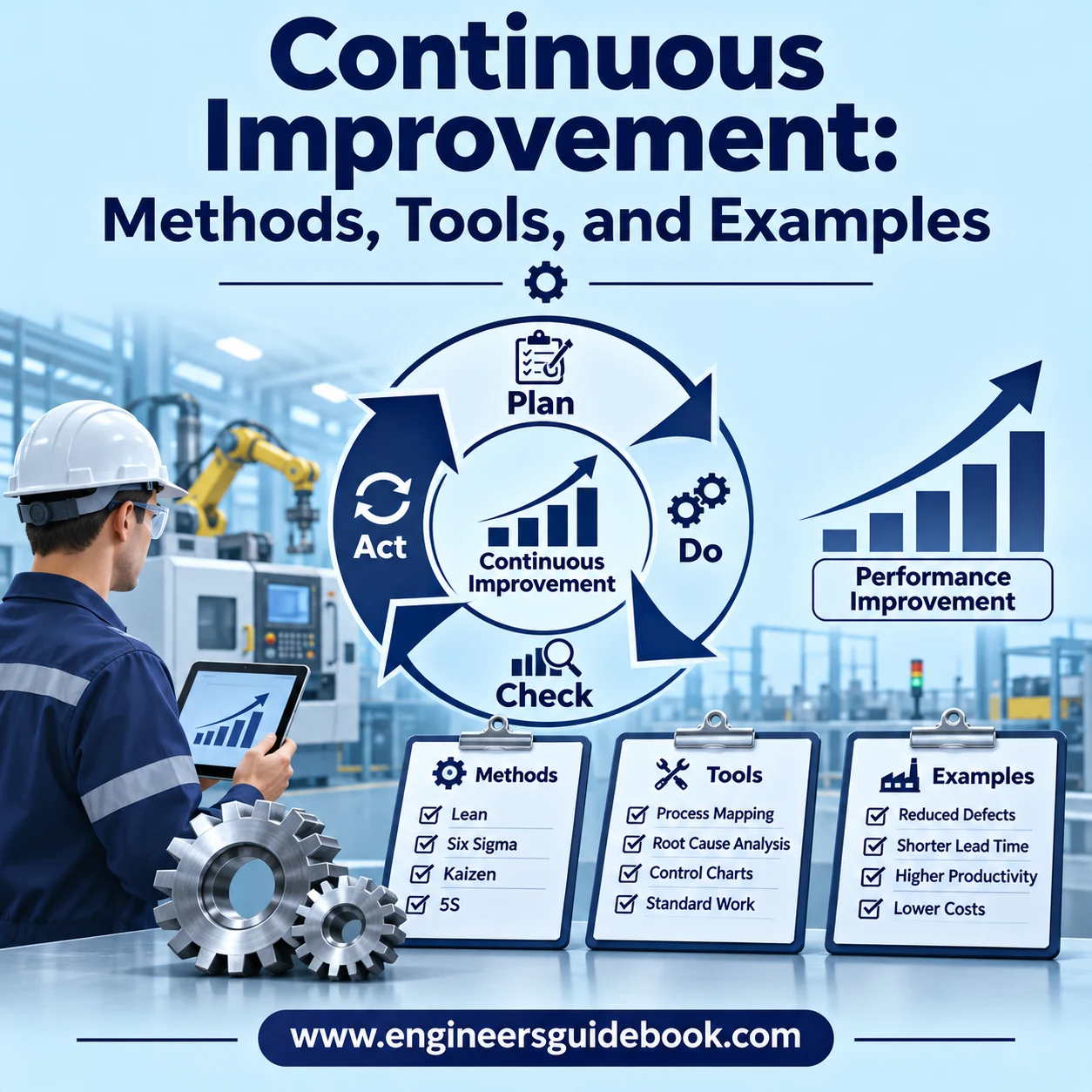
Continuous improvement is a systematic approach to enhancing processes, products, services, and operational performance through ongoing incremental or breakthrough changes. It uses methodologies such as Kaizen, Lean Manufacturing, Six Sigma, and the PDCA cycle, supported by tools like root cause analysis and value stream mapping to eliminate waste, reduce costs, improve quality, and achieve operational excellence.
1. Introduction to Continuous Improvement
1.1 What Is Continuous Improvement
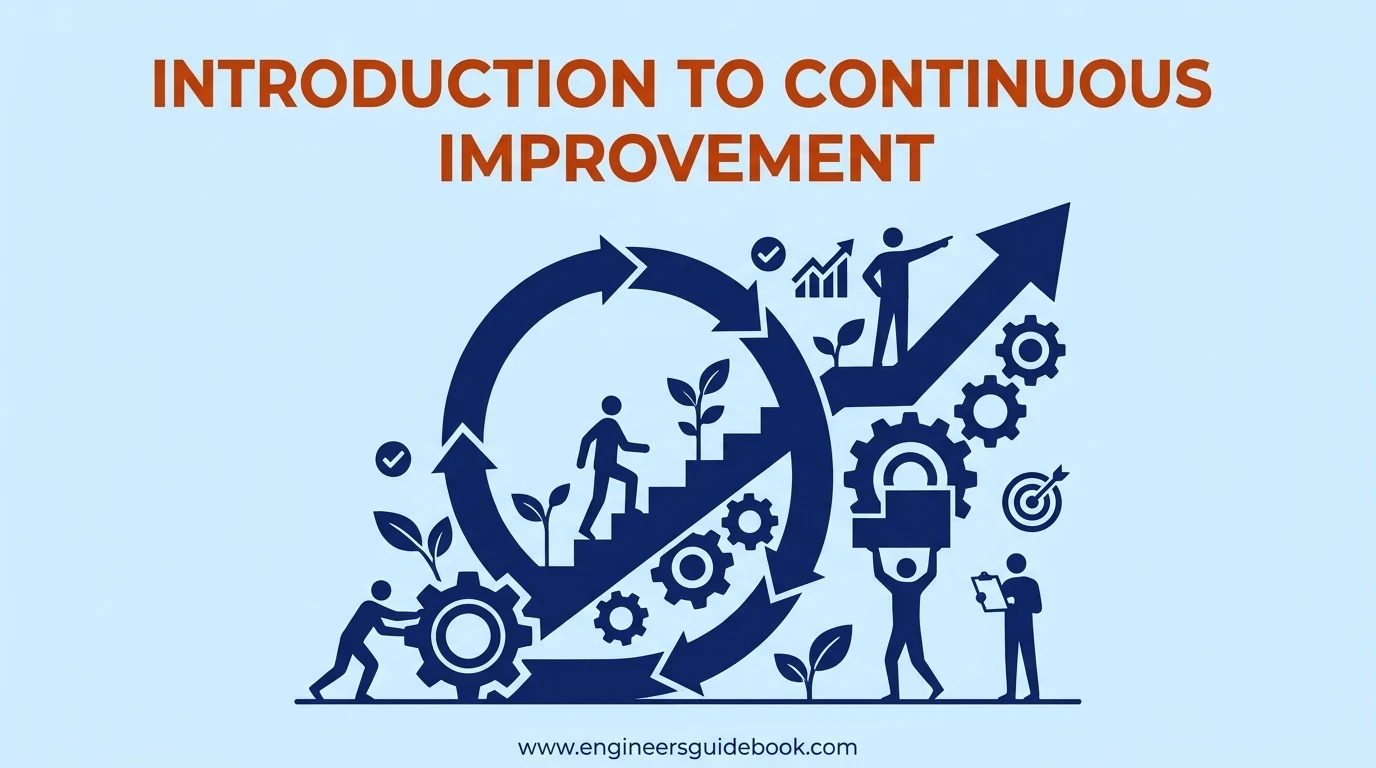
Continuous improvement is an ongoing organizational practice focused on identifying inefficiencies, implementing solutions, and evaluating performance. Rather than accepting existing operational limitations, organizations consistently seek opportunities to enhance productivity, reliability, and quality.
1.2 History and Evolution of Continuous Improvement
Modern continuous improvement evolved through statistical quality control, the contributions of W. Edwards Deming and Joseph Juran, and Japanese manufacturing practices. The Toyota Production System subsequently popularized systematic waste elimination and employee-driven improvement.
1.3 Fundamental Principles of Continuous Improvement
Continuous improvement relies on several fundamental principles:
- Customer-focused value creation
- Systematic waste elimination
- Employee participation
- Evidence-based decision-making
- Continuous performance evaluation
- Process standardization
These principles establish a foundation for sustainable organizational development.
1.4 Objectives of Continuous Improvement
The primary objective is to maximize operational effectiveness while minimizing unnecessary resource consumption. Organizations pursue improvements in productivity, profitability, equipment reliability, workplace safety, and customer satisfaction.
1.5 Importance of Continuous Improvement in Modern Industries
Modern industries face escalating operational costs, technological disruption, and stringent quality expectations. Continuous improvement strengthens organizational adaptability, allowing businesses to remain competitive while maintaining consistent operational standards.
2. Types of Continuous Improvement
2.1 Incremental Continuous Improvement
Incremental improvement involves implementing small, frequent changes to existing processes. Examples include optimizing machine settings, reorganizing tools, and reducing unnecessary operator movement.
Individual improvements may appear insignificant, but their cumulative impact can be substantial.
2.2 Breakthrough Continuous Improvement
Breakthrough improvement involves substantial operational changes that deliver significant performance gains. Examples include production line redesign, manufacturing automation, and comprehensive process reengineering.
These initiatives generally require greater investment and meticulous planning.
2.3 Process-Oriented Improvement
Process-oriented improvement concentrates on enhancing workflows and eliminating procedural bottlenecks. Organizations examine individual activities to identify redundant operations, excessive delays, and unnecessary resource utilization.
2.4 Employee-Driven Improvement
Employee-driven improvement encourages workers to identify operational problems and propose practical solutions. Frontline personnel often possess invaluable experiential knowledge concerning equipment limitations and recurring inefficiencies.
2.5 Technology-Driven Improvement
Technology-driven improvement utilizes automation, industrial sensors, artificial intelligence, and digital monitoring systems to optimize operational performance and improve decision-making.

3. Continuous Improvement Methods and Methodologies
3.1 Kaizen Methodology
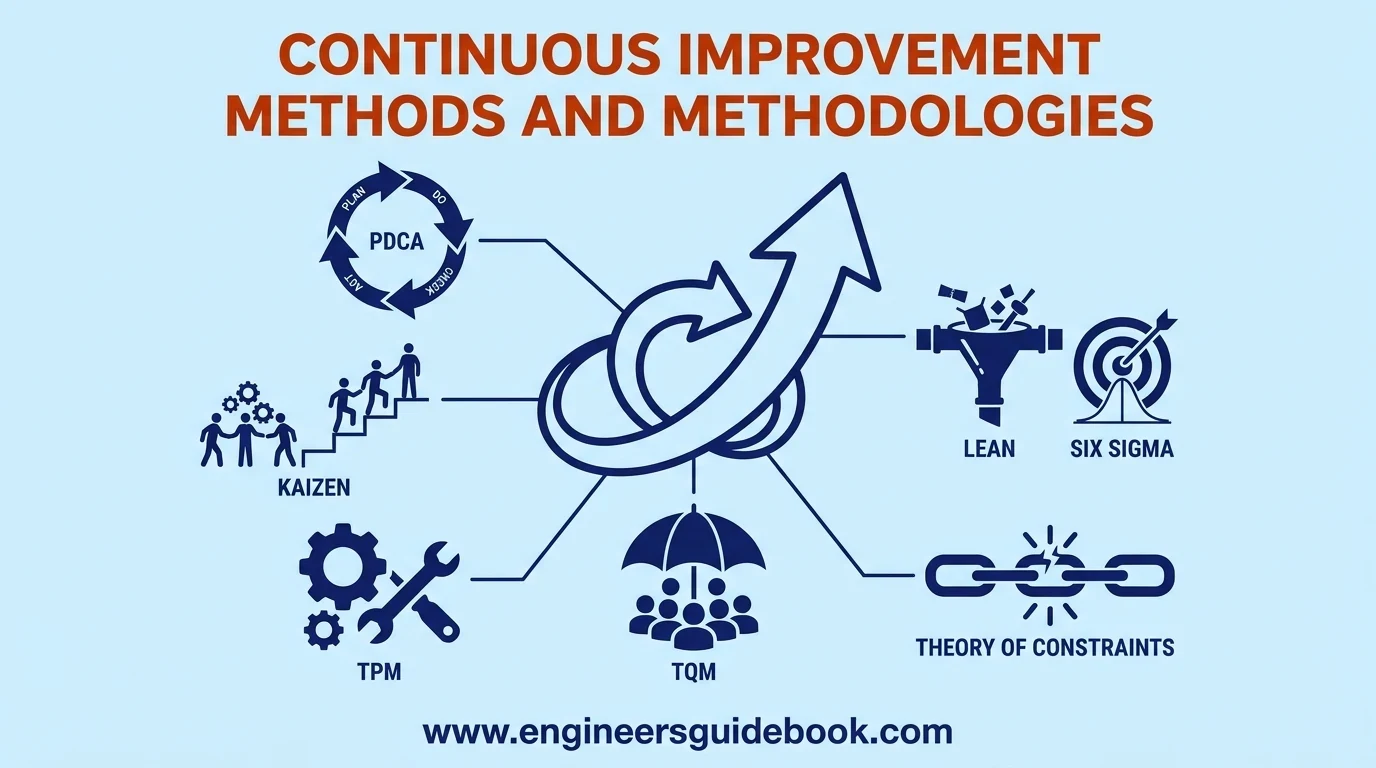
Kaizen is a Japanese improvement philosophy emphasizing small, consistent changes involving employees at every organizational level. Its fundamental premise is that no process is beyond improvement.
3.2 Plan-Do-Check-Act Cycle
The PDCA cycle provides a structured framework for iterative improvement.
- Plan: Identify problems and develop solutions.
- Do: Implement proposed changes.
- Check: Evaluate performance against objectives.
- Act: Standardize successful changes or refine unsuccessful solutions.
3.3 Lean Manufacturing
Lean manufacturing focuses on maximizing customer value by eliminating non-value-adding activities, including overproduction, waiting, transportation, excessive inventory, unnecessary motion, defects, overprocessing, and underutilized talent.
3.4 Six Sigma Methodology
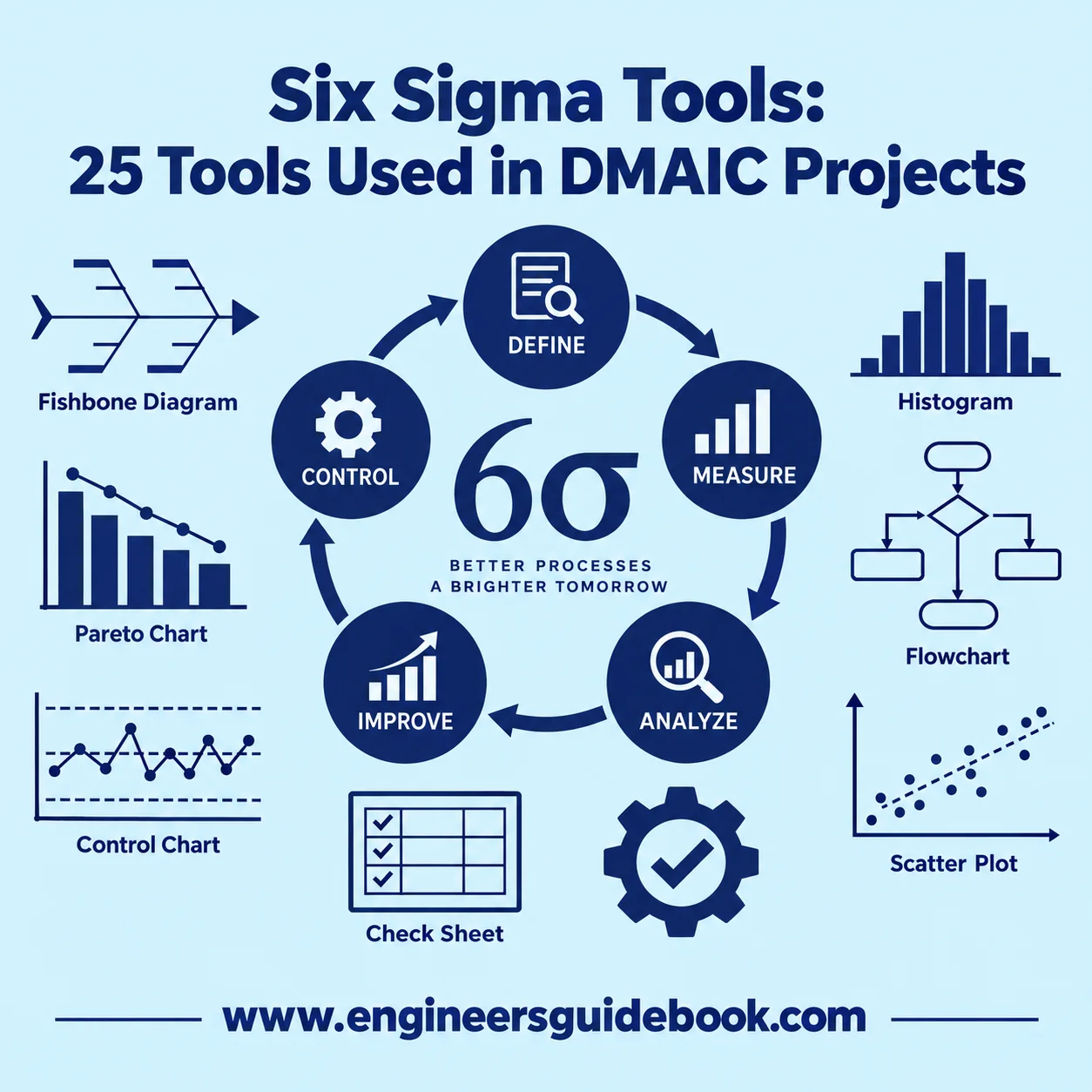
Six Sigma employs statistical techniques to reduce process variation and defects. Its DMAIC framework consists of Define, Measure, Analyze, Improve, and Control.
3.5 Lean Six Sigma
Lean Six Sigma combines Lean’s waste elimination principles with Six Sigma’s statistical problem-solving techniques. This integrated methodology simultaneously improves process velocity, consistency, and quality.
3.6 Total Quality Management
Total Quality Management establishes an organization-wide commitment to quality. It emphasizes customer satisfaction, employee involvement, process control, and systematic performance enhancement.
3.7 Total Productive Maintenance
Total Productive Maintenance improves equipment effectiveness through proactive maintenance, autonomous maintenance, employee training, and systematic equipment loss elimination.
3.8 Theory of Constraints
The Theory of Constraints identifies and addresses the operational bottleneck restricting overall system throughput. Once a constraint is resolved, the organization reassesses the system to identify subsequent limitations.
4. Essential Continuous Improvement Tools and Techniques
4.1 5S Methodology
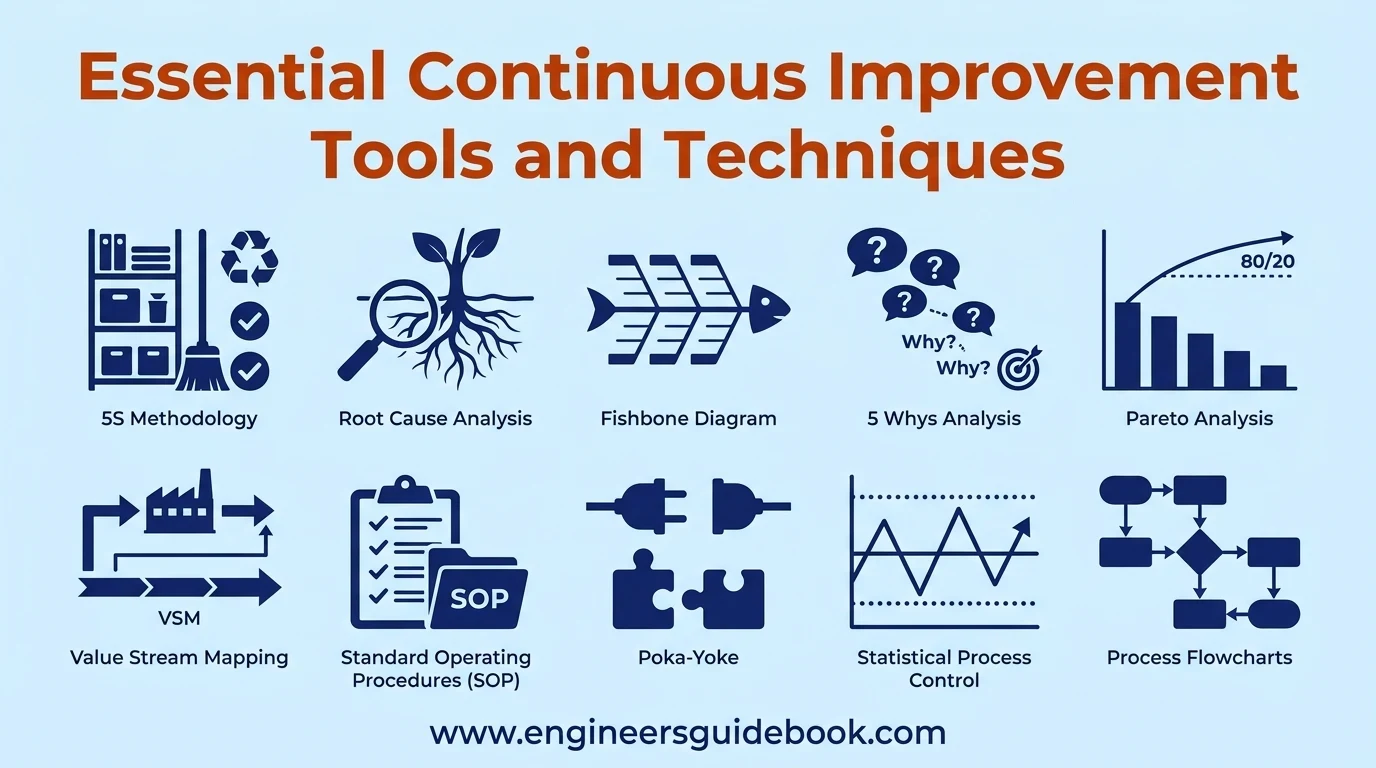
The 5S methodology establishes organized, efficient workplaces through Sort, Set in Order, Shine, Standardize, and Sustain. It reduces unnecessary movement, improves accessibility, and facilitates abnormality detection.
4.2 Root Cause Analysis
Root cause analysis identifies the underlying causes of operational problems rather than merely addressing their symptoms. Effective analysis helps prevent recurring failures.
4.3 Fishbone Diagram
The fishbone diagram categorizes potential problem causes into areas such as manpower, machinery, materials, methods, measurement, and environment.
4.4 5 Whys Analysis
The 5 Whys technique involves repeatedly questioning why a problem occurred until its underlying cause is identified. The number of questions can vary depending on problem complexity.
4.5 Pareto Analysis
Pareto analysis prioritizes problems according to their frequency, cost, or operational impact. It helps organizations concentrate resources on the most consequential improvement opportunities.
4.6 Value Stream Mapping
Value stream mapping visually represents material and information flows throughout a process. It distinguishes value-adding activities from unnecessary operations, delays, and inventory accumulation.
4.7 Standard Operating Procedures
Standard operating procedures document approved methods for executing tasks. They minimize procedural inconsistencies, improve repeatability, and establish a baseline for subsequent improvements.
4.8 Poka-Yoke
Poka-Yoke is a mistake-proofing technique designed to prevent errors or detect them immediately. Examples include component orientation guides, interlocking mechanisms, and automated inspection sensors.
4.9 Statistical Process Control
Statistical process control uses control charts and statistical measurements to distinguish normal process variation from abnormal disturbances requiring investigation.
4.10 Process Flowcharts
Process flowcharts graphically illustrate operational sequences, decision points, and activity relationships. They simplify process analysis and reveal unnecessary procedural complexity.
5. Understanding the Continuous Improvement Cycle
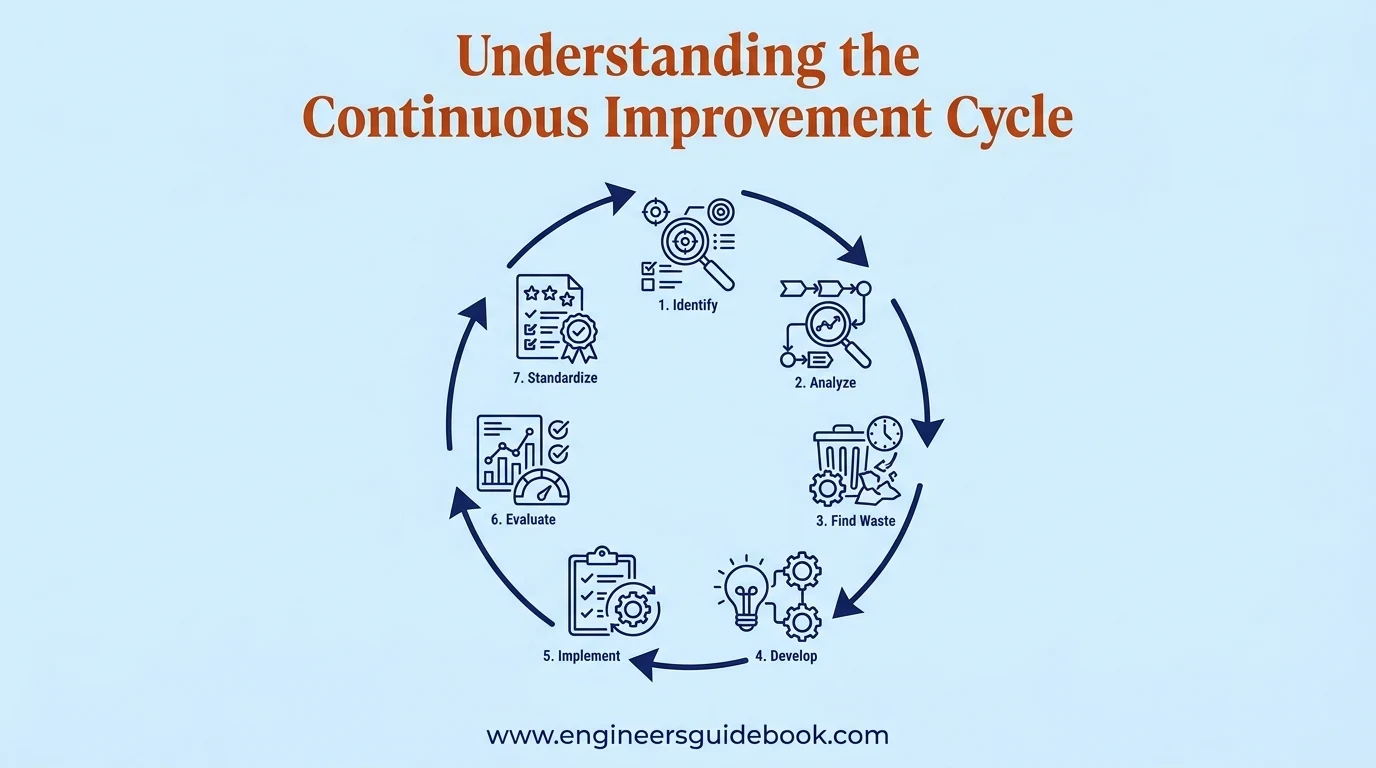
5.1 Identifying Improvement Opportunities
Improvement opportunities emerge through workplace observations, customer complaints, maintenance records, production reports, employee suggestions, and performance audits.
5.2 Analyzing Existing Processes
Organizations must establish a comprehensive understanding of current workflows, operational limitations, resource requirements, and baseline performance before introducing changes.
5.3 Identifying Waste and Inefficiencies
Systematic investigations reveal non-value-adding activities, excessive material consumption, production bottlenecks, equipment losses, and procedural redundancies.
5.4 Developing Improvement Solutions
Cross-functional teams develop potential countermeasures based on verified root causes. Proposed solutions should be evaluated for feasibility, implementation cost, safety, and anticipated benefits.
5.5 Implementing Process Changes
Approved improvements should initially be tested under controlled conditions where practical. Implementation requires defined responsibilities, realistic timelines, appropriate resources, and effective communication.
5.6 Evaluating Improvement Results
Post-implementation performance must be compared against baseline measurements. Quantitative evaluation establishes whether improvements have achieved their intended objectives without introducing undesirable consequences.
5.7 Standardizing Successful Improvements
Validated improvements should be incorporated into operating procedures, training programs, maintenance schedules, and inspection checklists. Standardization prevents regression to inefficient practices.
6. Benefits of Continuous Improvement
6.1 Increased Operational Efficiency
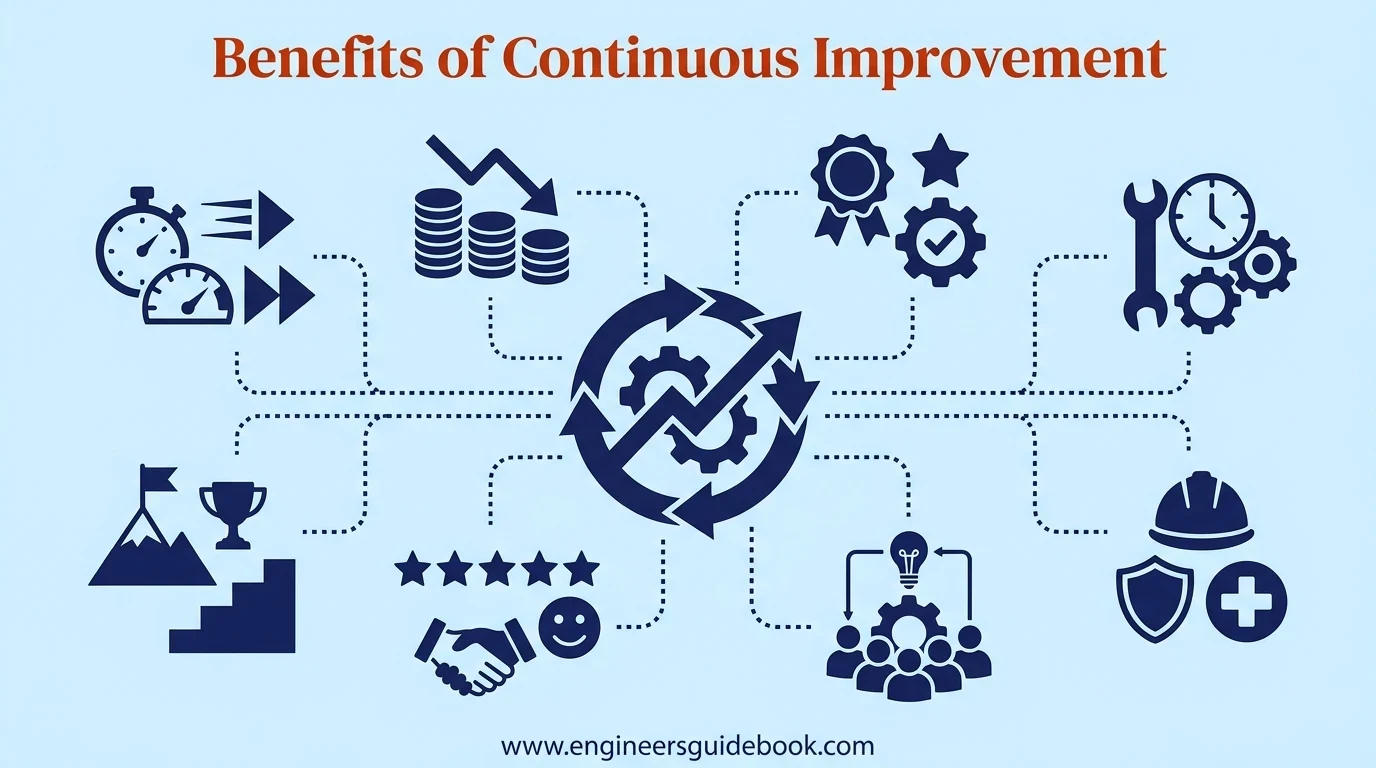
Eliminating unnecessary activities and optimizing workflows enables organizations to achieve greater output using existing resources.
6.2 Reduced Manufacturing Costs
Continuous improvement reduces material wastage, energy consumption, rework expenses, unnecessary maintenance costs, and other avoidable operational expenditures.
6.3 Improved Product Quality
Process standardization, statistical monitoring, and mistake-proofing minimize manufacturing variability and reduce the occurrence of defective products.
6.4 Reduced Equipment Downtime
Systematic failure analysis and proactive maintenance improvements enhance equipment reliability, reduce recurring breakdowns, and improve machine availability.
6.5 Enhanced Workplace Safety
Continuous improvement identifies hazardous conditions, ergonomic deficiencies, unsafe practices, and equipment-related risks. Corrective measures contribute to safer working environments.
6.6 Increased Employee Engagement
Participative improvement programs encourage employees to contribute ideas, develop problem-solving capabilities, and take ownership of operational performance.
6.7 Improved Customer Satisfaction
Consistent product quality, reliable delivery schedules, and responsive problem resolution strengthen customer confidence and long-term business relationships.
6.8 Sustainable Competitive Advantage
Organizations that consistently improve operational capabilities can respond more effectively to changing market demands while maintaining cost competitiveness and quality standards.
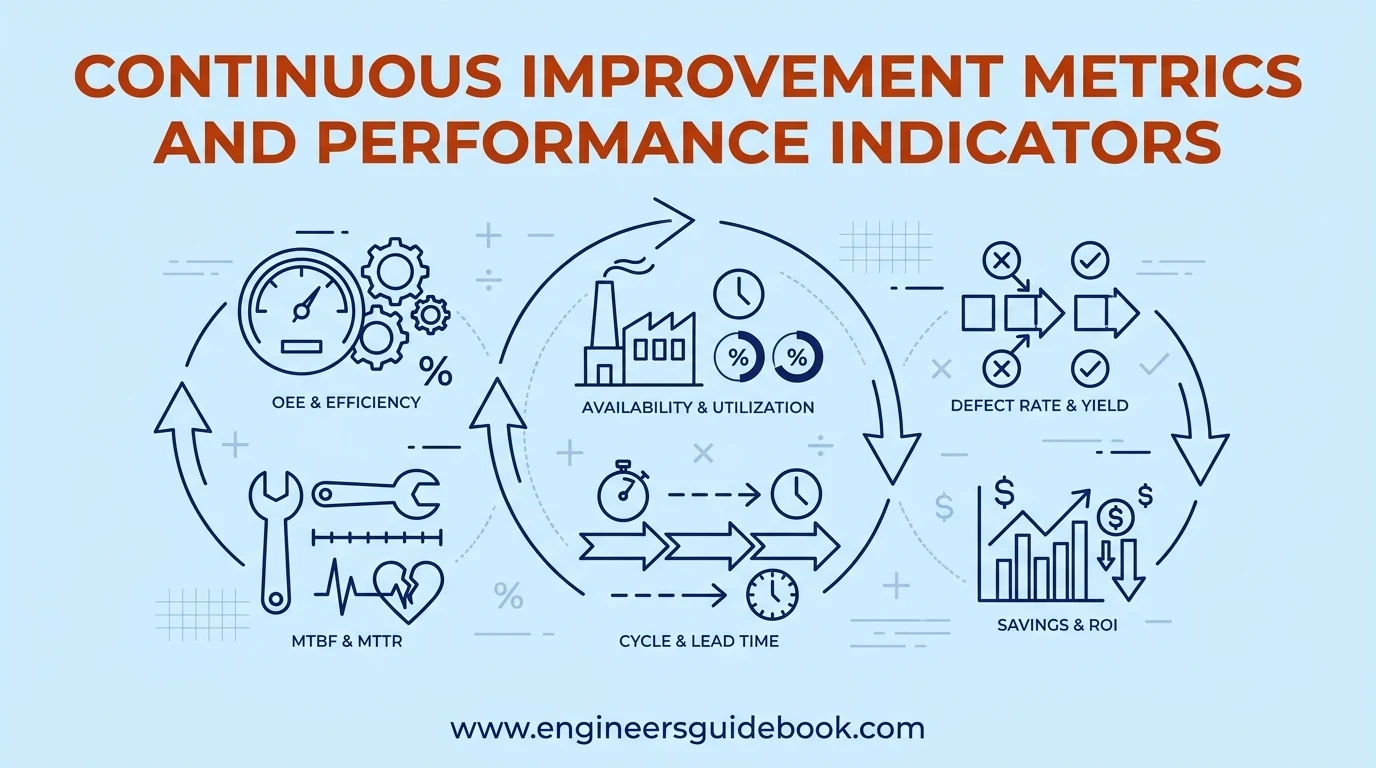
7. Continuous Improvement Metrics and Performance Indicators
7.1 Overall Equipment Effectiveness
Overall Equipment Effectiveness (OEE) measures manufacturing equipment productivity using three fundamental performance factors.
OEE = Availability × Performance × Quality × 100
The three factors must be expressed as decimal values when using this formula.
7.2 Production Efficiency
Production efficiency compares actual production output against the standard achievable output for an equivalent period.
Production Efficiency (%) = (Actual Output ÷ Standard Output) × 100
7.3 Machine Availability and Utilization
Machine availability measures equipment operating time relative to planned production time, whereas utilization compares actual operating time against the defined total available time.
Machine Availability (%) = (Operating Time ÷ Planned Production Time) × 100
Machine Utilization (%) = (Operating Time ÷ Total Available Time) × 100
7.4 Defect Rate and First Pass Yield
Defect rate measures the proportion of defective units, while first pass yield evaluates products meeting quality requirements without rework.
Defect Rate (%) = (Defective Units ÷ Total Units Produced) × 100
First Pass Yield (%) = (First-Pass Good Units ÷ Total Units Processed) × 100
7.5 Cycle Time and Lead Time
Cycle time measures the duration required to complete a process cycle. Lead time represents the total elapsed time between receiving a request and completing its delivery.
Reducing both metrics improves operational responsiveness.
7.6 Cost Savings and Return on Investment
Financial metrics establish the economic viability of continuous improvement initiatives.
Cost Savings = Previous Operating Cost − Improved Operating Cost
ROI (%) = [(Financial Benefits − Investment Cost) ÷ Investment Cost] × 100
Financial benefits and costs should be evaluated over a consistent period.
7.7 Mean Time Between Failures
Mean Time Between Failures (MTBF) measures the average operating duration between failures of repairable equipment.
MTBF = Total Operating Time ÷ Number of Failures
Increasing MTBF generally indicates improved equipment reliability under comparable operating conditions.
7.8 Mean Time to Repair
Mean Time to Repair (MTTR) measures the average duration required to repair failed equipment.
MTTR = Total Repair Time ÷ Number of Repairs
Reducing MTTR improves equipment maintainability, minimizes repair-related downtime, and supports overall manufacturing productivity.
8. Step-by-Step Continuous Improvement Implementation
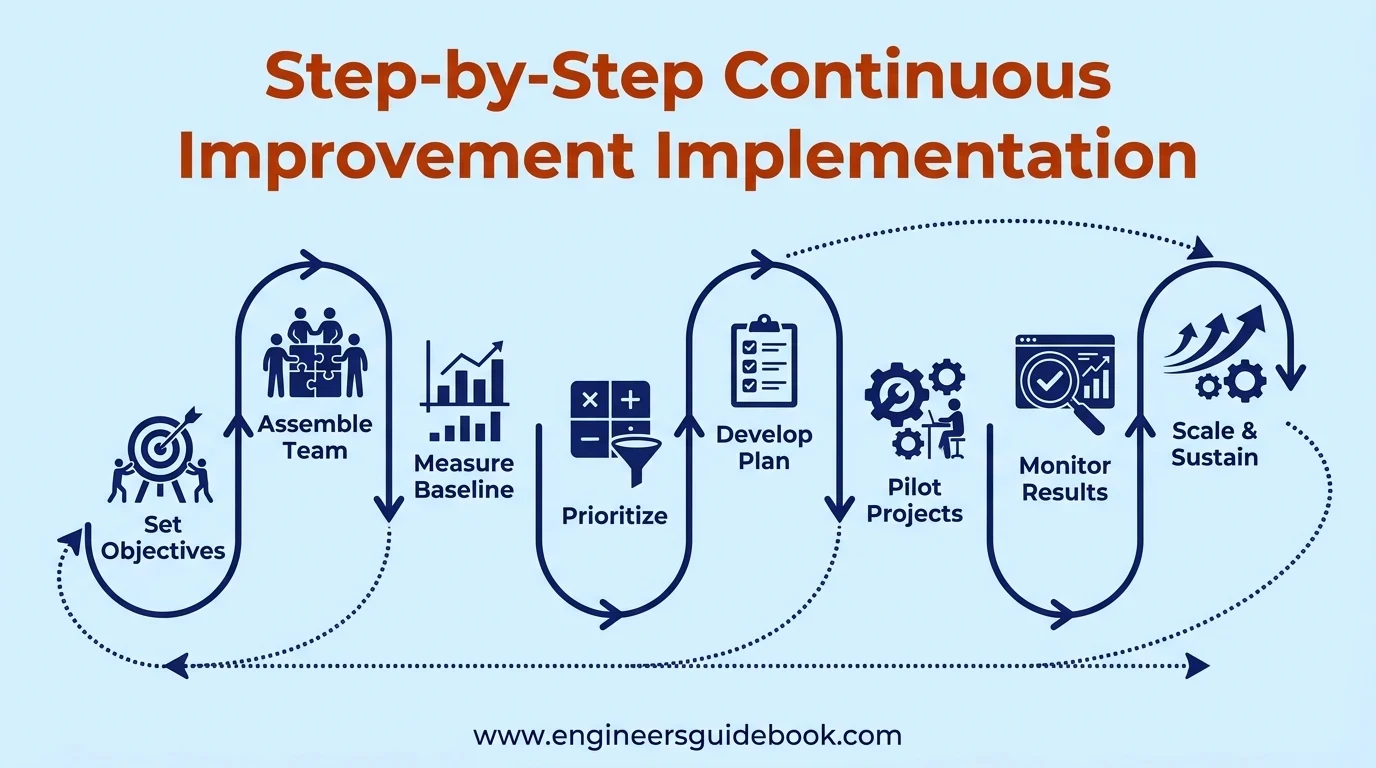
8.1 Establishing Clear Improvement Objectives
Organizations should establish SMART objectives that address specific operational deficiencies. For example, reducing equipment downtime by 20% within six months provides a measurable target and a definitive implementation timeline.
8.2 Building a Cross-Functional Improvement Team
An effective improvement team includes representatives from production, maintenance, quality assurance, engineering, and management. Cross-functional collaboration facilitates comprehensive problem analysis and minimizes departmental conflicts during implementation.
8.3 Establishing Baseline Performance
Baseline measurements establish the existing operational performance before improvement activities commence. Organizations should collect reliable data concerning productivity, equipment availability, production losses, defect rates, and operating expenses.
8.4 Prioritizing Improvement Opportunities
Not every operational deficiency requires immediate intervention. Pareto analysis, risk assessments, and impact-effort matrices help organizations prioritize improvement opportunities according to their financial impact, operational significance, and implementation feasibility.
8.5 Developing an Action Plan
A comprehensive action plan should define improvement activities, assigned responsibilities, resource requirements, completion deadlines, and performance indicators. Clear documentation promotes accountability and prevents implementation ambiguity.
8.6 Conducting Pilot Improvement Projects
Pilot projects enable organizations to evaluate proposed solutions on a limited scale. This controlled implementation approach minimizes operational disruption while identifying unforeseen complications before extensive deployment.
8.7 Monitoring and Validating Results
Improvement teams should regularly compare actual performance against established objectives. Statistical analysis and operational observations help determine whether implemented countermeasures have generated measurable and sustainable improvements.
8.8 Scaling and Sustaining Successful Improvements
Successful improvement initiatives should be replicated across comparable production lines, equipment, and departments where appropriate. Updated procedures, employee training, and periodic audits help sustain achieved benefits.
9. Practical Continuous Improvement Examples and Applications
9.1 Reducing Manufacturing Production Waste
A manufacturing facility experiencing excessive material wastage can implement value stream mapping and root cause analysis. Optimizing material handling, machine settings, and production parameters can substantially reduce unnecessary consumption.
9.2 Minimizing Machine Breakdown and Downtime
Maintenance teams can analyze recurring equipment failures using breakdown records and failure analysis techniques. Introducing condition-based monitoring, optimized lubrication schedules, and preventive maintenance activities improves equipment reliability and reduces unplanned interruptions.
9.3 Improving Assembly Line Productivity
Assembly line balancing distributes tasks according to workstation capacity and processing requirements. Eliminating bottlenecks and unnecessary operator movement increases production throughput without necessarily expanding manufacturing infrastructure.
9.4 Reducing Product Defects
Manufacturers can implement statistical process control and Poka-Yoke mechanisms to identify process abnormalities and prevent assembly mistakes. These techniques improve manufacturing consistency while reducing rejection and rework expenses.
9.5 Optimizing Machine Changeover Time
Single-Minute Exchange of Die (SMED) reduces equipment changeover duration by separating internal and external setup activities, eliminating unnecessary adjustments, and standardizing changeover procedures.
Shorter changeovers increase productive operating time.
9.6 Improving Inventory and Warehouse Management
Implementing Kanban systems, standardized storage locations, and demand-driven replenishment can reduce excessive inventory accumulation. Improved material visibility also minimizes retrieval delays and unnecessary inventory carrying costs.
9.7 Enhancing Industrial Energy Efficiency
Industrial facilities can reduce energy consumption through compressed air leakage elimination, variable frequency drive installation, motor load optimization, and systematic energy audits. These improvements contribute to lower operational expenses and environmental sustainability.
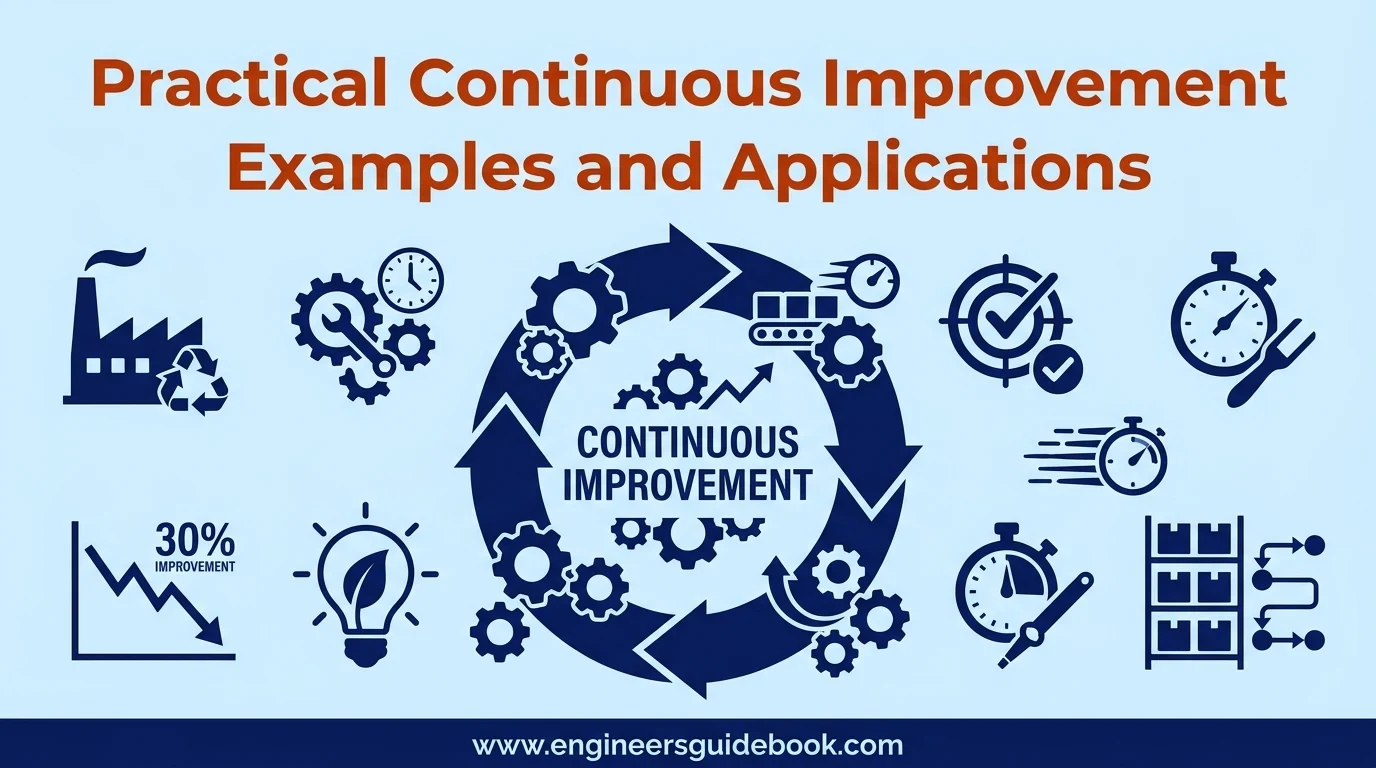
9.8 Continuous Improvement Calculation Example
Consider a manufacturing facility that reduces monthly machine downtime from 500 hours to 350 hours through continuous improvement initiatives.
Improvement (%) = [(Previous Value − Improved Value) ÷ Previous Value] × 100
Improvement = [(500 − 350) ÷ 500] × 100
Improvement = 30%
The organization achieves a 30% reduction in machine downtime, recovering 150 hours of potential productive capacity every month.
10. Building a Sustainable Continuous Improvement Culture
10.1 Leadership Commitment and Accountability
Senior management must actively support improvement initiatives through resource allocation, performance reviews, and strategic direction. Leadership participation demonstrates that continuous improvement is an organizational priority rather than a temporary undertaking.
10.2 Employee Empowerment and Participation
Employees should receive sufficient authority to identify problems, recommend solutions, and participate in improvement activities within established operational and safety boundaries. Empowerment strengthens accountability and encourages proactive problem-solving.
10.3 Continuous Training and Skill Development
Regular training develops employee competency in analytical techniques, equipment operation, quality management, and structured problem-solving. A technically proficient workforce accelerates improvement implementation and minimizes procedural errors.
10.4 Employee Suggestion Systems
Structured suggestion systems provide employees with an accessible mechanism for submitting improvement ideas. Organizations should evaluate proposals systematically, provide constructive feedback, and implement economically and technically viable recommendations.
10.5 Data-Driven Decision-Making
Reliable operational data eliminates excessive dependence on assumptions and subjective judgments. Performance dashboards, statistical analysis, and historical trends facilitate evidence-based decisions and more effective resource allocation.
10.6 Recognition and Reward Systems
Recognizing employee contributions encourages continued participation in improvement initiatives. Appreciation certificates, performance recognition, and appropriate incentives reinforce constructive behavior and collective organizational engagement.
10.7 Digital Technologies and Industry 4.0
Industrial Internet of Things devices, artificial intelligence, predictive analytics, and computerized maintenance management systems facilitate real-time performance monitoring. These technologies help organizations identify emerging inefficiencies and accelerate corrective interventions.
10.8 Sustaining Long-Term Improvement Initiatives
Long-term sustainability requires integrating improvement activities into everyday operational routines. Regular audits, departmental performance reviews, standardized procedures, and continuous employee development prevent organizational complacency.

11. Continuous Improvement Challenges and Best Practices
11.1 Resistance to Organizational Change
Employees may resist unfamiliar procedures because of uncertainty, apprehension, or insufficient understanding. Transparent communication, practical demonstrations, and early employee involvement can mitigate resistance.
11.2 Lack of Management Commitment
Improvement initiatives frequently deteriorate when management fails to provide sufficient direction and resources. Consistent leadership engagement is essential for maintaining organizational momentum and implementation discipline.
11.3 Insufficient Resources and Training
Limited financial resources, inadequate manpower, and insufficient technical expertise can impede improvement activities. Organizations should prioritize feasible projects and allocate resources according to expected operational benefits.
11.4 Poor Data Collection and Performance Measurement
Inaccurate operational data can produce misleading conclusions and ineffective countermeasures. Standardized data collection procedures, validated measurement systems, and consistent reporting practices improve analytical reliability.
11.5 Ineffective Communication and Collaboration
Departmental silos frequently obstruct improvement initiatives. Regular cross-functional meetings, clearly defined responsibilities, and centralized progress reporting facilitate effective collaboration.
11.6 Failure to Sustain Improvements
Organizations sometimes achieve impressive initial results but gradually revert to previous operating practices. Incorporating improvements into standard procedures and conducting follow-up audits prevents performance regression.
11.7 Common Continuous Improvement Mistakes
Several mistakes can undermine improvement effectiveness:
- Addressing symptoms instead of root causes
- Establishing unrealistic improvement targets
- Implementing solutions without validation
- Neglecting employee participation
- Prioritizing short-term results over sustainability
11.8 Best Practices for Successful Continuous Improvement
Successful organizations establish measurable objectives, encourage workforce participation, maintain accurate performance records, and adopt structured problem-solving methodologies. Continuous evaluation ensures improvement activities remain aligned with strategic business priorities.

12. Frequently Asked Questions About Continuous Improvement
12.1 What Is Continuous Improvement in Simple Terms?
Continuous improvement means consistently making changes to processes, products, or services to improve their efficiency, quality, reliability, and overall effectiveness.
12.2 What Are the Four Stages of Continuous Improvement?
The four stages are Plan, Do, Check, and Act. Collectively known as the PDCA cycle, these stages provide a structured framework for implementing and evaluating improvements.
12.3 What Are the Main Methods of Continuous Improvement?
The principal methods include Kaizen, Lean Manufacturing, Six Sigma, Lean Six Sigma, Total Quality Management, Total Productive Maintenance, and the PDCA cycle.
12.4 What Are the Best Tools for Continuous Improvement?
Commonly used tools include root cause analysis, Pareto charts, fishbone diagrams, 5 Whys analysis, value stream mapping, 5S, and statistical process control.
12.5 What Is a Real-Life Example of Continuous Improvement?
A manufacturing company reducing equipment breakdowns through optimized preventive maintenance schedules, improved lubrication practices, and systematic failure analysis demonstrates a practical application of continuous improvement.
12.6 What Is the Difference Between Kaizen and Continuous Improvement?
Kaizen is a specific Japanese improvement philosophy emphasizing incremental changes and employee participation. Continuous improvement is a broader concept encompassing multiple improvement methodologies and techniques.
12.7 What Is the Difference Between Continuous Improvement and Process Improvement?
Process improvement focuses on enhancing specific operational processes. Continuous improvement represents an ongoing organizational commitment to improving processes, products, services, and overall business performance.
12.8 How Is Continuous Improvement Measured?
Continuous improvement is measured using performance indicators such as OEE, production efficiency, defect rates, machine downtime, cycle time, cost savings, and customer satisfaction.
12.9 How Does Continuous Improvement Reduce Manufacturing Costs?
It reduces manufacturing costs by eliminating waste, minimizing equipment failures, preventing product defects, optimizing resource consumption, and improving workforce productivity.
12.10 Who Is Responsible for Continuous Improvement?
Continuous improvement is a shared responsibility involving senior management, engineers, supervisors, technicians, operators, and other employees throughout an organization.
12.11 How Do You Create a Continuous Improvement Plan?
Identify improvement opportunities, establish measurable objectives, analyze root causes, develop countermeasures, assign responsibilities, implement solutions, and monitor performance against established targets.
12.12 How Does Continuous Improvement Support Lean Manufacturing?
Continuous improvement supports Lean Manufacturing by systematically eliminating non-value-adding activities, optimizing production workflows, reducing operational variability, and maximizing customer value.

13. Conclusion
13.1 Key Takeaways of Continuous Improvement
Continuous improvement is an indispensable component of modern industrial management. It enables organizations to reduce operational losses, strengthen equipment reliability, enhance product quality, and improve profitability through systematic and measurable changes.
13.2 Selecting the Right Improvement Methods and Tools
Organizations should select improvement methodologies according to operational complexity, available resources, workforce competency, and strategic objectives. Combining complementary tools often produces more comprehensive results than relying on a single methodology.
13.3 Achieving Long-Term Operational Excellence
Operational excellence is not achieved through isolated improvement projects. It requires sustained leadership commitment, employee participation, analytical discipline, and an unwavering dedication to eliminating inefficiencies. By embedding continuous improvement into everyday operations, organizations can establish resilient, productive, and competitive industrial environments.