1. Introduction to Timing Belts
1.1 What is a Timing Belt?
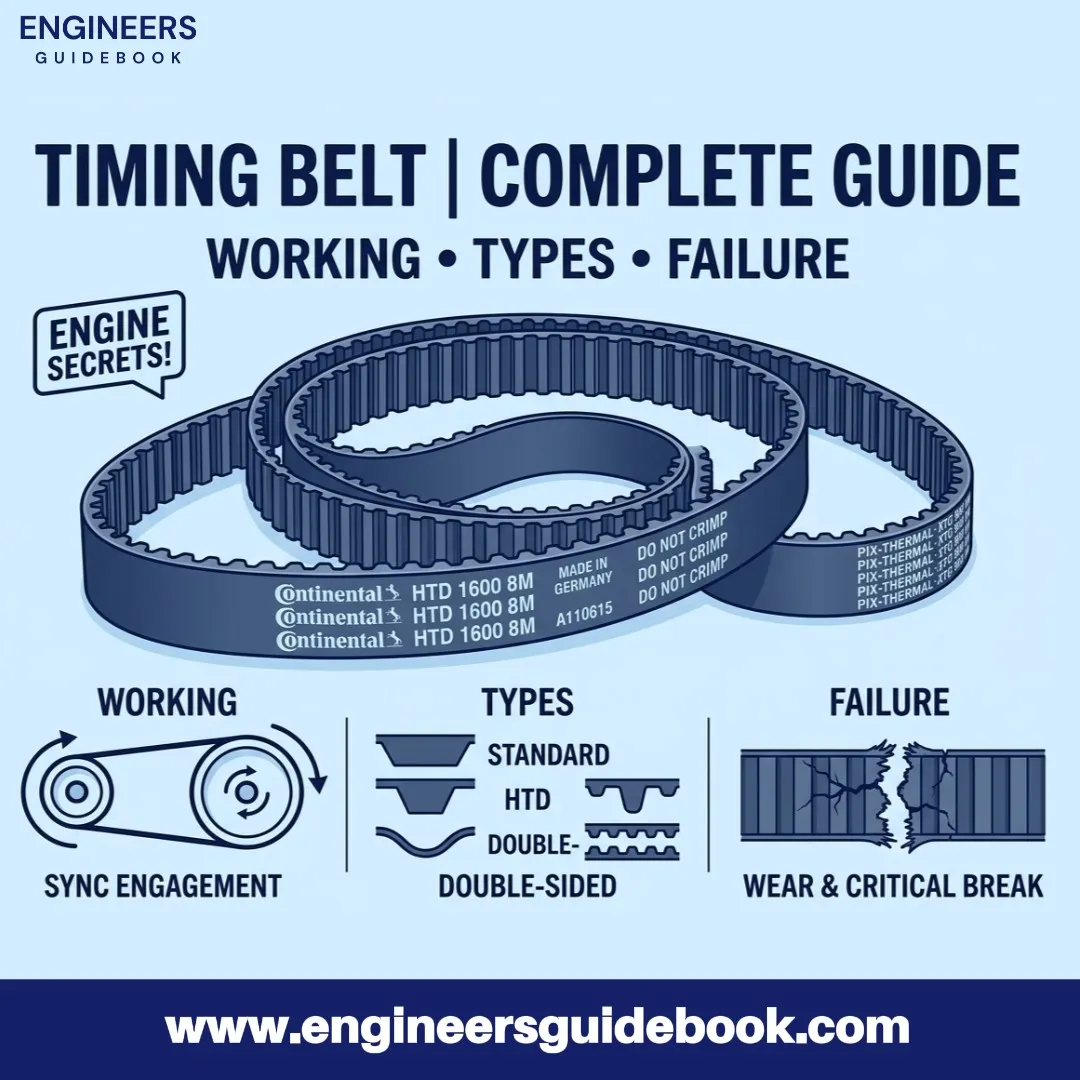
A timing belt is a toothed, reinforced belt used in internal combustion engines to synchronize the rotation of the crankshaft and camshaft.
It ensures that engine valves open and close at precise intervals relative to piston movement. Unlike conventional belts, a timing belt features molded teeth that interlock with corresponding grooves on pulleys, preventing slippage and maintaining exact mechanical timing.
Typically constructed from high-strength rubber compounds embedded with tensile fibers, timing belts operate within a sealed environment. Their role is not merely rotational transfer—it is precise orchestration. Even a slight deviation can disrupt combustion efficiency or, in severe cases, cause catastrophic engine failure.
1.2 Timing Belt vs Timing Chain
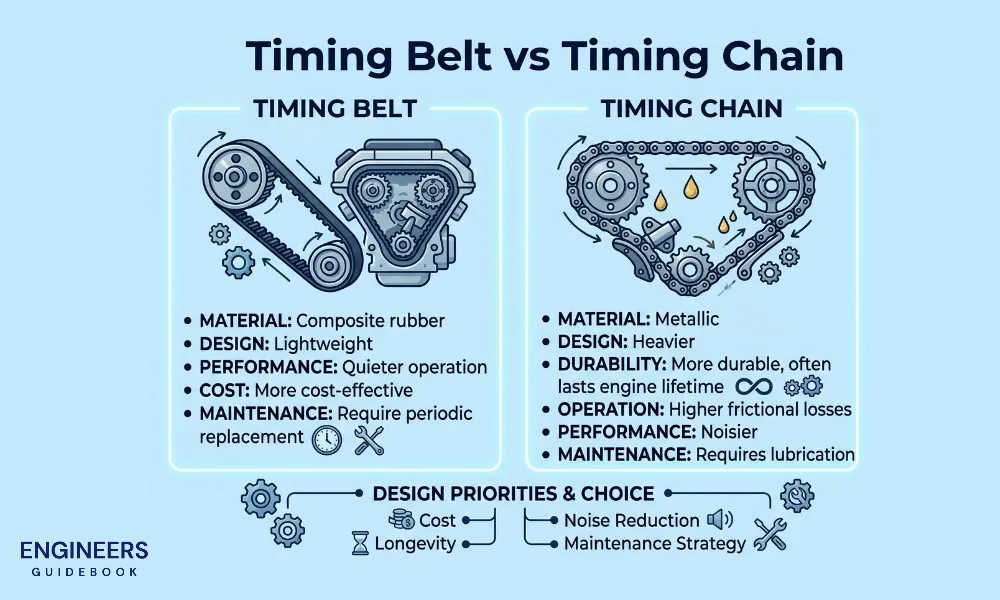
Timing belts and timing chains serve the same fundamental purpose but differ significantly in design, material, and performance characteristics.
Timing belts are made of composite rubber materials, making them lightweight, quieter, and more cost-effective. However, they require periodic replacement.
Timing chains, on the other hand, are metallic and resemble bicycle chains. They are more durable and often last the lifetime of the engine but tend to be noisier and heavier.
Additionally, chains require lubrication and can introduce higher frictional losses. The choice between the two depends on design priorities such as cost, longevity, noise reduction, and maintenance strategy.
2. Working Principle of a Timing Belt
2.1 How a Timing Belt Synchronizes Engine Components
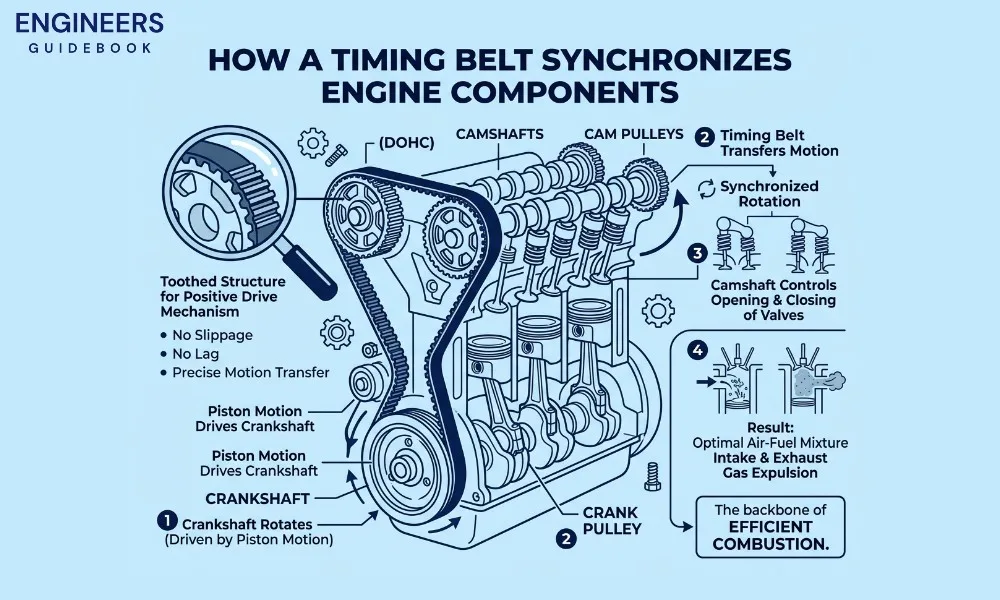
The timing belt connects the crankshaft to the camshaft(s), ensuring synchronized rotation. As the crankshaft rotates, driven by piston motion, the timing belt transfers this motion to the camshaft, which controls the opening and closing of valves.
The toothed structure of the belt ensures a positive drive mechanism. There is no slippage, no lag—only precise motion transfer. This synchronization enables optimal air-fuel mixture intake and exhaust gas expulsion, forming the backbone of efficient combustion.
2.2 Role in Crankshaft and Camshaft Coordination
The crankshaft converts linear piston motion into rotational energy, while the camshaft governs valve timing. The timing belt ensures that these two components operate in perfect phase alignment.
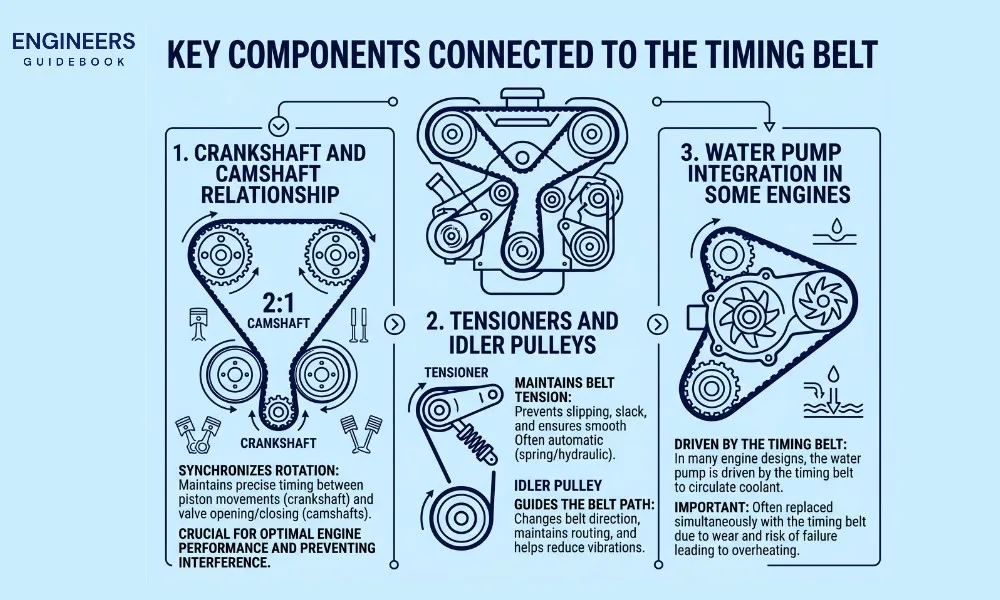
For every two rotations of the crankshaft, the camshaft completes one rotation in a four-stroke engine. This ratio must remain exact. Any discrepancy disrupts valve timing, leading to poor engine performance, increased emissions, and potential mechanical interference.
2.3 Step-by-Step Working Mechanism Explained
The process begins with the crankshaft rotating due to combustion forces. The timing belt, looped around the crankshaft pulley, transmits this rotation to the camshaft pulley. As the camshaft rotates, its lobes actuate the valves in a precisely timed sequence.
Simultaneously, the belt may drive additional components such as the water pump in certain engine designs. The tensioner maintains optimal belt tension, preventing slack or excessive strain. This continuous loop of synchronized motion ensures seamless engine operation, cycle after cycle.
3. Key Components Connected to the Timing Belt
3.1 Crankshaft and Camshaft Relationship
The crankshaft and camshaft are intrinsically linked through the timing belt. Their relationship is defined by a strict rotational ratio that governs engine timing. The crankshaft drives the camshaft, ensuring that valve events align perfectly with piston positions.
This relationship is fundamental. Any misalignment can lead to inefficient combustion or mechanical damage. Precision is not optional—it is mandatory.
3.2 Tensioners and Idler Pulleys
Tensioners and idler pulleys play a crucial supporting role in timing belt systems. The tensioner applies consistent force to maintain proper belt tension, compensating for thermal expansion and wear over time.
Idler pulleys, meanwhile, guide the belt along its path, ensuring smooth operation and optimal contact with drive pulleys. Together, these components prevent belt slippage, reduce vibration, and enhance overall system stability.
3.3 Water Pump Integration in Some Engines
In many engine configurations, the timing belt also drives the water pump. This integration improves efficiency by consolidating mechanical functions but introduces additional risk.
If the water pump fails, it can compromise the timing belt. Conversely, a worn timing belt can affect coolant circulation. For this reason, both components are often replaced simultaneously during maintenance to prevent cascading failures.
Also Read:
Types of V-Belts and Their Applications
4. Types of Timing Belts
4.1 Rubber Timing Belts
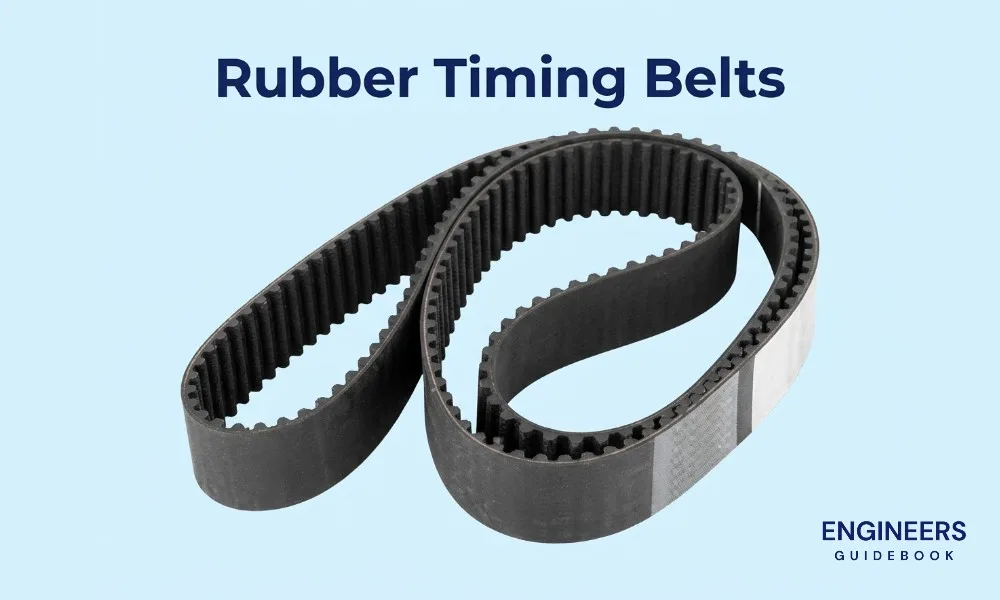
Rubber timing belts are the most commonly used type in modern vehicles. They are manufactured from synthetic rubber compounds such as neoprene or EPDM, offering flexibility and resistance to heat and wear.
These belts are lightweight and operate quietly, making them ideal for passenger vehicles. However, they are susceptible to aging and must be replaced at recommended intervals.
4.2 High-Performance (Kevlar Reinforced) Timing Belts
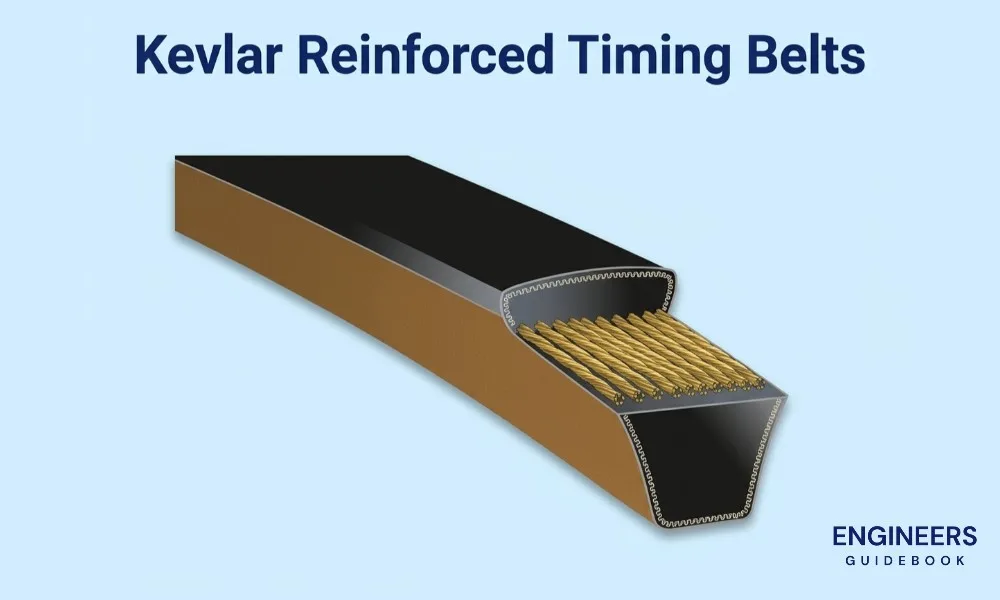
High-performance timing belts incorporate reinforcement materials like Kevlar or fiberglass to enhance tensile strength and durability. These belts are designed for high-stress applications, including performance engines and heavy-duty machinery.
They offer superior resistance to stretching and deformation, ensuring consistent timing even under extreme operating conditions. Their robustness makes them suitable for demanding environments where reliability is paramount.
4.3 Double Overhead Cam (DOHC) Timing Belts
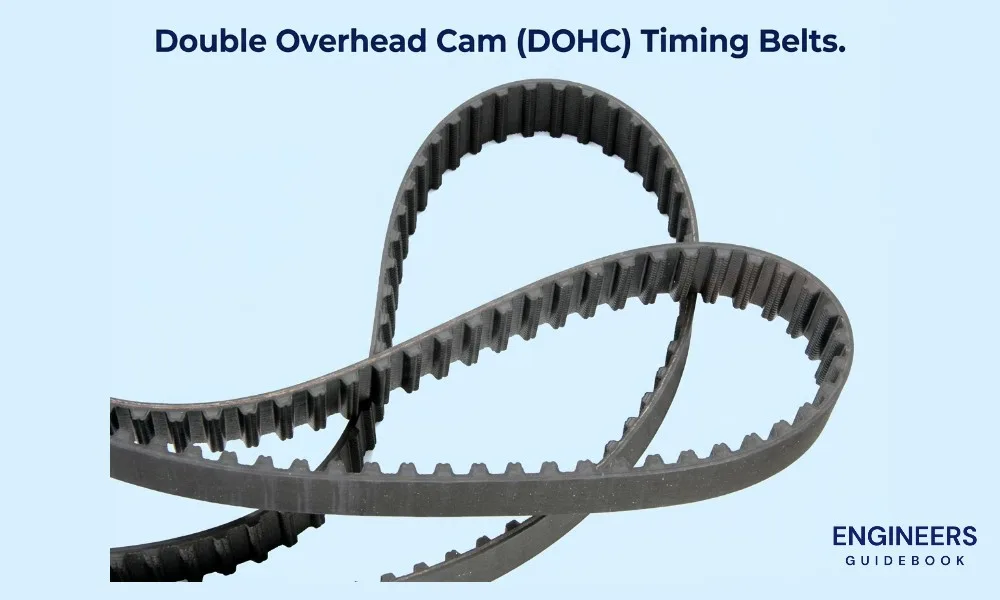
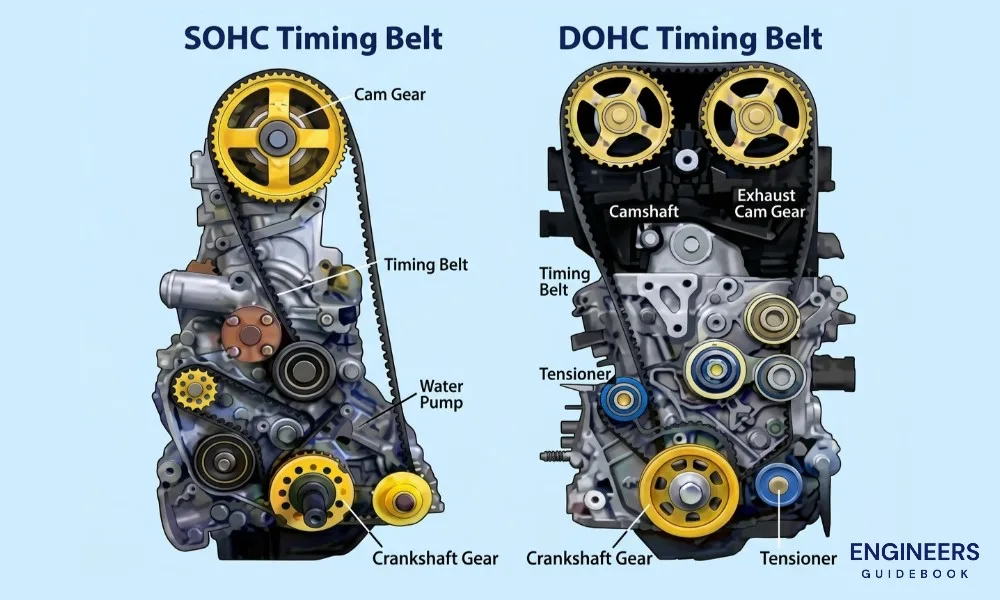
DOHC engines utilize two camshafts per cylinder bank—one for intake valves and one for exhaust valves. Timing belts in these systems are more complex, often requiring additional pulleys and precise routing.
These belts must maintain synchronization across multiple camshafts, making their design and installation more intricate. However, they enable improved engine performance and efficiency.
4.4 Single Overhead Cam (SOHC) Timing Belts
SOHC engines use a single camshaft to operate both intake and exhaust valves. Timing belts in these systems are simpler in design and easier to maintain.
While they may not offer the same performance benefits as DOHC systems, SOHC configurations are cost-effective and reliable, making them common in many standard vehicles.
5. Timing Belt Materials and Construction
5.1 Core Materials Used in Timing Belts
Timing belts are constructed using advanced composite materials. The outer layer is typically made of synthetic rubber, providing flexibility and resistance to environmental factors. Beneath this lies a tensile cord layer, often composed of fiberglass or aramid fibers, which provides structural strength.
This multi-layered construction ensures the belt can withstand high rotational forces, temperature variations, and continuous operation without failure.
5.2 Tooth Design and Its Importance
The tooth profile of a timing belt is a critical design feature. It determines how effectively the belt engages with pulleys and transmits motion. Common profiles include trapezoidal and curvilinear shapes, each offering distinct advantages.
A well-designed tooth profile minimizes noise, reduces wear, and ensures precise timing. Poor design, on the other hand, can lead to uneven load distribution and premature failure.
5.3 Reinforcement Fibers and Durability Factors
Reinforcement fibers embedded within the belt provide tensile strength and dimensional stability. Materials such as fiberglass, polyester, and Kevlar are commonly used to resist stretching and maintain accurate timing.
Durability is influenced by multiple factors, including material quality, operating temperature, load conditions, and maintenance practices. A high-quality timing belt, when properly maintained, delivers reliable performance over its intended lifespan.
6. Advantages of Timing Belts
6.1 Lightweight and Quiet Operation
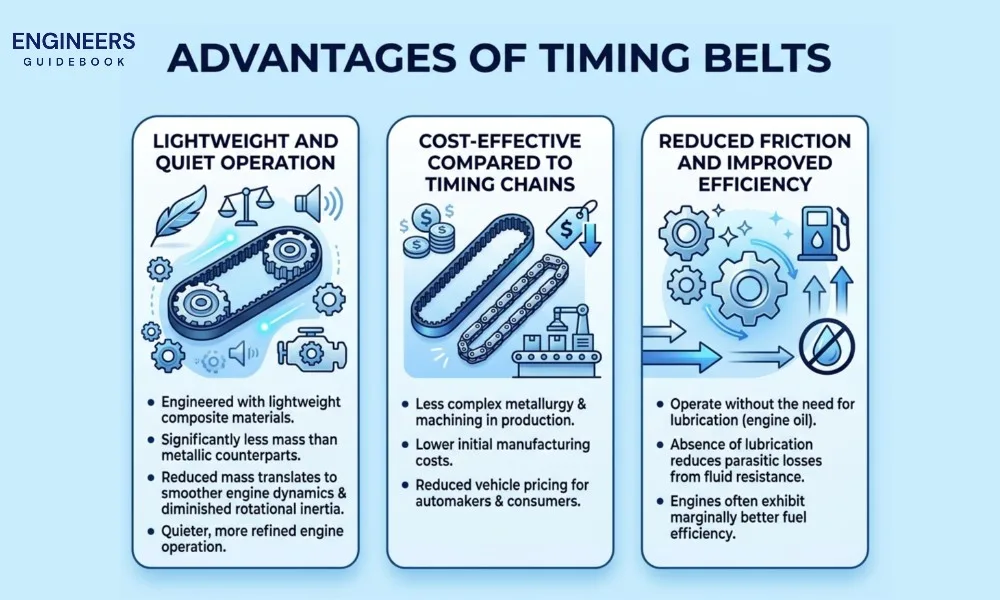
Timing belts are engineered with lightweight composite materials, making them significantly less massive than their metallic counterparts. This reduced mass translates into smoother engine dynamics and diminished rotational inertia. The result is a quieter, more refined engine operation.
Unlike chains, which generate metallic resonance and vibration, timing belts operate with near-silent precision. The absence of metal-to-metal contact eliminates clatter. This acoustic advantage is particularly valuable in passenger vehicles, where noise reduction enhances overall driving comfort.
6.2 Cost-Effective Compared to Timing Chains
From a manufacturing and ownership perspective, timing belts are economically advantageous. Their production involves less complex metallurgy and machining, leading to lower initial costs. For automakers, this translates into reduced vehicle pricing.
Replacement costs are also comparatively moderate. Although timing belts require periodic servicing, the parts themselves are inexpensive relative to timing chain assemblies. For many vehicle owners, this balance between affordability and functionality makes timing belts a pragmatic choice.
6.3 Reduced Friction and Improved Efficiency
Timing belts operate without the need for lubrication, unlike timing chains that rely on engine oil. This absence of lubrication reduces parasitic losses caused by fluid resistance. Consequently, engines equipped with timing belts often exhibit marginally better fuel efficiency.
Additionally, the flexible nature of the belt minimizes internal friction during operation. This leads to smoother energy transmission and less mechanical drag, contributing to improved engine responsiveness and efficiency.
7. Disadvantages of Timing Belts
7.1 Limited Lifespan
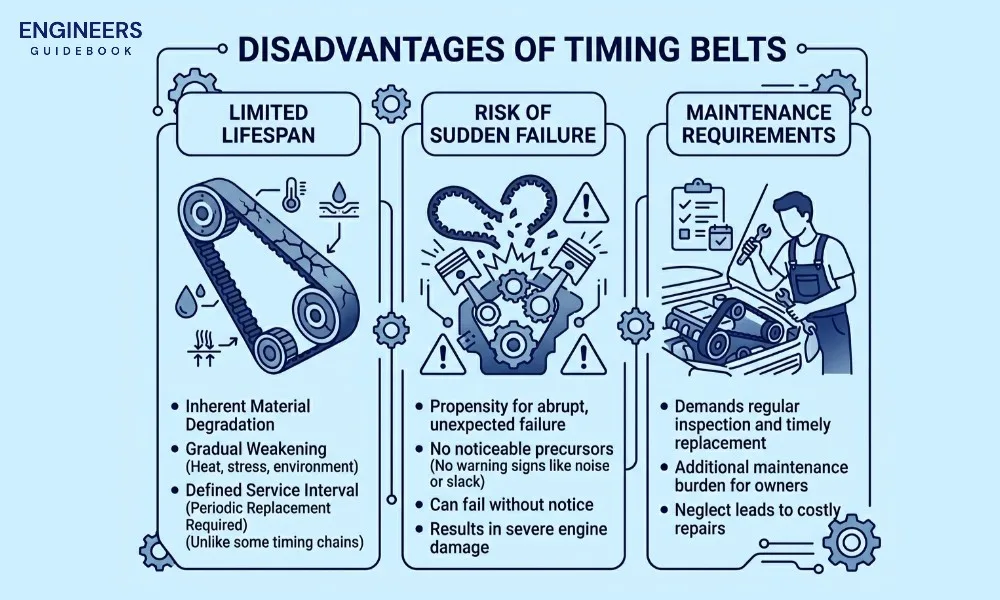
Timing belts are inherently subject to material degradation. Exposure to heat, mechanical stress, and environmental factors gradually weakens their integrity. Unlike chains, which can last the lifetime of an engine, timing belts have a defined service interval.
Over time, the rubber compound loses elasticity, and internal fibers may weaken. This finite lifespan necessitates proactive replacement, making long-term maintenance unavoidable.
7.2 Risk of Sudden Failure
One of the most critical drawbacks of timing belts is their propensity for abrupt failure. Unlike timing chains, which often exhibit warning signs such as noise or slack, timing belts can fail without noticeable precursors.
A snapped belt immediately disrupts engine timing. In interference engines, this can lead to catastrophic internal damage within milliseconds. The suddenness of failure elevates the importance of strict adherence to replacement schedules.
7.3 Maintenance Requirements
Timing belts demand inspection and timely replacement. This introduces an additional maintenance burden for vehicle owners. Neglecting this responsibility can result in severe engine damage and costly repairs.
Moreover, associated components such as tensioners and pulleys often require simultaneous servicing. This interconnected maintenance requirement increases the overall complexity of upkeep.
8. Common Timing Belt Problems
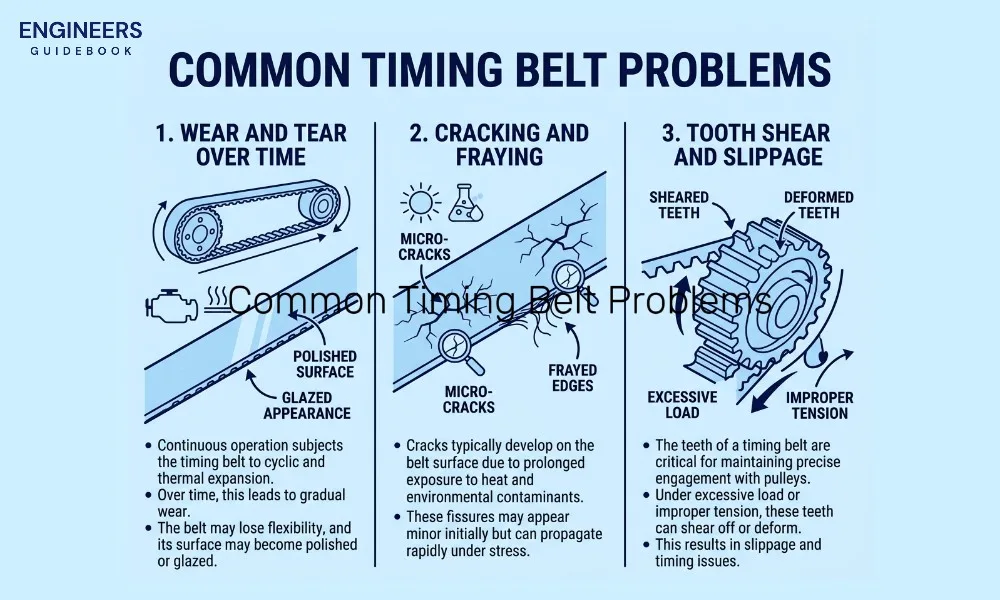
8.1 Wear and Tear Over Time
Continuous operation subjects the timing belt to cyclic and thermal expansion. Over time, this leads to gradual wear. The belt may lose flexibility, and its surface may become polished or glazed.
Such wear is inevitable. However, if left unchecked, it can compromise the belt’s ability to maintain proper synchronization, eventually leading to failure.
8.2 Cracking and Fraying
Cracks typically develop on the belt surface due to prolonged exposure to heat and environmental contaminants. These fissures may appear minor initially but can propagate rapidly under stress.
Fraying, on the other hand, occurs along the edges of the belt. It indicates misalignment or excessive . Both conditions weaken the belt structure and signal imminent failure if not addressed promptly.
8.3 Tooth Shear and Slippage
The teeth of a timing belt are critical for maintaining precise engagement with pulleys. Under excessive load or improper tension, these teeth can shear off or deform.
Tooth loss leads to slippage. Even a slight shift in timing can disrupt engine operation, causing misfires, reduced power output, and increased emissions. In severe cases, it can trigger complete engine malfunction.
9. Signs of a Failing Timing Belt
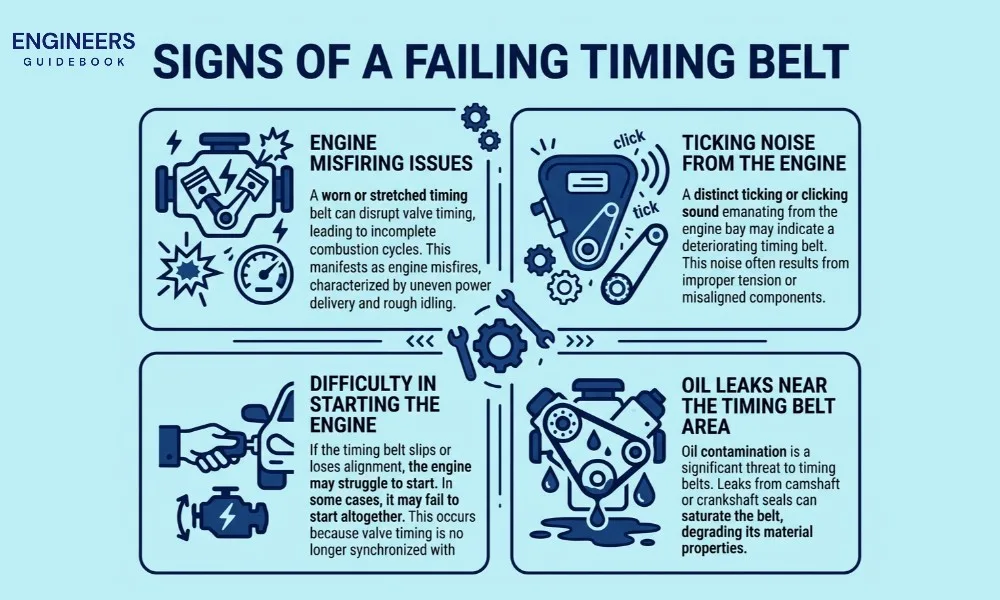
9.1 Engine Misfiring Issues
A worn or stretched timing belt can disrupt valve timing, leading to incomplete combustion cycles. This manifests as engine misfires, characterized by uneven power delivery and rough idling.
Misfiring is often an early . It indicates that synchronization between the crankshaft and camshaft is no longer precise.
9.2 Ticking Noise from the Engine
A distinct ticking or clicking sound emanating from the engine bay may indicate a deteriorating timing belt. This noise often results from improper tension or misaligned components.
While subtle at first, the sound can intensify over time. Ignoring it may lead to more mechanical issues.
9.3 Difficulty in Starting the Engine
If the timing belt slips or loses alignment, the engine may struggle to start. In some cases, it may fail to start altogether. This occurs because valve timing is no longer synchronized with piston .
Such starting issues should not be dismissed. They often signal underlying timing problems that require immediate attention.
9.4 Oil Leaks Near the Timing Belt Area
Oil contamination is a significant threat to timing belts. Leaks from camshaft or crankshaft seals can saturate the belt, degrading its material properties.
A belt exposed to oil becomes and prone to slipping or snapping. Visible oil accumulation near the timing cover is a clear warning sign.
10. Causes of Timing Belt Failure
10.1 Improper Tensioning
Correct tension is vital for optimal timing belt performance. Over-tensioning places excessive strain on the belt and associated components, accelerating wear.
Under-tensioning, conversely, can lead to slippage and misalignment. Both extremes compromise the belt’s functionality and longevity.
10.2 Contamination (Oil, Coolant, Dirt)
Foreign substances such as oil, coolant, and dirt can severely degrade timing belt materials. These contaminants alter the belt’s , reducing its strength and flexibility.
Coolant exposure can cause swelling, while oil can soften the rubber compound. Dirt particles introduce abrasive wear, further accelerating deterioration.
10.3 Misalignment of Pulleys
Proper alignment of pulleys ensures even load distribution across the belt. Misaligned pulleys create uneven , leading to localized wear and failure.
This issue often arises from worn bearings or improper installation. Regular inspection is essential to detect and correct alignment discrepancies.
10.4 Overheating and Environmental Factors
Excessive heat is a factor in timing belt degradation. High temperatures accelerate material breakdown, reducing elasticity and strength.
Environmental conditions such as humidity, dust, and chemical exposure also play a role. Together, these factors contribute to premature aging and failure.
11. What Happens When a Timing Belt Breaks?
11.1 Interference vs Non-Interference Engines
In non-interference engines, a broken timing belt typically results in engine stoppage without internal damage. The pistons and valves do not occupy the same space, preventing collision.
In interference engines, however, the situation is far more severe. The pistons and valves share overlapping paths. A broken belt leads to immediate collision, causing extensive internal damage.
11.2 Engine Damage Scenarios Explained
When a timing belt fails in an interference engine, the consequences can be catastrophic. Bent valves, damaged pistons, cracked cylinder heads, and նույնիսկ connecting rod damage are common outcomes.
The extent of damage depends on engine speed at the time of failure. Higher speeds amplify the severity, often necessitating complete engine overhaul.
11.3 Repair Costs and Consequences
Repairing damage caused by a broken timing belt can be financially burdensome. Minor repairs may involve valve replacement, while severe cases may require engine rebuilding or replacement.
The cost disparity between preventive maintenance and reactive repair is substantial. Replacing a timing belt at the recommended interval is significantly more economical than addressing catastrophic failure.
12. Timing Belt Replacement Interval
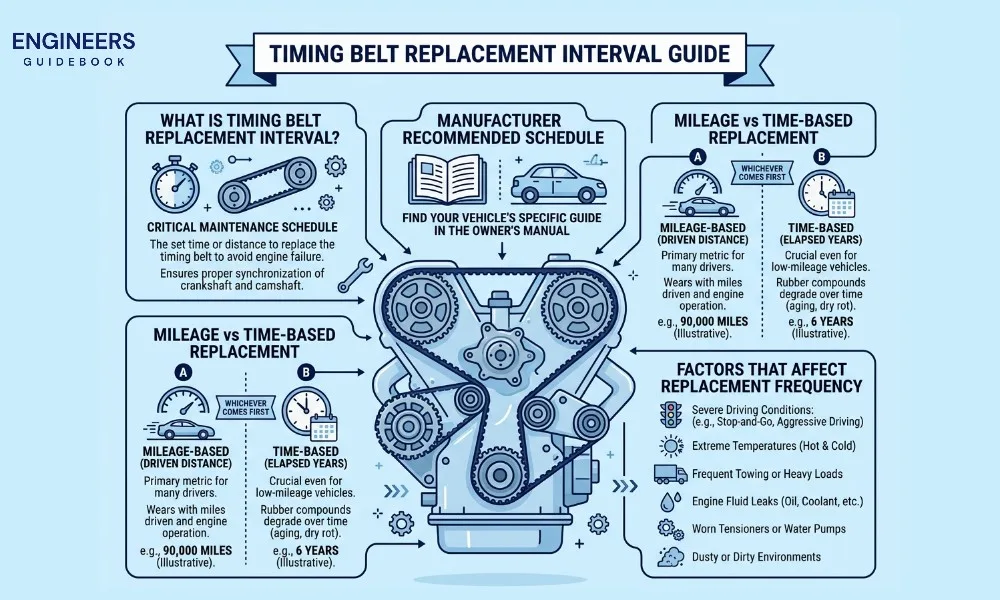
12.1 Manufacturer Recommended Replacement Schedule
Automobile manufacturers specify precise replacement intervals for timing belts, typically ranging between 60,000 to 100,000 kilometers. These guidelines are based on extensive testing and engineering analysis.
Adhering to these recommendations is essential. Deviating from them increases the risk of unexpected failure.
12.2 Mileage vs Time-Based Replacement
Timing belt replacement is governed by both mileage and time. Even if a vehicle has low mileage, the belt can degrade due to aging.
Rubber components deteriorate over time regardless of usage. Therefore, both factors must be considered to ensure timely replacement.
12.3 Factors That Affect Replacement Frequency
Several variables influence the lifespan of a timing belt. Driving conditions, environmental exposure, engine load, and maintenance practices all play a role.
Frequent short trips, extreme temperatures, and poor maintenance can accelerate wear. Conversely, optimal operating conditions and регуляр inspections can extend the belt’s service life.
13. Step-by-Step Timing Belt Replacement Process
13.1 Tools and Equipment Required
Replacing a timing belt demands precision and the correct set of tools. Essential equipment typically includes a socket wrench set, torque wrench, breaker bar, pulley removal tool, and alignment tools designed specifically for engine timing systems. A service manual is also invaluable, as it provides torque specifications and alignment diagrams.
In some engines, specialized camshaft locking tools are required to prevent unwanted movement during the replacement process. Without them, maintaining correct timing becomes difficult. Organization is equally important; keeping fasteners and components arranged methodically prevents installation errors later.
13.2 Safety Precautions Before Starting
Safety must be prioritized before beginning any mechanical procedure. The engine should be completely cool, and the vehicle battery must be disconnected to eliminate the possibility of accidental ignition.
Proper support of the vehicle using jack stands is crucial if access from below is required. Additionally, wearing protective gloves and eye protection reduces the risk of injury. A methodical approach—slow, deliberate, and attentive—helps prevent costly mistakes.
13.3 Removing the Old Timing Belt
The process begins by removing protective covers and auxiliary components such as drive belts, engine mounts, and timing covers. Once the timing assembly is exposed, the engine must be rotated until the timing marks on the crankshaft and camshaft align precisely.
After alignment, the tensioner is loosened to relieve tension on the belt. The old belt can then be carefully removed from the pulleys. During this stage, inspecting pulleys, seals, and surrounding components is highly recommended, as wear in these areas may compromise the new belt.
13.4 Installing the New Timing Belt
Installation begins with positioning the new belt onto the crankshaft pulley, followed by routing it over the camshaft pulleys and idler pulleys according to the specified path. Accuracy is paramount. Even a single tooth misalignment can disrupt engine timing.
The belt should sit snugly within the pulley grooves without twisting. Gentle handling is important; forcing the belt into place can damage its internal fibers and reduce its operational lifespan.
13.5 Proper Tensioning and Alignment
Once the belt is installed, the tensioner is adjusted to apply the correct amount of tension. This step requires careful attention, as improper tension can lead to premature wear or operational failure.
After tensioning, the engine is manually rotated several times using a wrench on the crankshaft bolt. This ensures that the belt moves smoothly and that timing marks remain aligned. If any deviation is detected, adjustments must be made immediately.
13.6 Final Inspection and Testing
The final stage involves reassembling all removed components, including timing covers, engine mounts, and accessory belts. A comprehensive inspection should follow to confirm that all fasteners are properly tightened.
Once reassembled, the engine is started and allowed to idle. Observing the engine for unusual noises, vibrations, or irregular operation helps confirm successful installation. A short test drive may also be conducted to verify stable performance under normal conditions.
14. Cost of Timing Belt Replacement
14.1 Parts Cost Breakdown
The cost of timing belt replacement components varies depending on vehicle type and engine complexity. A standard timing belt itself is relatively affordable. However, most replacement kits include additional parts such as tensioners, idler pulleys, and sometimes the water pump.
High-performance or specialized engines may require premium components, which increases overall cost. Despite these variations, replacing the entire timing kit is generally recommended to ensure long-term reliability.
14.2 Labor Charges Explained
Labor constitutes a significant portion of the total replacement cost. Timing belt replacement is labor-intensive because it requires partial disassembly of the engine’s front section. In many vehicles, multiple components must be removed before accessing the belt.
The complexity of the engine layout greatly influences labor charges. Compact engines with limited access often require more time, leading to higher service costs.
14.3 Cost Comparison: DIY vs Professional Service
Performing the replacement independently can reduce expenses, particularly labor costs. However, it requires technical knowledge, proper tools, and careful execution. Mistakes in timing alignment can lead to severe engine damage.
Professional service centers provide expertise and guarantee correct installation. Although the cost is higher, the assurance of precision and reliability often justifies the investment, especially for complex engines.
15. Maintenance Tips to Extend Timing Belt Life
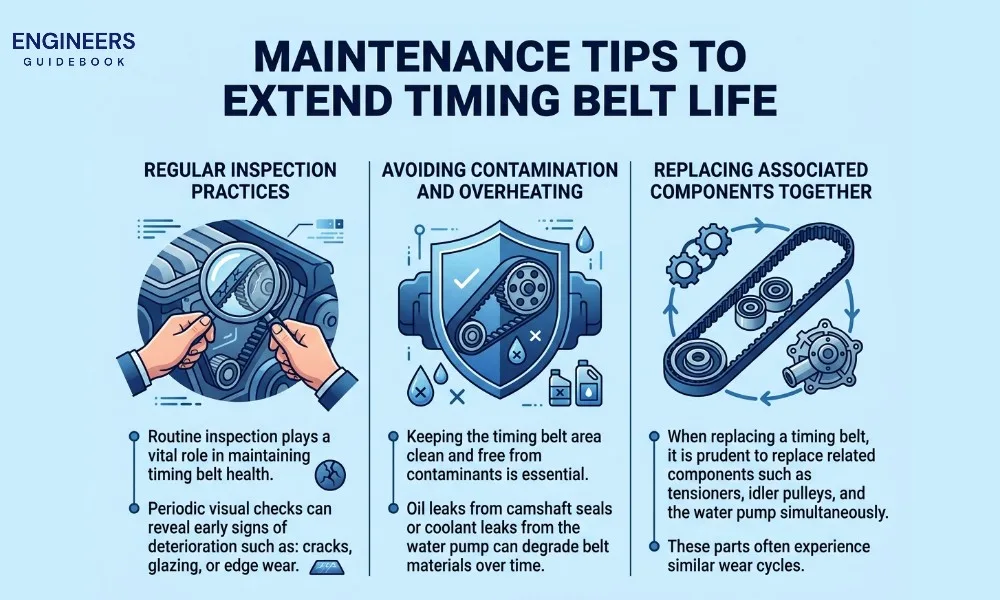
15.1 Regular Inspection Practices
Routine inspection plays a vital role in maintaining timing belt health. Periodic visual checks can reveal early signs of deterioration such as cracks, glazing, or edge wear.
Monitoring engine performance also helps detect timing-related issues early. Unusual noises, reduced efficiency, or irregular idling may indicate developing belt problems that require attention.
15.2 Avoiding Contamination and Overheating
Keeping the timing belt area clean and free from contaminants is essential. Oil leaks from camshaft seals or coolant leaks from the water pump can degrade belt materials over time.
Maintaining proper engine cooling also prevents excessive heat exposure, which accelerates belt aging. A well-maintained cooling system indirectly contributes to longer belt life.
15.3 Replacing Associated Components Together
When replacing a timing belt, it is prudent to replace related components such as tensioners, idler pulleys, and the water pump simultaneously. These parts often experience similar wear cycles.
Replacing them together ensures uniform reliability and prevents future disassembly of the engine for isolated failures. This proactive approach saves time and reduces long-term maintenance costs.
16. Timing Belt vs Timing Chain: Which One is Better?
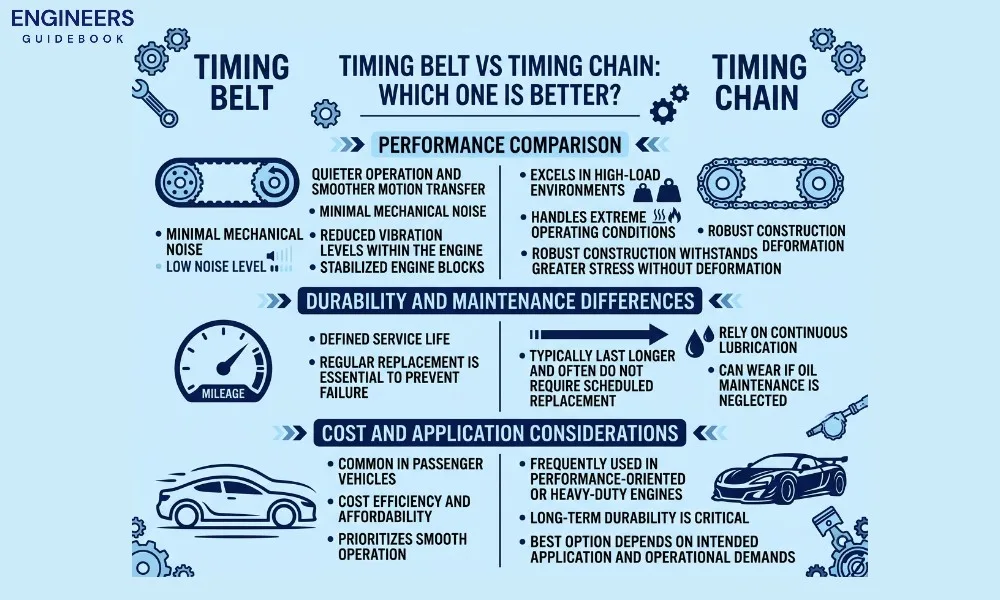
16.1 Performance Comparison
Timing belts offer quieter operation and smoother motion transfer due to their flexible structure. They produce minimal mechanical noise and reduce vibration levels within the engine.
Timing chains, however, excel in high-load environments and can handle extreme operating conditions. Their robust construction allows them to withstand greater stress without deformation.
16.2 Durability and Maintenance Differences
Timing chains typically last longer and often do not require scheduled replacement during the engine’s lifespan. However, they rely on continuous lubrication and can wear if oil maintenance is neglected.
Timing belts, while quieter and lighter, have a defined service life. Regular replacement is essential to prevent failure. Each system has advantages depending on maintenance practices and engine design.
16.3 Cost and Application Considerations
Vehicle manufacturers select timing belts or chains based on engineering objectives such as cost efficiency, noise reduction, and durability requirements. Timing belts are common in passenger vehicles where smooth operation and affordability are priorities.
Timing chains are frequently used in performance-oriented or heavy-duty engines where long-term durability is critical. The best option depends on the intended application and operational demands.
17. Frequently Asked Questions (FAQs)
17.1 How long does a timing belt last?
Most timing belts last between 60,000 and 100,000 kilometers, depending on vehicle design and driving conditions. Some modern belts may last longer due to improved materials and engineering advancements.
Regular maintenance and adherence to manufacturer recommendations ensure optimal service life.
17.2 Can you drive with a bad timing belt?
Driving with a deteriorating timing belt is highly risky. A weakened belt may fail unexpectedly, potentially causing severe engine damage, particularly in interference engines.
Immediate inspection and replacement are recommended once signs of wear appear.
17.3 How much time does replacement take?
Timing belt replacement typically takes between three to six hours, depending on the complexity of the engine and accessibility of components.
Engines with intricate layouts or limited space may require additional time for proper installation and alignment.
17.4 Is timing belt replacement necessary if it looks fine?
Yes, replacement is necessary even if the belt appears visually intact. Internal wear or material fatigue may not be visible externally.
Manufacturers establish replacement intervals based on testing and reliability analysis, making adherence essential for preventing unexpected failure.
18. Conclusion
Timing belts play a crucial role in engine synchronization and overall performance. Their design ensures precise coordination between critical engine components, enabling efficient combustion cycles and smooth operation.
Despite their advantages, timing belts require proper maintenance and timely replacement to avoid costly failures. Understanding their function, limitations, and service requirements is essential for vehicle reliability.