A foundation bolt is a heavy-duty anchoring fastener used to secure machinery, structural steel, towers, tanks, and industrial equipment to concrete foundations. It transfers tensile, shear, vibration, and overturning forces safely into the foundation. Foundation bolts are available in multiple shapes, materials, grades, and anchoring systems to suit different structural loads, environmental conditions, and installation requirements.
1. Foundation Bolt Overview
Foundation bolts form the critical mechanical connection between a structure or machine and its supporting concrete foundation. Although relatively simple in appearance, these fasteners perform an indispensable structural function. They restrain equipment against movement, resist imposed forces, preserve alignment, and help transmit operational loads safely into the supporting foundation.
Foundation bolt design varies considerably according to loading, concrete strength, environmental exposure, installation method, and the geometry of the supported equipment.
2. Types of Foundation Bolts
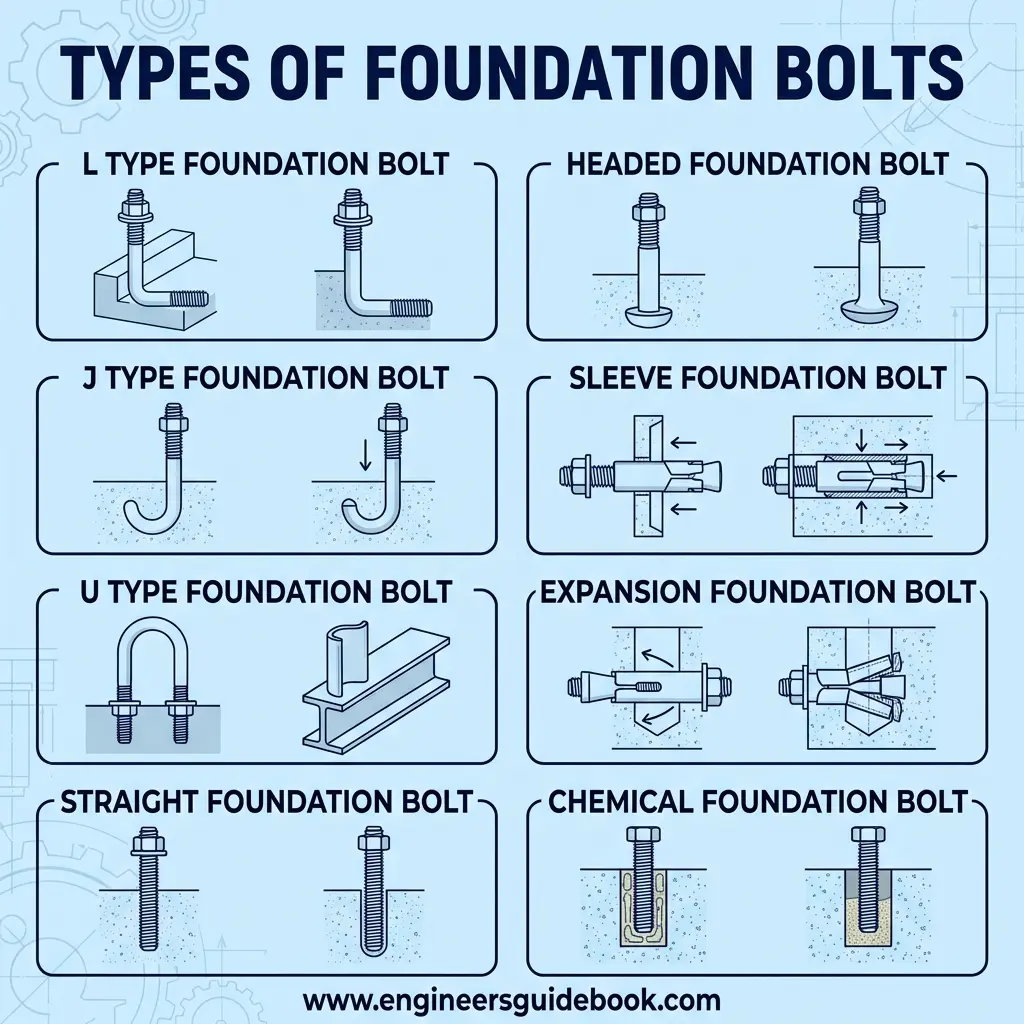
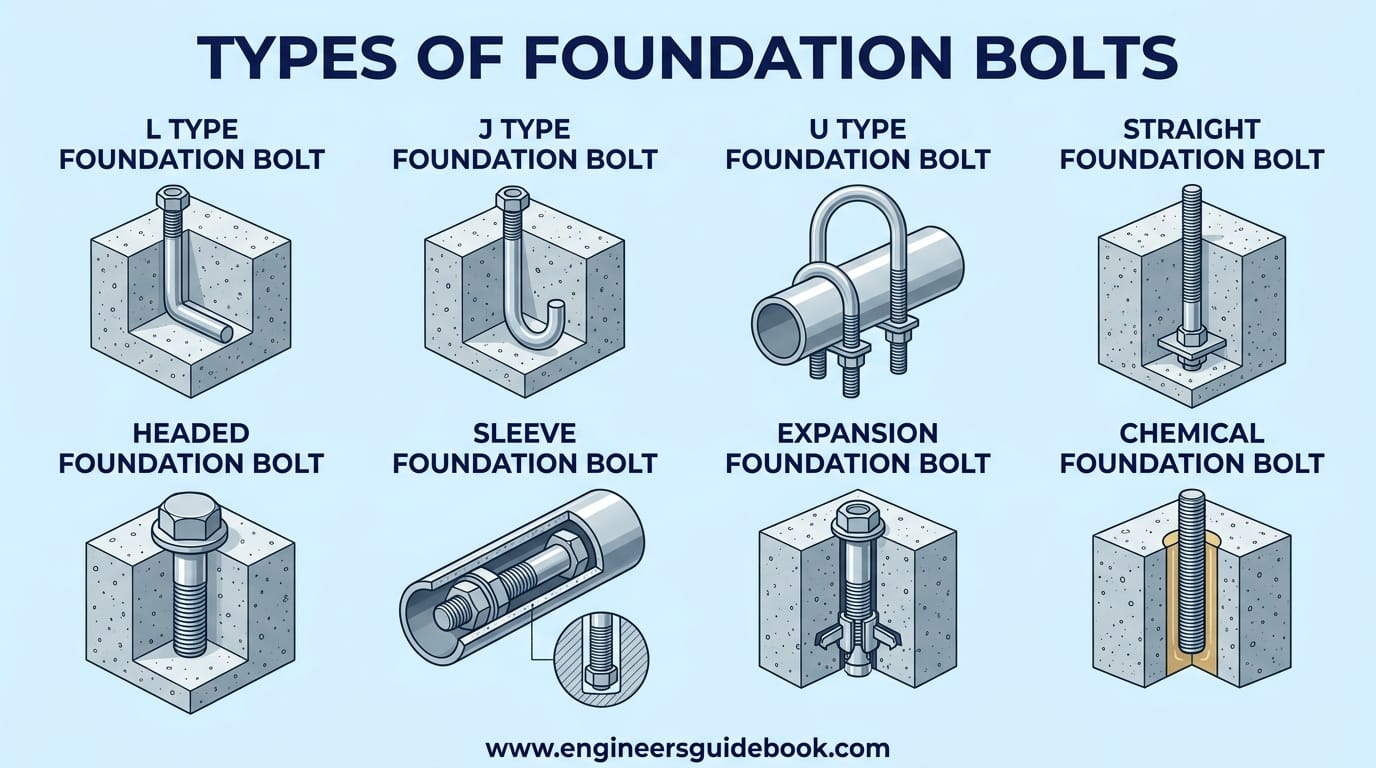
Foundation bolts are manufactured in numerous configurations because no single anchoring arrangement suits every structural or industrial requirement. Their geometry generally reflects how the bolt develops resistance within concrete and whether it is cast in place or installed afterward.
2.1 L Type Foundation Bolt
An L type foundation bolt incorporates a right-angle bend at its embedded end. The bent leg provides mechanical anchorage by bearing against the surrounding concrete.
These bolts are frequently used for machinery bases, structural columns, poles, and general construction applications. Their uncomplicated geometry makes fabrication economical, although sufficient embedment is necessary to develop adequate pullout resistance.
2.2 J Type Foundation Bolt
A J type foundation bolt has a curved lower end resembling the letter J. This hook increases resistance against axial withdrawal after the concrete has hardened.
J bolts are commonly embedded during foundation casting and may secure columns, equipment frames, supports, and light-to-medium structural assemblies. Correct orientation and positioning before concreting are particularly important because adjustment afterward is limited.
2.3 U Type Foundation Bolt
U type foundation bolts consist of a curved body with two parallel threaded legs. Rather than anchoring a single base plate point, their geometry allows them to encompass pipes, beams, or structural members.
They are widely employed for pipe supports, utility installations, equipment restraints, and structural fastening. Their two-threaded-end configuration distributes securing force across a broader attachment arrangement.
2.4 Straight Foundation Bolt
Straight foundation bolts use a linear threaded or partially threaded rod without a hook. Anchorage may be developed through an embedded plate, nut, welded component, adhesive resin, or specially designed anchoring assembly.
Their simple geometry makes them adaptable to substantial embedment depths and heavy-duty foundations. Straight anchor rods are frequently encountered in structural steel construction and industrial equipment installations.
2.5 Headed Foundation Bolt
A headed foundation bolt incorporates an enlarged forged or fabricated head at the embedded end. The head bears mechanically against the concrete and helps prevent the bolt from being pulled from the foundation.
Headed bolts are especially useful where substantial tensile loads must be transferred. Their performance depends on suitable embedment, concrete strength, spacing, and adequate concrete surrounding the head.
2.6 Sleeve Foundation Bolt
A sleeve foundation bolt incorporates a sleeve around part of the anchor assembly. Depending on the system, the sleeve may facilitate adjustment, isolation, or mechanical expansion.
Sleeved arrangements are valuable for machinery installation because positional tolerances can be easier to accommodate than with rigidly embedded bolts. After equipment alignment, the surrounding void may be filled with grout to produce a stable final connection.
2.7 Expansion Foundation Bolt
Expansion foundation bolts are typically installed into drilled holes in hardened concrete. Tightening activates an expansion mechanism that presses the anchor against the walls of the hole.
They are convenient for post-installed applications where cast-in bolts were not provided. However, their capacity depends strongly on concrete condition, hole dimensions, installation torque, spacing, and distance from concrete edges.
2.8 Chemical Foundation Bolt
Chemical foundation bolts use adhesive resin to bond a threaded rod into a drilled hole. Epoxy, vinyl ester, and other engineered resin systems can generate substantial anchoring resistance when installed correctly.
Chemical anchors are useful for retrofit projects, equipment modifications, and situations requiring post-installed anchorage. Hole cleaning, curing temperature, adhesive selection, embedment depth, and installation procedure significantly influence their performance.
3. Foundation Bolt Materials
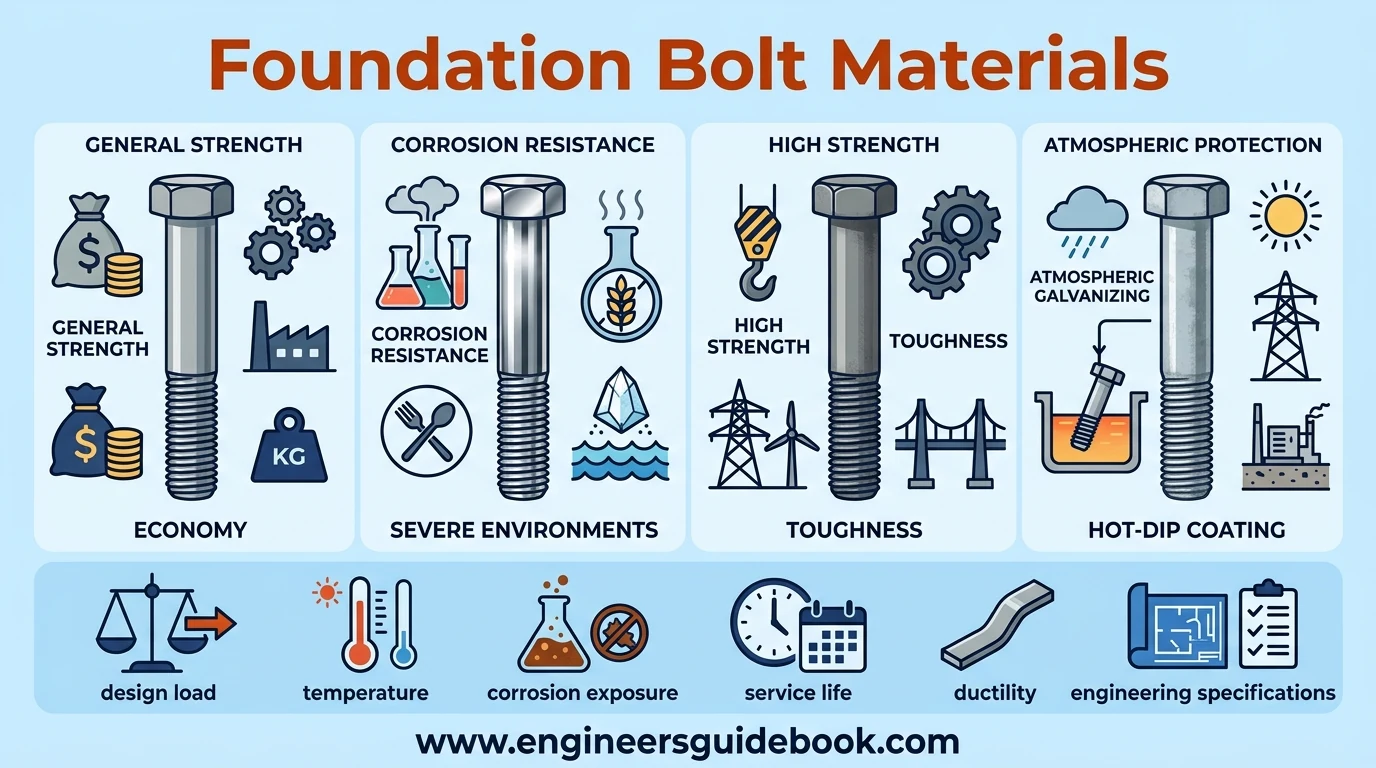
Material selection influences foundation bolt strength, ductility, corrosion resistance, weldability, and service life. Environmental exposure and design loading must therefore be evaluated alongside mechanical strength.
3.1 Carbon Steel
Carbon steel is one of the most prevalent foundation bolt materials because it provides an advantageous combination of strength, machinability, availability, and economy.
Different carbon steel grades can serve ordinary machinery foundations, structural connections, and general industrial applications. Protective coatings may be necessary where moisture or corrosive contaminants are present.
3.2 Stainless Steel
Stainless steel foundation bolts provide enhanced corrosion resistance for aggressive environments. They are frequently specified in chemical plants, food-processing installations, coastal locations, wastewater facilities, and exposed outdoor structures.
Grades such as 304 and 316 are common, with 316 offering improved resistance in chloride-bearing environments. Material selection should nevertheless consider mechanical properties as well as corrosion resistance.
3.3 Alloy Steel
Alloy steel foundation bolts are used when higher strength, improved toughness, or specialized mechanical behavior is required. Alloying elements and heat treatment can substantially increase tensile and yield properties.
Such bolts may be appropriate for heavy industrial machinery, energy infrastructure, large structural systems, and highly loaded anchorages.
3.4 Galvanized Foundation Bolts
Galvanized foundation bolts receive a zinc coating that protects the underlying steel from atmospheric corrosion. Hot-dip galvanizing is commonly employed for outdoor structural applications, transmission infrastructure, towers, and exposed equipment foundations.
Coating thickness can influence thread fit, so compatible galvanized nuts and appropriate thread allowances are important during specification.
3.5 Material Selection Factors
Foundation bolt material should be selected according to design load, temperature, corrosion exposure, expected service life, required ductility, coating compatibility, and applicable engineering specifications.
Higher strength alone does not necessarily indicate a superior solution. Excessively high-strength material may introduce different toughness, hydrogen embrittlement, or fabrication considerations. A balanced specification considers the entire anchorage system.
4. Foundation Bolt Standards and Specifications
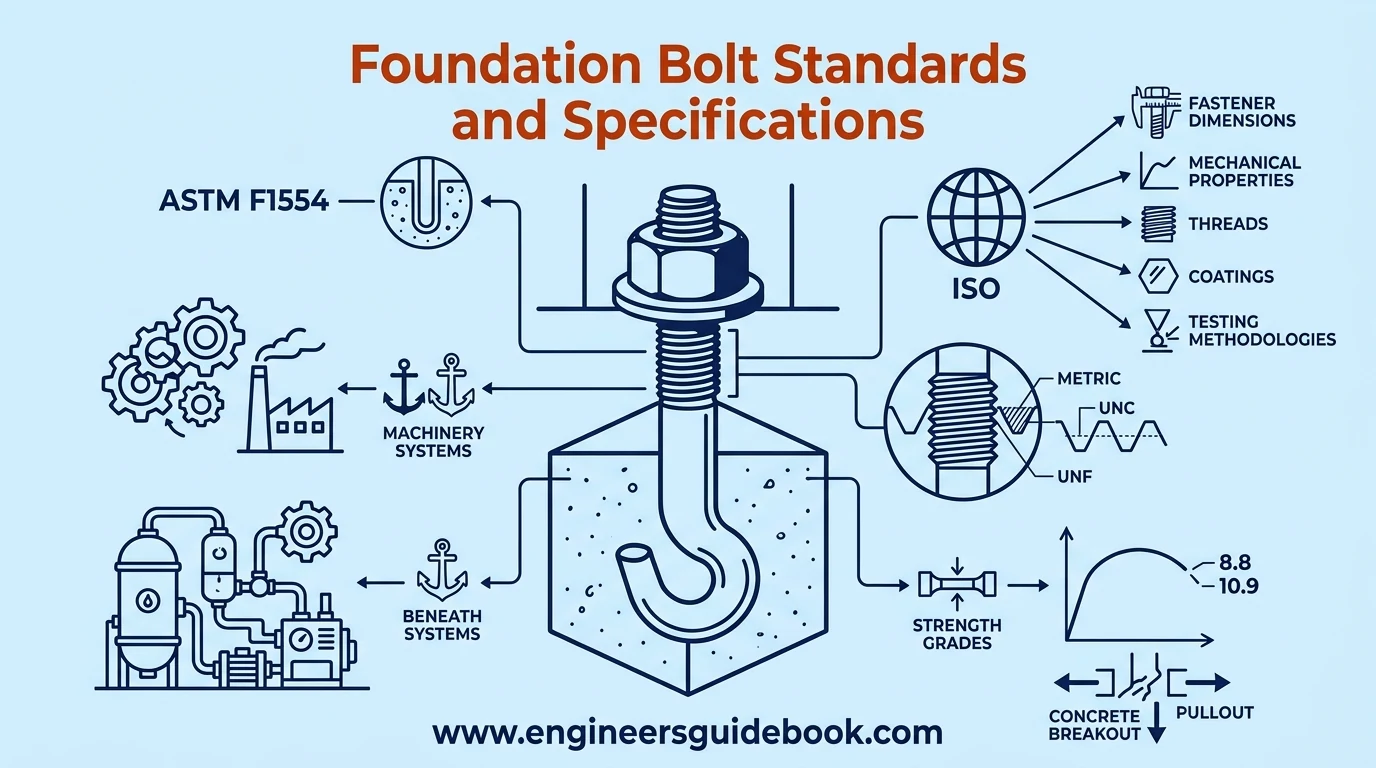
Engineering standards provide consistent requirements for materials, dimensions, mechanical properties, threads, testing, and identification. The applicable standard depends on project location, structural design methodology, and bolt configuration.
4.1 ASTM Standards
ASTM specifications are widely referenced for anchor rods and structural fastening materials. ASTM F1554 is particularly associated with anchor bolts intended to anchor structural supports to concrete foundations.
Different grades provide distinct yield-strength requirements, allowing designers to match bolt properties with structural loading and connection demands.
4.2 ISO Standards
ISO standards establish internationally recognized requirements for fastener dimensions, mechanical properties, threads, coatings, and testing methodologies.
Foundation bolt assemblies may reference multiple ISO standards rather than a single universal anchor-bolt specification. Engineers should therefore identify the relevant material, thread, dimensional, and mechanical-property standards separately.
4.3 DIN Standards
DIN specifications are frequently encountered in European-origin machinery and structural systems. Certain traditional anchor bolt shapes and fastener dimensions are associated with DIN requirements.
Where DIN bolts are specified, engineers should verify dimensional compatibility, material grade, threads, and any corresponding EN or ISO standards applicable to contemporary procurement.
4.4 ASME Standards
ASME standards primarily govern mechanical engineering systems such as pressure equipment, piping, and associated components. Foundation bolts used beneath such equipment may be influenced by project specifications developed around ASME-designed machinery or systems.
However, anchor design usually requires coordination with structural and material standards rather than assuming that an ASME designation alone defines the complete foundation bolt.
4.5 Thread Standards
Foundation bolts may use metric ISO threads or Unified threads such as UNC and UNF. Coarse threads are common because they are robust, easier to assemble, and comparatively tolerant of contamination encountered during construction.
Thread diameter, pitch, engagement length, tolerances, and coating must correspond with the specified nut to ensure proper load transfer.
4.6 Strength Grades
Strength grade indicates important mechanical properties of the bolt material, including yield and tensile strength. Metric fasteners may be identified using property classes, while ASTM anchor rods use designated grades.
Designers must ensure that bolt strength corresponds with the intended load while also verifying concrete breakout, pullout, and other anchorage limit states.
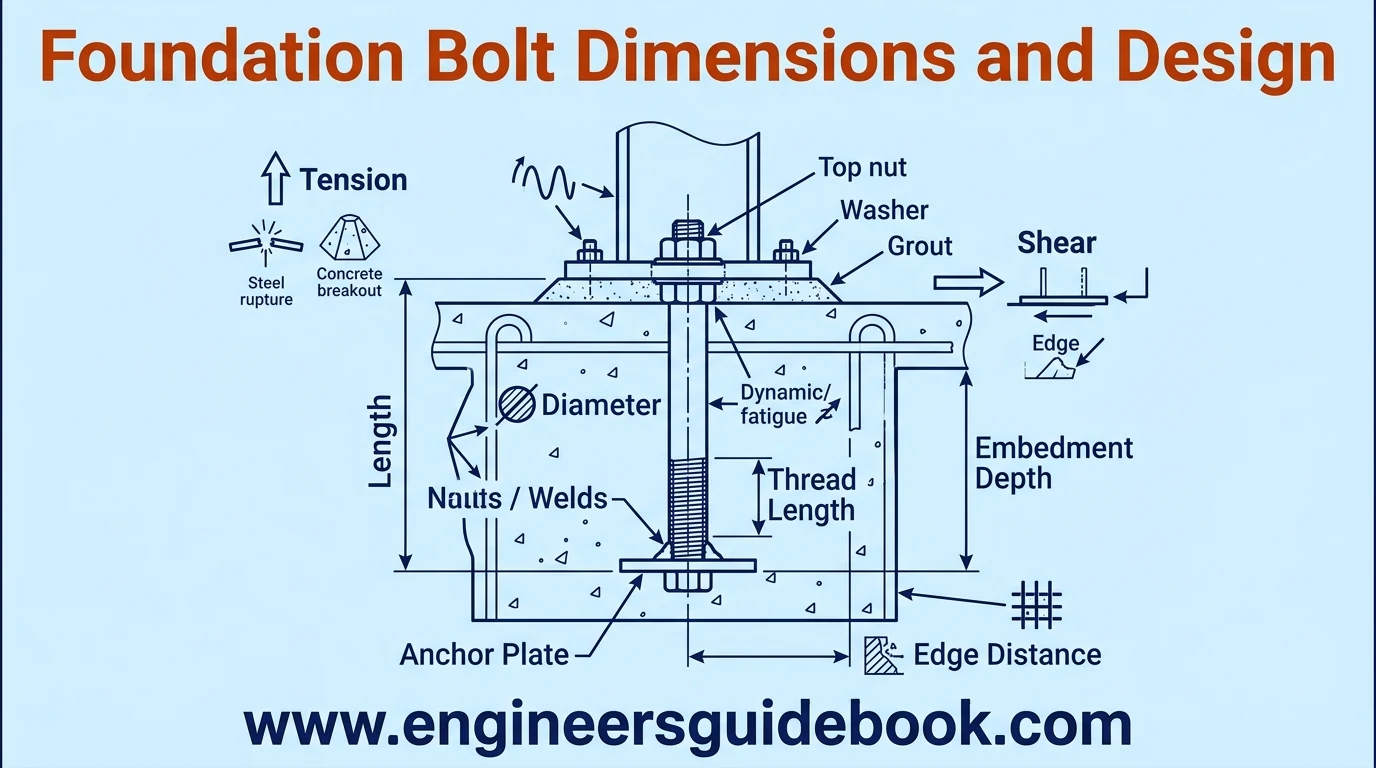
5. Foundation Bolt Dimensions and Design
Foundation bolt dimensions cannot be determined from equipment weight alone. Anchor geometry must reflect tensile forces, shear forces, concrete characteristics, base plate configuration, and installation constraints.
5.1 Bolt Diameter
Bolt diameter strongly affects tensile and shear capacity. Larger diameters provide greater steel cross-sectional area but also require suitable base plate holes, edge distances, spacing, and embedment.
Diameter selection should therefore follow engineering load calculations rather than arbitrary oversizing.
5.2 Bolt Length
Overall bolt length includes the embedded portion, projection above the concrete, base plate thickness, washer, nut, and any allowance required for leveling or grouting.
Insufficient projection can prevent proper nut engagement, whereas excessive projection may interfere with equipment or create unnecessary exposure.
5.3 Thread Length
Thread length must accommodate the base plate, washers, nuts, and installation tolerances while maintaining adequate engagement.
Threads should be positioned carefully so that critical shear planes do not inadvertently pass through reduced threaded sections where the design requires a full bolt shank.
5.4 Embedment Depth
Embedment depth is a fundamental parameter governing anchorage performance. Greater depth can increase resistance to pullout and concrete breakout, although capacity does not increase indefinitely without regard to concrete geometry.
Required embedment depends on anchor type, load direction, concrete strength, bolt diameter, and surrounding reinforcement.
5.5 Edge Distance
Edge distance is the spacing between an anchor bolt and the nearest free edge of concrete. Bolts installed too close to an edge can produce cracking, splitting, or premature concrete breakout.
Adequate edge distance is particularly important for anchors subjected to substantial tensile or lateral loads.
5.6 Anchor Plate Design
Anchor plates are attached to the embedded ends of straight anchor rods to develop mechanical bearing against concrete. Plate dimensions and thickness must provide adequate load distribution without excessive deformation.
The plate, welds or nuts, bolt, and surrounding concrete should function collectively as a coherent anchorage system.
5.7 Load Capacity Considerations
Foundation bolt capacity depends on more than the tensile strength of the steel. Potential failure modes include steel rupture, concrete breakout, pullout, pryout, edge failure, and combined tension-shear interaction.
Dynamic machinery may introduce fatigue and vibration effects as well. Reliable design requires evaluation of the complete load path rather than considering the anchor rod in isolation.
6. Foundation Bolt Applications
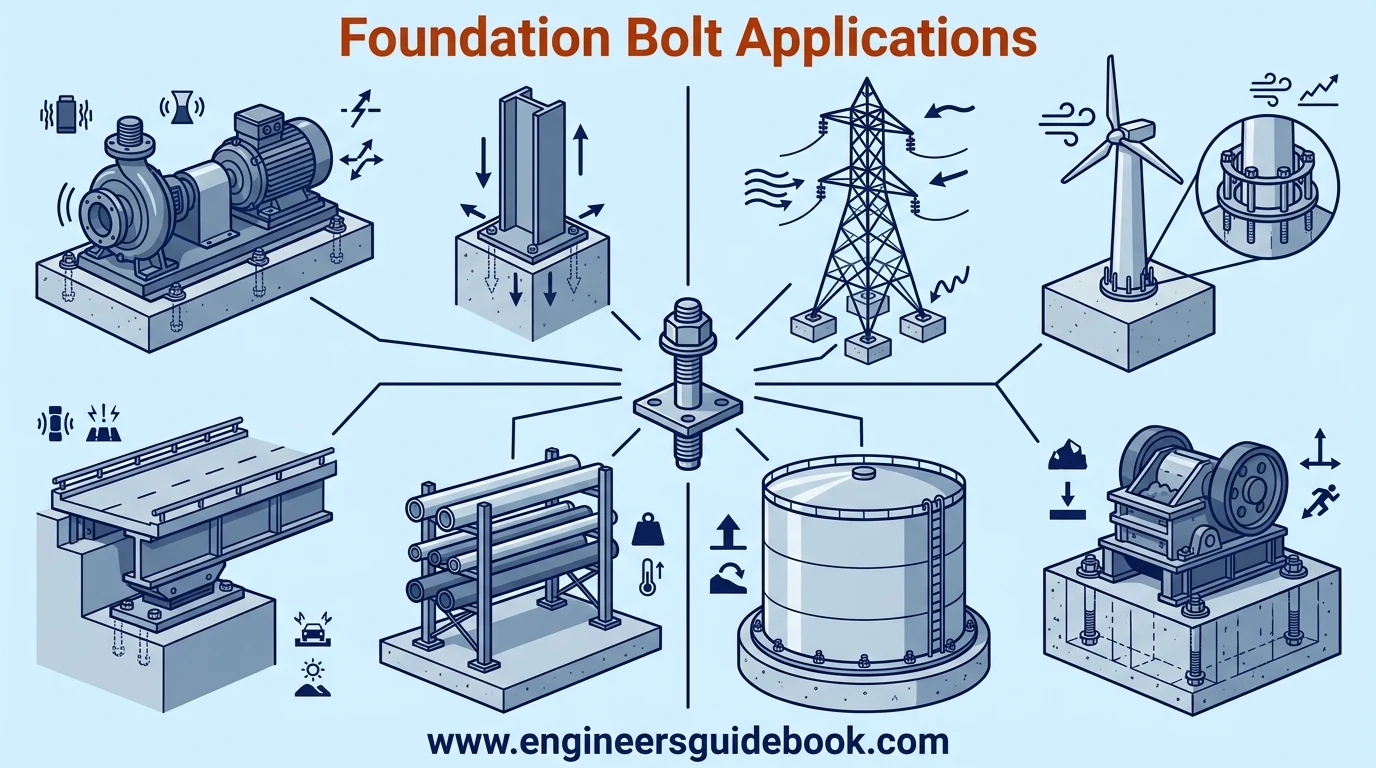
Foundation bolts are used wherever equipment or structures require dependable attachment to concrete. Their configuration changes according to operating forces, structural geometry, environmental exposure, and installation precision.
6.1 Industrial Machinery
Pumps, compressors, motors, gearboxes, presses, mixers, and production machinery commonly rely on foundation bolts. These installations may experience vibration, torque, and repeated dynamic loading.
Accurate bolt positioning is vital because machinery alignment and coupling performance can depend on foundation geometry.
6.2 Steel Structures
Structural columns are frequently secured to reinforced concrete foundations through base plates and anchor rods. Foundation bolts stabilize columns during erection and subsequently transfer tension and shear between the structural frame and foundation.
6.3 Transmission Towers
Electrical transmission towers use anchor bolts to transfer substantial wind, overturning, and structural forces into concrete foundations. Corrosion protection and fatigue resistance become important because these installations remain exposed for extended service periods.
6.4 Wind Turbines
Wind turbine towers impose high cyclic, tensile, and overturning loads on their foundations. Large anchor bolt assemblies are therefore designed to maintain secure tower-to-foundation connections under repeated wind-induced loading.
Installation precision and controlled bolt tensioning are particularly important.
6.5 Bridges
Foundation and anchor bolts are utilized in bridge bearings, structural supports, railings, equipment, and specialized connections. These anchors may experience vibration, traffic-induced cyclic loading, temperature variations, and environmental exposure.
Durability and corrosion protection consequently become significant design considerations.
6.6 Pipe Supports
Pipe racks, guides, shoes, equipment skids, and structural pipe supports are frequently anchored to concrete using foundation bolts.
Anchors may need to accommodate forces produced by pipe weight, thermal expansion, pressure thrust, vibration, and occasional loading.
6.7 Storage Tanks
Storage tank foundations often incorporate anchor bolts around the tank perimeter. These bolts help resist overturning, uplift, wind loads, and other forces acting on the tank shell and base connection.
Bolt quantity, diameter, arrangement, corrosion resistance, and anchorage details depend on tank geometry and structural design requirements.
6.8 Heavy Equipment Foundations
Generators, crushers, turbines, large compressors, industrial presses, and other heavy equipment require robust anchoring systems. Their foundation bolts may encounter substantial static and dynamic forces.
Proper embedment, bolt preload, grout quality, base plate stiffness, and foundation integrity collectively determine whether the equipment remains stable and aligned throughout its operational life.
7. Foundation Bolt Installation Guide
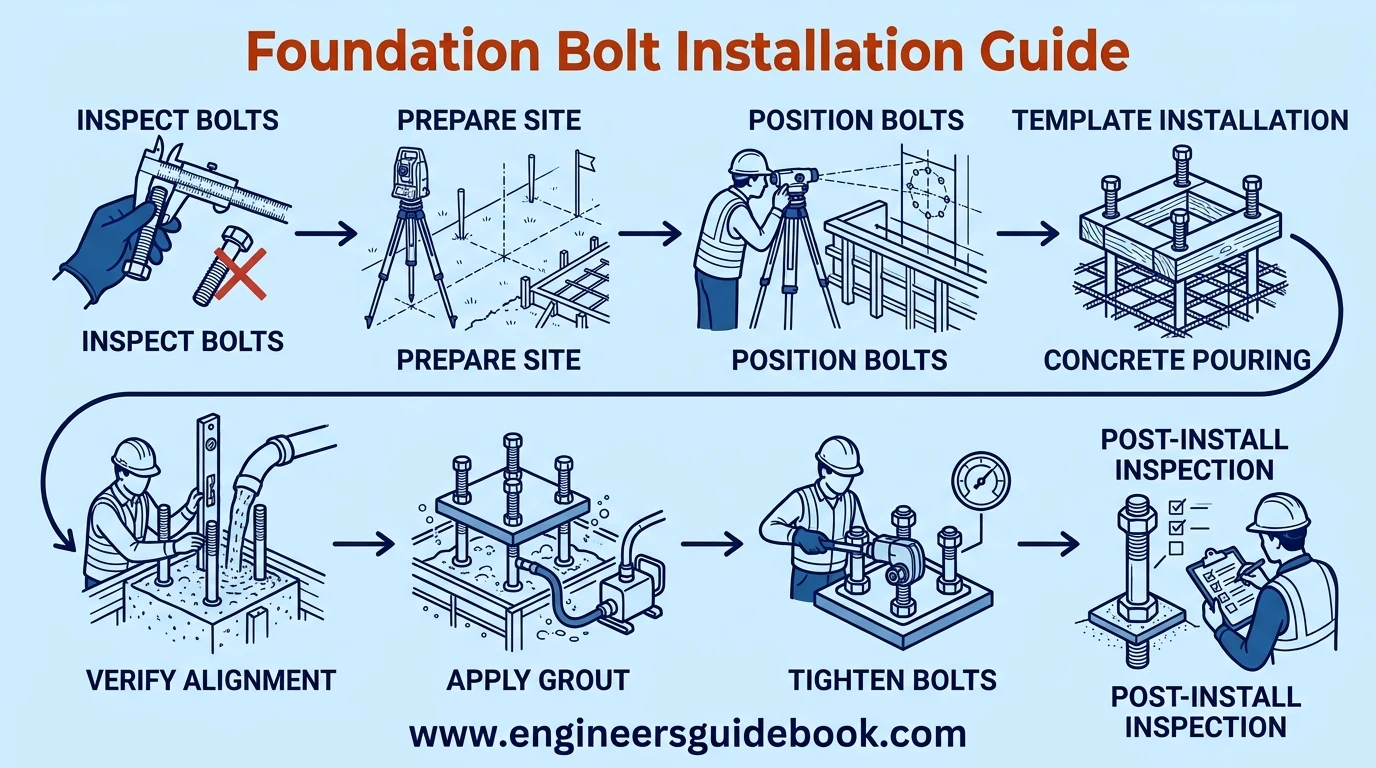
Correct foundation bolt installation is essential for structural stability, machinery alignment, and long-term anchorage reliability. Even a high-strength bolt can perform poorly if positioned inaccurately, embedded insufficiently, or tightened before concrete and grout have developed adequate strength.
Installation should therefore follow approved drawings, specified tolerances, manufacturer recommendations, and project procedures.
7.1 Pre Installation Inspection
Before installation begins, foundation bolts should be inspected for diameter, length, thread condition, material grade, coating, straightness, and identification markings. Nuts and washers should also be checked for compatibility.
Damaged threads, excessive corrosion, bent shanks, or incorrect bolt grades should be rejected before placement. Comparing supplied bolts with structural drawings prevents costly corrections after concrete pouring.
7.2 Site Preparation
The foundation area should be clean, accessible, and properly surveyed. Reinforcement, formwork, embedded plates, conduits, and other construction elements must be reviewed for potential interference with the anchorage arrangement.
Reference centerlines and elevation points should be clearly established. Good preparation reduces positional errors and allows bolts to remain stable during concrete placement.
7.3 Bolt Positioning
Foundation bolts must be positioned according to the approved bolt layout. Center-to-center spacing, projection height, orientation, and edge distance require particular attention.
Minor displacement can create serious difficulties when a machine base or structural column is lowered onto the foundation. Surveying instruments, measuring tapes, levels, and calibrated reference points are commonly used to confirm position.
7.4 Template Installation
Bolt templates are frequently used to maintain the exact geometry of multiple foundation bolts. A rigid template holds the bolts at their required spacing and orientation while concrete is placed.
Templates should be adequately supported so they cannot rotate, sag, or shift under vibration and construction activity. For large machinery bases, template accuracy can significantly influence subsequent equipment alignment.
7.5 Concrete Pouring
Concrete should be placed carefully around embedded bolts to avoid displacement and the formation of voids. Excessive direct impact from concrete discharge can move poorly supported anchors.
Proper consolidation is important around bolt hooks, heads, and anchor plates. However, vibration equipment should be operated carefully because aggressive contact with the bolt assembly may disturb alignment.
7.6 Alignment Verification
Bolt position should be checked before, during, and immediately after concrete placement. Verification typically includes spacing, verticality, projection, centerline location, and elevation.
Correcting a small deviation before the concrete hardens is considerably easier than modifying a hardened foundation. Final survey records are particularly useful for large structural or equipment foundations.
7.7 Grouting Process
After machinery or structural base plates are positioned and aligned, the gap beneath the plate is commonly filled with grout. Cementitious or epoxy grout may be selected depending on loading and equipment requirements.
The substrate should be properly prepared, and air pockets must be avoided. Effective grouting provides uniform bearing, transfers compressive forces, and supports the base plate against vibration and localized deformation.
7.8 Final Tightening
Final tightening should occur only after the concrete and grout have achieved the strength required by the project procedure. Nuts may be tightened using specified torque values, tensioning equipment, or another approved preload method.
Overtightening can overstress bolts or damage surrounding concrete, while insufficient tightening can permit movement and loss of alignment.
8. Foundation Bolt Testing and Inspection
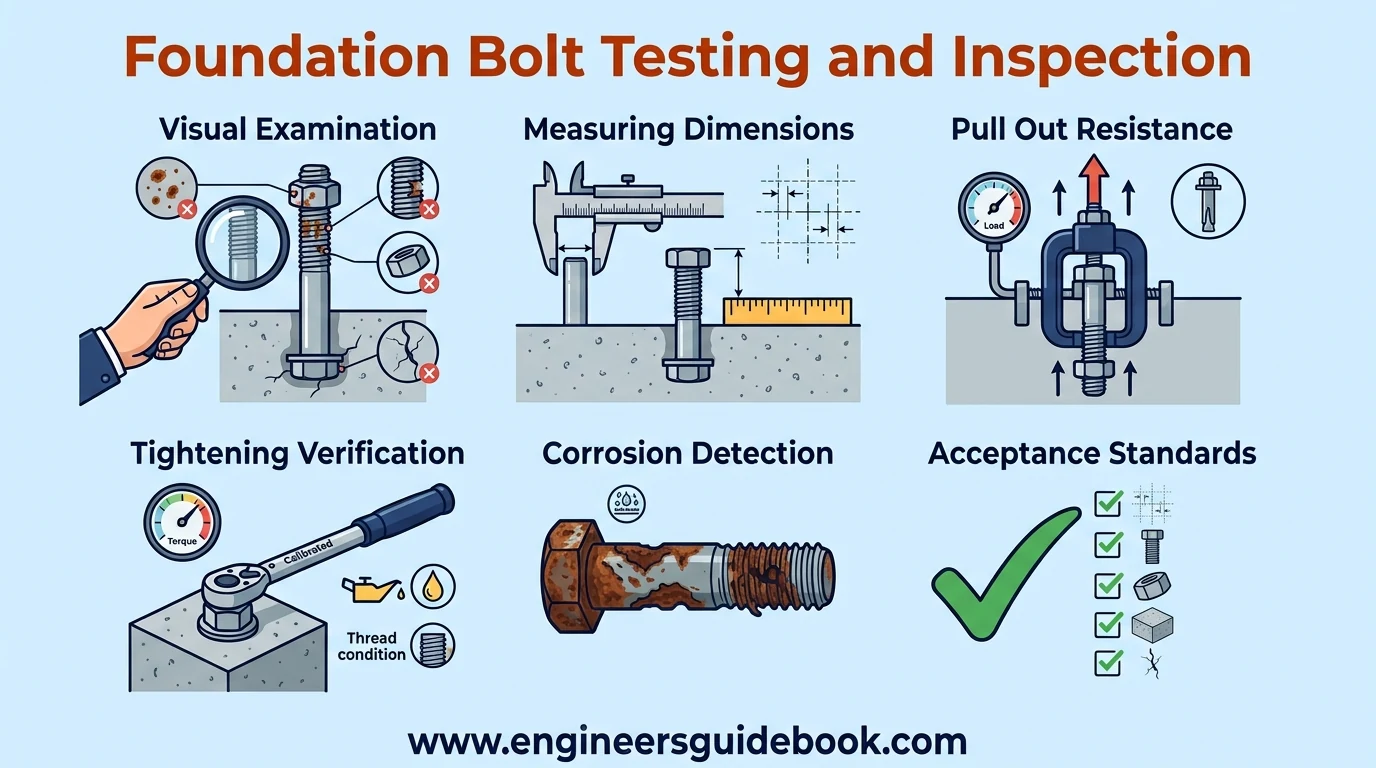
Inspection confirms that foundation bolts satisfy dimensional, structural, and installation requirements. The required inspection intensity depends on anchor type, service conditions, project criticality, and governing specifications.
8.1 Visual Inspection
Visual inspection identifies obvious defects such as corrosion, damaged threads, bent bolts, loose nuts, cracked grout, missing washers, and coating deterioration.
Inspectors should also look for displacement, concrete cracking, or signs of movement around the base plate. These seemingly minor indications can reveal developing anchorage problems.
8.2 Dimensional Inspection
Dimensional inspection verifies bolt diameter, projection, spacing, alignment, thread length, and location relative to reference centerlines.
For equipment foundations, positional tolerances may be stringent because bolt-hole mismatch can obstruct installation or compromise machinery alignment.
8.3 Pull Out Testing
Pull out testing applies controlled tensile force to an installed anchor to evaluate anchorage performance. It is particularly relevant to post-installed mechanical and chemical anchors.
The test load and acceptance procedure should be defined by the applicable design documents or approved testing specification. Excessive testing loads should not be applied arbitrarily because they may damage the anchor or concrete.
8.4 Torque Testing
Torque testing may be used to verify that nuts or mechanical anchors have been tightened according to specified requirements.
A calibrated torque wrench is normally required. Since friction affects the relationship between torque and bolt tension, lubrication, coatings, thread condition, and manufacturer instructions must be considered.
8.5 Corrosion Inspection
Corrosion inspection focuses on exposed threads, nuts, washers, and interfaces where water or chemicals can accumulate.
Rust staining, pitting, coating failure, and section loss should be assessed carefully. In aggressive environments, concealed portions of the anchorage may also require specialized evaluation.
8.6 Common Acceptance Criteria
Typical acceptance criteria include correct bolt location, adequate projection, undamaged threads, compliant material grade, satisfactory coating, proper nut engagement, sound grout, and absence of unacceptable concrete cracking.
Testing results should meet project-specific requirements rather than relying solely on general visual judgment.
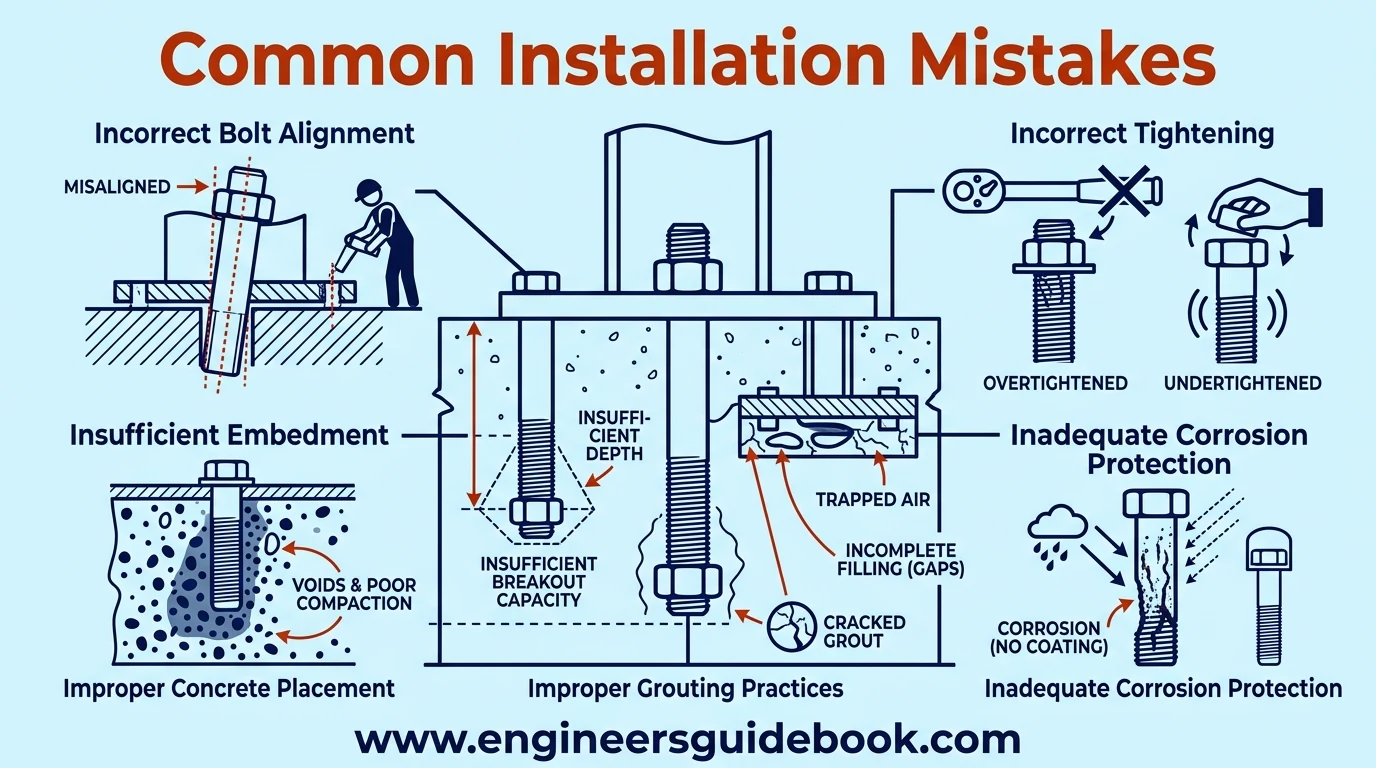
9. Common Installation Mistakes
Foundation bolt failures often originate from installation deficiencies rather than insufficient bolt strength. Accurate planning and quality control can prevent many common problems.
9.1 Incorrect Bolt Alignment
Misaligned bolts may prevent a base plate from fitting or force installers to enlarge bolt holes unnecessarily. Severe misalignment can also introduce eccentric loading.
Rigid templates and repeated survey checks are effective methods of controlling this problem.
9.2 Insufficient Embedment
Insufficient embedment reduces the concrete volume available to resist pullout and breakout forces. Increasing bolt diameter cannot automatically compensate for inadequate anchorage depth.
Embedment should always conform to the engineered design.
9.3 Improper Concrete Placement
Poor concrete consolidation can leave voids around embedded anchors, plates, or hooks. Segregation and inadequate compaction may further weaken the surrounding anchorage zone.
Concrete should therefore be placed and consolidated without disturbing bolt position.
9.4 Incorrect Tightening
Both overtightening and undertightening are undesirable. Excessive preload can damage threads or overstress components, while inadequate preload may permit vibration-induced loosening.
Specified tightening procedures and calibrated tools should be used for critical connections.
10. Maintenance and Replacement
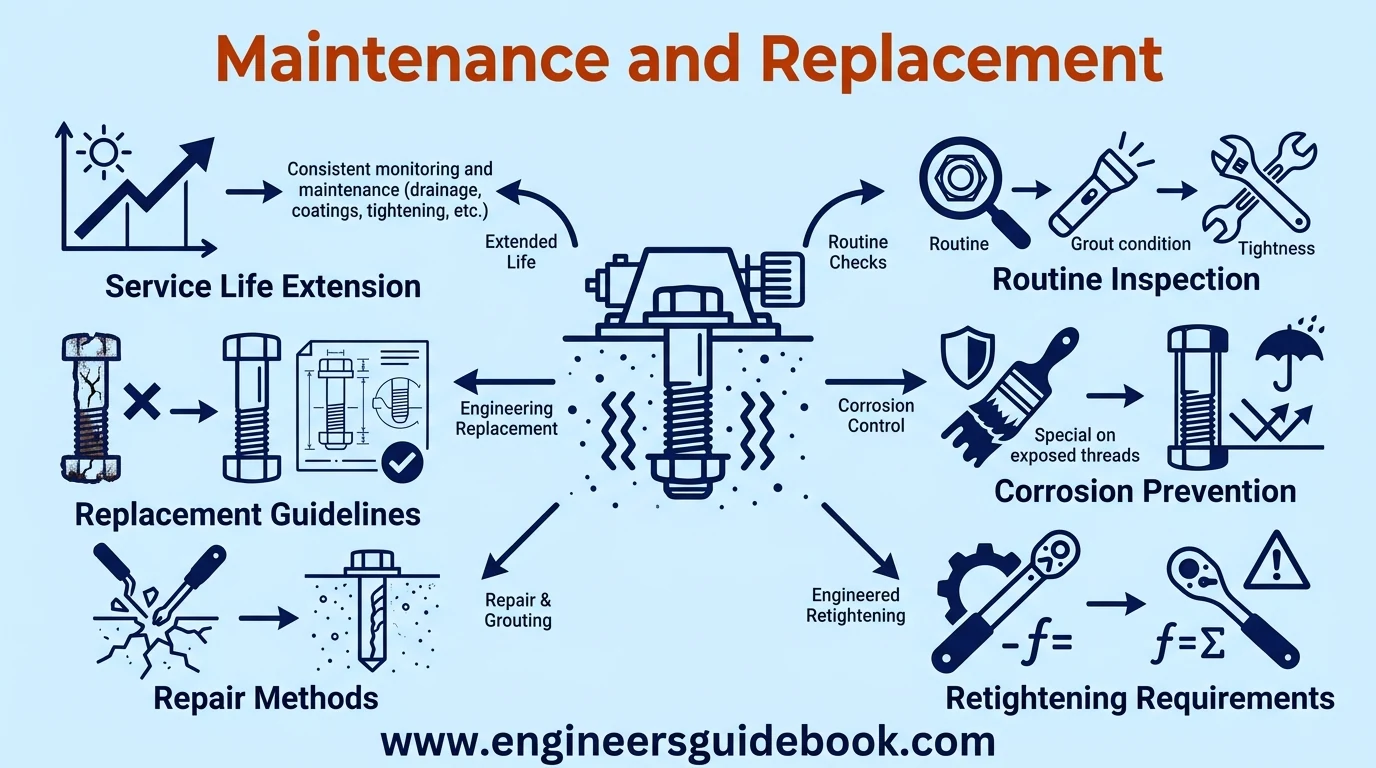
Foundation bolts require periodic attention, particularly when supporting vibrating machinery, outdoor structures, or equipment operating in chemically aggressive environments.
10.1 Routine Inspection Schedule
Inspection intervals should reflect equipment criticality, vibration levels, environmental exposure, and previous maintenance history.
Routine checks may include nut tightness, corrosion, grout condition, base plate movement, cracking, and bolt deformation.
10.2 Corrosion Prevention
Corrosion can be controlled through galvanizing, protective coatings, corrosion-resistant alloys, sealants, and appropriate drainage.
Exposed threads should receive particular attention because damaged coatings and retained moisture frequently accelerate deterioration in this region.
10.3 Retightening Requirements
Foundation bolts should not automatically be retightened at arbitrary intervals. Retightening should follow equipment procedures, engineering recommendations, or inspection findings.
Repeated uncontrolled tightening can gradually increase preload beyond the intended level.
10.4 Repair Methods
Repair options depend on the type and severity of damage. Loose nuts may require controlled retightening, while degraded grout can sometimes be removed and replaced.
More serious anchorage defects may require engineered solutions such as supplemental anchors, resin systems, modified base plates, or concrete rehabilitation.
10.5 Replacement Guidelines
Replacement becomes necessary when bolts suffer significant corrosion, cracking, permanent deformation, thread damage, or loss of structural capacity.
Because embedded bolts can be difficult to remove, replacement methods should be developed by competent engineering personnel rather than improvised on site.
10.6 Service Life Extension
Service life can be extended through proper drainage, corrosion protection, controlled tightening, vibration monitoring, grout maintenance, and early correction of deterioration.
Regular inspection is usually less expensive than repairing a failed anchorage after equipment movement or structural damage occurs.
11. Frequently Asked Questions
11.1 What Is the Difference Between a Foundation Bolt and an Anchor Bolt
The terms are frequently used interchangeably. Foundation bolt generally describes an anchor used to secure machinery or structural components to a foundation, while anchor bolt is the broader term covering many types of concrete anchorage.
11.2 How Deep Should a Foundation Bolt Be Embedded
There is no universal embedment depth. Required depth depends on bolt diameter, anchor configuration, concrete strength, tension and shear loads, spacing, edge distance, and the applicable design method.
11.3 Which Material Is Best for Foundation Bolts
Carbon steel is economical for general applications, stainless steel offers superior corrosion resistance, and alloy steel may be appropriate for high-strength requirements. The best material depends on loading and environmental exposure.
11.4 How Do You Install Foundation Bolts Correctly
Correct installation requires accurate positioning, adequate embedment, secure templates, careful concrete placement, alignment verification, proper grouting, controlled tightening, and final inspection.
11.5 Can Foundation Bolts Be Reused
Reuse depends on the bolt type, condition, previous loading, deformation, corrosion, and project requirements. Critical anchors should not be reused without engineering evaluation.
11.6 How Are Foundation Bolt Sizes Selected
Bolt size is selected by calculating tensile, shear, combined loading, and applicable concrete failure modes. Base plate geometry, embedment depth, spacing, and material strength must also be considered.
11.7 What Causes Foundation Bolts to Fail
Common causes include inadequate embedment, excessive loading, fatigue, corrosion, poor concrete quality, incorrect tightening, misalignment, deficient grout, and improper installation.
11.8 How Often Should Foundation Bolts Be Inspected
Inspection frequency depends on service conditions. High-vibration machinery, corrosive environments, and critical structures generally require more frequent checks than lightly loaded indoor installations.
12. Conclusion
Foundation bolts are fundamental components of structural and machinery anchorage systems. Their performance depends on coordinated design, material selection, installation, inspection, and maintenance.
A reliable foundation bolt system requires appropriate bolt type, material, strength grade, embedment, spacing, corrosion protection, and installation accuracy.
Use approved drawings, verify dimensions before concrete placement, maintain accurate alignment, protect threads, apply suitable grout, follow controlled tightening procedures, and document critical inspection results.