1. Introduction to Tapered Roller Bearings
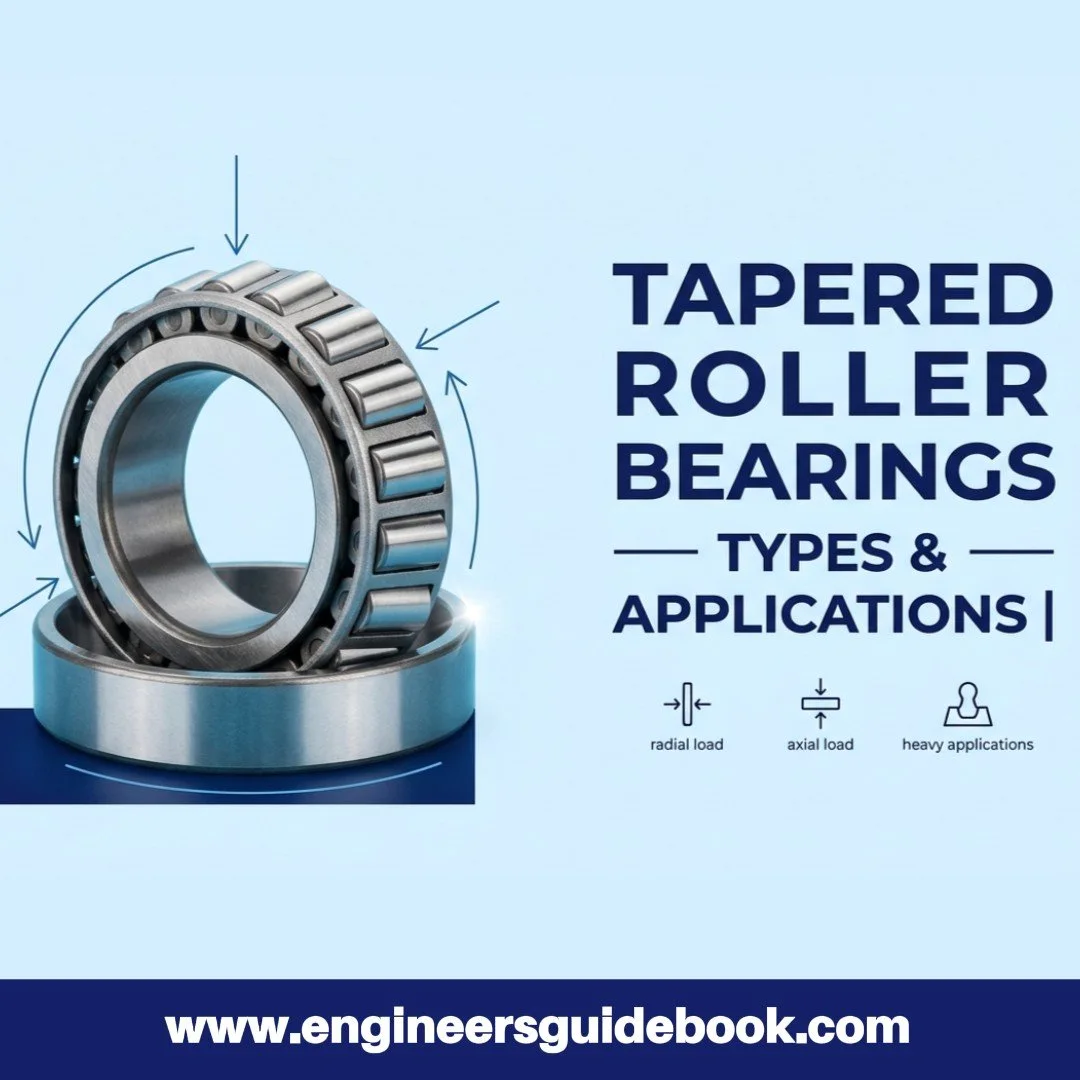
Tapered roller bearings are specialized rolling-element bearings designed to handle both axial and radial loads simultaneously.
Their unique conical geometry allows them to distribute stress evenly across the bearing components, enhancing durability and reducing wear.
In modern mechanical systems, they are indispensable for ensuring smooth motion, reducing friction, and maintaining alignment under high-load conditions. From automotive axles to industrial machinery, these bearings play a pivotal role in performance and reliability.
1.1 Why are these bearings widely used in heavy-duty
The combination of high load capacity, precise alignment capability, and robustness makes tapered roller bearings ideal for heavy-duty applications. Their design allows for precise control of preload and clearance, which is critical in precision machinery.
This makes them suitable for automotive gearboxes, railway axles, and high-performance industrial equipment where both durability and precision are paramount.
2. What Are Tapered Roller Bearings?
2.1 Basic definition and core concept
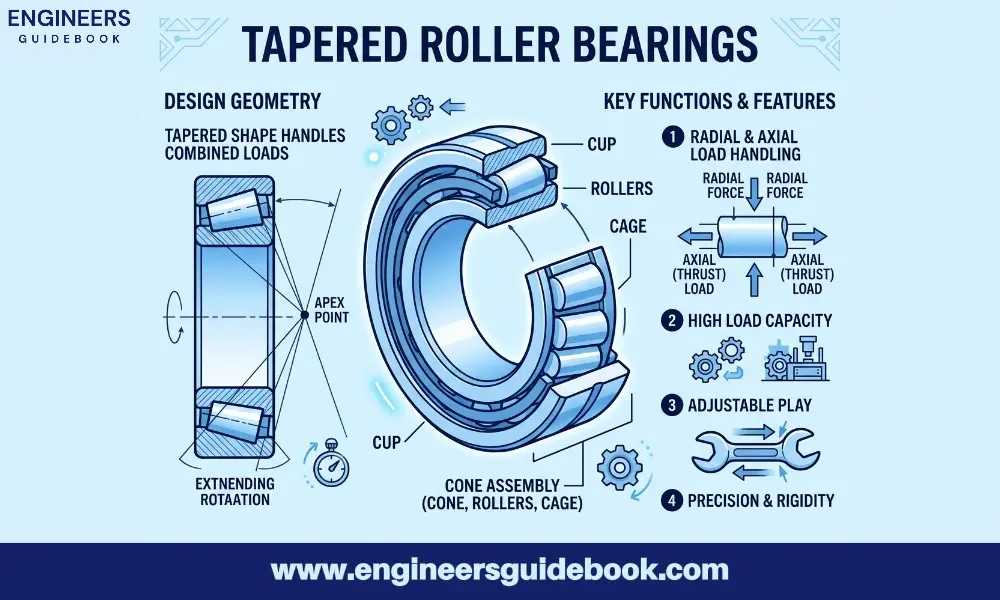
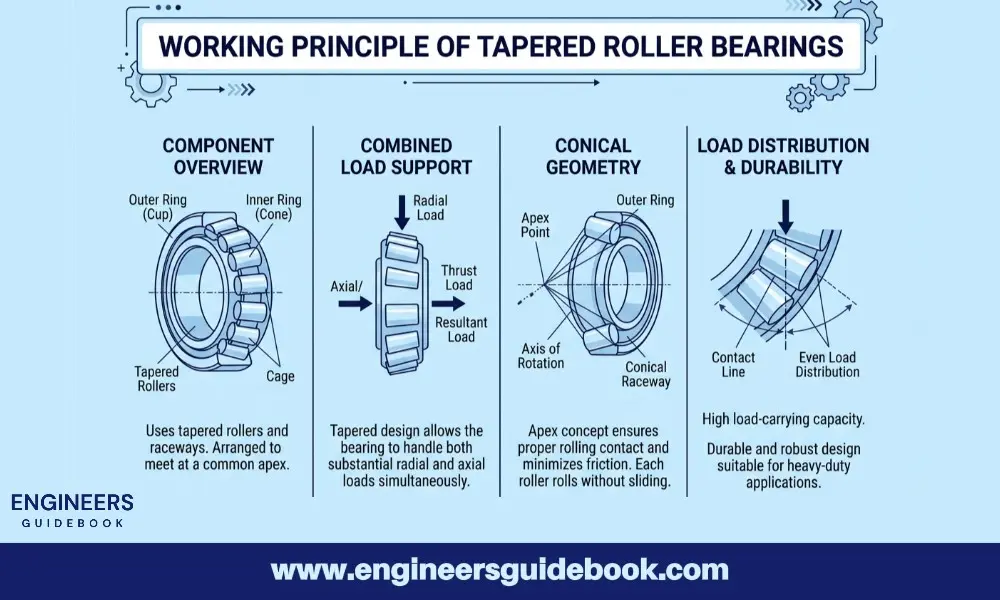
A tapered roller bearing consists of tapered inner and outer ring raceways, along with tapered rolling elements positioned between them. This geometry enables the bearing to support axial and radial loads simultaneously.
Unlike cylindrical or ball bearings, tapered roller bearings are engineered to handle substantial combined forces, making them uniquely versatile in demanding mechanical environments.
2.2 How they differ from other rolling element bearings
Unlike ball bearings, which primarily support radial loads, or cylindrical roller bearings, which excel in radial capacity but have limited axial support, tapered roller bearings provide a balanced solution.
Their conical rollers align along a common apex point, distributing loads more evenly and reducing edge stresses. This allows for greater durability under high axial and radial stress conditions.
Also Read Similar Topics:
Types of Roller Bearings |Classification and Applications|
How to Choose the Right Bearing |Step-by-Step Selection Guide|
Thrust Bearing | Types, Features and Applications|
3. Construction and Key Components
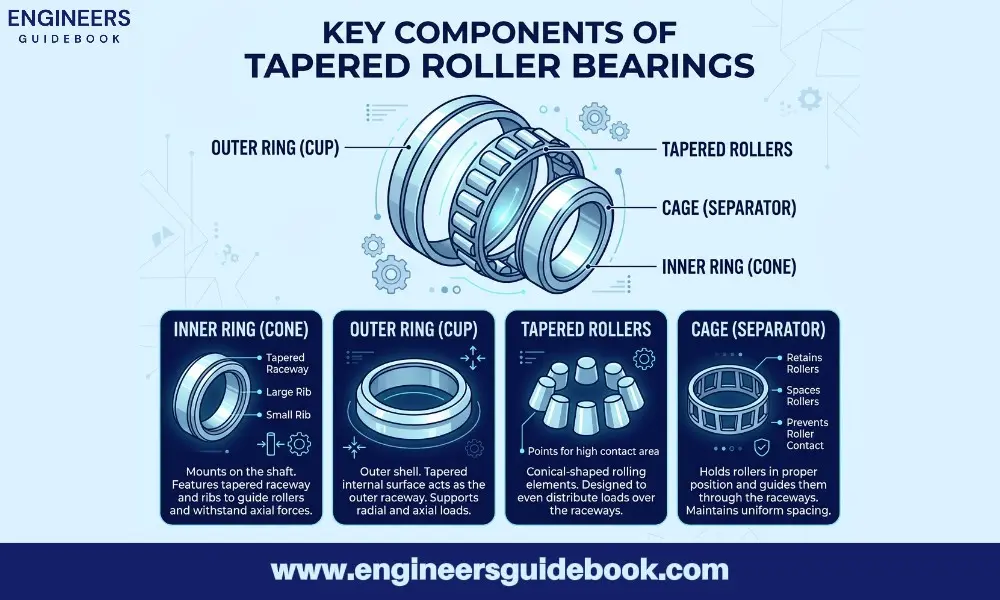
3.1 Inner ring (cone) and its role in load handling
The inner ring, also known as the cone, serves as the primary raceway for the tapered rollers. It carries both radial and axial loads and acts as the foundation for the bearing’s structural integrity. Proper manufacturing of the cone is crucial, as even minor imperfections can lead to uneven load distribution.
3.2 Outer ring (cup) and raceway design
The outer ring, or cup, complements the inner cone by providing a tapered raceway for the rollers. Its precision ensures smooth rotation and proper load transfer. High-quality raceway surfaces reduce friction, prevent wear, and improve bearing life.
3.3 Tapered rollers and load distribution mechanics
The tapered rollers are the heart of the bearing, converting radial forces into axial forces and distributing them across the contact surfaces. Their conical shape minimizes point contact, spreading load more efficiently and reducing localized stress concentrations.
3.4 Cage design and its influence on performance
The cage maintains proper roller spacing, preventing contact between individual rollers. This reduces friction, minimizes wear, and ensures uniform load distribution. Advanced cage designs can enhance speed capability and vibration resistance.
4. Working Principle of Tapered Roller Bearings
4.1 How tapered geometry enables combined load handling
The conical alignment of the rollers allows tapered roller bearings to simultaneously resist radial and axial loads. When a radial load is applied, it generates an axial component due to the contact angle, which is then resisted by the bearing structure, ensuring stability under multidirectional forces.
4.2 Axial and radial load interaction explained
Radial loads push the rollers outward along the cone, while axial loads force them along the axis of the bearing. The unique geometry allows these forces to be balanced efficiently, preventing premature wear or misalignment in heavy-duty applications.
4.3 Contact angle and its engineering significance
The contact angle, defined by the slope of the cone, dictates the axial load capacity of the bearing. A steeper contact angle increases axial load support but can reduce speed capability. Proper selection of the contact angle is essential for achieving desired performance characteristics.
5. Types of Tapered Roller Bearings
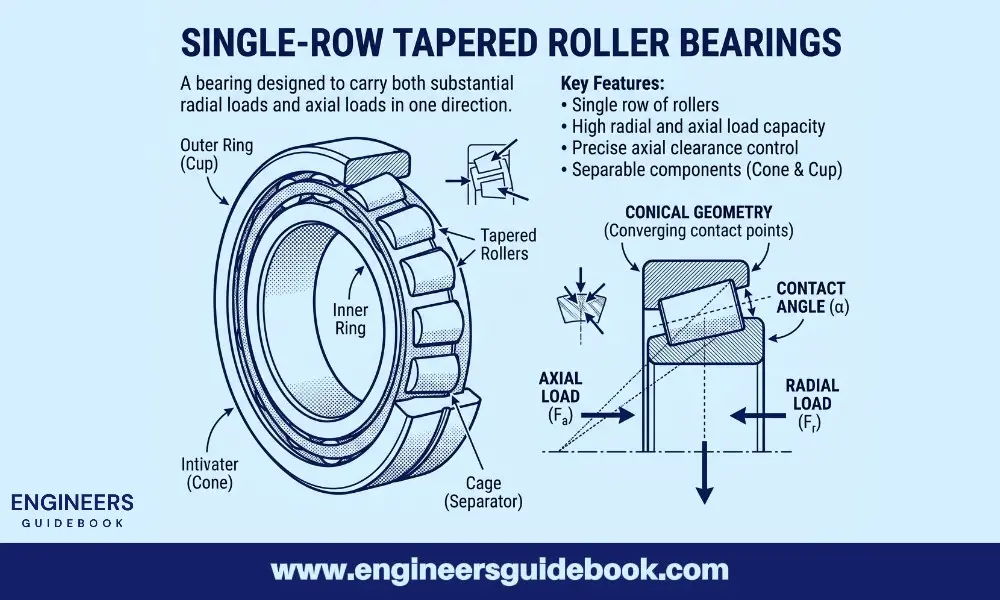
5.1 Single-row tapered roller bearings and their applications
Single-row tapered roller bearings are the most common type, designed to handle moderate axial and high radial loads. They are widely used in automotive wheel hubs, gearboxes, and general machinery.
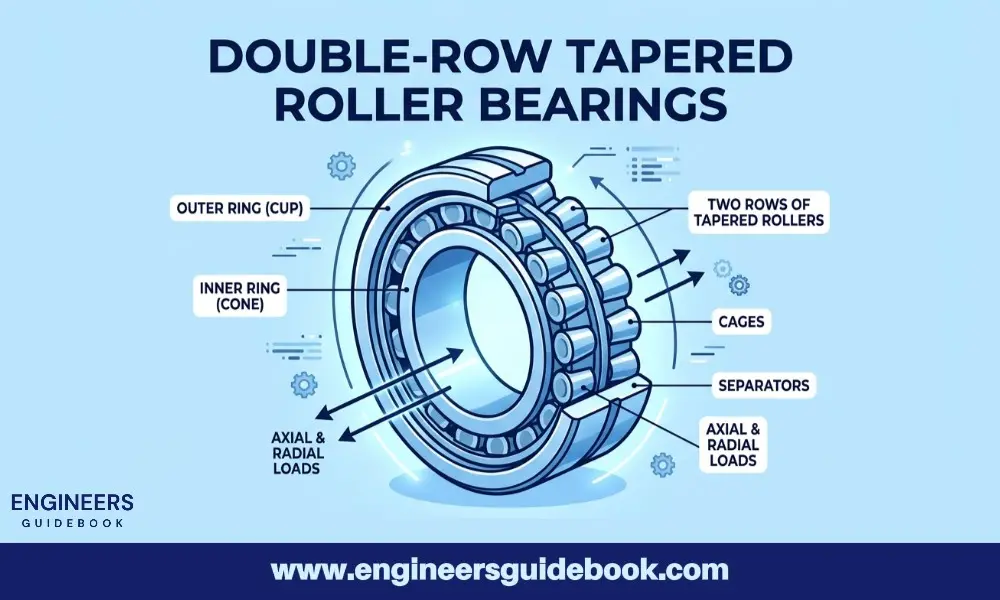
5.2 Double-row tapered roller bearings for increased load capacity
Double-row designs provide enhanced radial and axial load handling while maintaining compact dimensions. These bearings are often found in heavy machinery, large gear drives, and construction equipment.
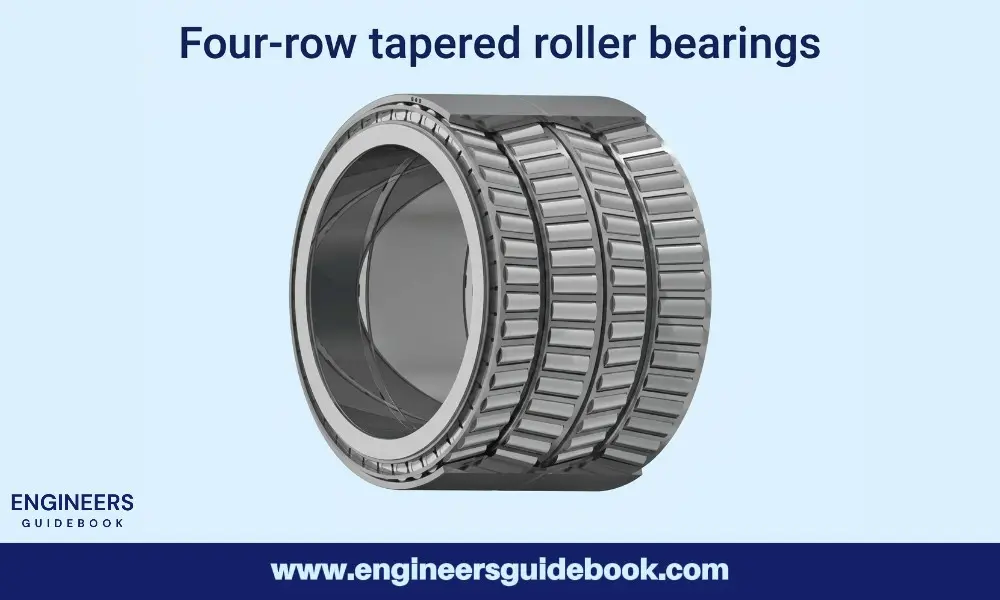
5.3 Four-row tapered roller bearings in heavy industries
Four-row tapered bearings are reserved for extremely heavy-duty applications such as rolling mills, mining equipment, and industrial presses. Their design offers massive load capacity and high structural rigidity.
6. Load Carrying Capacity and Performance Characteristics
6.1 Handling combined radial and axial loads efficiently
The tapered roller geometry ensures that the bearing can simultaneously carry substantial radial and axial loads. This capability is particularly advantageous in automotive and industrial applications where forces are multidirectional.
6.2 High load capacity under shock and impact conditions
Tapered roller bearings excel under dynamic and shock loading due to their robust construction and load distribution characteristics. They can tolerate sudden torque spikes or impact loads without catastrophic failure.
6.3 Speed limitations and performance trade-offs
While tapered roller bearings are strong and durable, their design produces higher friction compared to ball bearings. This can limit their maximum operational speed, so careful selection and lubrication are essential for high-speed applications.
7. Materials Used in Tapered Roller Bearings
7.1 Common materials like bearing steel and alloys
High-carbon chromium steel is the most common material, offering a balance of hardness, wear resistance, and fatigue strength. Specialized alloys may be used for extreme environments.
7.2 Heat treatment processes for durability
Precision heat treatments such as quenching and tempering enhance the steel’s hardness and fatigue life. These processes are critical to ensure long-lasting performance in demanding applications.
7.3 Advanced coatings and surface treatments
Bearings can be treated with coatings like black oxide, phosphate, or DLC (diamond-like carbon) to reduce friction, resist corrosion, and improve wear performance in harsh operating conditions.
8. Advantages of Tapered Roller Bearings
8.1 Superior load handling capabilities
Tapered roller bearings are capable of withstanding high radial and axial loads simultaneously, making them ideal for demanding engineering applications.
8.2 High durability and long service life
Their robust construction and precision manufacturing ensure extended operational life, even under heavy and shock loading.
8.3 Excellent performance under harsh conditions
From high temperatures to contaminated environments, these bearings maintain their integrity and performance, offering reliability in challenging applications.
9. Limitations and Challenges
9.1 Sensitivity to misalignment
Tapered roller bearings require precise alignment. Misalignment can cause uneven load distribution, leading to premature wear or failure.
9.2 Higher friction compared to some bearing types
The contact geometry results in increased friction, which can limit speed and efficiency. Proper lubrication is essential to mitigate this drawback.
9.3 Installation complexity and adjustment requirements
Preload, clearance, and alignment must be carefully set during installation. Incorrect adjustments can compromise performance and bearing life.
10. Applications of Tapered Roller Bearings
10.1 Automotive applications such as wheel hubs and transmissions
They are extensively used in vehicles for wheel hubs, differential assemblies, and gearboxes, providing stability and load handling.
10.2 Industrial machinery and heavy equipment
Machinery like conveyors, presses, and milling machines rely on tapered roller bearings for reliable performance under heavy loads.
10.3 Railway systems and aerospace uses
Axles, gear drives, and propulsion systems in railways and aerospace applications utilize these bearings for precision and durability.
10.4 Mining, construction, and agricultural equipment
Heavy-duty environments demand bearings that can withstand shock, vibration, and contamination—roles perfectly suited for tapered roller bearings.
11. Common Failure Modes and Troubleshooting
11.1 Wear patterns and their root causes
Uneven wear can result from misalignment, improper lubrication, or contamination. Recognizing these patterns is crucial for proactive maintenance.
11.2 Overheating and lubrication issues
Excessive heat can degrade the bearing lubricant, causing increased friction, noise, and eventual failure. Regular inspection and proper lubrication are essential.
11.3 Fatigue failure and contamination problems
Rolling element fatigue and surface pitting are common failure modes, often accelerated by debris or corrosive environments. Preventive maintenance mitigates these risks.
12. Comparison with Other Bearing Types
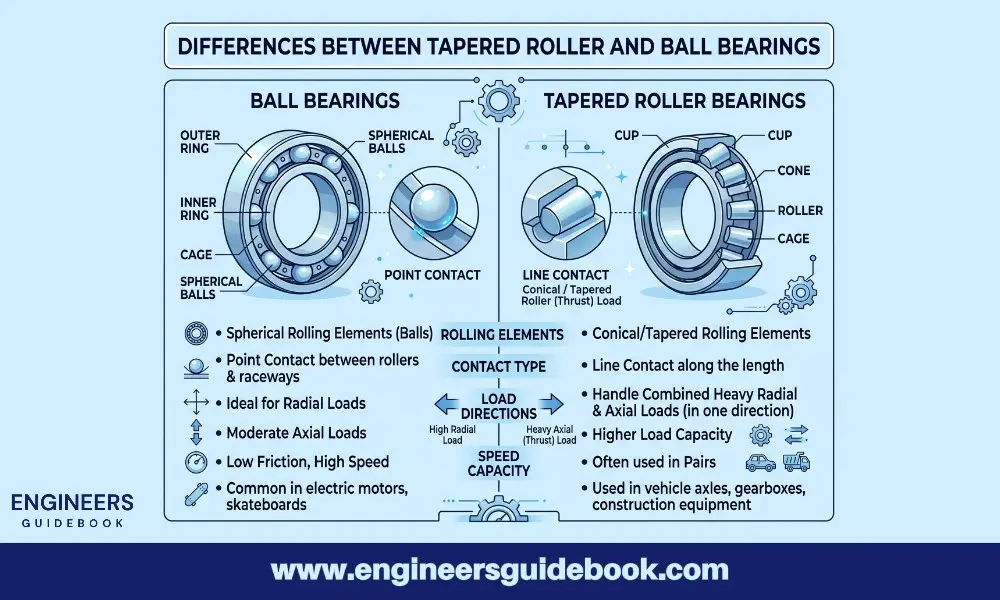
12.1 Differences between tapered roller and ball bearings
Ball bearings are optimized for high-speed, low-load applications, while tapered roller bearings excel under combined heavy loads.
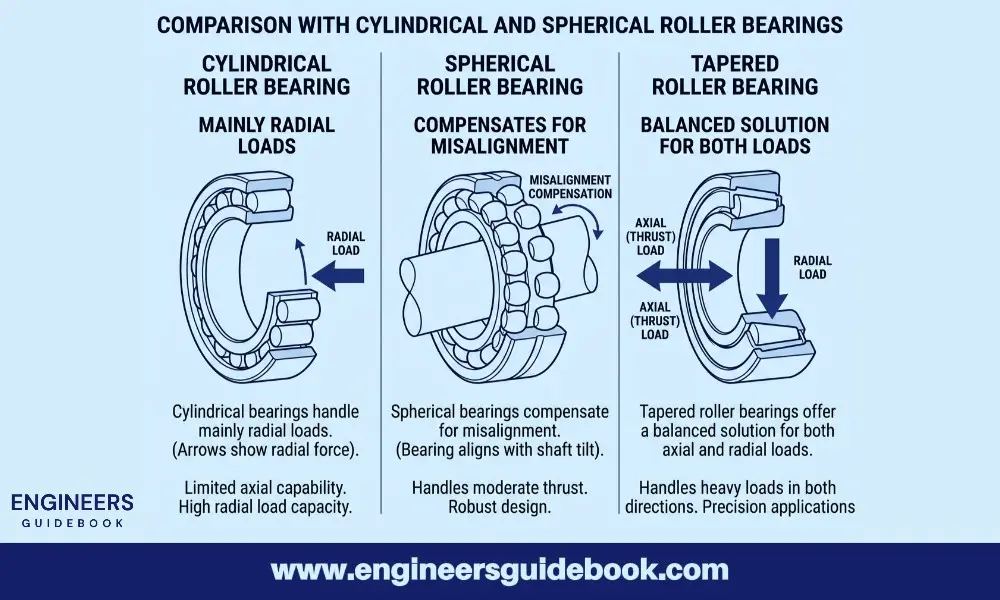
12.2 Comparison with cylindrical and spherical roller bearings
Cylindrical bearings handle mainly radial loads, and spherical bearings compensate for misalignment. Tapered roller bearings offer a balanced solution for both axial and radial loads.
12.3 When to choose tapered roller bearings over alternatives
When applications demand combined load capacity, durability under shock, and precise alignment, tapered roller bearings are the superior choice.
13. Conclusion
Tapered roller bearings are engineered for robustness, versatility, and high performance in demanding mechanical systems. Their unique ability to handle combined loads, maintain precision, and endure harsh conditions ensures they remain a cornerstone in automotive, industrial, and heavy machinery applications.