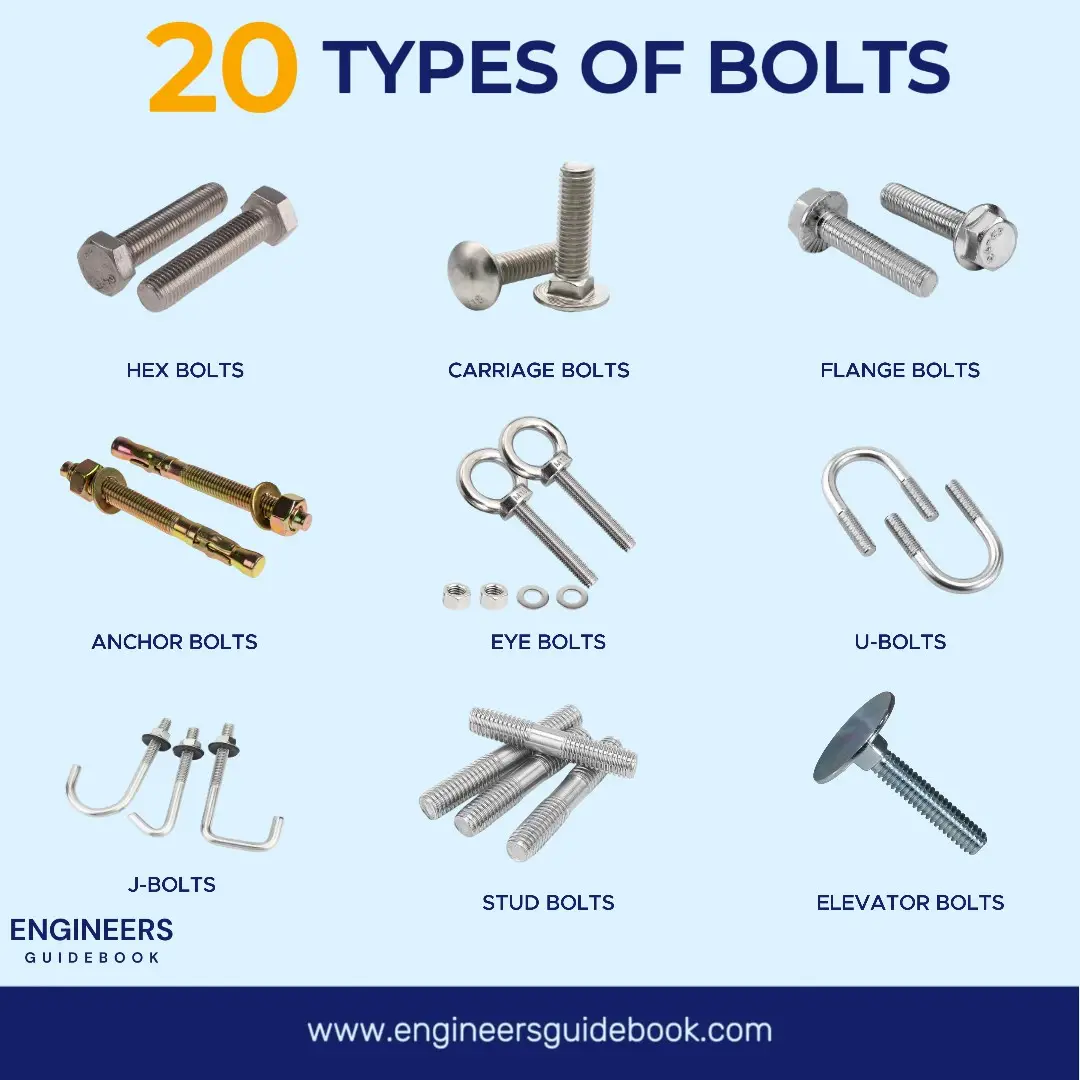
U bolts are U-shaped fasteners used to clamp pipes, tubes, axles, cables, and structural parts securely in place. They come in different shapes, sizes, materials, coatings, and strength grades. Choosing the right U bolt depends on load, environment, diameter, thread size, corrosion resistance, and the surface being fastened.
1. U Bolt Basics
1.1 What Is a U Bolt
A U bolt is a bent metal fastener shaped like the letter “U” with two threaded legs. It is commonly used with nuts and washers to secure round, square, or irregular objects to a supporting surface. The curved section wraps around the object, while the threaded ends pass through a plate, bracket, beam, or mounting base.
The design is simple, but its function is highly dependable. A U bolt can hold pipes against vibration, fasten leaf springs to axles, support conduits, clamp marine hardware, and anchor structural components. Because of this versatility, it is used across construction, automotive, plumbing, electrical, agricultural, and industrial sectors.
2. U Bolt Anatomy
2.1 U Shaped Body
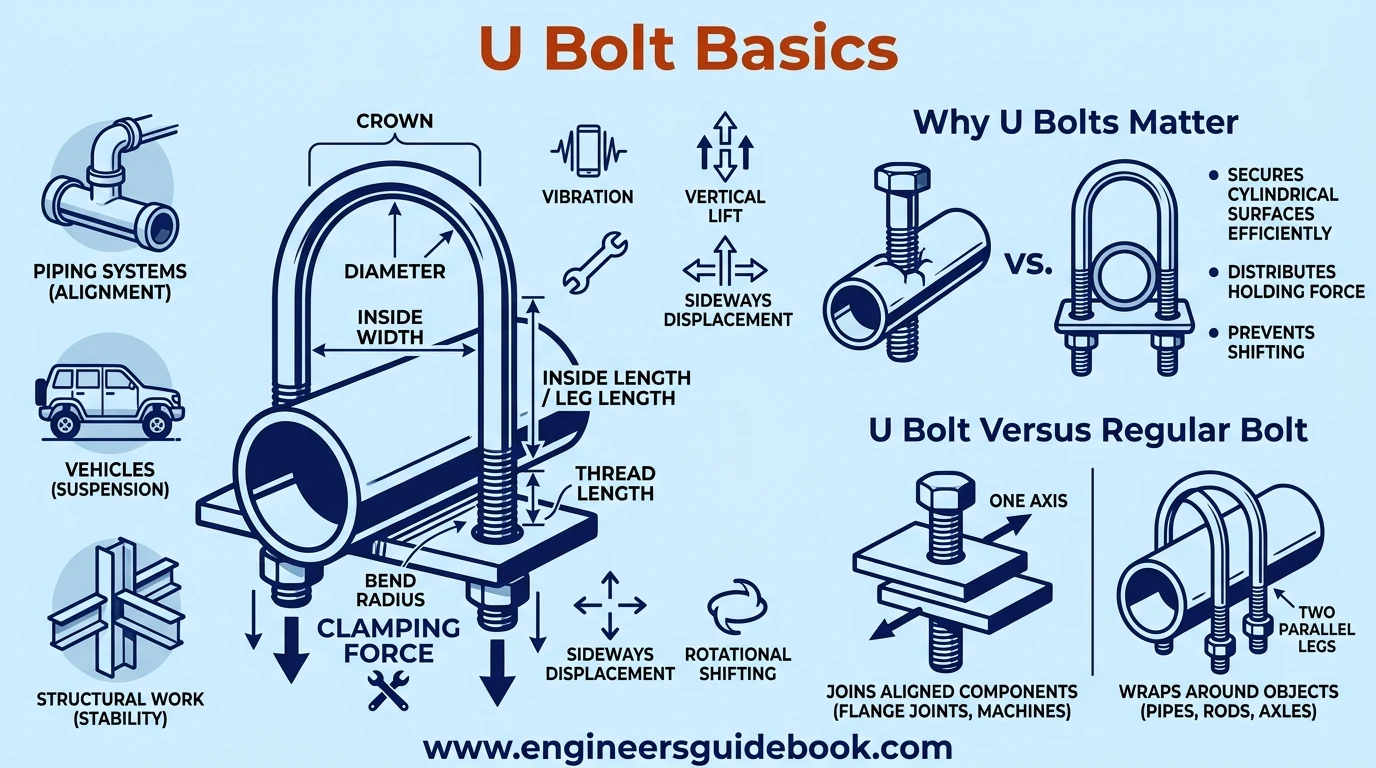
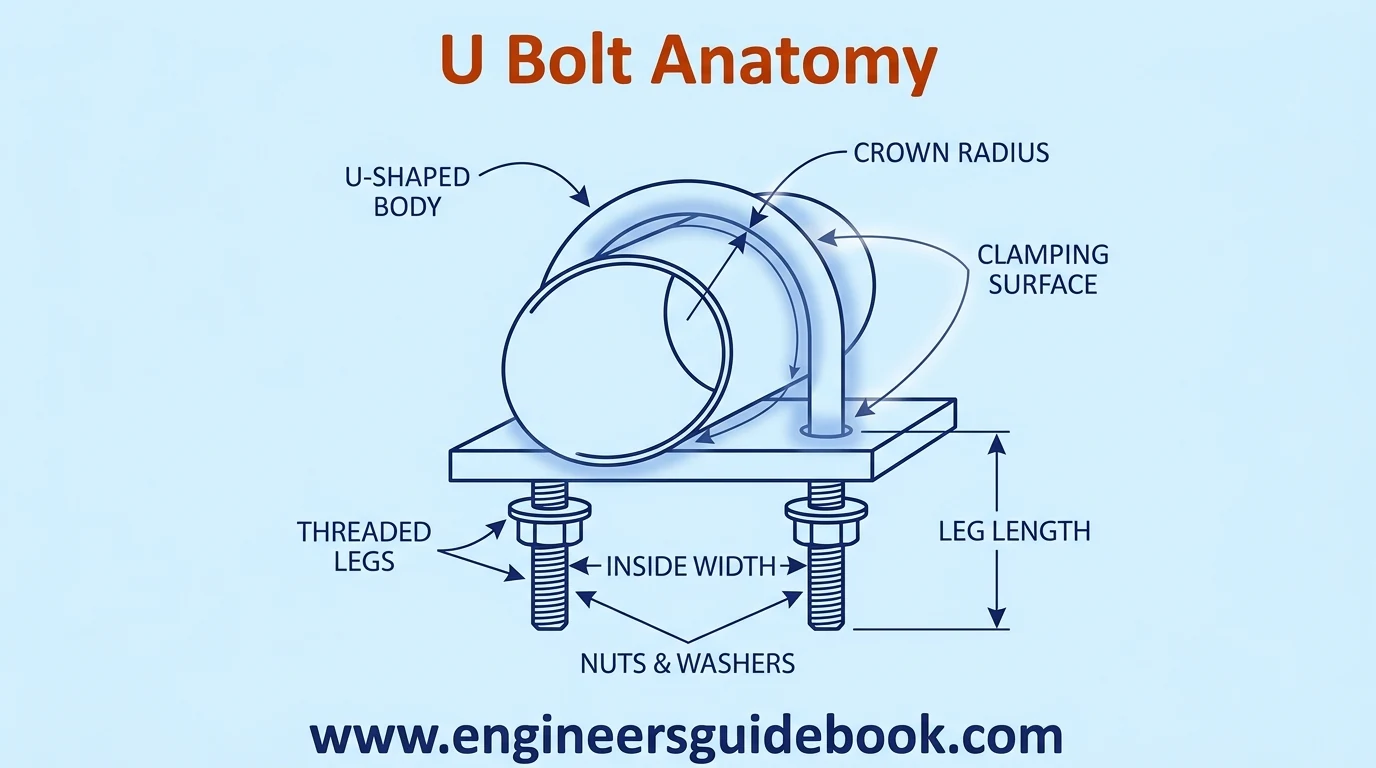
The U shaped body is the defining feature of the fastener. It is formed by bending a steel or metal rod into a U profile. The shape allows the bolt to encircle pipes, tubes, rods, or other components.
The body must be smooth and properly formed. Sharp bends can create stress concentration, while uneven forming can reduce load capacity. A well-formed U shaped body provides better seating, better alignment, and improved clamping performance.
2.2 Threaded Legs
The threaded legs are the two straight ends of the U bolt. These legs pass through mounting holes and accept nuts. Their length and thread quality directly affect installation reliability.
Threads may be coarse or fine depending on the application. Coarse threads are common because they are easier to install and tolerate dirt or minor surface damage. Fine threads offer more precise tensioning but may be less forgiving in rough environments.
Both legs should have equal thread length. Unequal legs can create uneven loading, poor nut engagement, and misalignment during tightening.
2.3 Crown Radius
The crown radius is the curved portion at the top of the U bolt. It determines how well the U bolt fits around a pipe, tube, or shaft. A matching crown radius improves contact and reduces localized stress.
If the radius is too tight, the U bolt may pinch the surface. If it is too wide, it may not grip properly. In pipe supports, an incorrect crown radius can damage insulation, coating, or pipe walls.
The crown radius is especially important in pressure piping, automotive suspension, and marine applications where vibration and cyclic loading are present.
2.4 Inside Width
Inside width is the distance between the inner faces of the two legs. It must match the object being clamped. For round pipe, the inside width should accommodate the pipe’s outside diameter, not only its nominal size.
This is a common mistake. Pipe sizes are often identified by nominal pipe size, but the actual outside diameter may be different. Choosing by nominal size alone can create fitment problems.
A correct inside width allows the U bolt to sit evenly without excessive clearance or forced spreading.
2.5 Leg Length
Leg length determines how far the threaded ends extend through the mounting surface. It must be long enough for washers, nuts, and proper thread engagement. It should not be excessively long unless required for adjustment.
Short legs may prevent full nut engagement. Overly long legs may interfere with nearby parts or create unnecessary protrusions. In machinery and vehicles, extra projection can become a snagging or damage point.
Correct leg length supports safe tightening and clean installation.
2.6 Nuts and Washers
Nuts and washers complete the U bolt assembly. Nuts provide the tightening force, while washers distribute pressure and protect the mounting surface. In many applications, flat washers are used under nuts to reduce surface galling and improve load distribution.
Lock nuts, spring washers, or prevailing torque nuts may be used where vibration is expected. Automotive and machinery installations often require specific nut grades. Using weak nuts with a high-strength U bolt can compromise the whole assembly.
The fastener system is only as strong as its weakest part.
2.7 Clamping Surface
The clamping surface is the area where the U bolt contacts the secured object and mounting support. It must be clean, stable, and compatible with the fastener material.
Rough surfaces can damage coatings. Soft surfaces can deform under pressure. Painted or insulated surfaces may compress after installation, reducing clamping force over time.
For critical service, the clamping surface should be inspected before installation. Proper seating prevents looseness, misalignment, and premature failure.
3. Main Types of U Bolts
3.1 Round Bend U Bolts
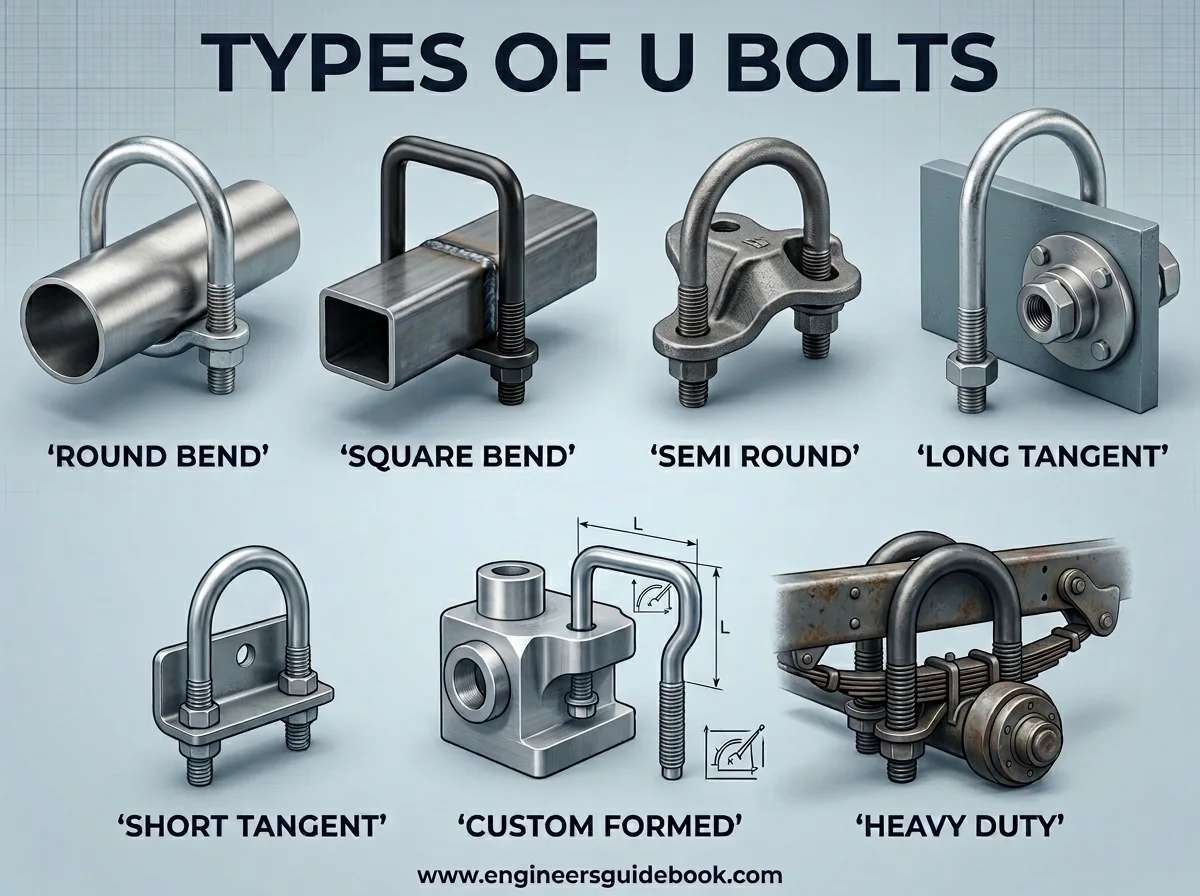
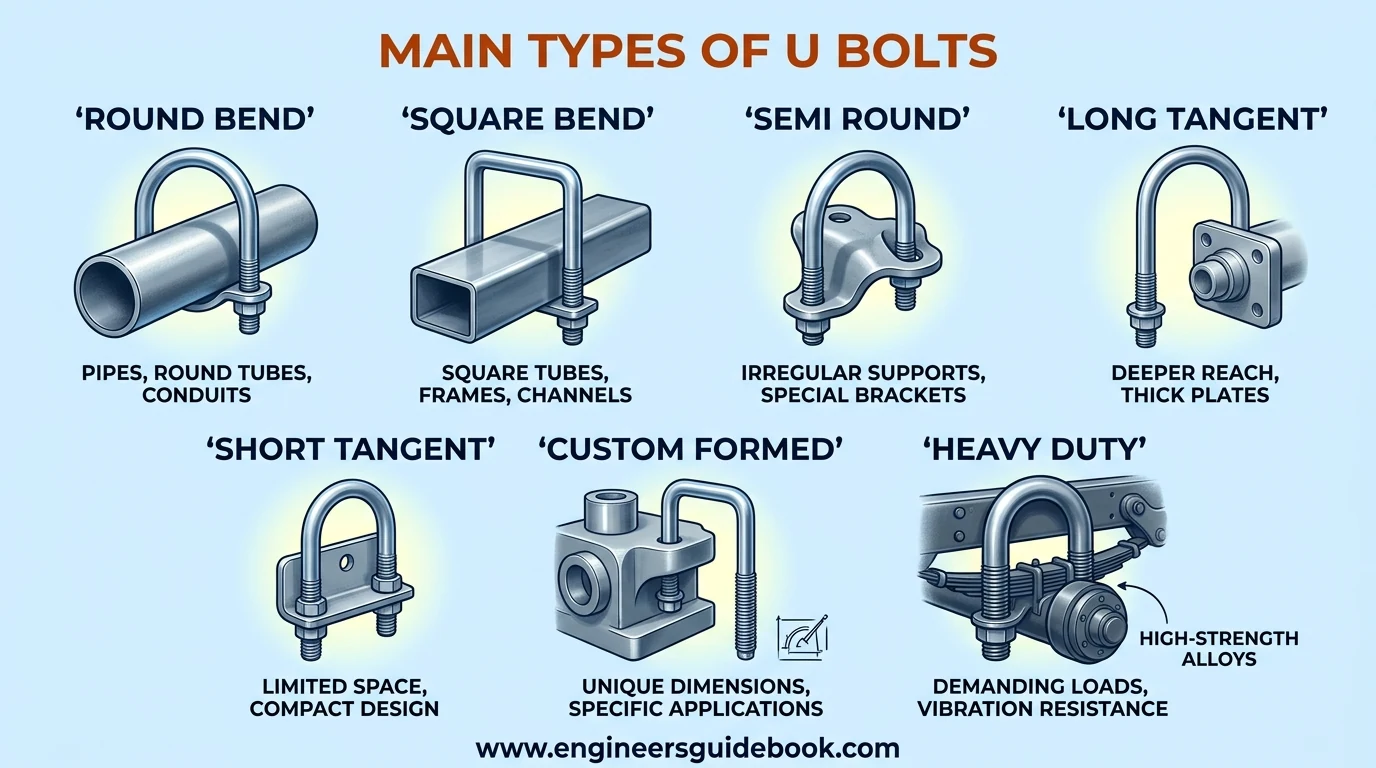
Round bend U bolts have a smooth semicircular crown. They are commonly used for pipes, round tubes, conduits, and cylindrical supports. Their curved shape matches round surfaces and provides balanced contact.
They are widely used in plumbing, construction, exhaust systems, marine hardware, and pipe support structures. When the diameter is correctly selected, they hold round objects securely without excessive point loading.
3.2 Square Bend U Bolts
Square bend U bolts have a flat top and two straight sides, forming a squared profile. They are suitable for square tubes, rectangular frames, channels, and flat-sided components.
These U bolts are common in trailer frames, structural brackets, agricultural equipment, and machinery mounts. Their geometry prevents rocking on flat surfaces and gives a more stable grip than a round bend design in square applications.
3.3 Semi Round U Bolts
Semi round U bolts combine curved and straighter geometry. They are useful where the clamped object is not perfectly round or square. This makes them suitable for special brackets, irregular supports, and mixed-profile installations.
They offer a practical compromise when standard round or square U bolts do not fit properly. However, fitment must still be checked carefully. A poor contact pattern can reduce holding force.
3.4 Long Tangent U Bolts
Long tangent U bolts have an extended straight section after the curved crown before the threaded legs begin. This design gives deeper reach and more clearance.
They are often used where the fastener must pass around a large component or through a thick mounting plate. Long tangent designs can also provide better alignment in heavy-duty clamping arrangements.
Their extended geometry is useful, but it must be selected carefully to avoid bending under load.
3.5 Short Tangent U Bolts
Short tangent U bolts have a shorter straight section between the bend and the threaded area. They are compact and suitable for applications with limited space.
These are often used in standard pipe supports, small brackets, light machinery, and general fastening. Their shorter form makes installation easier where clearance is restricted.
They are practical, economical, and widely available.
3.6 Custom Formed U Bolts
Custom formed U bolts are manufactured according to special dimensions, bend shapes, thread lengths, or material requirements. They are used when standard sizes do not meet the application.
Industries often require custom U bolts for non-standard pipe diameters, unique machinery frames, special load conditions, or corrosive environments. Customization may include unusual leg spacing, extra-long threads, special coatings, or high-strength alloys.
Custom U bolts should be specified with accurate drawings and tolerances.
3.7 Heavy Duty U Bolts
Heavy duty U bolts are designed for demanding load conditions. They usually have larger diameters, stronger materials, longer thread engagement, and higher strength grades.
They are commonly used in truck suspensions, trailers, bridges, industrial supports, and heavy equipment. These bolts must resist vibration, shock loading, and fatigue.
In critical applications, heavy duty U bolts should not be substituted with ordinary hardware. The risk of deformation or fracture is too high.
4. U Bolt Sizes
4.1 Diameter Size
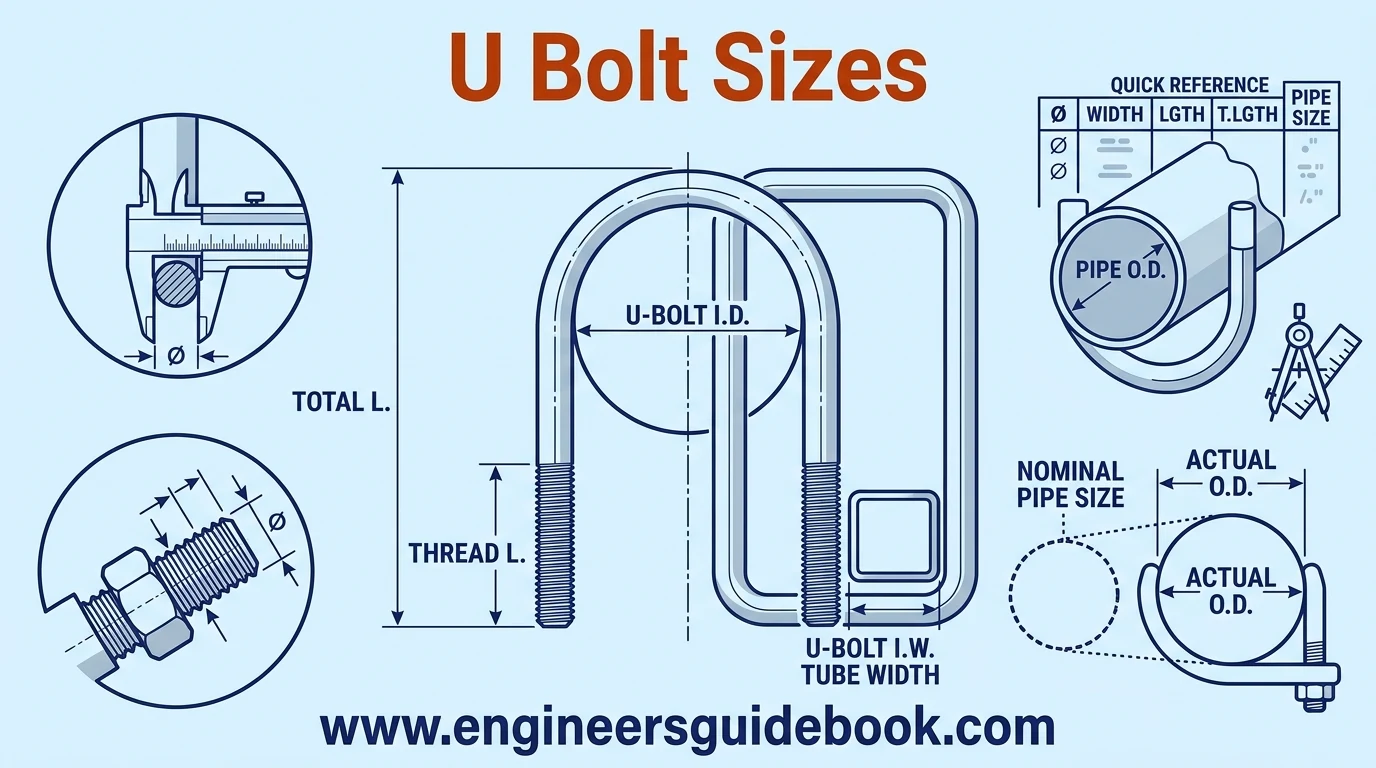
Diameter size refers to the rod thickness. Common diameters vary from small light-duty sizes to large heavy-duty sizes. Larger diameters generally provide greater tensile and clamping strength.
However, bigger is not always better. Oversized bolts may not fit brackets or may create excessive pressure on the clamped part. The correct diameter should match the load and installation design.
4.2 Thread Size
Thread size includes the bolt diameter and pitch. It determines which nuts will fit and how the bolt tightens. Matching thread size is essential for proper assembly.
Incorrect nuts can strip threads, jam during installation, or reduce clamping force. For reliable performance, nuts should match both diameter and thread pitch.
4.3 Inside Diameter
Inside diameter is important for round U bolts. It refers to the internal space created by the bend. This measurement should match the outside diameter of the pipe or round object.
Using a U bolt with the wrong inside diameter can cause loose gripping or surface indentation. Accurate measurement prevents these issues.
4.4 Inside Width
Inside width is used for both round and square U bolts. For square bend U bolts, it usually matches the width of the square tube or frame member.
Clearance should be enough for installation but not so much that the component can move. Good fitment is the foundation of reliable clamping.
4.5 Overall Length
Overall length is the total length from the top of the crown to the end of the threaded legs. It determines whether the U bolt can pass around the object and through the mounting plate.
This dimension must include the clamped object, plate thickness, washer thickness, nut height, and required thread projection.
4.6 Thread Length
Thread length is the usable threaded portion on each leg. It must be sufficient for tightening and adjustment. Too little thread length can prevent secure fastening.
In adjustable installations, longer thread length gives flexibility. In compact assemblies, excessive thread may be unnecessary.
4.7 Pipe Size Matching
Pipe size matching requires attention because nominal pipe size does not always equal outside diameter. A 2-inch pipe, for example, may have an outside diameter larger than 2 inches.
Always check the actual pipe outside diameter before selecting a U bolt. This avoids ordering errors and poor fitment.
4.8 Standard Size Chart
A standard size chart helps compare diameter, inside width, leg length, thread size, and suitable pipe size. It is useful for quick selection.
However, charts should be treated as guides, not substitutes for measurement. Field conditions, coatings, insulation, and bracket thickness can affect the final size requirement.
5. U Bolt Materials
5.1 Carbon Steel U Bolts
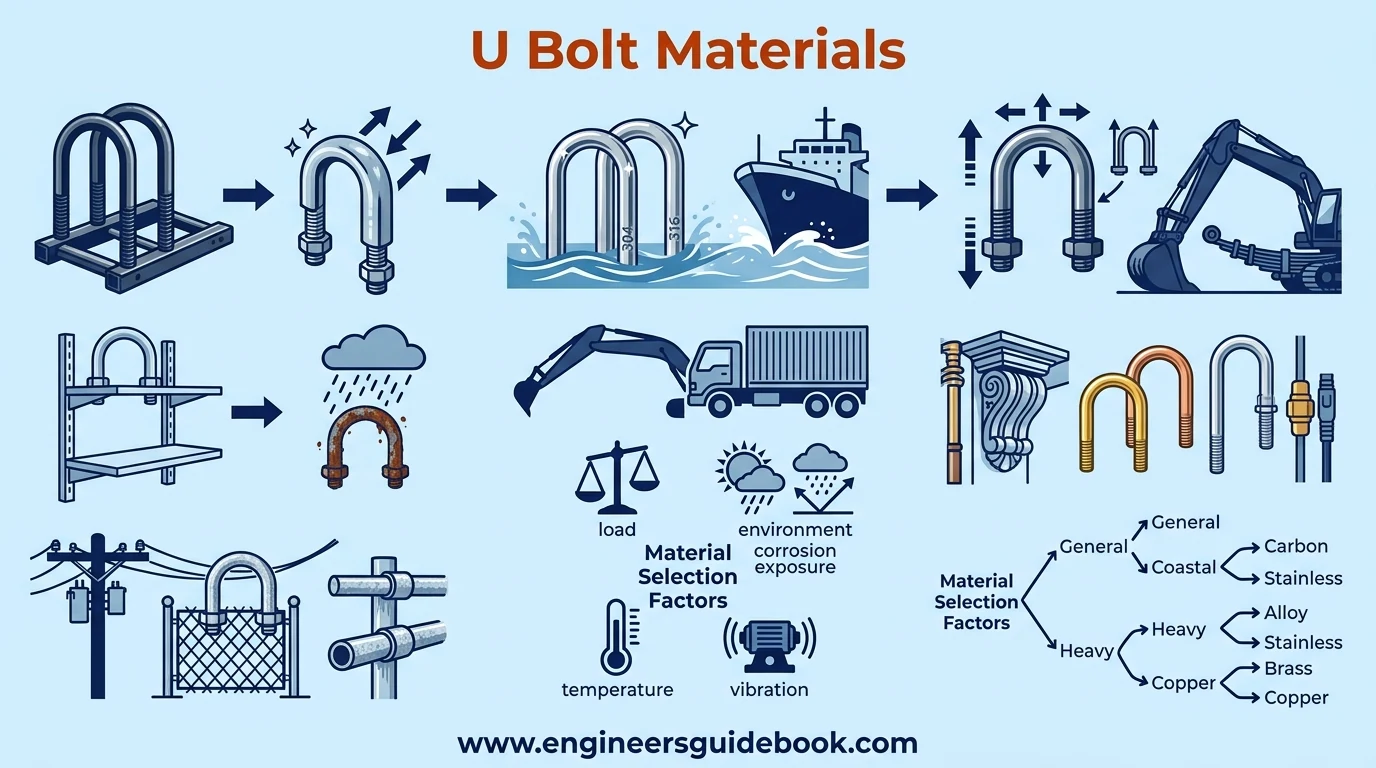
Carbon steel U bolts are strong, economical, and widely used. They are suitable for general industrial, construction, and automotive applications.
They often require protective coating because untreated carbon steel can rust. Zinc plating or galvanizing is commonly applied for corrosion resistance.
5.2 Stainless Steel U Bolts
Stainless steel U bolts offer excellent corrosion resistance. They are preferred in marine, chemical, food processing, outdoor, and humid environments.
Grades such as 304 and 316 are common. 316 stainless steel performs better in chloride-rich or coastal conditions.
5.3 Alloy Steel U Bolts
Alloy steel U bolts are used where higher strength is required. They may contain chromium, molybdenum, or other elements to improve hardness, toughness, and fatigue resistance.
These bolts are suitable for heavy equipment, suspension systems, and demanding mechanical service.
5.4 Mild Steel U Bolts
Mild steel U bolts are suitable for light to medium-duty applications. They are easy to form, weld, and manufacture.
They are cost-effective but need coating for outdoor use. Without protection, mild steel can deteriorate quickly in wet environments.
5.5 Galvanized Steel U Bolts
Galvanized steel U bolts are coated with zinc to resist corrosion. Hot dip galvanized versions provide thicker protection than ordinary zinc plating.
They are widely used outdoors, especially in construction, fencing, pole line hardware, and exposed pipe supports.
5.6 Brass and Non Ferrous Options
Brass, bronze, aluminum, and other non ferrous U bolts are used for special applications. They may be selected for conductivity, non-magnetic behavior, corrosion resistance, or decorative appearance.
They are not usually chosen for high-load service unless specifically engineered for it.
5.7 Material Selection Factors
Material selection depends on load, environment, corrosion exposure, temperature, vibration, and compatibility with connected components.
For indoor light-duty work, carbon steel may be enough. For coastal or chemical exposure, stainless steel may be better. For heavy mechanical loading, alloy steel may be required.
6. U Bolt Coatings and Finishes
6.1 Zinc Plated Finish
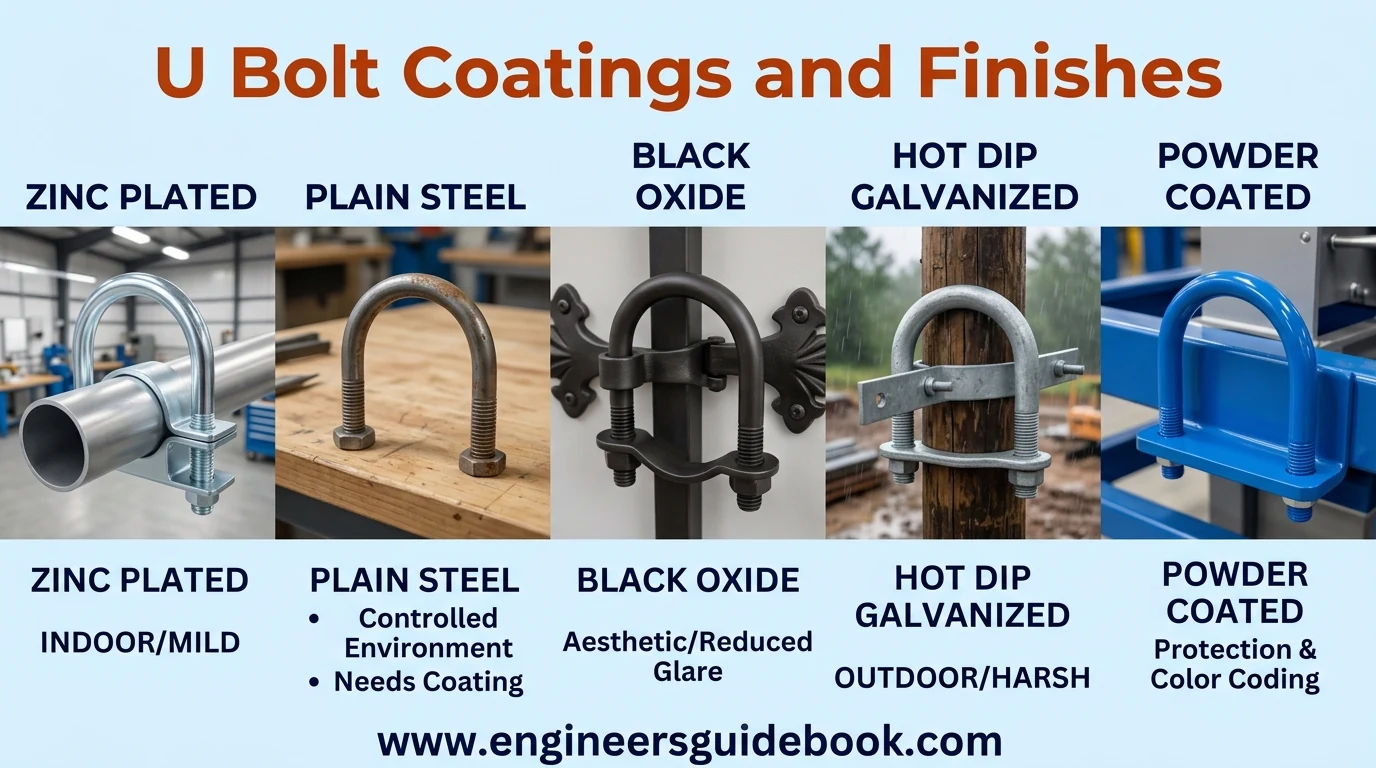
Zinc plating gives a thin protective layer against corrosion. It is suitable for indoor and mildly exposed environments.
It also improves appearance and reduces initial rusting. However, it is not ideal for severe outdoor or marine service.
6.2 Hot Dip Galvanized Finish
Hot dip galvanizing provides a thicker zinc coating. It offers stronger corrosion resistance than standard zinc plating.
It is preferred for outdoor structures, utility hardware, and exposed supports. The coating may be rougher, but it is more durable.
6.3 Black Oxide Finish
Black oxide provides a dark finish with mild corrosion resistance. It is mostly used for appearance, light protection, and reduced glare.
It is not suitable for highly corrosive environments unless combined with oil or additional protection.
6.4 Plain Steel Finish
Plain steel has no protective coating. It is suitable only for controlled environments or applications where the bolt will be painted, coated, or used temporarily.
Plain steel can rust quickly when exposed to moisture.
7. U Bolt Standards and Grades
7.1 Common Manufacturing Standards
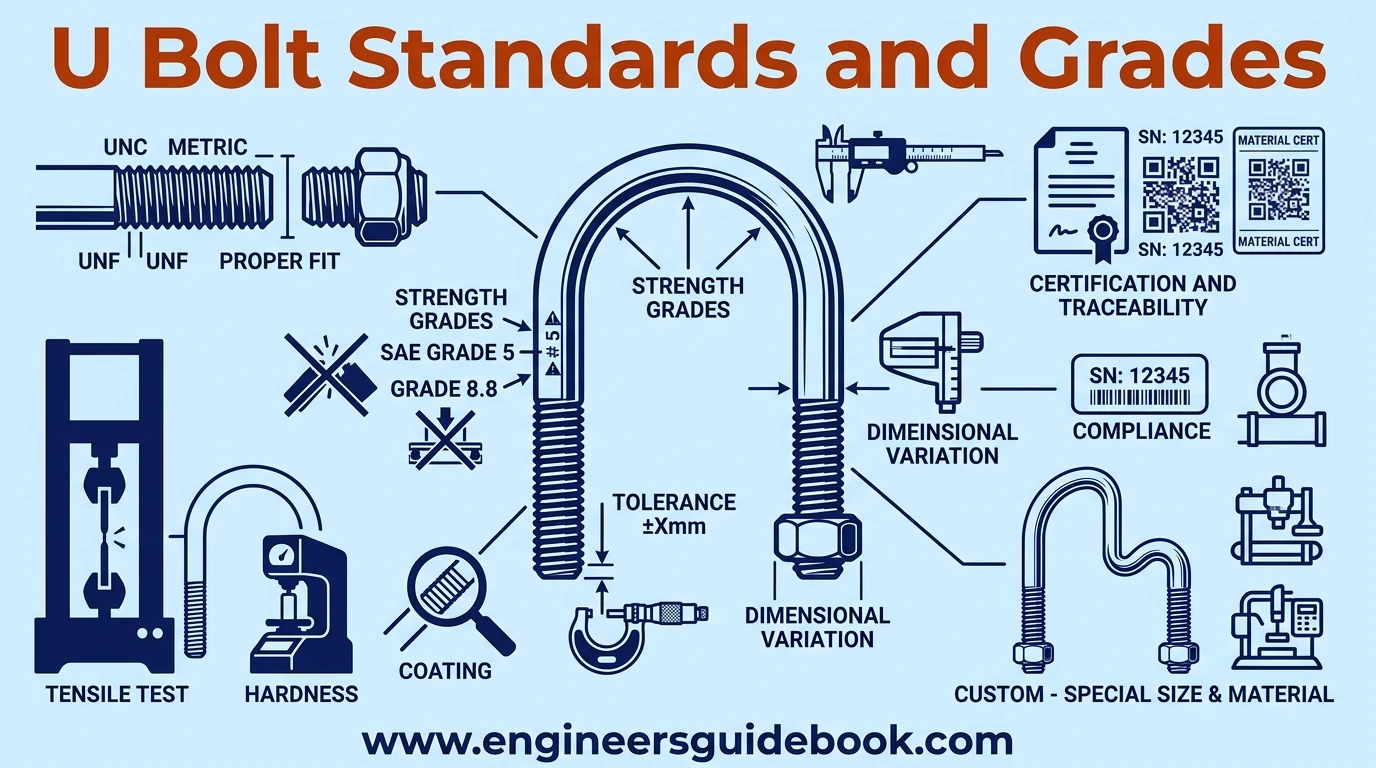
U bolts may be manufactured according to industrial standards, customer drawings, or project specifications. Standards help define dimensions, threads, materials, and tolerances.
For critical work, the specification should be clear before purchase.
7.2 Thread Standards
Thread standards define pitch, profile, and fit. Common thread systems include UNC, UNF, and metric threads.
Matching thread standards ensures nuts fit properly and tightening force is reliable.
7.3 Strength Grades
Strength grade indicates the mechanical capacity of the bolt material. Higher grades can carry greater loads, but they may also require matching nuts and controlled tightening.
Using the wrong grade can create serious failure risks.
7.4 Dimensional Tolerances
Dimensional tolerances control allowable variation in width, length, bend radius, and thread position. Tight tolerances are important where fitment is critical.
Loose tolerances may be acceptable for general work but not for precision machinery.
7.5 Testing Requirements
Testing may include tensile testing, hardness testing, coating thickness checks, and dimensional inspection. Critical U bolts may also require material certificates.
Testing confirms that the fastener meets the required performance level.
7.6 Certification and Traceability
Certification and traceability provide proof of material grade, coating type, and manufacturing compliance. This is important in industrial, automotive, marine, and structural applications.
Traceability helps identify the source and quality history of the fastener.
7.7 Standard Versus Custom U Bolts
Standard U bolts are available quickly and cost less. Custom U bolts are designed for special sizes, shapes, materials, or performance requirements.
The best choice depends on the application. For ordinary pipe support, standard may be enough. For unique machinery or critical loading, custom is often the safer option.
8. U Bolt Load Capacity
8.1 Tensile Strength
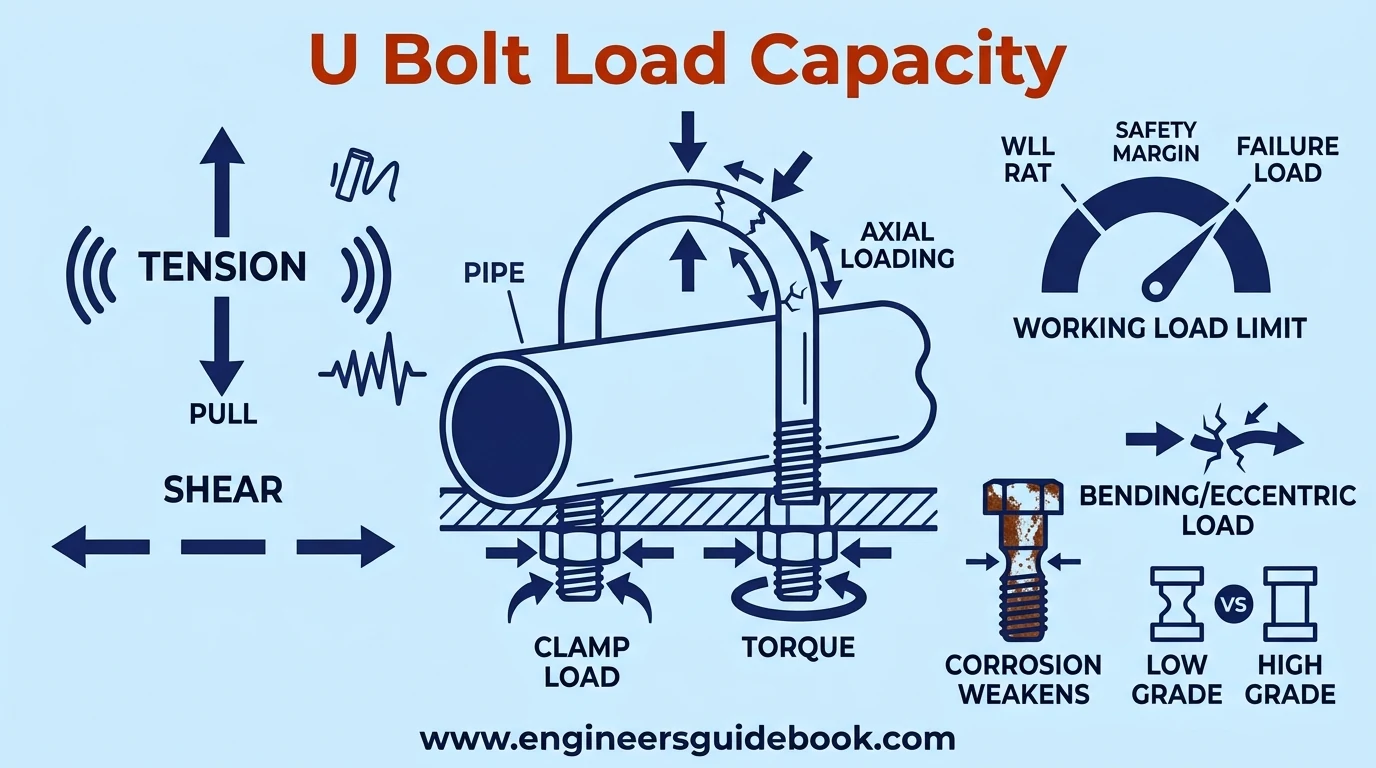
Tensile strength is the resistance of a U bolt against pulling force. It tells how much axial stress the metal can withstand before stretching, yielding, or breaking. In heavy-duty service, this value is critical because the bolt may be exposed to vibration, suspension movement, pipe thrust, or structural loading.
The tensile capacity depends on rod diameter, material grade, heat treatment, thread quality, and manufacturing accuracy. A larger U bolt usually offers higher tensile strength, but size alone is not enough. A small alloy steel U bolt can outperform a larger low-grade mild steel option in demanding service.
8.2 Shear Strength
Shear strength is the ability of the U bolt to resist sideways cutting force. This matters when the clamped object tries to slide across the fastener. In trailer axles, machine frames, pipe guides, and construction brackets, shear force can be significant.
A U bolt is not always designed as the primary shear member. In many installations, the clamp load creates friction, and that friction resists movement. If the assembly loses tightness, the bolt legs may start carrying direct shear. That can lead to fretting, thread damage, and eventual fracture.
8.3 Clamp Load
Clamp load is the compressive force created when nuts are tightened on the threaded legs. It is one of the most important performance factors in a U bolt assembly. Good clamp load keeps parts seated, aligned, and stable.
Too little clamp load allows movement. Too much clamp load can deform the pipe, crush a tube, strip threads, or overstress the bolt. The aim is controlled compression, not blind tightening. In sensitive applications, torque values should be specified and followed carefully.
8.4 Working Load Limit
Working load limit is the maximum load that should be applied during normal service. It is lower than the ultimate breaking strength because it includes a margin for safety. This margin accounts for shock, corrosion, fatigue, installation variation, and real-world operating conditions.
A U bolt should never be selected only by appearance. Two bolts may look similar but have very different working load limits. For lifting, suspension, and structural support, verified ratings are essential.
9. U Bolt Uses and Applications
9.1 Pipe Support Applications
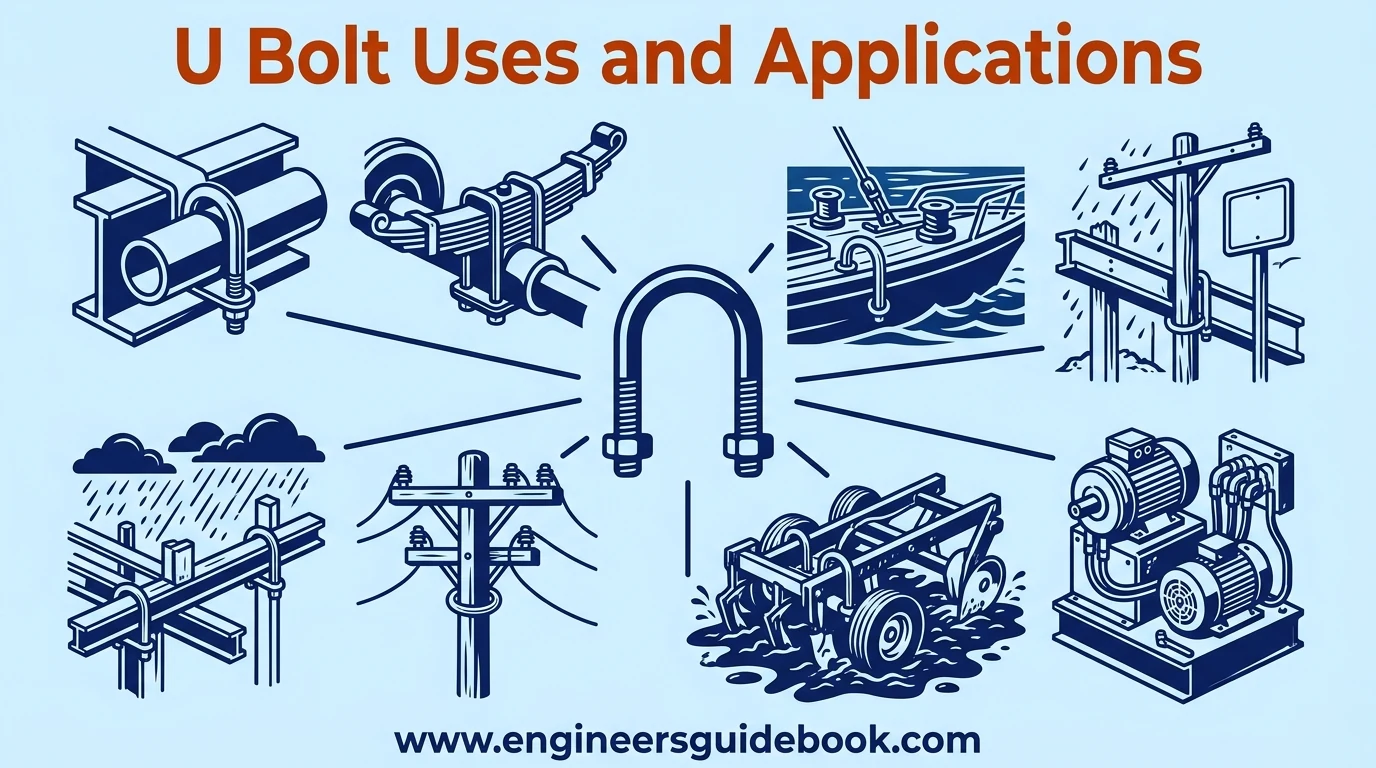
U bolts are widely used to hold pipes against beams, channels, brackets, and pipe racks. They keep piping aligned and reduce movement caused by vibration, pressure pulsation, and thermal expansion.
In simple supports, the U bolt acts as a restraint. In guided supports, it controls sideways motion while allowing limited axial movement. Correct sizing is important because excessive tightening can dent thin-wall pipe or damage protective coatings.
9.2 Automotive Suspension Applications
Automotive suspension systems use U bolts to fasten leaf springs to axles. This is one of the most demanding U bolt applications because the joint sees impact, vibration, road shock, and repeated flexing.
Suspension U bolts must be high strength and properly torqued. Reusing stretched or fatigued suspension U bolts is risky. Once the bolt has been heavily loaded, its clamping reliability may be reduced.
9.3 Trailer and Axle Applications
Trailers use U bolts for axles, spring seats, frame brackets, and load-bearing attachments. These fasteners help keep the axle positioned under changing road loads.
A loose trailer U bolt can cause axle misalignment, tire wear, poor tracking, and dangerous handling. For this reason, trailer U bolts should be inspected periodically, especially after heavy loading or long-distance travel.
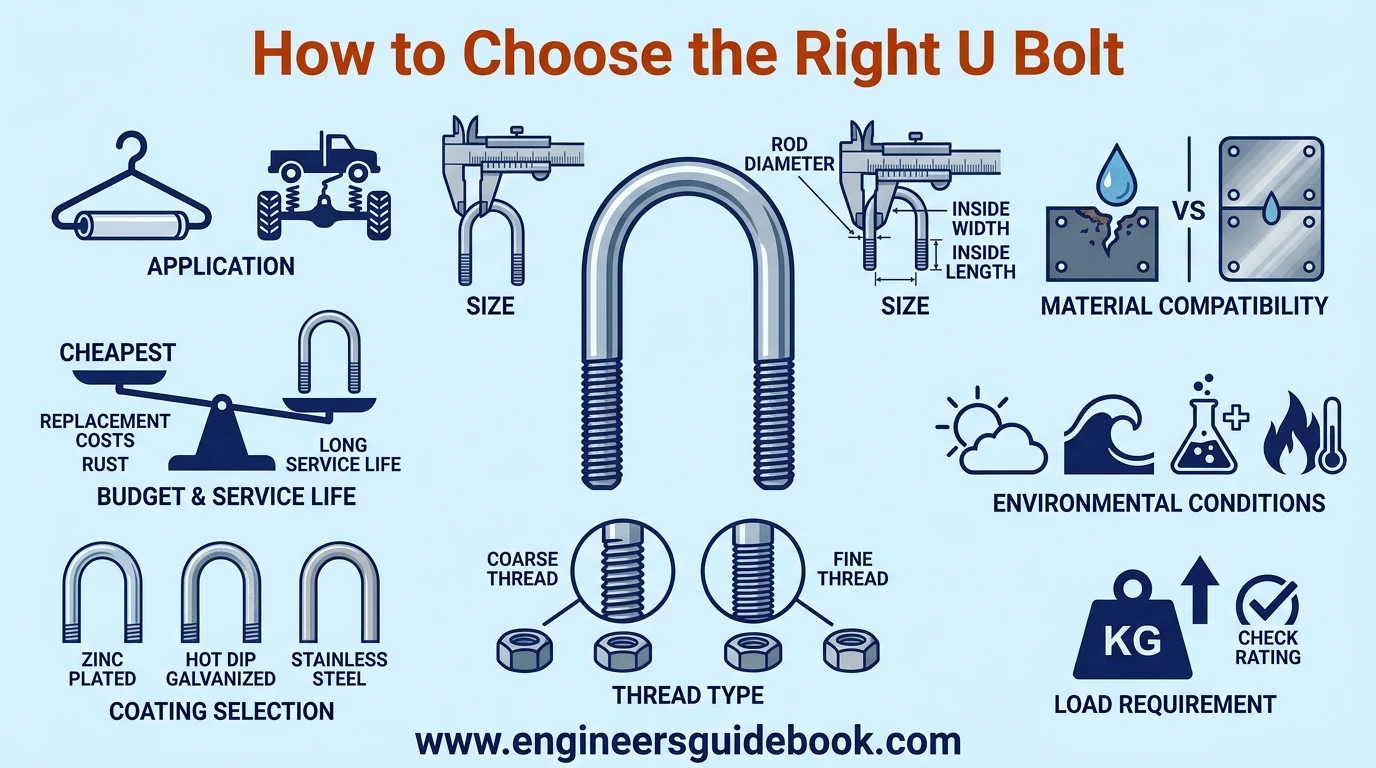
10. How to Choose the Right U Bolt
10.1 Application Requirement
The first step is to understand the job. A U bolt for a pipe hanger is different from a U bolt for a truck suspension. Load, vibration, temperature, environment, and safety risk must be identified before selection.
The application decides the shape, strength, material, coating, and installation method.
10.2 Correct Size Selection
Correct size includes rod diameter, inside width, inside length, thread length, and overall length. Measurement should be taken from the actual component, not estimated from memory.
For pipework, use outside diameter, not only nominal pipe size. For square tubes, measure the real width and allow suitable clearance.
10.3 Material Compatibility
Material compatibility prevents galvanic corrosion, staining, and premature degradation. Stainless steel may be excellent in wet environments, while carbon steel may be sufficient indoors.
The selected material should also be compatible with the clamped object. Dissimilar metals in the presence of moisture can create galvanic action.
10.4 Environmental Conditions
Environment strongly affects service life. Indoor dry areas are forgiving. Outdoor, marine, chemical, and high-temperature areas are not.
For corrosive environments, stainless steel, hot dip galvanizing, or specialized coatings may be required. For high heat, coating limits and material strength at temperature must be checked.
10.5 Load Requirement
The U bolt must be strong enough for the expected load and any additional shock or vibration. Load should include static weight, dynamic forces, operating movement, and accidental overload.
In critical applications, consult rated data or engineering specifications. Guesswork is not acceptable where failure can be hazardous.
10.6 Thread Type Selection
Thread type affects tightening behavior and nut compatibility. Coarse threads are common for general work because they install quickly and resist damage better. Fine threads allow more precise adjustment but need cleaner conditions.
Always match nuts to thread type. A near-fit nut can damage threads and reduce holding strength.
10.7 Coating Selection
Coating selection depends on corrosion exposure and appearance requirements. Zinc plating is suitable for light protection. Hot dip galvanizing offers stronger outdoor resistance. Stainless steel may eliminate the need for added coating in many environments.
The coating should not interfere with thread fit or hole clearance.
10.8 Budget and Service Life
The cheapest U bolt is not always economical. If it rusts, loosens, or fails early, replacement cost becomes higher than the initial saving.
A good selection balances purchase price, installation effort, inspection frequency, safety, and expected life.
11. U Bolt Installation
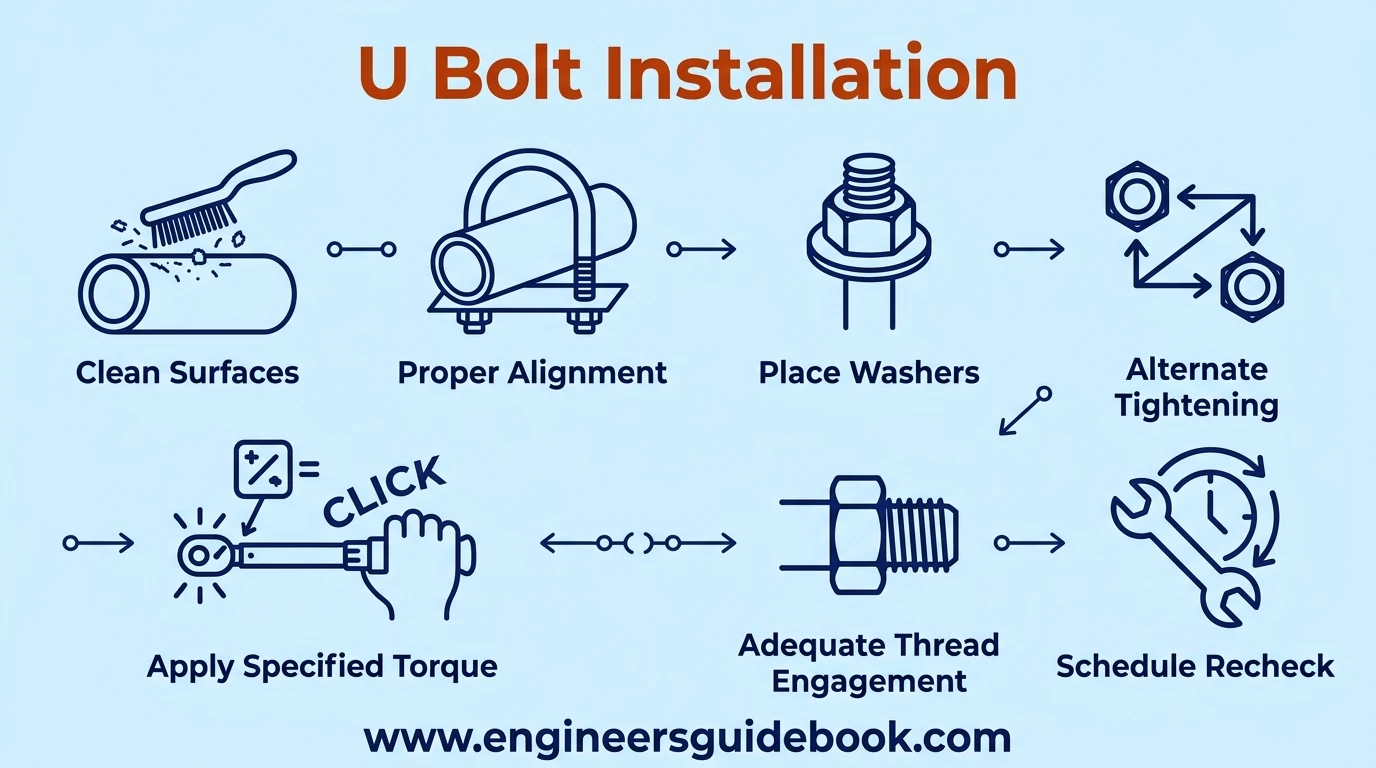
11.1 Surface Preparation
Before installation, surfaces should be clean, stable, and free from loose rust, paint flakes, oil, and debris. A contaminated surface can reduce friction and cause loosening.
For coated pipes or painted frames, avoid damaging the protective layer during installation.
11.2 Proper Alignment
The U bolt should sit squarely around the object. Both legs should pass evenly through the mounting holes. Misalignment causes uneven tightening and may bend the legs.
A properly aligned U bolt looks simple. It also performs better.
11.3 Washer Placement
Washers should be placed under the nuts to distribute load and protect the mounting surface. They also help achieve smoother tightening.
In slotted holes or softer materials, larger washers or backing plates may be needed.
11.4 Nut Tightening Sequence
Nuts should be tightened gradually and evenly. Tightening one side fully before the other can pull the U bolt out of alignment.
Alternate between both nuts until the desired seating and torque are achieved. This creates balanced clamping.
11.5 Torque Requirement
Torque controls the final clamp load. Under-tightening allows movement. Over-tightening may stretch the bolt or damage the clamped part.
Where torque values are specified, use a calibrated torque wrench. For critical assemblies, avoid tightening by feel alone.
11.6 Thread Engagement
Adequate thread engagement is essential. The nut should fully engage the threaded section, with a small amount of thread visible beyond the nut where required.
Insufficient engagement can strip threads under load.
11.7 Rechecking After Installation
After installation, rechecking may be necessary. This is especially true after vibration, thermal cycling, initial loading, or equipment startup.
Some assemblies settle after the first service period. A quick inspection can prevent long-term trouble.
11.8 Installation Mistakes to Avoid
Avoid using mismatched nuts, damaged threads, incorrect torque, poor alignment, and wrong material. Do not force a U bolt around a component that is too large.
Also avoid reusing heavily loaded U bolts in critical service. Hidden stretching can reduce reliability.
12. Frequently Asked Questions
12.1 What is a U bolt used for ?
A U bolt is used to clamp pipes, tubes, axles, poles, cables, and structural parts to a support. It is common in plumbing, automotive suspension, trailers, construction, marine hardware, agriculture, and industrial machinery.
12.2 What are the different types of U bolts ?
The main types include round bend U bolts, square bend U bolts, semi round U bolts, long tangent U bolts, short tangent U bolts, custom formed U bolts, and heavy duty U bolts. Each type suits a different shape or load condition.
12.3 How do you measure a U bolt ?
A U bolt is measured by rod diameter, inside width, inside length, overall length, thread length, and thread size. For pipe applications, the actual outside diameter of the pipe should be checked before selection.
12.4 What material is best for U bolts ?
The best material depends on the application. Carbon steel is suitable for general use, stainless steel is better for corrosion resistance, and alloy steel is preferred for high-strength applications.
12.5 Are stainless steel U bolts better than galvanized U bolts ?
Stainless steel U bolts are better in many corrosive and marine environments, especially when long-term rust resistance is required. Galvanized U bolts are often more economical and perform well outdoors, but the zinc layer can wear or degrade over time.
12.6 How tight should a U bolt be ?
A U bolt should be tightened enough to create secure clamp load without crushing the clamped object or overstressing the threads. For critical service, follow the specified torque value rather than guessing.
12.7 Can U bolts be reused ?
U bolts can sometimes be reused in light-duty, non-critical applications if they are undamaged. However, suspension, axle, lifting, and safety-critical U bolts should generally be replaced because they may have stretched or fatigued.
12.8 What is the difference between round U bolts and square U bolts ?
Round U bolts are designed for pipes, rods, and circular surfaces. Square U bolts are designed for square tubes, frames, and flat-sided members. The correct shape improves contact and clamping stability.
12.9 How do I choose the right U bolt size ?
Choose the size by measuring the object being clamped, checking the required load, selecting the proper rod diameter, confirming thread size, and allowing enough leg length for washers and nuts.
12.10 Why do U bolts fail?
U bolts fail because of overloading, corrosion, fatigue, poor installation, wrong material, insufficient torque, thread damage, or misalignment. Many failures begin with small movement that gradually damages the fastener.
13. Conclusion
U bolts are simple fasteners with serious responsibility. Their performance depends on correct size, material, coating, load rating, and installation quality. A good U bolt holds securely, resists movement, and survives the working environment.
The best practice is to start with the application, then confirm dimensions, load, material, thread type, and finish. For critical service, use certified fasteners and follow proper torque procedures.
When buying a U bolt, avoid choosing only by price or appearance. Match the fastener to the real service condition. The right U bolt improves safety, reduces maintenance, and gives the assembly a longer, more dependable working life.