A 5S audit checklist is a structured evaluation tool used to measure workplace organization, cleanliness, standardization, and sustainability across the five pillars of 5S. Each criterion receives a numerical score to identify performance gaps and improvement opportunities. Regular audits, corrective actions, visual management, and employee accountability help manufacturing facilities sustain 5S standards and improve operational efficiency.
1. Introduction to the 5S Audit Checklist
1.1 What Is a 5S Audit?
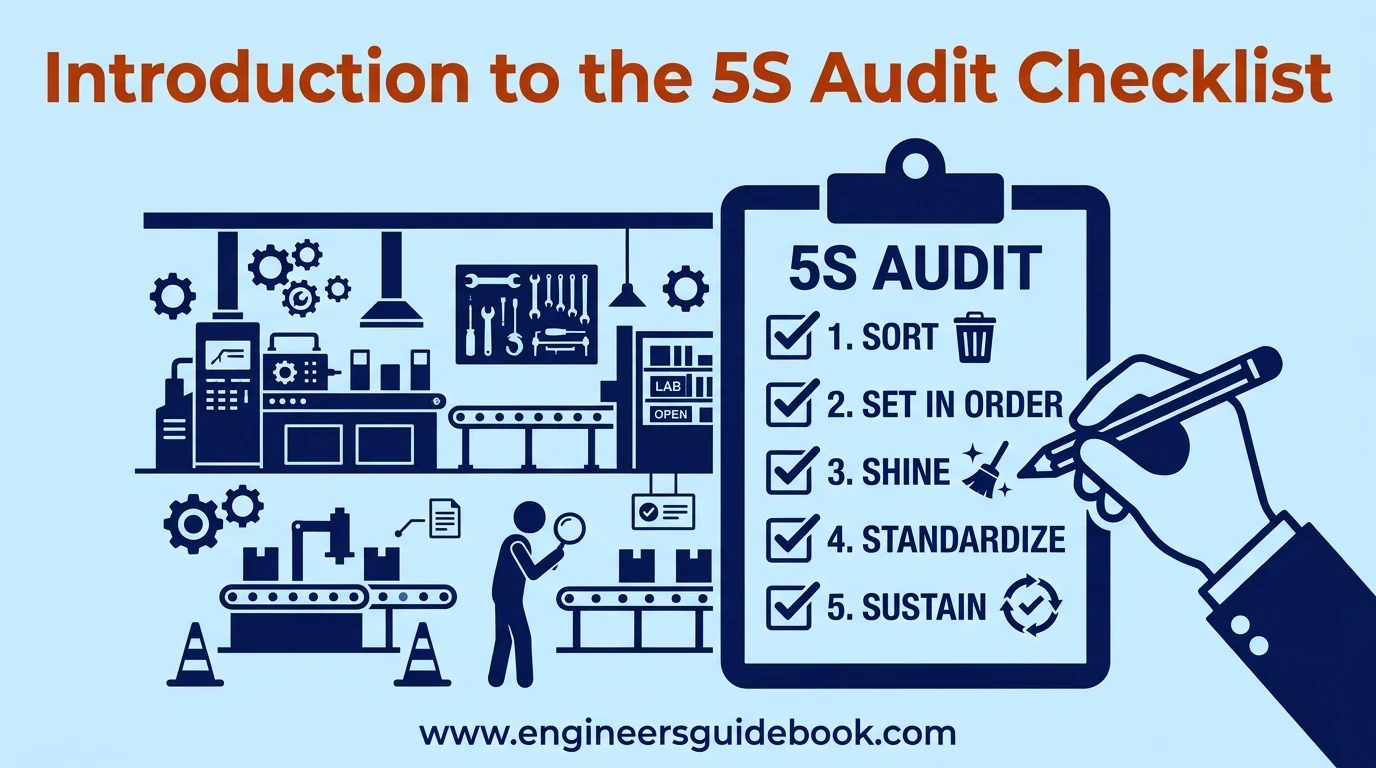
A 5S audit is a systematic workplace assessment that evaluates how effectively an organization implements the five principles of 5S. It measures actual workplace conditions against predetermined organizational, cleanliness, and operational standards.
Auditors identify deficiencies, document observations, and assign numerical performance scores.
1.2 Purpose of a 5S Audit Checklist
A 5S audit checklist establishes consistent evaluation criteria across departments. It eliminates ambiguity during inspections and provides a structured mechanism for identifying nonconformities, monitoring improvements, and maintaining workplace discipline.
1.3 Importance of 5S Audits in Manufacturing
Manufacturing environments contain machinery, tools, raw materials, and numerous operational activities. Without systematic organization, workplace inefficiencies can accumulate rapidly.
Regular 5S audits help prevent organizational deterioration while supporting equipment reliability, occupational safety, and production efficiency.
1.4 Benefits of Regular 5S Audits
Routine auditing delivers several operational benefits:
- Reduced material and tool retrieval time.
- Improved workplace safety.
- Greater employee accountability.
- Reduced operational waste.
- Improved manufacturing productivity.
- Enhanced workplace standardization.
2. Understanding the Five Pillars of 5S Auditing
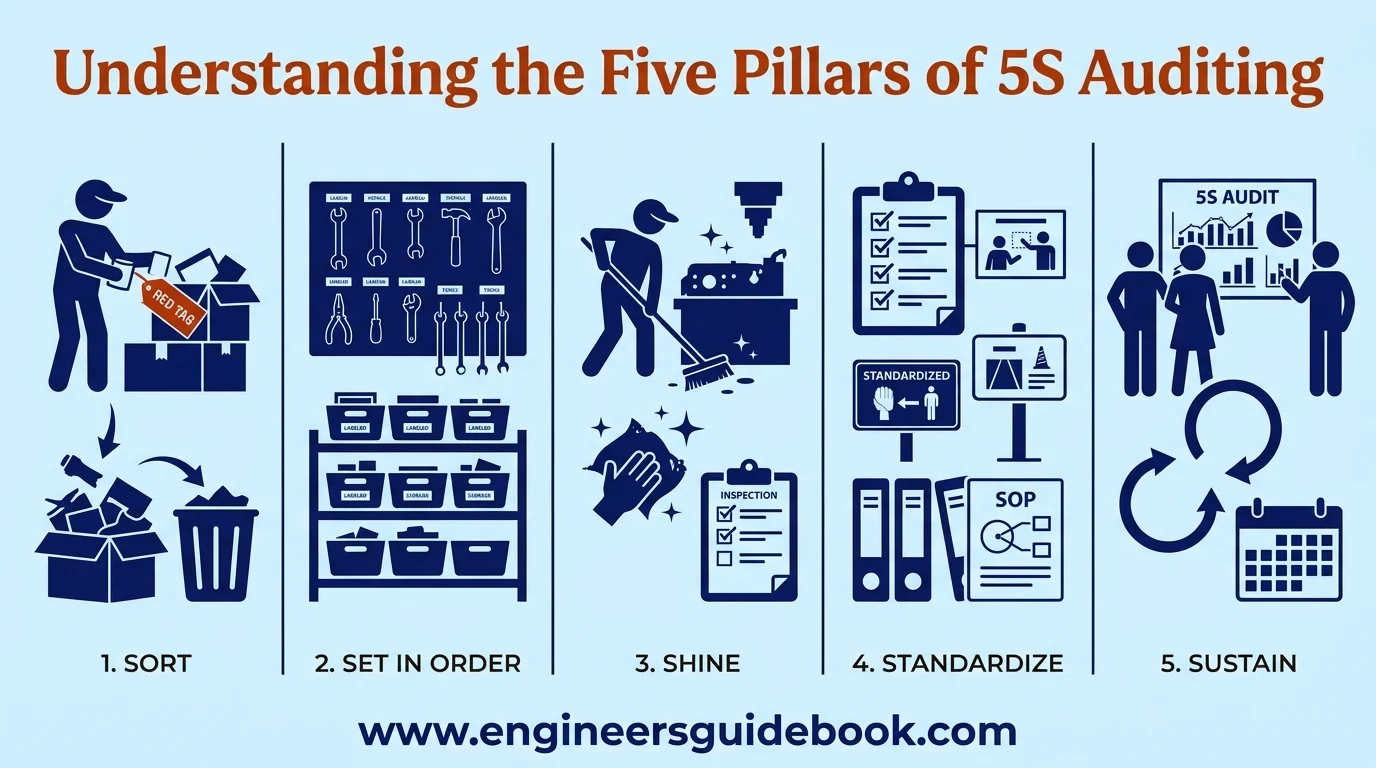
2.1 Sort (Seiri)
Sort auditing examines whether unnecessary materials, obsolete equipment, redundant tools, and unwanted inventory have been removed from designated workspaces.
Red-tagging systems provide an effective mechanism for identifying questionable items requiring relocation, disposal, or further evaluation.
2.2 Set in Order (Seiton)
This pillar evaluates the systematic arrangement of essential workplace items. Auditors examine storage locations, accessibility, labeling, and retrieval efficiency.
Frequently used tools should remain near their designated points of use without obstructing operational activities.
2.3 Shine (Seiso)
Shine auditing assesses workplace cleanliness and equipment housekeeping. Inspection activities focus on lubricant leakage, accumulated dust, contaminated surfaces, and cleaning deficiencies.
Cleaning also facilitates the early identification of equipment abnormalities.
2.4 Standardize (Seiketsu)
Standardization audits verify whether documented procedures, visual instructions, cleaning schedules, and workplace arrangements remain consistent.
Photographic reference standards can help employees distinguish acceptable workplace conditions from deviations.
2.5 Sustain (Shitsuke)
Sustain auditing measures organizational discipline and long-term compliance. Auditors examine employee participation, training records, previous audit results, and corrective action completion.
Sustainability transforms temporary workplace improvements into established operational practices.
3. Essential Components of a 5S Audit Checklist
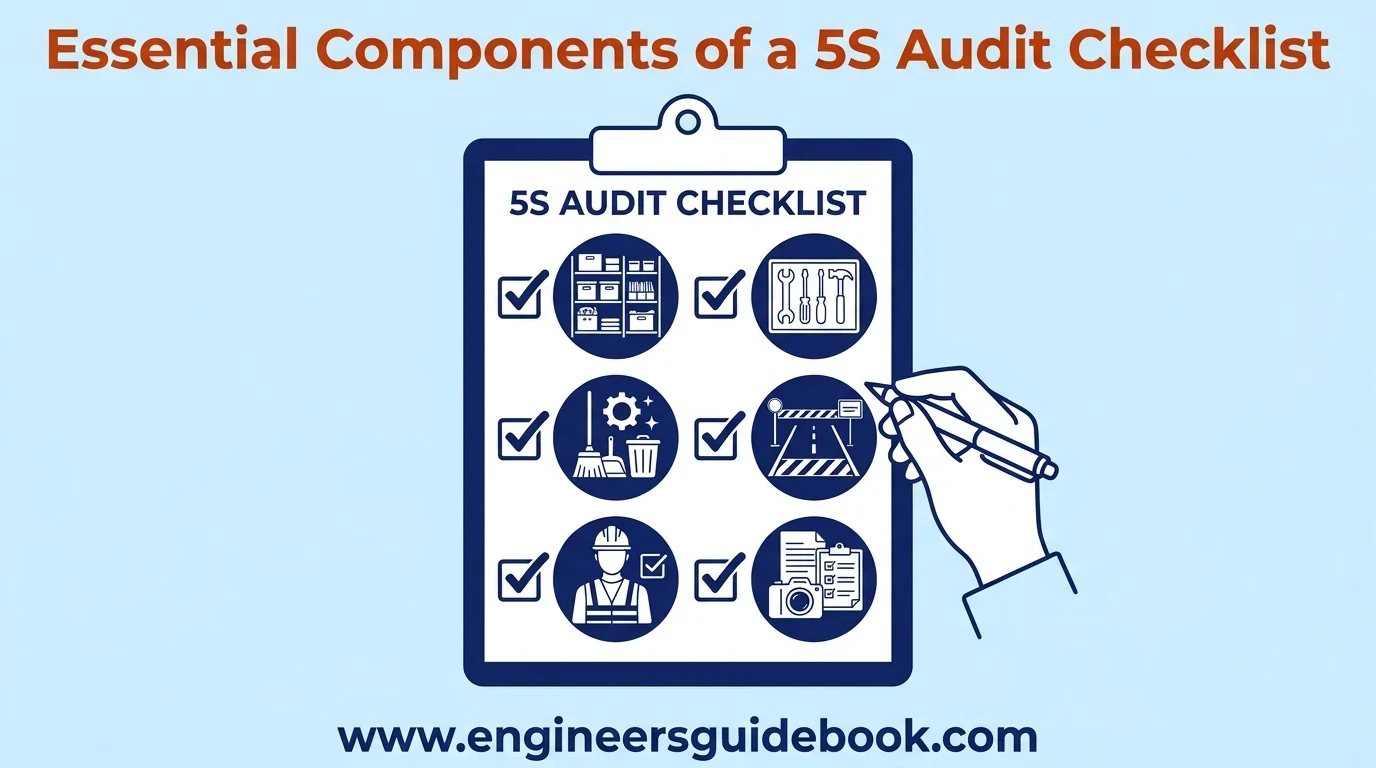
3.1 Workplace Organization Criteria
Organization criteria evaluate unnecessary inventory, material segregation, designated storage areas, and unobstructed workspaces. Each criterion should describe an observable condition that auditors can assess objectively.
3.2 Equipment and Tool Management
Auditors examine tool availability, equipment identification, storage arrangements, and inspection requirements. Shadow boards, labeled cabinets, and designated equipment locations improve retrieval efficiency and accountability.
3.3 Workplace Cleanliness and Housekeeping
Housekeeping assessments cover machinery surfaces, production floors, workbenches, storage racks, and inaccessible areas. Cleaning responsibilities and inspection frequencies should be clearly established.
3.4 Visual Management Standards
Visual management includes identification labels, floor markings, storage boundaries, instructional signage, and photographic reference standards. Effective visual controls make workplace abnormalities immediately recognizable.
3.5 Employee Compliance and Accountability
Employees should understand applicable 5S requirements and their individual responsibilities. Auditors assess adherence to established procedures, participation in improvement activities, and ownership of designated areas.
3.6 Audit Documentation and Evidence
A comprehensive checklist records inspection dates, department names, auditor details, individual scores, photographs, observations, and corrective actions. Documented evidence improves traceability and facilitates subsequent performance verification.
4. Complete 5S Audit Checklist
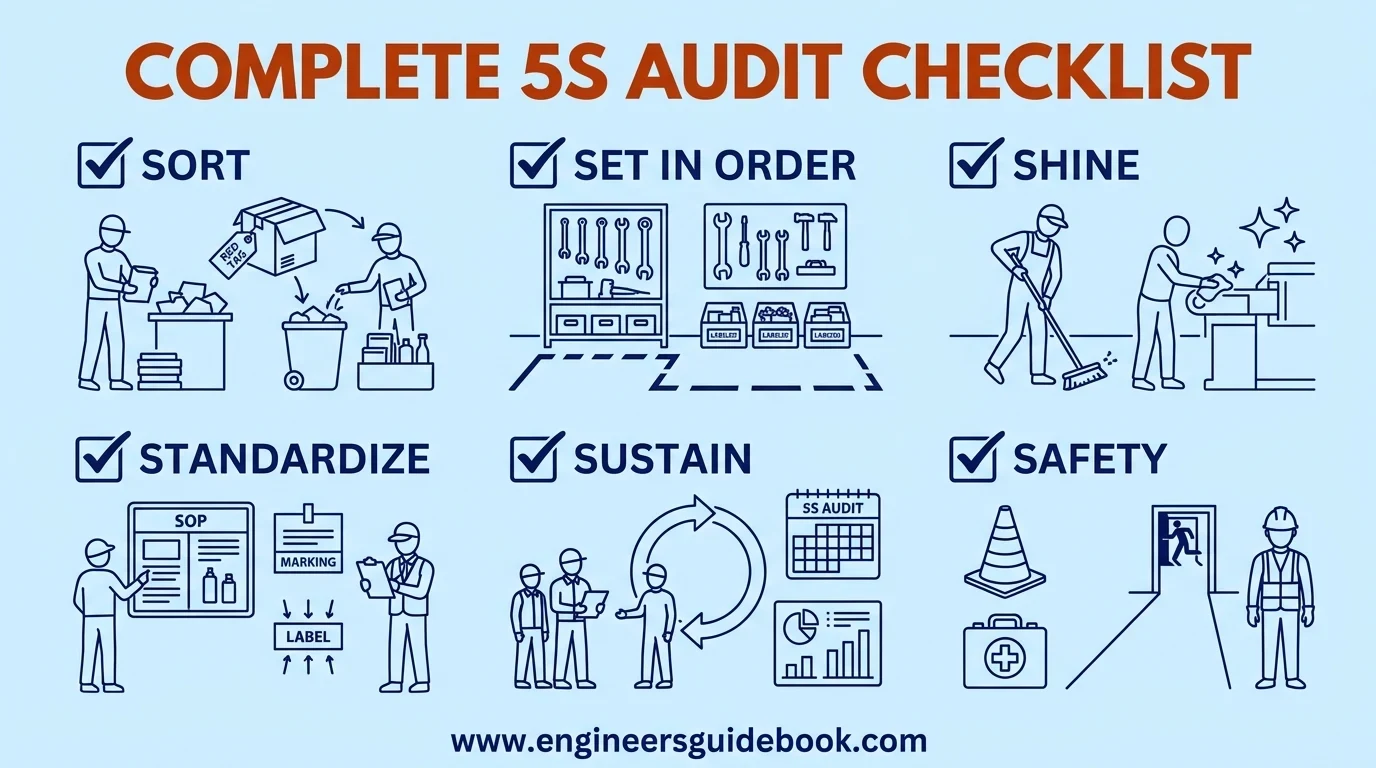
4.1 Sort Audit Checklist
Evaluate unnecessary items using the following inspection criteria:
- Unnecessary tools and materials are removed.
- Obsolete inventory is identified.
- Red-tagged items are appropriately managed.
- Workstations contain only essential items.
4.2 Set in Order Audit Checklist
Assess workplace arrangement against these requirements:
- Tools have designated storage locations.
- Storage containers are clearly labeled.
- Frequently used materials remain accessible.
- Walkways and storage boundaries are marked.
4.3 Shine Audit Checklist
Evaluate cleanliness and housekeeping performance:
- Floors and workstations are clean.
- Machinery is free from excessive contamination.
- Equipment leakage is identified and reported.
- Cleaning schedules are consistently followed.
4.4 Standardize Audit Checklist
Verify the implementation of consistent workplace standards:
- Standard operating procedures are available.
- Visual reference standards are displayed.
- Cleaning responsibilities are documented.
- Inspection checklists remain current.
4.5 Sustain Audit Checklist
Examine long-term implementation effectiveness:
- Employees receive appropriate 5S training.
- Scheduled audits are completed.
- Corrective actions are tracked.
- Previous improvements remain maintained.
4.6 Workplace Safety Considerations
Safety-related criteria should include emergency exit accessibility, electrical panel clearance, chemical segregation, and unobstructed pedestrian routes.
Critical safety deficiencies require immediate attention regardless of the overall 5S score. A 5S audit complements rather than replaces formal safety inspections.
5. 5S Audit Scoring System
5.1 Understanding the 5S Scoring Methodology
A scoring methodology converts qualitative observations into measurable performance indicators. Each inspection criterion receives a rating based on compliance with predefined requirements.
Consistent scoring enables meaningful comparisons between departments and successive audits.
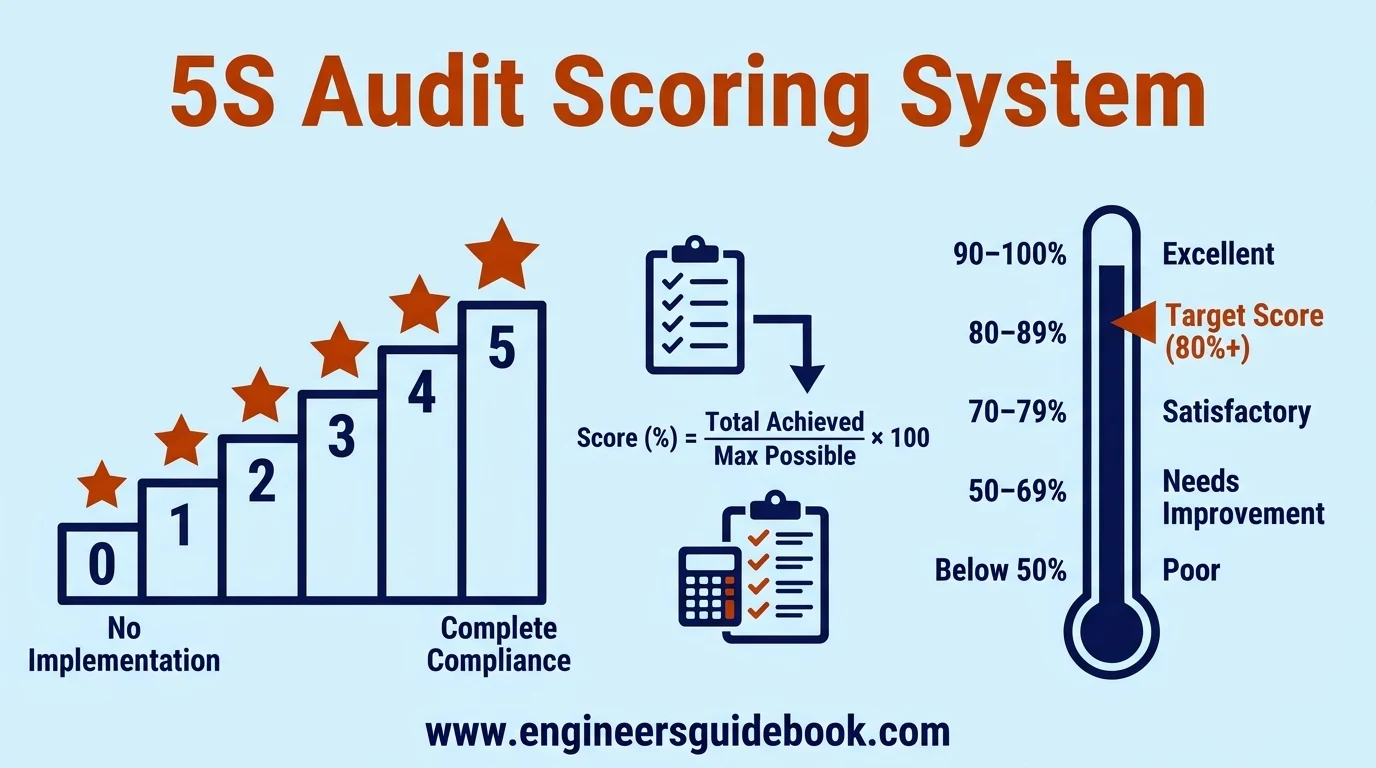
5.2 Establishing a 0–5 Rating Scale
The following rating scale provides a practical example:
Score Performance Level 0 No implementation 1 Very poor implementation 2 Partial implementation 3 Satisfactory implementation 4 Good implementation 5 Complete compliance
5.3 Defining Scoring Criteria
Each numerical rating should have explicit acceptance criteria. For example, complete tool organization may receive five points, whereas partially labeled storage locations may receive two or three points.
Clearly defined requirements minimize subjective interpretation.
5.4 Weighted and Unweighted Scoring Methods
Unweighted scoring assigns equal importance to every checklist item. Weighted scoring assigns greater importance to criteria with significant operational consequences.
Organizations should establish weighting factors before conducting audits to maintain evaluation consistency.
5.5 Calculating the Overall 5S Audit Score
The overall percentage score can be calculated using the following formula:
5S Audit Score (%) = (Total Achieved Score / Maximum Applicable Score) × 100
Nonapplicable criteria should be excluded from both the achieved and maximum possible scores.
5.6 Interpreting 5S Audit Results
An illustrative performance classification is presented below:
Audit Score Performance Classification 90–100% Excellent 80–89% Good 70–79% Satisfactory 50–69% Needs improvement Below 50% Poor
These ranges represent suggested internal benchmarks rather than universal industry requirements.
5.7 Establishing Minimum Acceptable Scores
Organizations should determine minimum acceptable scores according to operational maturity, workplace risks, and improvement objectives. An internal target of 80% may provide a starting point, with progressively stricter expectations as implementation matures.
6. Step-by-Step 5S Audit Procedure
6.1 Defining the Audit Scope
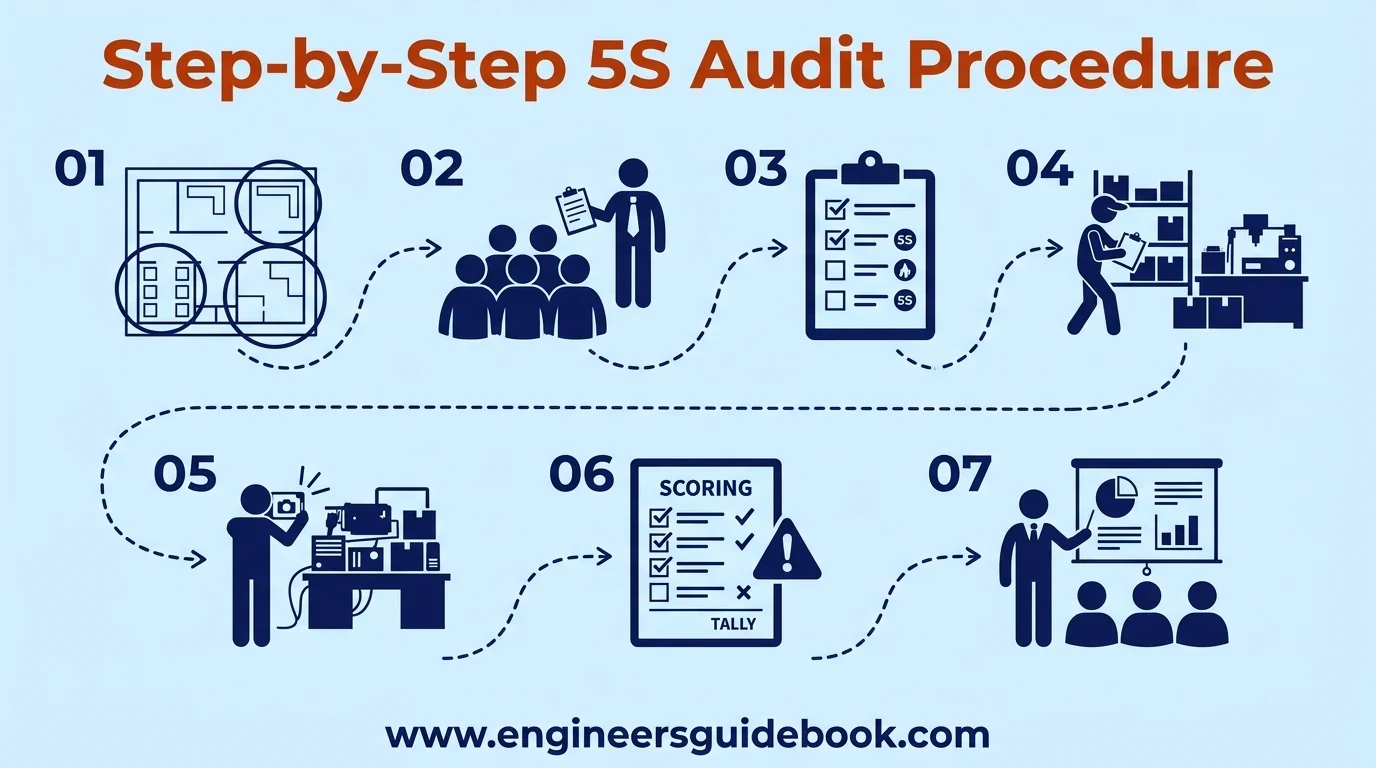
Establish the physical boundaries, departments, equipment, and activities included in the assessment. Clearly defined boundaries prevent inspection omissions and overlapping responsibilities.
6.2 Selecting and Training Auditors
Auditors should understand 5S principles, workplace standards, scoring methodologies, and evidence collection techniques. Cross-functional auditing and periodic scoring calibration can improve impartiality and consistency.
6.3 Preparing the Audit Checklist
Develop inspection criteria appropriate to the operational environment. Manufacturing lines, maintenance workshops, warehouses, and administrative offices may require different evaluation requirements while retaining the five fundamental pillars.
6.4 Conducting Workplace Inspections
Inspect actual workplace conditions through direct observation, employee discussions, and document verification. Examine storage arrangements, equipment cleanliness, visual controls, and compliance with documented standards.
6.5 Collecting Evidence and Recording Findings
Record observable deficiencies using written descriptions, photographs, equipment identification numbers, and location references. Evidence should clearly demonstrate deviations from established requirements.
6.6 Assigning Scores and Identifying Nonconformities
Assign ratings according to predefined scoring criteria. Document each nonconformity and distinguish critical deficiencies from minor organizational deviations requiring routine corrective action.
6.7 Communicating Audit Results
Present findings to department supervisors, employees, and relevant management personnel. Communication should highlight performance achievements, deficiencies, corrective responsibilities, and expected completion deadlines.
7. Practical 5S Audit Scoring Examples
7.1 Manufacturing Production Line Audit
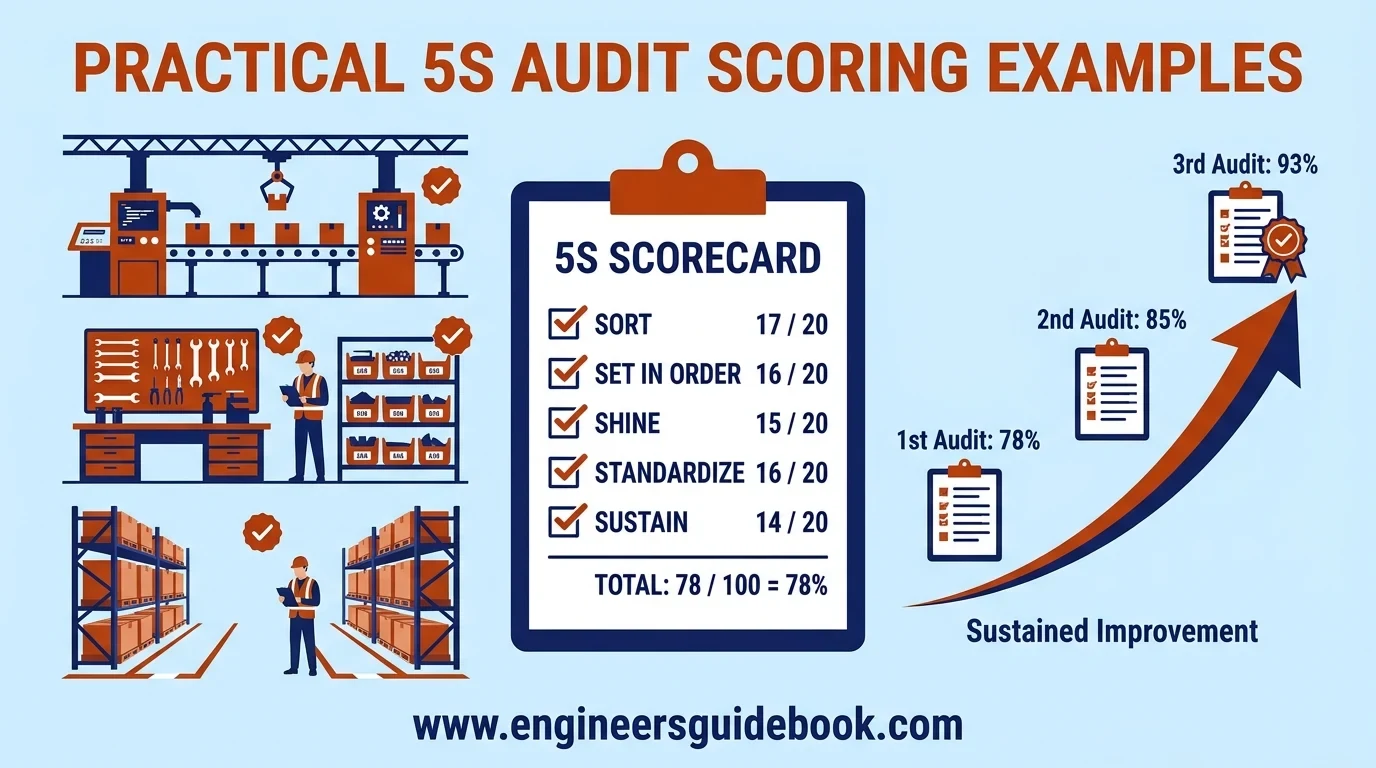
Consider a packaging line experiencing misplaced tools, scattered packaging materials, and inconsistent cleaning practices. An audit identifies these deficiencies and establishes corrective actions involving designated storage locations, material segregation, and documented housekeeping schedules.
7.2 Mechanical Maintenance Workshop Audit
A maintenance workshop may experience disorganized spanners, unidentified spare parts, and contaminated workbenches. Installing shadow boards, labeling storage cabinets, and introducing daily inspections can improve its 5S performance.
7.3 Warehouse and Spare Parts Audit
Warehouse auditing focuses on inventory identification, obsolete stock, rack organization, material accessibility, and pedestrian clearance. Effective visual controls reduce retrieval delays and prevent inappropriate material storage.
7.4 Step-by-Step 5S Score Calculation
Consider a manufacturing department with 20 applicable inspection criteria. Each criterion carries a maximum score of five points.
- Total inspection criteria = 20
- Maximum possible score = 100
- Total achieved score = 78
5S Audit Score = (78 / 100) × 100 = 78%
The department demonstrates satisfactory implementation but requires additional improvements.
7.5 Sample Completed 5S Audit Checklist
The following example illustrates individual pillar performance across a manufacturing department:
5S Pillar Maximum Score Achieved Score Sort 20 17 Set in Order 20 16 Shine 20 15 Standardize 20 16 Sustain 20 14 Total 100 78
The results identify Sustain as the weakest pillar, followed by Shine. Corrective actions should address these deficiencies while maintaining existing achievements.
7.6 Comparing Audit Scores Before and After Improvement
Following corrective action implementation, the department undergoes another assessment using identical evaluation criteria.
Audit Period 5S Score Initial audit 78% Second audit 85% Third audit 93%
The overall improvement amounts to 15 percentage points. However, sustained performance requires continued monitoring, employee participation, and verification that corrective measures remain effective under normal production conditions.
8. Analyzing 5S Audit Results and Corrective Actions
8.1 Identifying Performance Gaps
A 5S audit score provides a quantitative representation of workplace conditions. However, individual checklist results reveal specific operational deficiencies requiring attention.
Comparing actual scores against established targets helps organizations identify underperforming departments, recurring nonconformities, and weaknesses within individual 5S pillars.
8.2 Prioritizing Audit Findings
Not every audit finding carries identical operational significance. Deficiencies should be prioritized according to safety risks, production disruptions, financial consequences, and recurrence probability.
Blocked emergency exits require immediate intervention, whereas minor labeling inconsistencies may be addressed through scheduled improvement activities.
8.3 Conducting Root Cause Analysis
Recurring audit deficiencies frequently originate from underlying systemic weaknesses. Root cause analysis techniques, such as the 5 Whys and Fishbone Diagram, help identify these contributing factors.
For instance, repeatedly misplaced tools may indicate inadequate storage infrastructure rather than employee negligence.
8.4 Developing Corrective Action Plans
Corrective action plans translate audit observations into measurable improvement activities. Each action should address an identified deficiency and its underlying cause.
A comprehensive corrective action plan contains:
- Description of the nonconformity.
- Identified root cause.
- Recommended corrective action.
- Responsible personnel.
- Target completion date.
- Verification requirements.
8.5 Assigning Responsibilities and Deadlines
Clearly defined accountability prevents corrective actions from remaining unresolved indefinitely. Department supervisors should assign responsibilities according to employee competencies, available resources, and operational authority.
Completion deadlines should reflect the severity and complexity of each deficiency.
8.6 Verifying Corrective Action Effectiveness
Completing an action does not necessarily eliminate the underlying problem. Follow-up inspections should verify whether implemented measures deliver sustainable improvements.
Photographic comparisons, employee feedback, and subsequent audit results provide valuable evidence of corrective action effectiveness.

9. Measuring and Monitoring 5S Performance
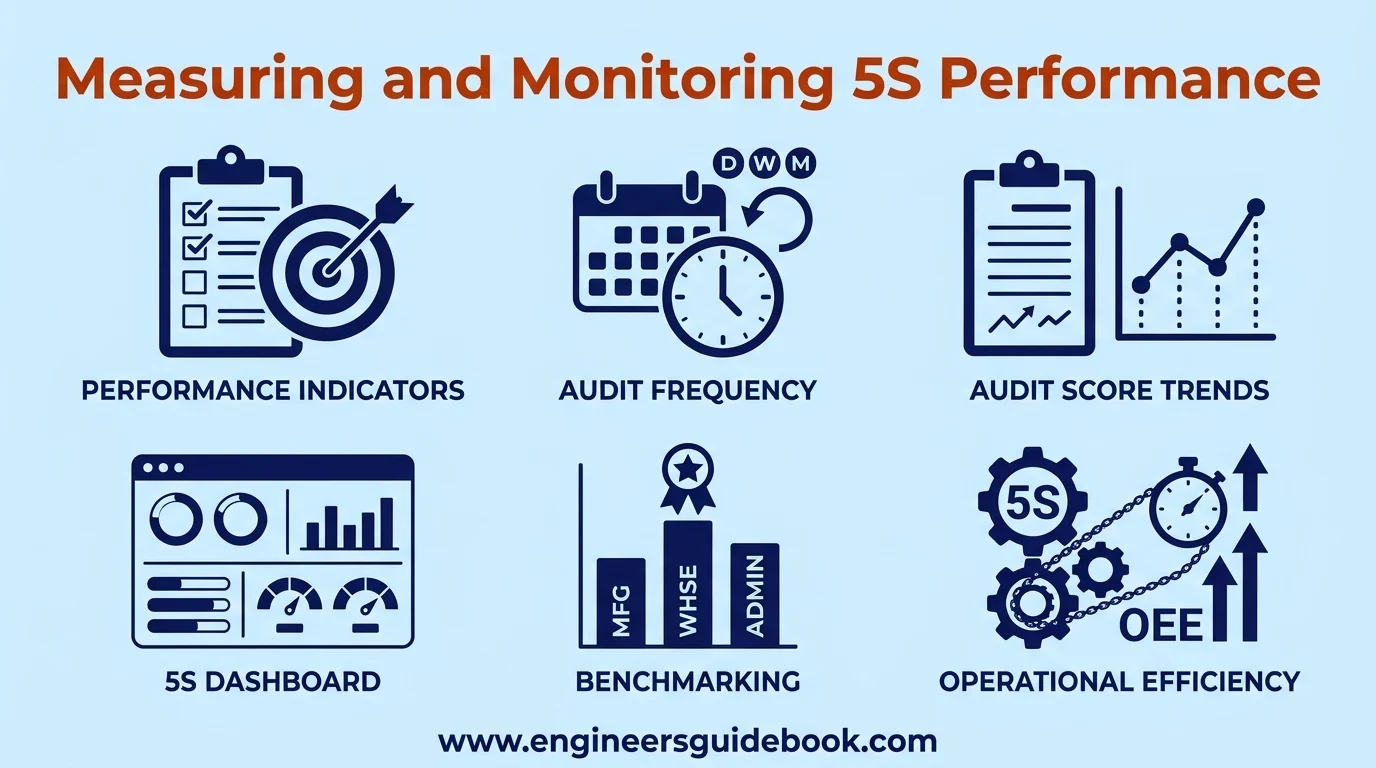
9.1 Key 5S Performance Indicators
Performance indicators help quantify the effectiveness of 5S implementation beyond individual inspection results.
Performance Indicator Measurement Objective Overall audit score Workplace compliance Corrective action closure rate Improvement execution Recurring nonconformities Implementation sustainability Tool retrieval time Workplace organization Audit completion rate Auditing consistency Employee participation Workforce engagement
9.2 Establishing 5S Audit Frequency
Audit frequency depends on workplace complexity, implementation maturity, and operational risks. Newly implemented 5S programs may require weekly inspections, while mature departments may benefit from monthly formal audits.
Daily housekeeping checks should complement periodic comprehensive assessments.
9.3 Tracking Audit Score Trends
Historical audit scores reveal improvement patterns and organizational deterioration. A declining score may indicate inadequate supervision, inconsistent standards, or reduced employee engagement.
Trend analysis helps management implement proactive interventions before deficiencies become deeply entrenched.
9.4 Developing 5S Performance Dashboards
Performance dashboards consolidate audit scores, corrective action status, departmental comparisons, and historical trends into an accessible visual format.
Color-coded indicators, bar charts, and trend graphs simplify performance interpretation and facilitate management decision-making.
9.5 Departmental Performance Benchmarking
Benchmarking enables organizations to compare 5S performance across manufacturing departments, maintenance workshops, warehouses, and administrative areas.
Comparisons should account for operational differences and checklist applicability. High-performing departments can provide transferable practices that support organization-wide improvement.
9.6 Linking 5S Performance to Operational Efficiency
Effective 5S implementation can contribute to measurable improvements in productivity, equipment accessibility, housekeeping efficiency, and material handling.
Organizations should examine relationships between audit scores and operational indicators such as Overall Equipment Effectiveness (OEE), equipment downtime, tool retrieval time, and manufacturing waste.
10. How to Sustain 5S in the Workplace
10.1 Establishing Standard Operating Procedures
Standard operating procedures institutionalize workplace organization requirements. They define cleaning methods, inspection responsibilities, storage arrangements, and acceptable workplace conditions.
Procedures should remain accessible, understandable, and regularly updated whenever operational requirements change.
10.2 Developing Daily 5S Inspection Routines
Daily inspections prevent minor organizational deficiencies from accumulating into significant operational problems.
Employees can conduct brief inspections before or after their shifts, checking tool placement, workstation cleanliness, material segregation, and abnormal equipment conditions.
10.3 Strengthening Employee Ownership
Sustainable 5S implementation requires employees to assume responsibility for their working environments. Assigning designated workplace zones establishes accountability and encourages proactive housekeeping.
Employee involvement in developing workplace standards also improves acceptance and practical applicability.
10.4 Implementing Visual Management Systems
Visual management makes workplace expectations immediately recognizable. Shadow boards, floor markings, identification labels, photographic standards, and inventory indicators reduce ambiguity.
A well-designed visual management system enables employees to recognize deviations without requiring extensive procedural explanations.
10.5 Encouraging Management Participation
Management commitment significantly influences 5S sustainability. Supervisors and senior managers should participate in workplace inspections, review performance indicators, and facilitate corrective action implementation.
Visible leadership involvement reinforces the importance of workplace discipline.
10.6 Establishing Recognition and Reward Programs
Recognition programs encourage constructive employee participation and acknowledge exceptional workplace improvements.
Organizations may introduce departmental achievement awards, employee appreciation certificates, or improvement competitions. Recognition should emphasize genuine operational improvements rather than numerical audit scores alone.
10.7 Integrating 5S With Continuous Improvement
5S should function as an integral component of continuous improvement rather than an isolated housekeeping initiative.
Integrating 5S with Kaizen, Lean Manufacturing, Total Productive Maintenance (TPM), and the Plan-Do-Check-Act (PDCA) cycle helps establish systematic operational excellence.

11. Common 5S Audit Mistakes and Best Practices
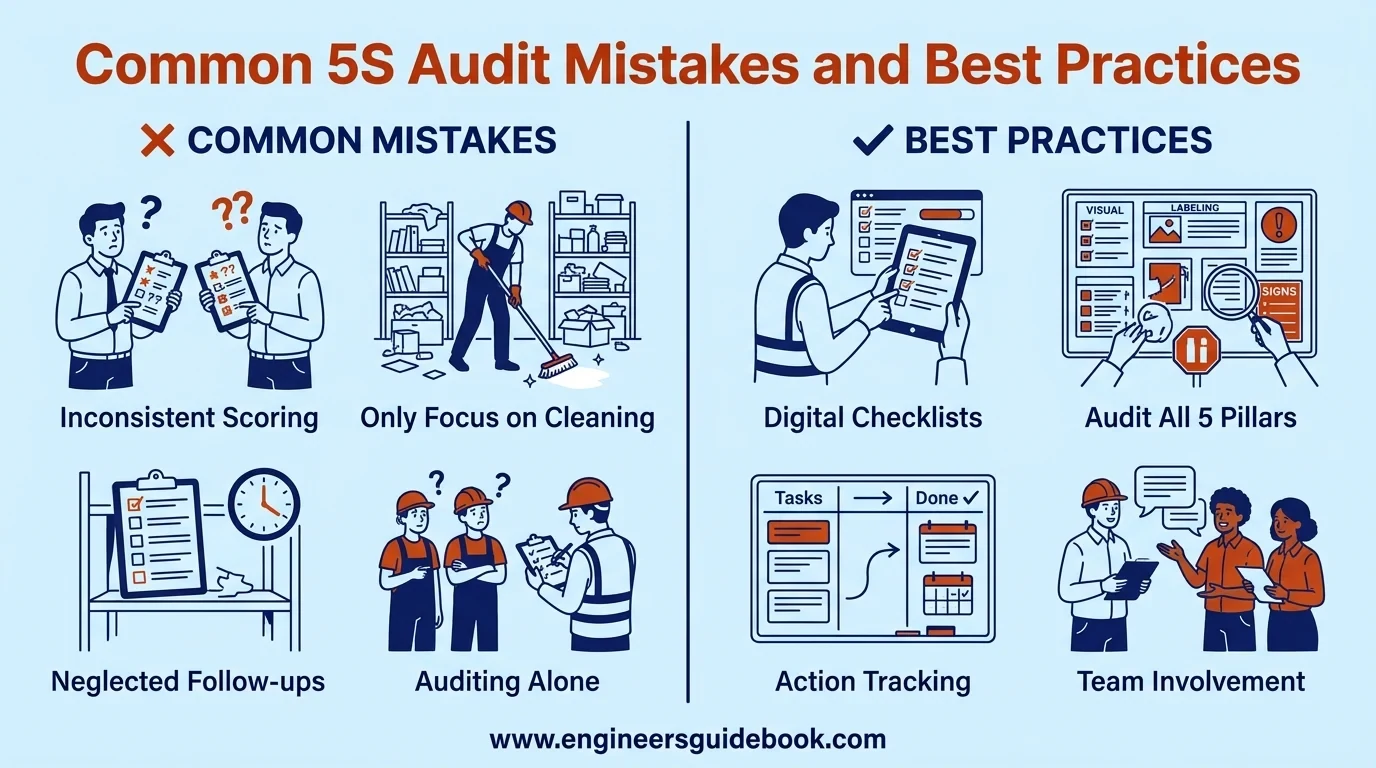
11.1 Inconsistent Audit Scoring
Different auditors may assign different scores to identical workplace conditions. Such inconsistencies undermine benchmarking and historical performance comparisons.
Standardized scoring guidelines, reference photographs, and auditor calibration sessions improve assessment reliability.
11.2 Subjective Evaluation Criteria
Ambiguous checklist statements introduce interpretative discrepancies. Requirements such as “workplace adequately organized” provide insufficient evaluation guidance.
Replacing subjective statements with observable conditions, such as “all tools stored in designated locations,” improves scoring objectivity.
11.3 Focusing Only on Workplace Cleanliness
Cleanliness represents only one component of the 5S methodology. An immaculate production floor may still contain unnecessary inventory, inefficient storage arrangements, or inadequate workplace standards.
Comprehensive audits must evaluate all five pillars independently.
11.4 Neglecting Corrective Action Follow-Ups
Audits deliver limited value when identified deficiencies remain unresolved. Repeated observations without corrective intervention gradually diminish employee confidence in the auditing process.
Action tracking and effectiveness verification should remain mandatory components of every audit cycle.
11.5 Conducting Audits Without Employee Involvement
Excluding operational personnel can create unrealistic workplace standards and unnecessary resistance. Employees possess practical knowledge regarding equipment accessibility, material movement, and production constraints.
Their involvement improves both corrective action feasibility and long-term compliance.
11.6 Using Digital 5S Audit Checklists
Digital audit checklists streamline data collection, photographic documentation, score calculation, and corrective action tracking.
Spreadsheet-based checklists, mobile inspection applications, and computerized management platforms can reduce administrative workloads while improving data accessibility and traceability.
11.7 Best Practices for Effective 5S Auditing
Successful 5S auditing requires consistency, transparency, measurable criteria, constructive feedback, and systematic follow-up. Organizations should periodically review their checklists, train auditors, maintain historical records, and incorporate employee recommendations.
The objective is sustainable workplace improvement rather than merely achieving a higher inspection score.
12. Frequently Asked Questions (FAQ)
12.1 What Is a 5S Audit Checklist?
A 5S audit checklist is a structured inspection document used to evaluate workplace organization, cleanliness, standardization, and employee discipline. It contains measurable criteria covering all five pillars of the 5S methodology.
12.2 What Are the Five Criteria of a 5S Audit?
The five fundamental criteria are Sort, Set in Order, Shine, Standardize, and Sustain. Each evaluates a specific aspect of workplace organization and long-term operational discipline.
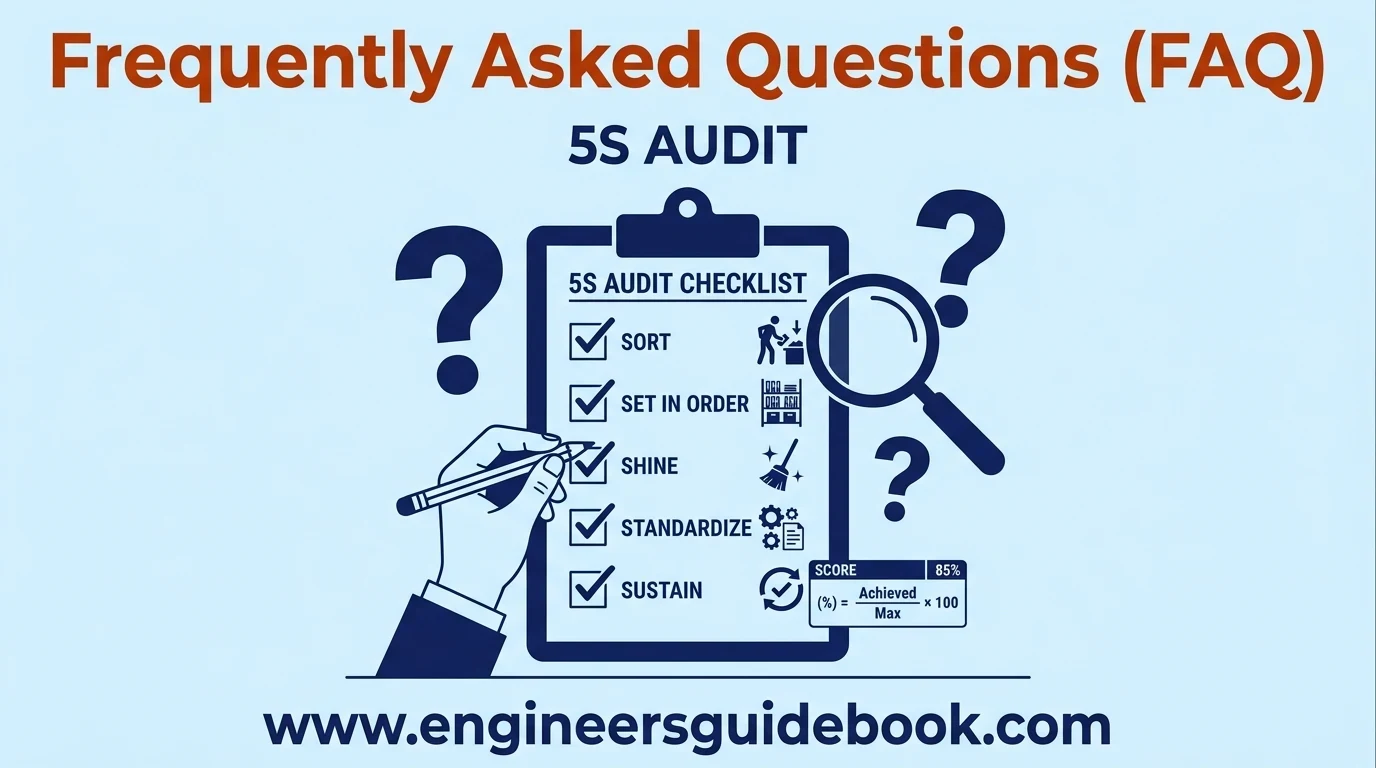
12.3 How Do You Calculate a 5S Audit Score?
Divide the total achieved score by the maximum applicable score and multiply the result by 100.
5S Audit Score (%) = (Achieved Score / Maximum Applicable Score) × 100
For example, achieving 85 out of 100 possible points produces an audit score of 85%.
12.4 What Is a Good 5S Audit Score?
An audit score between 80% and 89% may indicate good implementation, while scores of 90% or higher may indicate excellent performance. However, acceptable benchmarks depend on organizational requirements and the adopted scoring methodology.
12.5 How Often Should a 5S Audit Be Conducted?
Formal 5S audits can be conducted weekly, monthly, or quarterly, depending on implementation maturity and workplace requirements. Daily inspections help maintain established standards between formal assessments.
12.6 Who Is Responsible for Conducting a 5S Audit?
Trained auditors, department supervisors, continuous improvement teams, and designated 5S coordinators typically conduct audits. Cross-functional audit teams can improve objectivity, consistency, and organizational collaboration.
12.7 What Is the Difference Between a 5S Audit and a Safety Audit?
A 5S audit evaluates workplace organization, cleanliness, standardization, and sustainability. A safety audit specifically examines occupational hazards, regulatory compliance, risk controls, and accident prevention measures.
Although their objectives overlap, neither replaces the other.
12.8 How Can You Improve a Low 5S Audit Score?
Identify underperforming checklist criteria, investigate root causes, implement corrective actions, and establish employee accountability. Subsequent inspections should verify improvement effectiveness and prevent recurring deficiencies.
12.9 How Do You Sustain 5S in Manufacturing?
Sustain 5S through standardized procedures, daily inspections, periodic audits, employee training, visual management, management participation, and continuous improvement activities.
Consistent execution transforms workplace organization into an established operational habit.
12.10 Can a 5S Audit Checklist Be Customized?
Yes. Organizations can customize checklist criteria, scoring weights, inspection frequencies, and performance targets according to departmental requirements. However, the checklist should retain all five fundamental 5S pillars.
13. Conclusion
A well-structured 5S audit checklist provides a systematic foundation for evaluating workplace organization, identifying operational deficiencies, and sustaining continuous improvement. Numerical scoring transforms workplace observations into measurable performance indicators, enabling organizations to establish targets and monitor progress.
Nevertheless, achieving a high audit score is not the ultimate objective. Sustainable implementation requires corrective action effectiveness, employee ownership, standardized procedures, and consistent management commitment.
By integrating regular 5S audits with Lean Manufacturing and continuous improvement initiatives, industrial organizations can develop safer, more organized, and increasingly productive working environments while establishing a durable culture of operational excellence.