1. Oil Seal Overview
1. Oil Seal Meaning
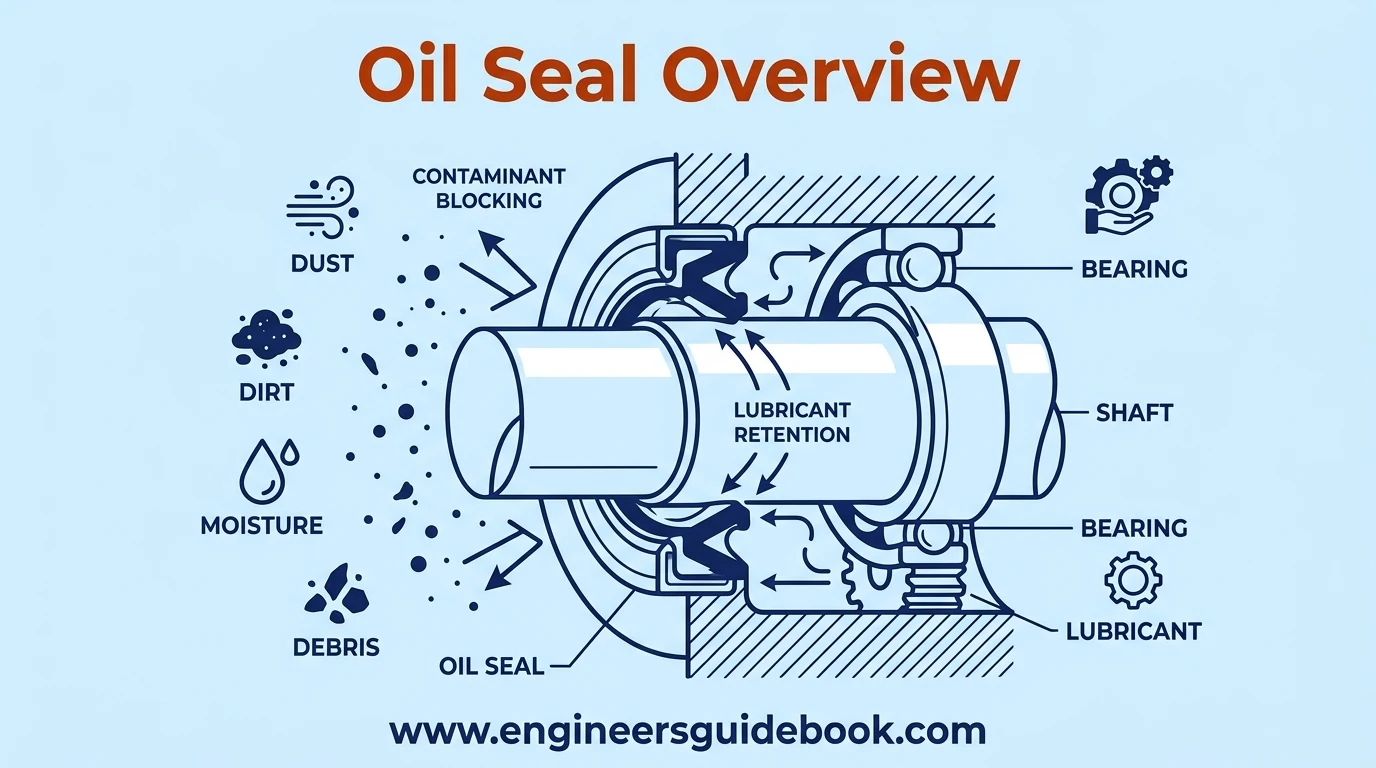
An oil seal is a mechanical sealing component used to retain lubricant inside a machine while preventing external contaminants from entering the system. It is commonly installed around rotating shafts, bearing housings, gearboxes, pumps, motors, and other mechanical assemblies where oil or grease must remain controlled within a defined space.
In simple terms, an oil seal acts like a protective boundary between two environments. On one side, there may be lubricating oil, grease, hydraulic fluid, or gear oil. On the other side, there may be dust, moisture, dirt, metal particles, chemical vapors, or abrasive debris. The oil seal keeps these two zones separated.
Oil seals are also called rotary shaft seals, grease seals, radial lip seals, or shaft seals, depending on their design and application. Although they are small in size, their function is critical. A single failed seal can cause lubricant loss, bearing damage, overheating, shaft wear, gearbox failure, and unexpected machine downtime.
2. Oil Seal Construction
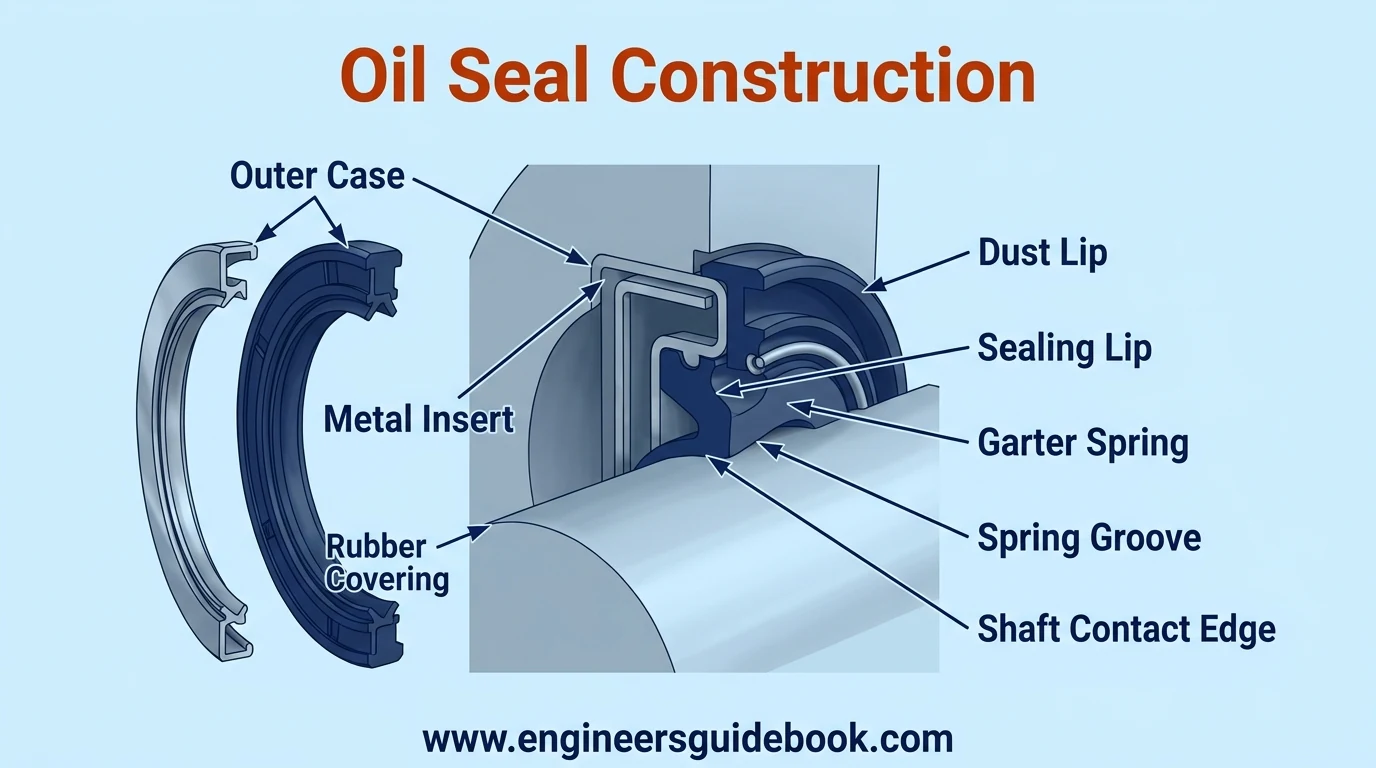
2.1 Outer Case
The outer case is the external supporting structure of the oil seal. It is usually made from metal, rubber-covered metal, or reinforced elastomer. Its main function is to hold the seal firmly inside the housing bore.
A metal outer case provides rigidity, dimensional stability, and strong retention. It is commonly used in applications where the housing bore is accurate and clean. Rubber-covered outer cases offer better sealing against minor housing imperfections. They also help prevent corrosion between the seal and the housing.
2.2 Sealing Lip
The sealing lip is the most important functional part of an oil seal. It is the flexible edge that contacts the rotating shaft and prevents oil leakage. The lip is usually made from elastomer or PTFE, depending on operating conditions.
The lip must maintain consistent contact pressure around the shaft circumference. It must also tolerate heat, friction, lubricant exposure, shaft movement, and vibration.
2.3 Dust Lip
The dust lip is an additional sealing lip positioned on the external side of the oil seal. Its main role is to stop dust, dirt, moisture, and foreign particles from reaching the primary sealing lip.
2.4 Garter Spring
The garter spring is a small circular spring fitted behind the sealing lip. It applies radial force to keep the lip in contact with the shaft. This is especially important when the seal operates under wear, temperature changes, shaft runout, or pressure fluctuation.
2.5 Metal Insert
The metal insert provides internal strength to the oil seal. It helps the seal maintain its shape during installation and operation. In many rotary shaft seals, the metal insert is embedded inside the elastomer body.
2.6 Rubber Covering
Rubber covering is used on many oil seals to improve static sealing between the outer diameter of the seal and the housing bore. It also provides corrosion protection and helps absorb minor surface irregularities.
2.7 Spring Groove
The spring groove is the recess that holds the garter spring in position behind the sealing lip. Although it appears simple, its geometry is important. It must secure the spring properly and maintain correct spring alignment during operation.
2.8 Shaft Contact Edge
The shaft contact edge is the precise line where the sealing lip touches the shaft surface. This small area controls the entire sealing action. It must be sharp enough to retain oil, yet smooth enough to avoid excessive wear.
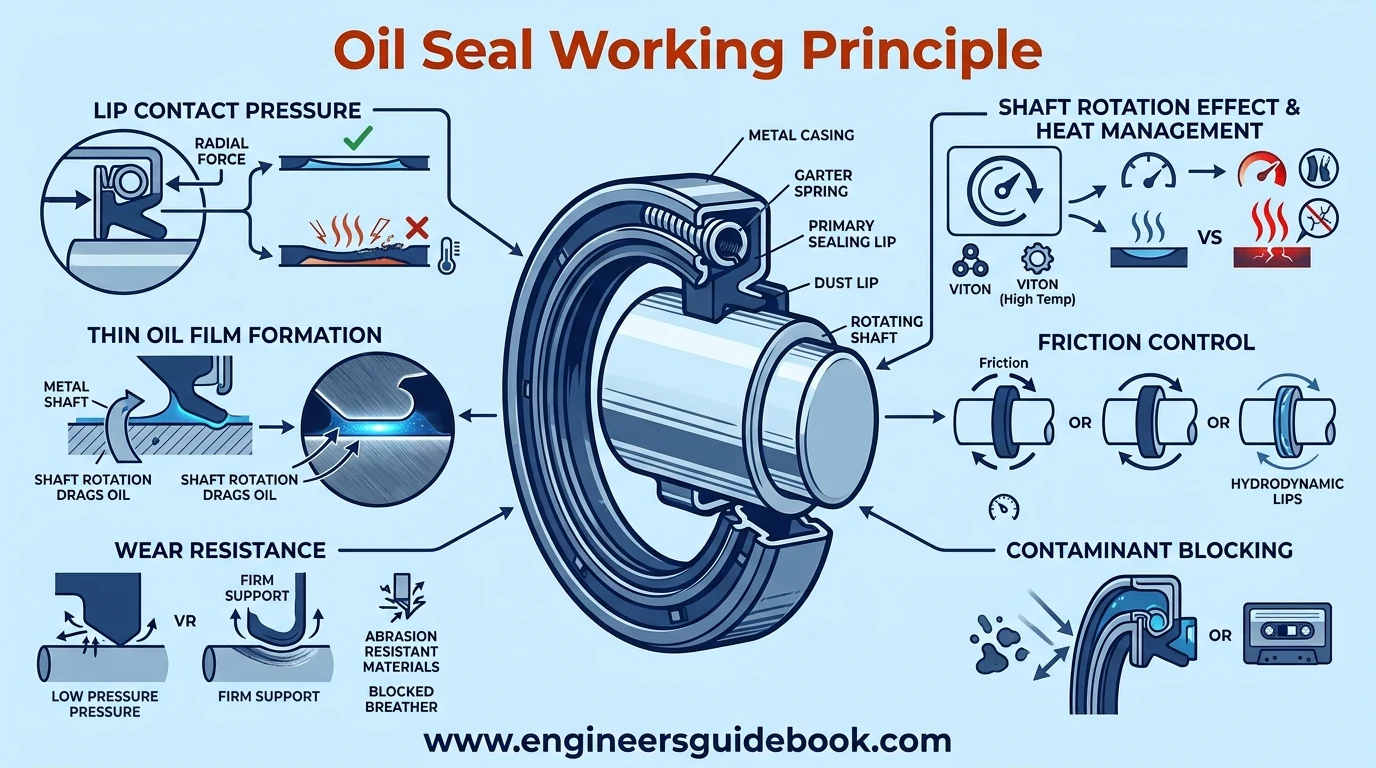
3. Oil Seal Working Principle
3.1 Lip Contact Pressure
Oil seals work by applying controlled lip contact pressure against the rotating shaft. This pressure creates a barrier that prevents oil from passing through the shaft opening.
The contact pressure must be carefully balanced. Too little pressure causes leakage. Too much pressure increases friction, heat, and lip wear. The garter spring, lip geometry, elastomer hardness, and shaft diameter all influence this pressure.
In a properly designed seal, the lip maintains enough radial force to control the lubricant while allowing a thin lubricating film to exist at the contact zone.
3.2 Thin Oil Film Formation
A very thin oil film forms between the sealing lip and the shaft during rotation. This film is microscopic but essential. It reduces friction and prevents dry contact between the rubber lip and the metal shaft.
The oil film works like a controlled lubrication interface. It allows the shaft to rotate smoothly while still preventing visible leakage. This is one reason why completely dry running is harmful to most oil seals.
If the oil film breaks down, heat rises quickly. The lip may harden, burn, crack, or wear unevenly. Proper lubrication before installation helps protect the lip during initial startup.
3.3 Shaft Rotation Effect
Shaft rotation affects how the oil seal performs. As the shaft turns, it drags a small amount of lubricant into the contact zone. This helps form the thin lubricating film needed for smooth sealing.
However, speed also generates heat. At high rotational speeds, the seal lip experiences more frictional energy. The material must be capable of handling the thermal load. Shaft runout, vibration, and eccentricity can further disturb the lip contact pattern.
For high-speed machines, low-friction designs, suitable materials, and accurate shaft finishing become very important.
3.4 Friction Control
Friction control is critical in oil seal performance. Every contact seal produces some friction, but excessive friction shortens service life. It can cause heat buildup, energy loss, lip wear, and surface damage.
Seal friction depends on lip load, material type, shaft speed, lubricant viscosity, temperature, and shaft finish. PTFE seals usually offer lower friction than many elastomeric seals. Hydrodynamic lip designs can also reduce friction by improving lubricant movement.
A well-selected oil seal minimizes friction while maintaining sufficient sealing force.
3.5 Heat Management
Heat is one of the major enemies of oil seals. Heat can come from shaft rotation, friction, ambient temperature, process temperature, or lubricant temperature. When the seal material exceeds its temperature limit, it begins to degrade.
Nitrile rubber performs well in many general applications but may harden at elevated temperatures. Fluoroelastomer and PTFE are better choices for hotter environments. Silicone can also handle high temperatures but may not be ideal for abrasive or mechanically demanding applications.
Proper heat management includes selecting the correct material, ensuring lubrication, avoiding excessive lip load, and maintaining suitable shaft speed.
4. Oil Seal Material Types
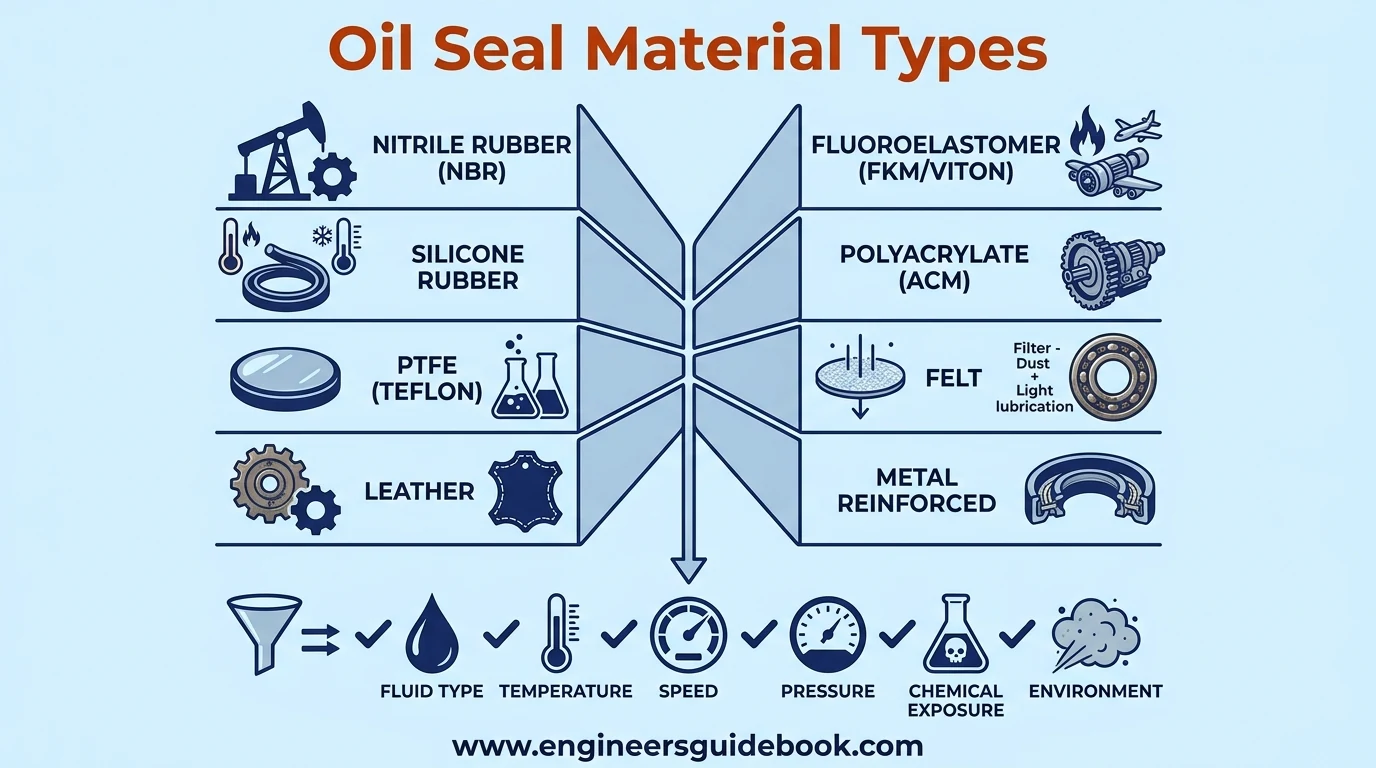
4.1 Nitrile Rubber Oil Seals
Nitrile rubber, often called NBR, is one of the most common materials for oil seals. It offers good resistance to mineral oils, grease, hydraulic fluids, and many petroleum-based lubricants.
NBR is widely used because it is economical, durable, and suitable for general industrial and automotive applications. It performs well in moderate temperature ranges and standard operating conditions.
However, nitrile rubber is not ideal for very high temperatures, aggressive chemicals, ozone exposure, or certain synthetic fluids. For normal gearboxes, pumps, motors, and engines, it remains a practical and popular choice.
4.2 Fluoroelastomer Oil Seals
Fluoroelastomer, commonly known as FKM or Viton, is used where higher temperature resistance and chemical resistance are required. It performs well with many oils, fuels, synthetic lubricants, and aggressive fluids.
FKM seals are common in engines, chemical processing equipment, compressors, high-temperature gearboxes, and demanding industrial machinery. They resist hardening better than nitrile in hot environments.
The main limitation is cost. Fluoroelastomer seals are more expensive than NBR seals. However, in severe applications, the longer service life often justifies the higher price.
4.3 Silicone Rubber Oil Seals
Silicone rubber oil seals are known for their excellent high-temperature flexibility and low-temperature performance. They remain elastic over a wide temperature range and are often used in applications where thermal cycling is present.
Silicone seals are suitable for light-duty sealing applications, hot air exposure, and certain engine environments. They also offer good resistance to ozone and weathering.
However, silicone has relatively lower tear strength and abrasion resistance compared with some other elastomers. It is not the best choice for dirty, abrasive, or high-pressure applications.
4.4 Polyacrylate Oil Seals
Polyacrylate rubber, also known as ACM, offers better heat and oil resistance than nitrile rubber. It is often used in automotive transmissions, engine applications, and gearboxes where oil temperatures are higher than normal.
ACM seals resist oxidation and hot oil degradation better than NBR. They are useful in environments where standard nitrile would become hard or brittle too quickly.
Their weakness is lower resistance to water, low temperatures, and some chemicals. Therefore, they should be selected carefully based on the actual operating medium.
4.5 PTFE Oil Seals
PTFE oil seals are used for demanding applications where low friction, chemical resistance, and high-temperature performance are required. PTFE has excellent resistance to many aggressive fluids and can operate in conditions where elastomeric seals may fail.
PTFE seals are often used in chemical plants, dry-running conditions, high-speed shafts, food-grade equipment, compressors, and special industrial machinery. They can handle wide temperature ranges and offer low wear under suitable conditions.
Unlike rubber seals, PTFE seals are less elastic. Installation must be done carefully to avoid lip deformation. Some PTFE seals require special installation tools.
4.6 Leather Oil Seals
Leather oil seals are older sealing designs but still appear in some vintage machinery, slow-speed equipment, and special applications. Leather has natural flexibility and can retain lubricant effectively under certain conditions.
These seals were widely used before modern elastomers became common. They can perform well in low-speed, grease-lubricated, or lightly loaded applications.
However, leather seals are less common today because rubber and PTFE materials offer better consistency, chemical resistance, and temperature performance.
4.7 Felt Oil Seals
Felt seals are used mainly for dust exclusion and light lubricant retention. They are often found in older machines, bearing housings, and low-speed equipment.
Felt can absorb oil and provide a simple sealing barrier. It is not suitable for high-pressure or high-speed sealing. Instead, it works best where the sealing demand is modest and the environment is not severe.
In modern machinery, felt seals are often replaced by elastomeric lip seals, V rings, or labyrinth seals.
4.8 Metal Reinforced Oil Seals
Metal reinforced oil seals contain a metal case or insert that improves dimensional strength. This reinforcement helps the seal remain stable during installation and operation.
These seals are used in applications where accurate positioning and rigid support are required. Metal reinforcement is especially useful for larger seals, high-speed shafts, and heavy-duty machinery.
The metal portion may be exposed or covered with rubber. Rubber-covered metal reinforced seals provide both strength and improved static sealing.
4.9 Material Compatibility Factors
Material compatibility is one of the most important parts of oil seal selection. The seal material must resist the operating fluid, temperature, pressure, speed, and external environment.
A seal that works well with mineral oil may fail quickly in synthetic oil or chemical fluid. A material suitable for low temperature may become unstable at high temperature. Similarly, a seal selected for clean oil may fail in abrasive dust or slurry exposure.
The correct material is selected by checking fluid type, temperature range, shaft speed, chemical exposure, pressure, and expected service life.
5. Rotary Shaft Oil Seals
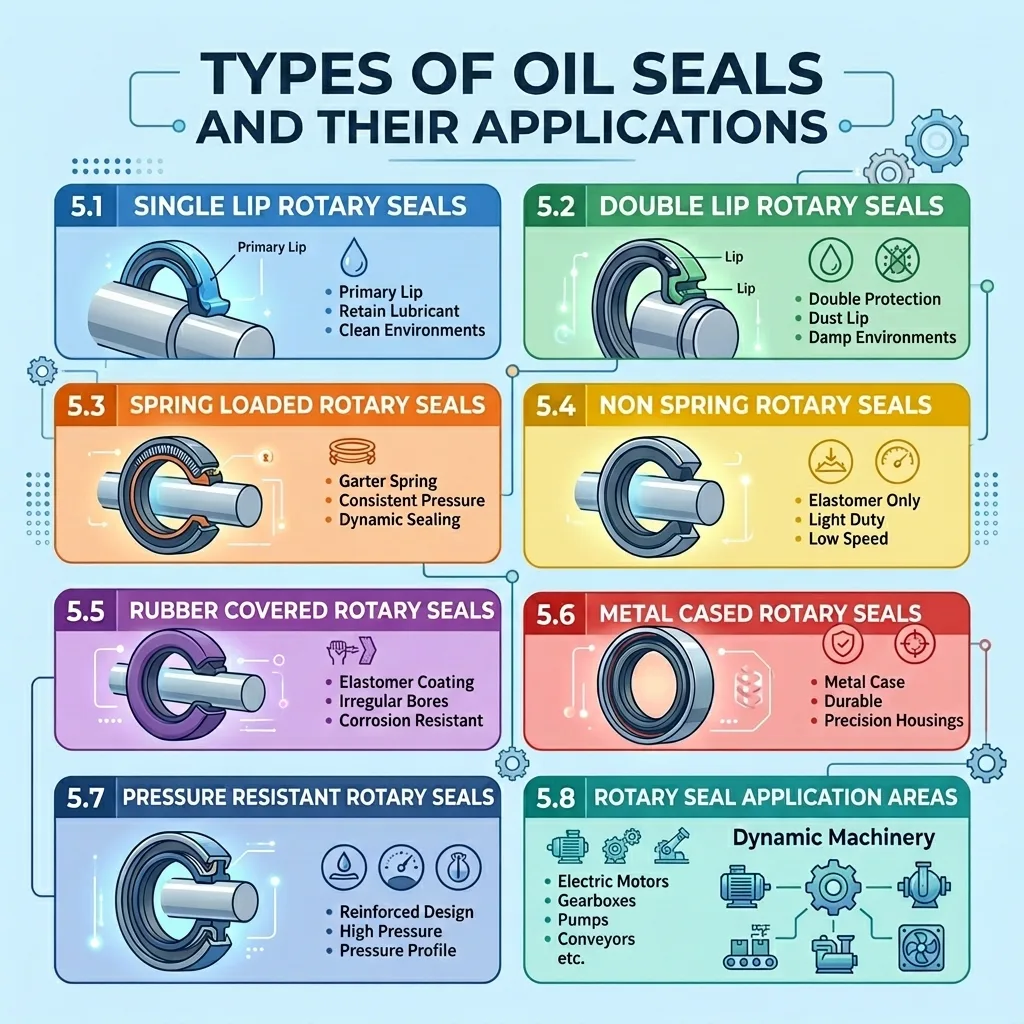
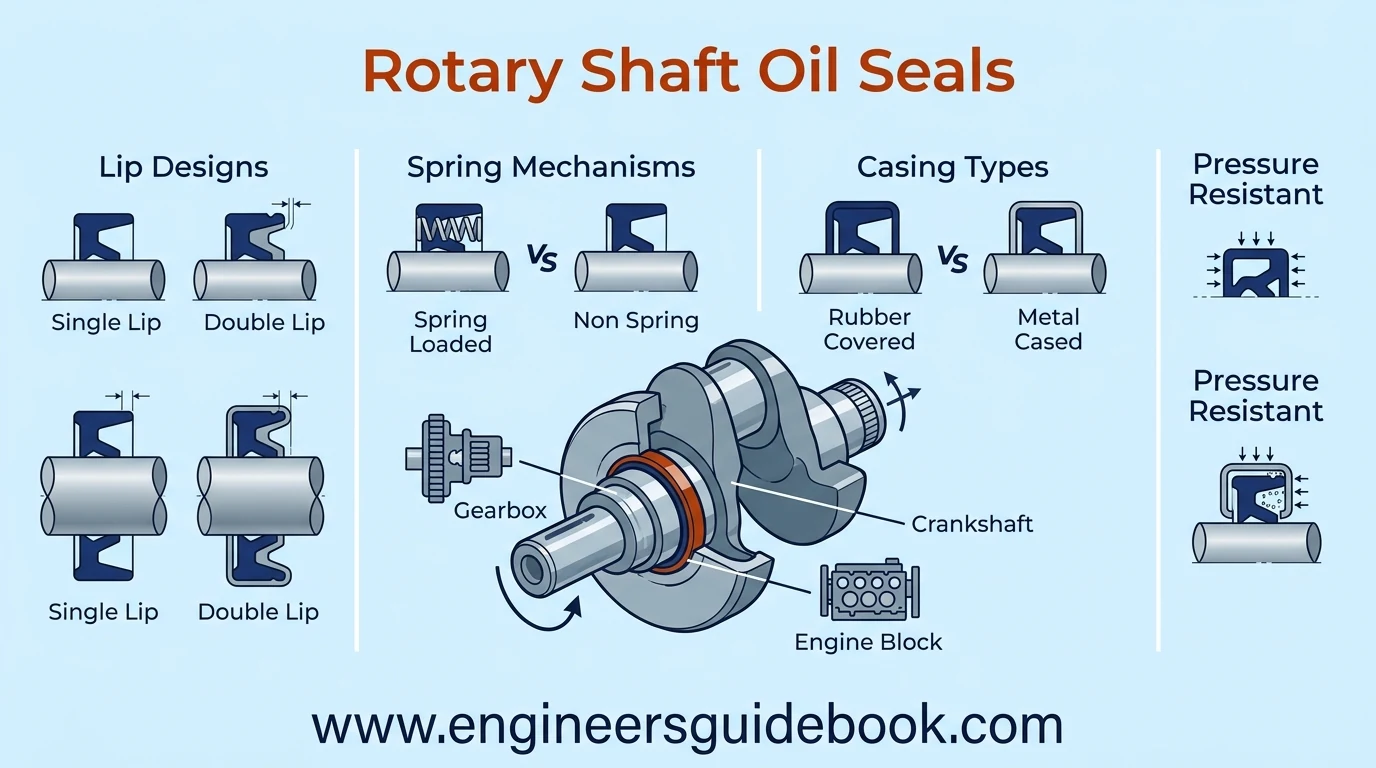
5.1 Single Lip Rotary Seals
Single lip rotary seals have one primary sealing lip. They are used to retain oil or grease inside a housing where contamination exposure is not severe.
These seals are simple, economical, and widely available. They are commonly used in gearboxes, pumps, motors, and general rotating equipment. Their design is suitable for clean environments and moderate operating conditions.
Single lip seals are not ideal where dust, water, or abrasive particles are present. In such cases, a double lip or protected seal design is better.
5.2 Double Lip Rotary Seals
Double lip rotary seals include a primary sealing lip and a secondary dust lip. The primary lip retains lubricant, while the secondary lip blocks external contaminants.
This design is common in automotive, agricultural, and industrial equipment. It provides better protection than a single lip seal, especially in dusty or moist environments.
The additional lip increases sealing security but may also increase friction. Therefore, speed, temperature, and lubrication conditions should be reviewed before selection.
5.3 Spring Loaded Rotary Seals
Spring loaded rotary seals use a garter spring to maintain consistent lip pressure on the shaft. The spring helps compensate for wear, shaft movement, and elastomer relaxation.
These seals are widely used in dynamic applications where reliable oil retention is required. They are suitable for gearboxes, engines, pumps, compressors, and bearing housings.
The spring must be compatible with the environment. In corrosive or wet conditions, stainless steel springs are often preferred.
5.4 Non Spring Rotary Seals
Non spring rotary seals do not use a garter spring. Their lip pressure comes from the elastomer shape and material elasticity.
These seals are used in light-duty applications, grease retention, dust exclusion, or low-speed equipment. They are simpler and may produce less friction than spring-loaded seals.
However, they may not maintain sealing force as effectively under wear, temperature change, or shaft runout. For demanding oil retention, spring-loaded designs are usually more reliable.
5.5 Rubber Covered Rotary Seals
Rubber covered rotary seals have an elastomer coating on the outer diameter. This covering improves sealing between the seal body and the housing bore.
They are useful where the housing bore has minor scratches, corrosion, or surface imperfections. The rubber layer provides better grip and helps prevent leakage around the outside of the seal.
Rubber covered seals are also less likely to corrode in damp environments compared with exposed metal case seals.
5.6 Metal Cased Rotary Seals
Metal cased rotary seals have an exposed metal outer shell. They provide strong structural support and excellent retention in accurately machined housings.
These seals are used in industrial equipment, gearboxes, engines, and high-volume machinery. They are durable and dimensionally stable.
However, metal cased seals require a clean and properly finished housing bore. If the bore is damaged or corroded, external leakage may occur unless sealant or a rubber-covered type is used.
5.7 Pressure Resistant Rotary Seals
Pressure resistant rotary seals are designed to handle higher internal pressure than standard oil seals. They may include reinforced lips, special profiles, support rings, or high-performance materials.
These seals are used in hydraulic pumps, pressurized gearboxes, compressors, and systems where internal pressure can push lubricant toward the shaft opening.
Using a standard oil seal in a pressurized system can cause lip inversion, leakage, or rapid wear. Pressure rating should always be checked before installation.
5.8 Rotary Seal Application Areas
Rotary shaft oil seals are used in many machines. Common application areas include electric motors, gear reducers, pumps, engines, transmissions, fans, blowers, conveyors, wheel hubs, and industrial rolls.
Their purpose is usually the same: retain lubricant and protect internal components. However, the design changes according to speed, temperature, pressure, shaft size, lubricant type, and contamination level.
Because rotary seals are used in so many systems, correct selection has a large impact on mechanical reliability.
6. Lip Design Types
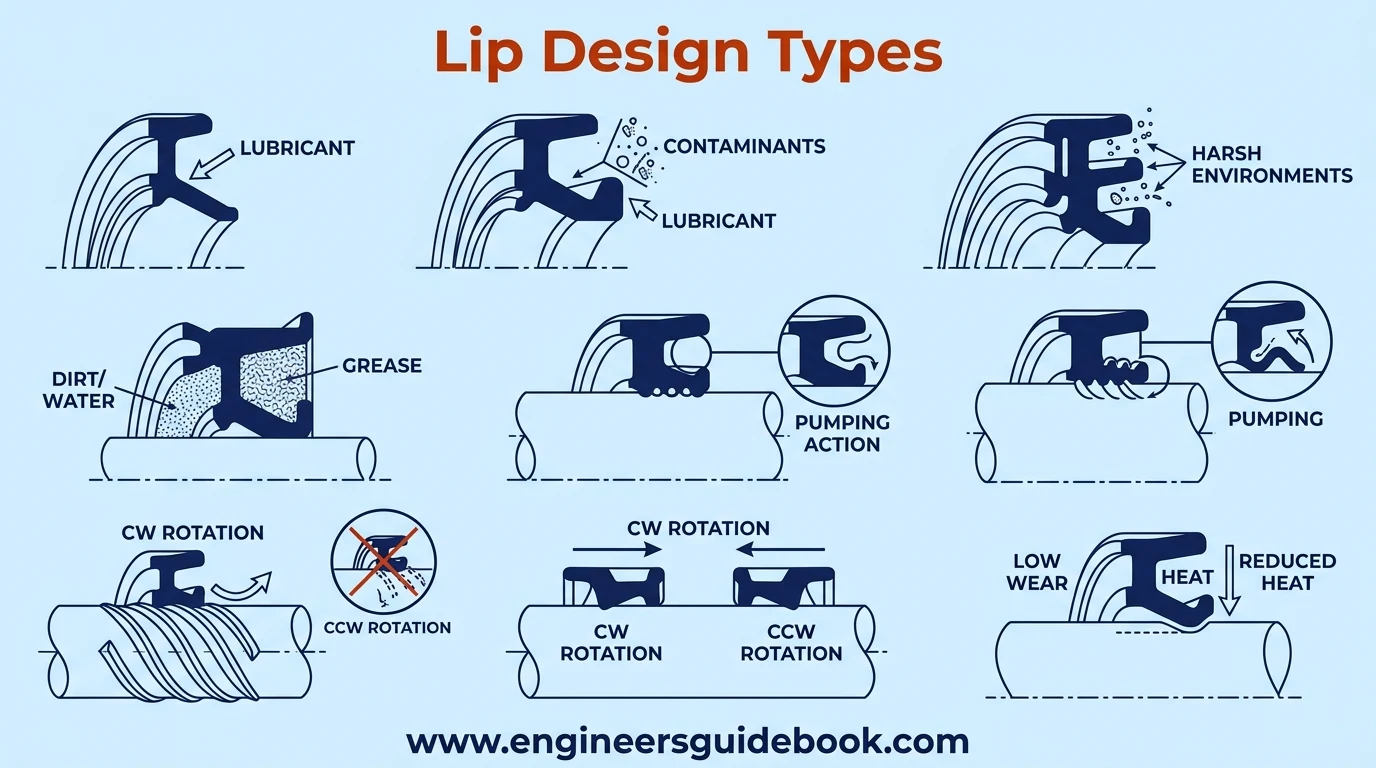
6.1 Single Lip Design
Single lip design is the simplest form of oil seal lip configuration. It uses one sealing edge to retain lubricant inside the machine.
This design is suitable for clean applications where the main concern is oil or grease retention. It is economical and easy to install.
However, single lip seals offer limited protection against dust and moisture. They should not be used alone in highly contaminated environments.
6.2 Double Lip Design
Double lip design includes one main sealing lip and one auxiliary lip. The main lip holds the lubricant. The auxiliary lip protects against contamination.
This design is very common because it provides a better balance between sealing and protection. It is used in wheel hubs, gearboxes, motors, pumps, and outdoor equipment.
Double lip seals are especially helpful where dust, water splashes, or fine particles are present near the shaft.
6.3 Triple Lip Design
Triple lip design provides additional sealing barriers for harsh environments. It may include one oil-retaining lip and two contaminant-blocking lips, or multiple lips arranged for special sealing duties.
These seals are used in heavy-duty equipment, agricultural machinery, off-road vehicles, and contaminated industrial areas. The extra lips improve protection but also increase friction.
Triple lip seals should be selected carefully for speed and heat conditions because each contact lip adds thermal load.
6.4 Dust Lip Design
Dust lip design focuses on external protection. The dust lip faces outward and blocks dirt, water, and abrasive particles before they reach the main sealing lip.
This design improves seal life in dirty environments. It is useful in conveyors, wheel bearings, construction equipment, and processing machinery.
For best performance, the area between the dust lip and primary lip may be filled with grease. This creates an additional protective barrier.
6.5 Hydrodynamic Lip Design
Hydrodynamic lip design uses small molded features on the sealing lip to direct oil back toward the lubricant side. These features may look like ribs, waves, or spiral grooves.
The purpose is to create a pumping action during shaft rotation. This helps reduce leakage and improves oil control, especially at higher speeds.
Hydrodynamic designs can be unidirectional or bidirectional. The correct type must match the shaft rotation direction.
6.6 Directional Pumping Lip Design
Directional pumping lip design moves lubricant in a specific direction. It is designed for shafts that rotate mainly one way.
When the shaft rotates correctly, the lip profile pumps oil back into the housing. If the shaft rotates opposite to the intended direction, sealing performance may decrease.
This design is useful in engines, transmissions, gearboxes, and machinery with predictable shaft rotation.
6.7 Bi Directional Lip Design
Bi directional lip design works with shafts that rotate in both directions. It provides oil return action regardless of rotation direction.
This design is important for reversing drives, gearboxes, actuators, and equipment that changes rotational direction during operation.
Bi directional seals offer more application flexibility than directional pumping seals. They are useful where machine movement is intermittent or reversible.
6.8 Low Friction Lip Design
Low friction lip design reduces contact force and heat generation. It is used where energy efficiency, high speed, or reduced wear is important.
These seals may use optimized lip geometry, special elastomers, PTFE materials, or reduced radial load. Lower friction means less heat and longer life under suitable conditions.
However, low friction seals must still provide enough sealing pressure. If the lip load is too low, leakage may occur.
7. Special Oil Seal Types
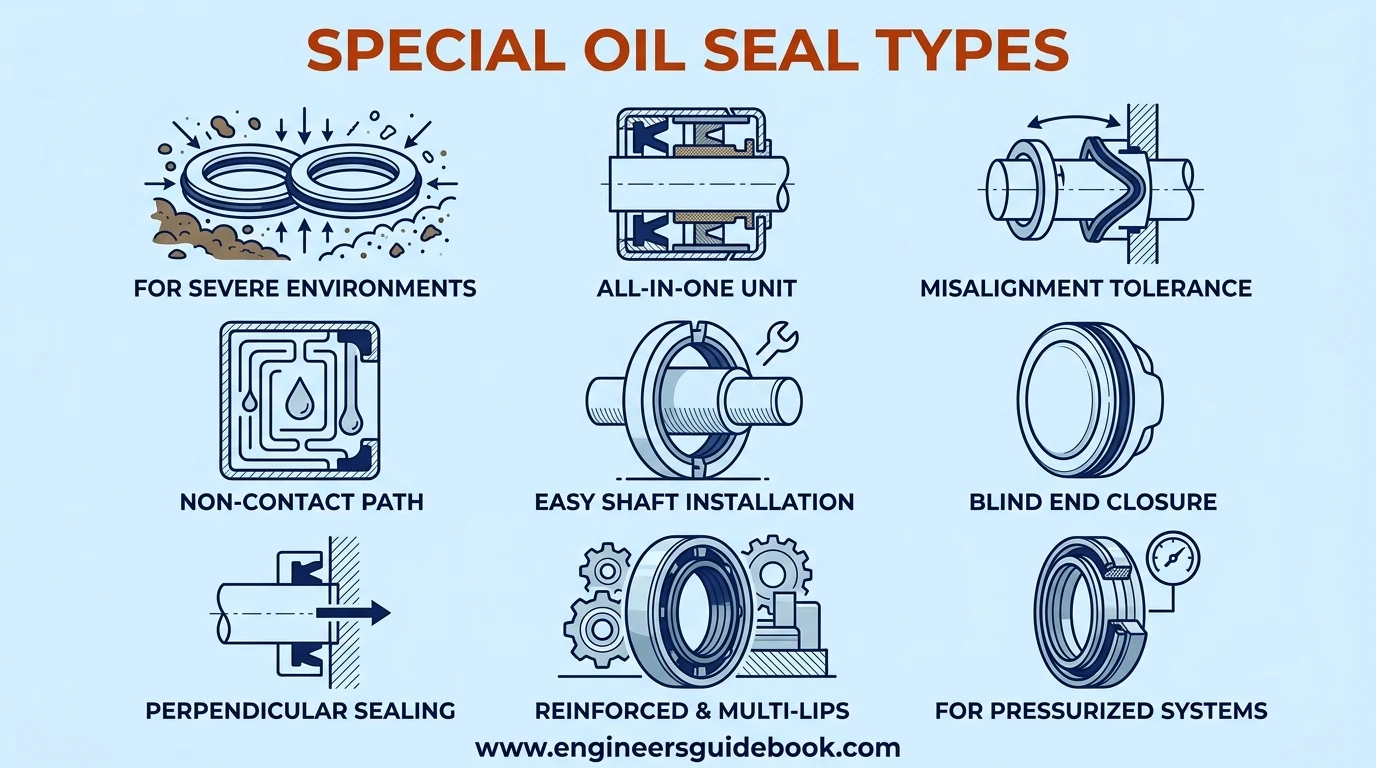
7.1 Mechanical Face Seals
Mechanical face seals are heavy-duty seals used in severe environments. They consist of two precision sealing faces that press against each other, usually with elastomeric load rings behind them.
These seals are common in construction equipment, mining machines, tracked vehicles, and agricultural machinery. They are designed to resist mud, sand, water, and abrasive material.
Mechanical face seals are highly durable but require accurate installation. The sealing faces must remain clean and properly aligned.
7.2 Cassette Oil Seals
Cassette oil seals are integrated sealing units that combine multiple sealing elements, a wear sleeve, and protective lips in one assembly. They are designed for demanding applications where ordinary lip seals may not survive.
These seals are often used in wheel hubs, agricultural machinery, commercial vehicles, and off-road equipment. Their enclosed design protects against mud, water, and dust.
Cassette seals simplify installation because the wear surface is built into the seal. This reduces dependence on the shaft surface condition.
7.3 V Ring Seals
V ring seals are flexible axial seals mounted on a shaft. They rotate with the shaft and seal against a stationary counterface.
They are commonly used as secondary seals to protect bearings and oil seals from dust, water spray, and contaminants. Their flexible lip allows easy installation and good tolerance for shaft misalignment.
V rings are often found in electric motors, pumps, gearboxes, bearing housings, and conveyors.
7.4 Labyrinth Seals
Labyrinth seals are non-contact seals that use a complex path to restrict lubricant leakage and contaminant entry. Instead of relying on lip contact, they create a tortuous passage that slows fluid and particle movement.
Because they do not contact the shaft directly, labyrinth seals produce very low friction. They are suitable for high-speed applications where contact seals may overheat.
They are widely used in turbines, compressors, electric motors, bearing housings, and high-speed rotating equipment.
7.5 Split Oil Seals
Split oil seals are designed with a cut or split section, allowing installation around a shaft without fully dismantling the machine. This makes them valuable for large equipment where shaft removal is difficult.
They are used in gearboxes, mills, marine equipment, and heavy industrial machinery. Split seals reduce maintenance time and labor.
However, their sealing performance depends heavily on correct installation. The split joint must be carefully positioned and sealed.
7.6 End Cap Seals
End cap seals are used to close the end of a housing where no shaft passes through. They prevent lubricant from escaping and protect the bearing or gearbox interior from contamination.
These seals are common in gearboxes, wheel hubs, bearing housings, and mechanical assemblies with blind ends.
End cap seals may be metal, rubber-covered, or elastomeric depending on the housing design and sealing requirement.
7.7 Axial Shaft Seals
Axial shaft seals seal against a surface perpendicular to the shaft axis. Unlike radial lip seals, they work in an axial direction.
These seals are useful where radial space is limited or where additional contamination protection is needed. V rings are a common example of axial sealing.
Axial seals are often used as secondary protection for bearings, pumps, motors, and outdoor rotating equipment.
7.8 Heavy Duty Oil Seals
Heavy duty oil seals are designed for severe working conditions. They may include multiple lips, reinforced cases, wear sleeves, high-grade elastomers, and additional protective features.
These seals are used in mining equipment, agricultural machinery, construction vehicles, steel mills, marine systems, and heavy gearboxes.
Their purpose is not only oil retention but also survival in abrasive, wet, hot, or high-load environments.
7.9 High Pressure Oil Seals
High pressure oil seals are made for applications where internal pressure is higher than standard seal limits. They may include reinforced lips, harder materials, anti-extrusion support, and specialized geometry.
They are used in hydraulic pumps, pressurized lubrication systems, compressors, and special rotating assemblies.
Before using a high pressure oil seal, pressure, speed, temperature, and lubrication conditions must be checked together. High pressure combined with high speed can create severe heat and wear.
8. Automotive Applications
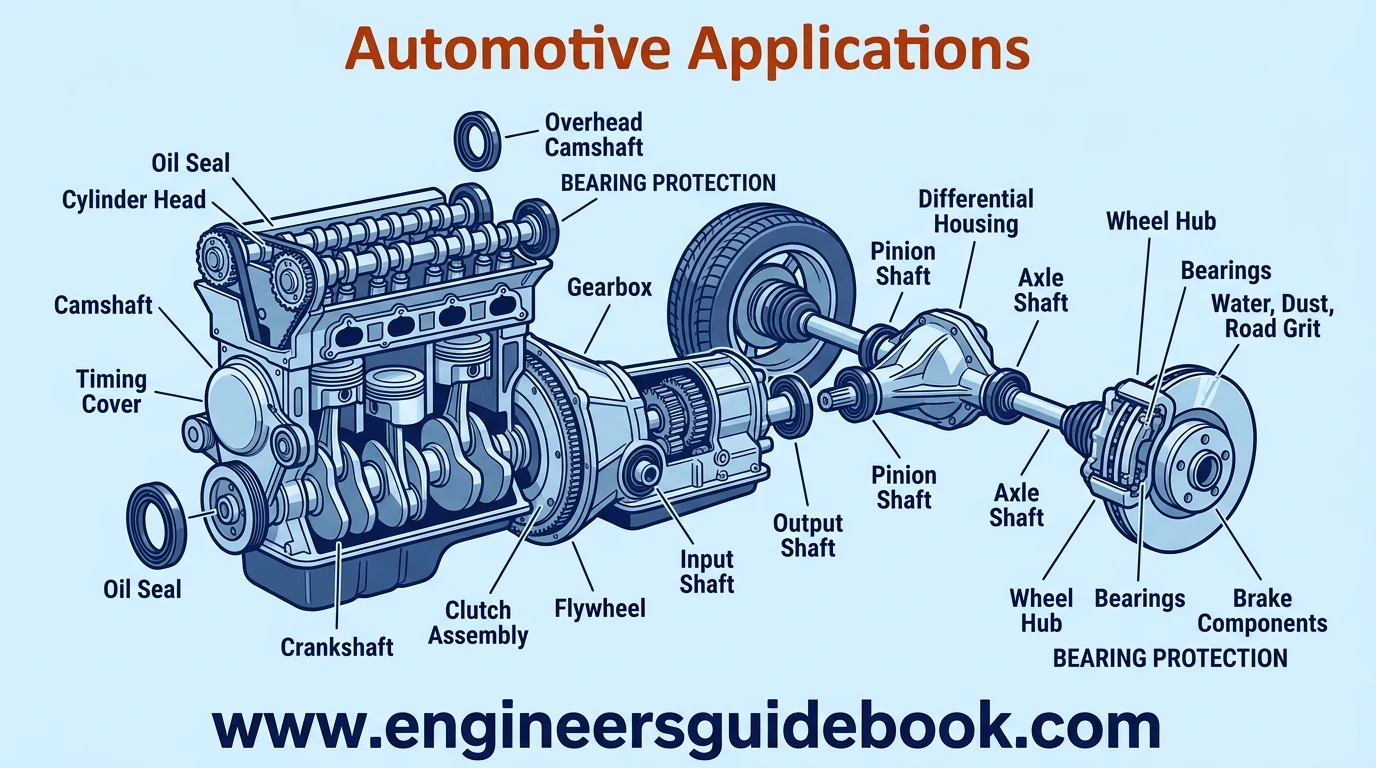
8.1 Engine Crankshaft Sealing
Engine crankshaft sealing is one of the most critical applications of oil seals in automotive systems. The crankshaft rotates continuously while transmitting power from the pistons to the drivetrain, and both the front and rear ends of the crankshaft pass through openings in the engine housing. These openings must be sealed properly to prevent engine oil from escaping.
8.2 Camshaft Sealing
Camshaft sealing prevents engine oil from escaping around the rotating camshaft. In overhead camshaft engines, camshaft seals are usually installed at the front of the cylinder head near the timing belt, timing chain, or camshaft pulley. Their duty looks simple, but failure can cause serious secondary damage.
8.3 Wheel Hub Sealing
Wheel hub sealing protects wheel bearings from lubricant loss and external contamination. In vehicles, wheel hubs are exposed to water, dust, road grit, mud, brake dust, and temperature variation. The oil seal or grease seal keeps bearing lubricant inside the hub while blocking unwanted particles from entering.
8.4 Gearbox Shaft Sealing
Gearbox shaft sealing is used at input shafts, output shafts, selector shafts, and intermediate shaft openings. Gearboxes contain oil that lubricates gears, bearings, and synchronizing components. Oil seals prevent this lubricant from escaping where shafts pass through the gearbox casing.
9. Industrial Applications
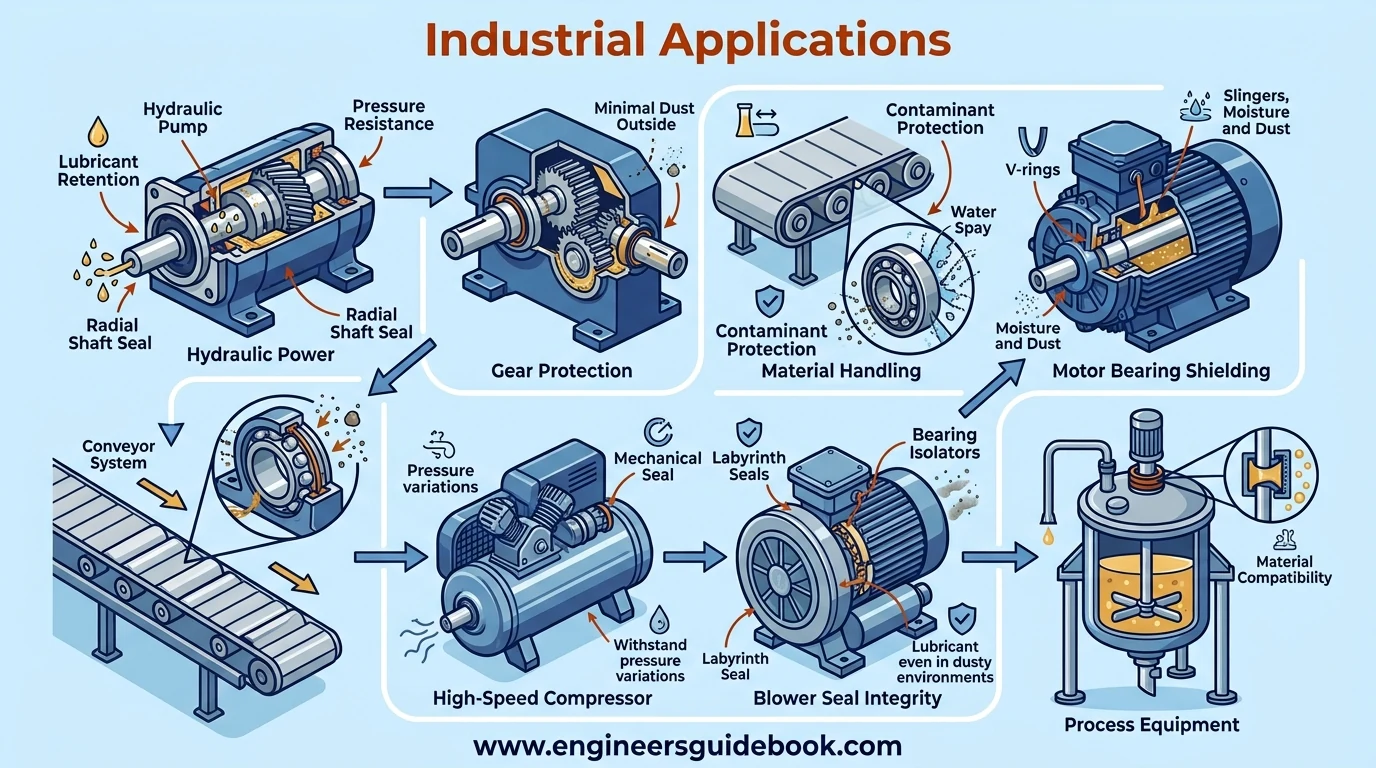
9.1 Hydraulic Pump Sealing
Hydraulic pump sealing prevents hydraulic oil from leaking around the pump shaft. Hydraulic pumps convert mechanical rotation into fluid power, and the shaft entry point must be sealed with precision. Any leakage at this location reduces cleanliness, efficiency, and reliability.
9.2 Gear Reducer Sealing
Gear reducer sealing is used to retain lubricant inside speed reducers, gear motors, and industrial gearboxes. These units rely on oil or grease to lubricate gears and bearings under continuous load. Shaft seals are installed at input and output shafts to control leakage.
9.3 Electric Motor Protection
Electric motor protection is another common use of oil seals and bearing seals. Motors need clean, well-lubricated bearings to run smoothly. In dusty, humid, or washdown environments, seals prevent contaminants from entering the bearing chamber.
9.4 Conveyor Roller Sealing
Conveyor roller sealing protects roller bearings from dust, moisture, and material spillage. Conveyor systems are used in cement plants, mining units, packaging lines, warehouses, food plants, paper mills, and bulk material handling facilities. In these environments, rollers are exposed to continuous contamination.
10. Heavy Duty Applications
10.1 Agricultural Machinery Sealing
Agricultural machinery sealing is challenging because equipment works directly in mud, soil, crop residue, fertilizer dust, water, and abrasive field conditions. Tractors, harvesters, seeders, tillers, balers, and sprayers all use oil seals in wheel hubs, gearboxes, axles, hydraulic pumps, and rotating joints.
10.2 Construction Equipment Sealing
Construction equipment sealing protects machinery working in mud, sand, stone dust, water, and impact-heavy environments. Excavators, loaders, bulldozers, graders, cranes, compactors, and backhoes use oil seals in engines, axles, hydraulic systems, final drives, rollers, and gearboxes.
10.3 Mining Equipment Sealing
Mining equipment sealing requires exceptional durability. Crushers, conveyors, loaders, drills, mills, screens, and haulage systems operate in abrasive dust, slurry, vibration, high load, and continuous duty. Few environments are more punishing for seals.
10.4 Marine Machinery Sealing
Marine machinery sealing protects equipment exposed to saltwater, humidity, corrosion, and continuous operation. Marine gearboxes, propulsion systems, pumps, winches, thrusters, deck machinery, and steering systems all require dependable sealing.

11. Oil Seal Selection Guide
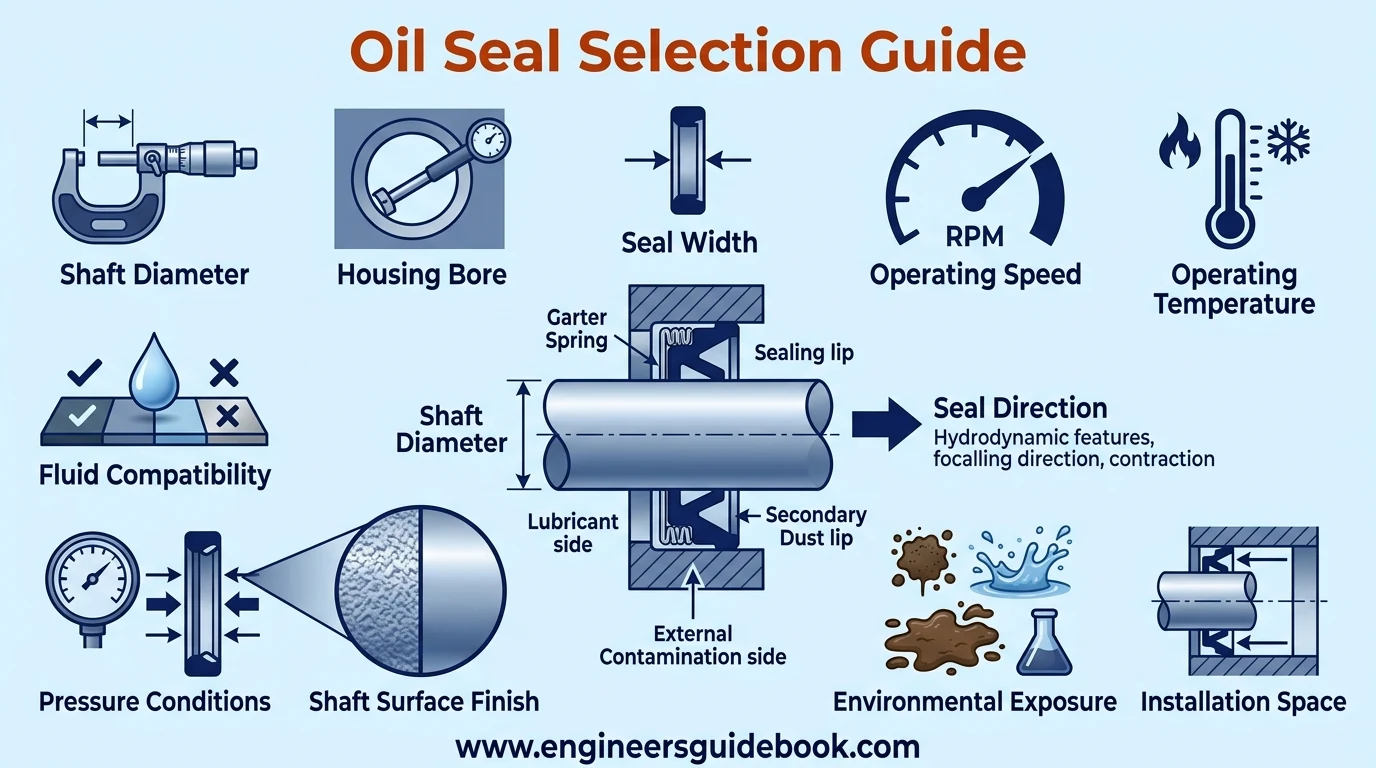
11.1 Shaft Diameter
Shaft diameter is the first dimension required when selecting an oil seal. The inner diameter of the seal must match the shaft correctly so the sealing lip can apply proper radial pressure.
If the seal is too tight, it may generate excessive friction and heat. If it is too loose, it may not seal properly. Accurate measurement is therefore essential.
The shaft should be measured at the actual seal running surface, not only from a drawing or nameplate. Worn shafts may have grooves, taper, or undersized areas that cause leakage.
11.2 Housing Bore
The housing bore supports the outer diameter of the oil seal. It must be clean, round, and correctly sized. The seal needs enough interference fit to remain fixed during operation.
If the bore is too loose, oil can leak around the outside of the seal or the seal may rotate in the housing. If the bore is too tight, the seal can deform during installation.
Rubber-covered seals are useful when the bore has minor scratches or surface irregularities. Metal-cased seals require more accurate bore condition.
11.3 Seal Width
Seal width refers to the axial thickness of the oil seal. It must match the space available in the housing and allow the sealing lip to contact the correct area of the shaft.
A seal that is too wide may not seat correctly. A seal that is too narrow may shift or lack support. In some repairs, a different width is used to move the lip away from an existing shaft groove.
Seal width also affects stiffness and installation stability. Larger seals may require more careful pressing to avoid tilting.
11.4 Operating Speed
Operating speed affects friction, heat generation, and oil film stability. As shaft speed increases, the seal lip experiences more sliding action. This can raise temperature at the contact edge.
High-speed applications require suitable materials, proper lubrication, and accurate shaft finish. PTFE and special low-friction elastomer designs may be preferred where speed is high.
A seal selected without considering speed may overheat, harden, crack, or wear prematurely. Speed limits should always be checked against shaft diameter and seal material.
11.5 Operating Temperature
Operating temperature strongly influences oil seal life. Heat can harden rubber, weaken elasticity, accelerate chemical aging, and reduce sealing force. Cold temperature can make some materials stiff and less flexible.
Nitrile rubber works well in many general applications but is not ideal for very high temperatures. Fluoroelastomer, silicone, and PTFE are better options for hot service. For cold environments, flexibility at low temperature must also be considered.
The selected seal must handle both continuous operating temperature and temporary temperature peaks. Startup, shutdown, friction, and process heat can all create thermal fluctuation.
11.6 Fluid Compatibility
Fluid compatibility means the seal material must resist the lubricant or process fluid it contacts. Oil seals may be exposed to mineral oil, synthetic oil, grease, fuel, hydraulic fluid, water, chemicals, or cleaning agents.
Incompatible fluids can cause the seal to swell, shrink, soften, crack, or lose strength. This leads to leakage and premature failure.
NBR is suitable for many petroleum oils. FKM offers better resistance to heat and many chemicals. PTFE performs well in aggressive fluids and low-friction service. The final selection should always be based on the actual fluid.
12. FAQ
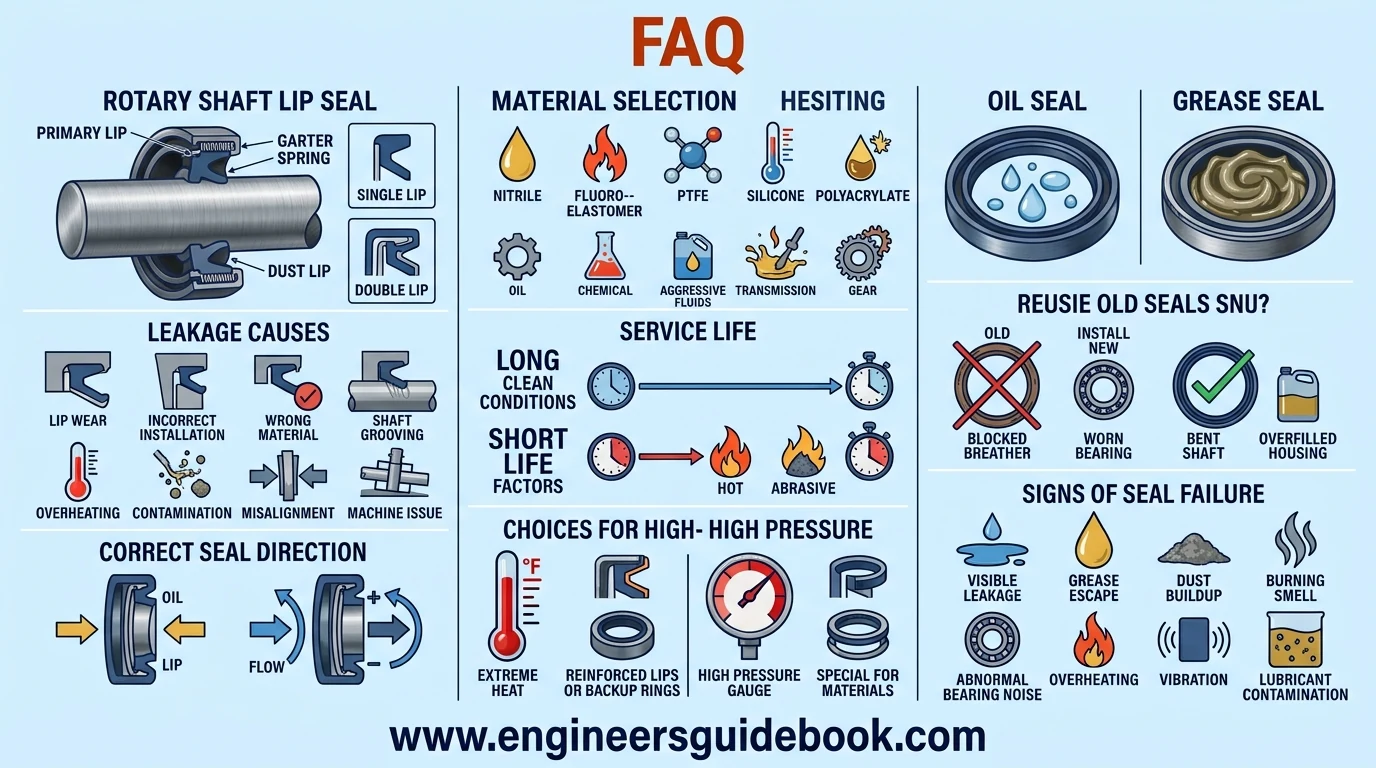
12.1 Most Common Oil Seal Type
The most common oil seal type is the rotary shaft lip seal. It is widely used in engines, gearboxes, pumps, motors, wheel hubs, and bearing housings.
This seal type is popular because it is compact, economical, easy to install, and effective in many general applications. Single lip and double lip versions are the most familiar designs.
For clean oil retention, a single lip seal may be enough. For dusty or wet service, a double lip seal is usually better.
12.2 Best Oil Seal Material
The best oil seal material depends on the application. Nitrile rubber is a strong general-purpose choice for mineral oils, grease, and moderate temperatures. Fluoroelastomer is better for high heat and chemical resistance. PTFE is excellent for low friction, aggressive fluids, and demanding service.
Silicone works well in high-temperature and low-temperature flexibility applications, but it is less suitable for abrasive service. Polyacrylate is useful for hot oil environments such as transmissions.
There is no universal best material. The correct material depends on oil type, temperature, pressure, speed, and contamination level.
12.3 Oil Seal and Grease Seal Difference
An oil seal is usually used to retain liquid lubricant, while a grease seal is used to retain grease. In many cases, both are radial lip seals with similar construction.
The main difference is the lubricant condition. Oil flows more easily and may require a more precise sealing lip. Grease is thicker and may be easier to retain, but contamination protection remains very important.
In practical maintenance, the terms oil seal and grease seal are sometimes used interchangeably. The actual application should guide the final seal selection.
12.4 Oil Seal Leakage Causes
Oil seal leakage can occur due to lip wear, incorrect installation, wrong material, shaft grooving, excessive pressure, poor shaft finish, overheating, contamination, or misalignment.
Sometimes leakage is caused by the machine rather than the seal. A blocked breather, worn bearing, bent shaft, overfilled housing, or wrong lubricant can force a good seal to fail.
A proper inspection should include the seal, shaft, housing, lubricant, breather, and bearing condition. Replacing only the seal without fixing the root cause may lead to repeated leakage.
13. Conclusion
Oil seals are available in many types, including rotary shaft seals, single lip seals, double lip seals, cassette seals, V ring seals, labyrinth seals, mechanical face seals, split seals, and high-pressure seals.
Each type has a specific purpose. Some are designed for simple lubricant retention. Others are built for mud, dust, water, high speed, high temperature, pressure, or severe mechanical load.
Understanding these types helps in selecting the correct seal for each machine.