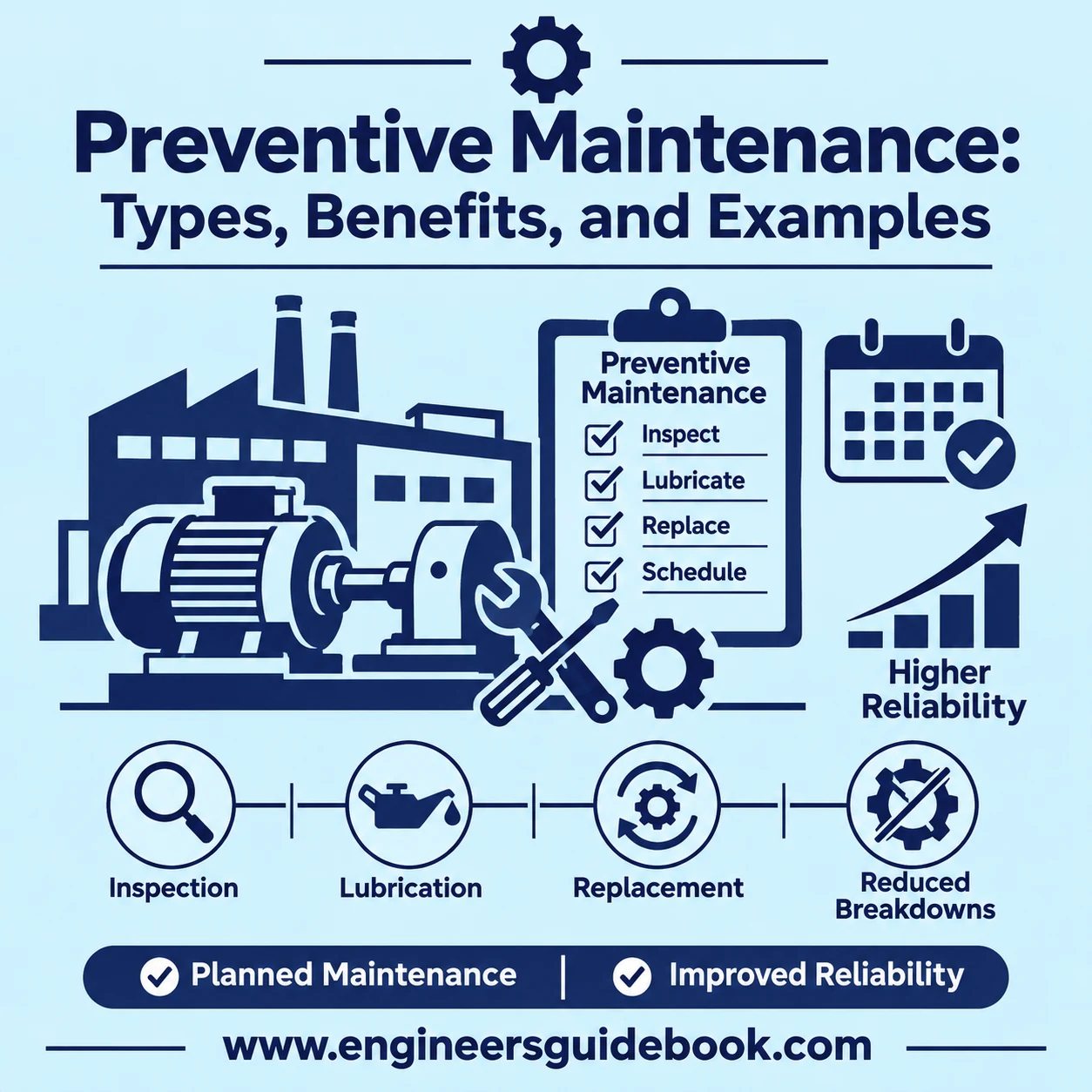
Preventive maintenance is a proactive maintenance strategy that involves regularly inspecting, servicing, and replacing equipment components before failures occur. Its main types include time-based, usage-based, and condition-based maintenance, with predictive and prescriptive approaches offering advanced capabilities. Preventive maintenance reduces unexpected breakdowns, extends equipment lifespan, improves operational safety, minimizes maintenance costs, and enhances production efficiency.
1. Introduction to Preventive Maintenance
1.1 What Is Preventive Maintenance?
Preventive maintenance (PM) is a systematic approach to maintaining machinery, equipment, and industrial assets before functional failures occur. It encompasses scheduled inspections, lubrication, cleaning, adjustments, testing, and component replacement to preserve equipment functionality and operational integrity.
1.2 Purpose and Objectives of Preventive Maintenance
The primary objective of preventive maintenance is to minimize the probability of equipment failure. It aims to maintain optimal operating conditions, reduce unplanned downtime, control maintenance expenditure, and maximize asset utilization throughout the equipment’s operational lifecycle.
1.3 Importance of Preventive Maintenance in Industrial Operations
Industrial facilities depend heavily on uninterrupted equipment operation. Even a minor mechanical malfunction can disrupt an entire production line. Preventive maintenance mitigates these disruptions while supporting production targets, equipment reliability, occupational safety, and consistent manufacturing performance.
1.4 How Preventive Maintenance Works
Preventive maintenance works by identifying equipment requirements and performing predetermined maintenance activities before significant deterioration occurs. Maintenance intervals are established using manufacturer recommendations, operating conditions, historical failure records, equipment criticality, and component service-life characteristics.
2. Types of Preventive Maintenance
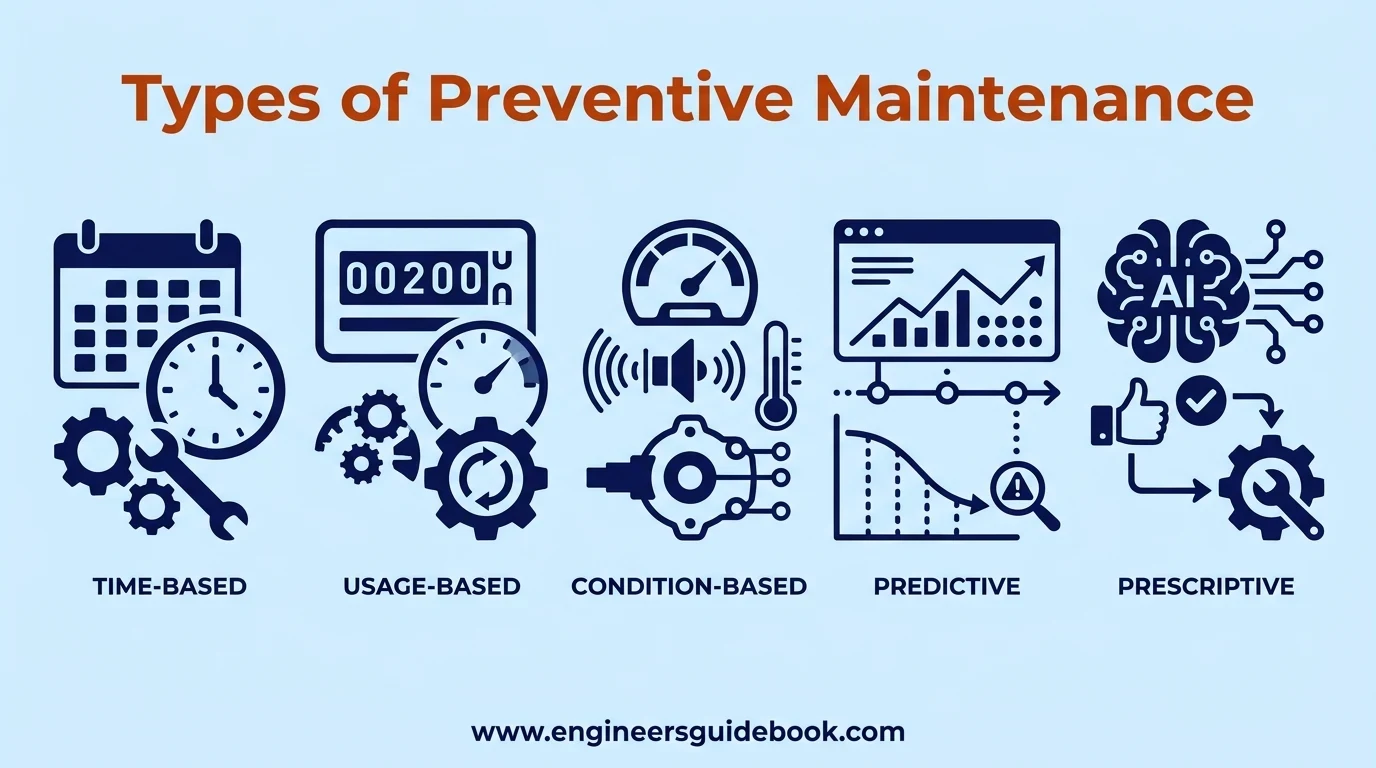
2.1 Time-Based Preventive Maintenance
Time-based maintenance involves servicing equipment at predetermined calendar intervals, regardless of actual utilization. For example, replacing gearbox lubricant every six months or inspecting electrical panels monthly represents time-based maintenance. This approach simplifies scheduling and resource allocation.
2.2 Usage-Based Preventive Maintenance
Usage-based maintenance is triggered by measurable equipment utilization, such as operating hours, production cycles, or distance traveled. Changing compressor oil after 2,000 operating hours is an example. Maintenance frequency corresponds more closely to actual equipment usage.
2.3 Condition-Based Maintenance
Condition-based maintenance initiates servicing when monitored equipment parameters indicate deterioration. Technicians evaluate vibration, temperature, lubricant quality, pressure, and other measurable characteristics to identify developing abnormalities and determine whether maintenance intervention is necessary.
2.4 Predictive Maintenance
Predictive maintenance utilizes historical data, condition monitoring, and analytical techniques to forecast potential equipment failures. Unlike conventional scheduled maintenance, it estimates future equipment conditions, allowing maintenance teams to intervene before anticipated failures materialize.
2.5 Prescriptive Maintenance
Prescriptive maintenance extends predictive capabilities by recommending specific corrective actions through advanced analytics and artificial intelligence. Rather than merely forecasting failures, it evaluates possible interventions. Predictive and prescriptive maintenance are often classified as distinct advanced proactive maintenance strategies.
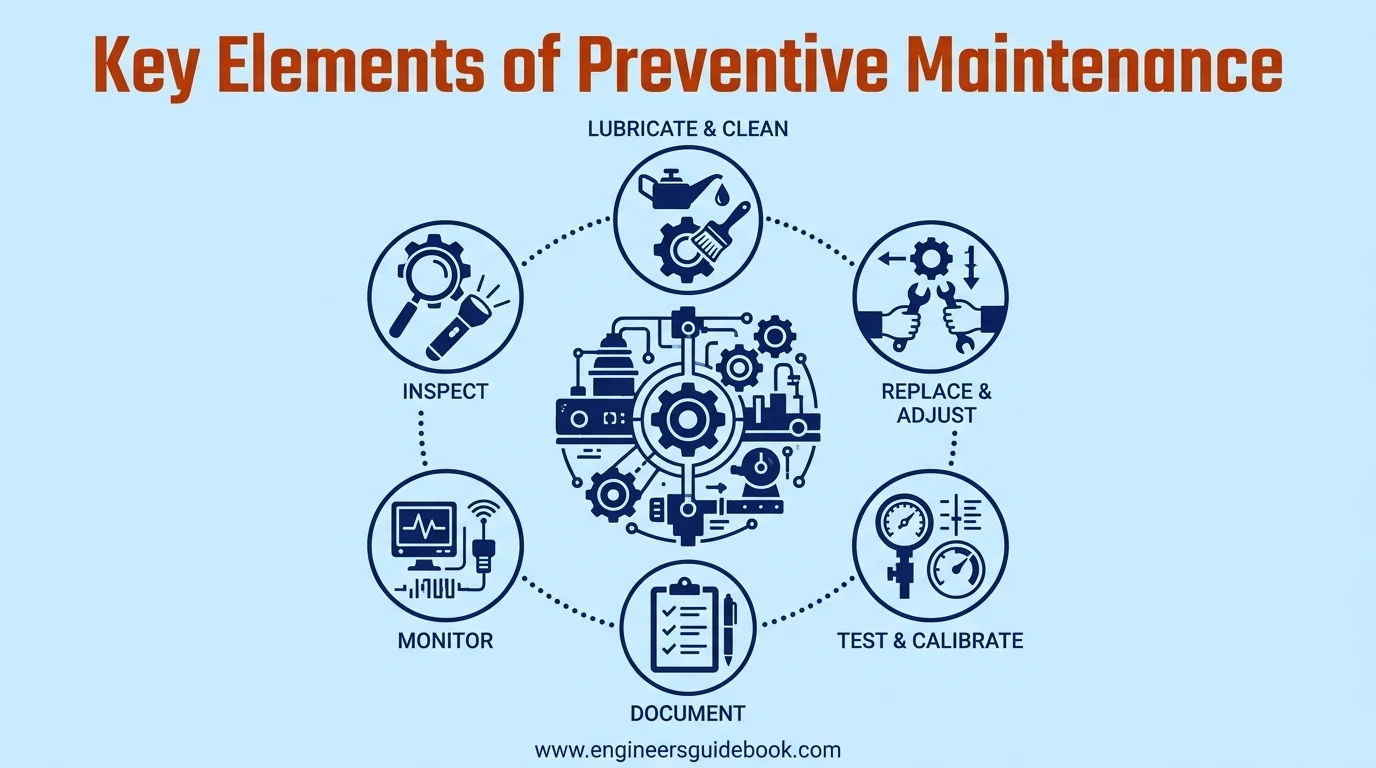
3. Key Elements of Preventive Maintenance
3.1 Routine Equipment Inspections
Periodic inspections help identify loose connections, abnormal noises, excessive vibration, corrosion, leakage, and mechanical deterioration. Structured inspection checklists ensure technicians consistently examine critical components and recognize incipient defects before they escalate.
3.2 Equipment Cleaning and Lubrication
Contaminants and inadequate lubrication accelerate equipment deterioration. Regular cleaning prevents material accumulation, while appropriate lubrication reduces friction, dissipates heat, minimizes surface wear, and preserves the mechanical efficiency of moving components.
3.3 Component Replacement and Adjustment
Replacing deteriorated components before failure helps maintain equipment reliability. Common activities include replacing worn belts, filters, seals, and bearings, alongside adjusting chain tension, shaft alignment, mechanical clearances, and fastening arrangements.
3.4 Equipment Testing and Calibration
Periodic testing verifies equipment functionality, while calibration ensures measurement accuracy. Pressure gauges, temperature sensors, weighing systems, and electrical instruments require appropriate verification to maintain process consistency and dependable operational control.
3.5 Maintenance Documentation and Record Keeping
Comprehensive maintenance documentation establishes a traceable history of equipment interventions. Recording inspection findings, replacement activities, maintenance costs, and failure patterns facilitates root cause analysis, performance evaluation, and informed maintenance planning.
3.6 Equipment Condition Monitoring
Condition monitoring provides valuable insights into asset health. Techniques such as vibration analysis, infrared thermography, ultrasonic inspection, and lubricant analysis help reveal mechanical, electrical, and tribological abnormalities before substantial damage occurs.
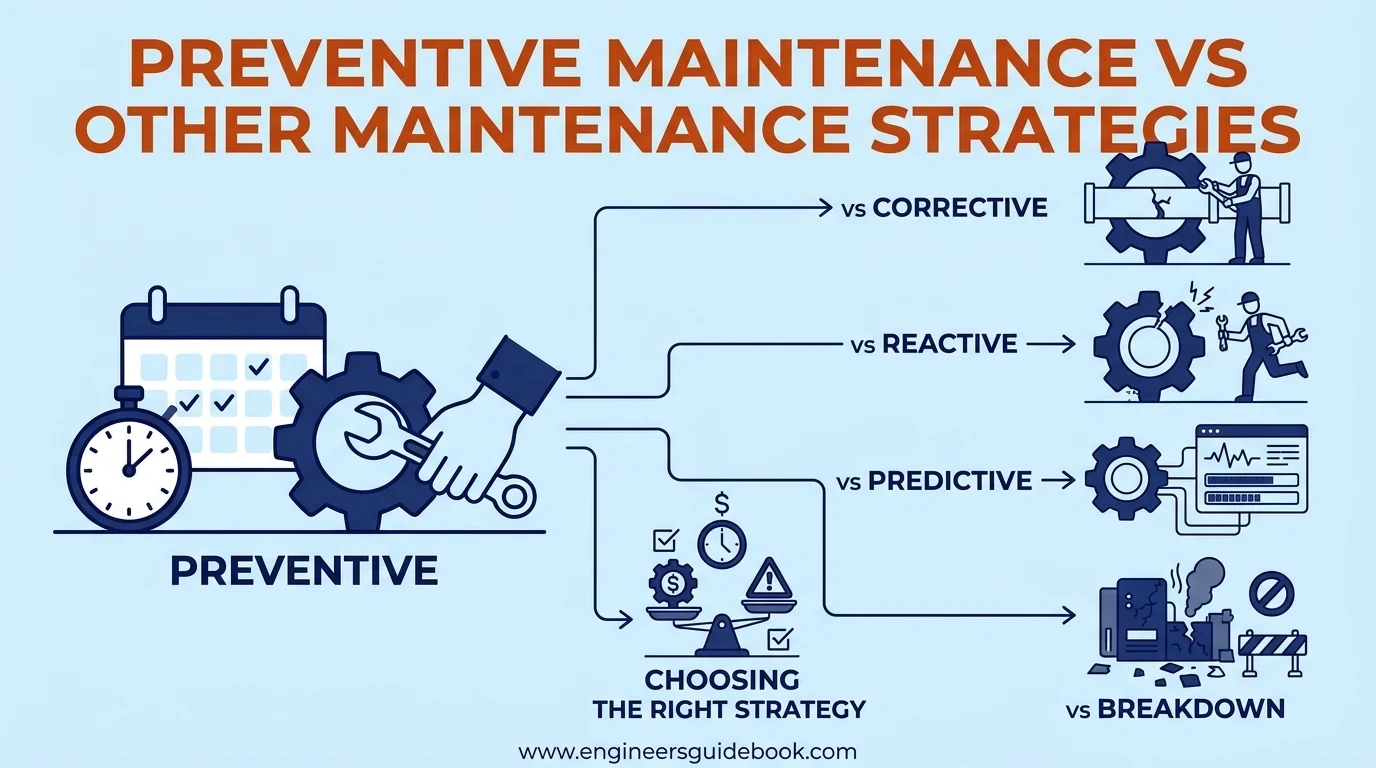
4. Preventive Maintenance vs Other Maintenance Strategies
4.1 Preventive Maintenance vs Corrective Maintenance
Preventive maintenance aims to avoid equipment failures, whereas corrective maintenance addresses identified faults. Corrective activities may occur before or after complete functional failure, depending on defect severity and operational requirements.
4.2 Preventive Maintenance vs Reactive Maintenance
Reactive maintenance responds to equipment failures after they occur. Preventive maintenance takes a proactive approach through planned interventions. Reactive strategies may be economical for inexpensive, noncritical assets but unsuitable for critical production equipment.
4.3 Preventive Maintenance vs Predictive Maintenance
Conventional preventive maintenance primarily relies on predetermined schedules or usage thresholds. Predictive maintenance uses condition data and analytical models to anticipate failures, potentially reducing unnecessary servicing and improving maintenance precision.
4.4 Preventive Maintenance vs Breakdown Maintenance
Breakdown maintenance restores equipment functionality following failure. Preventive maintenance attempts to preserve functionality before failure. Breakdown maintenance frequently involves unpredictable repair durations, emergency procurement, and unexpected production interruptions.
4.5 Choosing the Right Maintenance Strategy
Maintenance strategy selection depends on equipment criticality, failure consequences, replacement costs, operational requirements, and available resources. Combining scheduled, condition-based, and reactive maintenance often provides a more economical and technically appropriate solution.
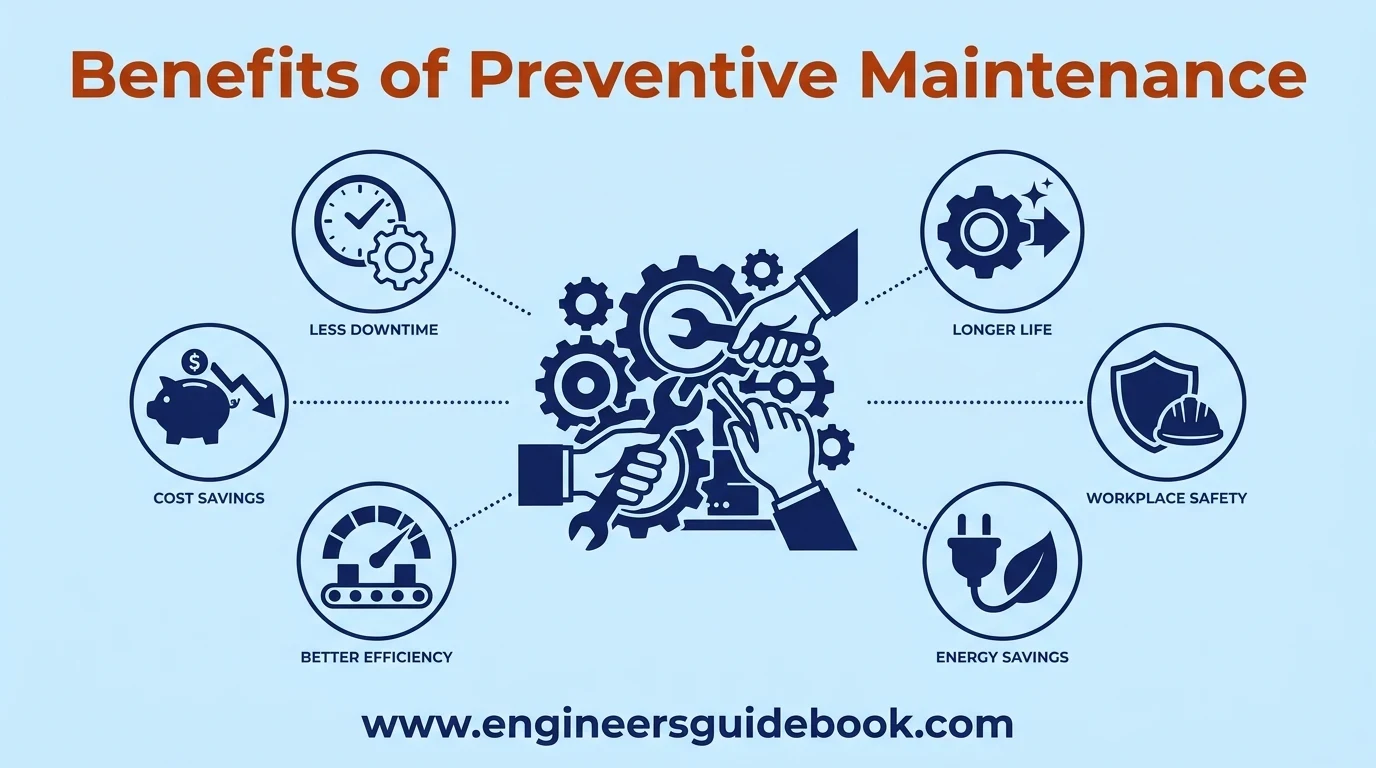
5. Benefits of Preventive Maintenance
5.1 Reduced Equipment Breakdowns and Downtime
Scheduled inspections and timely servicing detect developing defects before catastrophic failures occur. This proactive intervention minimizes avoidable production interruptions and reduces dependence on emergency maintenance activities.
5.2 Increased Equipment Reliability and Availability
Well-maintained machinery generally operates more consistently and experiences fewer preventable failures. Improved equipment reliability supports higher operational availability, predictable production schedules, and better utilization of manufacturing resources.
5.3 Extended Equipment Service Life
Proper lubrication, alignment, cleaning, and component replacement mitigate premature deterioration. These activities preserve equipment integrity, extend useful service life, and potentially defer substantial capital expenditure associated with asset replacement.
5.4 Reduced Maintenance and Operational Costs
Planned maintenance enables economical procurement, efficient workforce allocation, and timely component replacement. Although preventive activities require expenditure, an optimized program can reduce emergency repair costs and consequential production losses.
5.5 Improved Workplace Safety
Equipment defects can create hazardous operating conditions. Regular inspection of safety interlocks, electrical connections, pressure systems, protective guards, and mechanical components helps reduce equipment-related hazards and supports occupational safety compliance.
5.6 Enhanced Production Efficiency and Product Quality
Properly maintained equipment operates closer to its intended performance parameters. Consistent machine operation reduces process variability, production defects, speed losses, and unnecessary interruptions, thereby supporting Overall Equipment Effectiveness (OEE).
5.7 Improved Energy Efficiency
Misaligned shafts, clogged filters, compressed air leakage, and excessive mechanical friction increase energy consumption. Preventive maintenance addresses these inefficiencies, helping machinery operate economically while reducing avoidable electricity and utility expenditure.
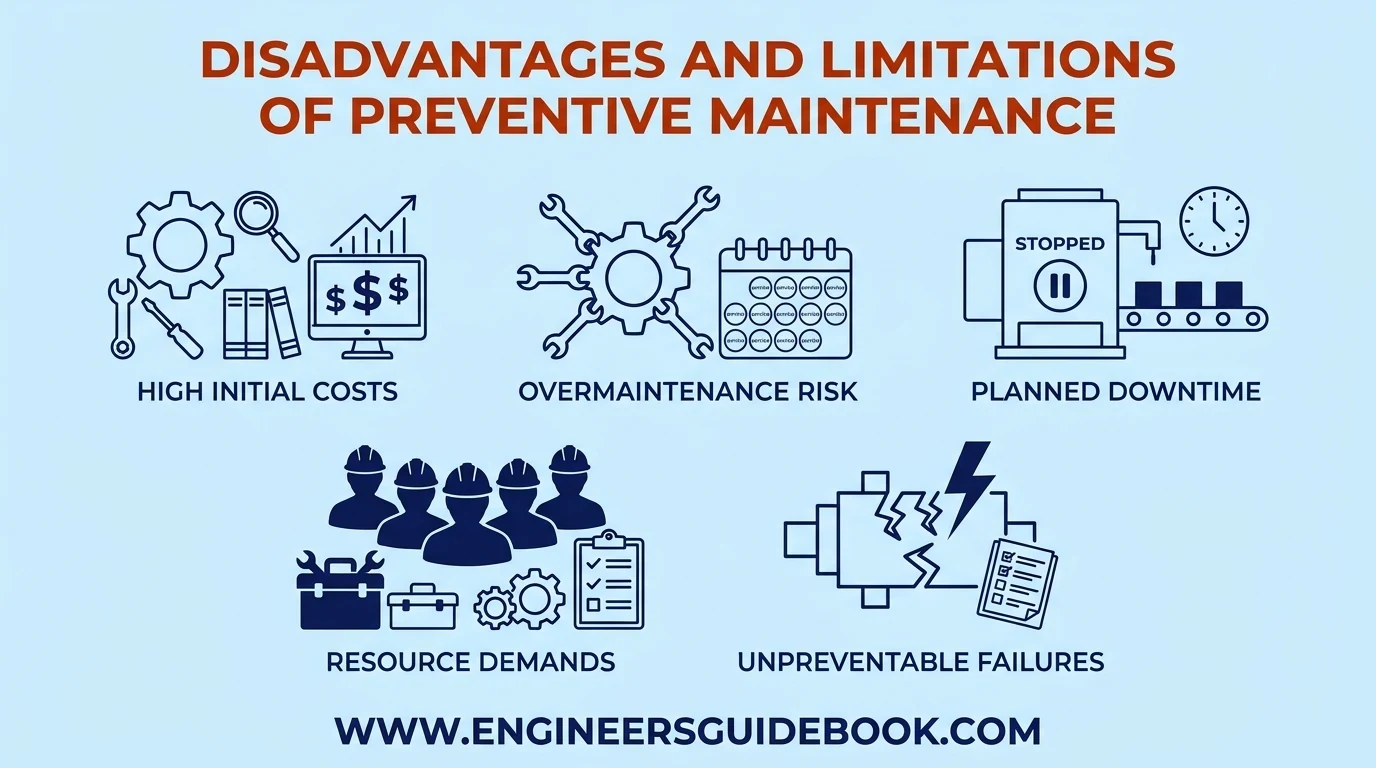
6. Disadvantages and Limitations of Preventive Maintenance
6.1 High Initial Implementation Costs
Establishing a comprehensive preventive maintenance program requires investment in inspection instruments, maintenance software, workforce training, spare parts, and documentation systems. These expenses can create financial constraints for smaller organizations.
6.2 Risk of Overmaintenance
Excessively frequent servicing can cause unnecessary component replacement, increased expenditure, and maintenance-induced failures. Maintenance intervals must balance equipment reliability requirements with actual deterioration rates and economic considerations.
6.3 Planned Production Downtime
Certain maintenance activities require equipment shutdowns. Although scheduled interruptions are generally more manageable than unexpected breakdowns, poorly coordinated maintenance windows can negatively affect production output and operational flexibility.
6.4 Resource and Workforce Requirements
Effective preventive maintenance requires competent technicians, appropriate tools, sufficient spare parts, and systematic supervision. Insufficient workforce capacity or inadequate resource availability can compromise maintenance quality and schedule compliance.
6.5 Inability to Prevent Every Equipment Failure
Not all failure mechanisms exhibit predictable deterioration. Random electrical faults, manufacturing defects, accidental damage, and sudden operational overloads may occur despite comprehensive preventive maintenance programs.
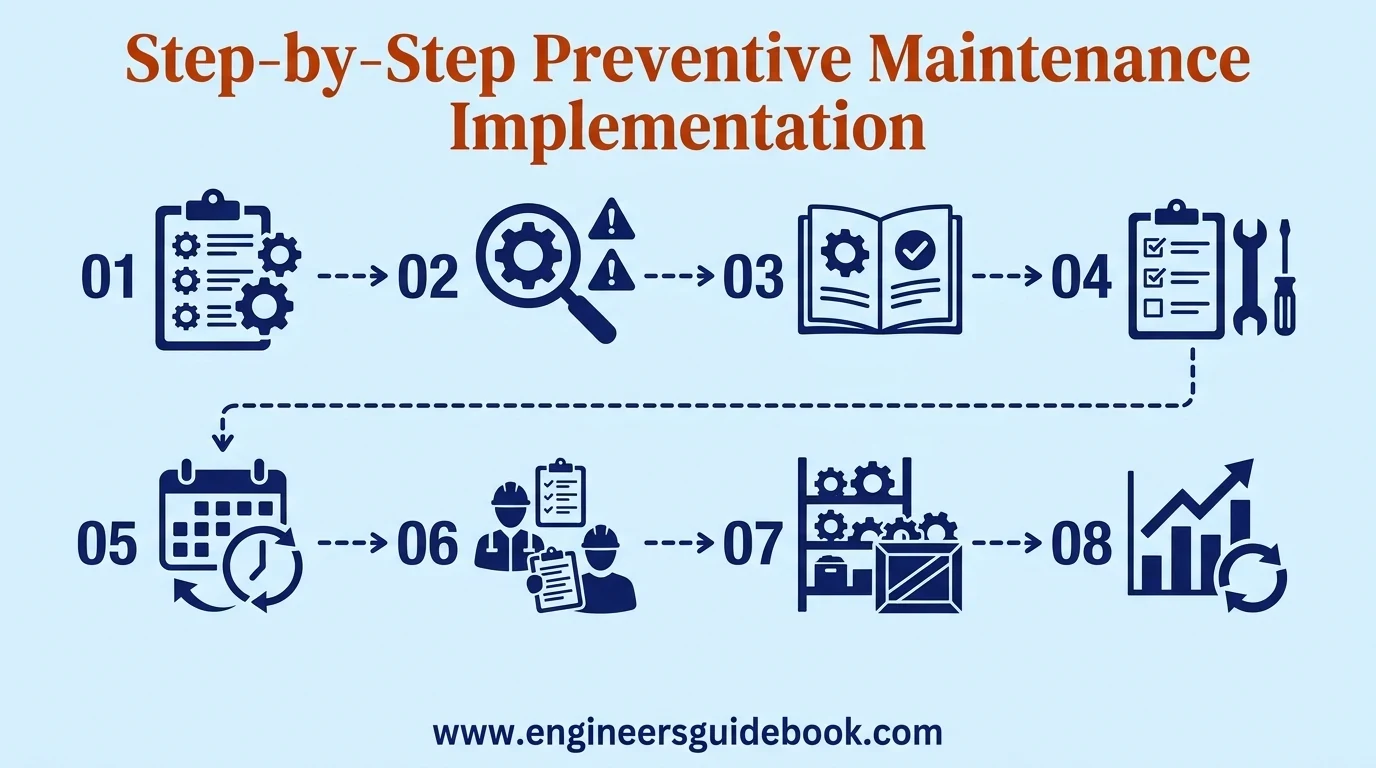
7. Step-by-Step Preventive Maintenance Implementation
7.1 Creating an Equipment Inventory
Begin by establishing a comprehensive asset register containing equipment identification numbers, locations, specifications, manufacturers, installation dates, and operating parameters. Accurate asset information forms the foundation of an organized maintenance management system.
7.2 Conducting Equipment Criticality Analysis
Classify equipment according to failure consequences, safety risks, production dependency, environmental impact, and repair costs. Criticality analysis ensures maintenance resources are prioritized toward assets with the greatest operational significance.
7.3 Reviewing Manufacturer Maintenance Recommendations
Consult original equipment manufacturer (OEM) manuals for recommended maintenance intervals, lubrication specifications, replacement requirements, and inspection procedures. Adapt these recommendations according to actual operating conditions and applicable safety requirements.
7.4 Identifying Maintenance Tasks and Requirements
Develop equipment-specific maintenance procedures covering inspections, cleaning, lubrication, testing, adjustments, and component replacement. Each task should specify acceptance criteria, required tools, safety precautions, and expected maintenance outcomes.
7.5 Establishing Maintenance Frequencies
Determine appropriate maintenance frequencies using equipment utilization, environmental conditions, manufacturer guidelines, historical failure data, and component degradation patterns. Periodically reassess these intervals to prevent undermaintenance and unnecessary servicing.
7.6 Assigning Maintenance Responsibilities
Define clear responsibilities for maintenance engineers, supervisors, technicians, and equipment operators. Establishing accountability ensures scheduled activities are completed correctly, documented systematically, and verified against established maintenance standards.
7.7 Managing Spare Parts and Maintenance Resources
Identify critical spare parts, consumables, specialized tools, and workforce requirements for scheduled maintenance activities. Maintain appropriate inventory levels to prevent procurement delays while avoiding excessive capital investment in unused inventory.
7.8 Monitoring and Improving Maintenance Effectiveness
Evaluate maintenance performance through equipment availability, breakdown frequency, preventive maintenance compliance, and maintenance expenditure. Analyze recurring failures and inspection findings to refine maintenance procedures, optimize servicing intervals, and establish a sustainable continuous improvement process.
8. Preventive Maintenance Planning and Scheduling
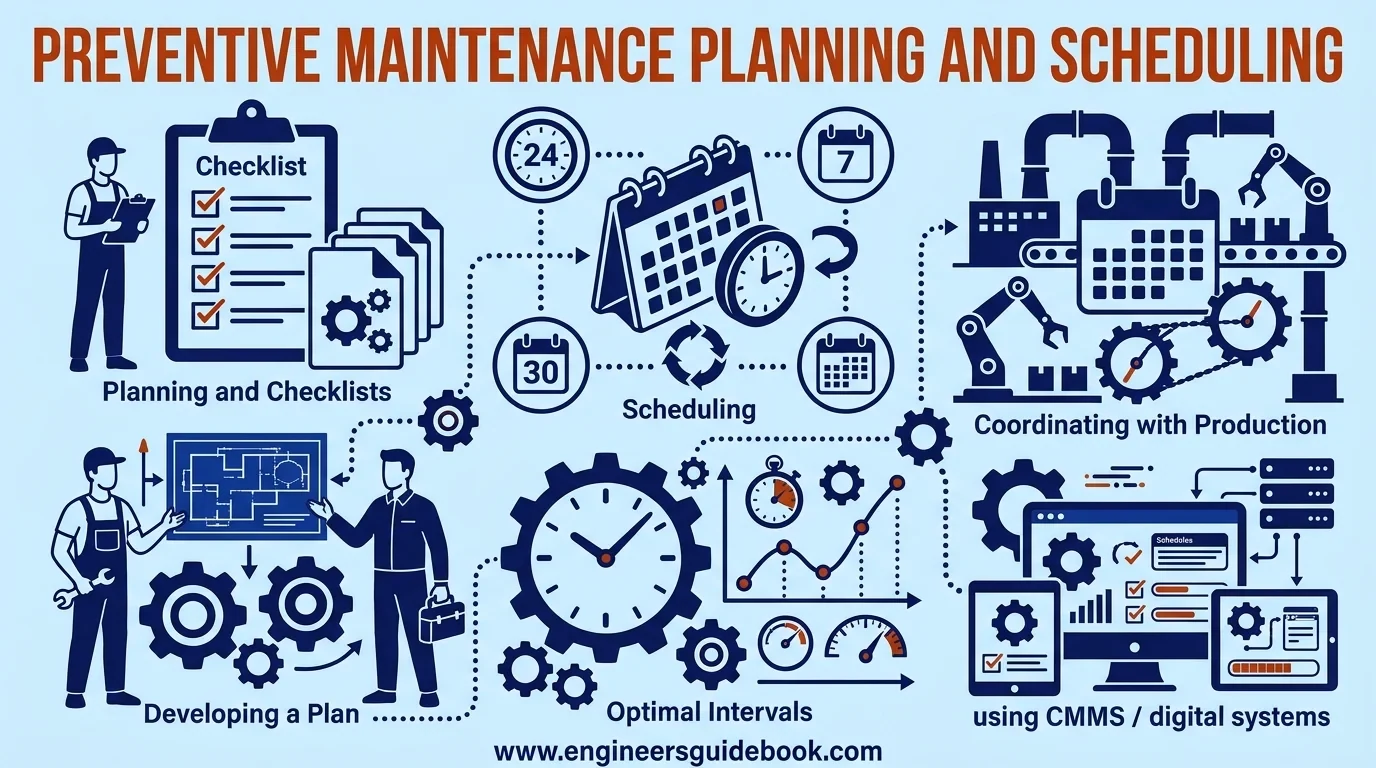
8.1 Developing a Preventive Maintenance Plan
A preventive maintenance plan establishes a structured framework for maintaining industrial assets. It should include equipment specifications, maintenance activities, servicing frequencies, workforce requirements, spare parts availability, and safety procedures. A comprehensive plan ensures maintenance activities remain consistent, organized, and aligned with operational objectives.
8.2 Creating Daily, Weekly, Monthly, and Annual Schedules
Maintenance schedules categorize activities according to their required frequencies. Daily tasks may involve visual inspections, while weekly activities include lubrication checks and cleaning. Monthly schedules typically incorporate detailed mechanical inspections, whereas annual schedules may involve comprehensive equipment overhauls and performance assessments.
8.3 Preparing Preventive Maintenance Checklists
Maintenance checklists standardize inspection and servicing procedures. An effective checklist includes equipment identification, inspection parameters, acceptance criteria, maintenance instructions, completion status, and technician remarks. Standardized checklists minimize procedural omissions and improve maintenance consistency.
8.4 Determining Optimal Maintenance Intervals
Optimal maintenance intervals balance equipment reliability with maintenance expenditure. Factors such as operating hours, environmental conditions, equipment age, manufacturer recommendations, and historical failure patterns influence servicing frequency. Periodic interval optimization prevents excessive maintenance and premature equipment deterioration.
8.5 Coordinating Maintenance With Production Operations
Maintenance and production departments must collaborate to establish suitable servicing windows. Scheduling activities during planned shutdowns, product changeovers, or periods of reduced demand minimizes production losses while ensuring essential maintenance tasks receive adequate attention.
8.6 Using CMMS for Maintenance Scheduling
A Computerized Maintenance Management System (CMMS) automates maintenance scheduling, work order generation, spare parts tracking, and performance reporting. Digital maintenance management improves organizational visibility, strengthens accountability, and reduces the likelihood of overdue maintenance activities.
9. Practical Examples of Preventive Maintenance
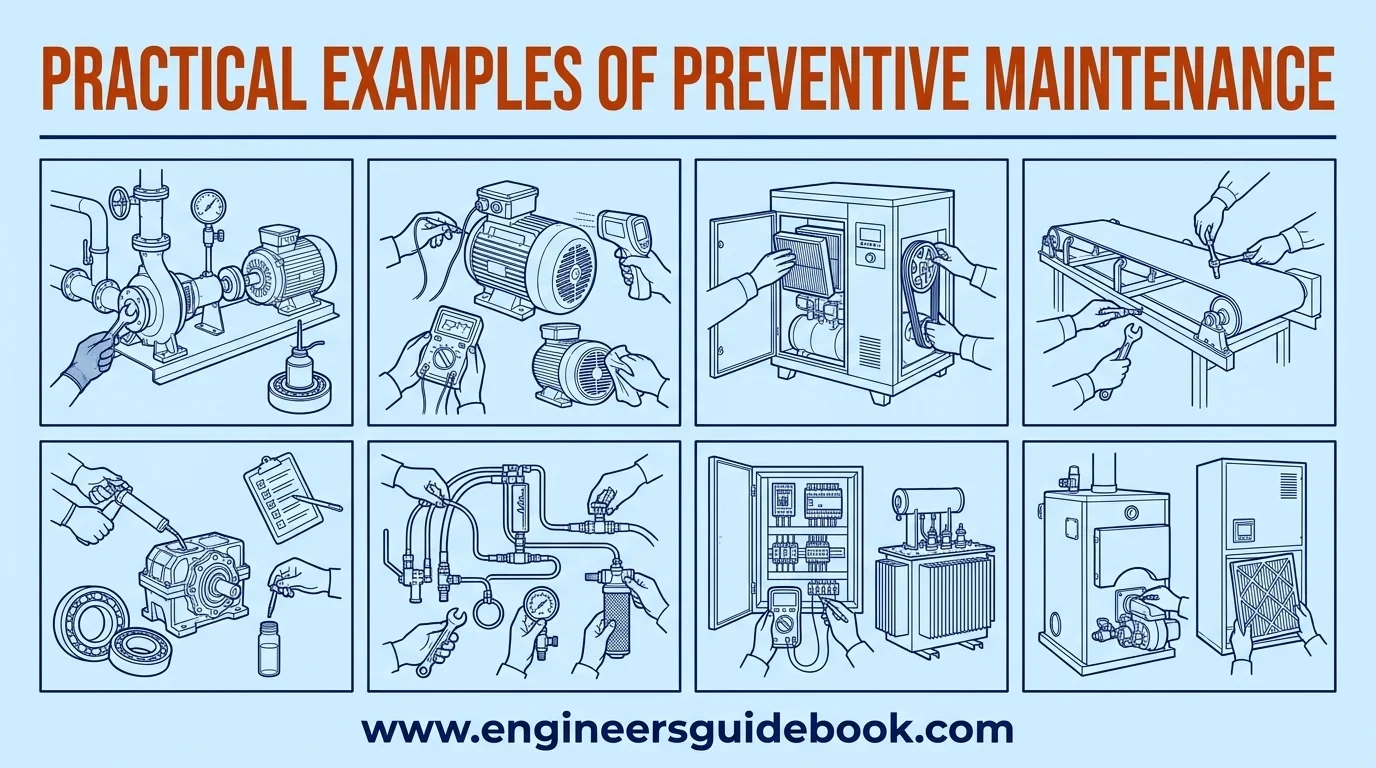
9.1 Centrifugal Pump Preventive Maintenance
Centrifugal pump maintenance includes inspecting mechanical seals, checking bearing lubrication, verifying shaft alignment, monitoring vibration, and identifying suction restrictions. Regular examination of operating pressure and flow conditions helps detect cavitation, internal wear, and hydraulic performance deterioration.
9.2 Electric Motor Preventive Maintenance
Electric motor maintenance involves checking insulation resistance, inspecting electrical terminals, monitoring bearing temperatures, and cleaning ventilation passages. Appropriate lubrication and periodic vibration measurements help identify mechanical abnormalities while preventing overheating and premature bearing failure.
9.3 Industrial Air Compressor Preventive Maintenance
Compressor maintenance typically includes replacing air filters, changing lubricant, inspecting drive belts, cleaning heat exchangers, and checking compressed air leakage. Monitoring operating temperatures and pressure fluctuations helps maintain compressor reliability and energy efficiency.
9.4 Conveyor System Preventive Maintenance
Conveyor maintenance focuses on belt tension, tracking alignment, roller condition, gearbox lubrication, and drive system integrity. Regular inspections prevent belt slippage, excessive friction, material accumulation, and unexpected interruptions in material transportation.
9.5 Gearbox and Bearing Preventive Maintenance
Gearboxes and bearings require appropriate lubrication, contamination control, temperature monitoring, and periodic vibration assessments. Lubricant analysis can reveal metallic debris, moisture ingress, and progressive internal wear, allowing timely investigation before extensive mechanical damage develops.
9.6 Hydraulic and Pneumatic System Preventive Maintenance
Hydraulic maintenance includes inspecting hoses, monitoring fluid contamination, replacing filters, and checking system pressure. Pneumatic maintenance involves inspecting cylinders, air preparation units, valves, and tubing. Both systems require effective leakage management to preserve operational performance.
9.7 Electrical Panel and Transformer Preventive Maintenance
Electrical maintenance includes inspecting connections, conducting thermographic surveys, checking insulation resistance, and examining protective devices. Transformer maintenance may also involve oil analysis and cooling system inspections. Qualified personnel must perform these activities using appropriate electrical isolation and safety procedures.
9.8 Industrial Boiler and HVAC Preventive Maintenance
Boiler maintenance encompasses water treatment monitoring, burner inspection, safety device testing, and heat transfer surface cleaning. HVAC maintenance includes filter replacement, coil cleaning, refrigerant system inspections, and airflow verification. These activities support thermal efficiency and dependable operation.
10. Preventive Maintenance KPIs and Performance Measurement
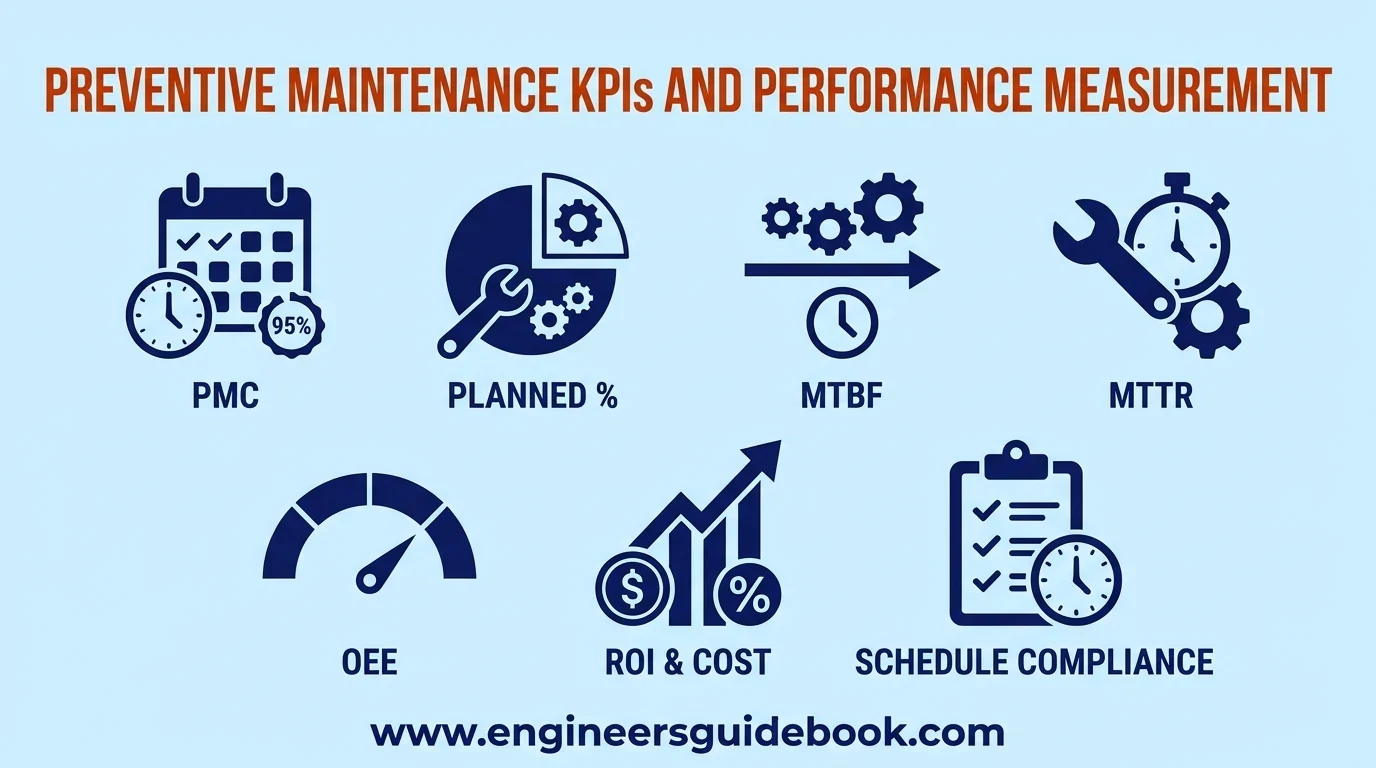
10.1 Preventive Maintenance Compliance
Preventive Maintenance Compliance (PMC) measures the percentage of scheduled preventive maintenance tasks completed within their required timeframe.
PMC = (PM Tasks Completed on Time / Total Scheduled PM Tasks) × 100
Completing 95 out of 100 scheduled tasks on time produces 95% compliance.
10.2 Planned Maintenance Percentage
Planned Maintenance Percentage (PMP) measures the proportion of maintenance labor hours devoted to planned activities.
PMP = (Planned Maintenance Hours / Total Maintenance Hours) × 100
A higher percentage generally indicates reduced dependence on reactive maintenance.
10.3 Mean Time Between Failures
Mean Time Between Failures (MTBF) measures the average operating duration between successive failures of repairable equipment.
MTBF = Total Operating Time / Number of Failures
Increasing MTBF generally indicates improved equipment reliability under comparable operating conditions.
10.4 Mean Time to Repair
Mean Time to Repair (MTTR) measures the average time required to repair failed equipment.
MTTR = Total Repair Time / Number of Repairs
Lower MTTR reflects faster equipment restoration and potentially improved maintenance execution.
10.5 Overall Equipment Effectiveness
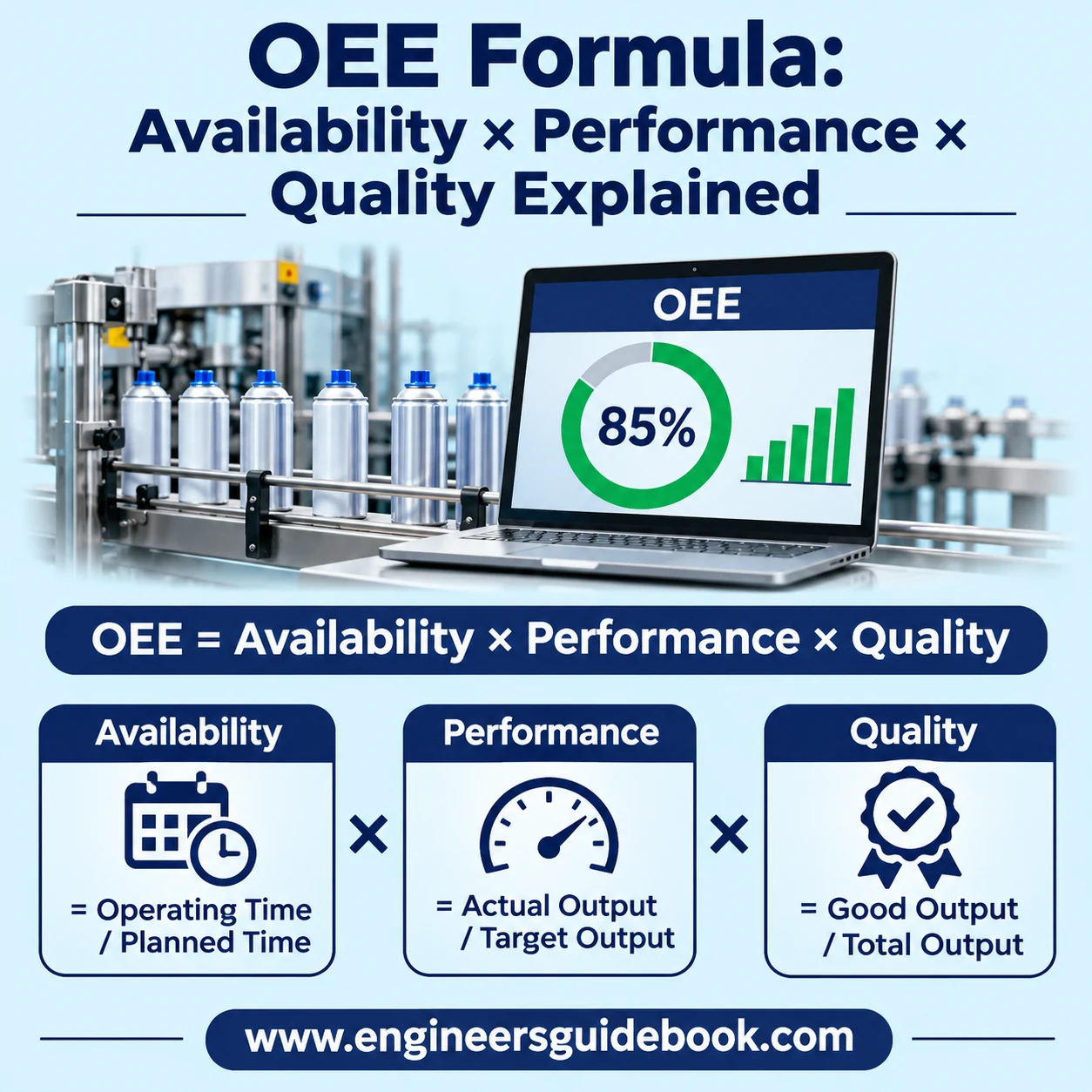
Overall Equipment Effectiveness (OEE) evaluates manufacturing productivity using availability, performance, and quality.
OEE = Availability × Performance × Quality
Effective preventive maintenance supports improved OEE by reducing equipment breakdowns, mechanical speed losses, and equipment-related production defects.
10.6 Maintenance Cost and Return on Investment
Maintenance cost analysis evaluates the financial effectiveness of maintenance activities by comparing expenditure against achieved savings.
ROI = [(Financial Benefits − Investment Cost) / Investment Cost] × 100
Financial benefits may include avoided downtime, reduced repair expenditure, and energy savings.
10.7 Preventive Maintenance Schedule Compliance
Schedule compliance evaluates maintenance execution against an established work schedule.
Schedule Compliance = (Scheduled Work Orders Completed as Planned / Total Scheduled Work Orders) × 100
Organizations should define this indicator consistently to distinguish it from due-date-based PM compliance.
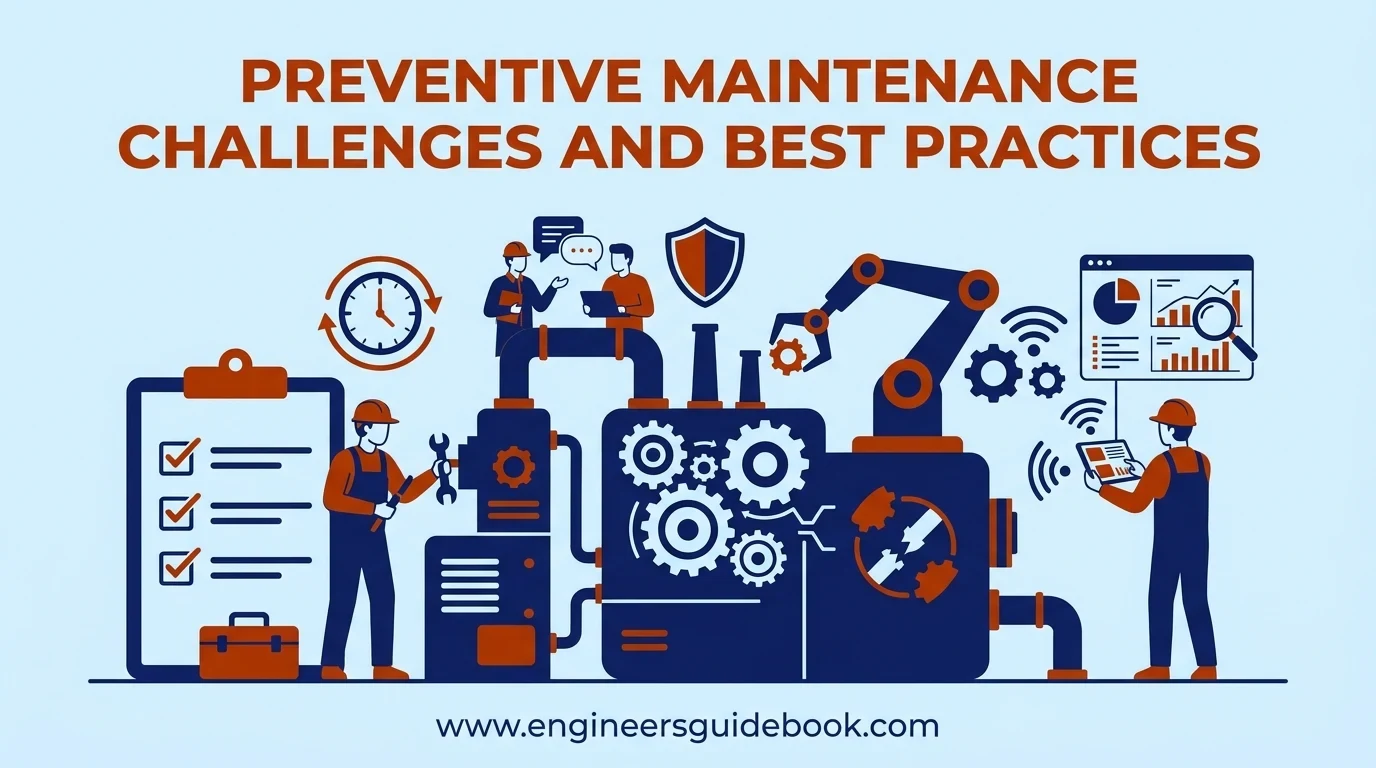
11. Preventive Maintenance Challenges and Best Practices
11.1 Common Preventive Maintenance Implementation Challenges
Common challenges include insufficient maintenance budgets, incomplete equipment records, workforce shortages, production pressures, and inadequate spare parts availability. Addressing these constraints requires systematic planning, management commitment, and effective interdepartmental communication.
11.2 Avoiding Unnecessary Maintenance Activities
Excessive servicing increases expenditure and introduces opportunities for maintenance-induced defects. Reviewing equipment failure modes, inspection results, and component service life helps eliminate redundant activities without compromising operational reliability.
11.3 Improving Maintenance Technician Training
Technicians require proficiency in mechanical systems, electrical diagnostics, instrumentation, lubrication practices, and industrial safety. Regular technical training strengthens fault detection capabilities, improves maintenance workmanship, and reduces procedural errors.
11.4 Standardizing Maintenance Procedures
Standard Operating Procedures (SOPs) establish uniform maintenance methodologies across equipment categories. Clearly documented instructions, torque specifications, lubrication requirements, isolation procedures, and inspection criteria improve repeatability and technical accountability.
11.5 Integrating Preventive Maintenance With TPM
Total Productive Maintenance (TPM) integrates preventive maintenance with broader organizational improvement initiatives. Planned maintenance and autonomous maintenance encourage collaboration between operators and maintenance personnel, strengthening equipment ownership and reducing production losses.
11.6 Leveraging CMMS and Industrial IoT Technologies
Industrial Internet of Things (IIoT) sensors enable continuous monitoring of equipment health indicators. Integrating these technologies with CMMS platforms facilitates automated notifications, condition-based work orders, and data-driven maintenance decisions.
11.7 Continuous Improvement Through Maintenance Data Analysis
Analyzing breakdown records, recurring defects, maintenance costs, and equipment performance helps identify improvement opportunities. Root cause analysis and periodic maintenance program reviews ensure servicing activities remain technically relevant and economically justified.
12. Frequently Asked Questions
12.1 What Is Preventive Maintenance in Simple Terms?
Preventive maintenance means regularly checking and servicing equipment before it breaks down. It helps machinery remain safe, reliable, and operational through planned maintenance activities.
12.2 What Are the Four Main Types of Preventive Maintenance?
Four commonly discussed approaches are time-based, usage-based, condition-based, and predictive maintenance. Classification varies across maintenance frameworks, with predictive maintenance sometimes categorized separately.
12.3 What Is an Example of Preventive Maintenance?
Replacing compressor oil after a specified number of operating hours, lubricating motor bearings at recommended intervals, and inspecting conveyor belts weekly are practical preventive maintenance examples.
12.4 What Is the Main Purpose of Preventive Maintenance?
Its primary purpose is to reduce equipment failure probability while improving reliability, operational safety, equipment availability, and useful service life.
12.5 What Is the Difference Between Preventive and Predictive Maintenance?
Conventional preventive maintenance follows predetermined servicing schedules. Predictive maintenance uses equipment condition data and analytical techniques to forecast potential failures and determine appropriate intervention timing.
12.6 How Often Should Preventive Maintenance Be Performed?
Maintenance frequency depends on manufacturer recommendations, equipment criticality, operating conditions, component deterioration, and historical failure data. There is no universal maintenance interval.
12.7 How Do You Create a Preventive Maintenance Schedule?
Identify equipment, determine maintenance requirements, establish servicing frequencies, allocate responsibilities, arrange necessary resources, and monitor schedule completion through a structured maintenance management system.
12.8 What Is a Preventive Maintenance Checklist?
A preventive maintenance checklist is a standardized document containing inspection points, servicing instructions, safety requirements, acceptance criteria, and completion records for specific equipment.
12.9 How Do You Calculate Preventive Maintenance Compliance?
Divide the number of preventive maintenance tasks completed on time by the total number of scheduled preventive maintenance tasks, then multiply the result by 100.
12.10 Can Preventive Maintenance Eliminate All Equipment Failures?
No. Preventive maintenance reduces failure probability but cannot eliminate unpredictable failures, manufacturing defects, accidental damage, or sudden equipment overloads.
13. Conclusion
13.1 Key Takeaways of Preventive Maintenance
Preventive maintenance is fundamental to sustainable asset management. Systematic inspections, scheduled servicing, component replacement, and performance monitoring help minimize equipment deterioration and unexpected operational disruptions.
13.2 Importance of a Proactive Maintenance Strategy
Transitioning from reactive repairs to proactive maintenance improves resource utilization, operational predictability, and equipment reliability. Effective implementation requires technical expertise, structured procedures, and organizational commitment.
13.3 Achieving Long-Term Equipment Reliability and Operational Excellence
Combining preventive maintenance with condition monitoring, digital maintenance management, and continuous improvement establishes a robust reliability framework. Organizations can consequently achieve lower lifecycle costs, improved productivity, safer operations, and sustainable operational excellence.