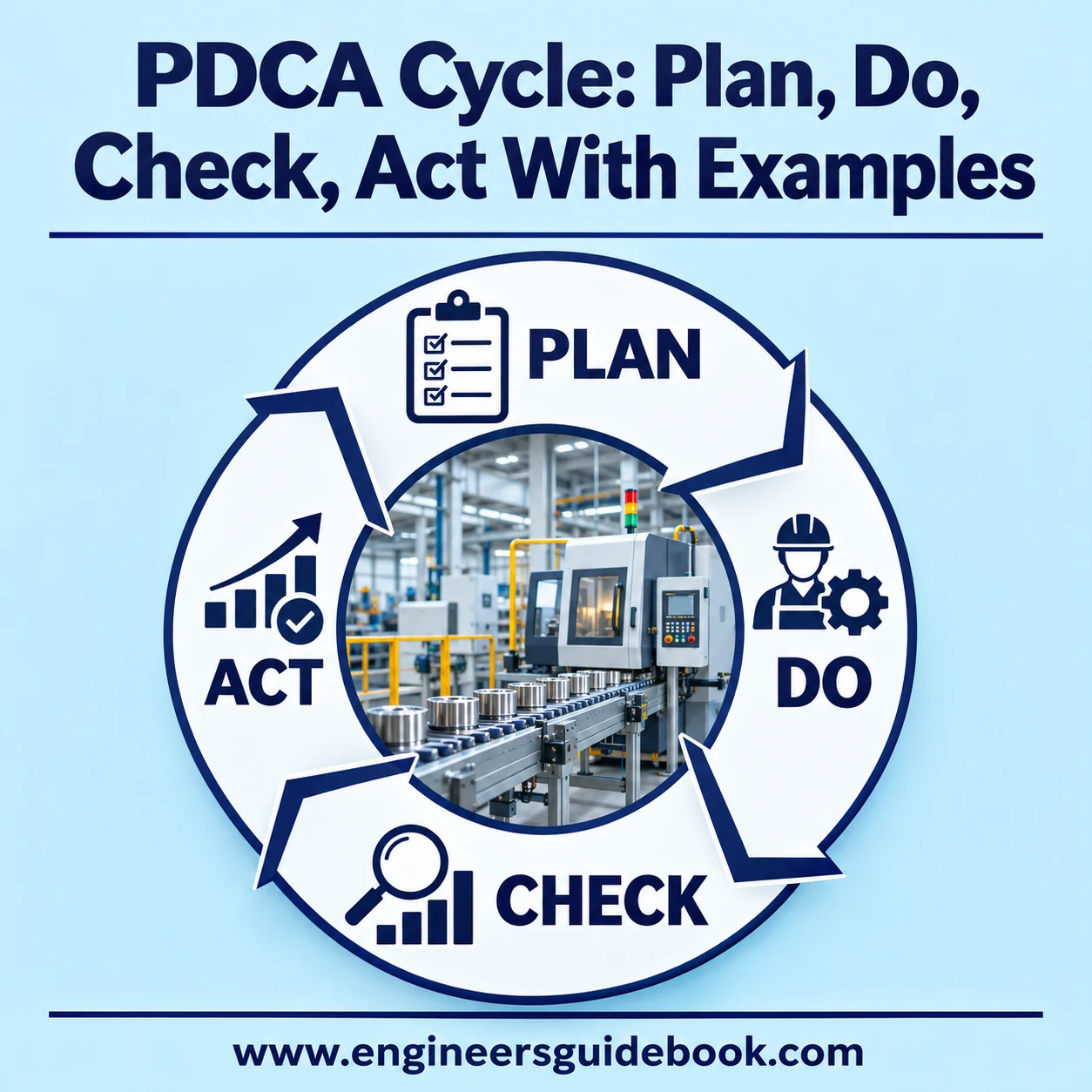
The PDCA Cycle is a four-stage continuous improvement methodology consisting of Plan, Do, Check, and Act. It helps organizations identify problems, implement solutions, evaluate results, and standardize successful improvements. Widely used in manufacturing, quality management, and industrial maintenance, the PDCA Cycle improves operational efficiency, reduces waste, and supports sustainable performance improvement through systematic experimentation.
1. Introduction to the PDCA Cycle
1.1 What Is the PDCA Cycle?
The PDCA Cycle is a systematic management framework designed to facilitate continuous improvement through structured problem-solving and iterative experimentation. It enables organizations to investigate operational deficiencies, develop practical solutions, and assess their effectiveness before permanent implementation.
Its cyclical structure ensures that improvement remains an ongoing organizational activity.
1.2 History and Evolution of the PDCA Cycle
The origins of PDCA can be traced to Walter A. Shewhart’s early work on statistical quality control. W. Edwards Deming subsequently popularized iterative improvement concepts within industrial management, particularly through his contributions to Japanese manufacturing.
The methodology eventually became fundamental to modern quality management practices.
1.3 The Deming Cycle and Shewhart Cycle
The PDCA Cycle is commonly associated with the Deming Cycle and Shewhart Cycle because of their shared philosophical foundations. However, Deming later emphasized the PDSA Cycle, replacing Check with Study to encourage deeper analytical learning from experimental results.
1.4 Core Principles of the PDCA Cycle
PDCA operates through several fundamental principles:
- Continuous improvement
- Evidence-based decision-making
- Systematic problem-solving
- Iterative experimentation
- Process standardization
These principles establish a disciplined framework for achieving measurable improvements rather than relying on conjecture.
1.5 Importance of PDCA in Continuous Improvement
PDCA transforms improvement initiatives into repeatable management processes. Organizations can progressively eliminate operational inefficiencies, mitigate recurring problems, and develop resilient production systems while cultivating a culture of accountability and organizational learning.

2. Understanding the Four Stages of the PDCA Cycle
2.1 Plan
The Plan stage involves identifying problems, analyzing existing conditions, establishing measurable objectives, and developing improvement strategies. Effective planning provides the analytical groundwork necessary for successful implementation.
2.2 Do
The Do stage involves executing the proposed solution, preferably through a controlled pilot project. Employees implement planned activities while collecting operational data to evaluate subsequent performance.
2.3 Check
During the Check stage, actual results are compared against predefined objectives. Performance discrepancies, unintended consequences, and improvement opportunities are identified through systematic evaluation.
2.4 Act
The Act stage focuses on standardizing successful solutions or modifying unsuccessful approaches. Management incorporates validated improvements into routine operations and determines subsequent improvement priorities.
2.5 How the Four Stages Work Together
Each stage establishes the foundation for the next. Planning guides execution, execution generates performance data, evaluation determines effectiveness, and corrective action consolidates organizational learning.
Together, these stages create an integrated feedback mechanism.
2.6 The Iterative Nature of the PDCA Cycle
PDCA does not terminate after implementing one improvement. Instead, each completed cycle creates a revised performance baseline from which further improvement opportunities emerge.
This iterative progression encourages incremental yet sustainable operational advancement.

3. Plan Phase of the PDCA Cycle
3.1 Identifying Problems and Improvement Opportunities
Organizations begin by identifying performance deficiencies such as excessive machine downtime, production bottlenecks, quality defects, material wastage, or elevated operating costs.
Improvement priorities should reflect operational significance, financial implications, and organizational objectives.
3.2 Defining the Problem Statement
A well-defined problem statement specifies the affected process, existing performance deficiency, and operational consequences without prematurely assuming its underlying cause.
For example, a packaging line experiencing an average of 120 minutes of unplanned downtime per shift requires a clearly documented investigation.
3.3 Collecting and Analyzing Baseline Data
Baseline data establishes existing process performance before implementing changes. Relevant information may include production volumes, breakdown frequencies, rejection rates, maintenance expenditures, and equipment availability.
Reliable baseline measurements facilitate meaningful performance comparisons.
3.4 Conducting Root Cause Analysis
Root cause analysis identifies the underlying mechanisms responsible for recurring operational problems. Techniques such as Fishbone Diagrams, Five Whys Analysis, and Pareto Analysis help distinguish fundamental causes from superficial symptoms.
3.5 Establishing SMART Improvement Objectives
Improvement objectives should follow the SMART framework:
- Specific
- Measurable
- Achievable
- Relevant
- Time-bound
For example, reducing average packaging machine downtime from 120 to 60 minutes per shift within three months represents a measurable improvement objective.
3.6 Developing an Effective Action Plan
An effective action plan defines implementation activities, resource requirements, assigned responsibilities, completion deadlines, and performance indicators.
Contingency measures and operational risks should also be considered before initiating process modifications.

4. Do Phase of the PDCA Cycle
4.1 Implementing the Proposed Improvement Plan
The improvement team executes the activities established during planning. Implementation must follow predefined procedures to maintain operational consistency and minimize uncontrolled process variations.
4.2 Conducting Small-Scale Pilot Tests
Pilot testing allows organizations to validate proposed improvements within a restricted operational environment before undertaking full-scale implementation.
For instance, a revised lubrication schedule can initially be tested on one production machine to assess its effectiveness.
4.3 Allocating Resources and Responsibilities
Successful implementation requires appropriate manpower, financial resources, materials, equipment, and technical expertise. Clearly assigned responsibilities prevent ambiguity and strengthen accountability throughout the improvement initiative.
4.4 Training Employees and Engaging Stakeholders
Employees must understand revised procedures, implementation objectives, and expected performance outcomes. Stakeholder engagement reduces resistance to change while encouraging practical contributions from personnel directly involved in operations.
4.5 Collecting Process Performance Data
Performance data should be collected throughout implementation using consistent measurement methods. Production output, equipment downtime, defect rates, and energy consumption provide quantitative evidence of operational changes.
4.6 Documenting Implementation Activities
Comprehensive documentation should capture procedural changes, implementation dates, operational observations, unexpected difficulties, and resource utilization.
Accurate records improve traceability and facilitate subsequent performance evaluations.

5. Check Phase of the PDCA Cycle
5.1 Measuring Improvement Performance
Performance measurement determines whether implemented changes have generated tangible operational improvements. Organizations should apply consistent measurement criteria to ensure reliable comparisons between baseline and post-implementation conditions.
5.2 Comparing Actual Results With Expected Outcomes
Actual performance is assessed against predetermined improvement targets.
For example, reducing machine downtime from 120 to 72 minutes represents a 40% improvement, although the original target of a 50% reduction remains unfulfilled.
5.3 Evaluating Key Performance Indicators
Common industrial performance indicators include:
- Overall Equipment Effectiveness (OEE)
- Mean Time Between Failures (MTBF)
- Mean Time to Repair (MTTR)
- Machine availability
- Production efficiency
- Product rejection rate
These indicators quantify improvement effectiveness across multiple operational dimensions.
5.4 Identifying Performance Deviations
Performance deviations arise when actual outcomes differ from anticipated results. Investigating these discrepancies helps determine whether inadequate resources, incorrect assumptions, or implementation deficiencies influenced performance.
5.5 Analyzing Unexpected Results
Unexpected outcomes may reveal previously unidentified process interdependencies. An improvement that increases production speed, for example, might simultaneously elevate product rejection rates.
Such consequences require comprehensive evaluation rather than isolated performance assessment.
5.6 Validating Improvement Effectiveness
Successful improvements must demonstrate measurable, repeatable, and sustainable results. Extended monitoring helps distinguish genuine process improvements from temporary fluctuations caused by changing operational conditions.

6. Act Phase of the PDCA Cycle
6.1 Standardizing Successful Improvements
Validated improvements should become part of routine operational practices. Standardization minimizes procedural inconsistencies and prevents employees from reverting to inefficient working methods.
6.2 Implementing Corrective Actions
When improvement objectives remain unmet, corrective actions should address identified deficiencies. Organizations may revise implementation methods, allocate additional resources, or investigate alternative solutions.
6.3 Updating Standard Operating Procedures
Standard operating procedures must reflect validated process modifications. Updated documentation ensures that employees consistently follow approved working methods and maintain established performance standards.
6.4 Scaling Improvements Across the Organization
Successful pilot projects can be replicated across comparable equipment, production lines, or departments after evaluating their suitability under different operational conditions.
Controlled expansion magnifies organizational benefits.
6.5 Documenting Lessons Learned
Organizations should preserve information concerning successful strategies, implementation challenges, unsuccessful experiments, and unexpected discoveries.
This institutional knowledge prevents repetitive mistakes and strengthens future improvement initiatives.
6.6 Restarting the Continuous Improvement Cycle
Following standardization or corrective action, organizations establish new improvement priorities. The subsequent PDCA Cycle builds upon accumulated experience, creating progressive advancements in operational excellence.

7. Essential Tools and Techniques Used in the PDCA Cycle
7.1 Root Cause Analysis
Root Cause Analysis systematically investigates the fundamental reasons behind operational failures. It supports the development of sustainable corrective measures instead of temporary symptom suppression.
7.2 Fishbone Diagram
The Fishbone Diagram categorizes potential problem causes into groups such as manpower, machinery, methods, materials, measurement, and environment.
Its visual structure facilitates comprehensive investigation and collaborative brainstorming.
7.3 Five Whys Analysis
Five Whys Analysis involves repeatedly questioning why a problem occurred until its underlying cause becomes apparent. The technique is particularly useful for investigating straightforward operational and maintenance problems.
7.4 Pareto Analysis
Pareto Analysis prioritizes problems according to their relative frequency, cost, or operational impact. It helps improvement teams concentrate resources on the most consequential contributors to performance deficiencies.
7.5 Process Mapping and Flowcharts
Process maps visually represent operational sequences, decision points, material movements, and departmental interactions.
These tools expose unnecessary activities, procedural redundancies, production bottlenecks, and non-value-adding operations.
7.6 Statistical Process Control
Statistical Process Control (SPC) uses statistical techniques to monitor process variability and identify abnormal performance patterns. It helps distinguish common-cause variation from special-cause variation within industrial processes.
7.7 Check Sheets and Control Charts
Check sheets facilitate structured data collection, while control charts monitor process behavior over time against statistically determined control limits.
Together, these instruments support objective performance assessment and early detection of process instability.
7.8 Performance Dashboards and KPI Tracking
Performance dashboards consolidate essential operational metrics into accessible visual interfaces. Regular KPI tracking enables management to evaluate improvement progress, identify emerging deficiencies, and initiate timely corrective interventions.
When integrated with the PDCA Cycle, these tools strengthen process visibility, managerial accountability, and evidence-based continuous improvement.

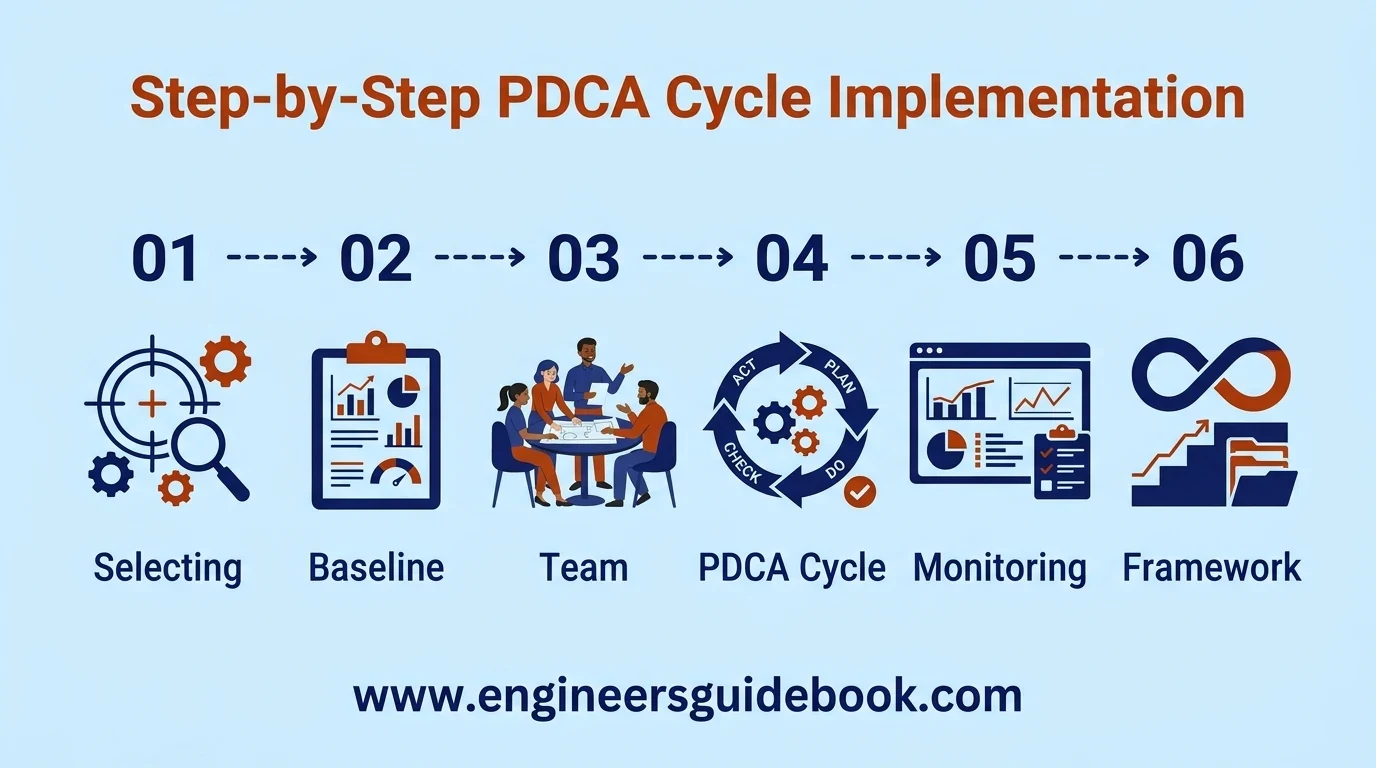
8. Step-by-Step PDCA Cycle Implementation
8.1 Selecting a Process for Improvement
Begin by identifying processes exhibiting excessive downtime, inconsistent quality, elevated operating costs, or declining productivity. Prioritize improvement opportunities according to their financial implications, operational significance, and alignment with strategic organizational objectives.
8.2 Establishing Baseline Performance
Establish quantitative baseline measurements before introducing modifications. Historical production records, maintenance reports, rejection percentages, and operational expenditures provide essential reference points for evaluating subsequent improvements objectively.
8.3 Forming a Cross-Functional Improvement Team
An effective improvement team incorporates representatives from production, maintenance, engineering, quality assurance, and management. Multidisciplinary collaboration facilitates comprehensive problem analysis, eliminates departmental silos, and strengthens implementation accountability.
8.4 Executing the Four PDCA Stages
Implement the four stages sequentially by developing an improvement plan, conducting controlled trials, evaluating performance outcomes, and standardizing validated solutions. Each stage should generate documented evidence supporting subsequent decisions.
8.5 Monitoring and Evaluating Progress
Establish periodic performance reviews to assess implementation progress. Visual dashboards, control charts, and performance reports facilitate early identification of deviations requiring managerial or technical intervention.
8.6 Establishing a Continuous Improvement Framework
Integrate PDCA into routine operational activities through regular improvement meetings, employee suggestion systems, performance evaluations, and standardized documentation. Institutionalizing these practices ensures improvement becomes a sustained organizational responsibility.
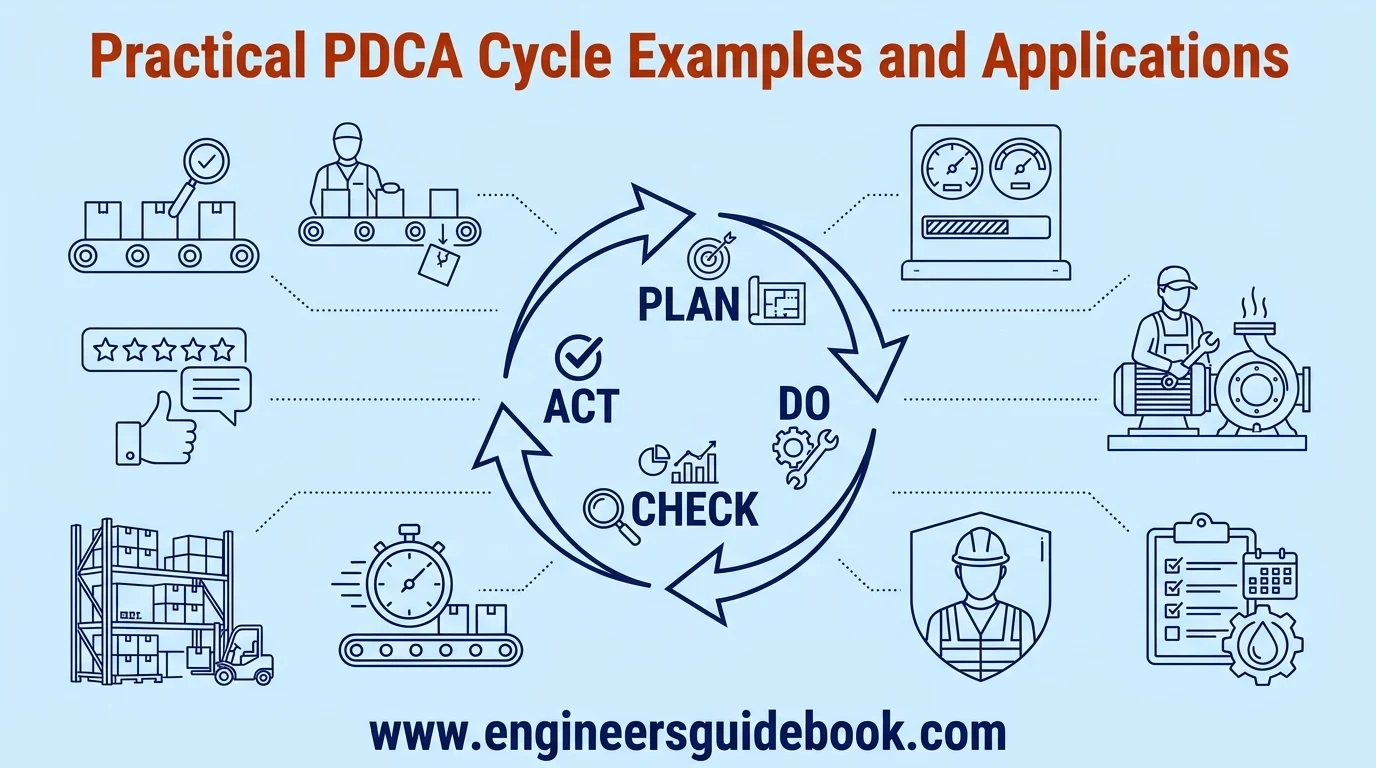
9. Practical PDCA Cycle Examples and Applications
9.1 Reducing Manufacturing Defects
Consider a manufacturing facility experiencing a 6% product rejection rate.
- Plan: Investigate defect causes and establish a 2% rejection target.
- Do: Implement revised machine settings and operator training.
- Check: Measure rejection rates following implementation.
- Act: Standardize validated settings if the target is sustainably achieved.
9.2 Improving Overall Equipment Effectiveness
A production facility with an OEE score of 65% identifies excessive changeover duration and minor stoppages as significant losses.
Management introduces standardized changeover procedures, monitors equipment performance, and incorporates successful modifications into production practices to improve OEE.
9.3 Reducing Machine Breakdown and Downtime
A centrifugal pump experiencing recurrent bearing failures requires systematic investigation. The maintenance team examines lubrication practices, tests revised maintenance procedures, monitors bearing condition, and standardizes effective interventions after validating their reliability.
9.4 Optimizing Preventive Maintenance Programs
Maintenance departments can apply PDCA to optimize inspection frequencies and servicing intervals. Historical failure patterns provide the planning foundation, while controlled implementation and condition monitoring determine whether revised maintenance schedules improve equipment reliability.
9.5 Improving Workplace Safety
An industrial facility experiencing recurring near-miss incidents investigates workplace hazards, implements appropriate engineering and administrative controls, evaluates safety performance, and incorporates validated measures into established safety procedures.
9.6 Reducing Production Cycle Time
Production engineers analyze workflow bottlenecks, implement revised workstation arrangements, and measure processing durations. Successful modifications are standardized to reduce unnecessary material movement, waiting periods, and non-value-adding activities.
9.7 Improving Inventory Management
Organizations can investigate excessive inventory accumulation, introduce revised replenishment procedures, and evaluate inventory turnover. Validated improvements reduce carrying costs, minimize obsolete inventory, and enhance material availability without creating unnecessary stock shortages.
9.8 Enhancing Customer Satisfaction
Customer complaints provide valuable improvement opportunities. Organizations identify recurring grievances, implement targeted service modifications, evaluate customer feedback, and standardize successful practices to strengthen customer satisfaction and retention.
10. Benefits and Limitations of the PDCA Cycle
10.1 Improved Operational Efficiency
PDCA systematically identifies process inefficiencies and facilitates their elimination. Improved resource utilization, reduced operational interruptions, and streamlined workflows contribute to higher organizational productivity.
10.2 Enhanced Product Quality
Controlled experimentation and systematic performance evaluation enable organizations to reduce process variability. Consequently, manufacturing consistency improves, rejection rates decline, and products conform more reliably to established specifications.
10.3 Reduced Operational Costs and Waste
The methodology addresses unnecessary expenditures associated with material wastage, equipment breakdowns, excessive inventory, and inefficient workflows. Incremental improvements can generate substantial cumulative financial benefits.
10.4 Improved Employee Engagement
Involving employees in improvement initiatives encourages ownership, collaboration, and constructive problem-solving. Personnel working directly with equipment frequently possess invaluable practical knowledge concerning recurring operational deficiencies.
10.5 Data-Driven Decision-Making
PDCA replaces speculative decision-making with empirical evaluation. Organizations assess proposed solutions using measurable performance indicators, reducing dependence on subjective assumptions and managerial intuition.
10.6 Time and Resource Requirements
Effective implementation requires adequate planning, reliable data collection, employee participation, and periodic performance evaluation. Multiple improvement iterations may consume considerable resources before satisfactory results materialize.
10.7 Limitations in Complex Improvement Projects
Highly intricate operational problems may involve numerous interdependent variables. Such projects frequently require supplementary analytical methodologies, advanced statistical techniques, specialized engineering expertise, and comprehensive risk assessments.
10.8 Common Implementation Mistakes and Solutions
Frequent implementation mistakes include inadequate planning, unreliable baseline data, premature standardization, insufficient employee engagement, and neglecting subsequent improvement cycles. Clear objectives, rigorous documentation, and management commitment mitigate these deficiencies.

11. PDCA Cycle and Other Improvement Methodologies
11.1 PDCA vs PDSA Cycle
PDCA emphasizes checking actual performance against planned objectives, whereas PDSA emphasizes studying experimental outcomes to develop deeper process knowledge. Both methodologies encourage iterative improvement, although PDSA places greater emphasis on scientific learning.
11.2 PDCA vs DMAIC
DMAIC consists of Define, Measure, Analyze, Improve, and Control. It provides a more elaborate analytical framework for complex, data-intensive improvement projects, whereas PDCA offers a comparatively straightforward and flexible improvement structure.
11.3 PDCA vs Kaizen
Kaizen represents a broader philosophy of continuous incremental improvement. PDCA provides a structured execution mechanism through which Kaizen initiatives can be planned, tested, evaluated, and standardized systematically.
11.4 PDCA and Lean Manufacturing
Lean manufacturing concentrates on eliminating waste and maximizing customer value. PDCA complements Lean initiatives by providing a disciplined methodology for testing waste-reduction strategies and sustaining operational improvements.
11.5 PDCA and Six Sigma
Six Sigma emphasizes reducing process variation and defects through statistical analysis. PDCA can support smaller improvement initiatives within Six Sigma programs, particularly when extensive DMAIC investigations are unnecessary.
11.6 PDCA and Total Productive Maintenance
Total Productive Maintenance (TPM) focuses on maximizing equipment effectiveness through proactive maintenance and employee participation. PDCA supports TPM by evaluating maintenance strategies, reducing equipment losses, and standardizing successful reliability improvements.
11.7 PDCA and ISO 9001 Quality Management
ISO 9001 incorporates the PDCA approach within its quality management system framework. Organizations apply iterative planning, implementation, performance evaluation, and corrective action to strengthen process consistency and quality management effectiveness.
11.8 Selecting the Right Improvement Methodology
Methodology selection depends on problem complexity, available resources, organizational objectives, and analytical requirements. PDCA suits iterative operational improvements, while more sophisticated methodologies may be appropriate for complex process variation problems.

12. Frequently Asked Questions About the PDCA Cycle
12.1 What Is the PDCA Cycle in Simple Words?
The PDCA Cycle is a continuous improvement method that involves planning a solution, testing it, checking its results, and taking appropriate action based on the findings.
12.2 What Are the Four Steps of the PDCA Cycle?
The four steps are Plan, Do, Check, and Act. Together, they establish a repeatable framework for systematic problem-solving, performance evaluation, and process improvement.
12.3 What Is the Main Purpose of the PDCA Cycle?
The primary purpose of PDCA is to improve processes continuously through controlled experimentation, evidence-based decisions, systematic evaluation, and standardization of successful solutions.
12.4 What Is a Real-Life Example of the PDCA Cycle?
A factory experiencing excessive machine downtime can investigate its causes, test revised maintenance procedures, measure downtime improvements, and standardize effective maintenance practices.
12.5 Why Is the PDCA Cycle Called the Deming Cycle?
PDCA is commonly called the Deming Cycle because W. Edwards Deming popularized iterative quality improvement principles. However, Deming himself later advocated the PDSA model.
12.6 What Is the Difference Between PDCA and PDSA?
PDCA emphasizes checking results against established objectives, while PDSA emphasizes studying results, comparing them with predictions, and generating new knowledge through experimentation.
12.7 How Is the PDCA Cycle Used in Manufacturing?
Manufacturers use PDCA to reduce defects, improve equipment availability, optimize production workflows, eliminate waste, reduce breakdowns, and enhance overall equipment effectiveness.
12.8 How Does PDCA Improve Quality Management?
PDCA improves quality management by identifying process deficiencies, testing corrective measures, evaluating product conformity, and incorporating successful improvements into standardized operating procedures.
12.9 What Are the Disadvantages of the PDCA Cycle?
Common disadvantages include time-consuming iterations, resource requirements, dependence on reliable data, and limited analytical depth when addressing highly complex operational problems without supplementary tools.
12.10 Is PDCA a Lean or Six Sigma Tool?
PDCA is a general continuous improvement methodology widely used in Lean manufacturing, quality management, and Six Sigma initiatives. It is not exclusive to any single management philosophy.
12.11 How Long Does a PDCA Cycle Take?
A PDCA Cycle may take several hours, weeks, or months depending on problem complexity, implementation requirements, resource availability, and the observation period necessary to validate results.
12.12 How Do You Measure the Success of a PDCA Cycle?
Success is measured by comparing actual performance against baseline measurements and predefined improvement objectives using relevant KPIs, financial outcomes, quality indicators, and sustainability assessments.

13. Conclusion
13.1 Key Takeaways From the PDCA Cycle
The PDCA Cycle provides a versatile framework for systematic problem-solving, controlled experimentation, performance evaluation, and sustainable improvement. Its effectiveness depends on disciplined execution, reliable information, and consistent follow-up.
13.2 Building a Sustainable Continuous Improvement Culture
Organizations must encourage employee participation, transparent communication, collaborative problem-solving, and evidence-based management. Embedding PDCA into daily operational practices transforms isolated improvement projects into an enduring organizational capability.
13.3 Achieving Long-Term Operational Excellence
Long-term operational excellence requires persistent refinement rather than sporadic corrective interventions. By repeatedly applying the Plan, Do, Check, and Act stages, organizations can strengthen equipment reliability, optimize resource utilization, improve product quality, and establish sustainable competitive advantages.