Machine availability measures the percentage of scheduled production time during which equipment is operational and available for manufacturing. It is calculated by dividing actual operating time by planned production time and multiplying by 100. High machine availability indicates minimal downtime, effective maintenance practices, improved equipment reliability, and better production efficiency.
1. Introduction to Machine Availability
1.1 What Is Machine Availability?
Machine availability is a manufacturing performance metric that measures equipment readiness during a specified period. It indicates how effectively machinery remains operational without interruptions caused by breakdowns, repairs, changeovers, or other stoppages.
1.2 Importance of Machine Availability in Manufacturing
High machine availability enables manufacturers to meet production commitments, minimize operational expenses, and maximize equipment productivity. Low availability creates production bottlenecks, increases manufacturing costs, and disrupts delivery schedules.
1.3 Role of Machine Availability in Production Efficiency
Consistent equipment operation facilitates uninterrupted material flow and efficient resource utilization. Improving availability helps manufacturers increase production output without necessarily investing in additional machinery.
1.4 Machine Availability as a Maintenance KPI
Maintenance departments use machine availability as a key performance indicator to evaluate equipment condition, maintenance effectiveness, and downtime reduction initiatives. It provides measurable insight into asset management performance.
1.5 Relationship Between Machine Availability and OEE
Availability is one of the three components of Overall Equipment Effectiveness (OEE), alongside performance and quality.
OEE = Availability × Performance × Quality
Reduced availability directly decreases the overall OEE score.
2. Understanding the Fundamentals of Machine Availability
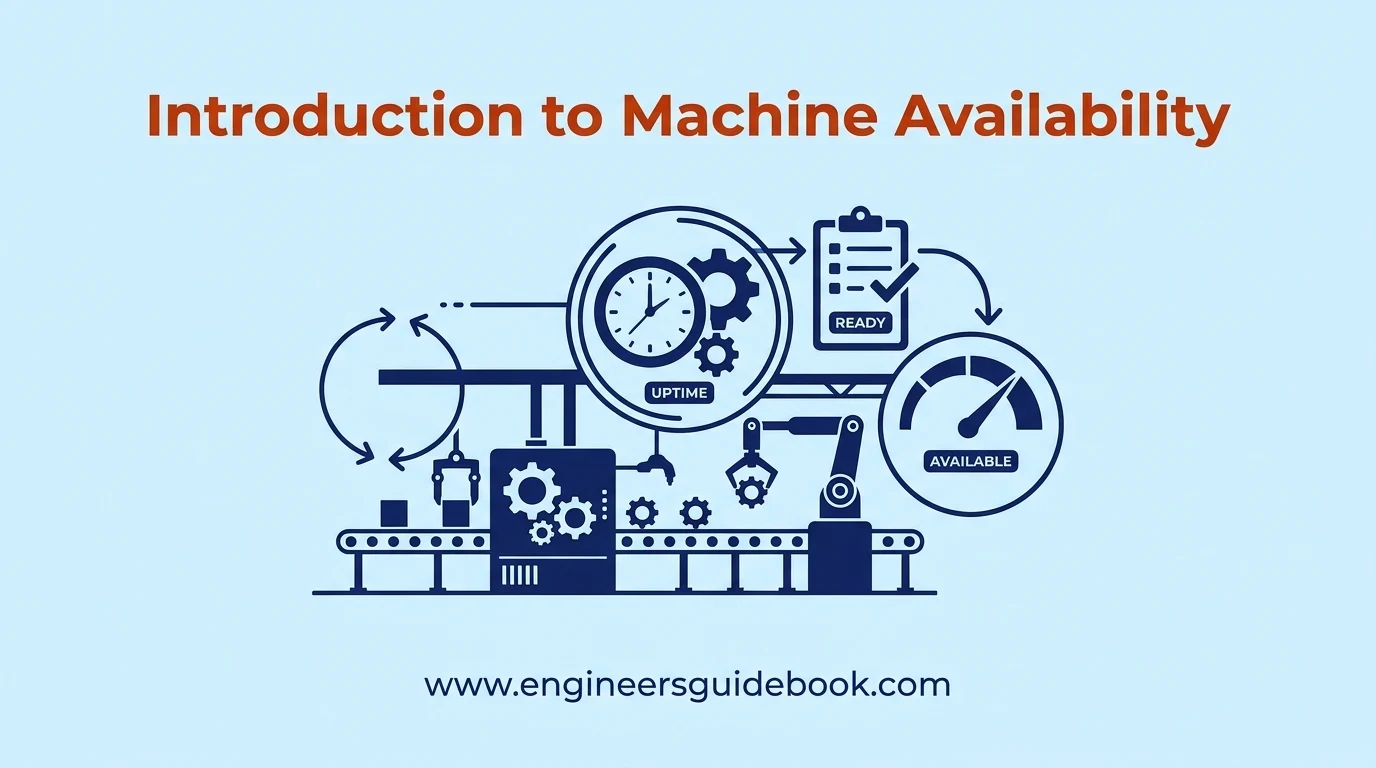
2.1 Planned Production Time
Planned production time represents the duration during which equipment is scheduled for manufacturing. Scheduled nonproduction periods, such as excluded breaks and holidays, are generally deducted from the calculation.
2.2 Actual Operating Time
Actual operating time represents the duration during which machinery operates within the planned production period. It is determined by subtracting recorded availability losses from planned production time.
2.3 Machine Downtime
Machine downtime refers to periods when equipment is unavailable or stopped during scheduled production. Mechanical failures, electrical faults, changeovers, and operational interruptions contribute to downtime.
2.4 Planned and Unplanned Downtime
Planned downtime includes scheduled maintenance, cleaning, and changeovers. Unplanned downtime results from unexpected equipment failures. Their inclusion in availability calculations depends on the selected measurement methodology and production schedule.
2.5 Equipment Reliability and Maintainability
Reliability measures equipment’s ability to function without failure, whereas maintainability describes how efficiently failed equipment can be restored. Together, these characteristics significantly influence machine availability.
2.6 Machine Availability vs Machine Utilization
Availability measures equipment readiness or operating time against a defined scheduled period. Utilization measures the extent to which equipment capacity or available time is actually used.
2.7 Machine Availability vs Machine Reliability
Reliable machinery experiences fewer failures. However, high availability can also result from rapid repairs, even when failures occur relatively frequently. Reliability and availability therefore measure different equipment characteristics.
3. Types of Machine Availability
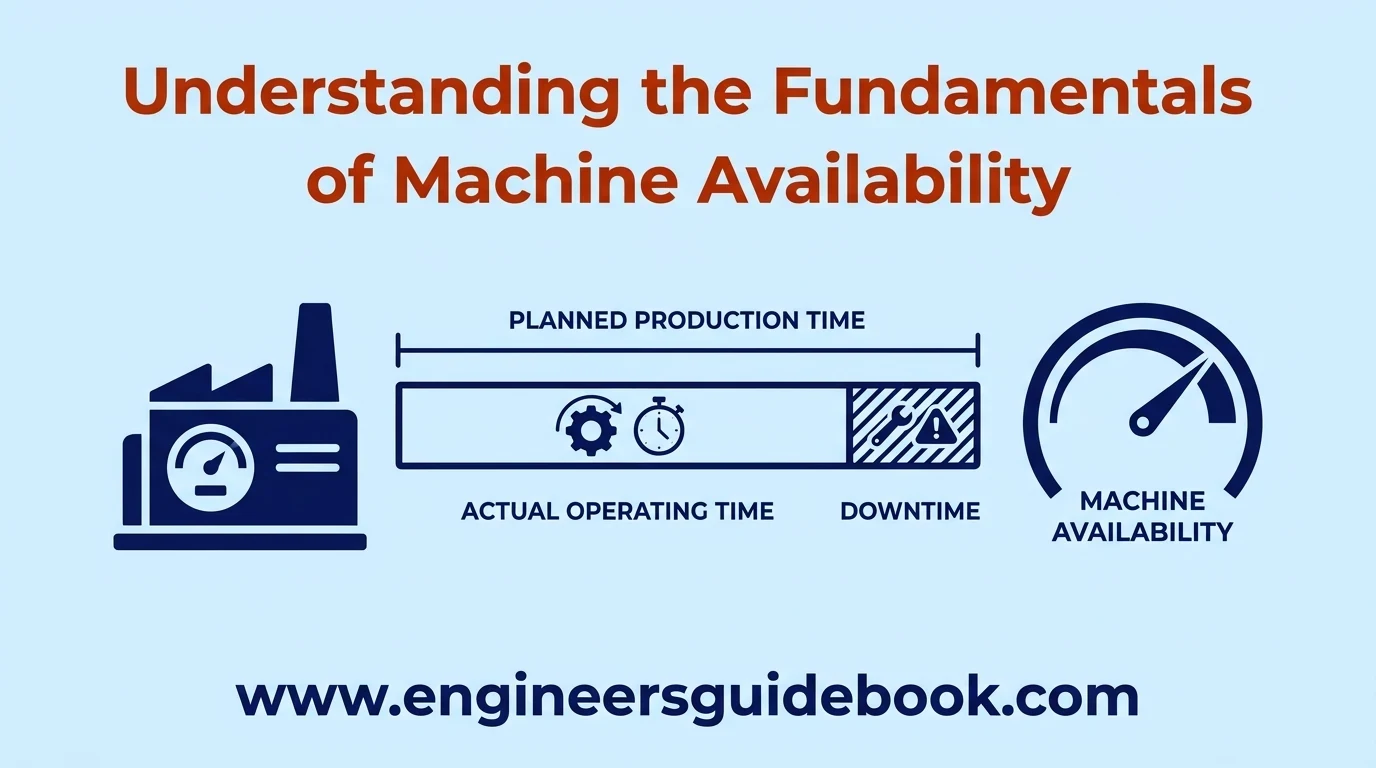
3.1 Inherent Availability
Inherent availability evaluates equipment availability under ideal maintenance support conditions, considering corrective maintenance time while excluding preventive maintenance and logistical delays.
Inherent Availability = MTBF / (MTBF + MTTR)
3.2 Achieved Availability
Achieved availability incorporates both preventive and corrective maintenance activities while generally excluding administrative and logistical delays. It provides a broader assessment of maintenance-related equipment availability.
3.3 Operational Availability
Operational availability measures equipment readiness under actual working conditions, including maintenance, administrative delays, spare parts shortages, and other applicable downtime contributors.
3.4 OEE Availability
OEE availability measures the proportion of planned production time during which equipment operates. It captures significant production stoppages, including breakdowns, setups, and adjustments.
3.5 Differences Between Availability Types
Availability Type Principal Consideration Inherent Corrective maintenance Achieved Corrective and preventive maintenance Operational Actual operating and support conditions OEE Scheduled production time losses
3.6 Selecting the Appropriate Availability Metric
Reliability engineers typically use inherent availability, while maintenance managers may prefer operational availability. Production departments frequently use OEE availability to quantify manufacturing losses.
4. Machine Availability Formula
4.1 Basic Machine Availability Formula
Machine availability is expressed as a percentage using the following equation.
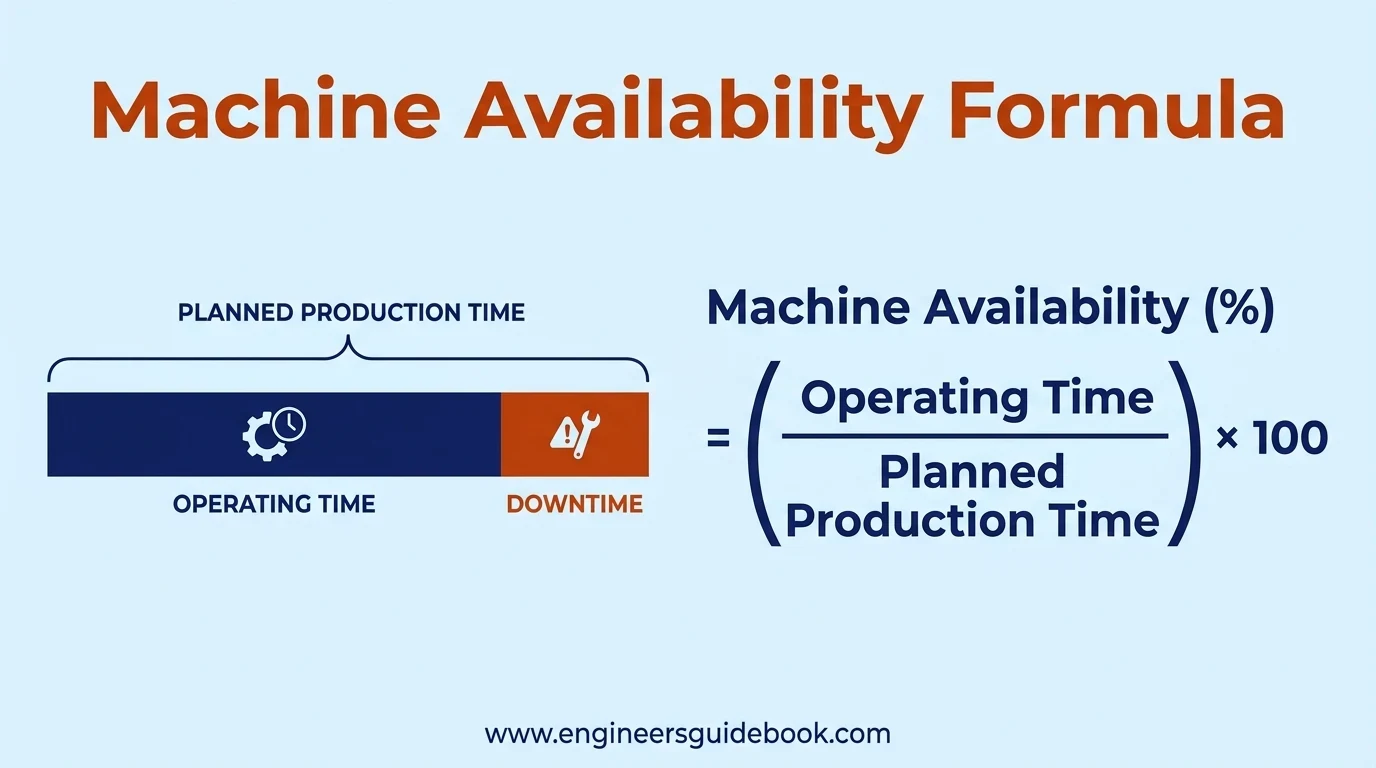
Machine Availability (%) = (Operating Time / Planned Production Time) × 100
Higher percentages indicate fewer production interruptions.
4.2 Machine Availability Formula Using Operating Time
When actual operating time and planned production time are available, dividing these values provides a straightforward assessment of equipment availability.
Both time measurements must use identical units.
4.3 Machine Availability Formula Using Downtime
When downtime records are available, machine availability can be calculated using:
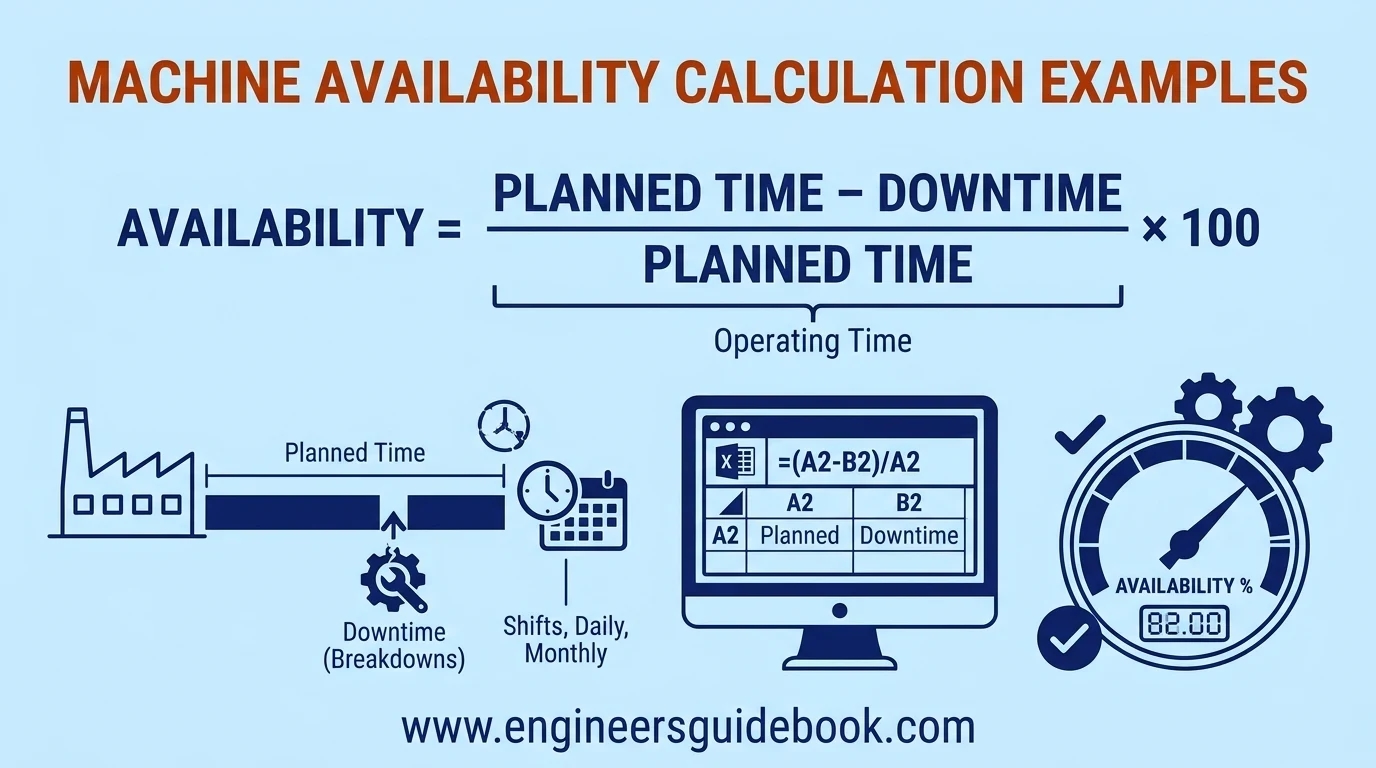
Availability (%) = [(Planned Production Time − Downtime) / Planned Production Time] × 100
4.4 Machine Availability Formula Using MTBF and MTTR
Inherent availability for repairable equipment can be estimated using reliability and maintainability parameters.
Availability (%) = [MTBF / (MTBF + MTTR)] × 100
Increasing MTBF or decreasing MTTR improves inherent availability.
4.5 OEE Availability Formula
The availability component of OEE is calculated as:
OEE Availability (%) = (Run Time / Planned Production Time) × 100
Run time excludes recorded availability-related stoppages.
4.6 Understanding Machine Availability Formula Variables
The principal variables include:
Operating Time: Actual equipment running duration.
Planned Production Time: Scheduled manufacturing duration.
Downtime: Recorded production stoppages.
MTBF: Mean time between failures.
MTTR: Mean time to repair.
4.7 Selecting the Correct Machine Availability Formula
Time-based formulas are appropriate for production monitoring. MTBF and MTTR calculations are more suitable for assessing inherent equipment availability and maintenance engineering performance.
5. How to Calculate Machine Availability Step by Step
5.1 Determining Planned Production Time
Establish the scheduled production duration and subtract designated nonproduction periods according to the organization’s measurement policy.
5.2 Recording Machine Downtime
Document every applicable stoppage with its starting time, ending time, duration, and associated reason.
5.3 Classifying Downtime Events
Categorize interruptions into mechanical failures, electrical faults, changeovers, maintenance activities, and operational delays to facilitate subsequent loss analysis.
5.4 Calculating Actual Operating Time
Subtract total applicable downtime from planned production time.
Operating Time = Planned Production Time − Downtime
5.5 Applying the Machine Availability Formula
Divide the calculated operating time by planned production time to determine the equipment availability ratio.
5.6 Converting Machine Availability Into a Percentage
Multiply the availability ratio by 100. For instance, an availability ratio of 0.92 represents 92% machine availability.
5.7 Calculating Availability for Multiple Machines
Divide the combined operating time of all machines by their combined planned production time. This produces a time-weighted fleet availability percentage.
5.8 Verifying Machine Availability Calculations
Check time units, overlapping downtime records, scheduling exclusions, and missing data. Availability percentages should remain between zero and 100%.

6. Machine Availability Calculation Examples
6.1 Single Machine Availability Calculation Example
Consider equipment scheduled for 600 minutes with 45 minutes of downtime.
Availability = (555 / 600) × 100 = 92.5%
6.2 Machine Availability Calculation for an Eight-Hour Shift
A machine operates for 420 minutes during a 480-minute planned production period.
Availability = (420 / 480) × 100 = 87.5%
6.3 Machine Availability Calculation With Multiple Breakdowns
A machine experiences three breakdowns lasting 15, 20, and 25 minutes during 500 minutes of planned production.
Availability = [(500 − 60) / 500] × 100 = 88%
6.4 Machine Availability Calculation Using MTBF and MTTR
Consider equipment with an MTBF of 200 hours and an MTTR of five hours.
Inherent Availability = [200 / (200 + 5)] × 100 = 97.56%
6.5 Daily Machine Availability Calculation Example
A machine has 1,200 minutes of planned production time and 90 minutes of downtime.
Daily Availability = (1,110 / 1,200) × 100 = 92.5%
6.6 Monthly Machine Availability Calculation Example
Monthly production records indicate 15,000 scheduled minutes and 1,500 minutes of downtime.
Monthly Availability = (13,500 / 15,000) × 100 = 90%
6.7 Production Line Availability Calculation Example
A production line is scheduled for 800 minutes but experiences 100 minutes of line-level stoppages.
Line Availability = (700 / 800) × 100 = 87.5%
6.8 Machine Availability Calculation Using Excel
Enter planned production time in cell A2 and downtime in cell B2.
excel =(A2-B2)/A2
Format the resulting cell as a percentage. This formula facilitates automated daily and monthly availability reporting.
7. Machine Availability Benchmarks and Targets
7.1 What Is a Good Machine Availability Percentage?
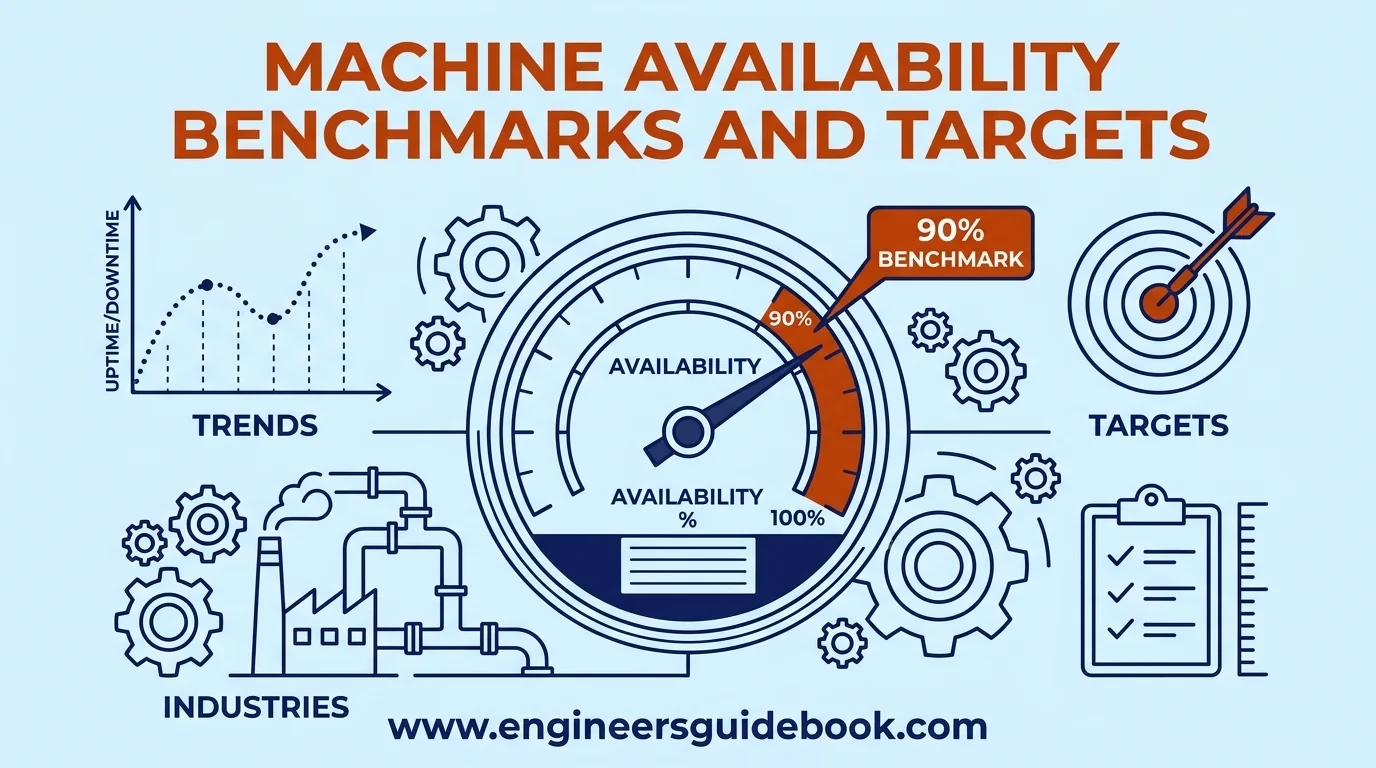
Machine availability above 90% is often considered a useful manufacturing target. However, acceptable performance depends on equipment criticality, production requirements, asset condition, and downtime classification.
7.2 The Meaning of 100 Percent Machine Availability
A 100% availability score indicates that no availability-related stoppages occurred during the measured production period. It does not necessarily indicate perfect production speed or product quality.
7.3 The 90 Percent OEE Availability Benchmark
The conventional world-class OEE benchmark commonly incorporates 90% availability, 95% performance, and 99% quality. These values produce approximately 85% OEE and serve as indicative rather than universal targets.
7.4 Machine Availability Benchmarks Across Industries
Continuous-process industries generally require stringent availability targets because equipment interruptions can affect interconnected operations. Batch manufacturing and discrete production environments may accommodate different availability thresholds.
7.5 Setting Realistic Machine Availability Targets
Establish targets using historical equipment performance, failure patterns, maintenance capabilities, production commitments, and asset criticality. Incremental improvements are generally more sustainable than arbitrary performance expectations.
7.6 Interpreting High and Low Availability Scores
High availability indicates limited recorded stoppages, while low availability suggests substantial downtime losses. Nevertheless, availability should be evaluated alongside reliability, performance, and quality metrics for comprehensive assessment.
7.7 Tracking Machine Availability Trends
Daily, weekly, and monthly availability monitoring helps identify deteriorating equipment conditions, recurring failures, and maintenance deficiencies. Historical trend analysis enables engineering teams to prioritize corrective actions, evaluate maintenance interventions, and establish measurable continuous improvement initiatives.
8. Factors Affecting Machine Availability
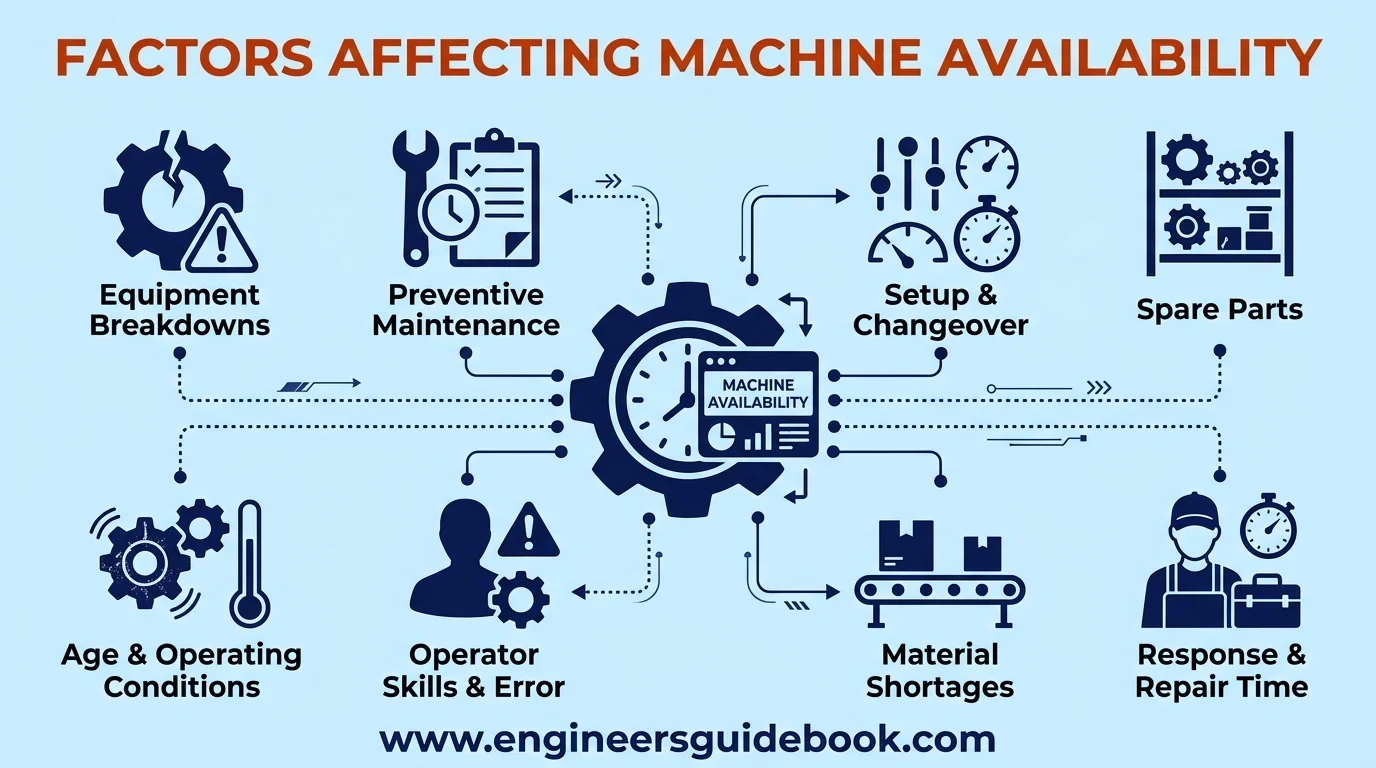
8.1 Equipment Breakdowns and Mechanical Failures
Unexpected equipment failures are among the primary causes of reduced machine availability. Bearing deterioration, gearbox damage, electrical faults, and lubrication deficiencies interrupt production and necessitate corrective maintenance. Recurring failures can significantly undermine manufacturing continuity.
8.2 Preventive Maintenance Downtime
Scheduled maintenance temporarily reduces equipment operating time but improves long-term reliability. Optimizing maintenance intervals helps manufacturers balance necessary maintenance activities against production requirements without compromising equipment integrity.
8.3 Machine Setup and Changeover Time
Product changeovers, tooling replacements, equipment adjustments, and cleaning activities consume valuable production time. Excessive setup durations reduce machine availability when these activities occur during planned production periods.
8.4 Spare Parts Availability
Unavailable replacement components prolong equipment restoration. Maintaining adequate inventories of critical bearings, seals, motors, sensors, and other essential components helps prevent unnecessary maintenance delays.
8.5 Equipment Age and Operating Conditions
Aging machinery becomes increasingly susceptible to mechanical degradation and component fatigue. Excessive temperatures, vibration, contamination, and operational overload accelerate deterioration, increasing failure frequency and reducing availability.
8.6 Operator Skills and Human Error
Improper machine operation, incorrect parameter adjustments, and inadequate inspections contribute to avoidable equipment failures. Competent operators can recognize early deterioration symptoms and prevent minor abnormalities from developing into major breakdowns.
8.7 Material Shortages and Production Interruptions
Raw material shortages and upstream process interruptions can leave functional machinery idle. These stoppages affect OEE availability when they occur during planned production time, although they do not necessarily indicate poor equipment reliability.
8.8 Maintenance Response and Repair Time
Delayed maintenance responses extend equipment downtime. Efficient troubleshooting, technician deployment, repair procedures, and functional testing accelerate equipment restoration and improve operational availability.
9. Machine Availability and Its Relationship With Manufacturing KPIs
9.1 Machine Availability and Overall Equipment Effectiveness
Machine availability directly influences Overall Equipment Effectiveness through the following relationship:
OEE = Availability × Performance × Quality
Improving availability increases OEE when performance and quality remain constant.
9.2 Machine Availability and Mean Time Between Failures
Mean Time Between Failures (MTBF) represents the average operating duration between consecutive equipment failures.
MTBF = Total Operating Time / Number of Failures
Higher MTBF generally indicates improved reliability and fewer breakdown-related availability losses.
9.3 Machine Availability and Mean Time to Repair
Mean Time to Repair (MTTR) measures the average active repair duration required to restore failed equipment.
MTTR = Total Repair Time / Number of Repairs
Reducing MTTR improves inherent availability by shortening corrective maintenance interruptions.
9.4 Machine Availability and Mean Time to Failure
Mean Time to Failure (MTTF) measures the expected operating lifespan of nonrepairable components before failure. Understanding MTTF supports replacement planning and helps prevent unexpected equipment stoppages.
9.5 Machine Availability and Production Capacity
Higher machine availability increases effective production capacity by providing additional operating time. Manufacturers can potentially achieve greater output using existing equipment without substantial capital expenditure.
9.6 Machine Availability and Maintenance Costs
Frequent breakdowns increase repair expenses, overtime requirements, replacement costs, and production losses. Effective availability improvement strategies can reduce total maintenance expenditure while strengthening asset performance.
9.7 Machine Availability and Overall Plant Productivity
Consistent machinery operation improves production synchronization, workforce utilization, and manufacturing throughput. Availability improvements are particularly valuable for bottleneck equipment that constrains overall plant productivity.

10. How to Improve Machine Availability
10.1 Implementing Effective Preventive Maintenance
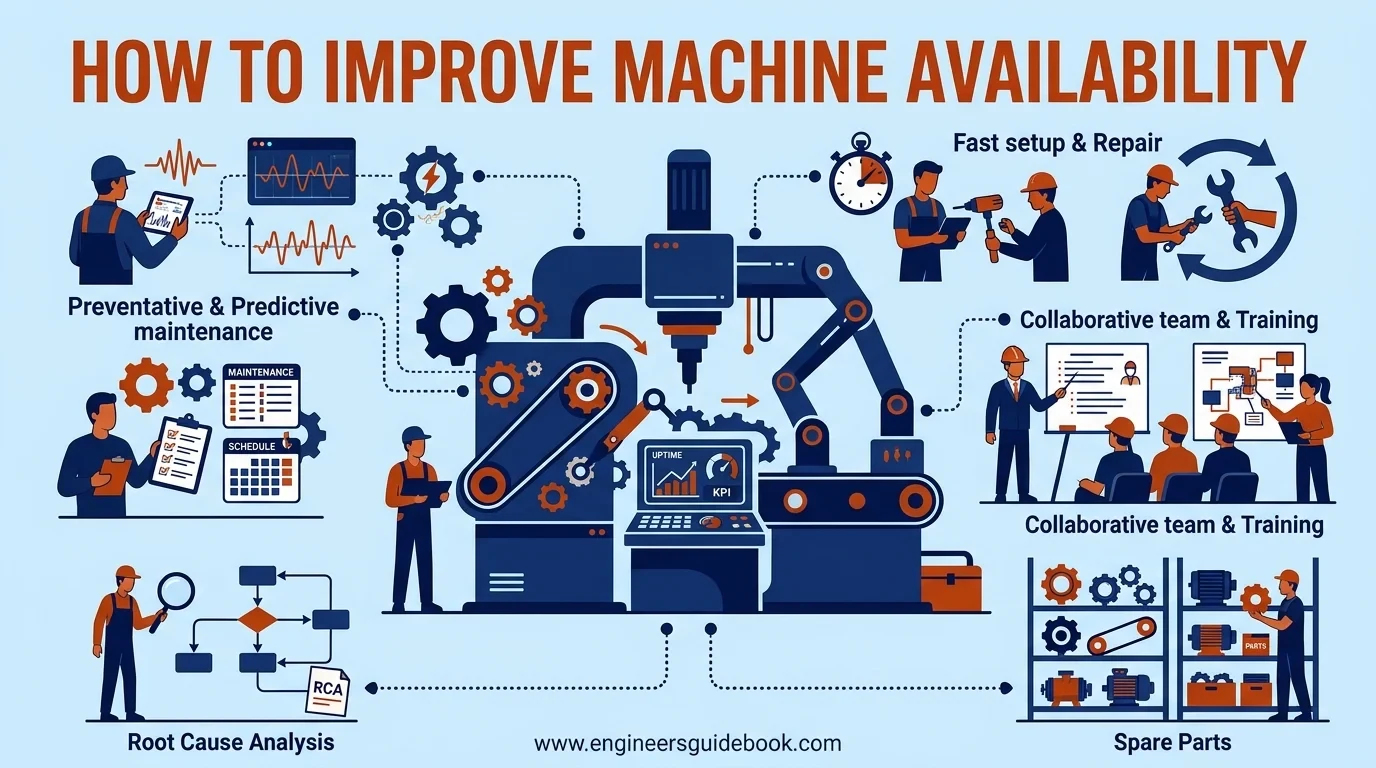
Develop maintenance schedules based on equipment criticality, manufacturer recommendations, operating hours, and historical failure patterns. Systematic lubrication, inspections, adjustments, and component replacements help prevent premature equipment degradation.
10.2 Adopting Predictive Maintenance Techniques
Predictive maintenance identifies developing equipment abnormalities before functional failure occurs. Vibration analysis, thermography, oil analysis, and ultrasonic inspections facilitate condition-based interventions and reduce unexpected stoppages.
10.3 Reducing Unplanned Machine Downtime
Analyze historical downtime records to identify predominant failure categories. Prioritize recurring and high-impact breakdowns through structured corrective actions, engineering modifications, and reliability improvement initiatives.
10.4 Increasing Mean Time Between Failures
Increasing MTBF requires eliminating recurrent failure mechanisms. Improved lubrication practices, precise shaft alignment, appropriate component selection, contamination control, and equipment redesign can extend operating intervals between failures.
10.5 Reducing Mean Time to Repair
Standardized troubleshooting procedures, accessible spare parts, appropriate maintenance tools, and trained technicians reduce equipment restoration time. Improving equipment accessibility also simplifies maintenance execution.
10.6 Optimizing Machine Setup and Changeover Time
Single-Minute Exchange of Die (SMED) methodologies reduce changeover duration by separating internal and external setup activities. Standardized tooling arrangements and advance preparation further minimize production interruptions.
10.7 Implementing Total Productive Maintenance
Total Productive Maintenance (TPM) promotes equipment ownership across production and maintenance departments. Autonomous maintenance, focused improvement, and planned maintenance collectively enhance equipment availability and operational discipline.
10.8 Conducting Root Cause Analysis
Root Cause Analysis (RCA) identifies underlying failure mechanisms rather than merely addressing observable symptoms. Techniques such as the 5 Whys, Fishbone Diagram, and Fault Tree Analysis support systematic problem resolution.
10.9 Optimizing Spare Parts Inventory
Classify replacement components according to equipment criticality, procurement lead time, failure probability, and consumption frequency. Establish appropriate reorder levels to minimize stockouts without accumulating excessive inventory.
10.10 Improving Operator and Maintenance Technician Training
Technical training strengthens diagnostic capabilities, operating discipline, and maintenance proficiency. Competency-based development programs help personnel identify abnormalities, prevent operational errors, and execute repairs safely and efficiently.
11. Machine Availability Monitoring and Reporting
11.1 Manual Machine Downtime Tracking
Manual downtime registers document equipment stoppages, failure descriptions, repair durations, and corrective actions. Standardized recording templates improve data consistency and facilitate subsequent performance analysis.
11.2 Automated Machine Availability Monitoring
Automated monitoring systems capture machine operating states and stoppage durations directly from equipment controllers. These systems reduce manual recording discrepancies and improve production data accuracy.
11.3 Using CMMS for Availability Tracking
Computerized Maintenance Management Systems (CMMS) consolidate maintenance work orders, breakdown histories, repair records, and equipment performance indicators. Centralized information supports maintenance planning and availability improvement.
11.4 Using IoT Sensors and Real-Time Monitoring
Industrial Internet of Things (IIoT) sensors continuously monitor equipment operating conditions. Real-time alerts enable maintenance personnel to investigate emerging abnormalities before they escalate into disruptive failures.
11.5 Creating Machine Availability Dashboards
Effective dashboards display availability percentages, downtime durations, MTBF, MTTR, and predominant failure categories. Visual performance indicators simplify comparisons between machines, shifts, departments, and production lines.
11.6 Developing Daily and Monthly Availability Reports
Daily reports highlight immediate production interruptions, whereas monthly reports reveal long-term performance trends. Both should incorporate downtime classifications, availability targets, corrective actions, and improvement responsibilities.
11.7 Common Machine Availability Calculation Mistakes
Common errors include inconsistent time units, duplicate downtime entries, incorrect production schedules, and inappropriate exclusion of stoppages. Averaging percentages without considering different scheduled durations can also distort aggregate results.
11.8 Using Availability Data for Continuous Improvement
Availability data enables maintenance teams to prioritize critical losses and allocate resources effectively. Pareto analysis, historical comparisons, and corrective action verification transform raw downtime information into actionable engineering insights.

12. Frequently Asked Questions
12.1 What Is Machine Availability in Manufacturing?
Machine availability measures the proportion of a defined period during which equipment is operational or ready to perform its intended manufacturing function.
12.2 What Is the Formula for Machine Availability?
The standard production-based machine availability formula is:
Availability (%) = (Operating Time / Planned Production Time) × 100
12.3 How Do You Calculate Machine Availability?
Subtract downtime from planned production time, divide the remaining operating time by planned production time, and multiply the result by 100.
12.4 What Is a Good Machine Availability Percentage?
An availability score of 90% or higher is a common manufacturing target. Appropriate benchmarks vary depending on equipment criticality, operating conditions, and production requirements.
12.5 How Do You Calculate Availability Using MTBF and MTTR?
Inherent machine availability can be calculated using:
Availability (%) = [MTBF / (MTBF + MTTR)] × 100
Both variables must use identical time units.
12.6 What Is the Difference Between Machine Availability and Utilization?
Availability measures equipment readiness or operating time within a defined period, whereas utilization measures how extensively equipment time or production capacity is actually used.
12.7 What Is the Difference Between Machine Availability and Reliability?
Availability measures equipment readiness over time. Reliability measures the probability that equipment performs its intended function without failure under specified operating conditions.
12.8 How Is Machine Availability Calculated in OEE?
OEE availability is calculated by dividing actual run time by planned production time and multiplying the result by 100.
12.9 Is Planned Maintenance Included in Machine Availability?
Planned maintenance is included in availability losses when performed during planned production time. Maintenance conducted outside that period is generally excluded from OEE availability calculations.
12.10 Can Machine Availability Be 100 Percent?
Yes. Machine availability reaches 100% when no applicable downtime occurs during the measurement period. However, maintaining this percentage indefinitely is generally impractical.
12.11 How Do You Calculate Availability for Multiple Machines?
Divide the combined operating time of all machines by their combined planned production time and multiply by 100 to obtain time-weighted fleet availability.
12.12 How Do You Calculate Machine Availability in Excel?
Use the following Excel formula, where A2 contains planned production time and B2 contains downtime:
=(A2-B2)/A2
Format the result as a percentage.
12.13 What Causes Low Machine Availability?
Frequent breakdowns, prolonged repairs, excessive changeovers, inadequate maintenance, spare parts shortages, and operational interruptions are common contributors to low machine availability.
12.14 How Can Machine Availability Be Improved?
Implement preventive and predictive maintenance, eliminate recurring failures, optimize changeovers, improve spare parts management, and reduce equipment repair durations.

13. Conclusion
13.1 Key Takeaways on Machine Availability
Machine availability is a fundamental manufacturing KPI that quantifies equipment readiness and production time losses. Improving availability strengthens production capacity, maintenance effectiveness, and operational continuity.
13.2 Importance of Accurate Availability Calculations
Accurate calculations require consistent measurement boundaries, reliable downtime records, and appropriate formulas. Dependable availability data supports informed engineering decisions and meaningful performance comparisons.
13.3 Building a Sustainable Machine Availability Improvement Strategy
Sustainable availability improvements require a combination of proactive maintenance, reliability engineering, workforce development, and continuous performance monitoring. By systematically eliminating downtime contributors and addressing underlying failure mechanisms, manufacturers can maximize equipment effectiveness, reduce operational expenditure, and establish a more resilient production environment.