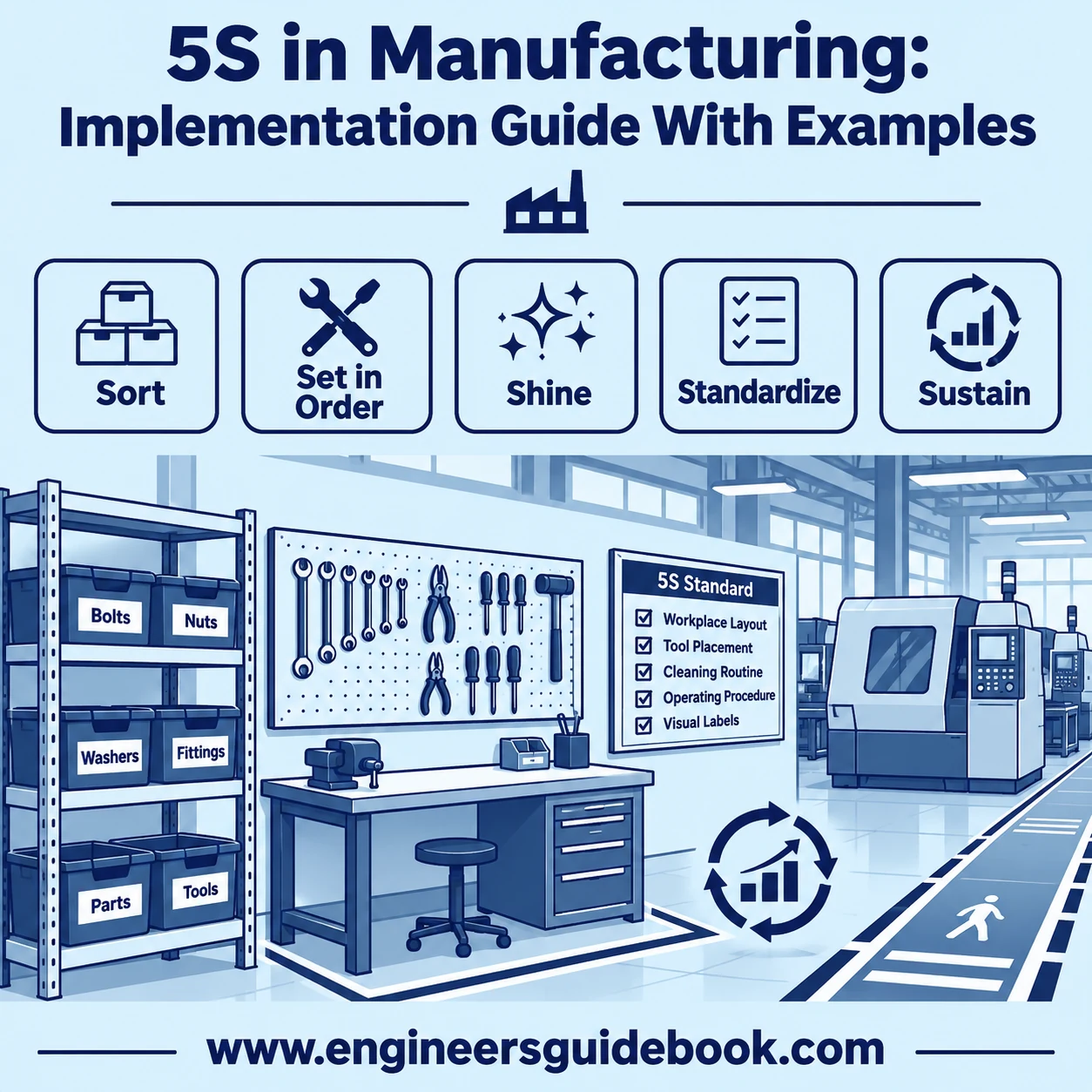
5S in manufacturing is a systematic workplace organization methodology that improves productivity, safety, quality, and operational efficiency through five principles: Sort, Set in Order, Shine, Standardize, and Sustain. Manufacturers implement 5S by eliminating unnecessary items, organizing resources, maintaining cleanliness, establishing workplace standards, and developing a culture of continuous improvement across production and maintenance departments.
1. Introduction to 5S in Manufacturing
1.1 What Is 5S in Manufacturing?
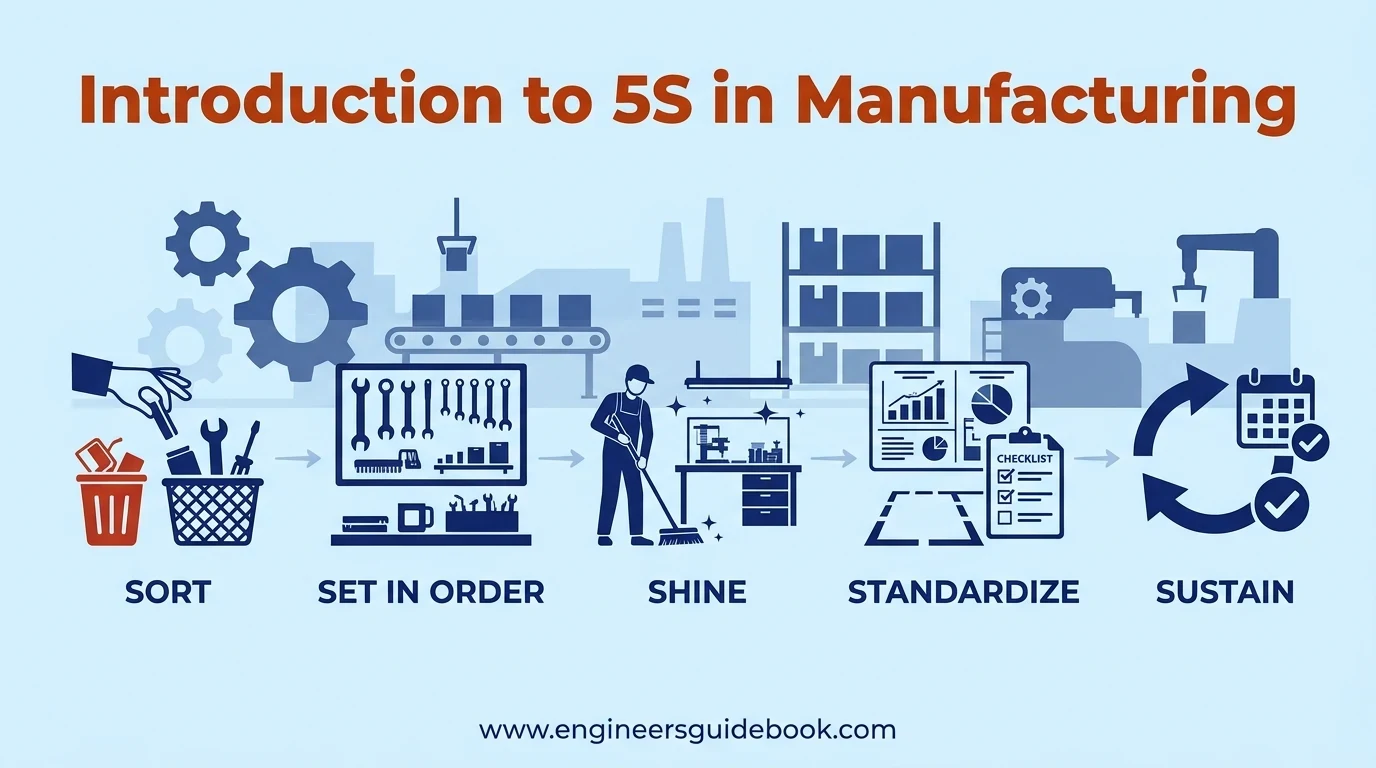
5S in manufacturing is a structured workplace management methodology designed to create organized, efficient, and safe production environments. It eliminates unnecessary activities, improves resource accessibility, and establishes consistent operational practices.
Unlike conventional housekeeping, 5S emphasizes long-term organizational discipline and measurable workplace improvements.
1.2 Origin and Evolution of 5S
The 5S methodology originated in Japan and became closely associated with the Toyota Production System. Japanese manufacturers adopted systematic workplace organization practices to minimize operational inefficiencies and improve production consistency.
Over time, 5S became a foundational element of industrial management worldwide.
1.3 Importance of 5S in Manufacturing
Manufacturing facilities frequently encounter misplaced tools, excessive inventory, equipment contamination, and inefficient material movement. These conditions contribute to production losses and operational delays.
5S addresses these deficiencies by establishing an organized workplace where abnormalities become easier to identify.
1.4 Role of 5S in Lean Manufacturing
5S provides the organizational foundation for lean manufacturing. It supports waste elimination, visual management, standardized work, and continuous improvement.
A well-organized production environment also facilitates the implementation of advanced lean manufacturing techniques.
2. The Five Principles of 5S in Manufacturing
2.1 Sort (Seiri)
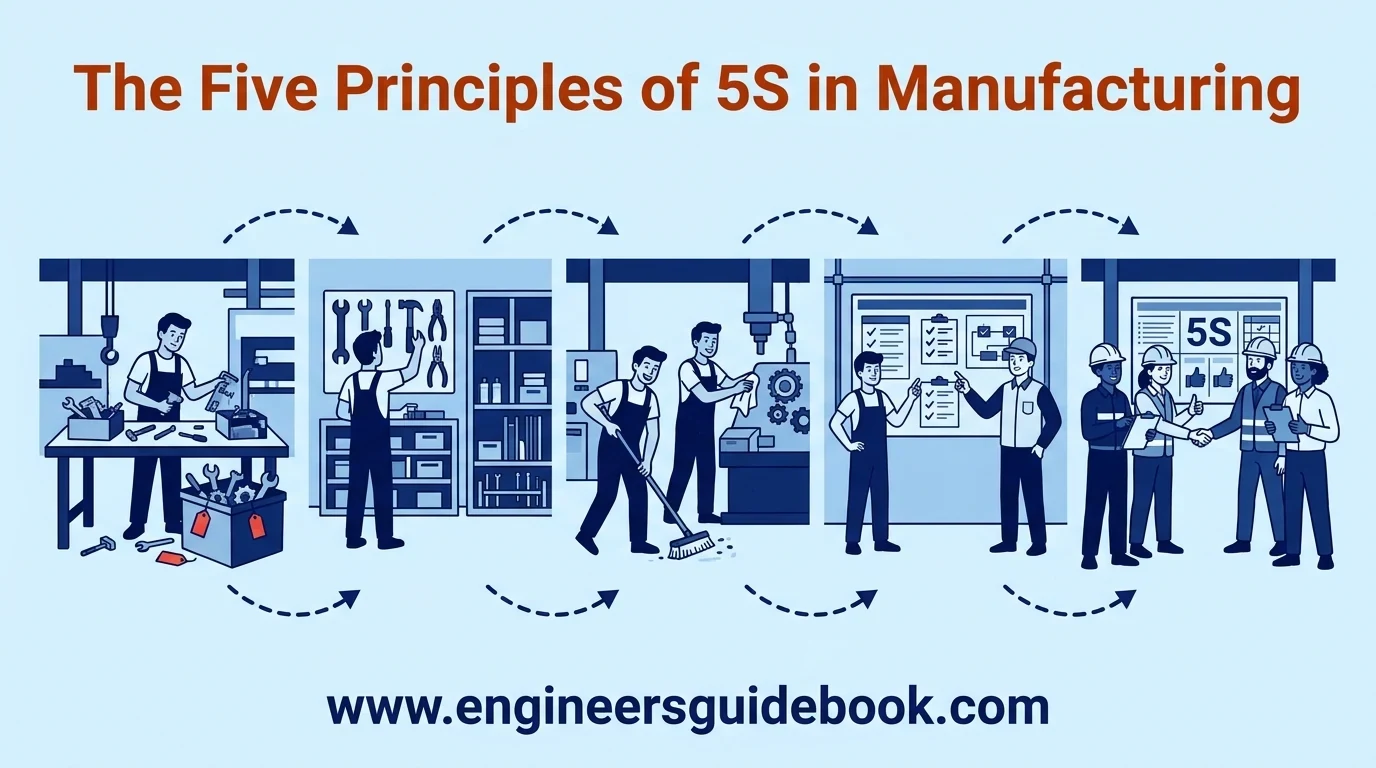
Sort involves separating essential workplace items from unnecessary materials. Obsolete components, damaged tools, redundant documents, and surplus inventory are identified for removal or relocation.
This principle reduces workplace congestion and improves space utilization.
2.2 Set in Order (Seiton)
Set in Order establishes designated locations for tools, materials, equipment, and documents. Frequently used items should remain readily accessible.
Shadow boards, labeled storage compartments, and strategically positioned racks minimize unnecessary movement and retrieval time.
2.3 Shine (Seiso)
Shine involves systematically cleaning machinery, workstations, floors, and surrounding production areas.
Cleaning also creates inspection opportunities. Operators can identify lubricant leakage, loose fasteners, damaged components, and other equipment abnormalities before they develop into significant failures.
2.4 Standardize (Seiketsu)
Standardization establishes consistent procedures for maintaining workplace organization. Manufacturers introduce cleaning schedules, visual instructions, inspection checklists, and documented responsibilities.
These practices prevent inconsistencies between production shifts and departments.
2.5 Sustain (Shitsuke)
Sustain focuses on maintaining established improvements through employee discipline, regular audits, training, and management involvement.
The ultimate objective is to transform 5S from an isolated improvement initiative into an enduring organizational culture.
3. Benefits of 5S in Manufacturing
3.1 Improved Production Efficiency
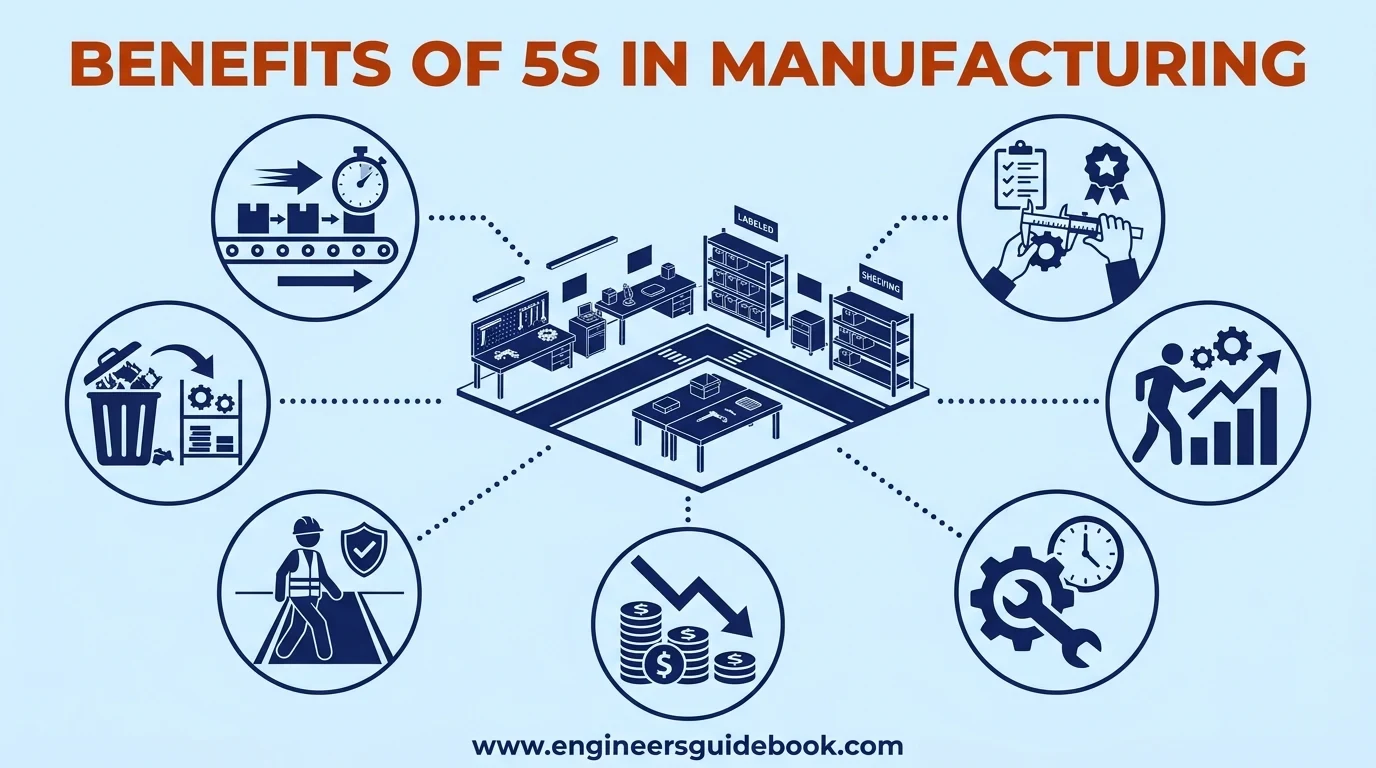
Organized workstations reduce unnecessary searching, walking, and material handling. Operators spend more time performing value-adding activities, improving production efficiency and workflow continuity.
3.2 Reduced Manufacturing Waste
5S helps eliminate several forms of lean manufacturing waste, particularly unnecessary motion, waiting, transportation, and excess inventory. Improved material visibility also reduces redundant purchasing.
3.3 Enhanced Workplace Safety
Clearly marked walkways, unobstructed emergency exits, and properly stored tools reduce workplace hazards. Systematic housekeeping supports accident prevention and occupational safety management.
3.4 Improved Product Quality
Clean and standardized production environments minimize contamination, component mix-ups, and procedural inconsistencies. These improvements contribute to greater manufacturing accuracy and product conformity.
3.5 Reduced Equipment Downtime
Routine cleaning and equipment inspection facilitate early detection of mechanical deterioration. Identifying abnormalities before catastrophic failure can reduce unplanned maintenance and production interruptions.
3.6 Increased Employee Productivity
Employees working in organized environments experience fewer operational disruptions. Accessible resources and clearly defined procedures improve task execution while reducing unnecessary physical exertion.
3.7 Lower Manufacturing Costs
Reduced material wastage, improved labor utilization, fewer equipment failures, and optimized storage collectively contribute to lower manufacturing costs. Financial benefits accumulate when improvements are consistently maintained.
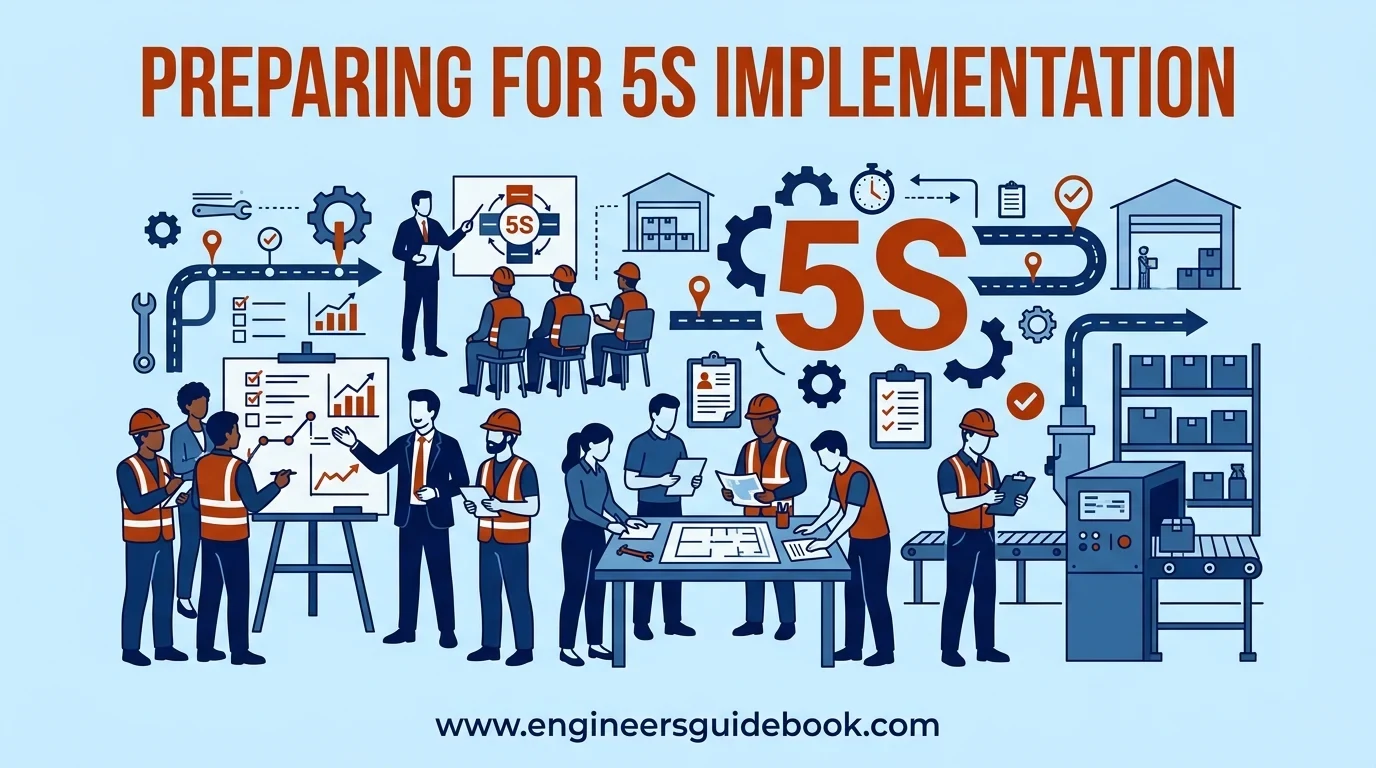
4. Preparing for 5S Implementation
4.1 Establishing Clear Implementation Objectives
Define measurable objectives before initiating 5S activities. Potential targets include reducing tool retrieval time, improving workplace audit scores, increasing available floor space, and eliminating identified safety hazards.
4.2 Securing Management Commitment
Management must provide adequate resources, implementation time, and organizational support. Leadership participation demonstrates that workplace organization is an operational priority rather than an optional housekeeping activity.
4.3 Forming a Dedicated 5S Team
Establish a multidisciplinary team comprising production operators, maintenance technicians, supervisors, quality personnel, and safety representatives. Assign specific responsibilities and designate departmental coordinators.
4.4 Conducting an Initial Workplace Assessment
Inspect existing manufacturing conditions and document organizational deficiencies. Record photographs, excessive inventory, unsafe storage arrangements, equipment cleanliness, and inefficient workstation layouts.
These observations establish a performance baseline.
4.5 Identifying Priority Manufacturing Areas
Prioritize departments experiencing frequent equipment failures, excessive material movement, safety concerns, or significant organizational deficiencies. Selecting a manageable pilot area helps demonstrate practical benefits.
4.6 Developing a 5S Implementation Plan
Prepare an implementation roadmap containing activities, deadlines, responsibilities, resource requirements, and performance indicators. Establish periodic review meetings to monitor progress and resolve implementation obstacles.
4.7 Providing Employee Training
Train employees on the five principles, workplace organization techniques, visual management, and audit requirements. Practical demonstrations reinforce theoretical knowledge and encourage active participation.
5. Step-by-Step 5S Implementation in Manufacturing
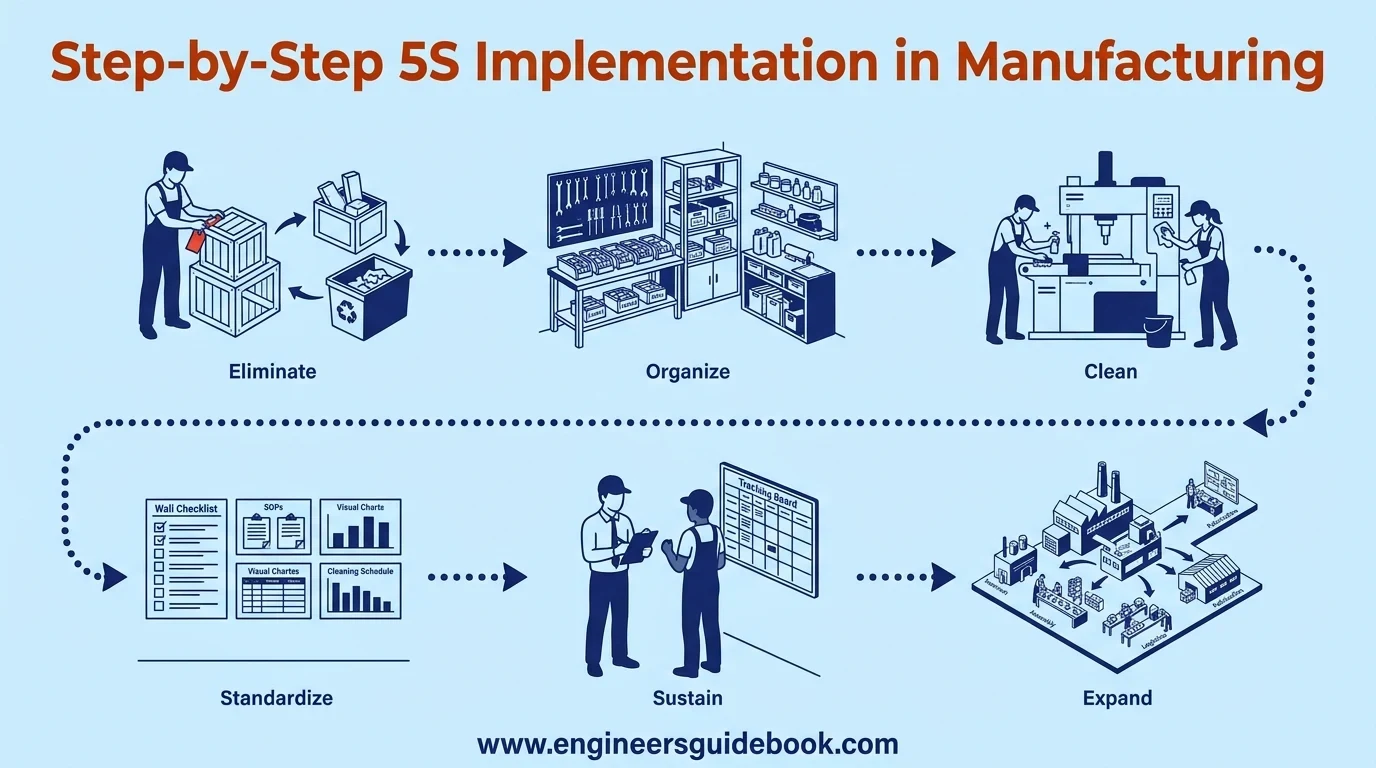
5.1 Step 1 – Eliminating Unnecessary Items
Inspect every workstation and classify items according to operational necessity. Apply red tags to questionable materials and transfer them to designated evaluation areas.
Determine whether tagged items should be retained, relocated, repaired, recycled, or discarded through authorized procedures.
5.2 Step 2 – Organizing Tools and Materials
Arrange essential items according to frequency of use, accessibility, ergonomic requirements, and operational sequence.
Introduce labeled storage bins, tool cabinets, identification boards, and designated material locations. Every essential item should have a clearly identifiable storage position.
5.3 Step 3 – Cleaning and Inspecting Equipment
Perform systematic cleaning of manufacturing equipment, workstations, and surrounding areas. Follow applicable equipment isolation and safety procedures.
Identify contamination sources and mechanical abnormalities. Assign corrective actions to eliminate recurring problems rather than repeatedly addressing their symptoms.
5.4 Step 4 – Establishing Workplace Standards
Develop visual standards demonstrating acceptable workplace conditions. Introduce standardized cleaning schedules, equipment inspection routines, storage arrangements, and departmental responsibilities.
Display instructions prominently to ensure consistency across operating shifts.
5.5 Step 5 – Sustaining Workplace Discipline
Conduct regular workplace inspections and evaluate compliance with established standards. Address deviations through corrective actions, refresher training, and employee feedback.
Supervisors should incorporate 5S verification into routine operational activities.
5.6 Expanding 5S Across Production Departments
Evaluate pilot implementation results before extending the methodology throughout the facility. Replicate successful practices while accommodating department-specific operational requirements.
Gradual expansion improves resource allocation and organizational acceptance.
6. Essential 5S Tools and Techniques
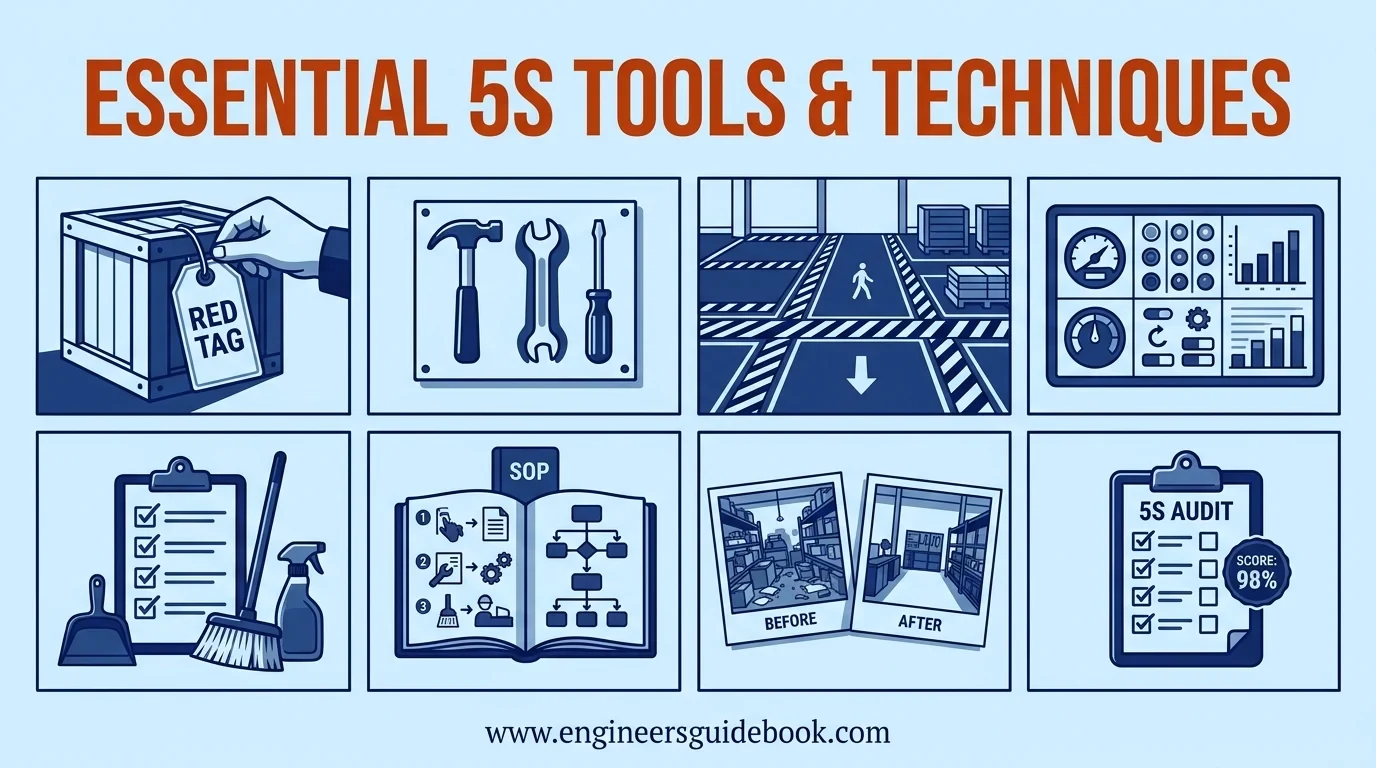
6.1 Red Tagging Technique
Red tagging identifies unnecessary, damaged, or questionable workplace items. Each tag records relevant identification details, classification, and the required disposition decision.
6.2 Shadow Boards and Tool Organization
Shadow boards display designated outlines for individual tools. Missing tools become immediately visible, simplifying inventory control and improving maintenance readiness.
6.3 Floor Marking and Color Coding
Floor markings identify pedestrian pathways, material storage zones, equipment boundaries, and restricted areas. Consistent color coding improves workplace navigation and visual communication.
6.4 Visual Management Systems
Visual management communicates operational information through labels, signs, status indicators, and display boards. Employees can quickly recognize deviations from established workplace conditions.
6.5 5S Cleaning Checklists
Cleaning checklists specify inspection locations, cleaning frequencies, responsible personnel, and verification requirements. They establish accountability and prevent important activities from being overlooked.
6.6 Standard Operating Procedures
Standard operating procedures document approved methods for workplace organization, equipment cleaning, material storage, and inspection. They minimize procedural variation and facilitate employee training.
6.7 Before-and-After Photography
Photographic documentation demonstrates visible improvements following 5S implementation. Comparative images also establish reference conditions for subsequent workplace inspections and audits.
6.8 5S Audit Scorecards
Audit scorecards evaluate workplace compliance against predefined criteria for each 5S principle. Numerical scoring enables performance comparison, identifies deficiencies, and supports continuous improvement.
7. Practical Examples of 5S in Manufacturing
7.1 5S in Assembly Lines
An assembly line can implement 5S by positioning components according to assembly sequence, introducing point-of-use storage, and removing redundant fixtures. Standardized arrangements reduce operator movement and assembly delays.
7.2 5S in Mechanical Maintenance Workshops
Maintenance workshops benefit from shadow boards, organized fastener compartments, labeled spare parts, and designated areas for damaged equipment. Technicians can retrieve required tools quickly, potentially reducing equipment repair time.
7.3 5S in Production and Packaging Areas
Packaging departments can establish designated locations for changeover components, packaging materials, cleaning accessories, and inspection instruments. Clearly identified storage areas reduce material mix-ups and facilitate efficient product changeovers.
7.4 5S in CNC Machine Shops
CNC workshops can organize cutting tools, fixtures, measuring instruments, and machining accessories according to operational requirements. Routine cleaning helps identify coolant leakage, chip accumulation, and equipment deterioration.
7.5 5S in Warehouses and Spare Parts Stores
Warehouses can implement labeled storage racks, bin identification systems, defined inventory locations, and unobstructed material handling routes. These improvements increase inventory accuracy and reduce material retrieval delays.
7.6 5S in Quality Control Laboratories
Quality laboratories benefit from organized testing instruments, clearly identified samples, standardized documentation, and designated chemical storage locations. Systematic organization reduces testing errors and supports procedural compliance.
7.7 5S in Electrical and Automation Workshops
Electrical workshops can establish dedicated storage for multimeters, sensors, relays, contactors, cables, and programmable logic controller accessories. Clearly labeled components and accessible technical documentation accelerate troubleshooting, improve maintenance preparedness, and minimize unnecessary equipment downtime.

8. Measuring 5S Implementation Performance
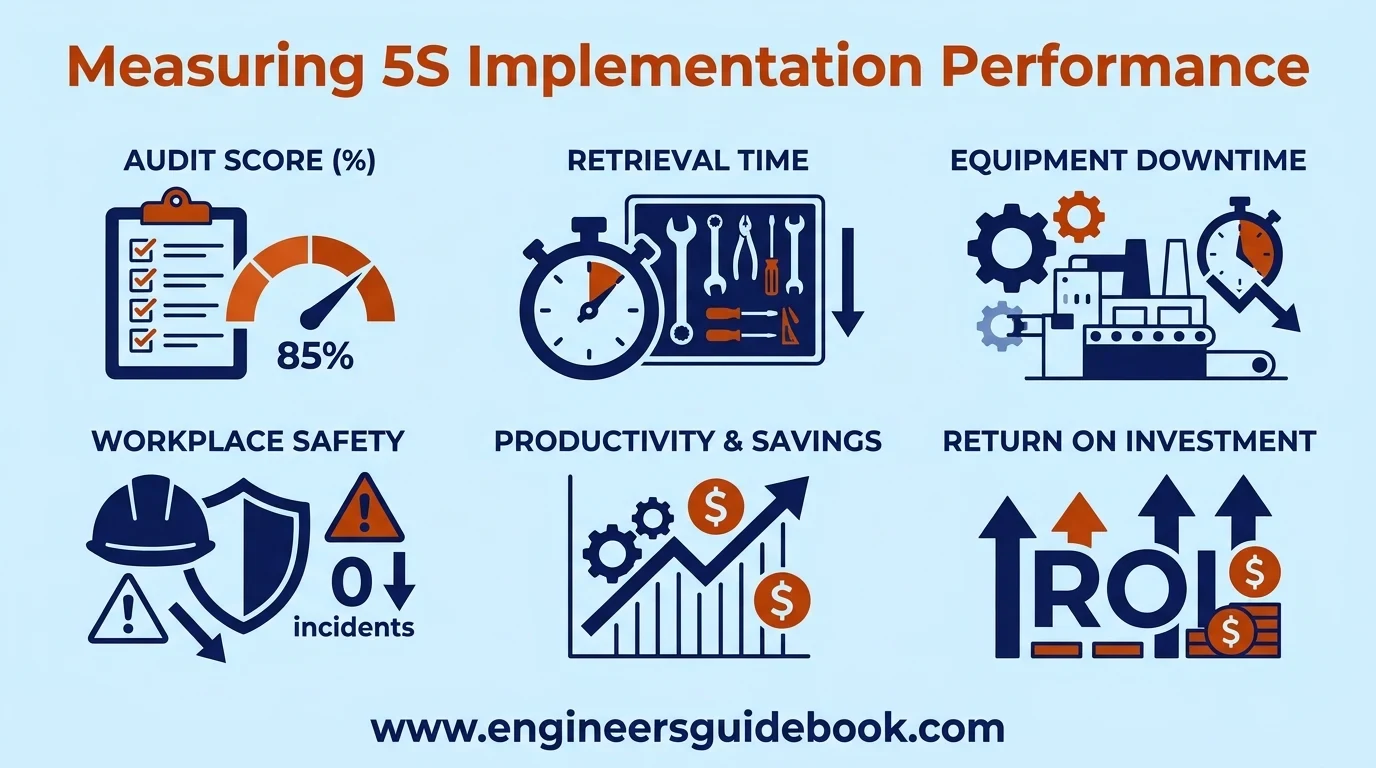
8.1 Establishing 5S Performance Indicators
Key performance indicators (KPIs) help manufacturers quantify workplace organization improvements. Relevant indicators include audit scores, tool retrieval time, equipment downtime, workplace incidents, inventory accuracy, and production efficiency. Establish baseline measurements before implementation to facilitate meaningful performance comparisons.
8.2 Calculating 5S Audit Scores
A 5S audit evaluates workplace compliance against predetermined assessment criteria. Each principle receives a numerical score based on implementation effectiveness.
5S Audit Score (%) = (Actual Audit Score / Maximum Possible Score) × 100
For example, if a manufacturing department achieves 85 points out of 100, its 5S compliance score is 85%.
8.3 Measuring Tool Retrieval Time
Record the average time employees require to locate and retrieve essential tools before and after implementation. Reduced retrieval time demonstrates improved accessibility, workstation organization, and operational efficiency.
8.4 Monitoring Equipment Downtime
Compare equipment downtime records before and after implementing 5S. Systematic cleaning and routine inspections can facilitate early fault detection, potentially reducing breakdown frequency and associated production losses.
8.5 Evaluating Workplace Safety Improvements
Monitor workplace accidents, near-miss incidents, housekeeping violations, and identified hazards. Improved safety indicators can demonstrate the effectiveness of organized storage, unobstructed pathways, and standardized workplace practices.
8.6 Measuring Productivity and Cost Savings
Evaluate production output, labor utilization, material consumption, and inventory-related expenses. Quantifiable improvements in these parameters help establish the economic contribution of 5S to manufacturing operations.
8.7 Calculating Return on Investment
Return on investment (ROI) determines the financial effectiveness of 5S implementation.
ROI (%) = [(Financial Benefits − Implementation Costs) / Implementation Costs] × 100
For example, if implementation costs $5,000 and generates annual financial benefits of $15,000, the first-year ROI is 200%.
9. Common 5S Implementation Challenges and Solutions
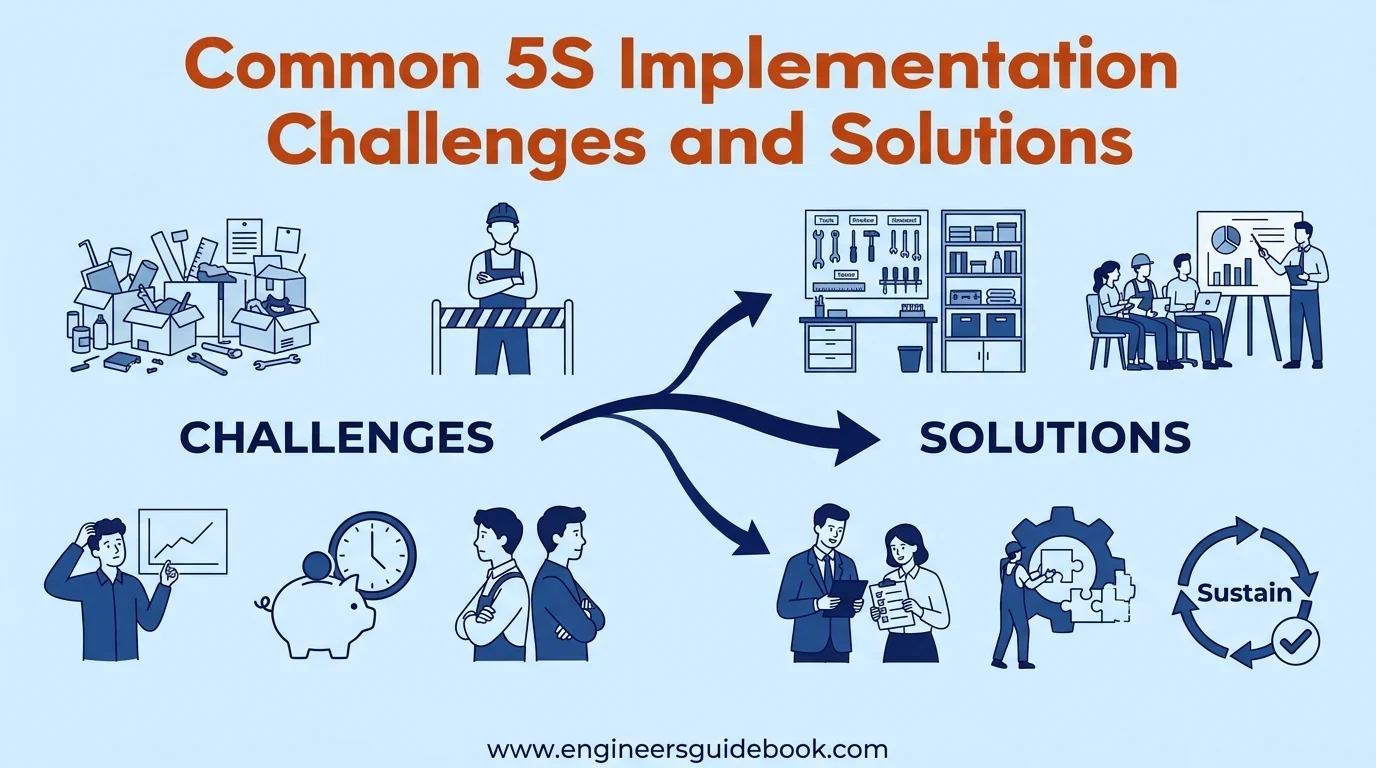
9.1 Employee Resistance to Change
Employees accustomed to conventional working practices may initially resist workplace reorganization. Involve personnel in planning, demonstrate practical advantages, and encourage collaborative decision-making to overcome organizational inertia.
9.2 Lack of Management Support
Insufficient leadership involvement can undermine implementation effectiveness. Management should allocate resources, participate in workplace inspections, review performance indicators, and reinforce organizational accountability.
9.3 Inadequate Training and Awareness
Employees cannot consistently maintain standards they do not understand. Structured training, practical demonstrations, refresher sessions, and visual instructions help establish methodological comprehension and consistent execution.
9.4 Inconsistent Workplace Standards
Different organizational practices between departments and production shifts create operational discrepancies. Establish uniform assessment criteria and standardized procedures while accommodating legitimate department-specific requirements.
9.5 Limited Resources and Budget
Manufacturers with financial constraints can prioritize inexpensive improvements such as labeling, red tagging, tool rearrangement, and cleaning schedules. Gradual implementation distributes expenditure while demonstrating measurable operational benefits.
9.6 Difficulty Sustaining Improvements
Initial enthusiasm frequently diminishes after implementation. Regular inspections, clearly assigned responsibilities, leadership engagement, and corrective action tracking help prevent workplaces from reverting to disorganized conditions.
9.7 Common 5S Implementation Mistakes
Treating 5S exclusively as a cleaning exercise is a fundamental misconception. Other mistakes include establishing unrealistic targets, neglecting employee involvement, overlooking performance measurement, and failing to investigate recurring workplace abnormalities.
10. Integrating 5S With Other Manufacturing Methodologies
10.1 5S and Lean Manufacturing
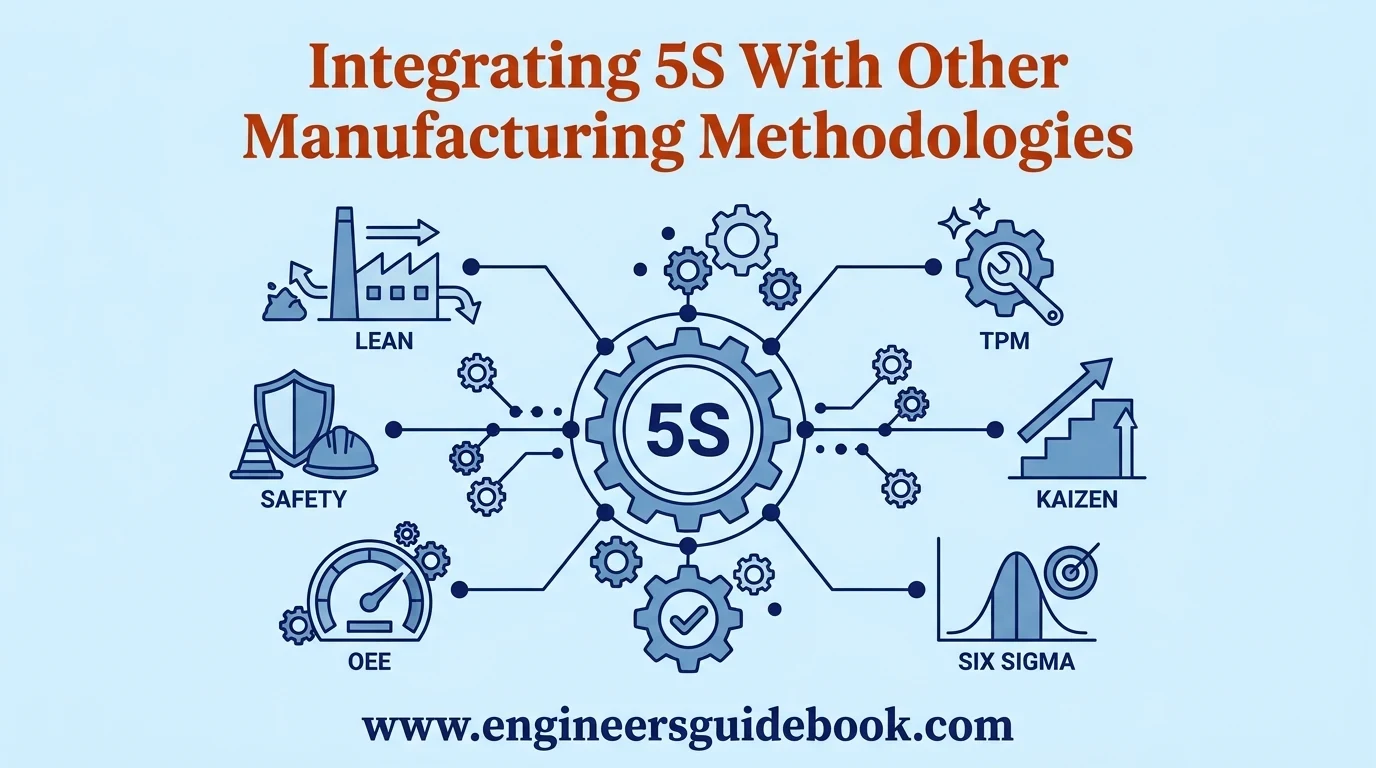
5S establishes the organizational infrastructure necessary for lean manufacturing. Systematic workplace arrangement reduces unnecessary motion, waiting, excess inventory, and other non-value-adding activities throughout production processes.
10.2 5S and Total Productive Maintenance
Total Productive Maintenance (TPM) emphasizes equipment reliability and employee participation. The Shine principle complements autonomous maintenance by encouraging operators to clean, inspect, and identify equipment abnormalities during routine activities.
10.3 5S and Kaizen
Kaizen promotes incremental, continuous improvement. Integrating Kaizen with 5S encourages employees to identify organizational deficiencies, propose practical solutions, and progressively refine workplace standards.
10.4 5S and Six Sigma
Six Sigma focuses on reducing process variation and defects. Organized workstations, standardized procedures, and improved material identification support process consistency and complement Six Sigma improvement initiatives.
10.5 5S and Overall Equipment Effectiveness
5S can positively influence Overall Equipment Effectiveness (OEE) by supporting equipment availability, operational performance, and product quality. Improved maintenance accessibility, reduced interruptions, and contamination prevention contribute to these improvements.
10.6 5S and Workplace Safety Management
Workplace organization complements occupational health and safety programs. Designated storage areas, hazard identification, unobstructed emergency access, and systematic inspections help reduce exposure to preventable workplace risks.
11. Best Practices for Sustaining 5S in Manufacturing
11.1 Establishing Daily 5S Routines
Incorporate brief workplace organization activities into daily production schedules. Employees should inspect their workstations, return tools, remove unnecessary materials, and verify cleanliness before completing their shifts.
11.2 Assigning Workplace Ownership
Allocate specific manufacturing areas to designated employees or teams. Clearly defined ownership strengthens accountability and prevents uncertainty regarding inspection, cleaning, and organizational responsibilities.
11.3 Conducting Regular 5S Audits
Schedule periodic audits to evaluate compliance with established workplace standards. Document deficiencies, assign corrective actions, establish completion deadlines, and verify the effectiveness of implemented solutions.
11.4 Developing Visual Performance Boards
Display departmental audit scores, improvement targets, corrective actions, and before-and-after photographs on visual performance boards. Transparent communication encourages accountability and makes organizational progress readily identifiable.
11.5 Encouraging Employee Participation
Production operators and maintenance technicians possess valuable practical knowledge about workplace inefficiencies. Encourage suggestions, collaborative problem-solving, and employee-led improvement activities to strengthen engagement.
11.6 Implementing Recognition and Reward Systems
Recognize departments and individuals demonstrating consistent workplace organization and meaningful improvements. Appropriate recognition reinforces desirable behaviors and encourages healthy participation without compromising audit integrity.
11.7 Leveraging Digital 5S Management Tools
Digital checklists, mobile inspection applications, electronic dashboards, and computerized maintenance management systems simplify documentation and performance monitoring. These technologies also facilitate corrective action tracking and historical analysis.
11.8 Building a Continuous Improvement Culture
Sustainable 5S implementation requires organizational commitment beyond periodic inspections. Embed workplace organization into employee induction, operational procedures, supervisory responsibilities, and continuous improvement programs.

12. Frequently Asked Questions (FAQs)
12.1 What Are the Five Steps of 5S in Manufacturing?
The five steps are Sort, Set in Order, Shine, Standardize, and Sustain. These principles systematically eliminate unnecessary items, organize resources, maintain cleanliness, establish standards, and preserve workplace improvements.
12.2 Why Is 5S Important in Manufacturing?
5S improves workplace organization, operational efficiency, safety, and resource accessibility. It also supports waste reduction, equipment reliability, standardized operations, and continuous improvement.
12.3 How Do You Implement 5S in a Factory?
Begin by conducting a workplace assessment, establishing objectives, and forming an implementation team. Apply the five principles sequentially, introduce visual standards, train employees, and conduct regular audits.
12.4 What Is an Example of 5S in Manufacturing?
A mechanical maintenance workshop implementing labeled storage cabinets, shadow boards, cleaning schedules, and standardized inspection checklists represents a practical example of 5S in manufacturing.
12.5 What Is the Difference Between 5S and 6S?
5S consists of five workplace organization principles, whereas 6S introduces Safety as an additional dedicated principle. Both methodologies promote organized, efficient, and disciplined working environments.
12.6 How Does 5S Improve Manufacturing Productivity?
5S reduces unnecessary movement, tool searching, material retrieval delays, and workplace congestion. Employees consequently dedicate more working time to productive manufacturing activities.
12.7 How Do You Calculate a 5S Audit Score?
Divide the actual audit score by the maximum possible score and multiply by 100. The resulting percentage represents workplace compliance against the established 5S assessment criteria.
12.8 How Often Should 5S Audits Be Conducted?
Formal 5S audits can be conducted weekly or monthly, depending on operational complexity and workplace conditions. Daily informal inspections are also beneficial for maintaining established standards.
12.9 How Long Does 5S Implementation Take?
Initial implementation may require several weeks or months, depending on facility size, resource availability, and existing workplace conditions. Sustaining improvements, however, remains an ongoing organizational responsibility.
12.10 What Is the Relationship Between 5S and Lean Manufacturing?
5S is a foundational lean manufacturing methodology that supports waste elimination, visual management, standardized work, and continuous improvement through systematic workplace organization.
12.11 Who Is Responsible for 5S in Manufacturing?
Everyone within the manufacturing organization shares responsibility for 5S. Management provides resources and direction, supervisors monitor compliance, and employees maintain workplace standards.
12.12 What Are the Disadvantages of 5S Implementation?
Potential disadvantages include initial expenditure, employee resistance, training requirements, temporary workflow disruptions, and ongoing auditing responsibilities. Effective planning and sustained leadership involvement can mitigate these limitations.

13. Conclusion
13.1 Key Takeaways From 5S Implementation
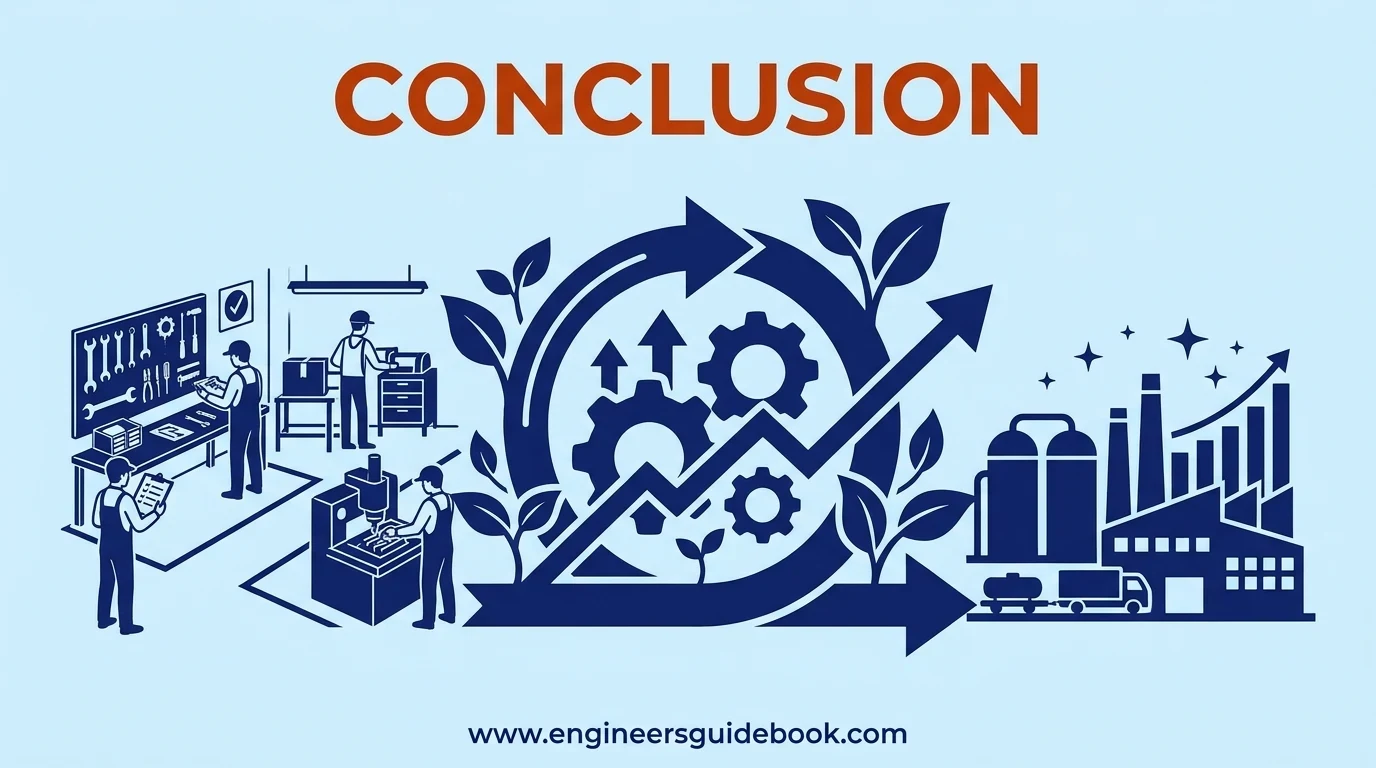
5S in manufacturing provides a structured framework for eliminating workplace inefficiencies, organizing resources, improving cleanliness, and establishing operational discipline. Successful implementation depends on systematic execution, employee participation, and measurable performance objectives.
13.2 Long-Term Impact on Manufacturing Performance
Consistent 5S practices can improve productivity, equipment reliability, workplace safety, and manufacturing quality. Over time, these operational improvements contribute to greater resource utilization, reduced manufacturing costs, and stronger industrial competitiveness.
13.3 Building a Sustainable 5S Culture
Sustainable workplace organization requires more than occasional cleaning campaigns or departmental audits. Manufacturers must integrate 5S principles into everyday operational practices, leadership responsibilities, and employee development programs. By fostering accountability, standardization, and continuous improvement, organizations can transform 5S into a lasting foundation for manufacturing excellence and operational sustainability.