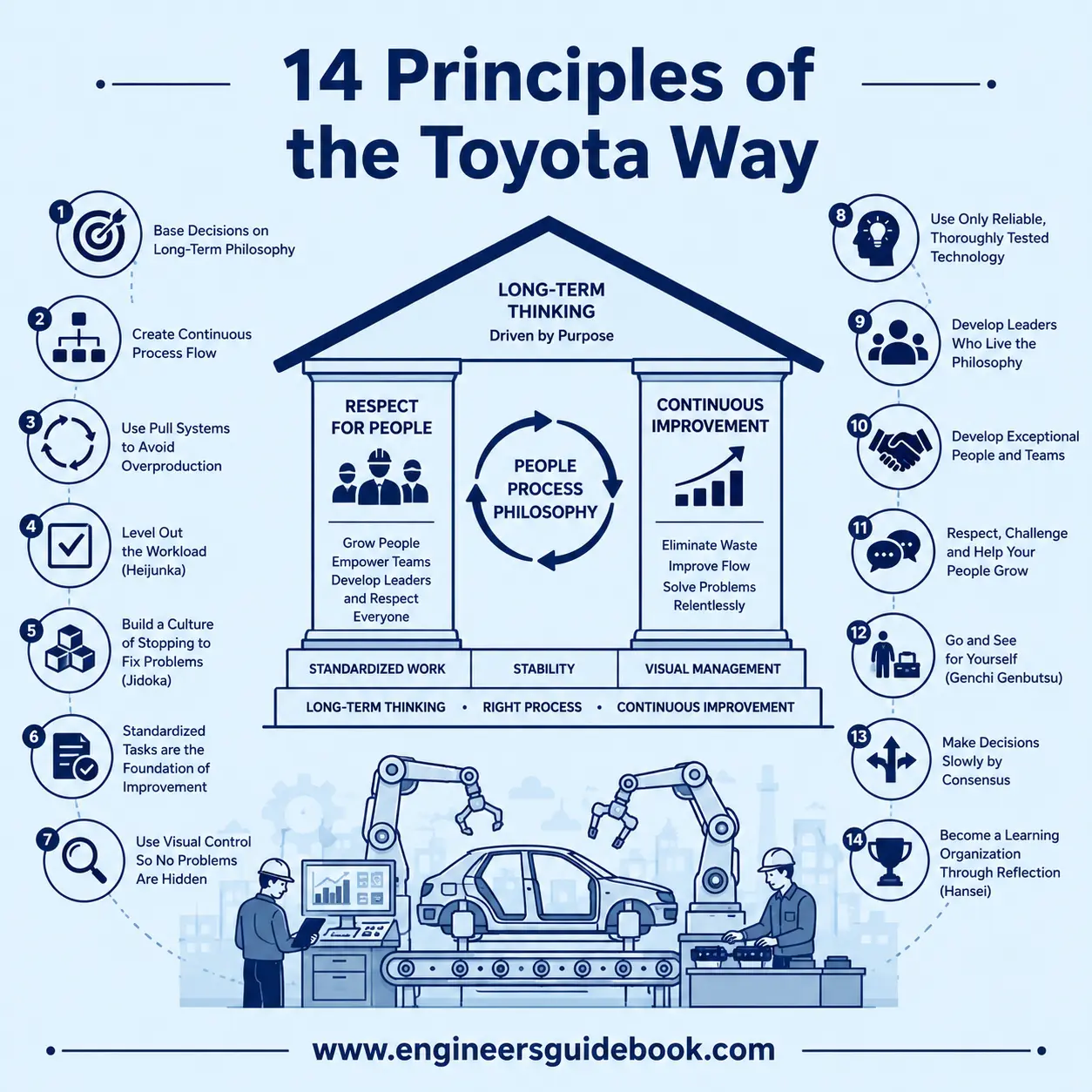
The 14 principles of the Toyota Way form a management philosophy centered on long-term purpose, continuous process improvement, employee development, built-in quality, and disciplined problem-solving. Rather than treating lean practices as isolated tools, the Toyota Way integrates leadership, workflow, technology, suppliers, and organizational learning into one enduring system for creating customer value.
1. Toyota Way Overview
1.1 Toyota Way Definition
The Toyota Way is a comprehensive management philosophy developed through decades of operational learning at Toyota. It combines long-term thinking, process discipline, respect for people, and relentless problem-solving to create sustainable organizational excellence.
It is not merely a manufacturing methodology. It is a behavioral and managerial framework that influences how decisions are made, how employees collaborate, and how customer value is delivered.
1.2 Fourteen-Principle Framework
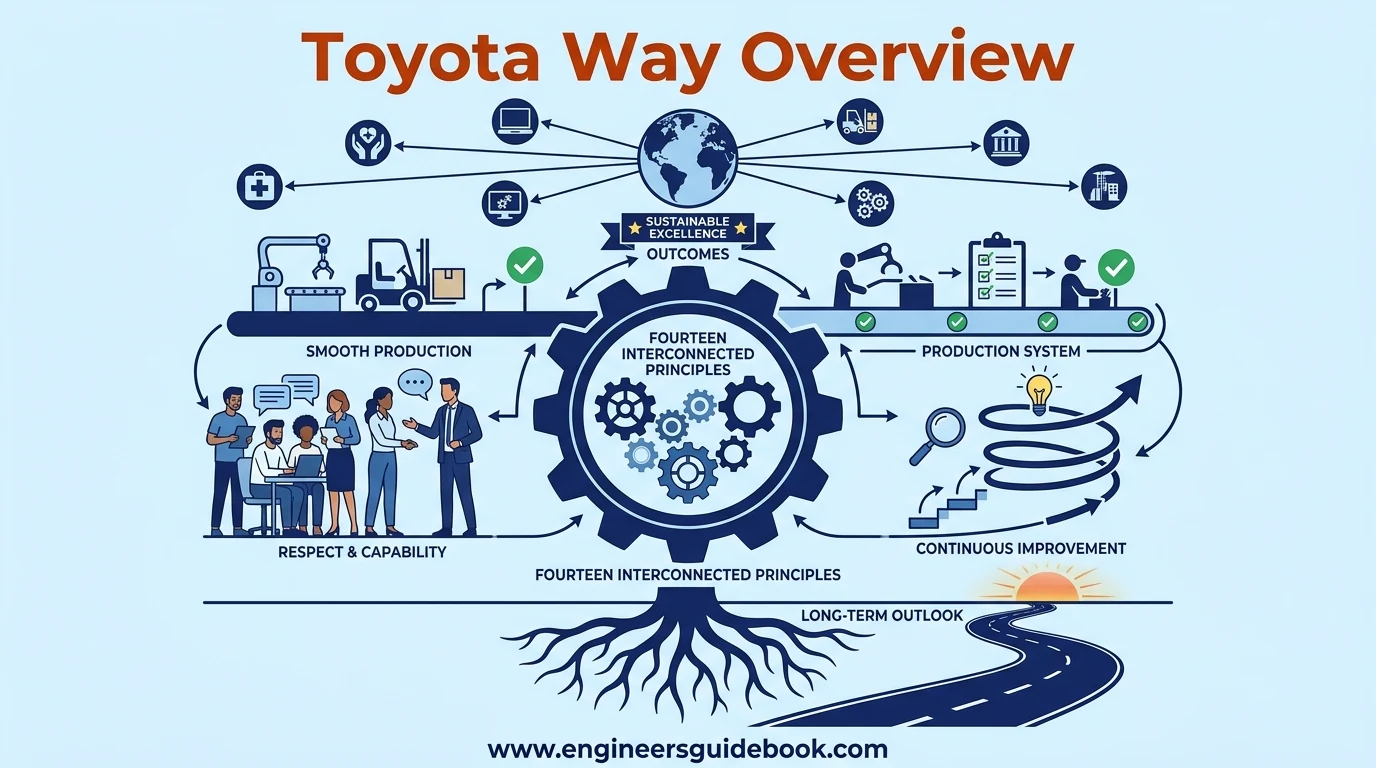
The framework contains 14 interconnected principles that guide leadership, production, employee development, supplier relationships, and organizational learning. Each principle reinforces the others.
Applying only selected tools may generate temporary improvements. Applying the complete framework creates a coherent operating culture capable of maintaining performance over time.
1.3 Toyota Production System Connection
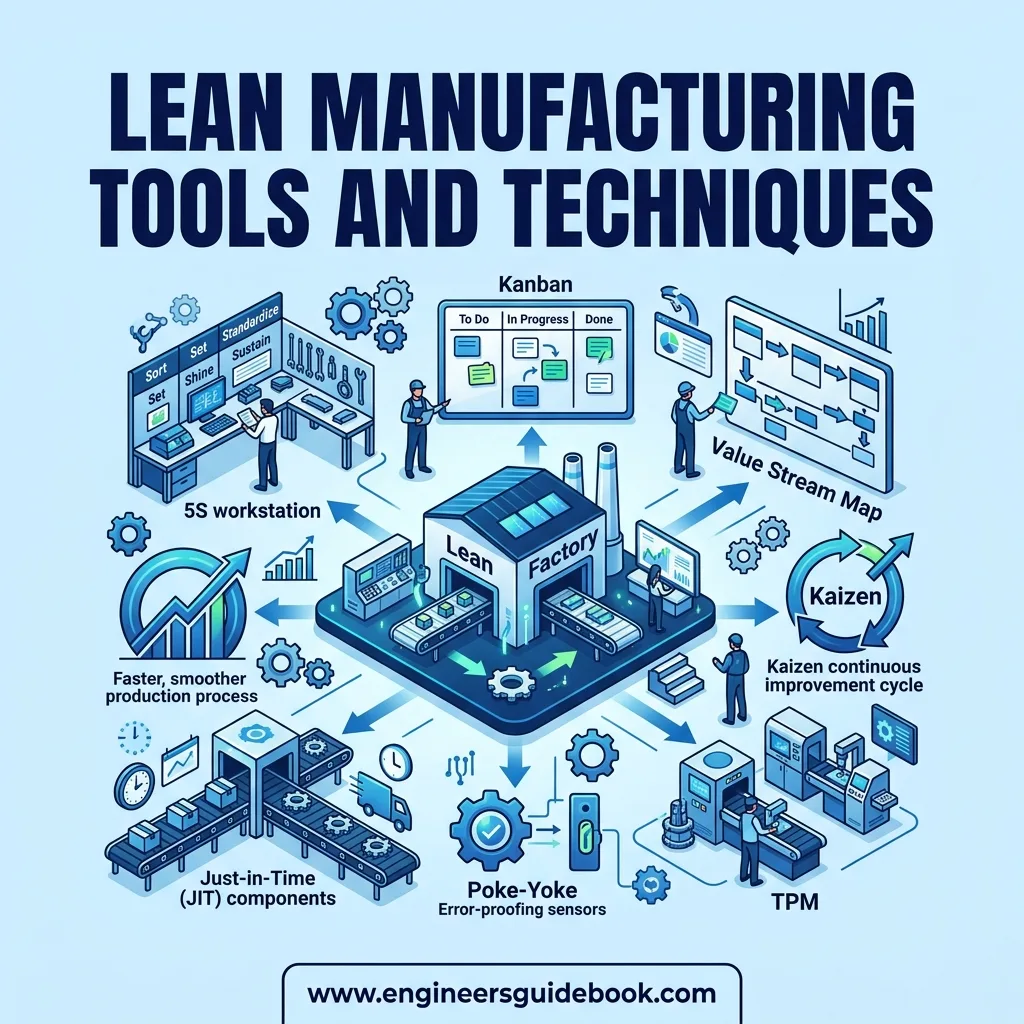
The Toyota Production System provides the operational architecture behind many Toyota Way principles. Concepts such as just-in-time production, jidoka, standardized work, and continuous flow translate the philosophy into practical workplace routines.
TPS emphasizes the elimination of waste, inconsistency, and overburden. The Toyota Way explains the managerial convictions needed to sustain those practices.
1.4 Long-Term Management Philosophy
Toyota encourages decisions based on enduring value rather than immediate financial gratification. Investments, partnerships, workforce development, and process improvements are evaluated through a long-range lens.
This temporal discipline enables the organization to resist expedient choices that may improve quarterly results while weakening future capability.
1.5 Continuous Improvement Culture
Continuous improvement, or kaizen, treats every process as improvable. Employees are expected to identify abnormalities, investigate causes, and refine working methods through small, methodical changes.
Improvement, therefore, becomes quotidian behavior rather than an occasional corporate initiative.
1.6 Respect for People
Respect involves developing employees, listening to their observations, assigning meaningful responsibility, and creating safe conditions for problem-solving. It also extends to customers, suppliers, communities, and business partners.
Toyota expects high performance, but it pairs demanding standards with coaching and capability development.
1.7 Global Business Relevance
The Toyota Way remains relevant beyond automotive manufacturing. Healthcare providers, software companies, warehouses, financial institutions, and public agencies can adapt its principles to improve flow, quality, responsiveness, and learning.
Its universality comes from addressing fundamental organizational problems rather than industry-specific machinery.
2. Toyota Way Foundations
2.1 Toyota Management History
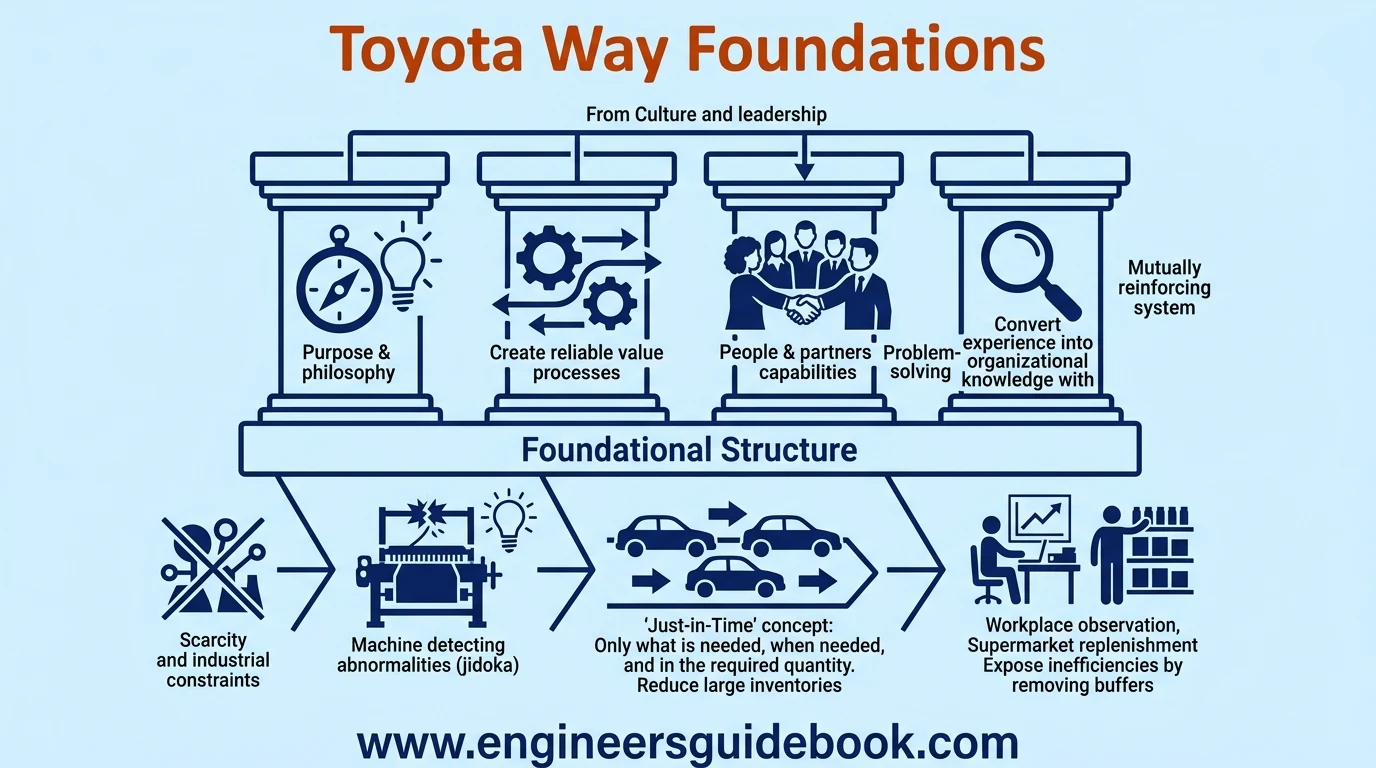
Toyota’s management system evolved through scarcity, competition, technological change, and postwar industrial constraints. Limited resources compelled the company to build flexible processes that minimized waste and exposed problems quickly.
Its philosophy emerged from experimentation rather than theoretical abstraction.
2.2 Sakichi Toyoda Legacy
Sakichi Toyoda developed automatic looms capable of stopping when a thread broke. This invention embodied the principle that machines should detect abnormalities instead of producing defects continuously.
His emphasis on invention, social contribution, and problem awareness helped establish the intellectual foundation of jidoka.
2.3 Kiichiro Toyoda Vision
Kiichiro Toyoda advanced the idea of producing only what was needed, when it was needed, and in the required quantity. This vision eventually developed into just-in-time production.
He also recognized that automotive manufacturing required synchronized processes rather than large inventories concealing operational weaknesses.
2.4 Taiichi Ohno Influence
Taiichi Ohno transformed Toyota’s emerging ideas into a rigorous production system. He challenged excess inventory, studied supermarket replenishment, and promoted workplace observation as the basis of improvement.
His methods exposed inefficiency by removing buffers that allowed poor processes to remain hidden.
2.5 Lean Thinking Evolution
Lean thinking later generalized Toyota’s methods into principles such as value, flow, pull, and perfection. Although lean terminology became globally popular, Toyota’s approach remained broader than waste reduction alone.
It incorporated leadership behavior, employee development, organizational purpose, and reflective learning.
2.6 Four Principle Categories
The 14 principles are commonly organized into four categories: philosophy, process, people and partners, and problem-solving. This structure demonstrates that operational tools cannot function independently from culture and leadership.
Each category supports the others in a mutually reinforcing system.
2.7 Philosophy Process People Problems
Philosophy defines purpose. Process creates reliable value. People develop the capability to maintain and improve the system. Problem-solving converts experience into organizational knowledge.
Neglecting any one dimension destabilizes the entire management architecture.
Also Read This:
Toyota Production System| A Complete Guide |
Toyota Production System House Explained
Muda, Mura, and Muri: The 3M Model of Lean Manufacturing
3. Long Term Philosophy
3.1 Principle One
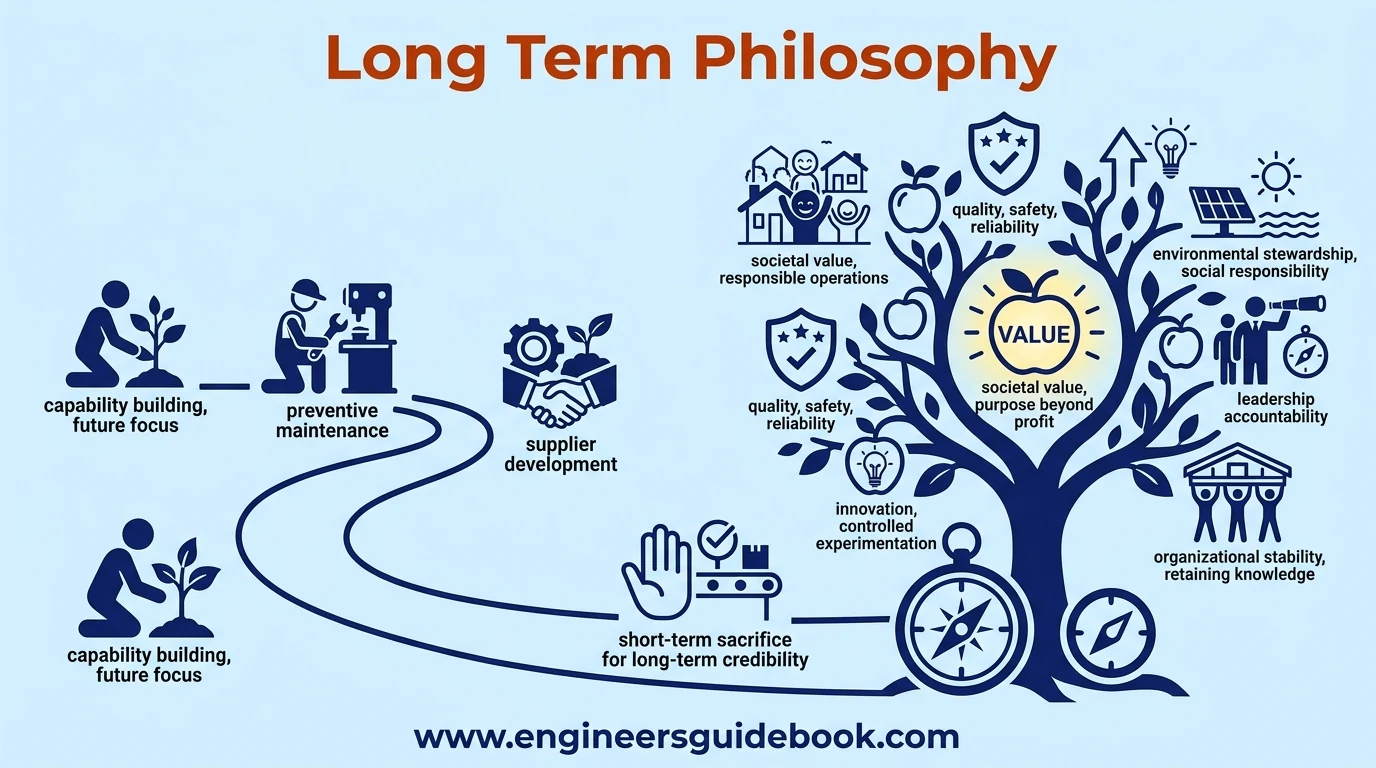
The first principle requires management decisions to be based on a long-term philosophy, even when doing so conflicts with short-term financial objectives.
This principle establishes the moral and strategic compass for the remaining 13 principles.
3.2 Long Term Thinking
Long-term thinking considers how present decisions influence future employees, customers, suppliers, and communities. It favors capability building over transient optimization.
Training, preventive maintenance, and supplier development may appear costly initially, yet they strengthen resilience and future competitiveness.
3.3 Purpose Beyond Profit
Profit is necessary for survival, but Toyota treats it as an outcome rather than the organization’s sole purpose. The deeper objective is to create value for society through reliable products, employment, innovation, and responsible operations.
Purpose gives employees a reason to improve beyond numerical targets.
3.4 Customer Value Creation
Customer value includes quality, safety, affordability, reliability, convenience, and timely delivery. Every activity should contribute directly or indirectly to these outcomes.
Work that consumes resources without enhancing customer value should be simplified, reduced, or eliminated.
3.5 Social Responsibility
Organizations influence communities, ecosystems, suppliers, and future generations. Toyota’s philosophy therefore encourages compliance, environmental stewardship, safe workplaces, and ethical commercial conduct.
Social responsibility becomes part of operational decision-making rather than an ornamental public-relations exercise.
3.6 Sustainable Decision Making
Sustainable decisions balance economic performance with human, technical, and environmental consequences. They avoid extracting short-term gains by exhausting equipment, exploiting suppliers, or overburdening employees.
Durable performance depends on preserving the system that produces results.
3.7 Short Term Sacrifices
A long-term philosophy sometimes requires accepting temporary cost, slower expansion, or reduced output. Stopping production to correct a quality problem may hurt immediate performance but protect customers and organizational credibility.
Such sacrifices prevent larger failures from metastasizing.
3.8 Leadership Accountability
Leaders must translate purpose into priorities, resource allocation, and daily behavior. They cannot advocate quality while rewarding output at any cost.
Accountability requires managers to model patience, ethical judgment, and disciplined adherence to long-term principles.
3.9 Organizational Stability
Stable organizations develop people, retain knowledge, maintain equipment, and build dependable supplier networks. Stability does not mean rigidity. It provides the foundation from which controlled experimentation and innovation can occur.
Without stability, improvement efforts become reactive and evanescent.
4. Continuous Process Flow
4.1 Principle Two
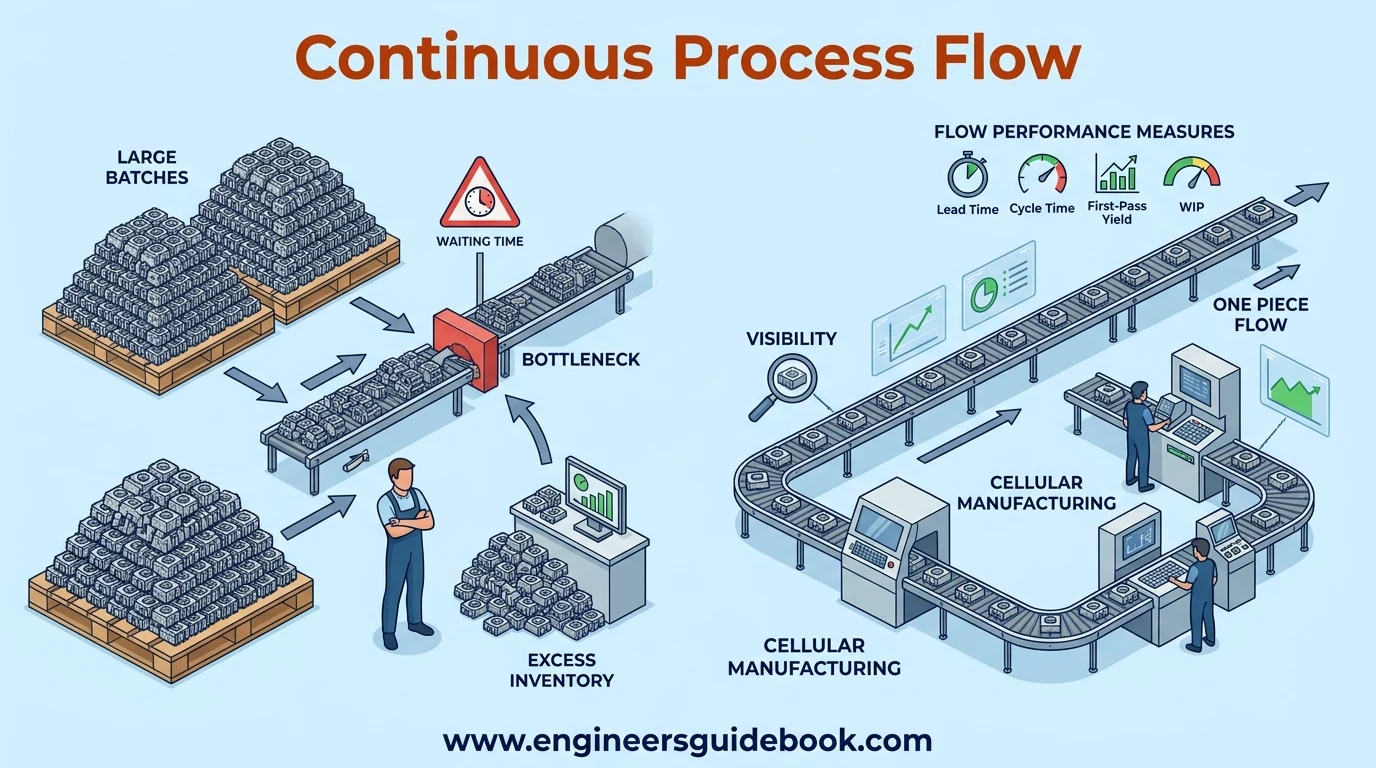
The second principle calls for continuous process flow to expose problems. Work should move smoothly from one value-creating step to the next with minimal delay, interruption, or accumulation.
Poor flow reveals where the system requires attention.
4.2 Continuous Flow
Continuous flow reduces the time between receiving demand and delivering the finished product or service. Smaller batches move rapidly through connected processes.
This approach improves responsiveness while making defects and delays visible sooner.
4.3 Workflow Visibility
Visible workflows allow employees to understand status, priorities, and abnormalities at a glance. Queues, stalled items, missing information, and overloaded stations become difficult to conceal.
Transparency enables faster coordination and more objective decision-making.
4.4 Bottleneck Exposure
Inventory often masks bottlenecks by keeping downstream operations busy temporarily. Continuous flow removes these cushions and reveals constrained equipment, uneven work distribution, and unreliable processes.
Once exposed, bottlenecks can be studied and corrected systematically.
4.5 Waiting Time Reduction
Waiting occurs when people, materials, machines, or information remain idle. Process mapping helps identify approvals, handoffs, breakdowns, and scheduling practices that create delay.
Reducing waiting shortens lead time without requiring employees to work faster.
4.6 Inventory Reduction
Excess inventory consumes space, capital, handling effort, and administrative attention. It can also conceal quality problems and unreliable production.
Reducing inventory forces processes to become more predictable, synchronized, and responsive.
4.7 One Piece Flow
One-piece flow moves individual units through successive operations instead of processing large batches. Defects are detected rapidly, lead times decrease, and priorities become clearer.
Where literal one-piece movement is impractical, the principle encourages the smallest feasible batch.
4.8 Cellular Manufacturing
Cellular manufacturing arranges equipment according to product flow rather than functional departments. Operators can oversee multiple related processes while material travels shorter distances.
Well-designed cells improve communication, flexibility, and ownership of quality.
4.9 Flow Performance Measures
Useful flow measures include lead time, cycle time, work-in-process, first-pass yield, queue duration, and takt attainment. These indicators reveal how effectively value moves through the system.
Output volume alone rarely explains whether the underlying process is healthy.
5. Pull Systems and Workload Balance
5.1 Principle Three
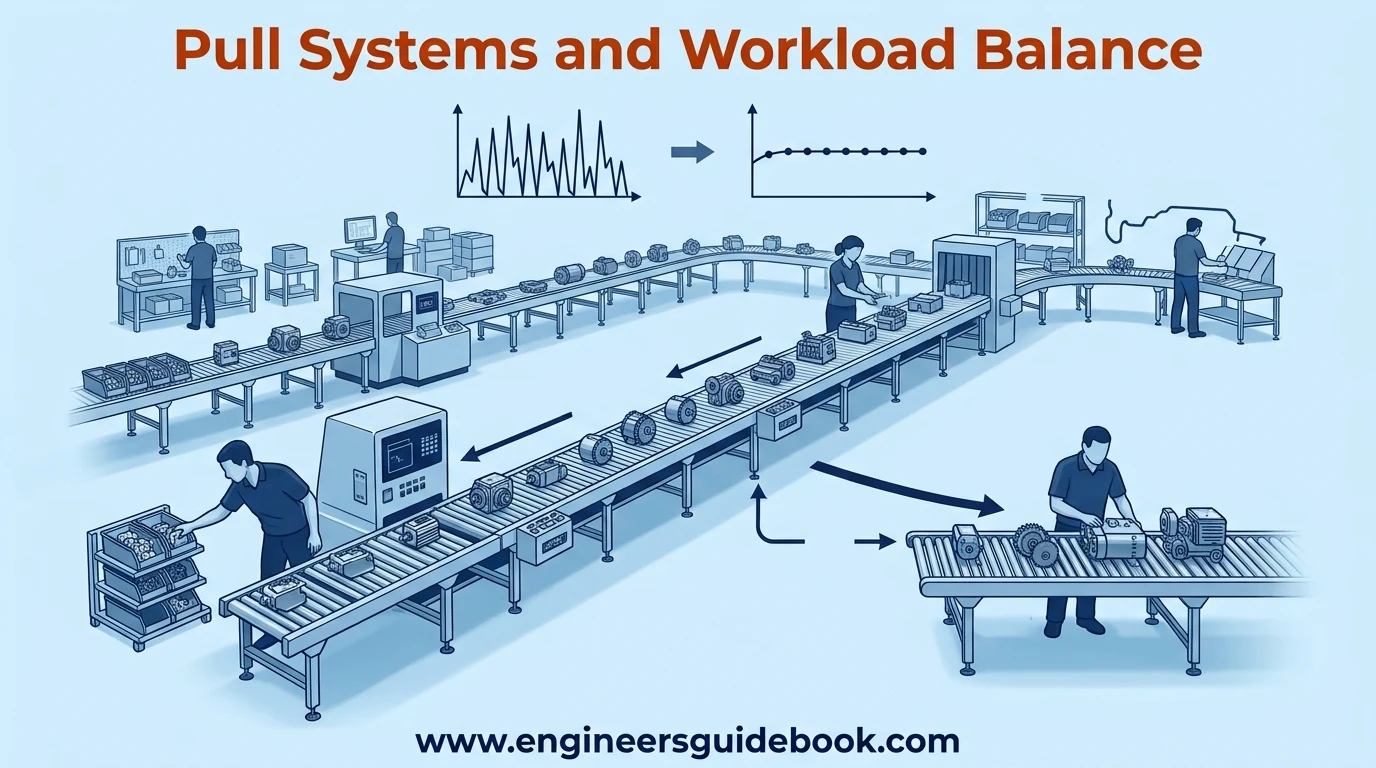
The third principle recommends pull systems to avoid overproduction. Upstream work should be triggered by actual downstream consumption rather than speculative schedules.
Production becomes responsive to real demand.
5.2 Pull Production
In a pull system, each process replenishes only what the next process has used. This creates a controlled linkage between demand and supply.
Pull reduces unnecessary work while exposing instability in replenishment and process reliability.
5.3 Customer Demand Signals
Demand signals may originate from customer orders, consumption records, empty containers, digital transactions, or replenishment cards. The signal must be clear, timely, and connected to a defined quantity.
Ambiguous signals create shortages, duplication, and erratic production.
5.4 Kanban Control
Kanban authorizes production or movement through visual cards, bins, labels, or electronic notifications. It limits work-in-process and prevents uncontrolled replenishment.
A well-calibrated kanban system reflects demand rate, replenishment time, container quantity, and process variability.
5.5 Overproduction Prevention
Overproduction is particularly destructive because it generates storage, transportation, handling, obsolescence, and hidden-defect costs. It also consumes capacity needed for genuine demand.
Pull systems restrain this waste by requiring explicit authorization before work begins.
5.6 Inventory Discipline
Inventory must be treated as a controlled operational parameter rather than an automatic solution to uncertainty. Standard quantities, locations, and replenishment rules create discipline.
When buffers are necessary, their purpose and size should remain visible and regularly reviewed.
5.7 Principle Four
The fourth principle requires workload leveling, known as heijunka. Organizations should reduce unevenness rather than oscillating between frantic production and inactivity.
Balanced work protects people, equipment, and quality.
5.8 Heijunka
Heijunka distributes production volume and product variety across a defined period. Instead of producing large batches of one model, the schedule mixes smaller quantities according to average demand.
This creates a more predictable operational cadence.
5.9 Production Leveling
Production leveling smooths demand placed on upstream processes. Stable schedules reduce overtime, expediting, equipment stress, and material shortages.
Leveling does not ignore customer demand; it translates fluctuating demand into manageable production patterns.
5.10 Product Mix Balance
Balancing product mix prevents long campaigns that delay less frequently produced items. Repeating sequences can supply multiple customer needs within shorter intervals.
Smaller changeovers and flexible work methods are essential enablers.
5.11 Capacity Stability
Stable capacity depends on reliable equipment, trained employees, standardized work, and realistic planning. Chronic overloading causes defects and breakdowns, while underutilization wastes resources.
Leveling aligns demand with sustainable operating capability.
5.12 Demand Variability
Customer demand is rarely perfectly stable. Organizations can mitigate variability through improved forecasting, shorter lead times, flexible staffing, smaller batches, and transparent order policies.
The objective is not to eliminate variation but to prevent it from amplifying throughout the system.
5.13 Supplier Workload Balance
Erratic ordering transfers instability to suppliers. Level schedules, reliable forecasts, and frequent replenishment help partners manage labor, materials, and equipment efficiently.
Respectful supply relationships avoid imposing avoidable volatility on external organizations.
6. Built In Quality and Standardization
6.1 Principle Five
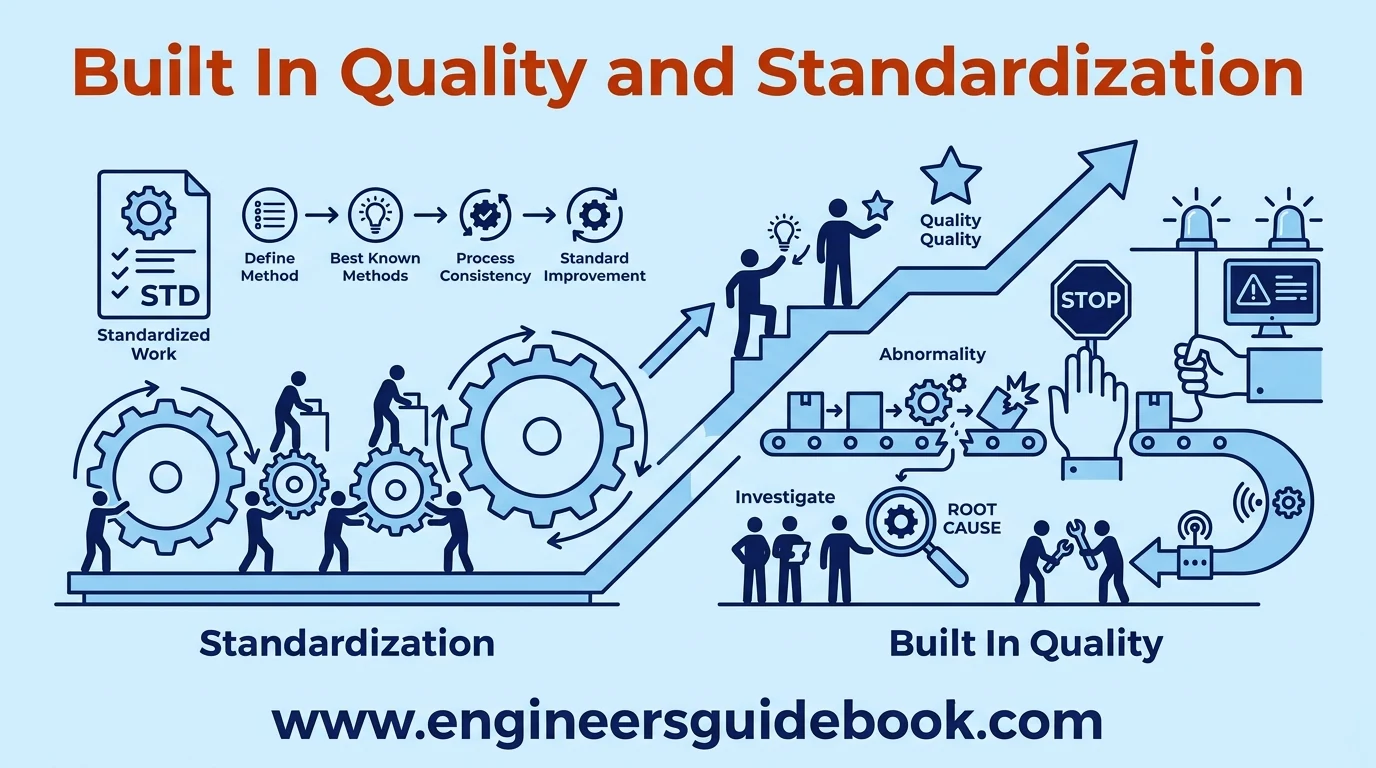
The fifth principle builds a culture of stopping to fix problems so quality is achieved correctly the first time. Defects should not advance to the next process.
Immediate containment protects customers and accelerates learning.
6.2 Jidoka
Jidoka means building intelligent detection and response into processes. Machines or employees stop work when an abnormal condition occurs.
This separation of people from constant machine supervision improves productivity while preventing automatic defect multiplication.
6.3 Stop and Fix Culture
Employees must have the authority and confidence to pause production when quality or safety is threatened. Punishing stoppages encourages concealment.
A mature culture distinguishes responsible intervention from careless disruption.
6.4 Andon Systems
Andon systems communicate process status through lights, screens, sounds, or digital alerts. They summon assistance and identify the location of abnormalities.
Their effectiveness depends on rapid support, clear escalation rules, and constructive leadership responses.
6.5 Defect Prevention
Defect prevention uses poka-yoke devices, sensors, fixtures, checklists, and process design to make errors impossible or immediately detectable.
Preventive controls are more reliable than depending solely on inspection after completion.
6.6 Root Cause Correction
Containment addresses the immediate symptom, while root cause correction prevents recurrence. Teams investigate why the process allowed failure and modify standards, equipment, training, or design.
Without root cause action, repeated firefighting becomes normalized.
6.7 Principle Six
The sixth principle identifies standardized tasks and processes as the foundation of continuous improvement and employee empowerment.
A process cannot be improved scientifically when its current method remains undefined.
6.8 Standardized Work
Standardized work documents the safest, most efficient known method for completing a task. It commonly specifies work sequence, expected timing, and standard work-in-process.
Standards create consistency without eliminating professional judgment.
6.9 Best Known Methods
A standard represents the best currently known method, not an immutable decree. It captures organizational learning so employees do not repeatedly rediscover the same solution.
When a better method is proven, the standard should change.
6.10 Process Consistency
Consistent execution reduces unexplained variation and makes abnormalities easier to identify. It also supports reliable planning, training, quality control, and capacity analysis.
Variation should occur intentionally, not through uncontrolled personal preference.
6.11 Employee Creativity
Standardization and creativity are complementary. Once routine work is stabilized, employees can focus creativity on improving the method rather than improvising every cycle.
Those closest to the process often possess the most consequential improvement insights.
6.12 Standard Improvement
Improvements should be tested, verified, documented, and incorporated into revised standards. This prevents gains from disappearing when personnel, shifts, or production conditions change.
Standard revision converts local success into institutional knowledge.
6.13 Quality at Source
Quality at source requires each process to verify its own output before transferring it downstream. Responsibility is not deferred to a final inspection department.
This principle shortens feedback loops and strengthens process ownership.
7. Visual Control and Reliable Technology
7.1 Principle Seven
The seventh principle uses visual control so problems remain visible. Employees should be able to distinguish normal from abnormal conditions without deciphering complicated reports.
Clarity accelerates action.
7.2 Visual Management
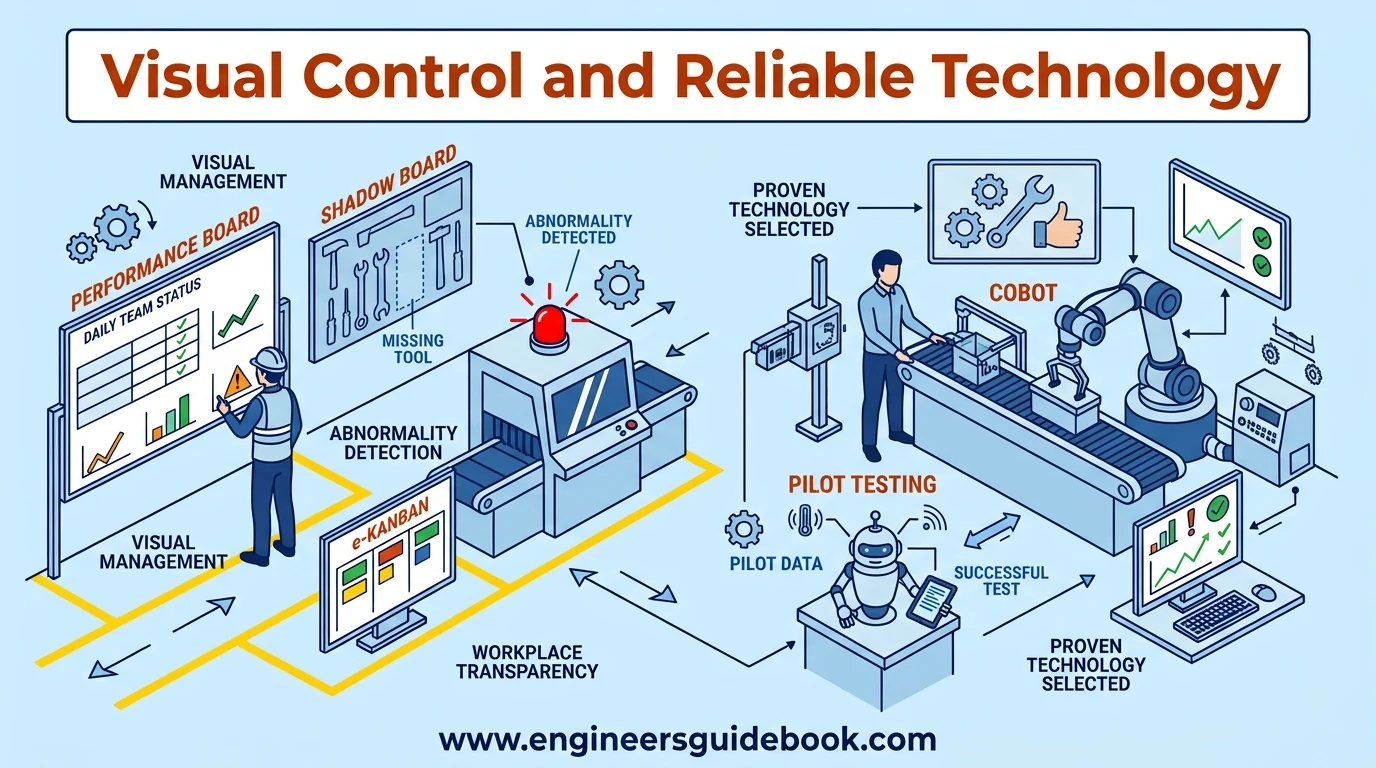
Visual management communicates standards, status, risks, and priorities through simple workplace cues. Examples include floor markings, shadow boards, production boards, kanban lanes, and status lights.
Effective visuals reduce dependence on memory and verbal instruction.
7.3 Five S Practices
Five S organizes the workplace through sorting, setting in order, cleaning, standardizing, and sustaining. The method removes clutter while establishing visible locations and conditions.
Its deeper purpose is abnormality recognition, not cosmetic tidiness.
7.4 Workplace Transparency
Transparent workplaces make missing tools, excess stock, unsafe conditions, and delayed work immediately apparent. Hidden problems cannot be managed reliably.
Visibility encourages shared responsibility and discourages the quiet accumulation of disorder.
7.5 Abnormality Detection
Visual limits, reference samples, gauges, alarms, and color-coded indicators help employees identify deviations quickly. Detection should occur at the point where corrective action remains inexpensive.
Late discovery allows minor irregularities to become systemic failures.
7.6 Performance Boards
Performance boards display relevant measures such as safety, quality, delivery, cost, staffing, and improvement actions. Teams review them during short daily meetings.
The board should stimulate problem-solving rather than become decorative data wallpaper.
7.7 Principle Eight
The eighth principle advises using reliable, thoroughly tested technology that serves people and processes. Technology should support established operational needs rather than dictate them.
Adoption must remain deliberate.
7.8 Proven Technology
Proven technology has demonstrated reliability, compatibility, maintainability, and practical value. Toyota traditionally favors dependable solutions over fashionable systems with uncertain consequences.
Conservatism in adoption can coexist with vigorous experimentation.
7.9 Technology Selection
Technology should be evaluated against process requirements, user capability, lifecycle cost, cybersecurity, safety, and integration needs. Selection based solely on novelty or vendor promises creates latent risk.
The process problem must be understood before the solution is purchased.
7.10 Human Process Support
Technology should reduce burden, improve accuracy, enhance visibility, or enable better decisions. It should not alienate employees from the process or obscure cause-and-effect relationships.
Human judgment remains essential where context and adaptation are required.
7.11 Automation Risks
Poorly designed automation can accelerate defects, conceal abnormalities, and create dependence on specialized support. Complex systems may also reduce flexibility and increase downtime.
Automation should simplify value creation rather than mechanize waste.
7.12 Pilot Testing
Pilot testing evaluates technology on a limited scale before widespread deployment. Teams can identify usability issues, failure modes, training needs, and unintended consequences.
Evidence from the pilot should determine whether expansion is justified.
7.13 Digital Lean Integration
Digital tools can strengthen lean systems through real-time monitoring, electronic kanban, predictive maintenance, and faster analysis. However, digitalization must reinforce flow, standardization, and problem visibility.
A dysfunctional process does not become lean merely because it is computerized.
8. Leadership and People Development
8.1 Principle Nine
Principle nine develops leaders who understand the work, embody Toyota’s philosophy, and teach it through consistent behavior.
8.2 Internal Leadership
Toyota cultivates leaders internally because experienced employees already understand its standards, language, routines, and cultural expectations.
8.3 Toyota Way Role Models
Leaders model humility, discipline, patience, and respect, turning everyday conduct into a powerful unwritten curriculum.
8.4 Gemba Leadership
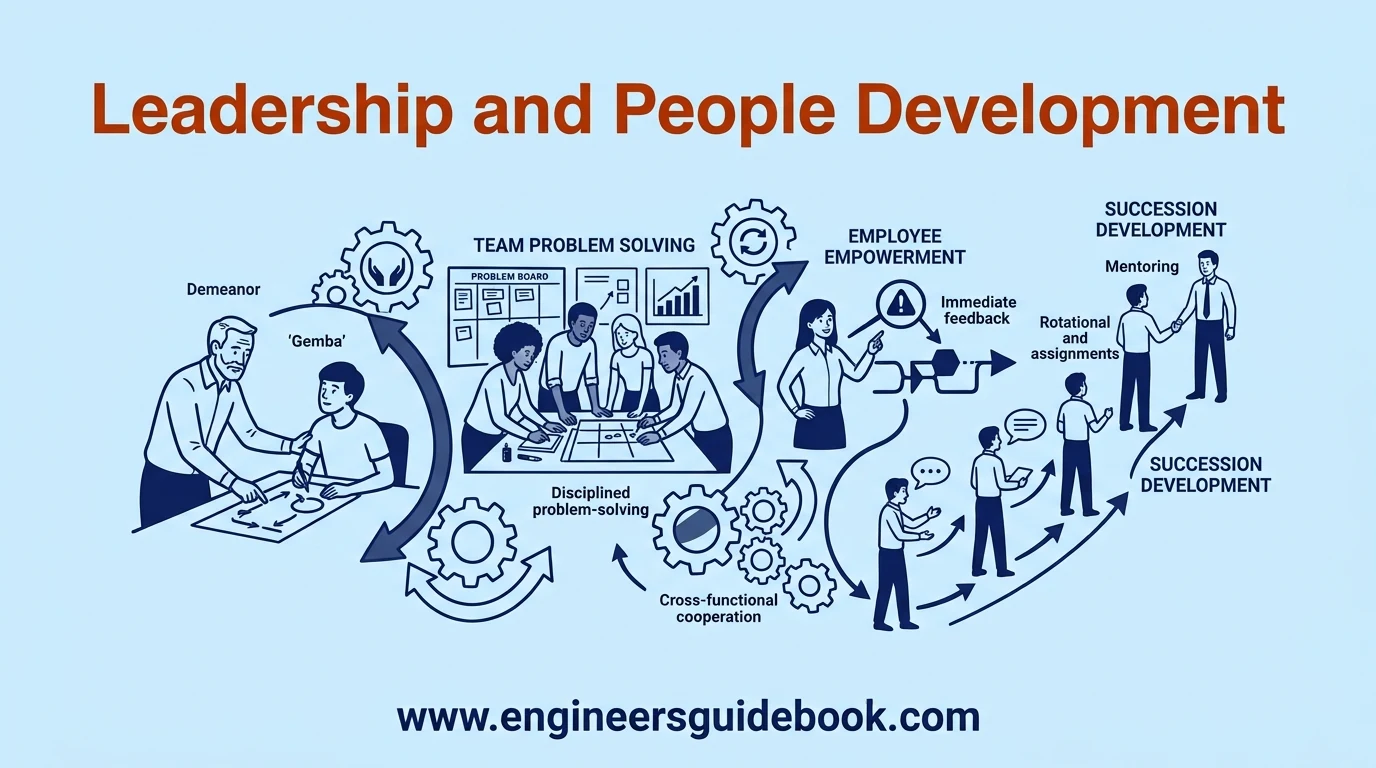
Gemba leadership places managers near actual work, where direct observation reveals delays, defects, burdens, and employee concerns.
8.5 Coaching Responsibilities
Leaders coach through questions, feedback, and guided experimentation instead of supplying answers that weaken independent thinking.
8.6 Succession Development
Future leaders receive mentoring, rotational assignments, and progressively difficult responsibilities before taking wider organizational authority.
8.7 Principle Ten
Principle ten develops exceptional people and teams that understand, practice, and strengthen the organization’s shared philosophy.
8.8 Exceptional People
Exceptional employees combine technical competence with curiosity, reliability, self-discipline, and an appetite for continuous improvement.
8.9 High Performing Teams
High-performing teams unite clear goals, standardized roles, mutual trust, candid communication, and collective accountability.
8.10 Cross Functional Cooperation
Cross-functional cooperation prevents departmental optimization from damaging the performance of the complete value stream.
8.11 Employee Empowerment
Empowerment gives employees authority, information, competence, and support to respond responsibly when abnormalities appear.
8.12 Skills Development
Toyota develops skills through instruction, supervised practice, job rotation, repetition, feedback, and documented standard work.
8.13 Team Problem Solving
Teams define problems, verify facts, identify causes, test countermeasures, and confirm results through disciplined collaboration.
9. Partners and Consensus Decisions
9.1 Principle Eleven
Principle eleven respects suppliers and partners while challenging them to improve quality, capability, delivery, and cost.
9.2 Supplier Respect
Respect includes honest communication, dependable commitments, fair expectations, prompt escalation, and recognition of supplier constraints.
9.3 Partner Development
Toyota strengthens suppliers through technical assistance, joint analysis, coaching, and sustained opportunities for organizational learning.
9.4 Challenging Expectations
Demanding expectations stimulate improvement when standards remain clear and support accompanies accountability.
9.5 Long Term Relationships
Long-term relationships encourage transparency, investment, innovation, and cooperative problem-solving beyond immediate price negotiations.
9.6 Shared Improvement
Joint workshops, process studies, and performance reviews create benefits that neither organization could achieve independently.
9.7 Principle Twelve
Principle twelve requires leaders to verify conditions personally before deciding, directing, or assigning responsibility.
9.8 Genchi Genbutsu
Genchi genbutsu means visiting the actual place and examining the actual condition rather than trusting conjecture.
9.9 Gemba Observation
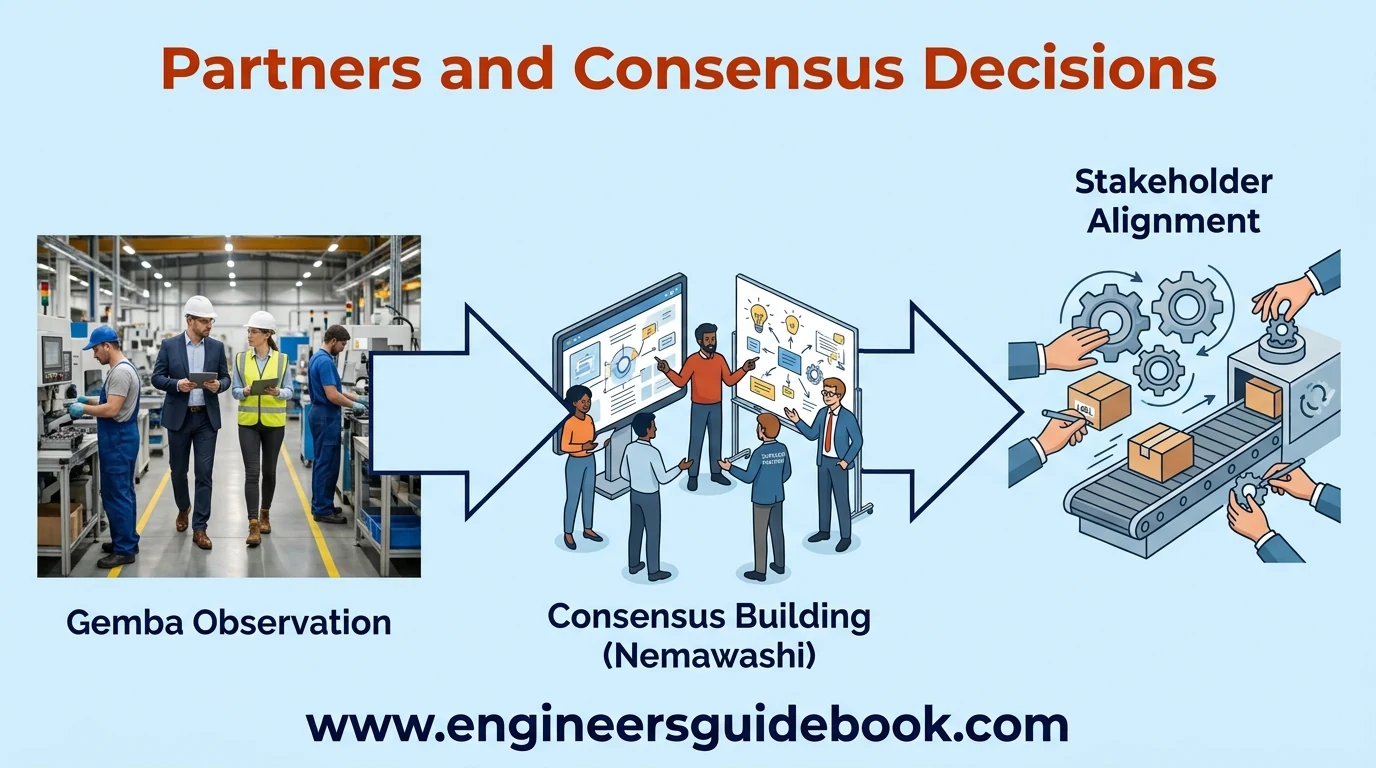
Gemba observation studies work sequence, movement, waiting, defects, workload, and interactions without disrupting the process.
9.10 Firsthand Verification
Firsthand verification exposes missing context, inaccurate reports, hidden assumptions, and unintended operational consequences.
9.11 Fact Based Management
Fact-based management separates evidence from opinion through observation, measurement, comparison, and validated cause-and-effect relationships.
9.12 Principle Thirteen
Principle thirteen promotes deliberate consensus before decisions and rapid, coordinated action after approval.
9.13 Nemawashi
Nemawashi discusses proposals informally with stakeholders, surfacing concerns and refining ideas before formal authorization.
9.14 Consensus Building
Consensus requires meaningful participation and sufficient alignment, not universal enthusiasm or endless agreement.
9.15 Decision Deliberation
Deliberation evaluates alternatives, risks, assumptions, resources, and downstream effects before committing the organization.
9.16 Rapid Implementation
Implementation accelerates after consensus because responsibilities, objections, resources, and timing have already been clarified.
9.17 Stakeholder Alignment
Alignment connects leaders, employees, suppliers, and support functions around one purpose and compatible priorities.
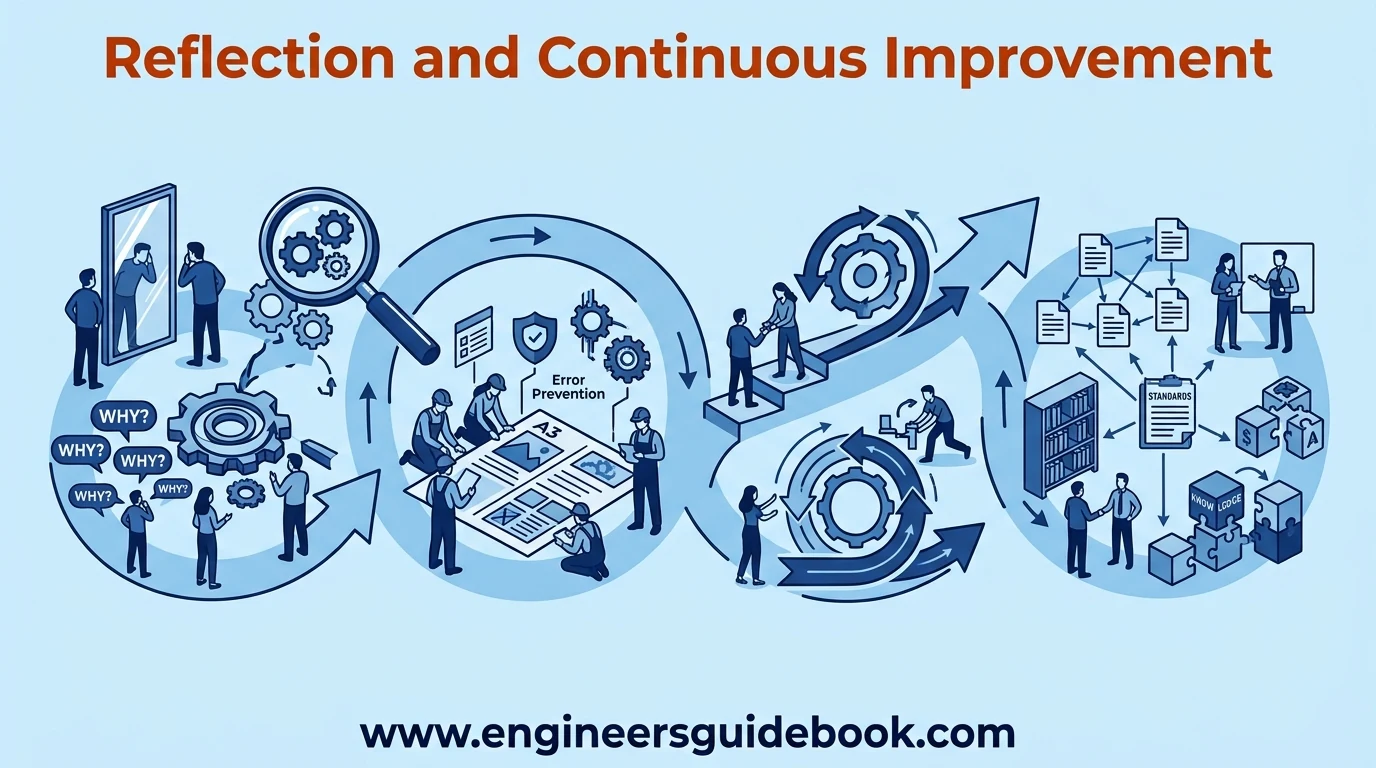
10. Reflection and Continuous Improvement
10.1 Principle Fourteen
Principle fourteen creates a learning organization through persistent reflection, experimentation, standardization, and improvement.
10.2 Learning Organization
A learning organization captures lessons, revises standards, develops people, and distributes knowledge across boundaries.
10.3 Hansei
Hansei is disciplined reflection that examines shortcomings honestly, even when an initiative appears successful.
10.4 Kaizen
Kaizen advances performance through frequent incremental changes that become consequential when sustained and standardized.
10.5 Five Whys
The Five Whys repeatedly probes causation until the underlying process weakness becomes sufficiently visible.
10.6 A3 Problem Solving
A3 problem-solving structures background, analysis, countermeasures, ownership, and follow-up within one coherent narrative.
10.7 Root Cause Analysis
Root cause analysis distinguishes symptoms from systemic causes and prevents recurring cycles of superficial repair.
10.8 Knowledge Sharing
Standards, coaching, reviews, and cross-site learning convert individual discoveries into collective capability.
10.9 Error Prevention
Error prevention redesigns work so mistakes become impossible, difficult, or immediately detectable.
10.10 Organizational Learning
Organizational learning occurs when experience permanently changes routines, systems, standards, and leadership behavior.
10.11 Continuous Improvement Cycles
Recurring plan, test, check, and adjust cycles produce evidence for each successive refinement.
11. Toyota Way Implementation
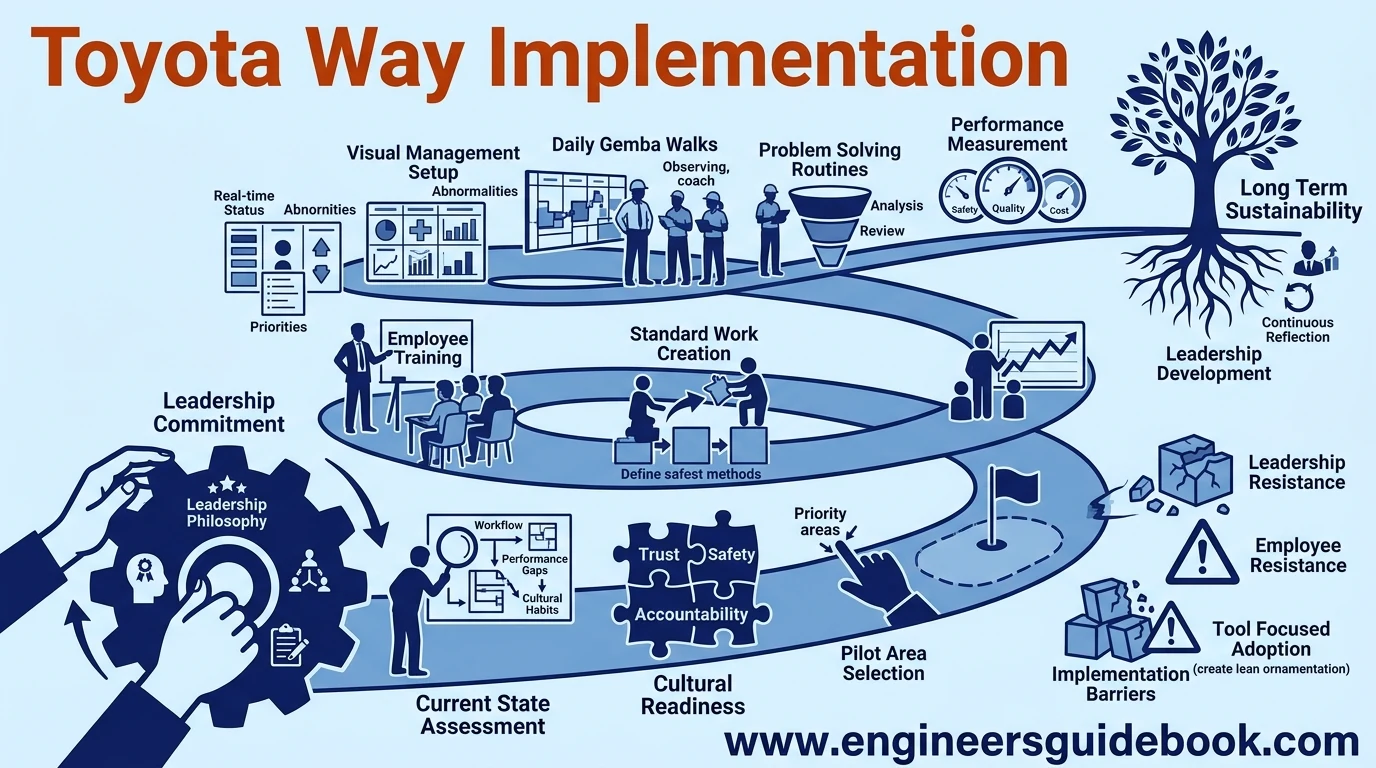
11.1 Leadership Commitment
Implementation requires leaders who model the philosophy, allocate resources, remove barriers, and sustain attention.
11.2 Current State Assessment
Assessment maps workflows, performance gaps, cultural habits, customer problems, and existing improvement capability.
11.3 Cultural Readiness
Readiness depends on trust, accountability, curiosity, and employees feeling safe enough to expose problems.
11.4 Principle Prioritization
Organizations should address their most consequential weaknesses without fragmenting the interdependent Toyota Way system.
11.5 Pilot Area Selection
A pilot should be important enough to matter yet contained enough to support controlled learning.
11.6 Employee Training
Training should explain philosophy, observation, standard work, visual management, and practical problem-solving methods.
11.7 Standard Work Creation
Standard work defines the safest, clearest, and most reliable current method for recurring tasks.
11.8 Visual Management Setup
Visual controls should reveal standards, priorities, status, abnormalities, and ownership without unnecessary ornamentation.
11.9 Daily Gemba Walks
Daily gemba walks sustain observation, employee coaching, issue escalation, and follow-up on unresolved actions.
11.10 Problem Solving Routines
Standard routines improve how problems are defined, analyzed, escalated, corrected, and reviewed.
11.11 Performance Measurement
Balanced measures should cover safety, quality, delivery, cost, people development, and improvement activity.
11.12 Implementation Barriers
Frequent barriers include shallow training, inconsistent leadership, unrealistic deadlines, weak follow-up, and fragmented ownership.
11.13 Leadership Resistance
Some leaders resist because the system challenges command-based authority and short-term performance habits.
11.14 Employee Resistance
Employees may distrust another initiative, especially when earlier programs disappeared without explanation or support.
11.15 Tool Focused Adoption
Copying kanban, Five S, or visual boards without changing behavior creates lean ornamentation.
11.16 Long Term Sustainability
Sustainability requires leadership development, standard revision, daily management, reflection, and persistent cultural reinforcement.
12. Frequently Asked Questions
12.1 What Are the Fourteen Principles of the Toyota Way
They cover long-term purpose, flow, pull, leveling, quality, standardization, visuals, technology, leadership, teams, partners, observation, consensus, and learning.
12.2 What Are the Four Categories of the Toyota Way
The categories are philosophy, process, people and partners, and problem-solving, forming one integrated management architecture.
12.3 How Is the Toyota Way Different From Lean Manufacturing
Lean often emphasizes waste reduction, while the Toyota Way also encompasses culture, leadership, relationships, and long-term purpose.
12.4 How Does the Toyota Way Support Continuous Improvement
It exposes abnormalities, establishes standards, develops problem-solvers, encourages reflection, and institutionalizes successful countermeasures.
12.5 What Is the Most Important Toyota Way Principle
Principle one is foundational because long-term philosophy influences how every subsequent principle is interpreted.
12.6 How Does Toyota Build Quality Into Every Process
Toyota combines jidoka, stop-and-fix authority, error-proofing, standardized work, and quality at the source.
12.7 What Does Genchi Genbutsu Mean
It means going to the actual place and observing actual conditions before forming conclusions.
12.8 What Is the Role of Kaizen in the Toyota Way
Kaizen transforms employee knowledge into continuous, cumulative, and standardized improvements.
12.9 Why Does Toyota Prefer Proven Technology
Proven technology protects process stability and is adopted after reliability, compatibility, and practical value are demonstrated.
12.10 How Does Toyota Develop Leaders
Leaders develop through coaching, internal promotion, gemba experience, demanding assignments, and repeated philosophical practice.
12.11 Can Service Companies Use the Toyota Way
Yes. Service organizations can improve information flow, customer requests, handoffs, standards, visibility, and problem-solving.
12.12 What Are the Challenges of Implementing the Toyota Way
Challenges include short-term thinking, inconsistent leaders, employee distrust, superficial tools, and impatience with cultural development.
12.13 How Long Does Toyota Way Implementation Take
Initial gains may emerge within months, but deep cultural integration generally requires several years of consistent practice.
13. Conclusion
The 14 principles integrate enduring purpose, process excellence, people development, partnership, and disciplined learning. Philosophy supplies direction, while stable processes convert strategic intent into dependable customer value.
Toyota strengthens performance by developing employees, leaders, teams, suppliers, and collaborative relationships. Observation, reflection, experimentation, and root cause analysis transform difficulties into reusable knowledge.
Authentic adoption gradually reshapes decisions, habits, leadership conduct, and organizational relationships. The Toyota Way sustains advantage through efficiency, adaptability, quality, trust, resilience, and continuous learning.