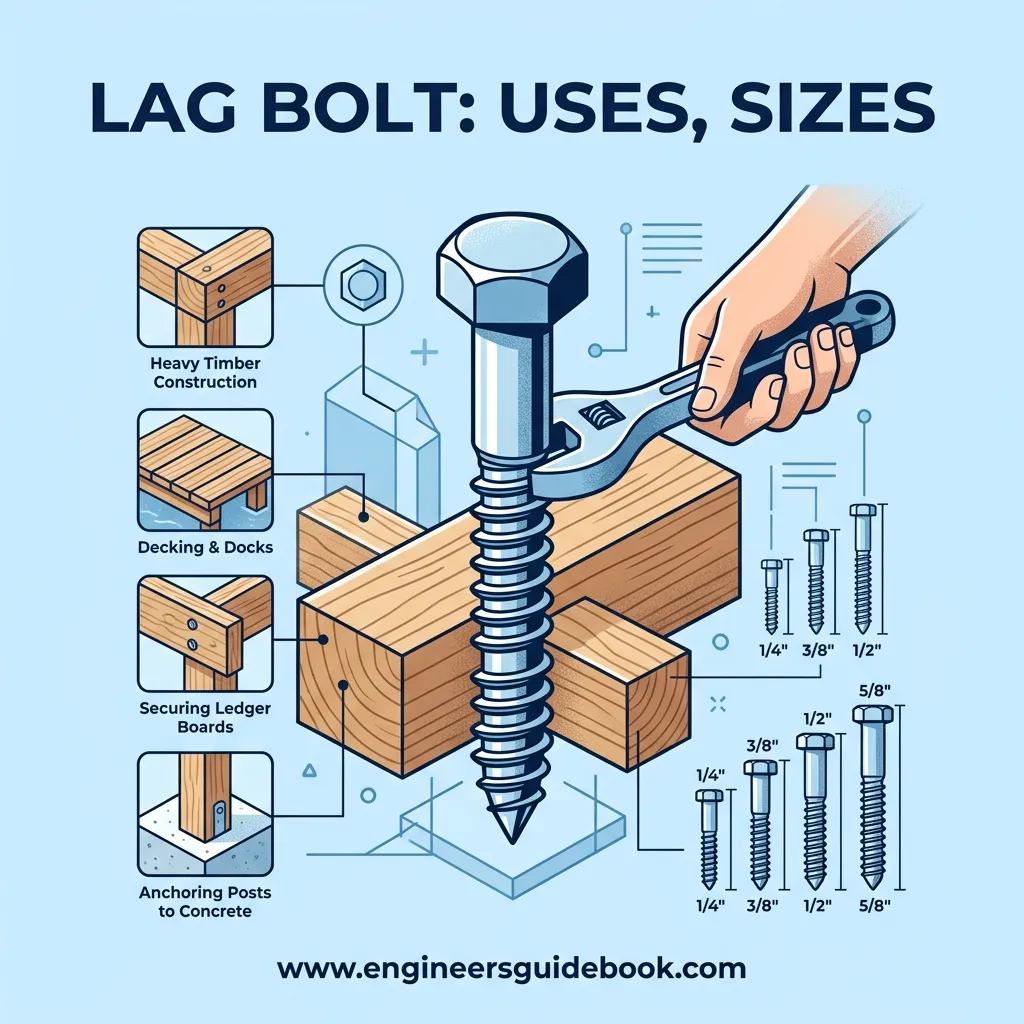
Lag bolts are heavy-duty threaded fasteners designed to create strong connections in wood, timber, and other structural materials. Recognizable by their large hexagonal heads, coarse threads, and pointed ends, they are commonly used for framing, decks, equipment mounting, and structural supports. Correct diameter, length, material, coating, and installation technique are essential for achieving reliable load-bearing performance.
1. Lag Bolt Overview
1.1 What Is a Lag Bolt
A lag bolt is a large, robust fastener primarily used when substantial holding strength is required. Unlike conventional machine bolts, which normally pass through components and engage with nuts, lag bolts are generally driven directly into wood or into a suitable anchor.
Their coarse threads penetrate the substrate and develop considerable withdrawal resistance. For this reason, lag bolts are widely used for structural timber connections, framing, mounting hardware, and applications where ordinary wood screws may lack sufficient strength.
1.2 Lag Bolt Design
Lag bolt design combines a wrench-driven head, comparatively thick shank, coarse thread profile, and tapered point. This geometry allows the fastener to withstand higher loads while generating strong mechanical engagement with the surrounding material.
The unthreaded portion found on many lag bolts also assists in drawing two components tightly together during tightening. Properly installed, the resulting joint can resist substantial tensile and shear forces.
2. Lag Bolt Components
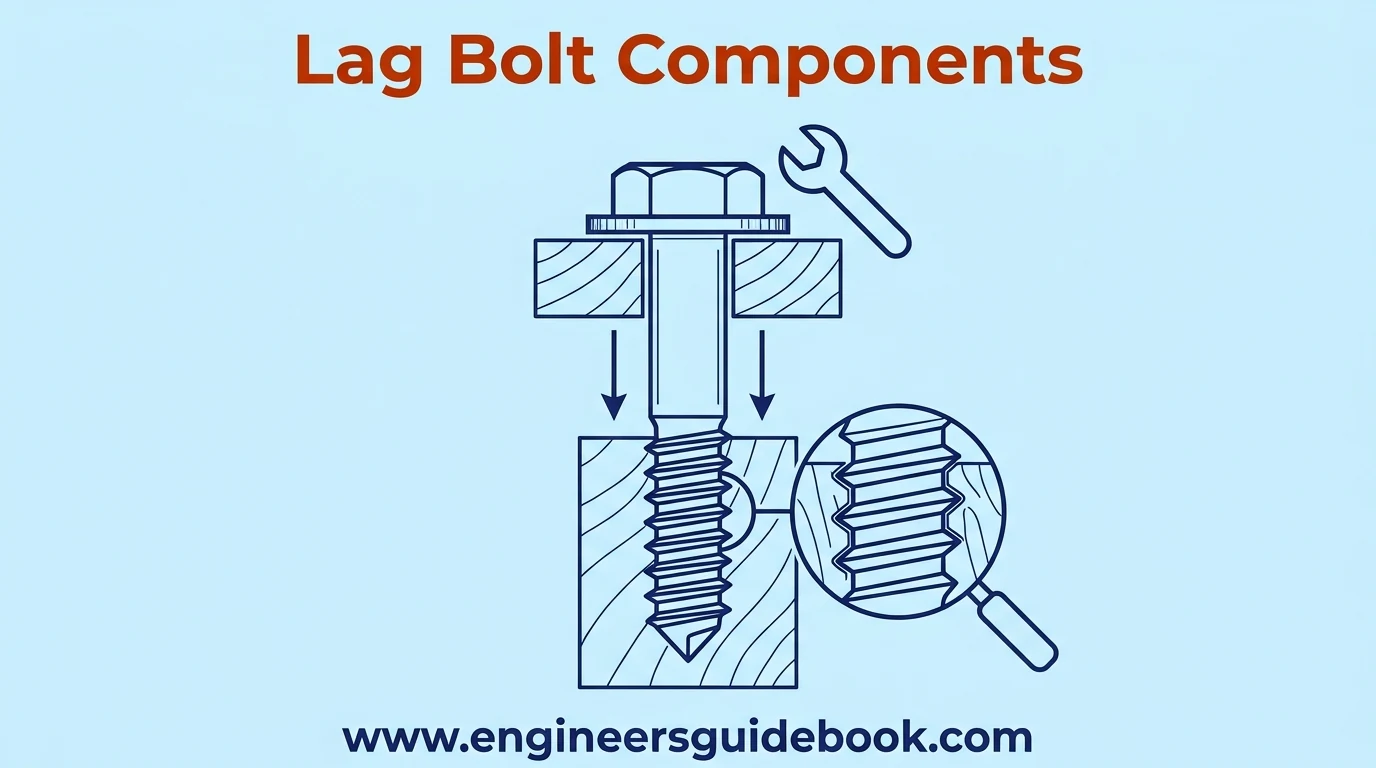
2.1 Hex Head
The hex head provides six flat surfaces for engagement with a wrench, socket, or impact tool. Its relatively large geometry allows considerable installation torque to be applied without relying on a screwdriver recess.
Adequate head strength is especially important because tightening torque and service loads are transferred through this region.
2.2 Bolt Shank
The shank is the cylindrical body between the head and threaded portion. Partially threaded lag bolts contain a smooth shank section that passes through the outer component while the threads engage the supporting material.
This arrangement can help pull mating components firmly together and minimize undesirable gaps within the connection.
2.3 Threaded Section
The threaded section produces the mechanical engagement responsible for much of a lag bolt’s holding capability. Its relatively coarse profile penetrates wood fibers and develops resistance against withdrawal.
Thread length varies according to bolt dimensions and configuration. Adequate penetration into sound supporting material is essential for reliable fastening.
2.4 Sharp Tip
A tapered or pointed tip assists initial positioning and thread engagement. Although the tip improves entry, larger lag bolts generally require an appropriately sized pilot hole rather than being forced directly into dense timber.
Pilot drilling reduces splitting, limits excessive installation torque, and improves alignment.
2.5 Washer Use
Flat washers are frequently installed beneath lag bolt heads to distribute clamping force over a larger surface area. This is particularly valuable when fastening softer timber, where concentrated pressure from the head could crush the surface.
Washers can also improve bearing conditions and provide a cleaner, more controlled connection.
2.6 Thread Geometry
Thread geometry encompasses pitch, depth, flank configuration, major diameter, and minor diameter. Lag bolts typically use coarse, deep threads because they must engage effectively with wood fibers.
The geometry influences installation torque, pullout resistance, and the amount of material retained around the fastener core.
3. Lag Bolt Types
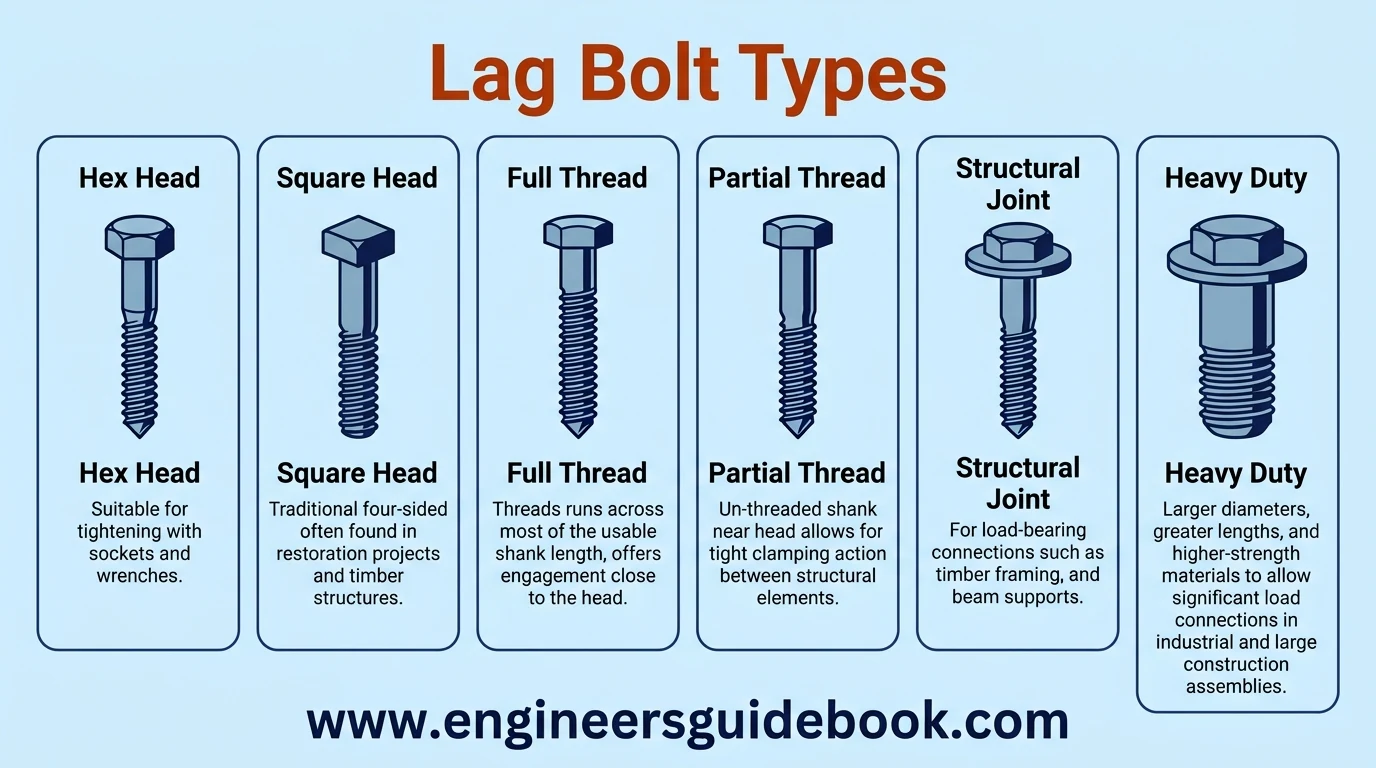
3.1 Hex Head Lag Bolts
Hex head lag bolts are the most prevalent configuration. Their six-sided heads permit efficient tightening with conventional sockets and wrenches, making them suitable for construction, woodworking, and equipment installation.
They are available in numerous diameters, lengths, grades, and finishes.
3.2 Square Head Lag Bolts
Square head lag bolts use four-sided heads that provide strong wrench engagement and a traditional appearance. They are often encountered in restoration projects, timber structures, and applications where historical aesthetics are desirable.
Their functional principle remains comparable to that of hex head designs.
3.3 Fully Threaded Lag Bolts
Fully threaded lag bolts carry threads across most of their usable shank length. This configuration provides engagement through a larger portion of the fastener and can be advantageous where the assembly geometry requires threads close to the head.
Selection should still account for the required clamping behavior and substrate thickness.
3.4 Partially Threaded Lag Bolts
Partially threaded lag bolts contain an unthreaded shank near the head. During tightening, this smooth section can move freely through the outer component while the threaded section pulls against the supporting member.
The resulting clamping action can create a tight, rigid joint between structural elements.
3.5 Structural Lag Bolts
Structural lag bolts are intended for demanding load-bearing connections such as timber framing, structural brackets, beams, and support assemblies. Their suitability depends on material properties, dimensions, installation conditions, and applicable engineering requirements.
Critical structural joints should be sized according to calculated loads rather than general hardware practice.
3.6 Heavy Duty Lag Bolts
Heavy duty lag bolts generally feature larger diameters, greater lengths, or higher-strength materials for connections exposed to significant loads. They are commonly employed in heavy timber, industrial supports, machinery mounting, and large construction assemblies.
Greater fastener size, however, also increases pilot-hole and installation requirements.
4. Lag Bolt Materials
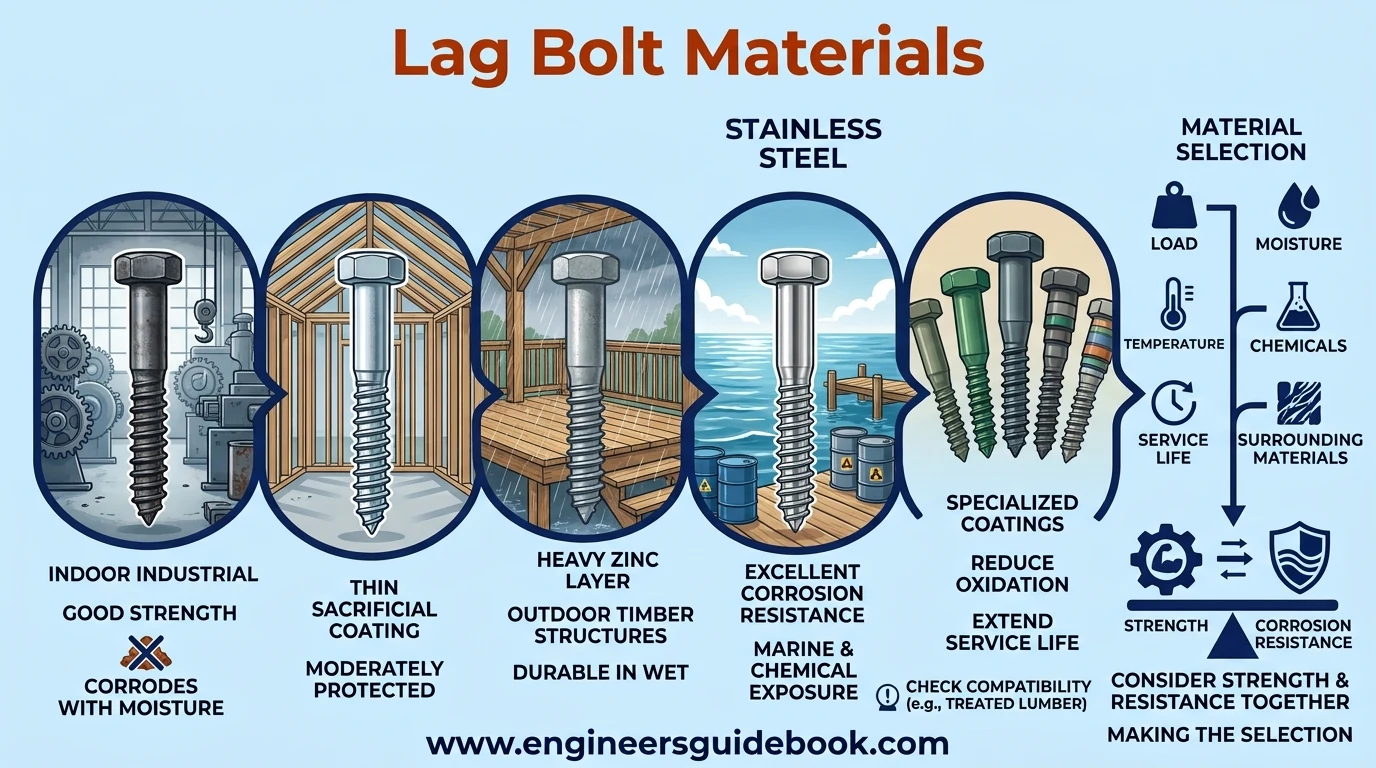
4.1 Carbon Steel
Carbon steel is widely used because it provides good strength, manufacturability, and economical cost. Carbon steel lag bolts are suitable for numerous indoor construction and industrial applications.
When exposed to moisture, however, untreated carbon steel can corrode rapidly, making protective finishes important in aggressive environments.
4.2 Stainless Steel
Stainless steel lag bolts provide excellent corrosion resistance and are frequently chosen for outdoor, marine, humid, and chemically exposed installations.
Common stainless grades offer different combinations of corrosion resistance and mechanical properties. Material selection should therefore consider both environmental severity and structural loading.
4.3 Zinc Plated Steel
Zinc plating provides carbon steel lag bolts with a thin sacrificial coating that helps retard corrosion. These fasteners are commonly used indoors and in moderately protected environments.
Although economical and visually clean, standard zinc plating is generally less suitable for persistent outdoor exposure than heavier protective systems.
4.4 Hot Dip Galvanized Steel
Hot dip galvanizing produces a substantially thicker zinc coating and is frequently specified for decks, timber structures, outdoor framing, and other weather-exposed construction.
The coating sacrifices itself preferentially to protect the underlying steel, giving galvanized fasteners greater durability in wet environments.
4.5 Corrosion Resistant Coatings
Specialized coatings may include mechanical zinc finishes, organic coatings, proprietary multilayer systems, and other protective treatments. Their purpose is to reduce oxidation and extend service life under specific environmental conditions.
Coating compatibility should also be considered when fasteners contact treated lumber or dissimilar metals.
4.6 Material Selection
Material selection depends on load, moisture exposure, temperature, chemical environment, expected service life, and surrounding materials. Indoor dry construction may permit economical coated carbon steel, whereas coastal or persistently wet environments can justify stainless steel.
Strength and corrosion resistance must be considered together rather than independently.
5. Lag Bolt Sizes
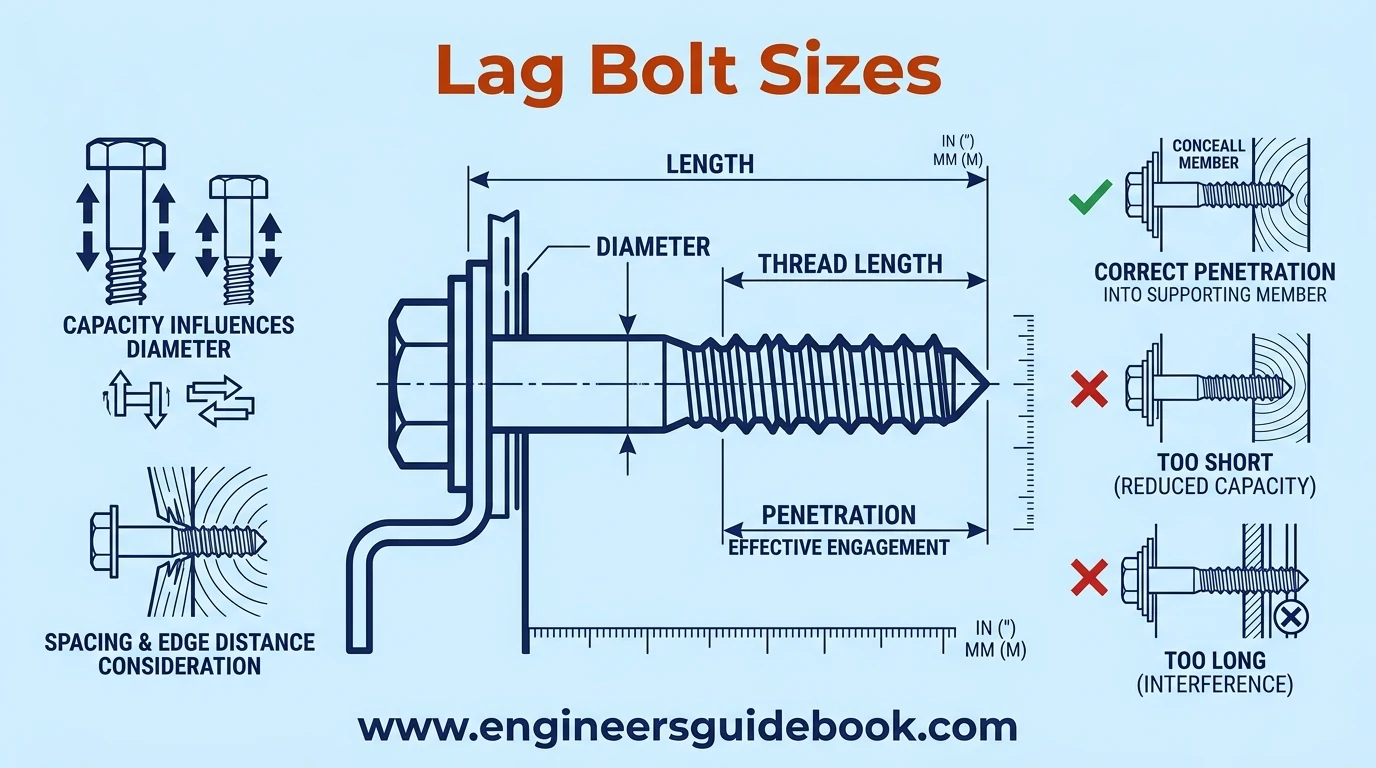
5.1 Lag Bolt Diameter
Diameter strongly influences both tensile and shear capacity. Larger-diameter lag bolts possess greater cross-sectional area and can generally withstand higher mechanical loads.
However, oversized fasteners may weaken timber if inadequate spacing or edge distance causes splitting. Diameter must therefore complement both load magnitude and member geometry.
5.2 Lag Bolt Length
Lag bolt length is typically measured from the bearing surface beneath the head to the tip. Required length depends on the thickness of attached components and the necessary penetration into the supporting member.
Insufficient penetration reduces holding capacity, while excessive length can create interference or installation problems.
5.3 Thread Length
Thread length determines how much of the fastener engages with the substrate. Longer threaded sections can provide substantial engagement, but connection performance depends on more than thread length alone.
Wood species, grain condition, pilot-hole dimensions, diameter, spacing, and penetration all influence capacity.
5.4 Common Imperial Sizes
Imperial lag bolts are commonly specified by diameter and length in inches. Typical diameters range from relatively small construction sizes to substantially larger fasteners used for heavy timber work.
Lengths vary widely, allowing selection for brackets, framing members, beams, posts, and multilayer assemblies.
5.5 Common Metric Sizes
Metric lag fasteners are designated using nominal diameter and length in millimeters, such as M8, M10, or M12 configurations. Dimensions should be selected according to the applicable specification and manufacturer data.
Metric and imperial fasteners should not be assumed interchangeable merely because their nominal dimensions appear similar.
5.6 Size Selection
Selecting the correct size requires consideration of applied load, substrate strength, connected material thickness, spacing, edge distance, and expected service conditions.
For important connections, manufacturer data or structural design calculations should determine the required fastener dimensions rather than intuitive selection.
5.7 Length Selection
Length should provide sufficient penetration into the main load-bearing member after accounting for washers, brackets, plates, and attached components.
The objective is to achieve effective thread engagement without unnecessarily penetrating concealed services or projecting beyond the supporting material.
5.8 Diameter Selection
Diameter selection balances strength against the integrity of the connected material. A larger bolt may increase mechanical capacity, but it also removes more material and requires a larger pilot hole.
Adequate spacing and edge distances become increasingly important as fastener diameter increases.
6. Lag Bolt Standards
6.1 ASME Standards
ASME dimensional standards are commonly referenced for inch-series fasteners and define characteristics such as head geometry, nominal dimensions, threads, and dimensional tolerances for applicable fastener categories.
Correct specification requires confirmation that the selected standard covers the particular lag screw or fastener configuration being used.
6.2 SAE Standards
SAE specifications are frequently associated with mechanical fasteners, materials, and strength classifications used in automotive and engineering industries.
Where SAE requirements are applicable, fastener properties should be verified from the relevant specification rather than inferred solely from appearance or nominal dimensions.
6.3 ASTM Specifications
ASTM specifications address materials, mechanical properties, coatings, testing, and numerous fastener-related requirements. An ASTM designation may establish material chemistry, tensile properties, coating performance, or other characteristics relevant to service conditions.
The correct specification depends on the precise fastener and application.
6.4 DIN Standards
DIN standards have historically provided dimensional and technical requirements for numerous fastener types used internationally. Many DIN fastener specifications remain common in industrial purchasing, although certain requirements may correspond with later European or ISO standards.
The referenced edition should always be identified.
6.5 ISO Standards
ISO standards support international consistency in fastener dimensions, terminology, mechanical requirements, and testing methodologies.
For metric fastening systems, ISO-based specifications simplify procurement and dimensional compatibility across manufacturers, provided the same applicable standard and property requirements are specified.
6.6 Dimensional Requirements
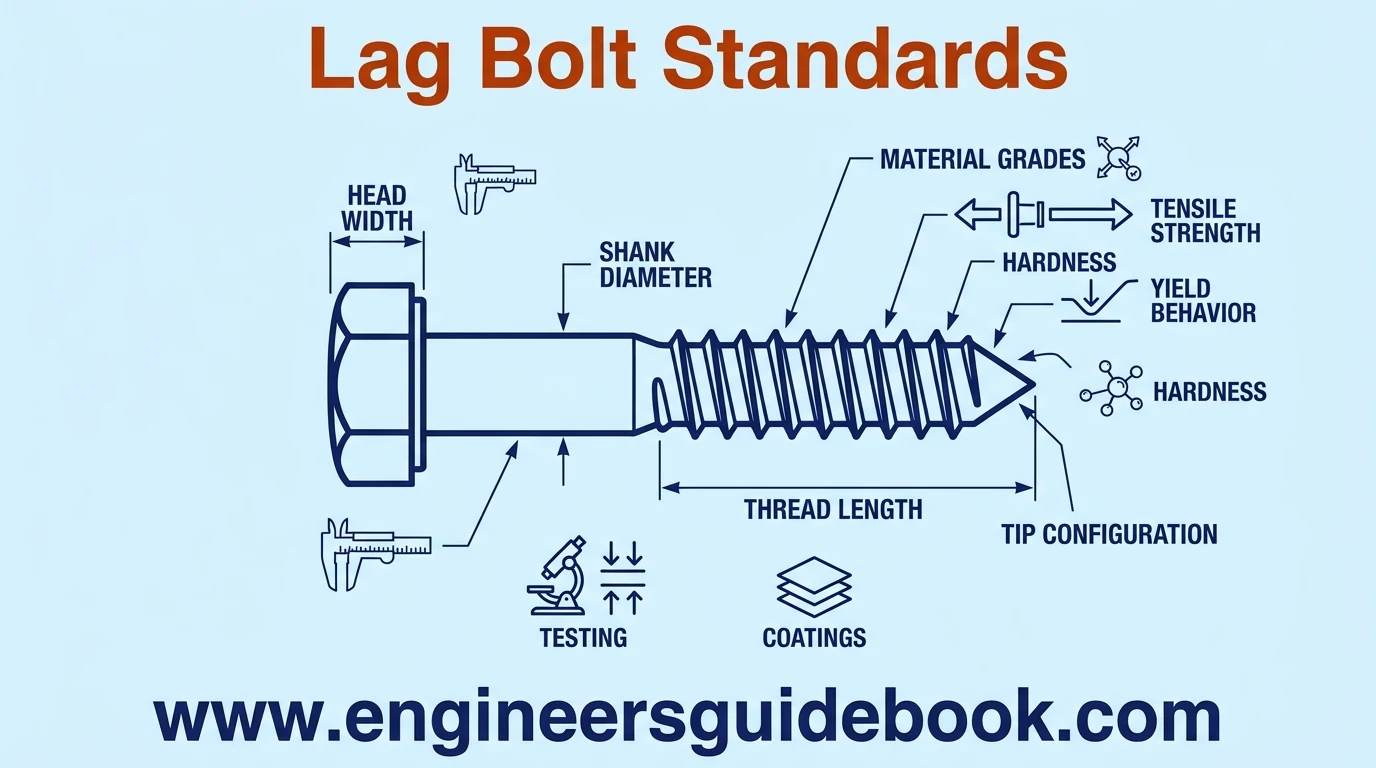
Dimensional requirements may govern head width, head height, shank diameter, thread length, tip configuration, tolerances, and overall length.
These dimensions affect tool engagement, installation clearance, thread penetration, and compatibility with washers or structural hardware.
6.7 Material Grades
Material grade identifies critical mechanical characteristics such as tensile strength, yield behavior, hardness, and chemical composition where applicable.
A visually similar lag bolt may have substantially different mechanical capability depending on its material specification and manufacturing quality. Grade selection should therefore follow engineering requirements for critical joints.
7. Lag Bolt Uses
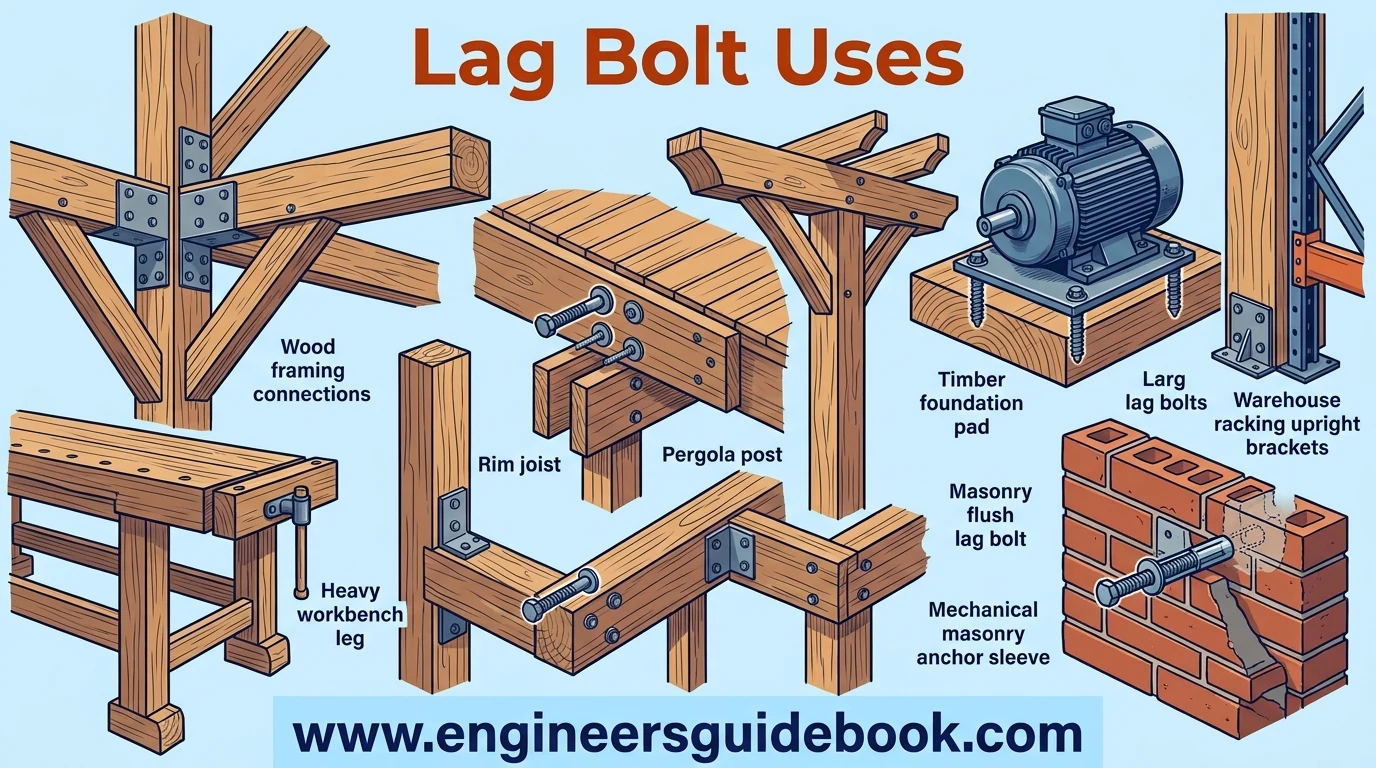
7.1 Wood Framing
Lag bolts are commonly used to connect timber framing members, brackets, beams, posts, and reinforcing hardware. Their coarse threads develop strong engagement in wood, while large heads provide substantial clamping capability.
7.2 Deck Construction
Deck structures frequently use lag bolts for ledger connections, posts, support brackets, and other heavy timber joints. Outdoor exposure generally makes corrosion-resistant fasteners particularly important.
7.3 Furniture Assembly
Heavy furniture, workbenches, wooden frames, and large tables can incorporate lag bolts where ordinary screws provide insufficient rigidity. Their strength makes them useful for thick structural wooden members.
7.4 Timber Connections
Large timber structures benefit from the deep thread engagement and shear resistance of appropriately selected lag bolts. Applications include beams, columns, structural plates, and reinforcement hardware.
7.5 Structural Supports
Lag bolts can secure structural brackets, supports, plates, and fixtures to suitable timber members. Proper edge distance, penetration, spacing, and load direction are essential where the connection carries structural forces.
7.6 Mounting Heavy Equipment
Equipment frames, cabinets, machinery bases, and mounting brackets can be anchored to timber using appropriately sized lag bolts. Washers are commonly employed to distribute load beneath the bolt head.
7.7 Outdoor Construction
Fences, pergolas, shelters, decks, timber retaining structures, and garden installations commonly employ lag bolts. Galvanized or stainless fasteners are often preferred because moisture exposure can rapidly deteriorate inadequately protected steel.
7.8 Masonry Applications
Lag bolts may be used with compatible anchors in concrete, brick, or masonry rather than being threaded directly into these materials. The anchor system provides the required interface between the fastener and brittle substrate.
Anchor type and load rating should match the base material and service load.
7.9 Industrial Applications
Industrial applications include machinery supports, timber platforms, equipment frames, structural brackets, warehouse fixtures, and heavy mounting assemblies. Their combination of mechanical strength, straightforward installation, and broad dimensional availability makes lag bolts a practical fastening solution wherever robust anchorage is required.
8. Lag Bolt Selection
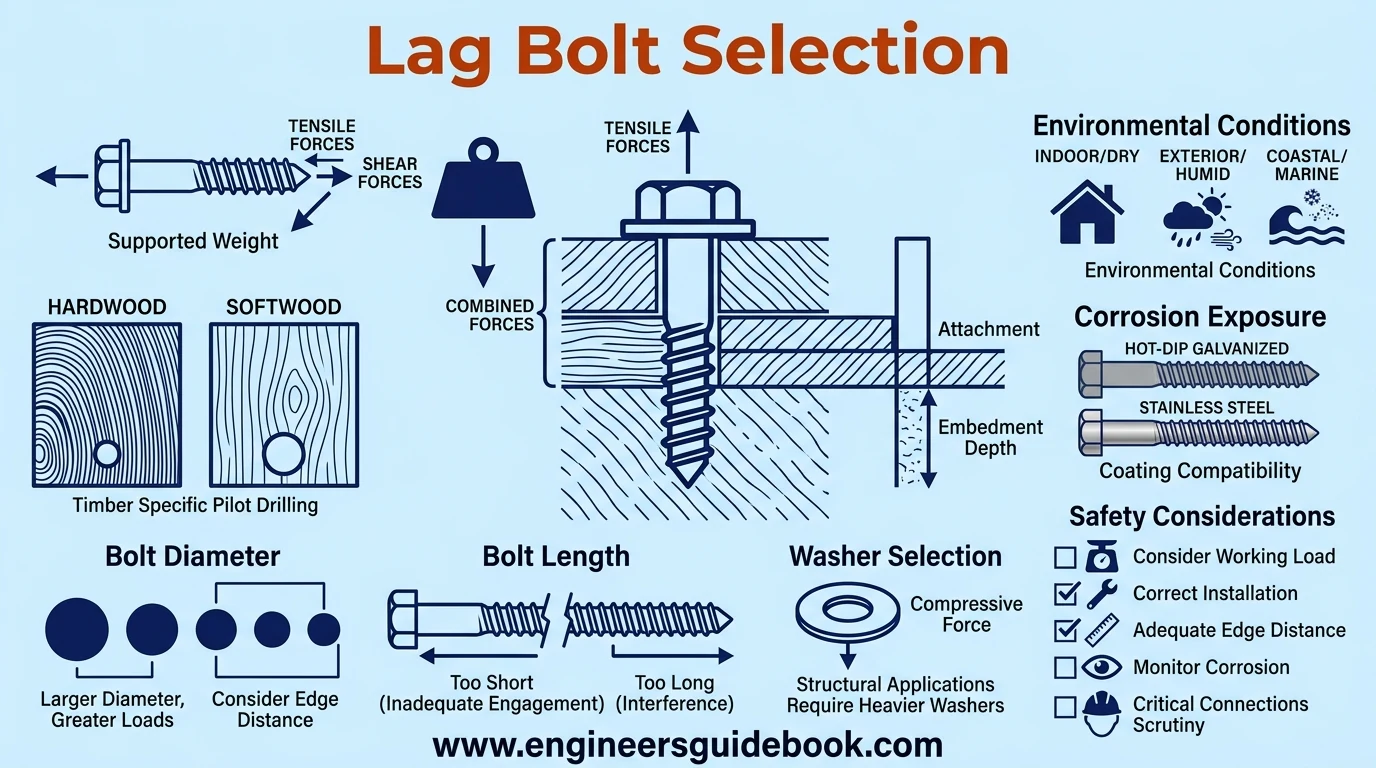
8.1 Load Requirements
Load requirements are the primary consideration when selecting a lag bolt. The fastener must withstand anticipated tensile, shear, and combined forces without yielding, pulling out, or damaging the connected material.
Heavier loads generally require larger diameters, greater embedment depth, stronger materials, or multiple fasteners. Structural connections should be sized using engineering calculations, approved design values, or manufacturer data rather than assumptions based solely on bolt size.
8.2 Wood Species
Wood species significantly affects lag bolt holding strength because density, grain structure, and hardness vary considerably. Dense hardwoods typically provide greater withdrawal resistance but may require more precise pilot drilling to prevent splitting.
Softer woods are easier to penetrate but can offer lower thread-holding capacity. Fastener dimensions and pilot-hole size should therefore correspond to the specific timber being used.
8.3 Material Thickness
The thickness of both the attached component and supporting member influences bolt length. A lag bolt must pass through the outer component while maintaining sufficient threaded penetration into the structural substrate.
Thin materials may also require washers or reinforcement to prevent localized crushing around the bolt head.
8.4 Environmental Conditions
Moisture, temperature fluctuations, chemicals, salt exposure, and atmospheric contamination can affect fastener performance. Indoor dry installations often tolerate coated carbon steel, while exterior or humid locations may demand more robust corrosion protection.
The surrounding timber or construction material should also be evaluated because treated wood can accelerate corrosion of incompatible fasteners.
8.5 Corrosion Exposure
Corrosion gradually reduces the effective cross-sectional area of a bolt and can compromise an otherwise strong connection. Hot-dip galvanized fasteners are widely used outdoors, whereas stainless steel is often selected for coastal, marine, or persistently damp environments.
Coating durability and compatibility with adjacent metals should always be considered.
8.6 Bolt Diameter
Bolt diameter influences tensile strength, shear capacity, thread engagement, and installation requirements. Larger diameters can support greater loads, but they also require larger pilot holes and adequate timber dimensions.
Excessive diameter near an edge can promote splitting, making proportionate selection essential.
8.7 Bolt Length
Lag bolt length should accommodate brackets, washers, plates, and connected materials while preserving sufficient penetration into the supporting member.
A bolt that is too short may lack adequate thread engagement. One that is unnecessarily long can interfere with concealed components or emerge from the opposite surface.
8.8 Washer Selection
Washers distribute the compressive force beneath the bolt head across a broader area. This reduces localized indentation, particularly in softwood.
Washer diameter, thickness, material, and corrosion resistance should complement the fastener and connection. Structural applications may require heavier washers to resist deformation.
8.9 Safety Considerations
Safe selection requires consideration of working load, installation method, edge distance, spacing, corrosion, timber condition, and expected service life.
Critical connections should not rely on damaged, unidentified, or heavily corroded lag bolts. Connections supporting people, elevated structures, or substantial equipment require particular engineering scrutiny.
9. Lag Bolt Installation
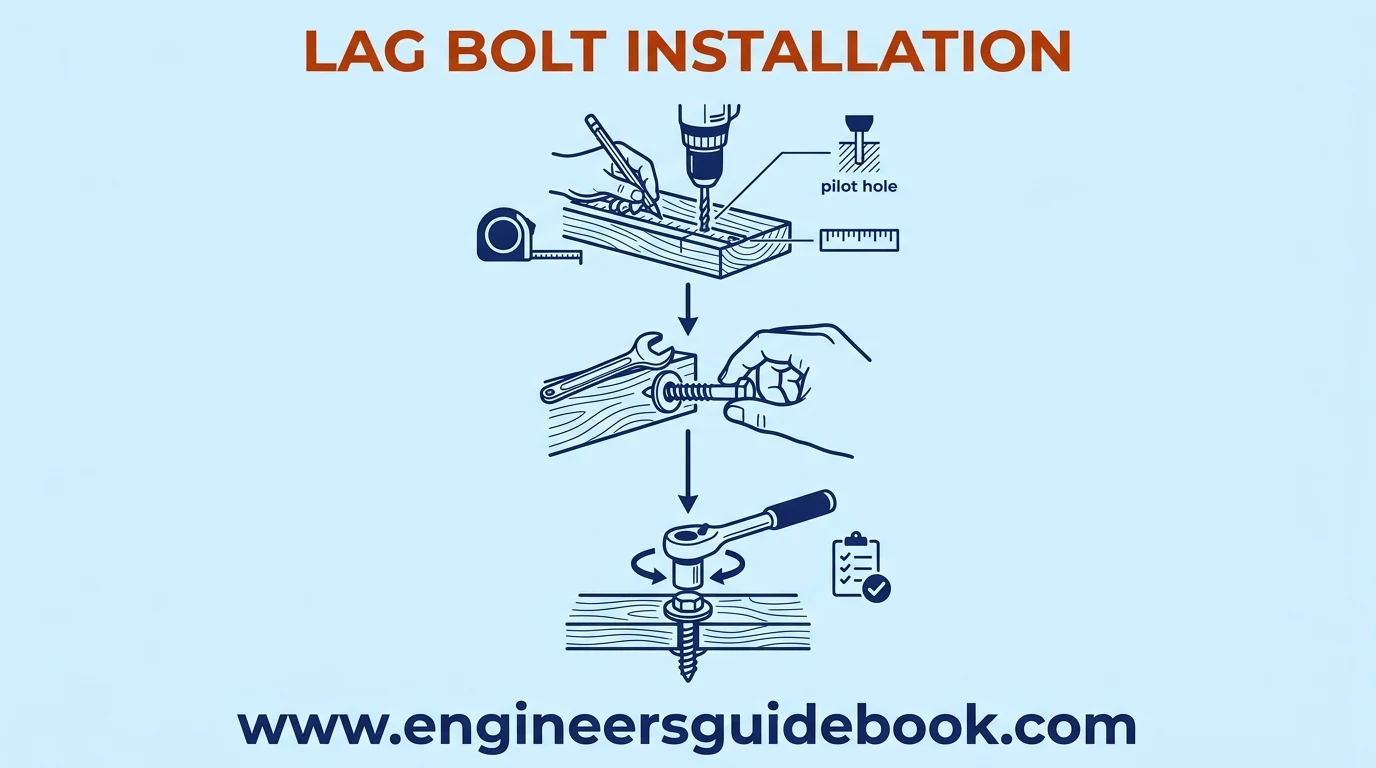
9.1 Required Tools
Typical tools include a drill, suitable drill bits, measuring tape, marking tool, wrench or socket, washers, and the selected lag bolts. A torque wrench may be useful where controlled tightening is specified.
Safety glasses and other appropriate personal protective equipment should be used during drilling and installation.
9.2 Installation Preparation
Before drilling, inspect the materials for cracks, knots, deterioration, hidden utilities, or obstructions. Confirm that the bolt diameter and length are suitable for the connection.
Components should be positioned correctly before holes are marked.
9.3 Hole Positioning
Accurate positioning maintains alignment and helps preserve adequate edge distances. Holes placed too close to timber edges can cause splitting under tightening or service loads.
Multiple bolts should also have sufficient spacing to prevent overlapping stress zones within the wood.
9.4 Pilot Hole Drilling
Pilot holes reduce installation torque and minimize splitting. They are particularly important for large-diameter lag bolts, dense hardwood, and locations near edges.
Drilling should remain perpendicular to the surface unless the connection specifically requires another orientation.
9.5 Pilot Hole Diameter
Pilot-hole diameter depends on bolt diameter, thread geometry, wood density, and manufacturer recommendations. The hole should permit the bolt core to enter while leaving sufficient wood for the threads to engage.
A hole that is too small increases installation torque, while an oversized hole diminishes withdrawal resistance.
9.6 Pilot Hole Depth
Pilot-hole depth should generally correspond to the intended threaded penetration of the lag bolt. Adequate depth prevents excessive resistance near the bottom of the hole.
Removing accumulated wood chips can also prevent false tightening before the bolt is fully seated.
9.7 Washer Placement
Place the washer beneath the bolt head before insertion. It should sit flat against the connected surface without excessive gaps or distortion.
A correctly sized washer provides more uniform load distribution and reduces surface crushing.
9.8 Lag Bolt Insertion
Insert the lag bolt into the prepared hole and begin engagement carefully. Initial alignment is important because forcing an angled bolt can damage threads, enlarge the hole, or create eccentric loading.
Once properly engaged, the bolt can be progressively tightened.
9.9 Bolt Tightening
Use a correctly sized socket or wrench and tighten gradually. The goal is to bring the connected components firmly together without crushing the wood or stripping the threads.
Excessive impact-tool use can produce uncontrolled torque and concealed damage.
9.10 Torque Control
Torque control helps maintain consistent clamping force, but wood connections behave differently from conventional bolted steel joints. Friction, moisture content, wood density, coatings, and washer conditions can substantially influence tightening response.
Where a specified installation torque exists, follow the manufacturer’s or engineer’s requirement.
9.11 Final Inspection
Inspect the completed connection for full seating, correct washer placement, cracking, stripped threads, excessive indentation, and alignment.
The joint should remain firm without visible deformation. Structural connections should also be inspected periodically where service conditions justify it.
10. Lag Bolt Installation Problems
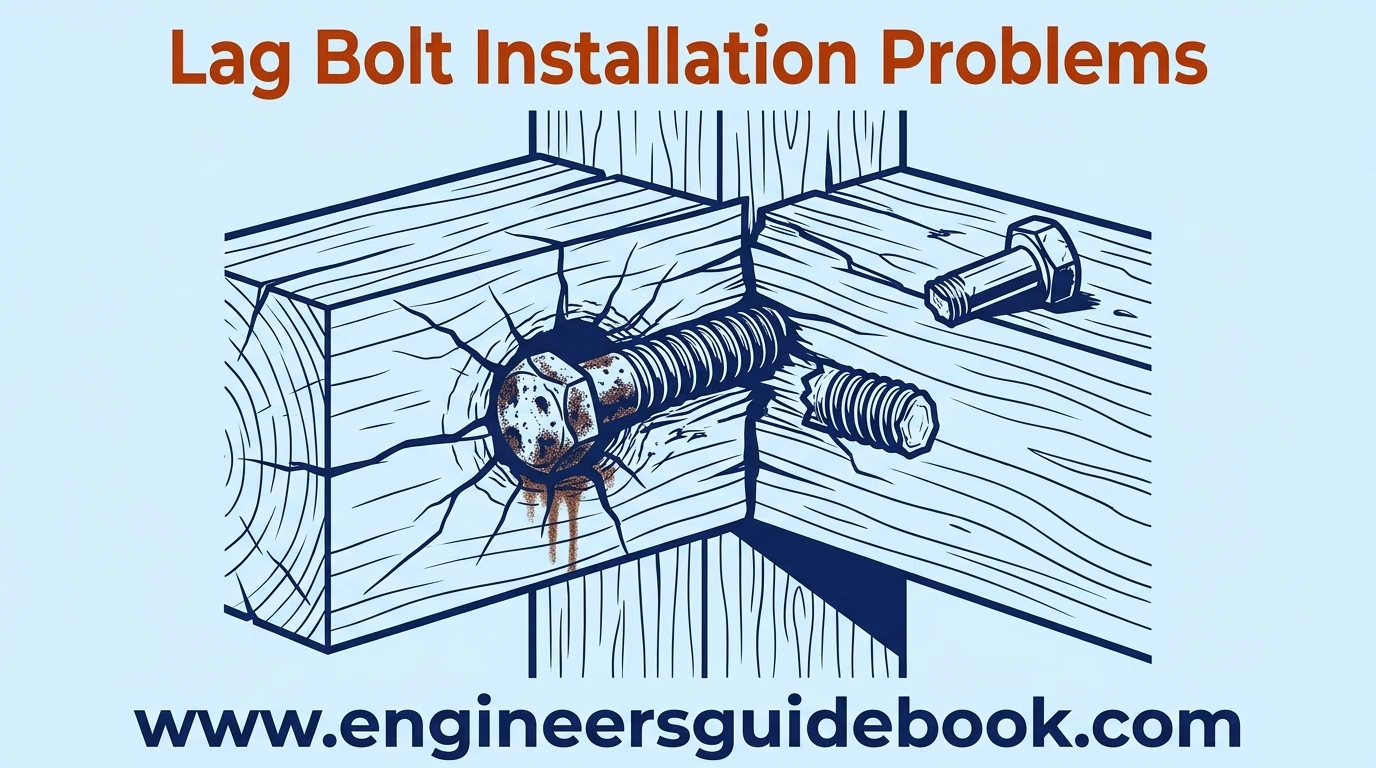
10.1 Wood Splitting
Splitting commonly results from inadequate pilot holes, insufficient edge distance, oversized fasteners, or excessive tightening. Correct drilling and spacing substantially reduce this risk.
10.2 Bolt Spinning
A spinning lag bolt usually indicates damaged wood fibers, an oversized hole, or stripped thread engagement. Simply continuing to rotate the bolt will not restore holding strength.
10.3 Thread Stripping
Thread stripping occurs when excessive torque destroys the wood surrounding the threads. Proper pilot sizing and controlled tightening help preserve the substrate.
10.4 Bolt Breakage
Fasteners can fracture from excessive installation torque, poor-quality material, corrosion, or unexpectedly high service loads. A broken bolt should prompt investigation of the underlying cause.
10.5 Head Damage
Using incorrect tools can round the hex head and make future tightening or removal difficult. A properly fitting socket distributes force more effectively than an unsuitable wrench.
10.6 Misaligned Holes
Misaligned holes can force the bolt into an unintended trajectory and reduce connection quality. Accurate marking and perpendicular drilling are preferable to forcing components into alignment.
10.7 Loose Connections
Loose joints may result from timber shrinkage, vibration, insufficient embedment, or inadequate initial tightening. Periodic inspection is useful in dynamic or exterior applications.
10.8 Corrosion Damage
Rust can reduce bolt diameter, damage coatings, and stain surrounding materials. Severely corroded fasteners should be replaced with an appropriately protected alternative.
10.9 Installation Mistakes
Common mistakes include omitting pilot holes, selecting incorrect lengths, over-tightening, using inadequate washers, and placing fasteners too close to edges.
Careful preparation usually prevents most of these failures.
11. Lag Bolts vs Other Fasteners
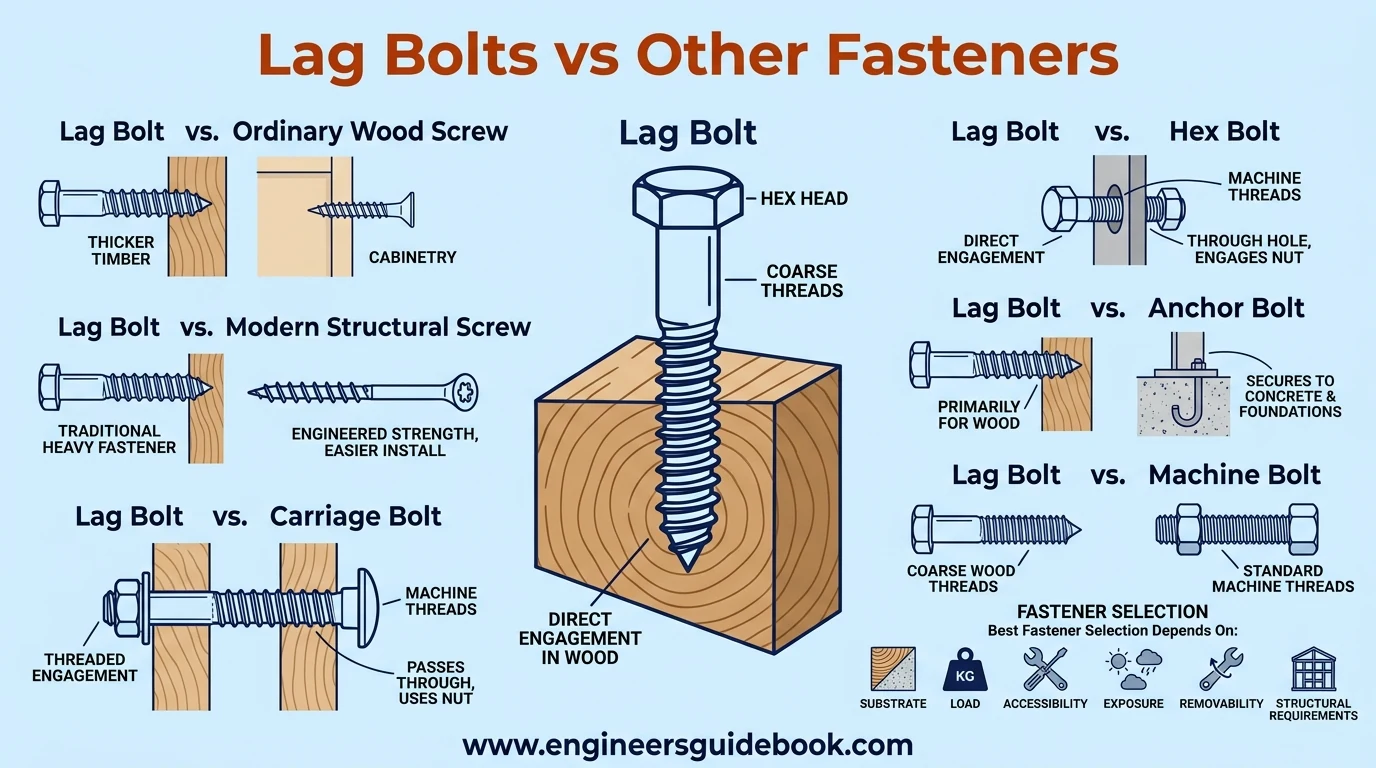
11.1 Lag Bolts vs Wood Screws
Lag bolts are generally larger and intended for heavier connections than ordinary wood screws. Wood screws are convenient for cabinetry and light construction, while lag bolts suit thicker timber and substantial hardware.
11.2 Lag Bolts vs Structural Screws
Modern structural screws can provide high engineered strength with smaller diameters and easier installation. Lag bolts remain advantageous where traditional heavy fasteners, broad availability, or specific connection details are required.
11.3 Lag Bolts vs Carriage Bolts
Carriage bolts pass completely through connected materials and use a nut. Lag bolts develop their anchorage directly through threaded engagement with the substrate.
11.4 Lag Bolts vs Hex Bolts
Hex bolts typically pass through clearance holes and are secured with nuts. Lag bolts have coarse threads and are commonly driven directly into wood or an anchor.
11.5 Lag Bolts vs Anchor Bolts
Anchor bolts primarily secure structures or equipment to concrete and foundations. Lag bolts are principally intended for wood, although they can be paired with suitable masonry anchors.
11.6 Lag Bolts vs Machine Bolts
Machine bolts use standardized machine threads and normally engage a nut or threaded component. Lag bolts use coarse threads designed for direct engagement with materials such as timber.
11.7 Fastener Selection
The best fastener depends on substrate, load, accessibility, environmental exposure, removability, and structural requirements. No single fastener type is universally superior.
12. Lag Bolt FAQs
12.1 What Are Lag Bolts Used For?
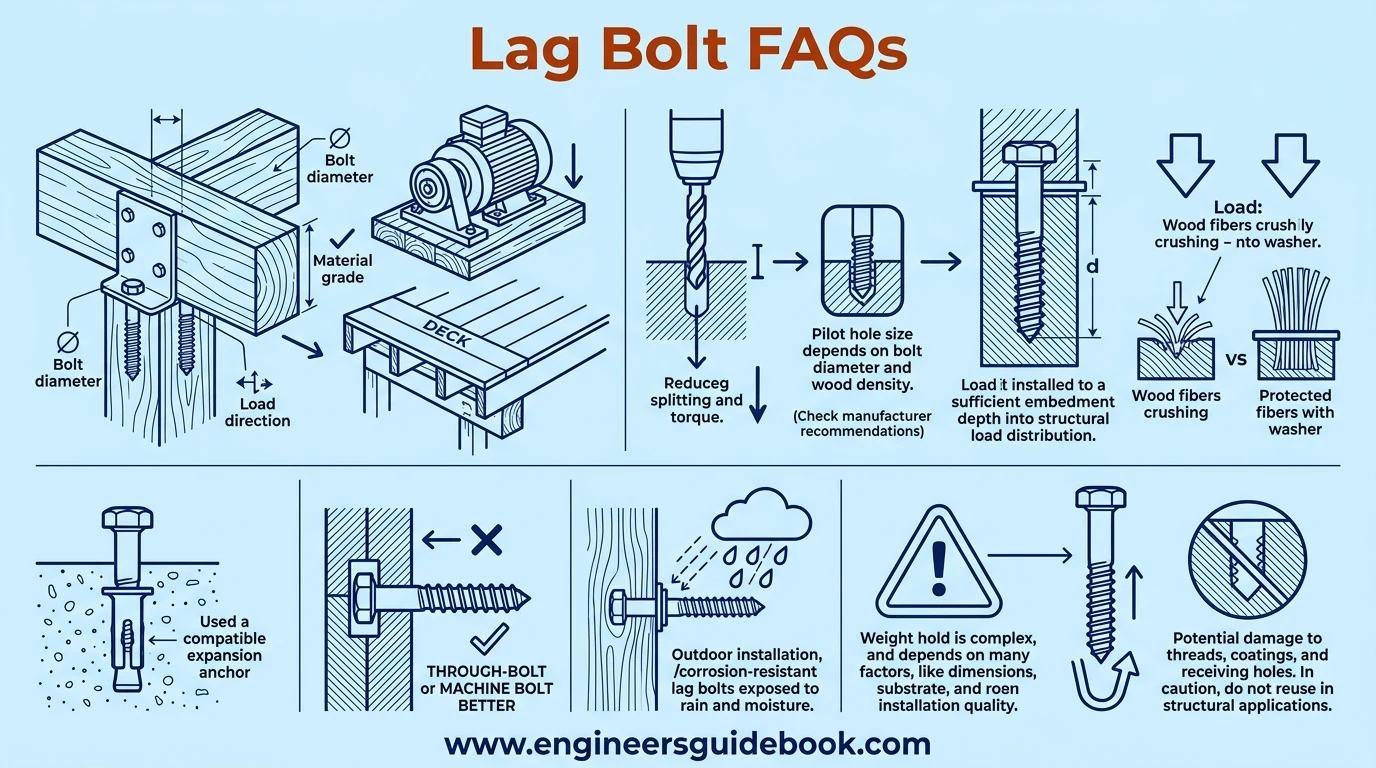
Lag bolts are used for heavy timber connections, deck construction, framing, brackets, machinery mounting, furniture, and other applications requiring substantial anchorage.
12.2 How Strong Are Lag Bolts?
Strength depends on diameter, material, grade, embedment depth, wood species, spacing, and loading direction. Larger bolts are not automatically adequate without suitable installation conditions.
12.3 Do Lag Bolts Need Pilot Holes?
Most medium and large lag bolts benefit from pilot holes. Pilot drilling reduces splitting and installation torque while improving alignment.
12.4 What Size Pilot Hole Is Needed for a Lag Bolt?
The required diameter depends on bolt size and wood density. Manufacturer recommendations or applicable design guidance should be followed rather than using one universal diameter ratio.
12.5 How Deep Should a Lag Bolt Go?
It should penetrate sufficiently into sound structural material to develop the required holding capacity after accounting for washers and attached components.
12.6 Can Lag Bolts Be Used in Concrete?
Yes, but normally only with a compatible concrete or masonry anchor designed for the selected fastener and load.
12.7 Can Lag Bolts Be Used in Metal?
Lag bolts are not generally intended to create conventional machine-threaded connections in metal. Through-bolts, machine bolts, or specialized fasteners are usually more appropriate.
12.8 Can Lag Bolts Be Used Outdoors?
Yes. Outdoor installations should use coatings or materials appropriate for moisture, weather, and chemical exposure.
12.9 Do Lag Bolts Need Washers?
Washers are strongly recommended in many applications because they distribute load and reduce crushing beneath the bolt head.
12.10 How Much Weight Can a Lag Bolt Hold?
There is no single weight rating. Capacity depends on fastener dimensions, substrate properties, embedment, spacing, load direction, and installation quality.
12.11 What Is the Difference Between a Lag Bolt and a Lag Screw?
The terms are frequently used interchangeably. Because the fastener typically threads directly into material rather than using a nut, “lag screw” is often the technically appropriate designation.
12.12 Can Lag Bolts Be Removed and Reused?
They can sometimes be removed, but reuse is not always advisable. Threads, coatings, or the receiving hole may become damaged, particularly in structural applications.
13. Conclusion
Correct selection requires balancing load capacity, diameter, length, material, corrosion resistance, substrate properties, and service conditions.
Reliable installation depends on accurate positioning, proper pilot drilling, washer use, controlled tightening, and careful final inspection.
Lag bolts can form exceptionally durable connections when selected and installed correctly. Structural safety ultimately depends on appropriate design, sound materials, proper spacing, sufficient embedment, and regular inspection where deterioration or movement is possible.