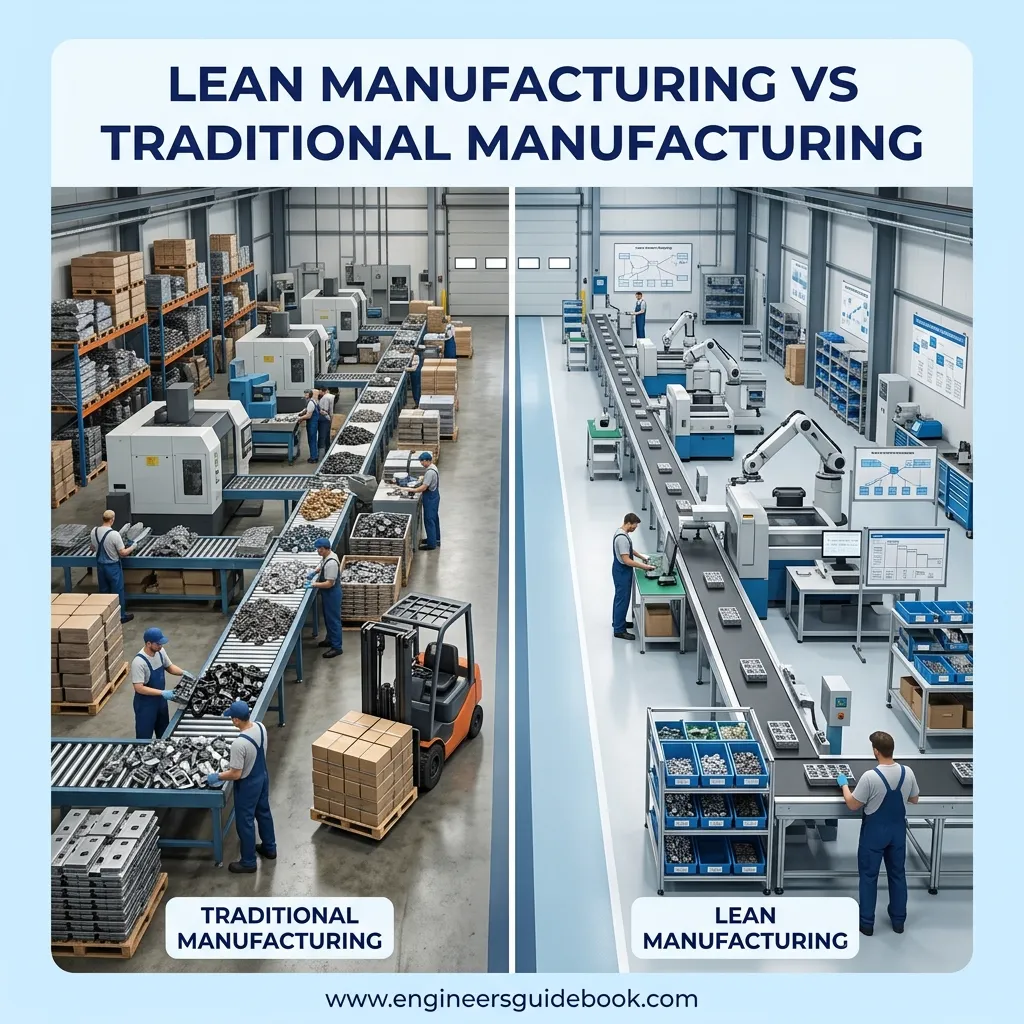
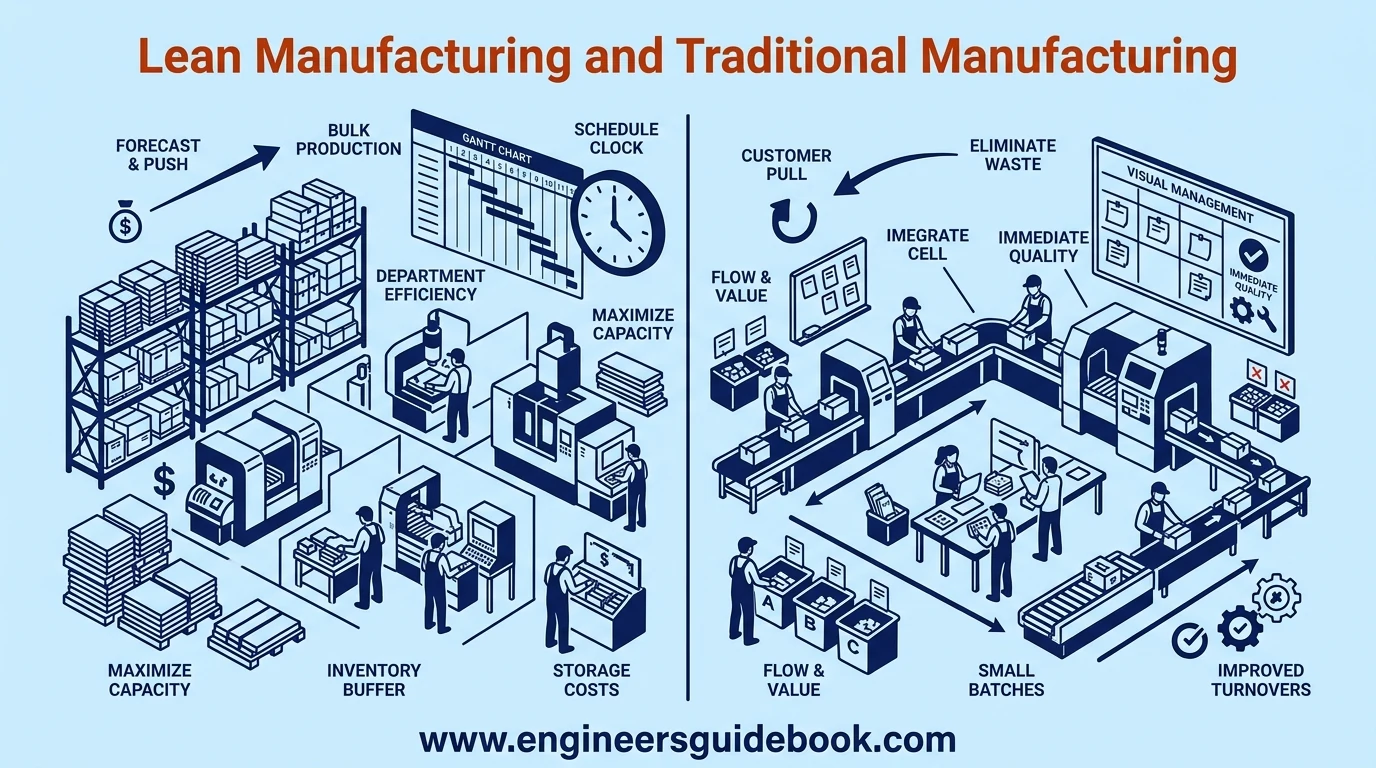
Lean manufacturing vs traditional manufacturing lets start with lean manufacturing prioritizes customer value, waste reduction, flexible flow, and continuous improvement, whereas traditional manufacturing emphasizes forecast-driven output, large batches, specialized departments, and inventory buffers. Lean seeks responsiveness through synchronized processes and employee-led problem solving. Traditional manufacturing pursues scale, utilization, and predictable control, making each approach suitable for different demand patterns and operating conditions.
1. Lean Manufacturing and Traditional Manufacturing
1.1 Manufacturing System Overview
Lean manufacturing organizes people, equipment, information, and materials around customer value. Traditional manufacturing generally organizes production around forecasted demand, departmental efficiency, and high-volume output supported by inventory and formal planning.
1.2 Production Philosophy Differences
Lean philosophy questions every activity that does not create value. Traditional philosophy emphasizes capacity utilization, economies of scale, and consistent production, even when immediate customer demand remains uncertain.
1.3 Operational Priorities
Lean operations prioritize flow, short lead times, quality at the source, rapid changeovers, and visible problems. Traditional operations emphasize throughput, equipment utilization, labor specialization, schedule compliance, and unit costs.
1.4 Business Performance Impact
Lean can improve inventory turnover, cash flow, responsiveness, and yield. Traditional manufacturing can achieve attractive unit economics in stable markets, but may incur higher storage, obsolescence, and coordination costs.
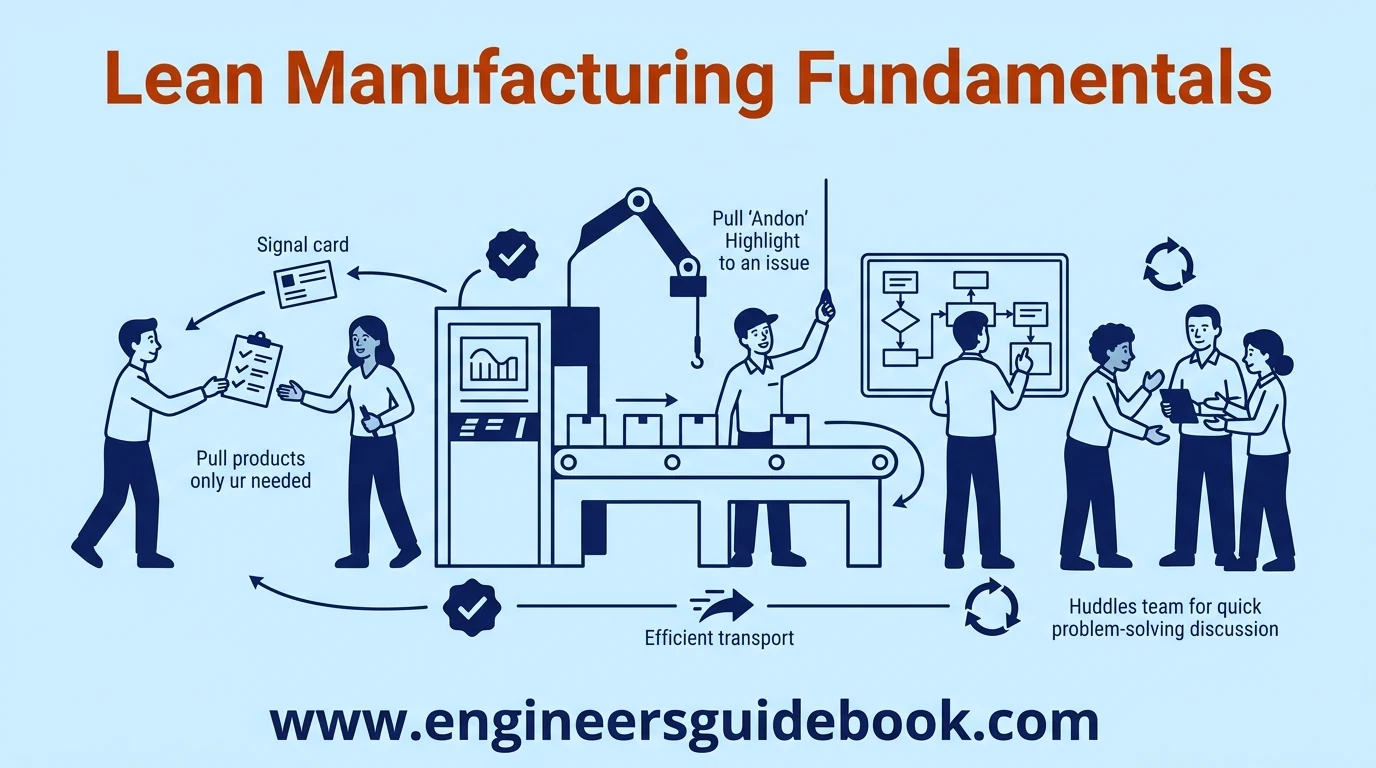
2. Lean Manufacturing Fundamentals
2.1 Customer Value
Customer value includes the features, quality, timing, reliability, and price buyers genuinely require. Lean organizations use these expectations to distinguish meaningful work from internal activity that adds complexity without commercial benefit.
2.2 Waste Elimination
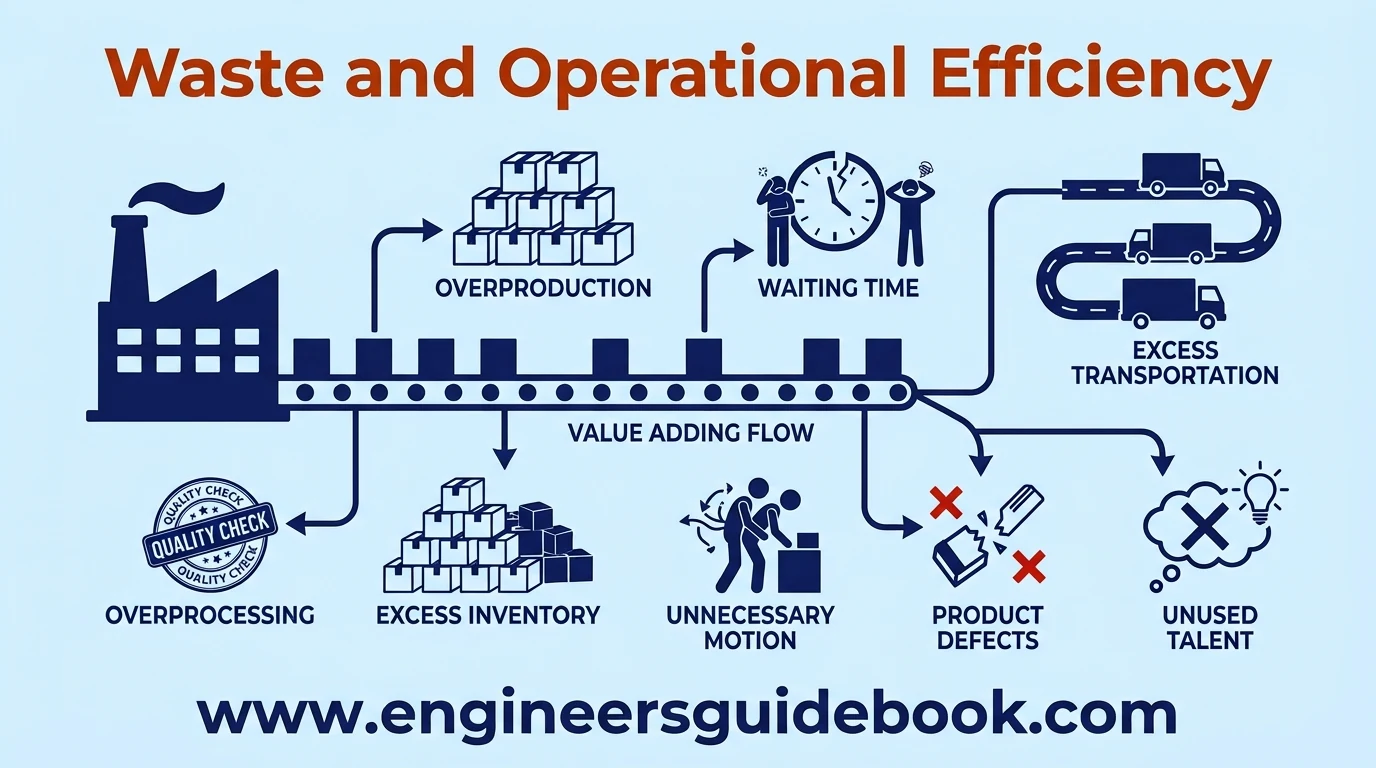
Waste is any resource consumption that does not create customer value. Lean targets overproduction, waiting, transport, overprocessing, inventory, motion, defects, and unused talent through observation and redesign.
2.3 Continuous Improvement
Continuous improvement relies on frequent, incremental refinement rather than occasional transformation campaigns. Employees study actual work, identify abnormalities, test countermeasures, and standardize successful changes, creating durable operational learning.
2.4 Pull Production
Pull production authorizes work according to actual downstream consumption. Replenishment signals such as kanban prevent premature output, restrain work in process, and synchronize production more closely with real demand.
2.5 Respect for People
Respect for people means involving employees in decisions that affect their work. Operators are expected to identify hazards, stop abnormalities, solve problems, and contribute practical knowledge.
2.6 Process Standardization
Standardized work defines the safest and most reliable known method for completing a task. It establishes a measurable baseline, reduces uncontrolled variation, and provides a foundation for improvement.
Also Read More:
Lean Manufacturing: Principles, Tools, Benefits, and Examples
How to Implement Lean Manufacturing Step by Step
5 Principles of Lean Manufacturing Explained With Examples
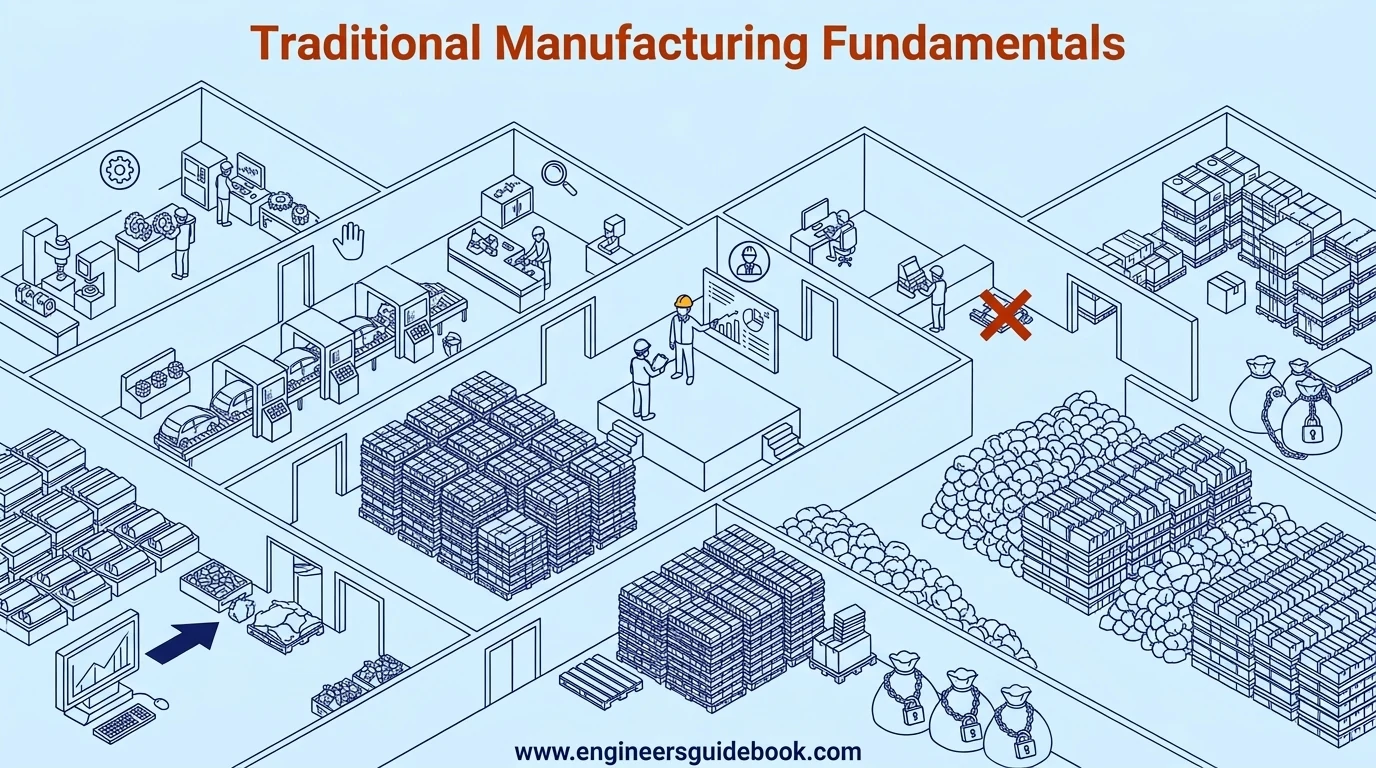
3. Traditional Manufacturing Fundamentals
3.1 Mass Production
Mass production uses dedicated equipment, repetitive tasks, and long runs to produce standardized goods efficiently. It performs well under stable demand but becomes less agile when product variety increases.
3.2 Forecast Driven Planning
Forecast-driven planning purchases materials and schedules capacity before confirmed demand is known. Accurate forecasts support continuity, while forecast errors can create shortages, excess stock, overtime, markdowns, and delays.
3.3 Large Batch Processing
Large batches reduce setup frequency and may lower apparent unit cost. However, they increase queue time, inventory and defect exposure because problems can affect many units before discovery and correction.
3.4 Functional Departments
Traditional factories often group similar expertise into machining, assembly, quality, maintenance, and warehousing departments. This strengthens specialization but can fragment material flow, communication and overall lead time.
3.5 Inventory Dependence
Inventory buffers protect production from supplier delays, equipment failures, and uneven demand. They also conceal reliability problems, consume cash and space, increase handling, and expose organizations to deterioration or obsolescence.
3.6 Management Control
Traditional systems frequently rely on centralized planning, formal authorization, and supervisory control. This can create consistency, yet excessive hierarchy may slow decisions, discourage initiative, and distance management from actual conditions.
4. Production Planning and Scheduling
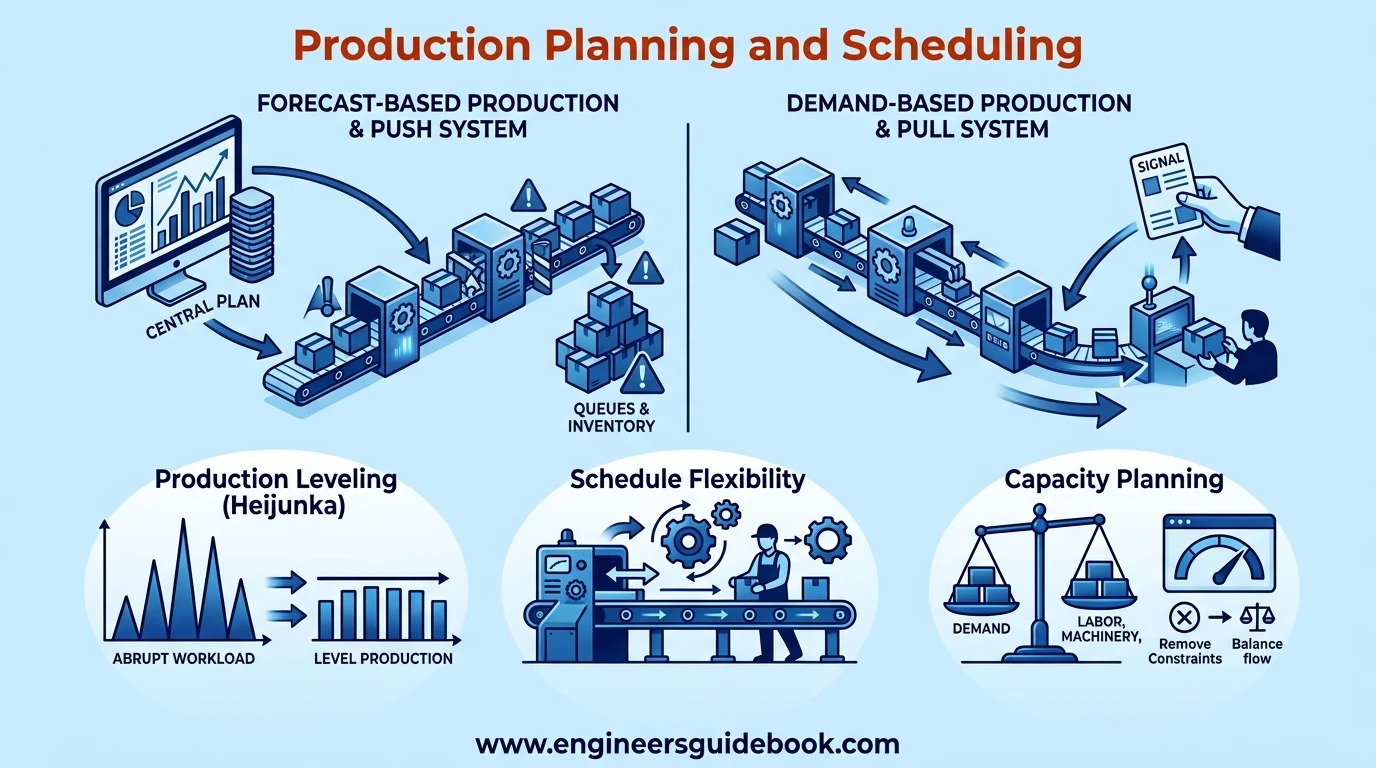
4.1 Demand Based Production
Demand-based production uses actual orders, withdrawals, or consumption signals to determine output. It reduces speculative manufacturing and improves alignment between production, inventory and customer requirements.
4.2 Forecast Based Production
Forecast-based production estimates future demand and creates schedules in advance. It remains useful where procurement or processing lead times are long, although uncertainty increases as the planning horizon expands.
4.3 Pull System
A pull system limits production authorization and work in process. Each stage responds to downstream need, creating tighter synchronization and exposing shortages, bottlenecks, defects, or equipment instability more rapidly.
4.4 Push System
A push system releases work according to a central plan. Departments complete assigned quantities and transfer them forward, sometimes creating queues when downstream capacity or demand is insufficient.
4.5 Production Leveling
Production leveling distributes volume and product mix more evenly over time. Known as heijunka, it reduces abrupt workload peaks, unstable staffing, supplier volatility, and oversized buffers.
4.6 Schedule Flexibility
Lean scheduling supports controlled adjustment through quick changeovers, cross-trained labor, and dependable equipment. Traditional schedules are often harder to revise because large batches and departmental commitments create operational inertia.
4.7 Capacity Planning
Capacity planning compares demand with available labor, machinery, and support resources. Lean balances flow and removes constraints, while traditional systems more commonly add buffers to protect service levels.
5. Inventory and Material Flow
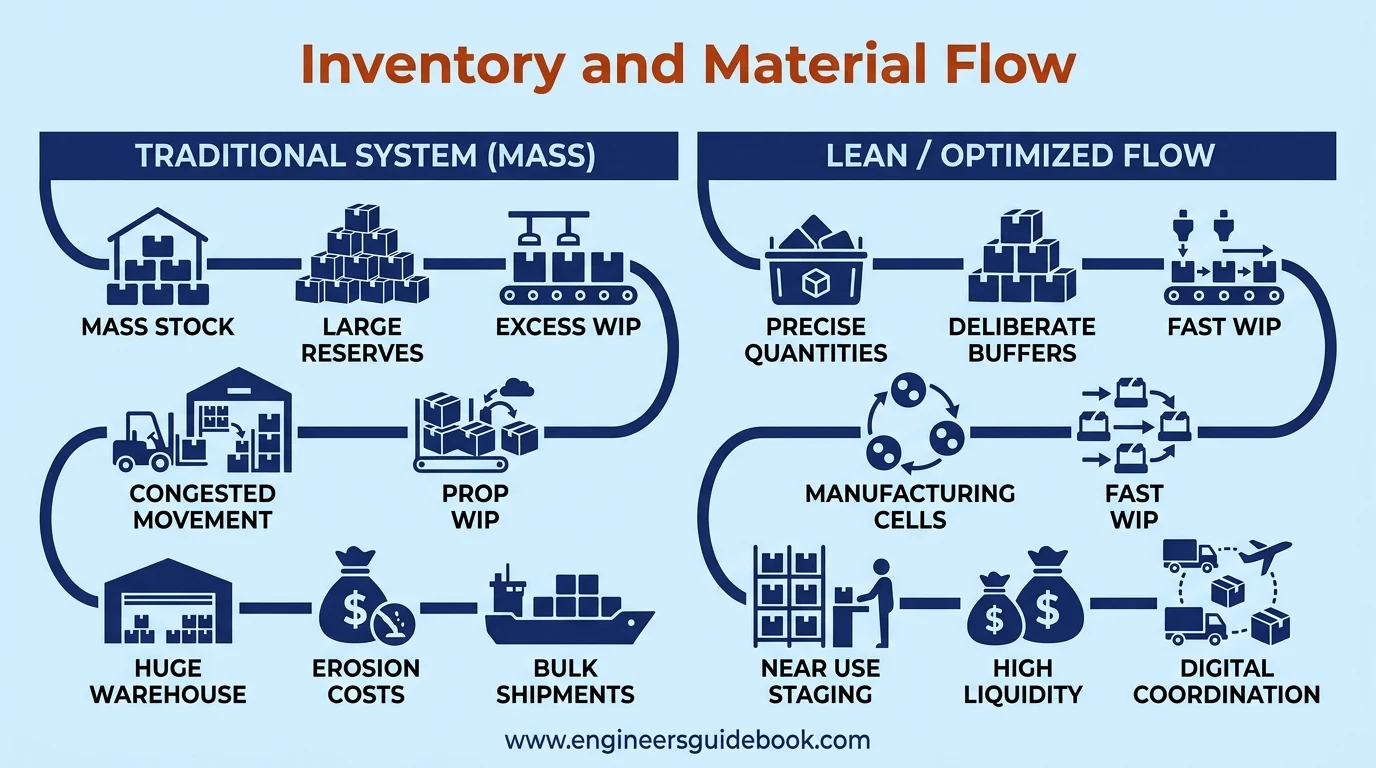
5.1 Just in Time Inventory
Just in time supplies materials in the quantity and moment required. It reduces stockholding and exposes instability, but depends on dependable suppliers, accurate signals, consistent quality, and disciplined logistics.
5.2 Safety Stock
Safety stock protects against demand and replenishment uncertainty. Lean seeks to reduce the causes requiring large reserves, while still retaining deliberate buffers where quantified risk justifies them.
5.3 Work in Process
Work in process includes partially completed units awaiting further operations. Excessive WIP extends lead time, obscures priorities, complicates traceability, and hides bottlenecks.
5.4 Material Movement
Lean layouts place sequential processes closer together, often through manufacturing cells. Traditional functional layouts may require longer travel between departments, adding handling, delay, congestion, and damage risk.
5.5 Warehouse Requirements
Traditional systems usually need larger warehouses for raw materials, WIP, and finished goods. Lean systems pursue smaller, faster-moving inventories near the point of use with reliable replenishment.
5.6 Inventory Carrying Costs
Inventory carrying costs include capital, storage, insurance, handling, shrinkage, deterioration, and obsolescence. Reducing unnecessary stock improves liquidity and prevents unsold production from quietly eroding profitability.
5.7 Supply Chain Coordination
Lean flow requires transparent information, stable supplier quality, smaller deliveries, and coordination. Traditional supply chains may rely on larger, less frequent shipments and greater inventory protection against disruption.
6. Waste and Operational Efficiency
6.1 Overproduction
Overproduction means making products earlier or in greater quantities than required. It is particularly corrosive because it generates inventory, storage, handling, complexity, and obsolescence.
6.2 Waiting Time
Waiting occurs when people, materials, information, or machines remain idle. Typical causes include breakdowns, approval delays, missing components, poor balancing, and unreliable scheduling.
6.3 Excess Transportation
Excess transportation moves materials without improving them. Poor layouts and distant storage increase travel, cost, damage exposure, lead time, and effort.
6.4 Overprocessing
Overprocessing includes duplicated entry, unnecessary inspection, excessive finishing, redundant approvals, or excessive tolerances. These activities consume capacity without producing proportionate value.
6.5 Excess Inventory
Excess inventory immobilizes cash and hides weak quality, unreliable equipment, and unstable scheduling. It also increases storage, counting, deterioration, traceability problems, and obsolescence.
6.6 Unnecessary Motion
Unnecessary motion includes avoidable walking, reaching, bending, searching, and repositioning. Ergonomic design, point-of-use storage, and organized tools improve productivity while reducing fatigue and injury risk.
6.7 Product Defects
Defects consume material, labor, capacity, and customer trust. Lean systems emphasize prevention, rapid containment, and immediate feedback rather than accepting rework as a normal operating condition.
6.8 Unused Talent
Unused talent arises when employee knowledge, creativity, and experience remain ignored. Excluding frontline workers from improvement deprives the organization of practical insight and weakens engagement and problem solving.
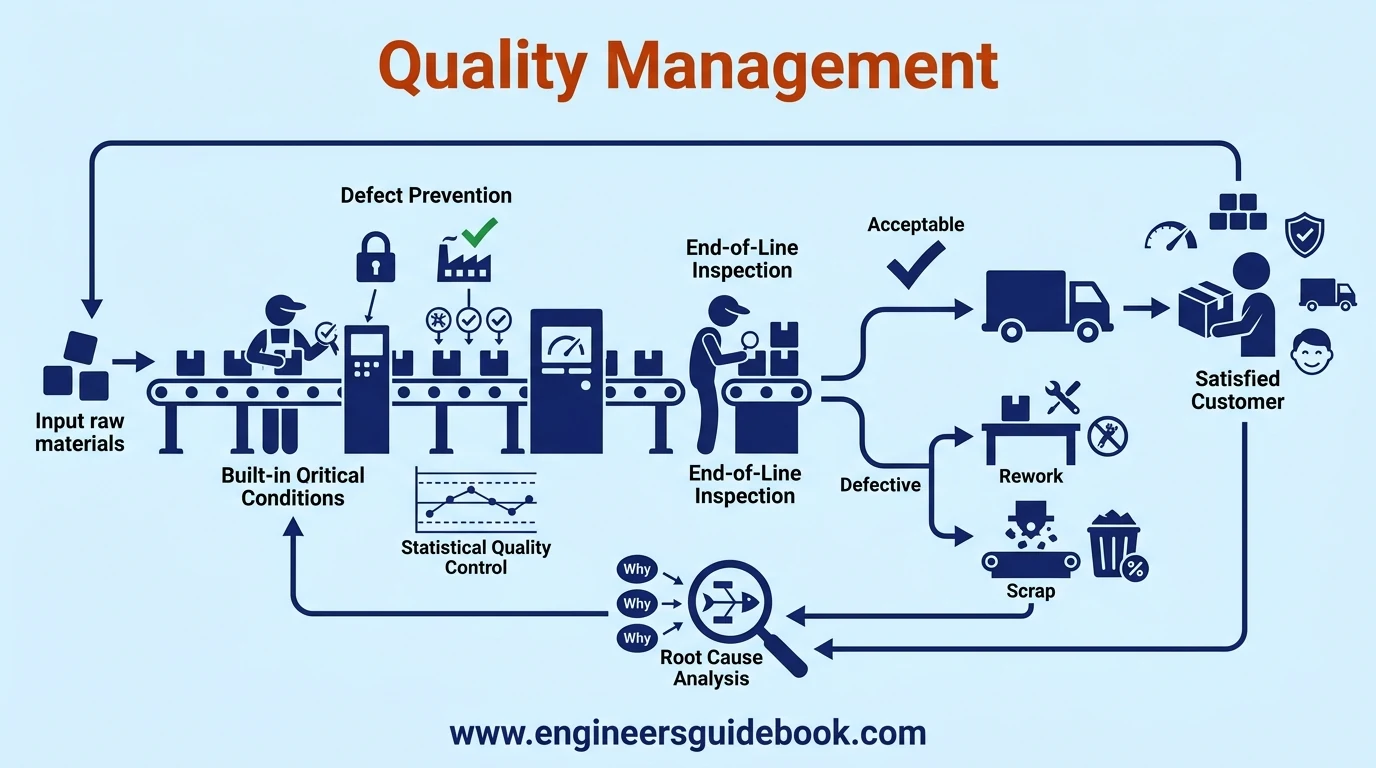
7. Quality Management
7.1 Built in Quality
Built-in quality requires abnormalities to be detected and corrected during production. Operators verify critical conditions at the source rather than relying entirely on final inspectors.
7.2 End of Line Inspection
End-of-line inspection separates acceptable products from defective ones after processing. It protects customers but cannot recover the resources already consumed by poor production.
7.3 Defect Prevention
Defect prevention uses error-proofing, capable processes, stable methods, and visual controls. The aim is to make mistakes difficult to create or immediately apparent when they occur.
7.4 Root Cause Analysis
Root cause analysis investigates why a failure occurred instead of treating only its visible symptom. Techniques such as five whys and cause-and-effect analysis support disciplined corrective action.
7.5 Statistical Quality Control
Statistical quality control uses process data to distinguish routine variation from abnormal change. Control charts and capability studies support logical intervention rather than reaction.
7.6 Rework and Scrap
Rework consumes additional labor and capacity, while scrap destroys material value entirely. Both indicate process failure and should be measured, analyzed, and reduced.
7.7 Customer Quality Expectations
Customers judge quality through performance, consistency, reliability, delivery, and service. Effective quality management translates these expectations into process controls so operational measurements remain commercially relevant.
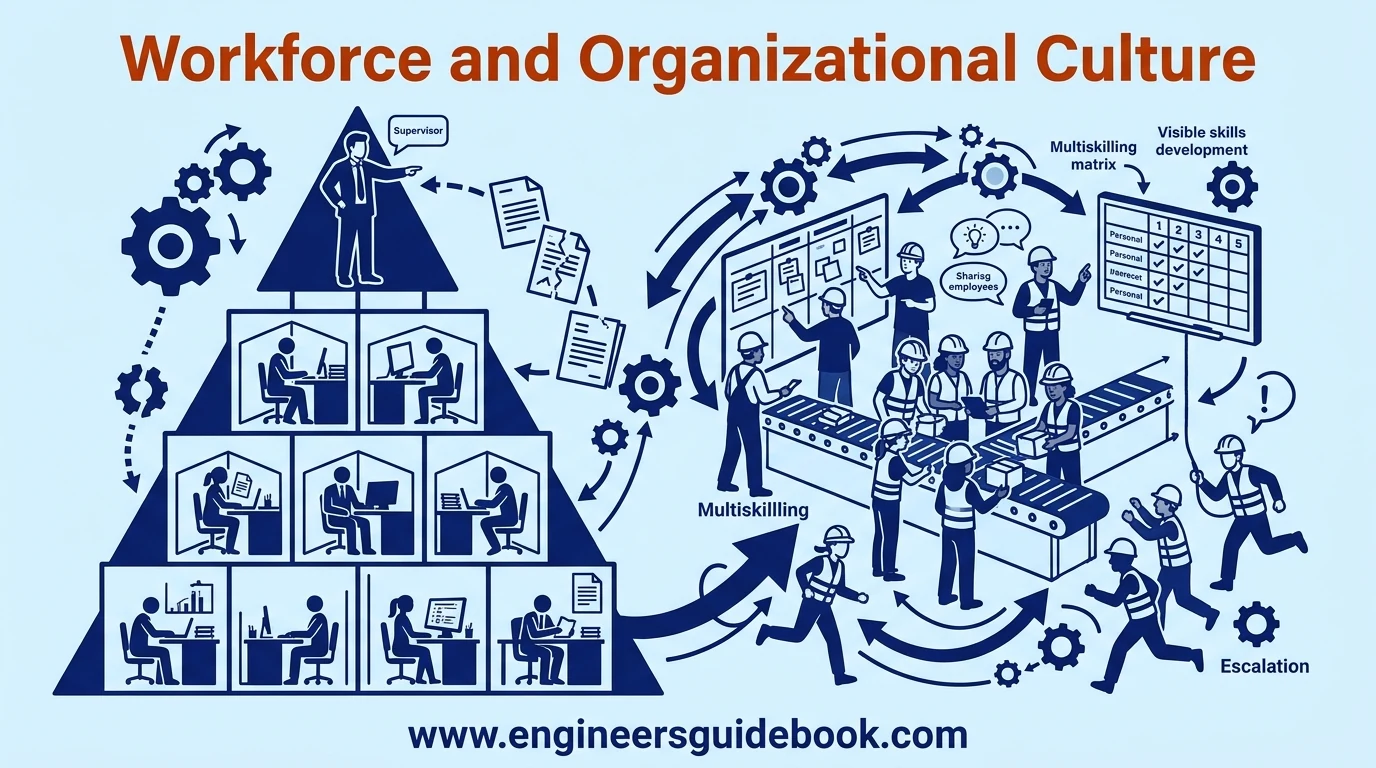
8. Workforce and Organizational Culture
8.1 Employee Involvement
Lean manufacturing treats employees as active contributors to operational excellence. Operators identify waste, recommend improvements, and participate in decisions. Traditional systems often restrict improvement work to supervisors, engineers, or management personnel.
8.2 Management Hierarchy
Traditional manufacturing commonly uses a vertical hierarchy with decisions flowing downward through multiple authority levels. Lean organizations favor flatter structures, faster escalation, and direct managerial engagement with frontline conditions.
8.3 Cross Functional Teams
Lean manufacturing forms cross-functional teams involving production, maintenance, quality, logistics, and engineering. This collaboration accelerates problem resolution. Traditional organizations may experience delays because departments pursue isolated targets and communicate formally.
8.4 Specialized Roles
Traditional manufacturing relies heavily on specialized roles to improve technical proficiency and task repetition. Lean retains expertise but promotes multiskilling, allowing employees to support different processes and respond to fluctuating workloads.
8.5 Problem Solving Authority
Lean employees are often authorized to stop production when defects or safety abnormalities appear. Traditional systems may require supervisory approval, allowing minor problems to proliferate before corrective action begins.
8.6 Skills Development
Lean organizations continuously develop technical, analytical, and interpersonal capabilities. Training includes standardized work, root cause analysis, equipment care, and waste identification. Traditional training generally concentrates on narrow occupational responsibilities.
8.7 Workplace Communication
Visual boards, daily meetings, andon signals, and performance discussions strengthen communication in lean environments. Traditional factories often depend on reports, departmental meetings, emails, and hierarchical information channels.
8.8 Continuous Improvement Culture
A continuous improvement culture regards every process as improvable. Small experiments are encouraged and studied. Traditional cultures may favor procedural stability, making significant changes only after performance deteriorates noticeably.
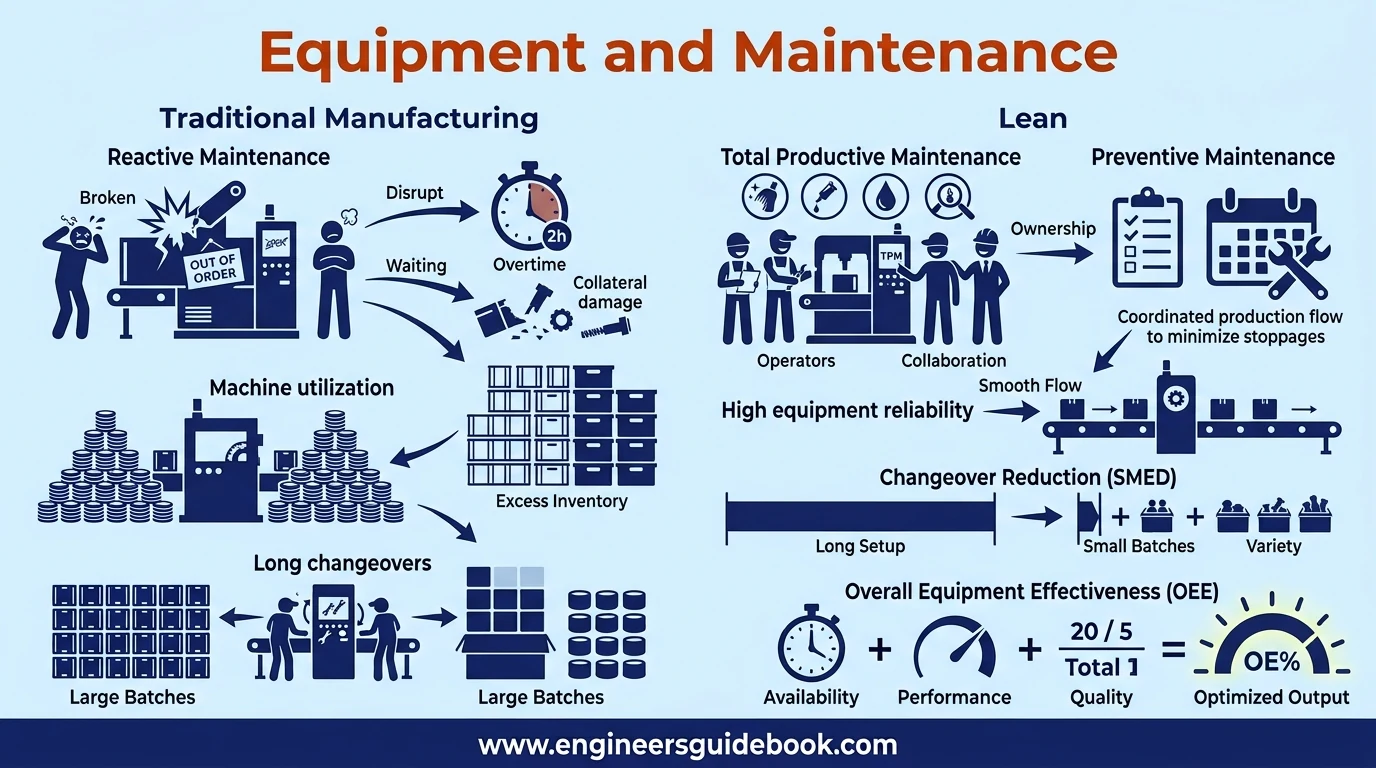
9. Equipment and Maintenance
9.1 Total Productive Maintenance
Total productive maintenance integrates operators, technicians, and management in equipment care. Cleaning, inspection, lubrication, and early abnormality detection prevent deterioration while improving ownership and operational dependability.
9.2 Reactive Maintenance
Reactive maintenance repairs machinery after failure. It remains common in traditional environments where production receives precedence over planned maintenance. Although simple initially, repeated breakdowns create disruption, overtime, and collateral damage.
9.3 Preventive Maintenance
Preventive maintenance schedules inspections and component replacement before predictable failure. Lean systems coordinate maintenance with production demand, reducing unexpected stoppages without generating excessive maintenance activity.
9.4 Equipment Reliability
Reliable equipment is indispensable to lean flow because limited inventory provides little protection against breakdowns. Traditional factories can sometimes absorb disruptions through spare capacity, buffers, and work-in-process inventory.
9.5 Machine Utilization
Traditional manufacturing frequently pursues maximum machine utilization, even when downstream demand is limited. Lean measures whether equipment supports balanced flow, recognizing that unnecessary production merely converts capacity into excess inventory.
9.6 Changeover Reduction
Lean organizations use single-minute exchange of die techniques to simplify adjustments and separate internal from external setup work. Faster changeovers enable smaller batches, greater variety, and responsive scheduling.
9.7 Overall Equipment Effectiveness
Overall equipment effectiveness combines availability, performance, and quality. It reveals whether machinery produces good output at the intended rate, preventing misleading conclusions based solely on operating hours.
10. Cost Flexibility and Performance
10.1 Production Costs
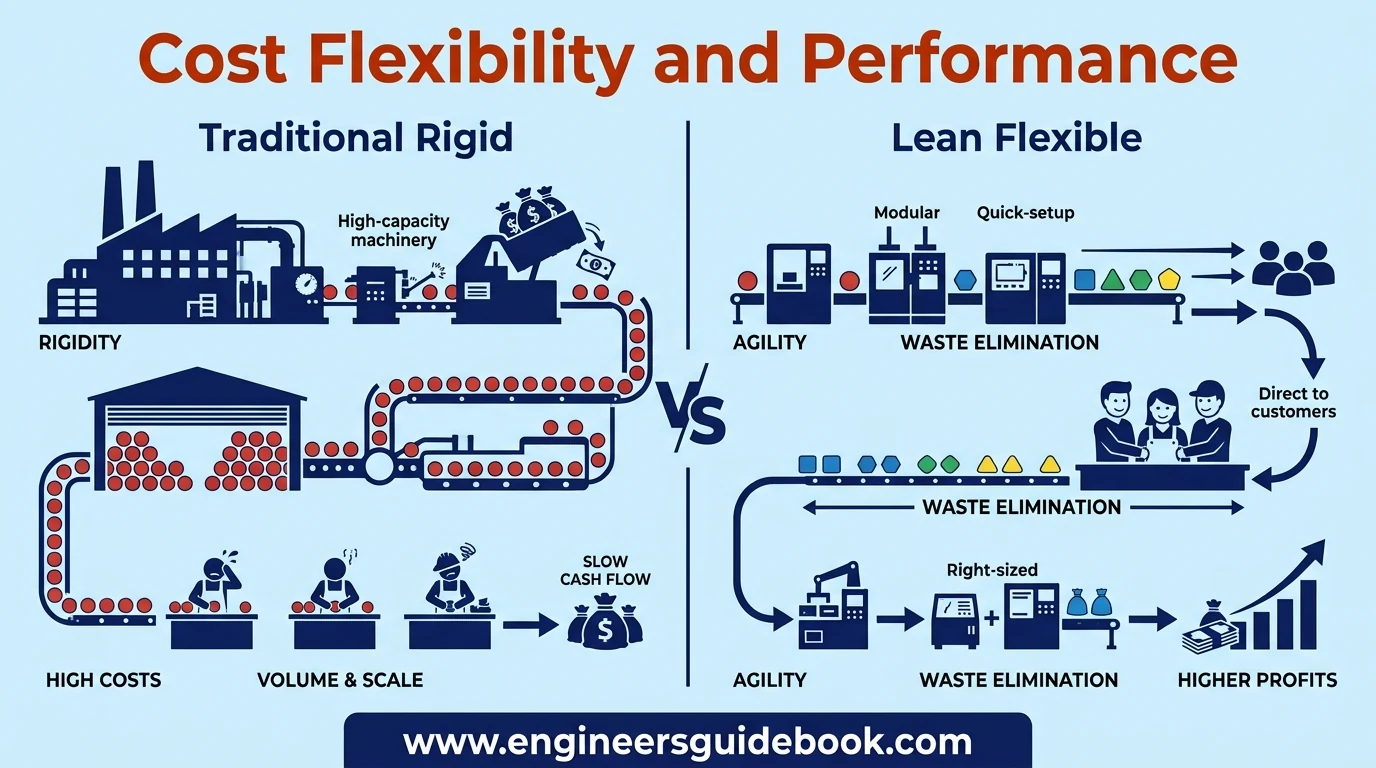
Traditional manufacturing reduces unit cost through volume and scale. Lean reduces total cost by eliminating waste, shortening flow, preventing defects, and lowering the resources required to fulfill customer demand.
10.2 Labor Productivity
Lean productivity improves through better methods, balanced workloads, ergonomic layouts, and fewer interruptions. Traditional productivity may be measured by individual output, sometimes encouraging local efficiency at the expense of total flow.
10.3 Lead Time
Lean manufacturing compresses lead time by reducing queues, batch sizes, transportation, and waiting. Traditional systems often experience longer throughput periods because products remain idle between specialized departments.
10.4 Delivery Performance
Stable processes, short lead times, and demand-based scheduling improve lean delivery reliability. Traditional manufacturers may deliver effectively when forecasts remain accurate but struggle when priorities change unexpectedly.
10.5 Production Flexibility
Lean systems use modular equipment, quick setups, standardized work, and cross-trained employees to accommodate change. Traditional mass-production systems are typically more efficient with long, uninterrupted runs of similar products.
10.6 Product Customization
Smaller batches and flexible processes allow lean manufacturers to offer greater customization without excessive inventory. Traditional systems may require long campaigns, minimum order quantities, or costly production interruptions.
10.7 Capital Requirements
Traditional manufacturing may invest heavily in high-capacity machinery, expansive warehouses, and automated transfer systems. Lean emphasizes right-sized equipment, compact layouts, and incremental investment aligned with demonstrated demand.
10.8 Profitability
Lean improves profitability through cash release, lower defects, faster delivery, and reduced operating expense. Traditional manufacturing can remain highly profitable where demand is stable, volume is substantial, and variety is limited.
11. Implementation and Business Suitability
11.1 Lean Transformation
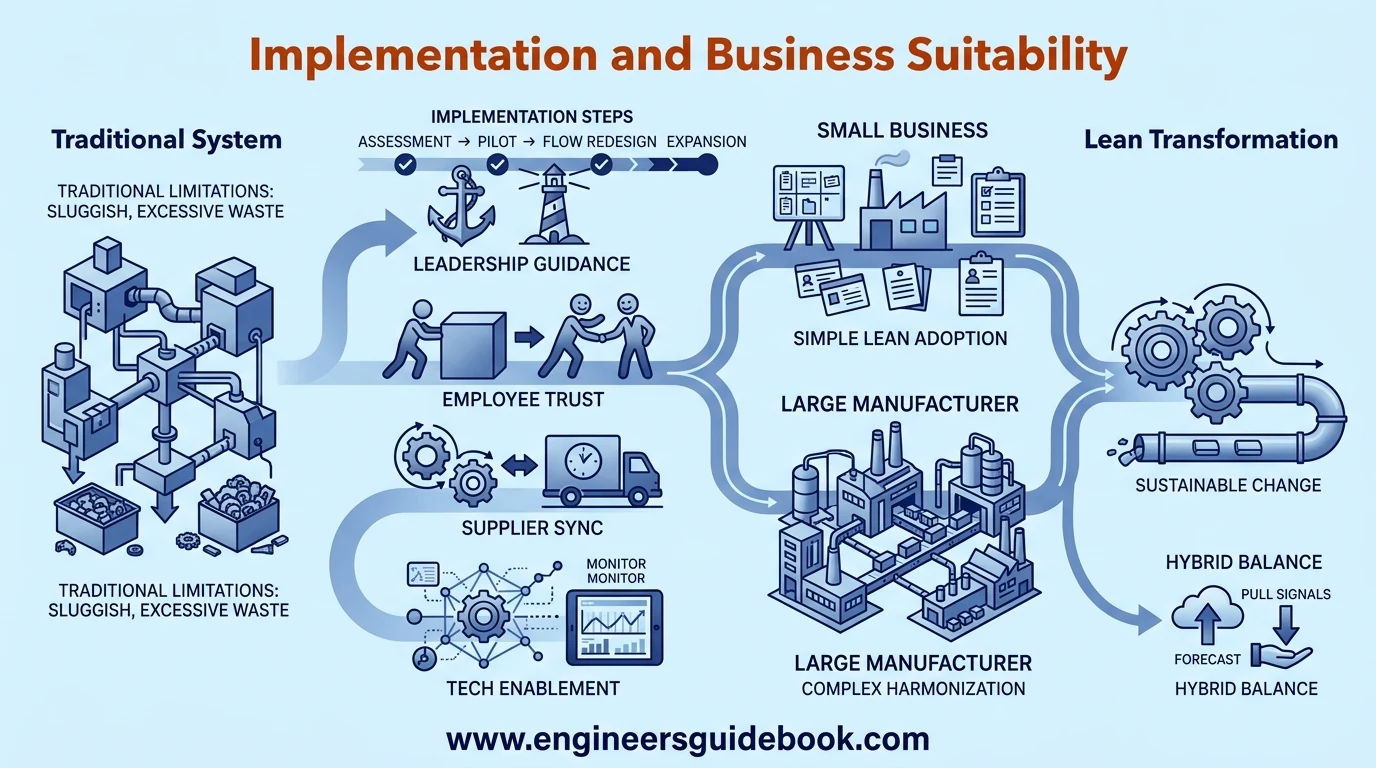
Lean transformation begins with understanding value streams, identifying constraints, stabilizing processes, and developing improvement capability. Sustainable change requires persistent behavioral reform rather than isolated deployment of fashionable tools.
11.2 Traditional System Limitations
Traditional systems become vulnerable when demand fluctuates, product lifecycles shorten, or customization increases. Large batches and departmental silos can generate sluggishness, hidden waste, and excessive working capital.
11.3 Leadership Commitment
Leaders must establish priorities, provide resources, remove barriers, and model disciplined problem solving. Without visible commitment, lean initiatives deteriorate into temporary housekeeping or cost-reduction campaigns.
11.4 Employee Resistance
Resistance often develops when employees associate lean with workforce reduction, intensified labor, or managerial surveillance. Transparent communication and meaningful participation are necessary to establish confidence and psychological safety.
11.5 Supplier Readiness
Just-in-time production requires dependable suppliers capable of consistent quality and frequent replenishment. Supplier instability can jeopardize lean flow, making collaborative development and prudent contingency planning essential.
11.6 Technology Integration
Digital systems can support either manufacturing model through real-time monitoring, predictive maintenance, automated scheduling, and traceability. Technology creates value only when it strengthens a coherent and capable process.
11.7 Small Business Suitability
Small manufacturers can adopt lean principles without expensive systems. Workplace organization, visual controls, standardized work, and simple replenishment methods often produce significant improvements with modest capital expenditure.
11.8 Large Manufacturer Suitability
Large manufacturers benefit from lean through harmonized processes and improved coordination. However, organizational complexity, legacy systems, and entrenched departmental metrics can make transformation arduous.
11.9 Hybrid Manufacturing Systems
Many organizations combine lean and traditional practices. Forecasts may guide long-term capacity, while pull signals control daily replenishment. Strategic buffers can also protect critical operations from volatile supply conditions.
11.10 Implementation Roadmap
A practical roadmap includes assessment, pilot selection, process stabilization, employee training, flow redesign, performance measurement, and gradual expansion. Each stage should generate verifiable learning before broader replication.
12. Frequently Asked Questions
12.1 What Is the Main Difference Between Lean Manufacturing and Traditional Manufacturing
Lean manufacturing produces according to customer demand while continuously eliminating waste. Traditional manufacturing emphasizes forecast-based production, large batches, specialized departments, and inventory protection.
12.2 Is Lean Manufacturing Better Than Traditional Manufacturing
Neither system is universally superior. Lean performs strongly in dynamic, competitive environments, whereas traditional production can remain efficient for standardized products with predictable, high-volume demand.
12.3 How Does Lean Manufacturing Reduce Waste
Lean exposes unnecessary activity through value-stream analysis, workplace observation, standardized work, pull systems, root cause analysis, and employee-led improvement.
12.4 Why Does Traditional Manufacturing Use More Inventory
Traditional manufacturers use inventory to protect schedules from forecast errors, supplier delays, long setups, machine failures, quality problems, and uneven production capacity.
12.5 Can Lean Manufacturing Work in Every Industry
Lean principles can support manufacturing, healthcare, construction, logistics, and services. However, individual tools must be adapted to the risks, regulations, demand patterns, and processes of each industry.
12.6 What Are the Disadvantages of Lean Manufacturing
Poorly designed lean systems may become vulnerable to supply disruption, demand volatility, employee fatigue, or insufficient inventory. Misapplication can also prioritize cost cutting over genuine improvement.
12.7 Is Traditional Manufacturing Still Relevant
Traditional manufacturing remains relevant for commodities, continuous processes, stable demand, and highly standardized production where long runs provide substantial economic advantage.
12.8 How Does Lean Manufacturing Improve Quality
Lean improves quality by detecting defects at their source, stabilizing work methods, preventing errors, analyzing root causes, and making abnormalities immediately visible.
12.9 How Long Does Lean Manufacturing Implementation Take
Initial improvements may appear within weeks, but meaningful transformation usually requires several years. Duration depends on leadership, process complexity, employee capability, and organizational discipline.
12.10 Can Lean and Traditional Manufacturing Be Combined
Yes. Hybrid systems can use forecasts for strategic planning while applying lean flow, pull replenishment, preventive quality, and continuous improvement within daily operations.
13. Conclusion
Lean manufacturing prioritizes customer value, low inventory, responsive flow, employee participation, and systematic waste removal. Traditional manufacturing prioritizes scale, specialization, forecasts, buffers, and centralized control.
The appropriate approach depends on demand stability, product variety, supplier capability, regulatory requirements, capital availability, and the organization’s tolerance for operational variability.
Manufacturers should evaluate total system performance rather than imitate popular practices. The selected model must support customer expectations, commercial objectives, workforce capability, and supply-chain realities.