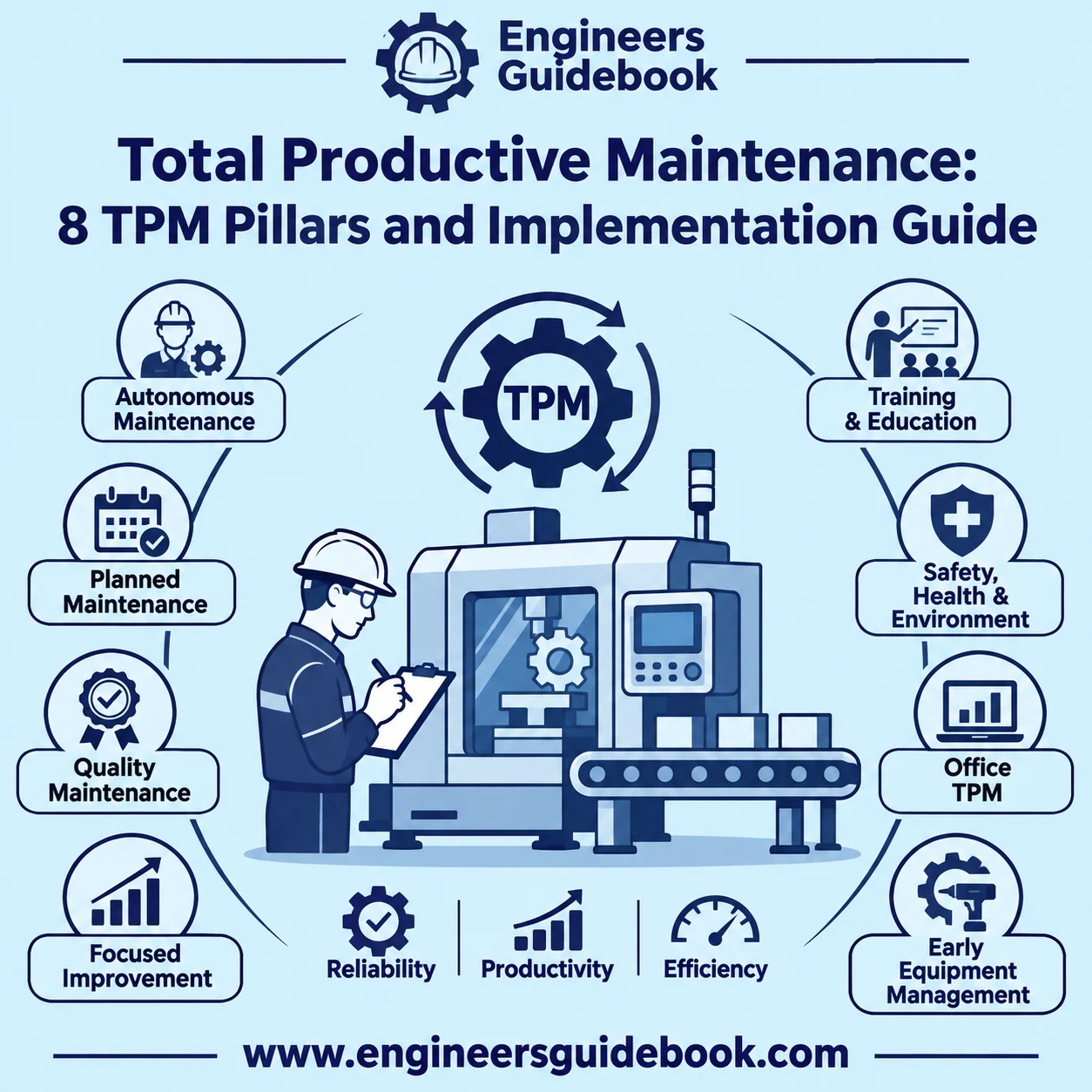
Total Productive Maintenance (TPM) is a systematic maintenance approach that maximizes equipment effectiveness through employee involvement, proactive maintenance, and continuous improvement. Its eight pillars include autonomous maintenance, planned maintenance, focused improvement, quality maintenance, early equipment management, education and training, safety, health and environment, and office TPM. These pillars collectively support operational reliability, productivity, and waste reduction.
1. Introduction to Total Productive Maintenance
1.1 What Is Total Productive Maintenance?
Total Productive Maintenance (TPM) is an organization-wide methodology that integrates equipment maintenance with production management to maximize operational effectiveness throughout the equipment life cycle.
1.2 History and Evolution of TPM
TPM originated in Japan, evolving from preventive maintenance practices. The Japan Institute of Plant Maintenance (JIPM) formally introduced TPM in 1971, establishing a participatory approach to equipment management.
1.3 Purpose and Objectives of TPM
The primary objectives of TPM include:
Eliminating equipment breakdowns.
Minimizing production losses.
Improving product quality.
Preventing workplace accidents.
Maximizing equipment effectiveness.
Reducing maintenance expenditure.
1.4 Importance of TPM in Manufacturing
Manufacturing facilities depend on equipment reliability to maintain production schedules. TPM improves operational continuity, reduces unexpected downtime, and enables organizations to utilize existing manufacturing assets more effectively.
1.5 Fundamental Principles of TPM
TPM emphasizes proactive maintenance, collective responsibility, systematic loss elimination, employee development, equipment standardization, and continuous improvement rather than relying exclusively on reactive repairs.
2. Total Productive Maintenance Framework
2.1 Understanding the TPM Framework
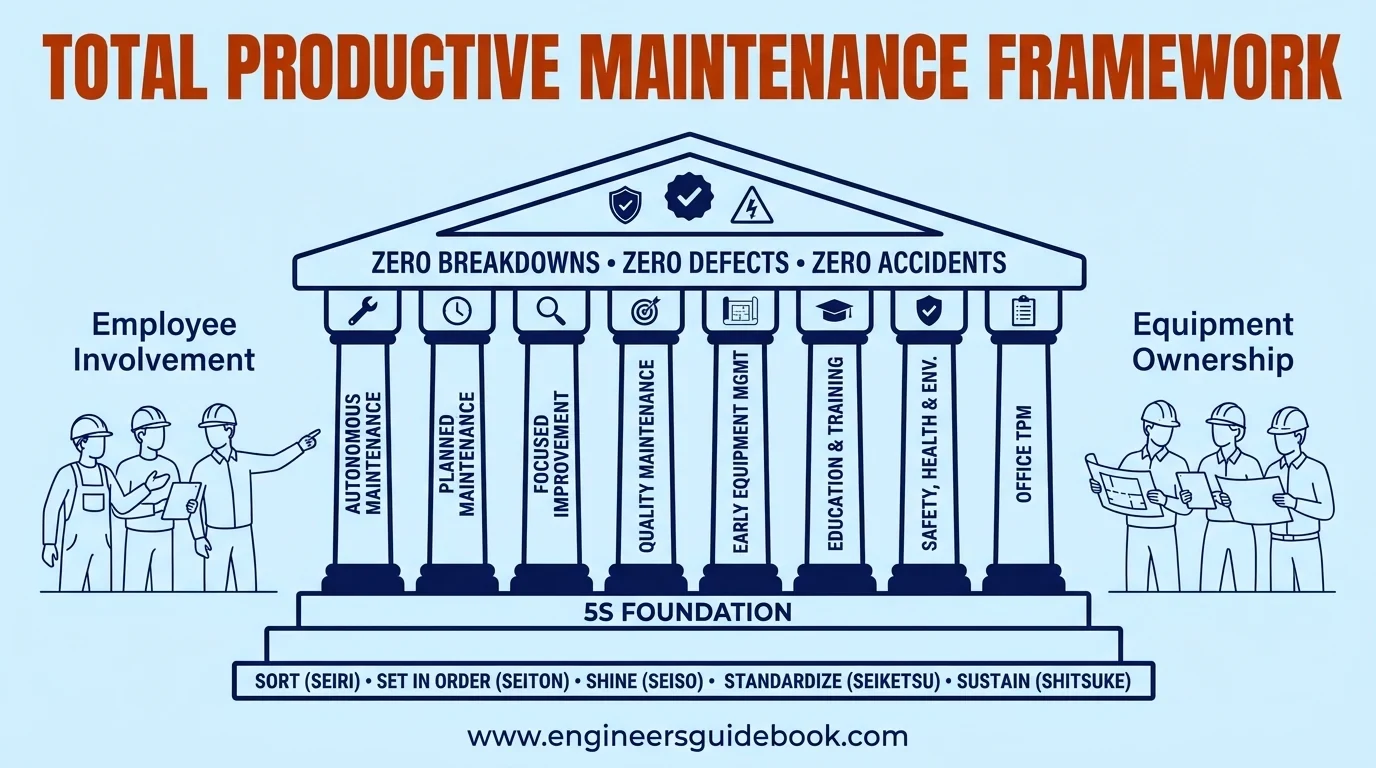
The TPM framework comprises eight interconnected pillars supported by a foundation of workplace organization. Each pillar addresses specific operational losses and contributes to sustainable equipment performance.
2.2 The Eight Pillars of TPM
Pillar Primary Function Autonomous Maintenance Operator-led routine maintenance Planned Maintenance Proactive equipment maintenance Focused Improvement Systematic loss elimination Quality Maintenance Equipment-related defect prevention Early Equipment Management Reliability-oriented equipment design Education and Training Employee competency development Safety, Health, and Environment Risk and environmental management Office TPM Administrative process improvement
2.3 The Role of 5S in TPM
The 5S methodology establishes the foundation for successful TPM implementation through five workplace organization practices:
Seiri: Sort unnecessary items.
Seiton: Set necessary items in order.
Seiso: Shine through cleaning.
Seiketsu: Standardize workplace practices.
Shitsuke: Sustain established standards
2.4 Zero Breakdowns, Zero Defects, and Zero Accidents
These three aspirational objectives guide TPM activities. Organizations pursue them by eliminating equipment deterioration, controlling process variability, and systematically addressing occupational hazards.
2.5 Employee Involvement and Equipment Ownership
TPM encourages operators, technicians, engineers, and managers to share responsibility for equipment performance. This collaborative approach facilitates early abnormality detection and strengthens maintenance accountability.
2.6 Differences Between TPM and Traditional Maintenance
Parameter Traditional Maintenance TPM Responsibility Maintenance department Entire organization Approach Often reactive Proactive and preventive Primary focus Equipment repair Loss elimination Operator involvement Limited Extensive Objective Restore functionality Maximize effectiveness
3. Pillar 1 and 2 of Total Productive Maintenance
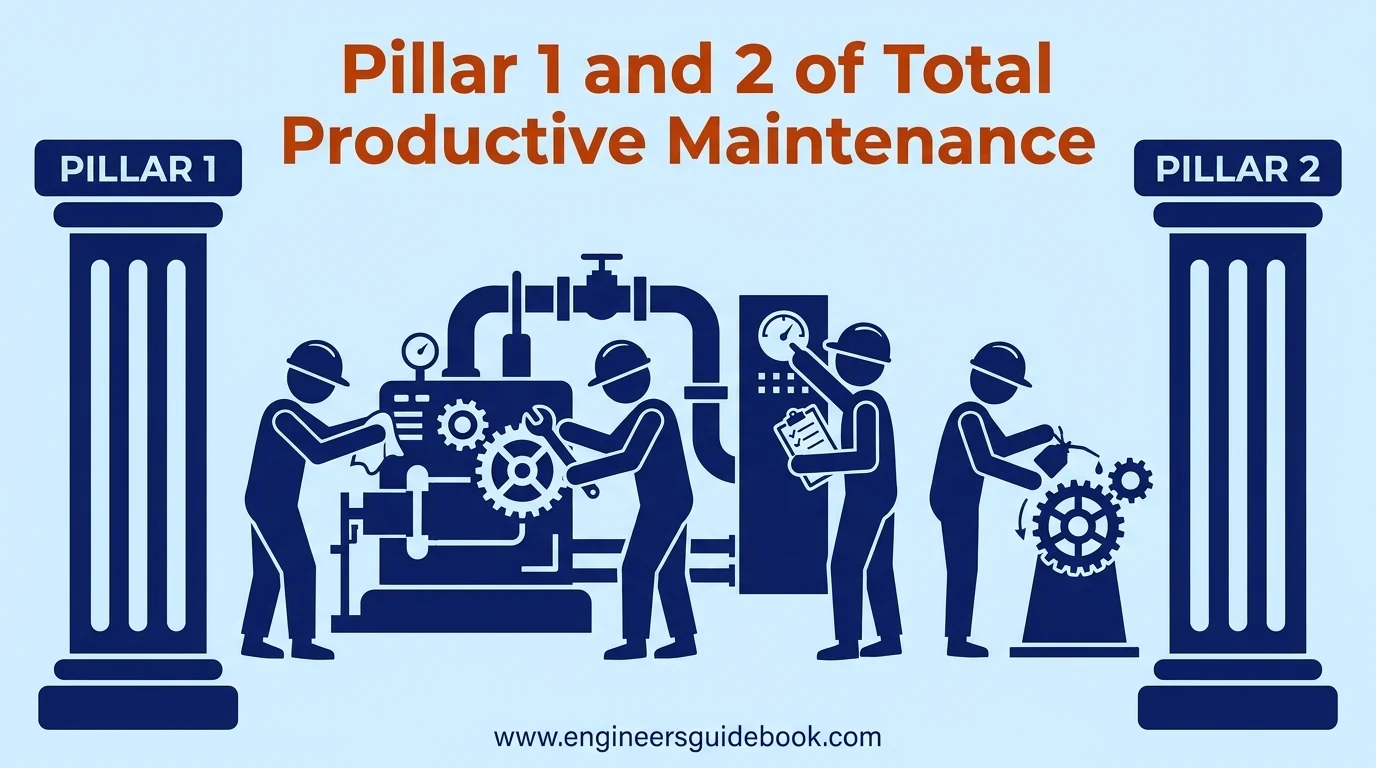
3.1 Autonomous Maintenance
Autonomous maintenance, also called Jishu Hozen, empowers trained machine operators to perform routine equipment care activities, including cleaning, inspection, lubrication, and authorized minor adjustments.
3.2 Objectives of Autonomous Maintenance
Its fundamental objectives include preventing accelerated deterioration, detecting abnormalities early, developing operator competencies, and reducing unnecessary dependence on specialized maintenance personnel.
3.3 Seven Steps of Autonomous Maintenance
The conventional seven-step implementation process includes:
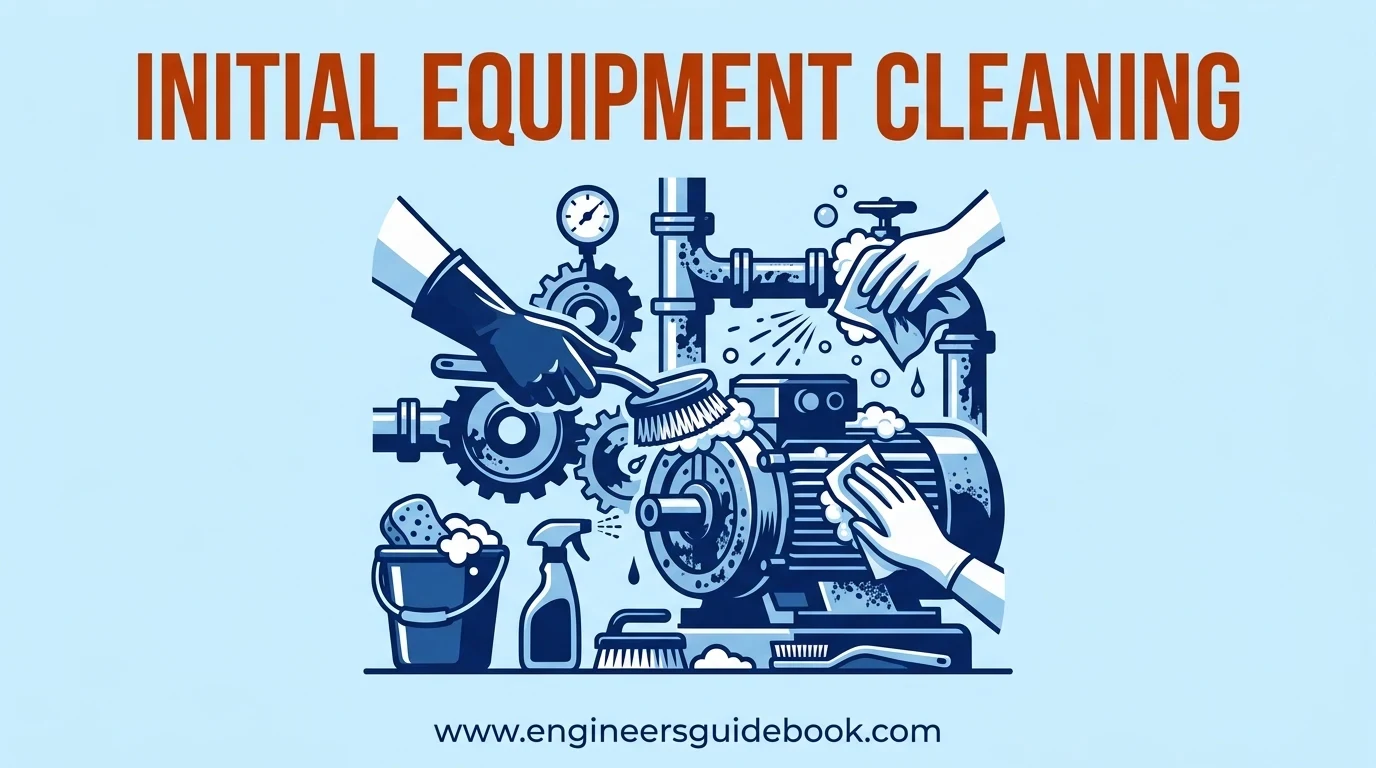
1. Initial equipment cleaning.
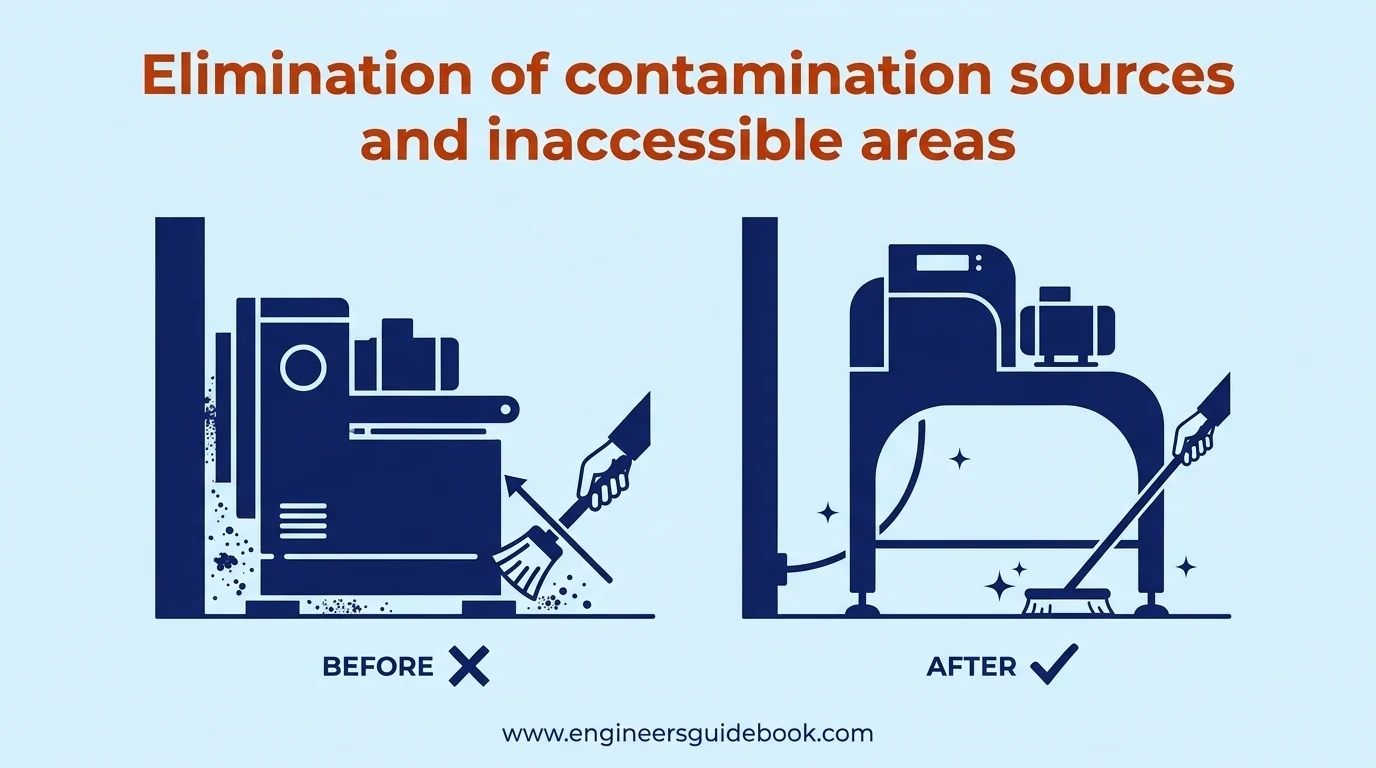
2. Elimination of contamination sources and inaccessible areas.
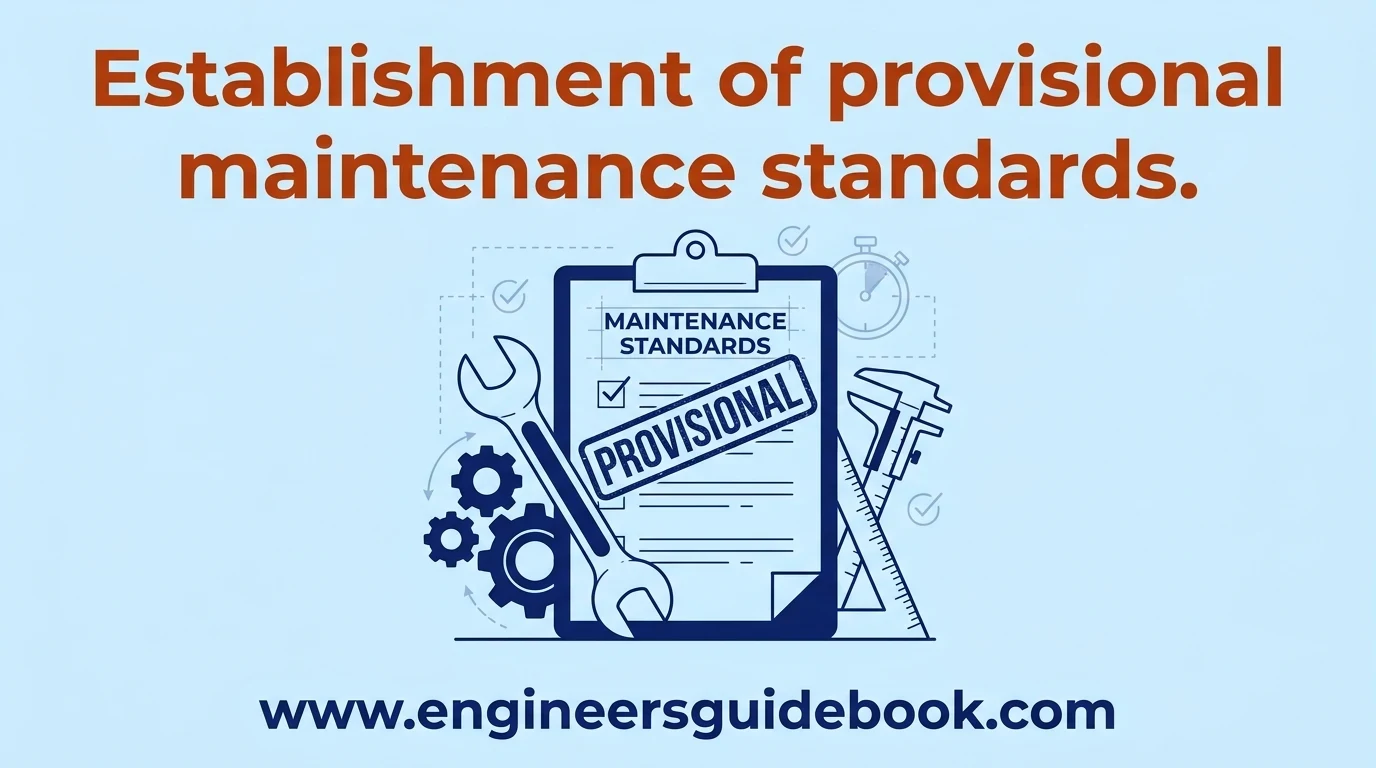
3. Establishment of provisional maintenance standards.
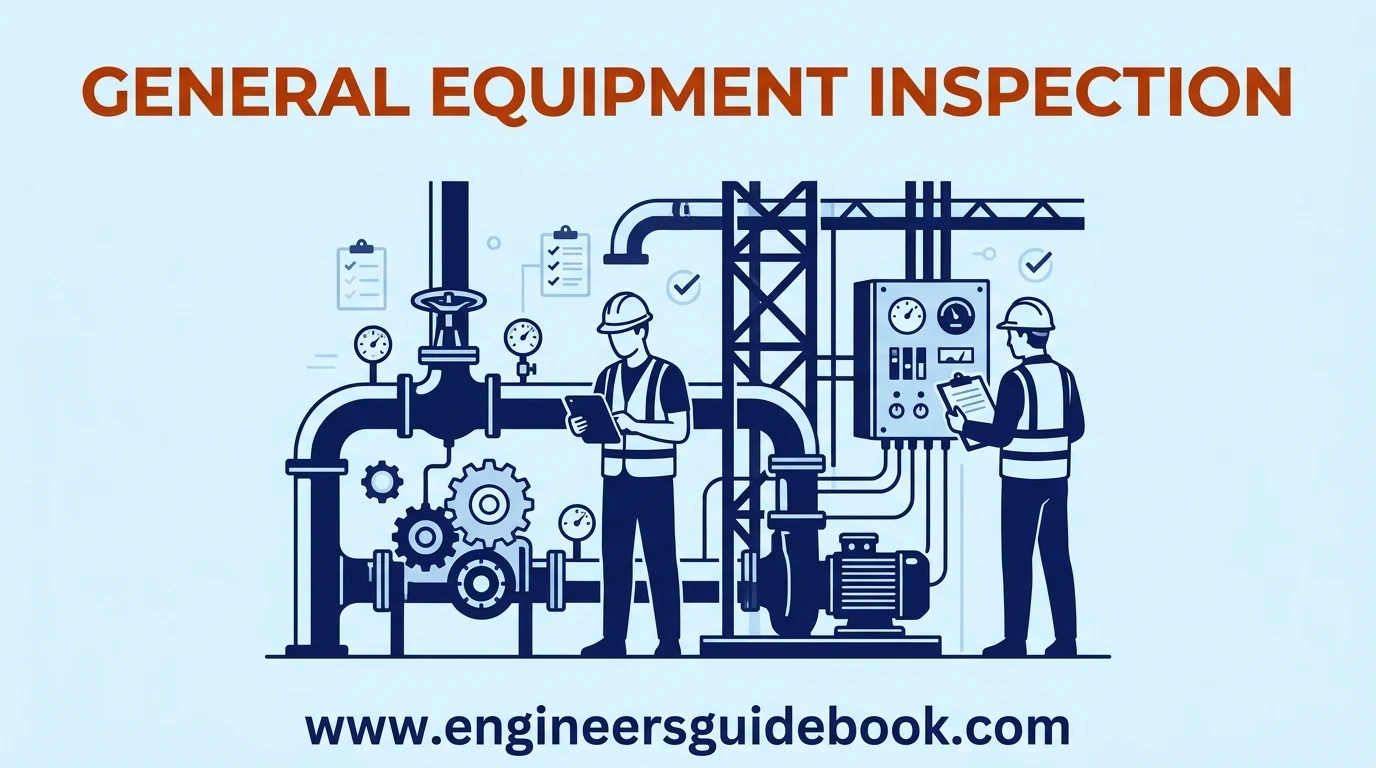
4. General equipment inspection.
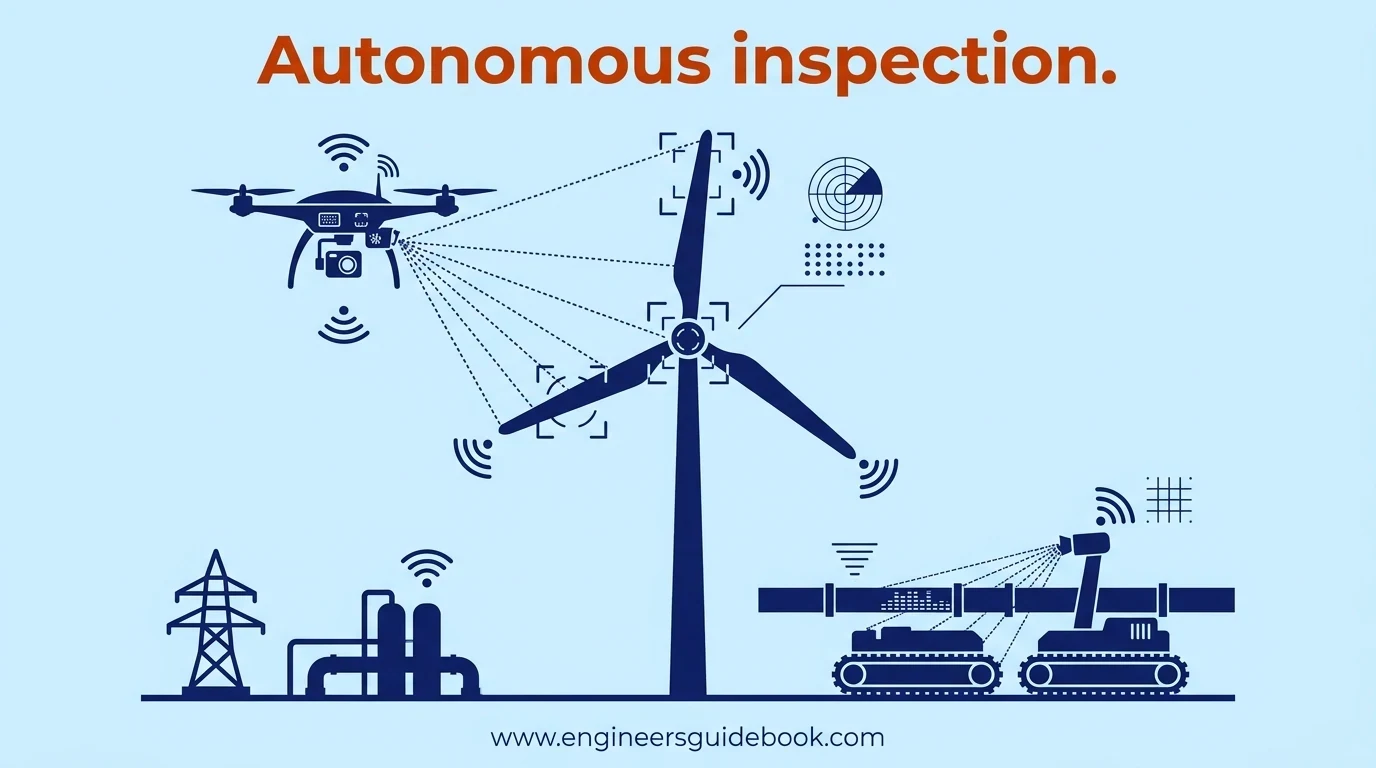
5. Autonomous inspection.
6. Standardization and workplace management.
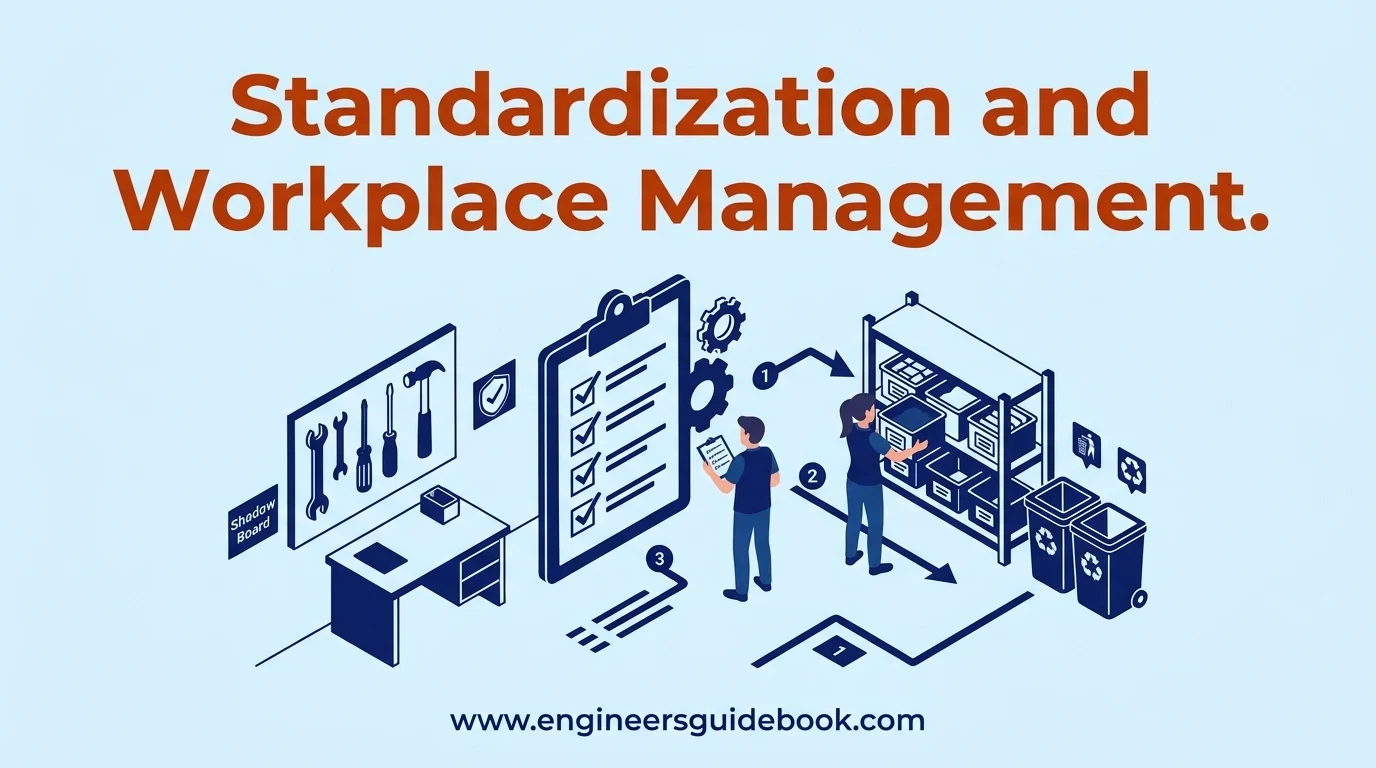
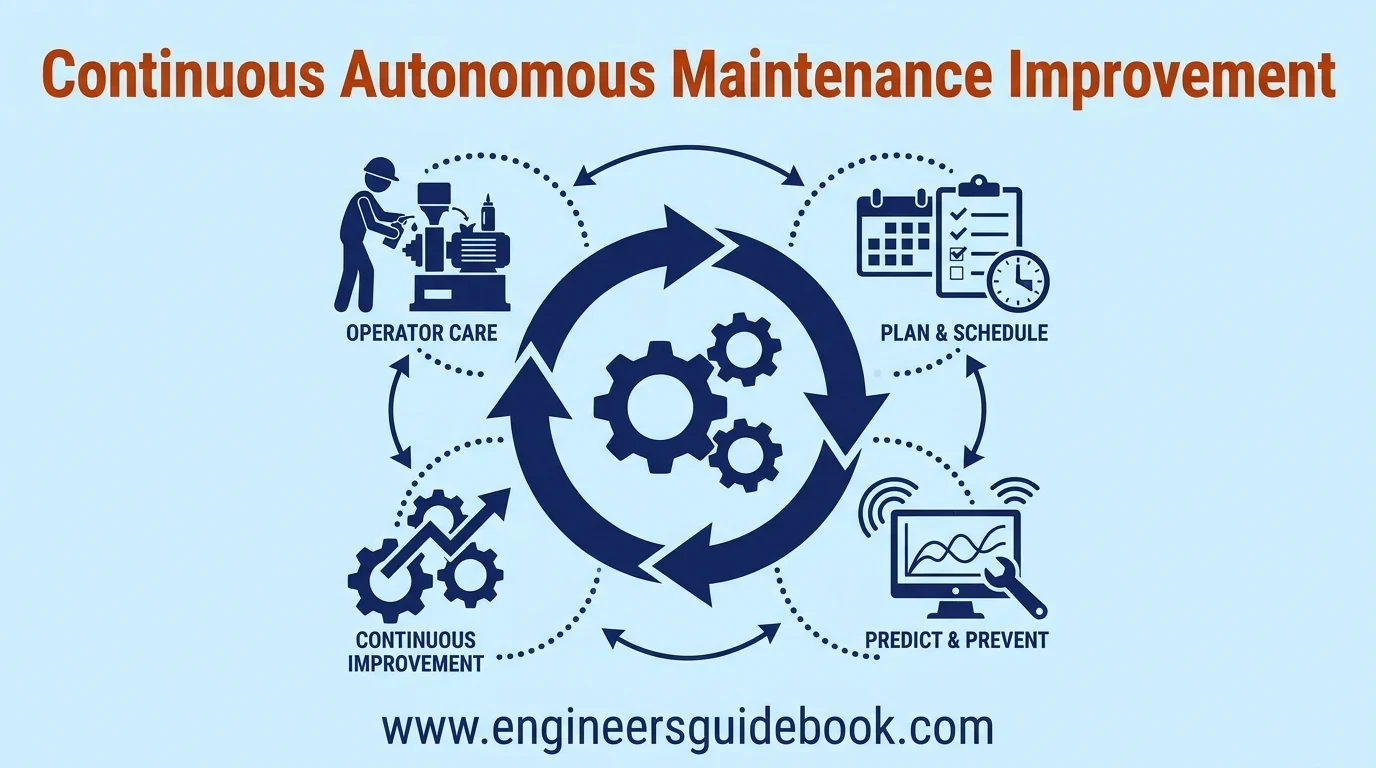
7. Continuous autonomous maintenance improvement.
3.4 Operator Responsibilities in Autonomous Maintenance
Operators inspect equipment condition, monitor abnormal vibration and noise, follow lubrication schedules, maintain cleanliness, and report defects. Specialized repairs remain the responsibility of qualified maintenance personnel.
3.5 Planned Maintenance
Planned maintenance systematically schedules equipment inspections, servicing, component replacements, and overhauls according to asset criticality, operating conditions, deterioration patterns, and historical failure data.
3.6 Preventive, Predictive, and Corrective Maintenance
Preventive maintenance follows predetermined intervals. Predictive maintenance evaluates equipment condition to anticipate failures, while corrective maintenance restores functionality or addresses identified equipment defects.
3.7 Developing an Effective Planned Maintenance Schedule
An effective schedule incorporates equipment criticality, manufacturer recommendations, maintenance history, spare parts availability, technician requirements, and production windows. Maintenance intervals should be periodically evaluated and optimized.
3.8 Benefits of Autonomous and Planned Maintenance
Combining these pillars improves equipment reliability, minimizes emergency repairs, reduces maintenance costs, and increases equipment availability while establishing a structured maintenance environment.
4. Pillar 3 and 4 of Total Productive Maintenance
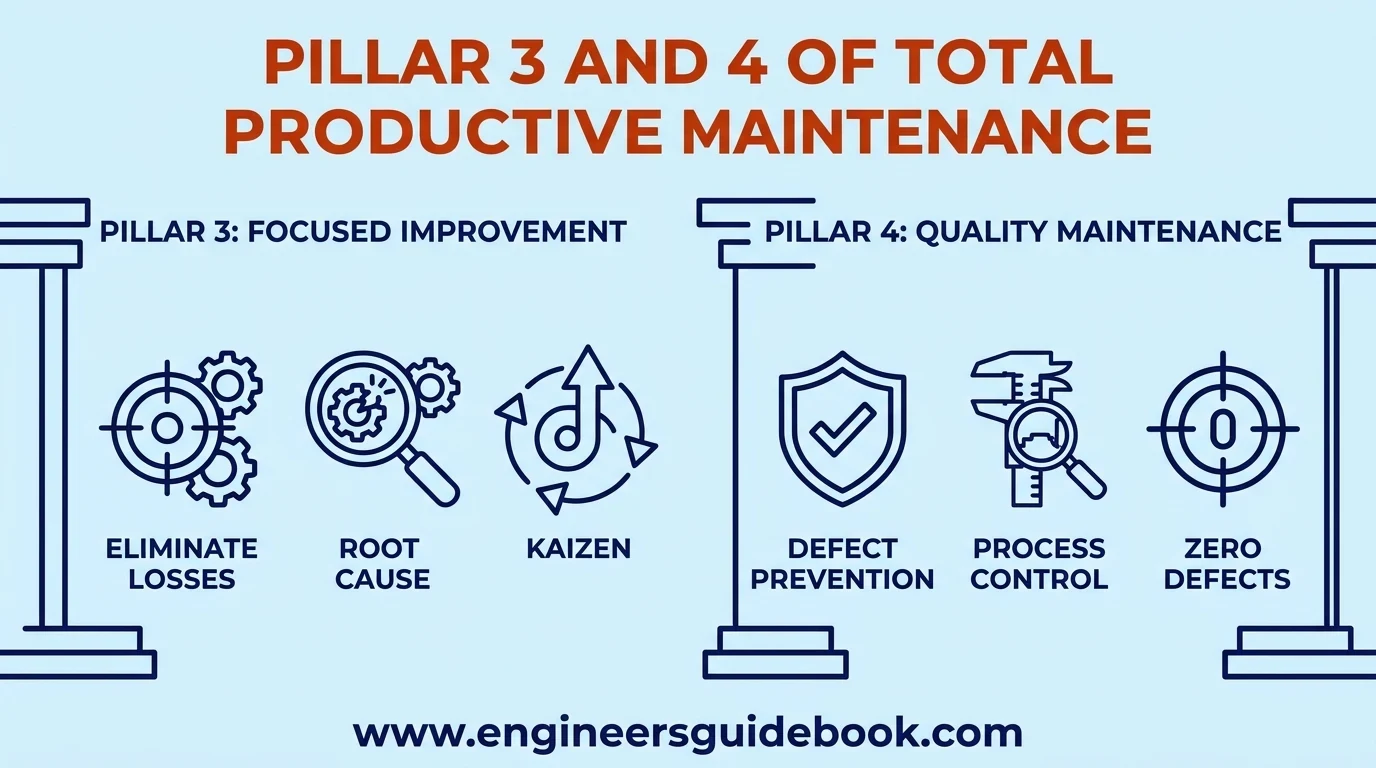
4.1 Focused Improvement
Focused improvement, known as Kobetsu Kaizen, involves cross-functional teams systematically identifying, analyzing, and eliminating recurring production and equipment losses through targeted improvement projects.
4.2 Identifying and Eliminating Equipment Losses
Teams examine downtime records, cycle times, rejection rates, and equipment abnormalities. Pareto analysis helps prioritize losses according to their frequency, duration, and operational consequences.
4.3 Root Cause Analysis and Kaizen
Root cause analysis techniques, including the 5 Whys, fishbone diagrams, and fault tree analysis, identify underlying failure mechanisms. Kaizen facilitates incremental improvements that prevent recurrence.
4.4 Continuous Improvement Through Focused Improvement
The Plan-Do-Check-Act cycle provides a structured improvement mechanism. Successful countermeasures are validated, documented, standardized, and replicated across similar equipment.
4.5 Quality Maintenance
Quality maintenance establishes and preserves equipment conditions necessary to manufacture products within specified quality parameters. Its emphasis is defect prevention rather than subsequent detection.
4.6 Identifying Equipment-Related Quality Defects
Worn bearings, inaccurate sensors, misaligned components, unstable temperatures, and incorrect machine settings can introduce dimensional inaccuracies, contamination, inconsistent filling, and other product defects.
4.7 Defect Prevention and Process Control
Statistical process control, equipment condition monitoring, calibration, mistake-proofing, and standardized operating parameters help maintain process stability and prevent equipment-induced quality deviations.
4.8 Achieving Zero Defects Through Quality Maintenance
Organizations pursue zero defects by correlating equipment conditions with quality characteristics, establishing acceptable operating limits, and eliminating deterioration mechanisms responsible for recurring defects.
5. Pillar 5 and 6 of Total Productive Maintenance
5.1 Early Equipment Management
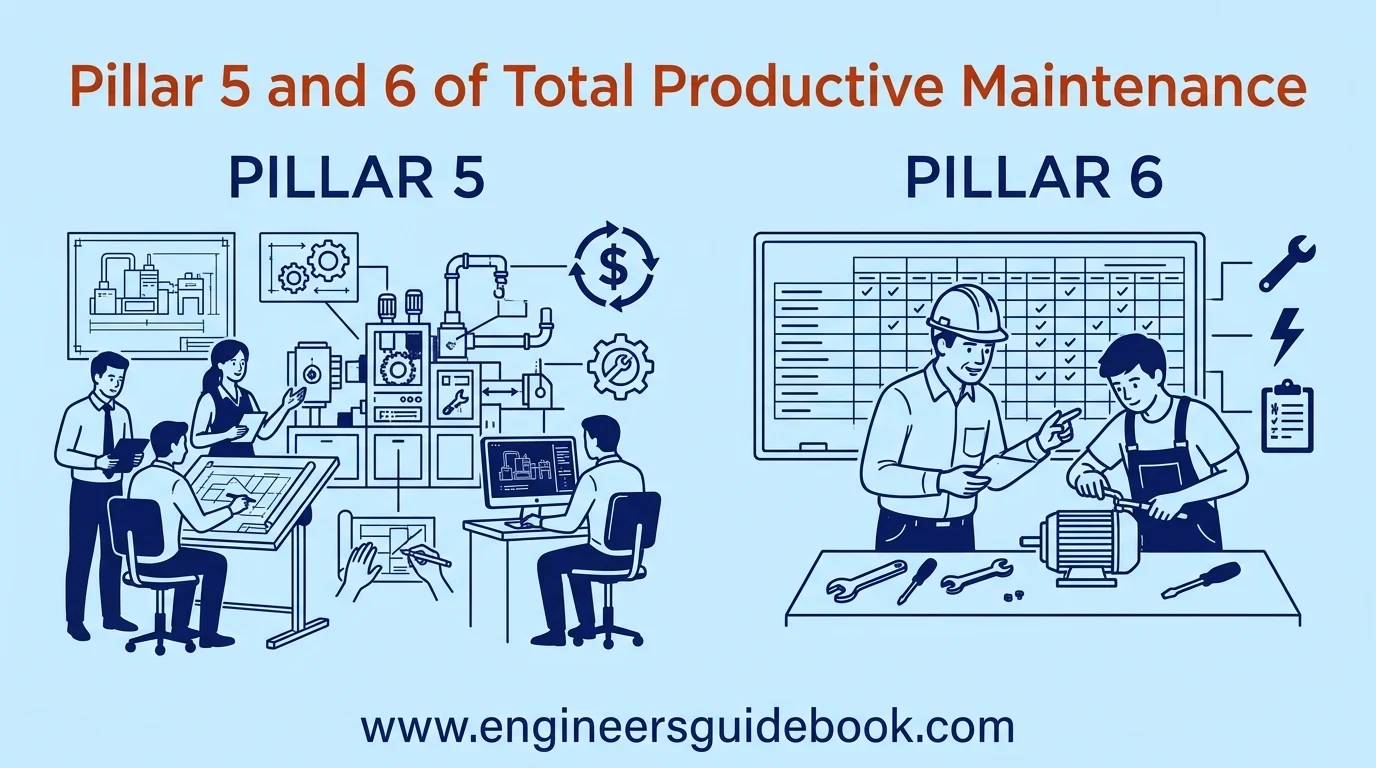
Early equipment management incorporates operational experience and maintenance requirements into equipment design, procurement, installation, and commissioning to minimize future reliability problems.
5.2 Equipment Reliability and Maintainability
Reliable equipment performs its intended function consistently. Maintainable equipment allows technicians to conduct inspections, servicing, and repairs efficiently through accessible components and practical design configurations.
5.3 Life Cycle Cost Management
Life cycle cost management evaluates total equipment ownership expenditure, including acquisition, installation, energy consumption, maintenance, replacement components, downtime, and eventual disposal costs.
5.4 Maintenance Prevention Through Equipment Design
Maintenance prevention involves eliminating foreseeable maintenance difficulties during equipment development. Accessible lubrication points, modular assemblies, standardized components, and effective contamination protection improve long-term serviceability.
5.5 Education and Training
The education and training pillar develops technical, operational, analytical, and problem-solving competencies necessary for effective equipment operation and maintenance.
5.6 Identifying Employee Skill Gaps
Skill assessments compare existing employee competencies against job-specific requirements. Practical evaluations, performance observations, and maintenance records help identify deficiencies requiring targeted training.
5.7 Developing a TPM Training Matrix
A training matrix documents employee competencies, qualification levels, and development requirements. Typical competency levels include awareness, supervised performance, independent performance, and ability to train others.
5.8 Technical Training and Multiskilling
Multiskilling develops capabilities across equipment operation, mechanical maintenance, electrical troubleshooting, instrumentation, and reliability analysis within established authorization and safety requirements.
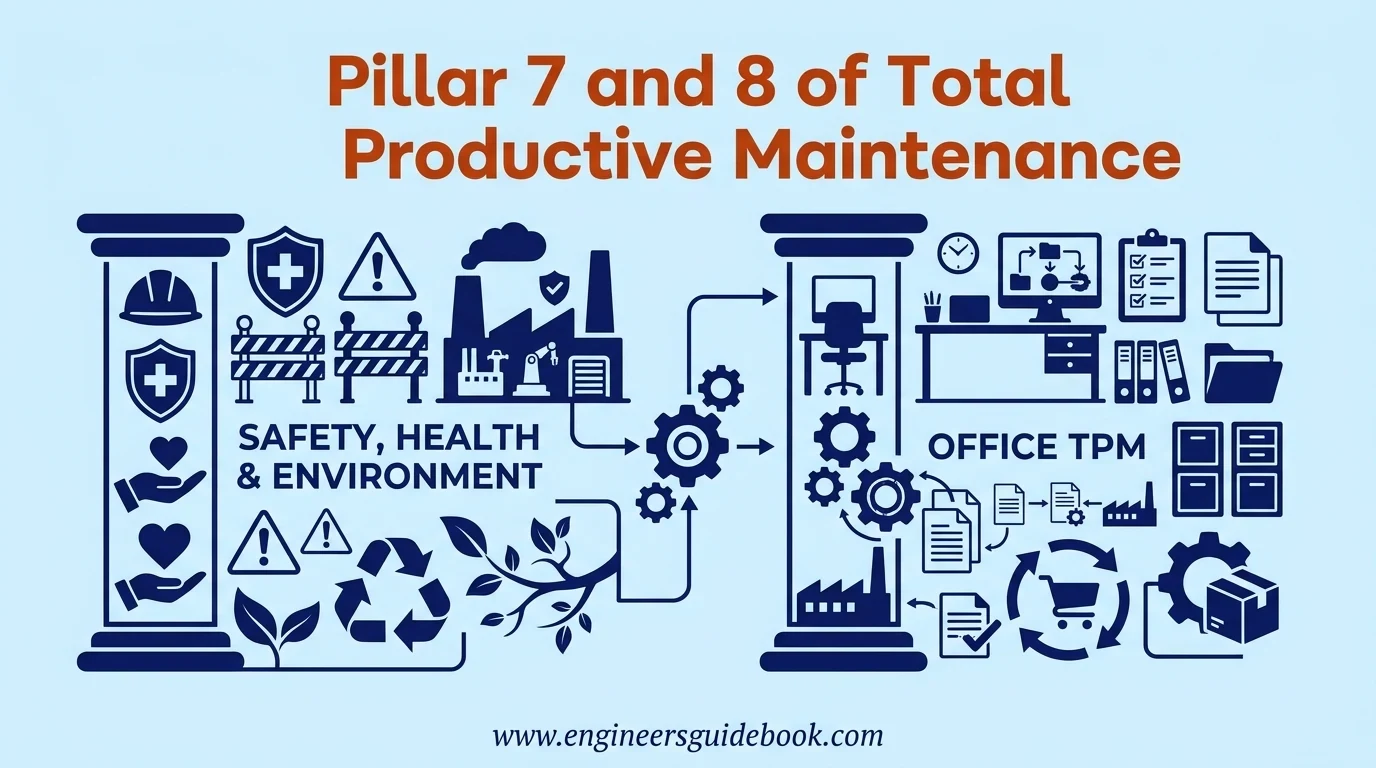
6. Pillar 7 and 8 of Total Productive Maintenance
6.1 Safety, Health, and Environment
This pillar integrates occupational safety, employee well-being, and environmental protection into routine equipment management and continuous improvement activities.
6.2 Workplace Hazard Identification and Risk Assessment
Systematic risk assessments identify mechanical, electrical, chemical, ergonomic, and environmental hazards. Appropriate control measures reduce exposure and mitigate potential consequences.
6.3 Accident Prevention Through TPM
Machine guarding, lockout/tagout procedures, safety inspections, interlock verification, and employee training contribute to accident prevention. Equipment maintenance must never compromise established safety controls.
6.4 Environmental Sustainability and Resource Efficiency
Maintaining efficient equipment reduces unnecessary energy consumption, lubricant leakage, material wastage, emissions, and resource losses, supporting environmental sustainability and lower operating expenditure.
6.5 Office TPM
Office TPM extends continuous improvement principles beyond production equipment into procurement, planning, finance, logistics, documentation, and other administrative functions.
6.6 Eliminating Administrative Process Losses
Administrative losses include redundant approvals, inaccurate documentation, communication delays, duplicated activities, and inefficient information processing. Standardized workflows help eliminate these inefficiencies.
6.7 Improving Procurement and Spare Parts Management
Effective spare parts management incorporates criticality classification, inventory optimization, supplier performance evaluation, reorder levels, and procurement planning to minimize maintenance-related production delays.
6.8 Integrating Administrative and Production Functions
Cross-functional coordination ensures maintenance resources, spare parts, purchasing approvals, and production schedules remain aligned with equipment reliability requirements and organizational objectives.
7. Total Productive Maintenance and Overall Equipment Effectiveness
7.1 Understanding Overall Equipment Effectiveness
Overall Equipment Effectiveness (OEE) measures how effectively manufacturing equipment converts planned production time into productive time spent manufacturing acceptable products at the ideal cycle rate.
7.2 Relationship Between TPM and OEE
OEE provides a quantitative framework for evaluating TPM performance. Improvements in equipment reliability, operating speed, and product quality directly influence overall equipment effectiveness.
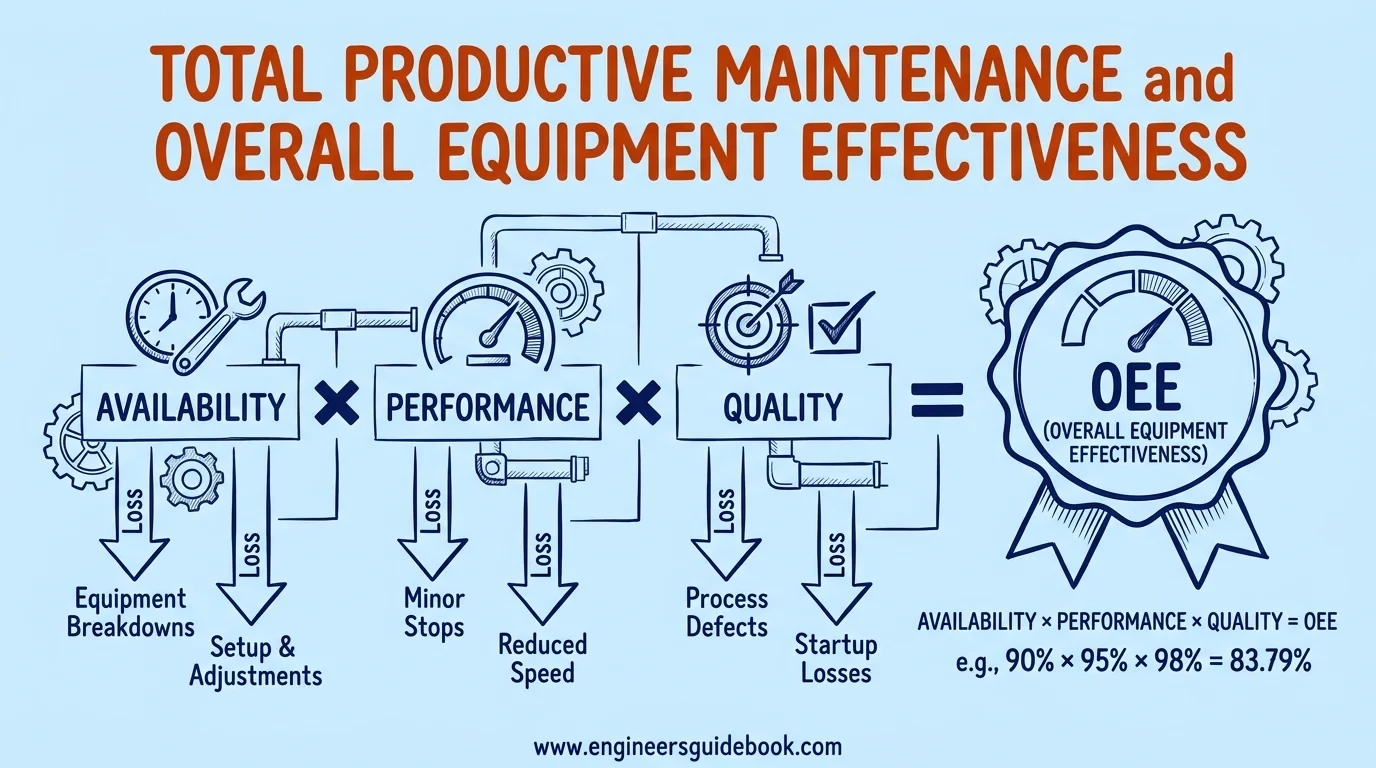
7.3 OEE Availability, Performance, and Quality
OEE comprises three fundamental components:
Availability: Actual operating time relative to planned production time.
Performance: Actual production rate relative to the ideal production rate.
Quality: Acceptable products relative to total manufactured products.
7.4 OEE Formula and Calculation
The standard OEE formula is:
OEE (%) = Availability × Performance × Quality × 100
All three factors must be expressed as decimal values before multiplication.
7.5 The Six Big Losses of TPM
Loss Category OEE Component Equipment breakdowns Availability Setup and adjustments Availability Idling and minor stops Performance Reduced operating speed Performance Process defects Quality Startup and reduced yield Quality
7.6 Equipment Breakdowns and Setup Losses
Mechanical failures, electrical faults, prolonged changeovers, and equipment adjustments reduce operating time and negatively affect availability.
7.7 Minor Stops and Reduced Speed Losses
Sensor interruptions, material feeding problems, recurring jams, and operation below ideal cycle speed diminish production output without necessarily causing prolonged equipment stoppages.
7.8 Process Defects and Startup Losses
Rejected products generated during normal operation or initial process stabilization reduce quality performance, increase material consumption, and contribute to manufacturing inefficiency.
7.9 Practical OEE Calculation Example
Consider a manufacturing machine with the following performance indicators:
Parameter Value Availability 90% Performance 95% Quality 98%
OEE = 0.90 × 0.95 × 0.98 × 100
OEE = 83.79%
The machine achieves an OEE score of 83.79%. Targeted TPM activities can improve this result by addressing downtime, speed reductions, and production defects.
8. Step-by-Step Total Productive Maintenance Implementation Guide
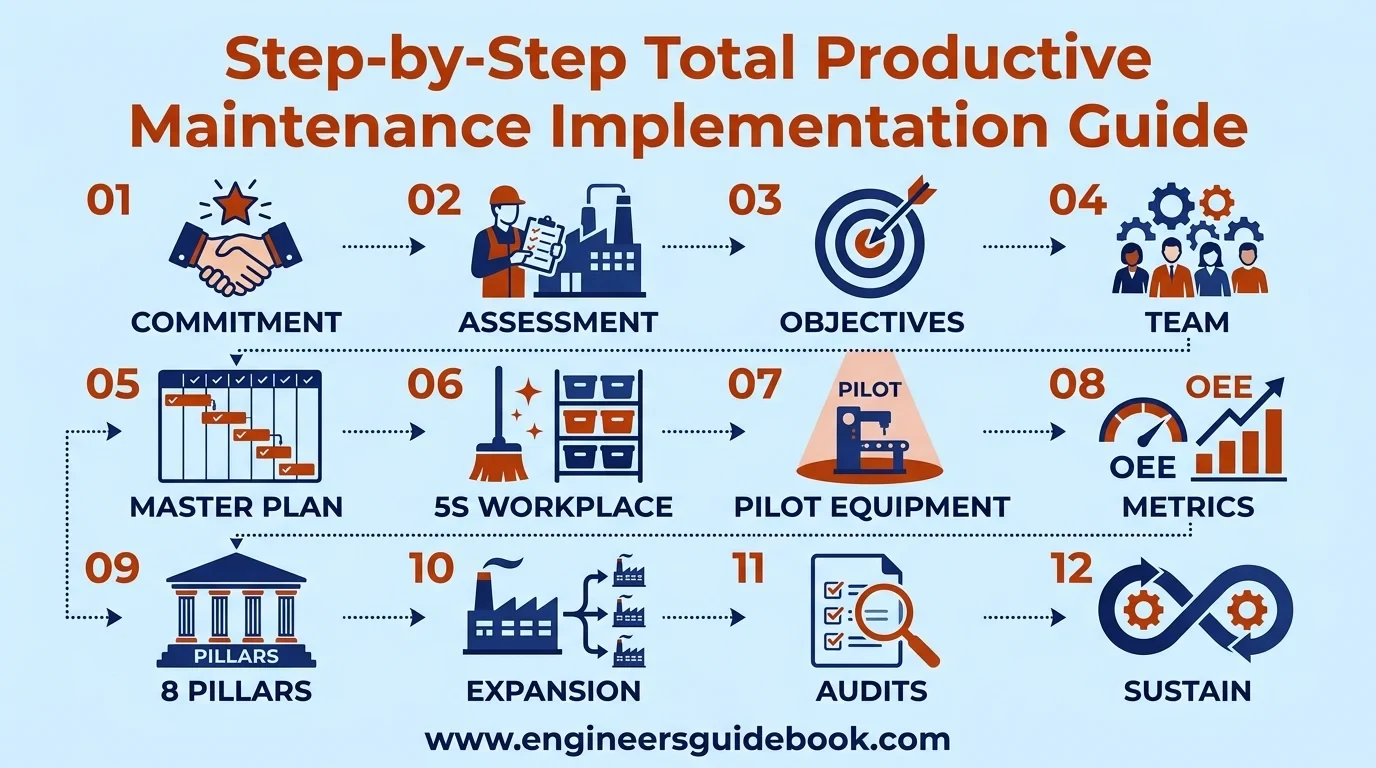
8.1 Establishing Management Commitment
Successful TPM implementation begins with management commitment. Senior management must allocate sufficient financial resources, establish organizational expectations, communicate maintenance objectives, and actively support employee participation.
8.2 Conducting an Initial Equipment Assessment
Evaluate equipment conditions, historical breakdowns, maintenance expenditure, production losses, and existing maintenance practices. Equipment criticality assessments help identify assets requiring immediate attention.
8.3 Defining TPM Objectives and Targets
Establish measurable objectives using the SMART framework. Targets may include reducing breakdown frequency by 30%, increasing OEE by five percentage points, or improving preventive maintenance compliance to 95%.
8.4 Establishing a Cross-Functional TPM Team
Form a dedicated team comprising production operators, maintenance technicians, engineers, quality personnel, safety officers, and management representatives. Clearly define individual responsibilities and reporting mechanisms.
8.5 Developing a TPM Master Plan
A TPM master plan establishes implementation milestones, resource requirements, training schedules, performance indicators, departmental responsibilities, and periodic assessment procedures.
8.6 Implementing 5S Workplace Organization
Remove unnecessary materials, organize tools, clean equipment, establish visual standards, and sustain workplace discipline. An organized manufacturing environment facilitates abnormality detection and efficient maintenance.
8.7 Selecting Pilot Equipment
Select equipment with significant production importance, measurable performance losses, and manageable improvement opportunities. Successful pilot projects demonstrate TPM effectiveness before organization-wide implementation.
8.8 Establishing Baseline Performance Metrics
Record existing OEE, equipment availability, breakdown frequency, maintenance costs, rejection rates, and repair durations. These baseline measurements provide reference points for evaluating subsequent improvements.
8.9 Implementing the Eight TPM Pillars
Introduce the eight pillars through structured activities, employee training, maintenance standardization, and targeted improvement projects. Implementation priorities should reflect equipment criticality and organizational maturity.
8.10 Expanding TPM Across the Organization
Following successful pilot implementation, replicate validated maintenance practices across additional machines, production lines, and departments. Adapt procedures according to equipment-specific operating requirements.
8.11 Conducting Regular TPM Audits
Periodic audits evaluate maintenance compliance, workplace organization, employee competencies, equipment conditions, and improvement progress. Identified deficiencies require documented corrective actions and assigned responsibilities.
8.12 Sustaining Continuous Improvement
Establish recurring performance reviews, Kaizen activities, employee feedback mechanisms, and maintenance optimization initiatives. TPM must become an enduring operational discipline rather than a temporary improvement campaign.
9. TPM Tools and Performance Measurement
9.1 TPM Key Performance Indicators
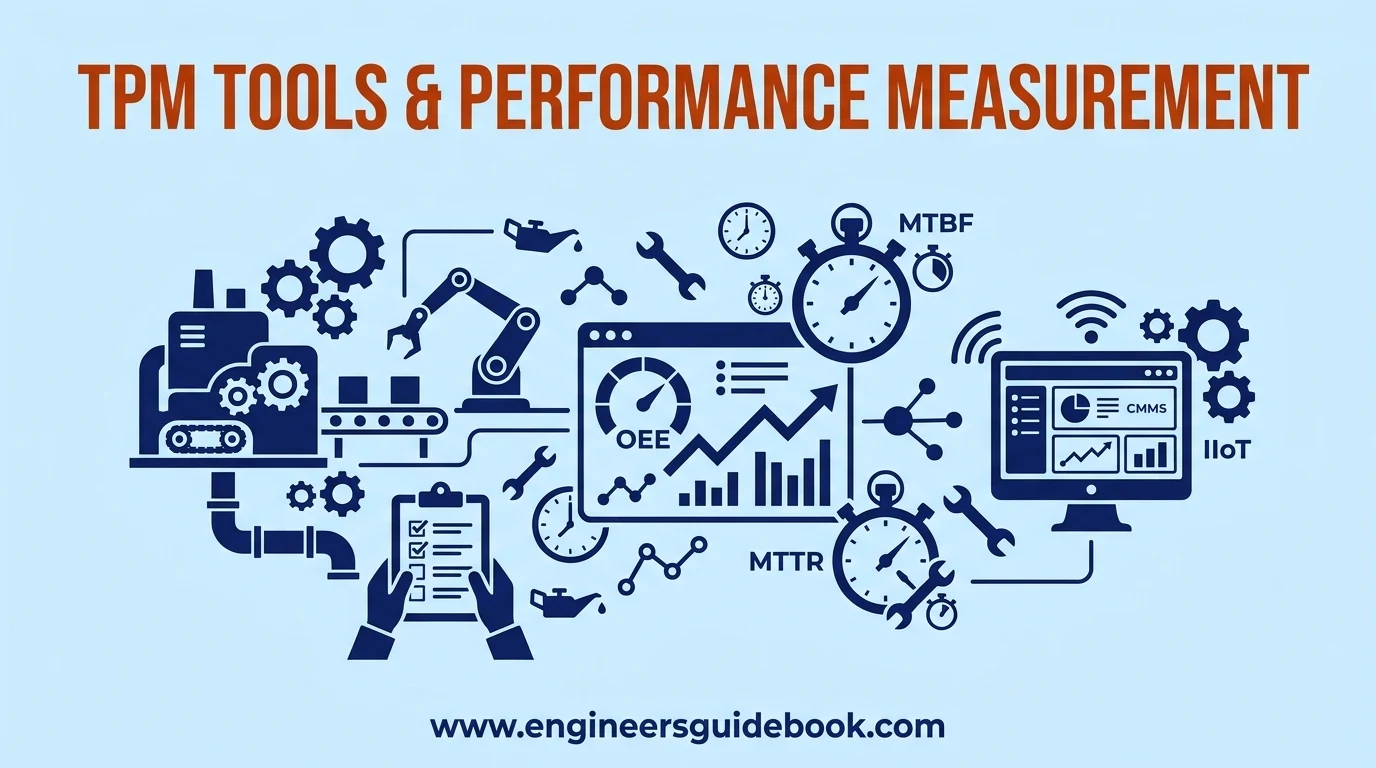
TPM performance indicators include OEE, MTBF, MTTR, equipment availability, maintenance compliance, breakdown frequency, and maintenance expenditure. These metrics quantify operational improvement.
9.2 Mean Time Between Failures
Mean Time Between Failures measures the average operating duration between failures of repairable equipment.
MTBF = Total Operating Time / Number of Failures
Increasing MTBF generally indicates improved equipment reliability.
9.3 Mean Time to Repair
Mean Time to Repair measures the average duration required to repair failed equipment.
MTTR = Total Repair Time / Number of Repairs
Reducing MTTR improves equipment maintainability and minimizes repair-related production interruptions.
9.4 Equipment Availability and Machine Utilization
Equipment availability measures readiness during the required operating period, whereas machine utilization evaluates actual operating time relative to available or scheduled time. Both indicators reveal opportunities for asset optimization.
9.5 Maintenance Cost and Breakdown Frequency
Monitoring maintenance expenditure alongside breakdown frequency helps identify problematic equipment, excessive corrective maintenance spending, and opportunities for economically justified equipment improvements.
9.6 Maintenance Compliance and Equipment Reliability
Maintenance compliance measures the proportion of scheduled maintenance activities completed within their prescribed timeframes. Consistent compliance supports reliability by addressing deterioration before functional failures occur.
9.7 TPM Checklists and Maintenance Standards
Standardized checklists specify inspection points, lubrication requirements, cleaning procedures, acceptable operating parameters, inspection frequencies, and abnormality reporting requirements.
9.8 One-Point Lessons and Visual Management
One-point lessons are concise instructional documents addressing specific maintenance tasks or equipment abnormalities. Visual management uses diagrams, identification labels, and performance boards to improve operational communication.
9.9 Computerized Maintenance Management Systems
A Computerized Maintenance Management System (CMMS) facilitates maintenance scheduling, work order management, spare parts tracking, equipment history documentation, and maintenance performance analysis.
9.10 Industry 4.0 and Digital TPM
Industrial IoT sensors, predictive analytics, artificial intelligence, and real-time monitoring systems enhance TPM by enabling condition-based maintenance and earlier detection of equipment deterioration.
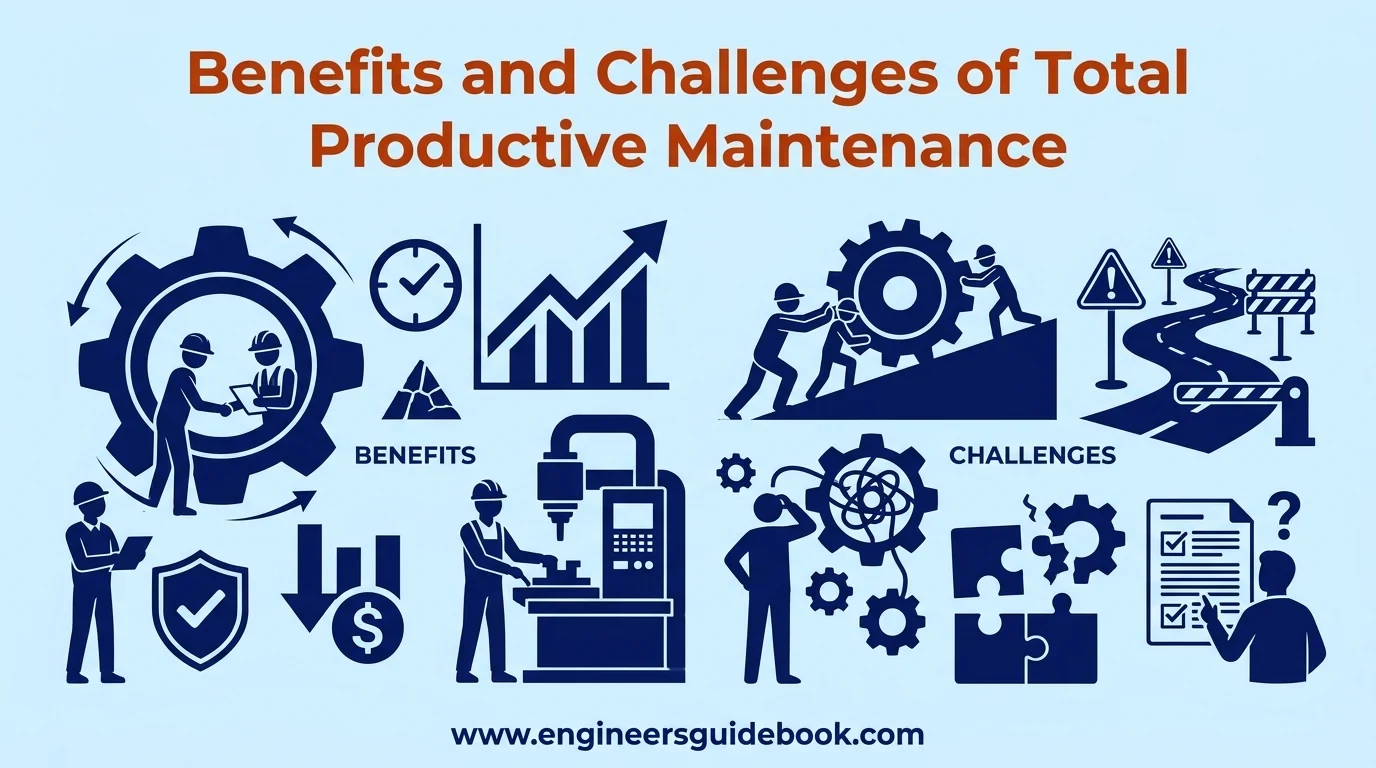
10. Benefits and Challenges of Total Productive Maintenance
10.1 Improved Equipment Reliability and Availability
Systematic inspection, lubrication, condition monitoring, and defect elimination reduce equipment deterioration, resulting in improved reliability and increased operational availability.
10.2 Reduced Unplanned Downtime
Early abnormality detection and proactive maintenance minimize unexpected equipment failures, allowing manufacturing facilities to maintain more consistent production schedules.
10.3 Increased Production Efficiency
TPM eliminates minor stoppages, equipment speed losses, prolonged changeovers, and recurring mechanical abnormalities, enabling production systems to achieve higher throughput.
10.4 Reduced Maintenance and Operating Costs
Preventing premature component failures reduces emergency repair expenditure, spare parts consumption, overtime requirements, and production losses associated with equipment breakdowns.
10.5 Improved Product Quality and Workplace Safety
Maintaining equipment within specified operating conditions reduces manufacturing defects. Systematic hazard identification and equipment safety inspections simultaneously improve occupational safety.
10.6 Increased Employee Engagement
Operator participation encourages equipment ownership, strengthens technical competencies, and facilitates collaboration between production and maintenance departments.
10.7 Common TPM Implementation Challenges
Typical challenges include inadequate management support, insufficient training, limited resources, unreliable maintenance records, production pressures, and resistance to organizational change.
10.8 Overcoming Employee Resistance to Change
Communicate TPM benefits clearly, involve employees in decision-making, provide practical training, and recognize measurable contributions. Employee participation should be supported rather than imposed without preparation.
10.9 Avoiding Common TPM Implementation Mistakes
Organizations should avoid unrealistic targets, excessive documentation, premature expansion, inadequate baseline measurements, and transferring specialized maintenance responsibilities to unqualified operators.
10.10 Sustaining Long-Term TPM Performance
Regular audits, refresher training, management reviews, standardized procedures, and performance monitoring prevent regression toward reactive maintenance practices and reinforce organizational accountability.
11. Practical Total Productive Maintenance Example
11.1 Manufacturing Production Line Scenario
Consider a hypothetical automated packaging line experiencing recurring mechanical breakdowns, conveyor stoppages, inconsistent filling, and excessive product rejection.
11.2 Identifying Equipment Performance Problems
Maintenance records reveal worn conveyor bearings, inadequate lubrication, sensor misalignment, and recurring filling nozzle leakage as significant contributors to production losses.
11.3 Assessing Initial Maintenance Performance
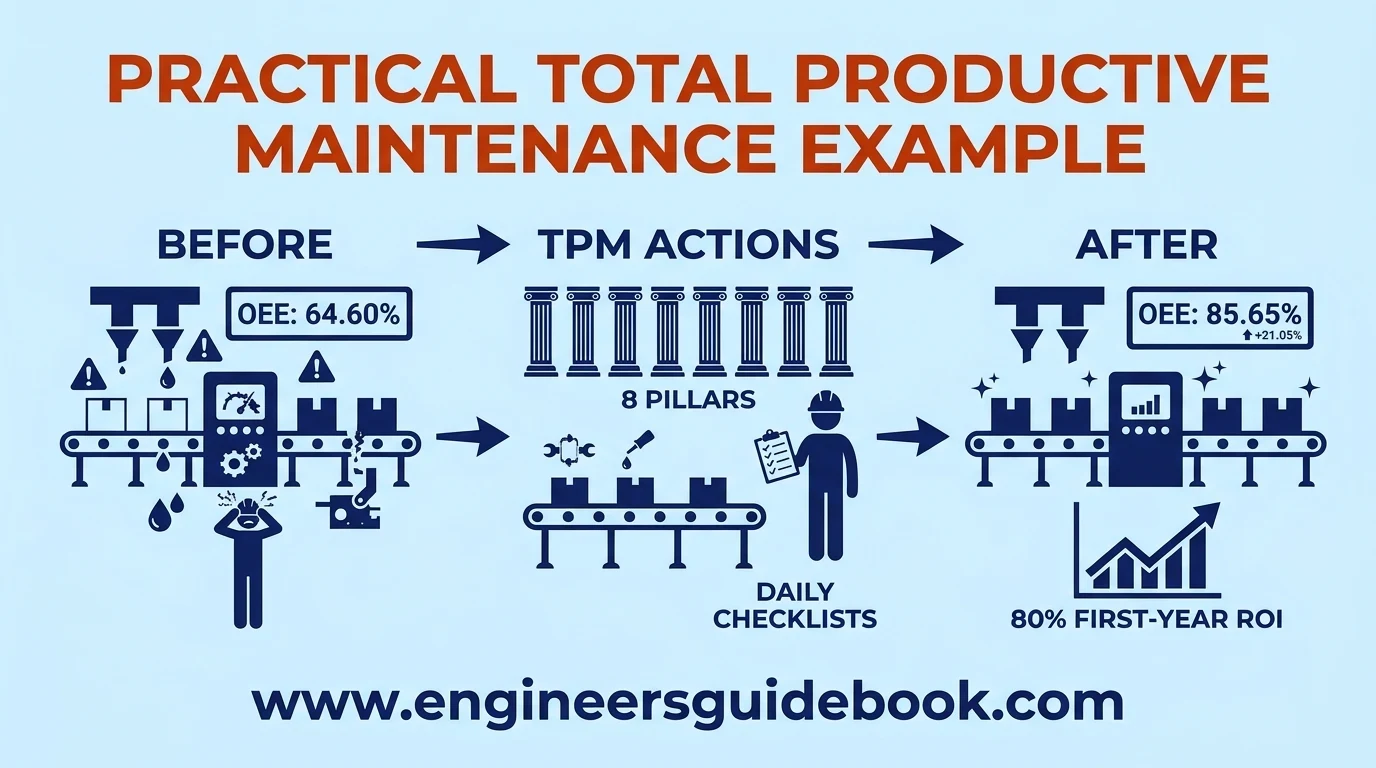
The initial assessment establishes equipment availability at 80%, performance at 85%, and quality at 95%, resulting in an OEE of 64.60%.
11.4 Developing a TPM Implementation Strategy
The maintenance team prioritizes critical abnormalities, establishes preventive maintenance schedules, develops operator inspection standards, and introduces targeted reliability improvement projects.
11.5 Applying the Eight TPM Pillars
Autonomous and planned maintenance address equipment deterioration, while focused improvement eliminates recurring losses. The remaining pillars support quality, training, equipment design, safety, and administrative efficiency.
11.6 Establishing Operator Maintenance Checklists
Daily checklists include conveyor condition inspections, leakage detection, sensor cleanliness, abnormal noise monitoring, and verification of designated lubrication points under approved safety procedures.
11.7 Measuring Equipment Performance Improvements
Following hypothetical TPM implementation, equipment performance improves as follows:
Performance Indicator Before TPM After TPM Availability 80% 92% Performance 85% 95% Quality 95% 98% OEE 64.60% 85.65%
Overall equipment effectiveness increases by 21.05 percentage points.
11.8 Evaluating Maintenance Cost Savings and ROI
Assume TPM implementation costs $10,000 and generates annual net operational savings of $18,000 before deducting the initial investment.
First-Year ROI = [(18,000 − 10,000) / 10,000] × 100
First-Year ROI = 80%
11.9 Lessons Learned and Continuous Improvement
Sustainable improvements require standardized maintenance practices, accurate performance measurements, employee participation, and systematic investigation of emerging equipment abnormalities.
12. Frequently Asked Questions
12.1 What Is Total Productive Maintenance in Simple Terms?
TPM is a maintenance methodology involving employees across an organization in maintaining equipment, preventing failures, and improving manufacturing productivity.
12.2 What Are the Eight Pillars of TPM?
The eight pillars are autonomous maintenance, planned maintenance, focused improvement, quality maintenance, early equipment management, education and training, safety, health and environment, and office TPM.
12.3 What Are the Main Objectives of TPM?
TPM aims to maximize equipment effectiveness while pursuing zero breakdowns, zero defects, zero accidents, and continuous operational improvement.
12.4 What Is the Difference Between TPM and Preventive Maintenance?
Preventive maintenance involves scheduled equipment servicing. TPM is a broader organizational methodology incorporating preventive maintenance, employee involvement, quality management, and systematic loss elimination.
12.5 What Is the Relationship Between TPM and OEE?
TPM provides improvement methodologies, whereas OEE measures their effectiveness through equipment availability, performance, and quality indicators.
12.6 What Are the Six Big Losses in TPM?
The six big losses are equipment breakdowns, setup and adjustment losses, minor stops, reduced operating speed, process defects, and startup or reduced yield losses.
12.7 What Are the Seven Steps of Autonomous Maintenance?
The seven steps include initial cleaning, contamination source elimination, provisional standard development, general inspection, autonomous inspection, standardization, and continuous autonomous management.
12.8 Why Is 5S Important in TPM?
5S establishes workplace organization, cleanliness, and discipline, making equipment abnormalities easier to identify while improving maintenance accessibility and operational efficiency.
12.9 What Is the Difference Between TPM and TQM?
Total Productive Maintenance focuses on equipment effectiveness, whereas Total Quality Management emphasizes organization-wide quality improvement and customer satisfaction.
12.10 What Is the Difference Between TPM and RCM?
TPM emphasizes collective employee involvement and equipment effectiveness. Reliability-Centered Maintenance (RCM) identifies appropriate maintenance strategies based on equipment functions, failure modes, and failure consequences.
12.11 How Long Does It Take to Implement TPM?
Pilot implementation may take several months, while comprehensive organization-wide implementation can require several years, depending on facility size, resources, and maintenance maturity.
12.12 Who Is Responsible for TPM in Manufacturing?
TPM is a collective responsibility involving machine operators, maintenance personnel, engineers, quality teams, administrative departments, and senior management.
12.13 Can TPM Be Implemented in Small Manufacturing Companies?
Yes. Small manufacturers can implement TPM through simplified maintenance standards, operator training, workplace organization, equipment inspections, and targeted improvement initiatives.
12.14 How Do You Measure the Success of TPM?
TPM success is measured through improvements in OEE, MTBF, MTTR, maintenance compliance, equipment reliability, production quality, safety performance, and operational costs.
13. Conclusion
13.1 Key Takeaways From Total Productive Maintenance
Total Productive Maintenance integrates proactive maintenance, employee involvement, equipment reliability, and continuous improvement through eight complementary pillars supported by workplace organization.
13.2 Building a Sustainable Maintenance Culture
A sustainable maintenance culture requires management commitment, technical competency, standardized procedures, cross-functional collaboration, and collective accountability for equipment performance.
13.3 Achieving Operational Excellence Through TPM
Successful TPM implementation transforms maintenance from a predominantly reactive function into a strategic operational discipline. By systematically eliminating equipment losses and optimizing asset performance, organizations can achieve greater manufacturing productivity, improved reliability, reduced operating expenditure, and sustainable operational excellence.