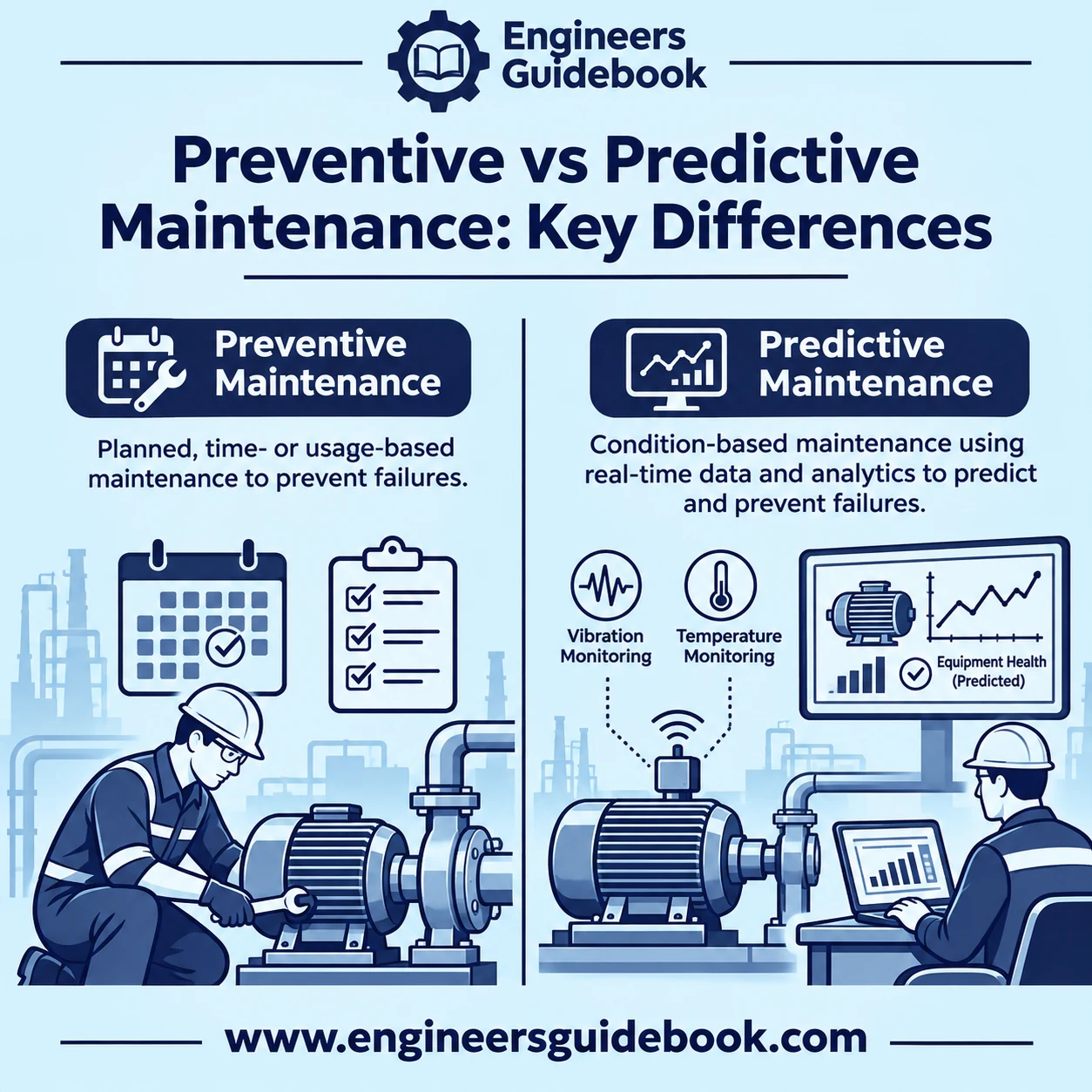
Preventive maintenance is performed at predetermined time or usage intervals, while predictive maintenance uses equipment condition data to anticipate failures and determine when maintenance is necessary. Preventive maintenance focuses on scheduled servicing, whereas predictive maintenance relies on condition monitoring, sensors, and data analysis to optimize maintenance activities, reduce downtime, and improve equipment reliability.
1. Introduction to Preventive vs Predictive Maintenance
1.1 Understanding Industrial Maintenance Strategies
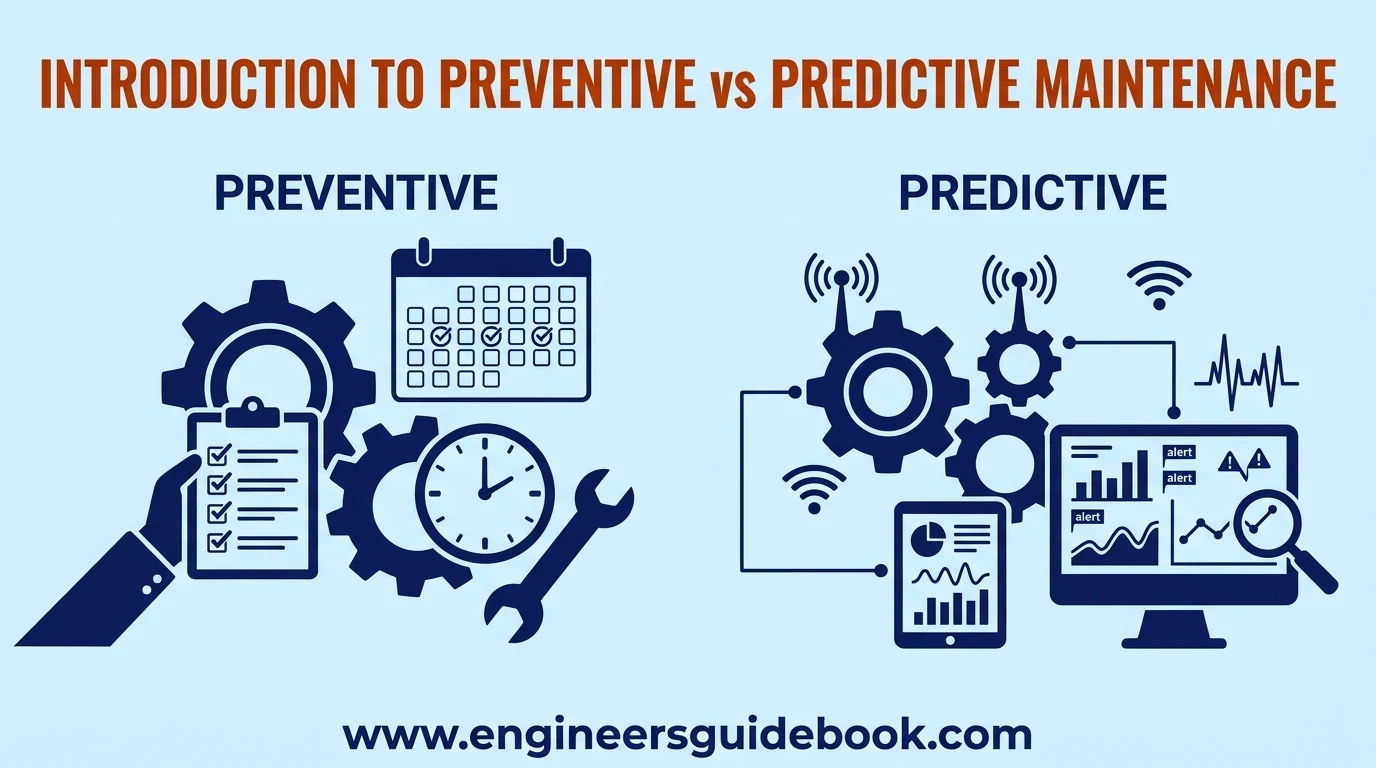
Industrial maintenance strategies encompass systematic practices designed to preserve equipment functionality, minimize operational disruptions, and maximize asset productivity. Preventive and predictive maintenance are two prominent proactive approaches that differ primarily in their execution methodology, scheduling criteria, and technological requirements.
1.2 Importance of Proactive Maintenance
Proactive maintenance addresses equipment deterioration before functional failure occurs. Instead of responding to unexpected breakdowns, maintenance teams implement planned interventions to safeguard machinery, reduce production losses, improve workplace safety, and maintain operational continuity.
1.3 Evolution of Modern Maintenance Practices
Industrial maintenance has evolved from reactive repairs to scheduled servicing and intelligent condition monitoring. Advancements in sensor technology, industrial automation, and data analytics have enabled organizations to transition toward more sophisticated, condition-driven maintenance frameworks.
1.4 Role of Maintenance in Equipment Reliability
Effective maintenance mitigates mechanical degradation, premature component wear, and operational inconsistencies. Both preventive and predictive maintenance can improve equipment availability, increase Mean Time Between Failures (MTBF), and contribute to sustainable manufacturing performance.
2. What Is Preventive Maintenance?
2.1 Definition of Preventive Maintenance
Preventive maintenance (PM) is a systematic maintenance strategy involving predetermined inspections, servicing, adjustments, and component replacements intended to reduce the probability of equipment failure.
Maintenance intervals are generally established using manufacturer recommendations, operational experience, historical failure records, and equipment service requirements.
2.2 How Preventive Maintenance Works
Preventive maintenance operates through predefined schedules and standardized maintenance procedures. Maintenance personnel perform designated activities when equipment reaches specific calendar intervals or operational thresholds.
The fundamental objective is to mitigate foreseeable deterioration before it develops into a significant mechanical or electrical failure.
2.3 Time-Based Preventive Maintenance
Time-based maintenance involves servicing equipment at predetermined calendar intervals, irrespective of its actual operating condition.
For example, an industrial compressor may undergo quarterly inspections, while electrical distribution panels receive annual preventive maintenance. Such schedules facilitate predictable resource allocation.
2.4 Usage-Based Preventive Maintenance
Usage-based maintenance schedules interventions according to measurable operational parameters, including running hours, production cycles, and accumulated mileage.
For instance, a gearbox may require lubricant replacement after every 2,000 operating hours, depending on manufacturer specifications and service conditions.
2.5 Common Preventive Maintenance Activities
Typical preventive maintenance activities include:
Lubricating bearings and mechanical components.
Replacing filters, seals, and worn consumables.
Inspecting electrical connections.
Checking belt tension and shaft alignment.
Cleaning equipment and cooling systems.
Calibrating instruments and safety devices.
These activities address predictable deterioration mechanisms and help preserve equipment functionality.

3. What Is Predictive Maintenance?
3.1 Definition of Predictive Maintenance
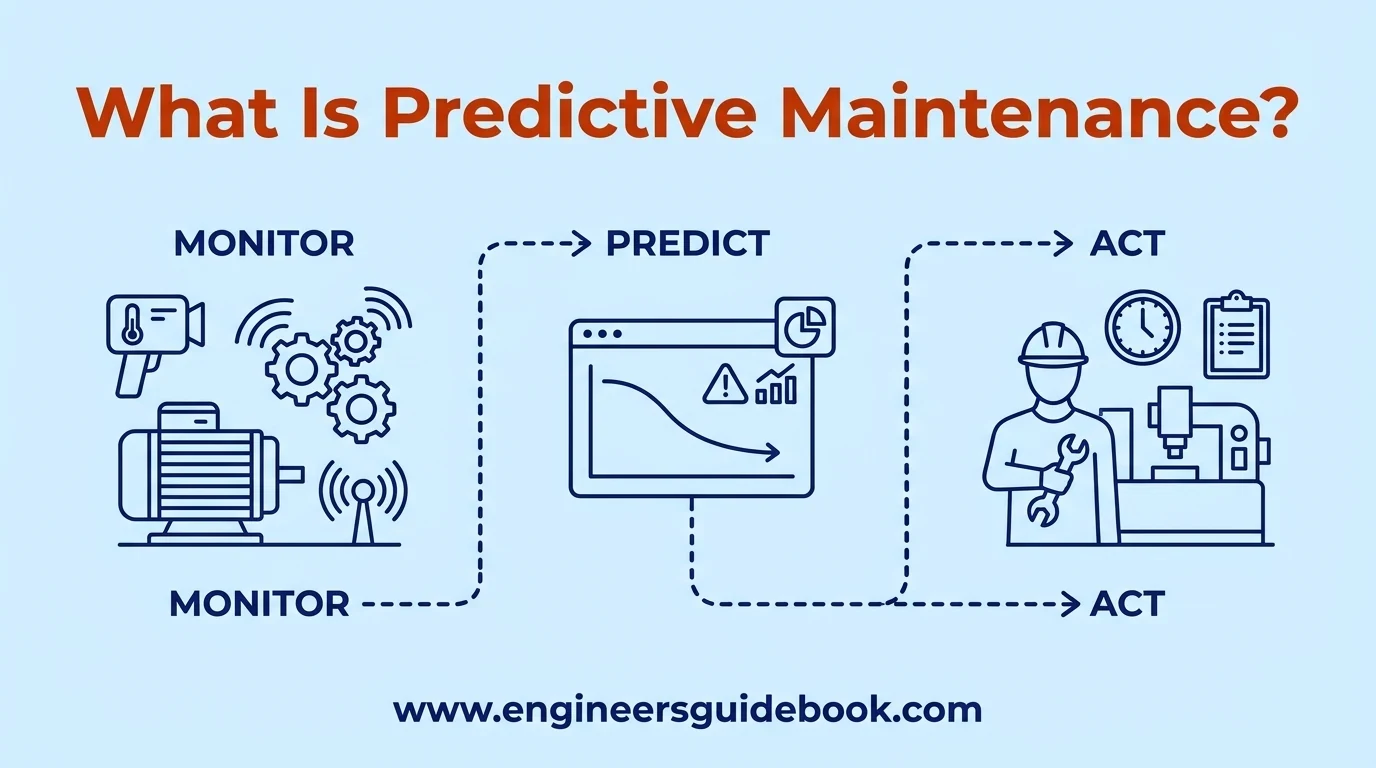
Predictive maintenance (PdM) is a condition-driven maintenance strategy that uses equipment measurements, diagnostic techniques, and analytical methods to anticipate potential failures and determine appropriate maintenance intervals.
Its primary objective is to intervene before functional failure while maximizing useful component life.
3.2 How Predictive Maintenance Works
Predictive maintenance evaluates equipment health through periodic or continuous monitoring. Collected measurements are compared against baseline conditions, historical trends, and established alarm thresholds.
When abnormal deterioration is identified, maintenance personnel investigate the underlying mechanism and schedule an appropriate intervention.
3.3 Equipment Condition Monitoring
Condition monitoring involves measuring physical and operational parameters associated with equipment health. These parameters include vibration amplitude, temperature, lubricant contamination, acoustic emissions, pressure fluctuations, and electrical current characteristics.
Changes in these measurements can reveal developing abnormalities.
3.4 Data Collection and Failure Prediction
Predictive maintenance transforms operational measurements into actionable maintenance intelligence. Historical trends, diagnostic algorithms, and prognostic models help identify deterioration patterns and estimate remaining useful life where sufficient data exists.
Prediction accuracy depends on measurement quality and equipment-specific failure mechanisms.
3.5 Common Predictive Maintenance Activities
Common predictive maintenance activities include:
Bearing vibration spectrum analysis.
Thermal imaging of electrical panels.
Gearbox lubricant contamination analysis.
Ultrasonic detection of compressed air leakage.
Motor current signature analysis.
Monitoring equipment performance degradation.
These techniques facilitate targeted maintenance interventions.
4. Key Differences Between Preventive and Predictive Maintenance
4.1 Maintenance Approach
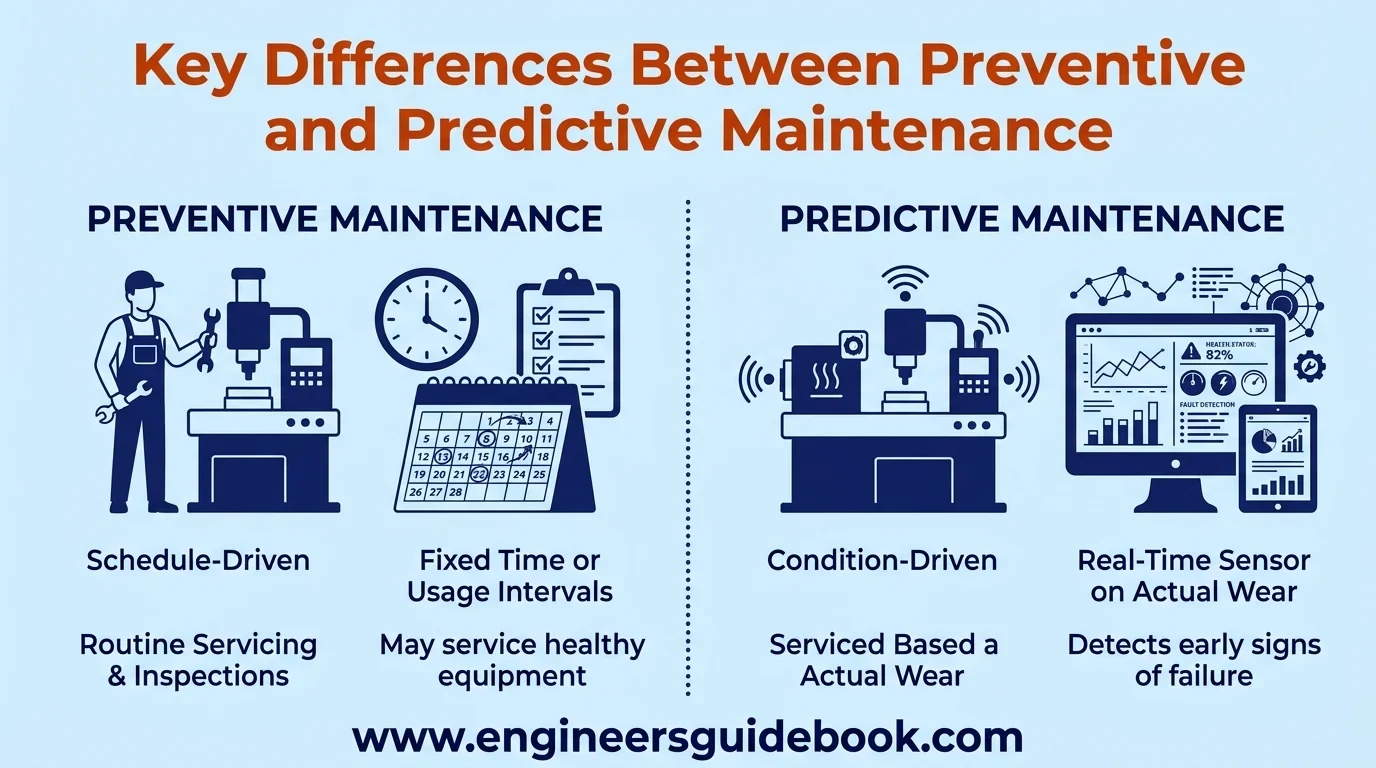
Preventive maintenance follows predetermined servicing intervals, while predictive maintenance prioritizes actual equipment health and anticipated deterioration. The former is primarily schedule-driven; the latter is condition-driven and supported by diagnostic evidence.
4.2 Maintenance Scheduling
Preventive maintenance schedules are established in advance using calendar dates or usage thresholds. Predictive maintenance schedules remain adaptable, allowing interventions to be planned according to measured equipment conditions and anticipated failure progression.
4.3 Equipment Failure Detection
Preventive maintenance relies heavily on routine inspections and scheduled replacements. Predictive maintenance employs diagnostic techniques capable of identifying incipient defects, including bearing fatigue, rotor imbalance, shaft misalignment, and insulation deterioration.
4.4 Data and Technology Requirements
Preventive maintenance generally requires equipment documentation, maintenance histories, and operational schedules. Predictive maintenance demands more extensive condition measurements, diagnostic instruments, analytical capabilities, and reliable data management infrastructure.
4.5 Maintenance Frequency
Preventive maintenance occurs at predetermined frequencies, potentially requiring servicing even when equipment remains healthy. Predictive maintenance enables more flexible intervals based on deterioration trends, although monitoring itself must occur at appropriate frequencies.
4.6 Resource and Workforce Requirements
Preventive maintenance primarily requires trained technicians, standardized procedures, and maintenance planning capabilities. Predictive maintenance additionally requires personnel proficient in instrumentation, failure diagnostics, signal interpretation, and condition assessment.
4.7 Maintenance Decision-Making
Preventive maintenance decisions originate predominantly from established schedules. Predictive maintenance decisions incorporate equipment-specific evidence, deterioration severity, operational criticality, and estimated failure progression to prioritize interventions.
4.8 Side-by-Side Comparison Table
Comparison Factor Preventive Maintenance Predictive Maintenance Maintenance basis Time or usage Equipment condition Scheduling Predetermined Condition-driven Initial investment Generally lower Generally higher Technology requirements Basic to moderate Moderate to advanced Failure detection Routine inspections Diagnostic monitoring Maintenance frequency Scheduled intervals Based on deterioration Data requirements Relatively limited Extensive condition data Workforce expertise Maintenance skills Diagnostic expertise Unnecessary servicing Higher potential Lower potential Component utilization Schedule-dependent Condition-dependent Decision-making Predefined procedures Data-driven analysis
5. Preventive vs Predictive Maintenance Technologies and Tools
5.1 Preventive Maintenance Checklists
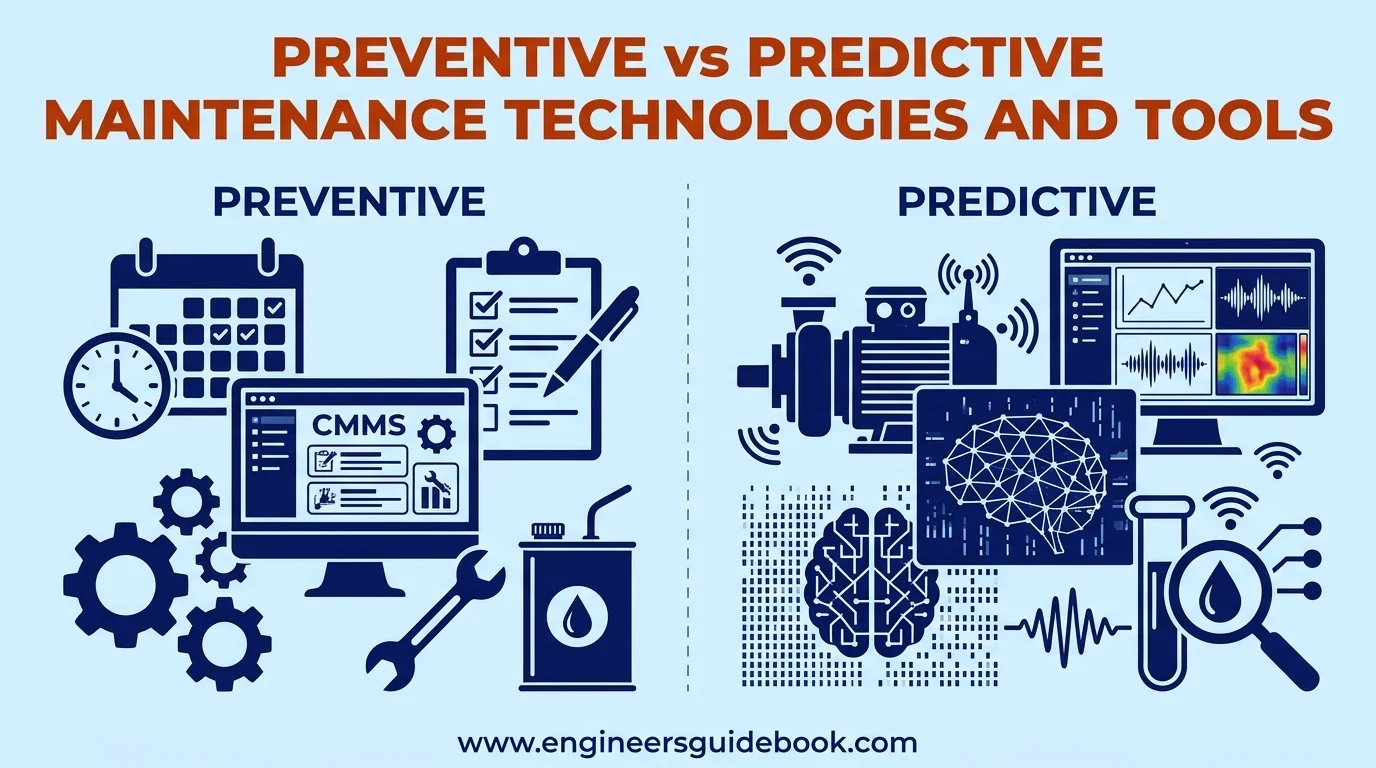
Maintenance checklists standardize inspection procedures, lubrication requirements, replacement activities, and safety verifications. They improve execution consistency, procedural compliance, and maintenance traceability across industrial facilities.
5.2 Computerized Maintenance Management Systems
Computerized Maintenance Management Systems (CMMS) support both strategies through automated work orders, maintenance scheduling, equipment histories, spare parts management, and performance reporting. Predictive monitoring systems can also integrate with CMMS platforms.
5.3 Vibration Analysis
Vibration analysis identifies mechanical abnormalities through measurements of vibration amplitude, frequency, and spectral characteristics. It is particularly valuable for diagnosing bearing defects, mechanical looseness, imbalance, and shaft misalignment in rotating machinery.
5.4 Infrared Thermography
Infrared thermography detects abnormal thermal patterns without requiring direct physical contact. Maintenance professionals use thermal imaging to investigate electrical hotspots, overheating bearings, defective connections, and compromised insulation systems.
5.5 Lubricant and Oil Analysis
Lubricant analysis evaluates viscosity, contamination, oxidation, moisture content, and wear particles. Abnormal results can indicate internal component deterioration, inadequate lubrication, or contamination ingress within gearboxes and hydraulic systems.
5.6 Ultrasonic Testing
Ultrasonic monitoring detects high-frequency acoustic signals associated with friction, electrical discharge, compressed air leakage, and developing mechanical defects. It complements other diagnostic techniques by revealing abnormalities that conventional inspections may overlook.
5.7 Industrial IoT Sensors
Industrial Internet of Things (IIoT) sensors facilitate continuous equipment monitoring through interconnected measurement devices. Real-time operational data enables remote condition assessment, automated notifications, and timely maintenance intervention.
5.8 Artificial Intelligence and Machine Learning
Artificial intelligence and machine learning can identify complex deterioration patterns, detect operational anomalies, and estimate failure probabilities. However, reliable predictions require representative datasets, validated models, and appropriate engineering interpretation.
6. Advantages and Disadvantages of Preventive Maintenance
6.1 Reduced Unexpected Equipment Failures
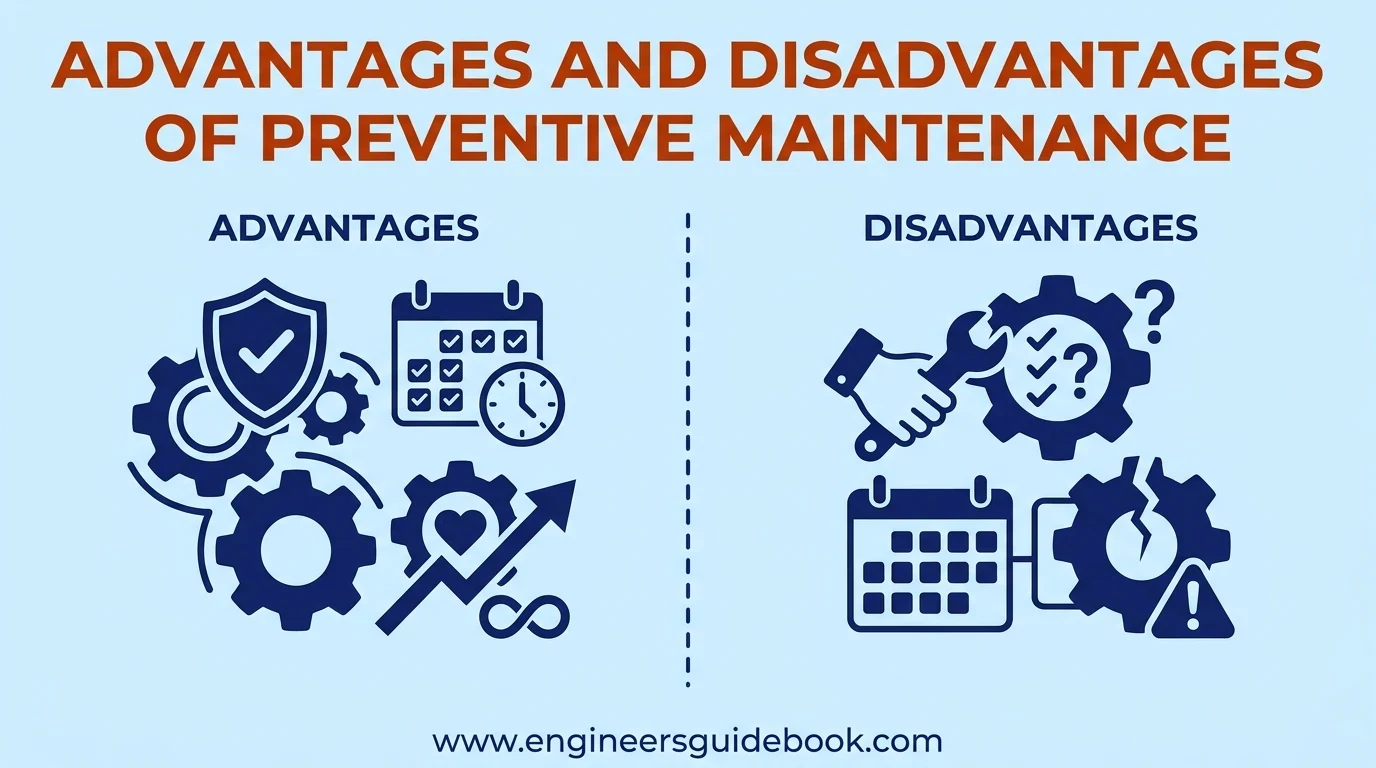
Scheduled inspections and servicing address predictable degradation mechanisms before they cause equipment breakdowns. Consequently, preventive maintenance can reduce unexpected failures and improve production continuity.
6.2 Simplified Maintenance Planning
Predetermined schedules enable maintenance departments to coordinate manpower, spare parts, tools, and production shutdowns. This structured approach simplifies resource allocation and departmental coordination.
6.3 Improved Equipment Lifespan
Regular lubrication, cleaning, adjustments, and component replacements mitigate excessive friction, contamination, and mechanical deterioration. Appropriate preventive maintenance can therefore extend equipment service life.
6.4 Lower Initial Investment
Preventive maintenance generally requires less sophisticated monitoring infrastructure than predictive maintenance. Organizations can establish effective programs using conventional tools, maintenance checklists, and basic scheduling software.
6.5 Risk of Unnecessary Maintenance
Fixed maintenance intervals may result in premature replacement of serviceable components. Excessive servicing also increases labor expenditure, material consumption, and the possibility of maintenance-induced failures.
6.6 Limitations of Fixed Maintenance Schedules
Equipment deterioration is not always proportional to operating time. Variable loads, environmental conditions, and unpredictable failure mechanisms can cause breakdowns between scheduled maintenance intervals.
7. Advantages and Disadvantages of Predictive Maintenance
7.1 Early Detection of Equipment Failures
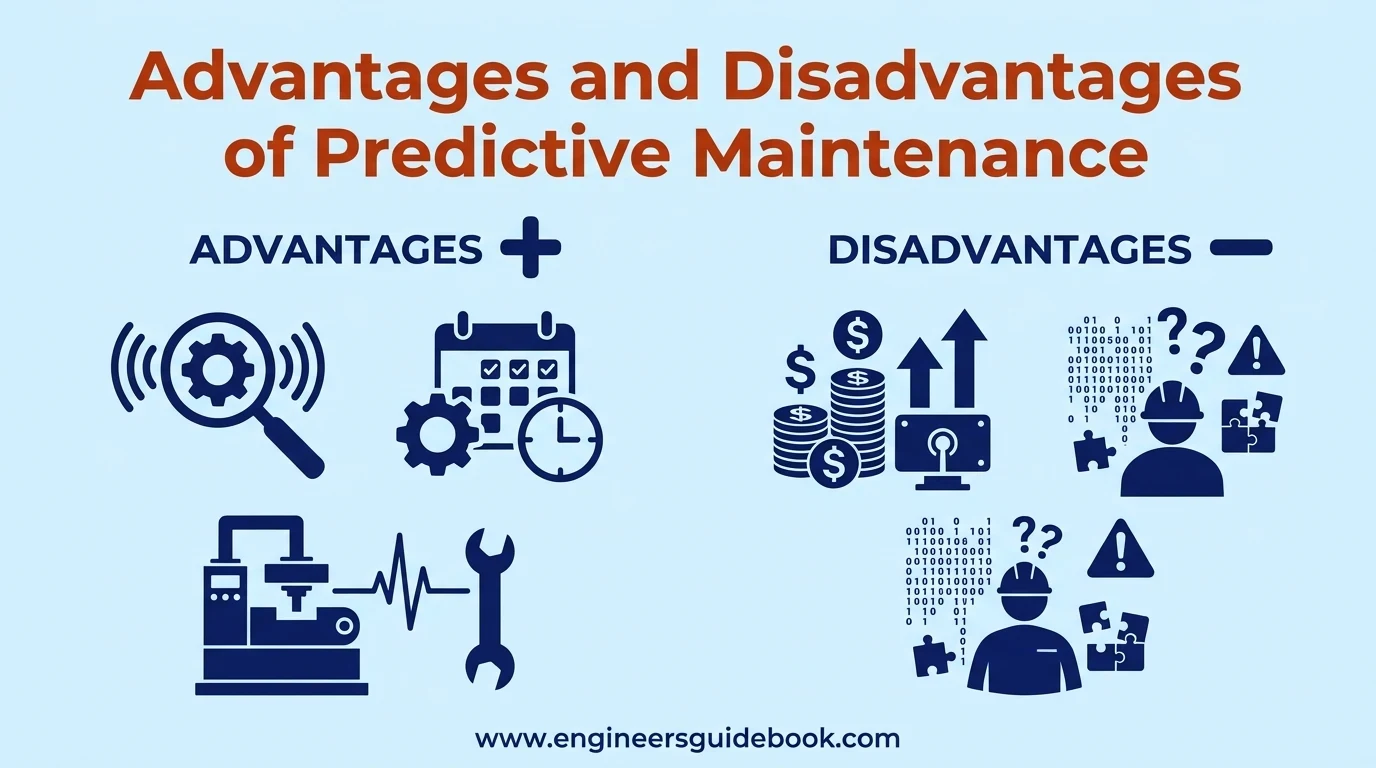
Predictive maintenance identifies developing abnormalities before they escalate into functional failures. Early detection provides maintenance teams with valuable opportunities to investigate defects and implement corrective measures.
7.2 Reduced Unplanned Downtime
Condition-based insights enable maintenance personnel to schedule repairs before anticipated breakdowns. Timely interventions can minimize emergency shutdowns, production interruptions, and associated financial losses.
7.3 Optimized Maintenance Intervals
Predictive maintenance reduces dependence on rigid servicing schedules. Components can remain operational while their measured condition remains acceptable, potentially maximizing useful service life and reducing unnecessary replacements.
7.4 Improved Asset Reliability
Continuous or periodic condition assessment provides greater visibility into equipment deterioration. Targeted interventions can improve asset reliability, operational availability, and Overall Equipment Effectiveness (OEE).
7.5 Higher Initial Implementation Costs
Predictive maintenance may require substantial investment in diagnostic instruments, industrial sensors, communication infrastructure, analytical software, and workforce training. These expenses can present financial barriers for smaller manufacturing facilities.
7.6 Technical Expertise and Data Challenges
Accurate condition assessment requires specialized diagnostic competencies and dependable measurements. Inadequate sensor placement, inconsistent data, incorrect alarm thresholds, and misinterpreted deterioration patterns can undermine predictive maintenance effectiveness. Successful implementation therefore depends on integrating technological capabilities with sound engineering judgment.
8. Preventive vs Predictive Maintenance Cost Comparison
8.1 Initial Implementation Costs
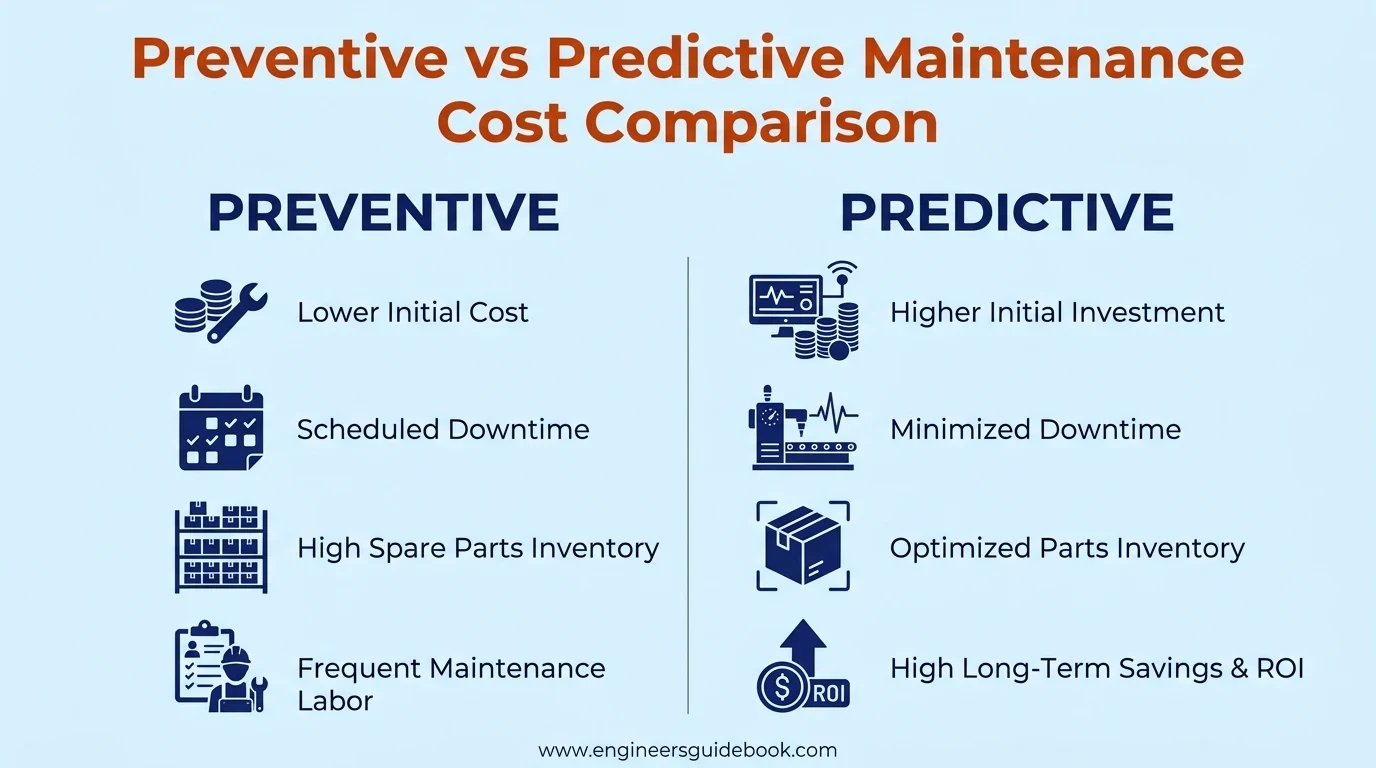
Preventive maintenance generally involves lower initial expenditure because it relies on conventional maintenance tools, standardized procedures, and scheduling systems. Predictive maintenance requires additional investment in diagnostic instruments, monitoring infrastructure, software platforms, and specialized workforce training.
8.2 Labor and Operational Expenses
Preventive maintenance requires recurring labor expenditure for scheduled inspections, servicing, and component replacements. Predictive maintenance can reduce unnecessary maintenance activities but introduces expenses associated with equipment monitoring, diagnostic analysis, and technical expertise.
8.3 Equipment and Technology Investment
Predictive maintenance typically requires vibration analyzers, thermal imaging cameras, ultrasonic instruments, industrial sensors, and analytical software. Preventive maintenance predominantly utilizes conventional mechanical tools, inspection instruments, and maintenance management software.
Technology investment should correspond to equipment criticality and anticipated financial benefits.
8.4 Spare Parts and Inventory Costs
Preventive maintenance frequently involves stocking replacement components according to predetermined servicing schedules. Predictive maintenance enables more targeted procurement by identifying developing equipment defects before failure occurs, potentially reducing excessive inventory and premature component replacement.
8.5 Production Downtime Costs
Scheduled preventive maintenance requires periodic equipment shutdowns, sometimes involving machinery that remains operationally healthy. Predictive maintenance helps organizations identify suitable maintenance windows, potentially minimizing unnecessary production interruptions and expensive emergency repairs.
8.6 Long-Term Cost Savings
Although predictive maintenance generally requires higher initial investment, it can generate substantial long-term savings through improved component utilization, reduced emergency repairs, lower downtime, and optimized maintenance expenditure.
Preventive maintenance remains economically advantageous for relatively simple, inexpensive equipment.
8.7 Return on Investment
Maintenance return on investment (ROI) evaluates financial benefits relative to implementation costs.
ROI (%) = [(Financial Benefits − Investment Costs) / Investment Costs] × 100
Financial benefits may include avoided downtime, reduced repair expenses, extended equipment lifespan, and lower spare parts consumption. Accurate calculations should also account for recurring monitoring expenses.
9. Practical Examples of Preventive and Predictive Maintenance
9.1 Centrifugal Pump Maintenance
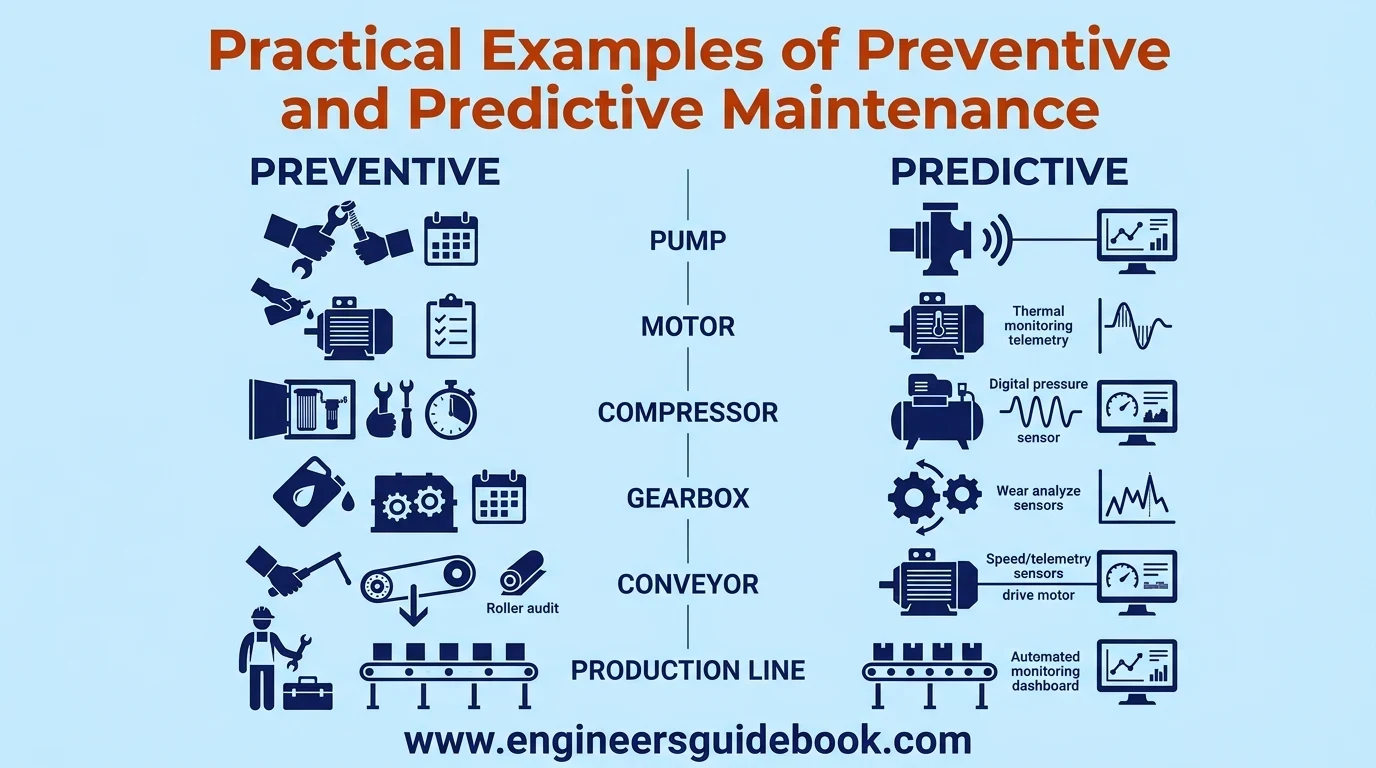
Preventive maintenance involves scheduled bearing lubrication, mechanical seal inspections, and coupling alignment checks.
Predictive maintenance utilizes vibration analysis, bearing temperature monitoring, and hydraulic performance measurements to identify developing abnormalities such as bearing deterioration, cavitation, and shaft misalignment.
9.2 Electric Motor Maintenance
Preventive motor maintenance includes periodic cleaning, terminal inspections, insulation resistance testing, and lubrication.
Predictive maintenance employs motor current signature analysis, thermography, and vibration monitoring to detect developing electrical faults, rotor abnormalities, and bearing degradation.
9.3 Industrial Compressor Maintenance
Preventive compressor maintenance includes scheduled air filter replacement, lubricant changes, and cooler cleaning.
Predictive maintenance monitors discharge temperatures, vibration characteristics, pressure deviations, and lubricant condition to identify impending mechanical deterioration and performance degradation.
9.4 Gearbox and Bearing Maintenance
Preventive maintenance involves replacing lubricants and inspecting transmission components at predetermined intervals.
Predictive maintenance analyzes wear particles, gear mesh frequencies, bearing vibration signatures, and temperature fluctuations to identify developing tribological and mechanical abnormalities.
9.5 Conveyor System Maintenance
Preventive conveyor maintenance includes scheduled belt tension adjustments, roller inspections, lubrication, and cleaning.
Predictive maintenance monitors drive motor current, bearing temperatures, gearbox vibration, and belt tracking behavior to detect progressive deterioration before operational failure.
9.6 Manufacturing Production Line Maintenance
Preventive maintenance follows standardized servicing schedules for filling machines, packaging equipment, and automated production systems.
Predictive maintenance evaluates operational data, cycle-time deviations, equipment vibration, and electrical parameters to detect abnormalities that could compromise production efficiency.
10. How to Choose Between Preventive and Predictive Maintenance
10.1 Equipment Criticality Assessment
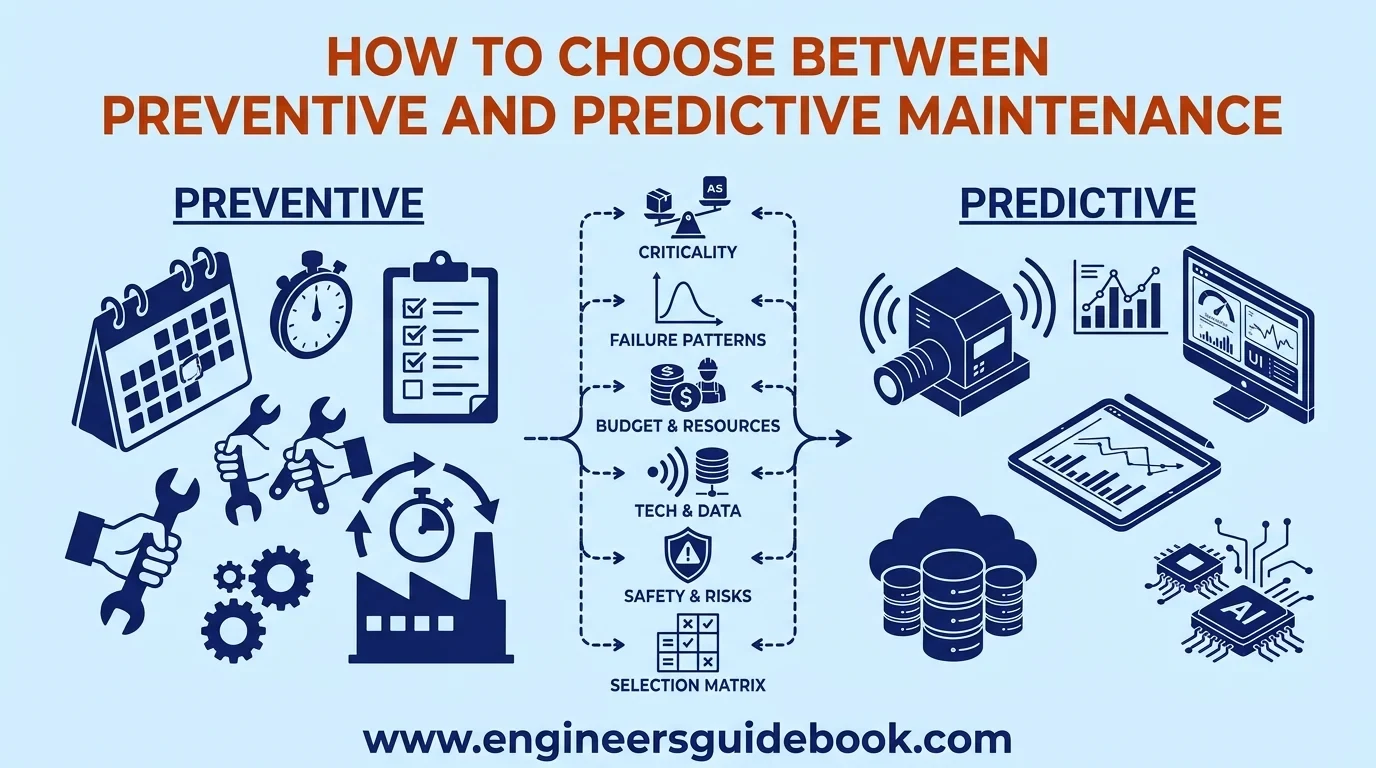
Equipment criticality assessments classify assets according to their operational importance, failure consequences, repair costs, and safety implications. Highly critical machinery often justifies predictive monitoring, whereas noncritical assets may require only conventional preventive maintenance.
10.2 Equipment Failure Patterns
Equipment exhibiting predictable age-related deterioration is generally suitable for scheduled maintenance. Assets with measurable deterioration patterns benefit from predictive techniques, provided that developing defects can be detected sufficiently early to permit intervention.
10.3 Maintenance Budget and Resources
Organizations should evaluate available financial resources, workforce competencies, diagnostic capabilities, and maintenance infrastructure. Predictive maintenance investments should be prioritized where anticipated savings and reliability improvements justify implementation expenditure.
10.4 Technology and Data Availability
Successful predictive maintenance requires dependable measurements, appropriate diagnostic instruments, and meaningful equipment baselines. Facilities lacking sufficient technological infrastructure can initially implement preventive maintenance while progressively developing condition monitoring capabilities.
10.5 Equipment Safety and Operational Risks
Equipment associated with hazardous substances, elevated pressures, or significant safety consequences requires rigorous maintenance controls. Predictive monitoring can supplement preventive maintenance but should not replace mandatory inspections, statutory testing, or essential safety procedures.
10.6 Maintenance Performance Indicators
Maintenance performance indicators help evaluate strategy effectiveness. Important metrics include:
Mean Time Between Failures (MTBF).
Mean Time to Repair (MTTR).
Overall Equipment Effectiveness (OEE).
Equipment availability.
Maintenance expenditure.
Unplanned downtime.
Maintenance schedule compliance.
10.7 Maintenance Strategy Selection Matrix
Equipment or Operational Factor Recommended Strategy Low-cost equipment Preventive maintenance Critical rotating machinery Predictive or hybrid maintenance Predictable component wear Preventive maintenance Detectable progressive deterioration Predictive maintenance Mandatory periodic inspections Preventive maintenance High production downtime costs Predictive or hybrid maintenance Limited monitoring infrastructure Preventive maintenance Complex automated machinery Hybrid maintenance
11. Combining Preventive and Predictive Maintenance
11.1 Developing a Hybrid Maintenance Strategy
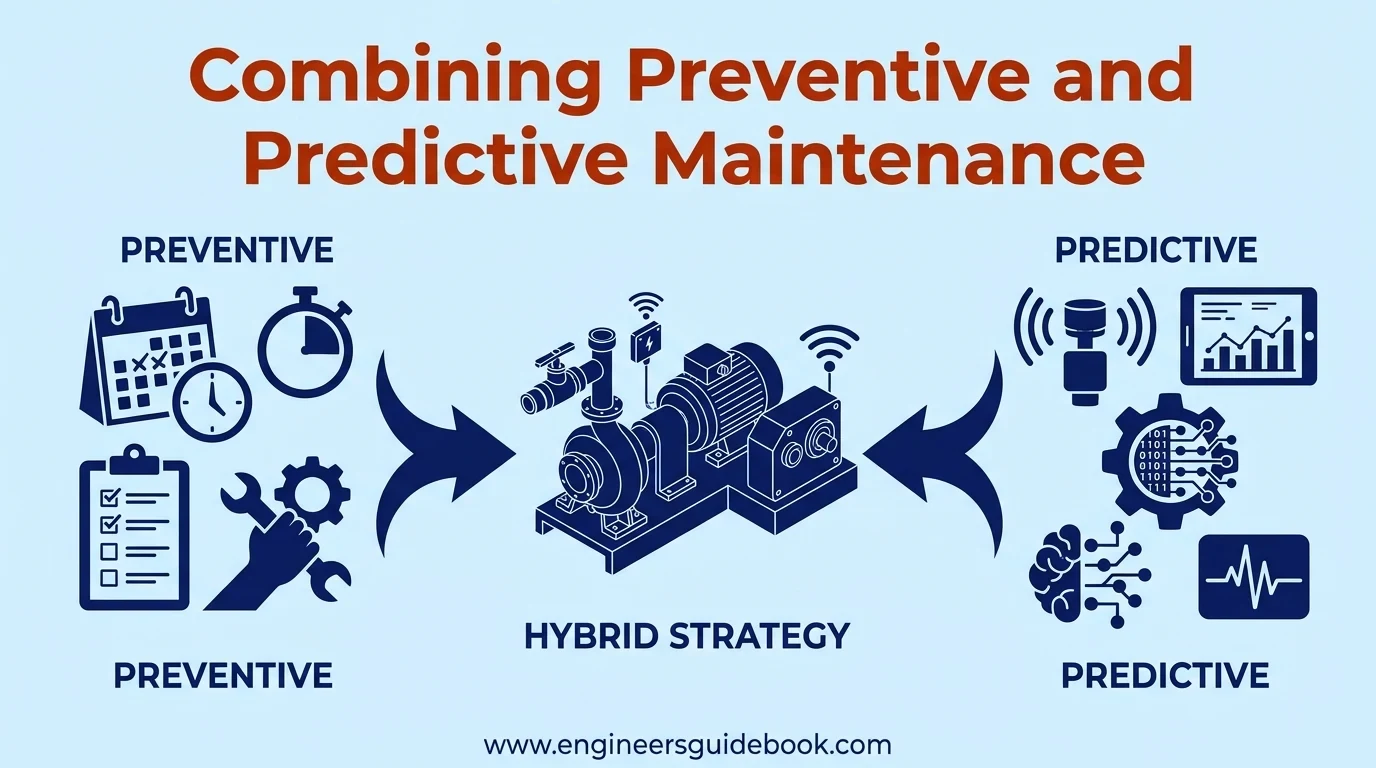
A hybrid maintenance strategy integrates scheduled servicing with condition-driven interventions. This approach preserves essential preventive activities while utilizing predictive diagnostics to optimize maintenance intervals and identify unexpected deterioration.
11.2 Identifying Suitable Equipment
Critical pumps, compressors, gearboxes, electric motors, and automated machinery frequently benefit from hybrid maintenance. Equipment selection should consider failure consequences, monitoring feasibility, historical breakdown frequency, and anticipated economic benefits.
11.3 Integrating Condition Monitoring With Scheduled Maintenance
Condition monitoring results can refine preventive maintenance schedules. For example, lubricant analysis may support extending gearbox oil replacement intervals, provided that lubricant specifications, manufacturer requirements, and operating conditions permit such adjustments.
11.4 Transitioning From Preventive to Predictive Maintenance
A structured transition begins with equipment criticality assessments, baseline measurements, and pilot monitoring programs. Maintenance teams can subsequently expand predictive capabilities based on demonstrated improvements in reliability, diagnostic accuracy, and financial performance.
11.5 Integrating Maintenance Management Systems
Integrating condition monitoring platforms with Computerized Maintenance Management Systems enables automated notifications, maintenance work orders, historical data recording, and intervention planning. This integration improves information accessibility and departmental coordination.
11.6 Measuring Maintenance Strategy Effectiveness
Regular performance assessments should compare maintenance expenditure, breakdown frequency, equipment availability, production losses, and component service life against established baselines. Continuous evaluation enables organizations to refine maintenance strategies systematically.
11.7 Avoiding Common Implementation Mistakes
Common mistakes include excessive sensor deployment, inadequate technician training, unreliable baseline measurements, inappropriate alarm thresholds, and neglecting essential preventive activities. Technology should complement engineering expertise rather than replace informed maintenance judgment.
11.8 Future Trends in Industrial Maintenance
Industrial maintenance is increasingly incorporating digital twins, edge computing, machine learning, wireless sensors, and automated prognostic systems. These technologies support more sophisticated equipment diagnostics, remote monitoring, and maintenance decision-making.
12. Frequently Asked Questions
12.1 What Is the Main Difference Between Preventive and Predictive Maintenance?
Preventive maintenance is performed at predetermined time or usage intervals, whereas predictive maintenance uses equipment condition measurements and deterioration trends to determine when maintenance intervention is necessary.
12.2 Is Predictive Maintenance Better Than Preventive Maintenance?
Predictive maintenance can be more effective for critical and expensive machinery with detectable failure mechanisms. However, preventive maintenance may be more economical for simpler equipment and predictable servicing requirements.
12.3 What Is an Example of Preventive and Predictive Maintenance?
Replacing motor bearings at predetermined operating intervals is an example of preventive maintenance. Monitoring bearing vibration trends and scheduling replacement when deterioration indicates an approaching failure is predictive maintenance.
12.4 Is Predictive Maintenance More Expensive Than Preventive Maintenance?
Predictive maintenance generally requires higher initial investment in monitoring technology and specialized training. However, it can reduce long-term maintenance expenditure by preventing costly breakdowns and unnecessary component replacements.
12.5 Can Preventive and Predictive Maintenance Be Used Together?
Yes. Combining preventive and predictive maintenance creates a hybrid strategy that integrates scheduled servicing, mandatory inspections, condition monitoring, and targeted maintenance interventions.
12.6 When Should Predictive Maintenance Be Used?
Predictive maintenance is particularly suitable for critical equipment with high downtime costs, expensive components, measurable deterioration patterns, and significant operational consequences associated with unexpected failures.
12.7 What Are the Main Limitations of Preventive Maintenance?
Preventive maintenance can result in unnecessary servicing, premature component replacement, excessive maintenance expenditure, and unexpected failures occurring between scheduled maintenance intervals.
12.8 Does Predictive Maintenance Require Artificial Intelligence?
No. Predictive maintenance can utilize conventional vibration analysis, thermography, lubricant analysis, and historical trend evaluation. Artificial intelligence enhances analytical capabilities but is not an essential requirement.
12.9 What Is the Difference Between Preventive, Predictive, and Corrective Maintenance?
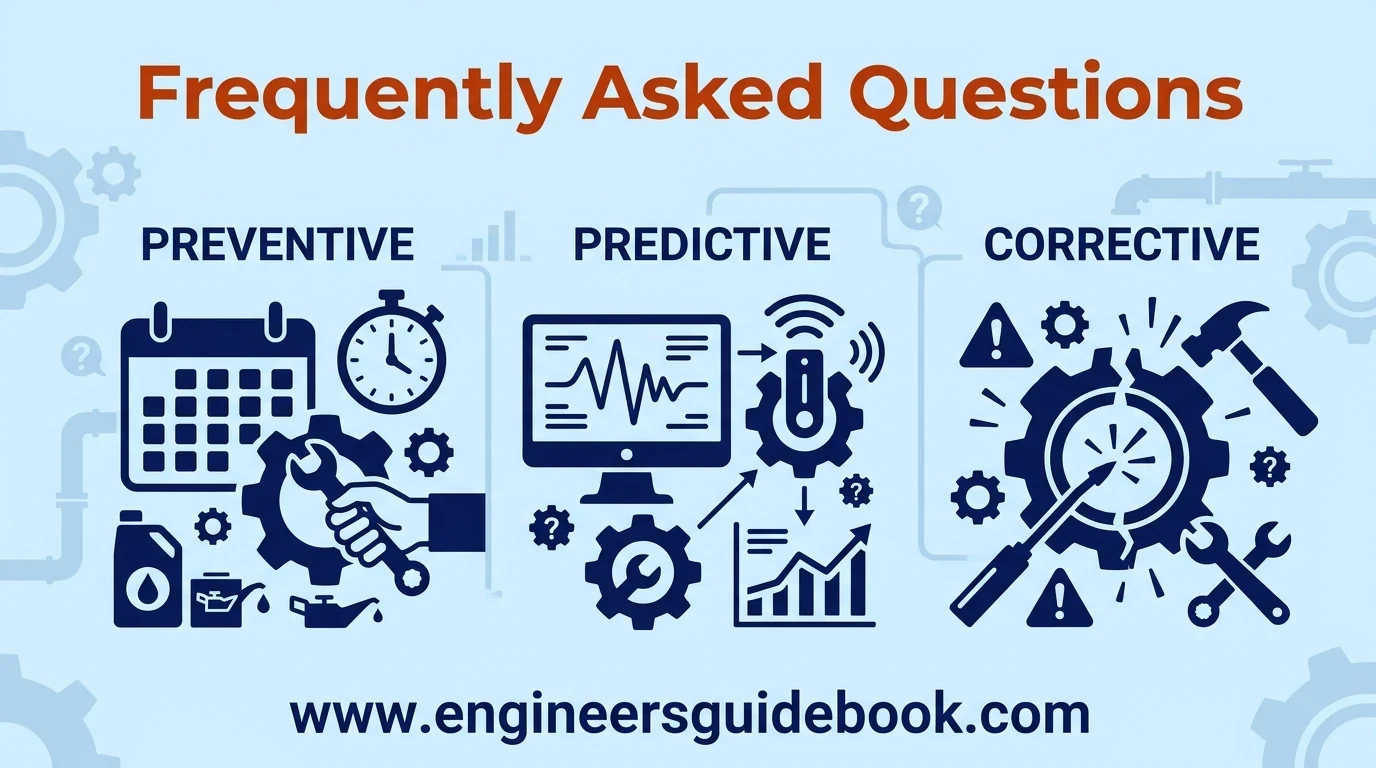
Preventive maintenance follows predetermined schedules. Predictive maintenance anticipates failures through equipment condition analysis. Corrective maintenance addresses identified faults to restore equipment functionality, either before or after complete functional failure.
12.10 Which Maintenance Strategy Is Best for Manufacturing Industries?
A hybrid maintenance strategy is often most suitable for manufacturing industries. Combining preventive and predictive techniques enables organizations to balance equipment reliability, production continuity, maintenance expenditure, and operational safety.
13. Conclusion
13.1 Summary of Key Differences
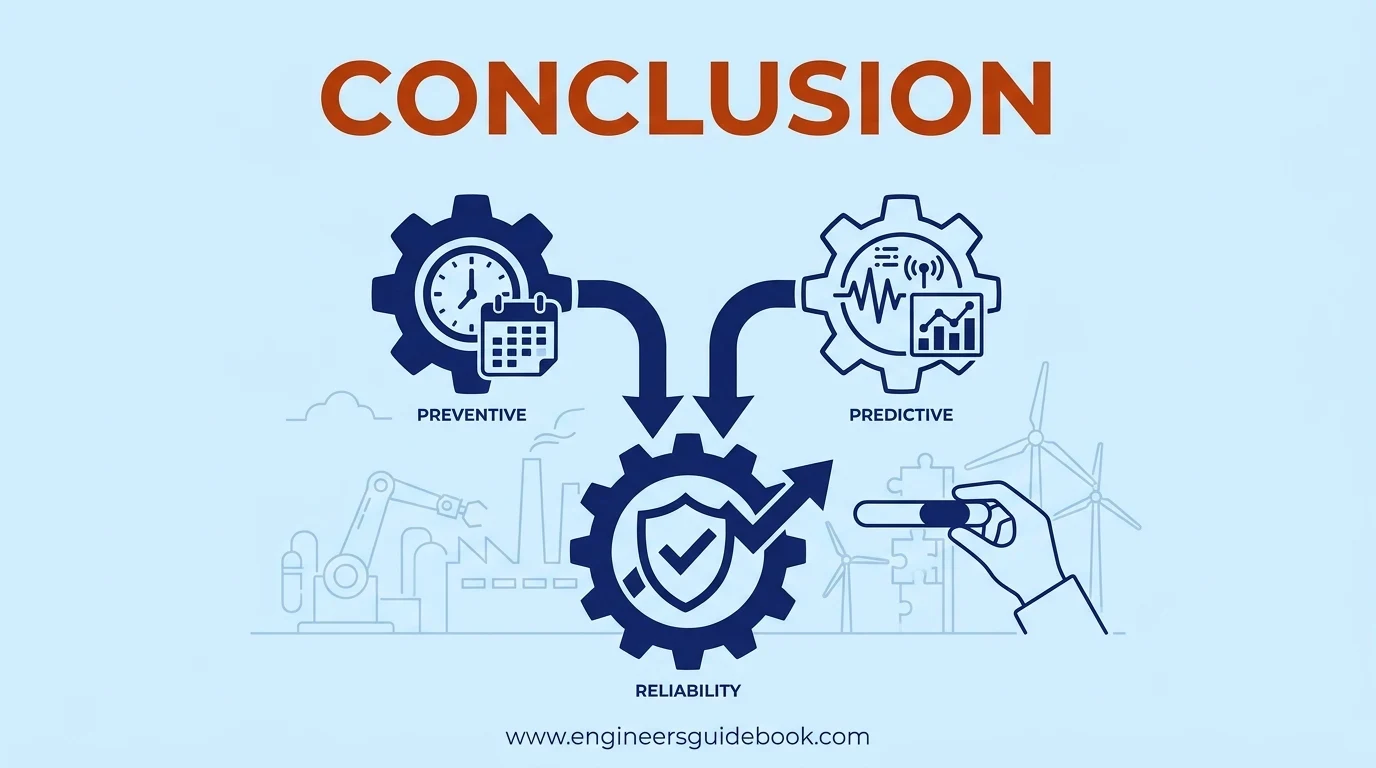
Preventive maintenance relies on predetermined servicing schedules, while predictive maintenance utilizes diagnostic measurements and equipment deterioration trends. Both approaches aim to minimize failures but differ considerably in technological requirements, implementation costs, and intervention methodology.
13.2 Selecting the Right Maintenance Strategy
The appropriate maintenance strategy depends on equipment criticality, failure characteristics, operational requirements, available resources, and financial considerations. Organizations should adopt maintenance practices that deliver measurable reliability improvements without introducing disproportionate expenditure.
13.3 Achieving Long-Term Equipment Reliability
Sustainable equipment reliability requires disciplined maintenance planning, competent personnel, accurate condition assessment, and continuous performance evaluation. Integrating preventive and predictive maintenance where economically and technically justified enables industrial organizations to minimize unplanned downtime, optimize asset utilization, reduce lifecycle costs, and achieve consistent operational excellence.