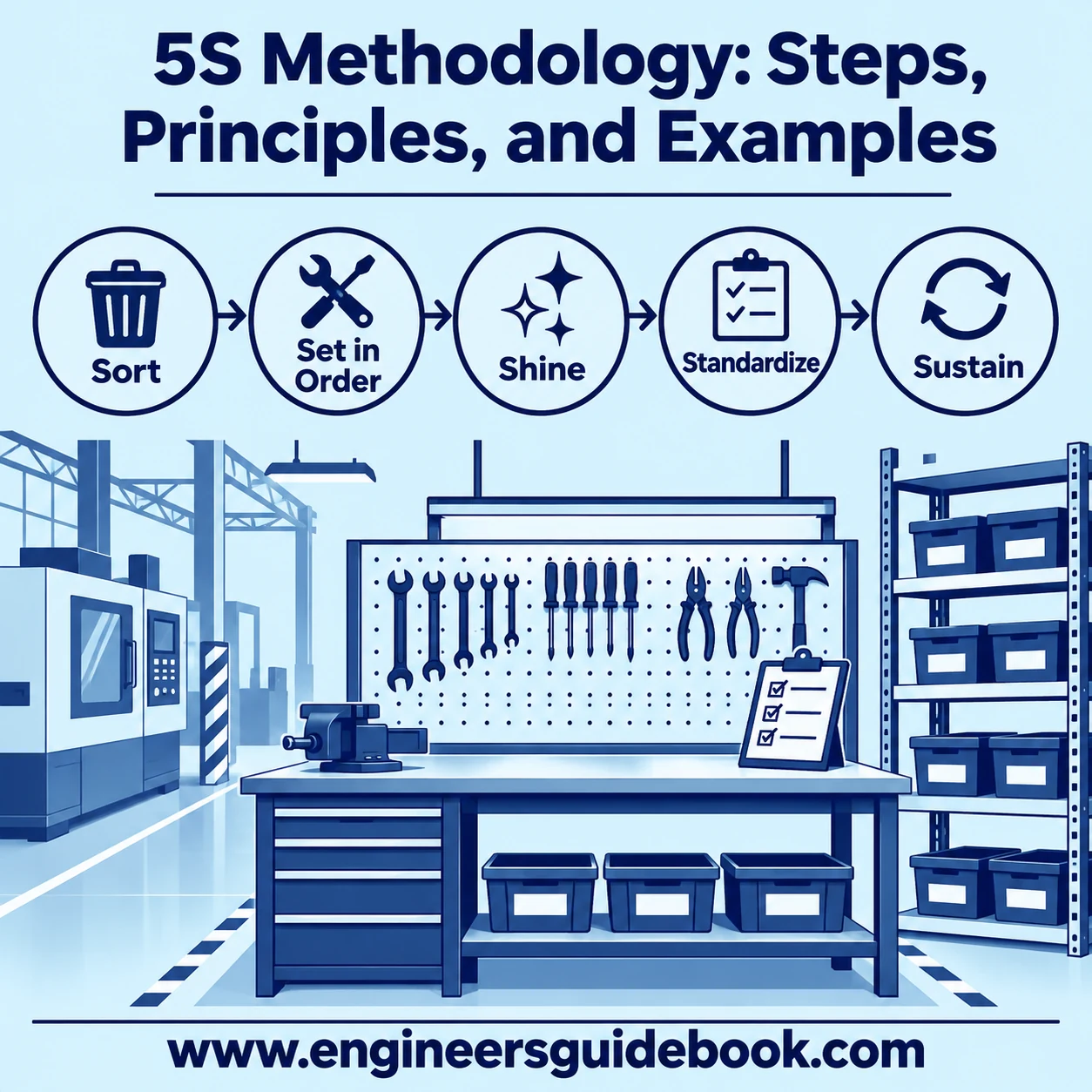
5S methodology is a systematic workplace organization technique based on five principles: Sort, Set in Order, Shine, Standardize, and Sustain. Originating in Japan, it helps organizations eliminate waste, improve productivity, enhance workplace safety, and maintain operational efficiency by creating a clean, organized, standardized, and disciplined working environment that supports continuous improvement.
1. Introduction to 5S Methodology
1.1 What Is 5S Methodology?
5S methodology is a structured workplace management approach designed to improve organization, cleanliness, efficiency, and operational discipline. It establishes a systematic framework for eliminating unnecessary materials, organizing essential resources, and maintaining consistent workplace standards.
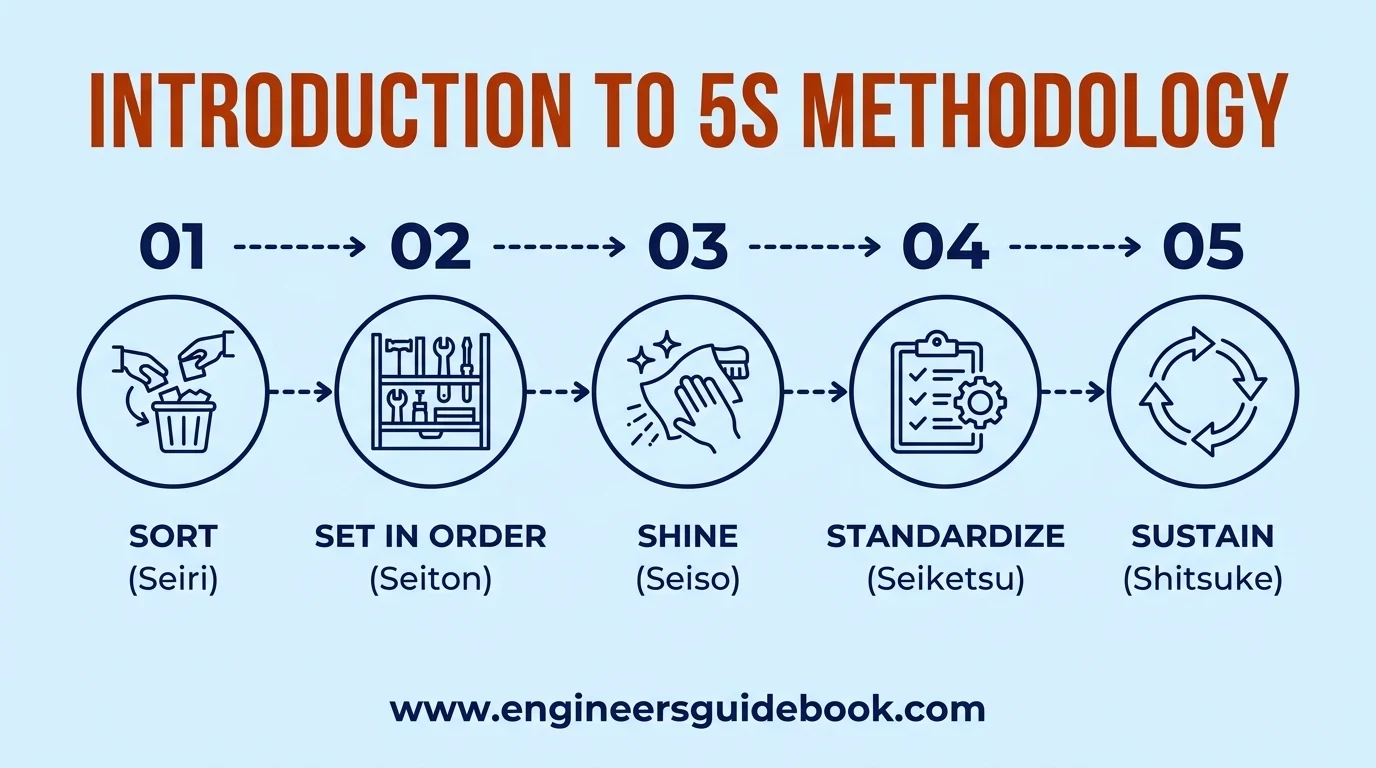
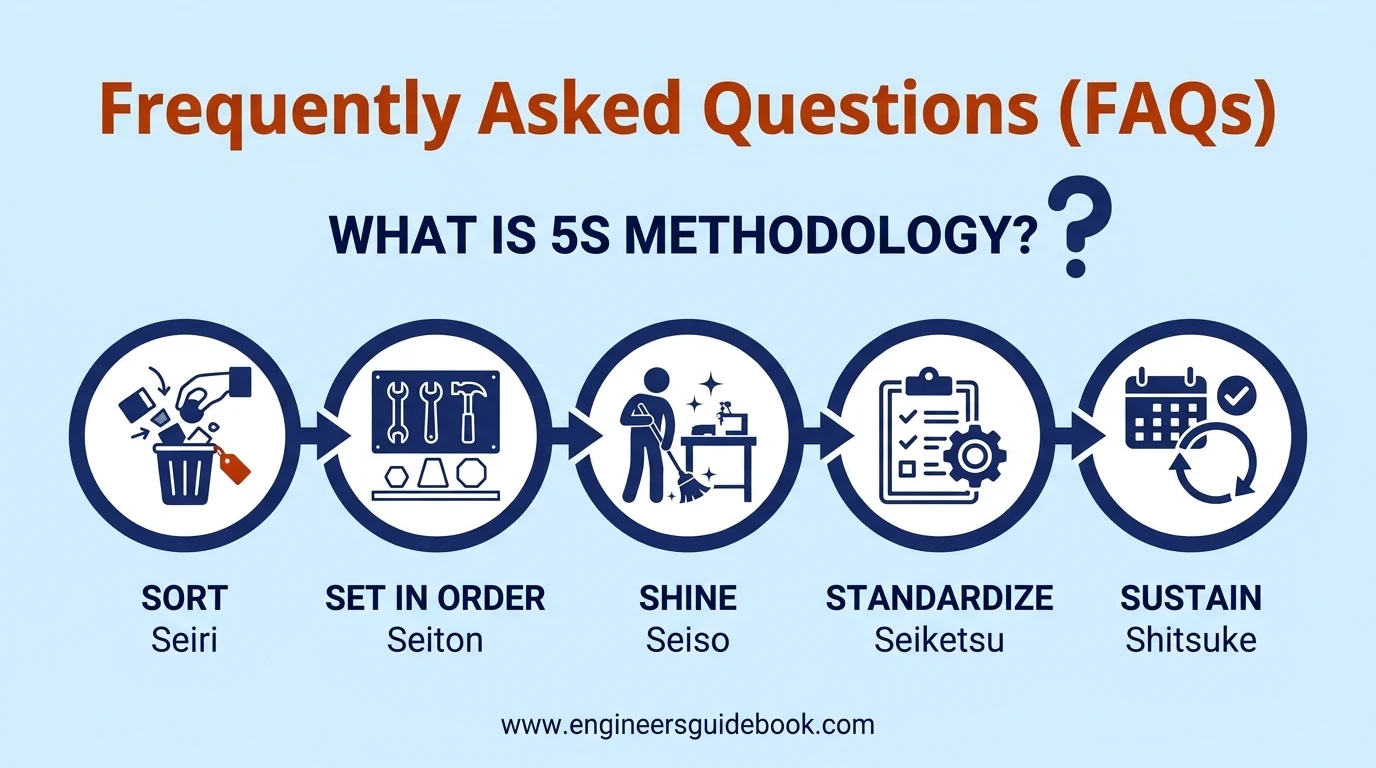
The five components of 5S methodology are:
- Sort (Seiri) – Eliminate unnecessary items.
- Set in Order (Seiton) – Organize essential items.
- Shine (Seiso) – Clean and inspect the workplace.
- Standardize (Seiketsu) – Establish consistent procedures.
- Sustain (Shitsuke) – Maintain discipline and encourage continuous improvement.
1.2 Origin and History of 5S
The 5S methodology originated in Japan and became closely associated with the Toyota Production System (TPS). Japanese manufacturers adopted systematic workplace organization practices to minimize operational inefficiencies and improve manufacturing performance.
Over time, 5S gained international recognition and became a foundational component of lean manufacturing, quality management, and operational excellence programs.
1.3 Purpose and Objectives of 5S
The primary objective of 5S is to establish an efficient workplace where employees can perform tasks safely, accurately, and consistently.
It minimizes unnecessary movement, reduces material search time, eliminates clutter, and improves resource utilization. Additionally, it encourages employees to take responsibility for their working environment.
1.4 Importance of 5S in Lean Manufacturing
Lean manufacturing focuses on eliminating non-value-added activities. The 5S methodology supports this objective by addressing workplace disorganization, unnecessary transportation, excessive inventory, and wasted employee motion.
An organized production environment also makes operational abnormalities more visible, allowing teams to identify inefficiencies before they escalate.
1.5 Fundamental Principles of 5S Methodology
The fundamental principles of 5S include simplicity, accessibility, cleanliness, standardization, accountability, and continuous improvement.
These principles transform workplace organization from an occasional housekeeping activity into a sustainable operational management practice.
2. First Step – Sort (Seiri)
2.1 Understanding the Sort Principle
Sort is the initial stage of 5S methodology. It involves systematically separating necessary items from unnecessary materials within a designated workplace.
The objective is to retain only resources that contribute to operational activities while removing obsolete, defective, redundant, or rarely utilized items from immediate working areas.
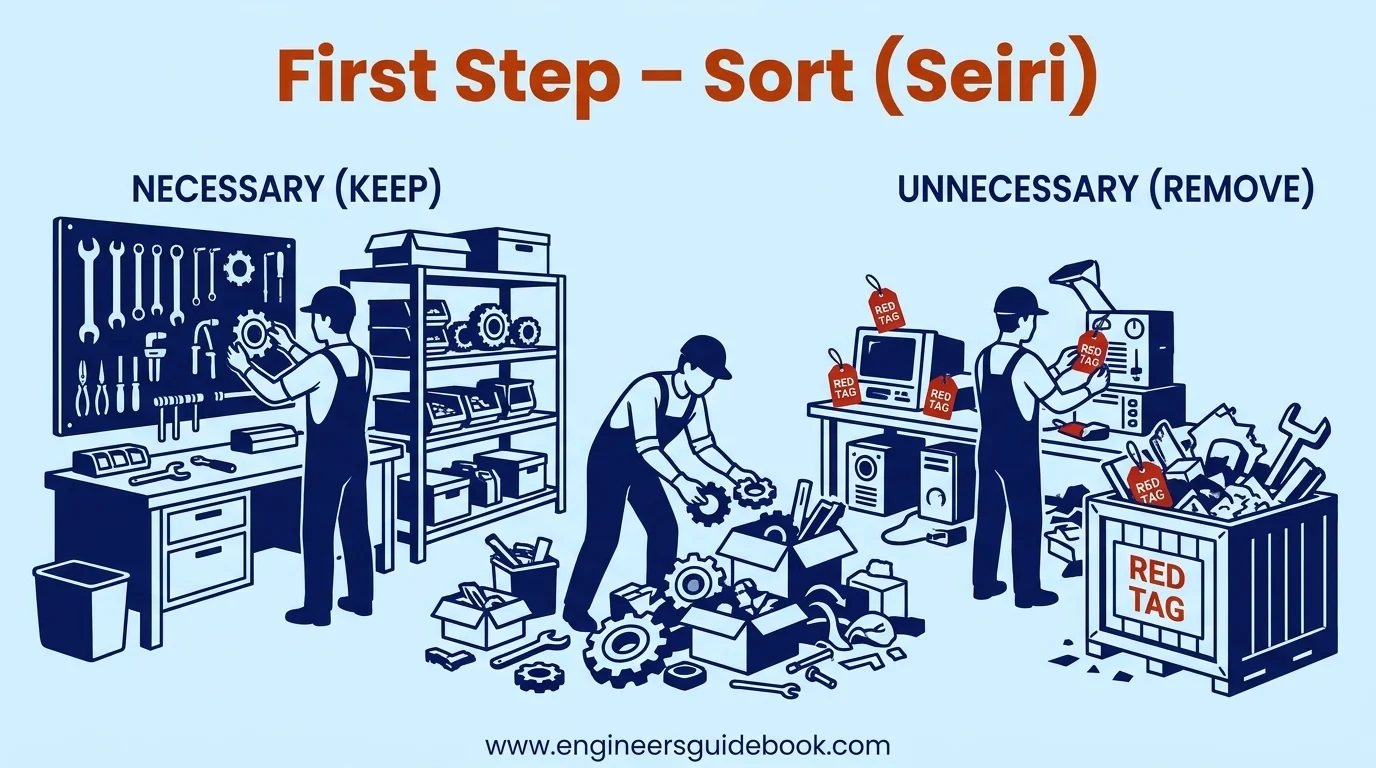
2.2 Identifying Necessary and Unnecessary Items
Employees should evaluate workplace items according to their operational importance, usage frequency, quantity, and condition.
Frequently used tools should remain accessible. Infrequently used equipment can be transferred to designated storage locations, while obsolete materials should undergo appropriate disposal or reassignment.
Safety-critical equipment must remain available regardless of its usage frequency.
2.3 Red Tagging Technique
Red tagging is a visual identification technique used to highlight potentially unnecessary workplace items.
A typical red tag contains information such as:
- Item name and identification number.
- Reason for tagging.
- Quantity and location.
- Tagging date.
- Recommended corrective action.
Tagged items are evaluated before being relocated, repaired, recycled, or discarded.
2.4 Removing Workplace Clutter
Excessive workplace clutter obstructs accessibility, creates safety hazards, and increases operational inefficiencies.
Removing redundant materials improves available floor space, facilitates equipment inspection, and reduces unnecessary employee movement.
2.5 Practical Examples of Sort
In an industrial maintenance workshop, technicians may identify damaged spanners, obsolete bearings, defective mechanical seals, and unused fabrication materials.
Removing or relocating these items creates additional storage capacity and improves access to essential maintenance resources.
3. Second Step – Set in Order (Seiton)
3.1 Understanding the Set in Order Principle
Set in Order focuses on arranging necessary items systematically so employees can locate, retrieve, utilize, and return them efficiently.
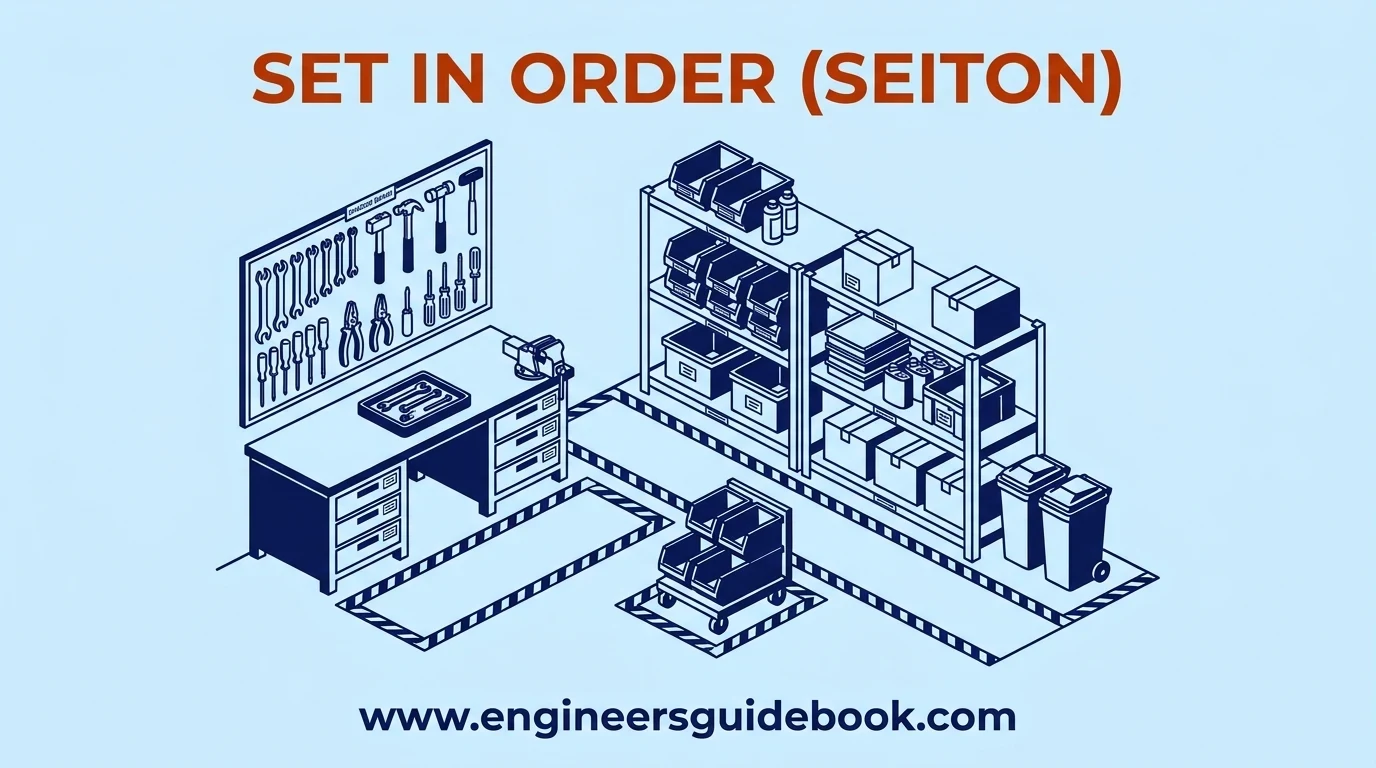
Its guiding philosophy is simple: a place for everything and everything in its place.
3.2 Organizing Tools and Equipment
Tools and equipment should be organized according to their functionality, usage frequency, ergonomic requirements, and operational sequence.
Frequently used instruments should be positioned near their point of use, while specialized equipment can be stored in clearly designated locations.
This arrangement minimizes unnecessary movement and retrieval time.
3.3 Visual Management and Workplace Labeling
Visual management communicates workplace information through readily identifiable markings and instructions.
Common visual management techniques include:
- Color-coded storage locations.
- Equipment identification labels.
- Floor markings and designated walkways.
- Inventory identification tags.
- Storage capacity indicators.
Consistent visual communication helps employees recognize incorrect placement and workplace abnormalities immediately.
3.4 Shadow Boards and Storage Optimization
Shadow boards provide designated storage positions for individual tools using visible outlines. A missing tool becomes immediately apparent.
Other storage optimization techniques include compartmentalized cabinets, labeled drawers, storage racks, and point-of-use inventory systems.
3.5 Practical Examples of Set in Order
A mechanical maintenance department can arrange spanners, Allen keys, screwdrivers, and measuring instruments on labeled shadow boards.
Technicians can retrieve required tools quickly, reducing maintenance preparation time and improving overall work efficiency.
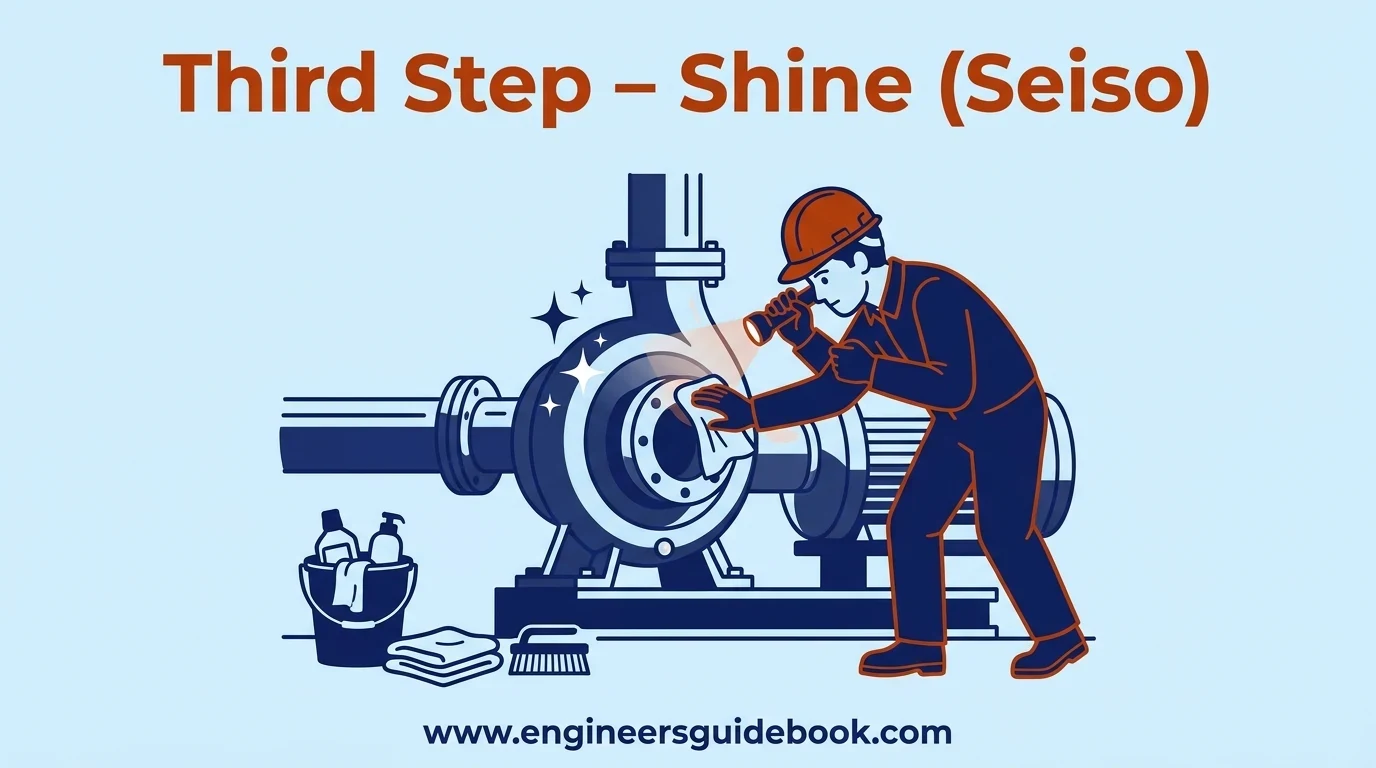
4. Third Step – Shine (Seiso)
4.1 Understanding the Shine Principle
Shine involves systematically cleaning and inspecting workplace surfaces, machinery, tools, and surrounding operational areas.
Unlike conventional housekeeping, this principle combines cleanliness with equipment condition monitoring and early abnormality detection.
4.2 Workplace Cleaning and Inspection
Regular cleaning activities should include equipment surfaces, production floors, workbenches, storage cabinets, and accessible machine components.
Employees should simultaneously inspect equipment for deterioration, contamination, damage, and other irregularities while following appropriate safety and isolation procedures.
4.3 Identifying Equipment Abnormalities
A clean machine makes developing equipment defects easier to recognize.
During cleaning and inspection, employees may identify:
- Lubricant leakage.
- Loose fasteners.
- Corrosion and surface deterioration.
- Damaged electrical cables.
- Cracked or worn mechanical components.
Early identification enables maintenance teams to initiate corrective actions before significant equipment failures occur.
4.4 Developing Routine Cleaning Schedules
Cleaning schedules should specify activities, frequencies, responsible personnel, required resources, and inspection criteria.
Depending on workplace conditions, cleaning tasks may be performed daily, weekly, or monthly.
4.5 Practical Examples of Shine
During routine cleaning of a centrifugal pump, an operator discovers lubricant leakage near the bearing housing.
Reporting this abnormality allows maintenance personnel to investigate its cause and take appropriate action before bearing damage or unexpected downtime occurs.
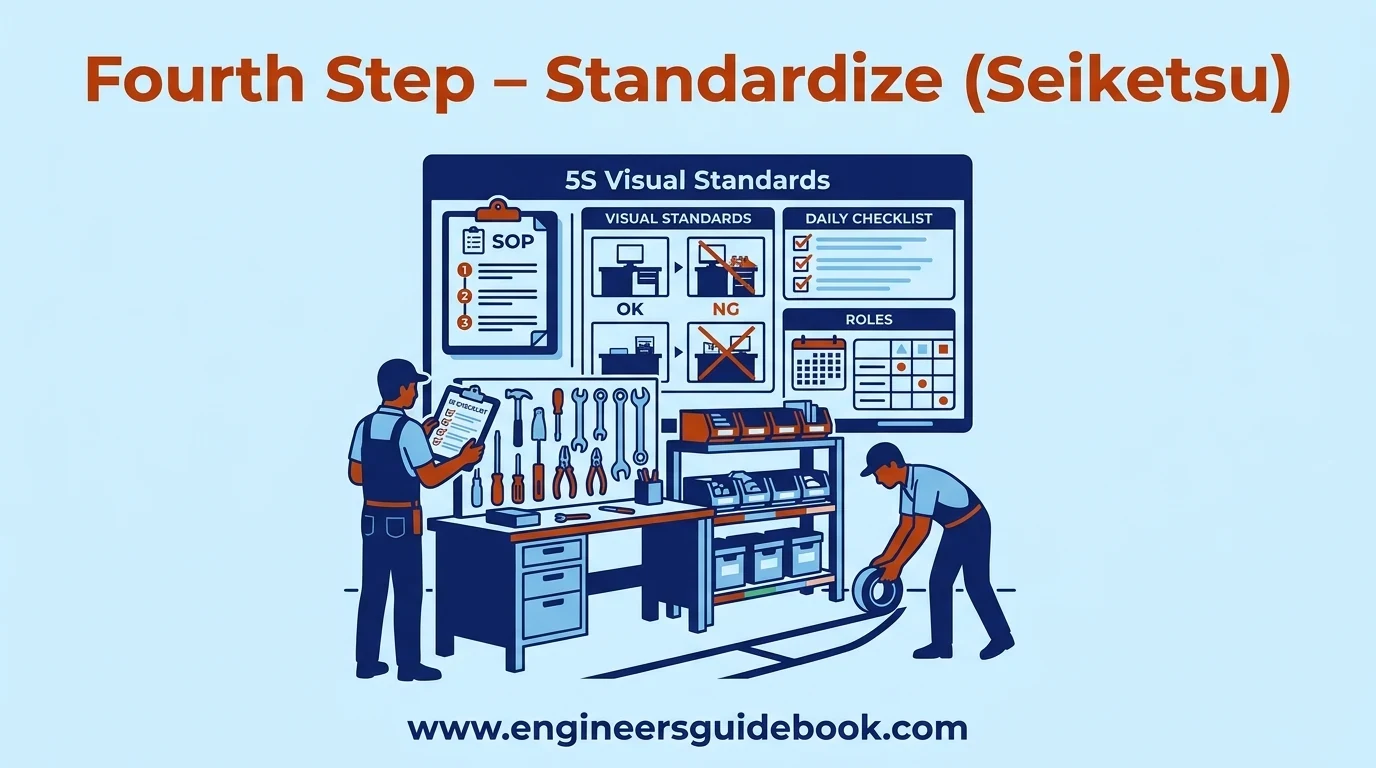
5. Fourth Step – Standardize (Seiketsu)
5.1 Understanding the Standardize Principle
Standardize establishes uniform procedures for maintaining the improvements achieved through Sort, Set in Order, and Shine.
Without standardization, workplace conditions can gradually revert to their original disorganized state.
5.2 Developing Standard Operating Procedures
Standard operating procedures (SOPs) provide documented instructions for performing recurring workplace activities consistently.
Procedures should define acceptable workplace conditions, cleaning methods, storage requirements, inspection frequencies, and escalation protocols for identified abnormalities.
5.3 Creating 5S Checklists and Visual Standards
Checklists enable employees to verify compliance with established workplace organization requirements.
Visual standards may include reference photographs, color-coded instructions, equipment arrangement diagrams, and cleaning responsibility charts.
These resources establish clear benchmarks for acceptable workplace conditions and facilitate consistent auditing.
5.4 Assigning Roles and Responsibilities
Every workplace area should have clearly defined ownership.
Operators may oversee daily equipment cleanliness, supervisors may monitor compliance, and maintenance personnel may address technical abnormalities requiring specialized intervention.
Clearly defined accountability prevents responsibilities from being overlooked.
5.5 Practical Examples of Standardize
A manufacturing facility can display reference photographs showing the correct arrangement of tools, spare parts, and workstation materials.
Employees use these photographs and standardized checklists to restore the workplace to its prescribed condition after each shift.
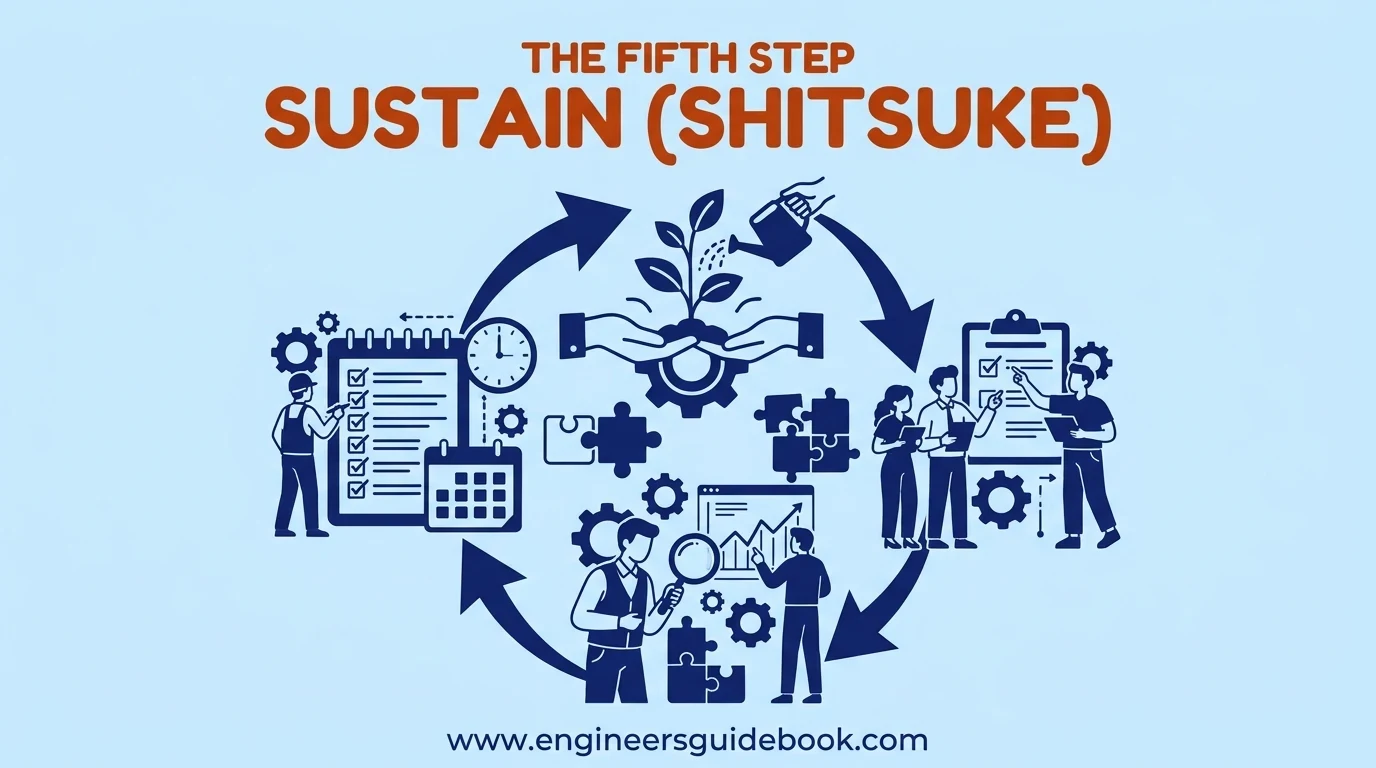
6. Fifth Step – Sustain (Shitsuke)
6.1 Understanding the Sustain Principle
Sustain is the final stage of 5S methodology and focuses on maintaining established standards through discipline, accountability, and continuous improvement.
It transforms workplace organization into an enduring organizational habit rather than a temporary improvement campaign.
6.2 Developing Workplace Discipline
Workplace discipline requires employees to consistently follow established procedures, return tools to designated locations, maintain cleanliness, and report abnormalities.
Management should reinforce these behaviors through active participation and consistent expectations.
6.3 Employee Training and Engagement
Training helps employees understand the purpose, principles, and practical application of 5S.
Employee involvement in workplace improvement decisions strengthens ownership and encourages proactive identification of organizational inefficiencies.
6.4 Continuous Monitoring and Improvement
Periodic audits, workplace inspections, performance reviews, and employee feedback help identify deviations from established standards.
Organizations should investigate recurring deficiencies and implement corrective measures to prevent their recurrence.
6.5 Practical Examples of Sustain
A production department conducts weekly 5S audits, reviews departmental performance scores, and assigns corrective actions for identified deficiencies.
Regular monitoring maintains workplace discipline while supporting incremental operational improvements.
7. Benefits of 5S Methodology
7.1 Improved Workplace Productivity
Organized workstations reduce unnecessary movement, material retrieval time, and operational interruptions.
Employees spend more time performing value-added activities, improving individual productivity and overall manufacturing efficiency.
7.2 Enhanced Occupational Safety
Removing clutter, maintaining clear walkways, organizing hazardous materials appropriately, and identifying equipment abnormalities contribute to a safer working environment.
However, 5S complements rather than replaces formal occupational safety procedures and risk assessments.
7.3 Reduced Waste and Operational Costs
Effective workplace organization reduces unnecessary inventory, duplicate purchases, material deterioration, and avoidable operational delays.
These improvements contribute to better resource utilization and lower operating costs.
7.4 Improved Equipment Reliability
Regular cleaning and inspection facilitate early detection of equipment deterioration.
Consequently, maintenance teams can address emerging defects proactively, potentially reducing breakdown frequency, improving Mean Time Between Failures (MTBF), and increasing equipment availability.
7.5 Better Product Quality and Employee Morale
Standardized, clean, and organized workplaces reduce opportunities for contamination, material mix-ups, and procedural inconsistencies.
Employees also benefit from improved working conditions, reduced frustration, and greater workplace ownership. Together, these advantages contribute to stronger quality performance, operational discipline, and a sustainable culture of continuous improvement.

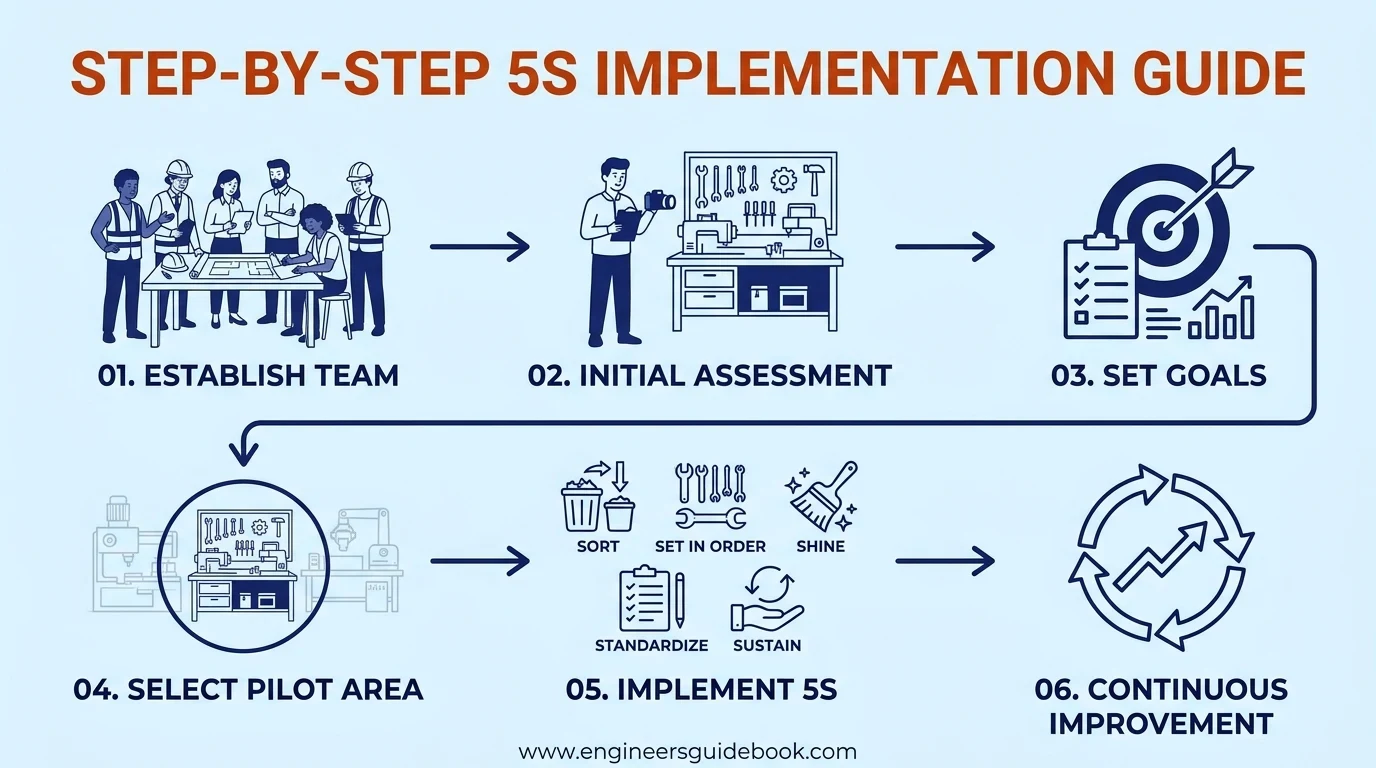
8. Step-by-Step 5S Implementation Guide
8.1 Establishing a 5S Implementation Team
Successful 5S implementation begins with establishing a cross-functional team comprising production personnel, maintenance technicians, quality representatives, safety officers, and departmental supervisors.
The team should define responsibilities, coordinate implementation activities, allocate resources, and monitor progress. Management participation is equally important for securing organizational commitment and overcoming operational barriers.
8.2 Conducting an Initial Workplace Assessment
An initial assessment establishes the existing workplace condition before implementing improvements. It should evaluate equipment arrangements, storage practices, housekeeping standards, material flow, and potential safety hazards.
Photographs, preliminary audit scores, tool retrieval times, and employee feedback provide valuable baseline information for subsequent performance comparisons.
8.3 Setting Implementation Goals and Targets
Implementation objectives should be specific, measurable, achievable, relevant, and time-bound (SMART).
Typical 5S implementation targets include:
- Reducing tool retrieval time by 40%.
- Achieving a 5S audit score of 90%.
- Eliminating unnecessary workplace inventory.
- Reducing workplace obstructions.
- Improving storage space utilization.
Targets should reflect actual operational requirements and baseline performance.
8.4 Selecting a Pilot Area
Implementing 5S within a controlled pilot area allows organizations to evaluate its effectiveness before expanding the methodology across multiple departments.
Maintenance workshops, assembly stations, and storage rooms are suitable pilot locations. Successful pilot projects demonstrate tangible benefits and encourage employee participation throughout the organization.
8.5 Implementing the Five Steps of 5S
The five stages should be implemented sequentially. Begin by removing unnecessary materials, arranging essential resources, cleaning the workplace, establishing standardized procedures, and developing mechanisms to sustain improvements.
Each implementation stage should have defined completion criteria, assigned responsibilities, and realistic deadlines.
8.6 Developing a Continuous Improvement Plan
A continuous improvement plan ensures that 5S remains an evolving operational practice. It should incorporate periodic audits, corrective action tracking, employee suggestions, refresher training, and performance evaluations.
The Plan-Do-Check-Act (PDCA) cycle provides an effective framework for systematically refining workplace organization practices.
9. Real-World Examples of 5S Methodology
9.1 5S in Manufacturing Industries
Manufacturing facilities implement 5S by organizing production materials, establishing designated equipment locations, marking transportation routes, and standardizing workstation arrangements.
For example, a packaging line can establish dedicated locations for changeover components, reducing preparation time and minimizing production interruptions during product changeovers.
9.2 5S in Maintenance Workshops
Maintenance workshops frequently contain numerous tools, spare parts, measuring instruments, and consumables.
Implementing labeled cabinets, shadow boards, segregated spare parts, and standardized inspection procedures improves accessibility. Faster tool retrieval can also contribute to reducing Mean Time to Repair (MTTR) during equipment breakdowns.
9.3 5S in Warehouses and Inventory Management
Warehouse operations benefit from systematic product classification, labeled storage racks, designated material handling routes, and standardized inventory arrangements.
These practices reduce picking errors, unnecessary transportation, misplaced inventory, and material retrieval delays while improving available storage capacity.
9.4 5S in Offices and Administrative Workplaces
Office environments can apply 5S to physical documents, stationery, electronic files, and digital communication systems.
Removing obsolete documents, standardizing folder structures, organizing shared resources, and establishing consistent file naming conventions improve administrative efficiency and information accessibility.
9.5 5S in Healthcare Facilities
Healthcare facilities use 5S to organize medical supplies, treatment instruments, pharmaceutical inventory, and emergency equipment.
Clearly identified storage locations and standardized arrangements enable healthcare personnel to access critical resources efficiently. Implementation must remain consistent with applicable infection control, medical storage, and patient safety requirements.
9.6 Before-and-After Workplace Transformation
Consider an illustrative example of a mechanical maintenance workshop implementing 5S.
Performance Parameter Before 5S After 5S Tool retrieval time 10 minutes 3 minutes Storage space utilization 60% 85% Unnecessary items 45 5 5S audit score 48% 92% Workplace obstructions 12 0
The hypothetical results demonstrate how systematic workplace organization can produce measurable operational improvements.

10. 5S Tools, Audits, and Performance Measurement
10.1 Essential 5S Implementation Tools
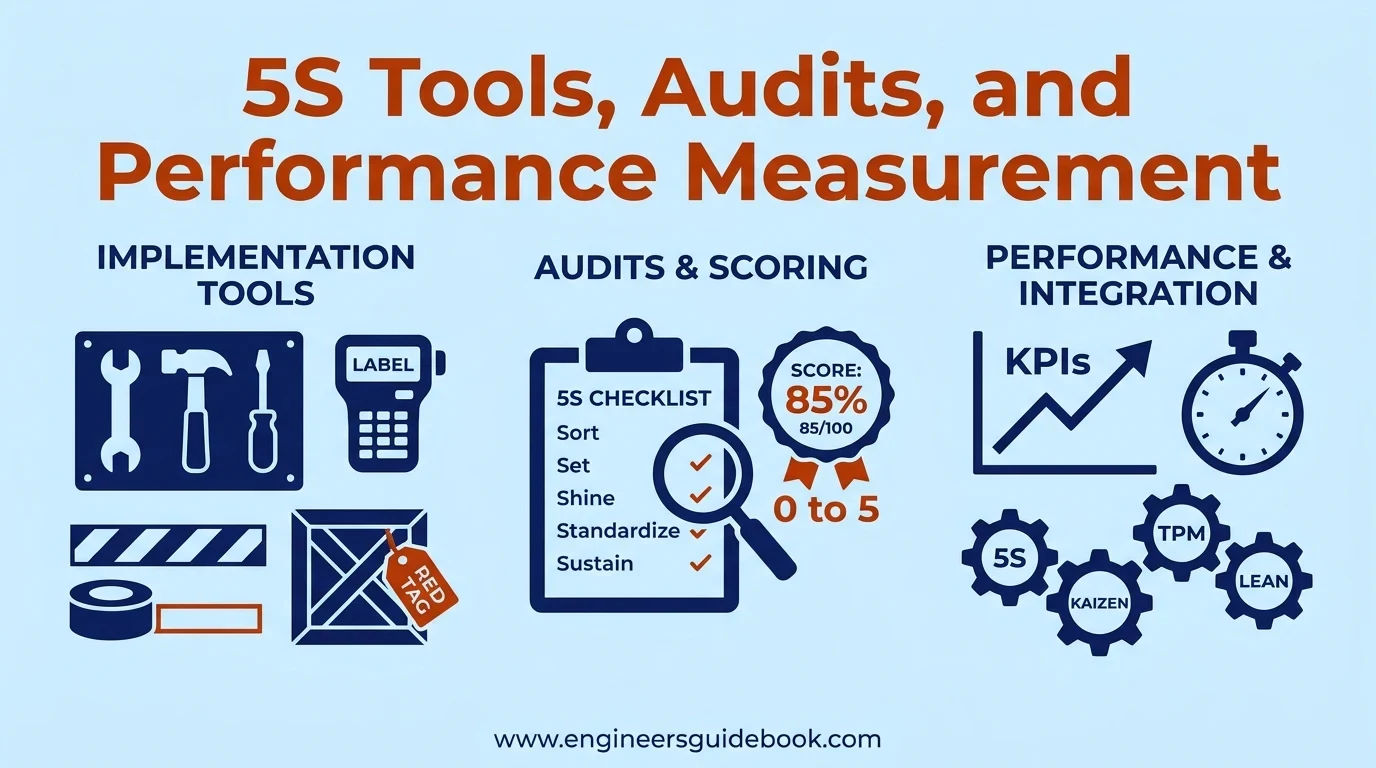
Various visual and administrative tools support effective 5S implementation. Common examples include red tags, shadow boards, floor markings, identification labels, cleaning schedules, audit checklists, reference photographs, and corrective action registers.
Tool selection should correspond to workplace characteristics, operational complexity, and organizational requirements.
10.2 Developing a 5S Audit Checklist
A comprehensive audit checklist evaluates compliance with each of the five 5S principles.
5S Principle Audit Criteria Sort Unnecessary items removed Set in Order Essential items correctly arranged Shine Workplace cleanliness maintained Standardize Documented procedures followed Sustain Standards consistently maintained
Additional criteria can be incorporated according to departmental requirements and operational risks.
10.3 Understanding the 5S Audit Scoring System
Organizations commonly use numerical rating scales to quantify workplace compliance. Individual audit criteria may receive scores ranging from zero to five, where zero represents noncompliance and five represents full compliance.
5S Audit Score (%) = (Total Achieved Score ÷ Maximum Possible Score) × 100
For example, achieving 85 points out of a possible 100 produces an audit score of 85%. Scoring thresholds should be established internally.
10.4 Key Performance Indicators for 5S
Key performance indicators (KPIs) provide quantitative evidence of implementation effectiveness.
Relevant indicators include tool retrieval time, audit compliance scores, corrective action closure rates, workplace obstruction frequency, inventory discrepancies, storage space utilization, and housekeeping compliance.
Equipment downtime and safety incidents may also be monitored as broader operational indicators.
10.5 Measuring 5S Implementation Effectiveness
Effectiveness should be evaluated by comparing post-implementation results against established baseline measurements.
Consistent measurement methodologies improve comparability. Organizations should investigate deteriorating performance trends and determine whether observed improvements genuinely result from 5S or other concurrent operational initiatives.
10.6 Integrating 5S With TPM, Kaizen, and Lean Manufacturing
5S complements Total Productive Maintenance (TPM) by establishing clean and organized conditions for autonomous maintenance and equipment inspections.
Kaizen builds upon these improvements through continuous incremental changes, while lean manufacturing utilizes 5S to eliminate unnecessary motion, transportation, inventory, and other non-value-added activities.
11. Common 5S Implementation Challenges and Best Practices
11.1 Employee Resistance to Change
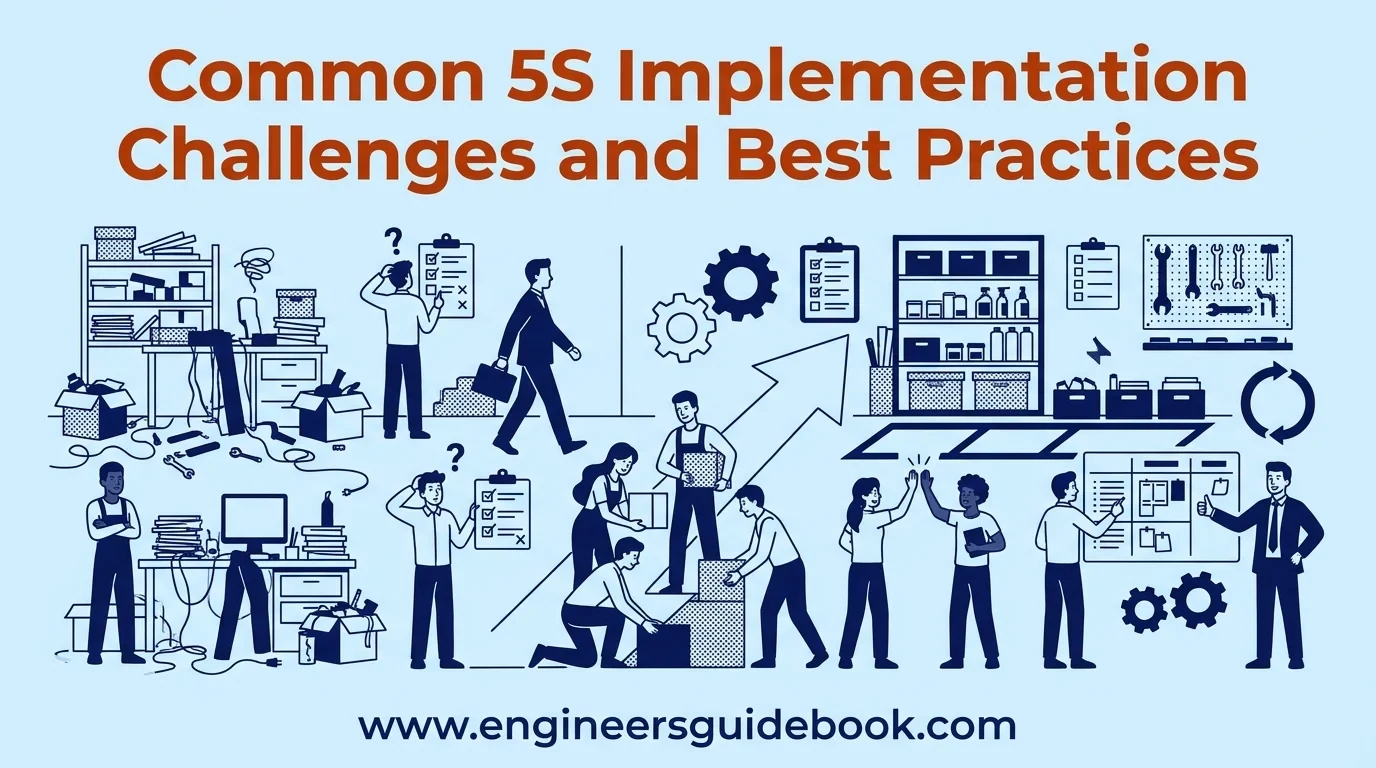
Employees may resist implementation because of established working habits, perceived additional responsibilities, or insufficient understanding of its benefits.
Active employee participation, practical demonstrations, and transparent communication help overcome resistance and encourage workplace ownership.
11.2 Lack of Management Commitment
Insufficient management involvement frequently undermines implementation sustainability.
Senior management should allocate appropriate resources, participate in workplace inspections, review performance indicators, and demonstrate consistent commitment to established organizational standards.
11.3 Inadequate Training and Standardization
Without adequate training, employees may interpret workplace organization requirements differently, resulting in inconsistent implementation.
Practical demonstrations, standardized instructions, visual references, and periodic refresher sessions help eliminate ambiguity and strengthen procedural compliance.
11.4 Common 5S Implementation Mistakes
Frequent implementation mistakes include treating 5S exclusively as a cleaning exercise, establishing unrealistic targets, neglecting employee feedback, removing essential equipment, and conducting superficial audits.
Excessive documentation without practical improvements can also diminish employee engagement and implementation effectiveness.
11.5 Best Practices for Successful 5S Implementation
Successful organizations establish clear workplace ownership, maintain straightforward visual standards, conduct regular inspections, and recognize meaningful improvements.
Implementation should emphasize practical functionality rather than superficial aesthetics. Corrective actions must address underlying causes of disorganization instead of repeatedly resolving identical deficiencies.
11.6 Building a Sustainable 5S Workplace Culture
A sustainable 5S culture develops when organization, cleanliness, and discipline become integral components of everyday operational activities.
Leadership involvement, employee accountability, constructive feedback, and continuous improvement reinforce these behaviors. Consistency ultimately determines long-term success.
12. Frequently Asked Questions (FAQs)
12.1 What Is 5S Methodology in Simple Words?
5S methodology is a workplace organization system that helps employees remove unnecessary items, arrange essential resources, maintain cleanliness, establish consistent procedures, and sustain an efficient working environment.
12.2 What Are the Five Steps of 5S Methodology?
The five steps are Sort (Seiri), Set in Order (Seiton), Shine (Seiso), Standardize (Seiketsu), and Sustain (Shitsuke). Each step contributes to establishing and maintaining an organized workplace.
12.3 What Is the Main Purpose of 5S?
The main purpose of 5S is to improve workplace efficiency, safety, organization, and operational discipline by eliminating unnecessary materials, reducing waste, and establishing standardized working conditions.
12.4 What Is an Example of 5S in the Workplace?
Organizing maintenance tools on labeled shadow boards, removing damaged tools, cleaning workbenches, establishing inspection checklists, and conducting regular workplace audits represents a practical example of 5S implementation.
12.5 What Is the Difference Between 5S and 6S?
The 6S methodology incorporates an additional principle known as Safety. Although safety is already supported by traditional 5S practices, 6S explicitly emphasizes hazard identification, risk reduction, and occupational safety awareness.
12.6 What Is the Difference Between 5S and Kaizen?
5S focuses primarily on workplace organization and standardization, whereas Kaizen emphasizes continuous incremental improvement across organizational processes. Both methodologies complement each other within lean management systems.
12.7 How Does 5S Improve Workplace Safety?
5S improves workplace safety by eliminating clutter, maintaining unobstructed walkways, organizing hazardous materials appropriately, and facilitating early detection of equipment abnormalities.
12.8 How Do You Calculate a 5S Audit Score?
Divide the total achieved audit score by the maximum possible score and multiply the result by 100. The resulting percentage represents workplace compliance with established 5S audit criteria.
12.9 How Often Should a 5S Audit Be Conducted?
5S audits may be conducted daily, weekly, or monthly, depending on operational complexity, workplace risks, and implementation maturity. Newly implemented areas generally require more frequent monitoring.
12.10 What Are the Limitations of 5S Methodology?
5S requires sustained management commitment, employee participation, training, and periodic monitoring. It cannot independently eliminate complex equipment failures, resolve engineering design deficiencies, or replace comprehensive maintenance and safety management systems.
13. Conclusion
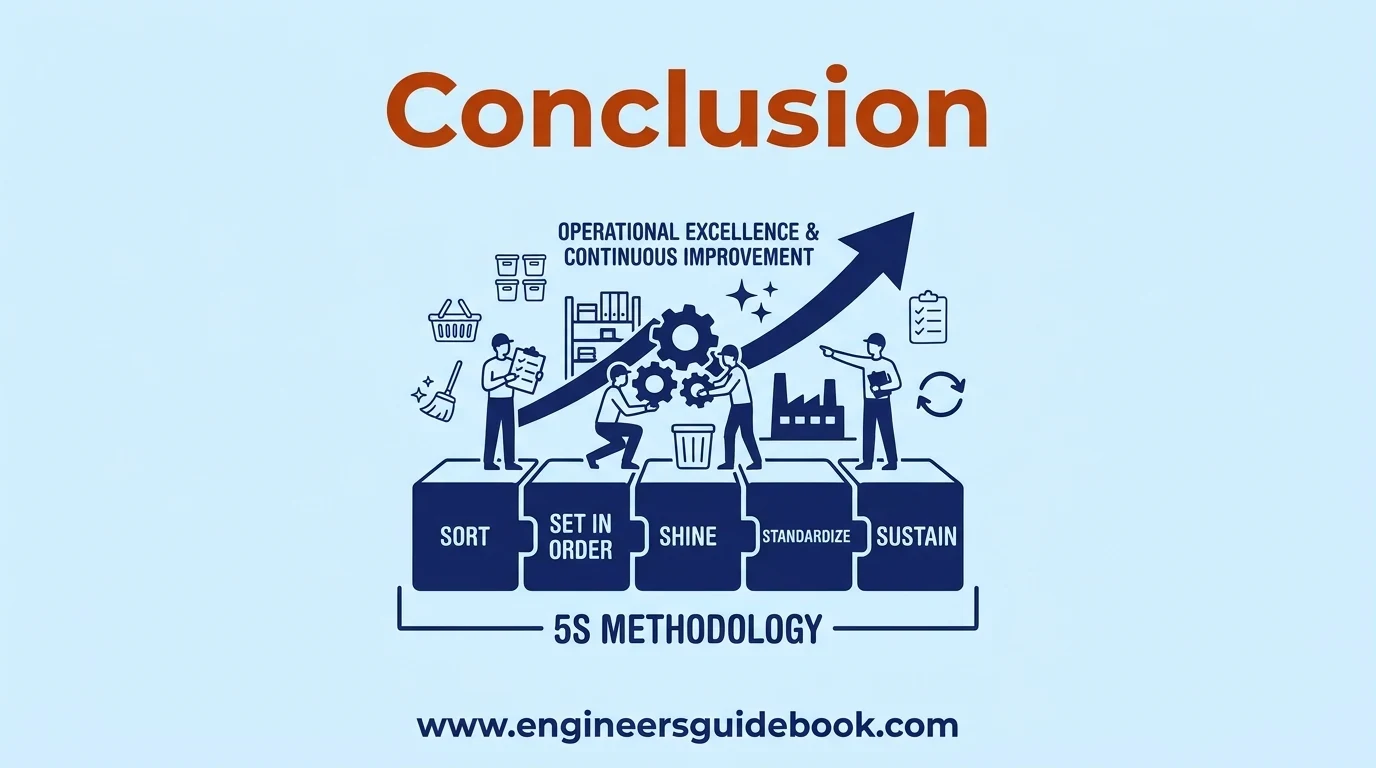
5S methodology provides a systematic foundation for workplace organization, operational efficiency, equipment reliability, and continuous improvement. Its five interconnected principles enable organizations to eliminate unnecessary resources, optimize workplace arrangements, maintain cleanliness, and establish sustainable operational standards.
Successful implementation extends beyond housekeeping. Through employee engagement, management commitment, measurable performance indicators, and regular audits, 5S becomes an integral component of operational excellence, lean manufacturing, and long-term organizational productivity.