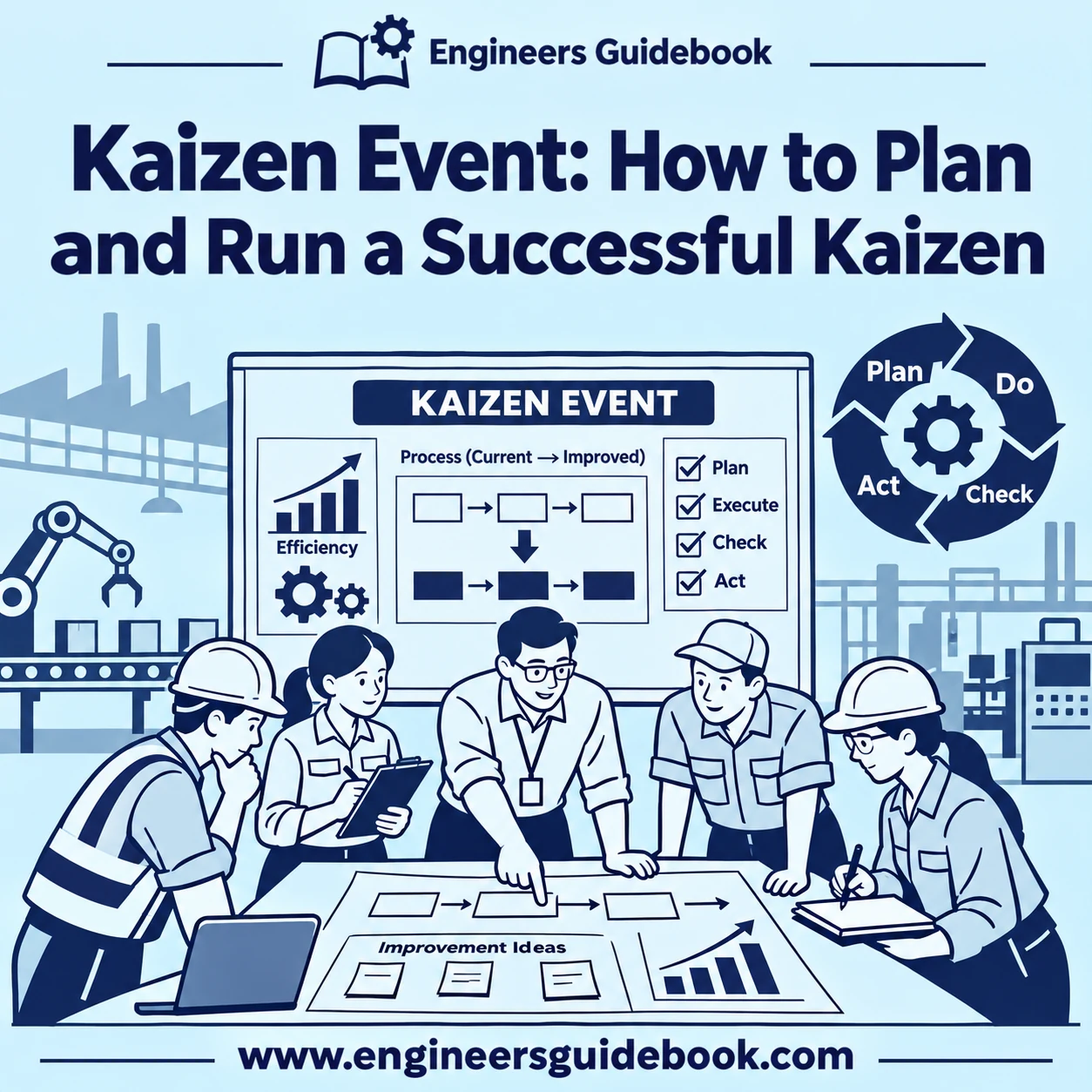
A Kaizen event is a structured, short-term improvement initiative in which a cross-functional team identifies problems, eliminates waste, and improves operational processes. Planning and running a successful Kaizen event involves defining objectives, selecting team members, collecting baseline data, analyzing root causes, implementing solutions, measuring results, and standardizing improvements to sustain long-term operational efficiency.
1. Introduction to Kaizen Events
1.1 What Is a Kaizen Event?
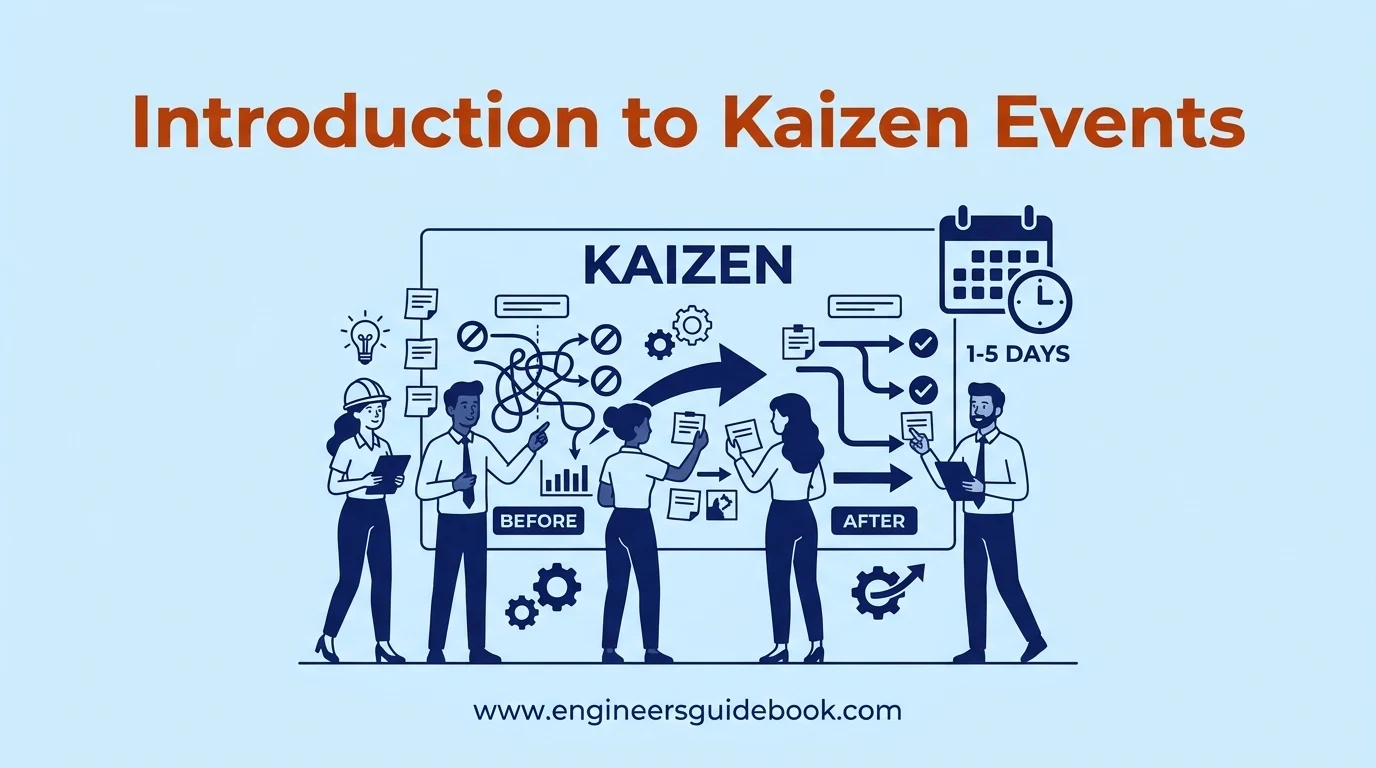
A Kaizen event is a focused improvement workshop designed to resolve specific operational problems within a predetermined timeframe. Typically lasting one to five days, it brings employees together to analyze existing processes, identify inefficiencies, and implement practical improvements.
Unlike conventional improvement projects, Kaizen events emphasize rapid execution, collaborative problem-solving, and measurable outcomes.
1.2 The Purpose of Kaizen Events
The primary purpose of a Kaizen event is to accelerate operational improvement without unnecessarily increasing organizational expenditure. These events address production bottlenecks, excessive downtime, quality deficiencies, material waste, and inefficient workflows.
They transform improvement opportunities into actionable solutions through systematic analysis and employee participation.
1.3 Kaizen Event vs Continuous Improvement
Continuous improvement represents an ongoing organizational philosophy focused on incremental enhancements. A Kaizen event, however, concentrates improvement activities within a defined period.
While continuous improvement occurs routinely throughout daily operations, Kaizen events mobilize dedicated resources to address particular challenges requiring concentrated attention.
1.4 Kaizen Event vs Kaizen Blitz
Kaizen event and Kaizen Blitz are frequently used interchangeably. However, a Kaizen Blitz generally emphasizes particularly intensive and rapid improvement activities.
Both approaches employ collaborative problem-solving, lean manufacturing principles, and practical experimentation to achieve measurable operational improvements.
2. Key Principles of a Successful Kaizen Event
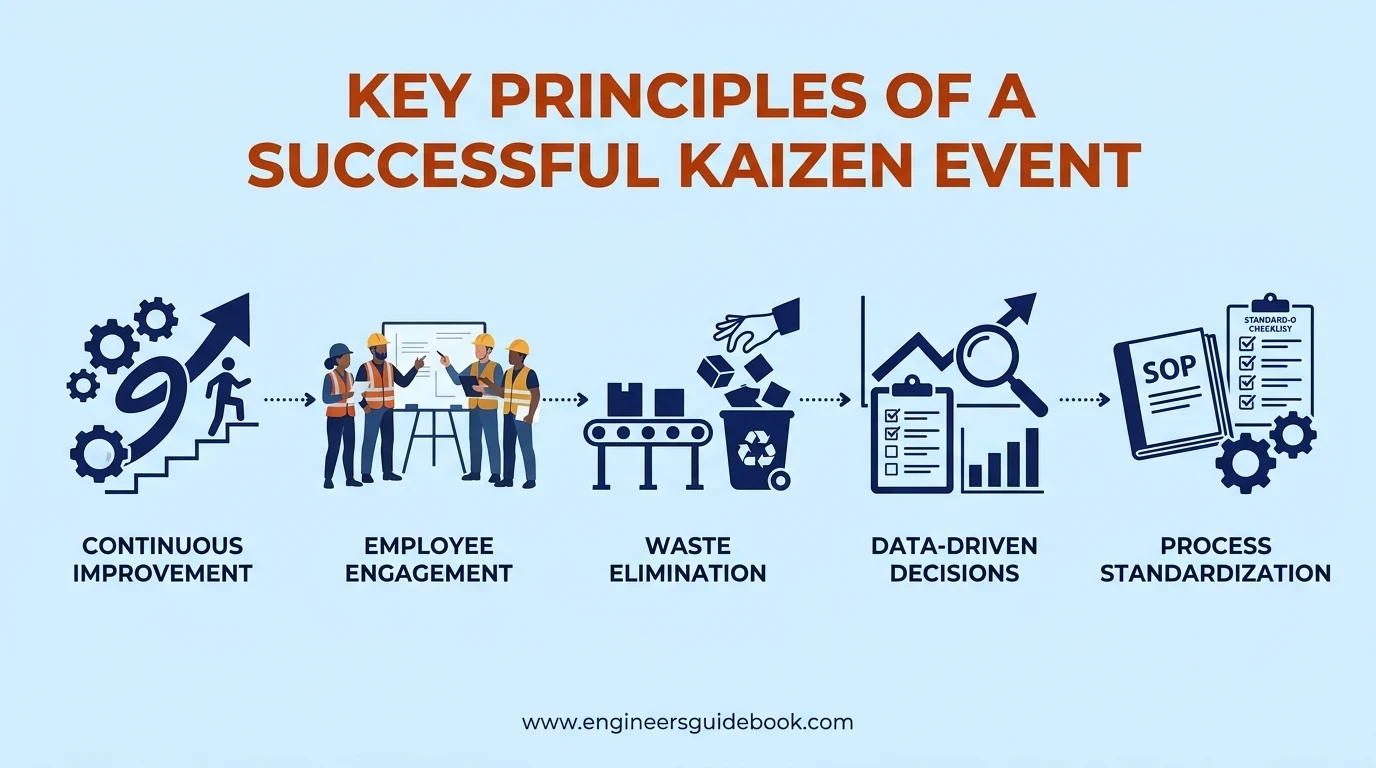
2.1 Continuous Improvement
Continuous improvement forms the philosophical foundation of every Kaizen event. Rather than pursuing perfection through expensive transformations, teams prioritize achievable enhancements that collectively generate substantial operational benefits.
Each improvement establishes a foundation for subsequent optimization.
2.2 Employee Engagement
Employees possess invaluable firsthand knowledge of operational challenges. Their participation enables organizations to uncover inefficiencies that management may otherwise overlook.
Successful Kaizen events encourage open communication, constructive feedback, collective accountability, and active involvement across organizational hierarchies.
2.3 Waste Elimination
Kaizen events systematically address the eight wastes of lean manufacturing, including transportation, inventory, motion, waiting, overproduction, overprocessing, defects, and underutilized talent.
Eliminating non-value-adding activities improves resource utilization while streamlining operational processes.
2.4 Data-Driven Decision Making
Effective improvement decisions require empirical evidence rather than conjecture. Teams examine production records, equipment downtime, defect rates, and process cycle times to establish factual improvement opportunities.
Quantitative analysis also enables objective validation of implemented countermeasures.
2.5 Process Standardization
Improvements must become embedded within routine operations. Standard operating procedures, visual instructions, and updated work standards ensure employees consistently follow optimized methodologies.
Without standardization, processes may gradually regress to their previous inefficient conditions.
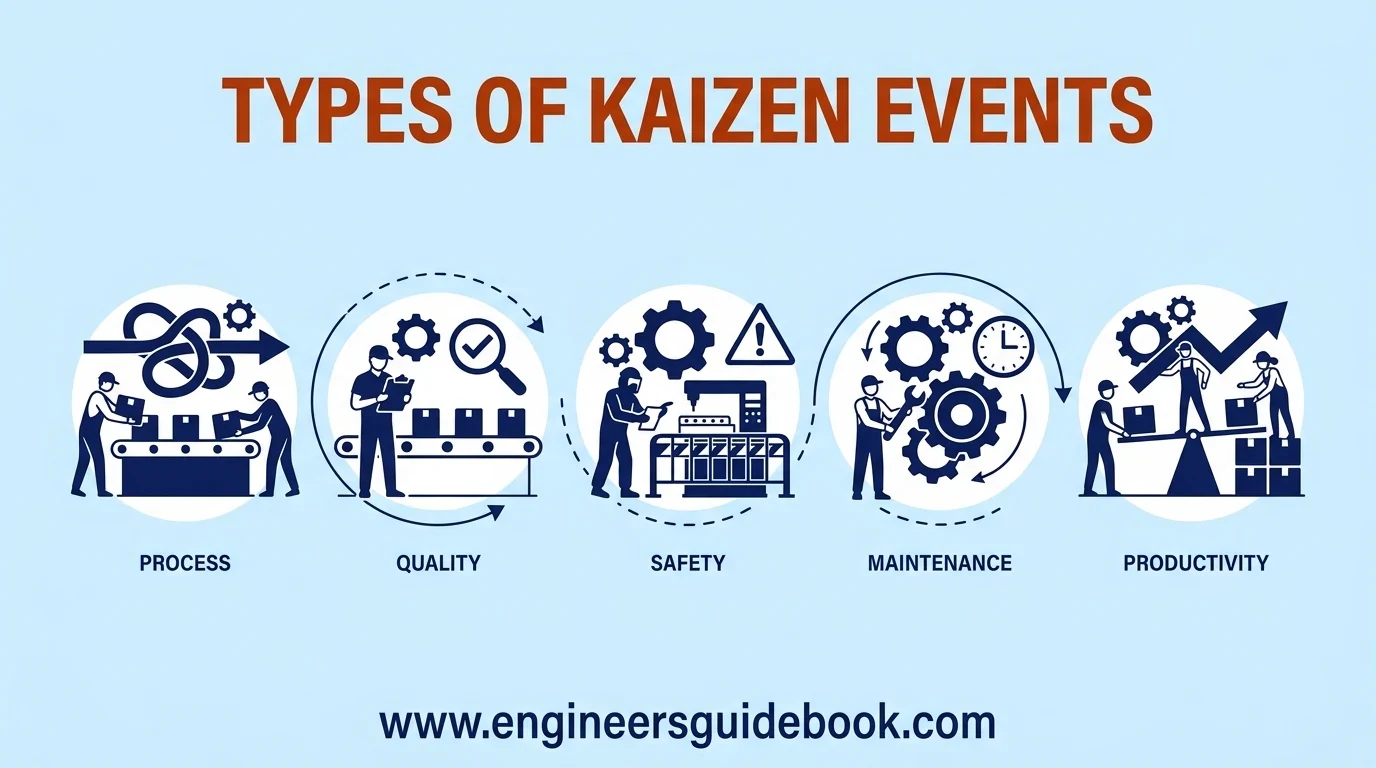
3. Types of Kaizen Events
3.1 Process Improvement Kaizen
Process improvement events concentrate on simplifying workflows, removing unnecessary activities, and reducing operational complexity.
Applications include optimizing assembly sequences, improving material transportation, reducing administrative delays, and eliminating production bottlenecks.
3.2 Quality Improvement Kaizen
Quality-focused events investigate recurring defects, process variability, rework, and customer complaints.
Teams identify underlying causes and introduce corrective measures such as mistake-proofing, improved inspection methods, and standardized operating parameters to enhance process conformance.
3.3 Safety Improvement Kaizen
Safety Kaizen events identify workplace hazards and reduce employee exposure to occupational risks.
Typical initiatives include improving machine guarding, eliminating trip hazards, redesigning ergonomic workstations, and strengthening material-handling procedures through appropriate risk-control measures.
3.4 Maintenance Improvement Kaizen
Maintenance Kaizen events address equipment reliability, recurring breakdowns, prolonged repair durations, and inadequate maintenance practices.
Teams may optimize preventive maintenance schedules, improve spare parts accessibility, reduce Mean Time to Repair (MTTR), and investigate recurrent equipment failures.
3.5 Productivity Improvement Kaizen
Productivity improvement events focus on increasing output relative to available resources without compromising quality or safety.
Common applications include production line balancing, changeover time reduction, workstation optimization, and improved machine utilization.
4. Benefits of Conducting Kaizen Events
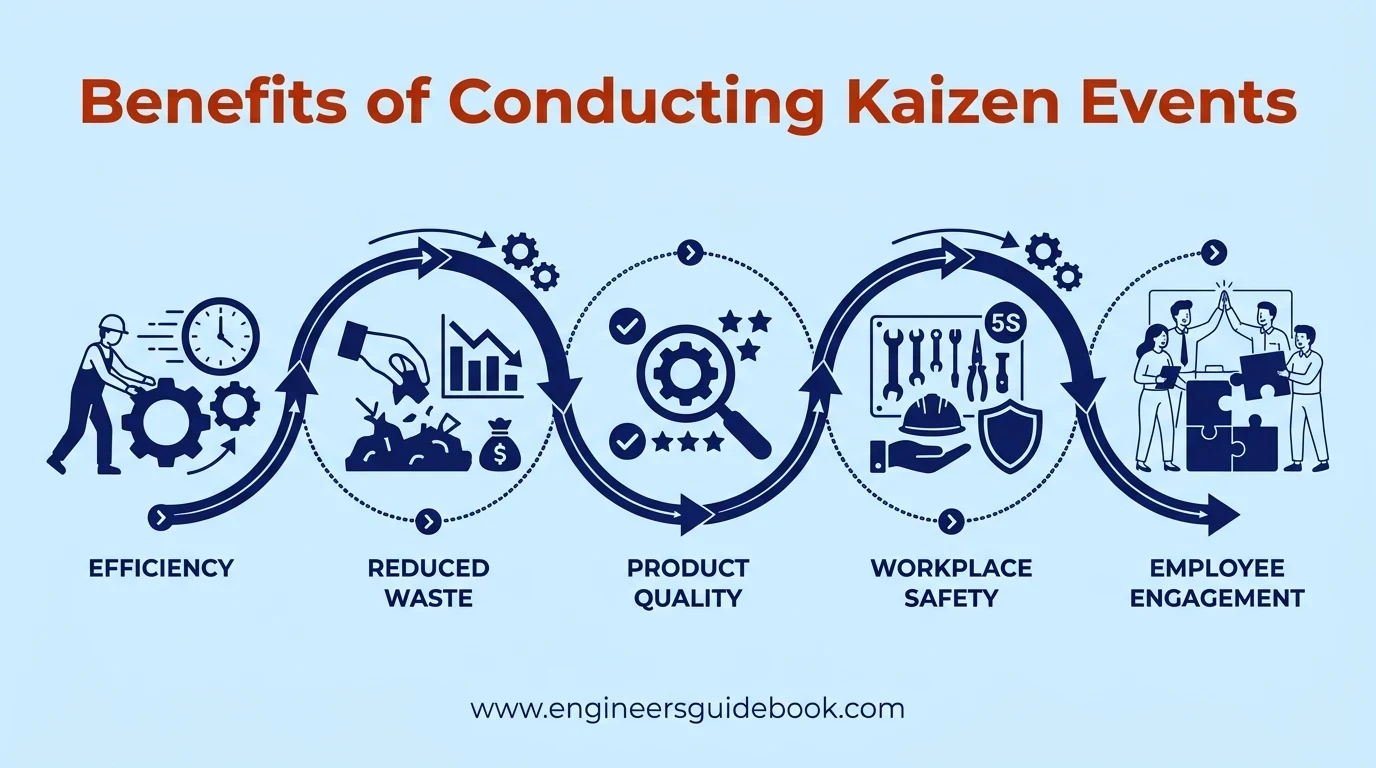
4.1 Increased Operational Efficiency
Kaizen events streamline production activities by eliminating redundant procedures and operational impediments. Employees spend more time performing value-adding activities instead of navigating inefficient workflows.
Consequently, organizations can improve throughput and shorten production lead times.
4.2 Reduced Operational Costs and Waste
Unnecessary material consumption, excessive inventory, and production delays inflate manufacturing expenses.
Kaizen events reduce these expenditures through targeted interventions, enabling organizations to achieve tangible financial savings without relying exclusively on capital-intensive investments.
4.3 Improved Product Quality
Systematic root cause analysis helps eliminate recurring quality deficiencies. Standardized processes also reduce unwanted variability and improve manufacturing consistency.
These improvements can decrease rejection rates, customer complaints, scrap generation, and rework expenses.
4.4 Enhanced Workplace Safety
Identifying hazardous conditions during improvement activities enables organizations to establish safer working environments.
Ergonomic enhancements, organized workstations, and effective engineering controls can reduce occupational risks while supporting sustainable operational performance.
4.5 Greater Employee Engagement
Participating in improvement initiatives gives employees greater ownership of workplace processes. Their recommendations become tangible operational enhancements, strengthening motivation and professional accountability.
This participatory approach fosters a culture of collective problem-solving.
5. How to Plan a Kaizen Event
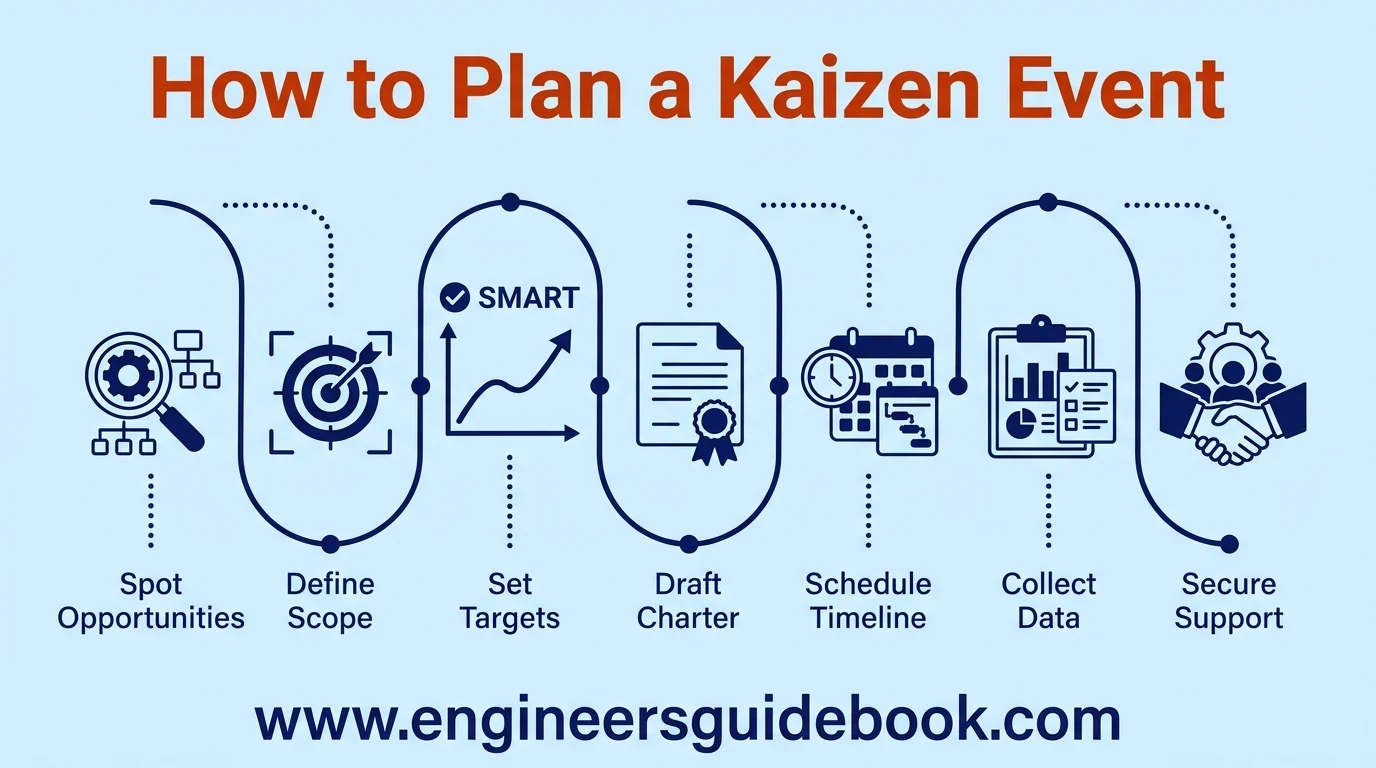
5.1 Identifying Improvement Opportunities
Begin by examining operational performance indicators, production losses, customer feedback, maintenance records, and workplace observations.
Prioritize problems according to their operational impact, frequency, financial consequences, and feasibility of resolution within the available timeframe.
5.2 Defining Event Objectives and Scope
Clearly specify the process under investigation and establish its boundaries. An excessively broad scope can dissipate team resources and undermine achievable outcomes.
For example, reducing filling machine changeover time represents a more manageable objective than improving an entire manufacturing facility.
5.3 Establishing Measurable Performance Targets
Performance targets should follow the SMART framework—specific, measurable, achievable, relevant, and time-bound.
Examples of measurable Kaizen objectives include:
- Reduce equipment changeover time by 30%.
- Decrease material rejection rates by 20%.
- Reduce average maintenance repair time by 15%.
- Improve production throughput by 10%.
Targets should reflect baseline performance and realistic improvement potential.
5.4 Developing a Kaizen Event Charter
A Kaizen event charter formalizes the improvement initiative. It establishes expectations and provides participants with a common operational direction.
An effective charter includes:
- Problem statement and improvement objectives.
- Project scope and limitations.
- Team members and responsibilities.
- Baseline performance and target metrics.
- Event duration and required resources.
- Expected deliverables and follow-up requirements.
5.5 Preparing the Event Schedule
Develop a structured agenda covering process observation, problem identification, root cause analysis, solution development, implementation, and results verification.
Allocate sufficient time for practical experimentation. An overly compressed schedule may encourage superficial analysis and ineffective countermeasures.
5.6 Collecting Baseline Performance Data
Baseline data establishes the initial operational condition against which improvements are evaluated.
Relevant measurements may include cycle time, production output, Overall Equipment Effectiveness (OEE), downtime, defect rates, labor hours, and material consumption.
Ensure measurement methods remain consistent throughout the event.
5.7 Securing Management Support
Management endorsement ensures access to personnel, equipment, financial resources, and implementation authority.
Leadership should also remove organizational barriers, facilitate interdepartmental coordination, and demonstrate commitment to sustaining improvements beyond the event.
6. Building a Kaizen Event Team
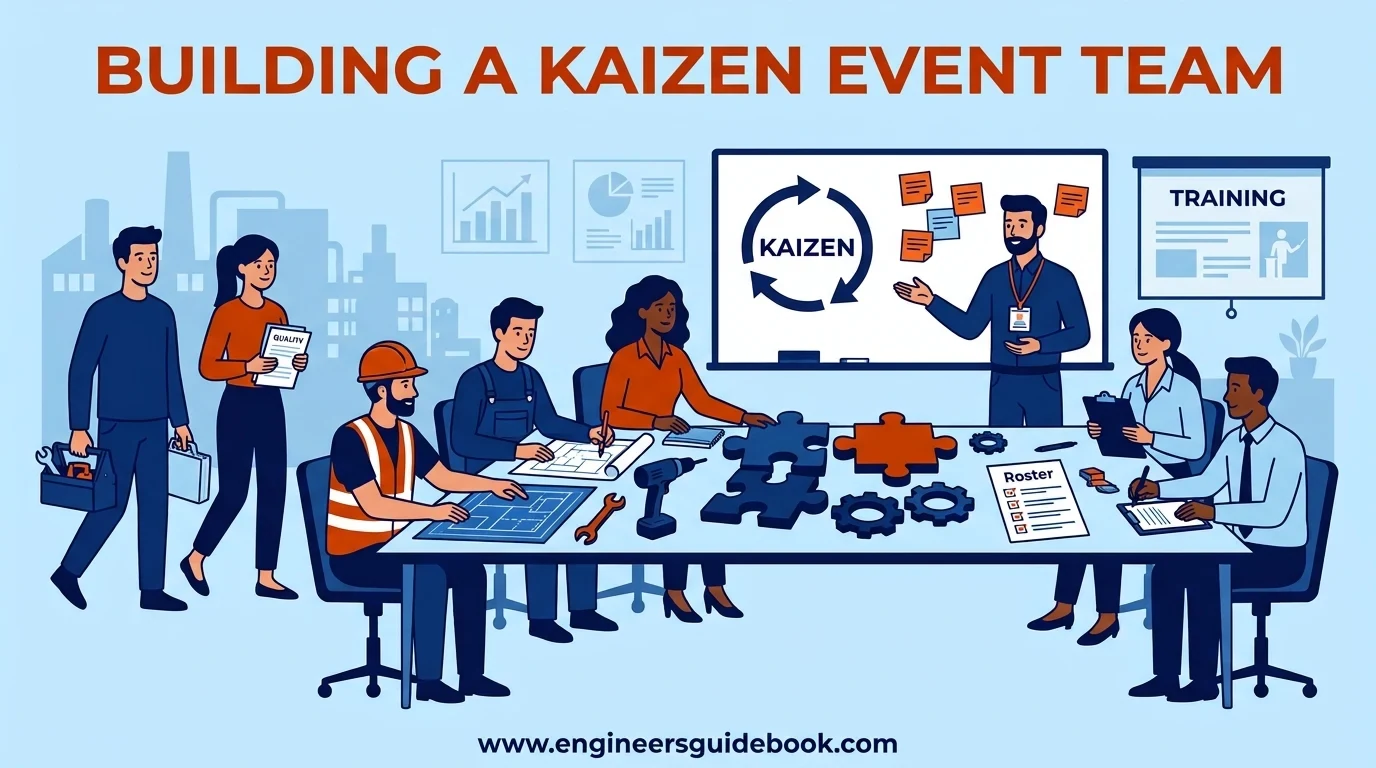
6.1 Selecting Cross-Functional Team Members
An effective Kaizen team incorporates individuals with complementary technical knowledge and operational experience.
Depending on the improvement objective, participants may include production operators, maintenance technicians, engineers, quality personnel, safety professionals, and department supervisors.
6.2 Defining Team Roles and Responsibilities
Clearly established responsibilities prevent ambiguity and improve accountability.
The event sponsor provides organizational support, the facilitator guides improvement activities, the process owner oversees implementation, and team members contribute technical expertise and execute assigned actions.
6.3 Selecting a Kaizen Facilitator
The facilitator coordinates event activities, maintains focus, and encourages equitable participation.
An effective facilitator should possess knowledge of lean manufacturing, analytical problem-solving, conflict resolution, process improvement methodologies, and group communication techniques.
6.4 Involving Frontline Employees
Frontline employees understand the practical intricacies of machinery, production sequences, and routine operational challenges.
Their involvement ensures proposed improvements are technically feasible, ergonomically appropriate, and compatible with actual workplace requirements.
6.5 Conducting Pre-Event Training
Provide participants with introductory training covering Kaizen principles, waste identification, root cause analysis, performance measurement, and relevant improvement tools.
This preparation establishes a common understanding and enables productive collaboration from the beginning of the event.
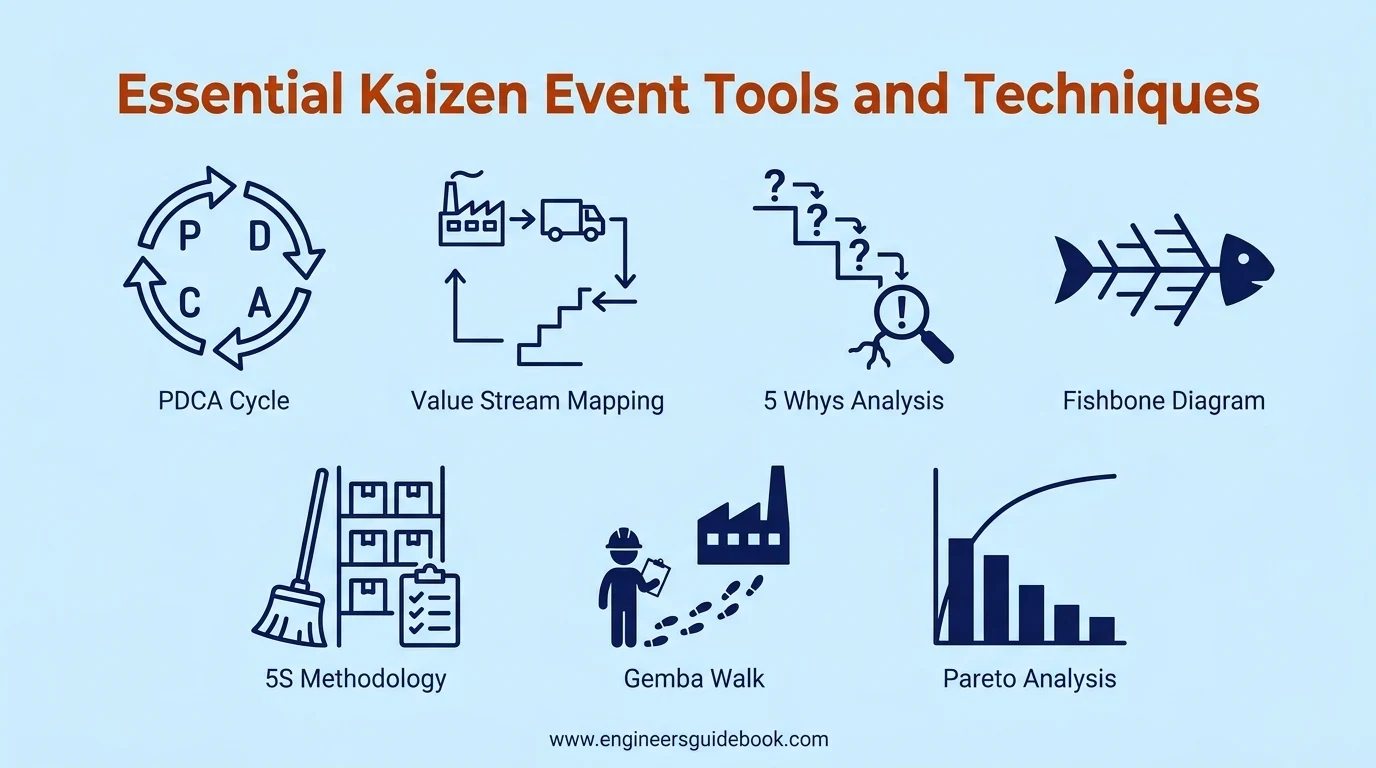
7. Essential Kaizen Event Tools and Techniques
7.1 PDCA Cycle
The Plan-Do-Check-Act cycle provides a systematic framework for continuous improvement.
Teams plan countermeasures, implement controlled changes, evaluate performance outcomes, and standardize successful solutions. Unsuccessful interventions undergo further analysis and refinement.
7.2 Value Stream Mapping
Value Stream Mapping (VSM) visually represents material and information flows throughout a process.
It distinguishes value-adding activities from non-value-adding operations, helping teams identify bottlenecks, excessive inventory, waiting periods, and opportunities for future-state process optimization.
7.3 5 Whys Analysis
The 5 Whys technique investigates underlying problems by repeatedly questioning why a particular failure or inefficiency occurred.
Rather than addressing superficial symptoms, teams investigate causal relationships and verify root causes before implementing corrective measures.
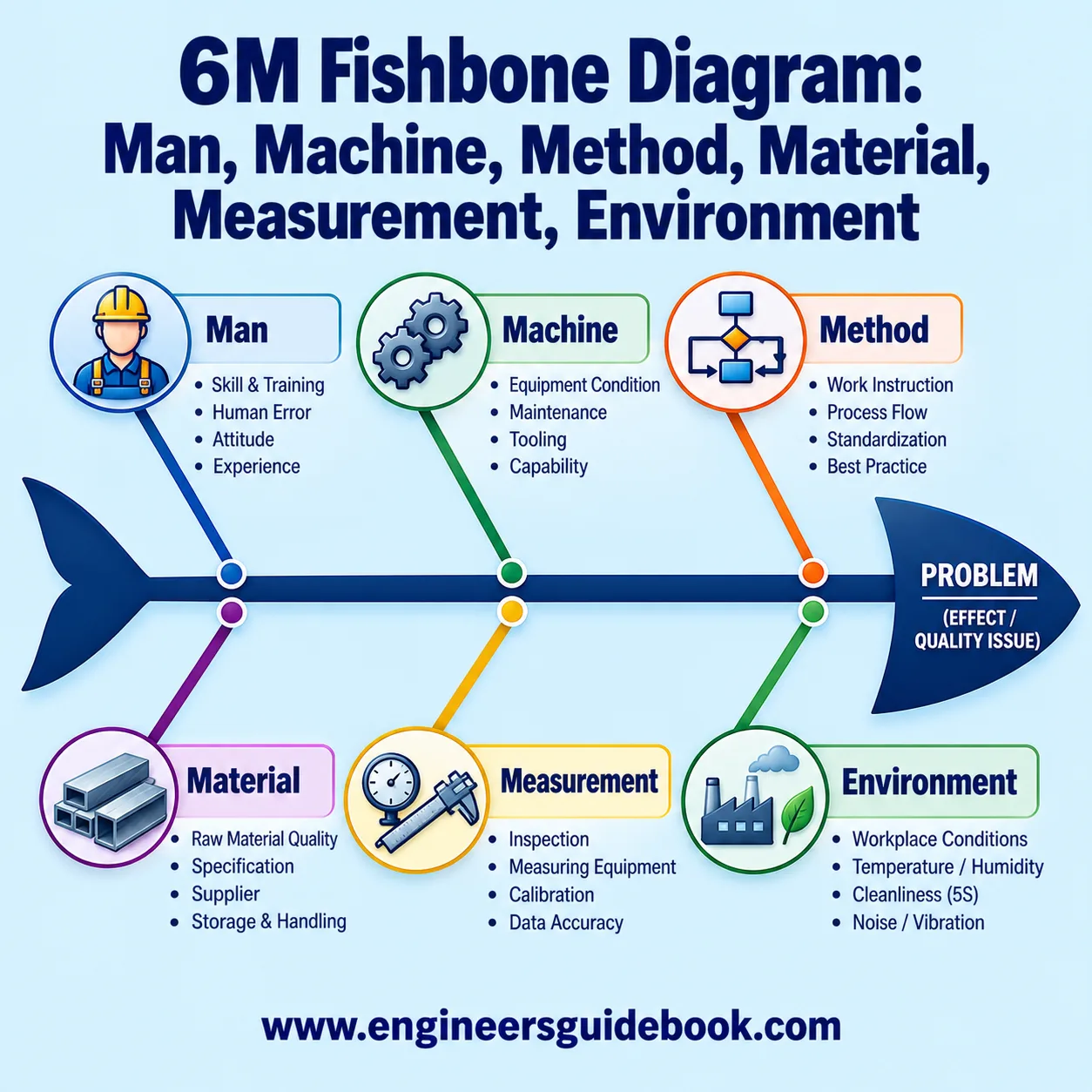
7.4 Fishbone Diagram
A fishbone diagram, also known as an Ishikawa diagram, categorizes potential causes of operational problems.
Manufacturing teams frequently employ the 6M framework, comprising manpower, machines, materials, methods, measurement, and mother nature, to systematically investigate process deficiencies.
7.5 5S Methodology
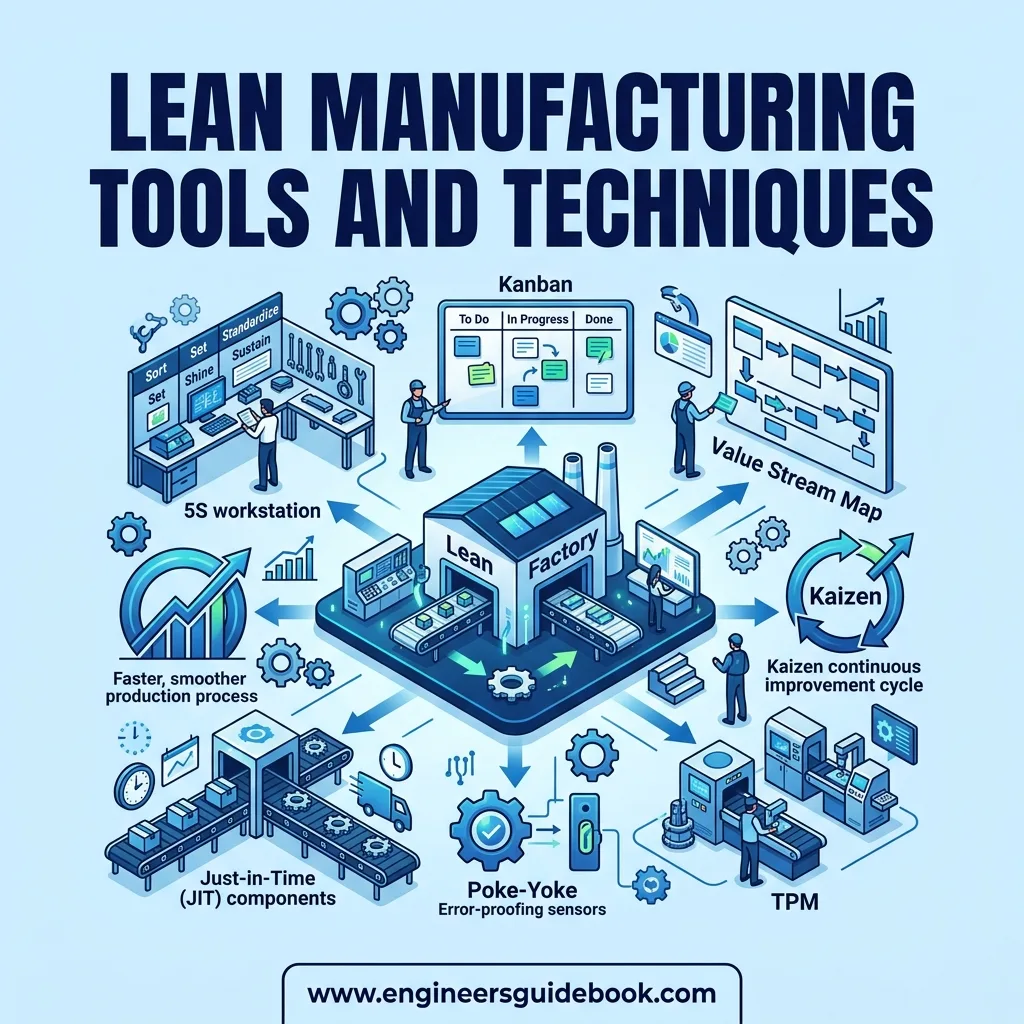
The 5S methodology incorporates Sort, Set in Order, Shine, Standardize, and Sustain.
It improves workplace organization, minimizes unnecessary motion, increases tool accessibility, and establishes visual management practices that support efficient and disciplined operations.
7.6 Gemba Walk
A Gemba walk involves visiting the actual workplace where value-adding activities occur.
Direct observation enables teams to understand operational realities, communicate with employees, identify process abnormalities, and validate improvement opportunities without relying exclusively on theoretical assumptions.
7.7 Pareto Analysis
Pareto analysis prioritizes problems according to their relative frequency or impact. It is associated with the 80/20 principle, which suggests that a relatively small proportion of causes often contributes to a substantial proportion of operational losses.
By concentrating resources on significant problems, Kaizen teams can maximize improvement effectiveness within limited timeframes.
8. Step-by-Step Kaizen Event Execution
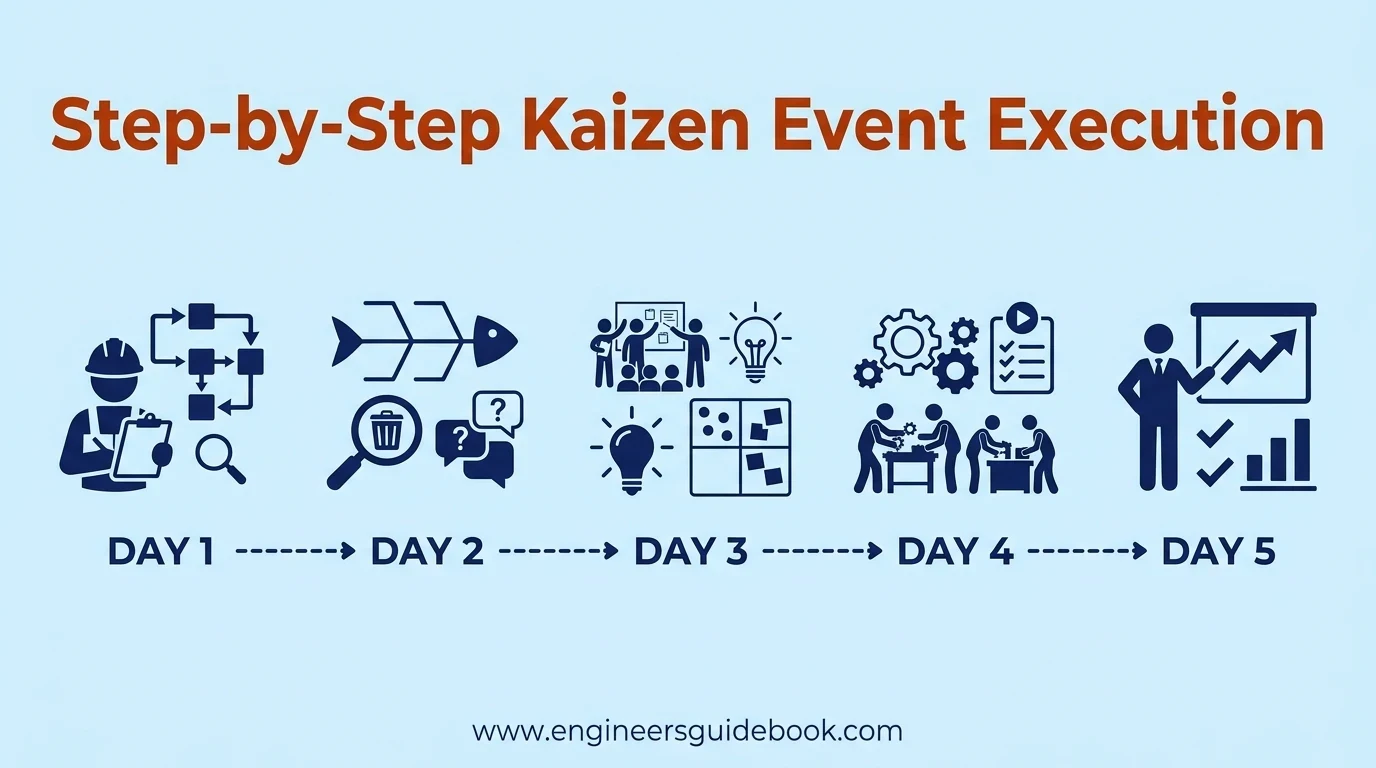
8.1 Day 1 Understanding the Current Process
The first day concentrates on understanding existing operational conditions. Begin with an opening meeting to communicate objectives, performance targets, and individual responsibilities.
Conduct a Gemba walk, observe work sequences, collect operational data, and develop a current-state process map. Document existing constraints without prematurely proposing solutions.
8.2 Day 2 Identifying Waste and Root Causes
The second day focuses on identifying non-value-adding activities, operational bottlenecks, and underlying process deficiencies.
Apply Pareto analysis, fishbone diagrams, and the 5 Whys technique to investigate significant problems. Distinguish symptoms from actual root causes and prioritize improvement opportunities according to their operational impact and implementation feasibility.
8.3 Day 3 Developing Improvement Solutions
Encourage participants to brainstorm practical countermeasures addressing verified root causes. Evaluate proposed solutions according to implementation costs, technical feasibility, safety implications, and anticipated benefits.
An impact-effort matrix can help prioritize high-impact improvements requiring relatively modest resources. Develop implementation plans with clearly defined responsibilities.
8.4 Day 4 Implementing and Testing Changes
Implement selected countermeasures through controlled experimentation. Activities may involve workstation rearrangement, equipment adjustments, workflow modifications, or revised operating procedures.
Conduct appropriate safety and quality assessments before introducing modifications. Monitor operational performance during trials and refine solutions wherever unexpected complications arise.
8.5 Day 5 Evaluating and Presenting Results
The final day focuses on verifying improvement effectiveness and communicating achievements.
Compare post-implementation measurements against baseline performance and established targets. Present results to management, document lessons learned, and establish follow-up action plans for outstanding activities and long-term performance verification.
9. Measuring Kaizen Event Success
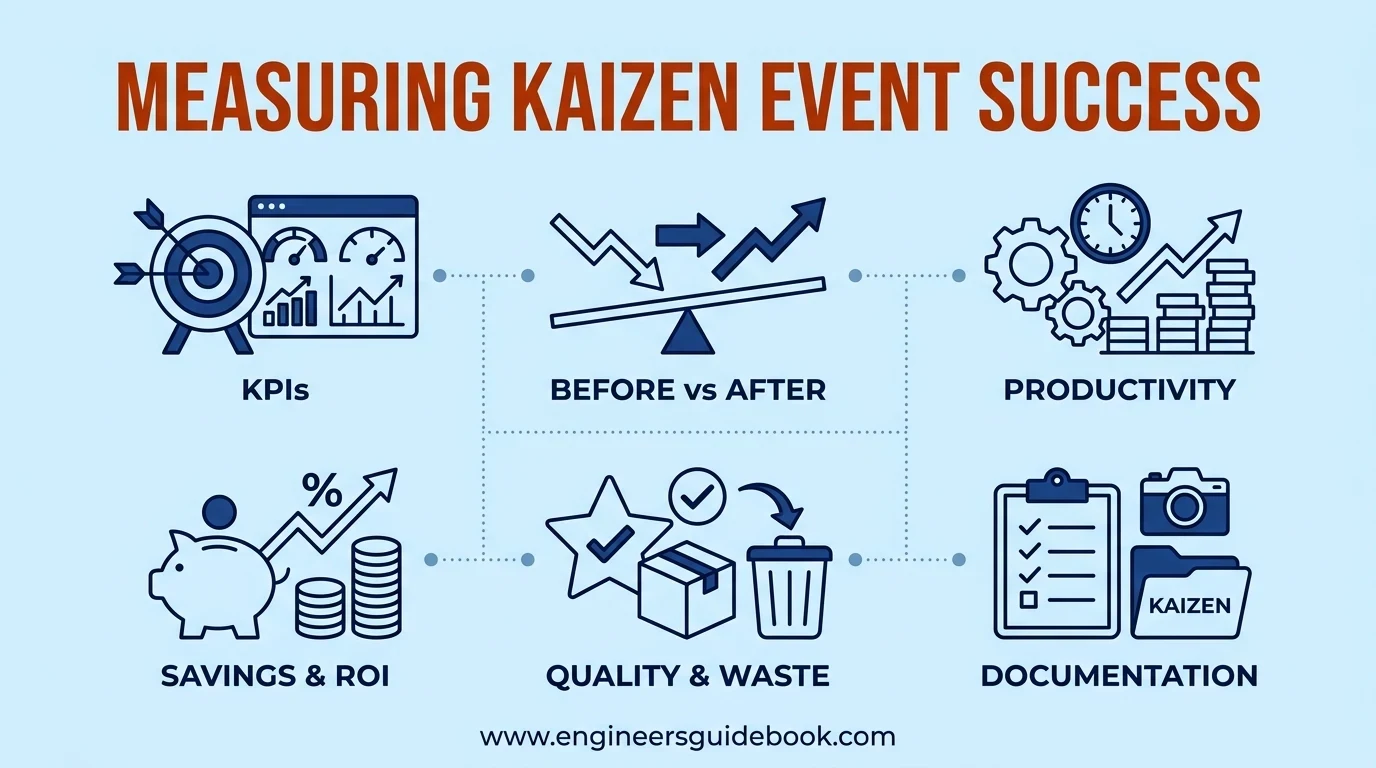
9.1 Selecting Key Performance Indicators
Key Performance Indicators (KPIs) provide quantitative evidence of improvement effectiveness. Select indicators directly aligned with the event objectives.
Relevant Kaizen performance indicators include:
- Overall Equipment Effectiveness (OEE).
- Production cycle time.
- Equipment downtime.
- Product rejection rate.
- Manufacturing cost per unit.
- Production throughput.
Avoid excessive indicators that complicate performance evaluation.
9.2 Comparing Before and After Performance
A meaningful performance comparison requires consistent measurement conditions, equivalent operating parameters, and reliable baseline data.
For indicators where lower values represent improvement, use the following formula:
Improvement (%) = [(Baseline Value − Improved Value) / Baseline Value] × 100
This calculation is particularly useful for evaluating reductions in downtime, defects, and cycle time.
9.3 Measuring Productivity Improvements
Productivity improvements demonstrate how effectively an organization converts available resources into measurable output.
Productivity = Total Output / Total Input
For example, increasing production from 800 to 1,000 units using identical labor hours represents a 25% productivity improvement. Verify that increased output does not compromise product quality or workplace safety.
9.4 Calculating Cost Savings and ROI
Financial evaluation determines whether improvement benefits justify implementation expenditure.
Net Savings = Gross Savings − Implementation Cost
ROI (%) = (Net Savings / Implementation Cost) × 100
If a Kaizen event generates annual savings of $15,000 against an implementation cost of $3,000, its first-year ROI is 400%.
Use consistent financial periods and distinguish actual savings from potential cost avoidance.
9.5 Tracking Quality and Waste Reduction
Monitor scrap generation, rejection rates, rework quantities, material consumption, and customer complaints following implementation.
These indicators reveal whether process modifications deliver genuine improvements or merely transfer inefficiencies elsewhere. Sustained reductions provide stronger evidence of effectiveness than isolated short-term results.
9.6 Documenting Kaizen Event Results
Prepare a comprehensive event report containing the original problem statement, baseline measurements, root cause findings, implemented countermeasures, achieved results, and outstanding actions.
Photographs, process maps, and performance charts provide valuable documentation for future improvement initiatives.
10. Sustaining Improvements After a Kaizen Event
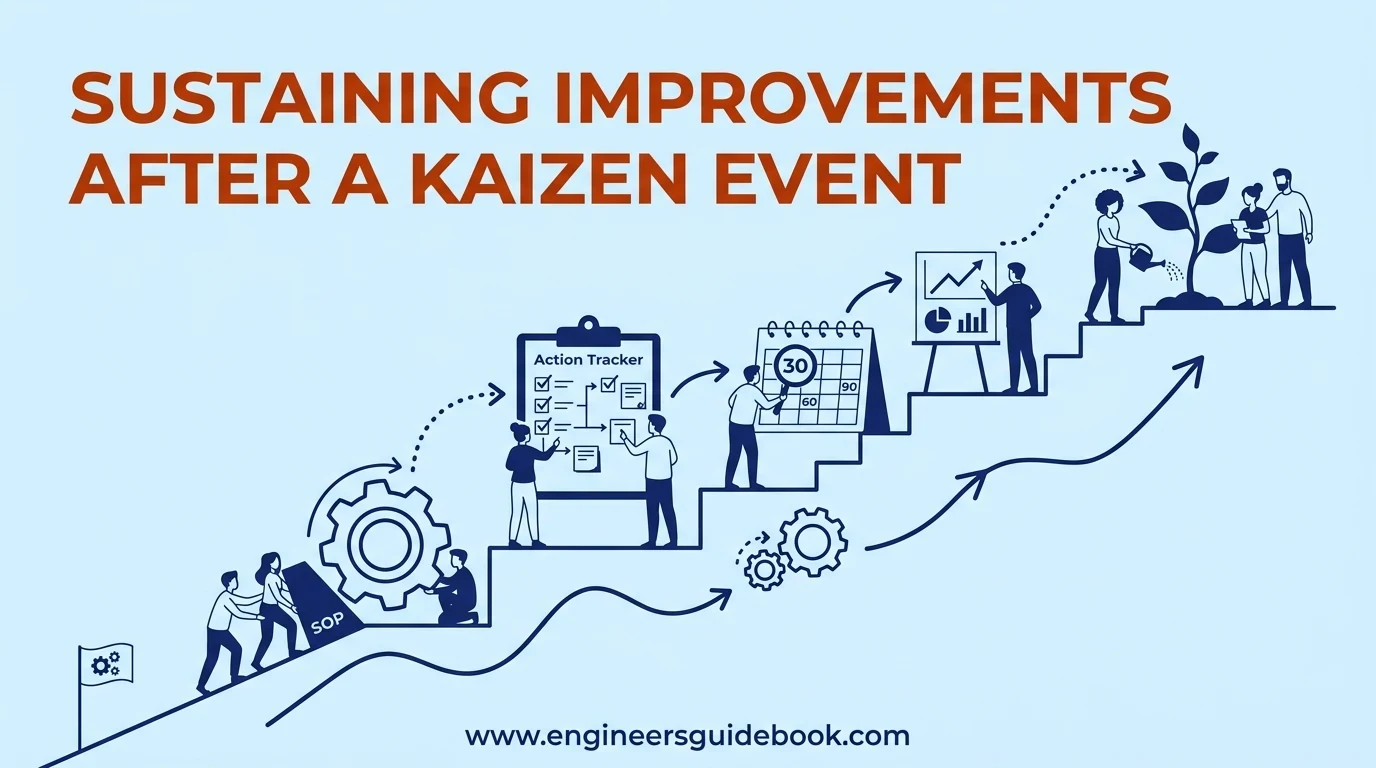
10.1 Standardizing Improved Processes
Translate successful improvements into standardized operating practices. Update standard operating procedures, work instructions, maintenance checklists, and visual management systems.
Standardization reduces procedural variability and ensures improvements remain independent of individual employee preferences.
10.2 Assigning Action Plan Responsibilities
Outstanding improvement activities require clearly designated process owners, completion deadlines, and verification criteria.
Establish an action tracker that records implementation status, responsible personnel, resource requirements, and completion evidence. Accountability prevents unresolved activities from disappearing into routine operational demands.
10.3 Conducting Follow-Up Audits
Schedule periodic audits to verify compliance with revised procedures and evaluate improvement sustainability.
Follow-up reviews may occur after 30, 60, and 90 days, depending on process criticality. Address deviations promptly through corrective actions and additional employee training.
10.4 Monitoring Long-Term Performance
Integrate relevant Kaizen performance indicators into existing operational dashboards and departmental review meetings.
Continuous monitoring helps identify deteriorating performance, emerging bottlenecks, and unintended consequences. Statistical process control techniques can further support early detection of process instability.
10.5 Preventing Process Regression
Process regression occurs when employees gradually return to previously established inefficient practices.
Prevent regression through visual controls, standardized work, supervisory verification, employee training, and accessible operating instructions. Investigate recurring deviations rather than relying exclusively on disciplinary measures.
10.6 Building a Continuous Improvement Culture
Kaizen should extend beyond isolated workshops. Encourage employees to identify inefficiencies, submit improvement suggestions, and participate in routine problem-solving activities.
Management recognition and consistent leadership involvement help institutionalize continuous improvement throughout the organization.
11. Practical Kaizen Event Examples and Common Mistakes
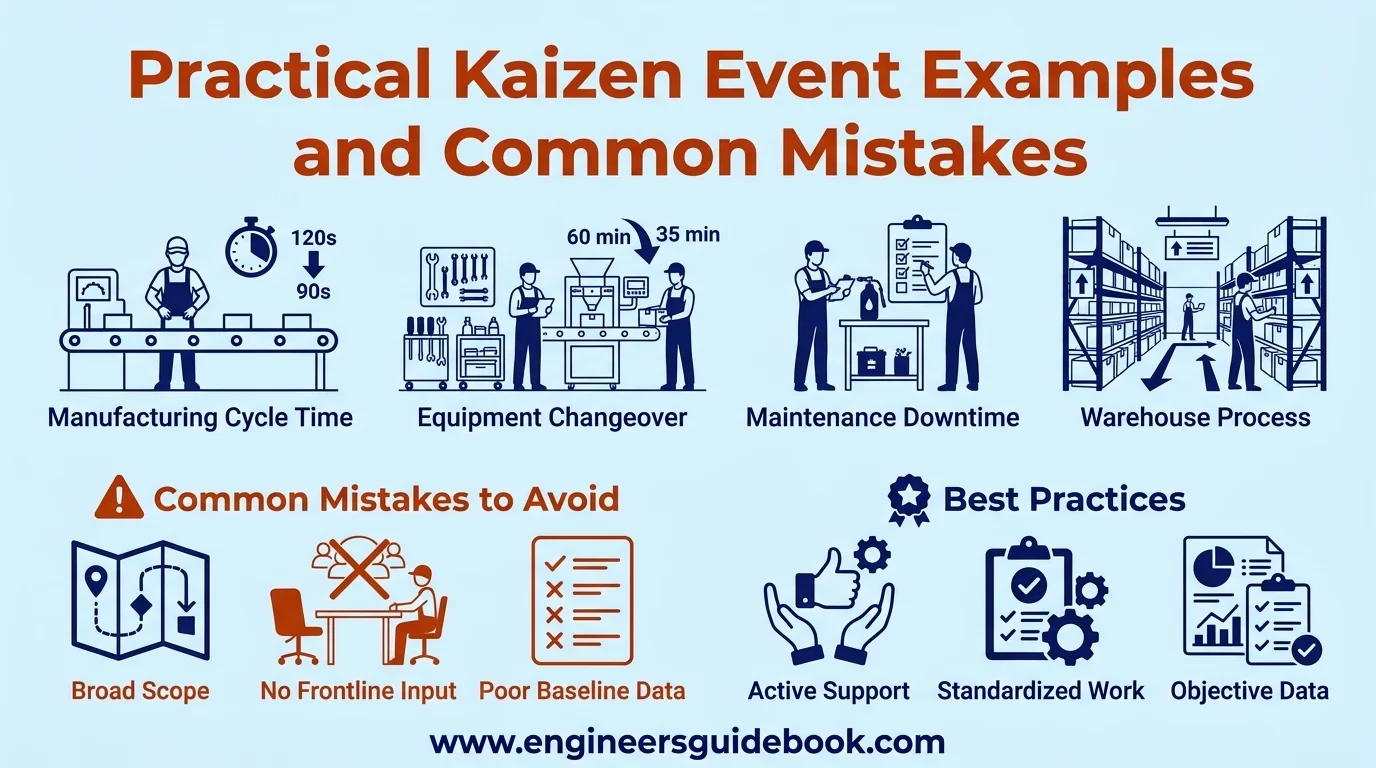
11.1 Manufacturing Cycle Time Reduction
Consider a manufacturing process with an average cycle time of 120 seconds. A Kaizen team identifies unnecessary material handling and redundant inspection activities.
Through workstation optimization and improved work sequencing, cycle time decreases to 90 seconds, representing a 25% reduction.
11.2 Equipment Changeover Time Improvement
A packaging line requires 60 minutes for product changeovers. The Kaizen team applies Single-Minute Exchange of Die (SMED) principles to separate internal and external setup activities.
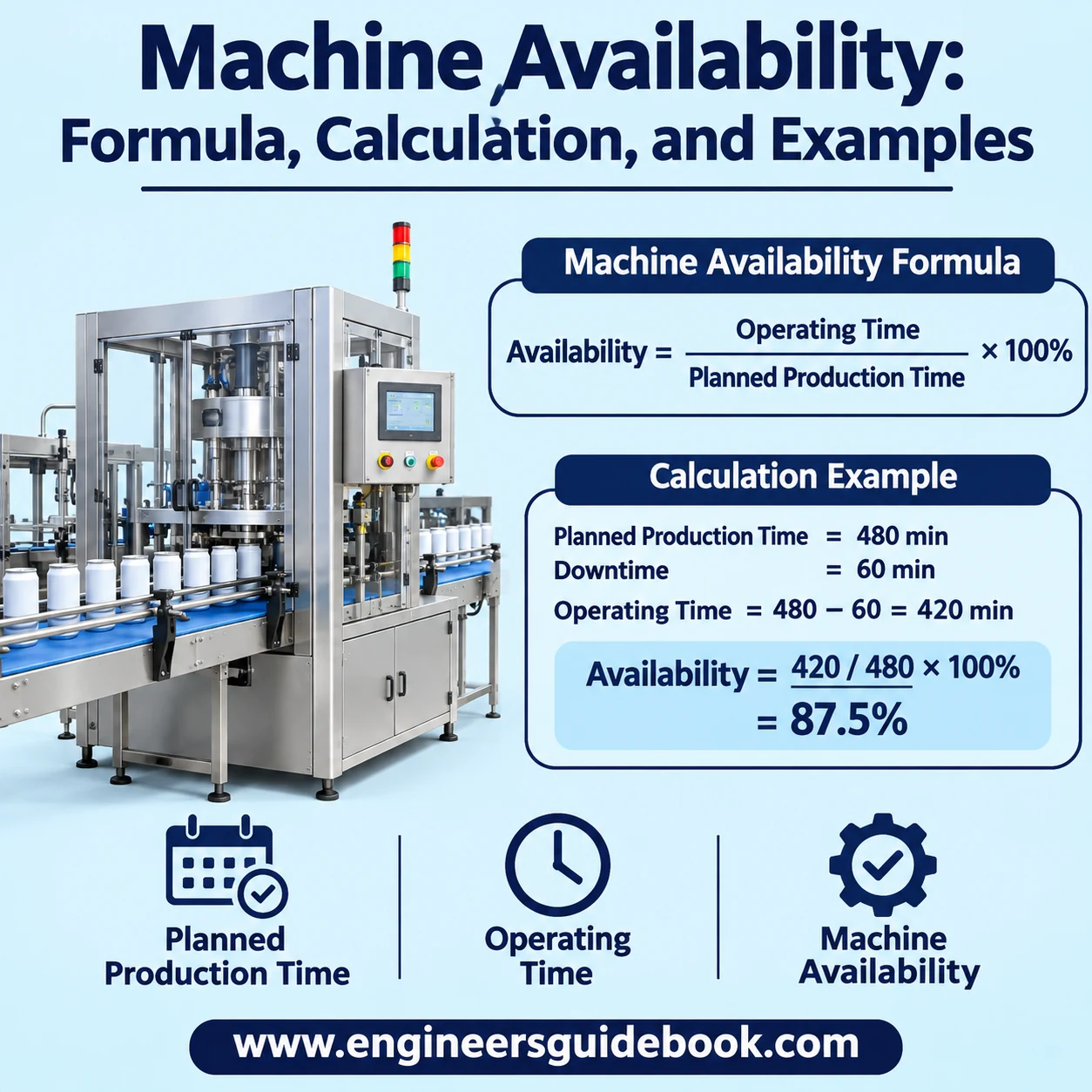
Pre-staging tools and components reduces changeover duration to 35 minutes, improving equipment availability.
11.3 Maintenance Downtime Reduction
A manufacturing facility experiences recurring equipment breakdowns caused by inadequate lubrication practices and delayed spare parts availability.
A maintenance Kaizen event introduces standardized lubrication schedules, organized spare parts storage, and improved troubleshooting instructions. These countermeasures can reduce breakdown frequency and repair duration.
11.4 Warehouse Process Optimization
A warehouse experiences prolonged order-picking times due to inefficient inventory placement.
The improvement team reorganizes storage locations according to product movement frequency, introduces visual identification systems, and optimizes picking routes. These modifications reduce unnecessary transportation and employee motion.
11.5 Common Kaizen Event Mistakes
Several organizational deficiencies can undermine Kaizen event effectiveness:
- Poorly defined improvement objectives.
- Excessively broad project scope.
- Insufficient baseline data.
- Inadequate frontline employee participation.
- Implementing solutions without root cause verification.
- Neglecting post-event performance monitoring.
Such mistakes frequently produce ephemeral improvements rather than sustainable operational transformation.
11.6 Best Practices for Successful Kaizen Events
Successful events require realistic objectives, capable facilitators, reliable performance data, and active management support.
Prioritize practical countermeasures, verify results objectively, and standardize successful changes. Maintain transparent communication throughout implementation and ensure process owners accept responsibility for sustaining improvements.
12. Frequently Asked Questions (FAQ)
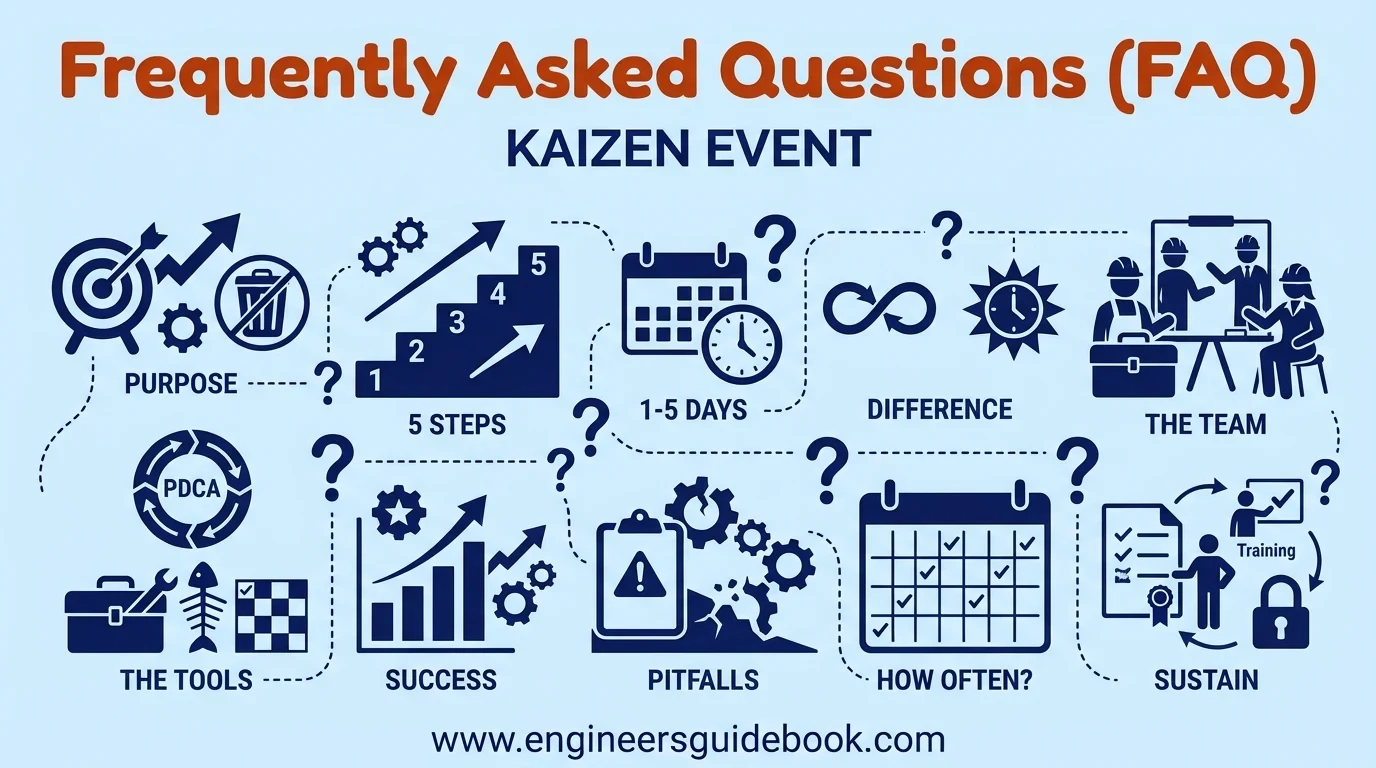
12.1 What Is the Main Purpose of a Kaizen Event?
The main purpose of a Kaizen event is to achieve measurable process improvements within a short timeframe through collaborative problem-solving, waste elimination, and systematic root cause analysis.
12.2 What Are the Five Steps of a Kaizen Event?
The five typical execution steps are understanding the current process, identifying waste and root causes, developing improvement solutions, implementing and testing changes, and evaluating results.
12.3 How Long Does a Kaizen Event Typically Last?
A Kaizen event typically lasts one to five working days. However, preparation and post-event follow-up may extend over several weeks, depending on project complexity.
12.4 What Is the Difference Between Kaizen and a Kaizen Event?
Kaizen is an ongoing philosophy of continuous improvement. A Kaizen event is a concentrated, time-bound workshop designed to address specific operational challenges and implement targeted improvements.
12.5 Who Should Participate in a Kaizen Event?
Participants typically include process operators, engineers, maintenance technicians, supervisors, quality professionals, process owners, and a trained facilitator. Team composition depends on the improvement objectives.
12.6 What Tools Are Used During a Kaizen Event?
Common Kaizen event tools include the PDCA cycle, 5 Whys analysis, fishbone diagrams, Pareto analysis, value stream mapping, Gemba walks, 5S methodology, and impact-effort matrices.
12.7 How Do You Measure the Success of a Kaizen Event?
Measure success by comparing baseline and post-implementation performance using relevant KPIs, including cycle time, productivity, downtime, quality, waste reduction, cost savings, and ROI.
12.8 What Are the Main Reasons Kaizen Events Fail?
Kaizen events commonly fail because of unclear objectives, inadequate planning, insufficient management support, unreliable data, poor employee involvement, ineffective countermeasures, and inadequate follow-up activities.
12.9 How Often Should Kaizen Events Be Conducted?
There is no universal frequency for conducting Kaizen events. Organizations should schedule them according to operational priorities, improvement opportunities, available resources, and process performance requirements.
12.10 How Do You Sustain Kaizen Event Improvements?
Sustain improvements through process standardization, employee training, assigned responsibilities, periodic audits, continuous KPI monitoring, and consistent management involvement.
13. Conclusion
13.1 Key Takeaways for Successful Kaizen Events
A successful Kaizen event combines meticulous preparation, cross-functional collaboration, empirical analysis, and disciplined execution. Clearly defined objectives and measurable performance indicators establish the foundation for effective improvement.
13.2 Turning Short-Term Improvements Into Long-Term Results
Rapid improvements deliver limited value unless they become embedded within everyday operations. Standardized procedures, consistent monitoring, and employee accountability transform temporary achievements into enduring organizational benefits.
13.3 Achieving Operational Excellence Through Kaizen
Kaizen events provide a practical mechanism for improving productivity, quality, reliability, safety, and cost efficiency. When integrated into a broader continuous improvement strategy, these initiatives help organizations eliminate operational inefficiencies, strengthen competitiveness, and progressively achieve sustainable operational excellence.