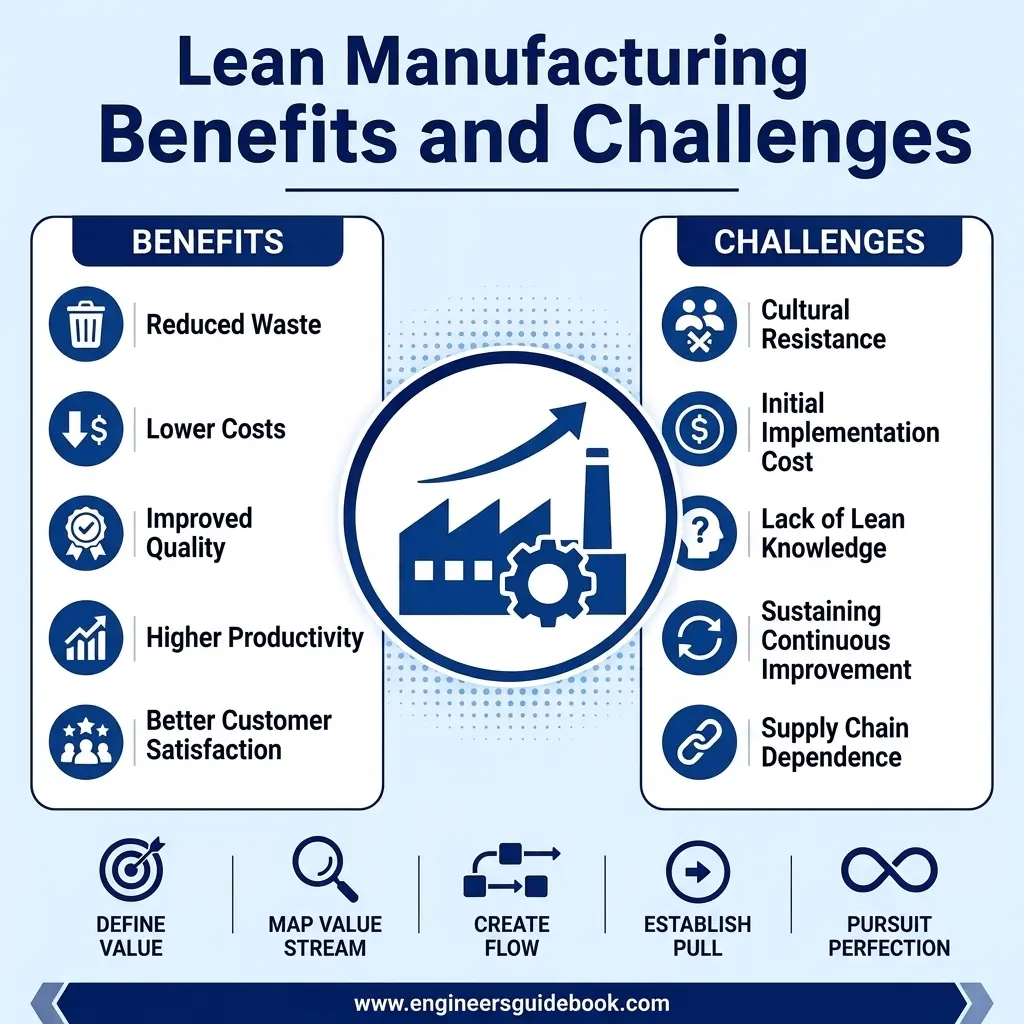
Lean manufacturing benefits deliver measurable results by eliminating waste, improving flow, strengthening quality, and engaging employees in continuous improvement. Its advantages extend beyond cost reduction to faster delivery, safer workplaces, greater flexibility, and stronger customer value. Achieving these gains requires disciplined leadership, reliable processes, employee participation, and a culture that treats improvement as an everyday responsibility.
1. Introduction to Lean Manufacturing
1.1 Lean Manufacturing Definition
Lean manufacturing is a management philosophy focused on maximizing customer value while minimizing waste. It improves how materials, information, labor, equipment, and time move through an organization.
1.2 Lean Manufacturing Origins
The philosophy emerged from the Toyota Production System, which combined just-in-time production, built-in quality, standardized work, and employee problem-solving to overcome scarce resources and volatile demand.
1.3 Lean Manufacturing Objectives
Its objectives are to remove non-value-adding activities, stabilize processes, shorten throughput time, improve quality, reduce costs, and create a responsive system that learns continuously.
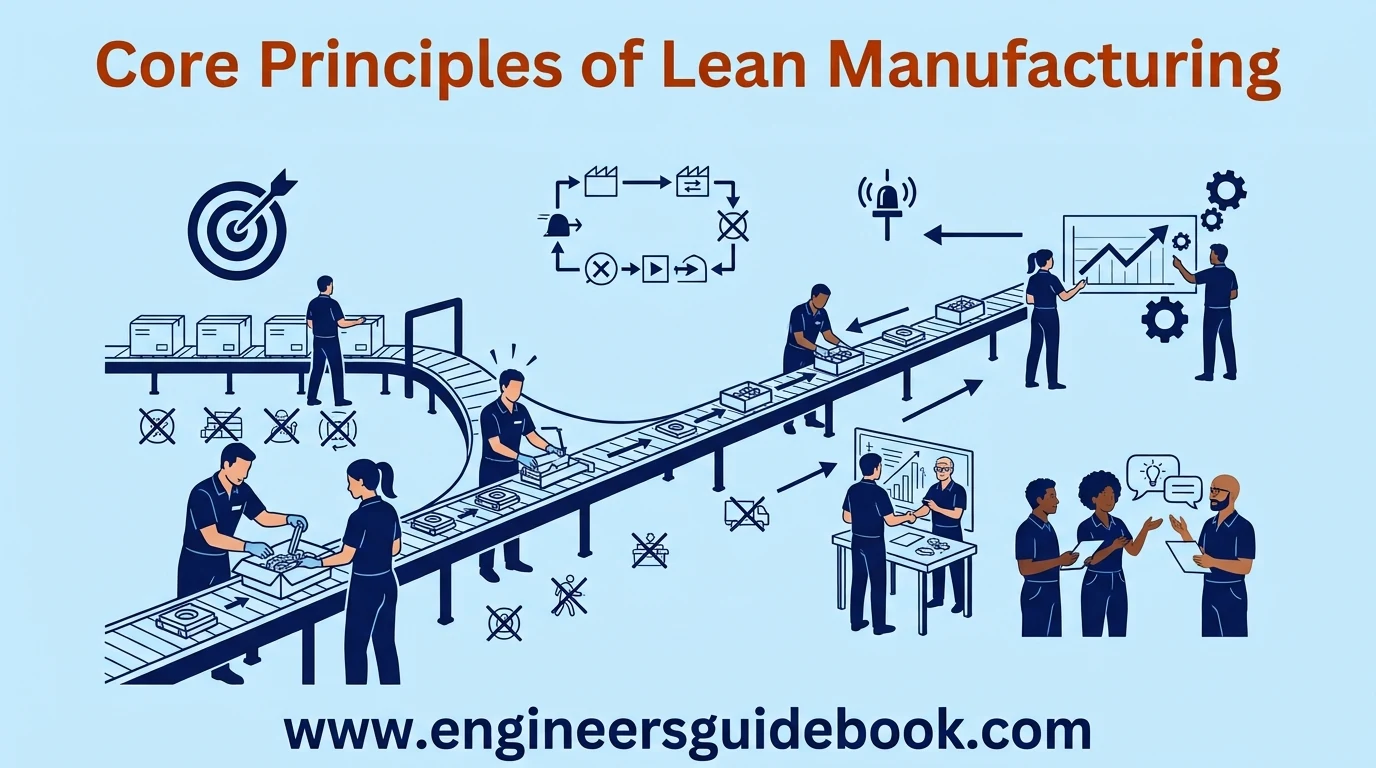
2. Core Principles of Lean Manufacturing
2.1 Customer Value
Customer value defines what buyers genuinely need and will pay for. Lean organizations align specifications, quality, timing, service, and price with those expectations.
2.2 Value Stream Mapping
Value stream mapping visualizes every activity required to deliver a product or service. It reveals delays, duplicated effort, excess inventory, poor information flow, and improvement opportunities.
2.3 Continuous Flow
Continuous flow allows work to progress from one step to the next without interruption, accumulation, or waiting. It reduces queues, shortens lead time, and exposes instability.
2.4 Pull Production
Pull production authorizes work according to downstream demand rather than forecasts alone. This prevents premature production, limits work-in-process, and aligns output with customer requirements.
2.5 Continuous Improvement
Continuous improvement encourages frequent, incremental changes through observation, experimentation, and employee participation. Small improvements compound over time, producing durable gains without constant large investment.
2.6 Respect for People
Respect for people means involving employees in decisions, developing their capabilities, listening to operational knowledge, and designing systems that support safe, purposeful work.
2.7 Waste Elimination
Lean targets defects, overproduction, waiting, unused talent, transportation, inventory, motion, and overprocessing. Removing these wastes releases capacity without merely accelerating human effort.
Also Read More:
Lean Manufacturing: Principles, Tools, Benefits, and Examples
How to Implement Lean Manufacturing Step by Step
5 Principles of Lean Manufacturing Explained With Examples
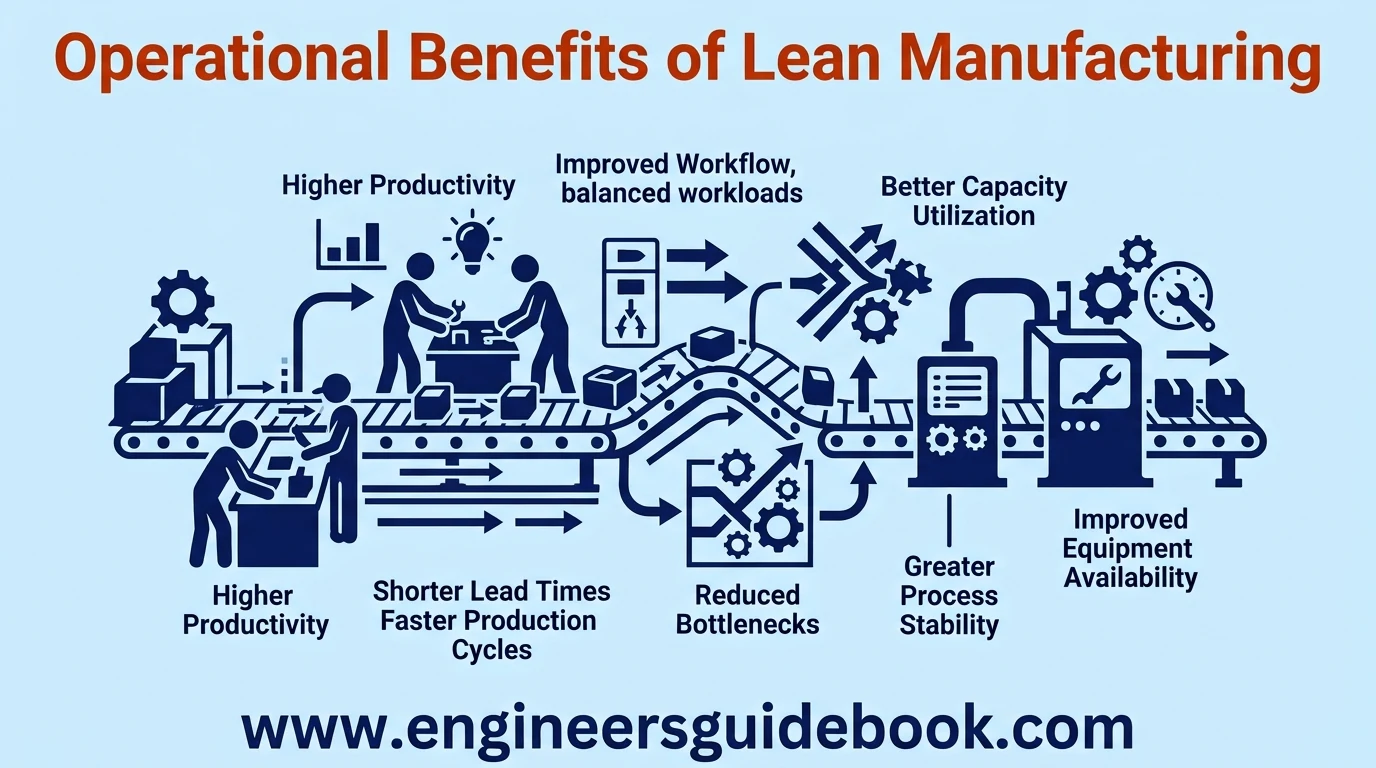
3. Operational Lean Manufacturing Benefits
3.1 Higher Productivity
Productivity rises when employees spend more time on value-creating work and less on searching, waiting, handling, correcting, or navigating poorly designed processes.
3.2 Shorter Lead Times
Lean compresses the interval between order and delivery by reducing queues, batch delays, approvals, changeovers, and internal transportation across the value stream.
3.3 Faster Production Cycles
Smaller batches, synchronized operations, and standardized methods accelerate production cycles. Faster cycles also reveal abnormalities before they multiply across large quantities.
3.4 Improved Workflow
Defined process sequences, balanced workloads, and visual controls create an intelligible workflow. Employees can recognize priorities, constraints, and deviations with less ambiguity.
3.5 Reduced Bottlenecks
Lean identifies constrained operations and addresses congestion through workload balancing, maintenance, setup reduction, cross-training, or process redesign rather than temporary expediting.
3.6 Better Capacity Utilization
Organizations use capacity more effectively when hidden losses are removed. Existing equipment, labor, and floor space can support greater output before new investment becomes necessary.
3.7 Greater Process Stability
Standardized work, preventive controls, and rapid problem response reduce variation. Stable processes make scheduling, staffing, quality control, and delivery more predictable.
3.8 Improved Equipment Availability
Total productive maintenance, autonomous inspections, and planned servicing reduce breakdowns and minor stoppages. Higher availability improves output while lowering emergency maintenance and disruption.
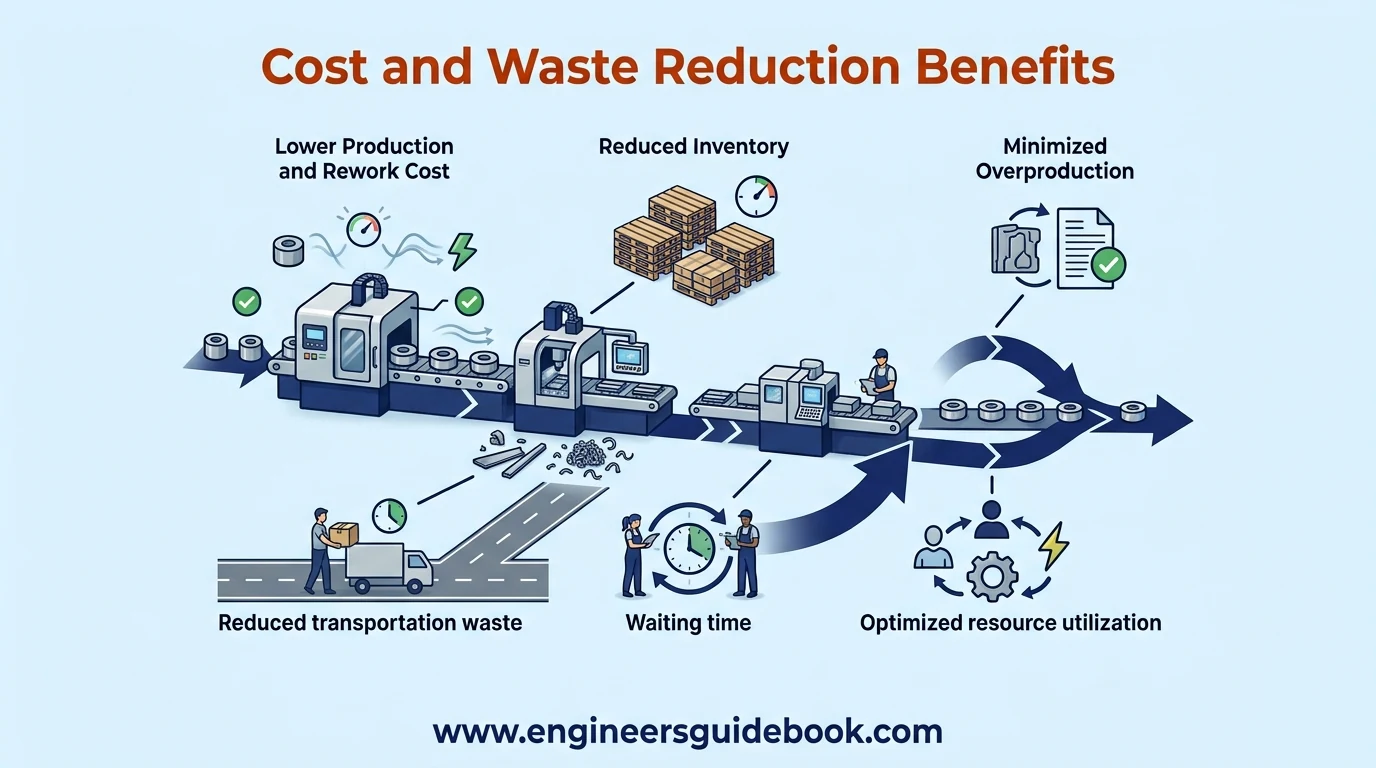
4. Cost and Waste Reduction Benefits
4.1 Lower Production Costs
Lean lowers production costs by reducing labor inefficiency, scrap, energy loss, rework, downtime, excessive handling, and unnecessary processing throughout operations.
4.2 Reduced Inventory Costs
Lower raw material, work-in-process, and finished goods inventory decreases storage expense, insurance, obsolescence, damage, counting effort, and working-capital requirements.
4.3 Lower Material Waste
Better process control and standardized methods reduce offcuts, spoilage, leakage, contamination, and excess consumption. Material yield improves, strengthening margins and environmental performance.
4.4 Reduced Overproduction
Producing only what is required prevents inventory accumulation and concealed defects. It also reduces storage pressure, premature purchasing, and obsolete products.
4.5 Lower Transportation Waste
Improved layouts and point-of-use storage shorten material travel. Fewer transfers reduce handling cost, product damage, congestion, and unnecessary forklift use.
4.6 Reduced Waiting Time
Balanced processes, dependable equipment, and timely information reduce waiting for machines, materials, approvals, instructions, tools, or quality decisions. Productive time increases.
4.7 Lower Rework Costs
Built-in quality and immediate defect containment prevent repeated correction. Lower rework protects labor capacity, delivery schedules, material usage, and customer confidence.
4.8 Improved Resource Utilization
Lean extracts greater value from existing resources by matching people, equipment, materials, energy, and information to demand rather than habitual operating patterns.
5. Quality and Customer Benefits
5.1 Improved Product Quality
Quality improves when standards are explicit, abnormalities are visible, and processes are corrected before defects continue downstream.
5.2 Fewer Defects
Root cause analysis, mistake-proofing, and first-piece verification reduce recurring errors. Defect prevention is more economical and reliable than post-production inspection.
5.3 Better Process Control
Visual indicators, standard parameters, and defined reaction plans create tighter control. Operators know the acceptable condition and required response to deviation.
5.4 Faster Problem Detection
Lean makes problems conspicuous through visual management, one-piece flow, and limited inventory. Earlier detection reduces containment scope and prevents widespread nonconformance.
5.5 Greater Product Consistency
Standardized work minimizes variation between operators, shifts, and production runs. Customers receive more uniform performance, appearance, and reliability.
5.6 Improved Delivery Performance
Stable processes and shorter lead times make delivery commitments dependable. Reduced disruption also limits costly schedule changes and emergency shipments.
5.7 Higher Customer Satisfaction
Customers benefit from better quality, faster response, dependable delivery, and competitive pricing. These outcomes strengthen trust and reduce complaints, returns, and escalation.
5.8 Stronger Customer Loyalty
Consistent value encourages repeat business and favorable recommendations. Lean supports loyalty by making reliability an operational capability rather than a marketing promise.

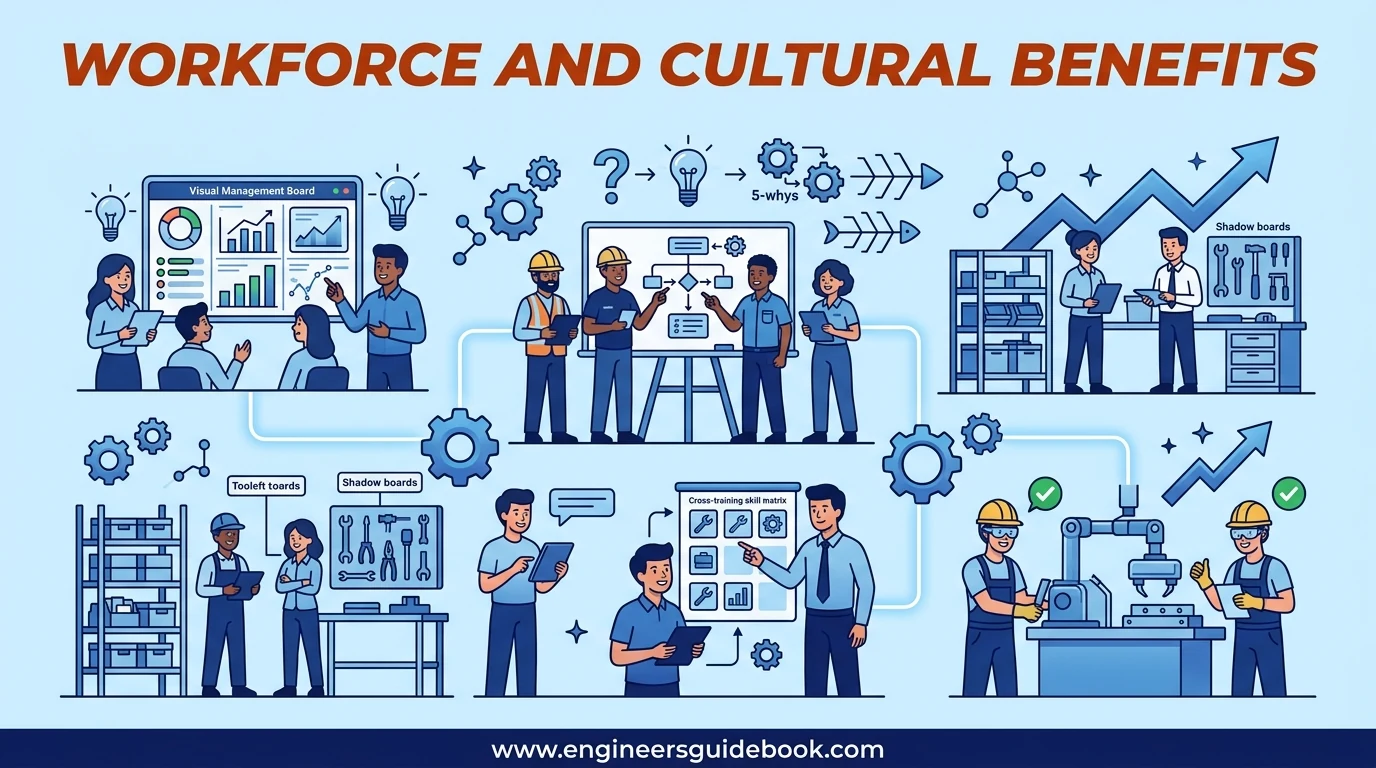
6. Workforce and Cultural Benefits
6.1 Greater Employee Involvement
Lean invites employees to identify waste, investigate causes, and improve their work. Participation converts frontline experience into practical operational intelligence.
6.2 Improved Teamwork
Cross-functional problem-solving breaks departmental isolation. Production, maintenance, quality, logistics, and engineering collaborate around shared outcomes.
6.3 Stronger Problem Solving
Structured methods such as the five whys, PDCA, and root cause analysis help teams replace conjecture with evidence and permanent corrective action.
6.4 Better Workplace Organization
The 5S methodology establishes orderly, clean, and visual workplaces. Tools and materials become easier to locate, inspect, use, and replenish.
6.5 Increased Employee Ownership
When employees help design standards and improvements, they develop stronger accountability for results. Ownership promotes care, vigilance, and faster response to abnormalities.
6.6 Enhanced Skill Development
Lean broadens capability through cross-training, coaching, standardized work, and problem-solving practice. A versatile workforce can adapt to demand and staffing changes.
6.7 Improved Communication
Visual boards, daily meetings, escalation rules, and standard handovers improve communication. Information reaches the right people before small issues become crises.
6.8 Stronger Safety Culture
Removing clutter, unnecessary motion, unstable processes, and equipment defects reduces hazard exposure. Lean safety integrates risk reduction into everyday improvement.
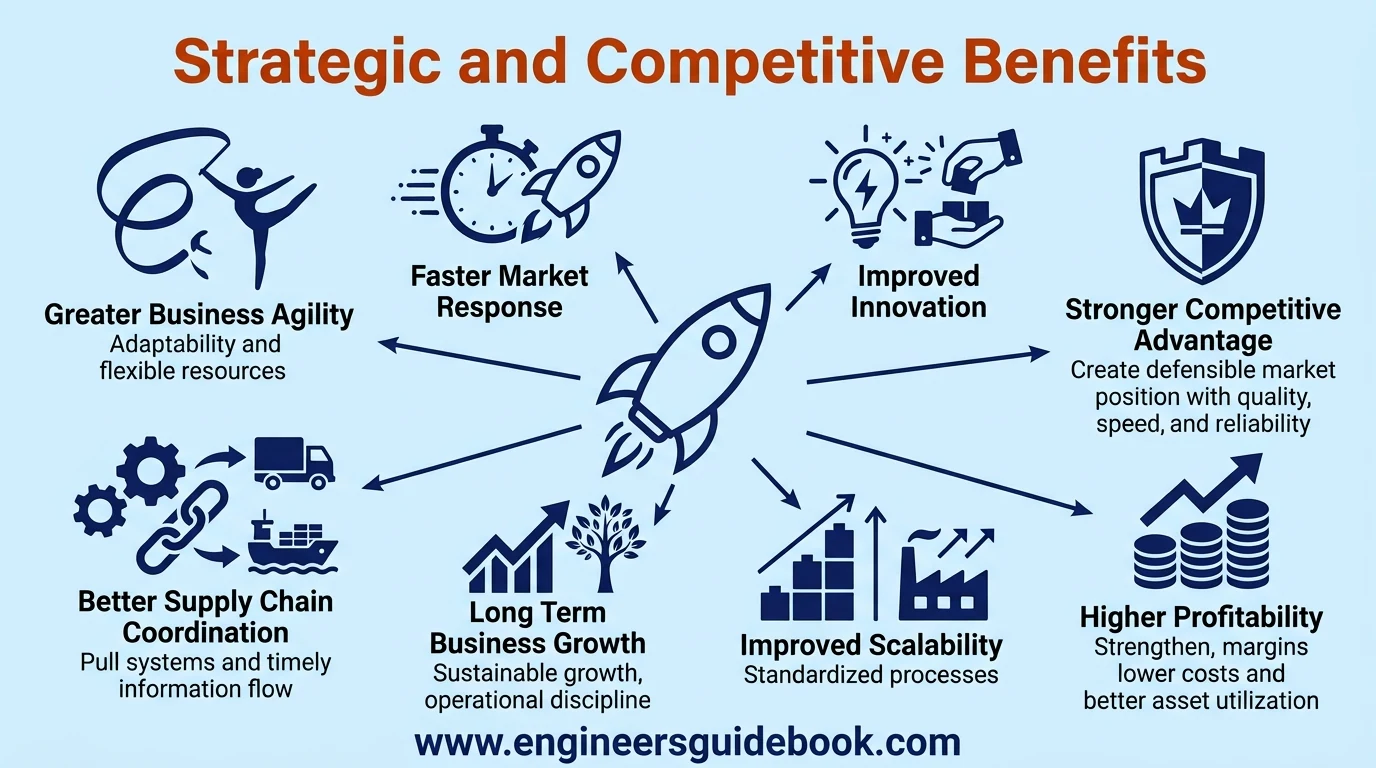
7. Strategic and Competitive Benefits
7.1 Greater Business Agility
Lean organizations respond effectively to changing demand because they operate with shorter cycles, flexible resources, lower inventory, and clear process visibility.
7.2 Faster Market Response
Reduced development and production lead times allow companies to launch products, modify specifications, and replenish supply faster than slower competitors.
7.3 Improved Innovation
Waste reduction frees time and capital for experimentation. Employee involvement also produces practical innovations that management may overlook.
7.4 Stronger Competitive Advantage
Superior quality, cost, speed, and reliability create a defensible market position. Competitors may copy tools, but a mature improvement culture is harder to imitate.
7.5 Better Supply Chain Coordination
Pull systems, shared schedules, and smaller replenishment quantities improve coordination with suppliers and distributors. Information becomes timely, specific, and demand-driven.
7.6 Improved Scalability
Standardized processes and repeatable routines make expansion easier. New lines, sites, and teams can adopt proven methods without recreating every practice.
7.7 Higher Profitability
Profitability improves through lower cost, better asset utilization, fewer quality losses, and stronger customer retention. Lean strengthens margins without relying solely on price increases.
7.8 Long Term Business Growth
Lean supports sustainable growth by building operational discipline, adaptability, and organizational learning. These capabilities help companies expand while preserving quality, responsiveness, and financial control.
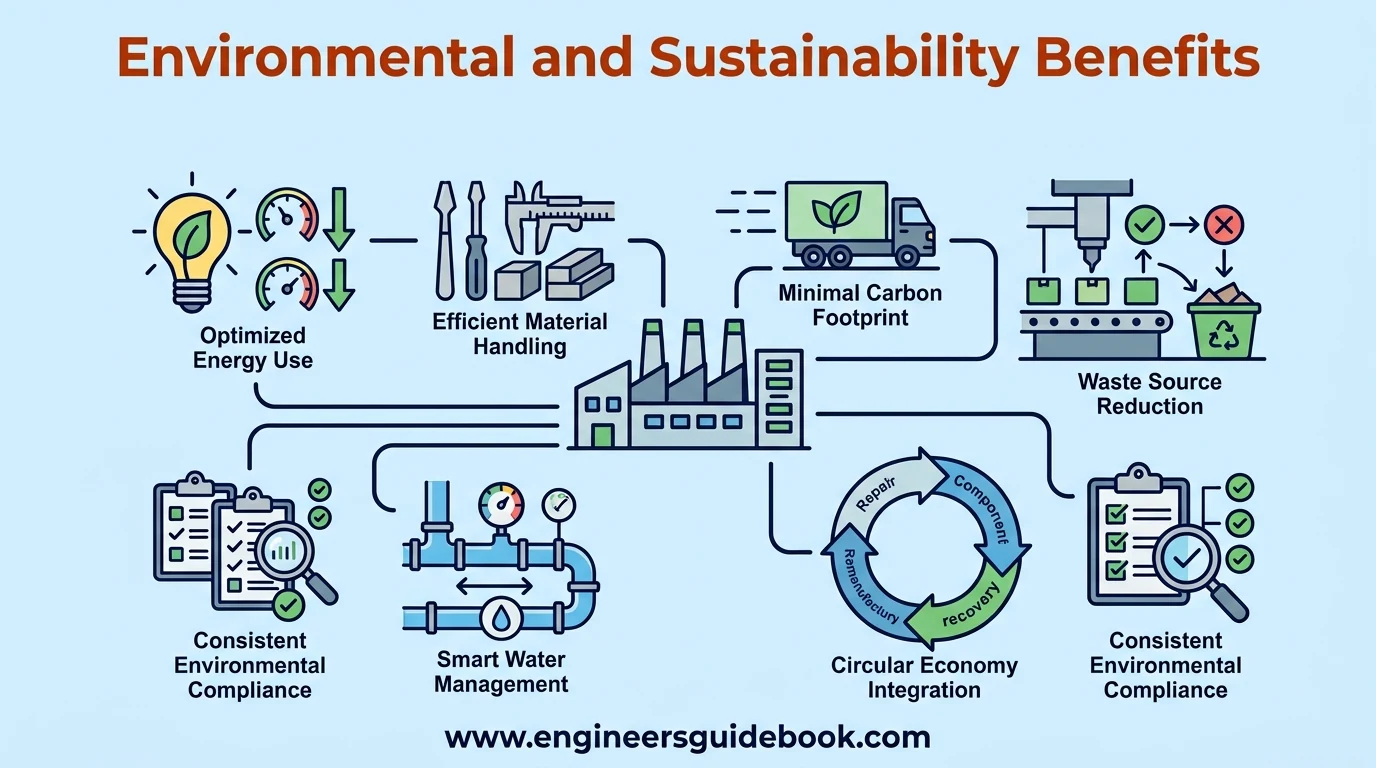
8. Environmental and Sustainability Benefits
8.1 Reduced Energy Consumption
Lean manufacturing reduces energy consumption by eliminating idle running, unnecessary machine cycles, compressed-air leakage, excessive heating, and inefficient production scheduling. Energy is consumed only when it contributes directly to customer value.
8.2 Lower Material Usage
Standardized work, accurate process controls, and improved cutting or mixing practices reduce unnecessary material consumption. Better yield means organizations can produce more output from the same quantity of raw materials.
8.3 Reduced Carbon Emissions
Lower energy use, shorter transportation routes, optimized logistics, and reduced rework collectively decrease greenhouse gas emissions. Lean therefore supports carbon reduction without treating sustainability as a separate operational initiative.
8.4 Less Industrial Waste
Defect prevention and controlled production reduce scrap, rejected products, contaminated materials, obsolete inventory, and disposable packaging. Waste is addressed at its source instead of being managed after generation.
8.5 Improved Water Efficiency
Lean analysis can expose excessive washing, cooling, rinsing, and leakage. Closed-loop systems, controlled cleaning cycles, and preventive maintenance help conserve water while maintaining sanitation and process reliability.
8.6 Sustainable Production Practices
Lean encourages organizations to design processes that use fewer resources over the entire product lifecycle. The resulting production system is economical, resilient, and less dependent on environmentally intensive inputs.
8.7 Circular Economy Support
Material segregation, component recovery, repair, remanufacturing, and reuse align lean operations with circular economy principles. Products and resources remain economically useful for longer periods rather than becoming premature waste.
8.8 Environmental Compliance
Visual controls, documented procedures, and routine audits improve compliance with environmental requirements. Organizations can monitor emissions, waste streams, chemical handling, and resource consumption more consistently.
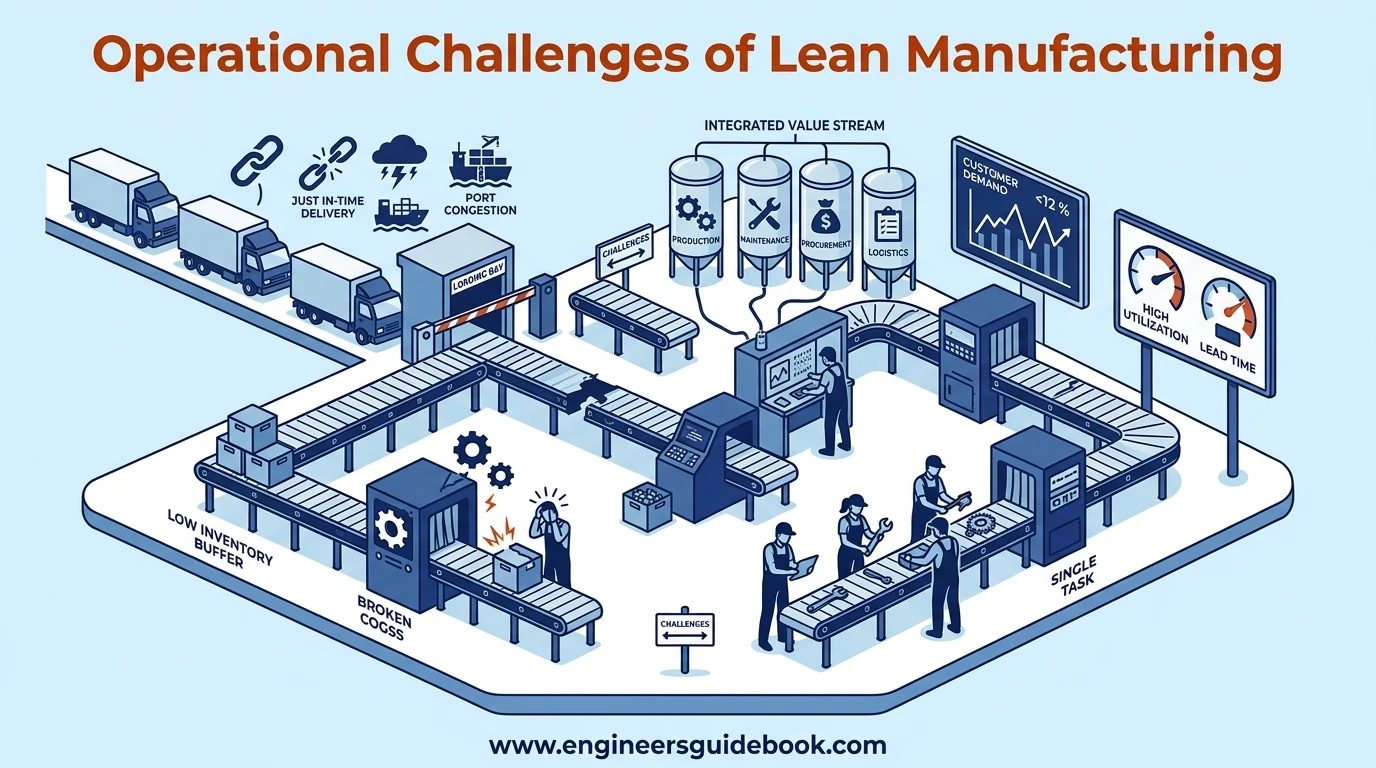
9. Operational Challenges of Lean Manufacturing
9.1 Process Disruptions
Lean implementation often exposes hidden weaknesses that were previously masked by inventory or excess capacity. During transition, redesigned layouts, new standards, and altered workflows may temporarily disrupt production.
9.2 Limited Inventory Buffers
Low inventory improves efficiency but reduces protection against delays. A late supplier, defective shipment, or equipment failure can stop production when adequate contingency planning is absent.
9.3 Supply Chain Vulnerability
Just-in-time systems depend on dependable suppliers and transportation networks. Political instability, natural disasters, port congestion, and material shortages can quickly affect lean supply chains.
9.4 Demand Variability
Sudden changes in customer demand can challenge production leveling. Organizations require flexible labor, rapid changeovers, reliable forecasting, and scalable capacity to avoid shortages or overproduction.
9.5 Equipment Reliability Issues
Lean operations cannot tolerate frequent breakdowns because limited buffers provide little recovery time. Preventive maintenance, spare-parts planning, and condition monitoring become indispensable.
9.6 Standardization Difficulties
Different operators may resist common methods, particularly when processes involve craftsmanship or variable conditions. Standards must remain practical, visible, and adaptable rather than excessively bureaucratic.
9.7 Complex Process Integration
Lean improvements in one department may create problems elsewhere if the value stream is not considered holistically. Production, maintenance, procurement, logistics, and quality must coordinate their decisions.
9.8 Performance Measurement Problems
Traditional metrics may reward large batches, high utilization, and excess production. Lean requires measures that emphasize flow, quality, lead time, customer value, and total system performance.
10. Organizational and Workforce Challenges
10.1 Resistance to Change
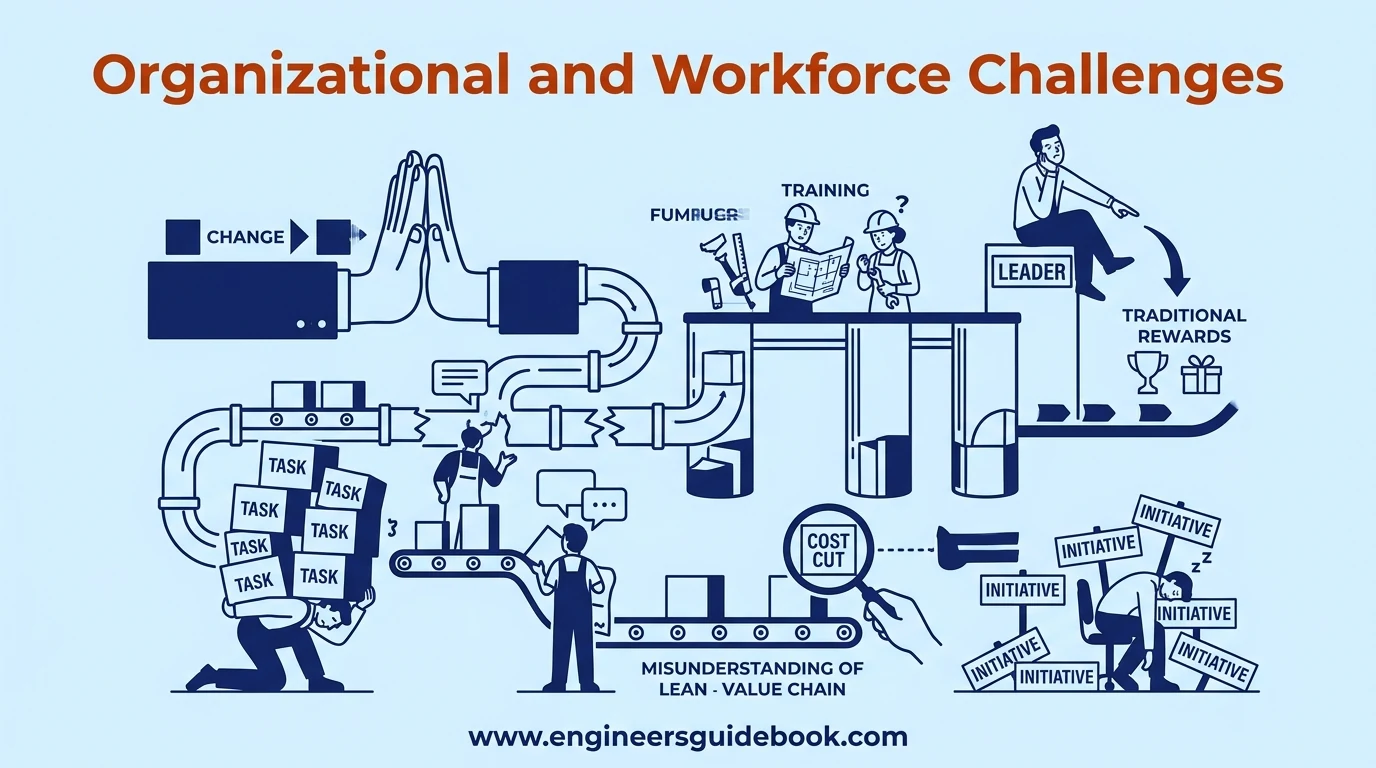
Employees may interpret lean as a cost-cutting program or a threat to job security. Resistance intensifies when changes are imposed without explanation, consultation, or visible leadership support.
10.2 Lack of Leadership Commitment
Lean fails when leaders delegate responsibility while continuing to reward traditional behavior. Management must provide resources, remove obstacles, review progress, and model continuous improvement.
10.3 Inadequate Employee Training
Tools such as value stream mapping, 5S, kanban, and root cause analysis require practical training. Superficial instruction can produce mechanical tool usage without genuine problem-solving capability.
10.4 Poor Communication
Unclear objectives create confusion about priorities, roles, and expected outcomes. Regular meetings, visual boards, transparent metrics, and consistent messages are essential during implementation.
10.5 Departmental Silos
Departments often optimize their own targets while harming overall flow. Lean requires shared objectives so local decisions support the complete value stream rather than isolated functional performance.
10.6 Employee Workload Concerns
Improvement activities can become an additional burden when employees receive no time or support. Lean should simplify work, not merely add meetings, reports, and responsibilities.
10.7 Misunderstanding Lean Principles
Some organizations equate lean with layoffs, speed, or inventory reduction alone. This narrow interpretation neglects quality, people development, stability, customer value, and long-term learning.
10.8 Continuous Improvement Fatigue
Too many simultaneous initiatives can exhaust employees and dilute attention. Improvement efforts should be prioritized, adequately resourced, and connected to meaningful operational problems.
11. Lean Manufacturing Implementation
11.1 Lean Readiness Assessment
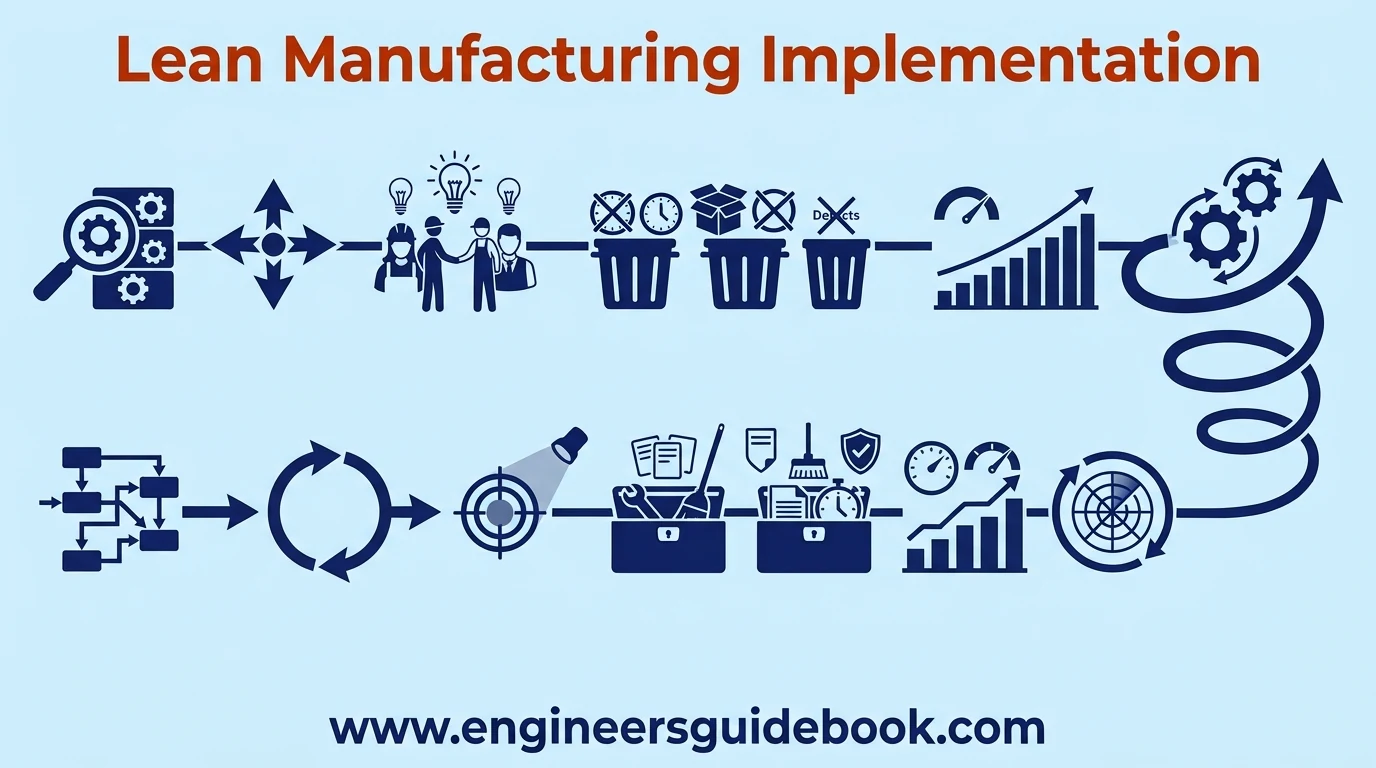
Implementation should begin with an honest assessment of leadership commitment, process stability, workforce capability, supplier reliability, data quality, and organizational willingness to change.
11.2 Leadership Alignment
Senior and middle managers must agree on objectives, responsibilities, and expected behaviors. Conflicting priorities can rapidly weaken credibility and fragment the transformation.
11.3 Employee Engagement
Employees should participate in identifying problems, testing solutions, and developing standards. Early involvement increases practical relevance and reduces apprehension about organizational change.
11.4 Waste Identification
Teams must observe real work and identify defects, waiting, excess motion, overprocessing, inventory, transportation, overproduction, and underused talent.
11.5 Value Stream Analysis
Current-state mapping reveals how materials and information move through the organization. Future-state design then establishes better flow, pull mechanisms, and improvement priorities.
11.6 Pilot Project Selection
A pilot project should be important enough to matter but manageable enough to control. Visible early success builds confidence and provides lessons for wider deployment.
11.7 Lean Tool Selection
Tools must address specific problems rather than follow fashion. Kanban, 5S, mistake-proofing, setup reduction, standardized work, and maintenance methods should be applied purposefully.
11.8 Performance Indicator Development
Balanced indicators may include lead time, first-pass yield, inventory turns, overall equipment effectiveness, delivery performance, safety, cost, and employee participation.
11.9 Continuous Monitoring
Daily management systems help teams review performance, detect abnormalities, assign actions, and verify results. Lean progress requires frequent observation rather than occasional audits.
11.10 Lean Culture Development
A lean culture emerges when improvement becomes routine behavior. Leaders ask constructive questions, employees solve problems, and standards evolve through disciplined experimentation.
12. Frequently Asked Questions
12.1 What Are the Main Benefits of Lean Manufacturing
The main benefits include lower costs, better quality, shorter lead times, higher productivity, reduced inventory, improved safety, stronger employee involvement, and greater customer satisfaction.
12.2 What Are the Biggest Challenges of Lean Manufacturing
Major challenges include resistance to change, weak leadership, unreliable suppliers, equipment breakdowns, inadequate training, poor communication, and misunderstanding lean as a short-term cost-reduction exercise.
12.3 How Does Lean Manufacturing Reduce Costs
Lean reduces costs by eliminating waste, preventing defects, lowering inventory, reducing downtime, improving labor utilization, and avoiding unnecessary transportation or processing.
12.4 How Does Lean Manufacturing Improve Quality
Lean builds quality into each process through standardized work, mistake-proofing, rapid defect detection, root cause analysis, and immediate corrective action.
12.5 Can Lean Manufacturing Increase Productivity
Yes. Productivity rises when employees and machines spend less time waiting, searching, moving, correcting errors, or producing items that customers do not need.
12.6 Why Do Lean Manufacturing Implementations Fail
Implementations fail when leadership loses interest, employees are excluded, tools are copied without understanding, targets conflict, or improvements are not sustained.
12.7 Is Lean Manufacturing Suitable for Small Businesses
Yes. Small businesses can use lean principles without expensive technology. Workplace organization, visual management, process mapping, and standardization often generate substantial improvements.
12.8 How Long Does Lean Manufacturing Implementation Take
Initial improvements may appear within weeks, but developing a mature lean culture usually takes several years. Lean is an enduring management system rather than a temporary project.
12.9 What Industries Use Lean Manufacturing
Lean is used in automotive, aerospace, food processing, chemicals, pharmaceuticals, construction, healthcare, logistics, software, banking, retail, and public administration.
12.10 What Are the Disadvantages of Lean Manufacturing
Potential disadvantages include vulnerability to supply disruptions, implementation expense, employee resistance, reduced inventory protection, and operational instability when processes are unreliable.
12.11 How Can Employees Support Lean Manufacturing
Employees can support lean by following standards, identifying abnormalities, suggesting improvements, maintaining organized workplaces, sharing knowledge, and participating in problem-solving activities.
12.12 How Is Lean Manufacturing Success Measured
Success is measured through improvements in quality, lead time, cost, productivity, delivery, safety, inventory, equipment reliability, customer satisfaction, and employee engagement.
13. Conclusion
Lean manufacturing creates value by integrating waste reduction, quality improvement, reliable flow, employee involvement, and customer responsiveness. Its benefits extend from daily operations to long-term competitiveness.
The approach also introduces meaningful challenges. Supply chain exposure, cultural resistance, unreliable equipment, weak communication, and superficial implementation can prevent expected results.
Successful implementation requires committed leadership, stable processes, employee development, appropriate metrics, focused pilot projects, and systematic follow-through. Tools must serve strategic objectives.