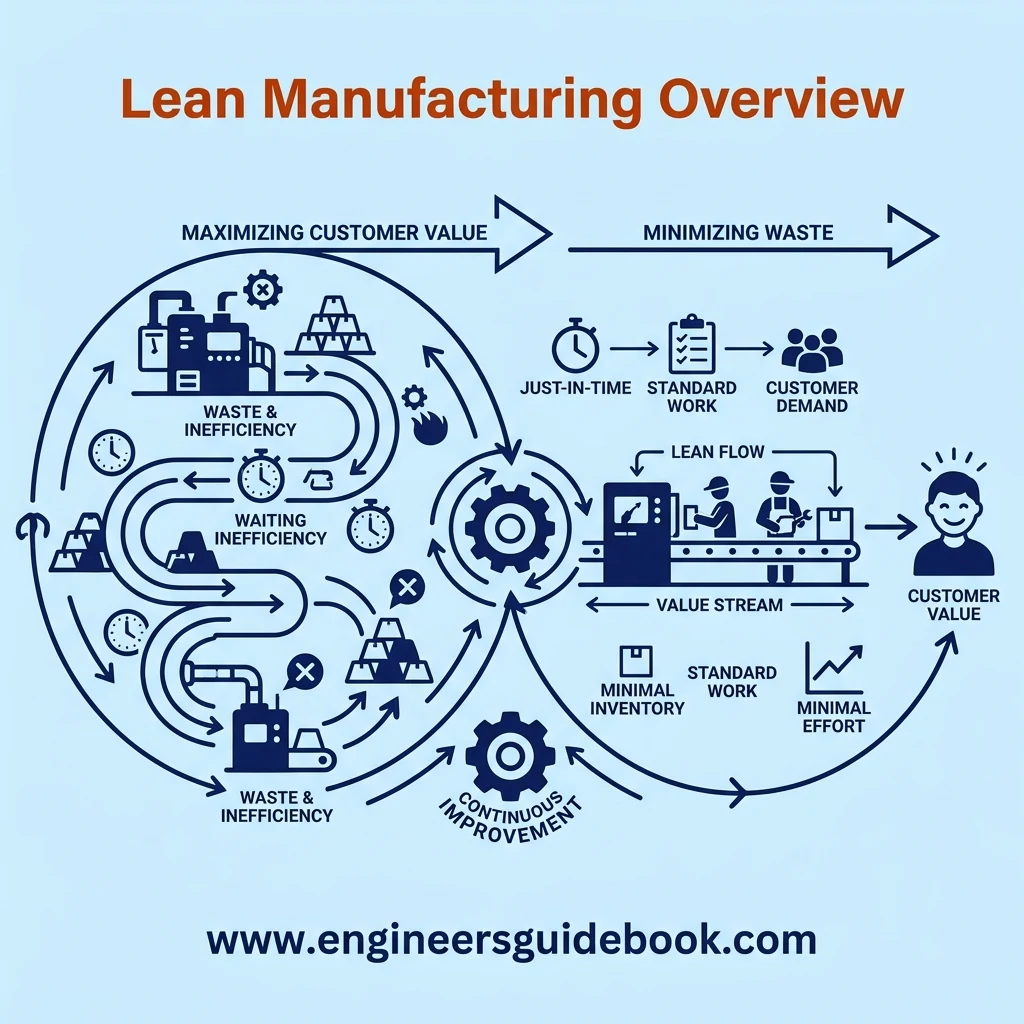
Lean manufacturing is a systematic approach to maximizing customer value while minimizing waste across production and business processes. Its five principles are identifying value, mapping the value stream, creating flow, establishing pull, and pursuing perfection. Together, these principles of lean manufacturing help organizations reduce costs, shorten lead times, improve quality, control inventory, and build a culture of continuous operational improvement.
1. Lean Manufacturing Overview
1.1 Lean Manufacturing Definition
Lean manufacturing is a production philosophy focused on delivering maximum customer value with the minimum necessary resources. It examines every activity within a process and distinguishes productive work from delays, defects, unnecessary movement, excess inventory, and other forms of waste.
Rather than simply accelerating production, lean aims to make work more deliberate, predictable, and efficient. The objective is a streamlined system in which materials, information, equipment, and people contribute directly to customer requirements.
1.2 Lean Manufacturing Purpose
The primary purpose of lean manufacturing is to improve organizational performance by eliminating activities that consume resources without creating meaningful value. This includes excessive waiting, overproduction, redundant transportation, avoidable processing, and quality failures.
Lean also improves responsiveness. When processes contain fewer inefficiencies, manufacturers can react more rapidly to demand changes while maintaining quality, productivity, and cost control.
1.3 Core Lean Philosophy
The core philosophy of lean is simple: create more value using fewer resources. Achieving this requires organizations to understand processes as interconnected systems rather than isolated departments.
Lean therefore promotes systematic problem solving, standardization, workforce participation, and continual refinement. Improvement becomes part of normal operations instead of an occasional management initiative.
1.4 Customer Focus
Customer demand determines what should be considered valuable. A manufacturing operation may perform technically impressive activities, but those activities contribute little if customers are unwilling to pay for the resulting outcome.
Lean organizations therefore evaluate specifications, quality, delivery, reliability, functionality, and price from the customer’s perspective. Processes are then organized around meeting these expectations efficiently.
1.5 Waste Elimination
Waste refers to resources consumed without increasing the value of the final product. Typical examples include defects, waiting, transportation, excess inventory, unnecessary motion, overprocessing, overproduction, and underutilized employee capability.
Eliminating waste does not mean indiscriminately cutting resources. It means removing inefficiency while preserving the people, equipment, knowledge, and activities necessary for reliable production.
1.6 Continuous Improvement
Continuous improvement recognizes that operational excellence is never permanently achieved. Processes can always be examined for smaller delays, recurring defects, unnecessary movements, unstable conditions, or opportunities for simplification.
Instead of waiting for massive transformation projects, lean encourages frequent incremental improvements. These small changes can accumulate into substantial gains in productivity, safety, quality, and cost performance.
1.7 Lean Manufacturing Goals
Major lean manufacturing goals include reducing lead time, lowering inventory, improving first-pass quality, increasing productivity, stabilizing processes, and improving delivery performance.
Long-term lean organizations also seek greater flexibility. A capable process should respond to changing customer demand without generating disproportionate overtime, excessive stock, quality problems, or production disruption.
2. Lean Manufacturing Foundations
2.1 Lean Manufacturing Origins
Modern lean manufacturing developed from production practices refined within Japanese industry after World War II. Limited resources encouraged manufacturers to seek production methods that could deliver variety and quality without depending on massive inventories or inefficient batch production.
These practices eventually influenced manufacturing organizations worldwide and formed the conceptual foundation of modern lean management.
2.2 Toyota Production System
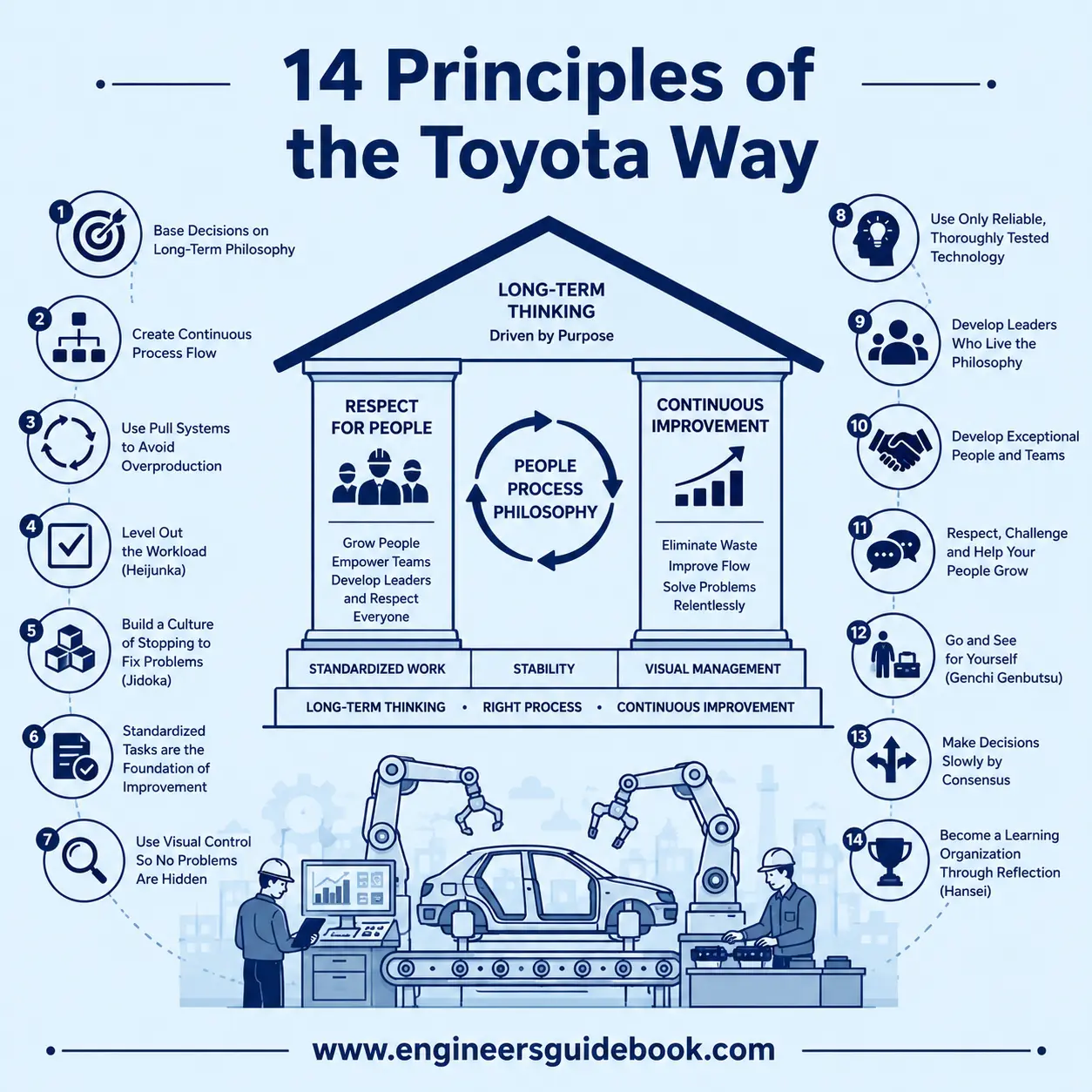
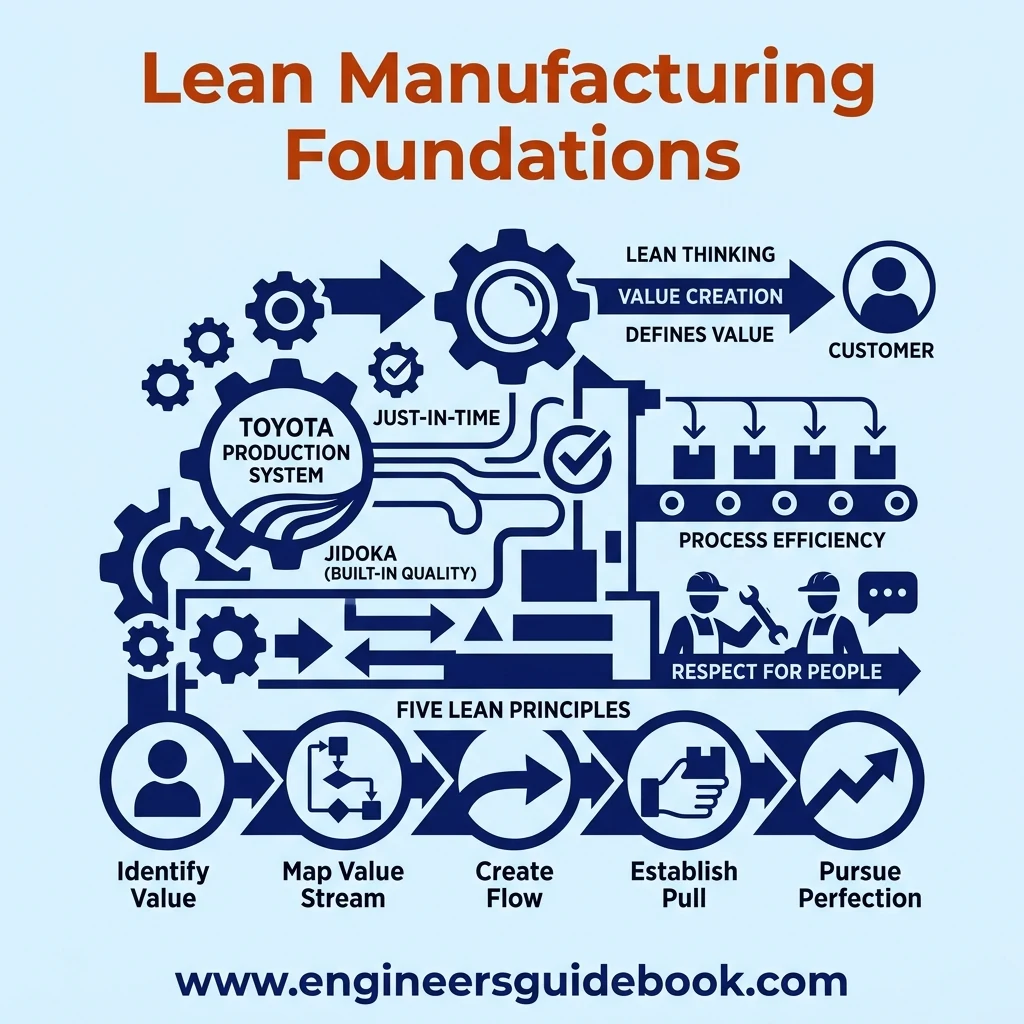
The Toyota Production System became the most influential operational model associated with lean manufacturing. It emphasizes eliminating waste while building processes capable of delivering products according to actual demand.
Two important concepts are just in time production and jidoka, often described as built-in quality. Together, they encourage smooth material flow while preventing abnormalities from silently continuing through production.
2.3 Lean Thinking
Lean thinking extends beyond individual tools such as 5S, Kanban, or value stream mapping. It represents a method of examining how value travels through an entire organization.
Managers and employees continuously ask whether each activity is necessary, whether it supports customer requirements, and whether the same result can be achieved more safely, quickly, reliably, or economically.
2.4 Value Creation
Value creation occurs when an activity changes a product or service in a way that satisfies a genuine customer requirement. Machining a component to the required dimension, assembling necessary parts, or packaging a product according to specification can therefore create value.
Lean seeks to increase the proportion of total process time devoted to such productive activities.
2.5 Process Efficiency
Process efficiency measures how effectively resources are converted into valuable output. A machine running continuously is not necessarily efficient if it produces unnecessary inventory, defective products, or output that downstream operations cannot process.
Lean examines the complete process. Efficiency improves when production rates, quality, manpower, equipment availability, and customer demand operate in synchrony.
2.6 Respect for People
Respect for people is an essential but sometimes overlooked lean principle. Operators, technicians, supervisors, and support teams possess practical knowledge about the processes they work with every day.
Lean organizations use this knowledge rather than relying exclusively on managerial directives. Employees are encouraged to identify abnormalities, propose improvements, participate in problem solving, and help establish sustainable work standards.
2.7 Five Lean Principles
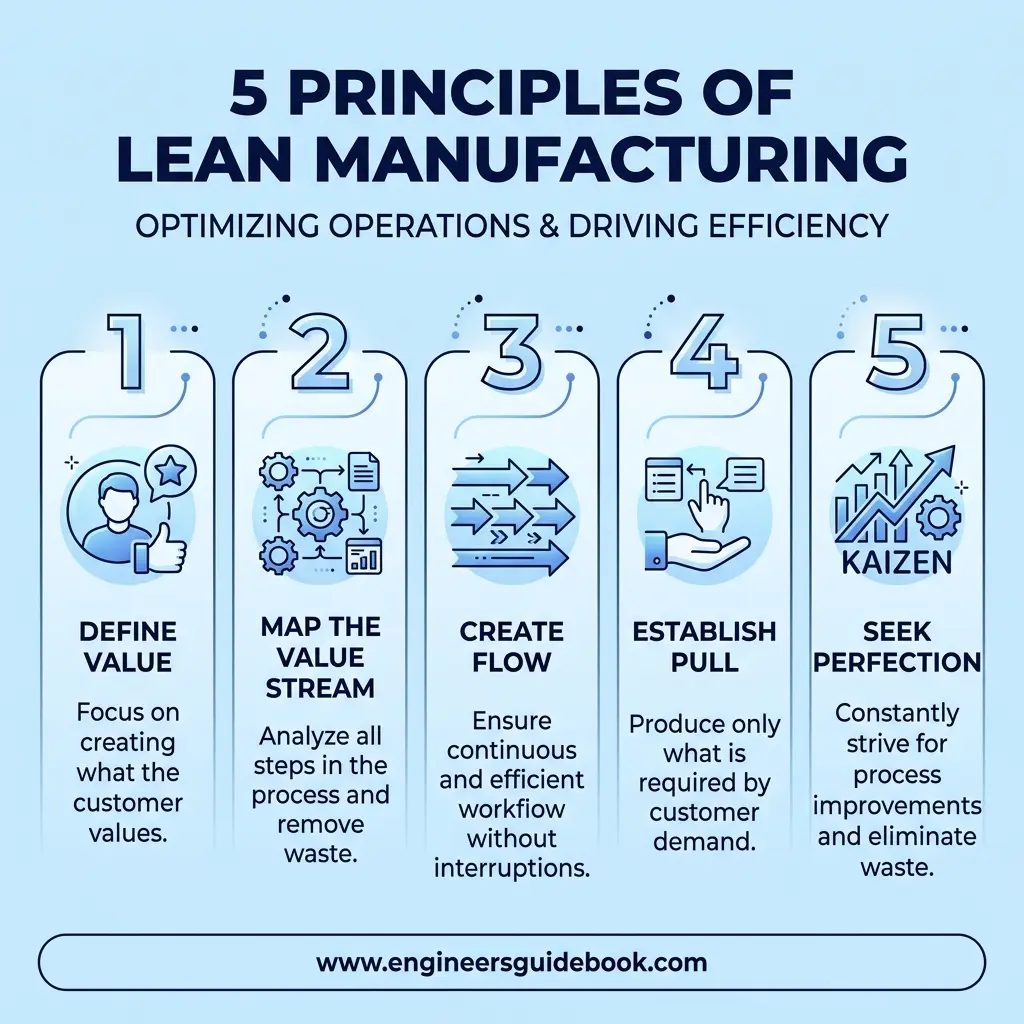
The five principles of lean manufacturing are identify value, map the value stream, create flow, establish pull, and pursue perfection.
These principles operate sequentially but also reinforce one another. Organizations determine what customers value, understand how that value is produced, remove interruptions, synchronize production with demand, and continuously improve the resulting system.
3. Identify Value
3.1 Customer Value
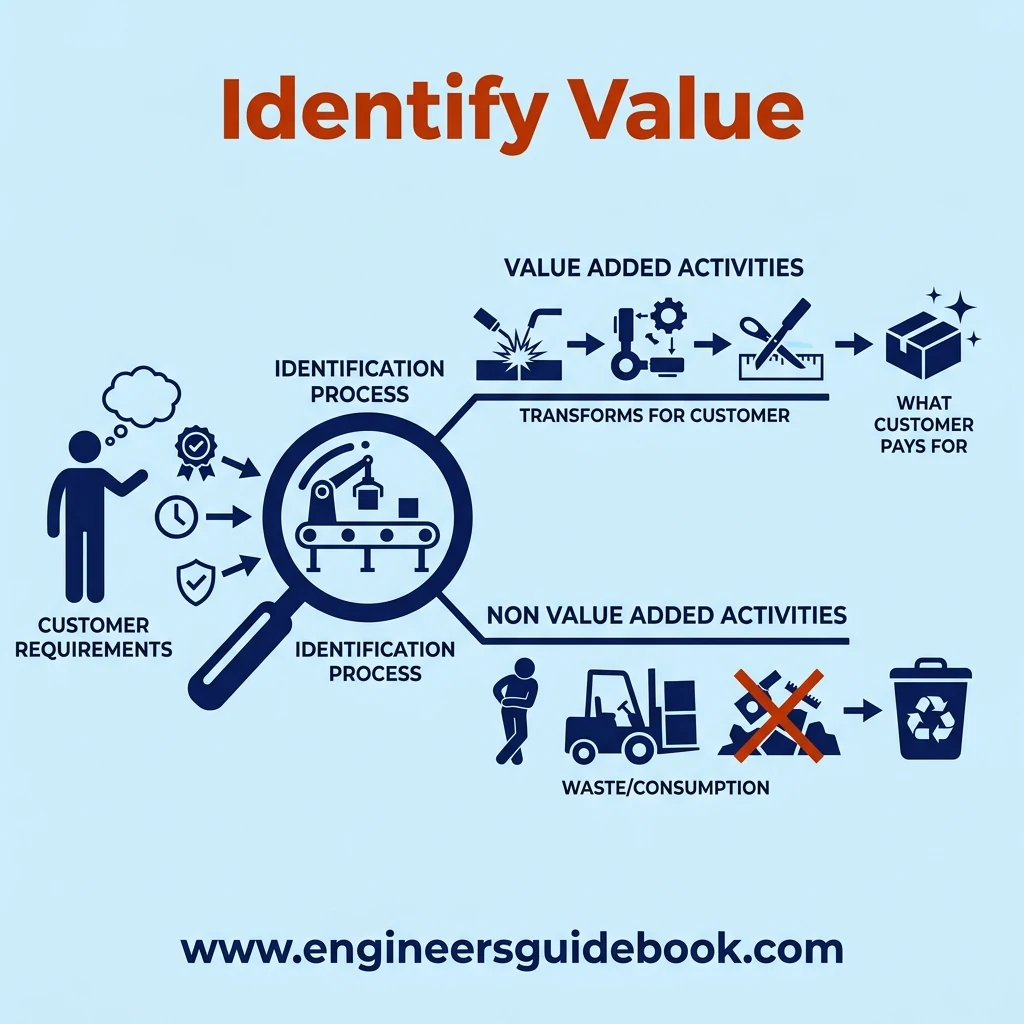
Customer value represents the characteristics, functions, quality, service, or performance for which the customer is willing to pay. It forms the starting point of every lean transformation.
Without understanding value accurately, businesses risk optimizing activities that contribute little to customer satisfaction or competitive advantage.
3.2 Customer Requirements
Customer requirements may include dimensional accuracy, product functionality, durability, appearance, delivery time, reliability, or price. These requirements should be translated into measurable operational specifications.
Clear requirements prevent departments from making assumptions about what customers value and allow production systems to prioritize the characteristics that genuinely influence satisfaction.
3.3 Value Added Activities
A value added activity directly transforms a product or service toward the condition required by the customer. For example, welding two components according to design specifications changes the product and contributes toward completion.
Lean organizations seek to perform value added work consistently while reducing the time surrounding it.
3.4 Non Value Added Activities
Non value added activities consume time or resources without improving the product from the customer’s perspective. Examples include waiting for material, moving components between distant workstations, repeated inspections, unnecessary approvals, and repairing preventable defects.
Some non value added activities may initially be necessary because of regulations or technical constraints, while others can be eliminated immediately.
3.5 Value Identification Process
Value identification begins by understanding the customer, product requirements, expected quality, delivery conditions, and acceptable price. The organization then evaluates each process according to whether it contributes toward those requirements.
This assessment establishes a practical boundary between necessary work and avoidable resource consumption.
3.6 Value Identification Example
Consider a manufacturer producing stainless steel brackets. Cutting, drilling, bending, and finishing according to customer drawings add value because they transform raw material into the required product.
Moving unfinished brackets across the factory three times, however, adds no customer value. Redesigning the layout could eliminate this unnecessary transportation.
3.7 Common Value Mistakes
A common mistake is defining value from the manufacturer’s perspective rather than the customer’s. Companies may retain complex procedures simply because they have always existed.
Another mistake is confusing activity with productivity. Employees can remain extremely busy while spending substantial time handling delays, defects, searching, transportation, or rework that customers never requested.
4. Map the Value Stream
4.1 Value Stream Definition
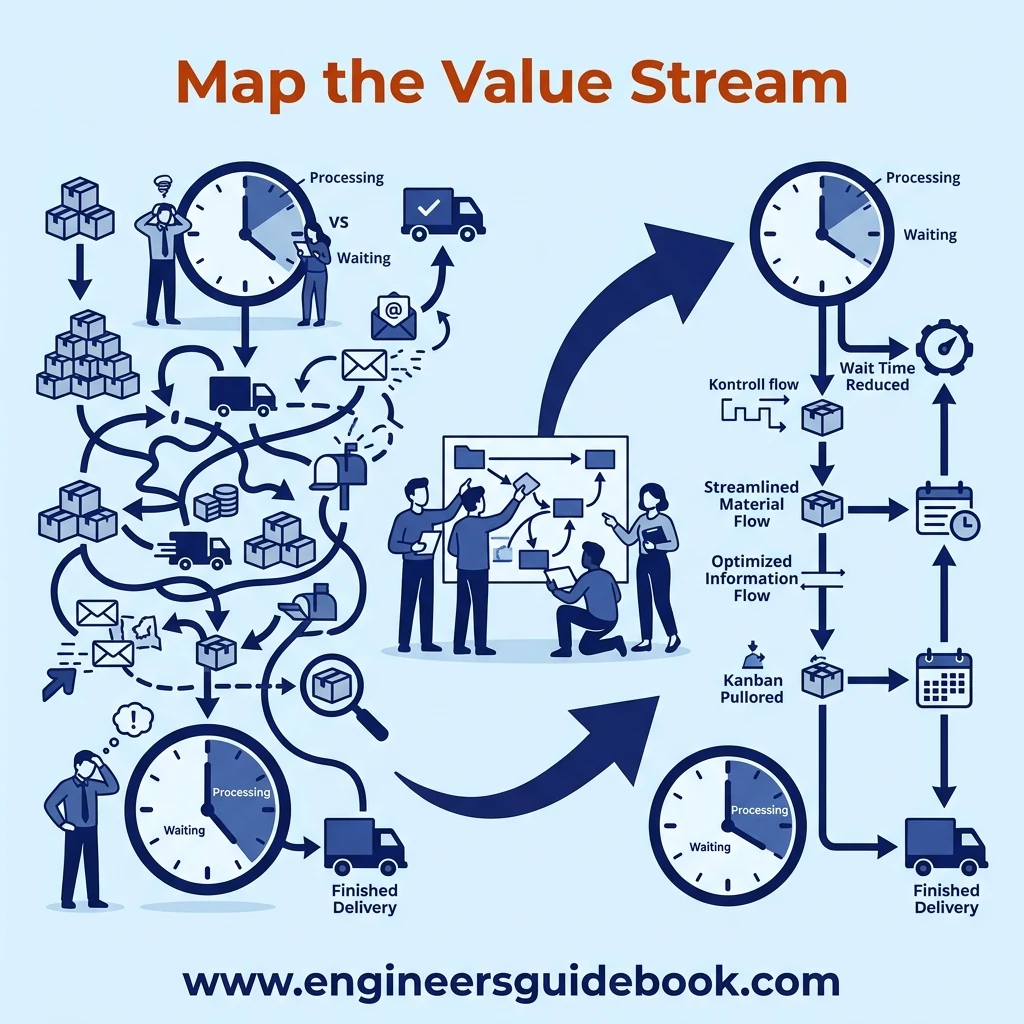
A value stream includes all activities required to move a product from raw material or customer order to finished delivery. It incorporates both value added and non value added work.
Examining the entire stream reveals inefficiencies that may remain invisible when individual departments are analyzed independently.
4.2 Process Mapping
Process mapping creates a visual representation of activities, decisions, movements, delays, and information exchanges throughout production. It helps teams understand how work actually occurs rather than how procedures suggest it should occur.
This visibility makes bottlenecks, redundant steps, excessive transportation, and communication gaps easier to identify.
4.3 Current State Mapping
A current state map documents existing operating conditions. It may include cycle times, inventory quantities, changeover times, staffing, information signals, equipment availability, and waiting periods.
The objective is not to create an attractive diagram. It is to expose the real condition of the process before improvement decisions are made.
4.4 Future State Mapping
Future state mapping defines how the process should operate after selected wastes and constraints are addressed. The future design may use improved layouts, smaller batches, pull signals, standardized work, or better production scheduling.
It gives improvement teams a coherent destination instead of allowing isolated changes to develop independently.
4.5 Material Flow
Material flow describes how raw materials, components, work in progress, and finished products move through manufacturing. Poor flow often creates excessive handling, congestion, damaged products, and long lead times.
Lean seeks shorter, clearer routes in which materials progress logically from one operation to the next.
4.6 Information Flow
Production cannot flow effectively unless information also flows efficiently. Work orders, schedules, forecasts, Kanban signals, quality information, and customer requirements influence when and how products are manufactured.
Poor information flow can create overproduction, shortages, waiting, and conflicting priorities even when physical equipment is capable of meeting demand.
4.7 Waste Identification
Value stream mapping enables teams to identify where waste accumulates. Large queues may indicate imbalance, repeated transport may reveal poor layout, and excessive waiting may expose equipment or scheduling constraints.
These observations convert vague concerns about inefficiency into identifiable improvement opportunities.
4.8 Value Stream Mapping Example
Suppose a component requires only 30 minutes of actual processing but takes four days to move through the factory. Mapping may reveal that most elapsed time occurs while batches wait between operations.
Reducing batch sizes and coordinating production could dramatically shorten lead time without increasing machine speed.
5. Create Flow
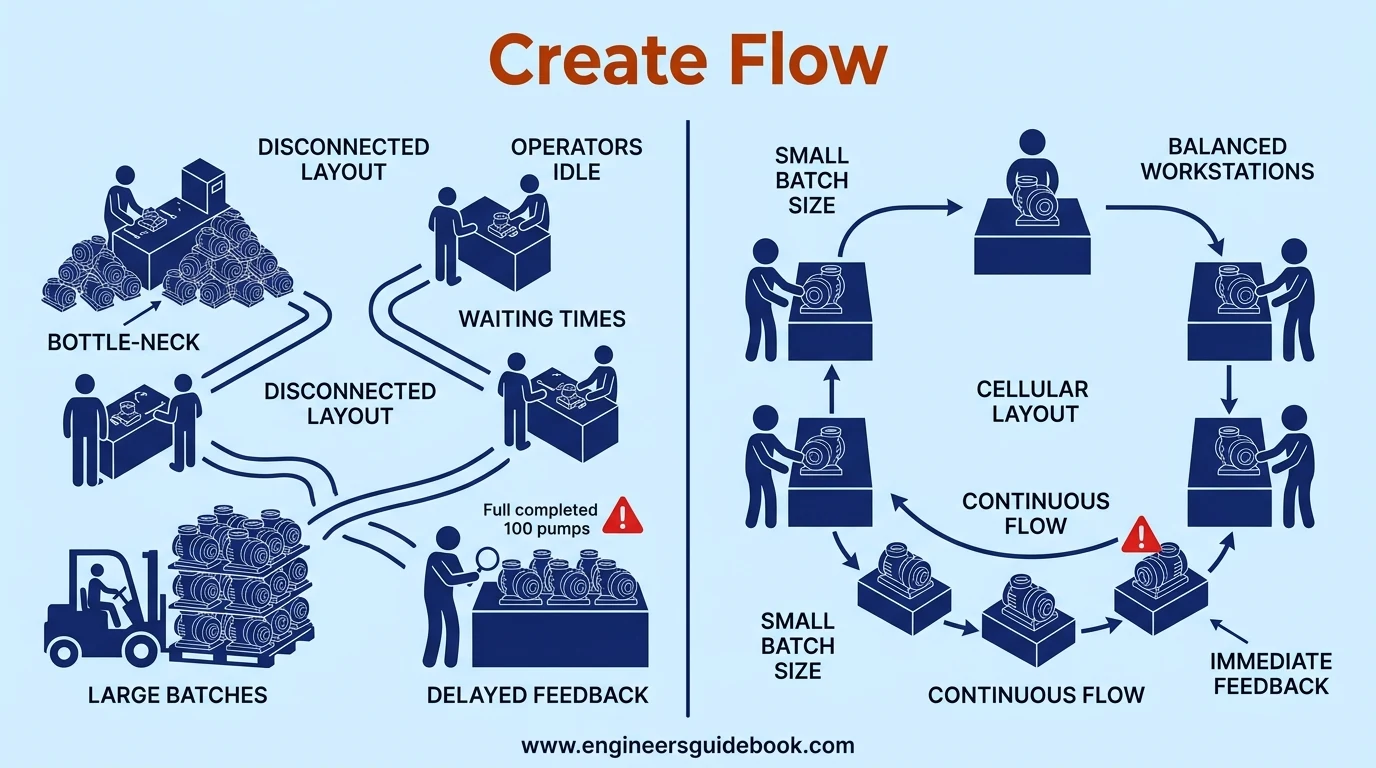
5.1 Continuous Flow
Continuous flow means products move progressively through operations with minimal interruption, waiting, or accumulation. Ideally, each process produces what the next process requires at the appropriate pace.
Smooth flow reduces work in progress and exposes production abnormalities faster than systems dependent on large intermediate inventories.
5.2 Process Bottlenecks
A bottleneck is a process whose capacity restricts overall system output. Increasing production elsewhere does little when material eventually accumulates before the constraint.
Lean teams identify bottlenecks through cycle times, queues, utilization, and production data, then improve capacity, reliability, workload distribution, or operating methods.
5.3 Workstation Balance
Workstation balancing distributes tasks so individual operations operate at compatible cycle times. Significant imbalance causes some operators to wait while others become overloaded.
Balancing work according to production demand creates smoother flow and reduces the tendency to compensate for inefficiency using excess inventory.
5.4 Production Layout
Facility layout strongly influences flow. Equipment organized purely by department can force products to travel considerable distances between operations.
Lean layouts frequently position related processes closer together. Cellular arrangements, for example, can reduce transportation and enable operators to detect interruptions quickly.
5.5 Standardized Work
Standardized work defines a consistent and effective method for completing an operation. It establishes sequence, timing, work content, and relevant operating conditions.
Standards create a stable baseline. When a better method is discovered, the standard can be revised, allowing improvement to become reproducible rather than dependent on individual habits.
5.6 Batch Size Reduction
Large batches often create long queues and conceal defects until many units have already been produced. Smaller batches allow products to move through production more frequently.
Reduced batch sizes can shorten lead time, decrease inventory, improve flexibility, and accelerate feedback when quality abnormalities occur.
5.7 Flow Improvement Example
An assembly line producing pumps may accumulate 100 units before transferring them to final testing. Changing to smaller transfer quantities allows testing to begin earlier.
A recurring assembly defect can then be identified after several units instead of after an entire large batch has been completed.
6. Establish Pull
6.1 Pull Production
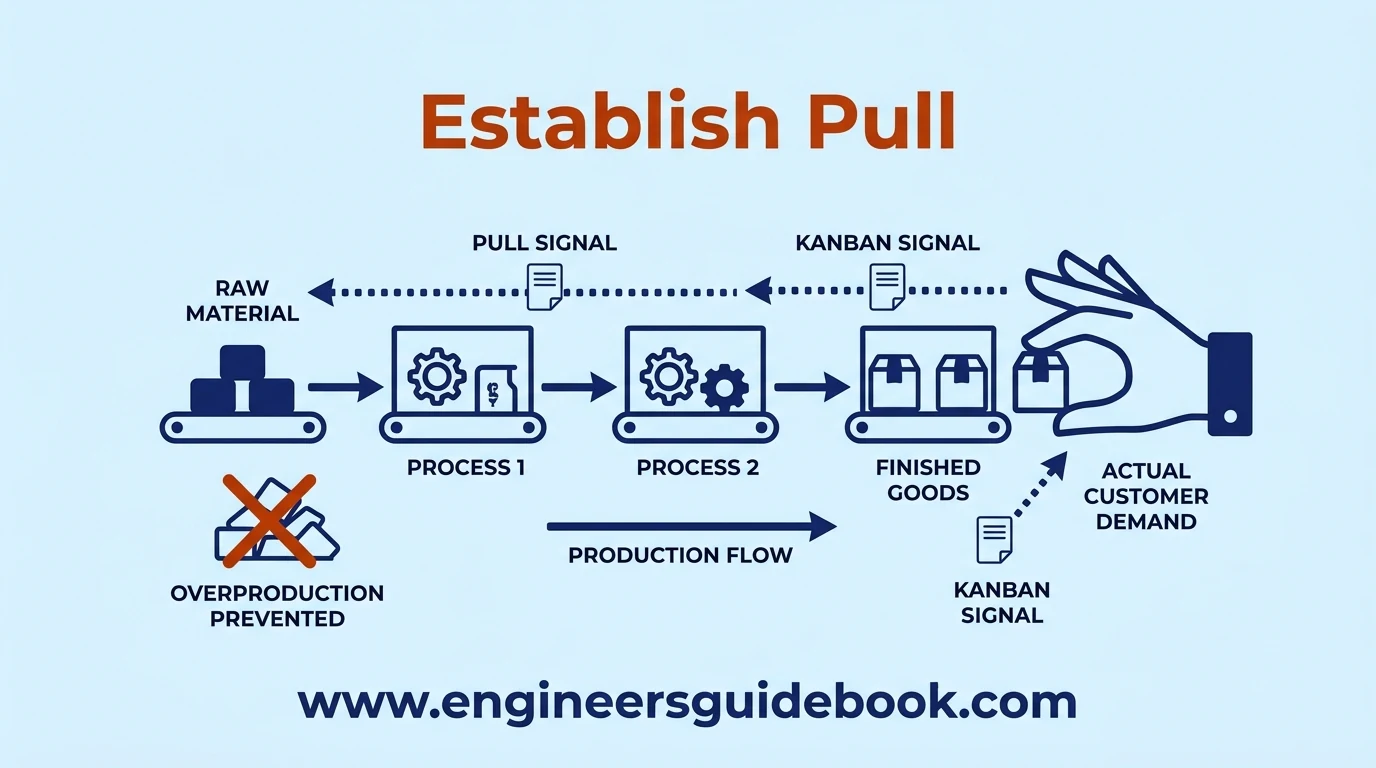
Pull production authorizes work according to downstream consumption rather than speculative forecasts alone. A process produces or replenishes material because another process has actually used it.
This approach helps prevent unnecessary production and aligns manufacturing activity more closely with real demand.
6.2 Customer Demand
Effective pull systems begin with a realistic understanding of customer demand. Production frequency, quantities, product mix, and delivery requirements must be translated into operational signals.
When production reflects actual consumption patterns, manufacturers can reduce surplus inventory while maintaining dependable product availability.
6.3 Just in Time Production
Just in time aims to provide the right product, in the right quantity, at the right location, when it is required. It relies on reliable equipment, predictable processes, disciplined scheduling, and effective supplier coordination.
JIT is therefore more sophisticated than simply reducing inventory. Unstable processes must first be addressed.
6.4 Kanban Systems
Kanban is a visual signaling mechanism used to control replenishment within a pull system. Cards, containers, electronic signals, or designated spaces can indicate when additional material should be produced or supplied.
Limiting Kanban quantities also limits work in progress, making disruptions and shortages easier to detect.
6.5 Inventory Control
Lean treats excess inventory cautiously because it consumes space and capital while potentially concealing process problems. High inventory can mask unreliable machines, lengthy changeovers, poor scheduling, or supplier instability.
The objective is not zero inventory under every circumstance, but the minimum controlled inventory necessary for reliable operations.
6.6 Overproduction Prevention
Overproduction occurs when items are manufactured earlier or in greater quantities than required. It is particularly damaging because it contributes to inventory, handling, storage, and potential obsolescence.
Pull systems reduce this waste by linking production authorization to genuine downstream consumption.
6.7 Pull System Example
Consider an assembly workstation using fastener kits supplied in standardized containers. When one container becomes empty, its Kanban signal authorizes replenishment.
Instead of continuously supplying large quantities based on forecasts, the upstream process replenishes only what has actually been consumed.
7. Pursue Perfection
7.1 Continuous Improvement
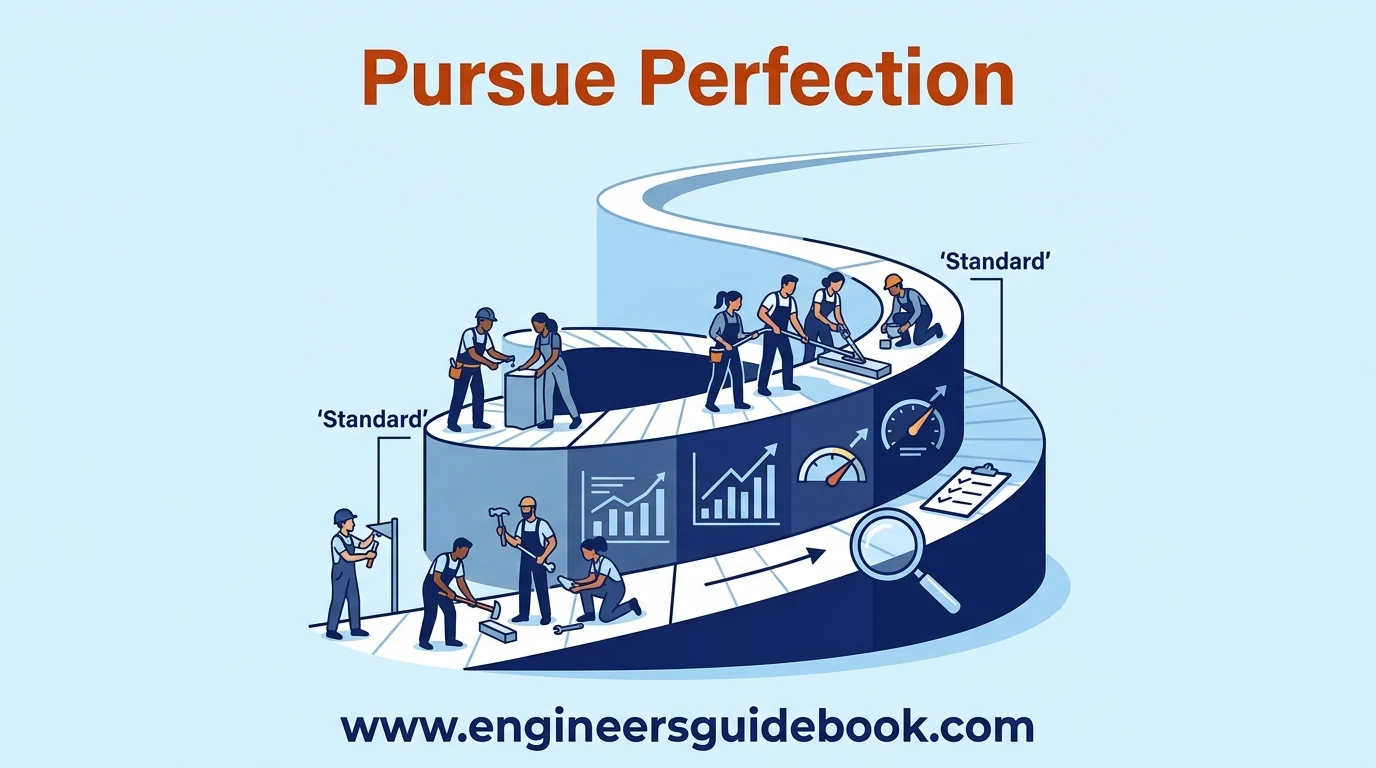
Pursuing perfection means treating lean transformation as an ongoing discipline rather than a finite project. Improvements eventually create new standards, but those standards become the starting point for further refinement.
This cycle prevents operational systems from becoming stagnant.
7.2 Kaizen Culture
Kaizen promotes frequent, incremental improvement involving employees throughout the organization. Rather than depending entirely on large capital projects, teams improve workplace organization, methods, layouts, reliability, and quality through practical changes.
A mature Kaizen culture makes problem identification a constructive activity instead of a source of blame.
7.3 Employee Involvement
Employees closest to the process often recognize operational difficulties before management reports reveal them. Their participation strengthens problem solving because practical experience complements engineering and managerial analysis.
Lean organizations therefore create mechanisms for suggestions, improvement teams, daily discussions, and structured escalation of abnormalities.
7.4 Root Cause Analysis
Root cause analysis prevents organizations from repeatedly treating symptoms. Methods such as the Five Whys and cause-and-effect analysis help teams investigate why defects, failures, or delays occurred.
Corrective action becomes more durable when it addresses the underlying mechanism instead of temporarily restoring production.
7.5 Standard Improvement
Improvement and standardization work together. Once a better production method has been verified, it should become the new standard so that gains are retained consistently.
Future improvements can then be evaluated against this revised baseline, creating an iterative progression toward better performance.
7.6 Performance Measurement
Lean performance should be evaluated using metrics that reflect system effectiveness. Useful indicators may include lead time, first-pass yield, overall equipment effectiveness, inventory turnover, changeover time, on-time delivery, downtime, and customer complaints.
Metrics should reveal problems and support decisions rather than encourage local optimization that damages overall flow.
7.7 Perfection Principle Example
A packaging line may initially reduce changeover time from 60 minutes to 35 minutes through better tool organization and standardized procedures. Instead of declaring the project complete, the team studies the remaining steps.
Further improvements might reduce adjustments, prepare materials externally, and eventually cut the changeover to 20 minutes. This repeated refinement exemplifies the lean pursuit of perfection.
8. Lean Manufacturing Implementation
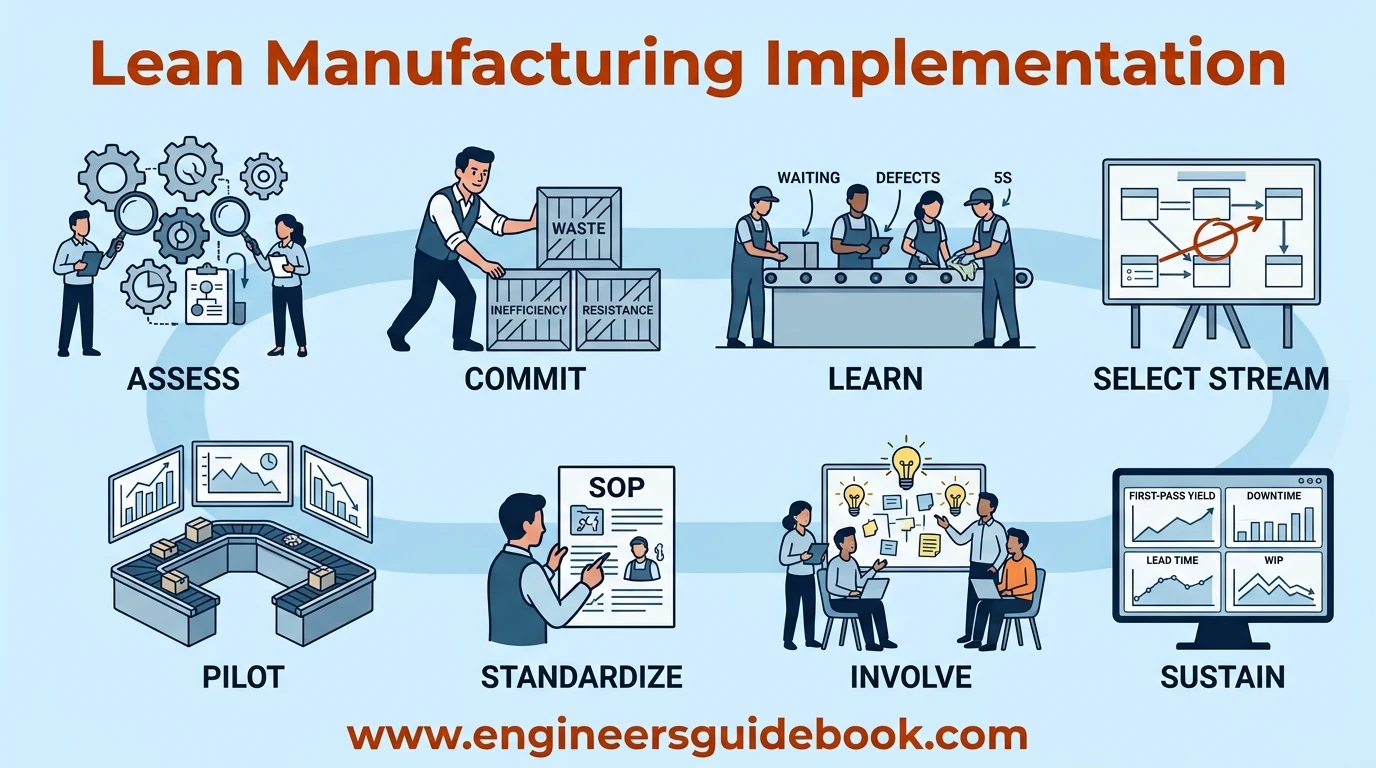
8.1 Lean Readiness Assessment
Lean implementation should begin with an honest assessment of the organization’s current operating condition. This includes evaluating process stability, leadership involvement, employee capability, quality performance, equipment reliability, inventory levels, and existing improvement practices.
A readiness assessment identifies weaknesses before lean tools are introduced. Organizations with unstable equipment, inconsistent procedures, or poor communication may need to establish basic operational discipline before attempting sophisticated pull systems or continuous flow.
8.2 Leadership Commitment
Leadership commitment is indispensable because lean transformation frequently requires changes in priorities, behaviors, resource allocation, and performance measurement. Senior managers must do more than approve lean projects; they need to reinforce lean principles through everyday decisions.
Effective leaders remove organizational barriers, participate in improvement activities, review performance, and encourage teams to expose problems rather than conceal them. Lean initiatives rarely endure when management treats them as temporary cost-cutting campaigns.
8.3 Employee Training
Employees need practical knowledge of lean concepts before they can participate effectively in improvement activities. Training may cover waste identification, 5S, Kaizen, standardized work, problem solving, Kanban, root cause analysis, and value stream mapping.
Training should connect theory with actual workplace conditions. Operators who practice identifying waiting, excessive motion, defects, and overproduction on their own production lines understand lean more effectively than those receiving classroom instruction alone.
8.4 Value Stream Selection
Organizations should select an appropriate value stream rather than attempting to transform every operation simultaneously. A suitable value stream usually has measurable customer demand, identifiable performance problems, and sufficient improvement potential.
Selection should consider business impact, process complexity, available data, leadership support, and feasibility. Beginning with a clearly defined product family makes improvement efforts easier to coordinate.
8.5 Pilot Projects
Pilot projects allow lean practices to be tested within a controlled operational area before wider deployment. A company might begin with one assembly cell, packaging line, warehouse zone, or product family.
The pilot establishes evidence. Successful improvements in lead time, quality, inventory, or productivity demonstrate the practical value of lean and provide lessons that can guide expansion into other departments.
8.6 Standardized Processes
Improvements must eventually become standardized processes. Without standardization, employees may gradually return to previous working methods and the benefits of improvement can deteriorate.
Standard work defines the preferred sequence, operating method, cycle time, quality expectations, and safety requirements. It also creates a measurable baseline from which future improvement can occur.
8.7 Lean Culture Development
Lean culture develops when improvement becomes a normal organizational behavior rather than a specialized project. Employees should feel responsible for identifying problems and capable of suggesting solutions.
Management plays a central role by rewarding constructive problem identification, encouraging teamwork, and treating mistakes as opportunities for learning when appropriate. Sustainable lean systems depend on habits as much as technical tools.
8.8 Continuous Monitoring
Lean performance requires ongoing monitoring through appropriate operational indicators. Metrics may include first-pass yield, downtime, lead time, work in progress, customer complaints, changeover duration, overall equipment effectiveness, and on-time delivery.
Monitoring helps determine whether improvements are sustained. When performance begins to deteriorate, teams can investigate deviations before they become entrenched operational problems.
9. Lean Manufacturing Tools
9.1 5S Methodology
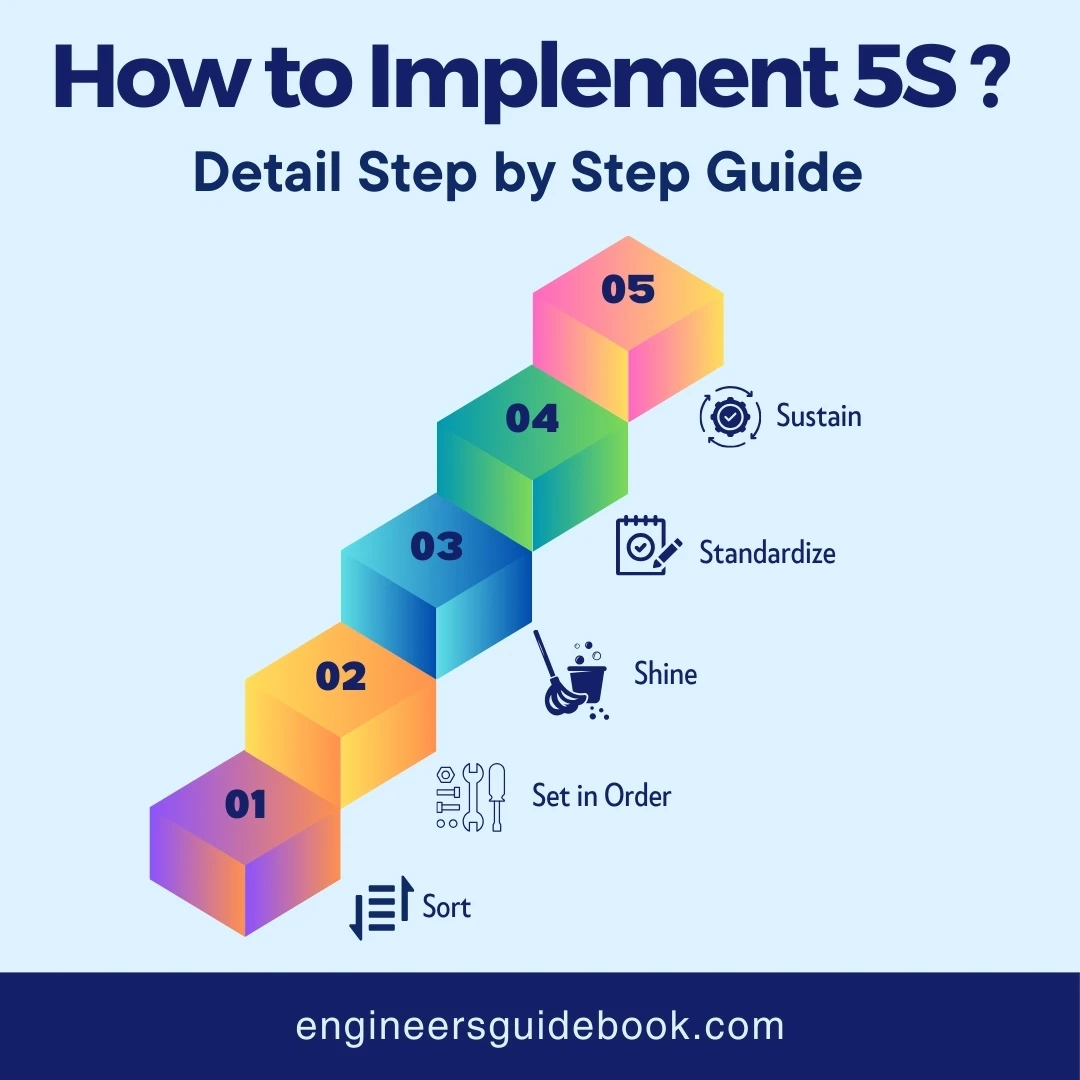
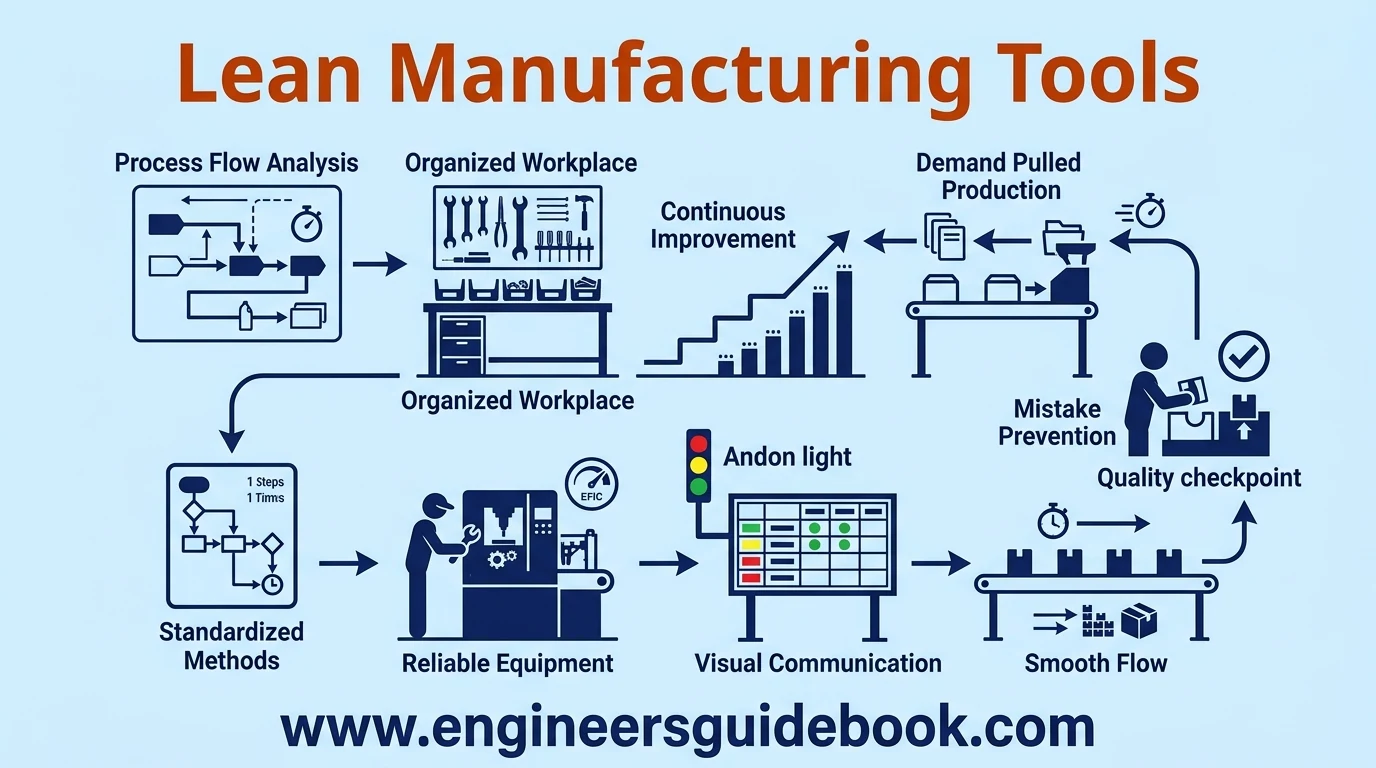
5S organizes the workplace through sorting, setting in order, shining, standardizing, and sustaining. It removes unnecessary items, establishes clear locations for tools and materials, and improves workplace visibility.
Beyond cleanliness, 5S can reduce searching, motion, safety hazards, and process variation.
9.2 Kaizen
Kaizen is the practice of continuous incremental improvement. Employees regularly identify small opportunities to make work safer, easier, faster, or more reliable.
Numerous modest improvements can collectively create substantial performance gains without requiring extensive capital investment.
9.3 Kanban
Kanban uses visual or electronic signals to authorize production and replenishment according to consumption. It helps control work in progress and prevents uncontrolled production.
When designed properly, Kanban connects upstream supply with downstream requirements while making shortages and abnormalities visible.
9.4 Value Stream Mapping
Value stream mapping illustrates material and information flow across an entire process. It reveals waiting, inventory accumulation, excessive transportation, communication gaps, and other impediments.
Teams typically compare a current-state map with a desired future-state design to establish targeted improvement actions.
9.5 Poka Yoke
Poka Yoke refers to mistake-proofing techniques that prevent errors or make them immediately detectable. Examples include fixtures that accept components only in the correct orientation or sensors that detect missing parts.
The principle is to design quality into the process rather than depend entirely on inspection afterward.
9.6 Just in Time
Just in Time coordinates production so required products are produced in the required quantity when needed. It minimizes unnecessary inventory while improving responsiveness.
Successful JIT depends on reliable equipment, stable processes, competent suppliers, disciplined scheduling, and predictable material flow.
9.7 Total Productive Maintenance
Total Productive Maintenance focuses on maximizing equipment effectiveness through preventive maintenance, operator involvement, condition monitoring, and systematic elimination of recurring failures.
Reliable equipment is essential for lean flow because frequent breakdowns create queues, emergency work, quality problems, and production instability.
9.8 Standardized Work
Standardized work documents the safest and most efficient known method for performing a task consistently. It establishes expected sequence, timing, and operating conditions.
Rather than preventing innovation, standards provide a reference against which improved methods can be tested and institutionalized.
9.9 Visual Management
Visual management communicates operational conditions through boards, markings, labels, status indicators, Andon systems, charts, and production displays.
Employees should be able to recognize normal and abnormal conditions rapidly. Effective visual management reduces ambiguity and accelerates corrective action.
10. Lean Manufacturing Examples
10.1 Automotive Manufacturing
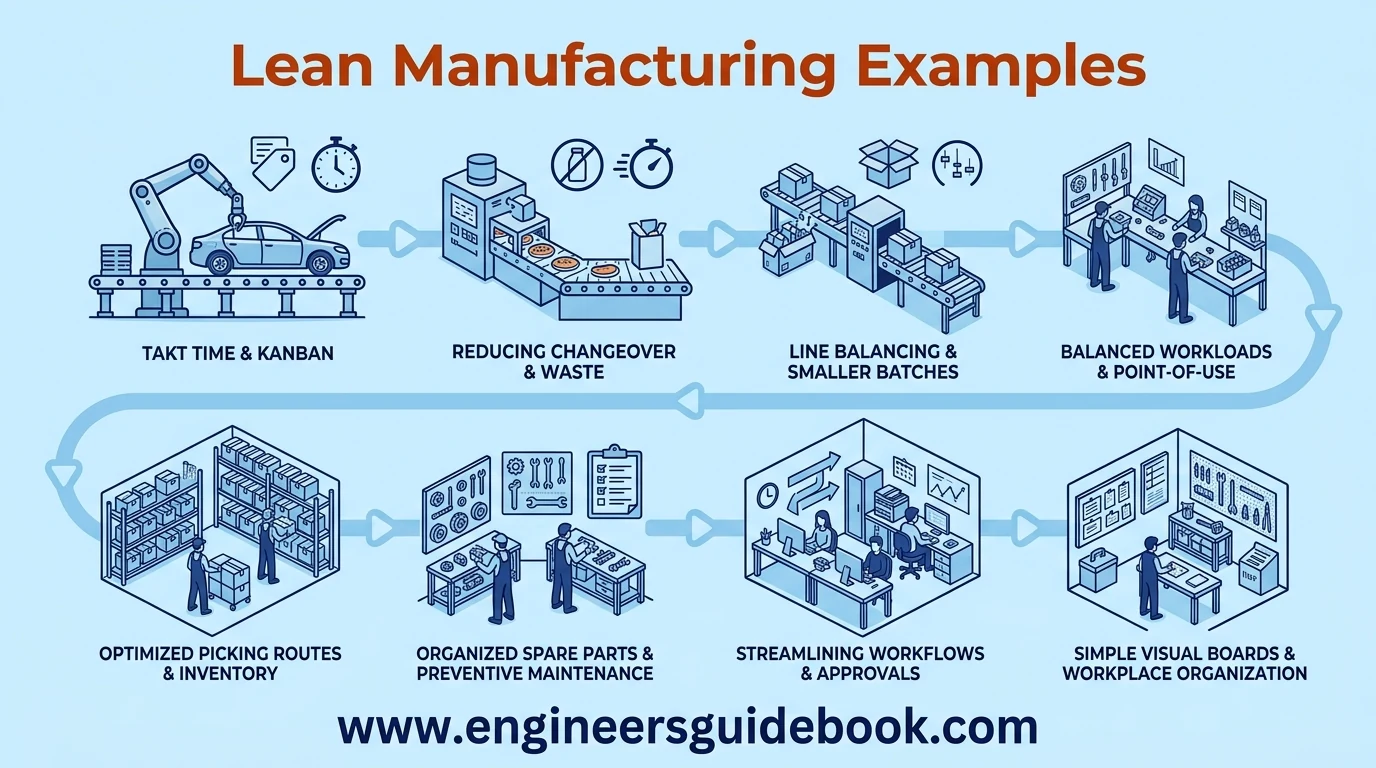
Automotive plants commonly use takt time, Kanban, cellular production, standardized work, and mistake-proofing. Components arrive according to production requirements, while abnormalities are addressed quickly to protect downstream flow.
10.2 Food Manufacturing
Food manufacturers can apply lean principles to reduce changeover time, product loss, excessive movement, packaging waste, and unplanned downtime while maintaining stringent hygiene and quality requirements.
10.3 Packaging Operations
A packaging line may use line balancing, visual controls, standardized setup procedures, and smaller batches to reduce waiting and increase throughput. Changeover improvement can also increase flexibility between product formats.
10.4 Assembly Lines
Assembly operations benefit from balanced workloads, ergonomic layouts, standardized work, and point-of-use material presentation. These measures reduce unnecessary movement while improving consistency and production rhythm.
10.5 Warehouse Operations
Warehouses can use lean methods to optimize storage locations, picking routes, replenishment, and inventory control. Frequently used items may be positioned closer to dispatch areas to reduce travel distance.
10.6 Maintenance Operations
Maintenance teams can apply lean principles by organizing spare parts, standardizing preventive maintenance procedures, improving work-order planning, and analyzing recurring equipment failures.
Reducing emergency corrective work allows resources to focus more effectively on reliability improvement.
10.7 Office Processes
Lean is equally applicable to administrative work. Repeated approvals, duplicate data entry, excessive email exchanges, waiting for decisions, and unnecessary documentation are forms of process waste.
Streamlining workflows can significantly shorten administrative lead times.
10.8 Small Business Operations
Small businesses can implement lean without expensive technology. Simple visual boards, organized workplaces, standard procedures, inventory limits, and employee improvement suggestions can produce meaningful results.
Lean depends more on disciplined thinking than organizational size.
11. Lean Manufacturing Benefits and Challenges
11.1 Waste Reduction
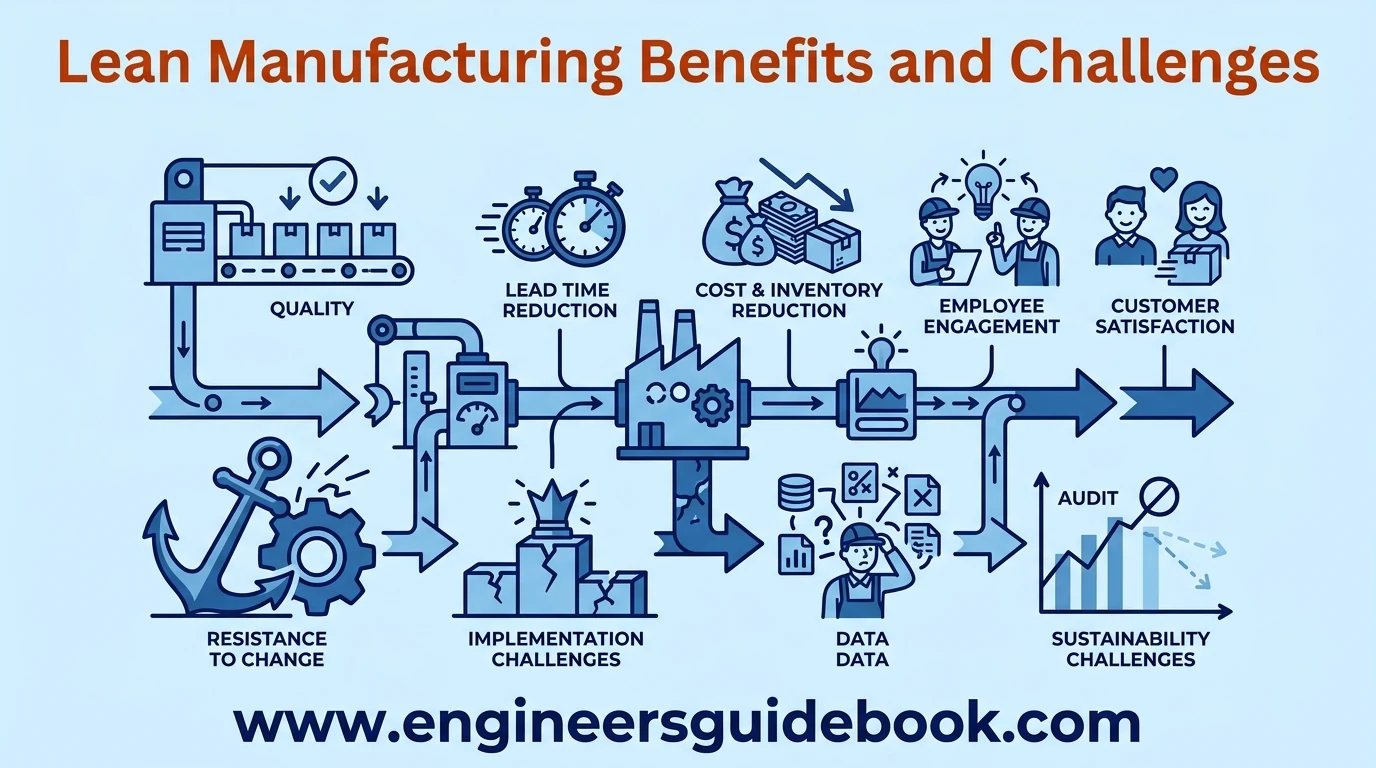
Lean systematically identifies activities that consume resources without providing customer value. Removing unnecessary motion, waiting, defects, transportation, and overproduction creates a more economical production system.
11.2 Cost Reduction
Lower waste typically reduces labor inefficiency, material loss, rework, storage requirements, and excess inventory. Cost reduction emerges from better processes rather than indiscriminate resource cuts.
11.3 Productivity Improvement
Productivity improves when employees and equipment spend more time producing useful output. Balanced workloads, reduced waiting, better layouts, and standardized methods increase effective capacity.
11.4 Quality Improvement
Mistake-proofing, standardized work, root cause analysis, and rapid feedback prevent defects from progressing downstream. Quality becomes a process responsibility rather than an inspection activity.
11.5 Lead Time Reduction
Removing queues and unnecessary processing allows products to move through operations faster. Shorter lead times improve responsiveness and reduce the time between customer order and delivery.
11.6 Inventory Reduction
Pull production, smaller batches, and improved process reliability reduce excessive raw material, work-in-progress, and finished-goods inventory while freeing storage space and working capital.
11.7 Employee Engagement
Lean encourages employees to participate in problem solving and process improvement. Greater involvement can strengthen ownership, operational knowledge, teamwork, and accountability.
11.8 Customer Satisfaction
Improved quality, shorter delivery times, reliable service, and competitive costs can strengthen customer satisfaction. Lean ultimately links operational excellence with the value experienced by the customer.
11.9 Resistance to Change
Employees may resist lean when they perceive it as additional workload or a workforce reduction initiative. Transparent communication and genuine participation are therefore essential during implementation.
11.10 Implementation Challenges
Common challenges include weak leadership, insufficient training, poor data, unstable processes, conflicting performance targets, and excessive focus on isolated tools.
Organizations must address these systemic obstacles instead of expecting individual lean techniques to solve them automatically.
11.11 Sustainability Challenges
Initial improvements can disappear when audits stop, leadership changes, or standards are ignored. Sustaining lean requires routine review, coaching, accountability, and continued improvement.
12. Lean Manufacturing FAQ
12.1 What Are the Five Principles of Lean Manufacturing
The five principles are identify value, map the value stream, create flow, establish pull, and pursue perfection. Together, they create a structured framework for improving customer value while eliminating waste.
12.2 What Is the Main Goal of Lean Manufacturing
The main goal is to maximize customer value while minimizing waste. Lean improves processes so fewer resources are consumed in producing the quality, quantity, and delivery performance customers require.
12.3 What Is an Example of Lean Manufacturing
A factory replacing large production batches with smaller batches and Kanban replenishment is a common example. The change can reduce inventory, expose defects sooner, and shorten manufacturing lead time.
12.4 What Are the Eight Wastes in Lean Manufacturing
The eight wastes are defects, overproduction, waiting, non-utilized talent, transportation, inventory, motion, and extra processing. They are often remembered using the acronym DOWNTIME.
12.5 How Does Lean Manufacturing Reduce Waste
Lean reduces waste by examining processes, identifying non-value-added activities, determining root causes, and redesigning work to eliminate or minimize unnecessary steps.
12.6 What Is the Difference Between Lean and Six Sigma
Lean primarily focuses on improving flow and eliminating waste, while Six Sigma emphasizes reducing variation and defects through structured, data-driven methods. Organizations frequently integrate both approaches as Lean Six Sigma.
12.7 What Is Value Stream Mapping in Lean Manufacturing
Value stream mapping is a visual method for analyzing material and information flow from the beginning of a process to customer delivery. It highlights delays, inventory, bottlenecks, and improvement opportunities.
12.8 How Is Kaizen Used in Lean Manufacturing
Kaizen engages employees in frequent, incremental improvements to processes, workplaces, equipment, and methods. Small improvements are standardized and become the foundation for subsequent changes.
12.9 Can Lean Manufacturing Be Used in Small Businesses
Yes. Small businesses can apply lean through workplace organization, standardized procedures, visual management, inventory control, waste elimination, and continuous improvement without requiring complex infrastructure.
12.10 How Do You Implement Lean Manufacturing
Implementation begins by understanding customer value, assessing current processes, mapping the value stream, removing waste, improving flow, introducing pull where appropriate, standardizing improvements, and continuously measuring performance.
13. Conclusion
13.1 Five Principles Summary
The five lean manufacturing principles provide a coherent progression from identifying customer value to pursuing continuous improvement. Value establishes direction, value stream mapping exposes waste, flow removes interruption, pull synchronizes production with demand, and perfection sustains improvement.
Long-term lean success requires more than isolated tools or occasional improvement events. Leadership commitment, employee involvement, process discipline, reliable measurement, and respect for people must operate together.