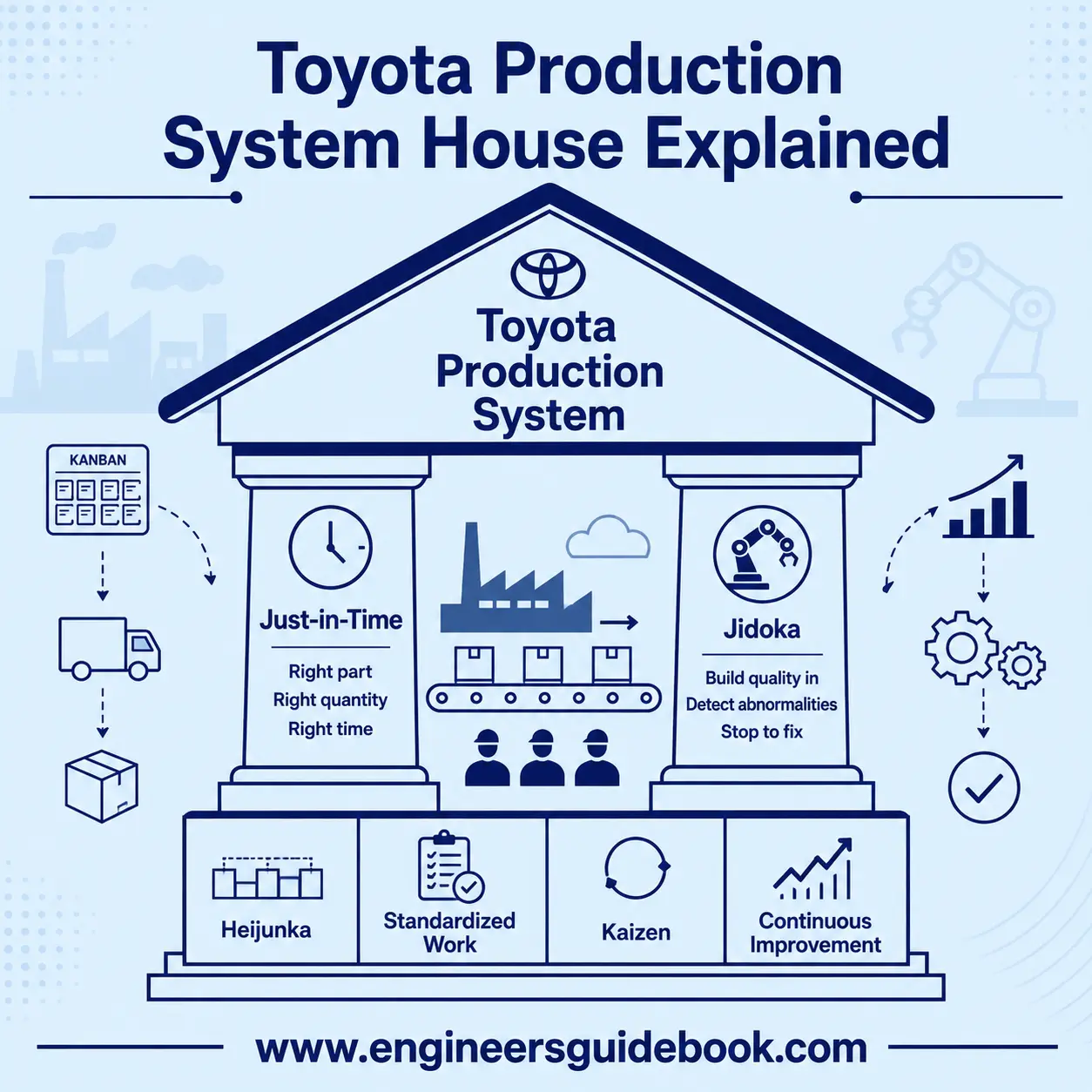
The Toyota Production System House is a visual model explaining how Toyota combines stable processes, Just in Time production, built-in quality, standardized work, and employee involvement. Its foundation supports two structural pillars, while the roof represents quality, cost, delivery, safety, and customer satisfaction. Every element must function together for sustainable operational excellence.
1. Toyota Production System House Overview
1.1 TPS House Concept
The TPS House presents Toyota’s philosophy as an integrated system rather than isolated tools.
1.2 House Structure
Its foundation creates stability, two pillars govern flow and quality, and the roof defines desired organizational outcomes.
1.3 System Objectives
The system pursues superior quality, lower cost, shorter lead time, safer work, and dependable customer service.
1.4 Customer Value
Every activity is evaluated by whether it creates value customers recognize and are willing to purchase.
2. History of the TPS House
2.1 Toyota Origins
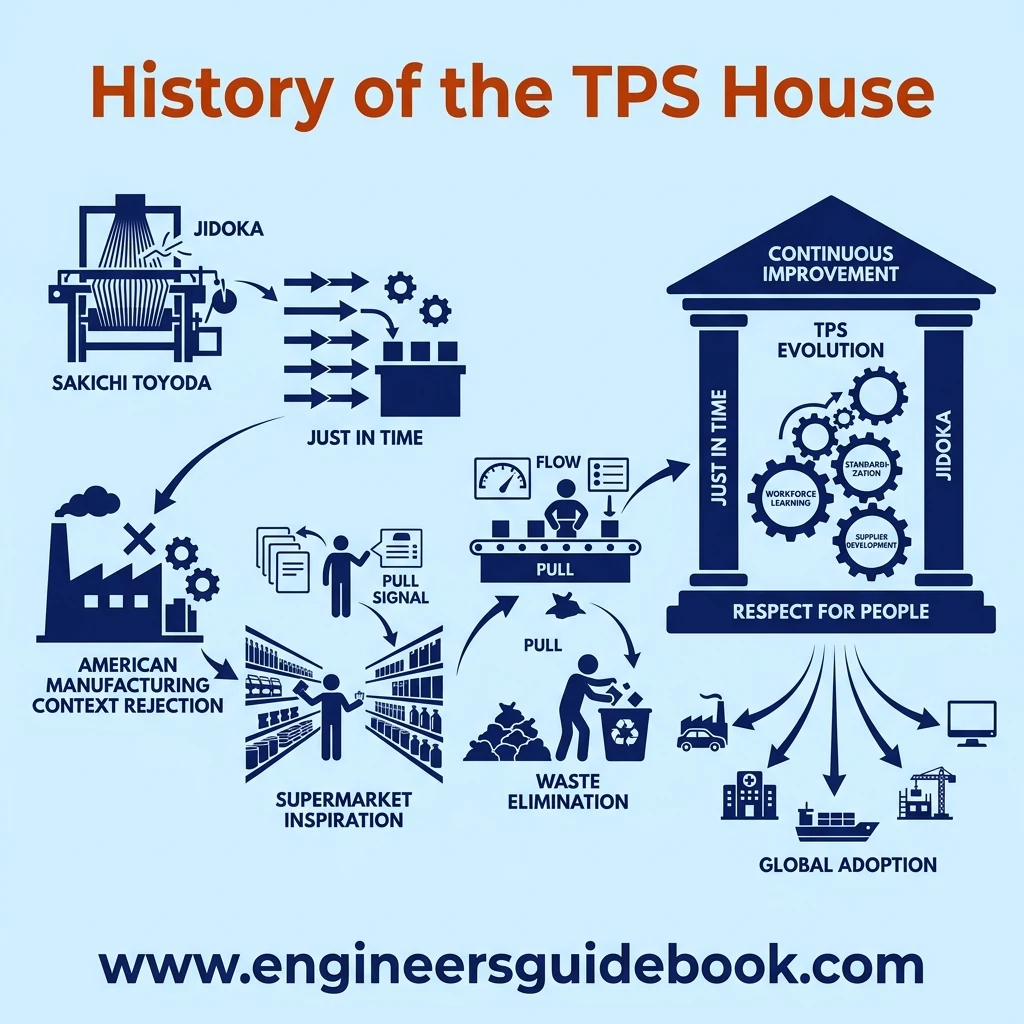
Toyota’s production philosophy emerged from Japan’s industrial development and the Toyoda family’s inventive manufacturing ventures.
2.2 Postwar Challenges
After World War II, scarce capital, limited materials, and fragmented demand made American-style mass production impractical.
2.3 Sakichi Toyoda
Sakichi Toyoda developed automatic looms that stopped when threads broke, establishing the principle later called Jidoka.
2.4 Kiichiro Toyoda
Kiichiro Toyoda promoted producing only what was needed, when needed, laying the groundwork for Just in Time.
2.5 Taiichi Ohno
Taiichi Ohno transformed these ideas into practical production routines centered on flow, pull, visibility, and waste elimination.
2.6 Eiji Toyoda
Eiji Toyoda supported long-term experimentation and helped institutionalize TPS across Toyota’s expanding manufacturing network.
2.7 American Manufacturing Influence
Toyota studied American factories but rejected excessive inventories, inflexible equipment, and production detached from actual demand.
2.8 Supermarket Inspiration
American supermarkets inspired replenishment systems in which downstream consumption signaled upstream production requirements.
2.9 TPS Evolution
TPS matured through decades of experimentation, setbacks, standardization, supplier development, and workforce learning.
2.10 Global Adoption
Organizations worldwide adapted TPS principles to manufacturing, healthcare, logistics, construction, and services.
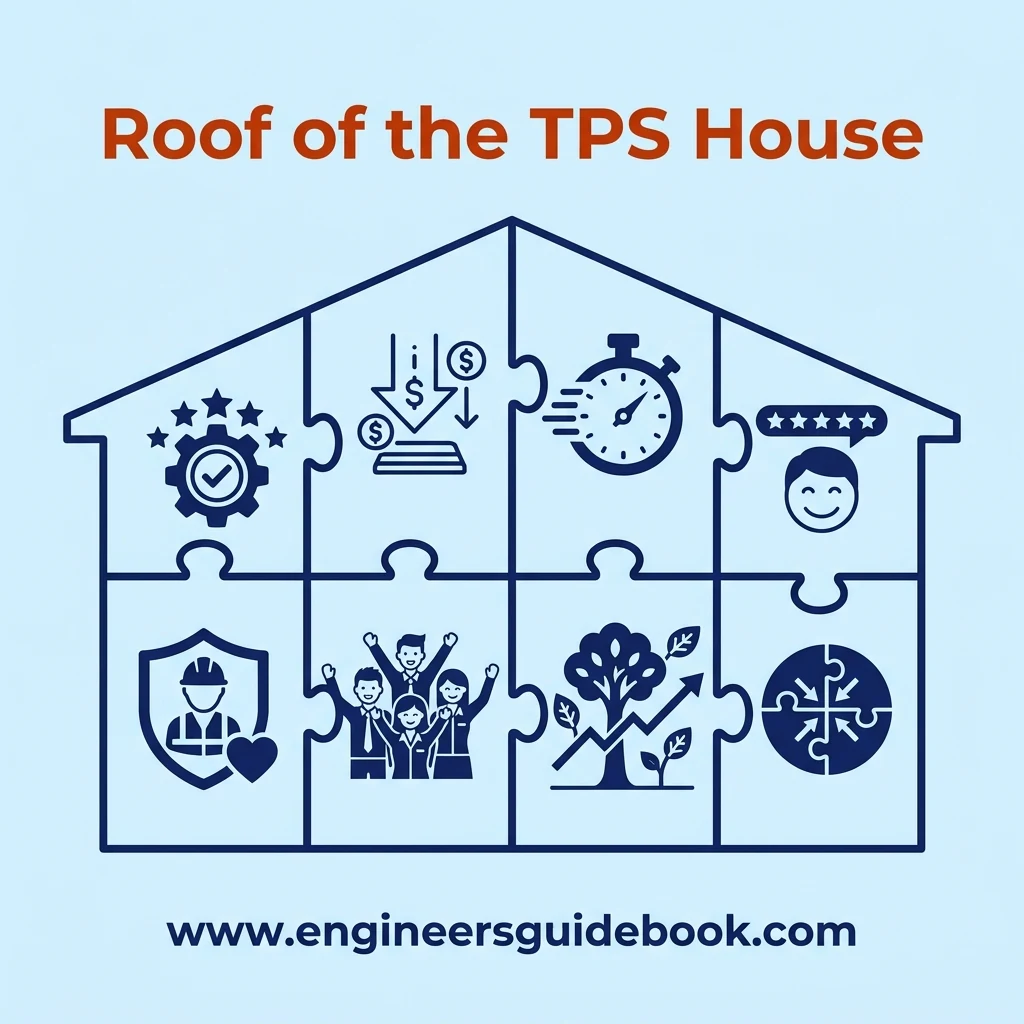
3. Roof of the TPS House
3.1 Highest Quality
Quality signifies consistently delivering products that meet specifications, expectations, and regulatory obligations.
3.2 Lowest Cost
Cost reduction comes from eliminating waste, preventing defects, simplifying flow, and using resources precisely.
3.3 Shortest Lead Time
Short lead times reduce waiting, accelerate response, expose problems, and improve cash conversion.
3.4 Customer Satisfaction
Customer satisfaction results when quality, availability, price, reliability, and service performance align consistently.
3.5 Employee Safety
Safety is indispensable because no efficiency gain justifies hazardous conditions, excessive strain, or preventable injury.
3.6 Workforce Morale
Morale improves when employees receive respect, clear standards, meaningful participation, and prompt support during abnormalities.
3.7 Sustainable Growth
TPS favors durable capability building over temporary output surges that exhaust people, equipment, or suppliers.
3.8 Shared Business Goals
The roof unifies departments around common performance outcomes rather than competing functional targets and local optimization.
Also Read More:
Lean Manufacturing: Principles, Tools, Benefits, and Examples
How to Implement Lean Manufacturing Step by Step
5 Principles of Lean Manufacturing Explained With Examples
4. Just-in-Time Pillar
4.1 Just-in-Time Meaning
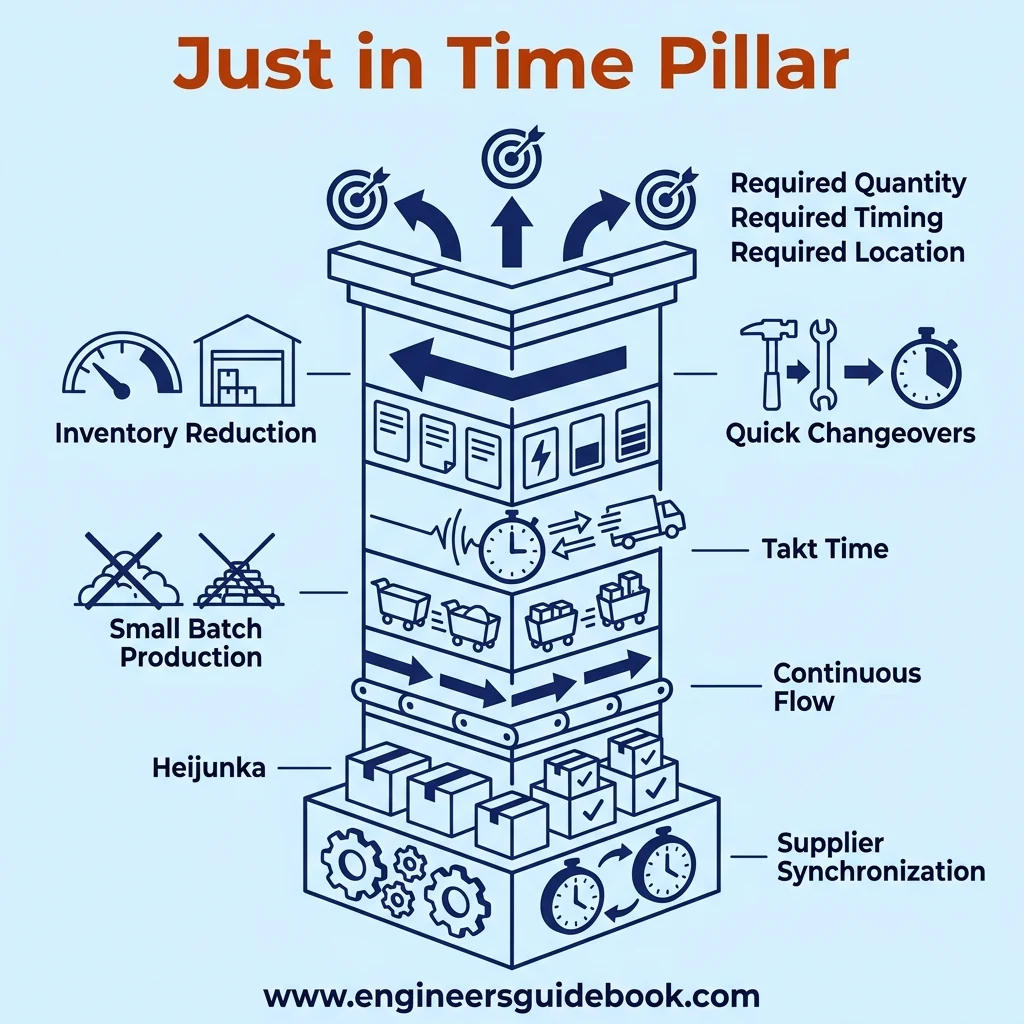
Just in Time means producing only the required item, in the required quantity, at the required moment.
4.2 Required Quantity
Producing exact quantities minimizes overproduction, surplus inventory, storage expense, deterioration, and hidden quality problems.
4.3 Required Timing
Correct timing synchronizes processes with customer demand and prevents premature production from congesting the value stream.
4.4 Required Location
Materials must arrive where consumption occurs, avoiding unnecessary handling, searching, transportation, and intermediate storage.
4.5 Takt Time
Takt time translates customer demand into the production rhythm needed to satisfy orders without overburdening resources.
4.6 Continuous Flow
Continuous flow moves work smoothly between steps, reducing queues, interruptions, handoffs, and unfinished inventory.
4.7 Pull Production
Pull production authorizes replenishment through actual downstream consumption instead of speculative forecasts and arbitrary schedules.
4.8 Kanban System
Kanban provides visible signals that regulate production, movement, quantities, and replenishment between connected processes.
4.9 Heijunka
Heijunka levels volume and product mix, reducing volatility while improving labor, equipment, and supplier utilization.
4.10 Small Batch Production
Small batches shorten feedback cycles, reduce inventory exposure, and reveal defects before substantial quantities accumulate.
4.11 Quick Changeovers
Rapid changeovers make product transitions economical and enable smaller batches without sacrificing capacity.
4.12 Inventory Reduction
Lower inventory releases capital and exposes instability concealed by buffers and excess work in process.
4.13 Lead Time Reduction
Removing delays compresses order-to-delivery time and increases responsiveness to changing customer requirements.
4.14 Supplier Synchronization
Suppliers must coordinate quality, quantities, packaging, timing, and logistics with the consuming production system.
5. Jidoka Pillar
5.1 Jidoka Meaning
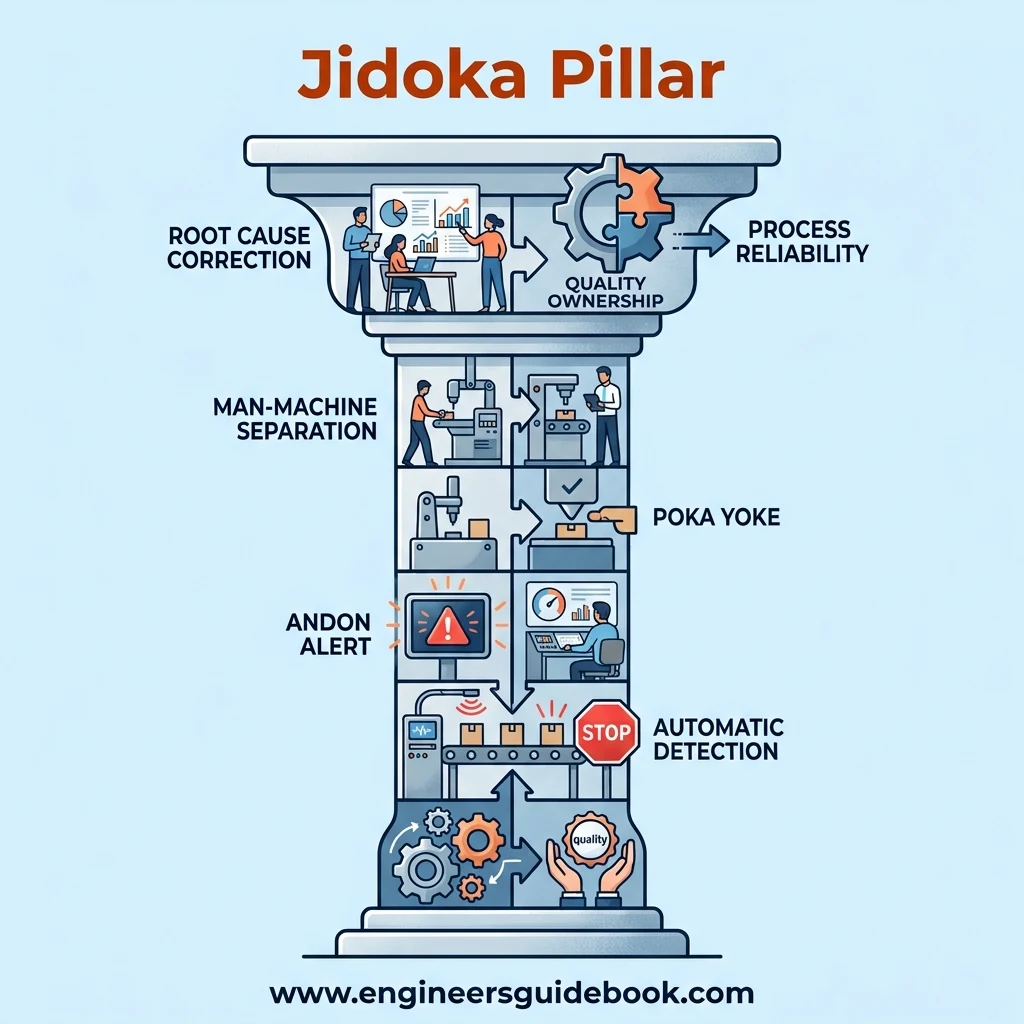
Jidoka means automation with human intelligence, allowing processes to detect abnormalities and stop autonomously.
5.2 Built in Quality
Quality is created within each process rather than inspected into products after production has finished.
5.3 Automatic Detection
Sensors, fixtures, controls, and checks identify defects, deviations, or equipment malfunctions immediately.
5.4 Immediate Stoppage
Stopping prevents an abnormal condition from propagating downstream and producing larger volumes of defective work.
5.5 Human Intelligence
Human judgment remains essential for diagnosis, correction, learning, and permanent countermeasure development.
5.6 Andon System
Andon displays production status and alerts leaders when operators require immediate assistance with an abnormality.
5.7 Poka Yoke
Poka Yoke devices prevent mistakes or make them instantly visible before they become customer-facing defects.
5.8 Source Inspection
Source inspection verifies conditions at the point where errors originate rather than relying on downstream detection.
5.9 Defect Containment
Containment isolates suspect material, protects subsequent processes, and preserves traceability during investigation.
5.10 Root Cause Correction
Teams address underlying causes through disciplined analysis instead of repeatedly treating symptoms with temporary repairs.
5.11 Man Machine Separation
Machines handle repetitive cycles independently while operators supervise multiple processes and intervene only when abnormalities arise.
5.12 Quality Ownership
Each employee accepts responsibility for passing only conforming work to the next process.
5.13 Process Reliability
Jidoka improves reliability by transforming hidden failures into visible, actionable opportunities for systemic correction.
6. Foundation of the TPS House
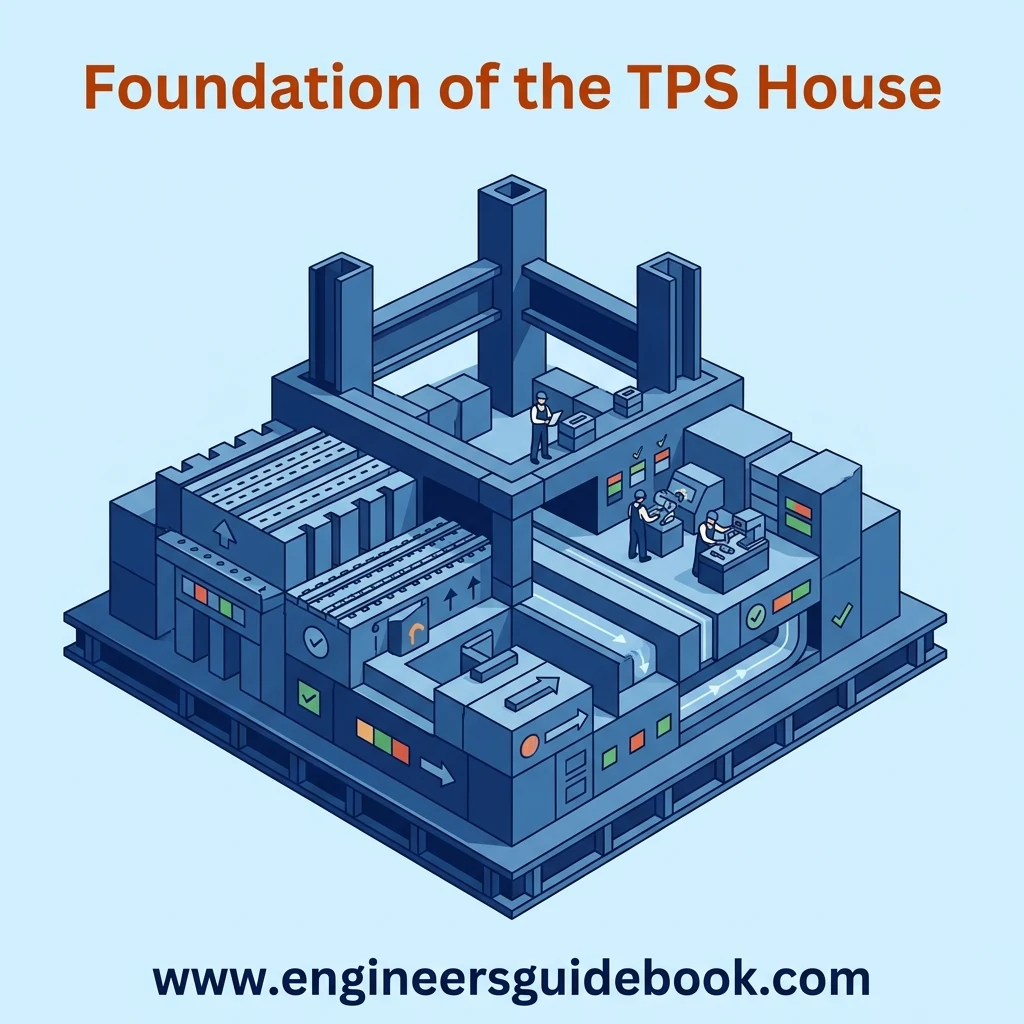
6.1 Process Stability
Stable processes produce predictable results and provide the essential platform for flow, pull, and improvement.
6.2 Standardized Work
Standardized work defines the safest, most efficient known method for completing a task consistently.
6.3 Production Leveling
Leveling moderates demand fluctuations and prevents uneven workloads from destabilizing labor, machines, and suppliers.
6.4 Visual Management
Visual controls make standards, status, priorities, and abnormalities understandable without elaborate reports.
6.5 Workplace Organization
Organized workplaces reduce searching, motion, contamination, hazards, and confusion while strengthening process discipline.
6.6 Equipment Reliability
Reliable equipment supports predictable output through preventive maintenance, monitoring, autonomous care, and restoration.
6.7 Reliable Supply
Dependable suppliers protect production from shortages, inconsistent deliveries, defective materials, and logistical uncertainty.
6.8 Quality Materials
Conforming materials reduce adjustment, rework, downtime, inspection burden, and instability in downstream operations.
6.9 Skilled Employees
Competent employees understand standards, recognize abnormalities, solve problems, and adapt responsibly.
6.10 Stable Methods
Stable methods reduce variation by defining repeatable sequences, responsibilities, parameters, and verification points.
6.11 Predictable Workloads
Predictable workloads prevent overburden, idle time, rushed decisions, and erratic resource allocation.
6.12 Consistent Processes
Consistency enables meaningful measurement because deviations become distinguishable from normal operating behavior.
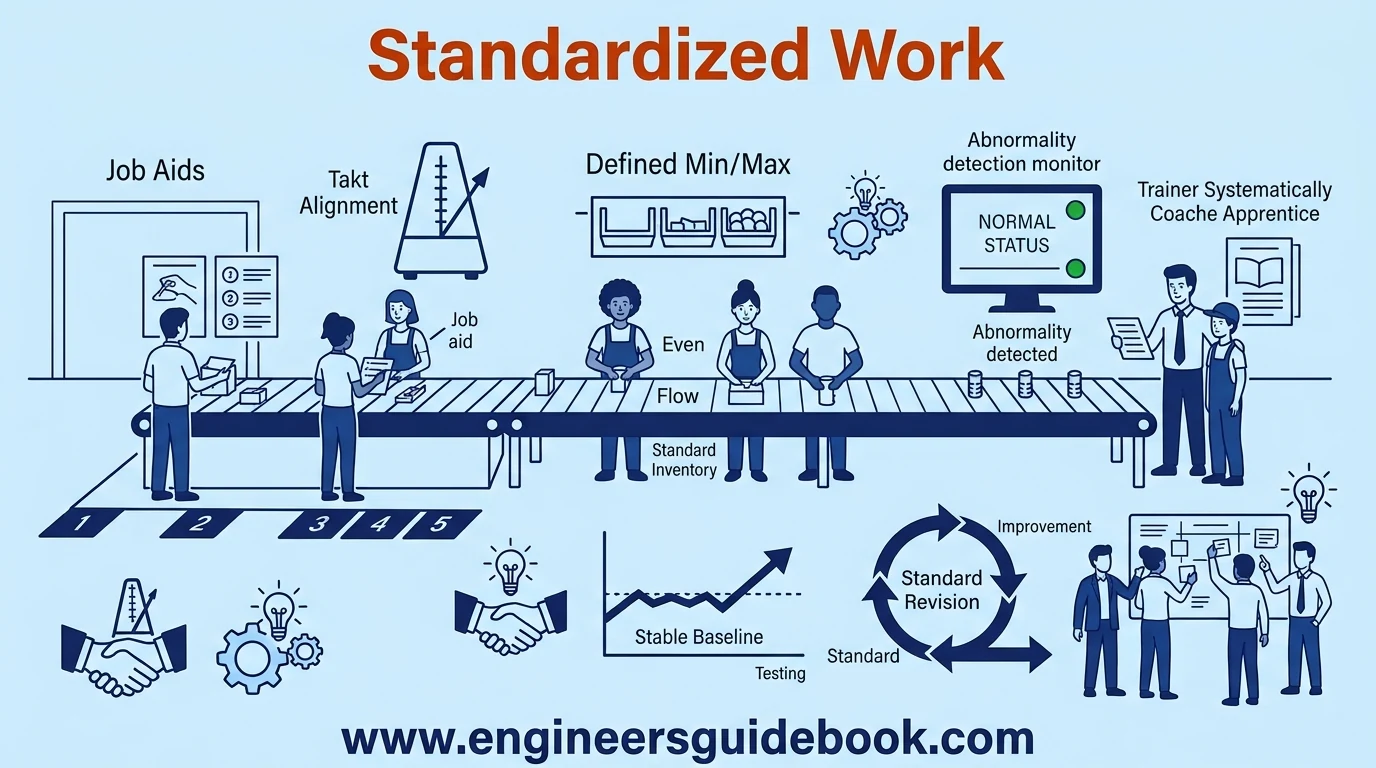
7. Standardized Work
7.1 Work Sequence
Work sequence specifies the safest and most efficient order in which tasks should be performed.
7.2 Takt Alignment
Standardized work aligns task duration with takt time so production matches customer demand.
7.3 Standard Inventory
Standard inventory defines the minimum work in process required to maintain uninterrupted, controlled flow.
7.4 Work Instructions
Clear instructions document critical steps, quality points, safety precautions, and expected operating conditions.
7.5 Operator Balance
Operator balance distributes work equitably, reducing waiting, bottlenecks, fatigue, and uneven cycle performance.
7.6 Process Consistency
Following agreed methods reduces variation and establishes dependable expectations for output, quality, and timing.
7.7 Abnormality Detection
A defined standard makes deviation visible, allowing teams to identify problems before performance deteriorates further.
7.8 Training Standards
Structured training ensures employees understand task steps, their purpose, and critical controls.
7.9 Improvement Baseline
Standardized work provides the baseline against which proposed improvements can be tested and validated objectively.
7.10 Standard Revision
Standards must evolve whenever a safer, simpler, faster, or more reliable method is proven.
7.11 Employee Participation
Employees who perform the work should help create standards, evaluate changes, and sustain improvements.
8. Kaizen and People
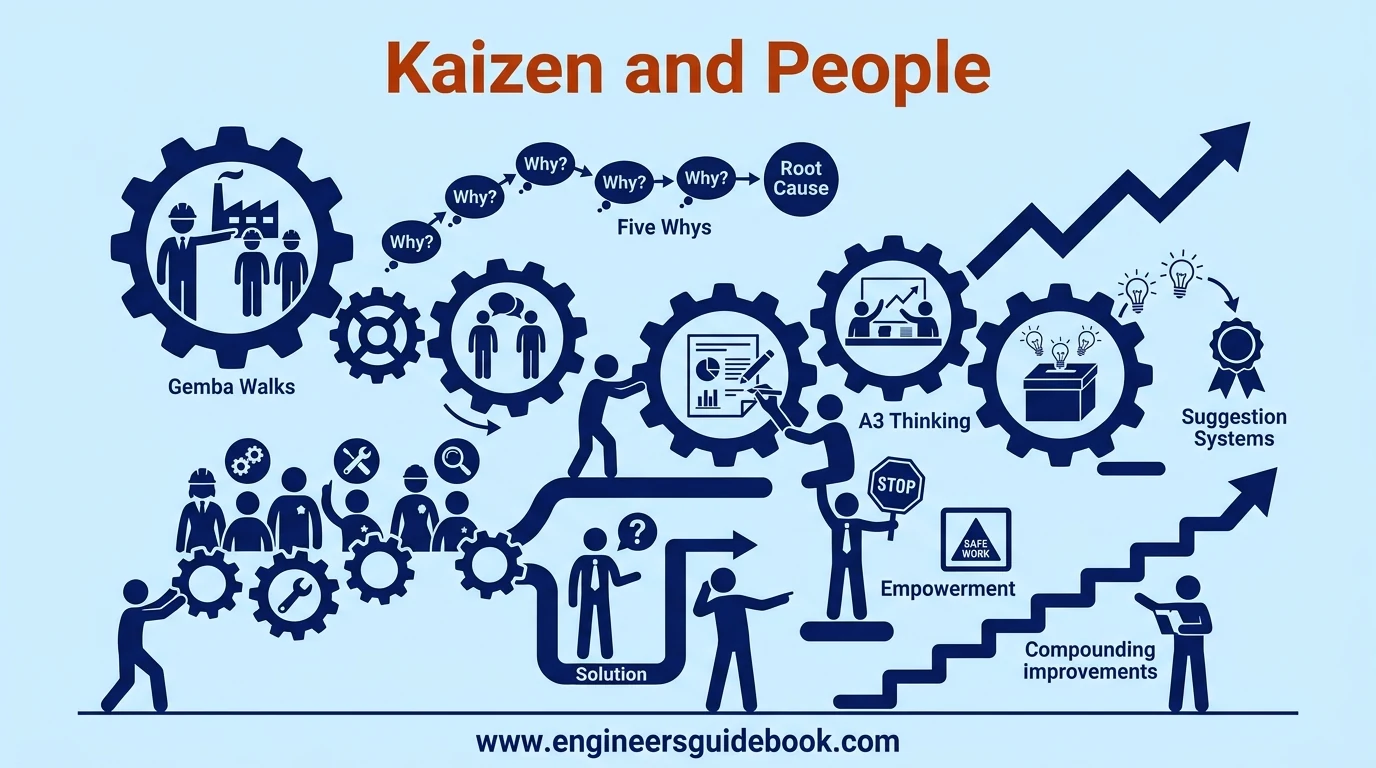
8.1 Kaizen Philosophy
Kaizen advances performance through frequent, practical changes rather than sporadic transformation projects.
8.2 Respect for People
Respect requires safe work, clear expectations, attentive leadership, and meaningful employee involvement.
8.3 Employee Empowerment
Employees receive authority to expose abnormalities, suggest countermeasures, and stop unsafe work.
8.4 Teamwork
Teams coordinate knowledge, workload, and decisions across production, maintenance, quality, and logistics.
8.5 Problem Solving
Structured problem solving defines gaps, investigates causes, tests countermeasures, and verifies results.
8.6 Gemba Walks
Gemba walks place leaders where work occurs, revealing conditions hidden by reports.
8.7 Five Whys
The Five Whys uncovers causal mechanisms by repeatedly questioning why failures occurred.
8.8 A3 Thinking
A3 thinking condenses analysis, targets, countermeasures, ownership, and follow-up into one document.
8.9 Suggestion Systems
Suggestion systems capture frontline ideas and reward useful improvements with prompt recognition.
8.10 Leadership Support
Leaders sustain Kaizen through resources, coaching, consistency, and psychological safety.
8.11 Coaching Culture
Coaching develops independent thinkers by using questions instead of prescribing every answer.
8.12 Cross Functional Collaboration
Cross-functional collaboration prevents local improvements from transferring waste elsewhere.
8.13 Learning Organization
Learning organizations convert experiments, failures, and successes into shared institutional knowledge.
8.14 Daily Improvement
Daily improvement embeds Kaizen in routine work and compounds small gains over time.
9. Waste Elimination
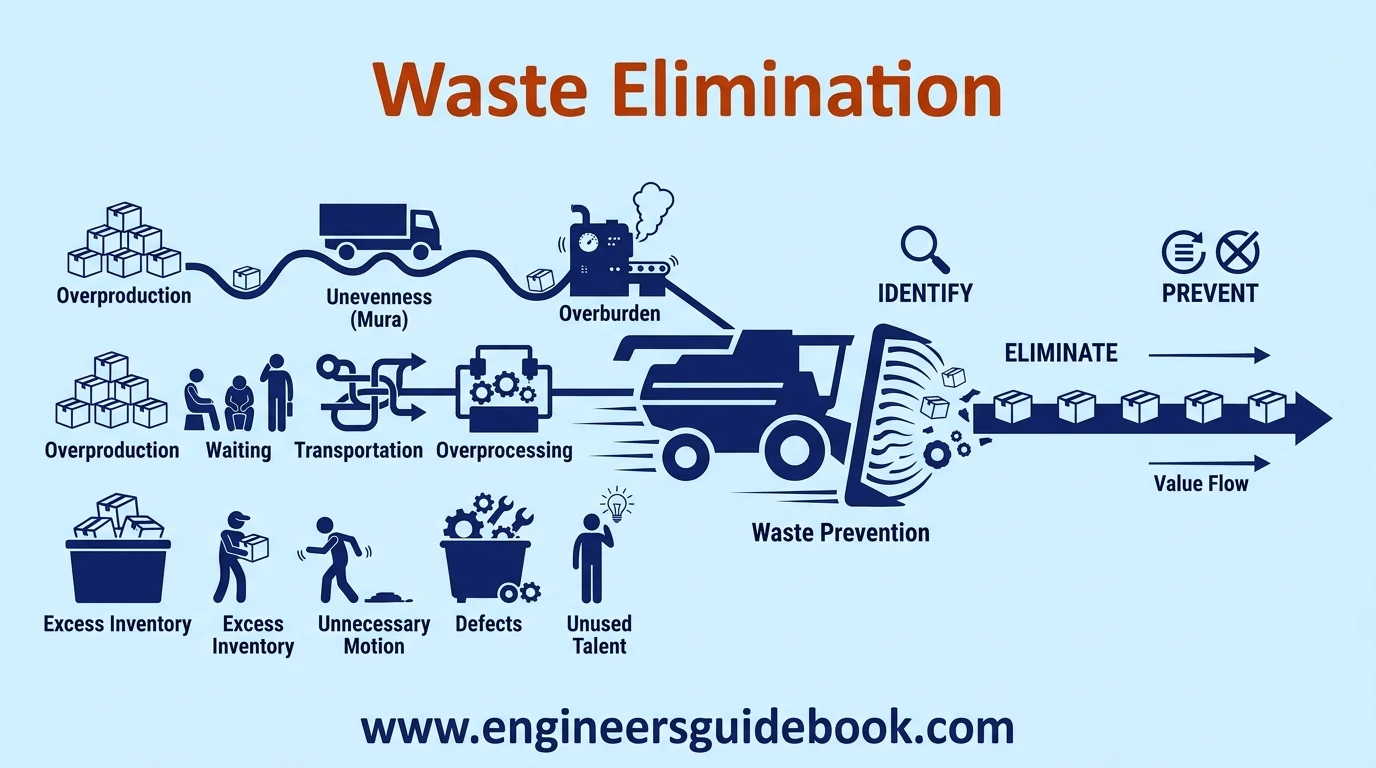
9.1 Muda
Muda is resource consumption that creates no value recognized by the customer.
9.2 Mura
Mura is unevenness in demand, workload, timing, or production output.
9.3 Muri
Muri is overburden that accelerates fatigue, breakdowns, defects, and unsafe behavior.
9.4 Overproduction
Overproduction creates items too early or excessively, generating inventory and hidden problems.
9.5 Waiting
Waiting occurs when people, materials, equipment, or information remain unnecessarily idle.
9.6 Transportation
Unnecessary transportation adds handling, distance, damage exposure, cost, and lead time.
9.7 Overprocessing
Overprocessing includes redundant inspections, excessive finishing, duplicated data, and needless complexity.
9.8 Excess Inventory
Excess inventory consumes cash and space while concealing instability and defects.
9.9 Unnecessary Motion
Poor workplace design causes searching, reaching, walking, bending, and avoidable fatigue.
9.10 Defects
Defects generate scrap, rework, delay, inspection expense, and customer dissatisfaction.
9.11 Unused Talent
Unused talent wastes employee knowledge, creativity, experience, and improvement potential.
9.12 Waste Identification
Teams identify waste through observation, data, employee insight, and customer-value analysis.
9.13 Value Stream Mapping
Value stream mapping reveals delays, inventories, disconnected processes, and information bottlenecks.
9.14 Waste Prevention
Standards, leveling, maintenance, visual controls, and mistake-proofing prevent waste recurrence.
10. TPS House Integration
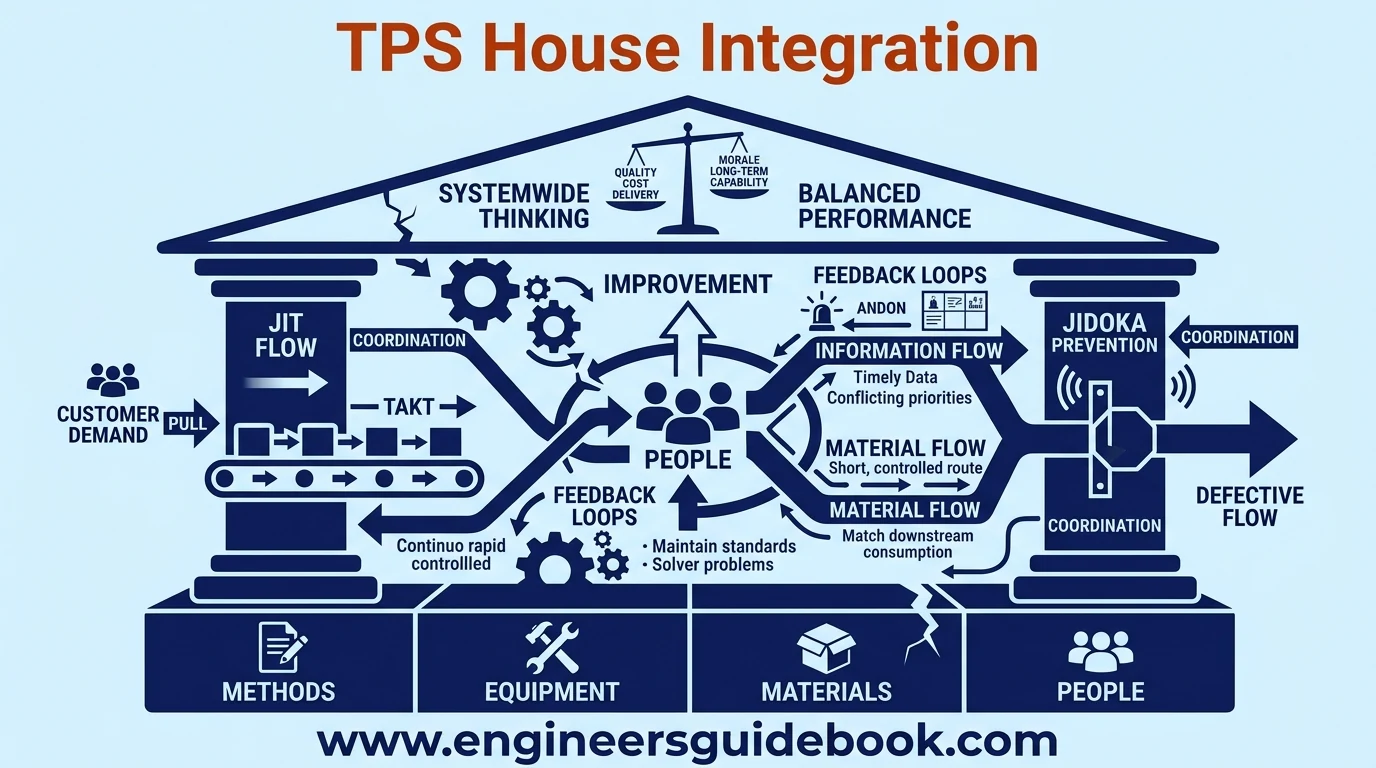
10.1 Pillar Coordination
Just in Time controls flow while Jidoka prevents defective flow from continuing.
10.2 Foundation Support
Stable methods, equipment, materials, and people support both TPS pillars.
10.3 Quality and Flow
Quality protects flow, while faster flow exposes abnormalities and shortens feedback cycles.
10.4 People and Processes
People maintain standards, recognize deviations, solve problems, and improve processes.
10.5 Stability and Improvement
Stability establishes a baseline; improvement raises it without creating operational confusion.
10.6 Customer Demand Connection
Customer demand determines takt, priorities, production mix, and replenishment requirements.
10.7 Information Flow
Accurate, timely information prevents conflicting priorities, shortages, congestion, and schedule disruption.
10.8 Material Flow
Materials should follow short, controlled routes in quantities matching downstream consumption.
10.9 Feedback Loops
Andon, meetings, checks, and visual boards provide rapid corrective feedback.
10.10 Systemwide Thinking
Systemwide thinking optimizes total value flow rather than isolated departmental efficiency.
10.11 Weak Link Effects
One weak element can destabilize quality, flow, delivery, safety, and improvement.
10.12 Balanced Performance
TPS balances quality, cost, delivery, safety, morale, and long-term capability.
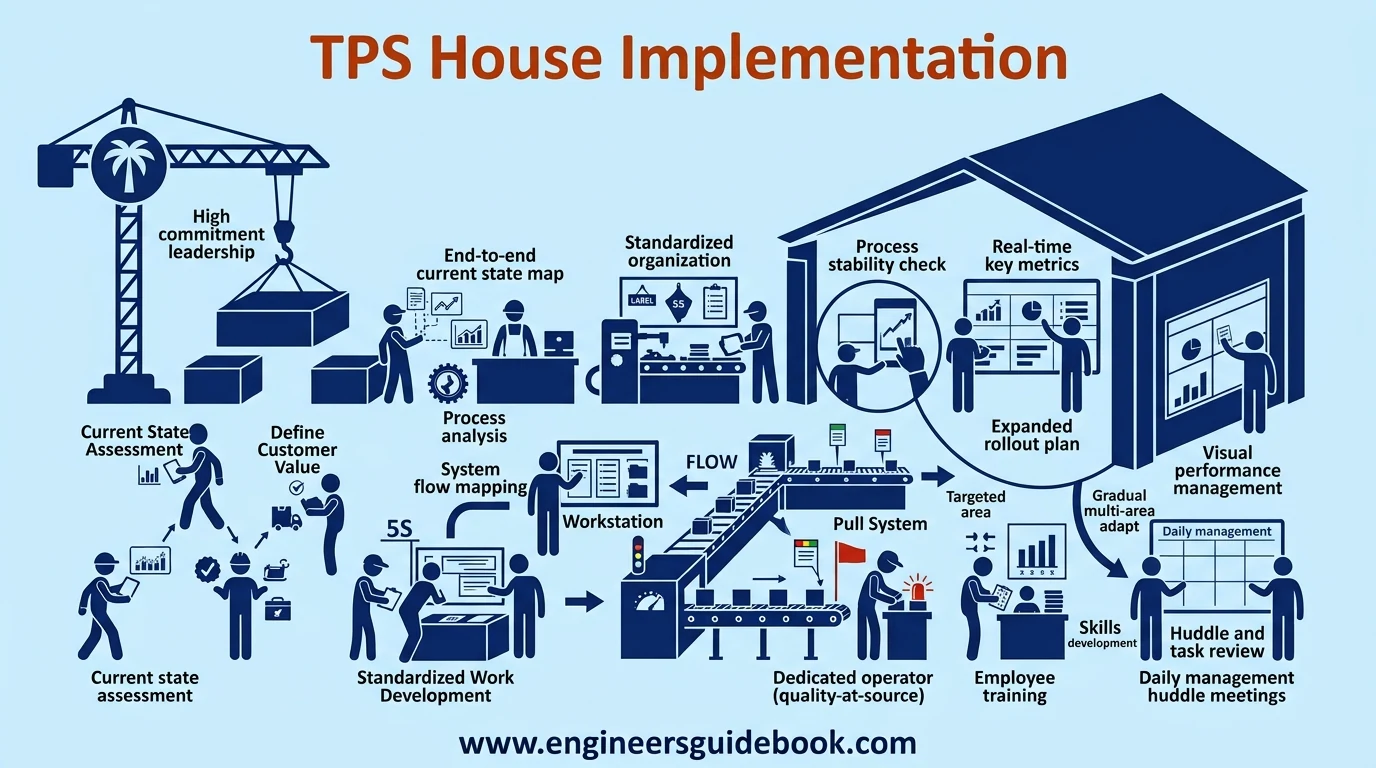
11. TPS House Implementation
11.1 Leadership Commitment
Leaders must model long-term thinking, workplace presence, consistency, and disciplined follow-through.
11.2 Current State Assessment
Assess actual defects, delays, inventories, skills, workload, and equipment reliability.
11.3 Customer Value Definition
Define value through required function, quality, delivery, service, and acceptable cost.
11.4 Value Stream Selection
Select a manageable product family or service stream for concentrated improvement.
11.5 Process Stabilization
Correct unreliable equipment, materials, staffing, and methods before introducing advanced pull.
11.6 Workplace Organization
Organized workplaces improve safety, visibility, access, cleanliness, and abnormality detection.
11.7 Standardized Work Development
Document task sequence, takt relationship, standard inventory, quality points, and precautions.
11.8 Flow Creation
Rearrange and balance processes to reduce queues, movement, waiting, and handoffs.
11.9 Pull System Introduction
Introduce pull with clear signals, quantities, replenishment rules, and Kanban discipline.
11.10 Quality at Source
Operators verify critical conditions and stop immediately when abnormalities appear.
11.11 Visual Controls
Visual controls communicate standards, status, priorities, ownership, and deviations instantly.
11.12 Employee Training
Training must build task competence, safety awareness, quality ownership, and problem-solving ability.
11.13 Pilot Area Selection
Choose a meaningful but manageable pilot where learning and measurement remain practical.
11.14 Performance Measurement
Measure quality, lead time, productivity, inventory, safety, and employee participation together.
11.15 Daily Management
Daily management reviews abnormalities, assigns actions, escalates barriers, and confirms standards.
11.16 Continuous Expansion
Expand proven practices gradually while adapting methods to each operational context.
11.17 Common Implementation Mistakes
Common mistakes include copying tools, ignoring culture, and pursuing premature cost reduction.
11.18 Cultural Resistance
Participation, transparency, coaching, and credible leadership gradually reduce cultural resistance.
11.19 Long Term Sustainability
Sustainability requires audits, succession, capability development, evolving standards, and persistent leadership.
12. Frequently Asked Questions
12.1 What is the Toyota Production System House?
It is a visual model connecting stability, flow, quality, people, and business outcomes.
12.2 What are the two pillars of the TPS House?
The pillars are Just in Time and Jidoka, representing flow and built-in quality.
12.3 What forms the foundation of the TPS House?
Its foundation includes stability, standardized work, leveling, reliable resources, and capable employees.
12.4 What does the roof of the TPS House represent?
The roof represents quality, low cost, short lead time, safety, morale, and satisfaction.
12.5 Why is Just in Time important in TPS?
It matches production with demand, reduces inventory, and exposes hidden instability.
12.6 How does Jidoka improve product quality?
Jidoka detects abnormalities, stops production, contains defects, and prompts immediate correction.
12.7 What is the role of standardized work in TPS?
It creates consistency, supports training, reveals deviations, and establishes an improvement baseline.
12.8 How does Kaizen support the TPS House?
Kaizen continually strengthens standards, removes waste, and develops employee capability.
12.9 What are Muda Mura and Muri?
Muda means waste, Mura means unevenness, and Muri means overburden.
12.10 How does Kanban fit into the TPS House?
Kanban signals production and replenishment within the Just in Time pillar.
12.11 Why is Heijunka necessary for production stability?
Heijunka levels volume and mix, reducing workload fluctuation and operational turbulence.
12.12 What happens when one part of the TPS House is weak?
A weak element destabilizes connected processes and compromises overall system performance.
12.13 Can the TPS House be used outside manufacturing?
Yes, its principles apply wherever repeatable processes create customer value.
12.14 How can a company begin implementing the TPS House?
Begin by defining value, assessing conditions, stabilizing one process, and developing standards.
12.15 What is the difference between TPS and Lean manufacturing?
TPS is Toyota’s system; Lean broadly adapts its principles across industries.
13. Conclusion
The TPS House integrates stability, synchronized flow, built-in quality, and human development.Every component must reinforce the others; isolated tools cannot sustain excellence.
Customer value directs production priorities, quality expectations, responsiveness, and improvement choices. Quality requires prevention, immediate detection, ownership, containment, and root-cause correction.